CBSE Maths Question of the Day and weekly starter questions
Our own CBSE Maths practice questions as images you can open, save or share: the daily puzzles from the Question of the Day and the weekly lesson starters, by course and week. Each image names the course and topic, and the question text is written out below it.
Question of the Day
The Question of the Day is a three-part multiple-choice puzzle, a new one each day, with hints if you get stuck. These are all the puzzles in the rotation, as images.
CBSE Class 10 Maths
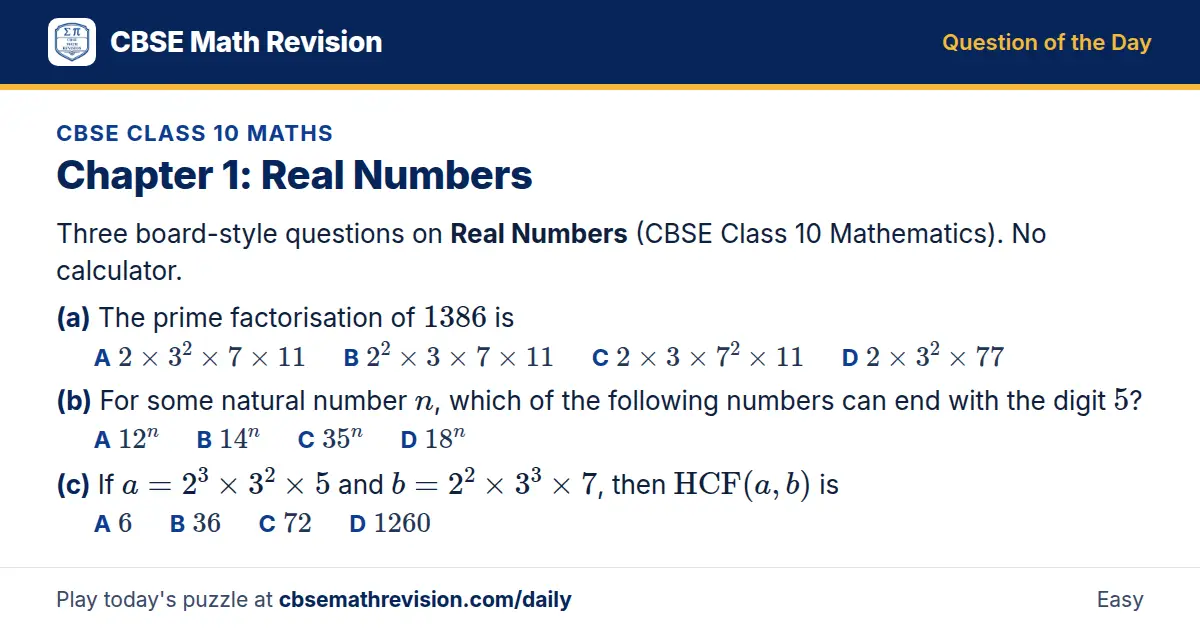
Chapter 1: Real Numbers
Three board-style questions on Real Numbers (CBSE Class 10 Mathematics). No calculator.
- The prime factorisation of 1386 is Options: A) 2 × 3² × 7 × 11; B) 2² × 3 × 7 × 11; C) 2 × 3 × 7² × 11; D) 2 × 3² × 77
- For some natural number n, which of the following numbers can end with the digit 5? Options: A) 12^n; B) 14^n; C) 35^n; D) 18^n
- If a = 2³ × 3² × 5 and b = 2² × 3³ × 7, then HCF(a, b) is Options: A) 6; B) 36; C) 72; D) 1260
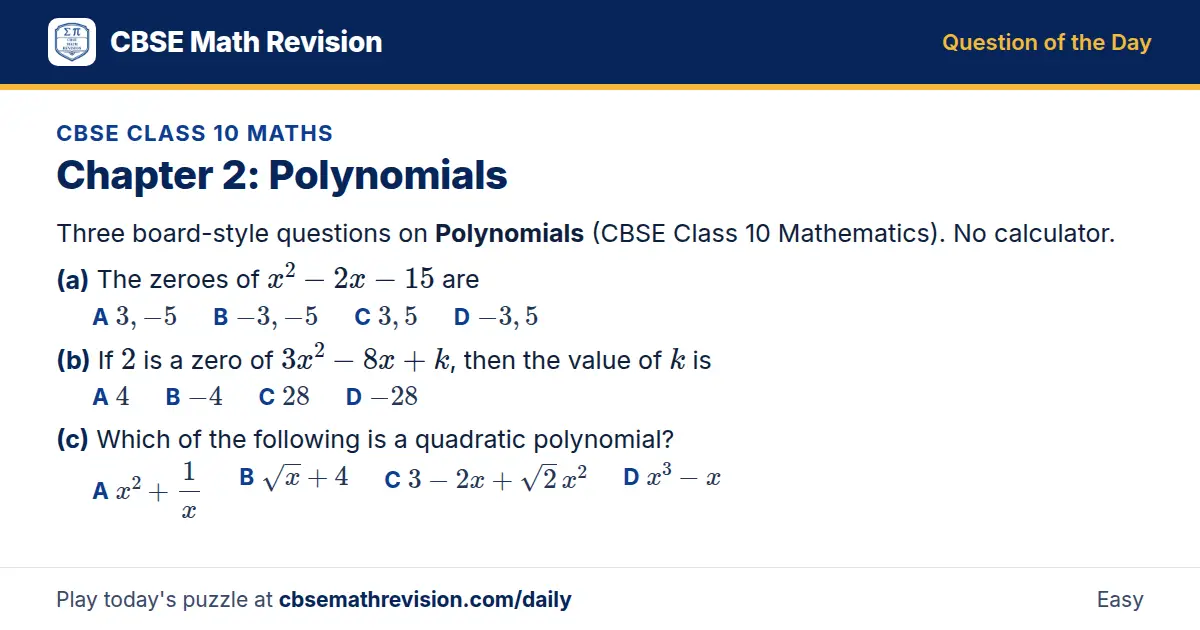
Chapter 2: Polynomials
Three board-style questions on Polynomials (CBSE Class 10 Mathematics). No calculator.
- The zeroes of x² - 2x - 15 are Options: A) 3, -5; B) -3, -5; C) 3, 5; D) -3, 5
- If 2 is a zero of 3x² - 8x + k, then the value of k is Options: A) 4; B) -4; C) 28; D) -28
- Which of the following is a quadratic polynomial? Options: A) x² + 1x; B) √x + 4; C) 3 - 2x + √2 x²; D) x³ - x
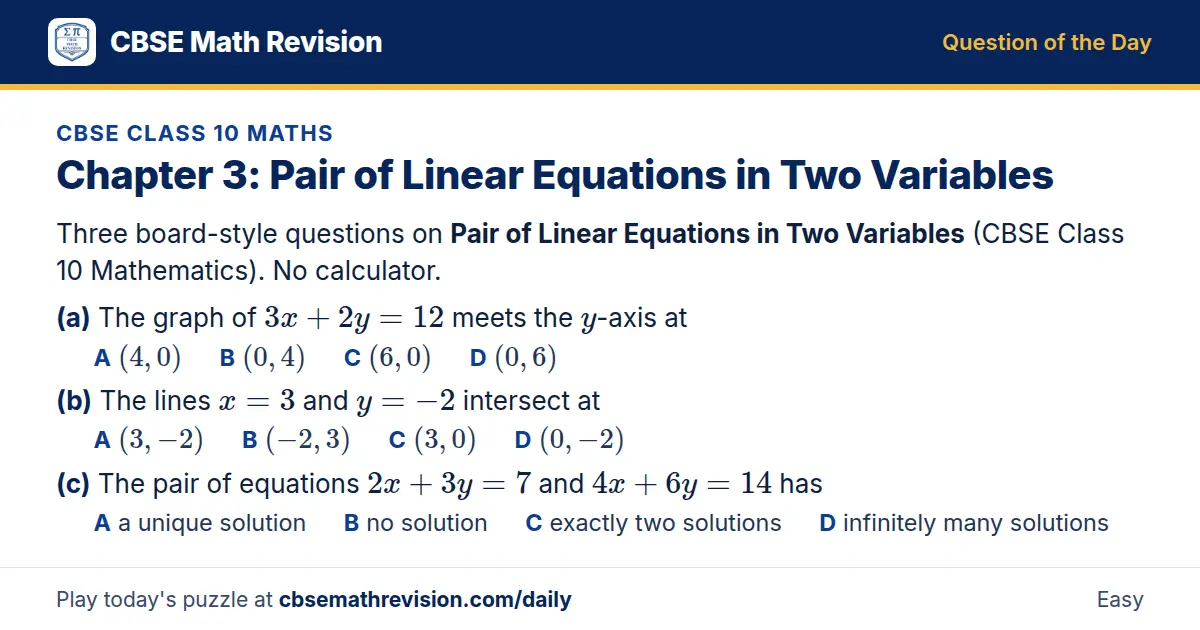
Chapter 3: Pair of Linear Equations in Two Variables
Three board-style questions on Pair of Linear Equations in Two Variables (CBSE Class 10 Mathematics). No calculator.
- The graph of 3x + 2y = 12 meets the y-axis at Options: A) (4, 0); B) (0, 4); C) (6, 0); D) (0, 6)
- The lines x = 3 and y = -2 intersect at Options: A) (3, -2); B) (-2, 3); C) (3, 0); D) (0, -2)
- The pair of equations 2x + 3y = 7 and 4x + 6y = 14 has Options: A) a unique solution; B) no solution; C) exactly two solutions; D) infinitely many solutions
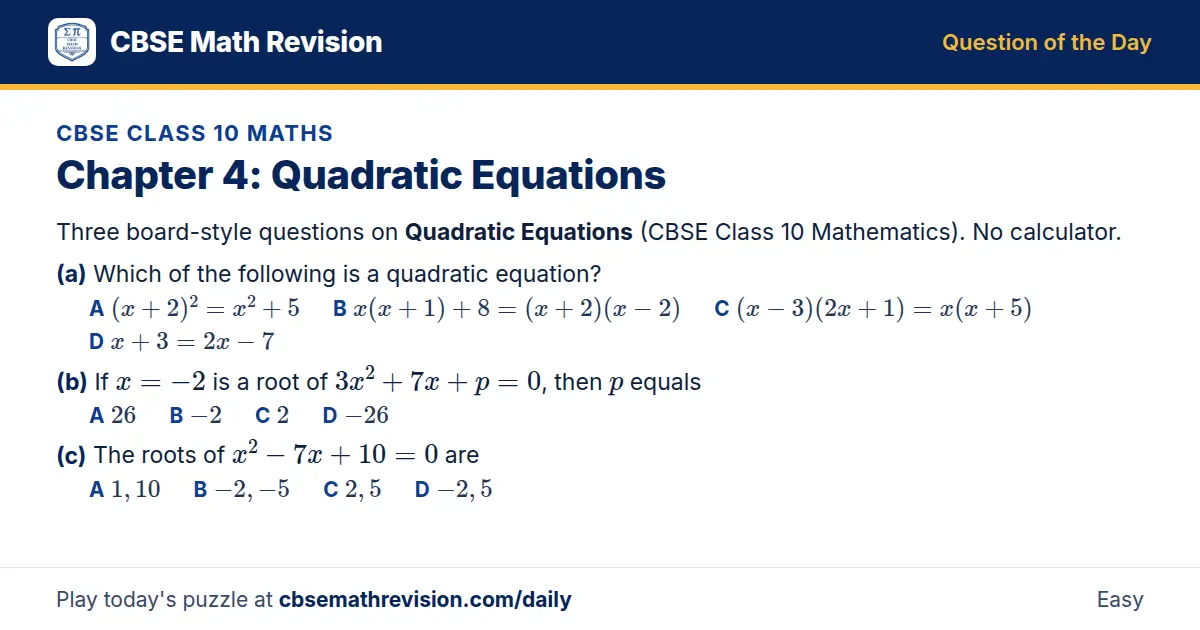
Chapter 4: Quadratic Equations
Three board-style questions on Quadratic Equations (CBSE Class 10 Mathematics). No calculator.
- Which of the following is a quadratic equation? Options: A) (x + 2)² = x² + 5; B) x(x + 1) + 8 = (x + 2)(x - 2); C) (x - 3)(2x + 1) = x(x + 5); D) x + 3 = 2x - 7
- If x = -2 is a root of 3x² + 7x + p = 0, then p equals Options: A) 26; B) -2; C) 2; D) -26
- The roots of x² - 7x + 10 = 0 are Options: A) 1, 10; B) -2, -5; C) 2, 5; D) -2, 5
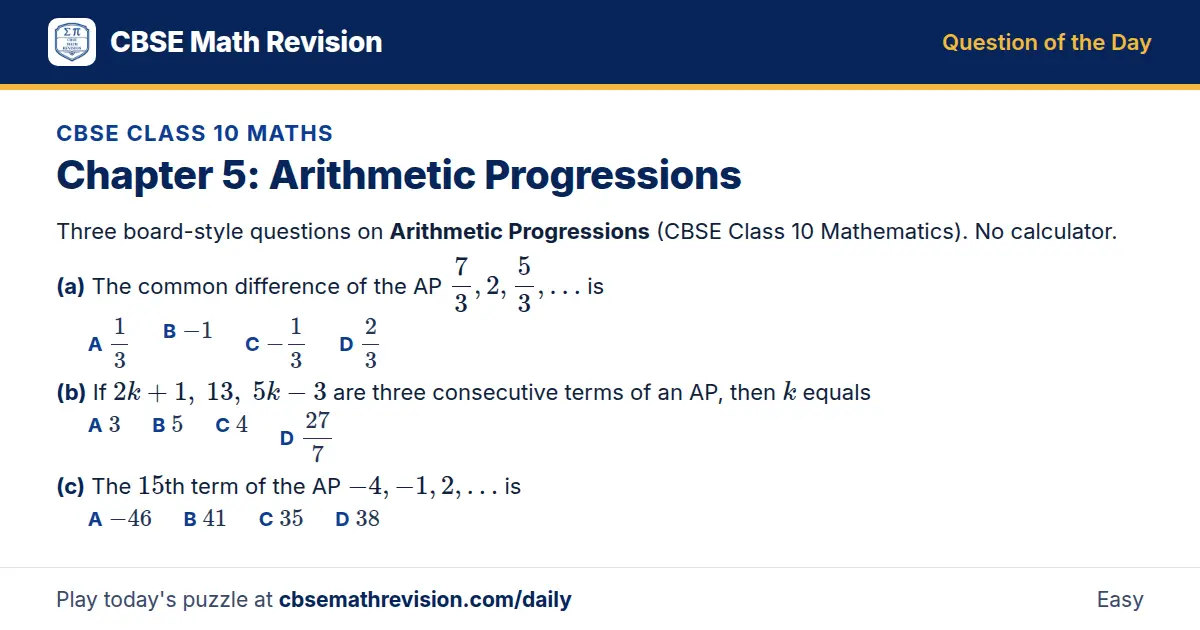
Chapter 5: Arithmetic Progressions
Three board-style questions on Arithmetic Progressions (CBSE Class 10 Mathematics). No calculator.
- The common difference of the AP 73, 2, 53, … is Options: A) 13; B) -1; C) -13; D) 23
- If 2k + 1, 13, 5k - 3 are three consecutive terms of an AP, then k equals Options: A) 3; B) 5; C) 4; D) 27/7
- The 15th term of the AP -4, -1, 2, … is Options: A) -46; B) 41; C) 35; D) 38
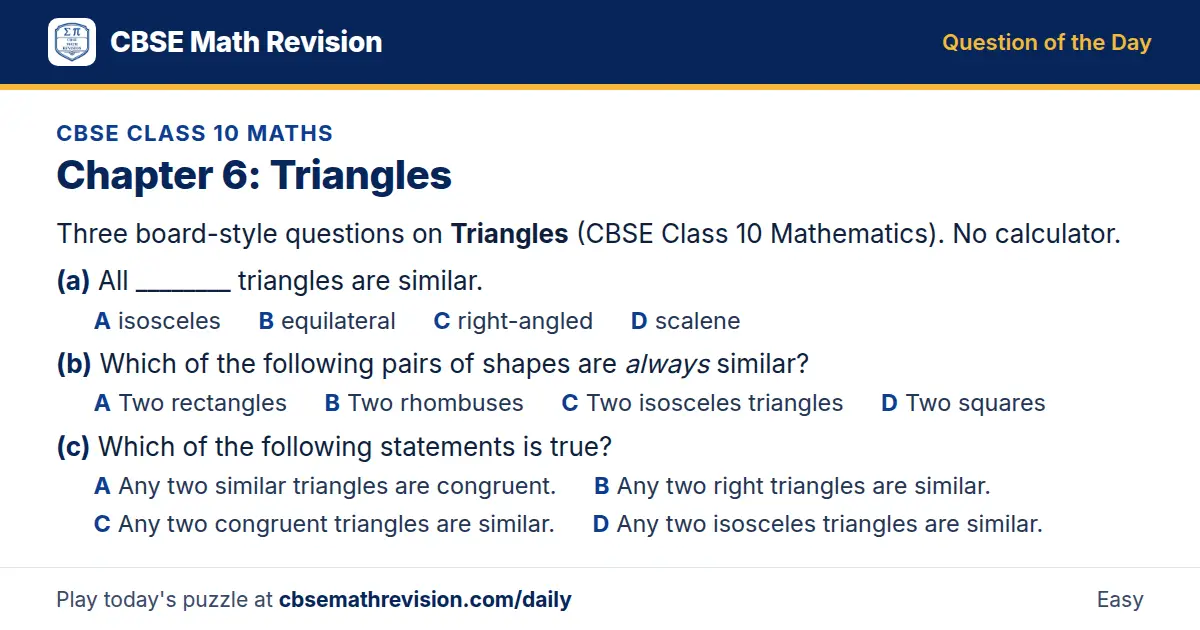
Chapter 6: Triangles
Three board-style questions on Triangles (CBSE Class 10 Mathematics). No calculator.
- All ________ triangles are similar. Options: A) isosceles; B) equilateral; C) right-angled; D) scalene
- Which of the following pairs of shapes are always similar? Options: A) Two rectangles; B) Two rhombuses; C) Two isosceles triangles; D) Two squares
- Which of the following statements is true? Options: A) Any two similar triangles are congruent.; B) Any two right triangles are similar.; C) Any two congruent triangles are similar.; D) Any two isosceles triangles are similar.
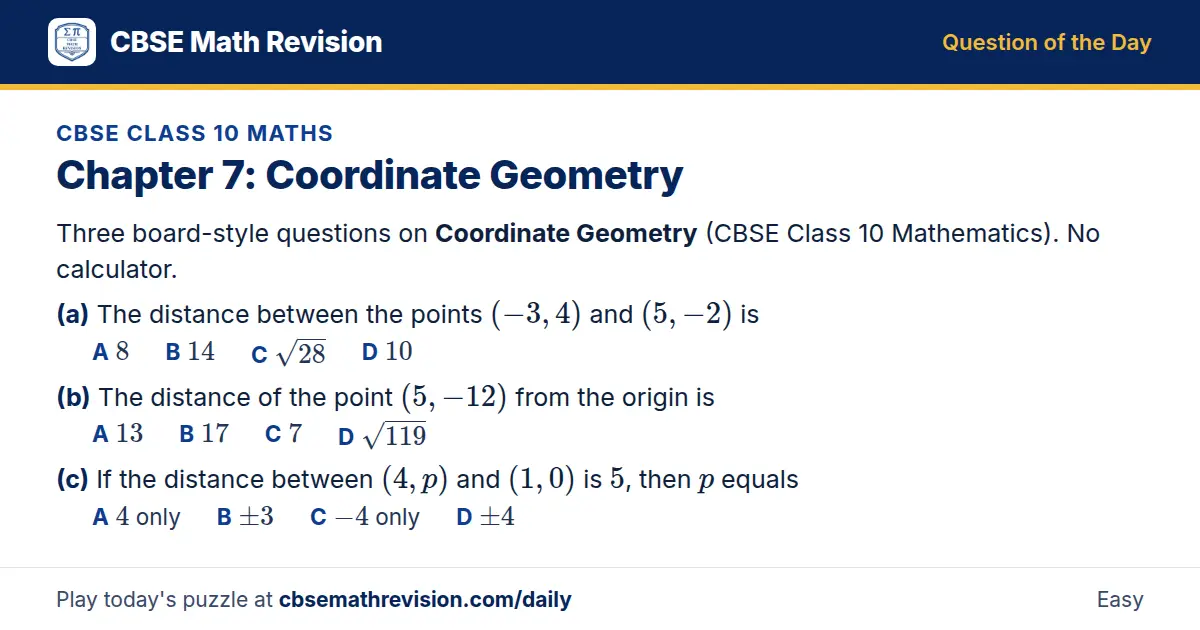
Chapter 7: Coordinate Geometry
Three board-style questions on Coordinate Geometry (CBSE Class 10 Mathematics). No calculator.
- The distance between the points (-3, 4) and (5, -2) is Options: A) 8; B) 14; C) √28; D) 10
- The distance of the point (5, -12) from the origin is Options: A) 13; B) 17; C) 7; D) √119
- If the distance between (4, p) and (1, 0) is 5, then p equals Options: A) 4 only; B) ± 3; C) -4 only; D) ± 4
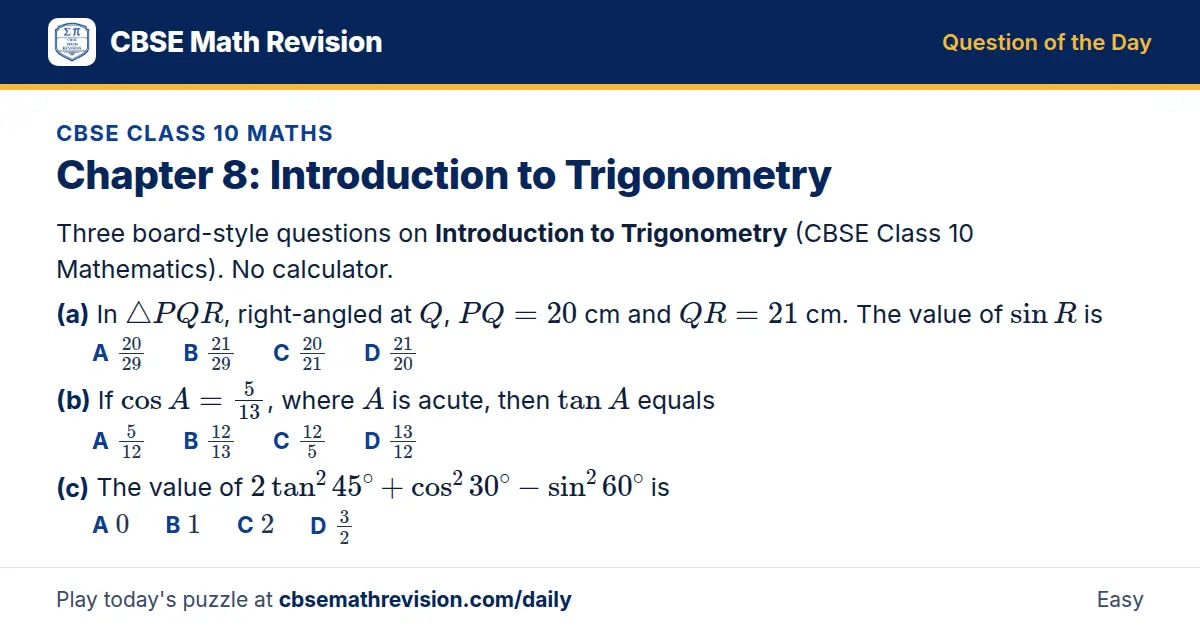
Chapter 8: Introduction to Trigonometry
Three board-style questions on Introduction to Trigonometry (CBSE Class 10 Mathematics). No calculator.
- In △ PQR, right-angled at Q, PQ = 20 cm and QR = 21 cm. The value of sin R is Options: A) 20/29; B) 21/29; C) 20/21; D) 21/20
- If cos A = 5/13, where A is acute, then tan A equals Options: A) 5/12; B) 12/13; C) 12/5; D) 13/12
- The value of 2tan² 45^∘ + cos² 30^∘ - sin² 60^∘ is Options: A) 0; B) 1; C) 2; D) 3/2
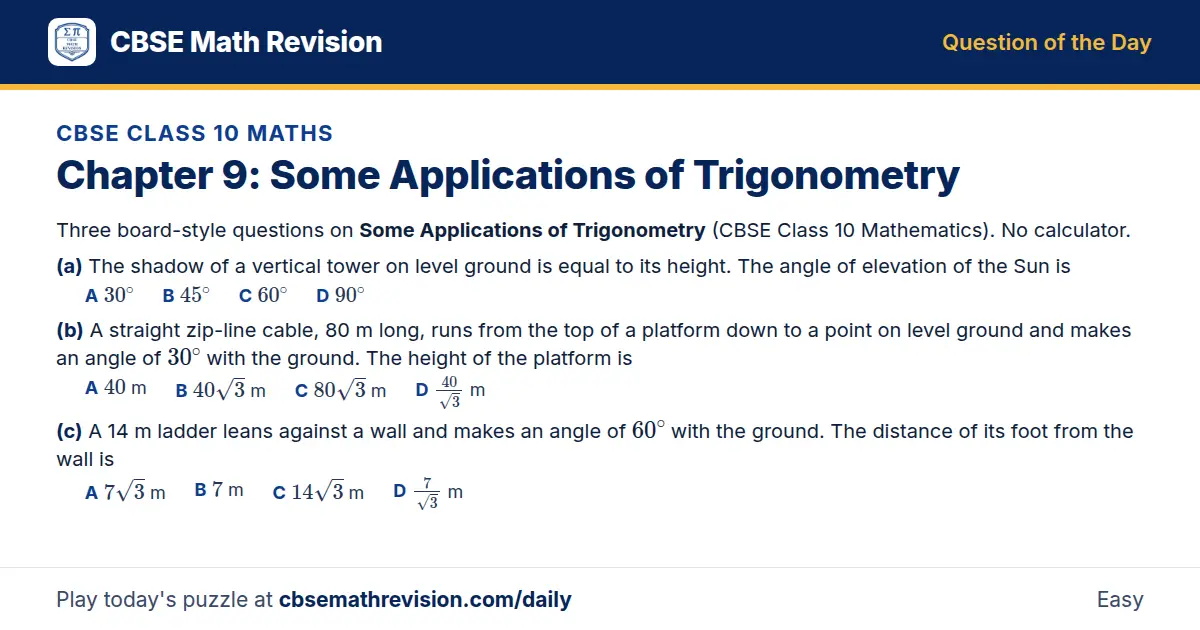
Chapter 9: Some Applications of Trigonometry
Three board-style questions on Some Applications of Trigonometry (CBSE Class 10 Mathematics). No calculator.
- The shadow of a vertical tower on level ground is equal to its height. The angle of elevation of the Sun is Options: A) 30^∘; B) 45^∘; C) 60^∘; D) 90^∘
- A straight zip-line cable, 80 m long, runs from the top of a platform down to a point on level ground and makes an angle of 30^∘ with the ground. The height of the platform is Options: A) 40 m; B) 40√3 m; C) 80√3 m; D) 40/(√3) m
- A 14 m ladder leans against a wall and makes an angle of 60^∘ with the ground. The distance of its foot from the wall is Options: A) 7√3 m; B) 7 m; C) 14√3 m; D) 7/(√3) m
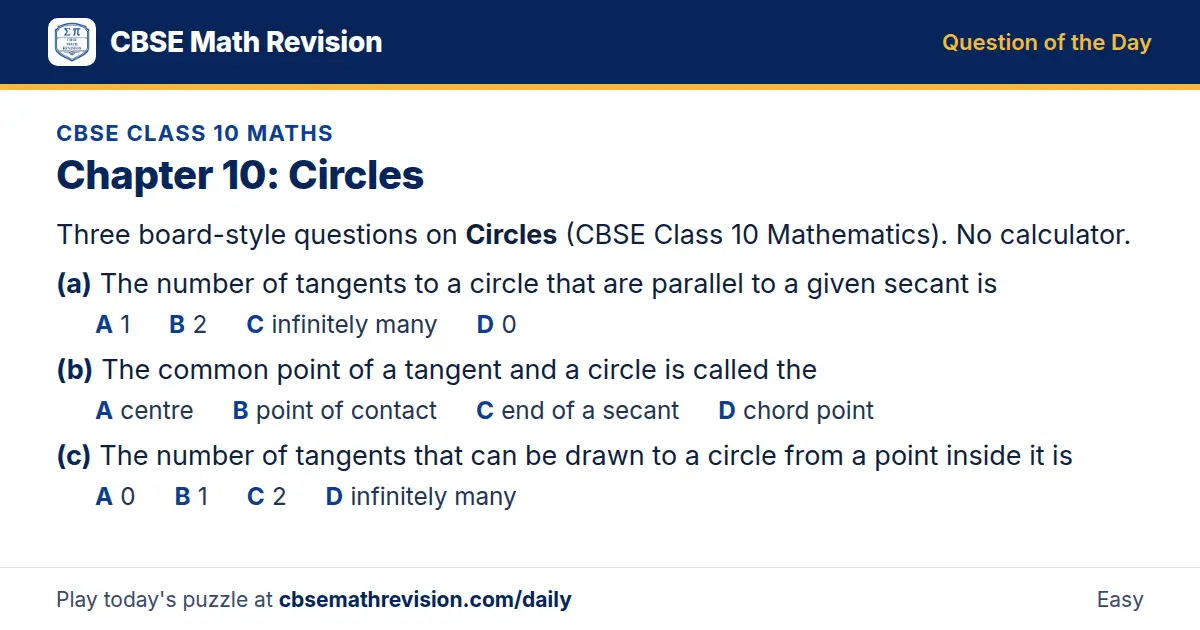
Chapter 10: Circles
Three board-style questions on Circles (CBSE Class 10 Mathematics). No calculator.
- The number of tangents to a circle that are parallel to a given secant is Options: A) 1; B) 2; C) infinitely many; D) 0
- The common point of a tangent and a circle is called the Options: A) centre; B) point of contact; C) end of a secant; D) chord point
- The number of tangents that can be drawn to a circle from a point inside it is Options: A) 0; B) 1; C) 2; D) infinitely many
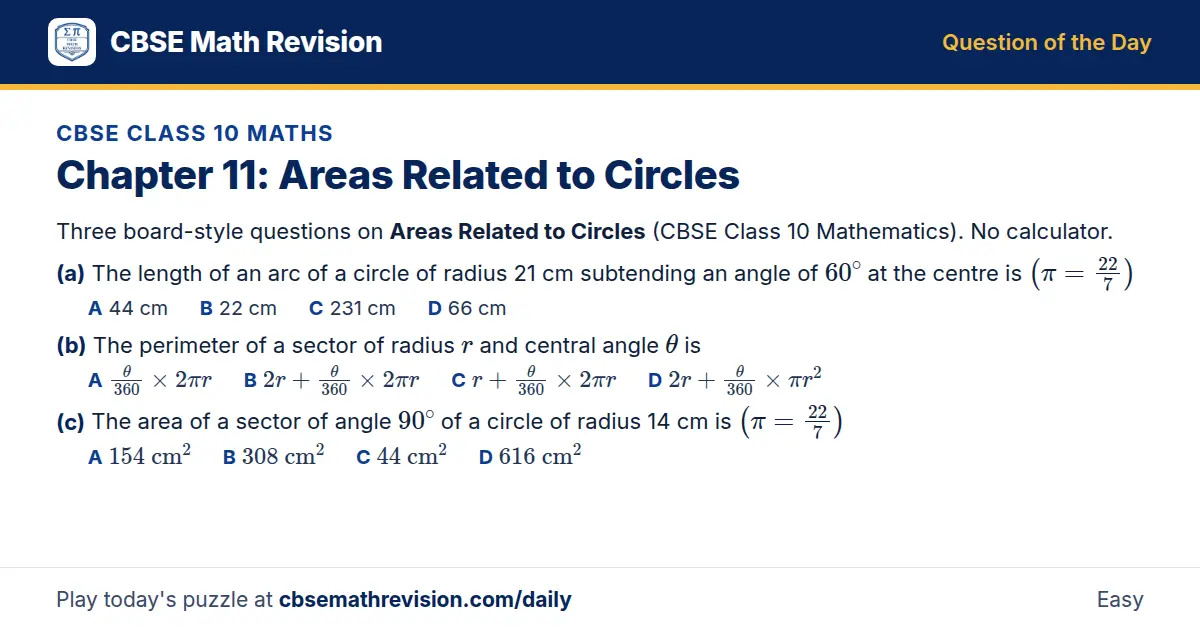
Chapter 11: Areas Related to Circles
Three board-style questions on Areas Related to Circles (CBSE Class 10 Mathematics). No calculator.
- The length of an arc of a circle of radius 21 cm subtending an angle of 60^∘ at the centre is (π=22/7) Options: A) 44 cm; B) 22 cm; C) 231 cm; D) 66 cm
- The perimeter of a sector of radius r and central angle θ is Options: A) (θ)/360×2π r; B) 2r+(θ)/360×2π r; C) r+(θ)/360×2π r; D) 2r+(θ)/360×π r²
- The area of a sector of angle 90^∘ of a circle of radius 14 cm is (π=22/7) Options: A) 154 cm²; B) 308 cm²; C) 44 cm²; D) 616 cm²
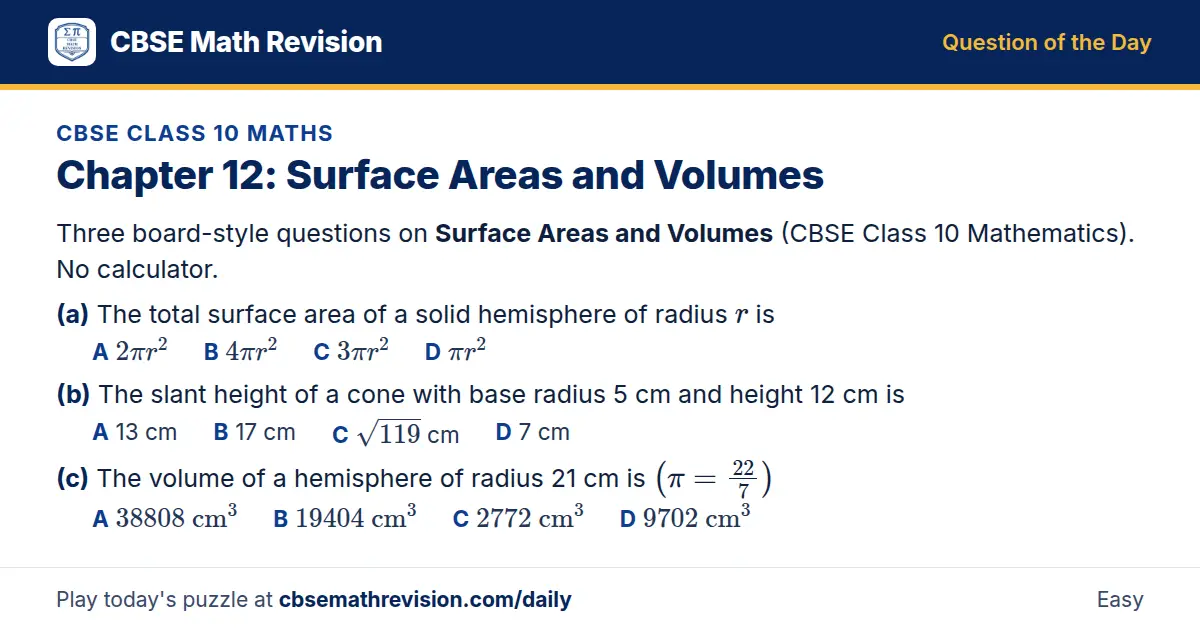
Chapter 12: Surface Areas and Volumes
Three board-style questions on Surface Areas and Volumes (CBSE Class 10 Mathematics). No calculator.
- The total surface area of a solid hemisphere of radius r is Options: A) 2π r²; B) 4π r²; C) 3π r²; D) π r²
- The slant height of a cone with base radius 5 cm and height 12 cm is Options: A) 13 cm; B) 17 cm; C) √119 cm; D) 7 cm
- The volume of a hemisphere of radius 21 cm is (π=22/7) Options: A) 38808 cm³; B) 19404 cm³; C) 2772 cm³; D) 9702 cm³
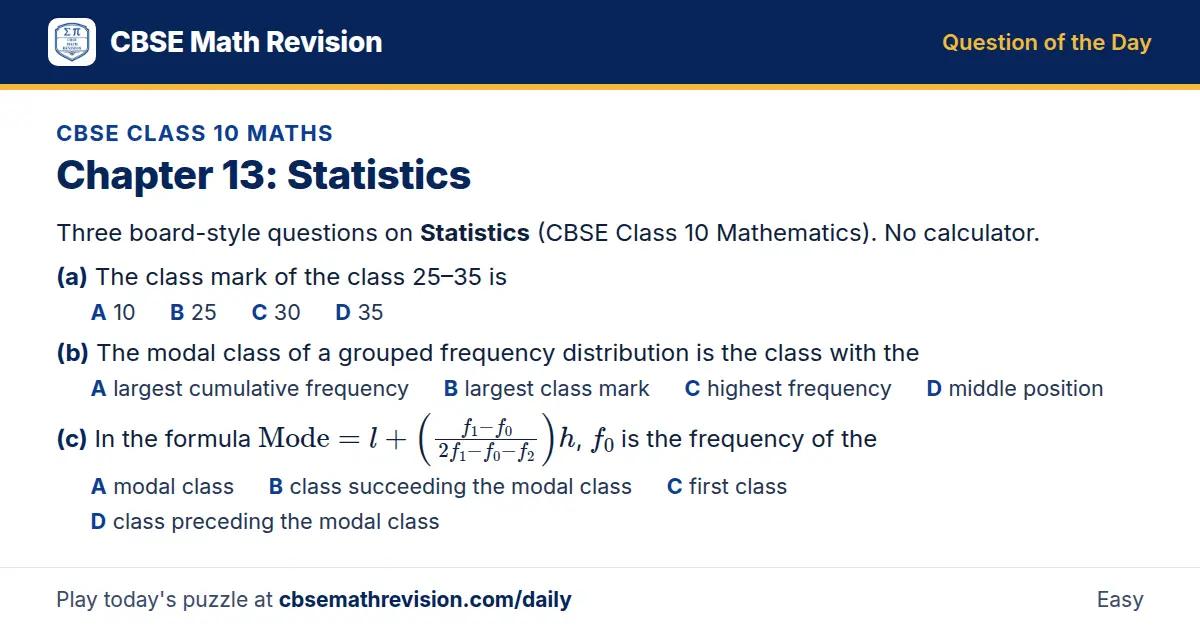
Chapter 13: Statistics
Three board-style questions on Statistics (CBSE Class 10 Mathematics). No calculator.
- The class mark of the class 25–35 is Options: A) 10; B) 25; C) 30; D) 35
- The modal class of a grouped frequency distribution is the class with the Options: A) largest cumulative frequency; B) largest class mark; C) highest frequency; D) middle position
- In the formula Mode=l+((f_1-f_0)/(2f_1-f_0-f_2))h, f_0 is the frequency of the Options: A) modal class; B) class succeeding the modal class; C) first class; D) class preceding the modal class
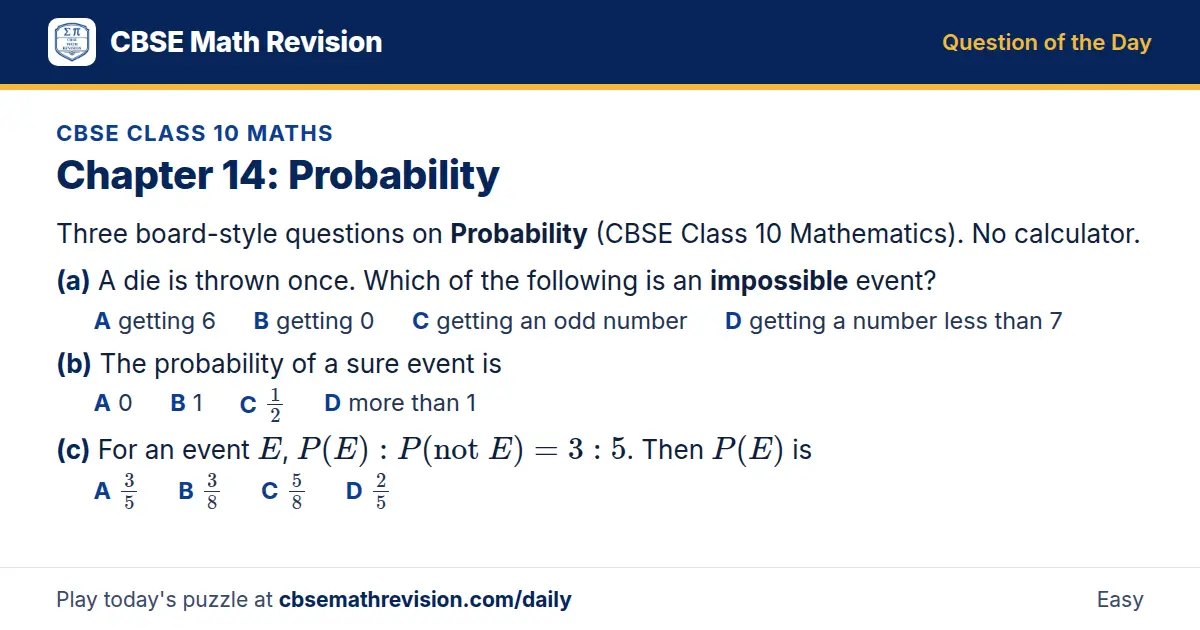
Chapter 14: Probability
Three board-style questions on Probability (CBSE Class 10 Mathematics). No calculator.
- A die is thrown once. Which of the following is an impossible event? Options: A) getting 6; B) getting 0; C) getting an odd number; D) getting a number less than 7
- The probability of a sure event is Options: A) 0; B) 1; C) 12; D) more than 1
- For an event E, P(E): P(not E) = 3: 5. Then P(E) is Options: A) 35; B) 38; C) 58; D) 25
CBSE Class 11 Maths
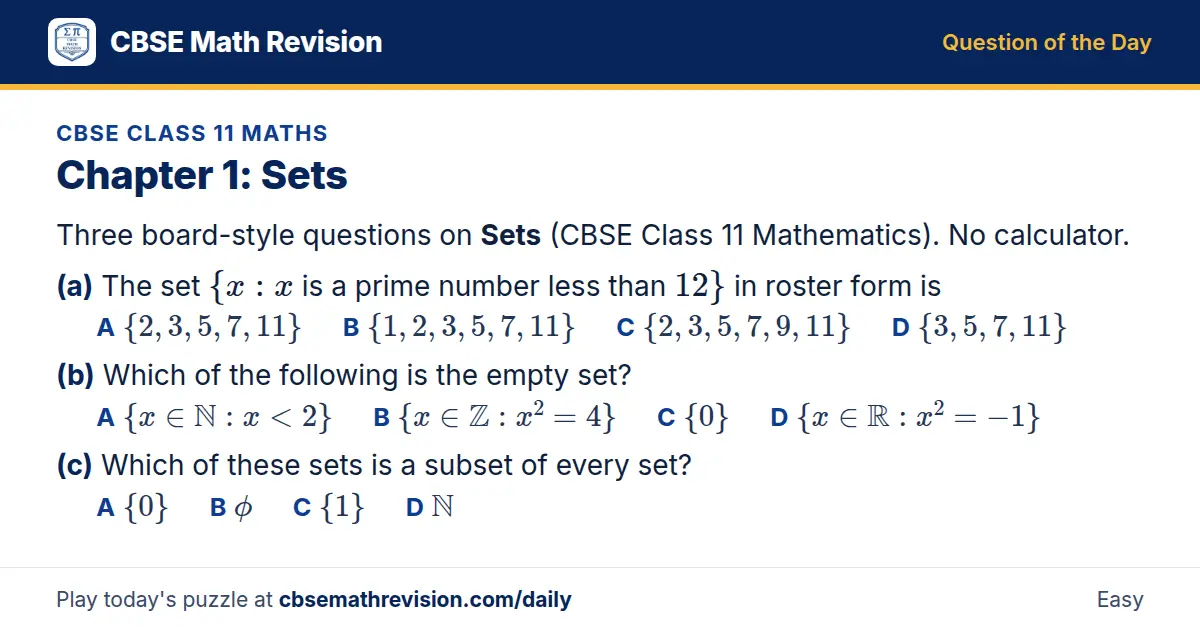
Chapter 1: Sets
Three board-style questions on Sets (CBSE Class 11 Mathematics). No calculator.
- The set x: x is a prime number less than 12 in roster form is Options: A) 2, 3, 5, 7, 11; B) 1, 2, 3, 5, 7, 11; C) 2, 3, 5, 7, 9, 11; D) 3, 5, 7, 11
- Which of the following is the empty set? Options: A) x ∈ ℕ: x < 2; B) x ∈ ℤ: x² = 4; C) 0; D) x ∈ ℝ: x² = -1
- Which of these sets is a subset of every set? Options: A) 0; B) φ; C) 1; D) ℕ
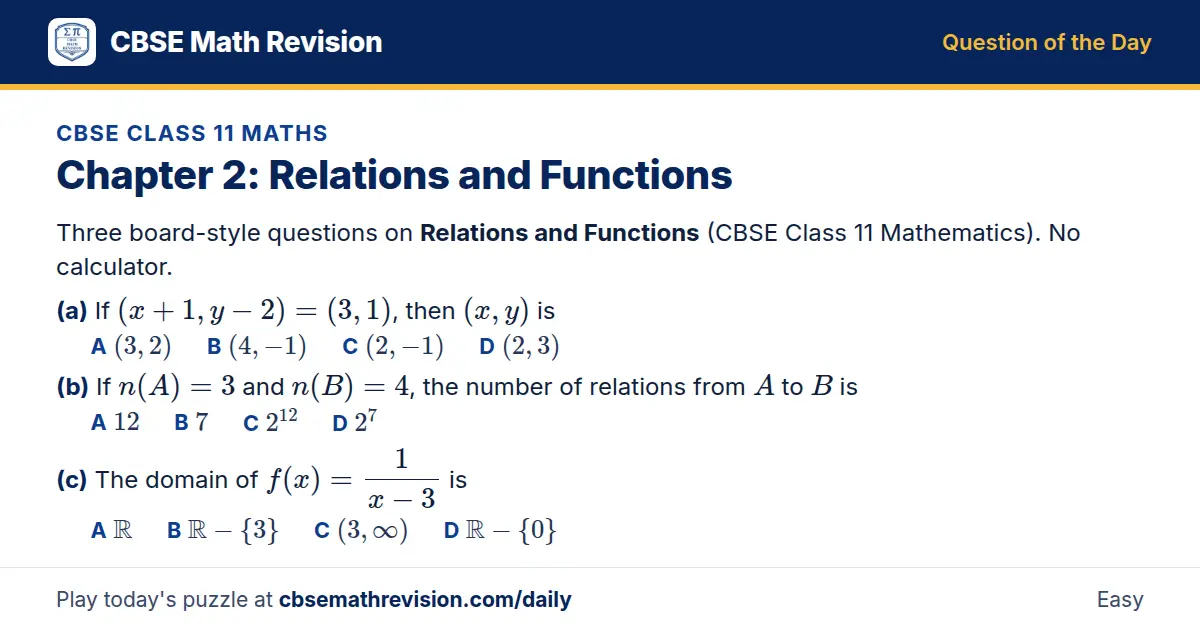
Chapter 2: Relations and Functions
Three board-style questions on Relations and Functions (CBSE Class 11 Mathematics). No calculator.
- If (x + 1, y - 2) = (3, 1), then (x, y) is Options: A) (3, 2); B) (4, -1); C) (2, -1); D) (2, 3)
- If n(A) = 3 and n(B) = 4, the number of relations from A to B is Options: A) 12; B) 7; C) 2¹²; D) 2⁷
- The domain of f(x) = 1/(x - 3) is Options: A) ℝ; B) ℝ - 3; C) (3, ∞); D) ℝ - 0
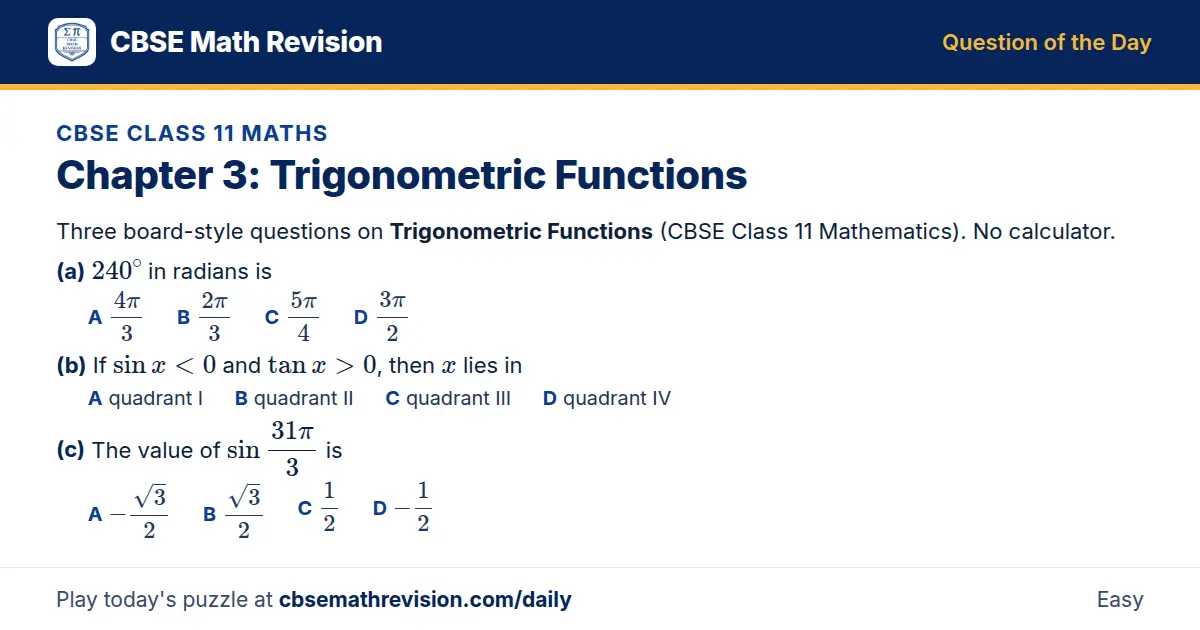
Chapter 3: Trigonometric Functions
Three board-style questions on Trigonometric Functions (CBSE Class 11 Mathematics). No calculator.
- 240^∘ in radians is Options: A) (4π)/3; B) (2π)/3; C) (5π)/4; D) (3π)/2
- If sin x < 0 and tan x > 0, then x lies in Options: A) quadrant I; B) quadrant II; C) quadrant III; D) quadrant IV
- The value of sin(31π)/3 is Options: A) -(√3)/2; B) (√3)/2; C) 12; D) -12
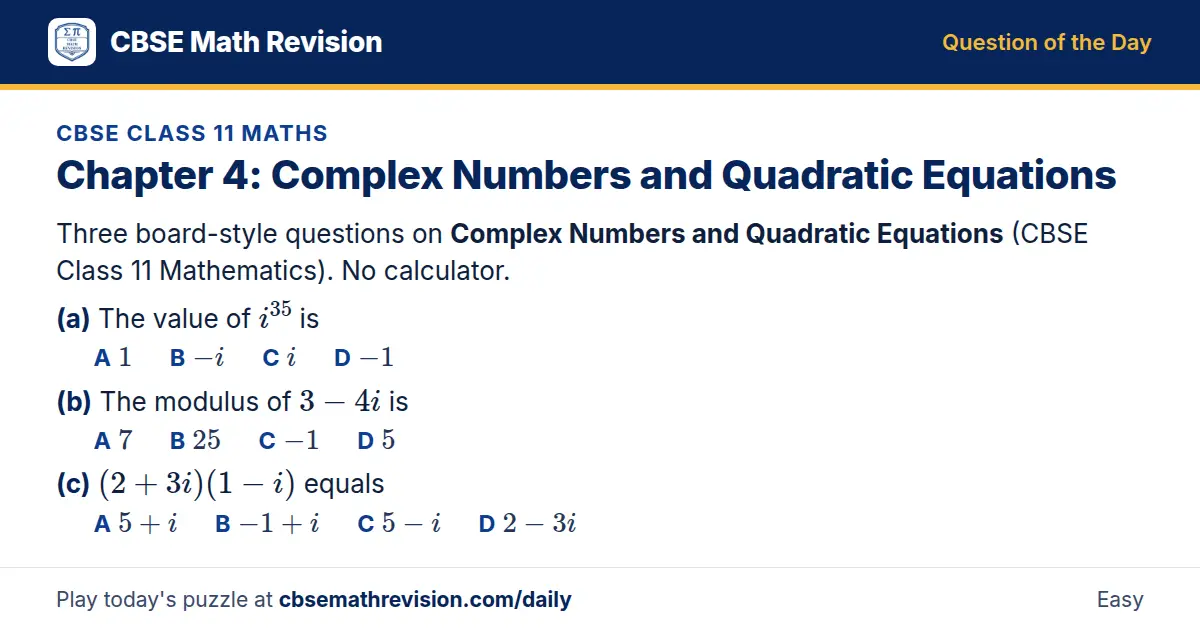
Chapter 4: Complex Numbers and Quadratic Equations
Three board-style questions on Complex Numbers and Quadratic Equations (CBSE Class 11 Mathematics). No calculator.
- The value of i³⁵ is Options: A) 1; B) -i; C) i; D) -1
- The modulus of 3 - 4i is Options: A) 7; B) 25; C) -1; D) 5
- (2 + 3i)(1 - i) equals Options: A) 5 + i; B) -1 + i; C) 5 - i; D) 2 - 3i
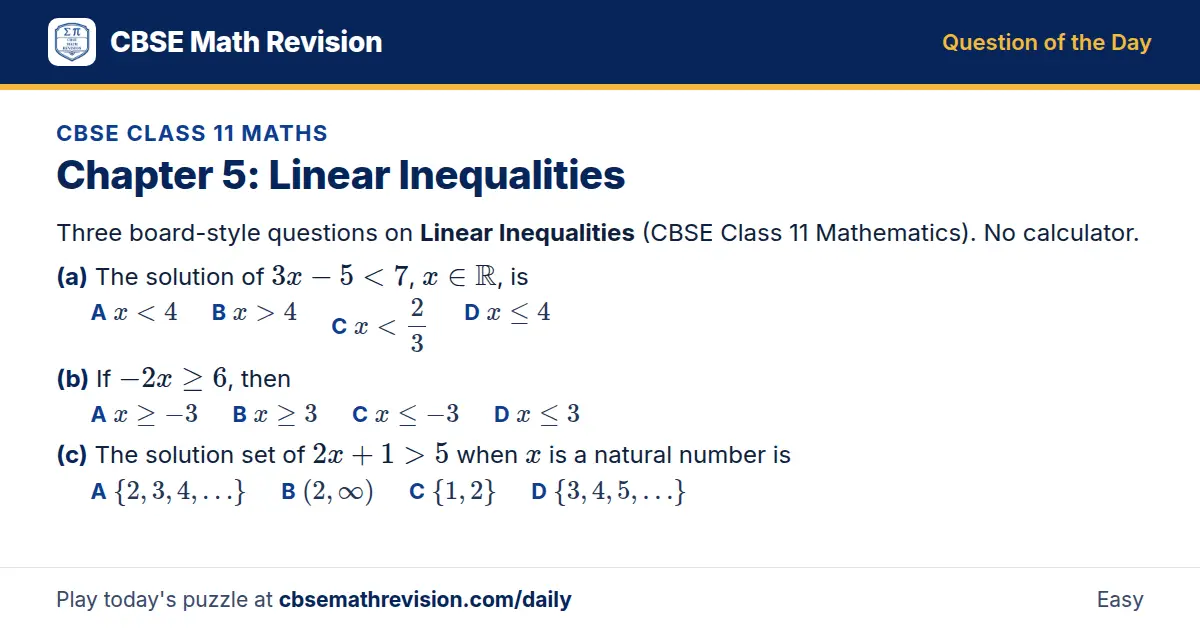
Chapter 5: Linear Inequalities
Three board-style questions on Linear Inequalities (CBSE Class 11 Mathematics). No calculator.
- The solution of 3x - 5 < 7, x ∈ ℝ, is Options: A) x < 4; B) x > 4; C) x < 23; D) x ≤ 4
- If -2x ≥ 6, then Options: A) x ≥ -3; B) x ≥ 3; C) x ≤ -3; D) x ≤ 3
- The solution set of 2x + 1 > 5 when x is a natural number is Options: A) 2, 3, 4, …; B) (2, ∞); C) 1, 2; D) 3, 4, 5, …
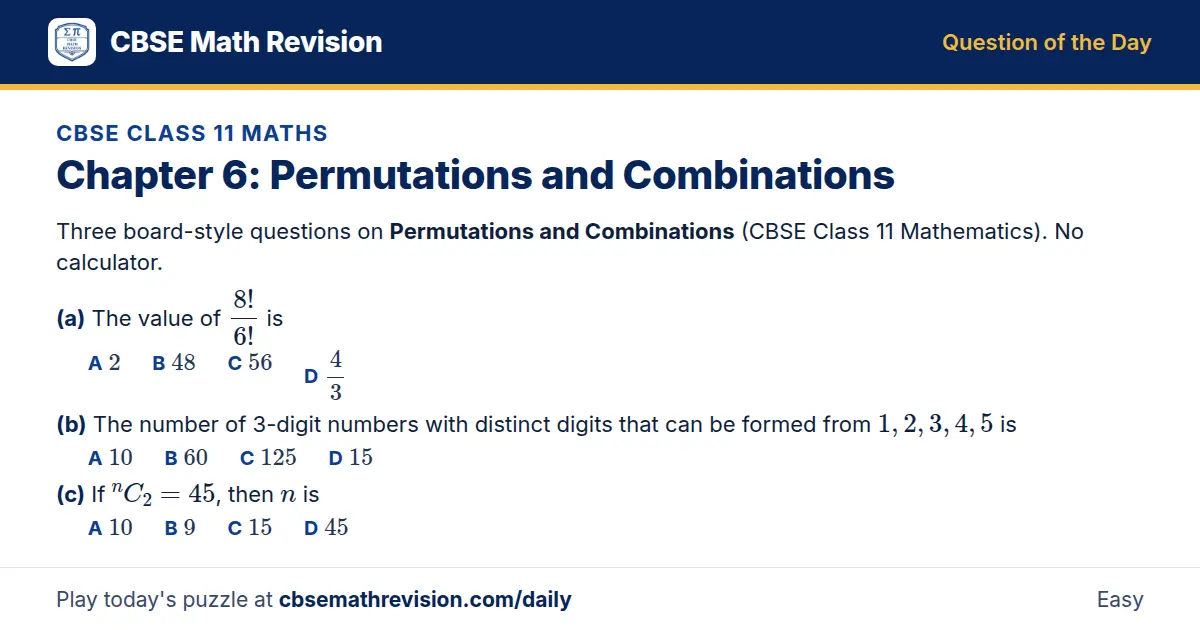
Chapter 6: Permutations and Combinations
Three board-style questions on Permutations and Combinations (CBSE Class 11 Mathematics). No calculator.
- The value of (8!)/(6!) is Options: A) 2; B) 48; C) 56; D) 43
- The number of 3-digit numbers with distinct digits that can be formed from 1, 2, 3, 4, 5 is Options: A) 10; B) 60; C) 125; D) 15
- If ^nC_2 = 45, then n is Options: A) 10; B) 9; C) 15; D) 45
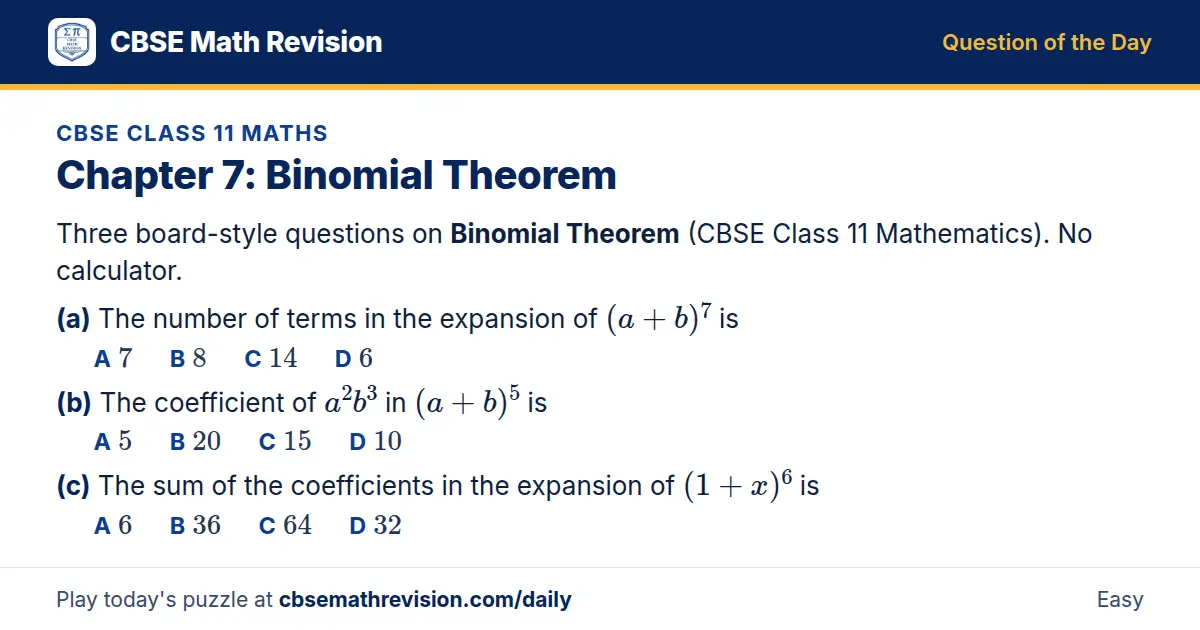
Chapter 7: Binomial Theorem
Three board-style questions on Binomial Theorem (CBSE Class 11 Mathematics). No calculator.
- The number of terms in the expansion of (a + b)⁷ is Options: A) 7; B) 8; C) 14; D) 6
- The coefficient of a²b³ in (a + b)⁵ is Options: A) 5; B) 20; C) 15; D) 10
- The sum of the coefficients in the expansion of (1 + x)⁶ is Options: A) 6; B) 36; C) 64; D) 32
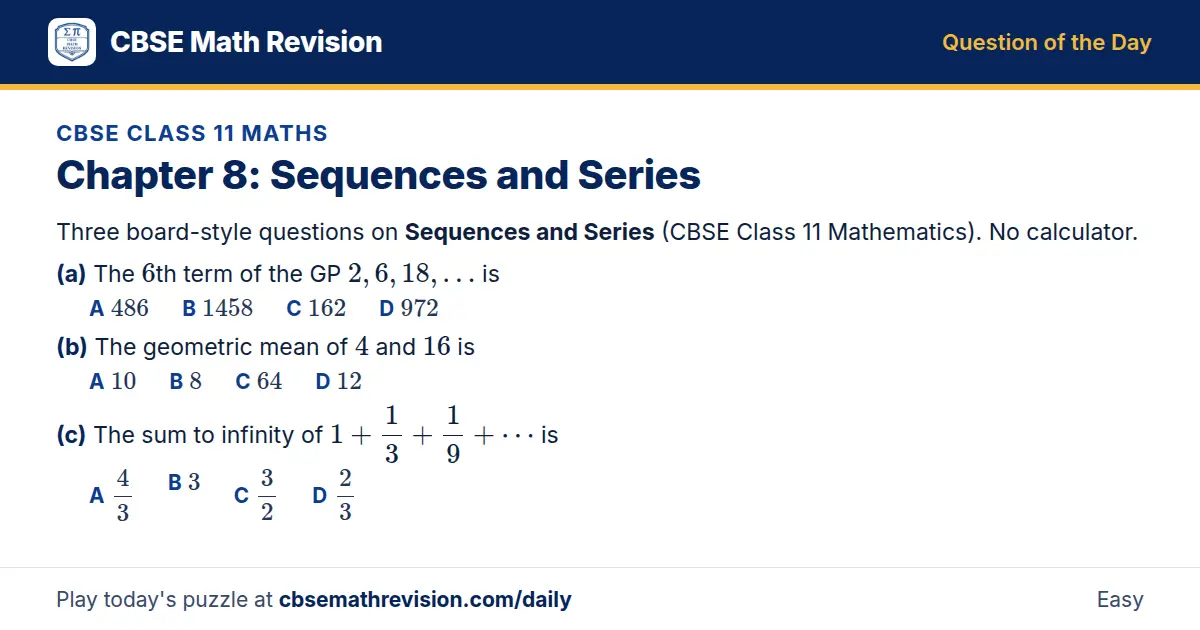
Chapter 8: Sequences and Series
Three board-style questions on Sequences and Series (CBSE Class 11 Mathematics). No calculator.
- The 6th term of the GP 2, 6, 18, … is Options: A) 486; B) 1458; C) 162; D) 972
- The geometric mean of 4 and 16 is Options: A) 10; B) 8; C) 64; D) 12
- The sum to infinity of 1 + 13 + 19 + … is Options: A) 43; B) 3; C) 32; D) 23
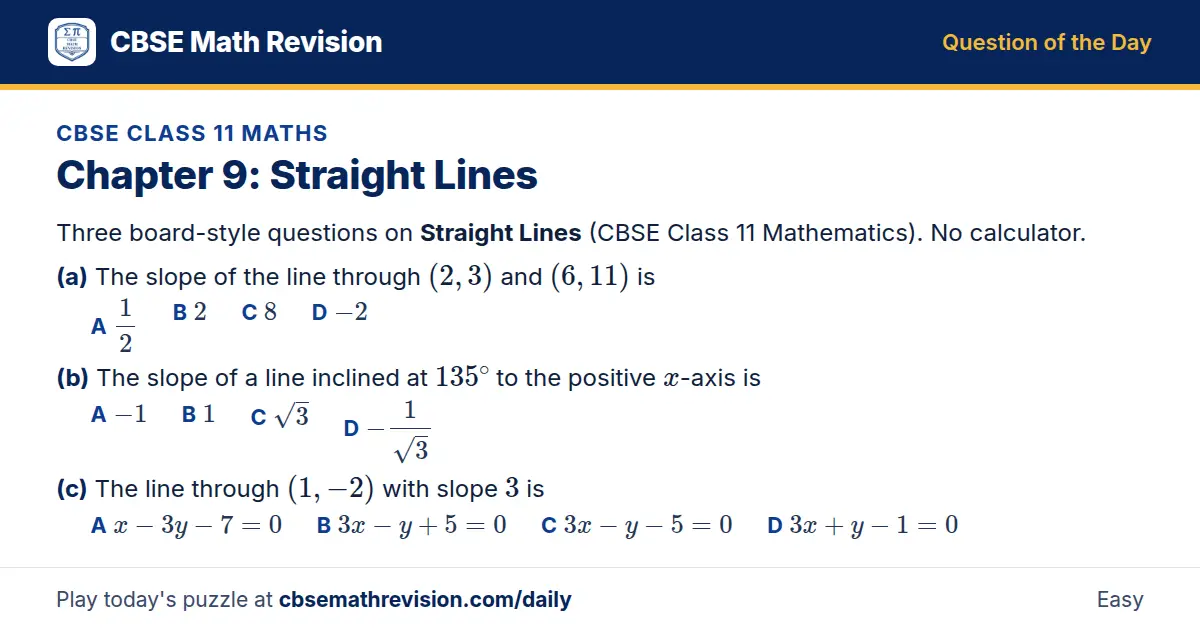
Chapter 9: Straight Lines
Three board-style questions on Straight Lines (CBSE Class 11 Mathematics). No calculator.
- The slope of the line through (2, 3) and (6, 11) is Options: A) 12; B) 2; C) 8; D) -2
- The slope of a line inclined at 135^∘ to the positive x-axis is Options: A) -1; B) 1; C) √3; D) -1/(√3)
- The line through (1, -2) with slope 3 is Options: A) x - 3y - 7 = 0; B) 3x - y + 5 = 0; C) 3x - y - 5 = 0; D) 3x + y - 1 = 0
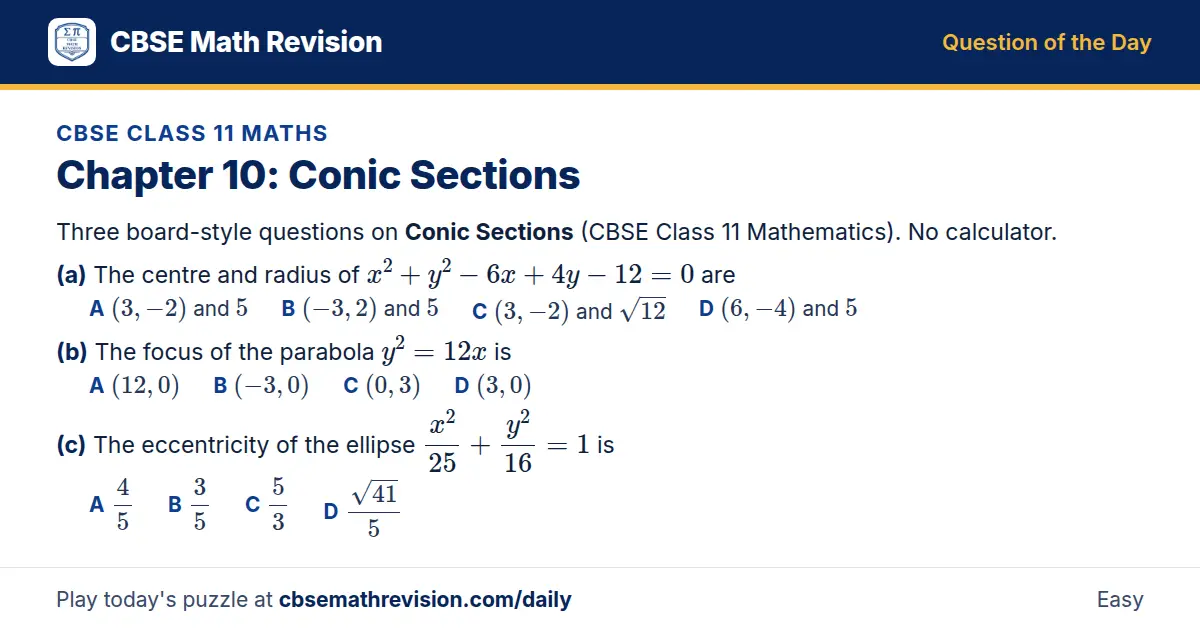
Chapter 10: Conic Sections
Three board-style questions on Conic Sections (CBSE Class 11 Mathematics). No calculator.
- The centre and radius of x² + y² - 6x + 4y - 12 = 0 are Options: A) (3, -2) and 5; B) (-3, 2) and 5; C) (3, -2) and √12; D) (6, -4) and 5
- The focus of the parabola y² = 12x is Options: A) (12, 0); B) (-3, 0); C) (0, 3); D) (3, 0)
- The eccentricity of the ellipse (x²)/25 + (y²)/16 = 1 is Options: A) 45; B) 35; C) 53; D) (√41)/5
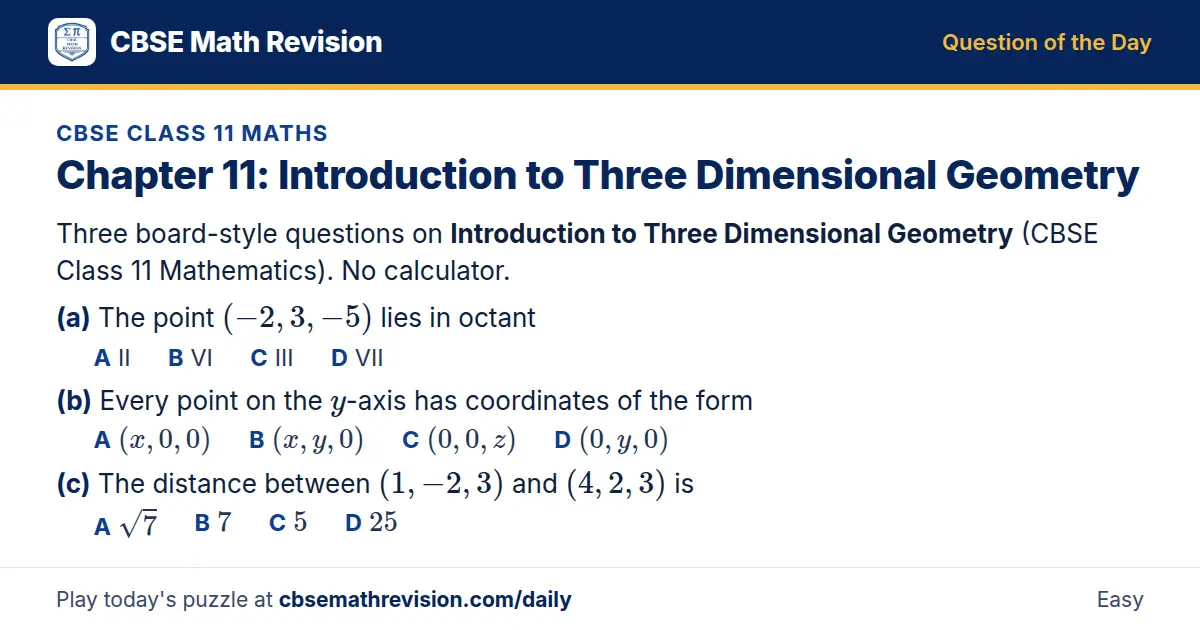
Chapter 11: Introduction to Three Dimensional Geometry
Three board-style questions on Introduction to Three Dimensional Geometry (CBSE Class 11 Mathematics). No calculator.
- The point (-2, 3, -5) lies in octant Options: A) II; B) VI; C) III; D) VII
- Every point on the y-axis has coordinates of the form Options: A) (x, 0, 0); B) (x, y, 0); C) (0, 0, z); D) (0, y, 0)
- The distance between (1, -2, 3) and (4, 2, 3) is Options: A) √7; B) 7; C) 5; D) 25
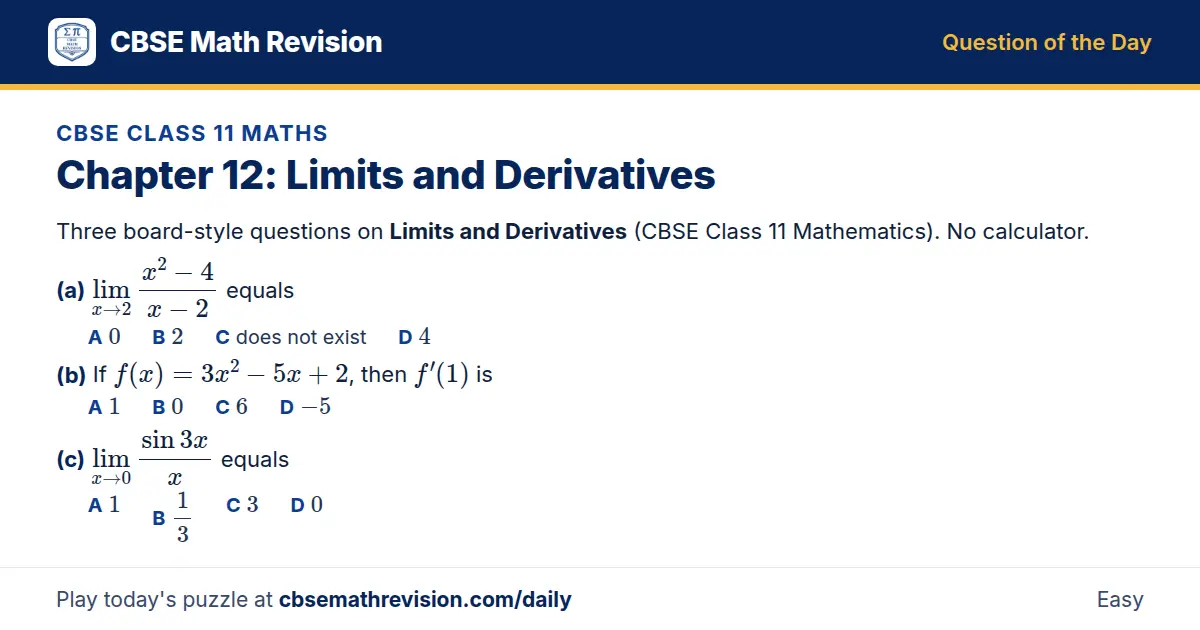
Chapter 12: Limits and Derivatives
Three board-style questions on Limits and Derivatives (CBSE Class 11 Mathematics). No calculator.
- lim_x → 2 (x² - 4)/(x - 2) equals Options: A) 0; B) 2; C) does not exist; D) 4
- If f(x) = 3x² - 5x + 2, then f'(1) is Options: A) 1; B) 0; C) 6; D) -5
- lim_x → 0 (sin 3x)/x equals Options: A) 1; B) 13; C) 3; D) 0
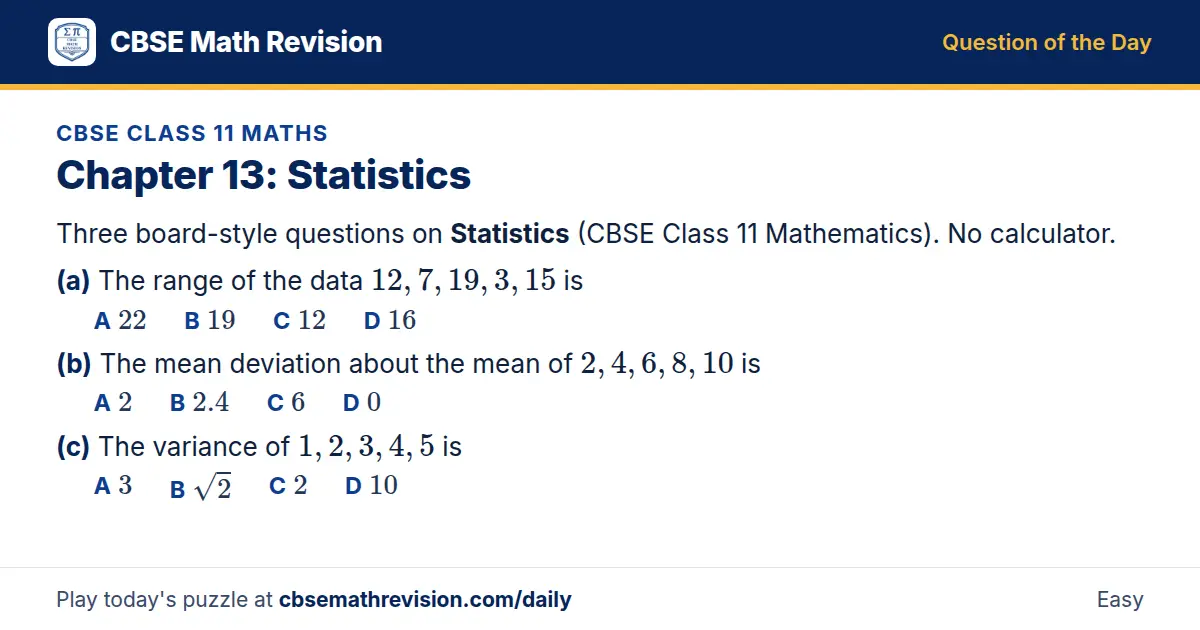
Chapter 13: Statistics
Three board-style questions on Statistics (CBSE Class 11 Mathematics). No calculator.
- The range of the data 12, 7, 19, 3, 15 is Options: A) 22; B) 19; C) 12; D) 16
- The mean deviation about the mean of 2, 4, 6, 8, 10 is Options: A) 2; B) 2.4; C) 6; D) 0
- The variance of 1, 2, 3, 4, 5 is Options: A) 3; B) √2; C) 2; D) 10
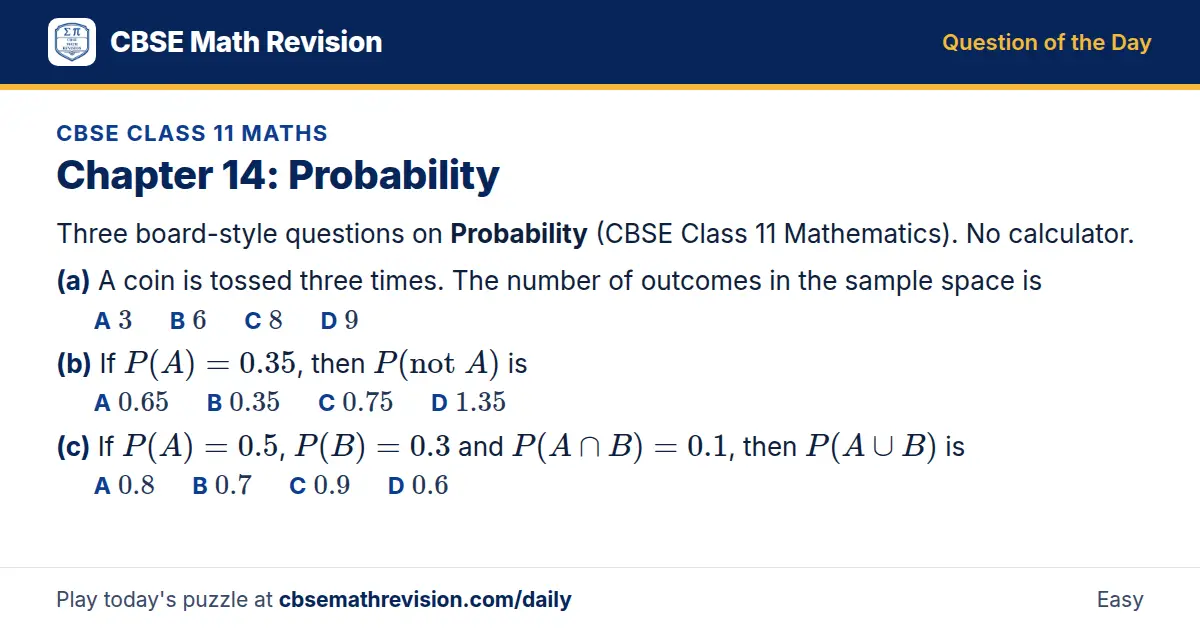
Chapter 14: Probability
Three board-style questions on Probability (CBSE Class 11 Mathematics). No calculator.
- A coin is tossed three times. The number of outcomes in the sample space is Options: A) 3; B) 6; C) 8; D) 9
- If P(A) = 0.35, then P(not A) is Options: A) 0.65; B) 0.35; C) 0.75; D) 1.35
- If P(A) = 0.5, P(B) = 0.3 and P(A ∩ B) = 0.1, then P(A ∪ B) is Options: A) 0.8; B) 0.7; C) 0.9; D) 0.6
CBSE Class 12 Maths
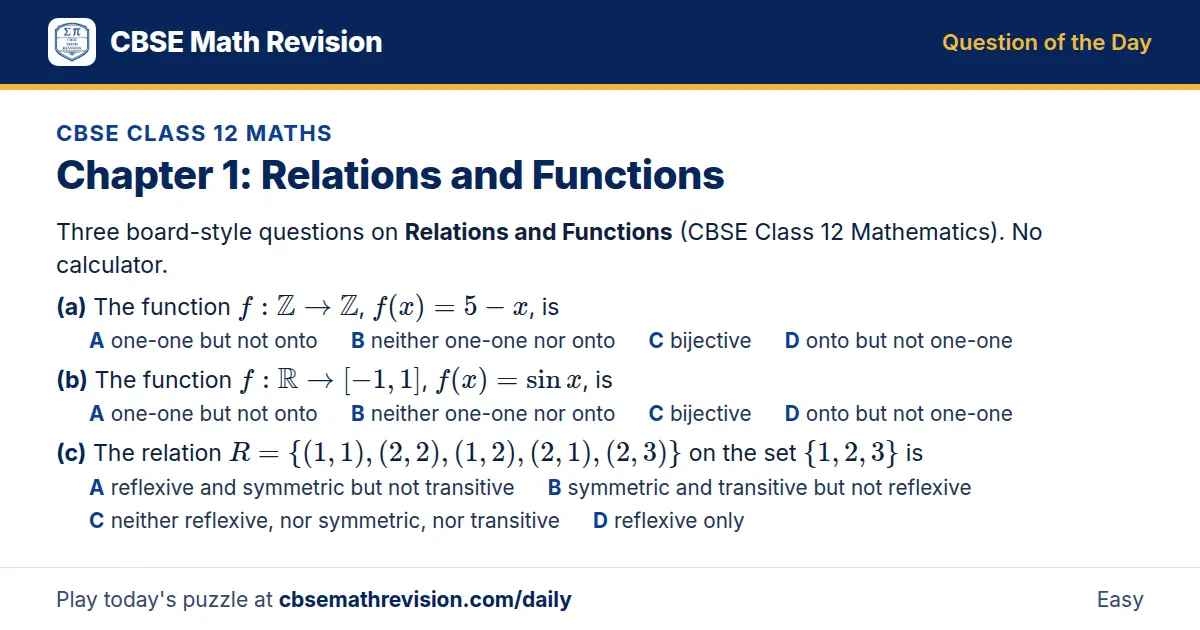
Chapter 1: Relations and Functions
Three board-style questions on Relations and Functions (CBSE Class 12 Mathematics). No calculator.
- The function f: ℤ → ℤ, f(x) = 5 - x, is Options: A) one-one but not onto; B) neither one-one nor onto; C) bijective; D) onto but not one-one
- The function f: ℝ → [-1, 1], f(x) = sin x, is Options: A) one-one but not onto; B) neither one-one nor onto; C) bijective; D) onto but not one-one
- The relation R = (1, 1), (2, 2), (1, 2), (2, 1), (2, 3) on the set 1, 2, 3 is Options: A) reflexive and symmetric but not transitive; B) symmetric and transitive but not reflexive; C) neither reflexive, nor symmetric, nor transitive; D) reflexive only
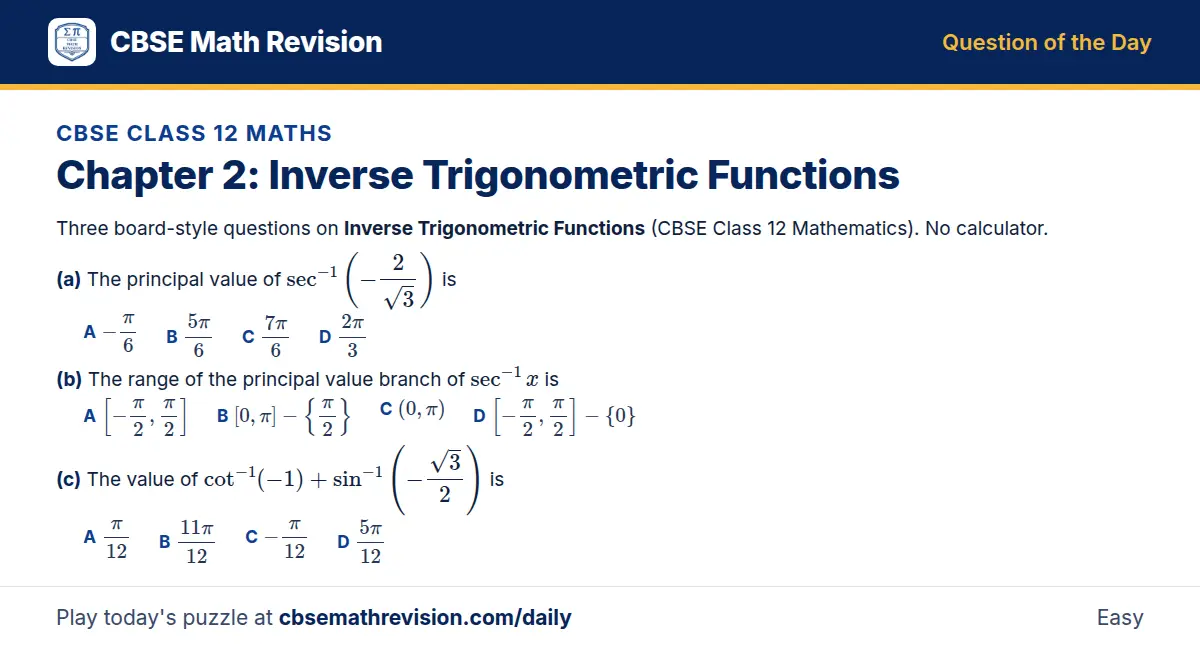
Chapter 2: Inverse Trigonometric Functions
Three board-style questions on Inverse Trigonometric Functions (CBSE Class 12 Mathematics). No calculator.
- The principal value of sec⁻¹(-2/(√3)) is Options: A) -(π)/6; B) (5π)/6; C) (7π)/6; D) (2π)/3
- The range of the principal value branch of sec⁻¹x is Options: A) [-(π)/2, (π)/2]; B) [0, π] - (π)/2; C) (0, π); D) [-(π)/2, (π)/2] - 0
- The value of cot⁻¹(-1) + sin⁻¹(-(√3)/2) is Options: A) (π)/12; B) (11π)/12; C) -(π)/12; D) (5π)/12
![CBSE Class 12 Maths Question of the Day on Matrices, a 3-part multiple-choice question: Three board-style questions on Matrices (CBSE Class 12 Mathematics). No calculator. (a) The 3 × 3 matrix A = [a_ij] with a_ij = i² - j² is (b) A, B, C are…](/cbse-frontend/img/questions/cbse-maths-class-12-matrices-question-of-the-day-cbse12-ch03.webp)
Chapter 3: Matrices
Three board-style questions on Matrices (CBSE Class 12 Mathematics). No calculator.
- The 3 × 3 matrix A = [a_ij] with a_ij = i² - j² is Options: A) a skew-symmetric matrix; B) a symmetric matrix; C) a diagonal matrix; D) a scalar matrix
- A, B, C are matrices of orders 2 × 3, 3 × 2 and 2 × 2 respectively. Which of the following is defined? Options: A) AC; B) BA + C; C) AB + C; D) CB
- If 2x - y 3; x + y z = 5 3; 7 2z - 4, then x + y + z equals Options: A) 9; B) 11; C) 15; D) 7
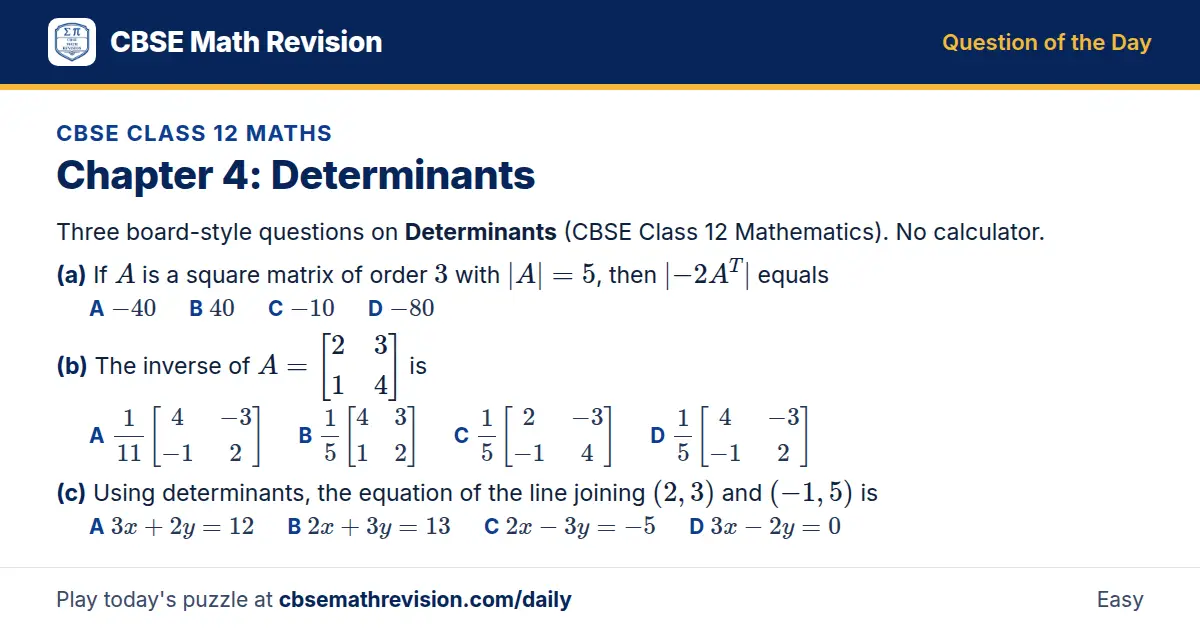
Chapter 4: Determinants
Three board-style questions on Determinants (CBSE Class 12 Mathematics). No calculator.
- If A is a square matrix of order 3 with |A| = 5, then |-2A^T| equals Options: A) -40; B) 40; C) -10; D) -80
- The inverse of A = 2 3; 1 4 is Options: A) 1/11 4 -3; -1 2; B) 15 4 3; 1 2; C) 15 2 -3; -1 4; D) 15 4 -3; -1 2
- Using determinants, the equation of the line joining (2, 3) and (-1, 5) is Options: A) 3x + 2y = 12; B) 2x + 3y = 13; C) 2x - 3y = -5; D) 3x - 2y = 0
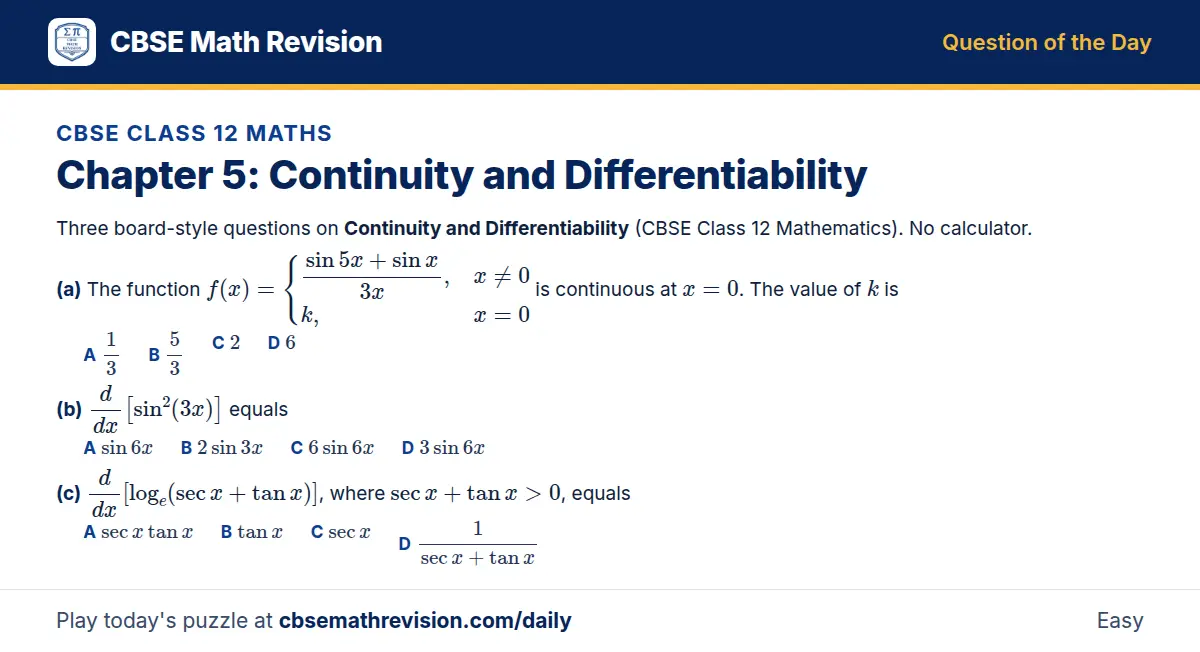
Chapter 5: Continuity and Differentiability
Three board-style questions on Continuity and Differentiability (CBSE Class 12 Mathematics). No calculator.
- The function f(x) = (sin 5x + sin x)/3x, x ≠ 0; k, x = 0 is continuous at x = 0. The value of k is Options: A) 13; B) 53; C) 2; D) 6
- d/dx[sin² (3x)] equals Options: A) sin 6x; B) 2sin 3x; C) 6sin 6x; D) 3sin 6x
- d/dx[log_e(sec x + tan x)], where sec x + tan x > 0, equals Options: A) sec x tan x; B) tan x; C) sec x; D) 1/(sec x + tan x)
Chapter 6: Application of Derivatives
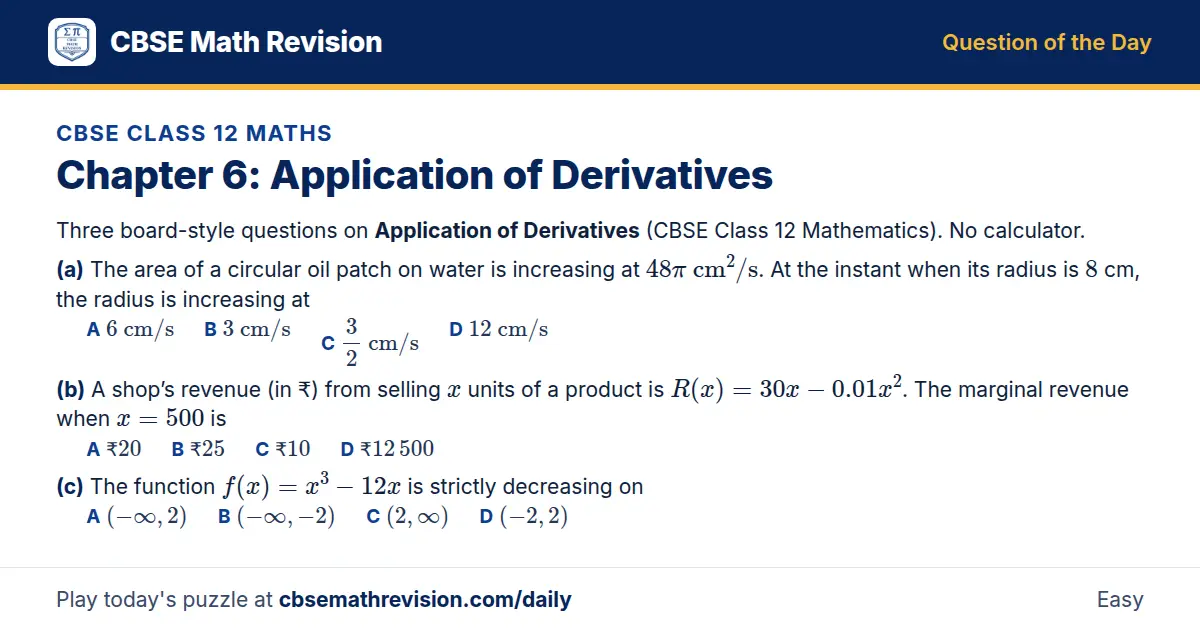
Three board-style questions on Application of Derivatives (CBSE Class 12 Mathematics). No calculator.
- The area of a circular oil patch on water is increasing at 48π cm^2/s. At the instant when its radius is 8 cm, the radius is increasing at Options: A) 6 cm/s; B) 3 cm/s; C) 3/2 cm/s; D) 12 cm/s
- A shop’s revenue (in ₹) from selling x units of a product is R(x) = 30x - 0.01x^2. The marginal revenue when x = 500 is Options: A) ₹20; B) ₹25; C) ₹10; D) ₹12 500
- The function f(x) = x³ - 12x is strictly decreasing on Options: A) (-∞, 2); B) (-∞, -2); C) (2, ∞); D) (-2, 2)
Chapter 7: Integrals
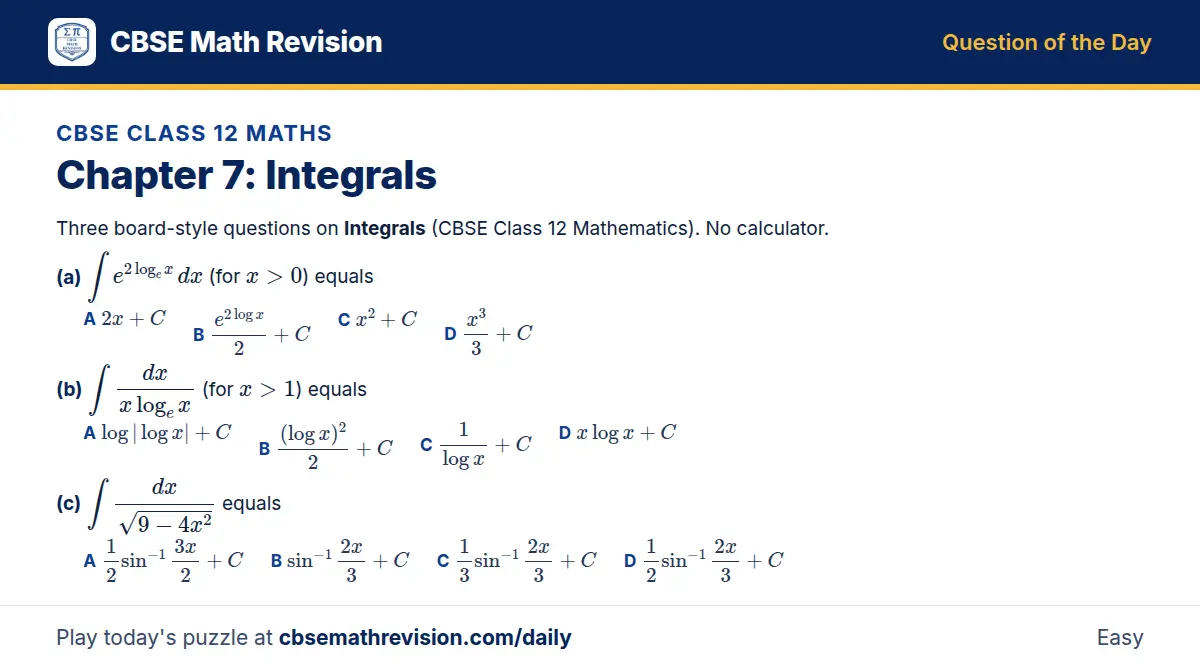
Three board-style questions on Integrals (CBSE Class 12 Mathematics). No calculator.
- ∫ e^(2log_e x) dx (for x > 0) equals Options: A) 2x + C; B) (e^(2log x))/2 + C; C) x² + C; D) (x³)/3 + C
- /(xlog_e x) (for x > 1) equals Options: A) log|log x| + C; B) ((log x)²)/2 + C; C) 1/(log x) + C; D) xlog x + C
- /(√(9 - 4x²)) equals Options: A) 12sin⁻¹3x/2 + C; B) sin⁻¹2x/3 + C; C) 13sin⁻¹2x/3 + C; D) 12sin⁻¹2x/3 + C
Chapter 8: Application of Integrals
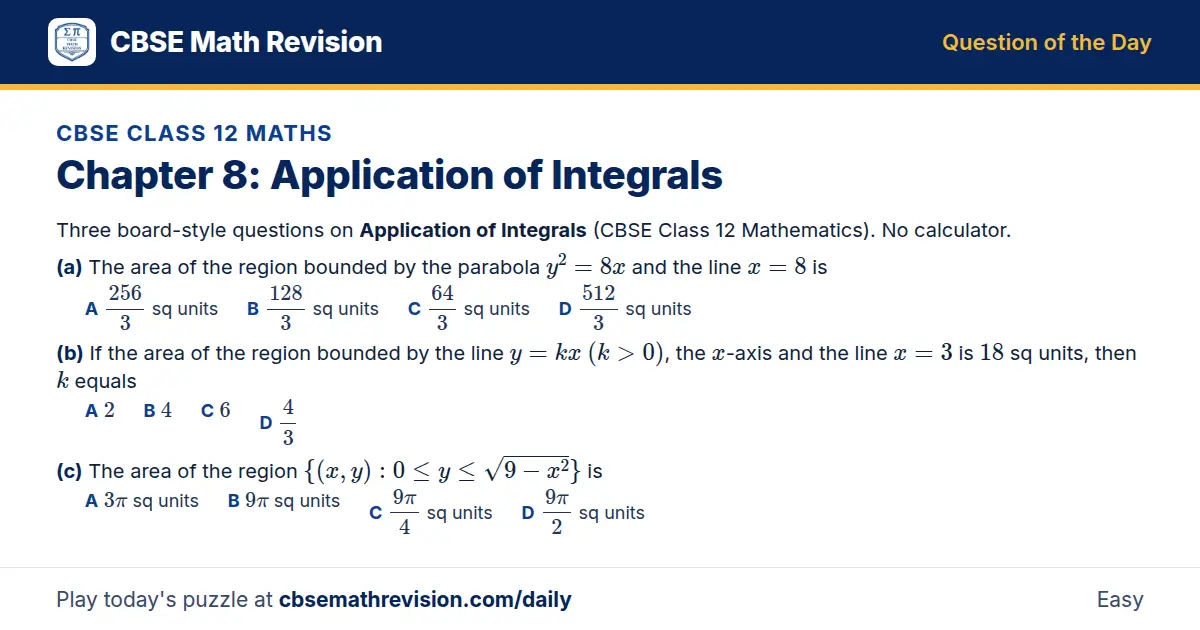
Three board-style questions on Application of Integrals (CBSE Class 12 Mathematics). No calculator.
- The area of the region bounded by the parabola y² = 8x and the line x = 8 is Options: A) 256/3 sq units; B) 128/3 sq units; C) 64/3 sq units; D) 512/3 sq units
- If the area of the region bounded by the line y = kx (k > 0), the x-axis and the line x = 3 is 18 sq units, then k equals Options: A) 2; B) 4; C) 6; D) 4/3
- The area of the region (x, y): 0 ≤ y ≤ √(9 - x²) is Options: A) 3π sq units; B) 9π sq units; C) (9π)/4 sq units; D) (9π)/2 sq units
Chapter 9: Differential Equations
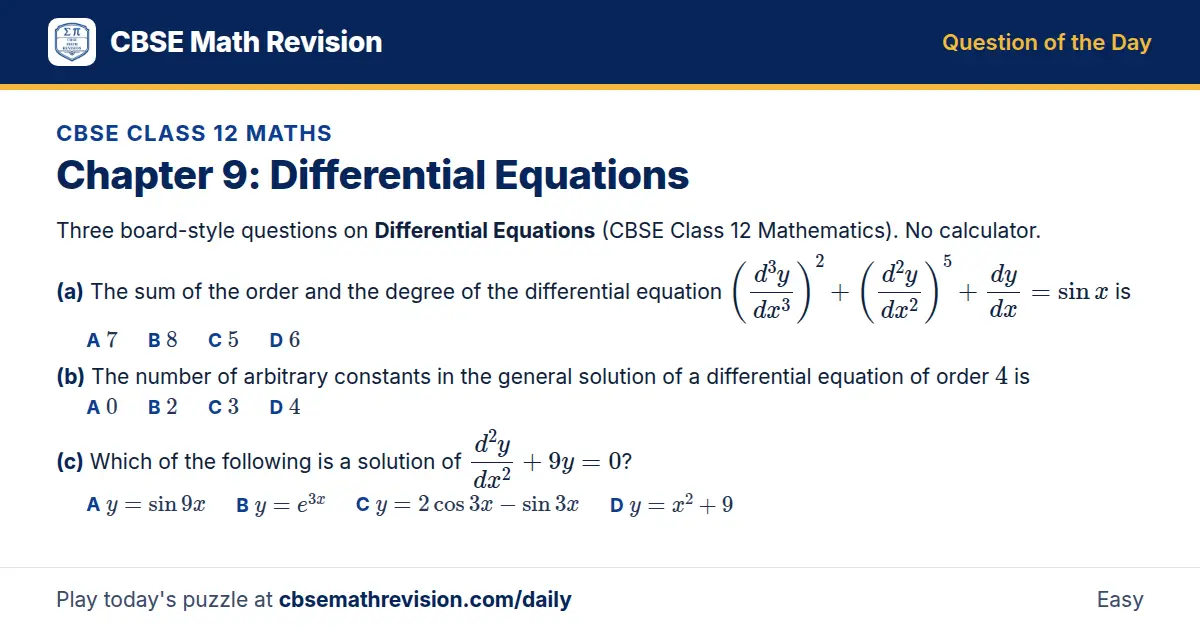
Three board-style questions on Differential Equations (CBSE Class 12 Mathematics). No calculator.
- The sum of the order and the degree of the differential equation ((d³y)/(dx³))² + ((d²y)/(dx²))⁵ + dy/dx = sin x is Options: A) 7; B) 8; C) 5; D) 6
- The number of arbitrary constants in the general solution of a differential equation of order 4 is Options: A) 0; B) 2; C) 3; D) 4
- Which of the following is a solution of (d²y)/(dx²) + 9y = 0? Options: A) y = sin 9x; B) y = e^(3x); C) y = 2cos 3x - sin 3x; D) y = x² + 9
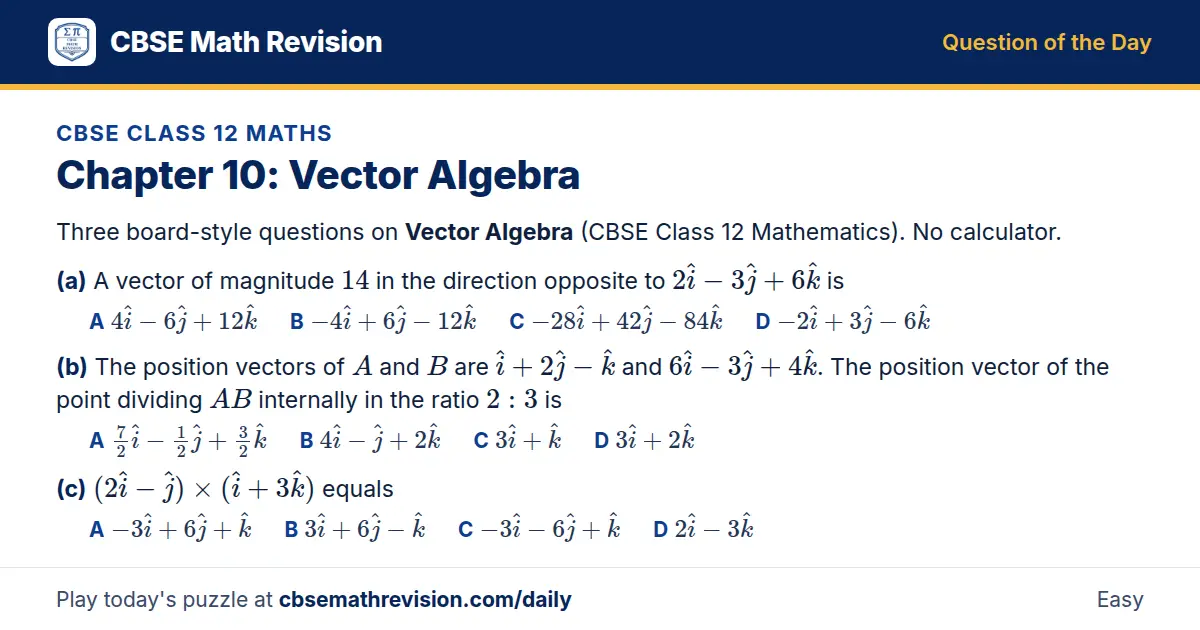
Chapter 10: Vector Algebra
Three board-style questions on Vector Algebra (CBSE Class 12 Mathematics). No calculator.
- A vector of magnitude 14 in the direction opposite to 2i - 3j + 6k is Options: A) 4i - 6j + 12k; B) -4i + 6j - 12k; C) -28i + 42j - 84k; D) -2i + 3j - 6k
- The position vectors of A and B are i + 2j - k and 6i - 3j + 4k. The position vector of the point dividing AB internally in the ratio 2: 3 is Options: A) 72i - 12j + 32k; B) 4i - j + 2k; C) 3i + k; D) 3i + 2k
- (2i - j) × (i + 3k) equals Options: A) -3i + 6j + k; B) 3i + 6j - k; C) -3i - 6j + k; D) 2i - 3k
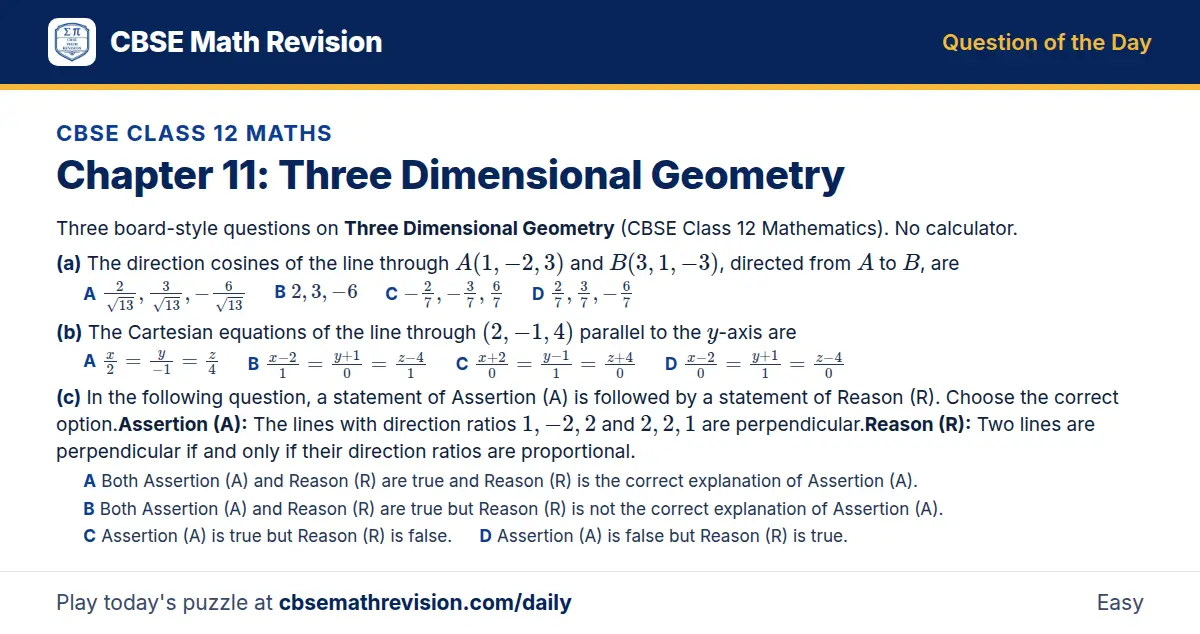
Chapter 11: Three Dimensional Geometry
Three board-style questions on Three Dimensional Geometry (CBSE Class 12 Mathematics). No calculator.
- The direction cosines of the line through A(1, -2, 3) and B(3, 1, -3), directed from A to B, are Options: A) 2/(√13), 3/(√13), -6/(√13); B) 2, 3, -6; C) -27, -37, 67; D) 27, 37, -67
- The Cartesian equations of the line through (2, -1, 4) parallel to the y-axis are Options: A) x/2 = y/(-1) = z/4; B) (x - 2)/1 = (y + 1)/0 = (z - 4)/1; C) (x + 2)/0 = (y - 1)/1 = (z + 4)/0; D) (x - 2)/0 = (y + 1)/1 = (z - 4)/0
- In the following question, a statement of Assertion (A) is followed by a statement of Reason (R). Choose the correct option. Assertion (A): The lines with direction ratios 1, -2, 2 and 2, 2, 1 are perpendicular. Reason (R): Two lines are perpendicular if and only if their direction ratios are proportional. Options: A) Both Assertion (A) and Reason (R) are true and Reason (R) is the correct explanation of Assertion (A).; B) Both Assertion (A) and Reason (R) are true but Reason (R) is not the correct explanation of Assertion (A).; C) Assertion (A) is true but Reason (R) is false.; D) Assertion (A) is false but Reason (R) is true.
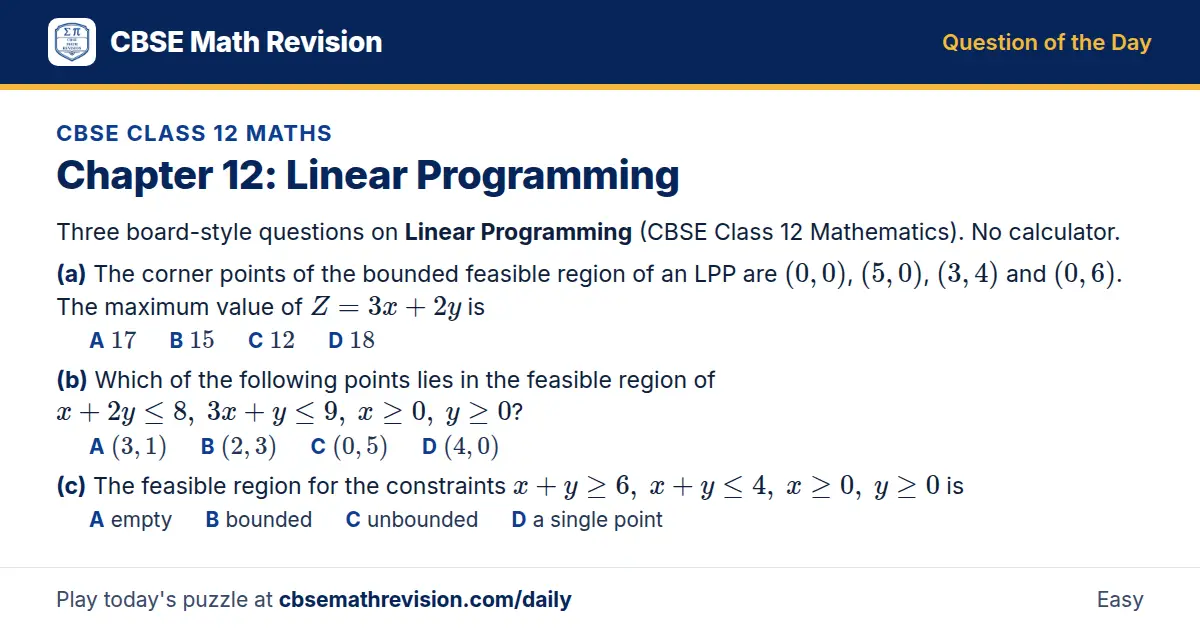
Chapter 12: Linear Programming
Three board-style questions on Linear Programming (CBSE Class 12 Mathematics). No calculator.
- The corner points of the bounded feasible region of an LPP are (0, 0), (5, 0), (3, 4) and (0, 6). The maximum value of Z = 3x + 2y is Options: A) 17; B) 15; C) 12; D) 18
- Which of the following points lies in the feasible region of x + 2y ≤ 8, 3x + y ≤ 9, x ≥ 0, y ≥ 0? Options: A) (3, 1); B) (2, 3); C) (0, 5); D) (4, 0)
- The feasible region for the constraints x + y ≥ 6, x + y ≤ 4, x ≥ 0, y ≥ 0 is Options: A) empty; B) bounded; C) unbounded; D) a single point
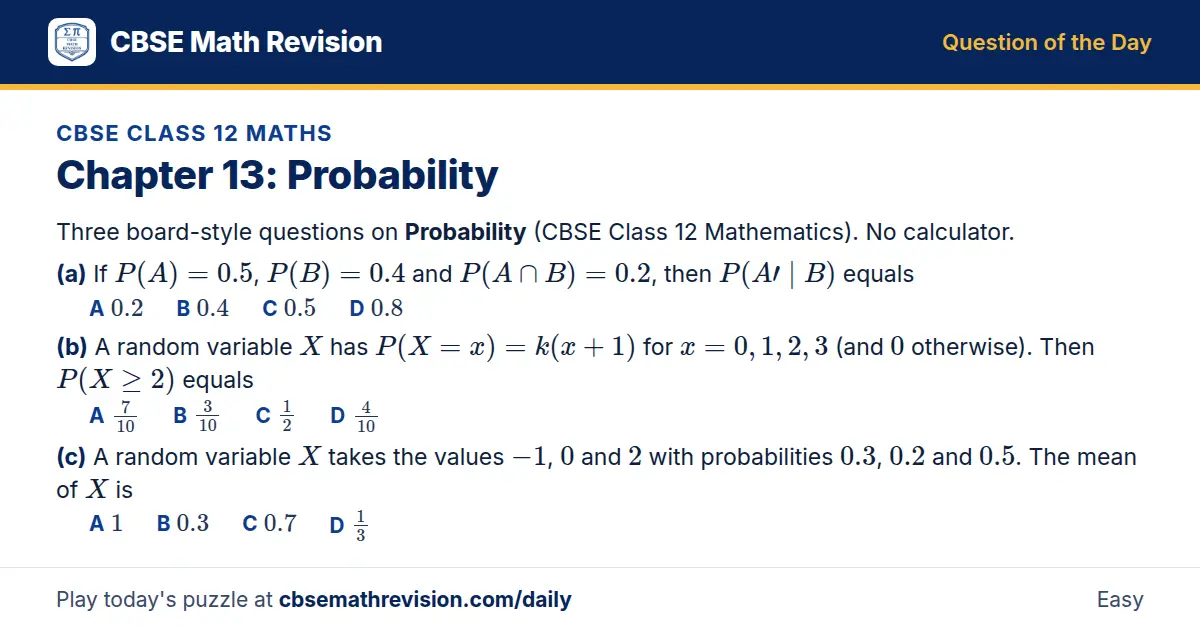
Chapter 13: Probability
Three board-style questions on Probability (CBSE Class 12 Mathematics). No calculator.
- If P(A) = 0.5, P(B) = 0.4 and P(A ∩ B) = 0.2, then P(A′ | B) equals Options: A) 0.2; B) 0.4; C) 0.5; D) 0.8
- A random variable X has P(X = x) = k(x + 1) for x = 0, 1, 2, 3 (and 0 otherwise). Then P(X ≥ 2) equals Options: A) 7/10; B) 3/10; C) 12; D) 4/10
- A random variable X takes the values -1, 0 and 2 with probabilities 0.3, 0.2 and 0.5. The mean of X is Options: A) 1; B) 0.3; C) 0.7; D) 13
Weekly starter questions
Three or four short questions for each teaching week, to open a lesson or warm up for homework. Each page shows the questions as images with their text; answers and mark schemes are in the teacher tools.
CBSE Class 10 Mathematics
96 starter questions: Weeks 1–18 · Weeks 19–31 · Weeks 33–46.
CBSE Class 11 Mathematics
105 starter questions: Weeks 1–19 · Weeks 20–34 · Weeks 35–45.
CBSE Class 12 Mathematics
96 starter questions: Weeks 1–18 · Weeks 19–31 · Weeks 32–46.