CBSE Class 12 Maths Question of the Day: chapters 1–4
40 CBSE Class 12 Mathematics puzzles from the Question of the Day rotation, chapters 1–4. Each puzzle is three board-style questions on one chapter, shown as an image with the question text written out below it; the answers, hints and step-marked solutions are on the daily puzzle page.
Chapter 1: Relations and Functions
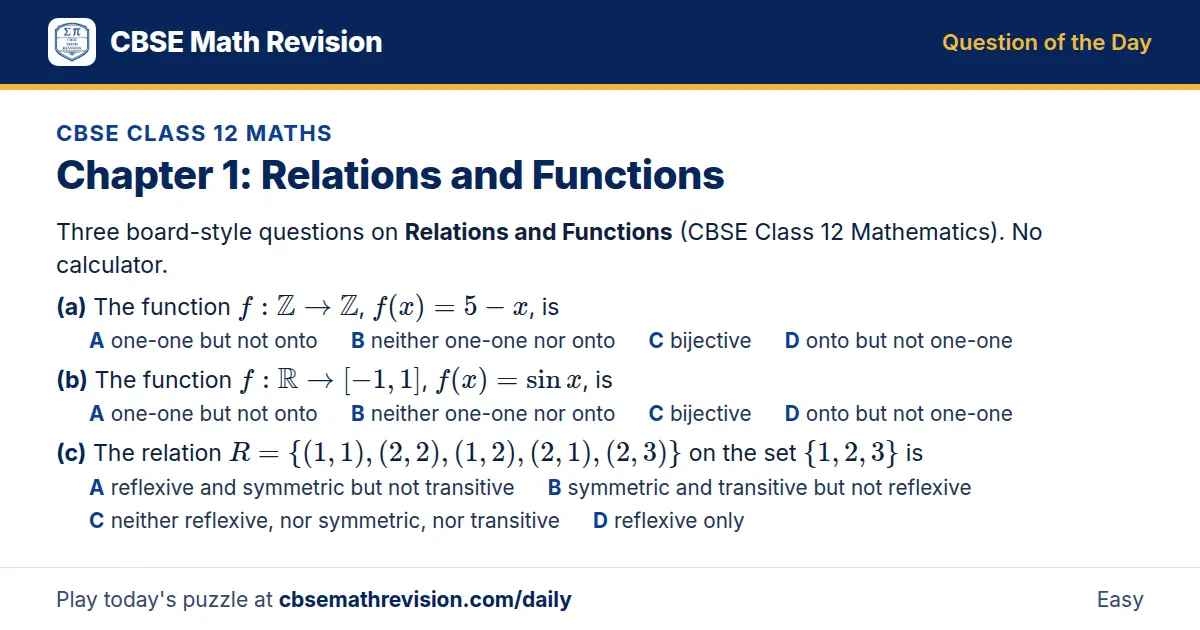
Chapter 1: Relations and Functions
Three board-style questions on Relations and Functions (CBSE Class 12 Mathematics). No calculator.
- The function f: ℤ → ℤ, f(x) = 5 - x, is Options: A) one-one but not onto; B) neither one-one nor onto; C) bijective; D) onto but not one-one
- The function f: ℝ → [-1, 1], f(x) = sin x, is Options: A) one-one but not onto; B) neither one-one nor onto; C) bijective; D) onto but not one-one
- The relation R = (1, 1), (2, 2), (1, 2), (2, 1), (2, 3) on the set 1, 2, 3 is Options: A) reflexive and symmetric but not transitive; B) symmetric and transitive but not reflexive; C) neither reflexive, nor symmetric, nor transitive; D) reflexive only
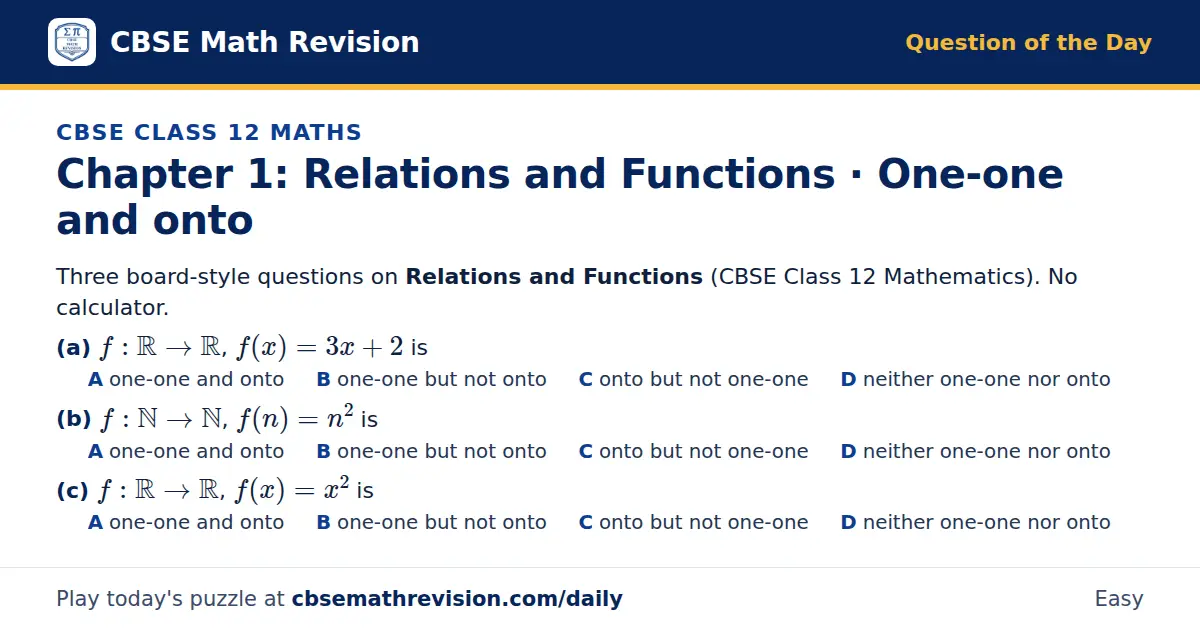
Chapter 1: Relations and Functions · One-one and onto
Three board-style questions on Relations and Functions (CBSE Class 12 Mathematics). No calculator.
- f: ℝ → ℝ, f(x) = 3x + 2 is Options: A) one-one and onto; B) one-one but not onto; C) onto but not one-one; D) neither one-one nor onto
- f: ℕ → ℕ, f(n) = n² is Options: A) one-one and onto; B) one-one but not onto; C) onto but not one-one; D) neither one-one nor onto
- f: ℝ → ℝ, f(x) = x² is Options: A) one-one and onto; B) one-one but not onto; C) onto but not one-one; D) neither one-one nor onto
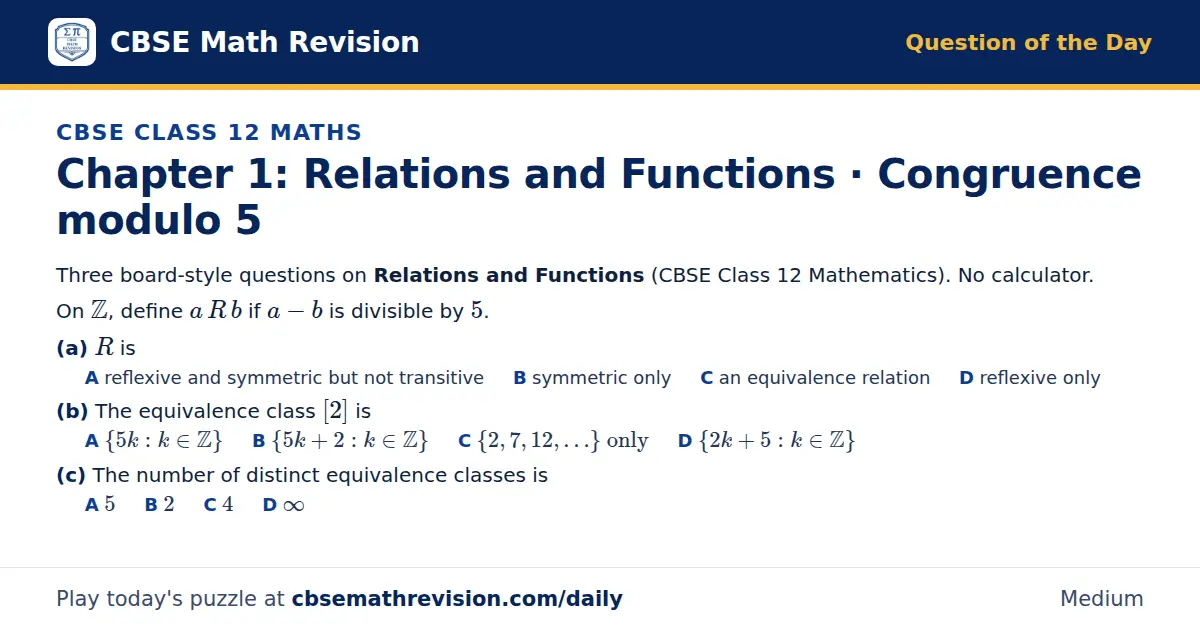
Chapter 1: Relations and Functions · Congruence modulo 5
Three board-style questions on Relations and Functions (CBSE Class 12 Mathematics). No calculator. On ℤ, define a R b if a - b is divisible by 5.
- R is Options: A) reflexive and symmetric but not transitive; B) symmetric only; C) an equivalence relation; D) reflexive only
- The equivalence class [2] is Options: A) 5k: k ∈ ℤ; B) 5k + 2: k ∈ ℤ; C) 2, 7, 12, … only; D) 2k + 5: k ∈ ℤ
- The number of distinct equivalence classes is Options: A) 5; B) 2; C) 4; D) ∞
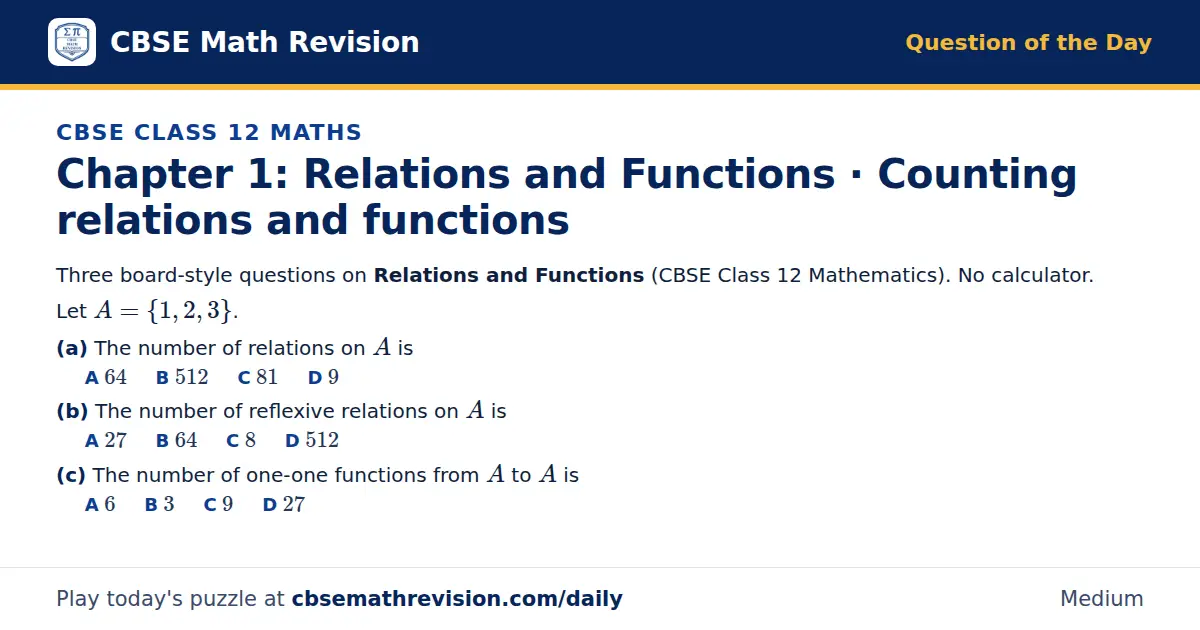
Chapter 1: Relations and Functions · Counting relations and functions
Three board-style questions on Relations and Functions (CBSE Class 12 Mathematics). No calculator. Let A = 1, 2, 3.
- The number of relations on A is Options: A) 64; B) 512; C) 81; D) 9
- The number of reflexive relations on A is Options: A) 27; B) 64; C) 8; D) 512
- The number of one-one functions from A to A is Options: A) 6; B) 3; C) 9; D) 27
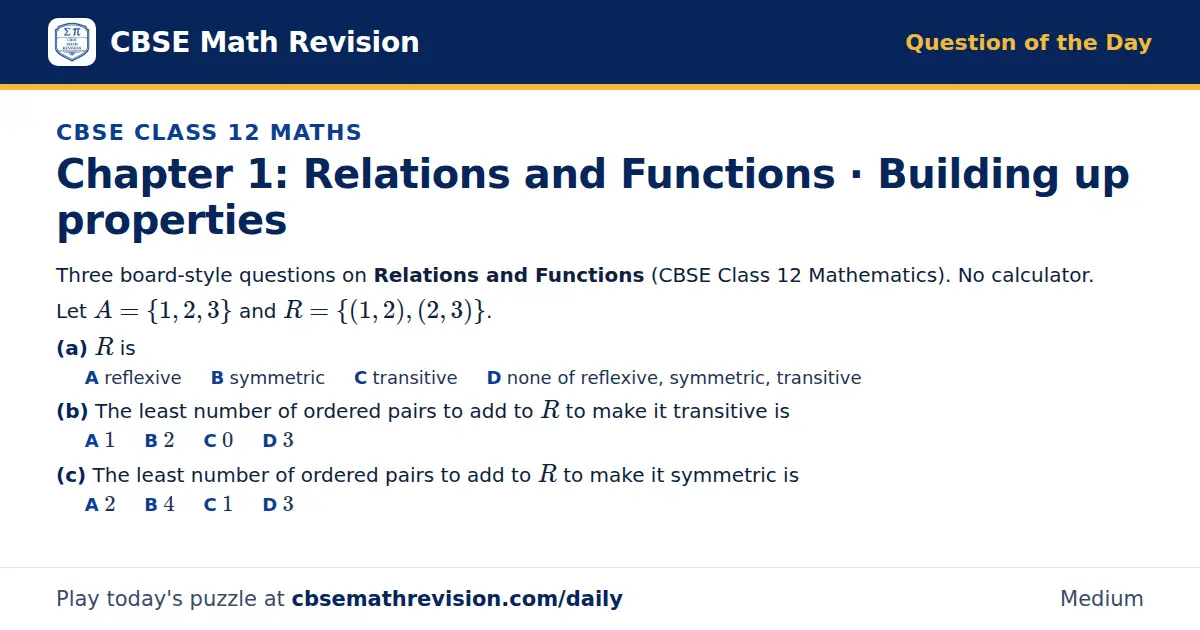
Chapter 1: Relations and Functions · Building up properties
Three board-style questions on Relations and Functions (CBSE Class 12 Mathematics). No calculator. Let A = 1, 2, 3 and R = (1, 2), (2, 3).
- R is Options: A) reflexive; B) symmetric; C) transitive; D) none of reflexive, symmetric, transitive
- The least number of ordered pairs to add to R to make it transitive is Options: A) 1; B) 2; C) 0; D) 3
- The least number of ordered pairs to add to R to make it symmetric is Options: A) 2; B) 4; C) 1; D) 3
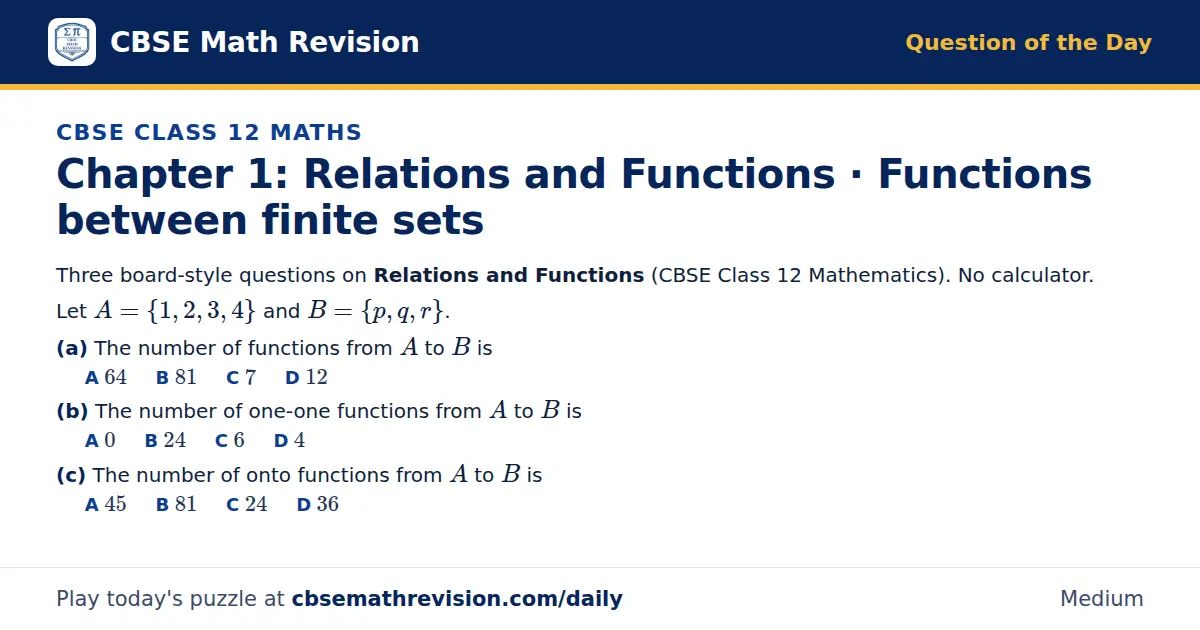
Chapter 1: Relations and Functions · Functions between finite sets
Three board-style questions on Relations and Functions (CBSE Class 12 Mathematics). No calculator. Let A = 1, 2, 3, 4 and B = p, q, r.
- The number of functions from A to B is Options: A) 64; B) 81; C) 7; D) 12
- The number of one-one functions from A to B is Options: A) 0; B) 24; C) 6; D) 4
- The number of onto functions from A to B is Options: A) 45; B) 81; C) 24; D) 36
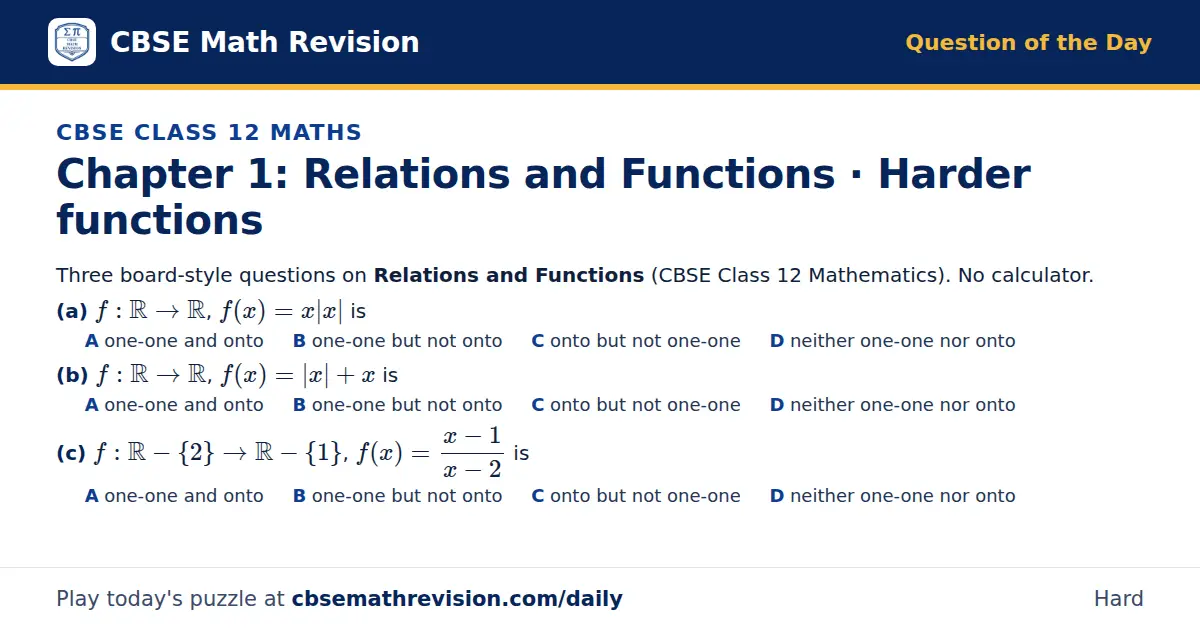
Chapter 1: Relations and Functions · Harder functions
Three board-style questions on Relations and Functions (CBSE Class 12 Mathematics). No calculator.
- f: ℝ → ℝ, f(x) = x|x| is Options: A) one-one and onto; B) one-one but not onto; C) onto but not one-one; D) neither one-one nor onto
- f: ℝ → ℝ, f(x) = |x| + x is Options: A) one-one and onto; B) one-one but not onto; C) onto but not one-one; D) neither one-one nor onto
- f: ℝ - 2 → ℝ - 1, f(x) = (x - 1)/(x - 2) is Options: A) one-one and onto; B) one-one but not onto; C) onto but not one-one; D) neither one-one nor onto
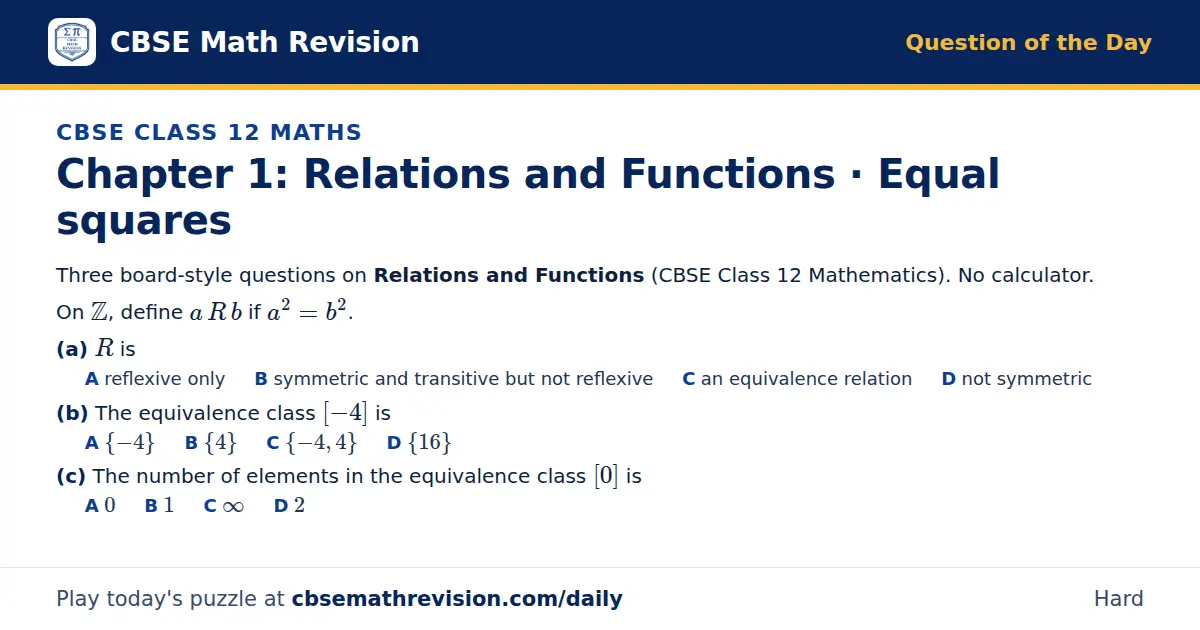
Chapter 1: Relations and Functions · Equal squares
Three board-style questions on Relations and Functions (CBSE Class 12 Mathematics). No calculator. On ℤ, define a R b if a² = b^2.
- R is Options: A) reflexive only; B) symmetric and transitive but not reflexive; C) an equivalence relation; D) not symmetric
- The equivalence class [-4] is Options: A) -4; B) 4; C) -4, 4; D) 16
- The number of elements in the equivalence class [0] is Options: A) 0; B) 1; C) ∞; D) 2
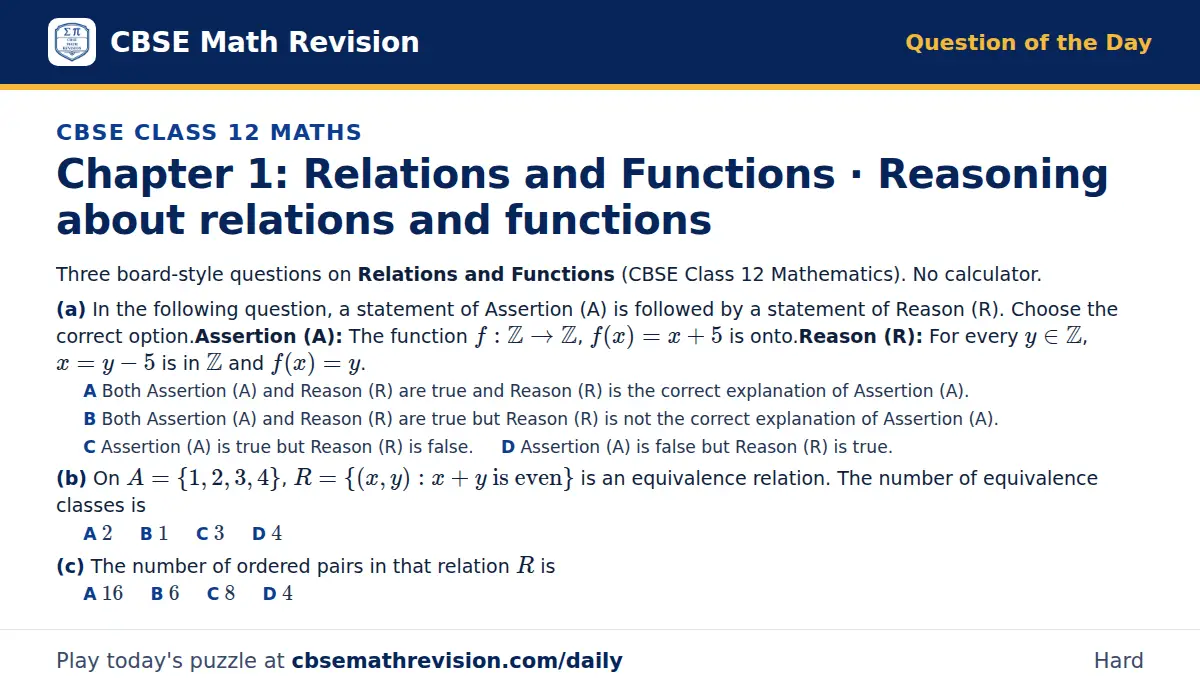
Chapter 1: Relations and Functions · Reasoning about relations and functions
Three board-style questions on Relations and Functions (CBSE Class 12 Mathematics). No calculator.
- In the following question, a statement of Assertion (A) is followed by a statement of Reason (R). Choose the correct option. Assertion (A): The function f: ℤ → ℤ, f(x) = x + 5 is onto. Reason (R): For every y ∈ ℤ, x = y - 5 is in ℤ and f(x) = y. Options: A) Both Assertion (A) and Reason (R) are true and Reason (R) is the correct explanation of Assertion (A).; B) Both Assertion (A) and Reason (R) are true but Reason (R) is not the correct explanation of Assertion (A).; C) Assertion (A) is true but Reason (R) is false.; D) Assertion (A) is false but Reason (R) is true.
- On A = 1, 2, 3, 4, R = (x, y): x + y is even is an equivalence relation. The number of equivalence classes is Options: A) 2; B) 1; C) 3; D) 4
- The number of ordered pairs in that relation R is Options: A) 16; B) 6; C) 8; D) 4
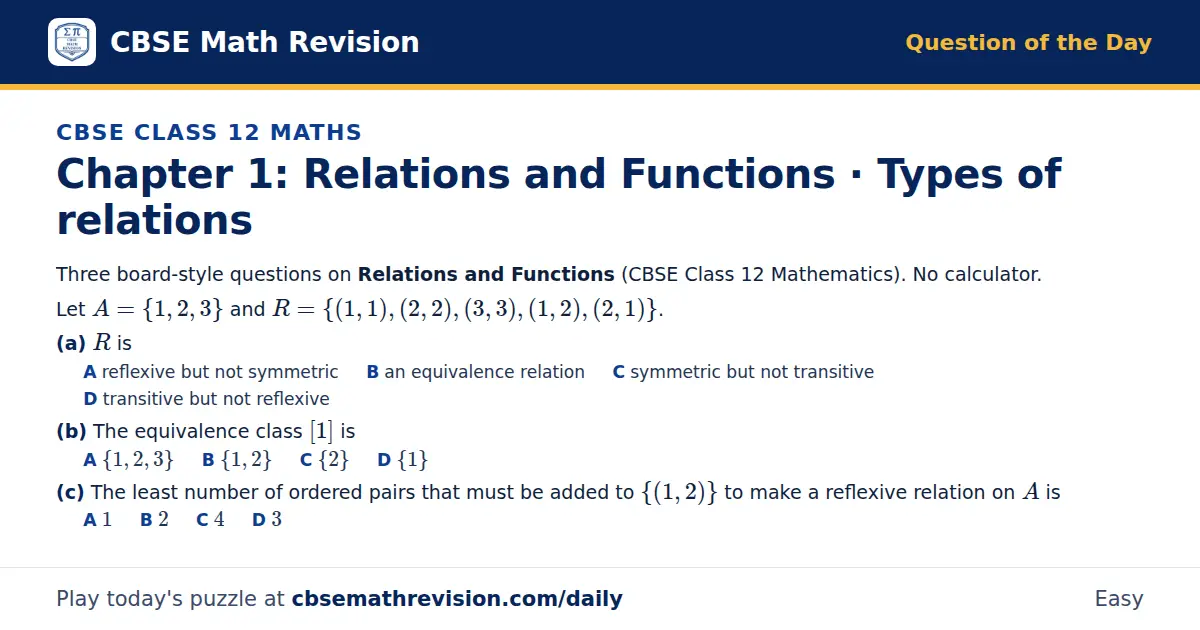
Chapter 1: Relations and Functions · Types of relations
Three board-style questions on Relations and Functions (CBSE Class 12 Mathematics). No calculator. Let A = 1, 2, 3 and R = (1,1), (2,2), (3,3), (1,2), (2,1).
- R is Options: A) reflexive but not symmetric; B) an equivalence relation; C) symmetric but not transitive; D) transitive but not reflexive
- The equivalence class [1] is Options: A) 1, 2, 3; B) 1, 2; C) 2; D) 1
- The least number of ordered pairs that must be added to (1, 2) to make a reflexive relation on A is Options: A) 1; B) 2; C) 4; D) 3
Chapter 2: Inverse Trigonometric Functions
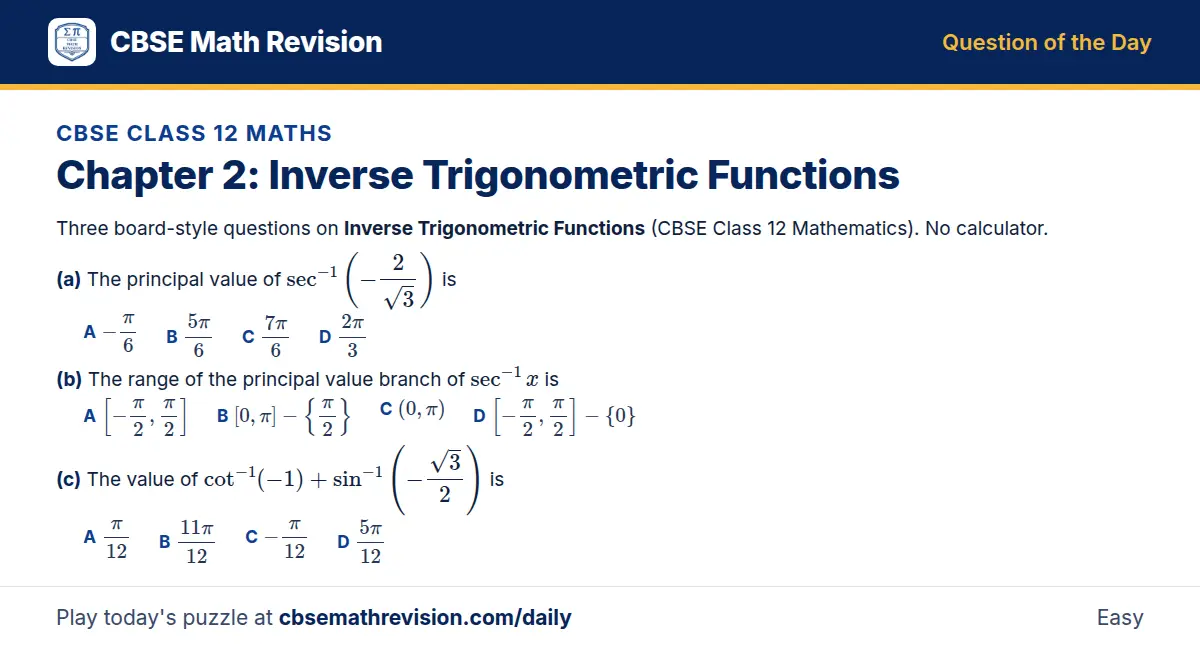
Chapter 2: Inverse Trigonometric Functions
Three board-style questions on Inverse Trigonometric Functions (CBSE Class 12 Mathematics). No calculator.
- The principal value of sec⁻¹(-2/(√3)) is Options: A) -(π)/6; B) (5π)/6; C) (7π)/6; D) (2π)/3
- The range of the principal value branch of sec⁻¹x is Options: A) [-(π)/2, (π)/2]; B) [0, π] - (π)/2; C) (0, π); D) [-(π)/2, (π)/2] - 0
- The value of cot⁻¹(-1) + sin⁻¹(-(√3)/2) is Options: A) (π)/12; B) (11π)/12; C) -(π)/12; D) (5π)/12
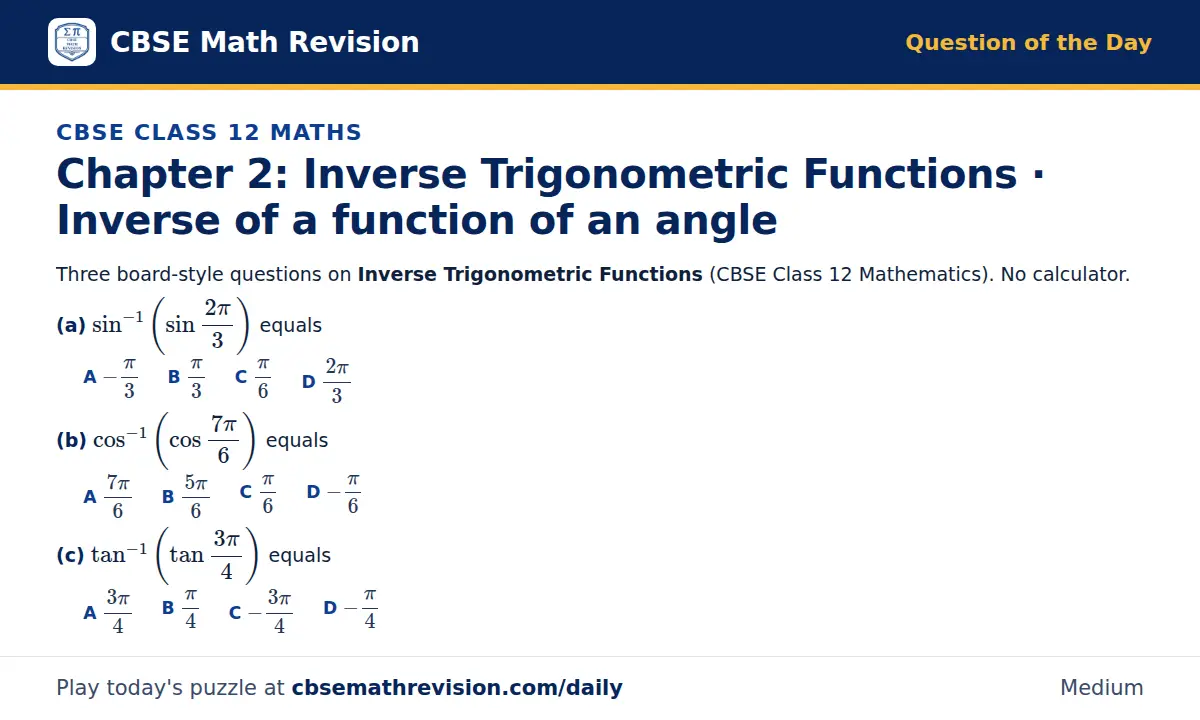
Chapter 2: Inverse Trigonometric Functions · Inverse of a function of an angle
Three board-style questions on Inverse Trigonometric Functions (CBSE Class 12 Mathematics). No calculator.
- sin⁻¹(sin(2π)/3) equals Options: A) - (π)/3; B) (π)/3; C) (π)/6; D) (2 π)/3
- cos⁻¹(cos(7π)/6) equals Options: A) (7 π)/6; B) (5 π)/6; C) (π)/6; D) - (π)/6
- tan⁻¹(tan(3π)/4) equals Options: A) (3 π)/4; B) (π)/4; C) - (3 π)/4; D) - (π)/4
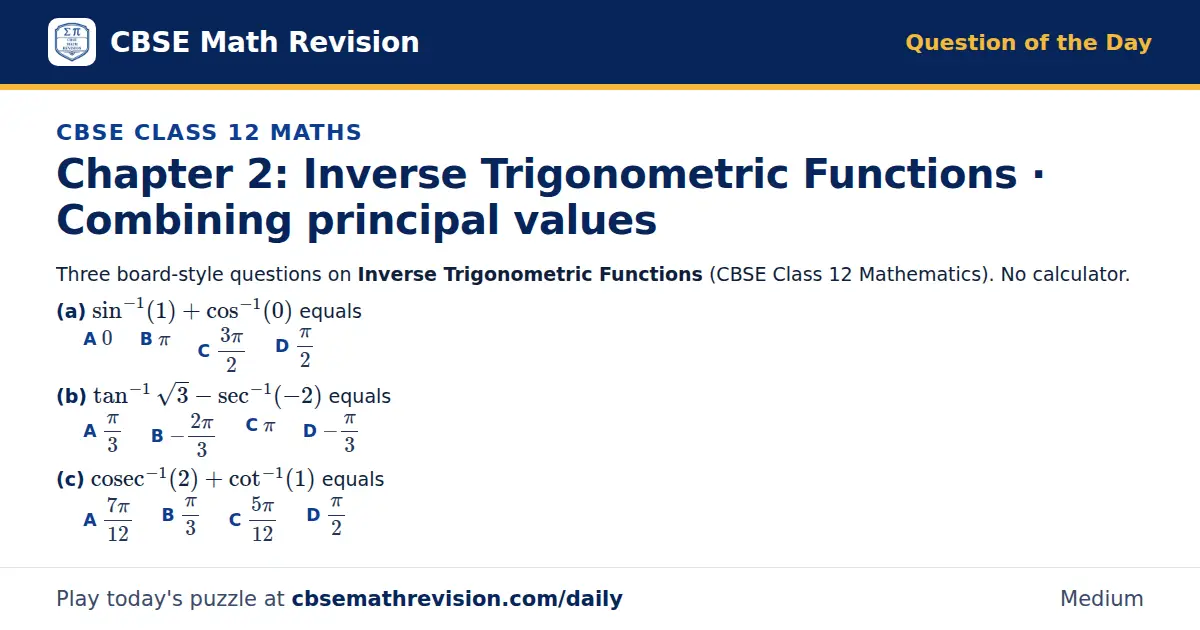
Chapter 2: Inverse Trigonometric Functions · Combining principal values
Three board-style questions on Inverse Trigonometric Functions (CBSE Class 12 Mathematics). No calculator.
- sin⁻¹(1) + cos⁻¹(0) equals Options: A) 0; B) π; C) (3 π)/2; D) (π)/2
- tan⁻¹√3 - sec⁻¹(-2) equals Options: A) (π)/3; B) - (2 π)/3; C) π; D) - (π)/3
- cosec⁻¹(2) + cot⁻¹(1) equals Options: A) (7 π)/12; B) (π)/3; C) (5 π)/12; D) (π)/2
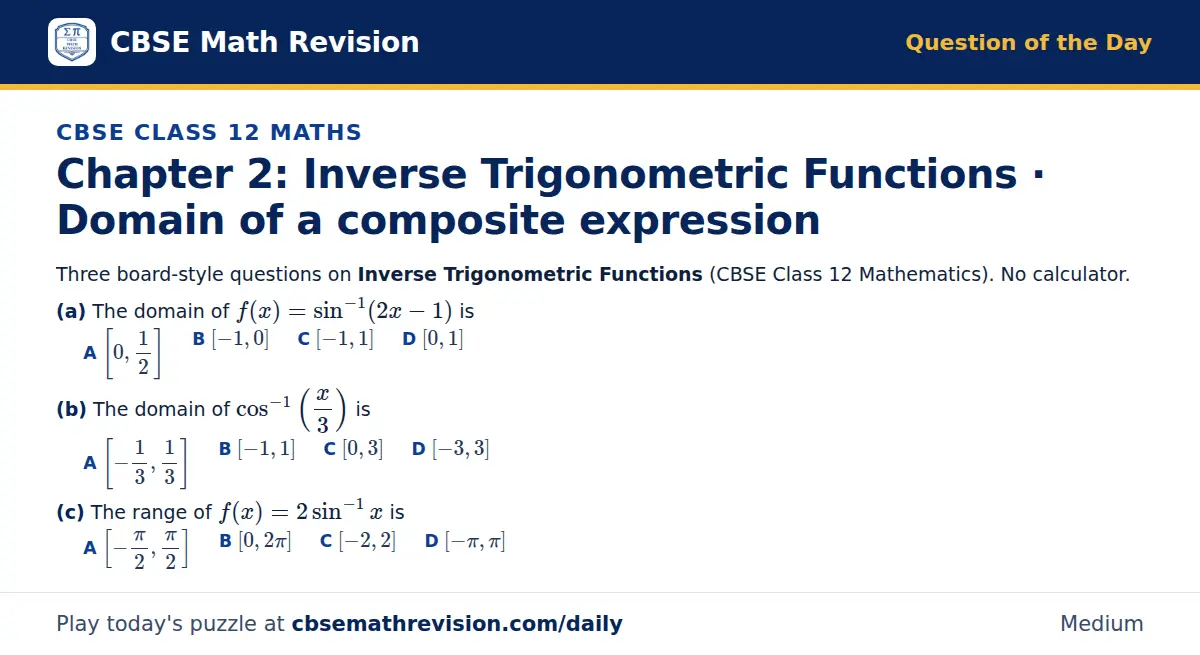
Chapter 2: Inverse Trigonometric Functions · Domain of a composite expression
Three board-style questions on Inverse Trigonometric Functions (CBSE Class 12 Mathematics). No calculator.
- The domain of f(x) = sin⁻¹(2x - 1) is Options: A) [0, 12]; B) [-1, 0]; C) [-1, 1]; D) [0, 1]
- The domain of cos⁻¹(x/3) is Options: A) [-13, 13]; B) [-1, 1]; C) [0, 3]; D) [-3, 3]
- The range of f(x) = 2sin⁻¹x is Options: A) [-(π)/2, (π)/2]; B) [0, 2π]; C) [-2, 2]; D) [-π, π]
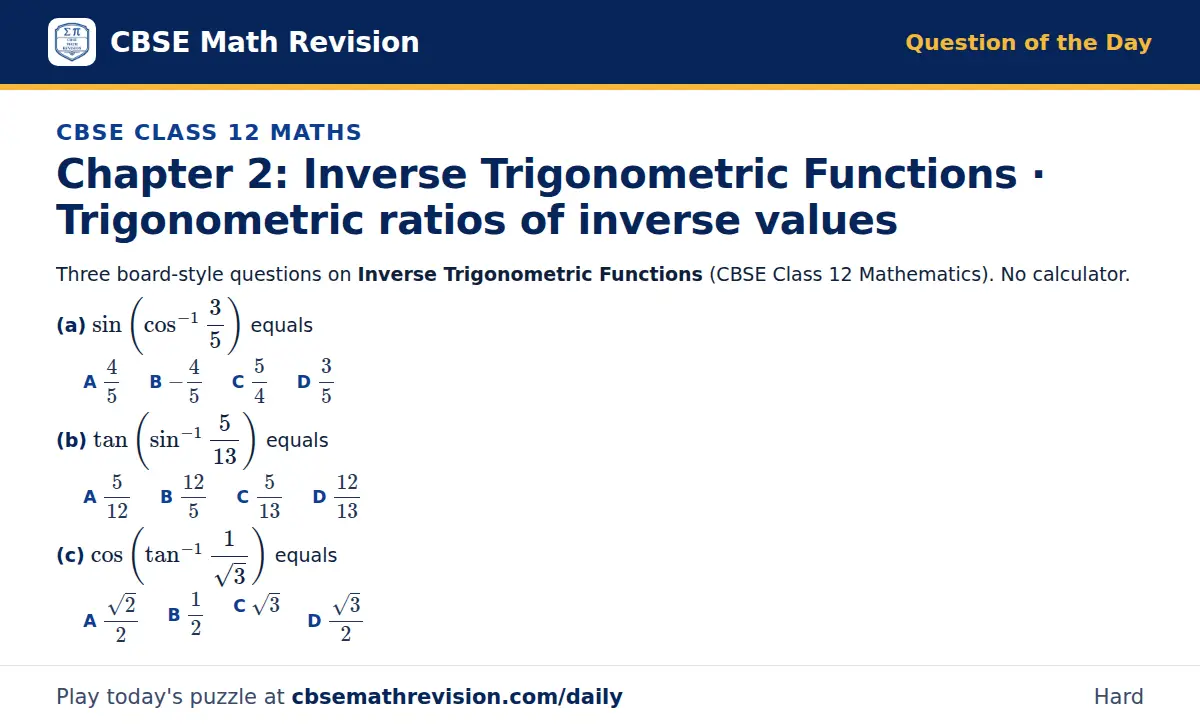
Chapter 2: Inverse Trigonometric Functions · Trigonometric ratios of inverse values
Three board-style questions on Inverse Trigonometric Functions (CBSE Class 12 Mathematics). No calculator.
- sin(cos⁻¹35) equals Options: A) 4/5; B) - 4/5; C) 5/4; D) 3/5
- tan(sin⁻¹5/13) equals Options: A) 5/12; B) 12/5; C) 5/13; D) 12/13
- cos(tan⁻¹1/(√3)) equals Options: A) (√2)/2; B) 1/2; C) √3; D) (√3)/2
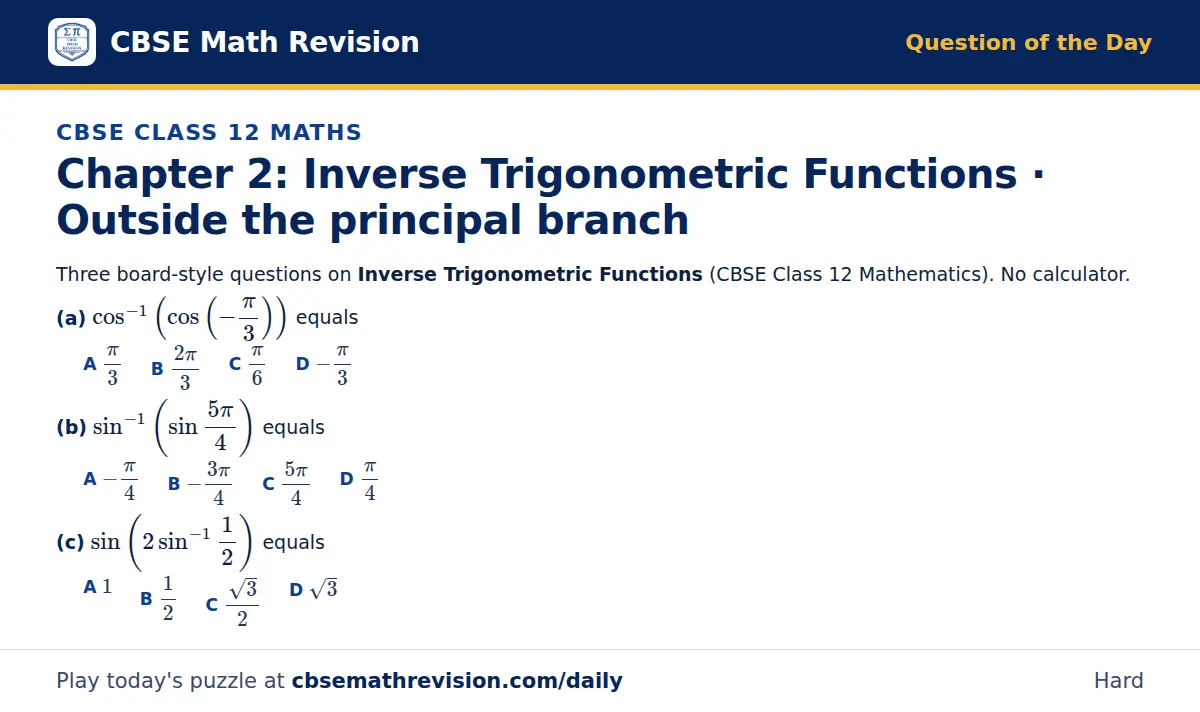
Chapter 2: Inverse Trigonometric Functions · Outside the principal branch
Three board-style questions on Inverse Trigonometric Functions (CBSE Class 12 Mathematics). No calculator.
- cos⁻¹(cos(-(π)/3)) equals Options: A) (π)/3; B) (2 π)/3; C) (π)/6; D) - (π)/3
- sin⁻¹(sin(5π)/4) equals Options: A) - (π)/4; B) - (3 π)/4; C) (5 π)/4; D) (π)/4
- sin(2sin⁻¹12) equals Options: A) 1; B) 1/2; C) (√3)/2; D) √3
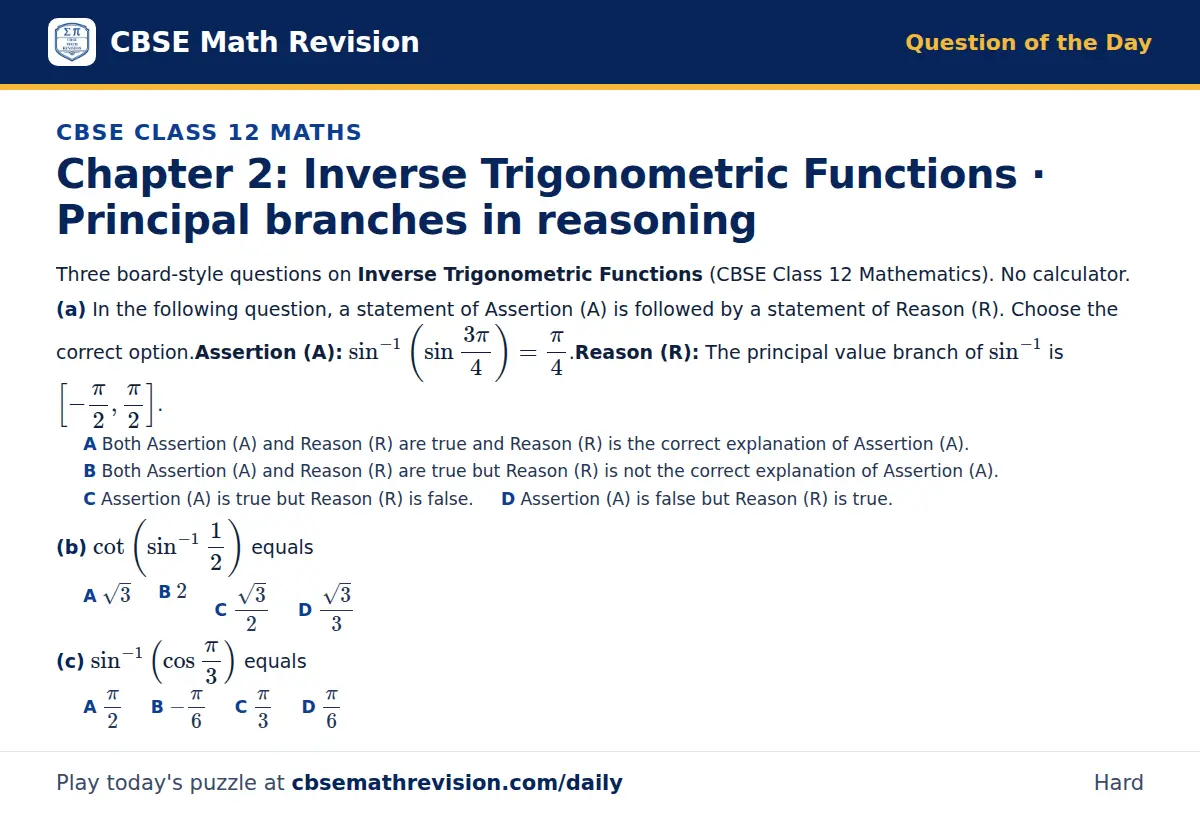
Chapter 2: Inverse Trigonometric Functions · Principal branches in reasoning
Three board-style questions on Inverse Trigonometric Functions (CBSE Class 12 Mathematics). No calculator.
- In the following question, a statement of Assertion (A) is followed by a statement of Reason (R). Choose the correct option. Assertion (A): sin⁻¹(sin(3π)/4) = (π)/4. Reason (R): The principal value branch of sin⁻¹ is [-(π)/2, (π)/2]. Options: A) Both Assertion (A) and Reason (R) are true and Reason (R) is the correct explanation of Assertion (A).; B) Both Assertion (A) and Reason (R) are true but Reason (R) is not the correct explanation of Assertion (A).; C) Assertion (A) is true but Reason (R) is false.; D) Assertion (A) is false but Reason (R) is true.
- cot(sin⁻¹12) equals Options: A) √3; B) 2; C) (√3)/2; D) (√3)/3
- sin⁻¹(cos(π)/3) equals Options: A) (π)/2; B) - (π)/6; C) (π)/3; D) (π)/6
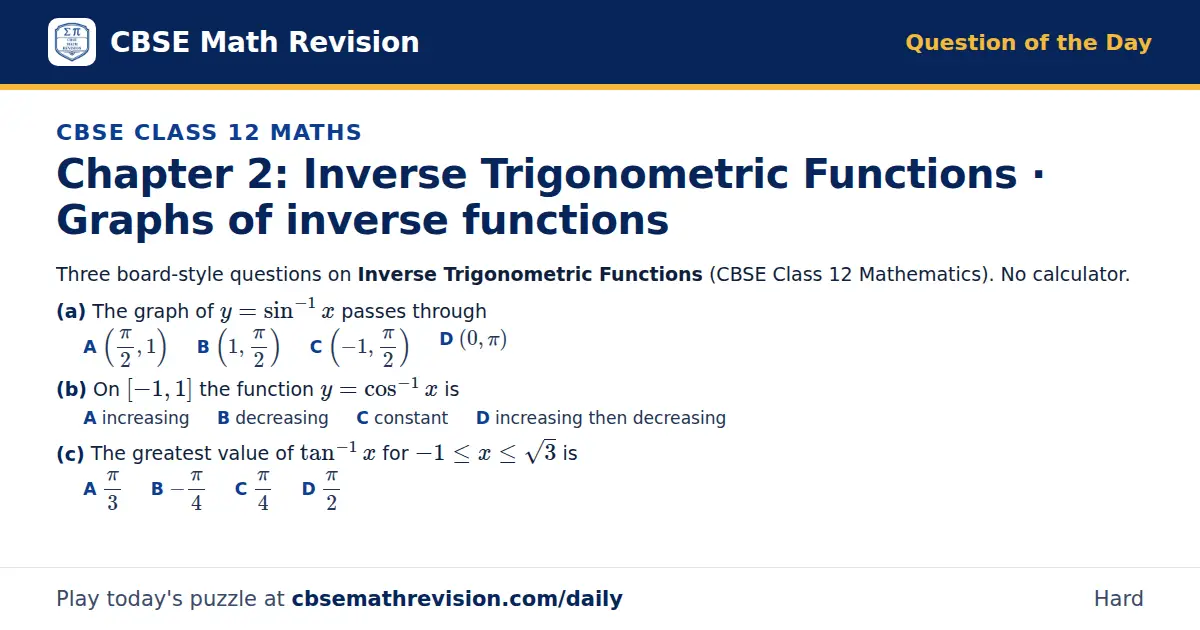
Chapter 2: Inverse Trigonometric Functions · Graphs of inverse functions
Three board-style questions on Inverse Trigonometric Functions (CBSE Class 12 Mathematics). No calculator.
- The graph of y = sin⁻¹x passes through Options: A) ((π)/2, 1); B) (1, (π)/2); C) (-1, (π)/2); D) (0, π)
- On [-1, 1] the function y = cos⁻¹x is Options: A) increasing; B) decreasing; C) constant; D) increasing then decreasing
- The greatest value of tan⁻¹x for -1 ≤ x ≤ √3 is Options: A) (π)/3; B) - (π)/4; C) (π)/4; D) (π)/2
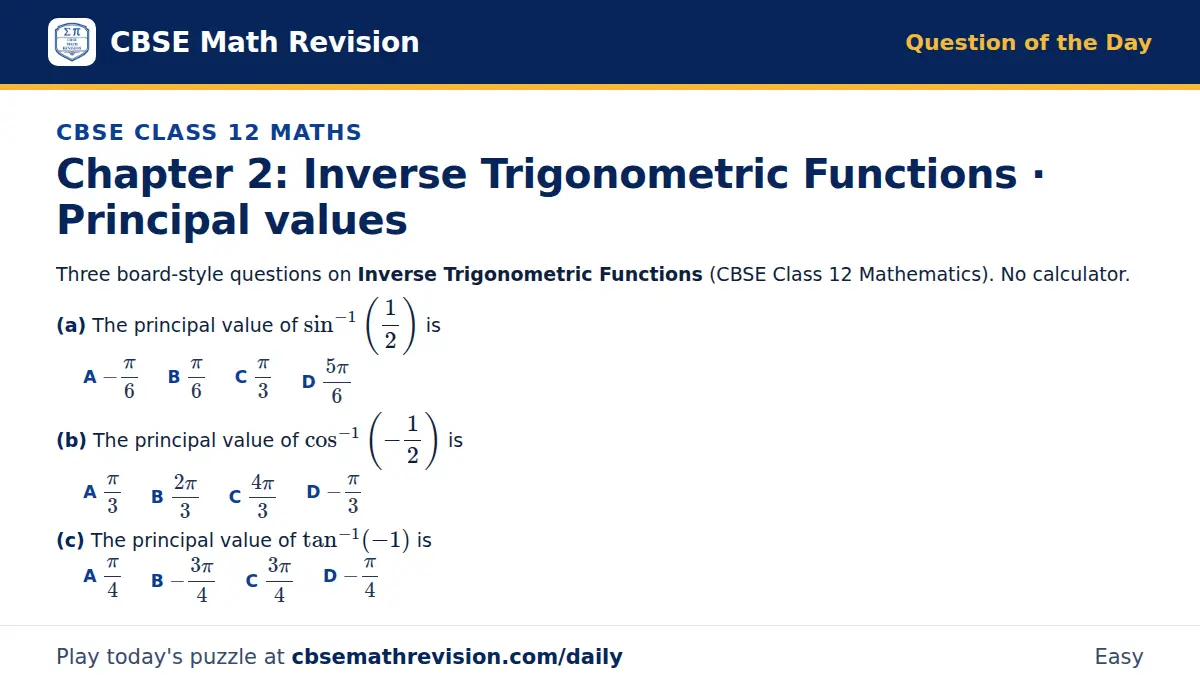
Chapter 2: Inverse Trigonometric Functions · Principal values
Three board-style questions on Inverse Trigonometric Functions (CBSE Class 12 Mathematics). No calculator.
- The principal value of sin⁻¹(12) is Options: A) - (π)/6; B) (π)/6; C) (π)/3; D) (5 π)/6
- The principal value of cos⁻¹(-12) is Options: A) (π)/3; B) (2 π)/3; C) (4 π)/3; D) - (π)/3
- The principal value of tan⁻¹(-1) is Options: A) (π)/4; B) - (3 π)/4; C) (3 π)/4; D) - (π)/4
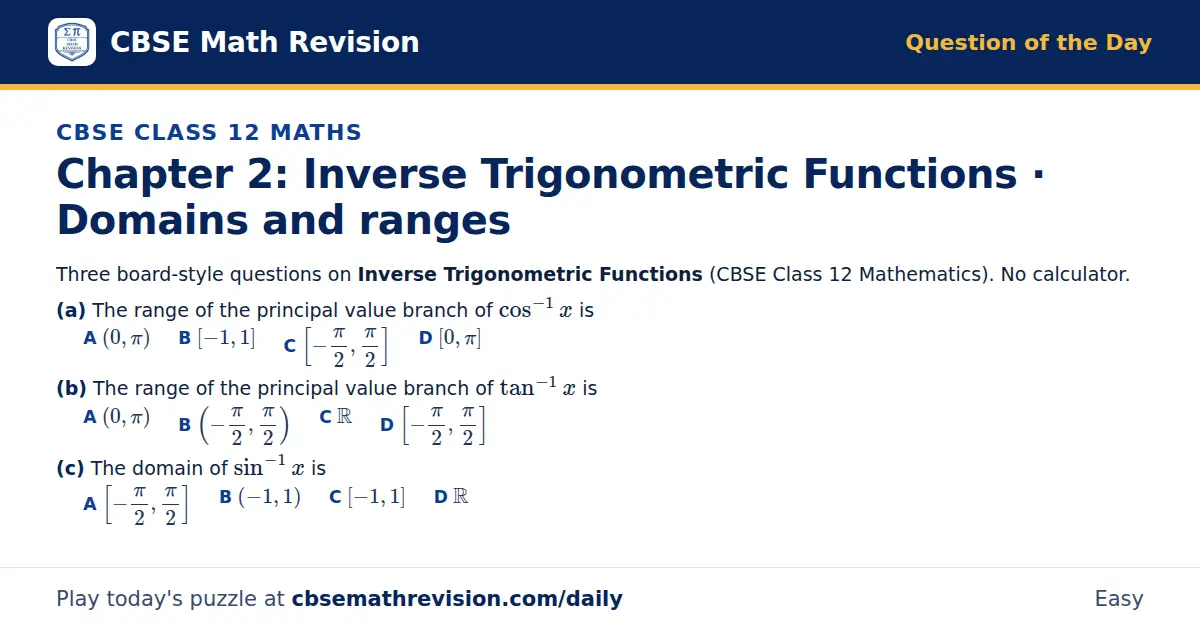
Chapter 2: Inverse Trigonometric Functions · Domains and ranges
Three board-style questions on Inverse Trigonometric Functions (CBSE Class 12 Mathematics). No calculator.
- The range of the principal value branch of cos⁻¹x is Options: A) (0, π); B) [-1, 1]; C) [-(π)/2, (π)/2]; D) [0, π]
- The range of the principal value branch of tan⁻¹x is Options: A) (0, π); B) (-(π)/2, (π)/2); C) ℝ; D) [-(π)/2, (π)/2]
- The domain of sin⁻¹x is Options: A) [-(π)/2, (π)/2]; B) (-1, 1); C) [-1, 1]; D) ℝ
Chapter 3: Matrices
![CBSE Class 12 Maths Question of the Day on Matrices, a 3-part multiple-choice question: Three board-style questions on Matrices (CBSE Class 12 Mathematics). No calculator. (a) The 3 × 3 matrix A = [a_ij] with a_ij = i² - j² is (b) A, B, C are…](/cbse-frontend/img/questions/cbse-maths-class-12-matrices-question-of-the-day-cbse12-ch03.webp)
Chapter 3: Matrices
Three board-style questions on Matrices (CBSE Class 12 Mathematics). No calculator.
- The 3 × 3 matrix A = [a_ij] with a_ij = i² - j² is Options: A) a skew-symmetric matrix; B) a symmetric matrix; C) a diagonal matrix; D) a scalar matrix
- A, B, C are matrices of orders 2 × 3, 3 × 2 and 2 × 2 respectively. Which of the following is defined? Options: A) AC; B) BA + C; C) AB + C; D) CB
- If 2x - y 3; x + y z = 5 3; 7 2z - 4, then x + y + z equals Options: A) 9; B) 11; C) 15; D) 7
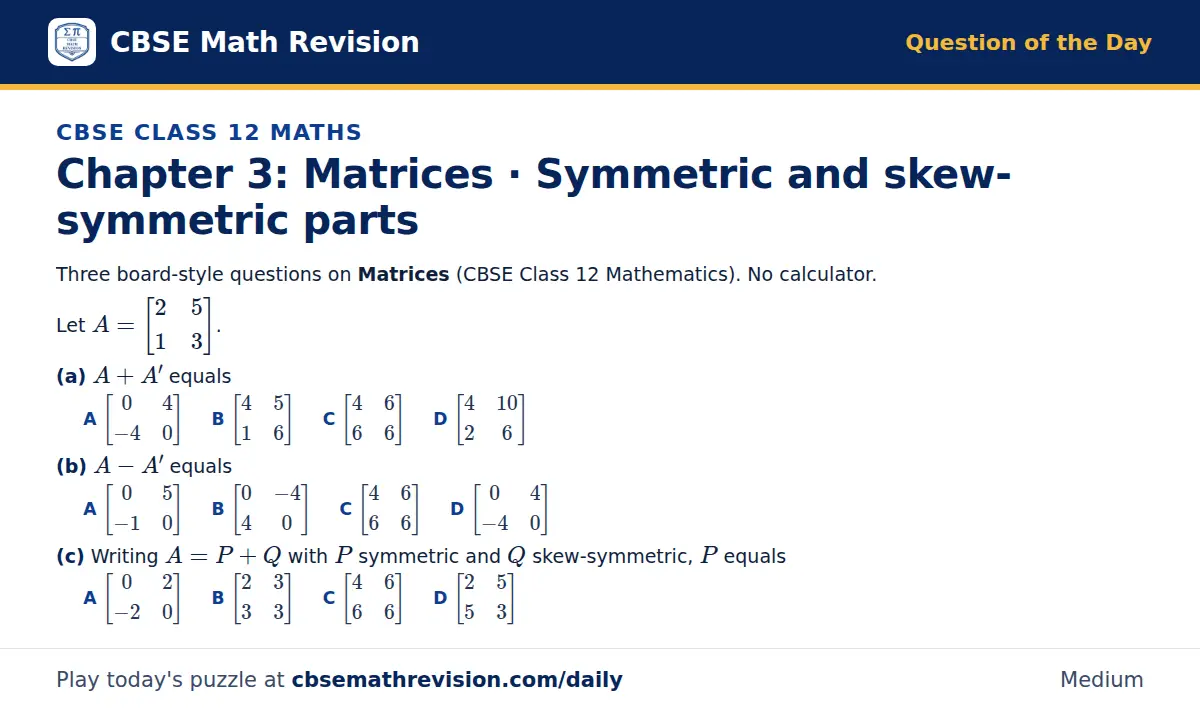
Chapter 3: Matrices · Symmetric and skew-symmetric parts
Three board-style questions on Matrices (CBSE Class 12 Mathematics). No calculator. Let A = 2 5; 1 3.
- A + A' equals Options: A) 0 4; -4 0; B) 4 5; 1 6; C) 4 6; 6 6; D) 4 10; 2 6
- A - A' equals Options: A) 0 5; -1 0; B) 0 -4; 4 0; C) 4 6; 6 6; D) 0 4; -4 0
- Writing A = P + Q with P symmetric and Q skew-symmetric, P equals Options: A) 0 2; -2 0; B) 2 3; 3 3; C) 4 6; 6 6; D) 2 5; 5 3
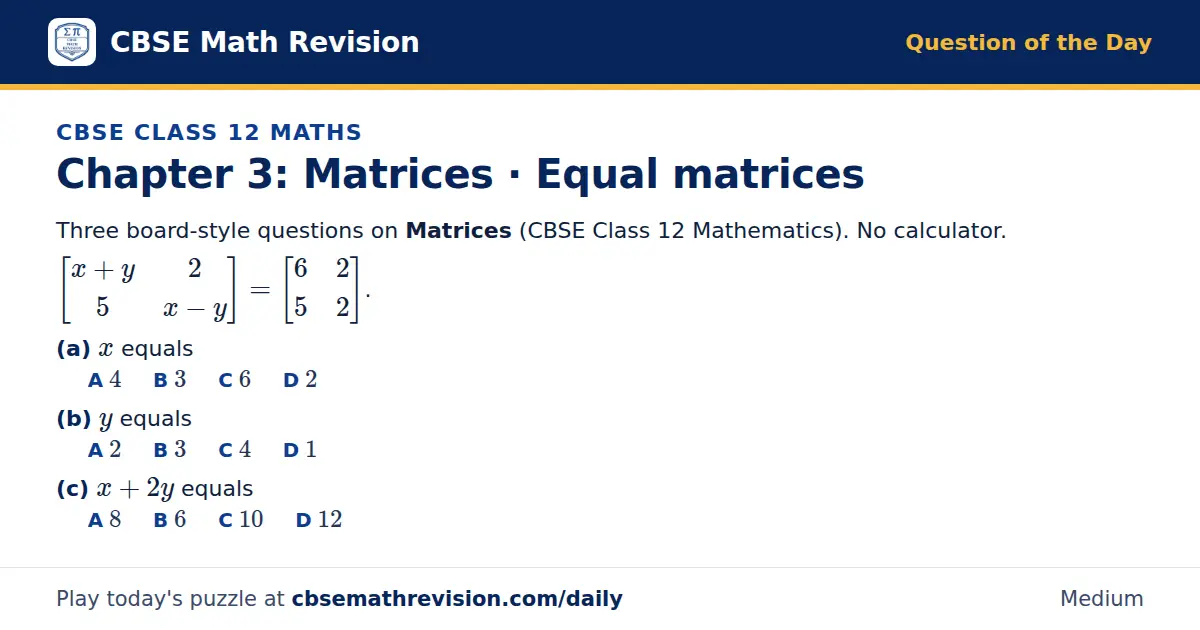
Chapter 3: Matrices · Equal matrices
Three board-style questions on Matrices (CBSE Class 12 Mathematics). No calculator. x + y 2; 5 x - y = 6 2; 5 2.
- x equals Options: A) 4; B) 3; C) 6; D) 2
- y equals Options: A) 2; B) 3; C) 4; D) 1
- x + 2y equals Options: A) 8; B) 6; C) 10; D) 12
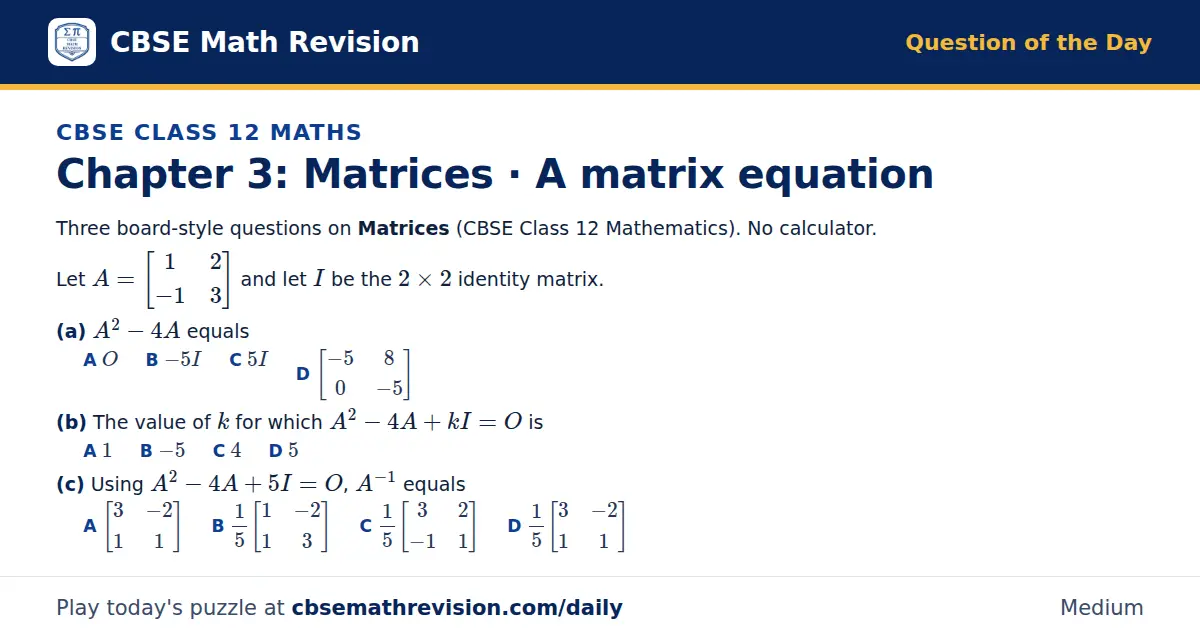
Chapter 3: Matrices · A matrix equation
Three board-style questions on Matrices (CBSE Class 12 Mathematics). No calculator. Let A = 1 2; -1 3 and let I be the 2 × 2 identity matrix.
- A² - 4A equals Options: A) O; B) -5I; C) 5I; D) -5 8; 0 -5
- The value of k for which A² - 4A + kI = O is Options: A) 1; B) -5; C) 4; D) 5
- Using A² - 4A + 5I = O, A⁻¹ equals Options: A) 3 -2; 1 1; B) 15 1 -2; 1 3; C) 15 3 2; -1 1; D) 15 3 -2; 1 1
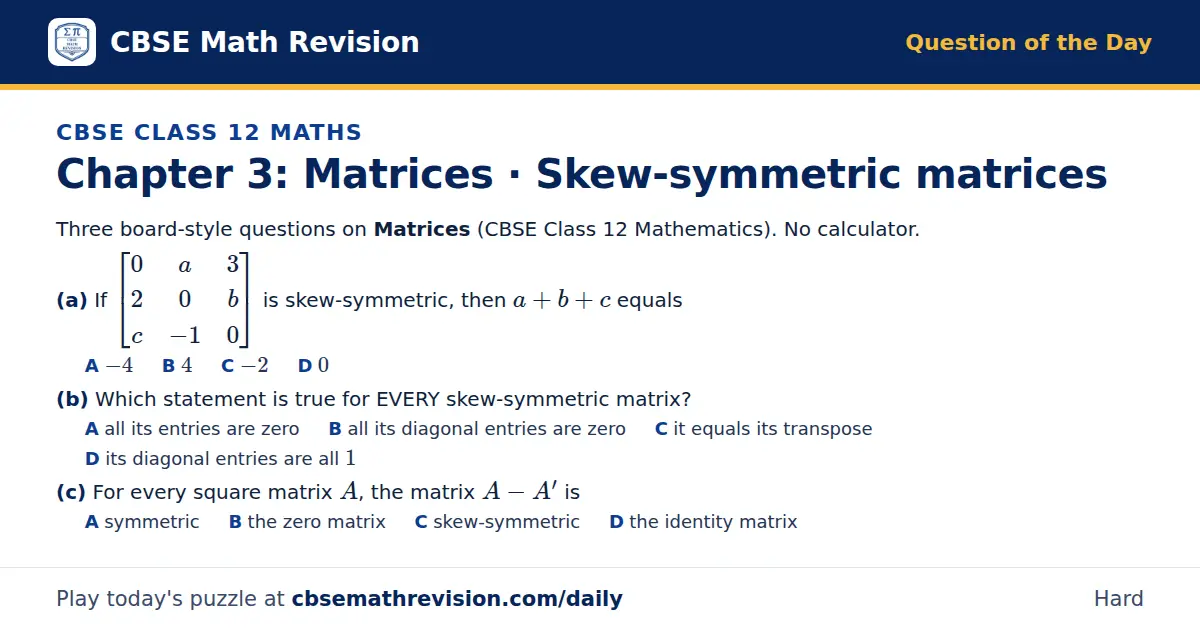
Chapter 3: Matrices · Skew-symmetric matrices
Three board-style questions on Matrices (CBSE Class 12 Mathematics). No calculator.
- If 0 a 3; 2 0 b; c -1 0 is skew-symmetric, then a + b + c equals Options: A) -4; B) 4; C) -2; D) 0
- Which statement is true for EVERY skew-symmetric matrix? Options: A) all its entries are zero; B) all its diagonal entries are zero; C) it equals its transpose; D) its diagonal entries are all 1
- For every square matrix A, the matrix A - A' is Options: A) symmetric; B) the zero matrix; C) skew-symmetric; D) the identity matrix
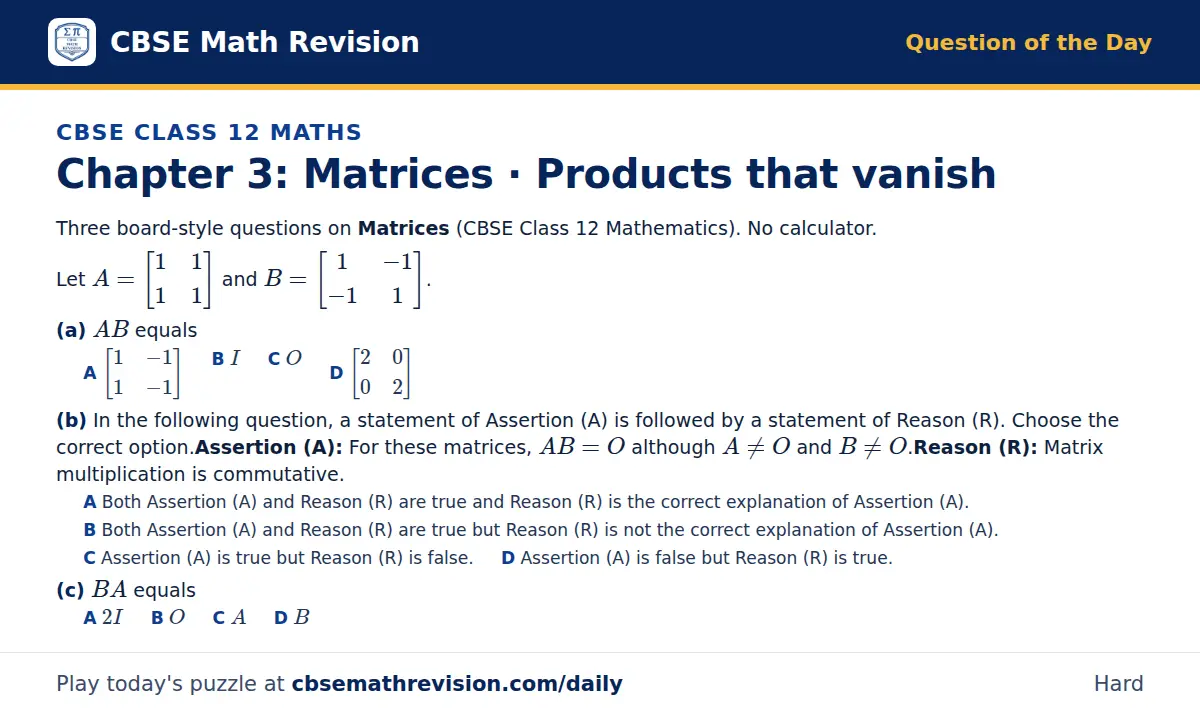
Chapter 3: Matrices · Products that vanish
Three board-style questions on Matrices (CBSE Class 12 Mathematics). No calculator. Let A = 1 1; 1 1 and B = 1 -1; -1 1.
- AB equals Options: A) 1 -1; 1 -1; B) I; C) O; D) 2 0; 0 2
- In the following question, a statement of Assertion (A) is followed by a statement of Reason (R). Choose the correct option. Assertion (A): For these matrices, AB = O although A ≠ O and B ≠ O. Reason (R): Matrix multiplication is commutative. Options: A) Both Assertion (A) and Reason (R) are true and Reason (R) is the correct explanation of Assertion (A).; B) Both Assertion (A) and Reason (R) are true but Reason (R) is not the correct explanation of Assertion (A).; C) Assertion (A) is true but Reason (R) is false.; D) Assertion (A) is false but Reason (R) is true.
- BA equals Options: A) 2I; B) O; C) A; D) B
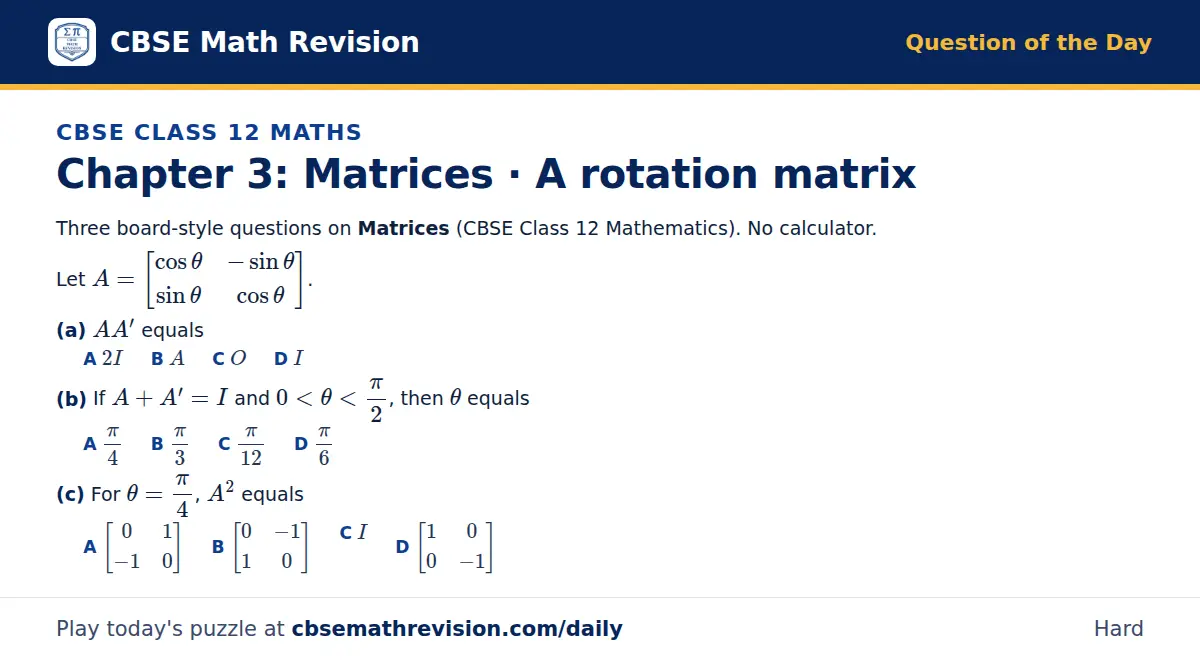
Chapter 3: Matrices · A rotation matrix
Three board-style questions on Matrices (CBSE Class 12 Mathematics). No calculator. Let A = cosθ -sinθ; sinθ cosθ.
- AA' equals Options: A) 2I; B) A; C) O; D) I
- If A + A' = I and 0 < θ < (π)/2, then θ equals Options: A) (π)/4; B) (π)/3; C) (π)/12; D) (π)/6
- For θ = (π)/4, A² equals Options: A) 0 1; -1 0; B) 0 -1; 1 0; C) I; D) 1 0; 0 -1
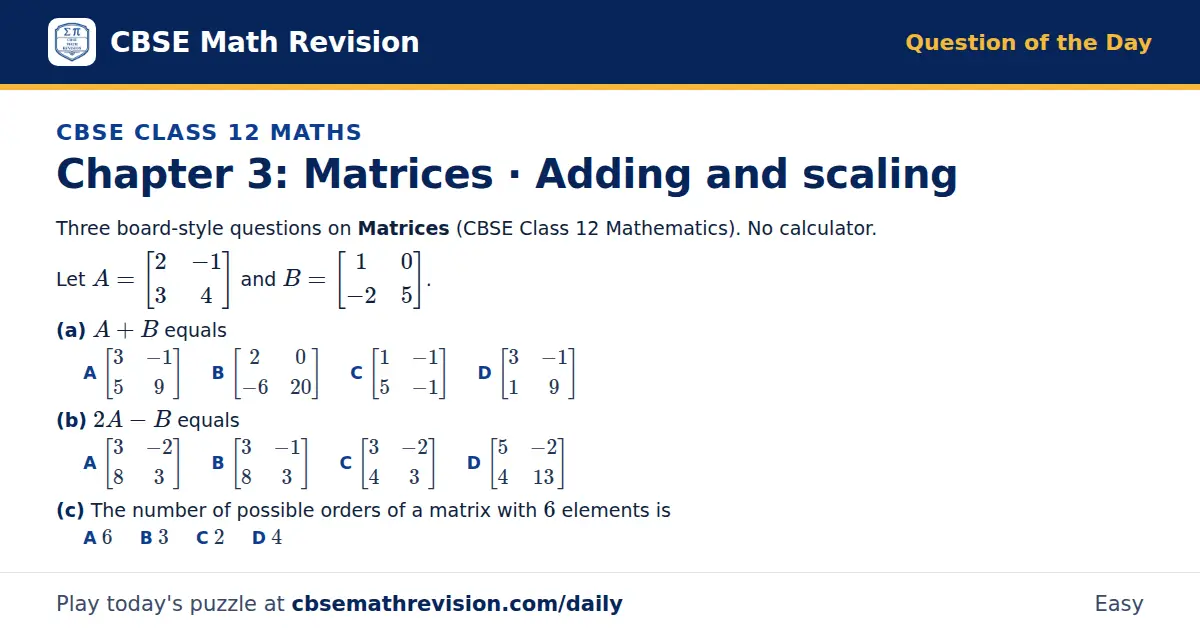
Chapter 3: Matrices · Adding and scaling
Three board-style questions on Matrices (CBSE Class 12 Mathematics). No calculator. Let A = 2 -1; 3 4 and B = 1 0; -2 5.
- A + B equals Options: A) 3 -1; 5 9; B) 2 0; -6 20; C) 1 -1; 5 -1; D) 3 -1; 1 9
- 2A - B equals Options: A) 3 -2; 8 3; B) 3 -1; 8 3; C) 3 -2; 4 3; D) 5 -2; 4 13
- The number of possible orders of a matrix with 6 elements is Options: A) 6; B) 3; C) 2; D) 4
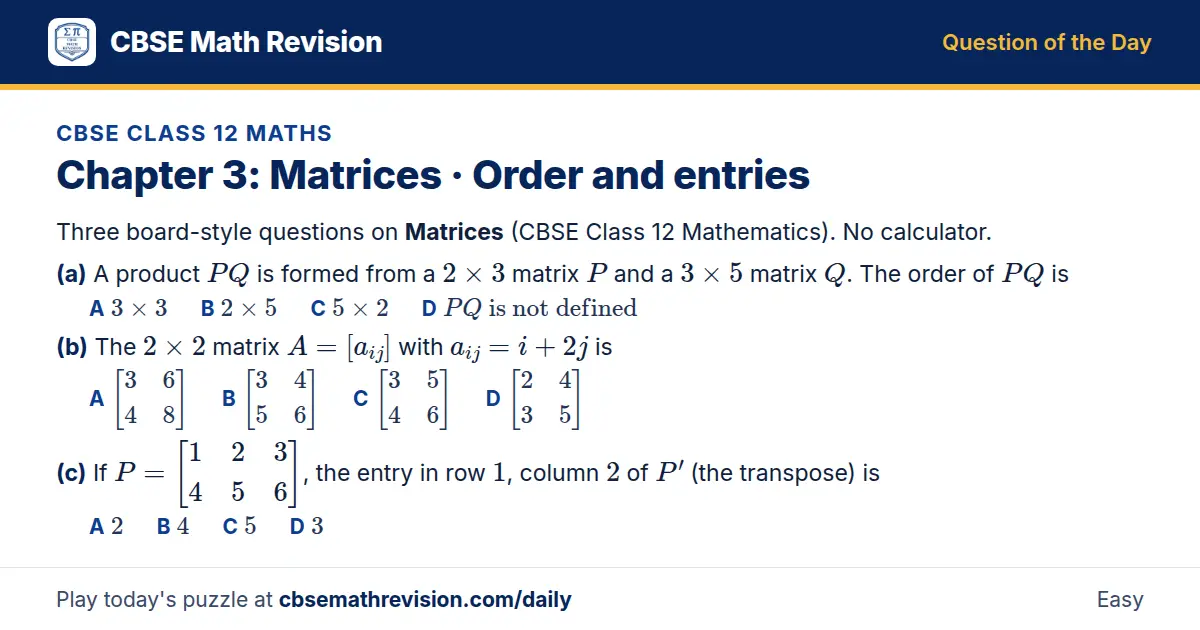
Chapter 3: Matrices · Order and entries
Three board-style questions on Matrices (CBSE Class 12 Mathematics). No calculator.
- A product PQ is formed from a 2 × 3 matrix P and a 3 × 5 matrix Q. The order of PQ is Options: A) 3 × 3; B) 2 × 5; C) 5 × 2; D) PQ is not defined
- The 2 × 2 matrix A = [a_ij] with a_ij = i + 2j is Options: A) 3 6; 4 8; B) 3 4; 5 6; C) 3 5; 4 6; D) 2 4; 3 5
- If P = 1 2 3; 4 5 6, the entry in row 1, column 2 of P' (the transpose) is Options: A) 2; B) 4; C) 5; D) 3
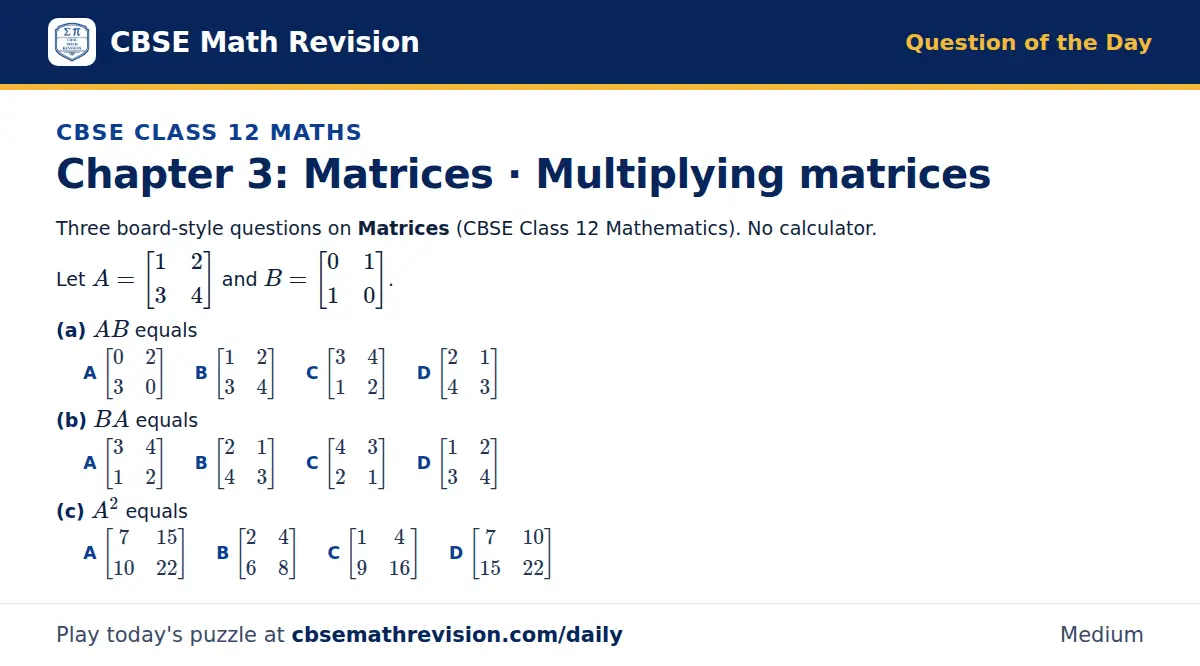
Chapter 3: Matrices · Multiplying matrices
Three board-style questions on Matrices (CBSE Class 12 Mathematics). No calculator. Let A = 1 2; 3 4 and B = 0 1; 1 0.
- AB equals Options: A) 0 2; 3 0; B) 1 2; 3 4; C) 3 4; 1 2; D) 2 1; 4 3
- BA equals Options: A) 3 4; 1 2; B) 2 1; 4 3; C) 4 3; 2 1; D) 1 2; 3 4
- A² equals Options: A) 7 15; 10 22; B) 2 4; 6 8; C) 1 4; 9 16; D) 7 10; 15 22
Chapter 4: Determinants
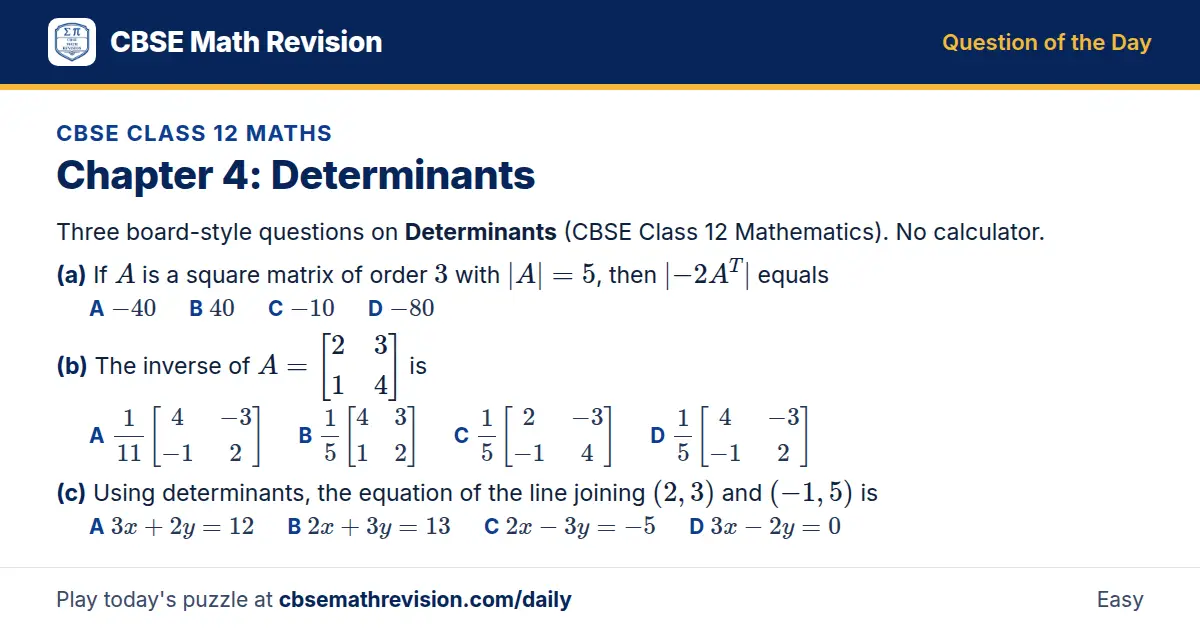
Chapter 4: Determinants
Three board-style questions on Determinants (CBSE Class 12 Mathematics). No calculator.
- If A is a square matrix of order 3 with |A| = 5, then |-2A^T| equals Options: A) -40; B) 40; C) -10; D) -80
- The inverse of A = 2 3; 1 4 is Options: A) 1/11 4 -3; -1 2; B) 15 4 3; 1 2; C) 15 2 -3; -1 4; D) 15 4 -3; -1 2
- Using determinants, the equation of the line joining (2, 3) and (-1, 5) is Options: A) 3x + 2y = 12; B) 2x + 3y = 13; C) 2x - 3y = -5; D) 3x - 2y = 0
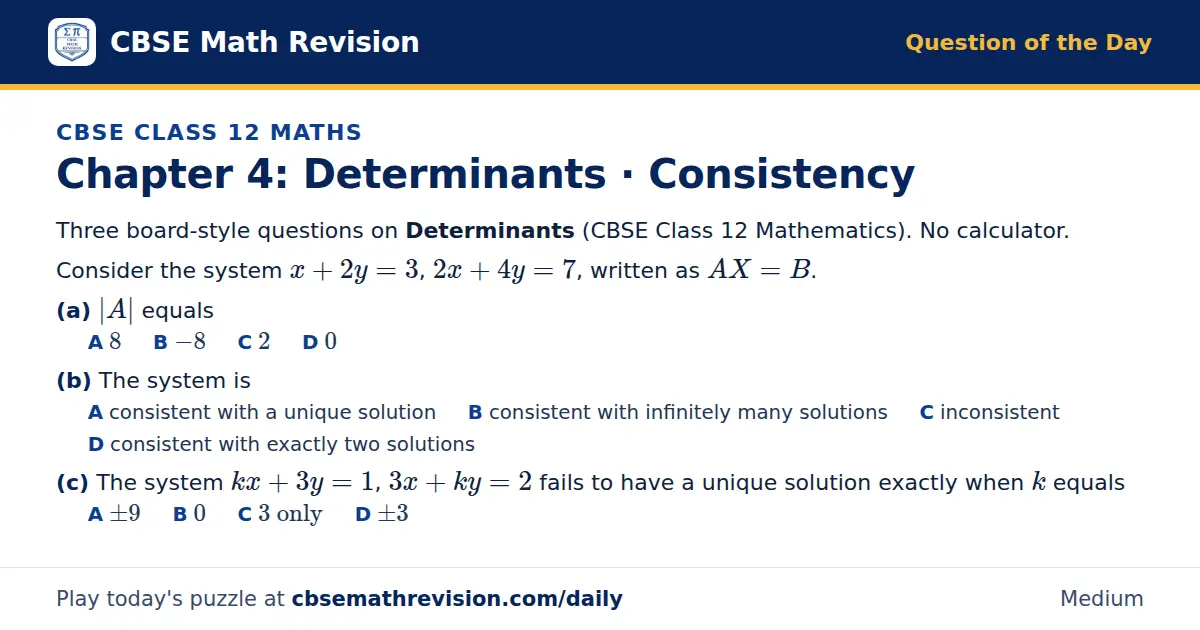
Chapter 4: Determinants · Consistency
Three board-style questions on Determinants (CBSE Class 12 Mathematics). No calculator. Consider the system x + 2y = 3, 2x + 4y = 7, written as AX = B.
- |A| equals Options: A) 8; B) -8; C) 2; D) 0
- The system is Options: A) consistent with a unique solution; B) consistent with infinitely many solutions; C) inconsistent; D) consistent with exactly two solutions
- The system kx + 3y = 1, 3x + ky = 2 fails to have a unique solution exactly when k equals Options: A) ± 9; B) 0; C) 3 only; D) ± 3
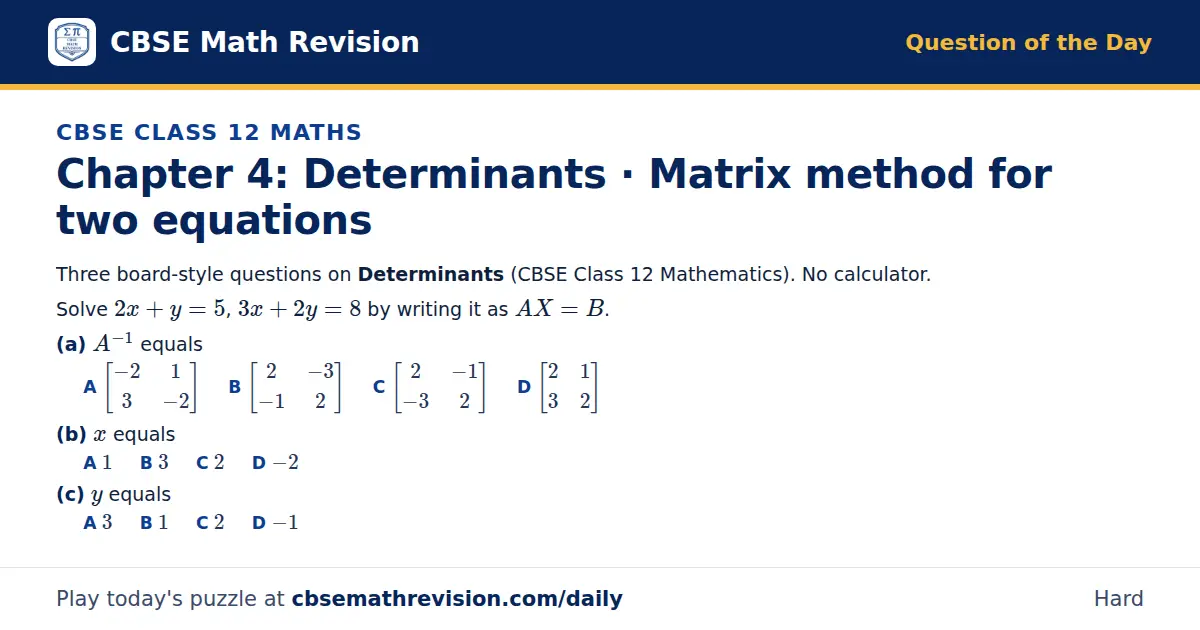
Chapter 4: Determinants · Matrix method for two equations
Three board-style questions on Determinants (CBSE Class 12 Mathematics). No calculator. Solve 2x + y = 5, 3x + 2y = 8 by writing it as AX = B.
- A⁻¹ equals Options: A) -2 1; 3 -2; B) 2 -3; -1 2; C) 2 -1; -3 2; D) 2 1; 3 2
- x equals Options: A) 1; B) 3; C) 2; D) -2
- y equals Options: A) 3; B) 1; C) 2; D) -1
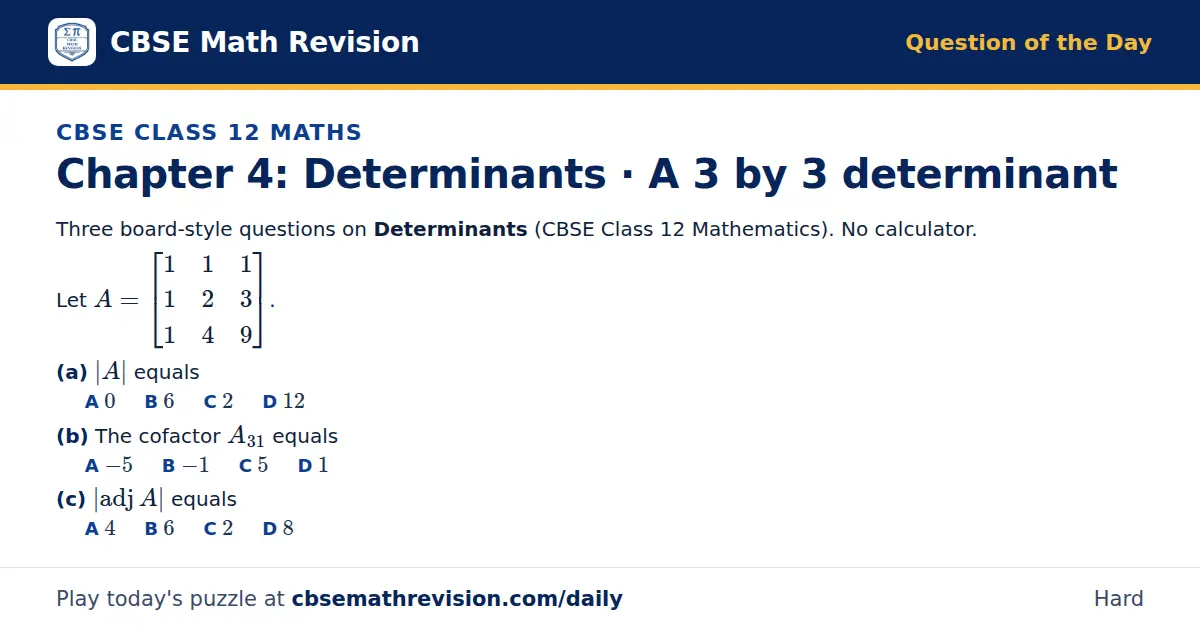
Chapter 4: Determinants · A 3 by 3 determinant
Three board-style questions on Determinants (CBSE Class 12 Mathematics). No calculator. Let A = 1 1 1; 1 2 3; 1 4 9.
- |A| equals Options: A) 0; B) 6; C) 2; D) 12
- The cofactor A_31 equals Options: A) -5; B) -1; C) 5; D) 1
- |adj A| equals Options: A) 4; B) 6; C) 2; D) 8
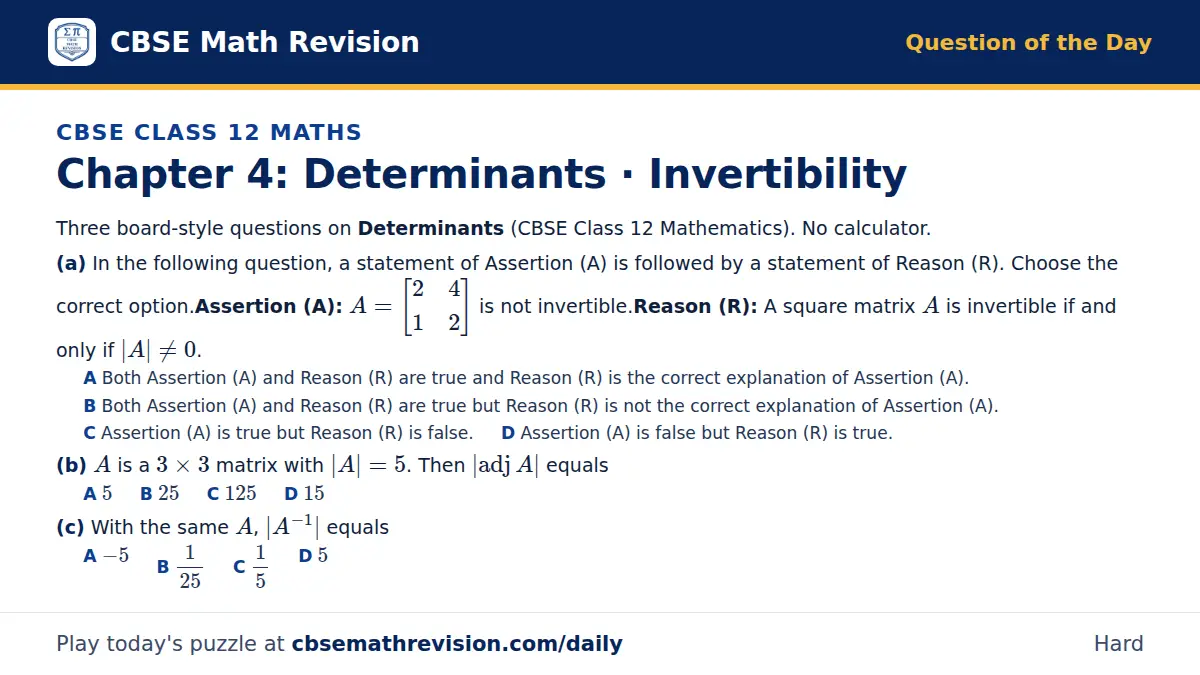
Chapter 4: Determinants · Invertibility
Three board-style questions on Determinants (CBSE Class 12 Mathematics). No calculator.
- In the following question, a statement of Assertion (A) is followed by a statement of Reason (R). Choose the correct option. Assertion (A): A = 2 4; 1 2 is not invertible. Reason (R): A square matrix A is invertible if and only if |A| ≠ 0. Options: A) Both Assertion (A) and Reason (R) are true and Reason (R) is the correct explanation of Assertion (A).; B) Both Assertion (A) and Reason (R) are true but Reason (R) is not the correct explanation of Assertion (A).; C) Assertion (A) is true but Reason (R) is false.; D) Assertion (A) is false but Reason (R) is true.
- A is a 3 × 3 matrix with |A| = 5. Then |adj A| equals Options: A) 5; B) 25; C) 125; D) 15
- With the same A, |A⁻¹| equals Options: A) -5; B) 1/25; C) 1/5; D) 5
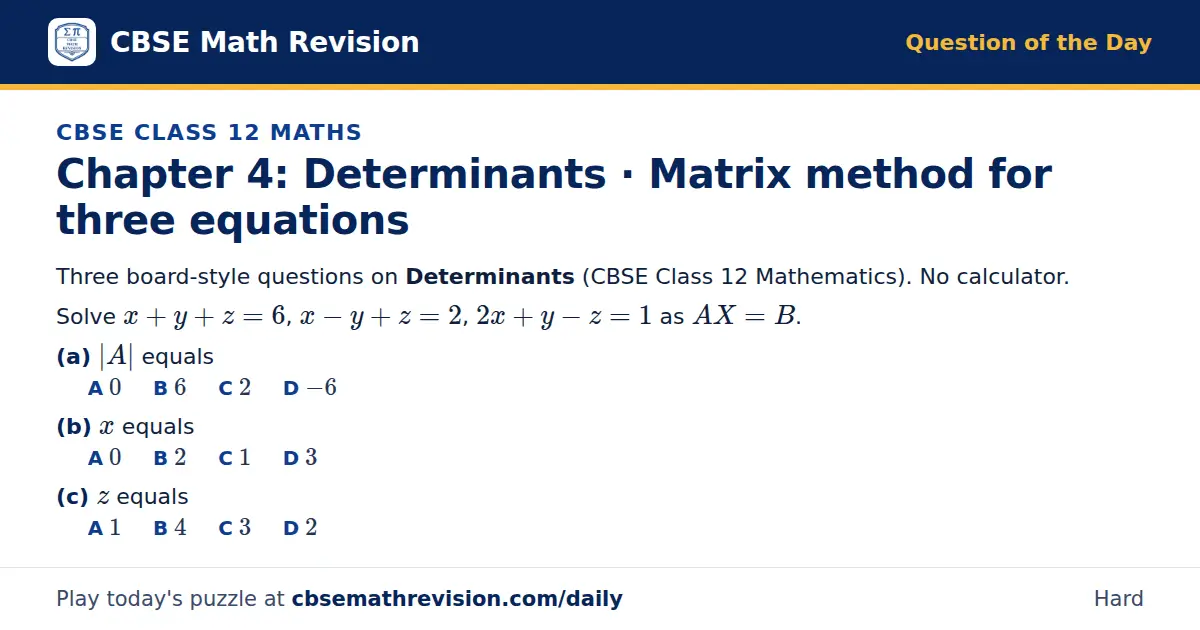
Chapter 4: Determinants · Matrix method for three equations
Three board-style questions on Determinants (CBSE Class 12 Mathematics). No calculator. Solve x + y + z = 6, x - y + z = 2, 2x + y - z = 1 as AX = B.
- |A| equals Options: A) 0; B) 6; C) 2; D) -6
- x equals Options: A) 0; B) 2; C) 1; D) 3
- z equals Options: A) 1; B) 4; C) 3; D) 2
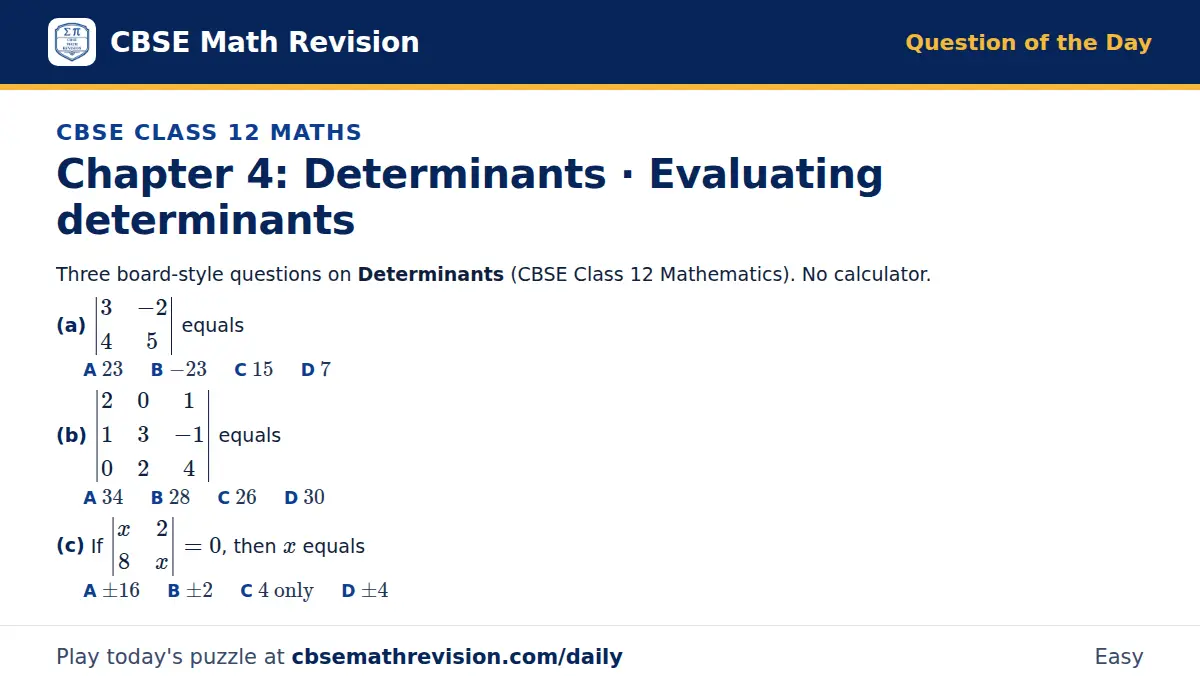
Chapter 4: Determinants · Evaluating determinants
Three board-style questions on Determinants (CBSE Class 12 Mathematics). No calculator.
- 3 -2; 4 5 equals Options: A) 23; B) -23; C) 15; D) 7
- 2 0 1; 1 3 -1; 0 2 4 equals Options: A) 34; B) 28; C) 26; D) 30
- If x 2; 8 x = 0, then x equals Options: A) ± 16; B) ± 2; C) 4 only; D) ± 4
Chapter 4: Determinants · Minors and cofactors
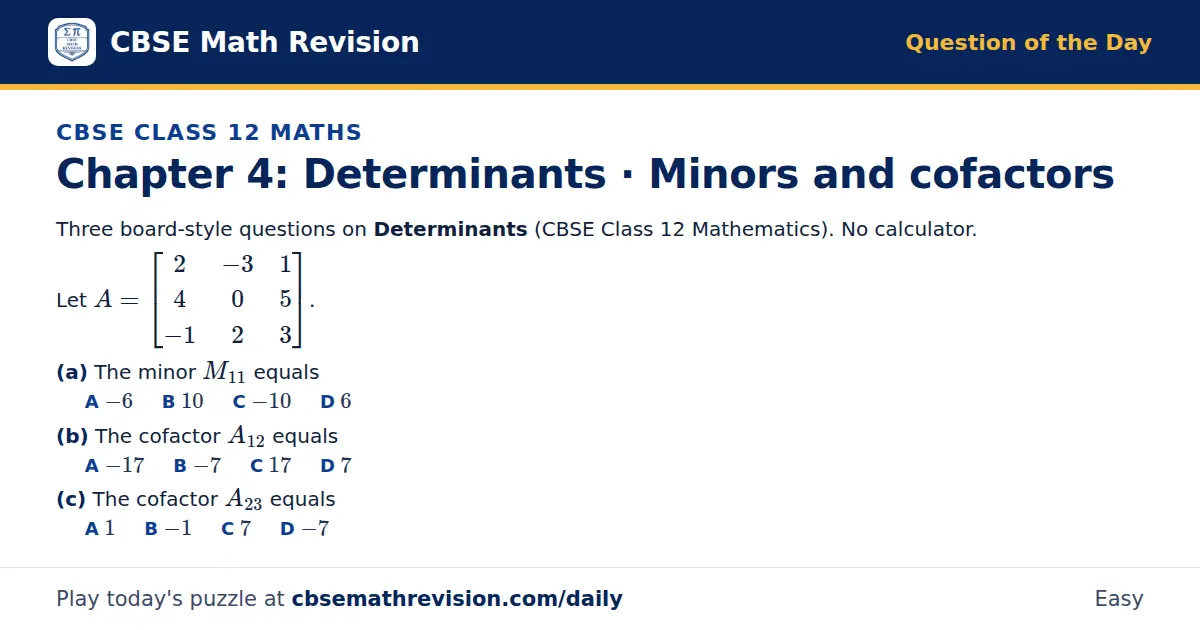
Three board-style questions on Determinants (CBSE Class 12 Mathematics). No calculator. Let A = 2 -3 1; 4 0 5; -1 2 3.
- The minor M_11 equals Options: A) -6; B) 10; C) -10; D) 6
- The cofactor A_12 equals Options: A) -17; B) -7; C) 17; D) 7
- The cofactor A_23 equals Options: A) 1; B) -1; C) 7; D) -7
Chapter 4: Determinants · Area of a triangle
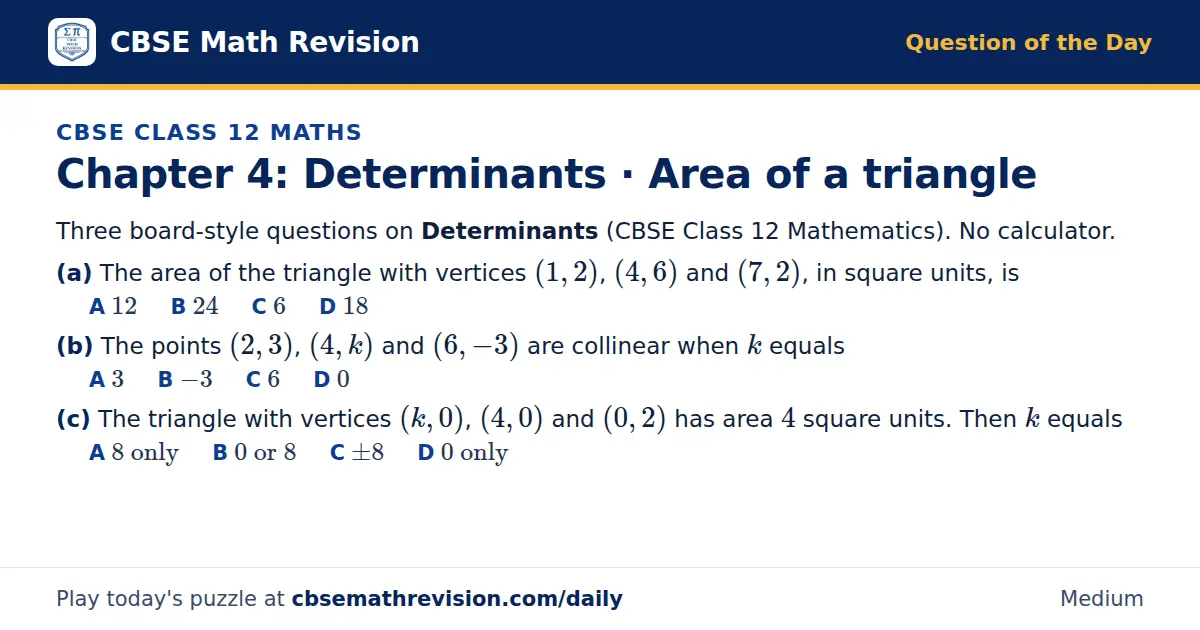
Three board-style questions on Determinants (CBSE Class 12 Mathematics). No calculator.
- The area of the triangle with vertices (1, 2), (4, 6) and (7, 2), in square units, is Options: A) 12; B) 24; C) 6; D) 18
- The points (2, 3), (4, k) and (6, -3) are collinear when k equals Options: A) 3; B) -3; C) 6; D) 0
- The triangle with vertices (k, 0), (4, 0) and (0, 2) has area 4 square units. Then k equals Options: A) 8 only; B) 0 or 8; C) ± 8; D) 0 only
Chapter 4: Determinants · Adjoint and inverse
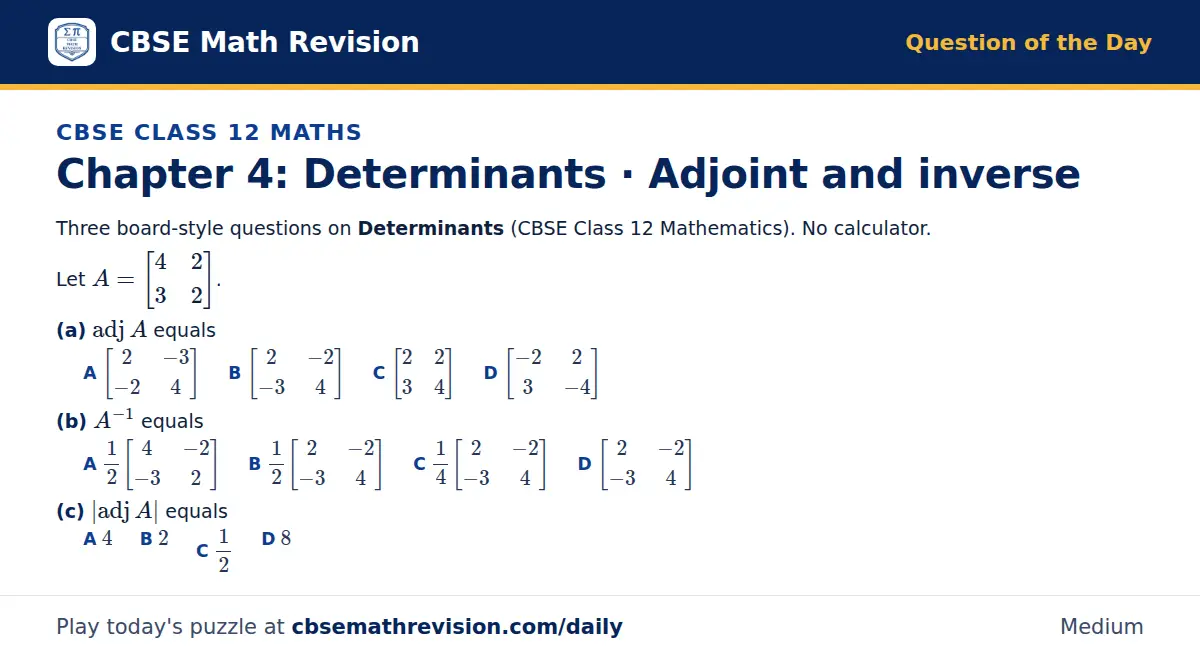
Three board-style questions on Determinants (CBSE Class 12 Mathematics). No calculator. Let A = 4 2; 3 2.
- adj A equals Options: A) 2 -3; -2 4; B) 2 -2; -3 4; C) 2 2; 3 4; D) -2 2; 3 -4
- A⁻¹ equals Options: A) 12 4 -2; -3 2; B) 12 2 -2; -3 4; C) 14 2 -2; -3 4; D) 2 -2; -3 4
- |adj A| equals Options: A) 4; B) 2; C) 1/2; D) 8
More Question of the Day puzzles
Other chapters: Chapters 1–4 · Chapters 5–7 · Chapters 8–10 · Chapters 11–13. See all CBSE Maths daily and weekly questions.