CBSE Class 12 Maths Question of the Day: chapters 5–7
30 CBSE Class 12 Mathematics puzzles from the Question of the Day rotation, chapters 5–7. Each puzzle is three board-style questions on one chapter, shown as an image with the question text written out below it; the answers, hints and step-marked solutions are on the daily puzzle page.
- Play today's CBSE Class 12 Maths puzzle
- ← Chapters 1–4
- Chapters 8–10 →
- All CBSE Class 12 Maths puzzles by chapter
Chapter 5: Continuity and Differentiability
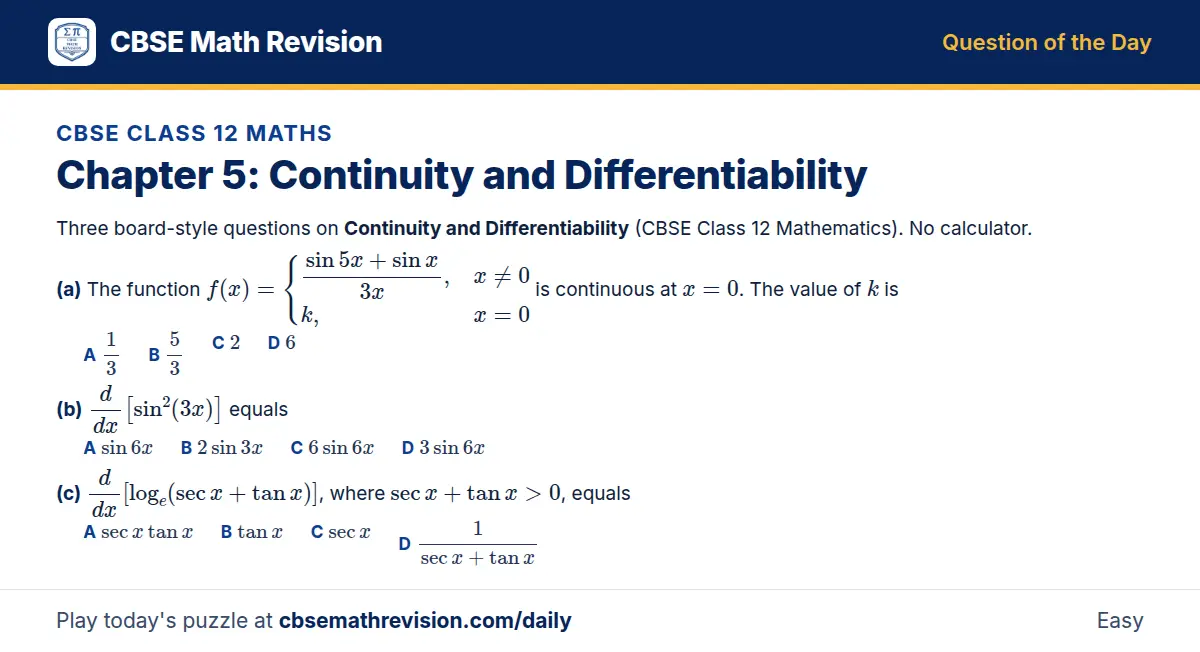
Chapter 5: Continuity and Differentiability
Three board-style questions on Continuity and Differentiability (CBSE Class 12 Mathematics). No calculator.
- The function f(x) = (sin 5x + sin x)/3x, x ≠ 0; k, x = 0 is continuous at x = 0. The value of k is Options: A) 13; B) 53; C) 2; D) 6
- d/dx[sin² (3x)] equals Options: A) sin 6x; B) 2sin 3x; C) 6sin 6x; D) 3sin 6x
- d/dx[log_e(sec x + tan x)], where sec x + tan x > 0, equals Options: A) sec x tan x; B) tan x; C) sec x; D) 1/(sec x + tan x)
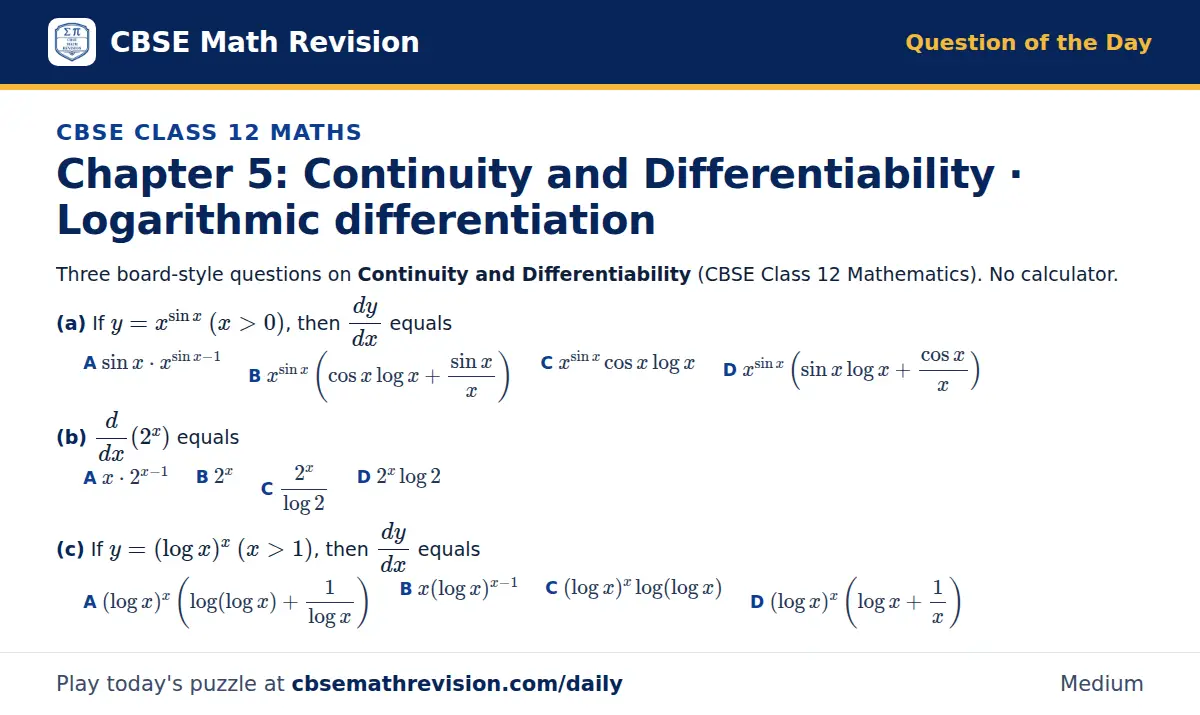
Chapter 5: Continuity and Differentiability · Logarithmic differentiation
Three board-style questions on Continuity and Differentiability (CBSE Class 12 Mathematics). No calculator.
- If y = x^(sin x) (x > 0), then dy/dx equals Options: A) sin x · x^(sin x - 1); B) x^(sin x)(cos xlog x + (sin x)/x); C) x^(sin x)cos xlog x; D) x^(sin x)(sin xlog x + (cos x)/x)
- d/dx(2^x) equals Options: A) x · 2^(x - 1); B) 2^x; C) (2^x)/(log 2); D) 2^xlog 2
- If y = (log x)^x (x > 1), then dy/dx equals Options: A) (log x)^x(log(log x) + 1/(log x)); B) x(log x)^(x - 1); C) (log x)^xlog(log x); D) (log x)^x(log x + 1x)
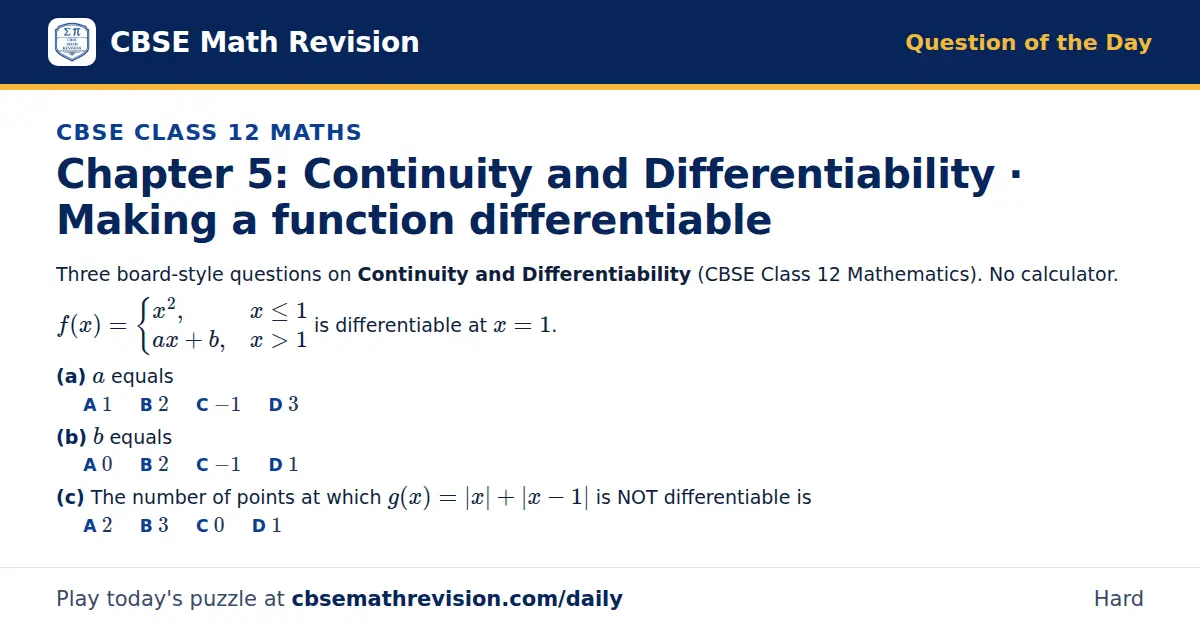
Chapter 5: Continuity and Differentiability · Making a function differentiable
Three board-style questions on Continuity and Differentiability (CBSE Class 12 Mathematics). No calculator. f(x) = x², x ≤ 1; ax + b, x > 1 is differentiable at x = 1.
- a equals Options: A) 1; B) 2; C) -1; D) 3
- b equals Options: A) 0; B) 2; C) -1; D) 1
- The number of points at which g(x) = |x| + |x - 1| is NOT differentiable is Options: A) 2; B) 3; C) 0; D) 1
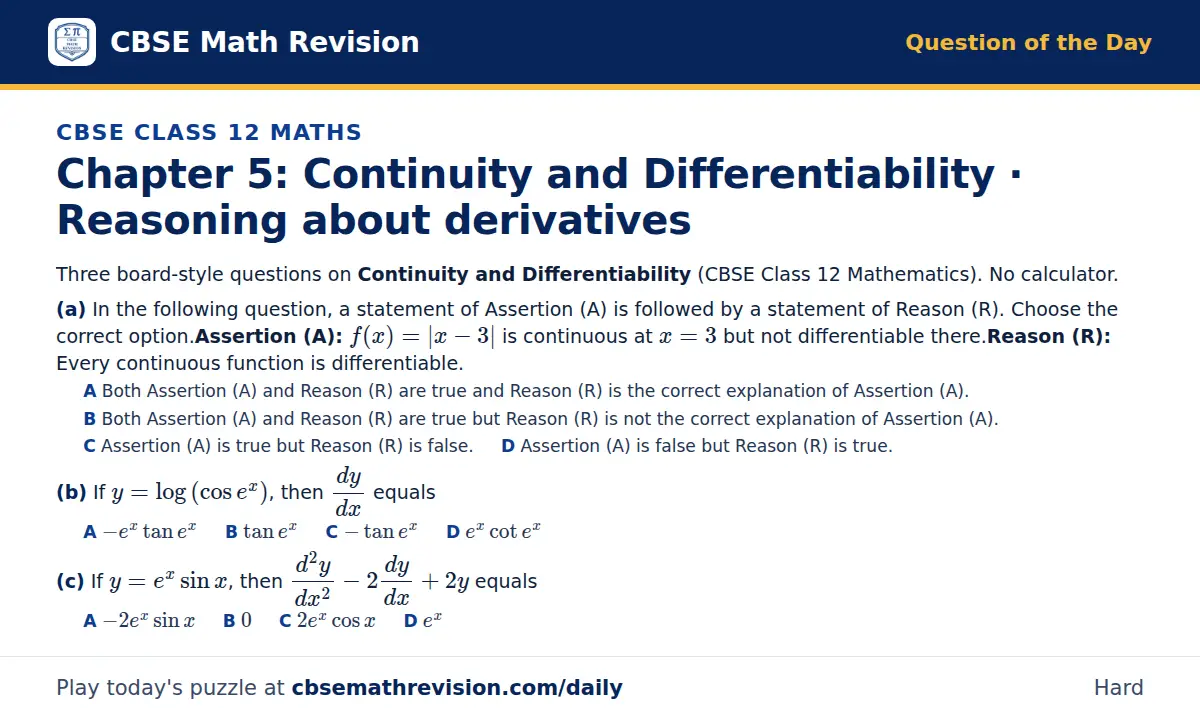
Chapter 5: Continuity and Differentiability · Reasoning about derivatives
Three board-style questions on Continuity and Differentiability (CBSE Class 12 Mathematics). No calculator.
- In the following question, a statement of Assertion (A) is followed by a statement of Reason (R). Choose the correct option. Assertion (A): f(x) = |x - 3| is continuous at x = 3 but not differentiable there. Reason (R): Every continuous function is differentiable. Options: A) Both Assertion (A) and Reason (R) are true and Reason (R) is the correct explanation of Assertion (A).; B) Both Assertion (A) and Reason (R) are true but Reason (R) is not the correct explanation of Assertion (A).; C) Assertion (A) is true but Reason (R) is false.; D) Assertion (A) is false but Reason (R) is true.
- If y = log(cos e^x), then dy/dx equals Options: A) -e^xtan e^x; B) tan e^x; C) -tan e^x; D) e^xcot e^x
- If y = e^xsin x, then (d²y)/(dx²) - 2dy/dx + 2y equals Options: A) - 2 e^x sin x; B) 0; C) 2 e^x cos x; D) e^x
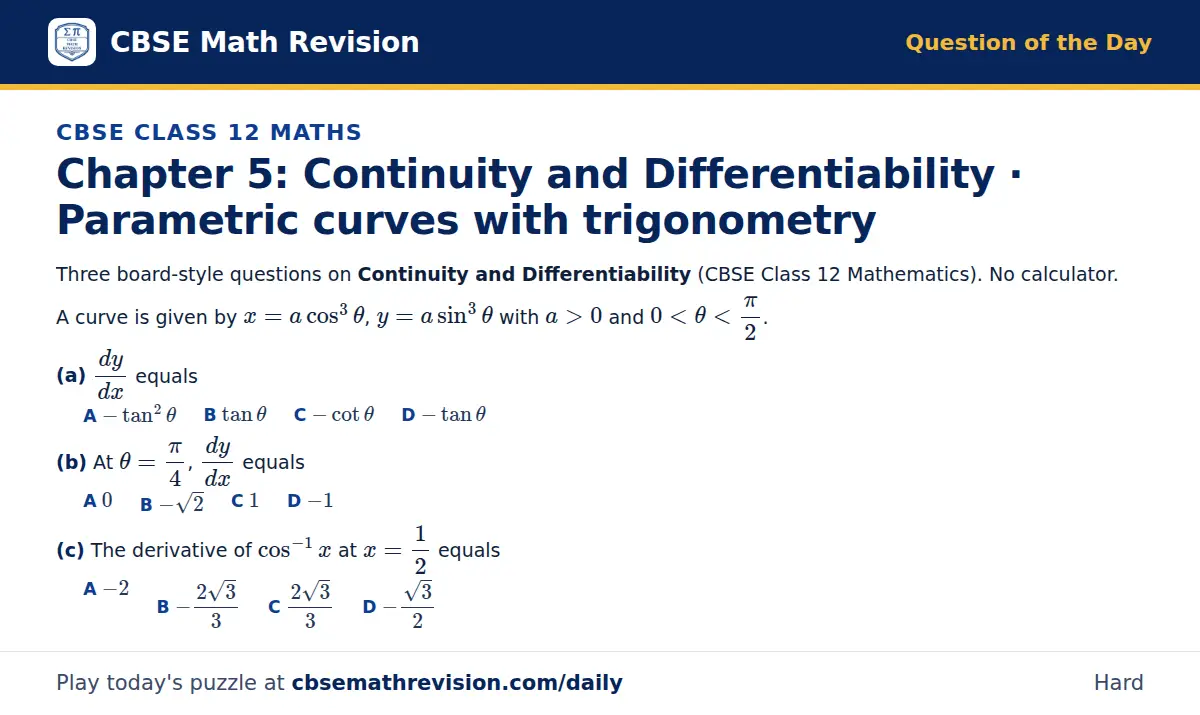
Chapter 5: Continuity and Differentiability · Parametric curves with trigonometry
Three board-style questions on Continuity and Differentiability (CBSE Class 12 Mathematics). No calculator. A curve is given by x = acos³θ, y = asin³θ with a > 0 and 0 < θ < (π)/2.
- dy/dx equals Options: A) -tan²θ; B) tanθ; C) -cotθ; D) -tanθ
- At θ = (π)/4, dy/dx equals Options: A) 0; B) - √2; C) 1; D) -1
- The derivative of cos⁻¹x at x = 12 equals Options: A) -2; B) - (2 √3)/3; C) (2 √3)/3; D) - (√3)/2
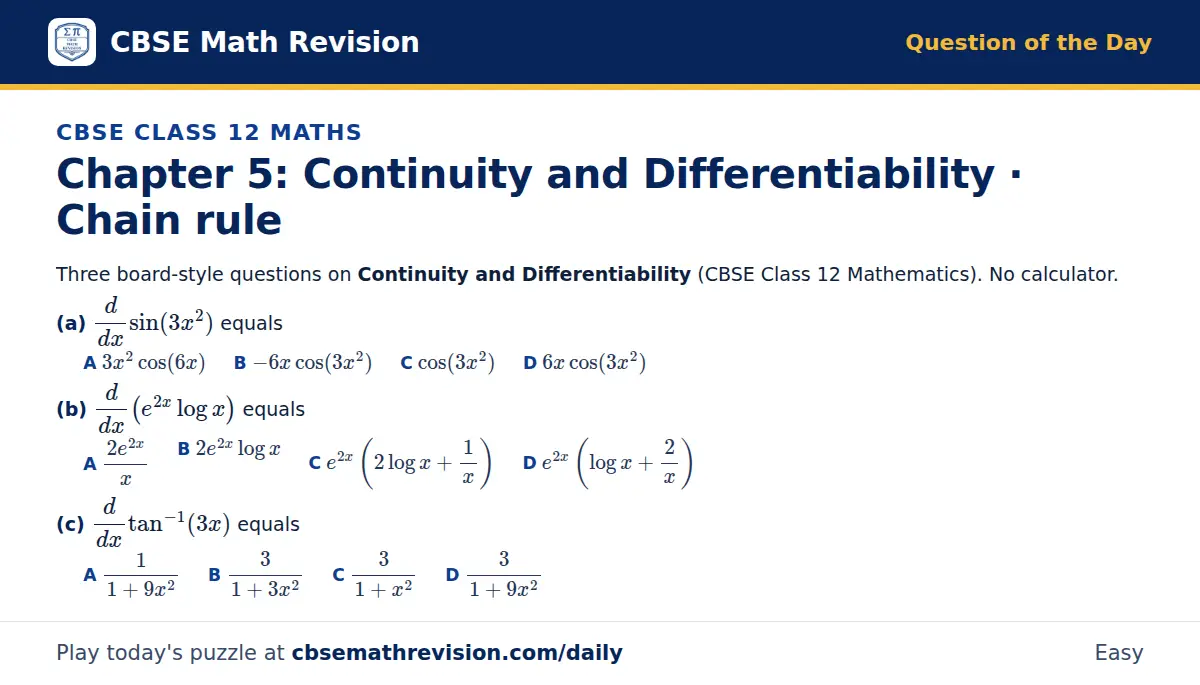
Chapter 5: Continuity and Differentiability · Chain rule
Three board-style questions on Continuity and Differentiability (CBSE Class 12 Mathematics). No calculator.
- d/dxsin(3x²) equals Options: A) 3x²cos(6x); B) -6xcos(3x²); C) cos(3x²); D) 6xcos(3x²)
- d/dx(e^(2x)log x) equals Options: A) (2e^(2x))/x; B) 2e^(2x)log x; C) e^(2x)(2log x + 1x); D) e^(2x)(log x + 2x)
- d/dxtan⁻¹(3x) equals Options: A) 1/(1 + 9x²); B) 3/(1 + 3x²); C) 3/(1 + x²); D) 3/(1 + 9x²)
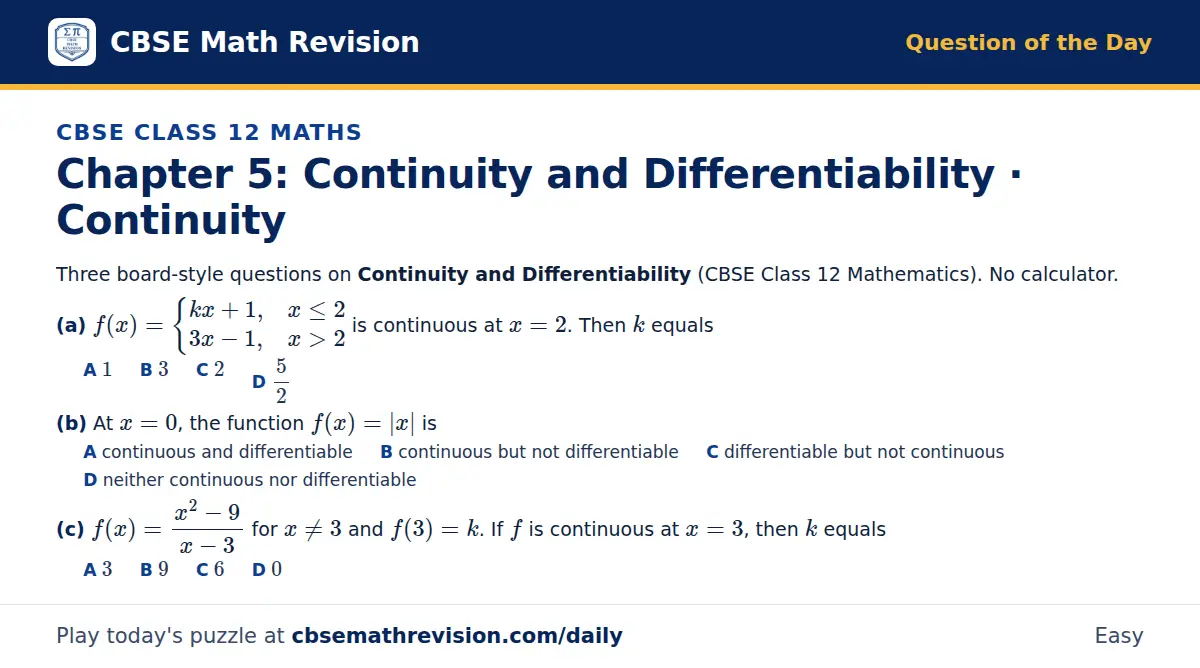
Chapter 5: Continuity and Differentiability · Continuity
Three board-style questions on Continuity and Differentiability (CBSE Class 12 Mathematics). No calculator.
- f(x) = kx + 1, x ≤ 2; 3x - 1, x > 2 is continuous at x = 2. Then k equals Options: A) 1; B) 3; C) 2; D) 5/2
- At x = 0, the function f(x) = |x| is Options: A) continuous and differentiable; B) continuous but not differentiable; C) differentiable but not continuous; D) neither continuous nor differentiable
- f(x) = (x² - 9)/(x - 3) for x ≠ 3 and f(3) = k. If f is continuous at x = 3, then k equals Options: A) 3; B) 9; C) 6; D) 0
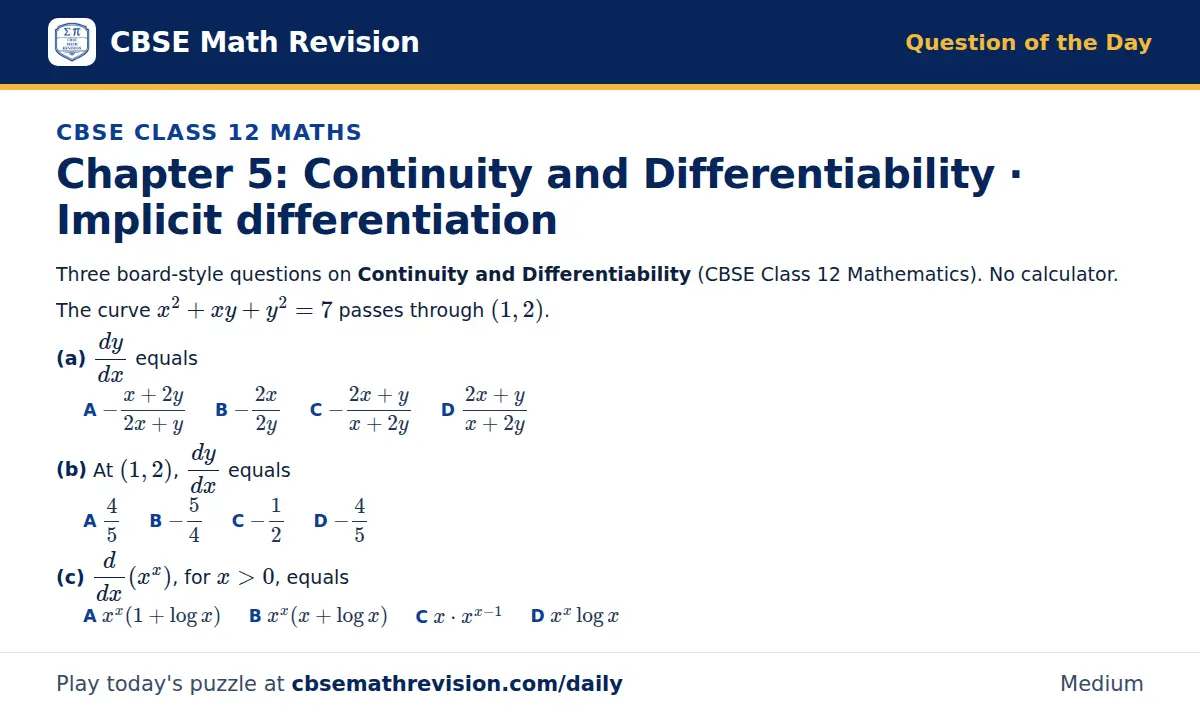
Chapter 5: Continuity and Differentiability · Implicit differentiation
Three board-style questions on Continuity and Differentiability (CBSE Class 12 Mathematics). No calculator. The curve x² + xy + y² = 7 passes through (1, 2).
- dy/dx equals Options: A) -(x + 2y)/(2x + y); B) -2x/2y; C) -(2x + y)/(x + 2y); D) (2x + y)/(x + 2y)
- At (1, 2), dy/dx equals Options: A) 4/5; B) - 5/4; C) - 1/2; D) - 4/5
- d/dx(x^x), for x > 0, equals Options: A) x^x(1 + log x); B) x^x(x + log x); C) x · x^(x - 1); D) x^x log x
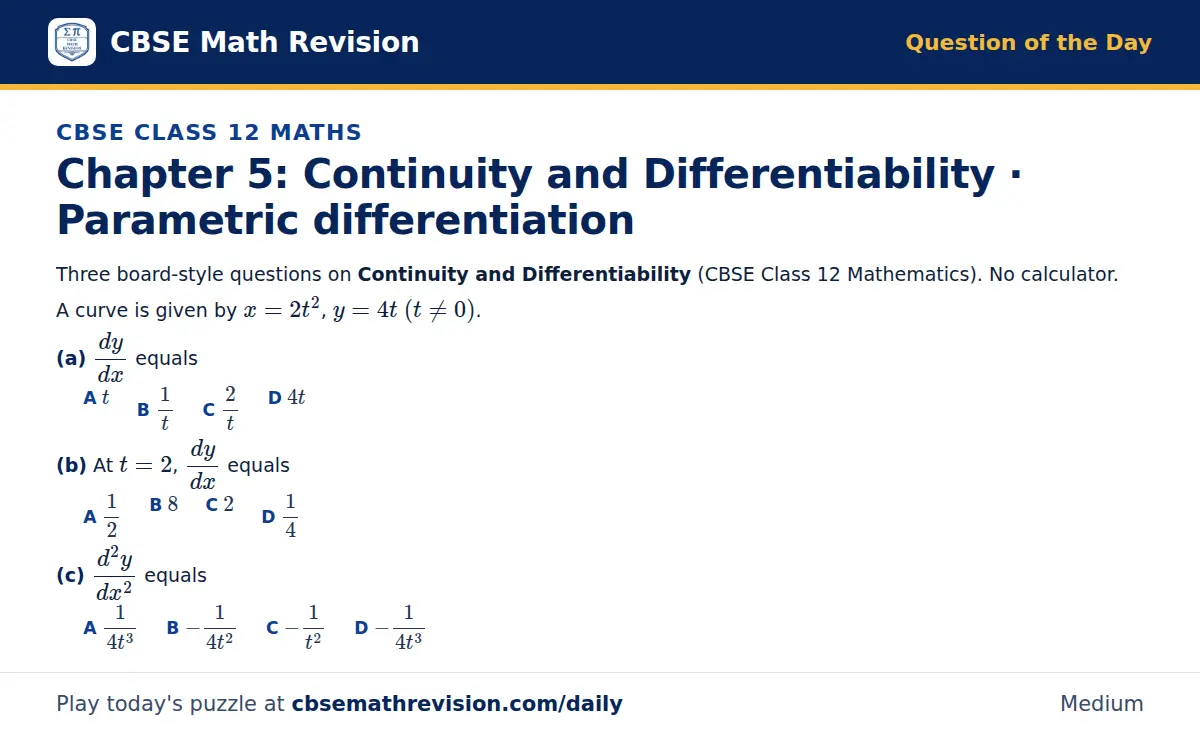
Chapter 5: Continuity and Differentiability · Parametric differentiation
Three board-style questions on Continuity and Differentiability (CBSE Class 12 Mathematics). No calculator. A curve is given by x = 2t², y = 4t (t ≠ 0).
- dy/dx equals Options: A) t; B) 1t; C) 2/t; D) 4t
- At t = 2, dy/dx equals Options: A) 1/2; B) 8; C) 2; D) 1/4
- (d²y)/(dx²) equals Options: A) 1/(4t³); B) -1/(4t²); C) -1/(t²); D) -1/(4t³)
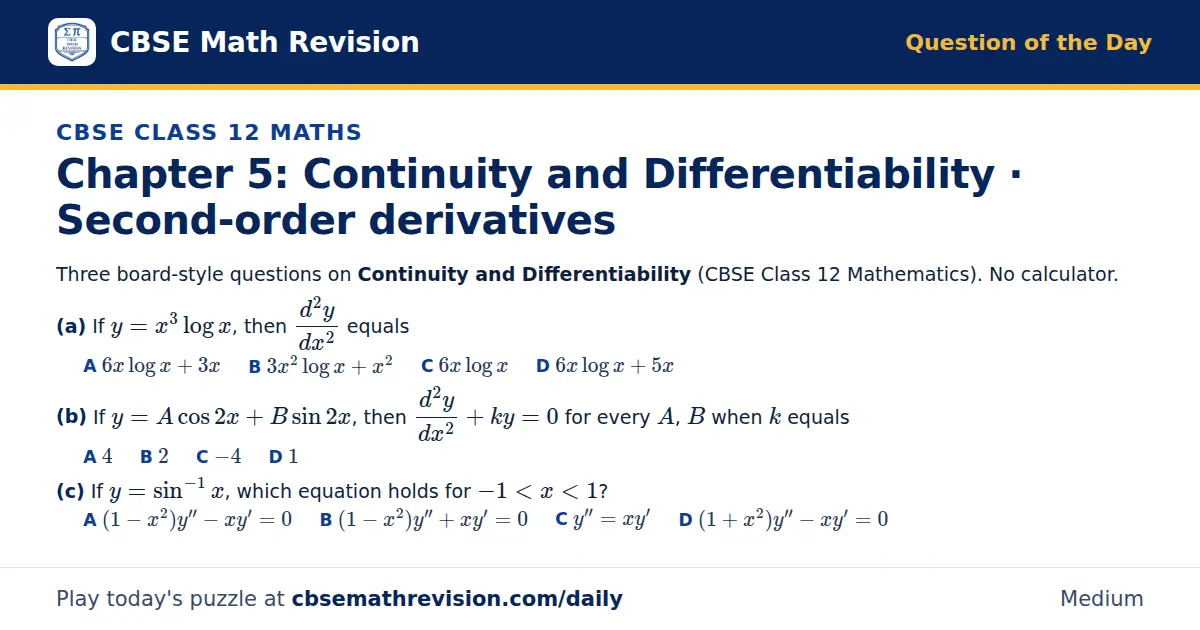
Chapter 5: Continuity and Differentiability · Second-order derivatives
Three board-style questions on Continuity and Differentiability (CBSE Class 12 Mathematics). No calculator.
- If y = x³log x, then (d²y)/(dx²) equals Options: A) 6xlog x + 3x; B) 3x²log x + x²; C) 6xlog x; D) 6xlog x + 5x
- If y = Acos 2x + Bsin 2x, then (d²y)/(dx²) + ky = 0 for every A, B when k equals Options: A) 4; B) 2; C) -4; D) 1
- If y = sin⁻¹x, which equation holds for -1 < x < 1? Options: A) (1 - x²)y'' - xy' = 0; B) (1 - x²)y'' + xy' = 0; C) y'' = xy'; D) (1 + x²)y'' - xy' = 0
Chapter 6: Application of Derivatives
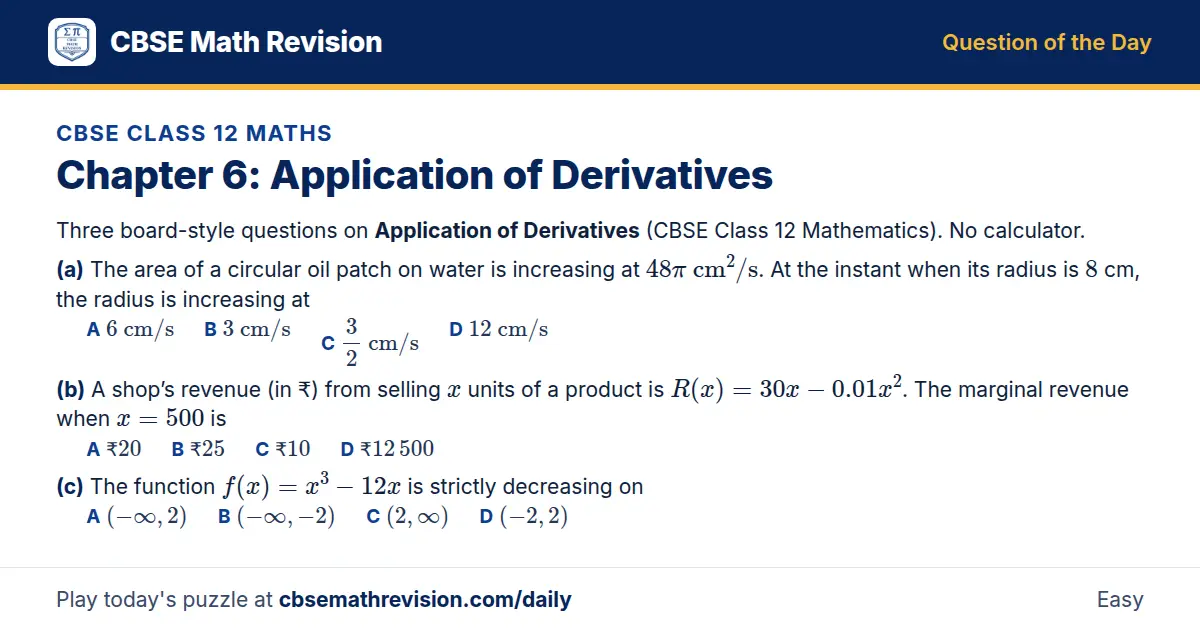
Chapter 6: Application of Derivatives
Three board-style questions on Application of Derivatives (CBSE Class 12 Mathematics). No calculator.
- The area of a circular oil patch on water is increasing at 48π cm^2/s. At the instant when its radius is 8 cm, the radius is increasing at Options: A) 6 cm/s; B) 3 cm/s; C) 3/2 cm/s; D) 12 cm/s
- A shop’s revenue (in ₹) from selling x units of a product is R(x) = 30x - 0.01x^2. The marginal revenue when x = 500 is Options: A) ₹20; B) ₹25; C) ₹10; D) ₹12 500
- The function f(x) = x³ - 12x is strictly decreasing on Options: A) (-∞, 2); B) (-∞, -2); C) (2, ∞); D) (-2, 2)
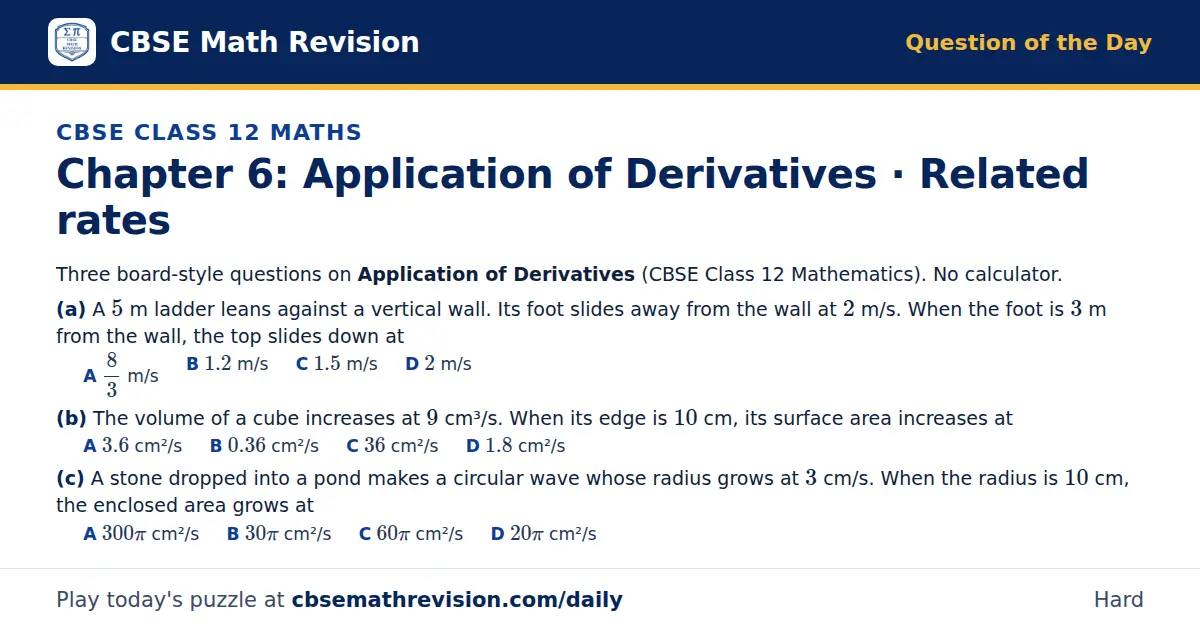
Chapter 6: Application of Derivatives · Related rates
Three board-style questions on Application of Derivatives (CBSE Class 12 Mathematics). No calculator.
- A 5 m ladder leans against a vertical wall. Its foot slides away from the wall at 2 m/s. When the foot is 3 m from the wall, the top slides down at Options: A) 8/3 m/s; B) 1.2 m/s; C) 1.5 m/s; D) 2 m/s
- The volume of a cube increases at 9 cm³/s. When its edge is 10 cm, its surface area increases at Options: A) 3.6 cm²/s; B) 0.36 cm²/s; C) 36 cm²/s; D) 1.8 cm²/s
- A stone dropped into a pond makes a circular wave whose radius grows at 3 cm/s. When the radius is 10 cm, the enclosed area grows at Options: A) 300π cm²/s; B) 30π cm²/s; C) 60π cm²/s; D) 20π cm²/s
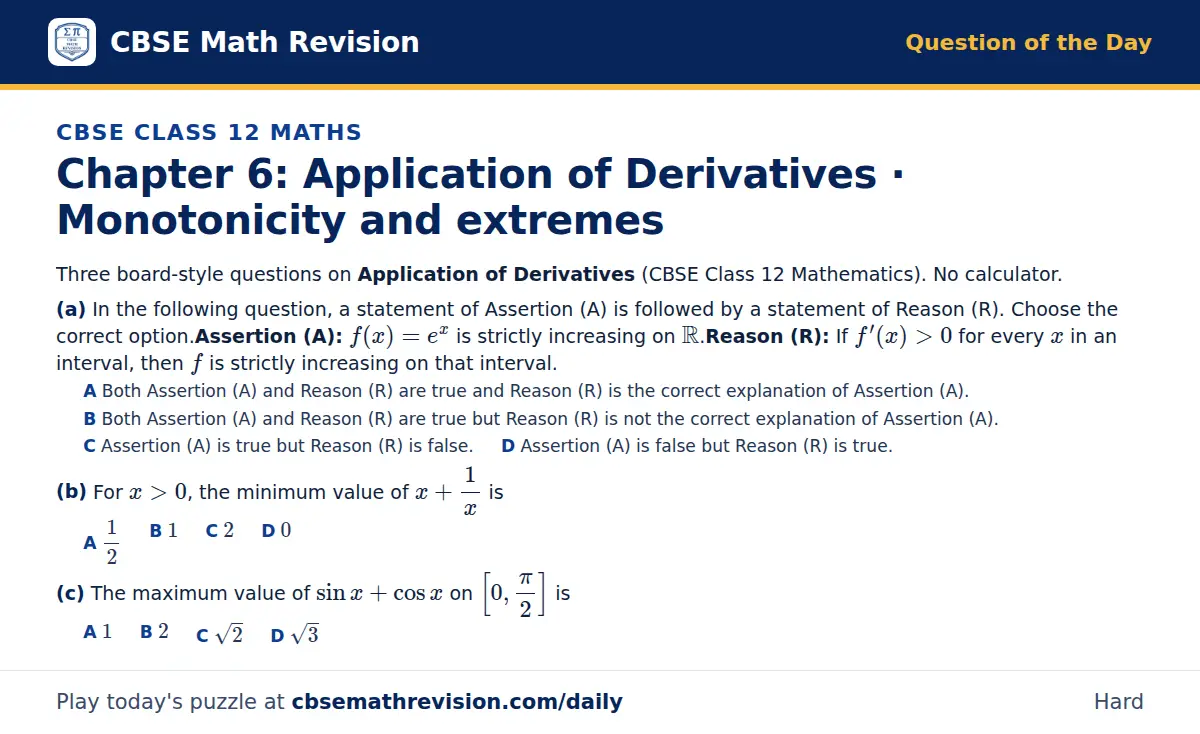
Chapter 6: Application of Derivatives · Monotonicity and extremes
Three board-style questions on Application of Derivatives (CBSE Class 12 Mathematics). No calculator.
- In the following question, a statement of Assertion (A) is followed by a statement of Reason (R). Choose the correct option. Assertion (A): f(x) = e^x is strictly increasing on ℝ. Reason (R): If f'(x) > 0 for every x in an interval, then f is strictly increasing on that interval. Options: A) Both Assertion (A) and Reason (R) are true and Reason (R) is the correct explanation of Assertion (A).; B) Both Assertion (A) and Reason (R) are true but Reason (R) is not the correct explanation of Assertion (A).; C) Assertion (A) is true but Reason (R) is false.; D) Assertion (A) is false but Reason (R) is true.
- For x > 0, the minimum value of x + 1x is Options: A) 1/2; B) 1; C) 2; D) 0
- The maximum value of sin x + cos x on [0, (π)/2] is Options: A) 1; B) 2; C) √2; D) √3
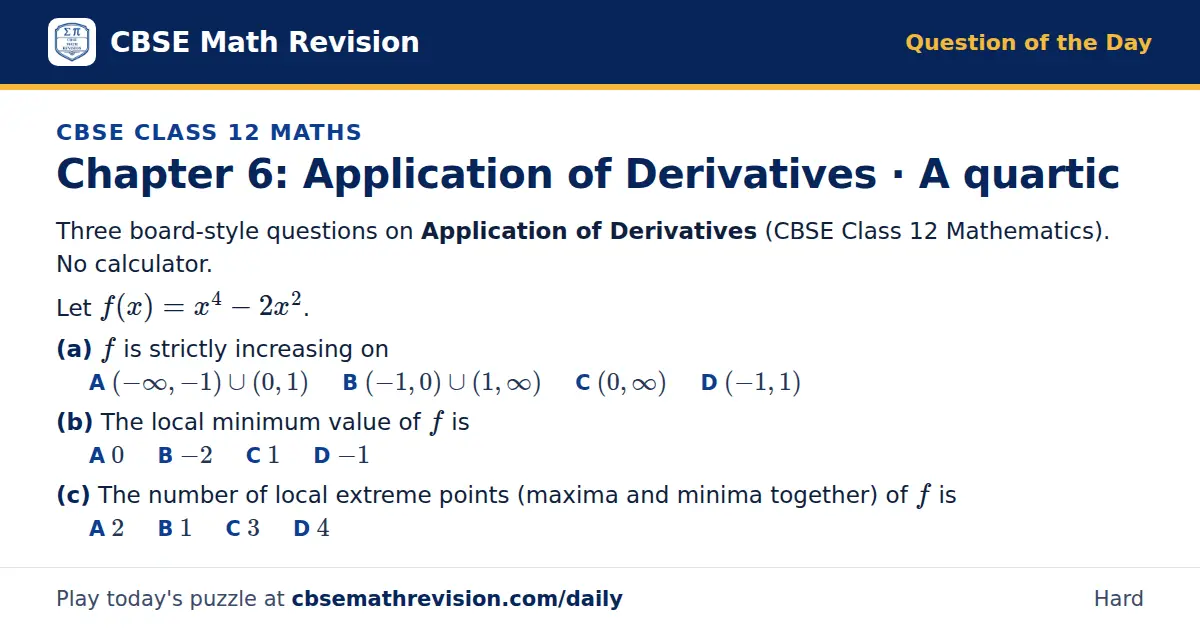
Chapter 6: Application of Derivatives · A quartic
Three board-style questions on Application of Derivatives (CBSE Class 12 Mathematics). No calculator. Let f(x) = x⁴ - 2x^2.
- f is strictly increasing on Options: A) (-∞, -1) ∪ (0, 1); B) (-1, 0) ∪ (1, ∞); C) (0, ∞); D) (-1, 1)
- The local minimum value of f is Options: A) 0; B) -2; C) 1; D) -1
- The number of local extreme points (maxima and minima together) of f is Options: A) 2; B) 1; C) 3; D) 4
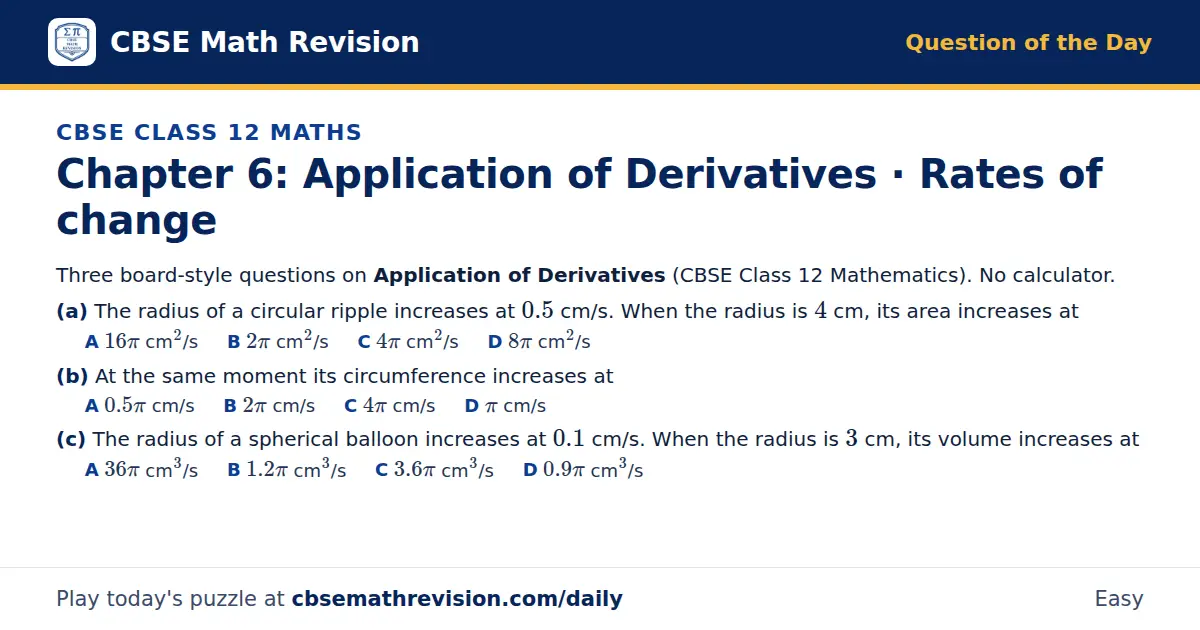
Chapter 6: Application of Derivatives · Rates of change
Three board-style questions on Application of Derivatives (CBSE Class 12 Mathematics). No calculator.
- The radius of a circular ripple increases at 0.5 cm/s. When the radius is 4 cm, its area increases at Options: A) 16π cm^2/s; B) 2π cm^2/s; C) 4π cm^2/s; D) 8π cm^2/s
- At the same moment its circumference increases at Options: A) 0.5π cm/s; B) 2π cm/s; C) 4π cm/s; D) π cm/s
- The radius of a spherical balloon increases at 0.1 cm/s. When the radius is 3 cm, its volume increases at Options: A) 36π cm^3/s; B) 1.2π cm^3/s; C) 3.6π cm^3/s; D) 0.9π cm^3/s
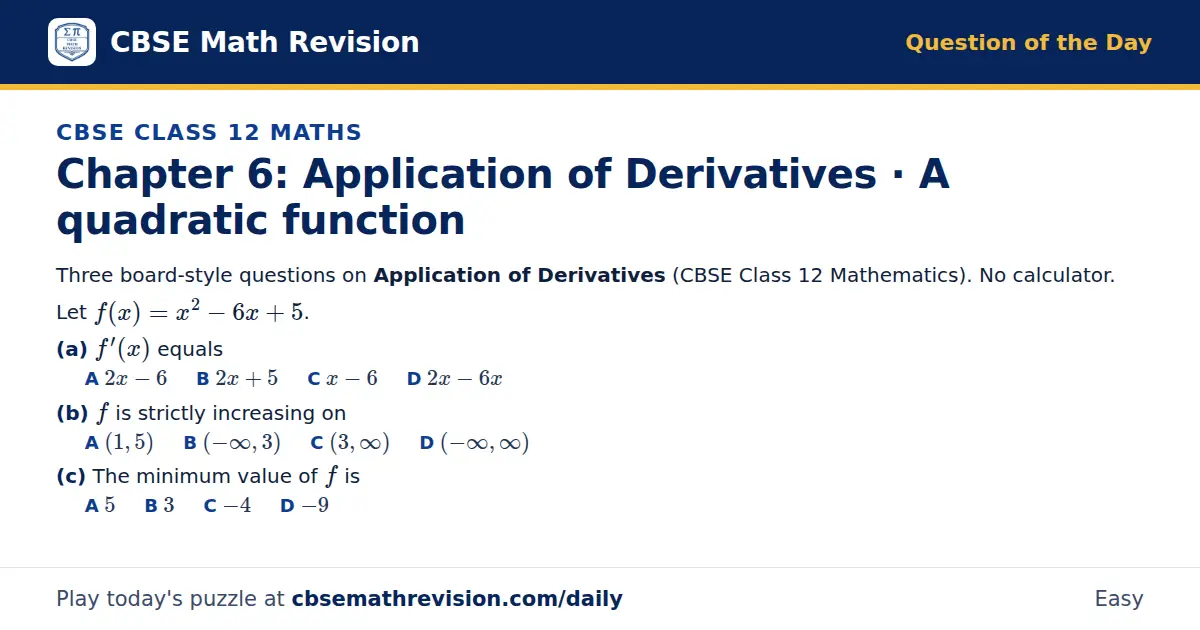
Chapter 6: Application of Derivatives · A quadratic function
Three board-style questions on Application of Derivatives (CBSE Class 12 Mathematics). No calculator. Let f(x) = x² - 6x + 5.
- f'(x) equals Options: A) 2x - 6; B) 2x + 5; C) x - 6; D) 2x - 6x
- f is strictly increasing on Options: A) (1, 5); B) (-∞, 3); C) (3, ∞); D) (-∞, ∞)
- The minimum value of f is Options: A) 5; B) 3; C) -4; D) -9
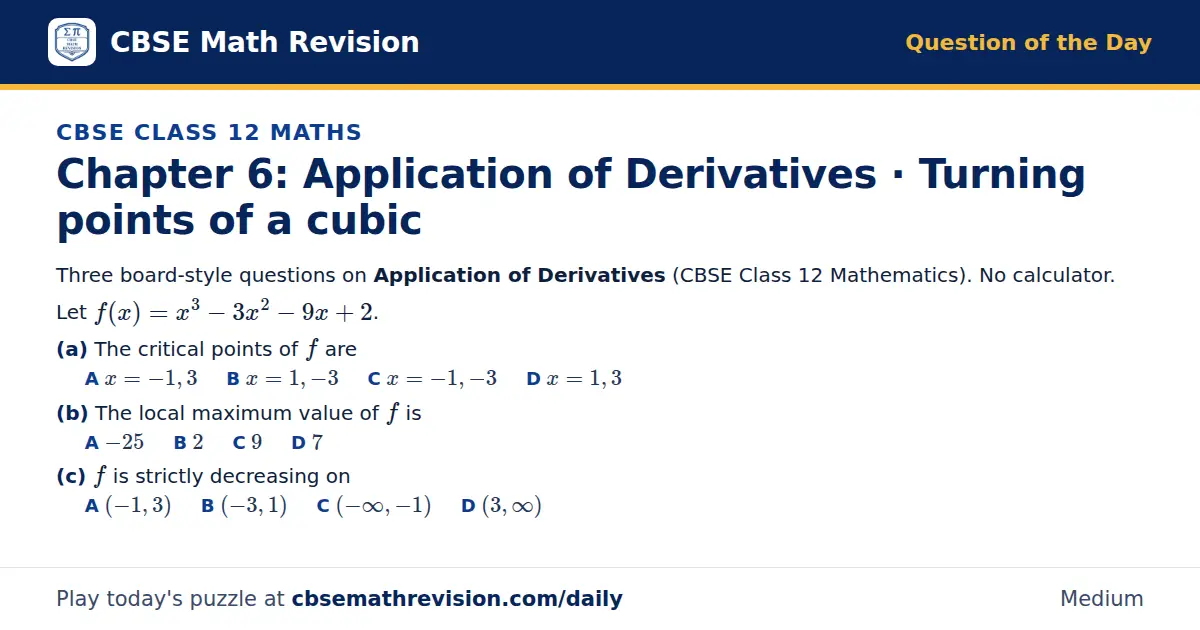
Chapter 6: Application of Derivatives · Turning points of a cubic
Three board-style questions on Application of Derivatives (CBSE Class 12 Mathematics). No calculator. Let f(x) = x³ - 3x² - 9x + 2.
- The critical points of f are Options: A) x = -1, 3; B) x = 1, -3; C) x = -1, -3; D) x = 1, 3
- The local maximum value of f is Options: A) -25; B) 2; C) 9; D) 7
- f is strictly decreasing on Options: A) (-1, 3); B) (-3, 1); C) (-∞, -1); D) (3, ∞)
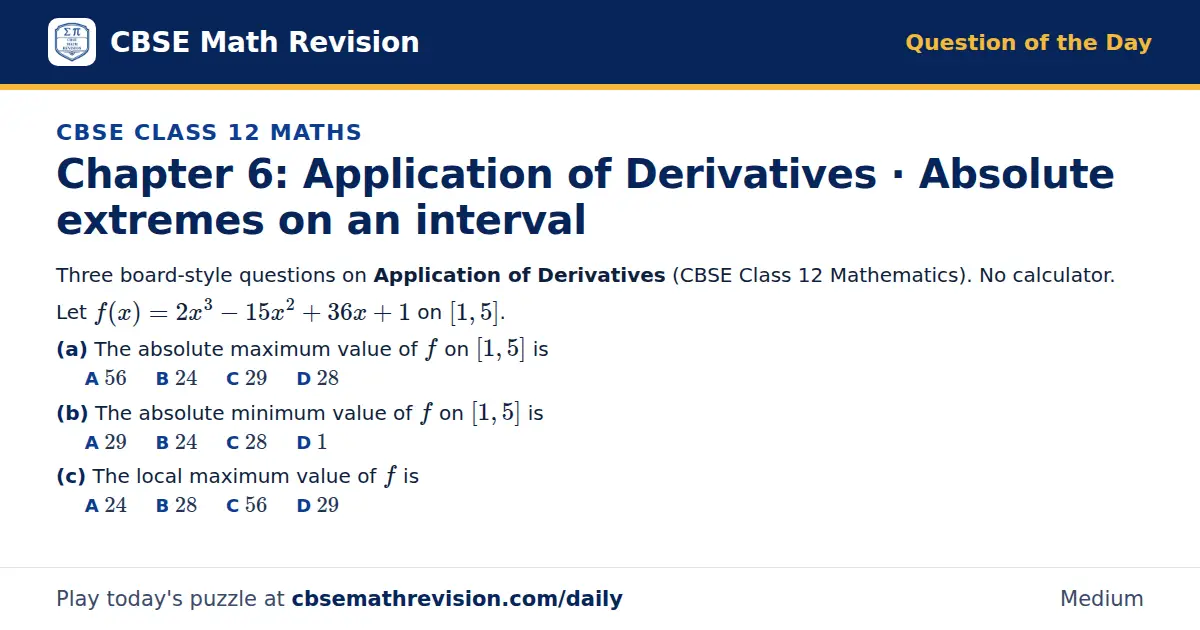
Chapter 6: Application of Derivatives · Absolute extremes on an interval
Three board-style questions on Application of Derivatives (CBSE Class 12 Mathematics). No calculator. Let f(x) = 2x³ - 15x² + 36x + 1 on [1, 5].
- The absolute maximum value of f on [1, 5] is Options: A) 56; B) 24; C) 29; D) 28
- The absolute minimum value of f on [1, 5] is Options: A) 29; B) 24; C) 28; D) 1
- The local maximum value of f is Options: A) 24; B) 28; C) 56; D) 29
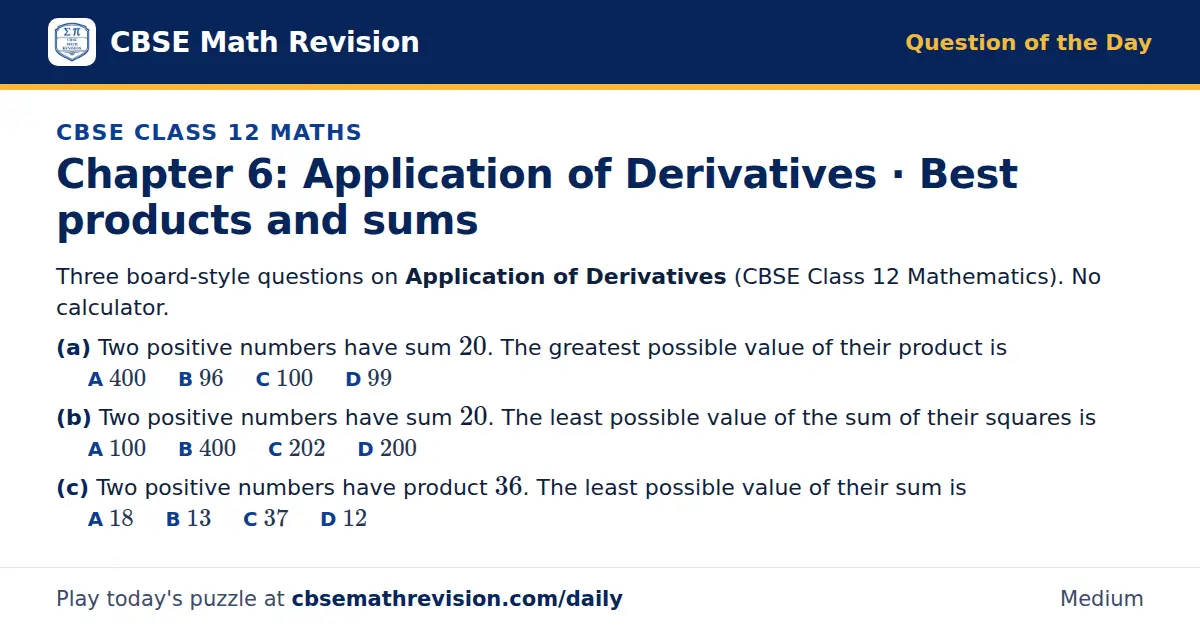
Chapter 6: Application of Derivatives · Best products and sums
Three board-style questions on Application of Derivatives (CBSE Class 12 Mathematics). No calculator.
- Two positive numbers have sum 20. The greatest possible value of their product is Options: A) 400; B) 96; C) 100; D) 99
- Two positive numbers have sum 20. The least possible value of the sum of their squares is Options: A) 100; B) 400; C) 202; D) 200
- Two positive numbers have product 36. The least possible value of their sum is Options: A) 18; B) 13; C) 37; D) 12
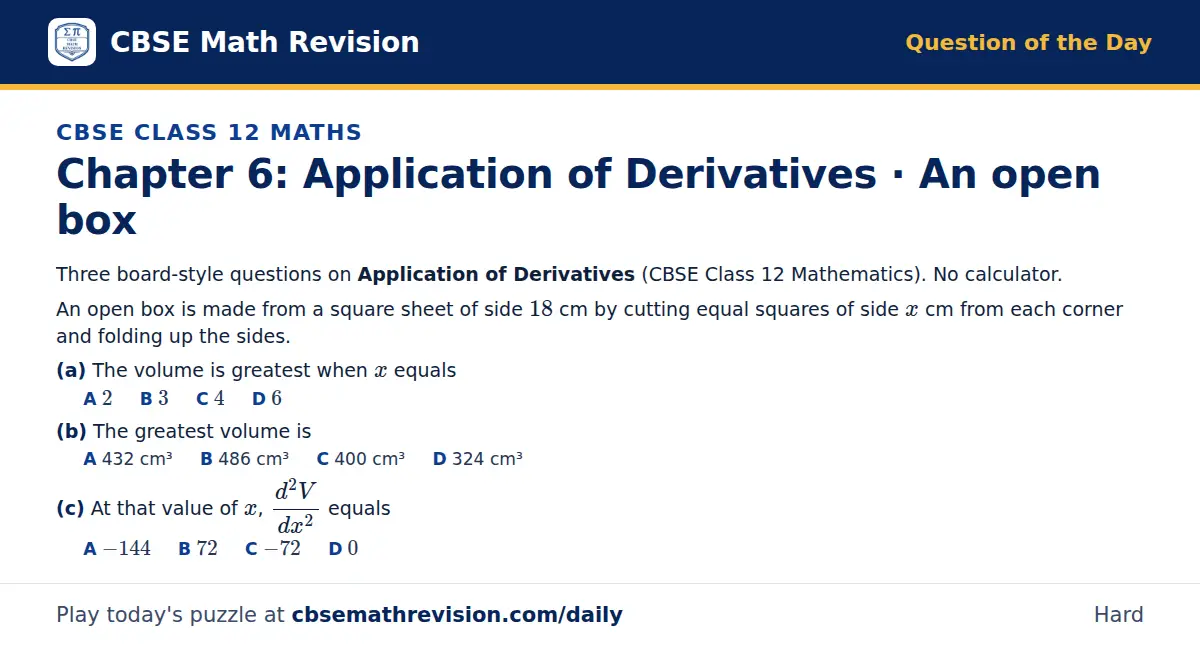
Chapter 6: Application of Derivatives · An open box
Three board-style questions on Application of Derivatives (CBSE Class 12 Mathematics). No calculator. An open box is made from a square sheet of side 18 cm by cutting equal squares of side x cm from each corner and folding up the sides.
- The volume is greatest when x equals Options: A) 2; B) 3; C) 4; D) 6
- The greatest volume is Options: A) 432 cm³; B) 486 cm³; C) 400 cm³; D) 324 cm³
- At that value of x, (d²V)/(dx²) equals Options: A) -144; B) 72; C) -72; D) 0
Chapter 7: Integrals
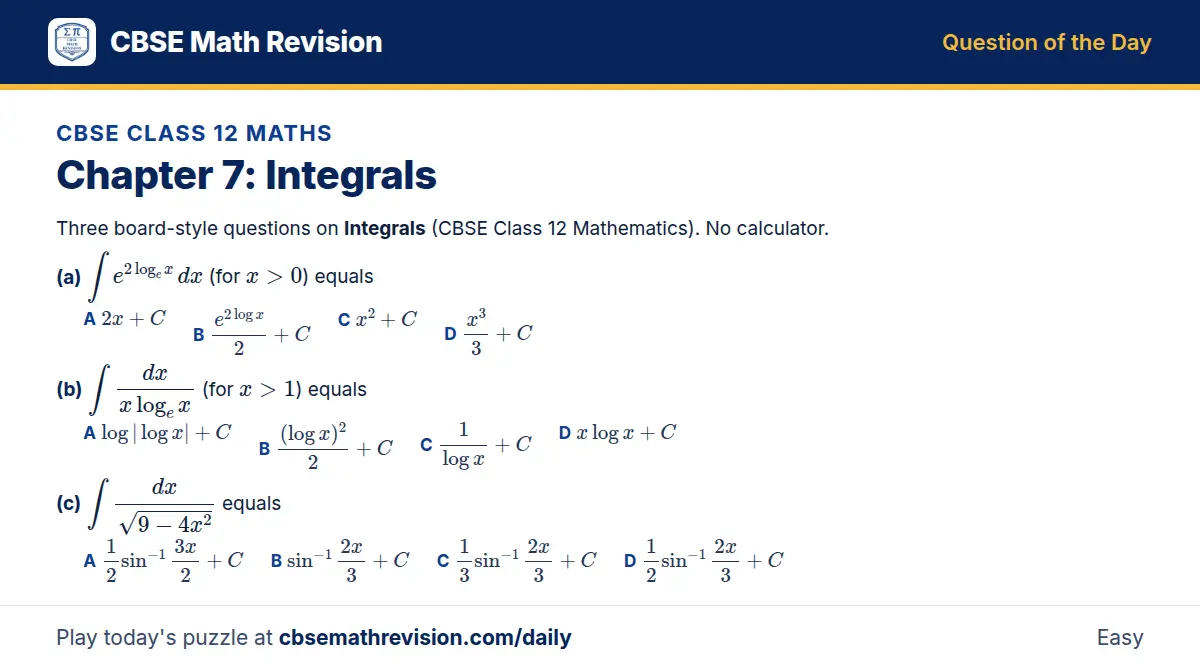
Chapter 7: Integrals
Three board-style questions on Integrals (CBSE Class 12 Mathematics). No calculator.
- ∫ e^(2log_e x) dx (for x > 0) equals Options: A) 2x + C; B) (e^(2log x))/2 + C; C) x² + C; D) (x³)/3 + C
- /(xlog_e x) (for x > 1) equals Options: A) log|log x| + C; B) ((log x)²)/2 + C; C) 1/(log x) + C; D) xlog x + C
- /(√(9 - 4x²)) equals Options: A) 12sin⁻¹3x/2 + C; B) sin⁻¹2x/3 + C; C) 13sin⁻¹2x/3 + C; D) 12sin⁻¹2x/3 + C
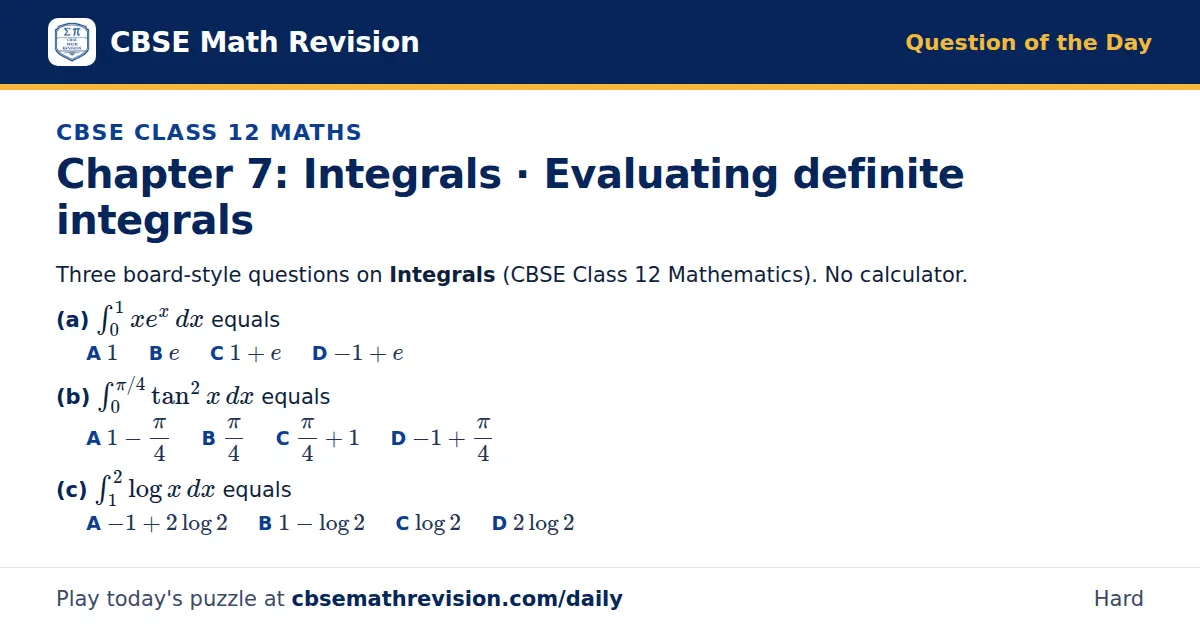
Chapter 7: Integrals · Evaluating definite integrals
Three board-style questions on Integrals (CBSE Class 12 Mathematics). No calculator.
- ∫_0¹ x e^x dx equals Options: A) 1; B) e; C) 1 + e; D) -1 + e
- ∫_0^(π/4) tan² x dx equals Options: A) 1 - (π)/4; B) (π)/4; C) (π)/4 + 1; D) -1 + (π)/4
- ∫_1² log x dx equals Options: A) -1 + 2 log 2; B) 1 - log 2; C) log 2; D) 2 log 2
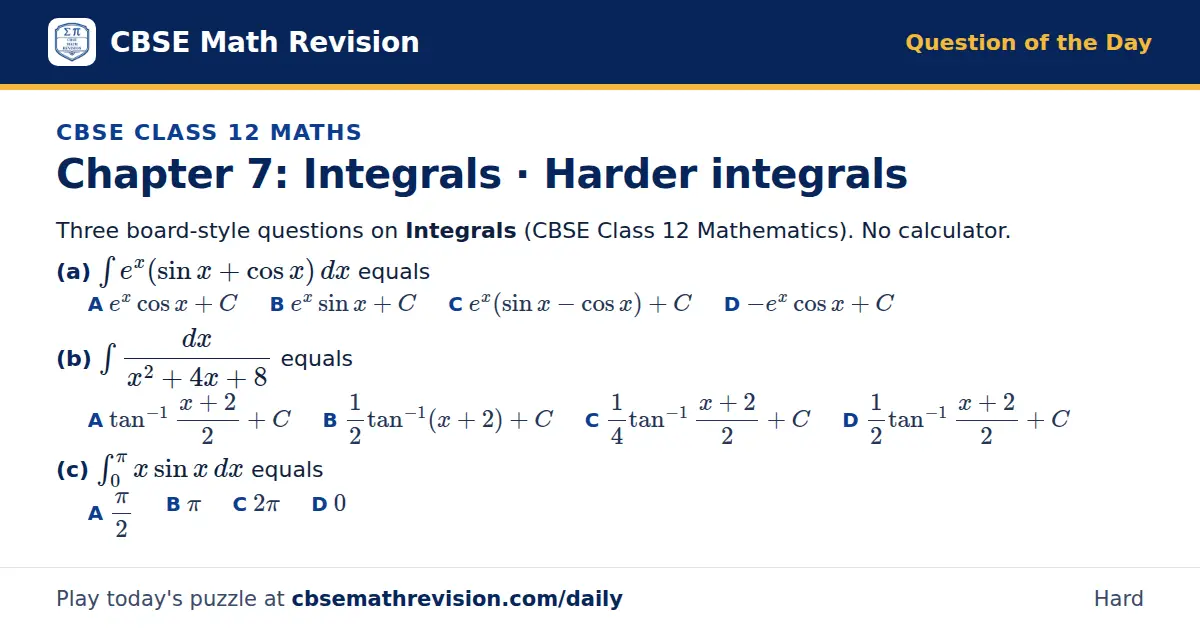
Chapter 7: Integrals · Harder integrals
Three board-style questions on Integrals (CBSE Class 12 Mathematics). No calculator.
- ∫ e^x(sin x + cos x) dx equals Options: A) e^xcos x + C; B) e^xsin x + C; C) e^x(sin x - cos x) + C; D) -e^xcos x + C
- ∫ dx/(x² + 4x + 8) equals Options: A) tan⁻¹(x + 2)/2 + C; B) 12tan⁻¹(x + 2) + C; C) 14tan⁻¹(x + 2)/2 + C; D) 12tan⁻¹(x + 2)/2 + C
- ∫_0^(π) xsin x dx equals Options: A) (π)/2; B) π; C) 2 π; D) 0
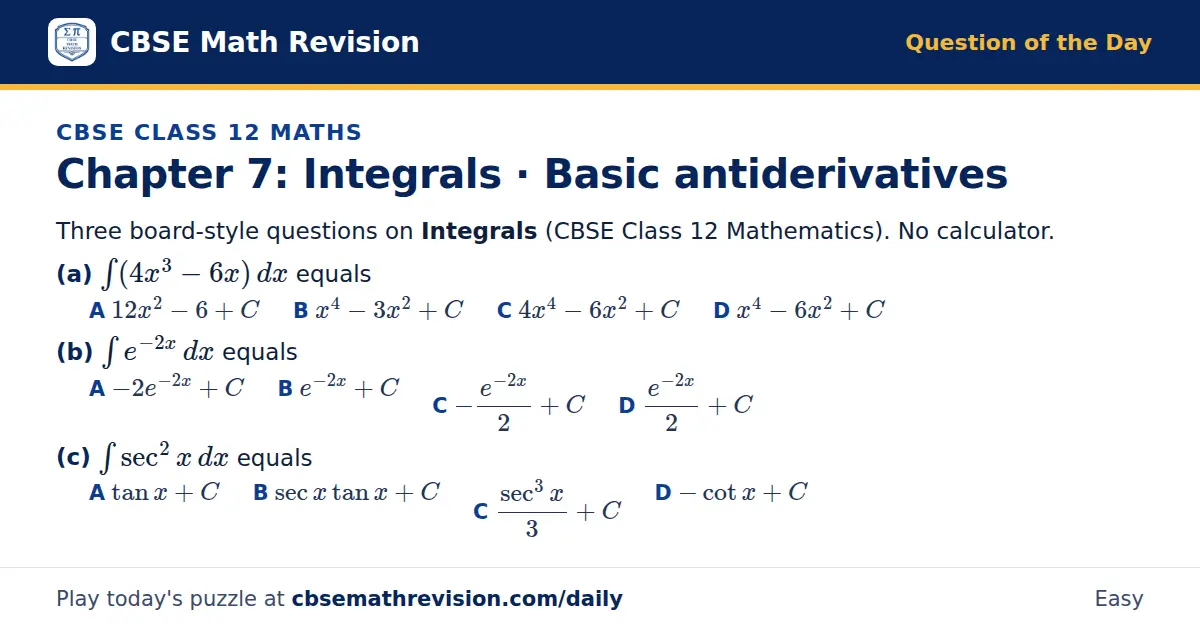
Chapter 7: Integrals · Basic antiderivatives
Three board-style questions on Integrals (CBSE Class 12 Mathematics). No calculator.
- ∫ (4x³ - 6x) dx equals Options: A) 12x² - 6 + C; B) x⁴ - 3x² + C; C) 4x⁴ - 6x² + C; D) x⁴ - 6x² + C
- ∫ e^(-2x) dx equals Options: A) -2e^(-2x) + C; B) e^(-2x) + C; C) -(e^(-2x))/2 + C; D) (e^(-2x))/2 + C
- ∫ sec² x dx equals Options: A) tan x + C; B) sec x tan x + C; C) (sec³ x)/3 + C; D) -cot x + C
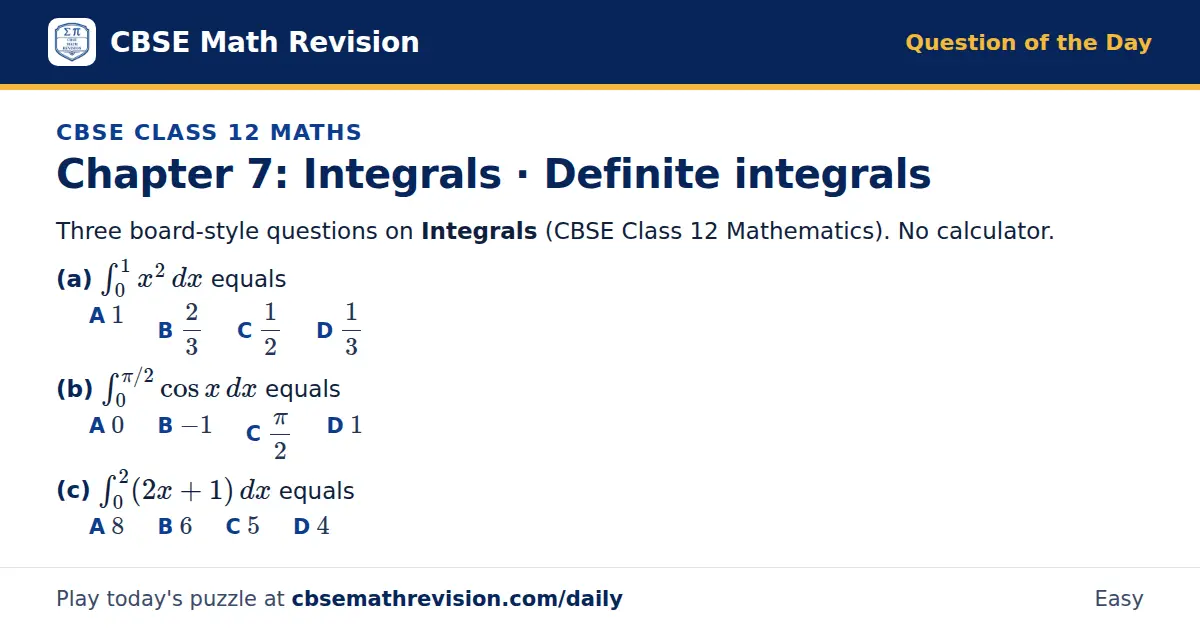
Chapter 7: Integrals · Definite integrals
Three board-style questions on Integrals (CBSE Class 12 Mathematics). No calculator.
- ∫_0¹ x² dx equals Options: A) 1; B) 2/3; C) 1/2; D) 1/3
- ∫_0^(π/2) cos x dx equals Options: A) 0; B) -1; C) (π)/2; D) 1
- ∫_0² (2x + 1) dx equals Options: A) 8; B) 6; C) 5; D) 4
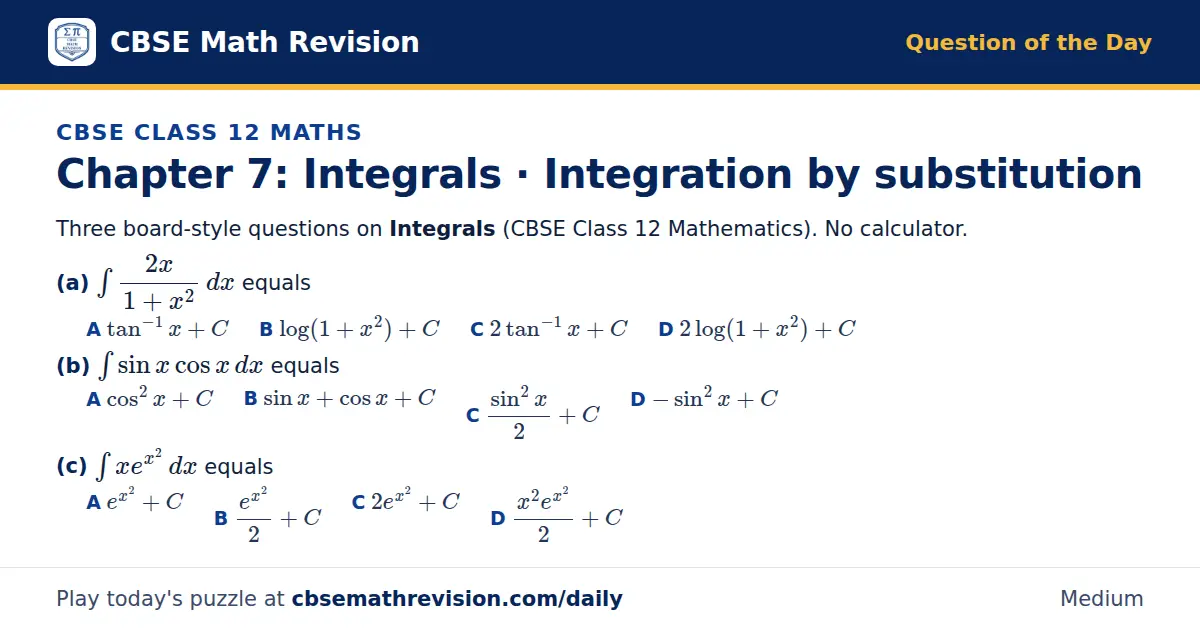
Chapter 7: Integrals · Integration by substitution
Three board-style questions on Integrals (CBSE Class 12 Mathematics). No calculator.
- ∫ 2x/(1 + x²) dx equals Options: A) tan⁻¹x + C; B) log(1 + x²) + C; C) 2tan⁻¹x + C; D) 2log(1 + x²) + C
- ∫ sin xcos x dx equals Options: A) cos² x + C; B) sin x + cos x + C; C) (sin² x)/2 + C; D) -sin² x + C
- ∫ x e^(x²) dx equals Options: A) e^(x²) + C; B) (e^(x²))/2 + C; C) 2e^(x²) + C; D) (x² e^(x²))/2 + C
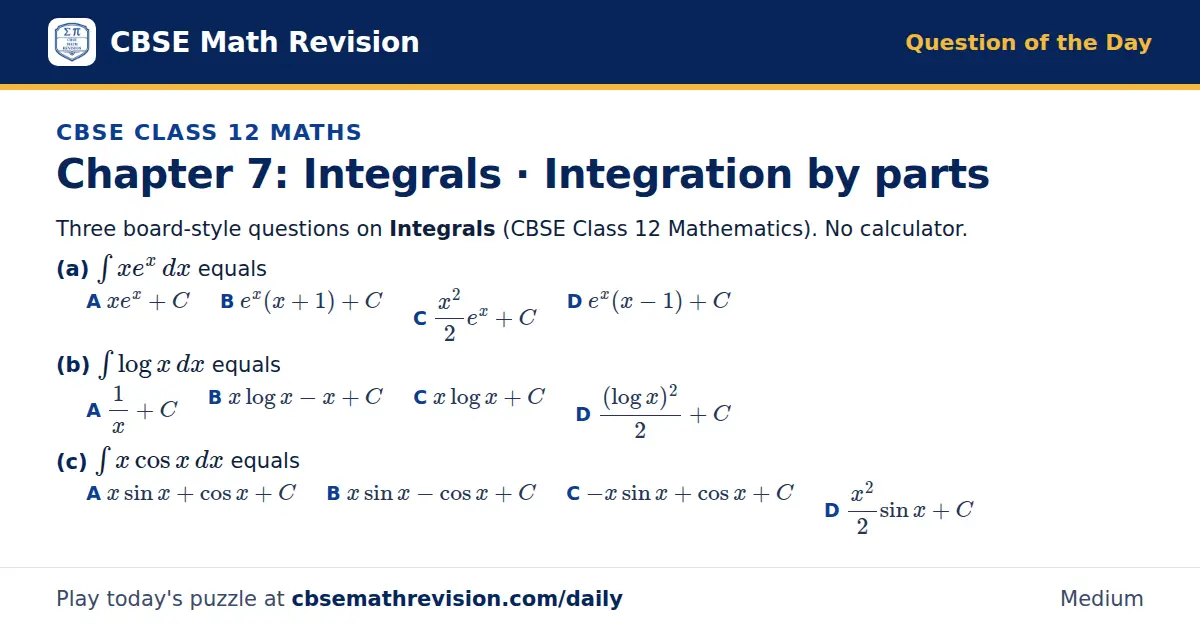
Chapter 7: Integrals · Integration by parts
Three board-style questions on Integrals (CBSE Class 12 Mathematics). No calculator.
- ∫ x e^x dx equals Options: A) x e^x + C; B) e^x(x + 1) + C; C) (x²)/2e^x + C; D) e^x(x - 1) + C
- ∫ log x dx equals Options: A) 1x + C; B) xlog x - x + C; C) xlog x + C; D) ((log x)²)/2 + C
- ∫ xcos x dx equals Options: A) xsin x + cos x + C; B) xsin x - cos x + C; C) -xsin x + cos x + C; D) (x²)/2sin x + C
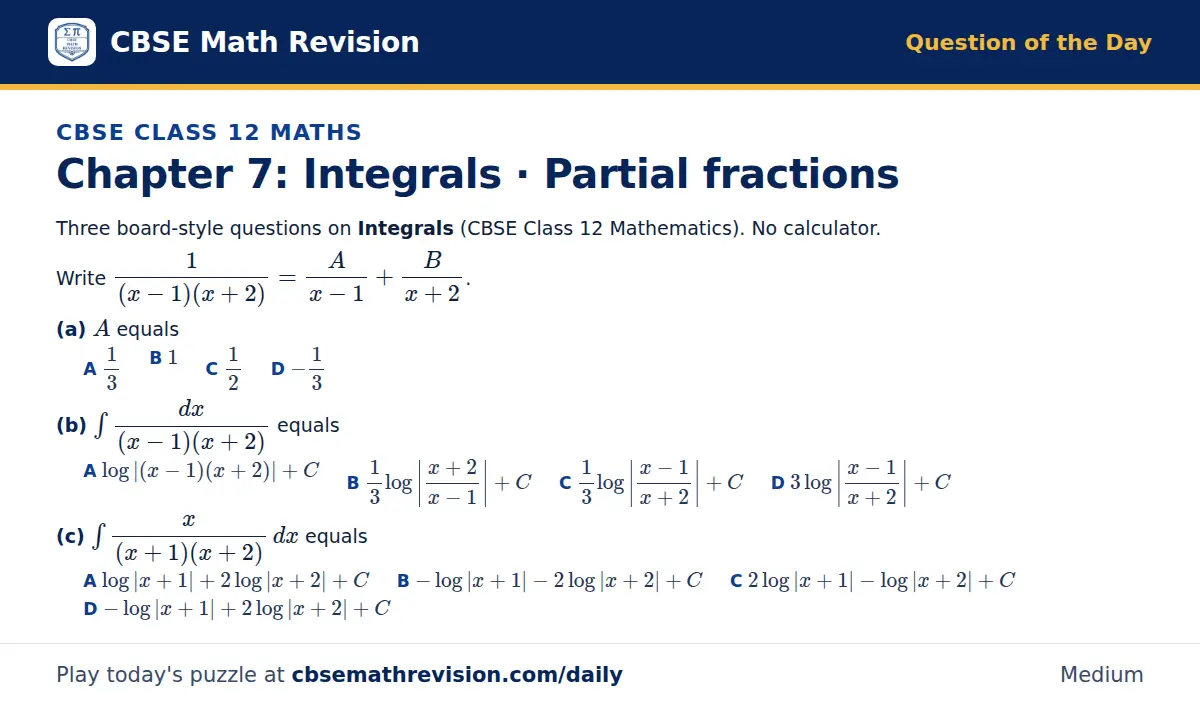
Chapter 7: Integrals · Partial fractions
Three board-style questions on Integrals (CBSE Class 12 Mathematics). No calculator. Write 1/((x - 1)(x + 2)) = A/(x - 1) + B/(x + 2).
- A equals Options: A) 1/3; B) 1; C) 1/2; D) - 1/3
- ∫ dx/((x - 1)(x + 2)) equals Options: A) log|(x - 1)(x + 2)| + C; B) 13log|(x + 2)/(x - 1)| + C; C) 13log|(x - 1)/(x + 2)| + C; D) 3log|(x - 1)/(x + 2)| + C
- ∫ x/((x + 1)(x + 2)) dx equals Options: A) log|x + 1| + 2log|x + 2| + C; B) -log|x + 1| - 2log|x + 2| + C; C) 2log|x + 1| - log|x + 2| + C; D) -log|x + 1| + 2log|x + 2| + C
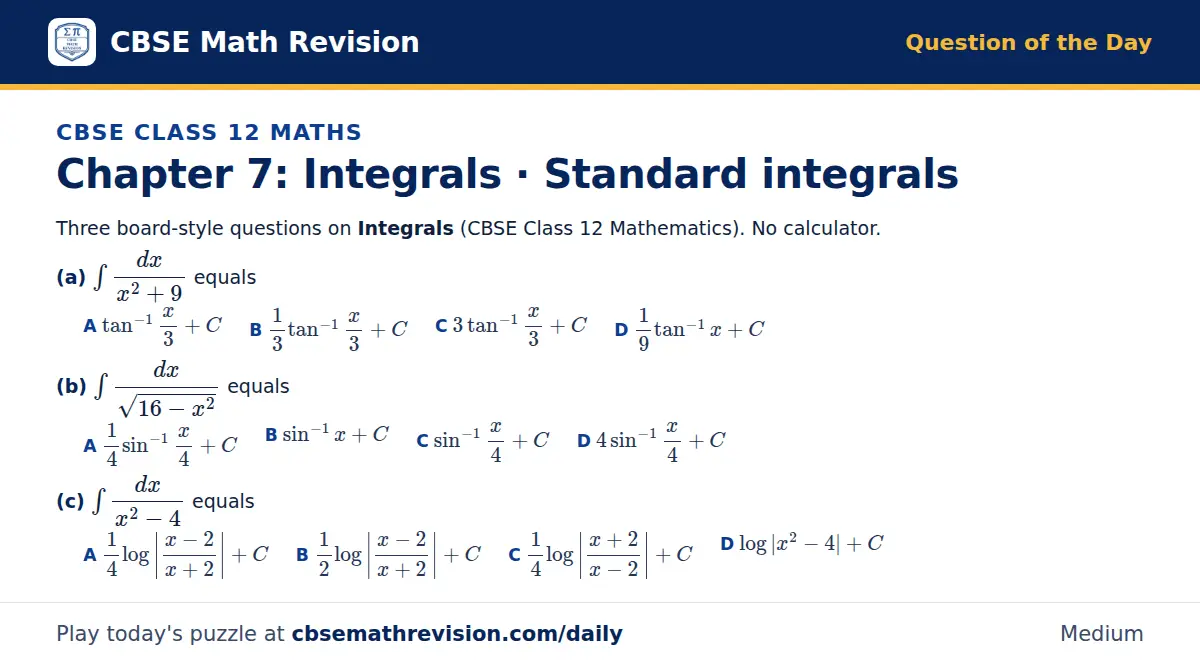
Chapter 7: Integrals · Standard integrals
Three board-style questions on Integrals (CBSE Class 12 Mathematics). No calculator.
- ∫ dx/(x² + 9) equals Options: A) tan⁻¹x/3 + C; B) 13tan⁻¹x/3 + C; C) 3tan⁻¹x/3 + C; D) 19tan⁻¹x + C
- ∫ dx/(√(16 - x²)) equals Options: A) 14sin⁻¹x/4 + C; B) sin⁻¹x + C; C) sin⁻¹x/4 + C; D) 4sin⁻¹x/4 + C
- ∫ dx/(x² - 4) equals Options: A) 14log|(x - 2)/(x + 2)| + C; B) 12log|(x - 2)/(x + 2)| + C; C) 14log|(x + 2)/(x - 2)| + C; D) log|x² - 4| + C
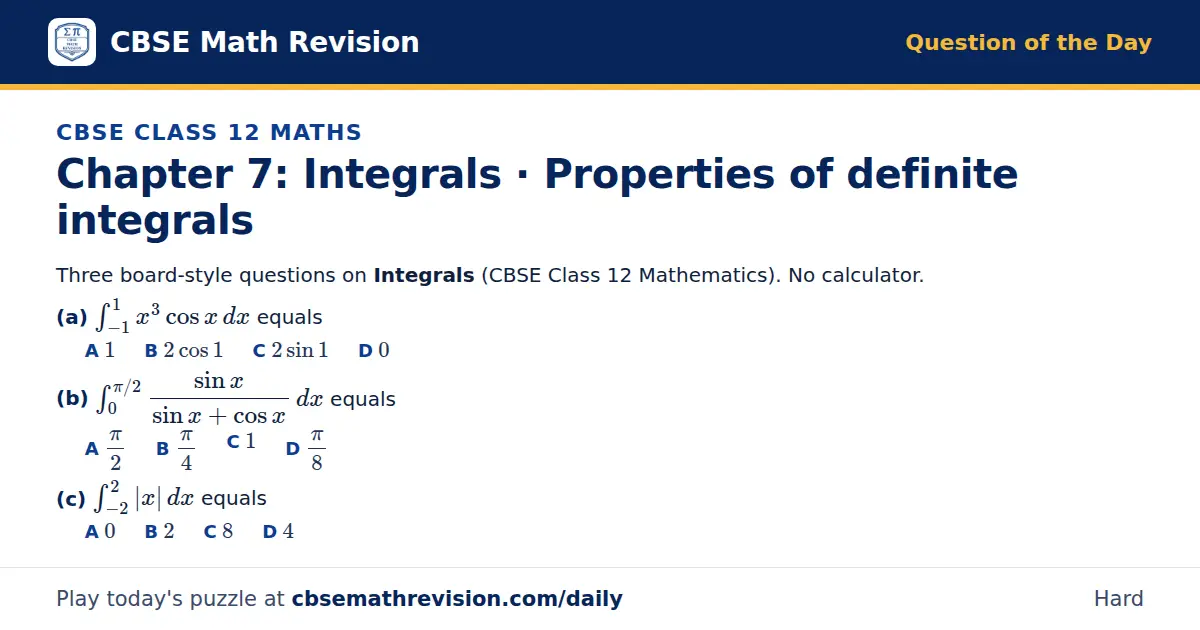
Chapter 7: Integrals · Properties of definite integrals
Three board-style questions on Integrals (CBSE Class 12 Mathematics). No calculator.
- ∫_-1¹ x³cos x dx equals Options: A) 1; B) 2 cos 1; C) 2 sin 1; D) 0
- ∫_0^(π/2) (sin x)/(sin x + cos x) dx equals Options: A) (π)/2; B) (π)/4; C) 1; D) (π)/8
- ∫_-2² |x| dx equals Options: A) 0; B) 2; C) 8; D) 4
More Question of the Day puzzles
Other chapters: Chapters 1–4 · Chapters 5–7 · Chapters 8–10 · Chapters 11–13. See all CBSE Maths daily and weekly questions.