CBSE Class 12 Maths Question of the Day: all the puzzles
Every CBSE Class 12 Mathematics puzzle in the Question of the Day rotation, as images you can open, save or share. Each puzzle is three board-style questions on one chapter; the question text is written out below each image, and the answers, hints and step-marked solutions are on the daily puzzle page.
- Play today's CBSE Class 12 Maths puzzle
- CBSE Class 10 Maths puzzles
- CBSE Class 11 Maths puzzles
- All CBSE Maths daily and weekly questions
Every puzzle in the rotation
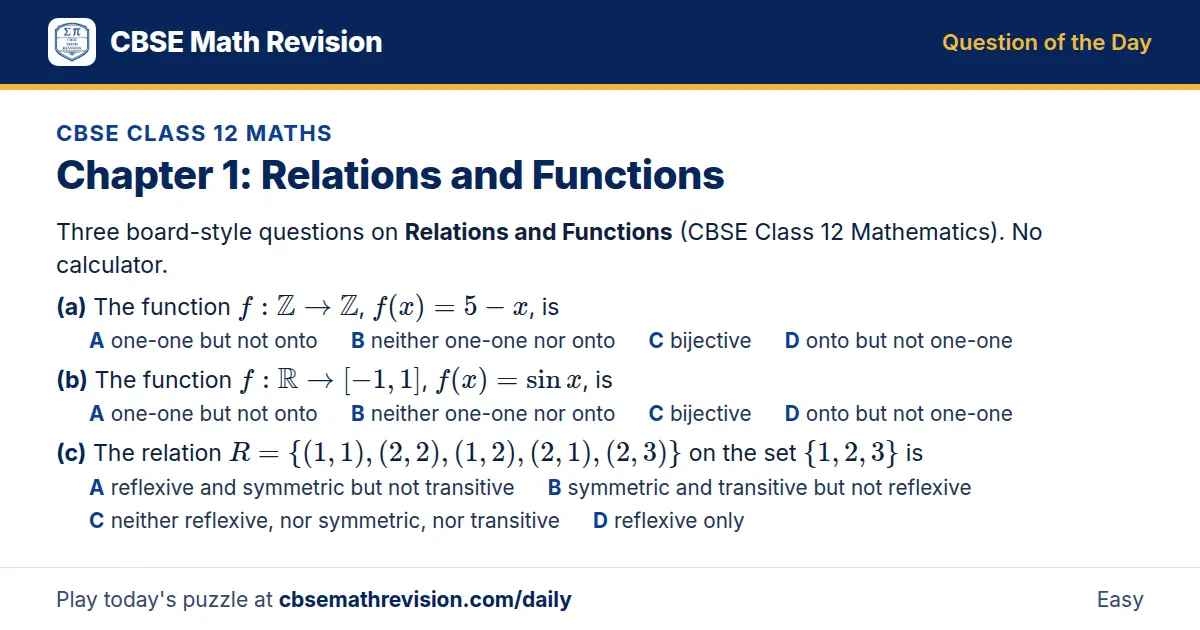
Chapter 1: Relations and Functions
Three board-style questions on Relations and Functions (CBSE Class 12 Mathematics). No calculator.
- The function f: ℤ → ℤ, f(x) = 5 - x, is Options: A) one-one but not onto; B) neither one-one nor onto; C) bijective; D) onto but not one-one
- The function f: ℝ → [-1, 1], f(x) = sin x, is Options: A) one-one but not onto; B) neither one-one nor onto; C) bijective; D) onto but not one-one
- The relation R = (1, 1), (2, 2), (1, 2), (2, 1), (2, 3) on the set 1, 2, 3 is Options: A) reflexive and symmetric but not transitive; B) symmetric and transitive but not reflexive; C) neither reflexive, nor symmetric, nor transitive; D) reflexive only
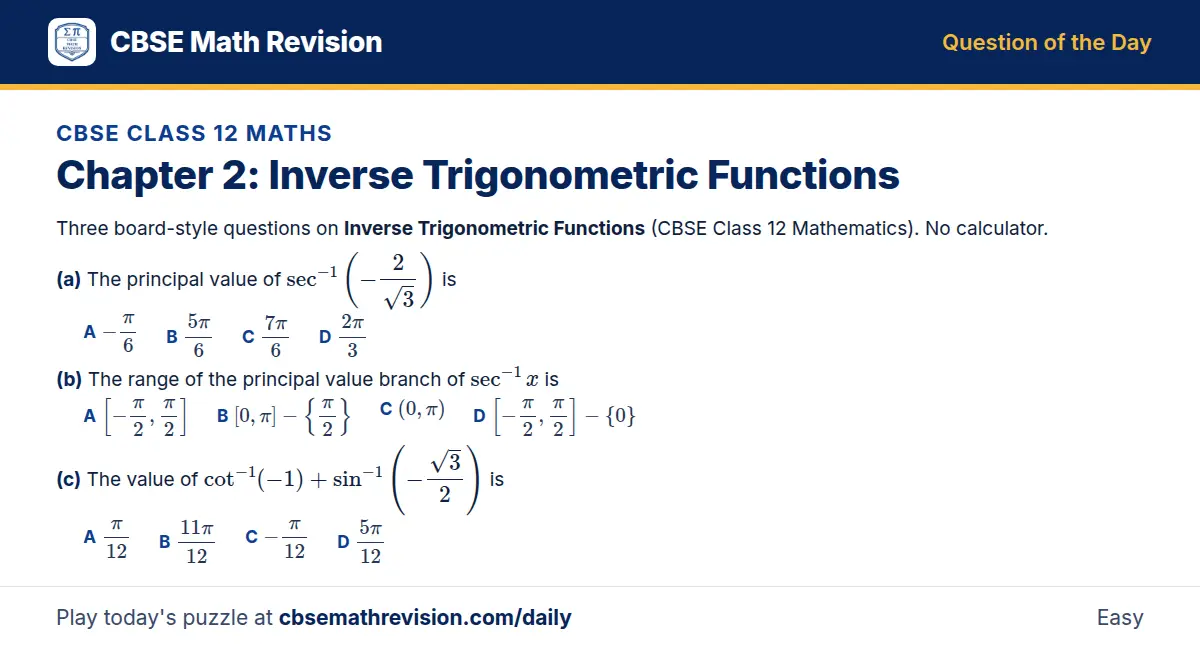
Chapter 2: Inverse Trigonometric Functions
Three board-style questions on Inverse Trigonometric Functions (CBSE Class 12 Mathematics). No calculator.
- The principal value of sec⁻¹(-2/(√3)) is Options: A) -(π)/6; B) (5π)/6; C) (7π)/6; D) (2π)/3
- The range of the principal value branch of sec⁻¹x is Options: A) [-(π)/2, (π)/2]; B) [0, π] - (π)/2; C) (0, π); D) [-(π)/2, (π)/2] - 0
- The value of cot⁻¹(-1) + sin⁻¹(-(√3)/2) is Options: A) (π)/12; B) (11π)/12; C) -(π)/12; D) (5π)/12
![CBSE Class 12 Maths Question of the Day on Matrices, a 3-part multiple-choice question: Three board-style questions on Matrices (CBSE Class 12 Mathematics). No calculator. (a) The 3 × 3 matrix A = [a_ij] with a_ij = i² - j² is (b) A, B, C are…](/cbse-frontend/img/questions/cbse-maths-class-12-matrices-question-of-the-day-cbse12-ch03.webp)
Chapter 3: Matrices
Three board-style questions on Matrices (CBSE Class 12 Mathematics). No calculator.
- The 3 × 3 matrix A = [a_ij] with a_ij = i² - j² is Options: A) a skew-symmetric matrix; B) a symmetric matrix; C) a diagonal matrix; D) a scalar matrix
- A, B, C are matrices of orders 2 × 3, 3 × 2 and 2 × 2 respectively. Which of the following is defined? Options: A) AC; B) BA + C; C) AB + C; D) CB
- If 2x - y 3; x + y z = 5 3; 7 2z - 4, then x + y + z equals Options: A) 9; B) 11; C) 15; D) 7
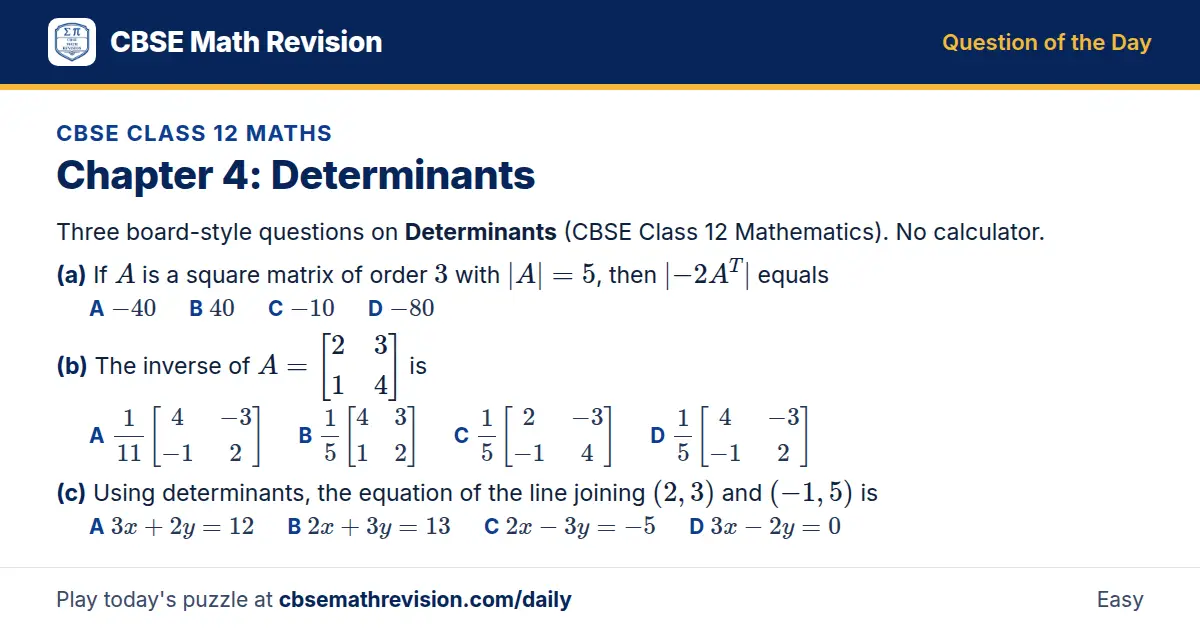
Chapter 4: Determinants
Three board-style questions on Determinants (CBSE Class 12 Mathematics). No calculator.
- If A is a square matrix of order 3 with |A| = 5, then |-2A^T| equals Options: A) -40; B) 40; C) -10; D) -80
- The inverse of A = 2 3; 1 4 is Options: A) 1/11 4 -3; -1 2; B) 15 4 3; 1 2; C) 15 2 -3; -1 4; D) 15 4 -3; -1 2
- Using determinants, the equation of the line joining (2, 3) and (-1, 5) is Options: A) 3x + 2y = 12; B) 2x + 3y = 13; C) 2x - 3y = -5; D) 3x - 2y = 0
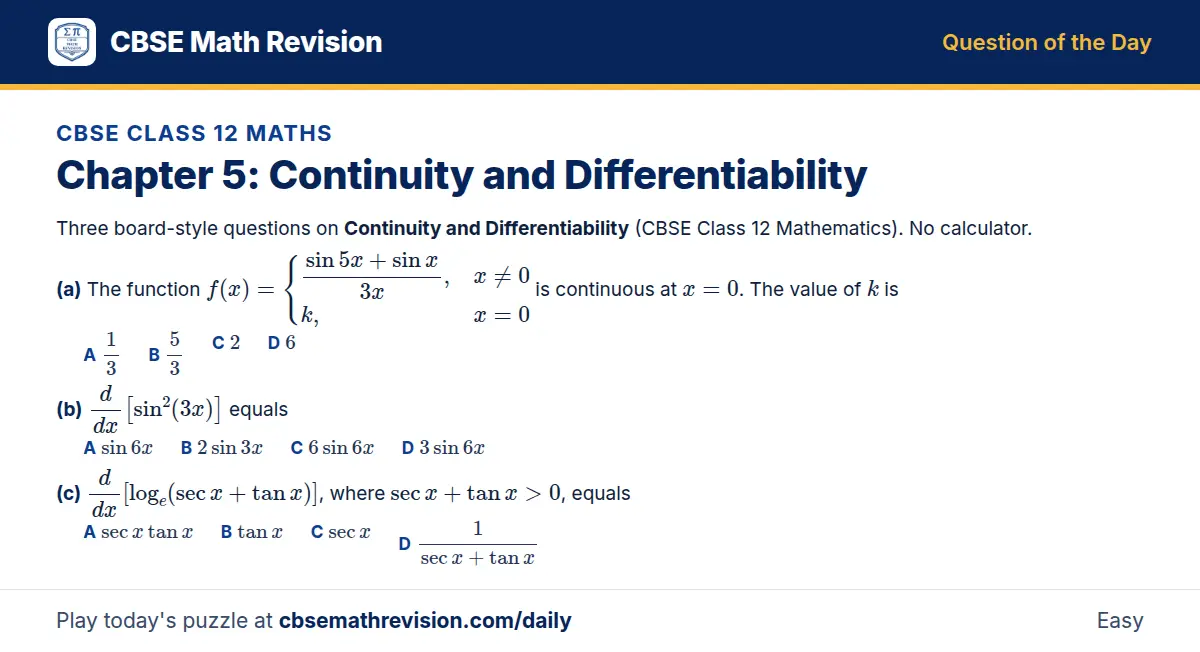
Chapter 5: Continuity and Differentiability
Three board-style questions on Continuity and Differentiability (CBSE Class 12 Mathematics). No calculator.
- The function f(x) = (sin 5x + sin x)/3x, x ≠ 0; k, x = 0 is continuous at x = 0. The value of k is Options: A) 13; B) 53; C) 2; D) 6
- d/dx[sin² (3x)] equals Options: A) sin 6x; B) 2sin 3x; C) 6sin 6x; D) 3sin 6x
- d/dx[log_e(sec x + tan x)], where sec x + tan x > 0, equals Options: A) sec x tan x; B) tan x; C) sec x; D) 1/(sec x + tan x)
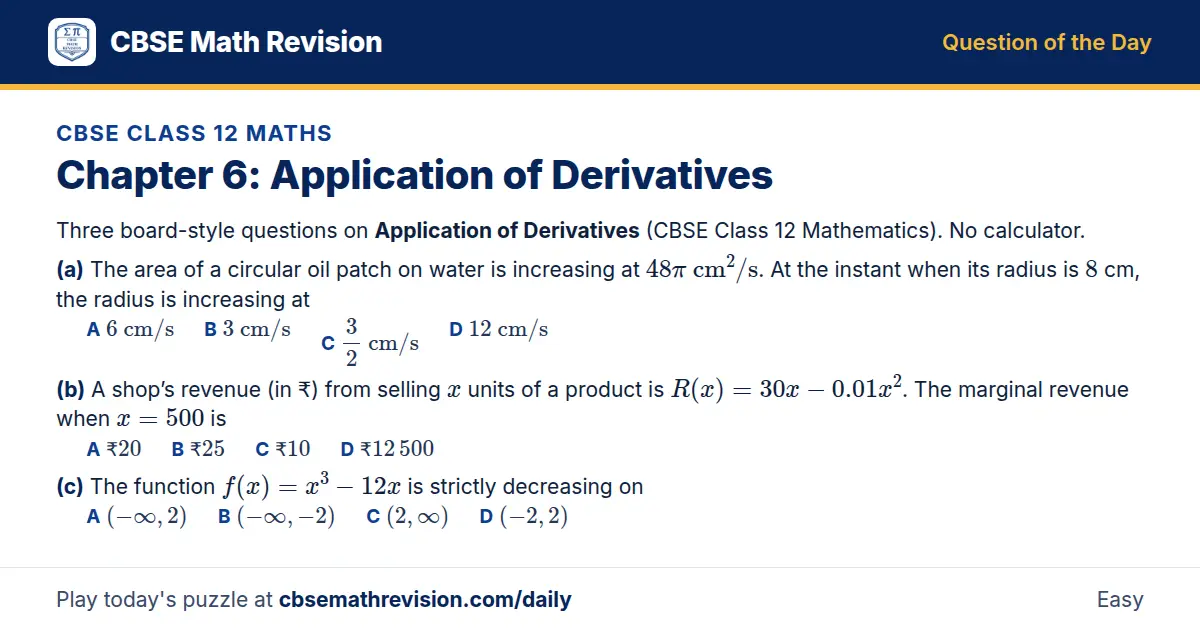
Chapter 6: Application of Derivatives
Three board-style questions on Application of Derivatives (CBSE Class 12 Mathematics). No calculator.
- The area of a circular oil patch on water is increasing at 48π cm^2/s. At the instant when its radius is 8 cm, the radius is increasing at Options: A) 6 cm/s; B) 3 cm/s; C) 3/2 cm/s; D) 12 cm/s
- A shop’s revenue (in ₹) from selling x units of a product is R(x) = 30x - 0.01x^2. The marginal revenue when x = 500 is Options: A) ₹20; B) ₹25; C) ₹10; D) ₹12 500
- The function f(x) = x³ - 12x is strictly decreasing on Options: A) (-∞, 2); B) (-∞, -2); C) (2, ∞); D) (-2, 2)
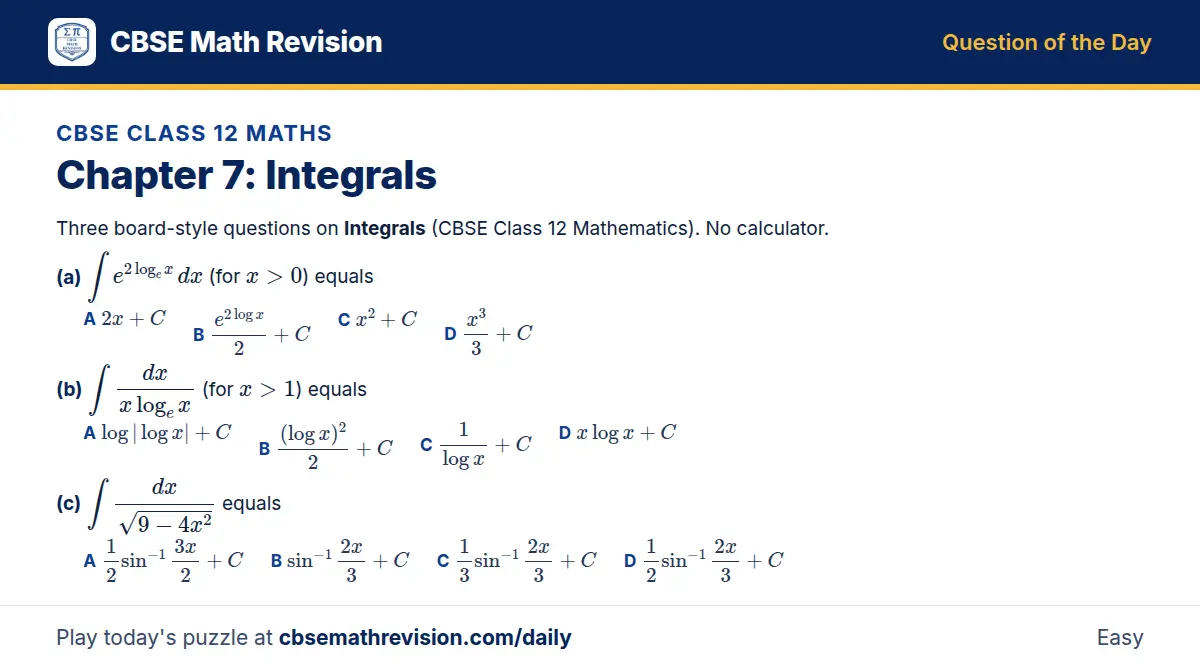
Chapter 7: Integrals
Three board-style questions on Integrals (CBSE Class 12 Mathematics). No calculator.
- ∫ e^(2log_e x) dx (for x > 0) equals Options: A) 2x + C; B) (e^(2log x))/2 + C; C) x² + C; D) (x³)/3 + C
- /(xlog_e x) (for x > 1) equals Options: A) log|log x| + C; B) ((log x)²)/2 + C; C) 1/(log x) + C; D) xlog x + C
- /(√(9 - 4x²)) equals Options: A) 12sin⁻¹3x/2 + C; B) sin⁻¹2x/3 + C; C) 13sin⁻¹2x/3 + C; D) 12sin⁻¹2x/3 + C
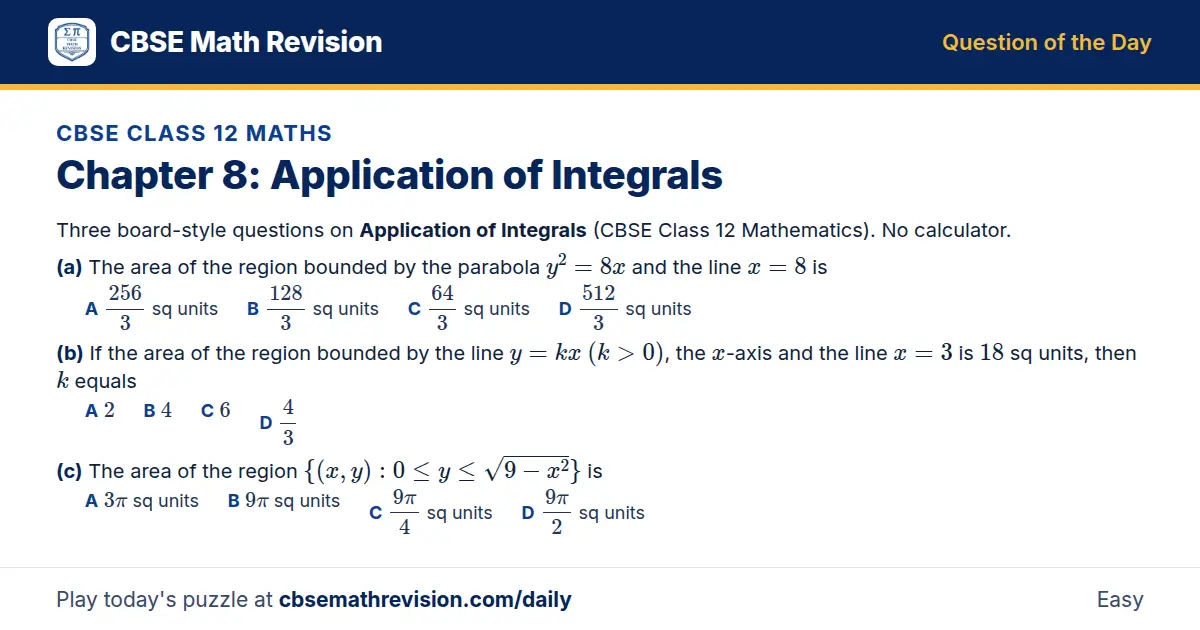
Chapter 8: Application of Integrals
Three board-style questions on Application of Integrals (CBSE Class 12 Mathematics). No calculator.
- The area of the region bounded by the parabola y² = 8x and the line x = 8 is Options: A) 256/3 sq units; B) 128/3 sq units; C) 64/3 sq units; D) 512/3 sq units
- If the area of the region bounded by the line y = kx (k > 0), the x-axis and the line x = 3 is 18 sq units, then k equals Options: A) 2; B) 4; C) 6; D) 4/3
- The area of the region (x, y): 0 ≤ y ≤ √(9 - x²) is Options: A) 3π sq units; B) 9π sq units; C) (9π)/4 sq units; D) (9π)/2 sq units
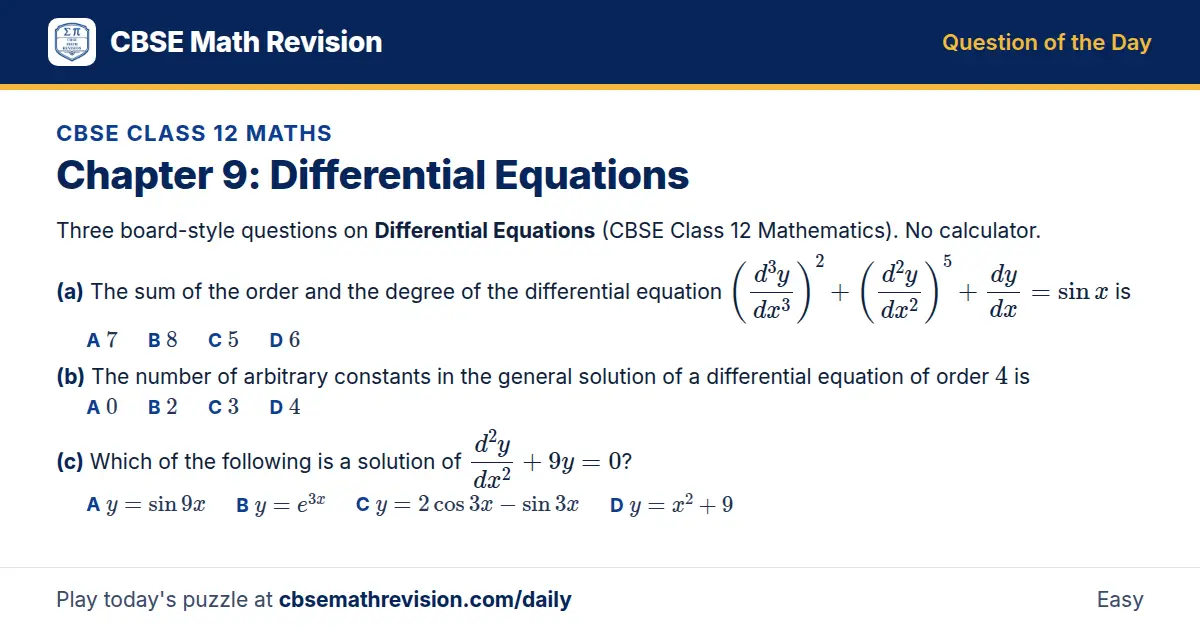
Chapter 9: Differential Equations
Three board-style questions on Differential Equations (CBSE Class 12 Mathematics). No calculator.
- The sum of the order and the degree of the differential equation ((d³y)/(dx³))² + ((d²y)/(dx²))⁵ + dy/dx = sin x is Options: A) 7; B) 8; C) 5; D) 6
- The number of arbitrary constants in the general solution of a differential equation of order 4 is Options: A) 0; B) 2; C) 3; D) 4
- Which of the following is a solution of (d²y)/(dx²) + 9y = 0? Options: A) y = sin 9x; B) y = e^(3x); C) y = 2cos 3x - sin 3x; D) y = x² + 9
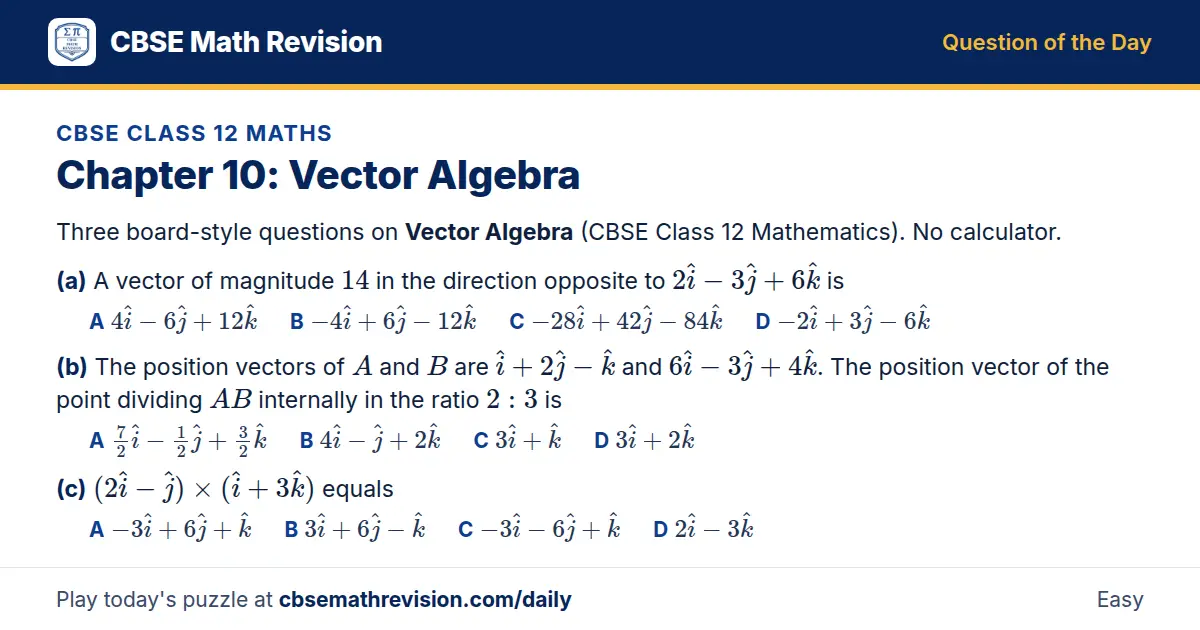
Chapter 10: Vector Algebra
Three board-style questions on Vector Algebra (CBSE Class 12 Mathematics). No calculator.
- A vector of magnitude 14 in the direction opposite to 2i - 3j + 6k is Options: A) 4i - 6j + 12k; B) -4i + 6j - 12k; C) -28i + 42j - 84k; D) -2i + 3j - 6k
- The position vectors of A and B are i + 2j - k and 6i - 3j + 4k. The position vector of the point dividing AB internally in the ratio 2: 3 is Options: A) 72i - 12j + 32k; B) 4i - j + 2k; C) 3i + k; D) 3i + 2k
- (2i - j) × (i + 3k) equals Options: A) -3i + 6j + k; B) 3i + 6j - k; C) -3i - 6j + k; D) 2i - 3k
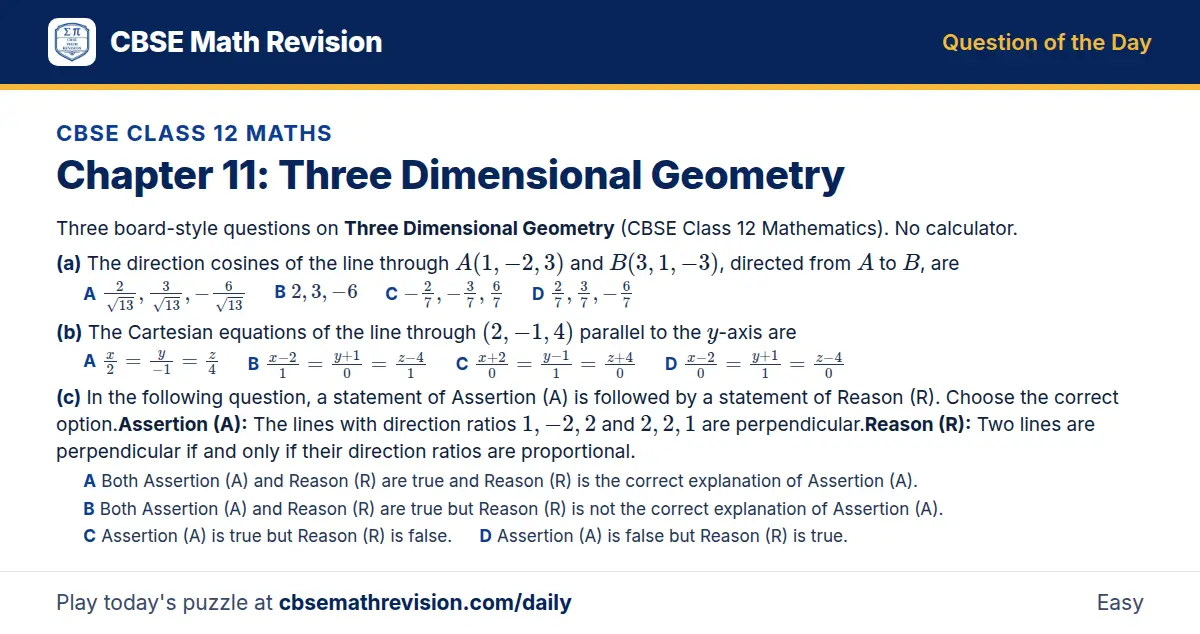
Chapter 11: Three Dimensional Geometry
Three board-style questions on Three Dimensional Geometry (CBSE Class 12 Mathematics). No calculator.
- The direction cosines of the line through A(1, -2, 3) and B(3, 1, -3), directed from A to B, are Options: A) 2/(√13), 3/(√13), -6/(√13); B) 2, 3, -6; C) -27, -37, 67; D) 27, 37, -67
- The Cartesian equations of the line through (2, -1, 4) parallel to the y-axis are Options: A) x/2 = y/(-1) = z/4; B) (x - 2)/1 = (y + 1)/0 = (z - 4)/1; C) (x + 2)/0 = (y - 1)/1 = (z + 4)/0; D) (x - 2)/0 = (y + 1)/1 = (z - 4)/0
- In the following question, a statement of Assertion (A) is followed by a statement of Reason (R). Choose the correct option. Assertion (A): The lines with direction ratios 1, -2, 2 and 2, 2, 1 are perpendicular. Reason (R): Two lines are perpendicular if and only if their direction ratios are proportional. Options: A) Both Assertion (A) and Reason (R) are true and Reason (R) is the correct explanation of Assertion (A).; B) Both Assertion (A) and Reason (R) are true but Reason (R) is not the correct explanation of Assertion (A).; C) Assertion (A) is true but Reason (R) is false.; D) Assertion (A) is false but Reason (R) is true.
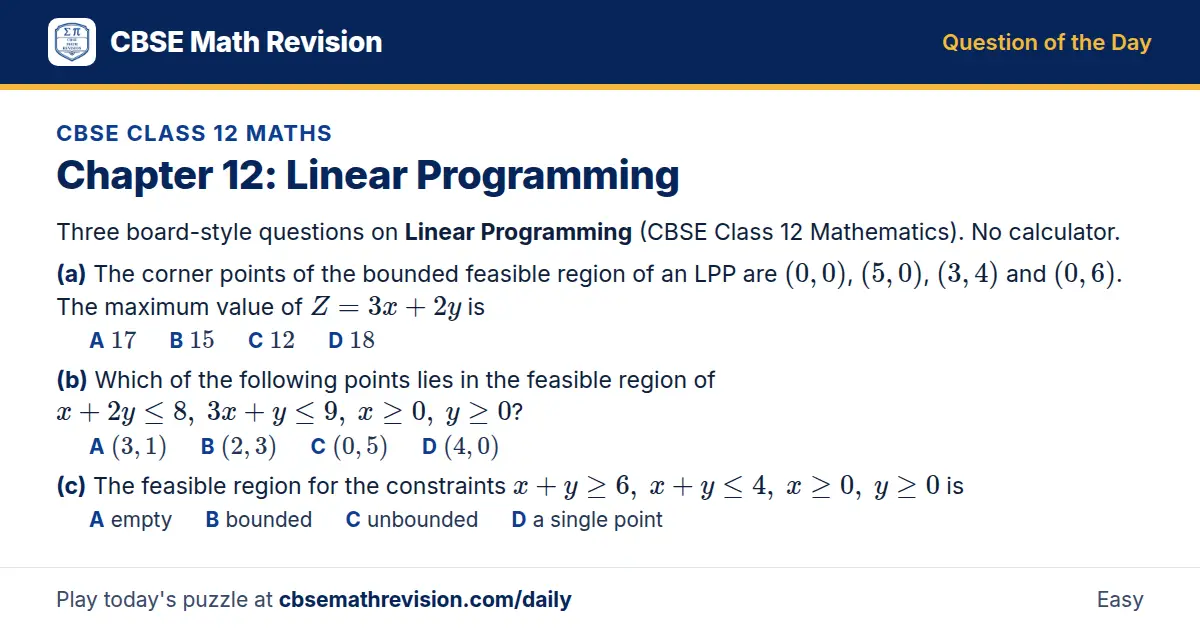
Chapter 12: Linear Programming
Three board-style questions on Linear Programming (CBSE Class 12 Mathematics). No calculator.
- The corner points of the bounded feasible region of an LPP are (0, 0), (5, 0), (3, 4) and (0, 6). The maximum value of Z = 3x + 2y is Options: A) 17; B) 15; C) 12; D) 18
- Which of the following points lies in the feasible region of x + 2y ≤ 8, 3x + y ≤ 9, x ≥ 0, y ≥ 0? Options: A) (3, 1); B) (2, 3); C) (0, 5); D) (4, 0)
- The feasible region for the constraints x + y ≥ 6, x + y ≤ 4, x ≥ 0, y ≥ 0 is Options: A) empty; B) bounded; C) unbounded; D) a single point
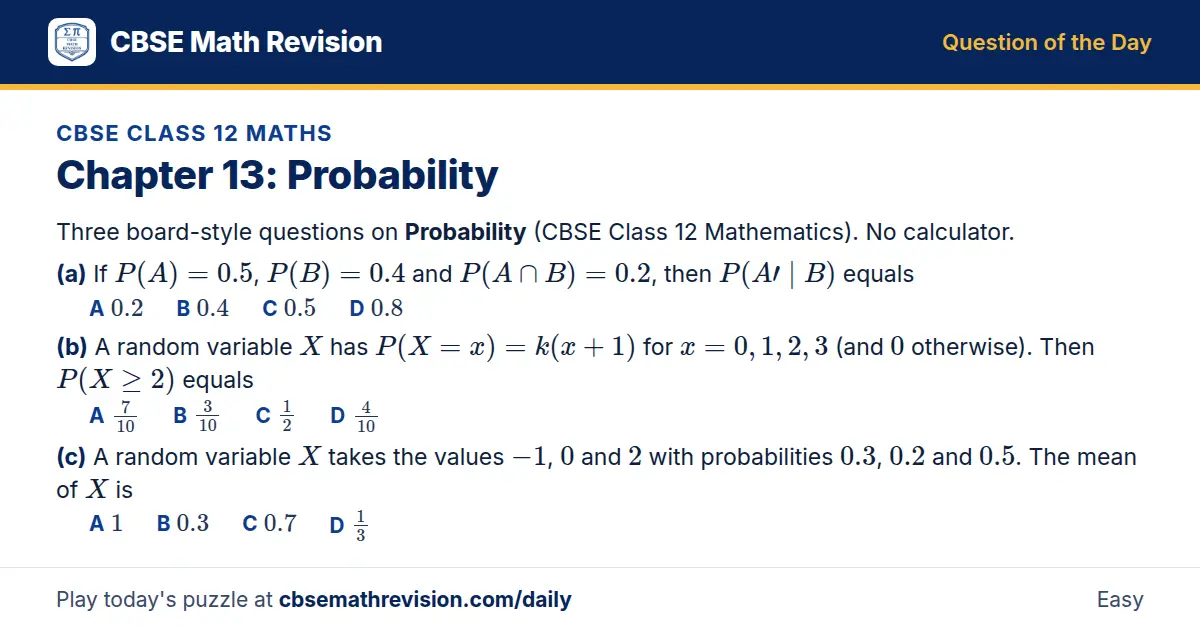
Chapter 13: Probability
Three board-style questions on Probability (CBSE Class 12 Mathematics). No calculator.
- If P(A) = 0.5, P(B) = 0.4 and P(A ∩ B) = 0.2, then P(A′ | B) equals Options: A) 0.2; B) 0.4; C) 0.5; D) 0.8
- A random variable X has P(X = x) = k(x + 1) for x = 0, 1, 2, 3 (and 0 otherwise). Then P(X ≥ 2) equals Options: A) 7/10; B) 3/10; C) 12; D) 4/10
- A random variable X takes the values -1, 0 and 2 with probabilities 0.3, 0.2 and 0.5. The mean of X is Options: A) 1; B) 0.3; C) 0.7; D) 13
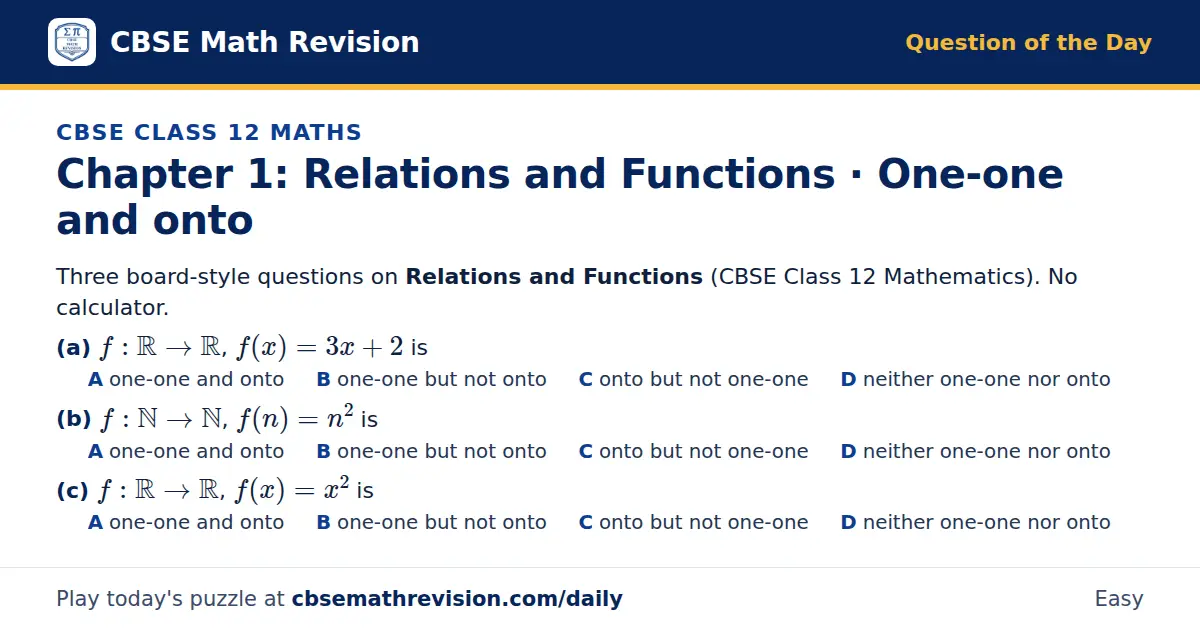
Chapter 1: Relations and Functions · One-one and onto
Three board-style questions on Relations and Functions (CBSE Class 12 Mathematics). No calculator.
- f: ℝ → ℝ, f(x) = 3x + 2 is Options: A) one-one and onto; B) one-one but not onto; C) onto but not one-one; D) neither one-one nor onto
- f: ℕ → ℕ, f(n) = n² is Options: A) one-one and onto; B) one-one but not onto; C) onto but not one-one; D) neither one-one nor onto
- f: ℝ → ℝ, f(x) = x² is Options: A) one-one and onto; B) one-one but not onto; C) onto but not one-one; D) neither one-one nor onto
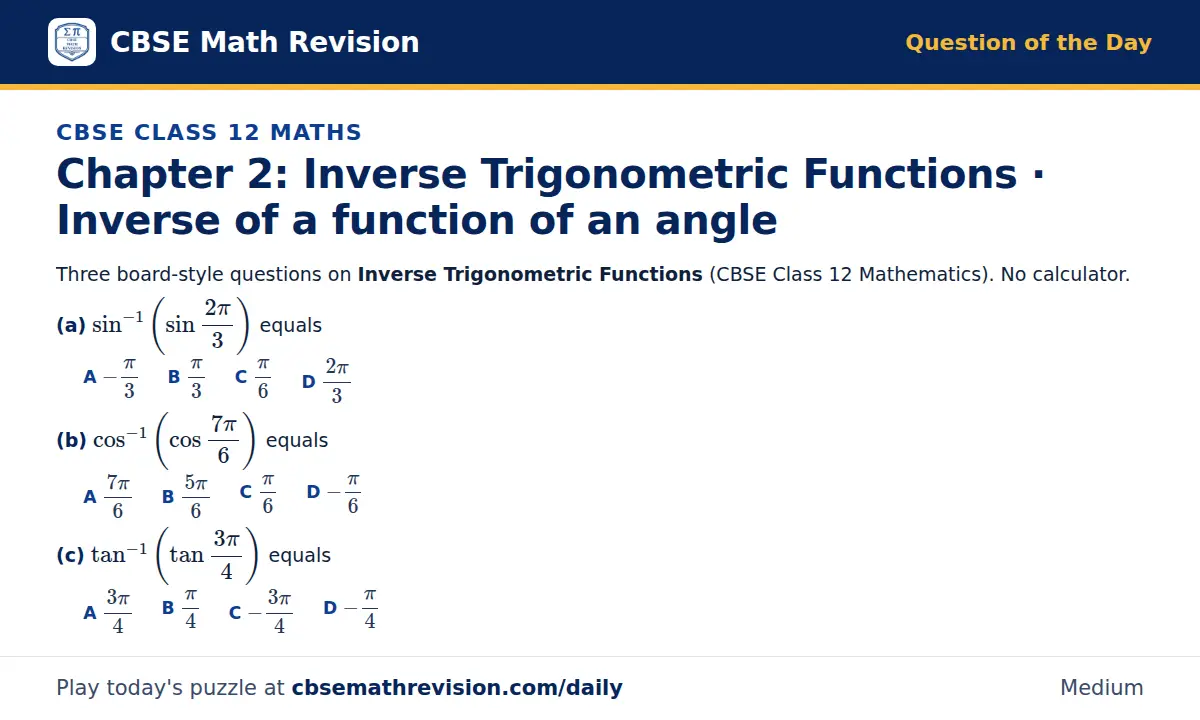
Chapter 2: Inverse Trigonometric Functions · Inverse of a function of an angle
Three board-style questions on Inverse Trigonometric Functions (CBSE Class 12 Mathematics). No calculator.
- sin⁻¹(sin(2π)/3) equals Options: A) - (π)/3; B) (π)/3; C) (π)/6; D) (2 π)/3
- cos⁻¹(cos(7π)/6) equals Options: A) (7 π)/6; B) (5 π)/6; C) (π)/6; D) - (π)/6
- tan⁻¹(tan(3π)/4) equals Options: A) (3 π)/4; B) (π)/4; C) - (3 π)/4; D) - (π)/4
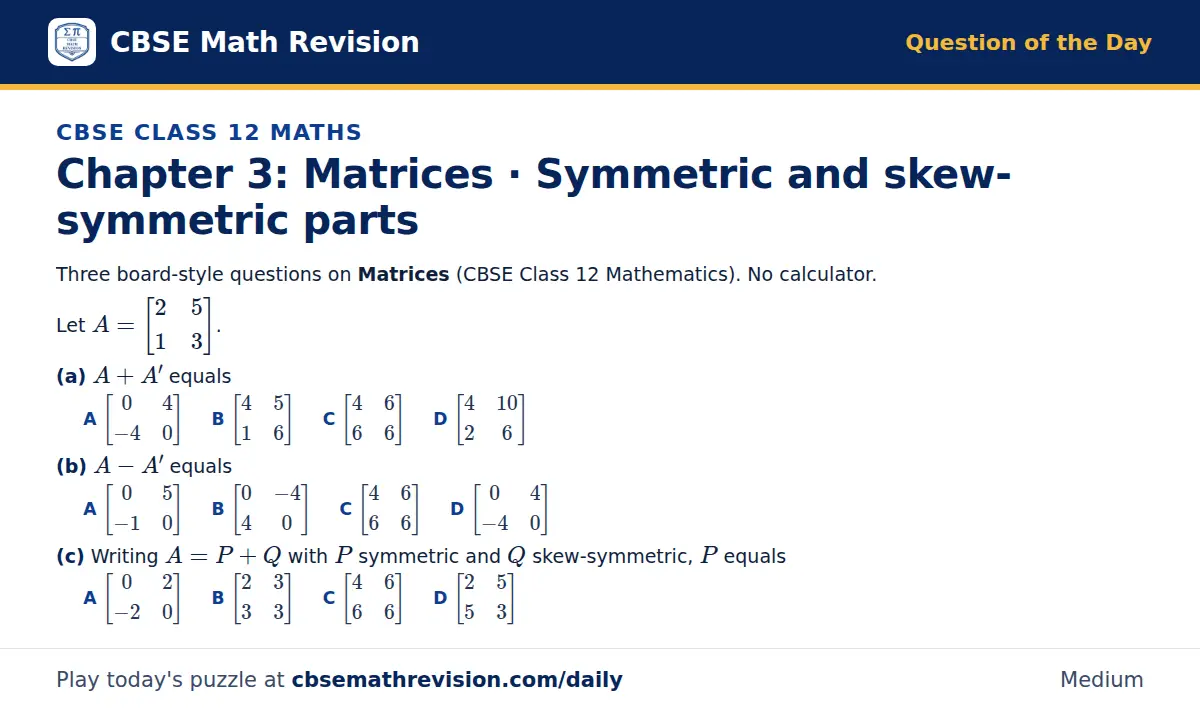
Chapter 3: Matrices · Symmetric and skew-symmetric parts
Three board-style questions on Matrices (CBSE Class 12 Mathematics). No calculator. Let A = 2 5; 1 3.
- A + A' equals Options: A) 0 4; -4 0; B) 4 5; 1 6; C) 4 6; 6 6; D) 4 10; 2 6
- A - A' equals Options: A) 0 5; -1 0; B) 0 -4; 4 0; C) 4 6; 6 6; D) 0 4; -4 0
- Writing A = P + Q with P symmetric and Q skew-symmetric, P equals Options: A) 0 2; -2 0; B) 2 3; 3 3; C) 4 6; 6 6; D) 2 5; 5 3
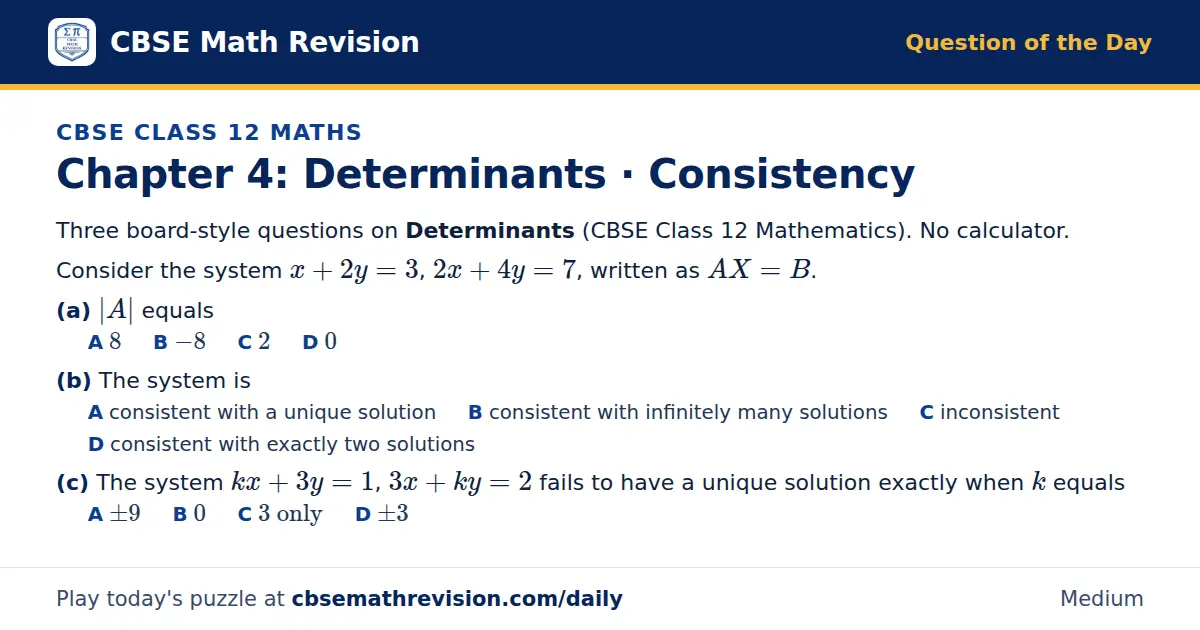
Chapter 4: Determinants · Consistency
Three board-style questions on Determinants (CBSE Class 12 Mathematics). No calculator. Consider the system x + 2y = 3, 2x + 4y = 7, written as AX = B.
- |A| equals Options: A) 8; B) -8; C) 2; D) 0
- The system is Options: A) consistent with a unique solution; B) consistent with infinitely many solutions; C) inconsistent; D) consistent with exactly two solutions
- The system kx + 3y = 1, 3x + ky = 2 fails to have a unique solution exactly when k equals Options: A) ± 9; B) 0; C) 3 only; D) ± 3
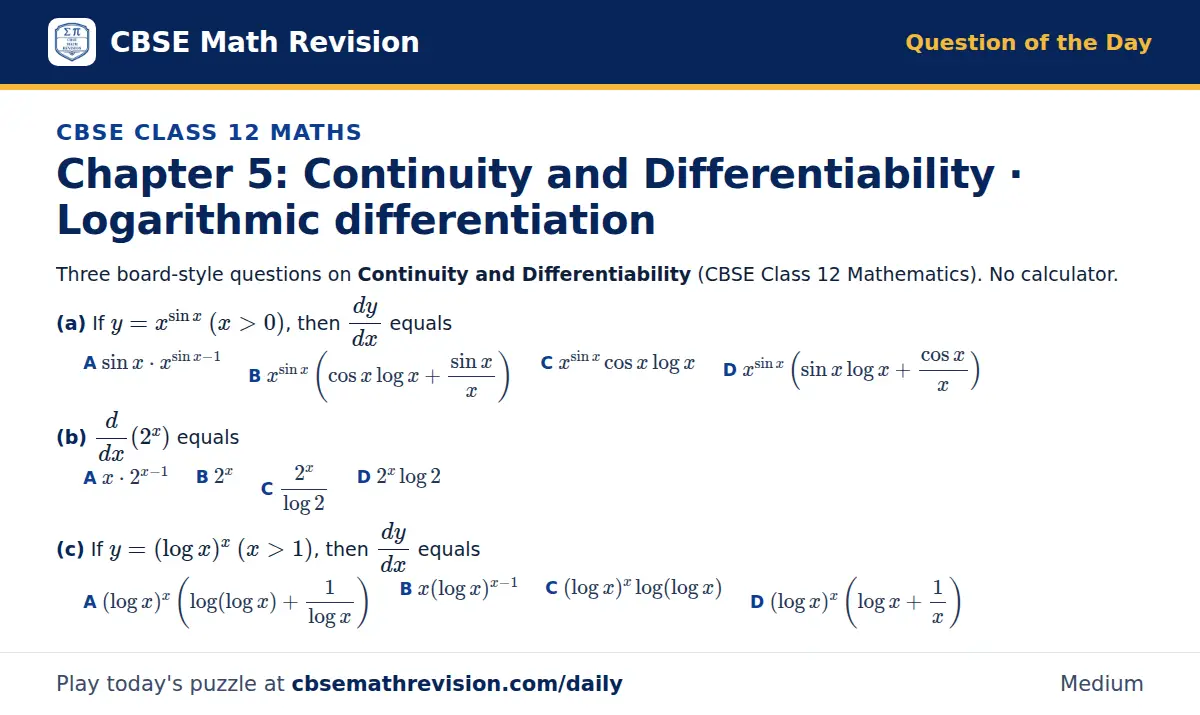
Chapter 5: Continuity and Differentiability · Logarithmic differentiation
Three board-style questions on Continuity and Differentiability (CBSE Class 12 Mathematics). No calculator.
- If y = x^(sin x) (x > 0), then dy/dx equals Options: A) sin x · x^(sin x - 1); B) x^(sin x)(cos xlog x + (sin x)/x); C) x^(sin x)cos xlog x; D) x^(sin x)(sin xlog x + (cos x)/x)
- d/dx(2^x) equals Options: A) x · 2^(x - 1); B) 2^x; C) (2^x)/(log 2); D) 2^xlog 2
- If y = (log x)^x (x > 1), then dy/dx equals Options: A) (log x)^x(log(log x) + 1/(log x)); B) x(log x)^(x - 1); C) (log x)^xlog(log x); D) (log x)^x(log x + 1x)
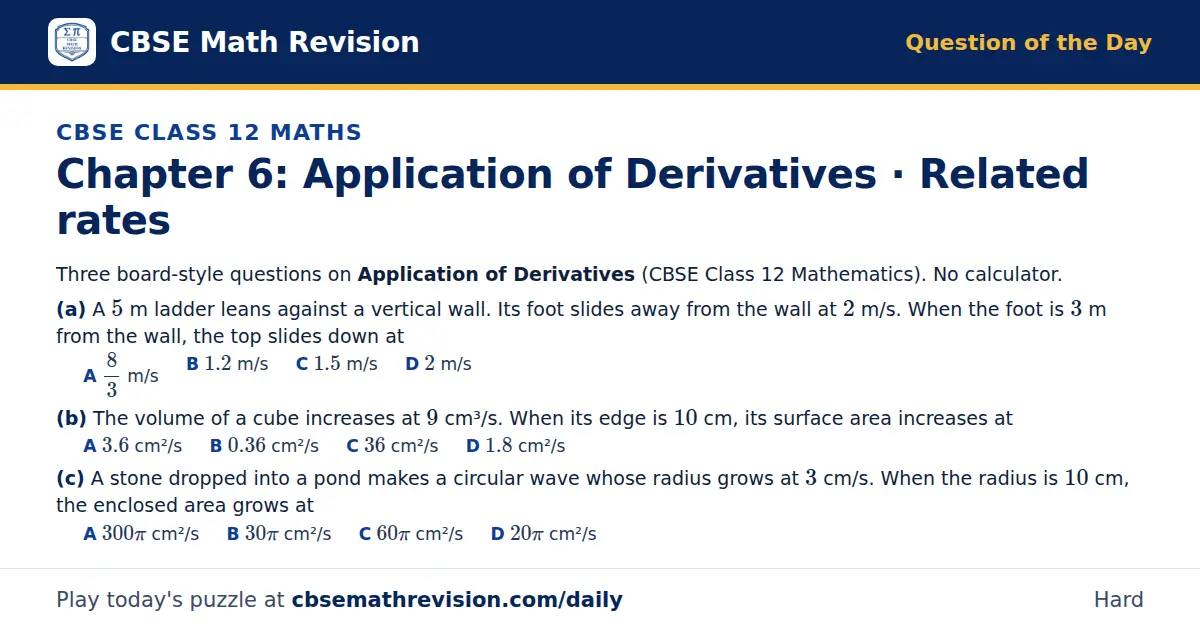
Chapter 6: Application of Derivatives · Related rates
Three board-style questions on Application of Derivatives (CBSE Class 12 Mathematics). No calculator.
- A 5 m ladder leans against a vertical wall. Its foot slides away from the wall at 2 m/s. When the foot is 3 m from the wall, the top slides down at Options: A) 8/3 m/s; B) 1.2 m/s; C) 1.5 m/s; D) 2 m/s
- The volume of a cube increases at 9 cm³/s. When its edge is 10 cm, its surface area increases at Options: A) 3.6 cm²/s; B) 0.36 cm²/s; C) 36 cm²/s; D) 1.8 cm²/s
- A stone dropped into a pond makes a circular wave whose radius grows at 3 cm/s. When the radius is 10 cm, the enclosed area grows at Options: A) 300π cm²/s; B) 30π cm²/s; C) 60π cm²/s; D) 20π cm²/s
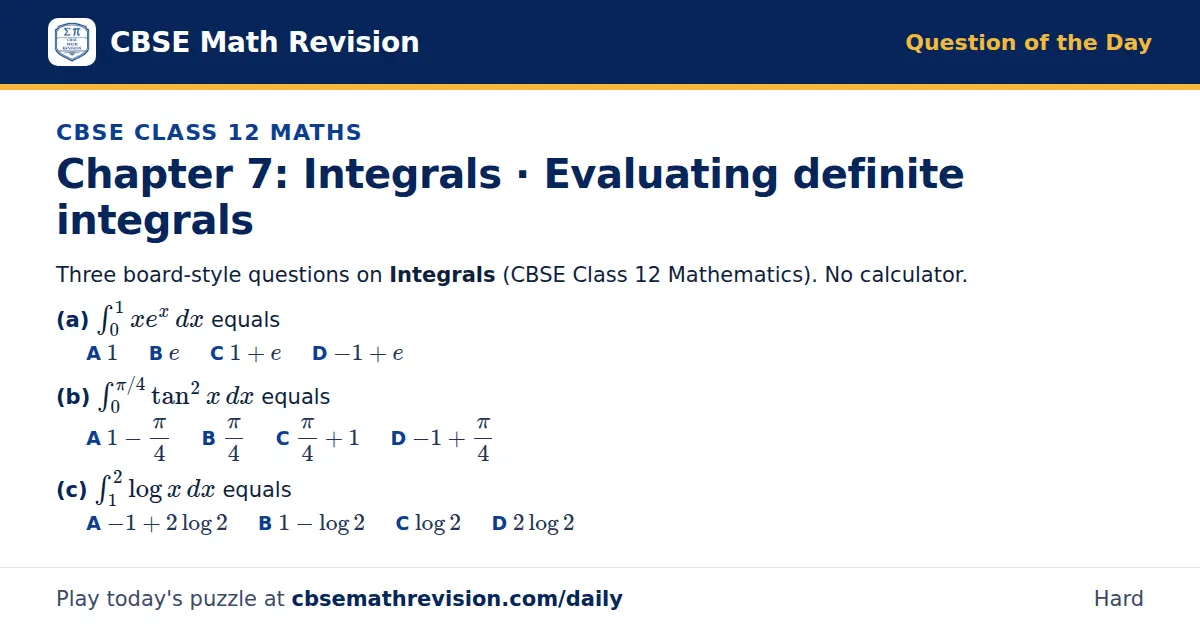
Chapter 7: Integrals · Evaluating definite integrals
Three board-style questions on Integrals (CBSE Class 12 Mathematics). No calculator.
- ∫_0¹ x e^x dx equals Options: A) 1; B) e; C) 1 + e; D) -1 + e
- ∫_0^(π/4) tan² x dx equals Options: A) 1 - (π)/4; B) (π)/4; C) (π)/4 + 1; D) -1 + (π)/4
- ∫_1² log x dx equals Options: A) -1 + 2 log 2; B) 1 - log 2; C) log 2; D) 2 log 2
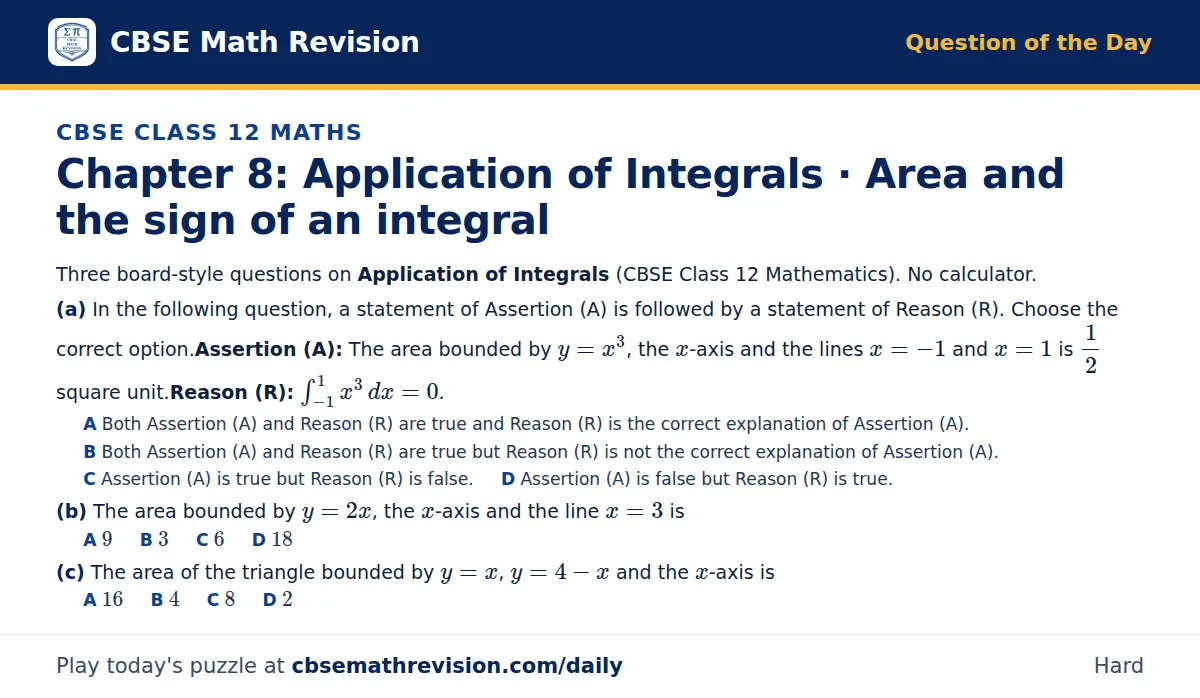
Chapter 8: Application of Integrals · Area and the sign of an integral
Three board-style questions on Application of Integrals (CBSE Class 12 Mathematics). No calculator.
- In the following question, a statement of Assertion (A) is followed by a statement of Reason (R). Choose the correct option. Assertion (A): The area bounded by y = x³, the x-axis and the lines x = -1 and x = 1 is 12 square unit. Reason (R): ∫_-1¹ x³ dx = 0. Options: A) Both Assertion (A) and Reason (R) are true and Reason (R) is the correct explanation of Assertion (A).; B) Both Assertion (A) and Reason (R) are true but Reason (R) is not the correct explanation of Assertion (A).; C) Assertion (A) is true but Reason (R) is false.; D) Assertion (A) is false but Reason (R) is true.
- The area bounded by y = 2x, the x-axis and the line x = 3 is Options: A) 9; B) 3; C) 6; D) 18
- The area of the triangle bounded by y = x, y = 4 - x and the x-axis is Options: A) 16; B) 4; C) 8; D) 2
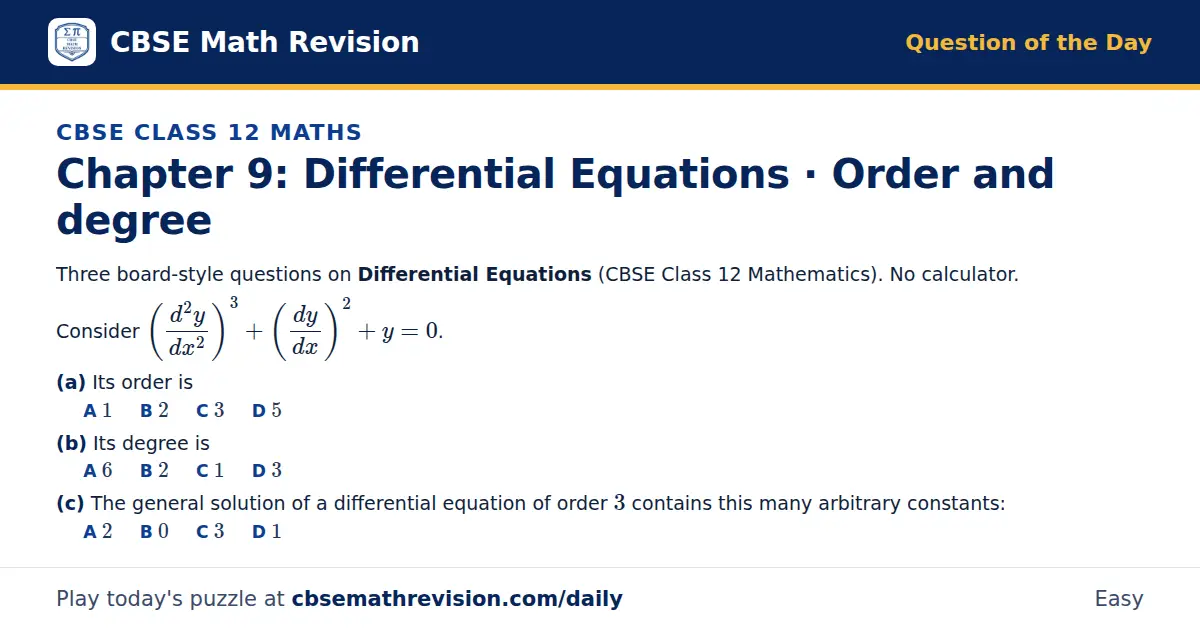
Chapter 9: Differential Equations · Order and degree
Three board-style questions on Differential Equations (CBSE Class 12 Mathematics). No calculator. Consider ((d²y)/(dx²))³ + (dy/dx)² + y = 0.
- Its order is Options: A) 1; B) 2; C) 3; D) 5
- Its degree is Options: A) 6; B) 2; C) 1; D) 3
- The general solution of a differential equation of order 3 contains this many arbitrary constants: Options: A) 2; B) 0; C) 3; D) 1
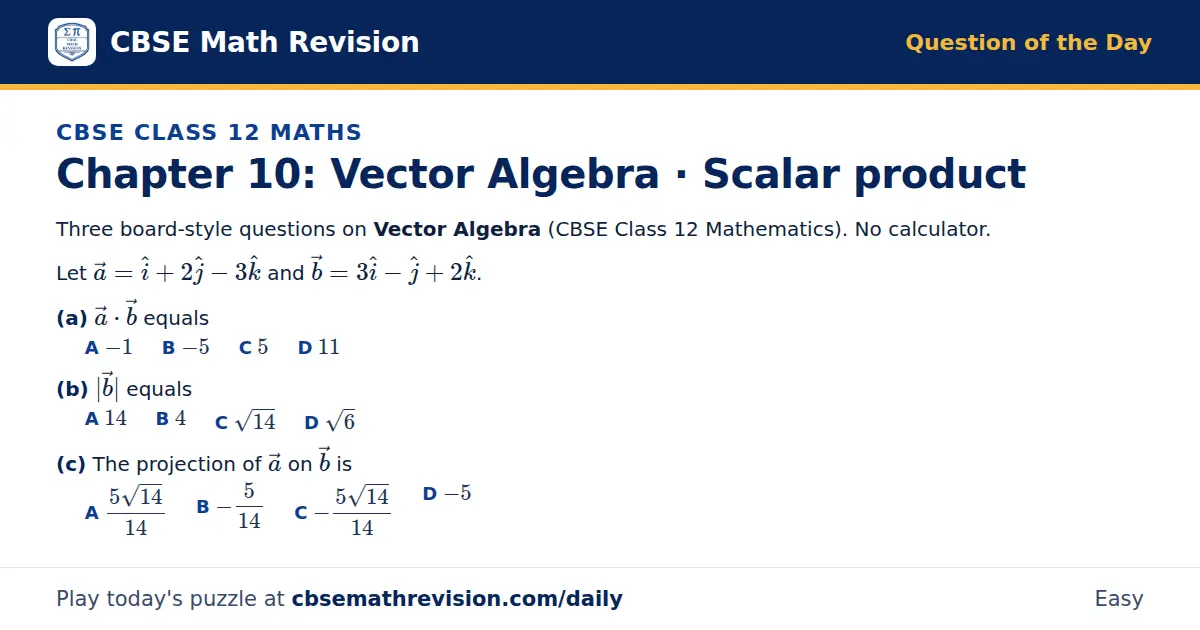
Chapter 10: Vector Algebra · Scalar product
Three board-style questions on Vector Algebra (CBSE Class 12 Mathematics). No calculator. Let a = i + 2 j - 3 k and b = 3 i - j + 2 k.
- a · b equals Options: A) -1; B) -5; C) 5; D) 11
- | b| equals Options: A) 14; B) 4; C) √14; D) √6
- The projection of a on b is Options: A) (5 √14)/14; B) - 5/14; C) - (5 √14)/14; D) -5
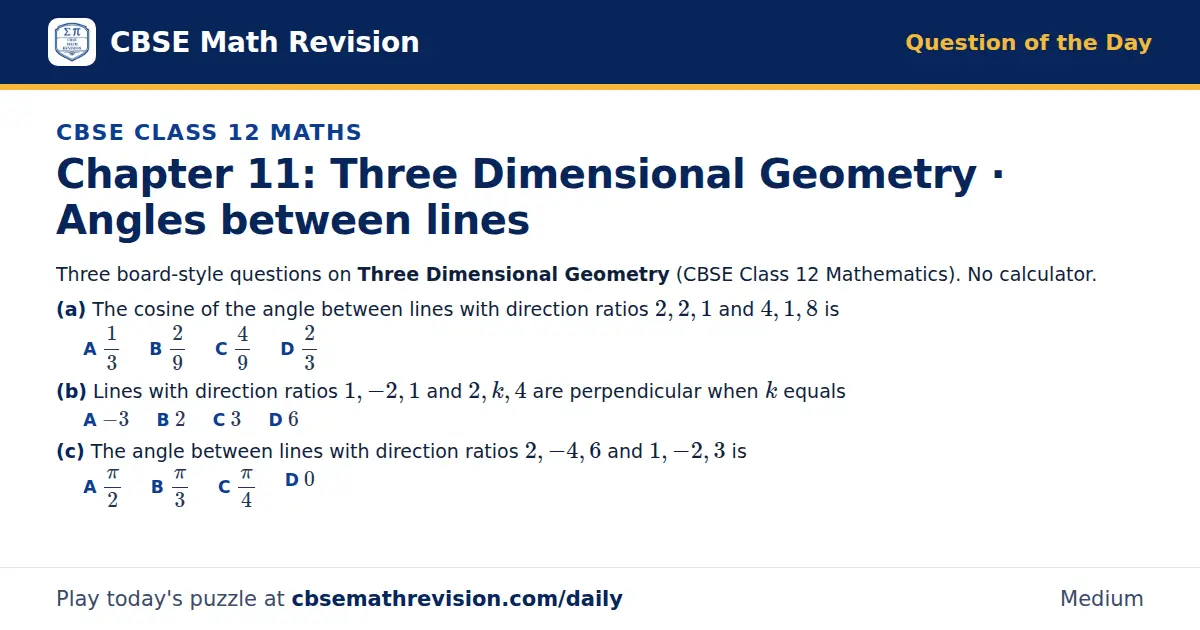
Chapter 11: Three Dimensional Geometry · Angles between lines
Three board-style questions on Three Dimensional Geometry (CBSE Class 12 Mathematics). No calculator.
- The cosine of the angle between lines with direction ratios 2, 2, 1 and 4, 1, 8 is Options: A) 1/3; B) 2/9; C) 4/9; D) 2/3
- Lines with direction ratios 1, -2, 1 and 2, k, 4 are perpendicular when k equals Options: A) -3; B) 2; C) 3; D) 6
- The angle between lines with direction ratios 2, -4, 6 and 1, -2, 3 is Options: A) (π)/2; B) (π)/3; C) (π)/4; D) 0
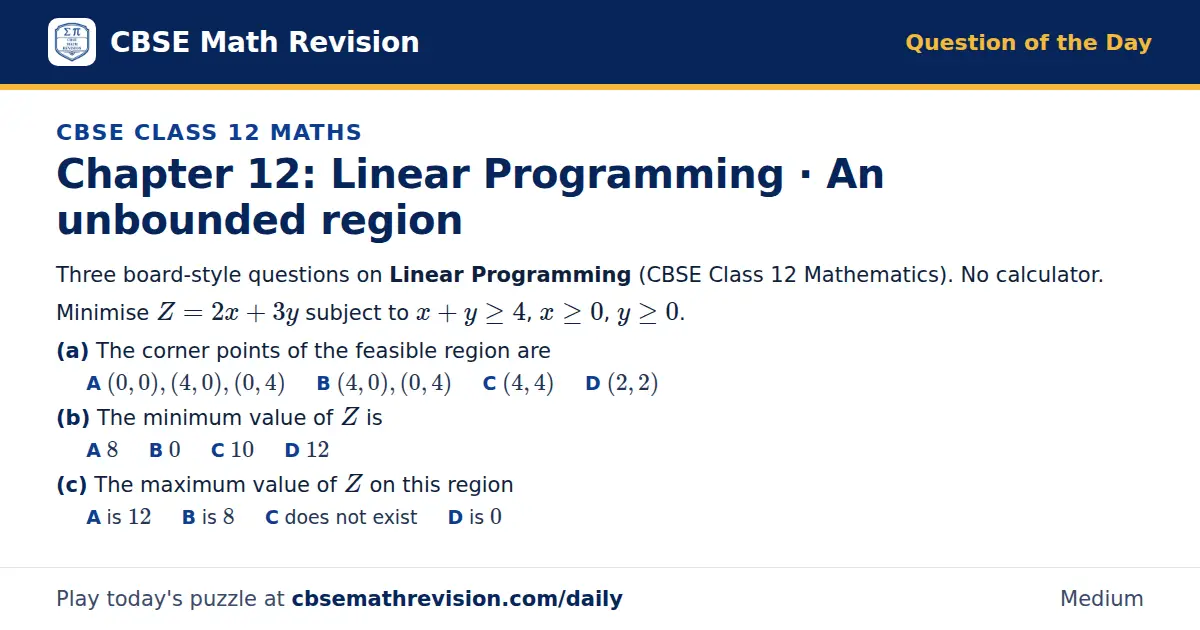
Chapter 12: Linear Programming · An unbounded region
Three board-style questions on Linear Programming (CBSE Class 12 Mathematics). No calculator. Minimise Z = 2x + 3y subject to x + y ≥ 4, x ≥ 0, y ≥ 0.
- The corner points of the feasible region are Options: A) (0, 0), (4, 0), (0, 4); B) (4, 0), (0, 4); C) (4, 4); D) (2, 2)
- The minimum value of Z is Options: A) 8; B) 0; C) 10; D) 12
- The maximum value of Z on this region Options: A) is 12; B) is 8; C) does not exist; D) is 0
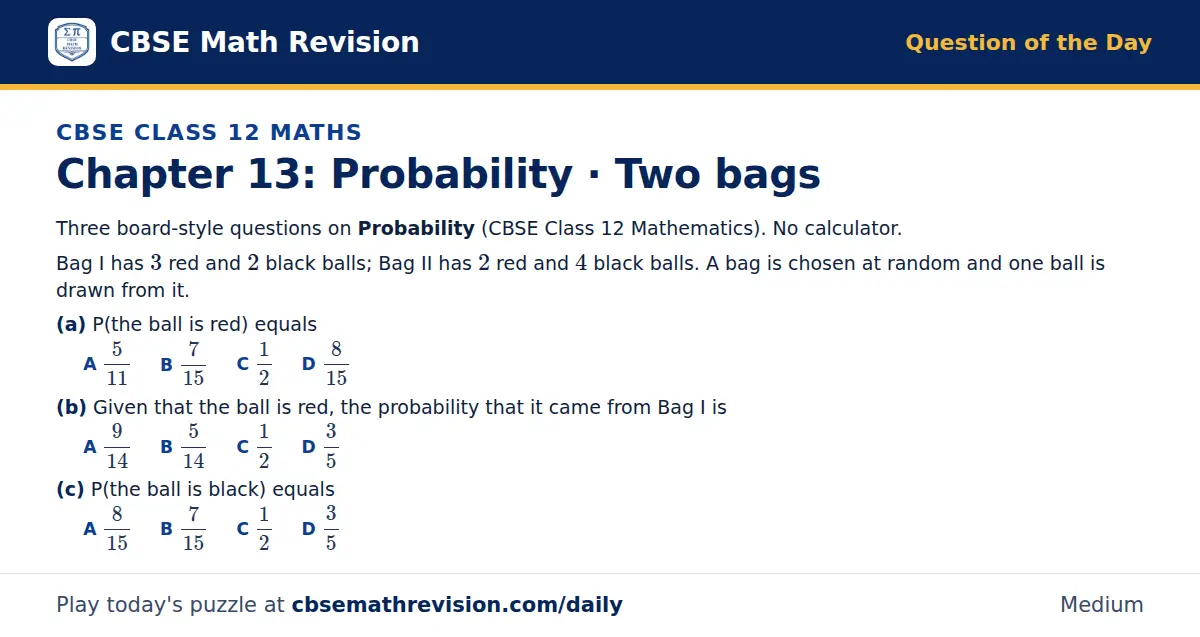
Chapter 13: Probability · Two bags
Three board-style questions on Probability (CBSE Class 12 Mathematics). No calculator. Bag I has 3 red and 2 black balls; Bag II has 2 red and 4 black balls. A bag is chosen at random and one ball is drawn from it.
- P(the ball is red) equals Options: A) 5/11; B) 7/15; C) 1/2; D) 8/15
- Given that the ball is red, the probability that it came from Bag I is Options: A) 9/14; B) 5/14; C) 1/2; D) 3/5
- P(the ball is black) equals Options: A) 8/15; B) 7/15; C) 1/2; D) 3/5
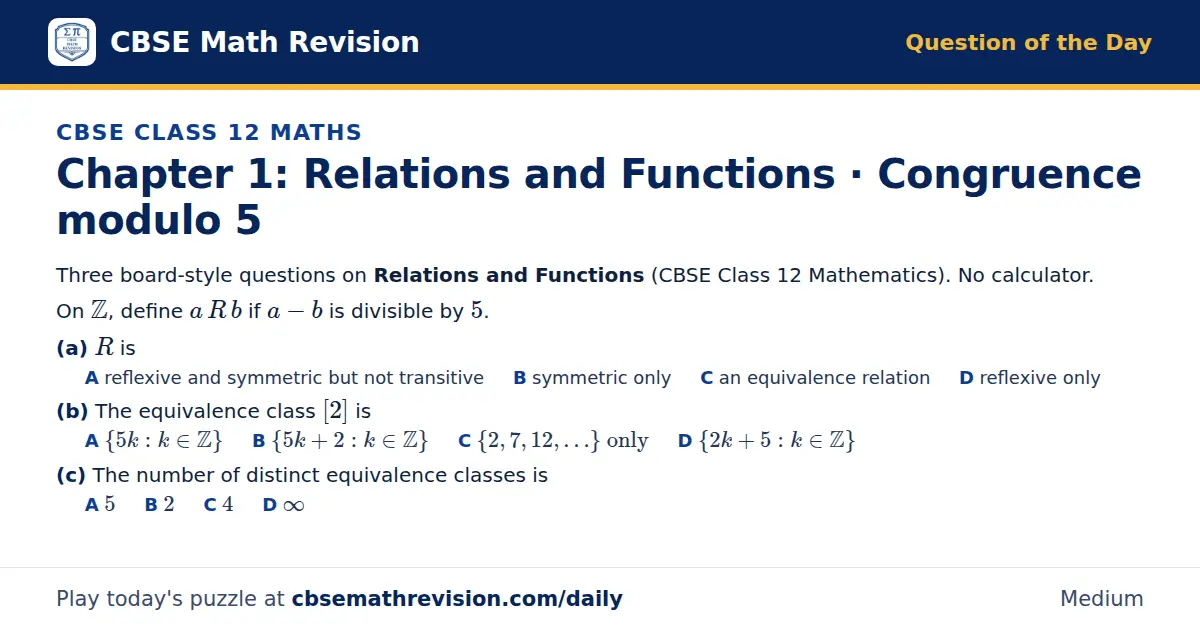
Chapter 1: Relations and Functions · Congruence modulo 5
Three board-style questions on Relations and Functions (CBSE Class 12 Mathematics). No calculator. On ℤ, define a R b if a - b is divisible by 5.
- R is Options: A) reflexive and symmetric but not transitive; B) symmetric only; C) an equivalence relation; D) reflexive only
- The equivalence class [2] is Options: A) 5k: k ∈ ℤ; B) 5k + 2: k ∈ ℤ; C) 2, 7, 12, … only; D) 2k + 5: k ∈ ℤ
- The number of distinct equivalence classes is Options: A) 5; B) 2; C) 4; D) ∞
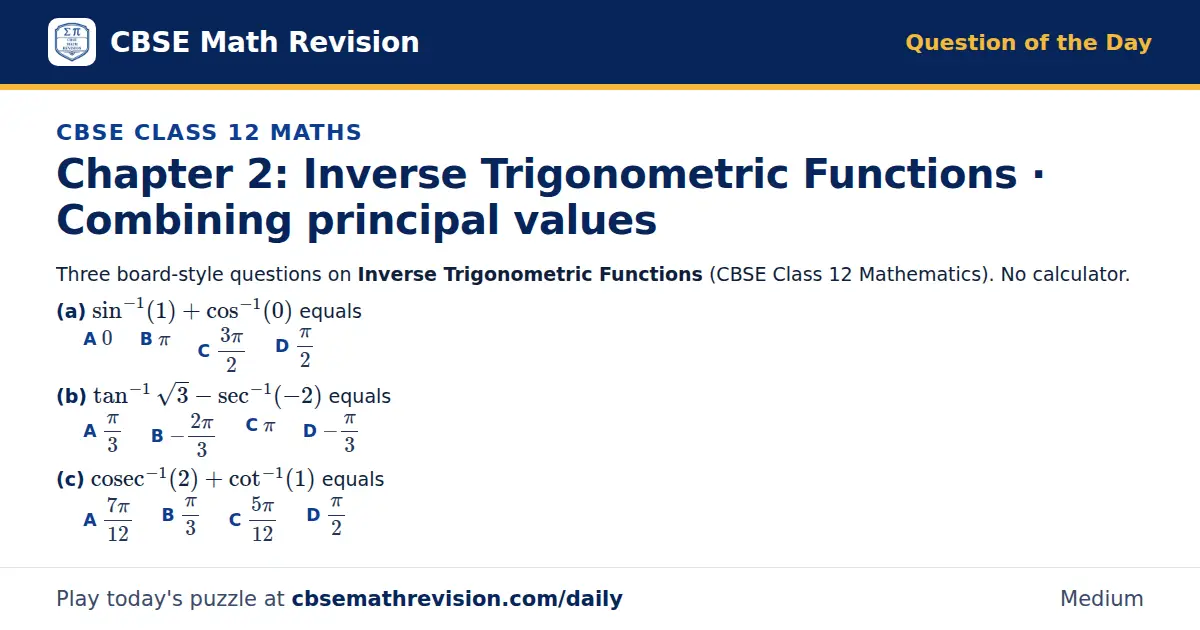
Chapter 2: Inverse Trigonometric Functions · Combining principal values
Three board-style questions on Inverse Trigonometric Functions (CBSE Class 12 Mathematics). No calculator.
- sin⁻¹(1) + cos⁻¹(0) equals Options: A) 0; B) π; C) (3 π)/2; D) (π)/2
- tan⁻¹√3 - sec⁻¹(-2) equals Options: A) (π)/3; B) - (2 π)/3; C) π; D) - (π)/3
- cosec⁻¹(2) + cot⁻¹(1) equals Options: A) (7 π)/12; B) (π)/3; C) (5 π)/12; D) (π)/2
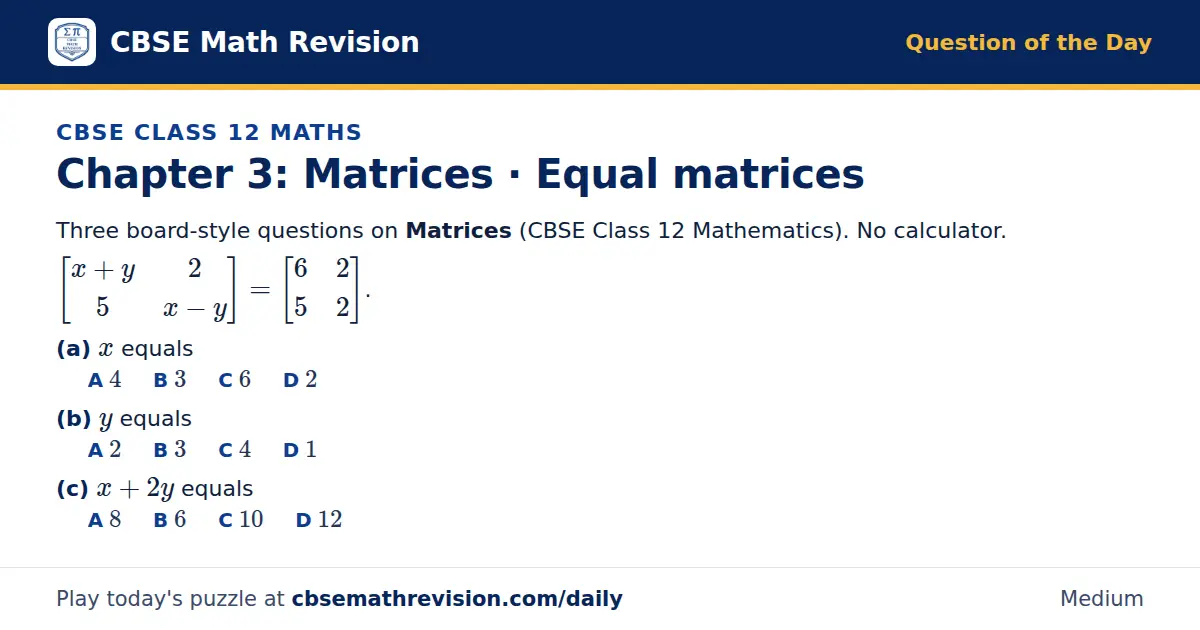
Chapter 3: Matrices · Equal matrices
Three board-style questions on Matrices (CBSE Class 12 Mathematics). No calculator. x + y 2; 5 x - y = 6 2; 5 2.
- x equals Options: A) 4; B) 3; C) 6; D) 2
- y equals Options: A) 2; B) 3; C) 4; D) 1
- x + 2y equals Options: A) 8; B) 6; C) 10; D) 12
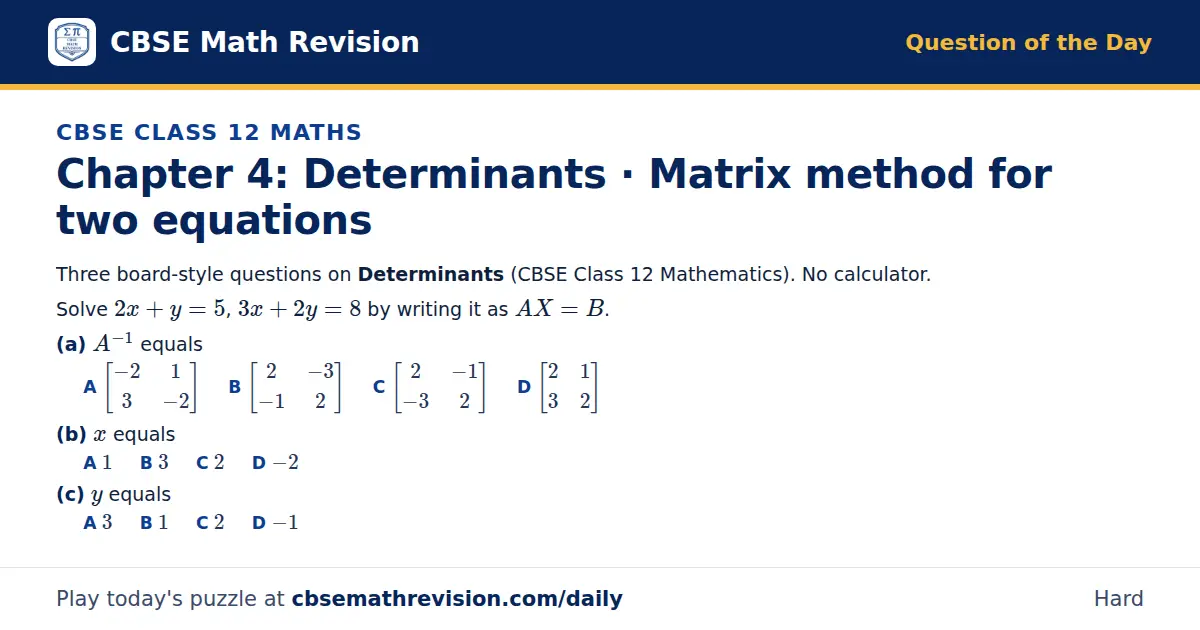
Chapter 4: Determinants · Matrix method for two equations
Three board-style questions on Determinants (CBSE Class 12 Mathematics). No calculator. Solve 2x + y = 5, 3x + 2y = 8 by writing it as AX = B.
- A⁻¹ equals Options: A) -2 1; 3 -2; B) 2 -3; -1 2; C) 2 -1; -3 2; D) 2 1; 3 2
- x equals Options: A) 1; B) 3; C) 2; D) -2
- y equals Options: A) 3; B) 1; C) 2; D) -1
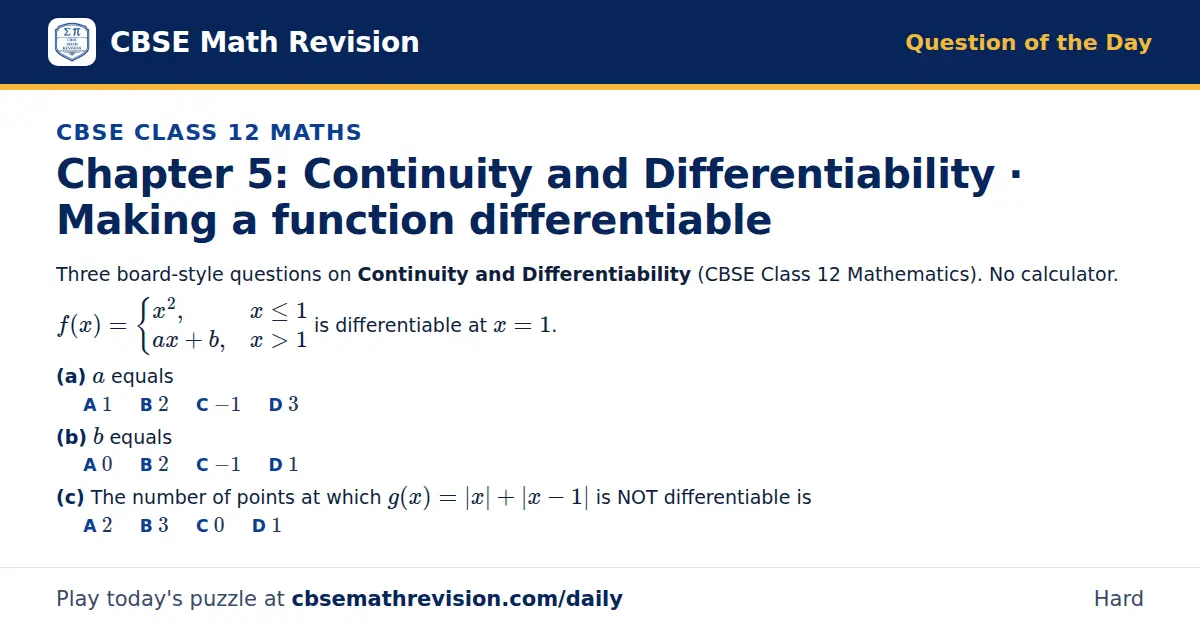
Chapter 5: Continuity and Differentiability · Making a function differentiable
Three board-style questions on Continuity and Differentiability (CBSE Class 12 Mathematics). No calculator. f(x) = x², x ≤ 1; ax + b, x > 1 is differentiable at x = 1.
- a equals Options: A) 1; B) 2; C) -1; D) 3
- b equals Options: A) 0; B) 2; C) -1; D) 1
- The number of points at which g(x) = |x| + |x - 1| is NOT differentiable is Options: A) 2; B) 3; C) 0; D) 1
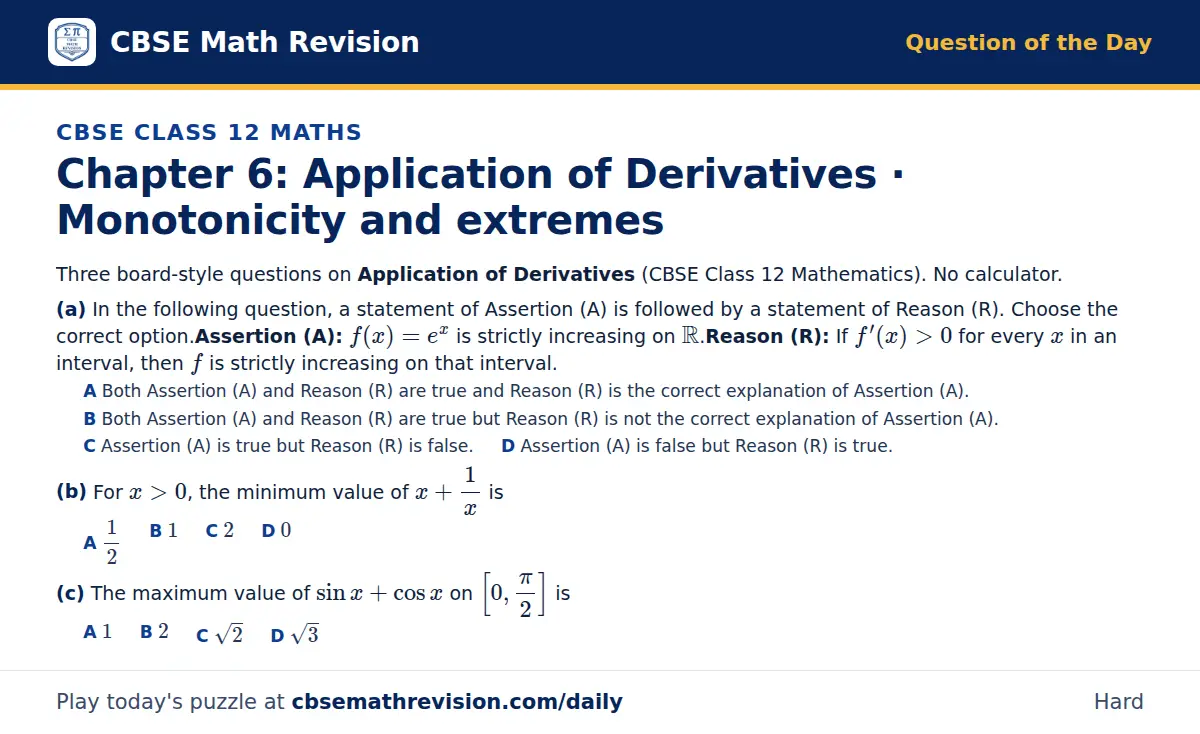
Chapter 6: Application of Derivatives · Monotonicity and extremes
Three board-style questions on Application of Derivatives (CBSE Class 12 Mathematics). No calculator.
- In the following question, a statement of Assertion (A) is followed by a statement of Reason (R). Choose the correct option. Assertion (A): f(x) = e^x is strictly increasing on ℝ. Reason (R): If f'(x) > 0 for every x in an interval, then f is strictly increasing on that interval. Options: A) Both Assertion (A) and Reason (R) are true and Reason (R) is the correct explanation of Assertion (A).; B) Both Assertion (A) and Reason (R) are true but Reason (R) is not the correct explanation of Assertion (A).; C) Assertion (A) is true but Reason (R) is false.; D) Assertion (A) is false but Reason (R) is true.
- For x > 0, the minimum value of x + 1x is Options: A) 1/2; B) 1; C) 2; D) 0
- The maximum value of sin x + cos x on [0, (π)/2] is Options: A) 1; B) 2; C) √2; D) √3
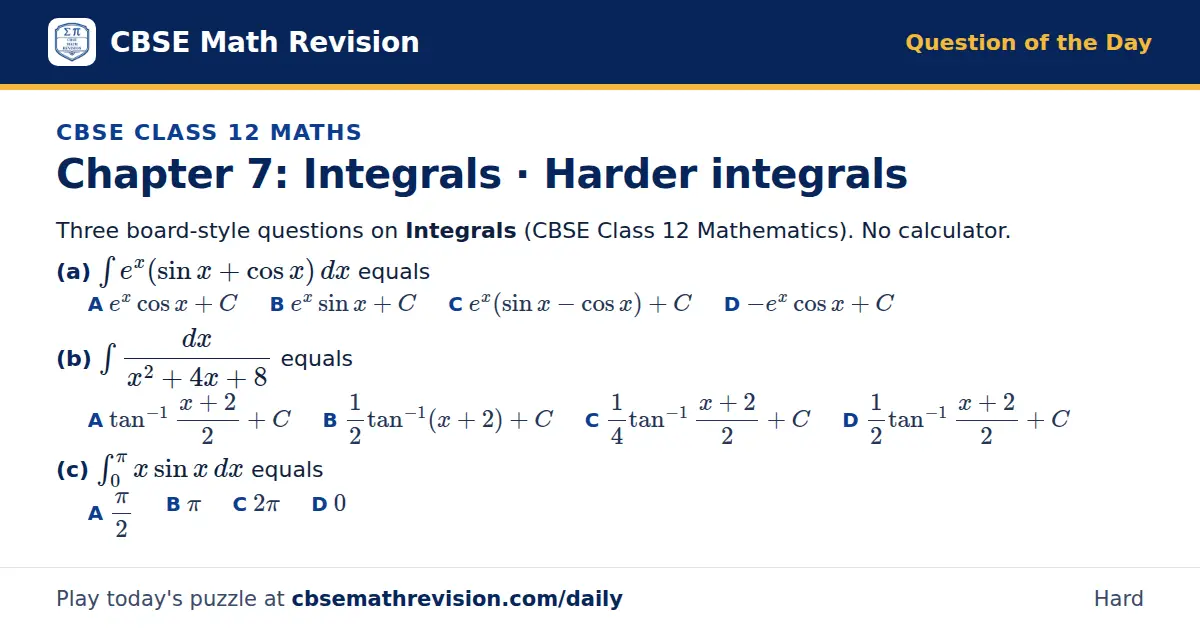
Chapter 7: Integrals · Harder integrals
Three board-style questions on Integrals (CBSE Class 12 Mathematics). No calculator.
- ∫ e^x(sin x + cos x) dx equals Options: A) e^xcos x + C; B) e^xsin x + C; C) e^x(sin x - cos x) + C; D) -e^xcos x + C
- ∫ dx/(x² + 4x + 8) equals Options: A) tan⁻¹(x + 2)/2 + C; B) 12tan⁻¹(x + 2) + C; C) 14tan⁻¹(x + 2)/2 + C; D) 12tan⁻¹(x + 2)/2 + C
- ∫_0^(π) xsin x dx equals Options: A) (π)/2; B) π; C) 2 π; D) 0
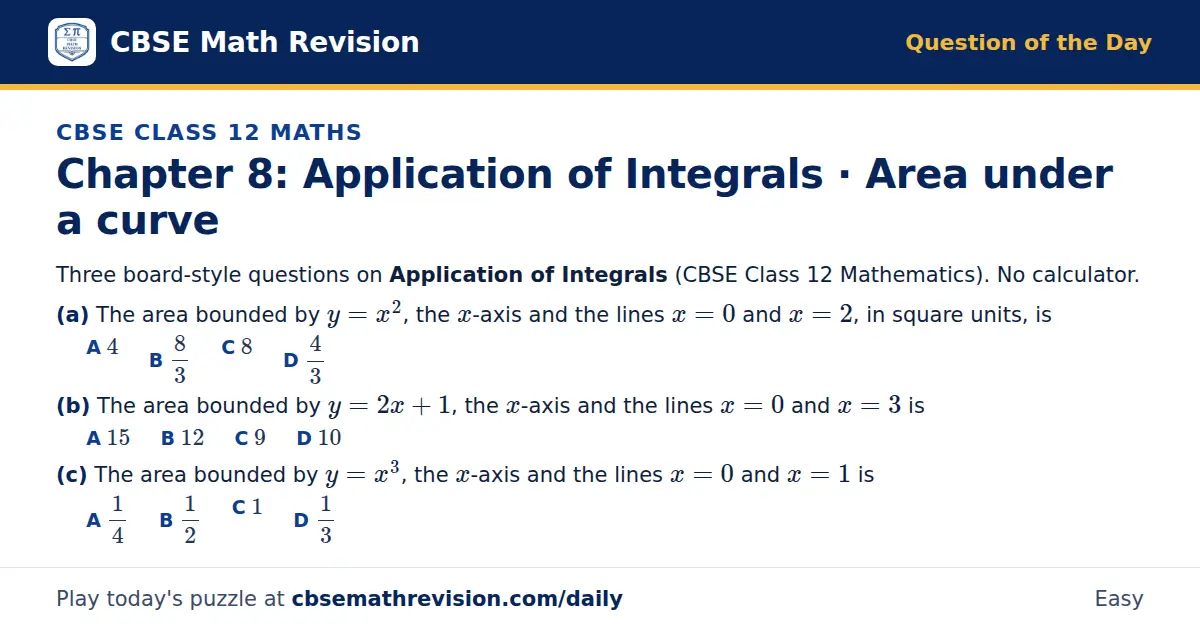
Chapter 8: Application of Integrals · Area under a curve
Three board-style questions on Application of Integrals (CBSE Class 12 Mathematics). No calculator.
- The area bounded by y = x², the x-axis and the lines x = 0 and x = 2, in square units, is Options: A) 4; B) 8/3; C) 8; D) 4/3
- The area bounded by y = 2x + 1, the x-axis and the lines x = 0 and x = 3 is Options: A) 15; B) 12; C) 9; D) 10
- The area bounded by y = x³, the x-axis and the lines x = 0 and x = 1 is Options: A) 1/4; B) 1/2; C) 1; D) 1/3
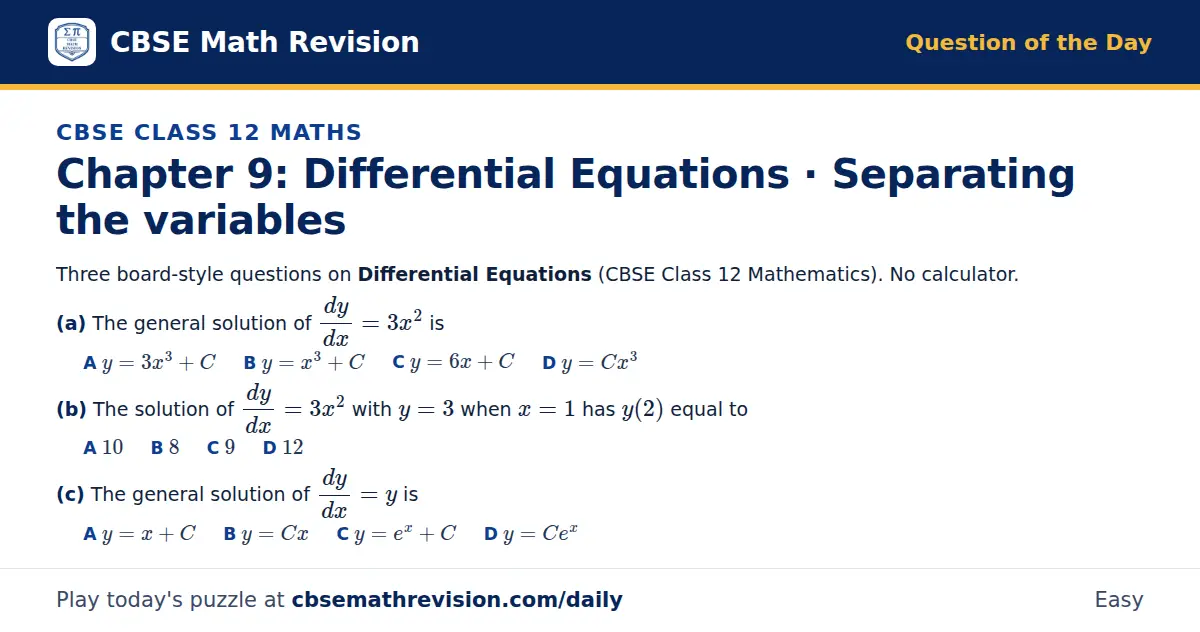
Chapter 9: Differential Equations · Separating the variables
Three board-style questions on Differential Equations (CBSE Class 12 Mathematics). No calculator.
- The general solution of dy/dx = 3x² is Options: A) y = 3x³ + C; B) y = x³ + C; C) y = 6x + C; D) y = Cx³
- The solution of dy/dx = 3x² with y = 3 when x = 1 has y(2) equal to Options: A) 10; B) 8; C) 9; D) 12
- The general solution of dy/dx = y is Options: A) y = x + C; B) y = Cx; C) y = e^x + C; D) y = Ce^x
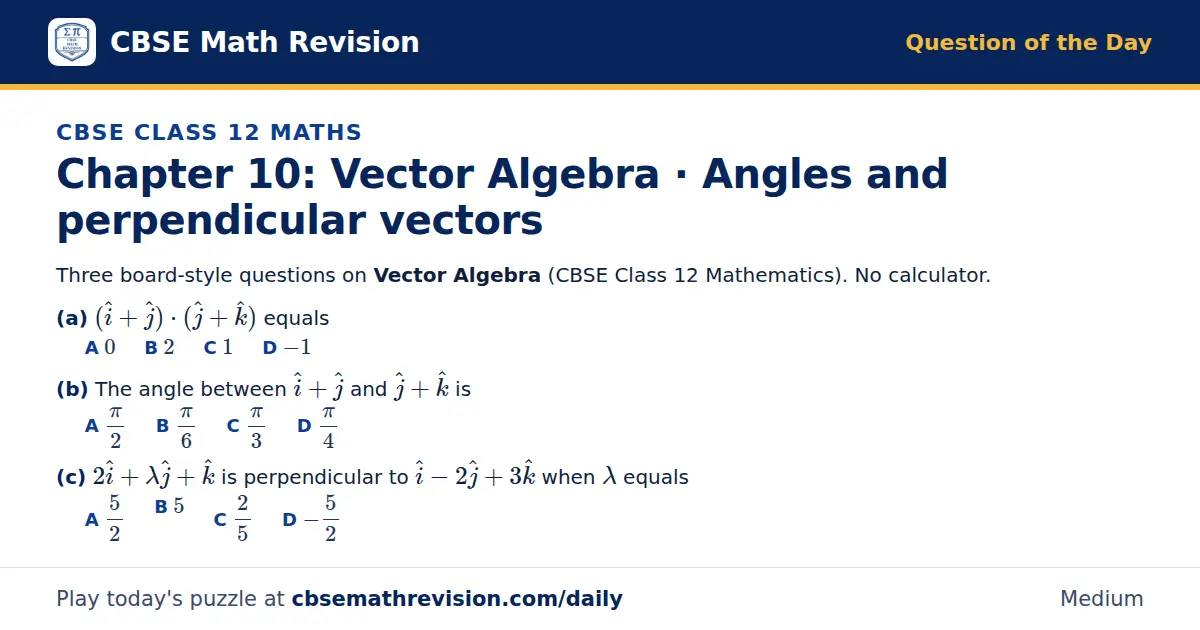
Chapter 10: Vector Algebra · Angles and perpendicular vectors
Three board-style questions on Vector Algebra (CBSE Class 12 Mathematics). No calculator.
- (i + j) · (j + k) equals Options: A) 0; B) 2; C) 1; D) -1
- The angle between i + j and j + k is Options: A) (π)/2; B) (π)/6; C) (π)/3; D) (π)/4
- 2 i + λ j + k is perpendicular to i - 2 j + 3 k when λ equals Options: A) 5/2; B) 5; C) 2/5; D) - 5/2
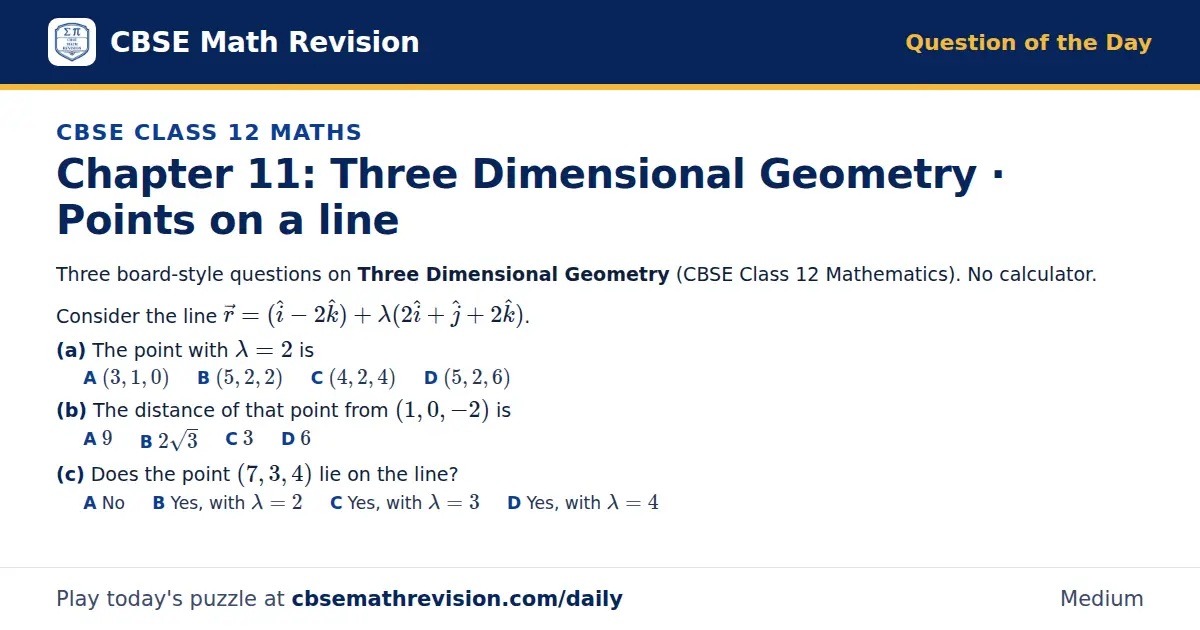
Chapter 11: Three Dimensional Geometry · Points on a line
Three board-style questions on Three Dimensional Geometry (CBSE Class 12 Mathematics). No calculator. Consider the line r = (i - 2 k) + λ(2 i + j + 2 k).
- The point with λ = 2 is Options: A) (3, 1, 0); B) (5, 2, 2); C) (4, 2, 4); D) (5, 2, 6)
- The distance of that point from (1, 0, -2) is Options: A) 9; B) 2 √3; C) 3; D) 6
- Does the point (7, 3, 4) lie on the line? Options: A) No; B) Yes, with λ = 2; C) Yes, with λ = 3; D) Yes, with λ = 4
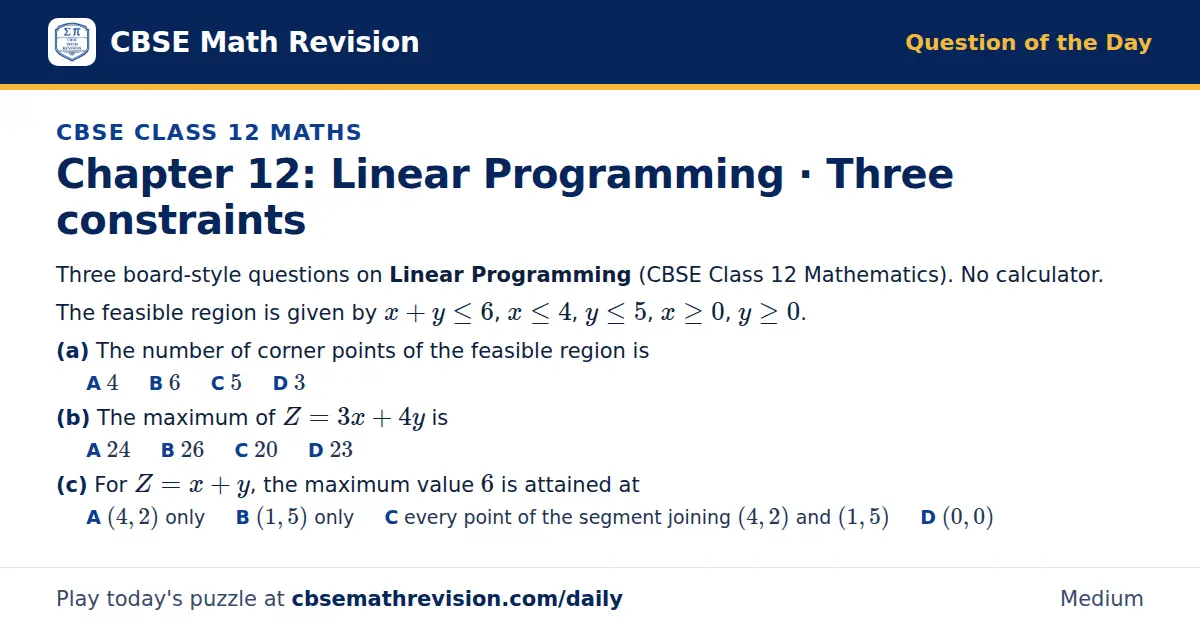
Chapter 12: Linear Programming · Three constraints
Three board-style questions on Linear Programming (CBSE Class 12 Mathematics). No calculator. The feasible region is given by x + y ≤ 6, x ≤ 4, y ≤ 5, x ≥ 0, y ≥ 0.
- The number of corner points of the feasible region is Options: A) 4; B) 6; C) 5; D) 3
- The maximum of Z = 3x + 4y is Options: A) 24; B) 26; C) 20; D) 23
- For Z = x + y, the maximum value 6 is attained at Options: A) (4, 2) only; B) (1, 5) only; C) every point of the segment joining (4, 2) and (1, 5); D) (0, 0)
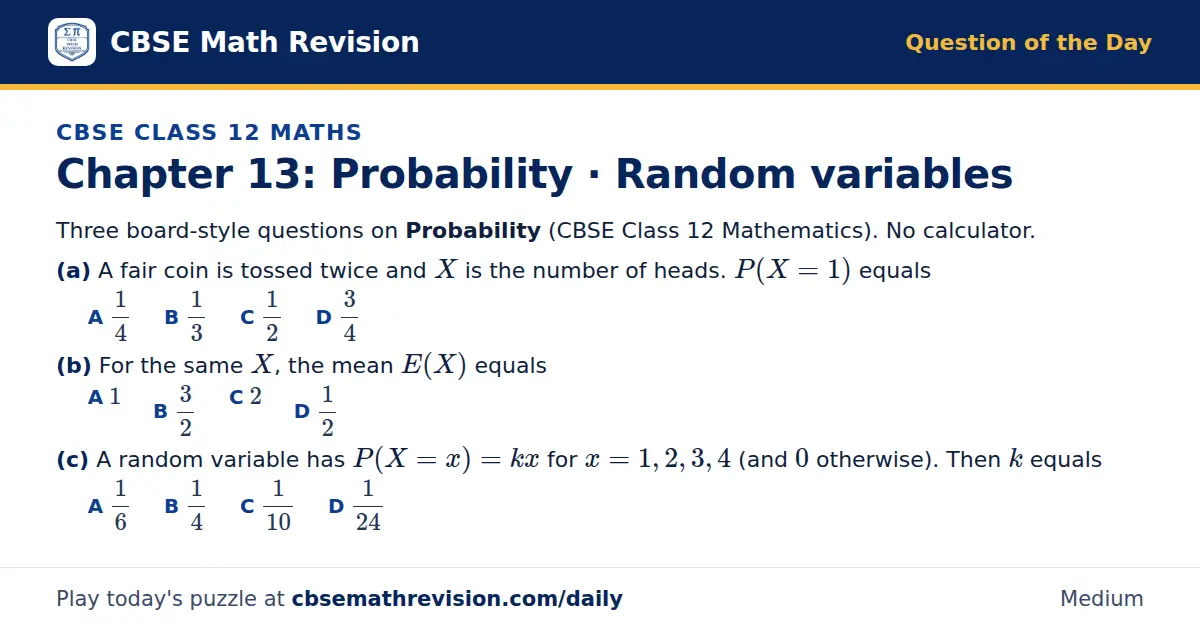
Chapter 13: Probability · Random variables
Three board-style questions on Probability (CBSE Class 12 Mathematics). No calculator.
- A fair coin is tossed twice and X is the number of heads. P(X = 1) equals Options: A) 1/4; B) 1/3; C) 1/2; D) 3/4
- For the same X, the mean E(X) equals Options: A) 1; B) 3/2; C) 2; D) 1/2
- A random variable has P(X = x) = kx for x = 1, 2, 3, 4 (and 0 otherwise). Then k equals Options: A) 1/6; B) 1/4; C) 1/10; D) 1/24
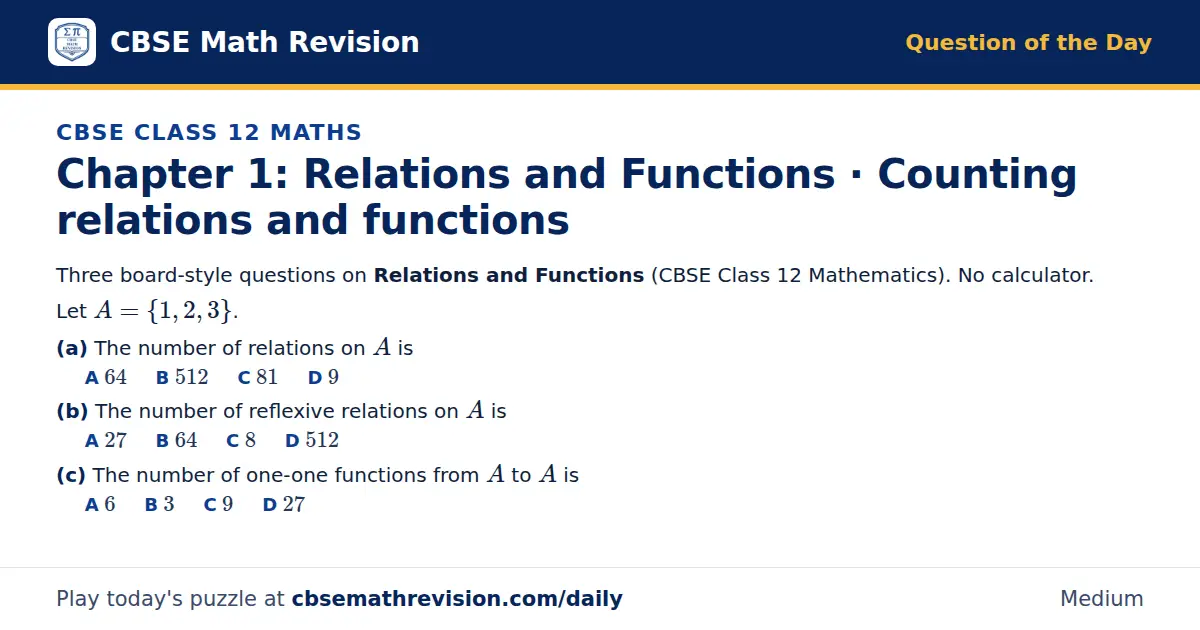
Chapter 1: Relations and Functions · Counting relations and functions
Three board-style questions on Relations and Functions (CBSE Class 12 Mathematics). No calculator. Let A = 1, 2, 3.
- The number of relations on A is Options: A) 64; B) 512; C) 81; D) 9
- The number of reflexive relations on A is Options: A) 27; B) 64; C) 8; D) 512
- The number of one-one functions from A to A is Options: A) 6; B) 3; C) 9; D) 27
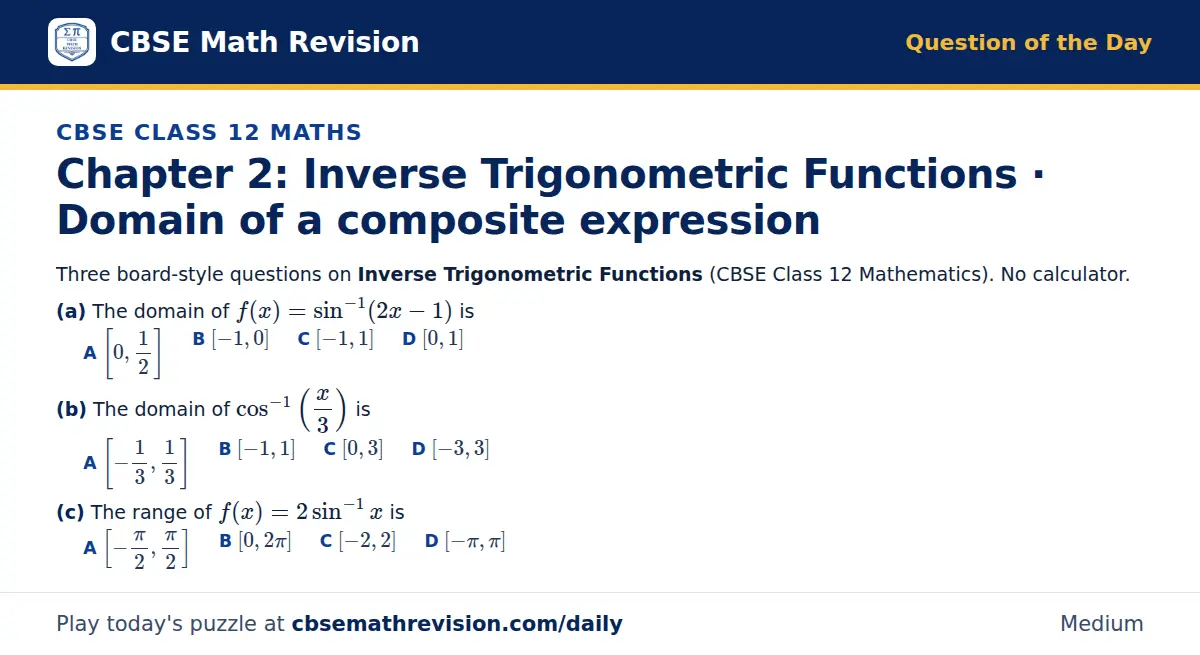
Chapter 2: Inverse Trigonometric Functions · Domain of a composite expression
Three board-style questions on Inverse Trigonometric Functions (CBSE Class 12 Mathematics). No calculator.
- The domain of f(x) = sin⁻¹(2x - 1) is Options: A) [0, 12]; B) [-1, 0]; C) [-1, 1]; D) [0, 1]
- The domain of cos⁻¹(x/3) is Options: A) [-13, 13]; B) [-1, 1]; C) [0, 3]; D) [-3, 3]
- The range of f(x) = 2sin⁻¹x is Options: A) [-(π)/2, (π)/2]; B) [0, 2π]; C) [-2, 2]; D) [-π, π]
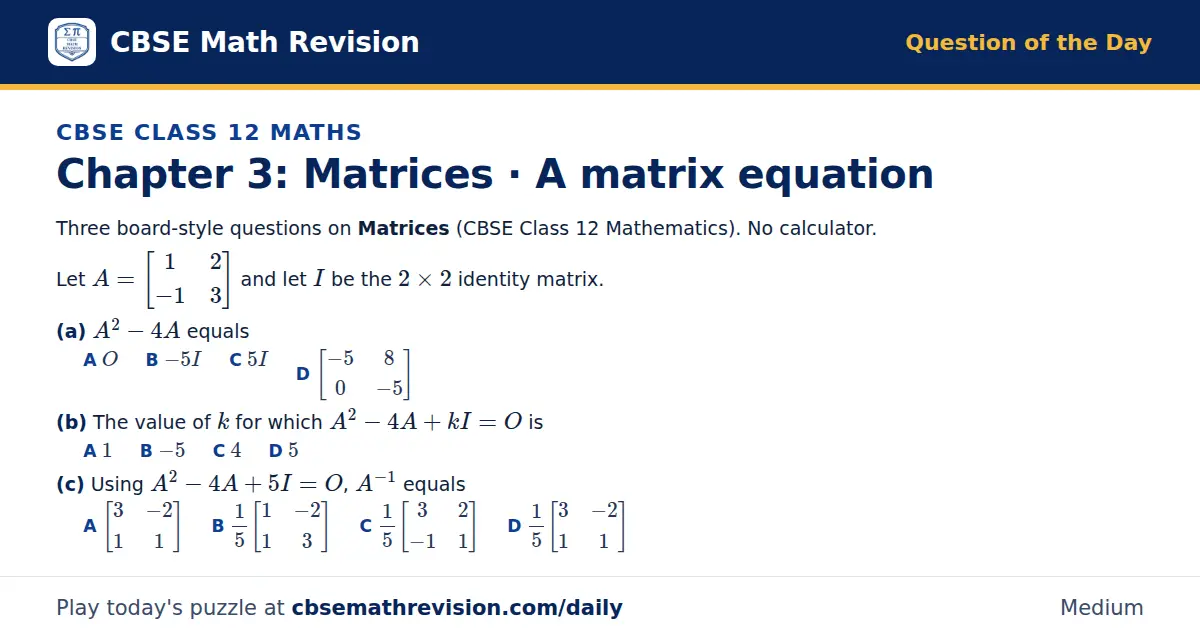
Chapter 3: Matrices · A matrix equation
Three board-style questions on Matrices (CBSE Class 12 Mathematics). No calculator. Let A = 1 2; -1 3 and let I be the 2 × 2 identity matrix.
- A² - 4A equals Options: A) O; B) -5I; C) 5I; D) -5 8; 0 -5
- The value of k for which A² - 4A + kI = O is Options: A) 1; B) -5; C) 4; D) 5
- Using A² - 4A + 5I = O, A⁻¹ equals Options: A) 3 -2; 1 1; B) 15 1 -2; 1 3; C) 15 3 2; -1 1; D) 15 3 -2; 1 1
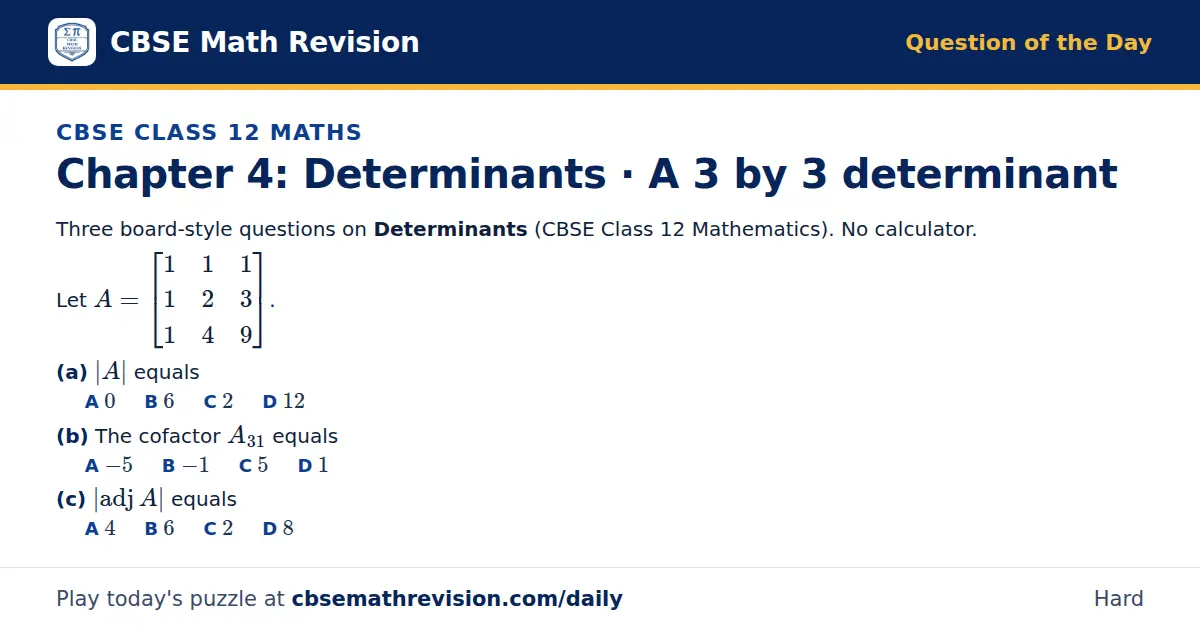
Chapter 4: Determinants · A 3 by 3 determinant
Three board-style questions on Determinants (CBSE Class 12 Mathematics). No calculator. Let A = 1 1 1; 1 2 3; 1 4 9.
- |A| equals Options: A) 0; B) 6; C) 2; D) 12
- The cofactor A_31 equals Options: A) -5; B) -1; C) 5; D) 1
- |adj A| equals Options: A) 4; B) 6; C) 2; D) 8
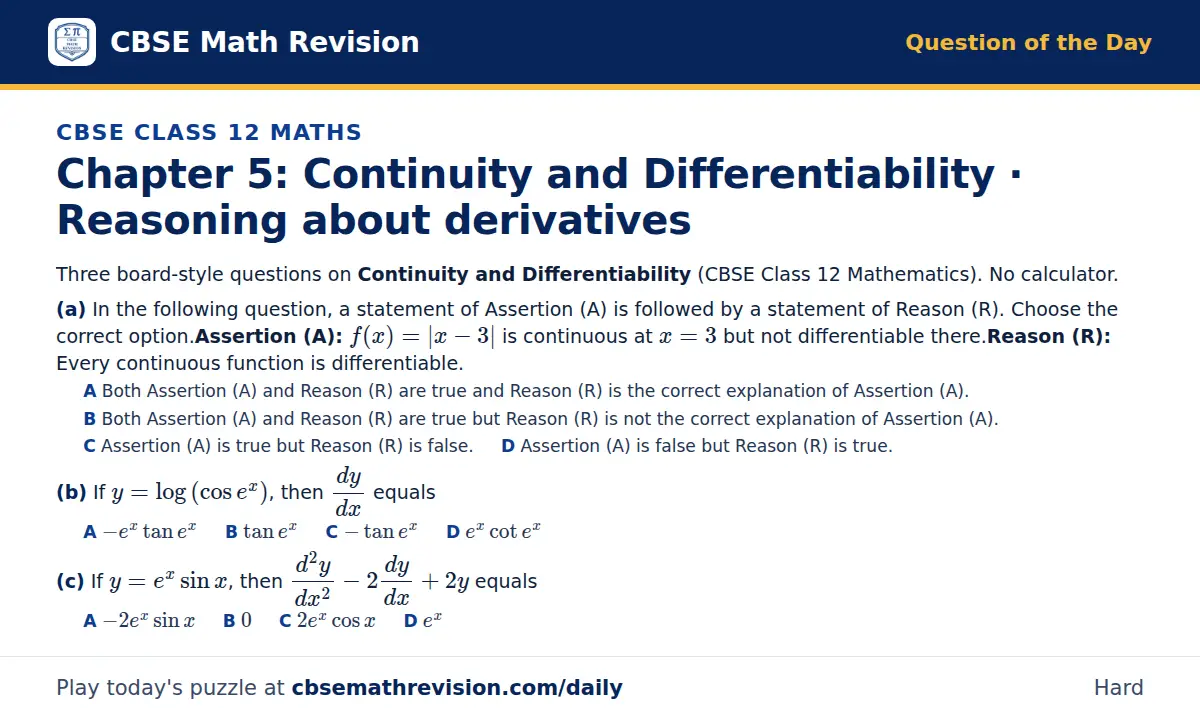
Chapter 5: Continuity and Differentiability · Reasoning about derivatives
Three board-style questions on Continuity and Differentiability (CBSE Class 12 Mathematics). No calculator.
- In the following question, a statement of Assertion (A) is followed by a statement of Reason (R). Choose the correct option. Assertion (A): f(x) = |x - 3| is continuous at x = 3 but not differentiable there. Reason (R): Every continuous function is differentiable. Options: A) Both Assertion (A) and Reason (R) are true and Reason (R) is the correct explanation of Assertion (A).; B) Both Assertion (A) and Reason (R) are true but Reason (R) is not the correct explanation of Assertion (A).; C) Assertion (A) is true but Reason (R) is false.; D) Assertion (A) is false but Reason (R) is true.
- If y = log(cos e^x), then dy/dx equals Options: A) -e^xtan e^x; B) tan e^x; C) -tan e^x; D) e^xcot e^x
- If y = e^xsin x, then (d²y)/(dx²) - 2dy/dx + 2y equals Options: A) - 2 e^x sin x; B) 0; C) 2 e^x cos x; D) e^x
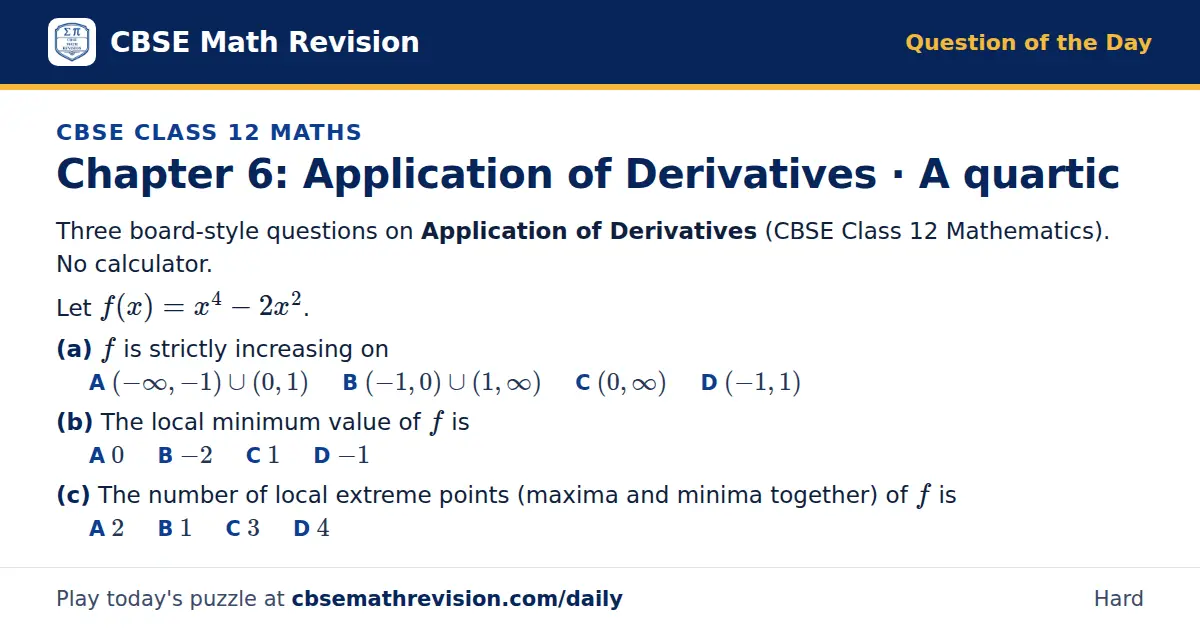
Chapter 6: Application of Derivatives · A quartic
Three board-style questions on Application of Derivatives (CBSE Class 12 Mathematics). No calculator. Let f(x) = x⁴ - 2x^2.
- f is strictly increasing on Options: A) (-∞, -1) ∪ (0, 1); B) (-1, 0) ∪ (1, ∞); C) (0, ∞); D) (-1, 1)
- The local minimum value of f is Options: A) 0; B) -2; C) 1; D) -1
- The number of local extreme points (maxima and minima together) of f is Options: A) 2; B) 1; C) 3; D) 4
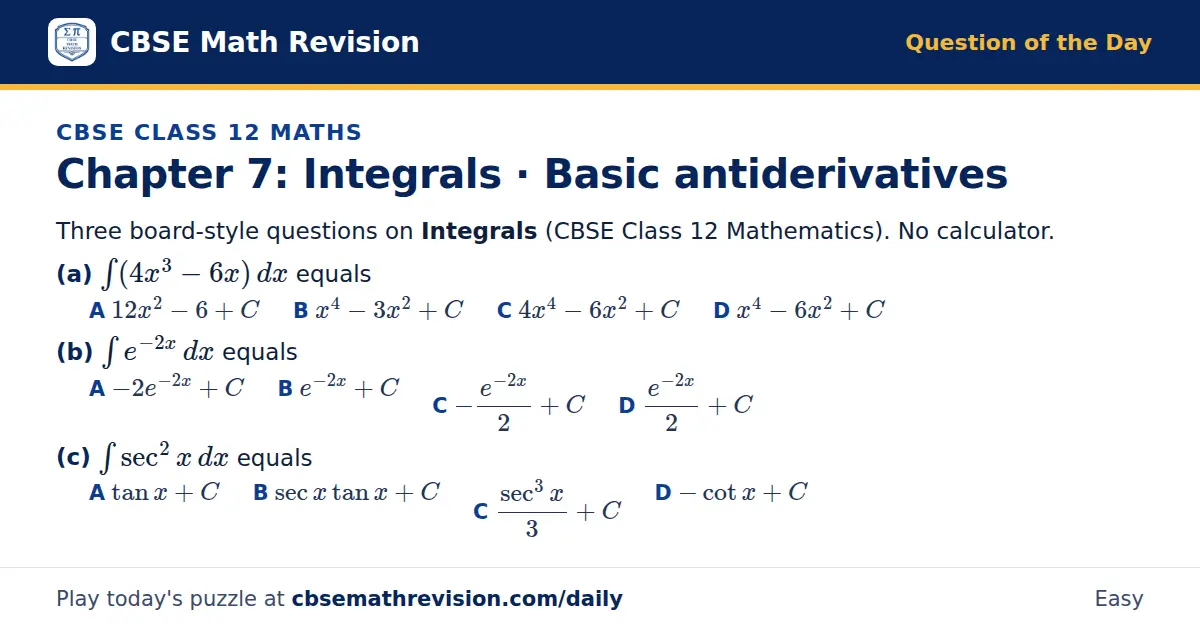
Chapter 7: Integrals · Basic antiderivatives
Three board-style questions on Integrals (CBSE Class 12 Mathematics). No calculator.
- ∫ (4x³ - 6x) dx equals Options: A) 12x² - 6 + C; B) x⁴ - 3x² + C; C) 4x⁴ - 6x² + C; D) x⁴ - 6x² + C
- ∫ e^(-2x) dx equals Options: A) -2e^(-2x) + C; B) e^(-2x) + C; C) -(e^(-2x))/2 + C; D) (e^(-2x))/2 + C
- ∫ sec² x dx equals Options: A) tan x + C; B) sec x tan x + C; C) (sec³ x)/3 + C; D) -cot x + C
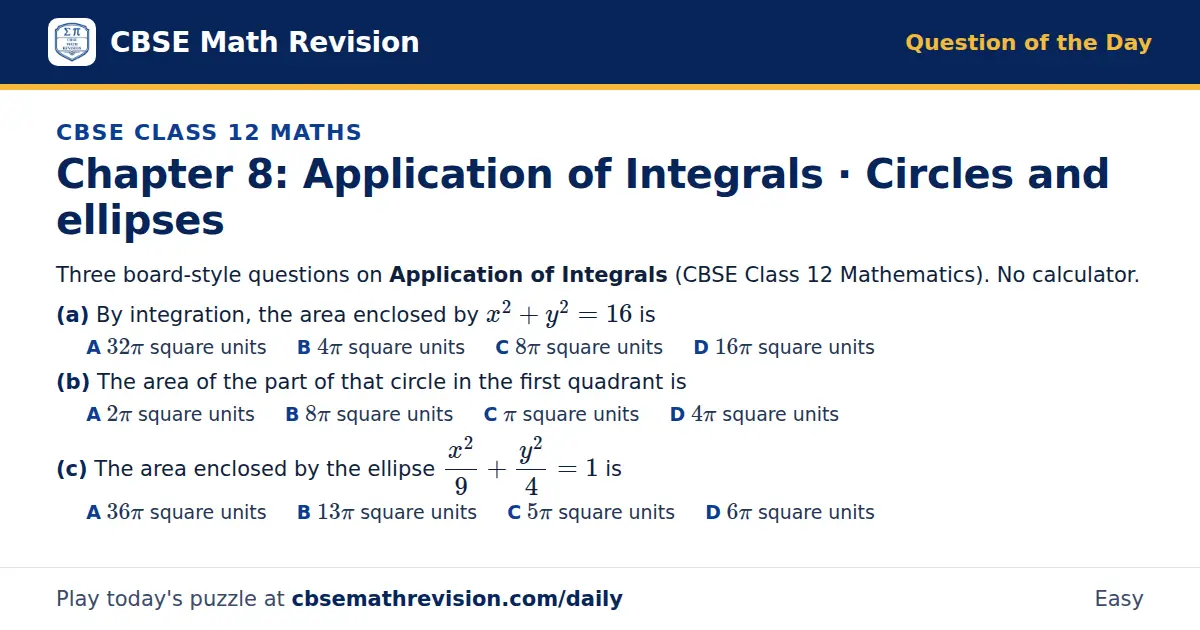
Chapter 8: Application of Integrals · Circles and ellipses
Three board-style questions on Application of Integrals (CBSE Class 12 Mathematics). No calculator.
- By integration, the area enclosed by x² + y² = 16 is Options: A) 32π square units; B) 4π square units; C) 8π square units; D) 16π square units
- The area of the part of that circle in the first quadrant is Options: A) 2π square units; B) 8π square units; C) π square units; D) 4π square units
- The area enclosed by the ellipse (x²)/9 + (y²)/4 = 1 is Options: A) 36π square units; B) 13π square units; C) 5π square units; D) 6π square units
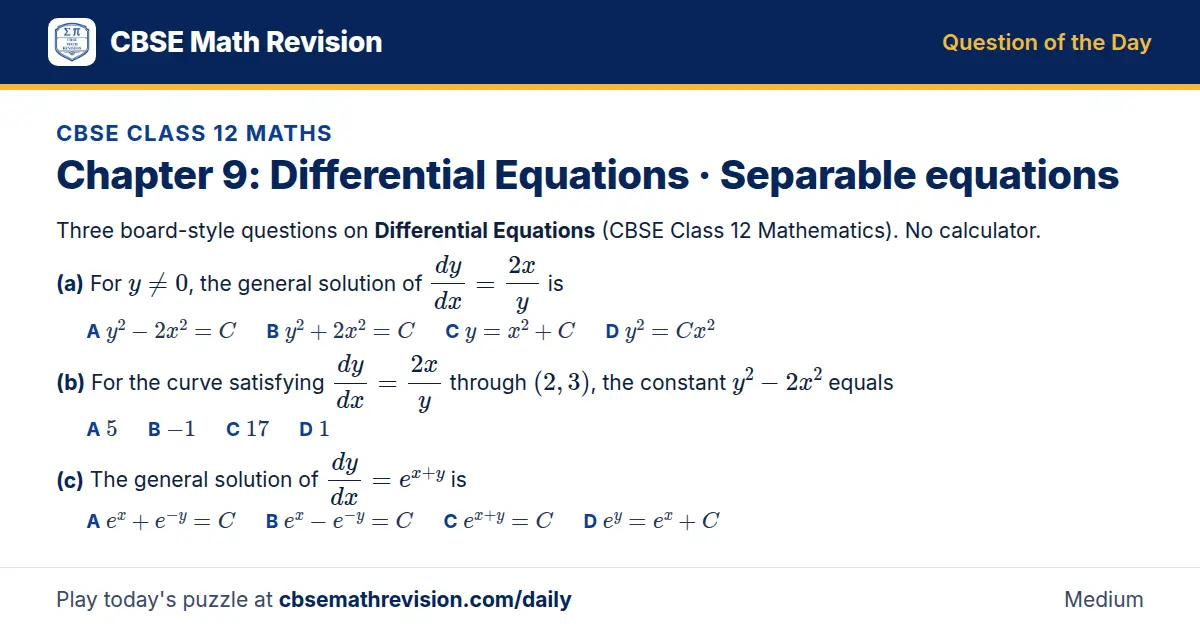
Chapter 9: Differential Equations · Separable equations
Three board-style questions on Differential Equations (CBSE Class 12 Mathematics). No calculator.
- For y ≠ 0, the general solution of dy/dx = 2x/y is Options: A) y² - 2x² = C; B) y² + 2x² = C; C) y = x² + C; D) y² = Cx²
- For the curve satisfying dy/dx = 2x/y through (2, 3), the constant y² - 2x² equals Options: A) 5; B) -1; C) 17; D) 1
- The general solution of dy/dx = e^(x + y) is Options: A) e^x + e^(-y) = C; B) e^x - e^(-y) = C; C) e^(x + y) = C; D) e^y = e^x + C
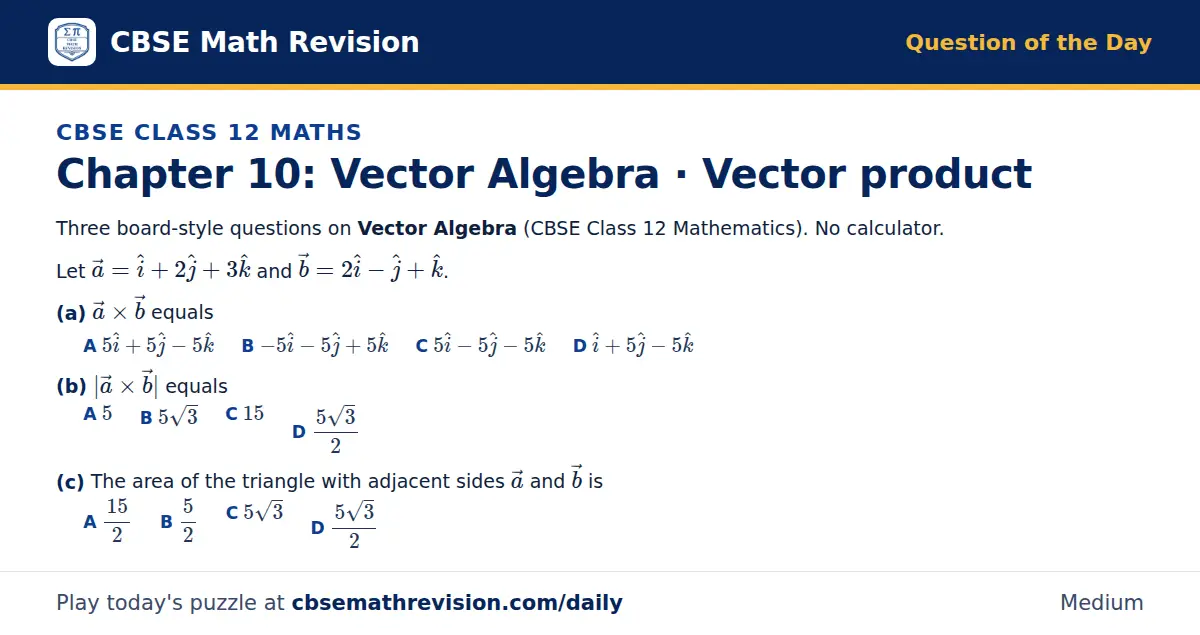
Chapter 10: Vector Algebra · Vector product
Three board-style questions on Vector Algebra (CBSE Class 12 Mathematics). No calculator. Let a = i + 2 j + 3 k and b = 2 i - j + k.
- a × b equals Options: A) 5 i + 5 j - 5 k; B) -5 i - 5 j + 5 k; C) 5 i - 5 j - 5 k; D) i + 5 j - 5 k
- | a × b| equals Options: A) 5; B) 5 √3; C) 15; D) (5 √3)/2
- The area of the triangle with adjacent sides a and b is Options: A) 15/2; B) 5/2; C) 5 √3; D) (5 √3)/2
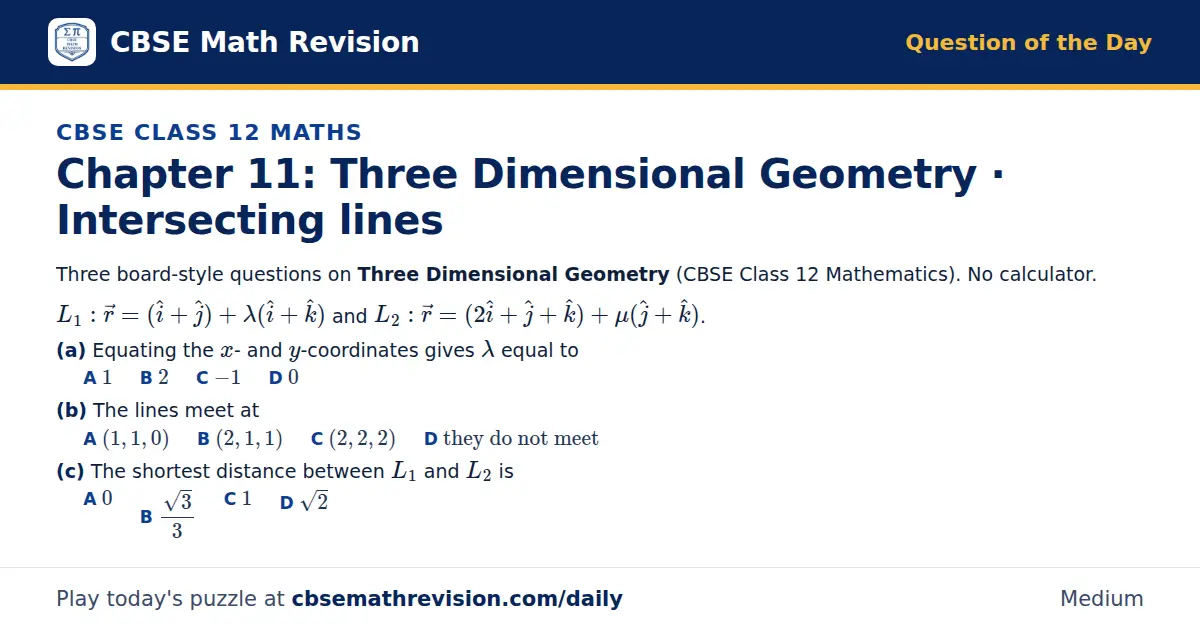
Chapter 11: Three Dimensional Geometry · Intersecting lines
Three board-style questions on Three Dimensional Geometry (CBSE Class 12 Mathematics). No calculator. L_1: r = (i + j) + λ(i + k) and L_2: r = (2 i + j + k) + μ(j + k).
- Equating the x- and y-coordinates gives λ equal to Options: A) 1; B) 2; C) -1; D) 0
- The lines meet at Options: A) (1, 1, 0); B) (2, 1, 1); C) (2, 2, 2); D) they do not meet
- The shortest distance between L_1 and L_2 is Options: A) 0; B) (√3)/3; C) 1; D) √2
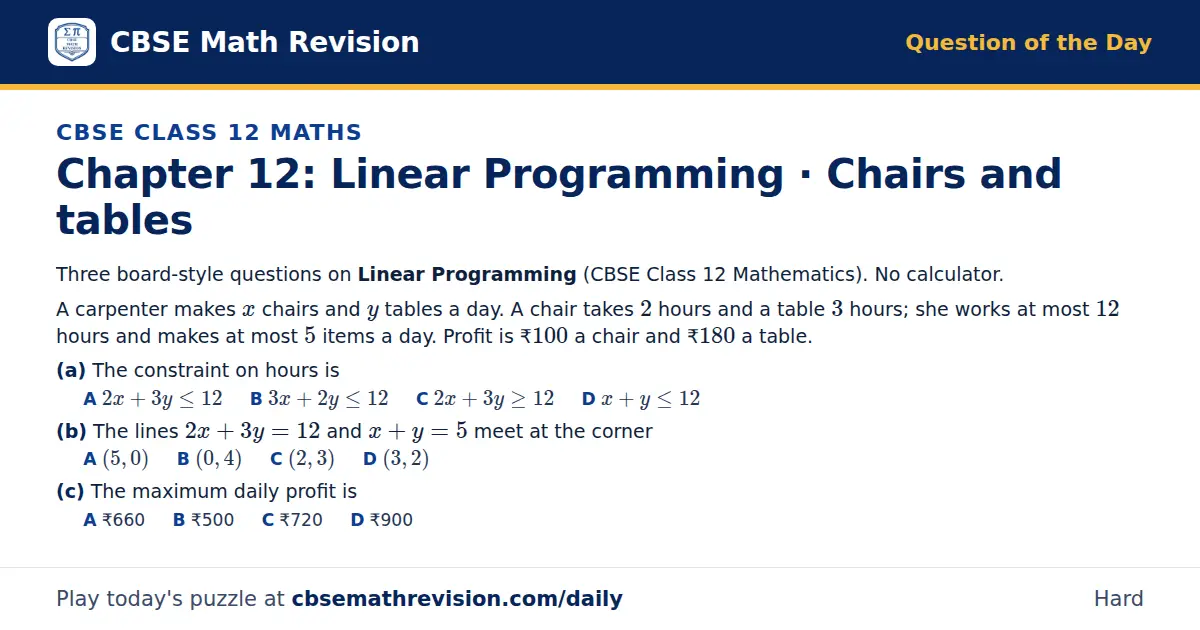
Chapter 12: Linear Programming · Chairs and tables
Three board-style questions on Linear Programming (CBSE Class 12 Mathematics). No calculator. A carpenter makes x chairs and y tables a day. A chair takes 2 hours and a table 3 hours; she works at most 12 hours and makes at most 5 items a day. Profit is ₹100 a chair and ₹180 a table.
- The constraint on hours is Options: A) 2x + 3y ≤ 12; B) 3x + 2y ≤ 12; C) 2x + 3y ≥ 12; D) x + y ≤ 12
- The lines 2x + 3y = 12 and x + y = 5 meet at the corner Options: A) (5, 0); B) (0, 4); C) (2, 3); D) (3, 2)
- The maximum daily profit is Options: A) ₹660; B) ₹500; C) ₹720; D) ₹900
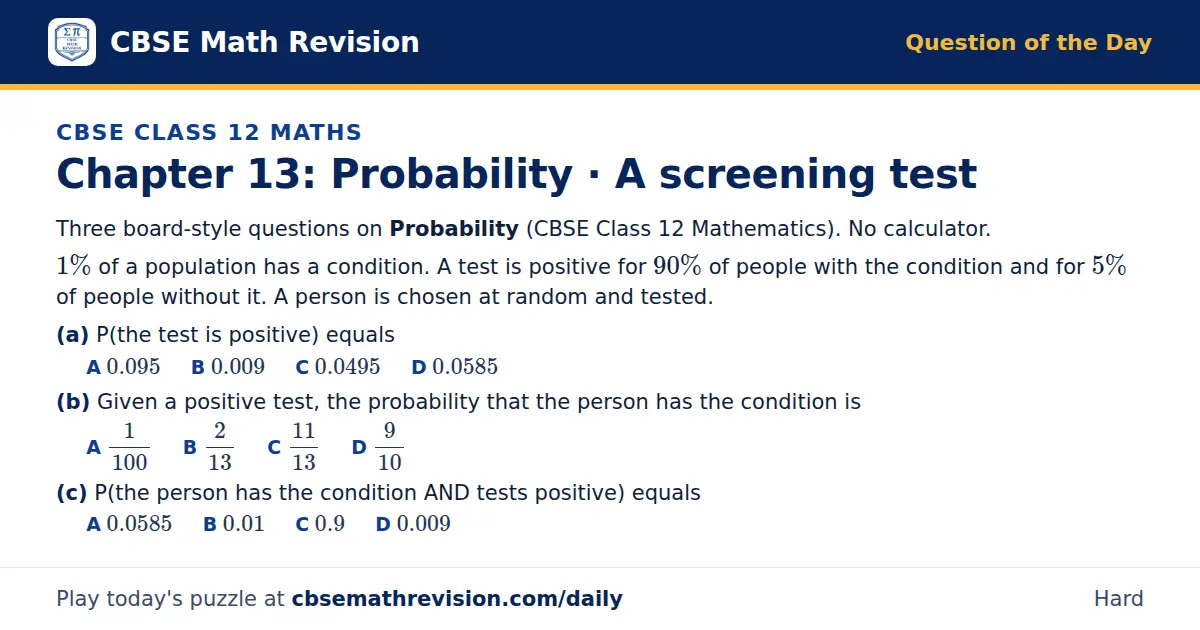
Chapter 13: Probability · A screening test
Three board-style questions on Probability (CBSE Class 12 Mathematics). No calculator. 1% of a population has a condition. A test is positive for 90% of people with the condition and for 5% of people without it. A person is chosen at random and tested.
- P(the test is positive) equals Options: A) 0.095; B) 0.009; C) 0.0495; D) 0.0585
- Given a positive test, the probability that the person has the condition is Options: A) 1/100; B) 2/13; C) 11/13; D) 9/10
- P(the person has the condition AND tests positive) equals Options: A) 0.0585; B) 0.01; C) 0.9; D) 0.009
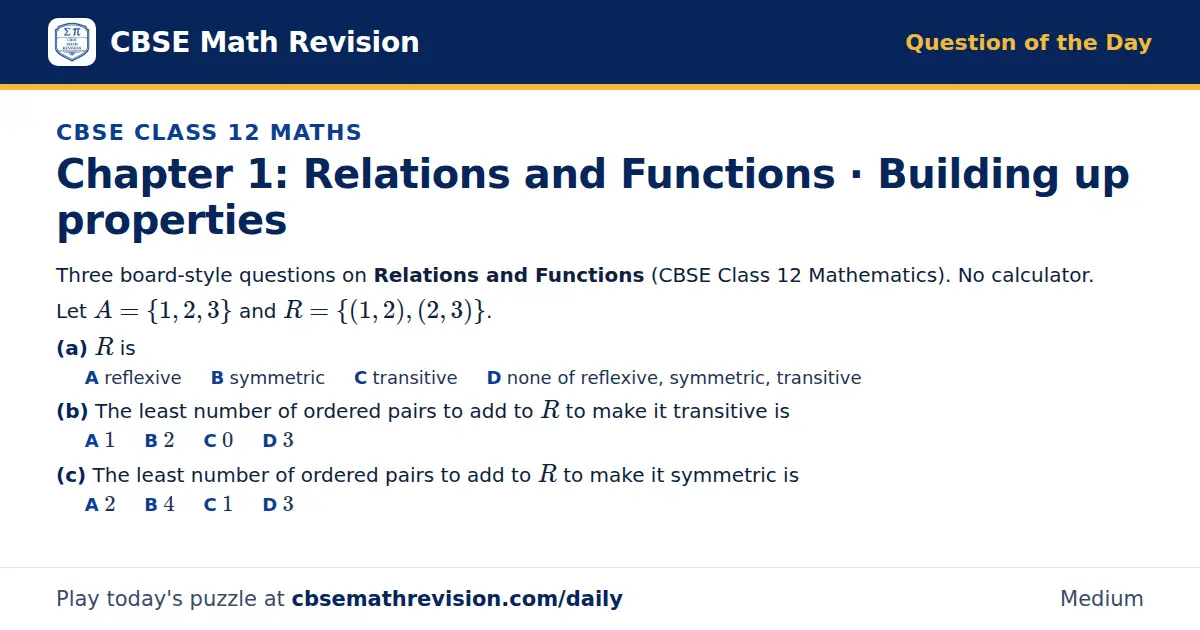
Chapter 1: Relations and Functions · Building up properties
Three board-style questions on Relations and Functions (CBSE Class 12 Mathematics). No calculator. Let A = 1, 2, 3 and R = (1, 2), (2, 3).
- R is Options: A) reflexive; B) symmetric; C) transitive; D) none of reflexive, symmetric, transitive
- The least number of ordered pairs to add to R to make it transitive is Options: A) 1; B) 2; C) 0; D) 3
- The least number of ordered pairs to add to R to make it symmetric is Options: A) 2; B) 4; C) 1; D) 3
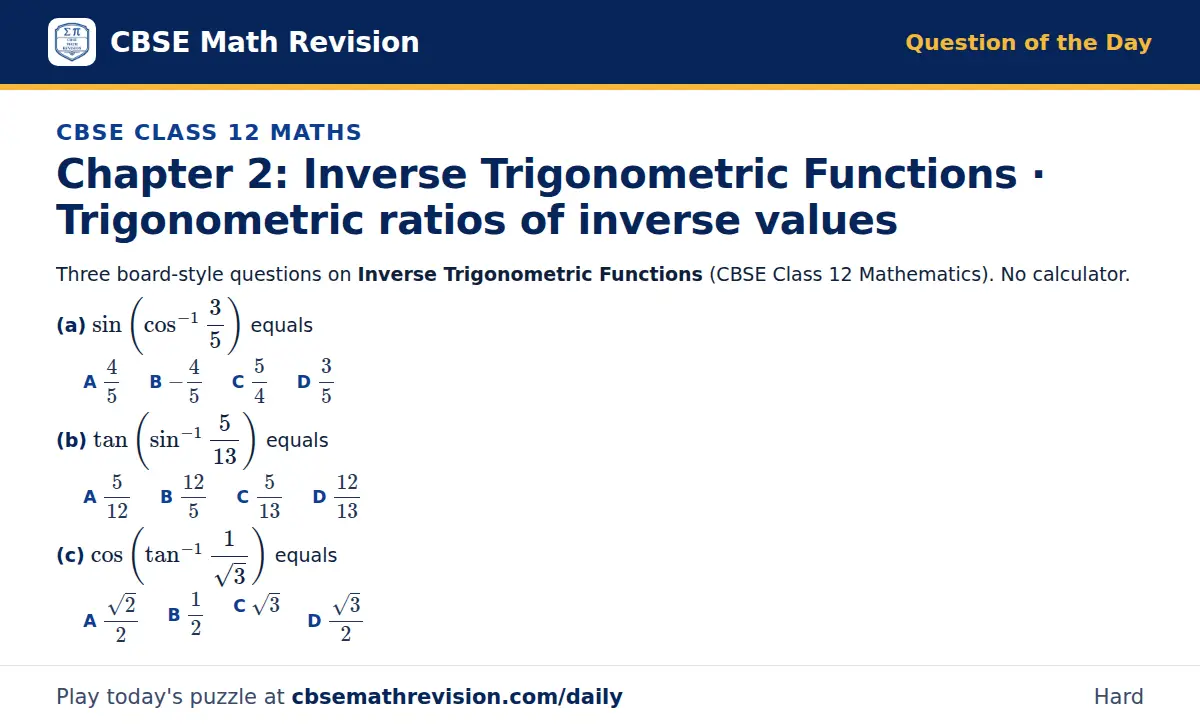
Chapter 2: Inverse Trigonometric Functions · Trigonometric ratios of inverse values
Three board-style questions on Inverse Trigonometric Functions (CBSE Class 12 Mathematics). No calculator.
- sin(cos⁻¹35) equals Options: A) 4/5; B) - 4/5; C) 5/4; D) 3/5
- tan(sin⁻¹5/13) equals Options: A) 5/12; B) 12/5; C) 5/13; D) 12/13
- cos(tan⁻¹1/(√3)) equals Options: A) (√2)/2; B) 1/2; C) √3; D) (√3)/2
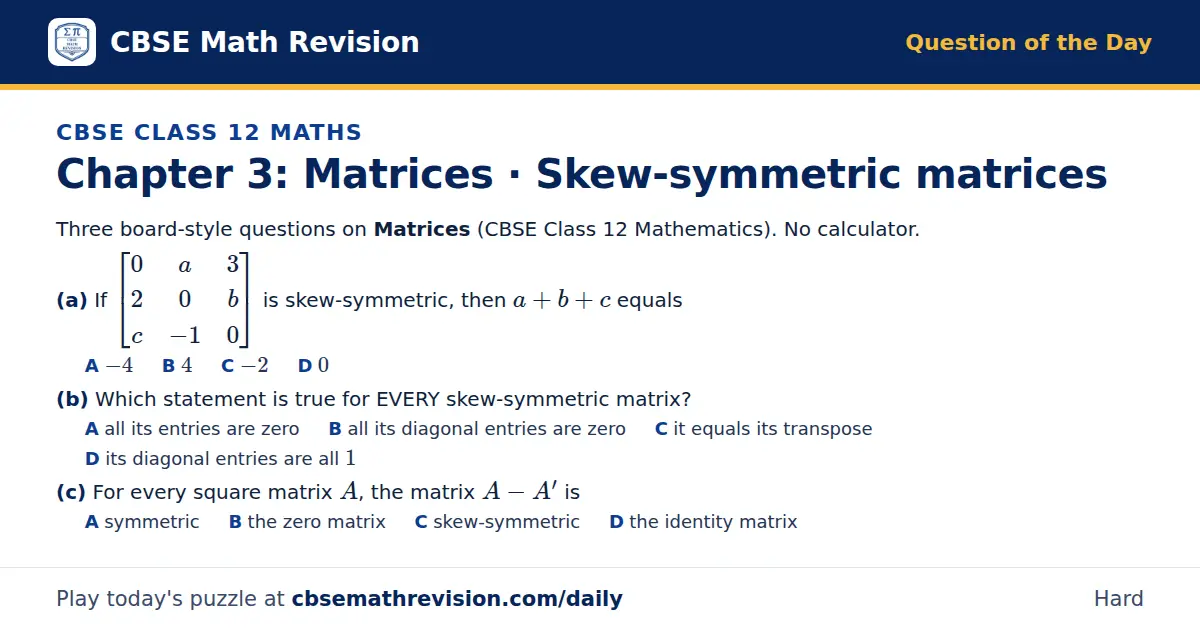
Chapter 3: Matrices · Skew-symmetric matrices
Three board-style questions on Matrices (CBSE Class 12 Mathematics). No calculator.
- If 0 a 3; 2 0 b; c -1 0 is skew-symmetric, then a + b + c equals Options: A) -4; B) 4; C) -2; D) 0
- Which statement is true for EVERY skew-symmetric matrix? Options: A) all its entries are zero; B) all its diagonal entries are zero; C) it equals its transpose; D) its diagonal entries are all 1
- For every square matrix A, the matrix A - A' is Options: A) symmetric; B) the zero matrix; C) skew-symmetric; D) the identity matrix
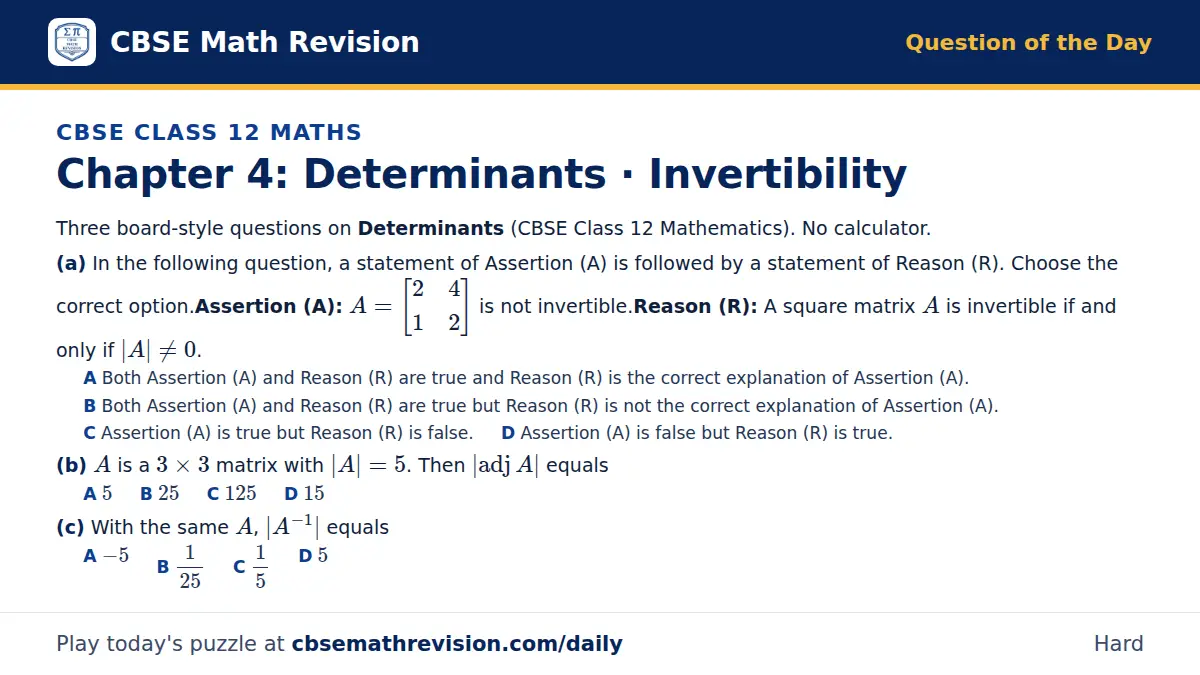
Chapter 4: Determinants · Invertibility
Three board-style questions on Determinants (CBSE Class 12 Mathematics). No calculator.
- In the following question, a statement of Assertion (A) is followed by a statement of Reason (R). Choose the correct option. Assertion (A): A = 2 4; 1 2 is not invertible. Reason (R): A square matrix A is invertible if and only if |A| ≠ 0. Options: A) Both Assertion (A) and Reason (R) are true and Reason (R) is the correct explanation of Assertion (A).; B) Both Assertion (A) and Reason (R) are true but Reason (R) is not the correct explanation of Assertion (A).; C) Assertion (A) is true but Reason (R) is false.; D) Assertion (A) is false but Reason (R) is true.
- A is a 3 × 3 matrix with |A| = 5. Then |adj A| equals Options: A) 5; B) 25; C) 125; D) 15
- With the same A, |A⁻¹| equals Options: A) -5; B) 1/25; C) 1/5; D) 5
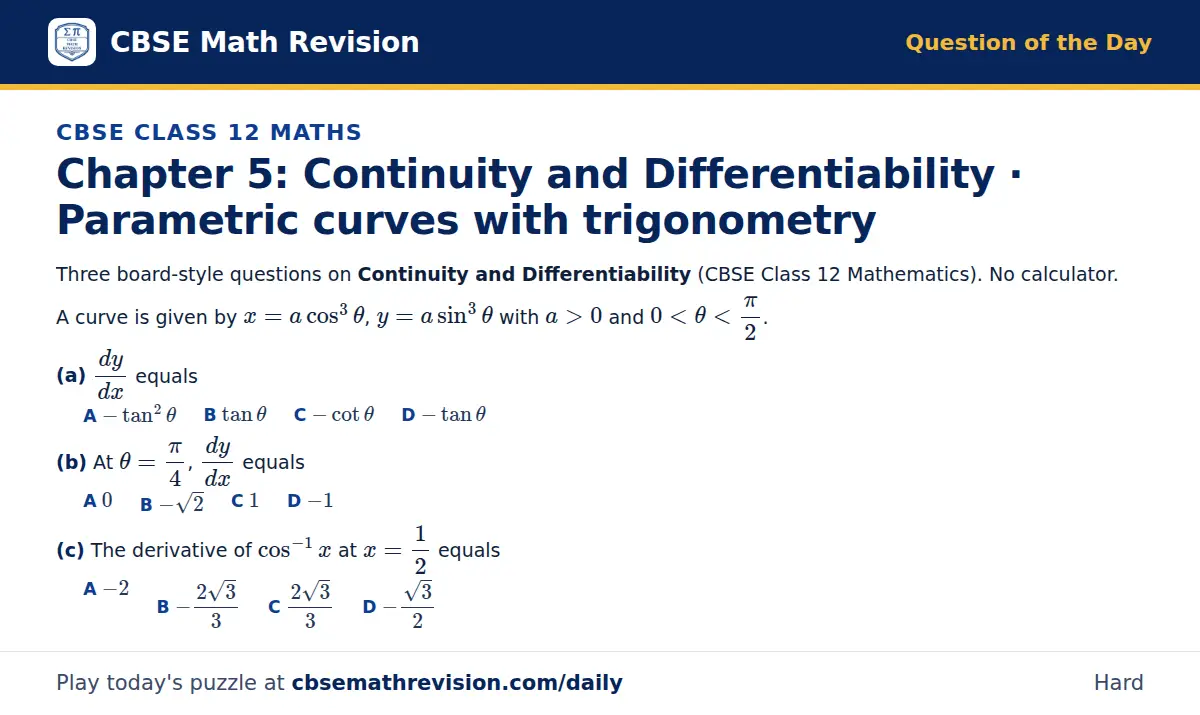
Chapter 5: Continuity and Differentiability · Parametric curves with trigonometry
Three board-style questions on Continuity and Differentiability (CBSE Class 12 Mathematics). No calculator. A curve is given by x = acos³θ, y = asin³θ with a > 0 and 0 < θ < (π)/2.
- dy/dx equals Options: A) -tan²θ; B) tanθ; C) -cotθ; D) -tanθ
- At θ = (π)/4, dy/dx equals Options: A) 0; B) - √2; C) 1; D) -1
- The derivative of cos⁻¹x at x = 12 equals Options: A) -2; B) - (2 √3)/3; C) (2 √3)/3; D) - (√3)/2
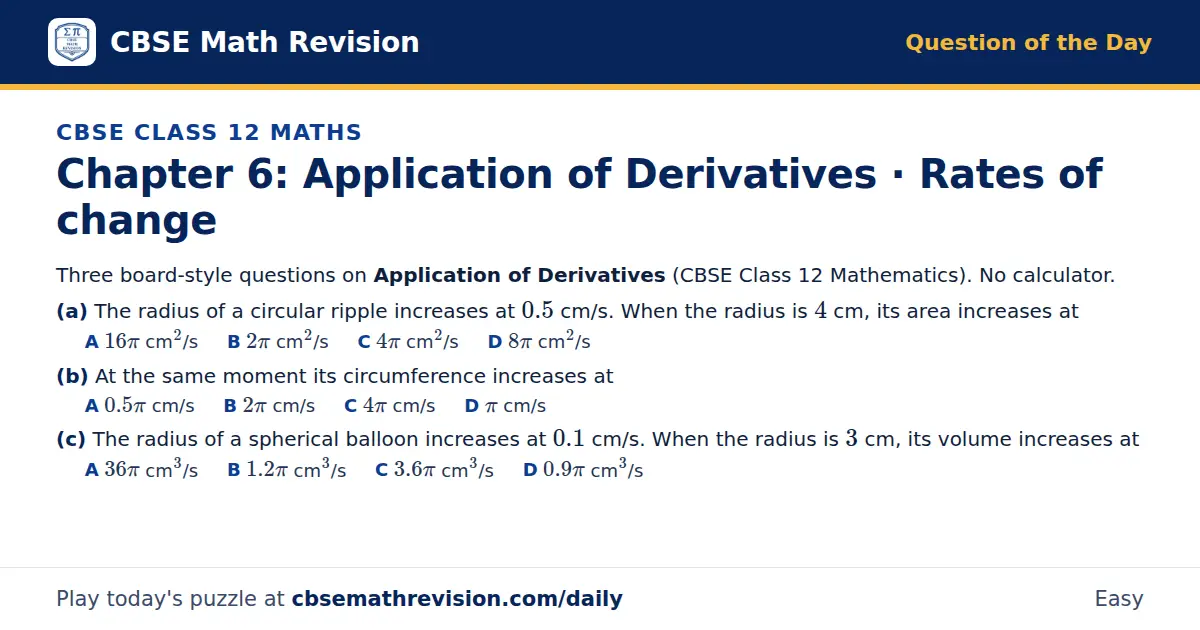
Chapter 6: Application of Derivatives · Rates of change
Three board-style questions on Application of Derivatives (CBSE Class 12 Mathematics). No calculator.
- The radius of a circular ripple increases at 0.5 cm/s. When the radius is 4 cm, its area increases at Options: A) 16π cm^2/s; B) 2π cm^2/s; C) 4π cm^2/s; D) 8π cm^2/s
- At the same moment its circumference increases at Options: A) 0.5π cm/s; B) 2π cm/s; C) 4π cm/s; D) π cm/s
- The radius of a spherical balloon increases at 0.1 cm/s. When the radius is 3 cm, its volume increases at Options: A) 36π cm^3/s; B) 1.2π cm^3/s; C) 3.6π cm^3/s; D) 0.9π cm^3/s
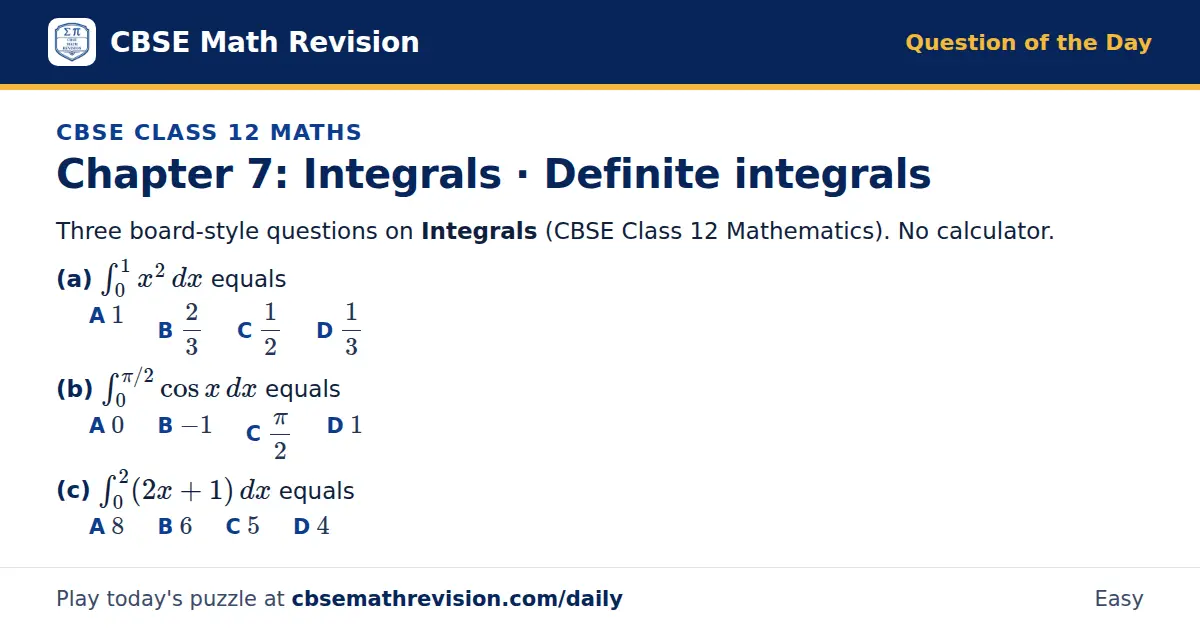
Chapter 7: Integrals · Definite integrals
Three board-style questions on Integrals (CBSE Class 12 Mathematics). No calculator.
- ∫_0¹ x² dx equals Options: A) 1; B) 2/3; C) 1/2; D) 1/3
- ∫_0^(π/2) cos x dx equals Options: A) 0; B) -1; C) (π)/2; D) 1
- ∫_0² (2x + 1) dx equals Options: A) 8; B) 6; C) 5; D) 4
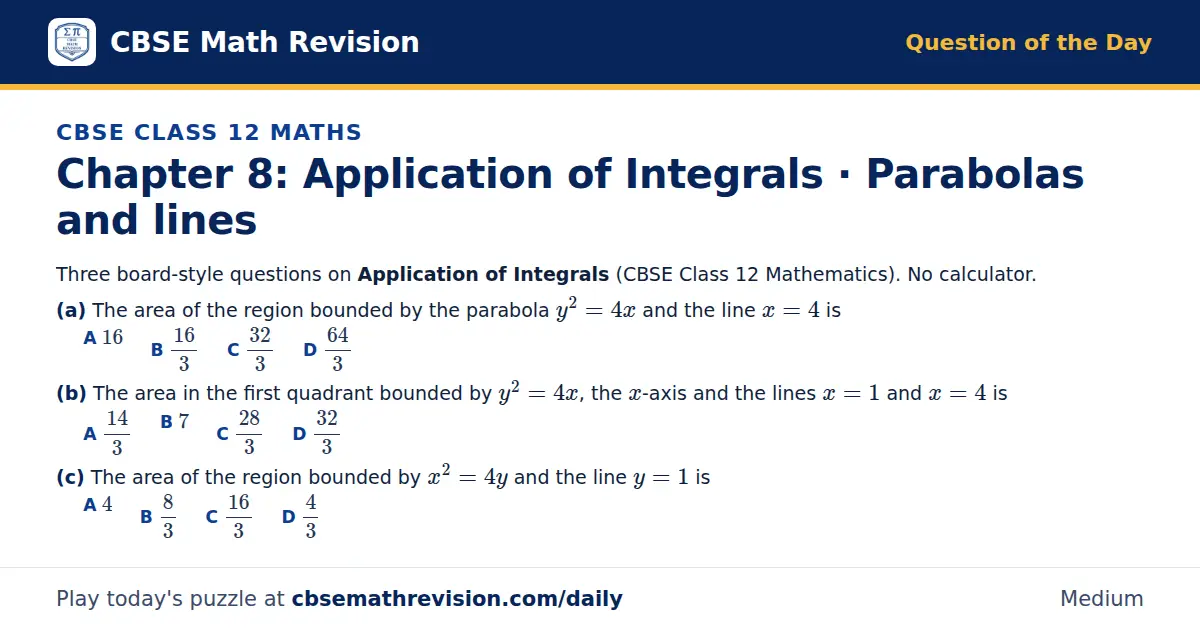
Chapter 8: Application of Integrals · Parabolas and lines
Three board-style questions on Application of Integrals (CBSE Class 12 Mathematics). No calculator.
- The area of the region bounded by the parabola y² = 4x and the line x = 4 is Options: A) 16; B) 16/3; C) 32/3; D) 64/3
- The area in the first quadrant bounded by y² = 4x, the x-axis and the lines x = 1 and x = 4 is Options: A) 14/3; B) 7; C) 28/3; D) 32/3
- The area of the region bounded by x² = 4y and the line y = 1 is Options: A) 4; B) 8/3; C) 16/3; D) 4/3
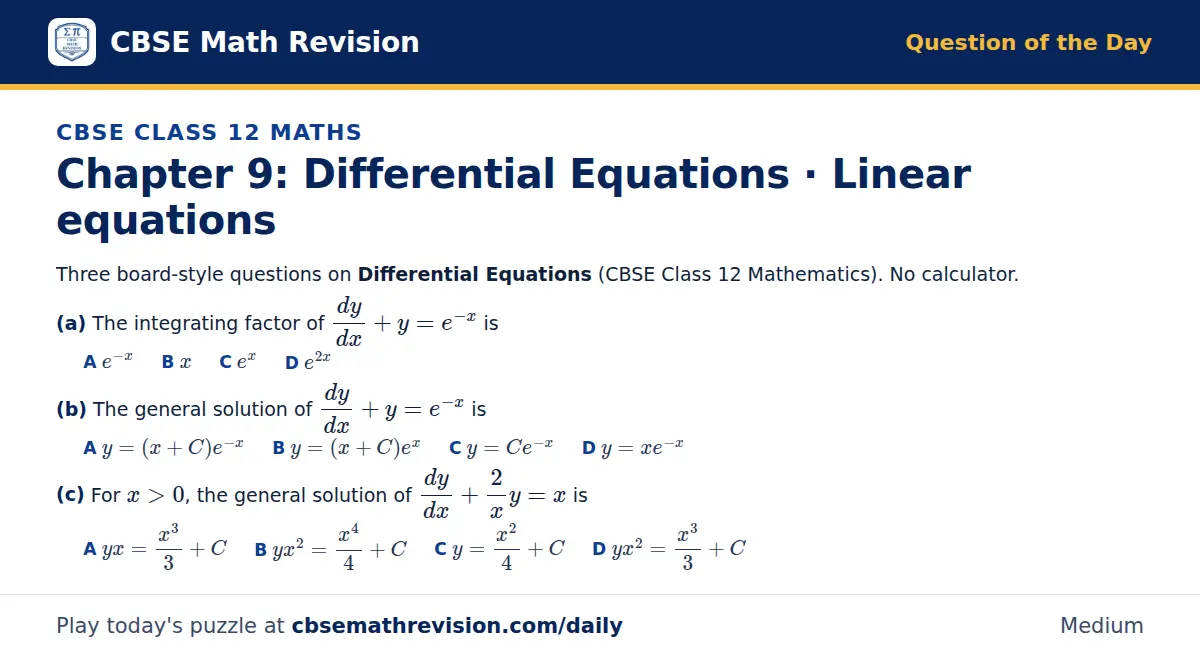
Chapter 9: Differential Equations · Linear equations
Three board-style questions on Differential Equations (CBSE Class 12 Mathematics). No calculator.
- The integrating factor of dy/dx + y = e^(-x) is Options: A) e^(-x); B) x; C) e^x; D) e^(2x)
- The general solution of dy/dx + y = e^(-x) is Options: A) y = (x + C)e^(-x); B) y = (x + C)e^x; C) y = Ce^(-x); D) y = xe^(-x)
- For x > 0, the general solution of dy/dx + 2/xy = x is Options: A) yx = (x³)/3 + C; B) yx² = (x⁴)/4 + C; C) y = (x²)/4 + C; D) yx² = (x³)/3 + C
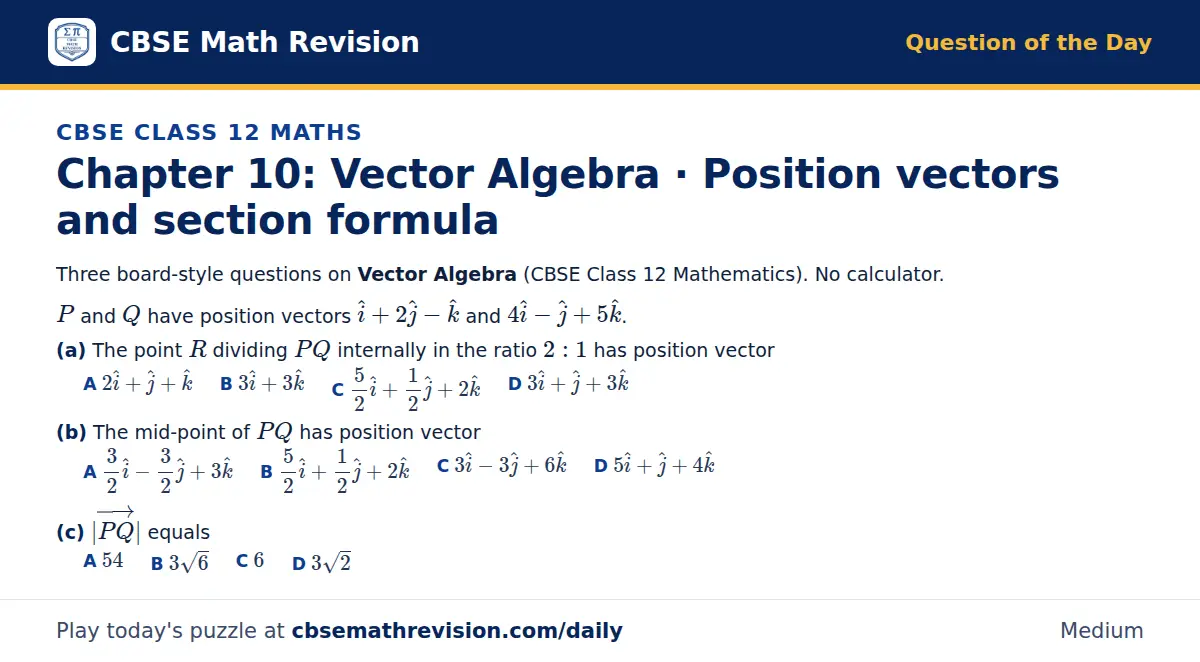
Chapter 10: Vector Algebra · Position vectors and section formula
Three board-style questions on Vector Algebra (CBSE Class 12 Mathematics). No calculator. P and Q have position vectors i + 2 j - k and 4 i - j + 5 k.
- The point R dividing PQ internally in the ratio 2: 1 has position vector Options: A) 2 i + j + k; B) 3 i + 3 k; C) 52 i + 12 j + 2 k; D) 3 i + j + 3 k
- The mid-point of PQ has position vector Options: A) 32 i - 32 j + 3 k; B) 52 i + 12 j + 2 k; C) 3 i - 3 j + 6 k; D) 5 i + j + 4 k
- |PQ| equals Options: A) 54; B) 3 √6; C) 6; D) 3 √2
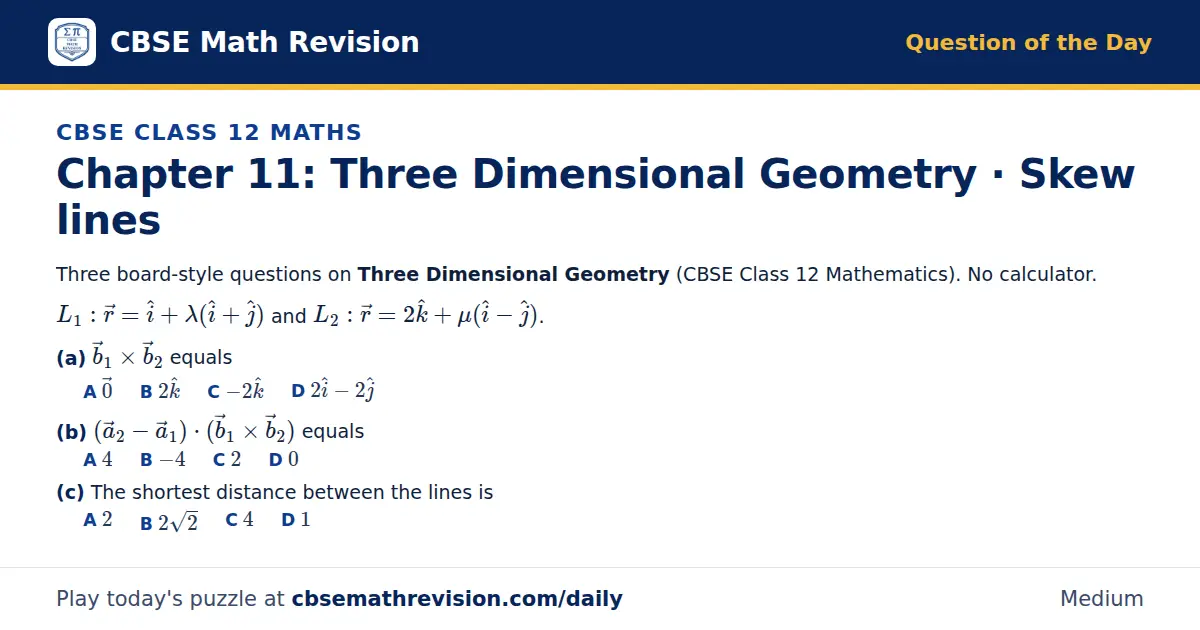
Chapter 11: Three Dimensional Geometry · Skew lines
Three board-style questions on Three Dimensional Geometry (CBSE Class 12 Mathematics). No calculator. L_1: r = i + λ(i + j) and L_2: r = 2 k + μ(i - j).
- b_1 × b_2 equals Options: A) 0; B) 2 k; C) -2 k; D) 2 i - 2 j
- (a_2 - a_1) · (b_1 × b_2) equals Options: A) 4; B) -4; C) 2; D) 0
- The shortest distance between the lines is Options: A) 2; B) 2 √2; C) 4; D) 1
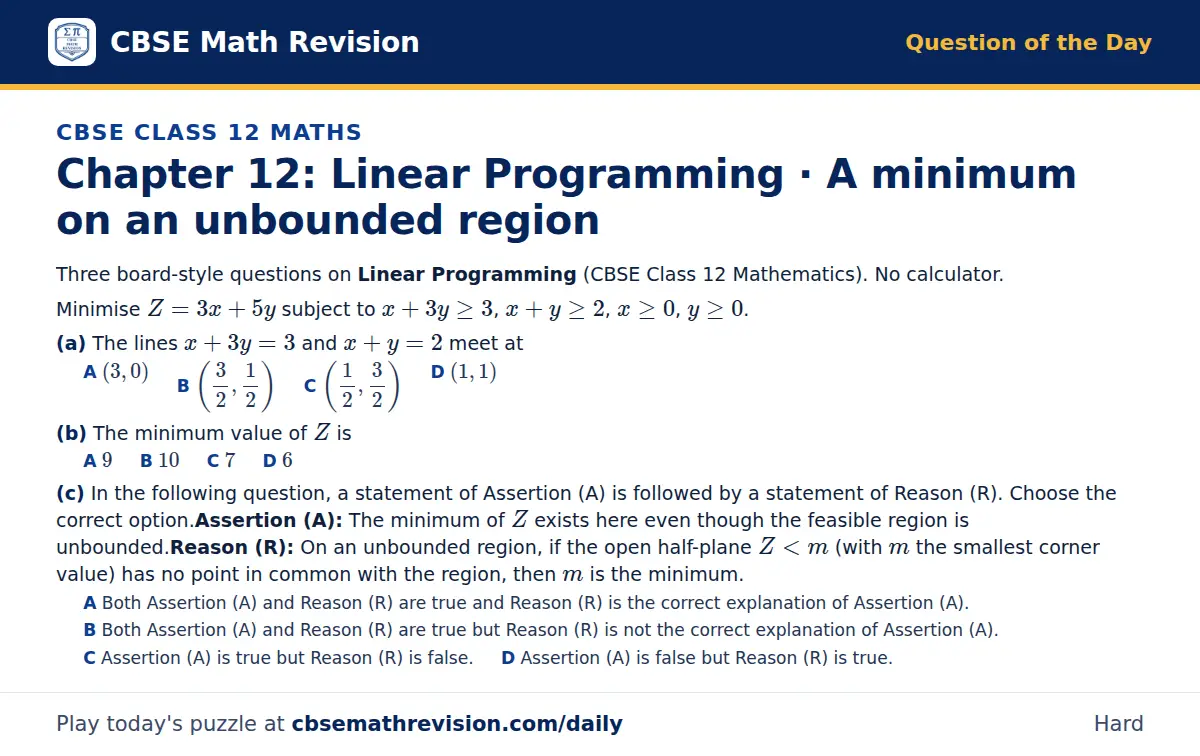
Chapter 12: Linear Programming · A minimum on an unbounded region
Three board-style questions on Linear Programming (CBSE Class 12 Mathematics). No calculator. Minimise Z = 3x + 5y subject to x + 3y ≥ 3, x + y ≥ 2, x ≥ 0, y ≥ 0.
- The lines x + 3y = 3 and x + y = 2 meet at Options: A) (3, 0); B) (32, 12); C) (12, 32); D) (1, 1)
- The minimum value of Z is Options: A) 9; B) 10; C) 7; D) 6
- In the following question, a statement of Assertion (A) is followed by a statement of Reason (R). Choose the correct option. Assertion (A): The minimum of Z exists here even though the feasible region is unbounded. Reason (R): On an unbounded region, if the open half-plane Z < m (with m the smallest corner value) has no point in common with the region, then m is the minimum. Options: A) Both Assertion (A) and Reason (R) are true and Reason (R) is the correct explanation of Assertion (A).; B) Both Assertion (A) and Reason (R) are true but Reason (R) is not the correct explanation of Assertion (A).; C) Assertion (A) is true but Reason (R) is false.; D) Assertion (A) is false but Reason (R) is true.
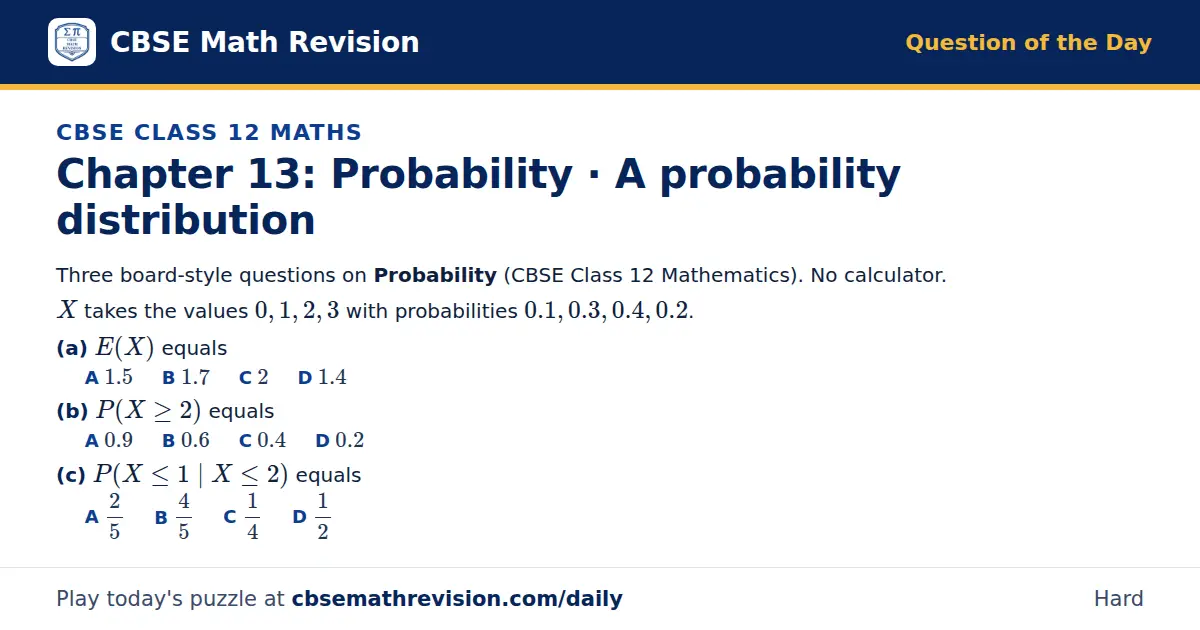
Chapter 13: Probability · A probability distribution
Three board-style questions on Probability (CBSE Class 12 Mathematics). No calculator. X takes the values 0, 1, 2, 3 with probabilities 0.1, 0.3, 0.4, 0.2.
- E(X) equals Options: A) 1.5; B) 1.7; C) 2; D) 1.4
- P(X ≥ 2) equals Options: A) 0.9; B) 0.6; C) 0.4; D) 0.2
- P(X ≤ 1 | X ≤ 2) equals Options: A) 2/5; B) 4/5; C) 1/4; D) 1/2
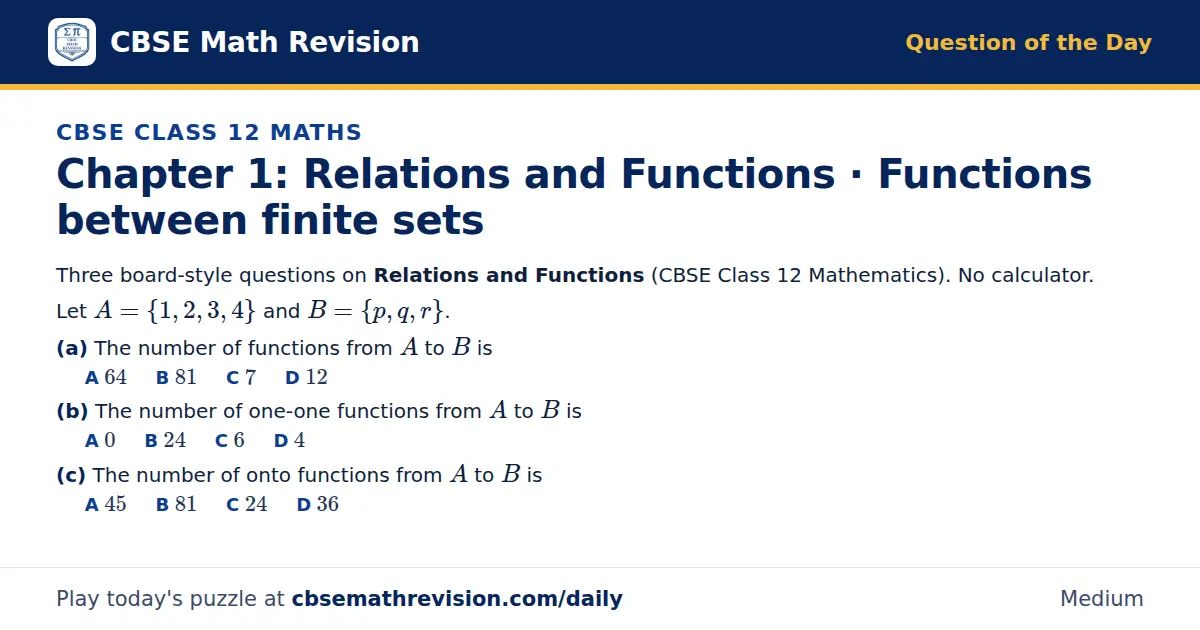
Chapter 1: Relations and Functions · Functions between finite sets
Three board-style questions on Relations and Functions (CBSE Class 12 Mathematics). No calculator. Let A = 1, 2, 3, 4 and B = p, q, r.
- The number of functions from A to B is Options: A) 64; B) 81; C) 7; D) 12
- The number of one-one functions from A to B is Options: A) 0; B) 24; C) 6; D) 4
- The number of onto functions from A to B is Options: A) 45; B) 81; C) 24; D) 36
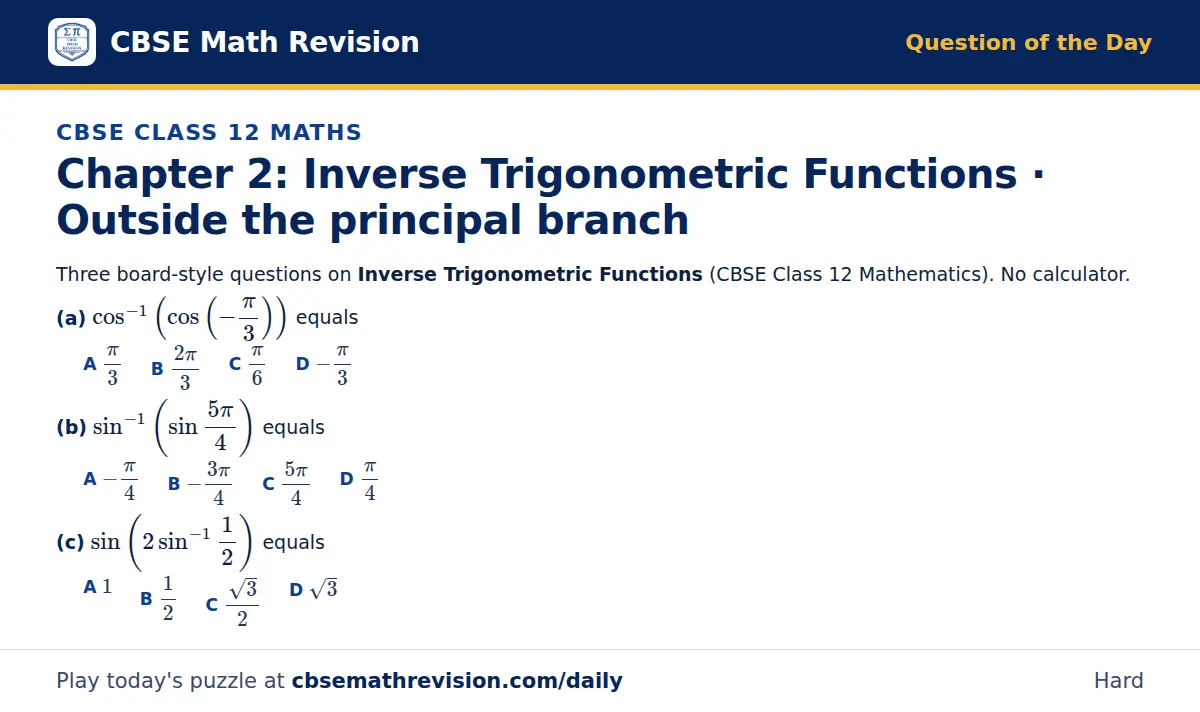
Chapter 2: Inverse Trigonometric Functions · Outside the principal branch
Three board-style questions on Inverse Trigonometric Functions (CBSE Class 12 Mathematics). No calculator.
- cos⁻¹(cos(-(π)/3)) equals Options: A) (π)/3; B) (2 π)/3; C) (π)/6; D) - (π)/3
- sin⁻¹(sin(5π)/4) equals Options: A) - (π)/4; B) - (3 π)/4; C) (5 π)/4; D) (π)/4
- sin(2sin⁻¹12) equals Options: A) 1; B) 1/2; C) (√3)/2; D) √3
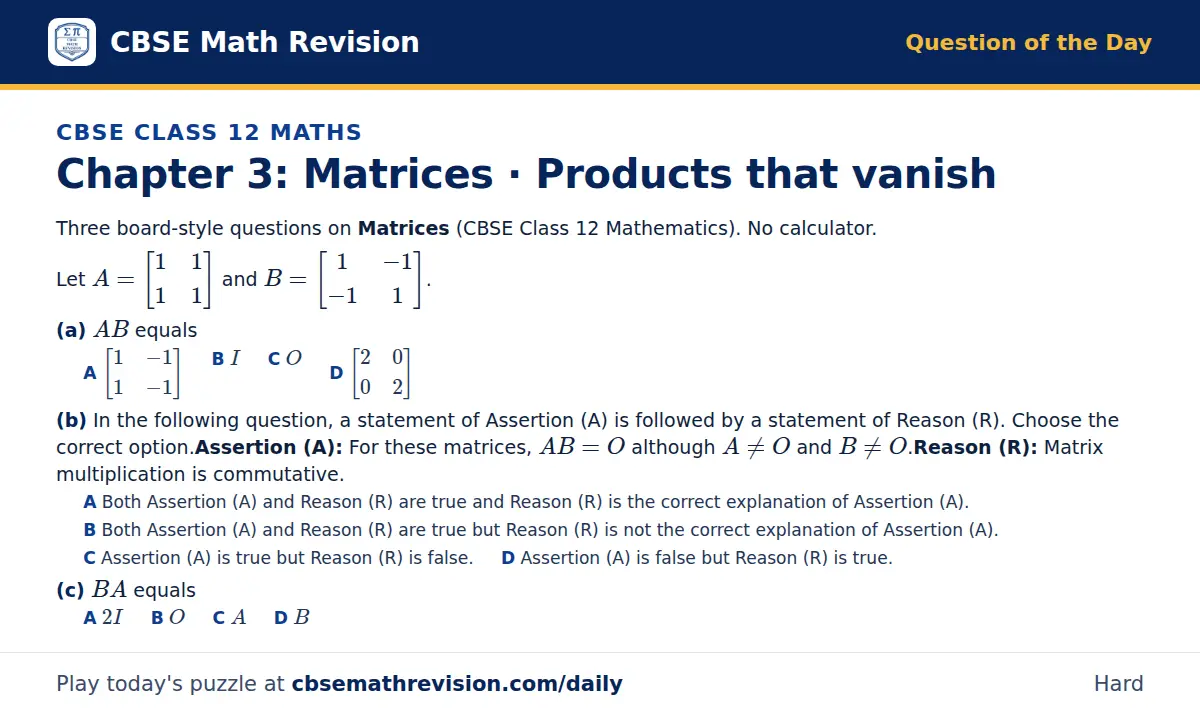
Chapter 3: Matrices · Products that vanish
Three board-style questions on Matrices (CBSE Class 12 Mathematics). No calculator. Let A = 1 1; 1 1 and B = 1 -1; -1 1.
- AB equals Options: A) 1 -1; 1 -1; B) I; C) O; D) 2 0; 0 2
- In the following question, a statement of Assertion (A) is followed by a statement of Reason (R). Choose the correct option. Assertion (A): For these matrices, AB = O although A ≠ O and B ≠ O. Reason (R): Matrix multiplication is commutative. Options: A) Both Assertion (A) and Reason (R) are true and Reason (R) is the correct explanation of Assertion (A).; B) Both Assertion (A) and Reason (R) are true but Reason (R) is not the correct explanation of Assertion (A).; C) Assertion (A) is true but Reason (R) is false.; D) Assertion (A) is false but Reason (R) is true.
- BA equals Options: A) 2I; B) O; C) A; D) B
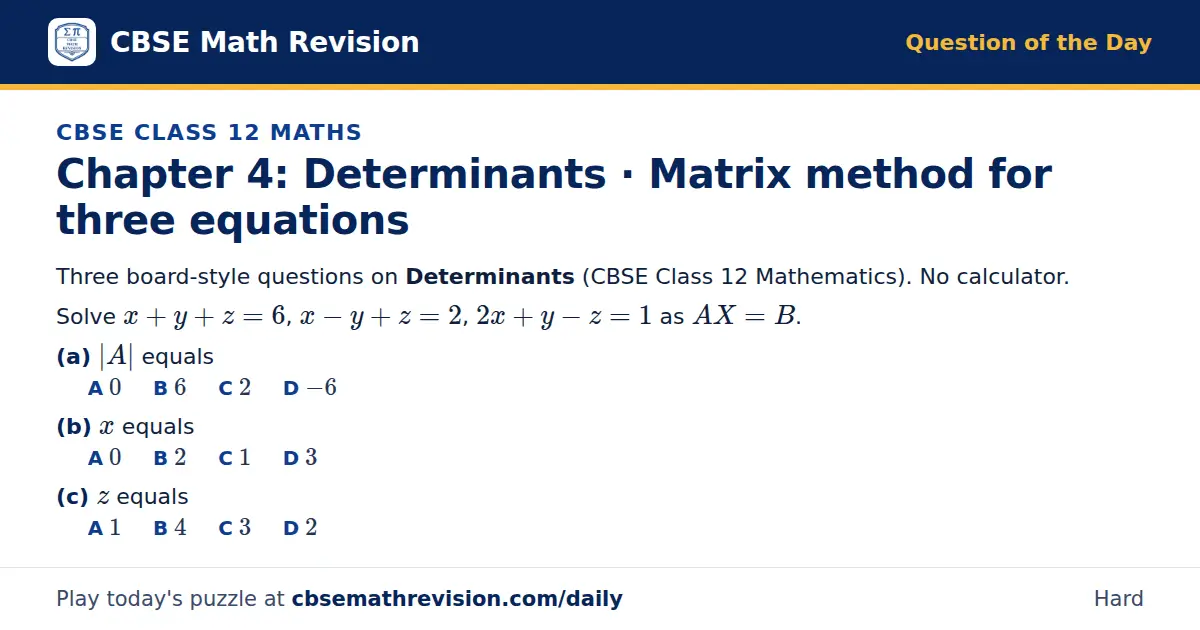
Chapter 4: Determinants · Matrix method for three equations
Three board-style questions on Determinants (CBSE Class 12 Mathematics). No calculator. Solve x + y + z = 6, x - y + z = 2, 2x + y - z = 1 as AX = B.
- |A| equals Options: A) 0; B) 6; C) 2; D) -6
- x equals Options: A) 0; B) 2; C) 1; D) 3
- z equals Options: A) 1; B) 4; C) 3; D) 2
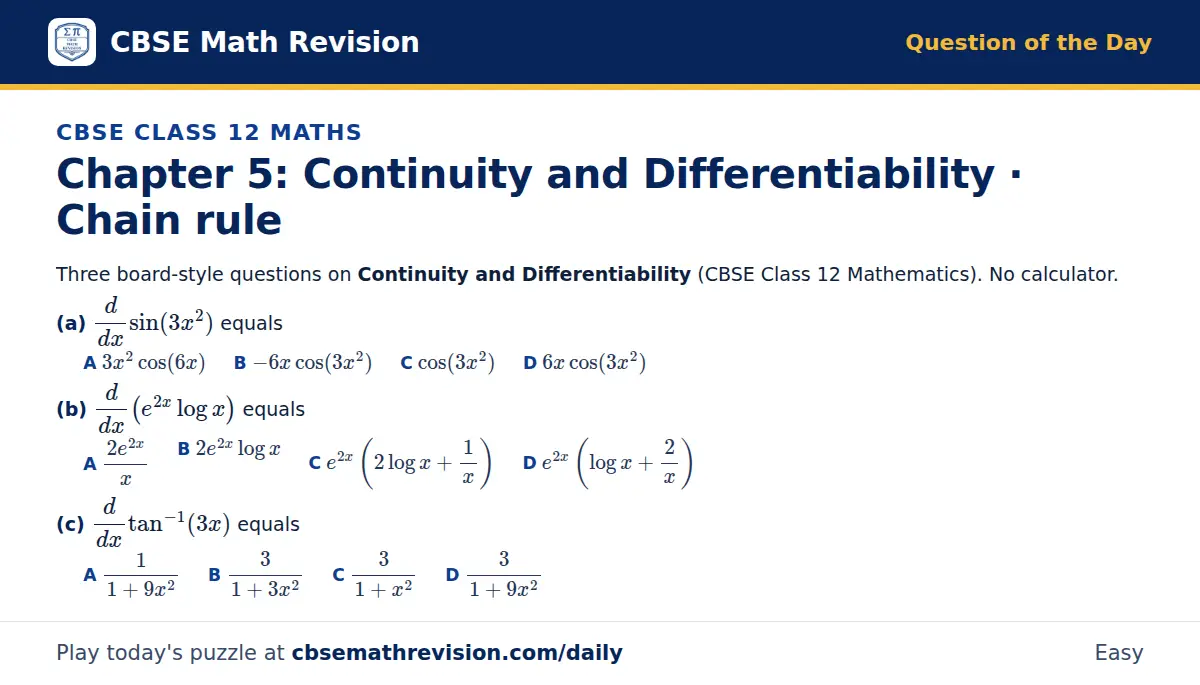
Chapter 5: Continuity and Differentiability · Chain rule
Three board-style questions on Continuity and Differentiability (CBSE Class 12 Mathematics). No calculator.
- d/dxsin(3x²) equals Options: A) 3x²cos(6x); B) -6xcos(3x²); C) cos(3x²); D) 6xcos(3x²)
- d/dx(e^(2x)log x) equals Options: A) (2e^(2x))/x; B) 2e^(2x)log x; C) e^(2x)(2log x + 1x); D) e^(2x)(log x + 2x)
- d/dxtan⁻¹(3x) equals Options: A) 1/(1 + 9x²); B) 3/(1 + 3x²); C) 3/(1 + x²); D) 3/(1 + 9x²)
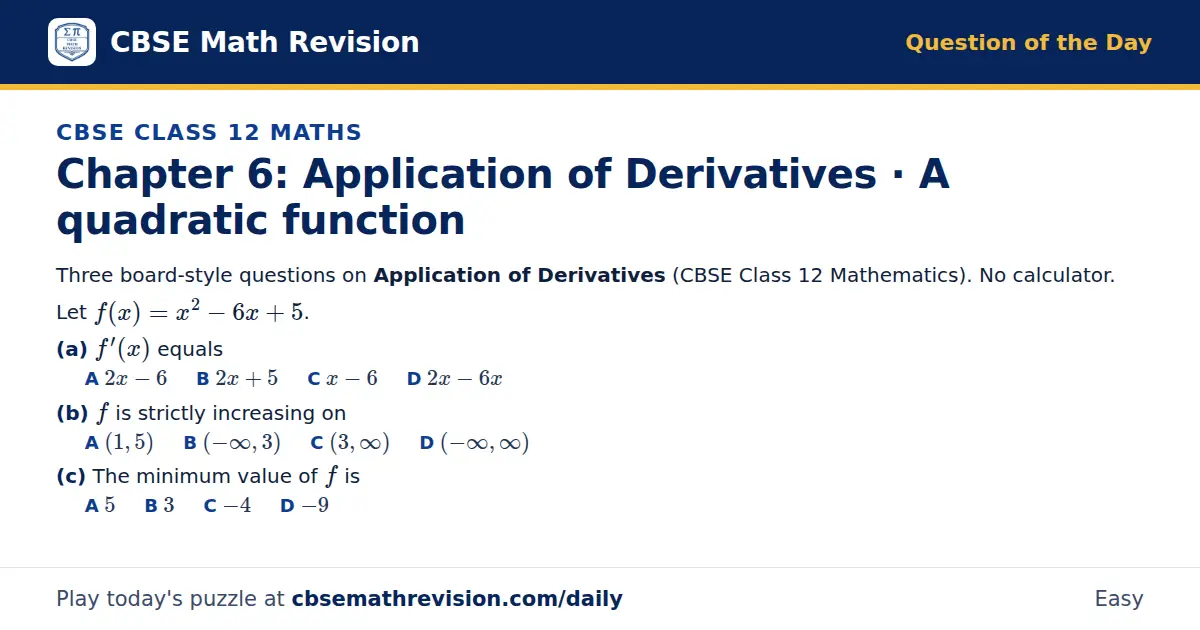
Chapter 6: Application of Derivatives · A quadratic function
Three board-style questions on Application of Derivatives (CBSE Class 12 Mathematics). No calculator. Let f(x) = x² - 6x + 5.
- f'(x) equals Options: A) 2x - 6; B) 2x + 5; C) x - 6; D) 2x - 6x
- f is strictly increasing on Options: A) (1, 5); B) (-∞, 3); C) (3, ∞); D) (-∞, ∞)
- The minimum value of f is Options: A) 5; B) 3; C) -4; D) -9
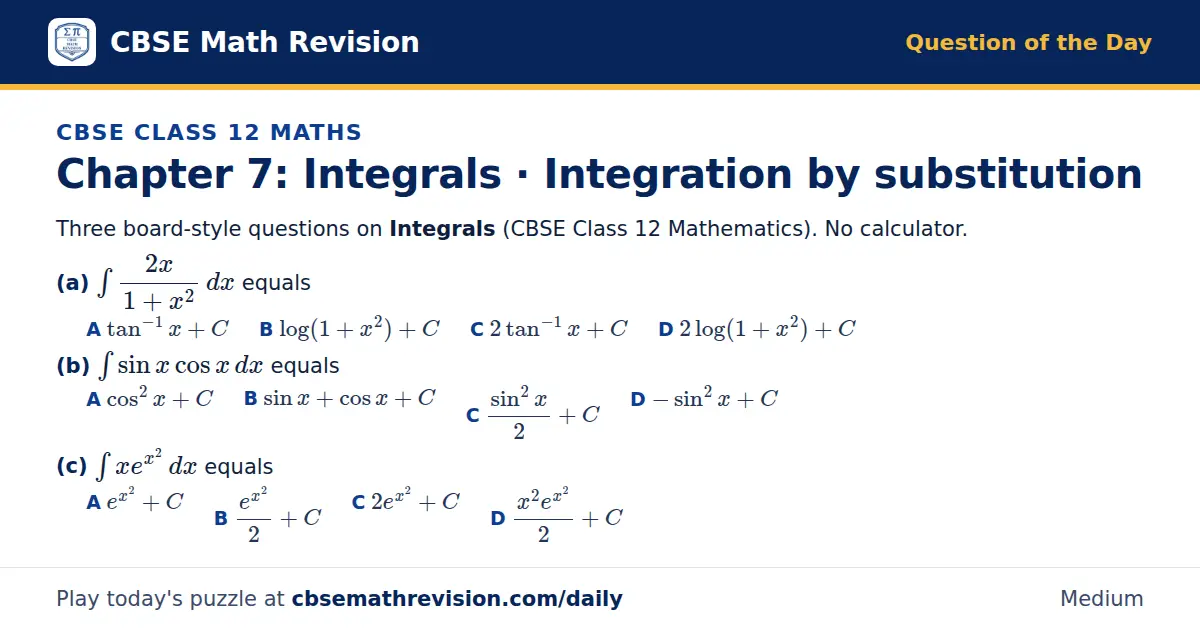
Chapter 7: Integrals · Integration by substitution
Three board-style questions on Integrals (CBSE Class 12 Mathematics). No calculator.
- ∫ 2x/(1 + x²) dx equals Options: A) tan⁻¹x + C; B) log(1 + x²) + C; C) 2tan⁻¹x + C; D) 2log(1 + x²) + C
- ∫ sin xcos x dx equals Options: A) cos² x + C; B) sin x + cos x + C; C) (sin² x)/2 + C; D) -sin² x + C
- ∫ x e^(x²) dx equals Options: A) e^(x²) + C; B) (e^(x²))/2 + C; C) 2e^(x²) + C; D) (x² e^(x²))/2 + C
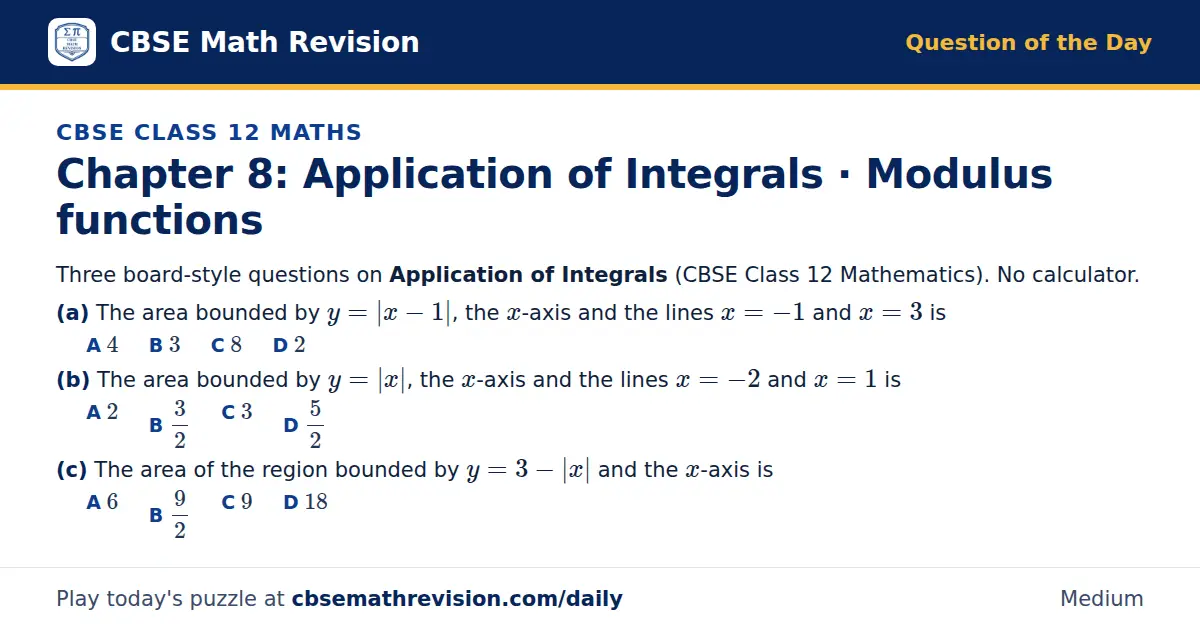
Chapter 8: Application of Integrals · Modulus functions
Three board-style questions on Application of Integrals (CBSE Class 12 Mathematics). No calculator.
- The area bounded by y = |x - 1|, the x-axis and the lines x = -1 and x = 3 is Options: A) 4; B) 3; C) 8; D) 2
- The area bounded by y = |x|, the x-axis and the lines x = -2 and x = 1 is Options: A) 2; B) 3/2; C) 3; D) 5/2
- The area of the region bounded by y = 3 - |x| and the x-axis is Options: A) 6; B) 9/2; C) 9; D) 18
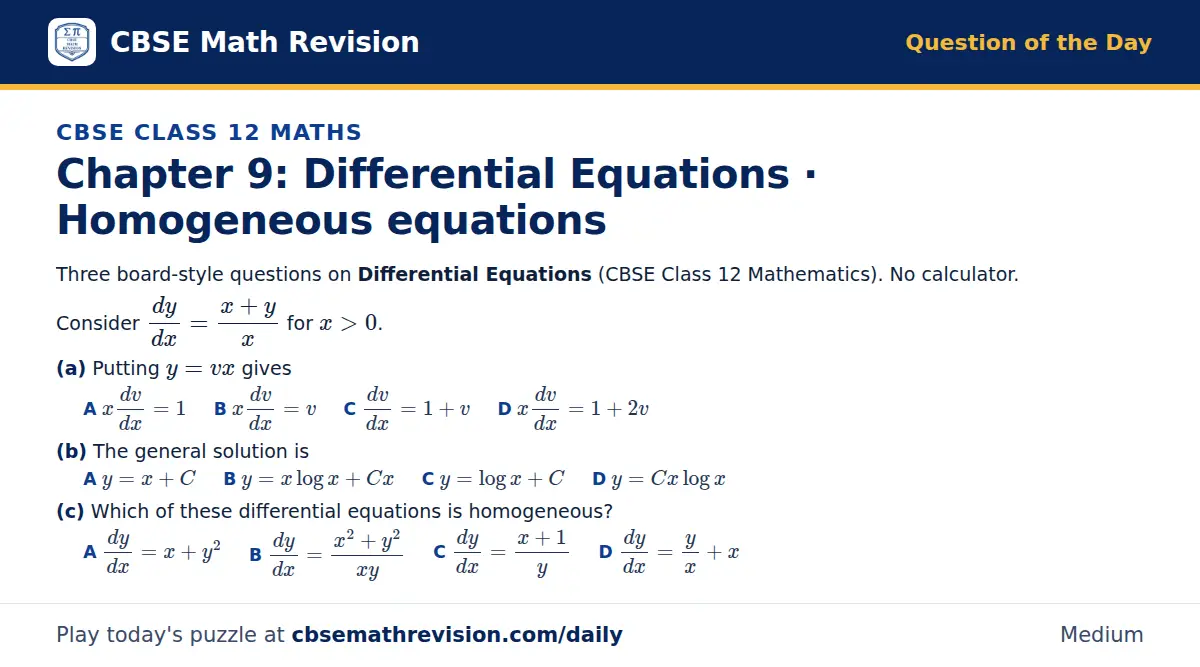
Chapter 9: Differential Equations · Homogeneous equations
Three board-style questions on Differential Equations (CBSE Class 12 Mathematics). No calculator. Consider dy/dx = (x + y)/x for x > 0.
- Putting y = vx gives Options: A) xdv/dx = 1; B) xdv/dx = v; C) dv/dx = 1 + v; D) xdv/dx = 1 + 2v
- The general solution is Options: A) y = x + C; B) y = xlog x + Cx; C) y = log x + C; D) y = Cxlog x
- Which of these differential equations is homogeneous? Options: A) dy/dx = x + y²; B) dy/dx = (x² + y²)/xy; C) dy/dx = (x + 1)/y; D) dy/dx = y/x + x
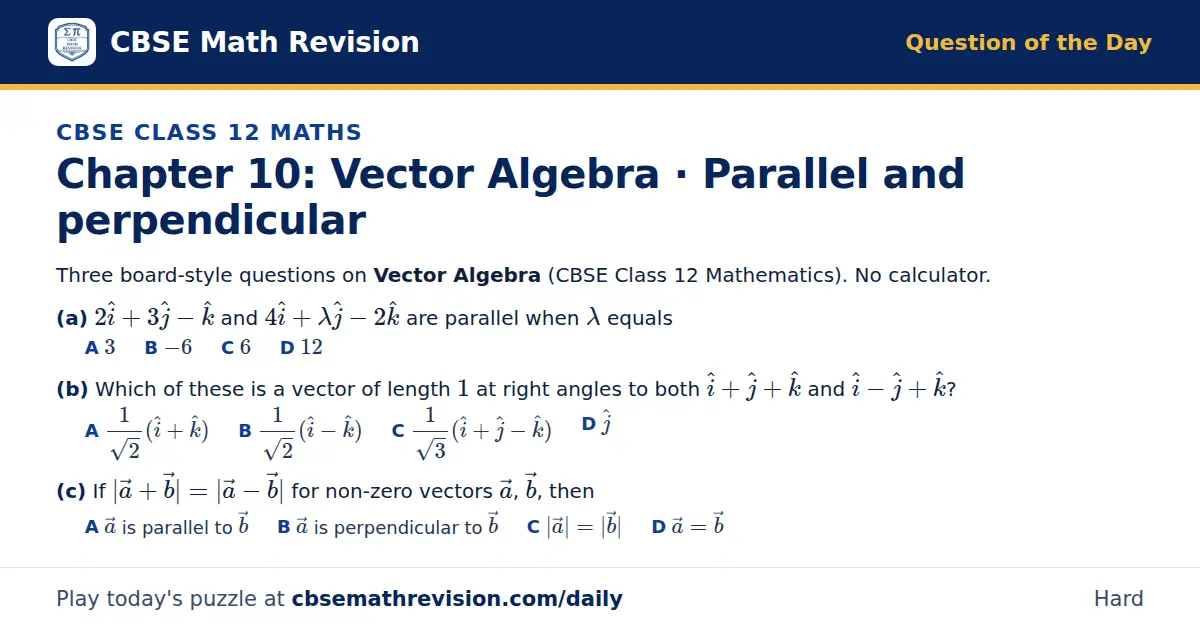
Chapter 10: Vector Algebra · Parallel and perpendicular
Three board-style questions on Vector Algebra (CBSE Class 12 Mathematics). No calculator.
- 2 i + 3 j - k and 4 i + λ j - 2 k are parallel when λ equals Options: A) 3; B) -6; C) 6; D) 12
- Which of these is a vector of length 1 at right angles to both i + j + k and i - j + k? Options: A) 1/(√2)(i + k); B) 1/(√2)(i - k); C) 1/(√3)(i + j - k); D) j
- If | a + b| = | a - b| for non-zero vectors a, b, then Options: A) a is parallel to b; B) a is perpendicular to b; C) | a| = | b|; D) a = b
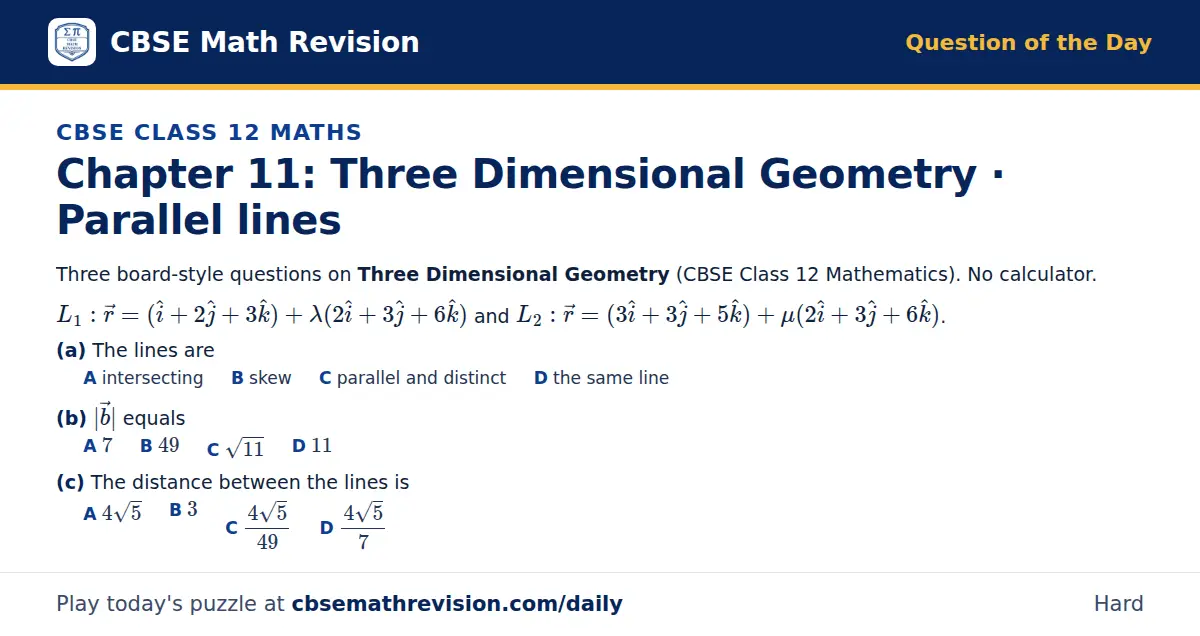
Chapter 11: Three Dimensional Geometry · Parallel lines
Three board-style questions on Three Dimensional Geometry (CBSE Class 12 Mathematics). No calculator. L_1: r = (i + 2 j + 3 k) + λ(2 i + 3 j + 6 k) and L_2: r = (3 i + 3 j + 5 k) + μ(2 i + 3 j + 6 k).
- The lines are Options: A) intersecting; B) skew; C) parallel and distinct; D) the same line
- | b| equals Options: A) 7; B) 49; C) √11; D) 11
- The distance between the lines is Options: A) 4 √5; B) 3; C) (4 √5)/49; D) (4 √5)/7
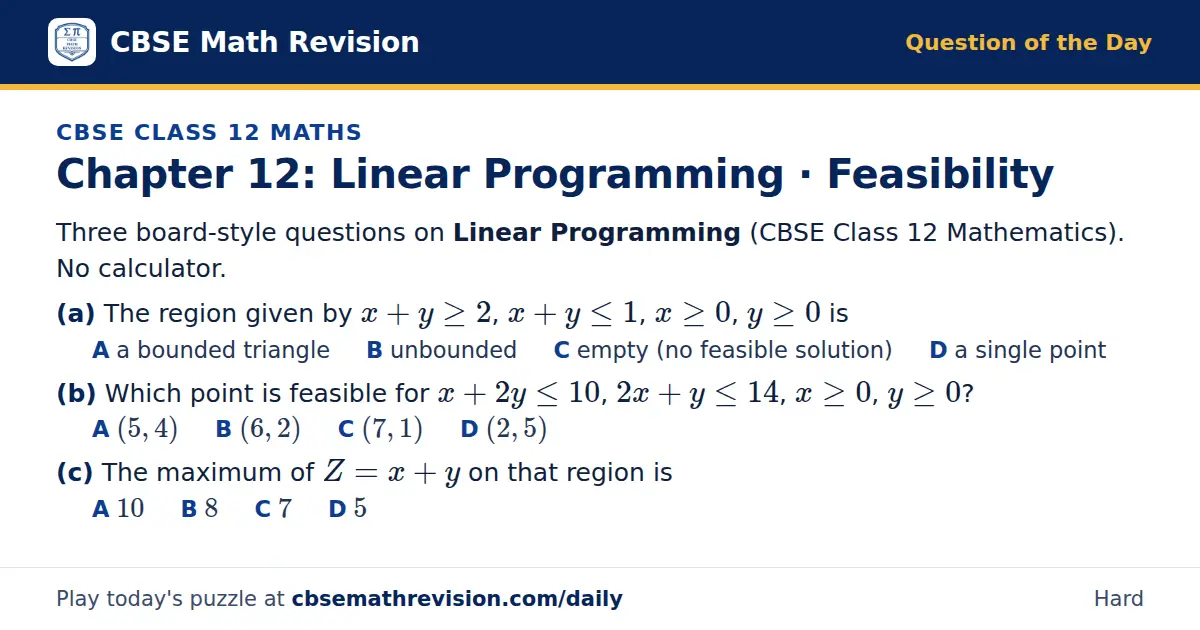
Chapter 12: Linear Programming · Feasibility
Three board-style questions on Linear Programming (CBSE Class 12 Mathematics). No calculator.
- The region given by x + y ≥ 2, x + y ≤ 1, x ≥ 0, y ≥ 0 is Options: A) a bounded triangle; B) unbounded; C) empty (no feasible solution); D) a single point
- Which point is feasible for x + 2y ≤ 10, 2x + y ≤ 14, x ≥ 0, y ≥ 0? Options: A) (5, 4); B) (6, 2); C) (7, 1); D) (2, 5)
- The maximum of Z = x + y on that region is Options: A) 10; B) 8; C) 7; D) 5
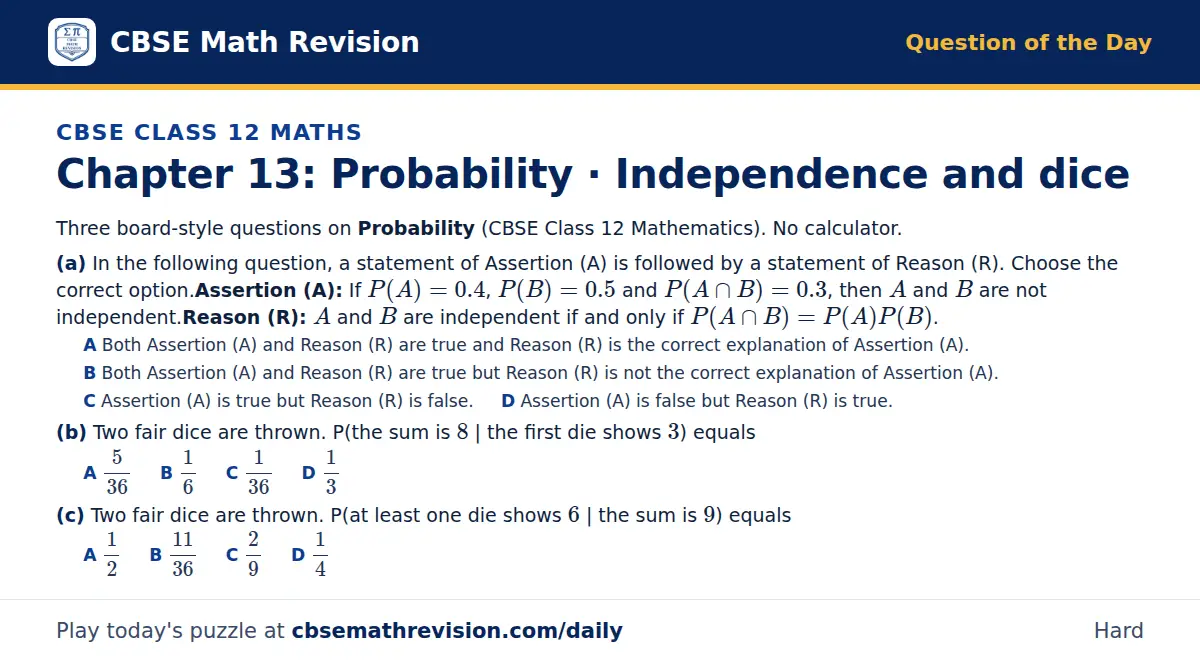
Chapter 13: Probability · Independence and dice
Three board-style questions on Probability (CBSE Class 12 Mathematics). No calculator.
- In the following question, a statement of Assertion (A) is followed by a statement of Reason (R). Choose the correct option. Assertion (A): If P(A) = 0.4, P(B) = 0.5 and P(A ∩ B) = 0.3, then A and B are not independent. Reason (R): A and B are independent if and only if P(A ∩ B) = P(A)P(B). Options: A) Both Assertion (A) and Reason (R) are true and Reason (R) is the correct explanation of Assertion (A).; B) Both Assertion (A) and Reason (R) are true but Reason (R) is not the correct explanation of Assertion (A).; C) Assertion (A) is true but Reason (R) is false.; D) Assertion (A) is false but Reason (R) is true.
- Two fair dice are thrown. P(the sum is 8 | the first die shows 3) equals Options: A) 5/36; B) 1/6; C) 1/36; D) 1/3
- Two fair dice are thrown. P(at least one die shows 6 | the sum is 9) equals Options: A) 1/2; B) 11/36; C) 2/9; D) 1/4
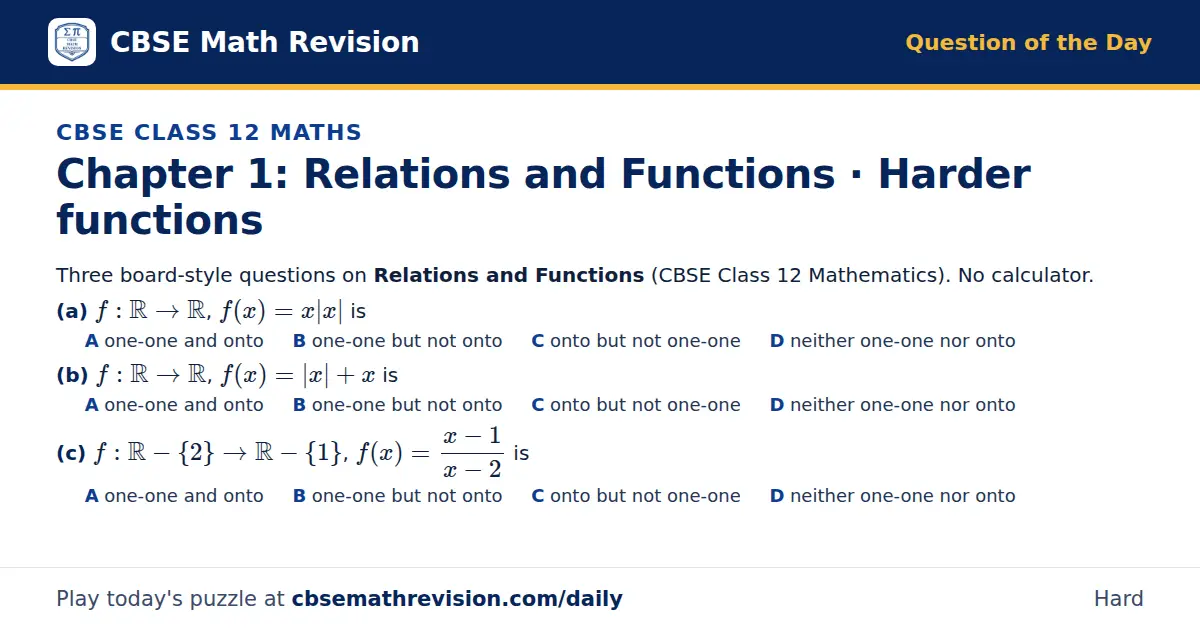
Chapter 1: Relations and Functions · Harder functions
Three board-style questions on Relations and Functions (CBSE Class 12 Mathematics). No calculator.
- f: ℝ → ℝ, f(x) = x|x| is Options: A) one-one and onto; B) one-one but not onto; C) onto but not one-one; D) neither one-one nor onto
- f: ℝ → ℝ, f(x) = |x| + x is Options: A) one-one and onto; B) one-one but not onto; C) onto but not one-one; D) neither one-one nor onto
- f: ℝ - 2 → ℝ - 1, f(x) = (x - 1)/(x - 2) is Options: A) one-one and onto; B) one-one but not onto; C) onto but not one-one; D) neither one-one nor onto
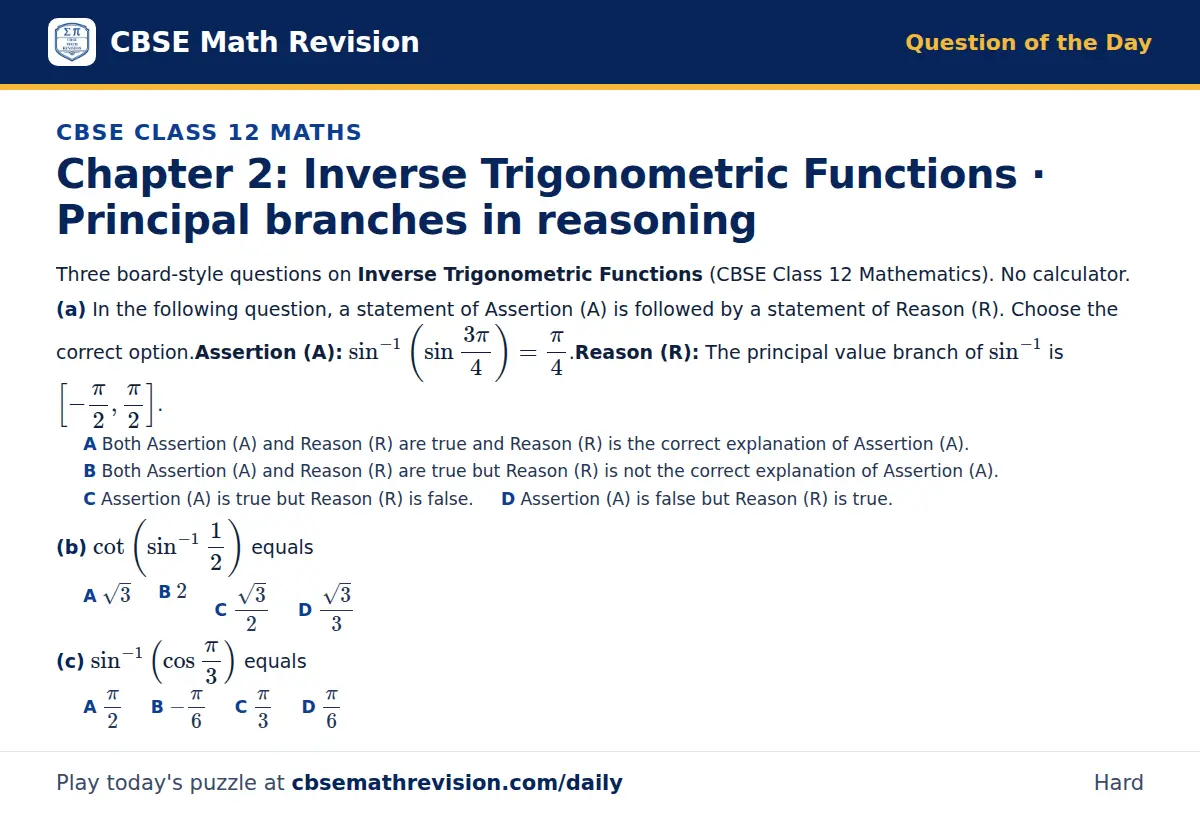
Chapter 2: Inverse Trigonometric Functions · Principal branches in reasoning
Three board-style questions on Inverse Trigonometric Functions (CBSE Class 12 Mathematics). No calculator.
- In the following question, a statement of Assertion (A) is followed by a statement of Reason (R). Choose the correct option. Assertion (A): sin⁻¹(sin(3π)/4) = (π)/4. Reason (R): The principal value branch of sin⁻¹ is [-(π)/2, (π)/2]. Options: A) Both Assertion (A) and Reason (R) are true and Reason (R) is the correct explanation of Assertion (A).; B) Both Assertion (A) and Reason (R) are true but Reason (R) is not the correct explanation of Assertion (A).; C) Assertion (A) is true but Reason (R) is false.; D) Assertion (A) is false but Reason (R) is true.
- cot(sin⁻¹12) equals Options: A) √3; B) 2; C) (√3)/2; D) (√3)/3
- sin⁻¹(cos(π)/3) equals Options: A) (π)/2; B) - (π)/6; C) (π)/3; D) (π)/6
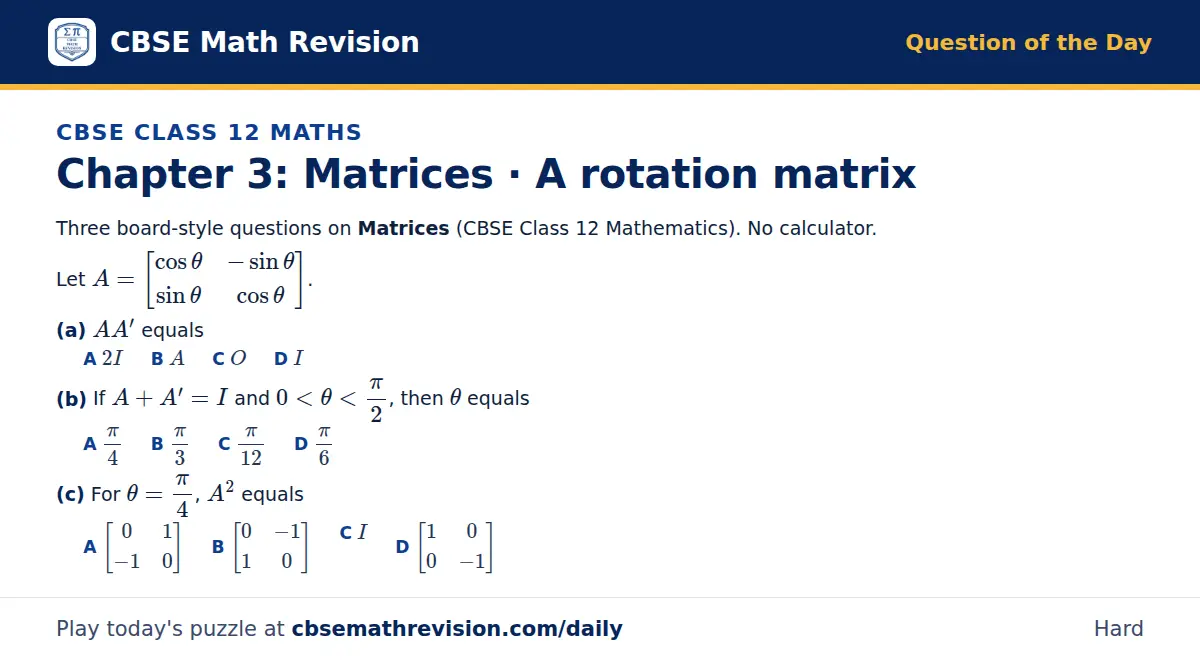
Chapter 3: Matrices · A rotation matrix
Three board-style questions on Matrices (CBSE Class 12 Mathematics). No calculator. Let A = cosθ -sinθ; sinθ cosθ.
- AA' equals Options: A) 2I; B) A; C) O; D) I
- If A + A' = I and 0 < θ < (π)/2, then θ equals Options: A) (π)/4; B) (π)/3; C) (π)/12; D) (π)/6
- For θ = (π)/4, A² equals Options: A) 0 1; -1 0; B) 0 -1; 1 0; C) I; D) 1 0; 0 -1
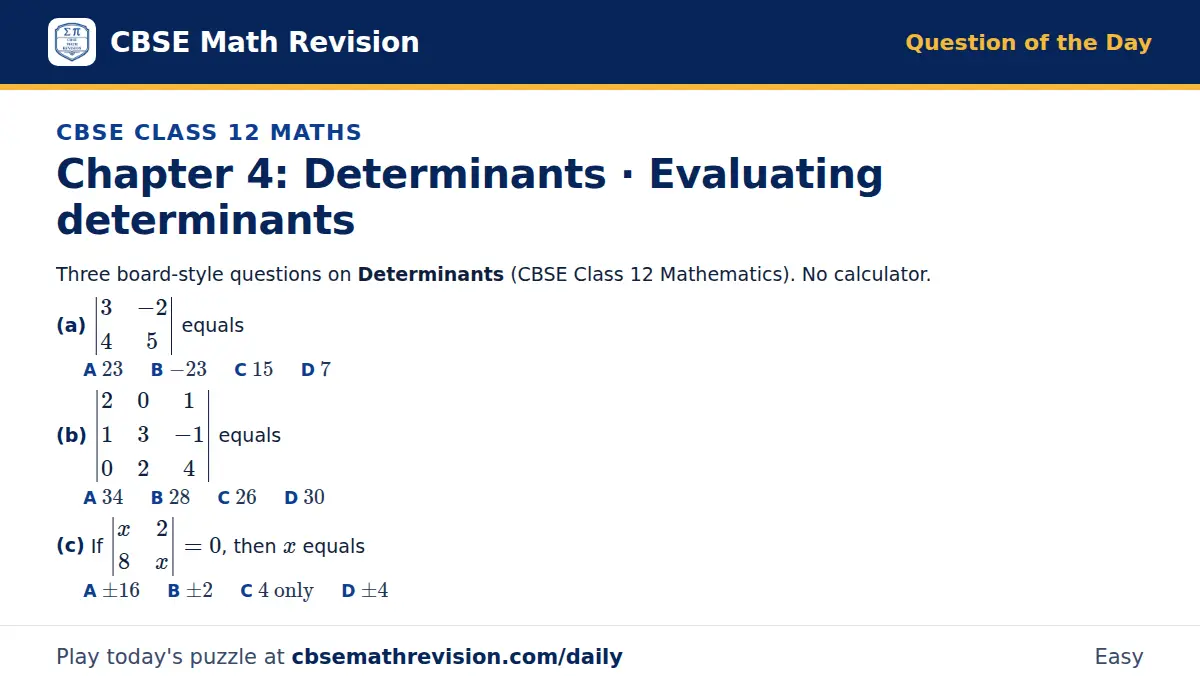
Chapter 4: Determinants · Evaluating determinants
Three board-style questions on Determinants (CBSE Class 12 Mathematics). No calculator.
- 3 -2; 4 5 equals Options: A) 23; B) -23; C) 15; D) 7
- 2 0 1; 1 3 -1; 0 2 4 equals Options: A) 34; B) 28; C) 26; D) 30
- If x 2; 8 x = 0, then x equals Options: A) ± 16; B) ± 2; C) 4 only; D) ± 4
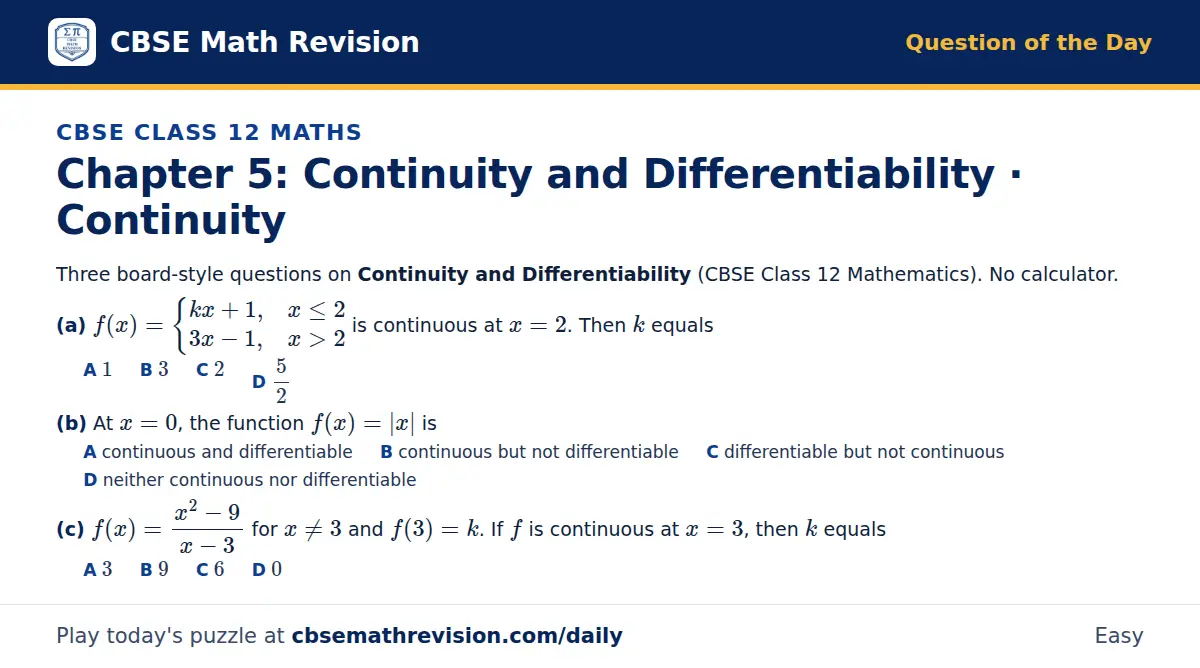
Chapter 5: Continuity and Differentiability · Continuity
Three board-style questions on Continuity and Differentiability (CBSE Class 12 Mathematics). No calculator.
- f(x) = kx + 1, x ≤ 2; 3x - 1, x > 2 is continuous at x = 2. Then k equals Options: A) 1; B) 3; C) 2; D) 5/2
- At x = 0, the function f(x) = |x| is Options: A) continuous and differentiable; B) continuous but not differentiable; C) differentiable but not continuous; D) neither continuous nor differentiable
- f(x) = (x² - 9)/(x - 3) for x ≠ 3 and f(3) = k. If f is continuous at x = 3, then k equals Options: A) 3; B) 9; C) 6; D) 0
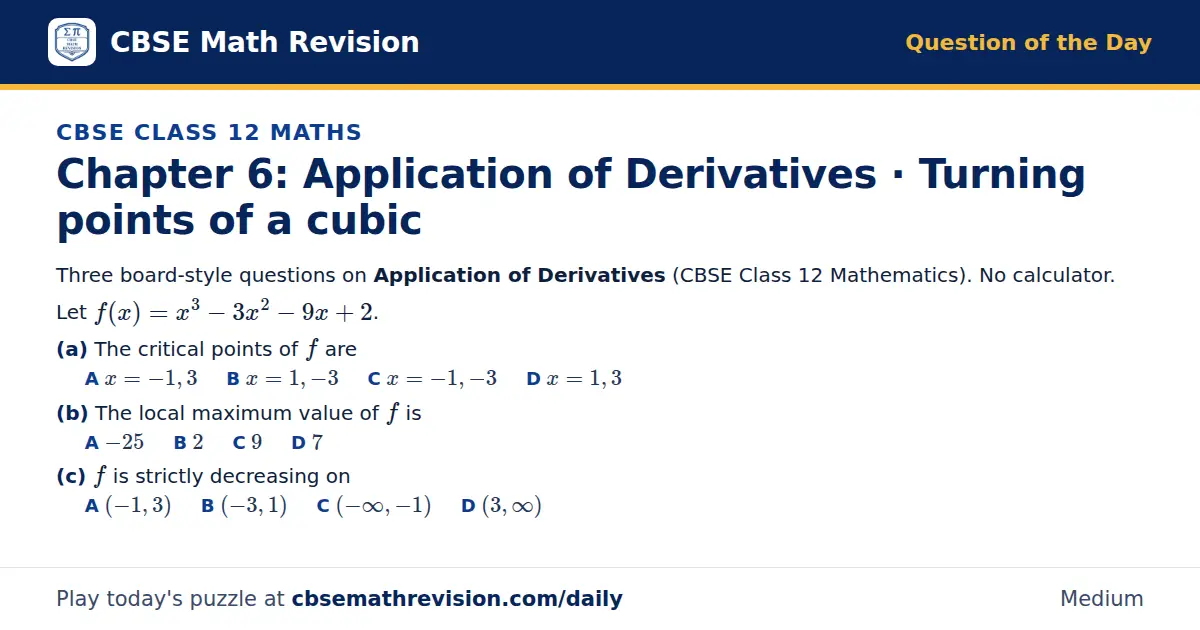
Chapter 6: Application of Derivatives · Turning points of a cubic
Three board-style questions on Application of Derivatives (CBSE Class 12 Mathematics). No calculator. Let f(x) = x³ - 3x² - 9x + 2.
- The critical points of f are Options: A) x = -1, 3; B) x = 1, -3; C) x = -1, -3; D) x = 1, 3
- The local maximum value of f is Options: A) -25; B) 2; C) 9; D) 7
- f is strictly decreasing on Options: A) (-1, 3); B) (-3, 1); C) (-∞, -1); D) (3, ∞)
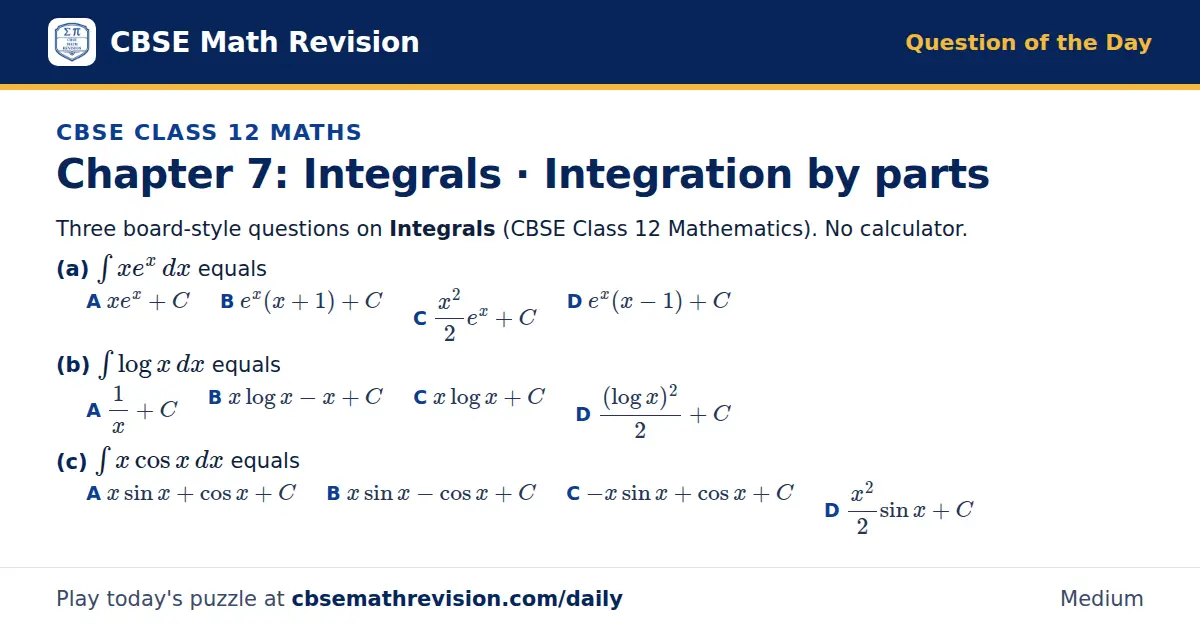
Chapter 7: Integrals · Integration by parts
Three board-style questions on Integrals (CBSE Class 12 Mathematics). No calculator.
- ∫ x e^x dx equals Options: A) x e^x + C; B) e^x(x + 1) + C; C) (x²)/2e^x + C; D) e^x(x - 1) + C
- ∫ log x dx equals Options: A) 1x + C; B) xlog x - x + C; C) xlog x + C; D) ((log x)²)/2 + C
- ∫ xcos x dx equals Options: A) xsin x + cos x + C; B) xsin x - cos x + C; C) -xsin x + cos x + C; D) (x²)/2sin x + C
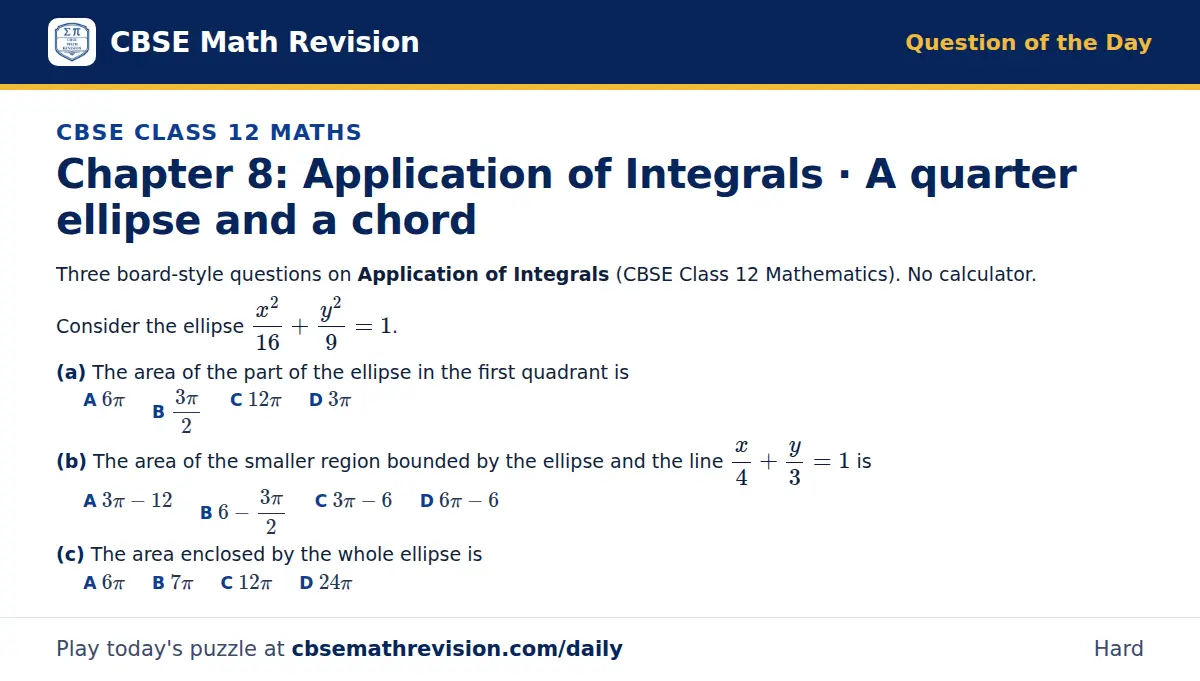
Chapter 8: Application of Integrals · A quarter ellipse and a chord
Three board-style questions on Application of Integrals (CBSE Class 12 Mathematics). No calculator. Consider the ellipse (x²)/16 + (y²)/9 = 1.
- The area of the part of the ellipse in the first quadrant is Options: A) 6π; B) (3π)/2; C) 12π; D) 3π
- The area of the smaller region bounded by the ellipse and the line x/4 + y/3 = 1 is Options: A) 3π - 12; B) 6 - (3π)/2; C) 3π - 6; D) 6π - 6
- The area enclosed by the whole ellipse is Options: A) 6π; B) 7π; C) 12π; D) 24π
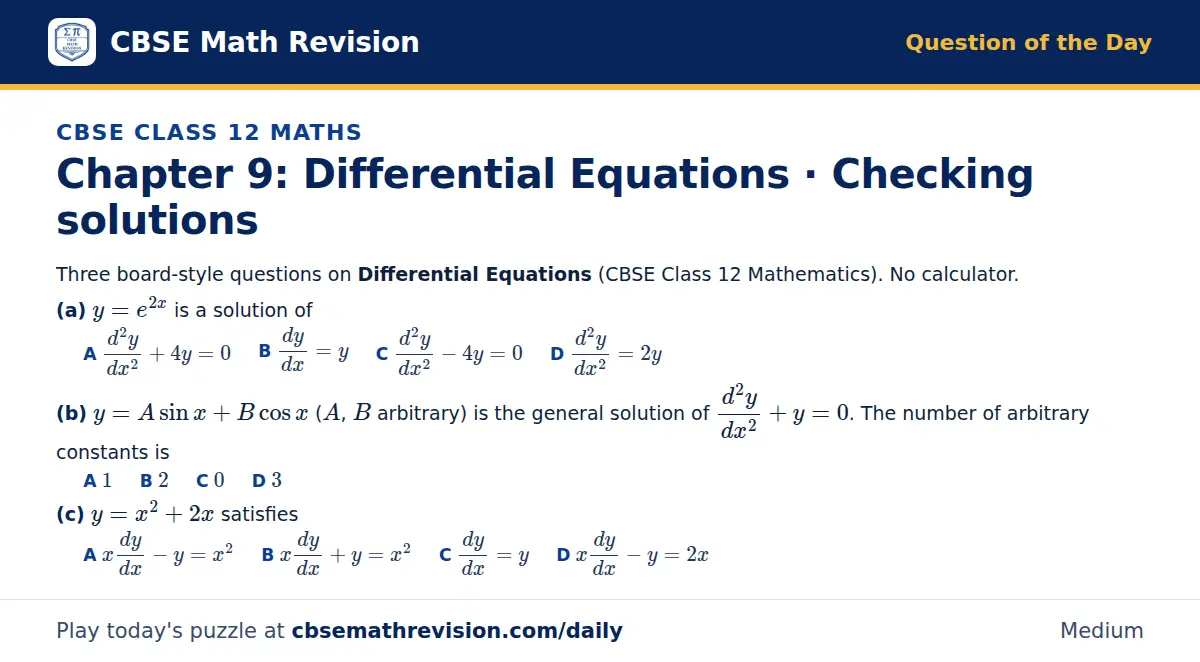
Chapter 9: Differential Equations · Checking solutions
Three board-style questions on Differential Equations (CBSE Class 12 Mathematics). No calculator.
- y = e^(2x) is a solution of Options: A) (d²y)/(dx²) + 4y = 0; B) dy/dx = y; C) (d²y)/(dx²) - 4y = 0; D) (d²y)/(dx²) = 2y
- y = Asin x + Bcos x (A, B arbitrary) is the general solution of (d²y)/(dx²) + y = 0. The number of arbitrary constants is Options: A) 1; B) 2; C) 0; D) 3
- y = x² + 2x satisfies Options: A) xdy/dx - y = x²; B) xdy/dx + y = x²; C) dy/dx = y; D) xdy/dx - y = 2x
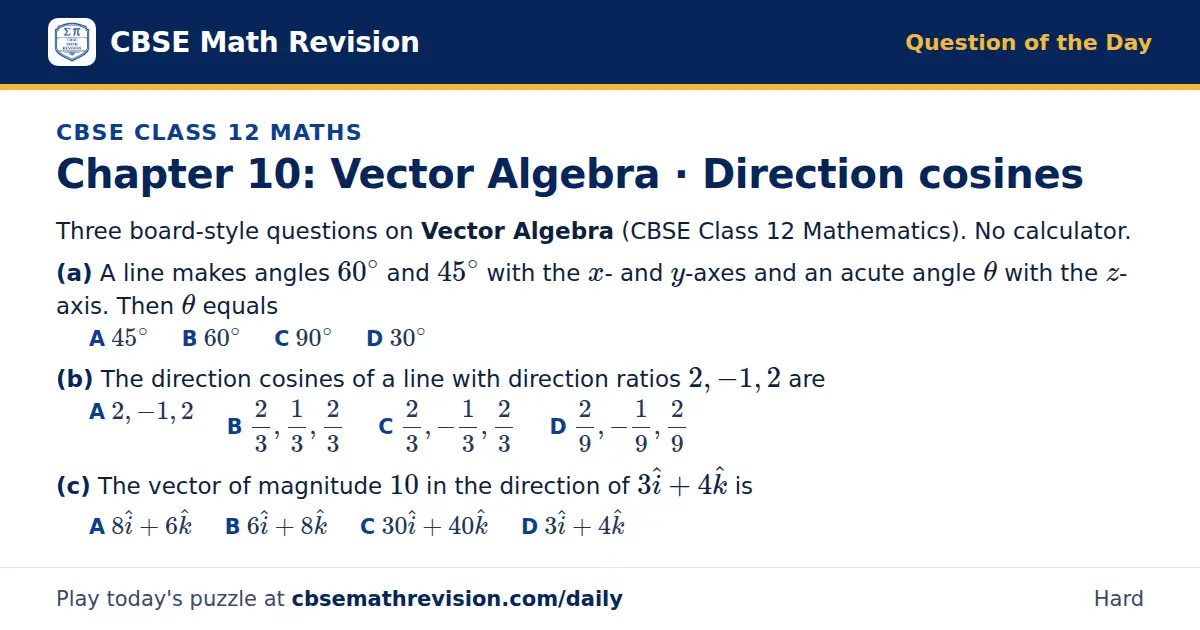
Chapter 10: Vector Algebra · Direction cosines
Three board-style questions on Vector Algebra (CBSE Class 12 Mathematics). No calculator.
- A line makes angles 60^∘ and 45^∘ with the x- and y-axes and an acute angle θ with the z-axis. Then θ equals Options: A) 45^∘; B) 60^∘; C) 90^∘; D) 30^∘
- The direction cosines of a line with direction ratios 2, -1, 2 are Options: A) 2, -1, 2; B) 23, 13, 23; C) 23, -13, 23; D) 29, -19, 29
- The vector of magnitude 10 in the direction of 3 i + 4 k is Options: A) 8 i + 6 k; B) 6 i + 8 k; C) 30 i + 40 k; D) 3 i + 4 k
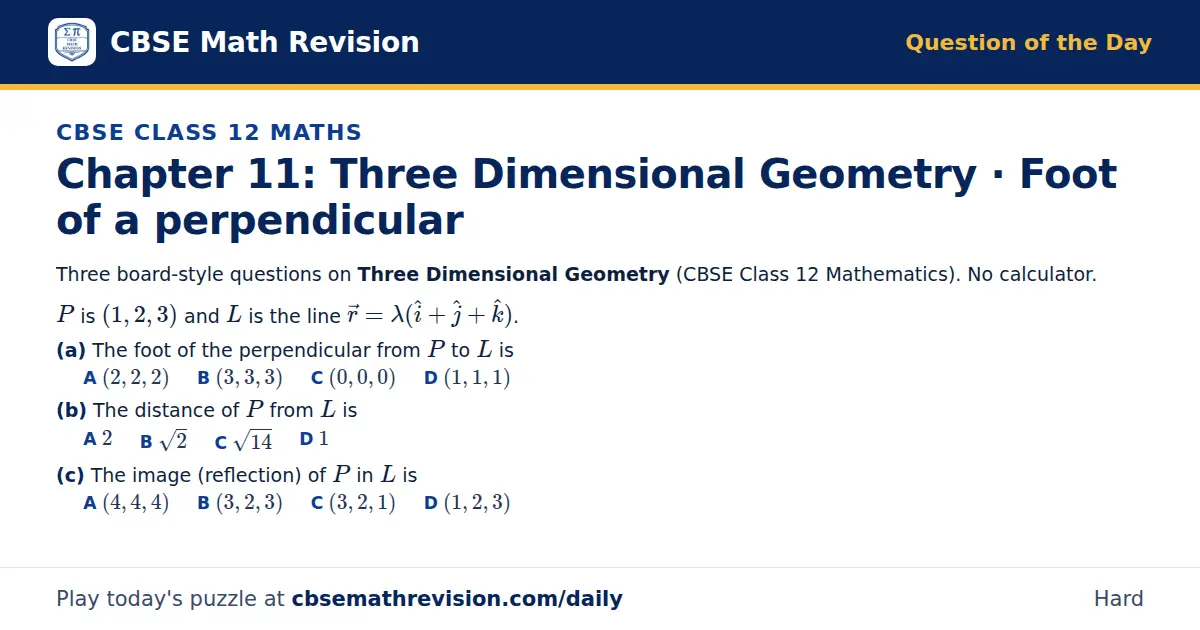
Chapter 11: Three Dimensional Geometry · Foot of a perpendicular
Three board-style questions on Three Dimensional Geometry (CBSE Class 12 Mathematics). No calculator. P is (1, 2, 3) and L is the line r = λ(i + j + k).
- The foot of the perpendicular from P to L is Options: A) (2, 2, 2); B) (3, 3, 3); C) (0, 0, 0); D) (1, 1, 1)
- The distance of P from L is Options: A) 2; B) √2; C) √14; D) 1
- The image (reflection) of P in L is Options: A) (4, 4, 4); B) (3, 2, 3); C) (3, 2, 1); D) (1, 2, 3)
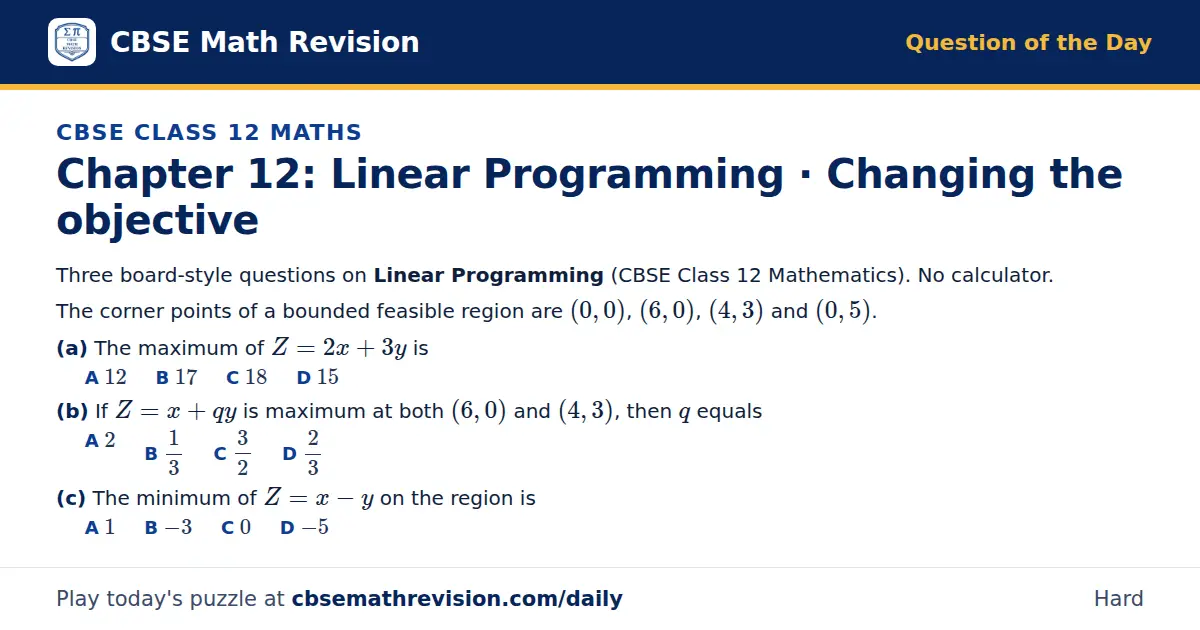
Chapter 12: Linear Programming · Changing the objective
Three board-style questions on Linear Programming (CBSE Class 12 Mathematics). No calculator. The corner points of a bounded feasible region are (0, 0), (6, 0), (4, 3) and (0, 5).
- The maximum of Z = 2x + 3y is Options: A) 12; B) 17; C) 18; D) 15
- If Z = x + qy is maximum at both (6, 0) and (4, 3), then q equals Options: A) 2; B) 1/3; C) 3/2; D) 2/3
- The minimum of Z = x - y on the region is Options: A) 1; B) -3; C) 0; D) -5
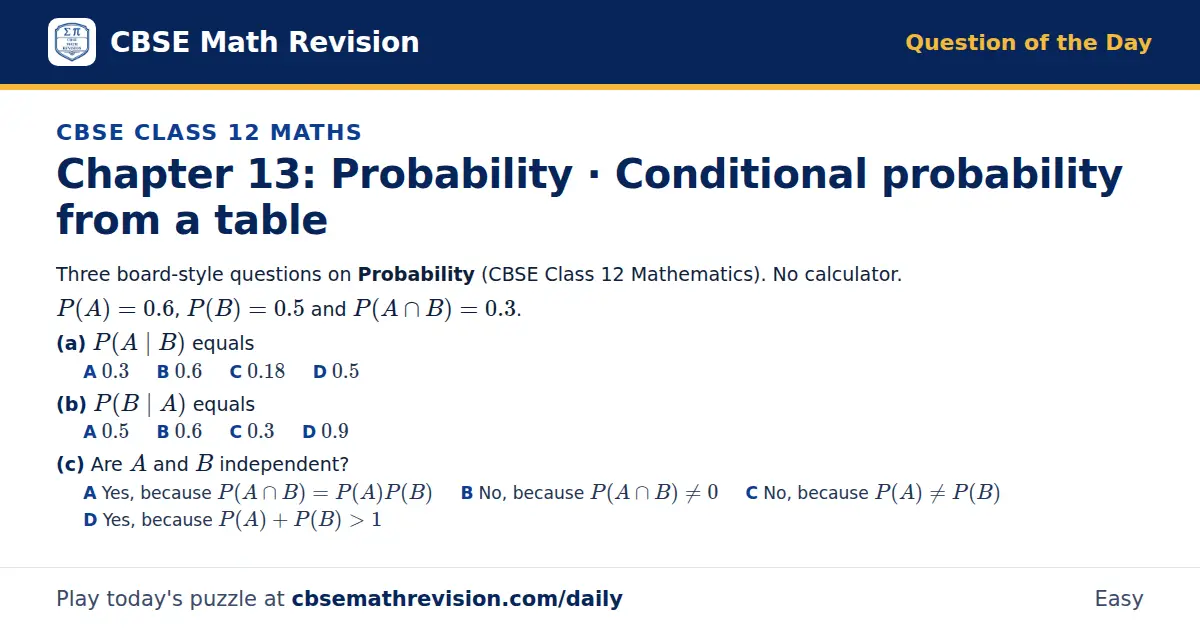
Chapter 13: Probability · Conditional probability from a table
Three board-style questions on Probability (CBSE Class 12 Mathematics). No calculator. P(A) = 0.6, P(B) = 0.5 and P(A ∩ B) = 0.3.
- P(A | B) equals Options: A) 0.3; B) 0.6; C) 0.18; D) 0.5
- P(B | A) equals Options: A) 0.5; B) 0.6; C) 0.3; D) 0.9
- Are A and B independent? Options: A) Yes, because P(A ∩ B) = P(A)P(B); B) No, because P(A ∩ B) ≠ 0; C) No, because P(A) ≠ P(B); D) Yes, because P(A) + P(B) > 1
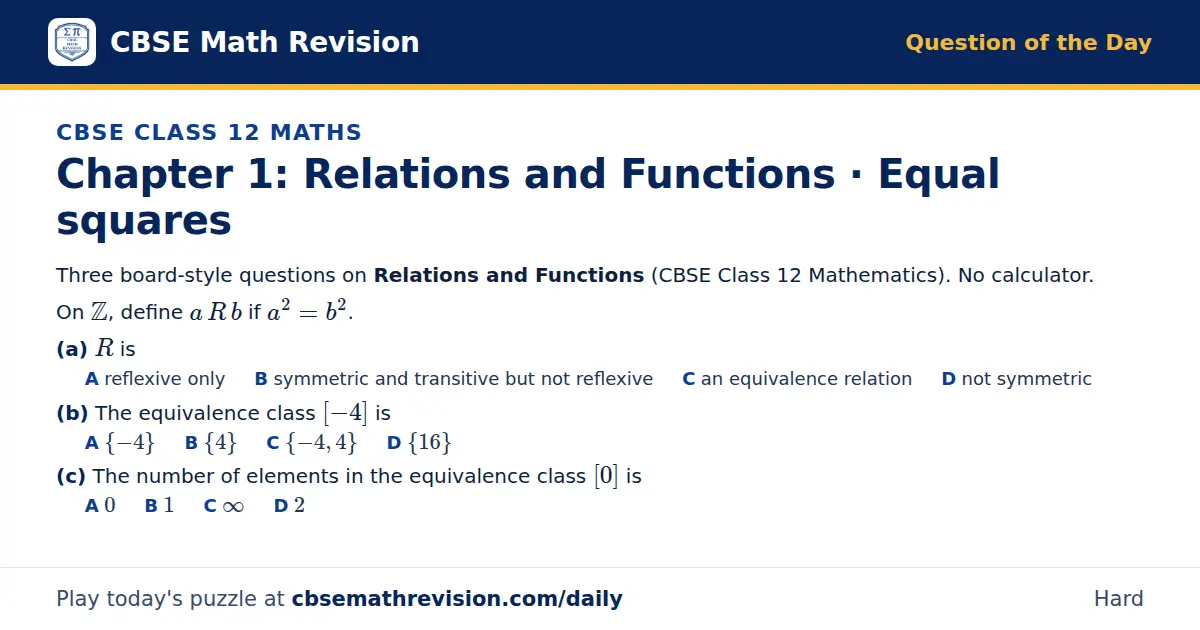
Chapter 1: Relations and Functions · Equal squares
Three board-style questions on Relations and Functions (CBSE Class 12 Mathematics). No calculator. On ℤ, define a R b if a² = b^2.
- R is Options: A) reflexive only; B) symmetric and transitive but not reflexive; C) an equivalence relation; D) not symmetric
- The equivalence class [-4] is Options: A) -4; B) 4; C) -4, 4; D) 16
- The number of elements in the equivalence class [0] is Options: A) 0; B) 1; C) ∞; D) 2
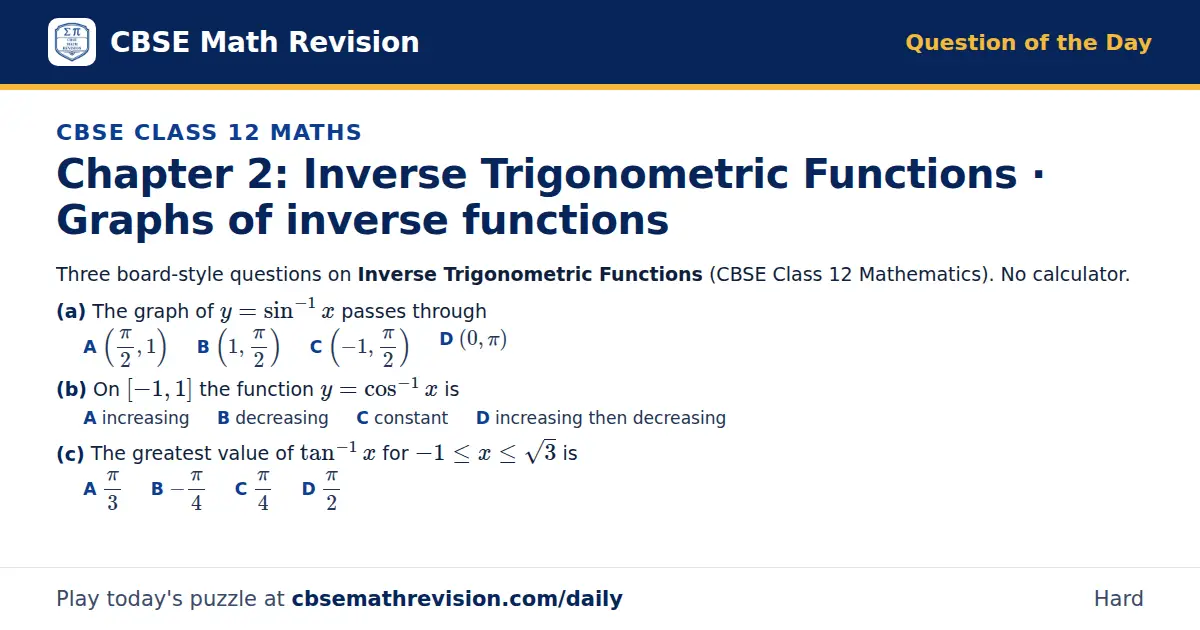
Chapter 2: Inverse Trigonometric Functions · Graphs of inverse functions
Three board-style questions on Inverse Trigonometric Functions (CBSE Class 12 Mathematics). No calculator.
- The graph of y = sin⁻¹x passes through Options: A) ((π)/2, 1); B) (1, (π)/2); C) (-1, (π)/2); D) (0, π)
- On [-1, 1] the function y = cos⁻¹x is Options: A) increasing; B) decreasing; C) constant; D) increasing then decreasing
- The greatest value of tan⁻¹x for -1 ≤ x ≤ √3 is Options: A) (π)/3; B) - (π)/4; C) (π)/4; D) (π)/2
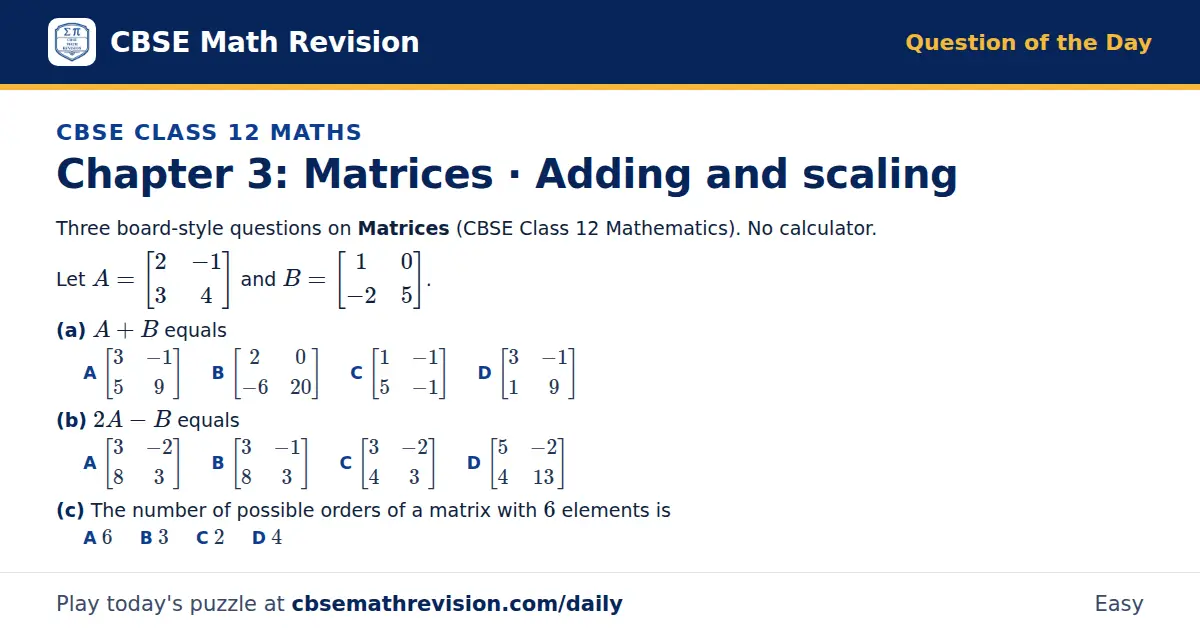
Chapter 3: Matrices · Adding and scaling
Three board-style questions on Matrices (CBSE Class 12 Mathematics). No calculator. Let A = 2 -1; 3 4 and B = 1 0; -2 5.
- A + B equals Options: A) 3 -1; 5 9; B) 2 0; -6 20; C) 1 -1; 5 -1; D) 3 -1; 1 9
- 2A - B equals Options: A) 3 -2; 8 3; B) 3 -1; 8 3; C) 3 -2; 4 3; D) 5 -2; 4 13
- The number of possible orders of a matrix with 6 elements is Options: A) 6; B) 3; C) 2; D) 4
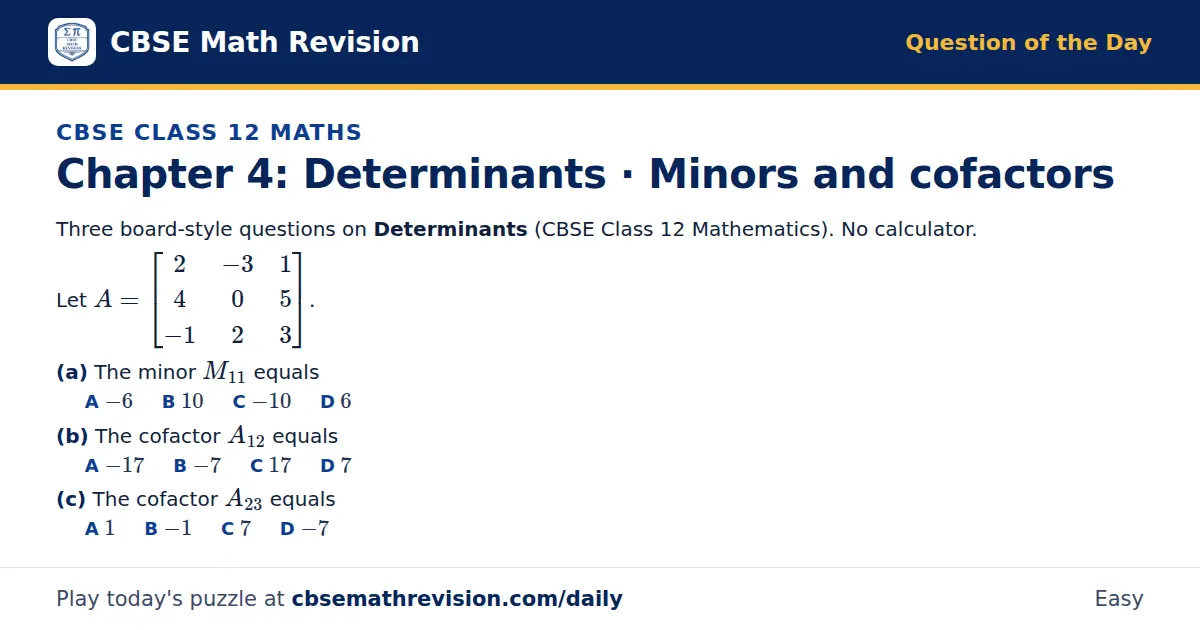
Chapter 4: Determinants · Minors and cofactors
Three board-style questions on Determinants (CBSE Class 12 Mathematics). No calculator. Let A = 2 -3 1; 4 0 5; -1 2 3.
- The minor M_11 equals Options: A) -6; B) 10; C) -10; D) 6
- The cofactor A_12 equals Options: A) -17; B) -7; C) 17; D) 7
- The cofactor A_23 equals Options: A) 1; B) -1; C) 7; D) -7
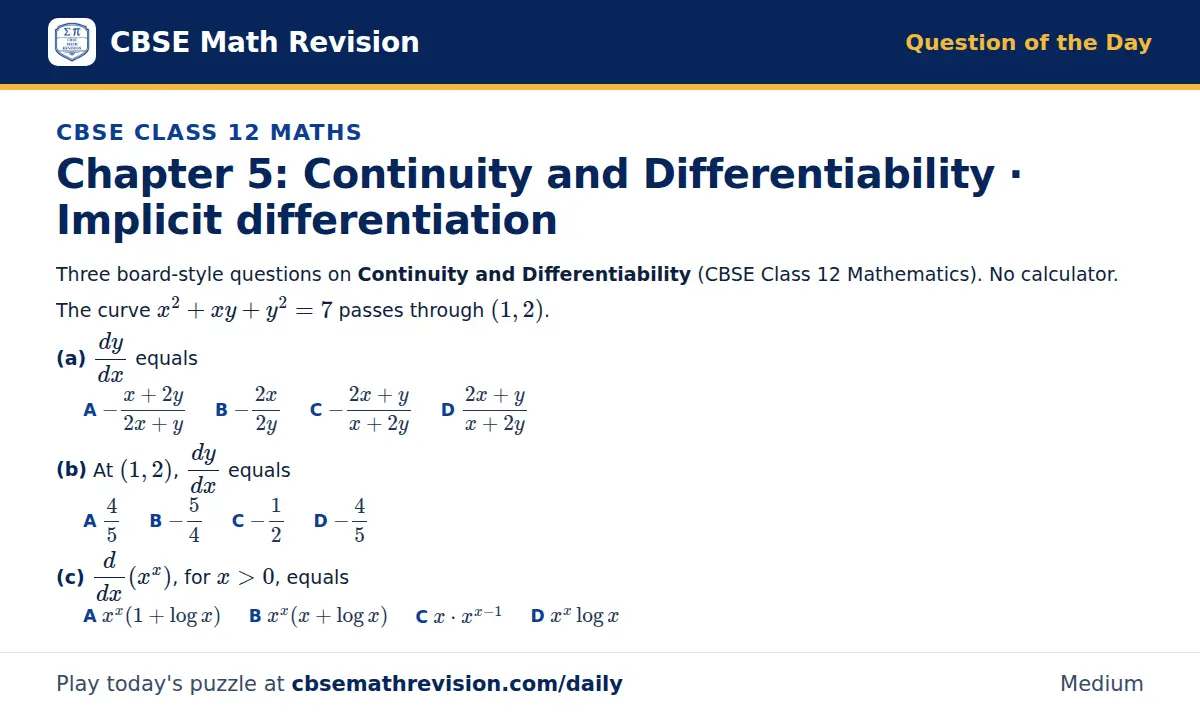
Chapter 5: Continuity and Differentiability · Implicit differentiation
Three board-style questions on Continuity and Differentiability (CBSE Class 12 Mathematics). No calculator. The curve x² + xy + y² = 7 passes through (1, 2).
- dy/dx equals Options: A) -(x + 2y)/(2x + y); B) -2x/2y; C) -(2x + y)/(x + 2y); D) (2x + y)/(x + 2y)
- At (1, 2), dy/dx equals Options: A) 4/5; B) - 5/4; C) - 1/2; D) - 4/5
- d/dx(x^x), for x > 0, equals Options: A) x^x(1 + log x); B) x^x(x + log x); C) x · x^(x - 1); D) x^x log x
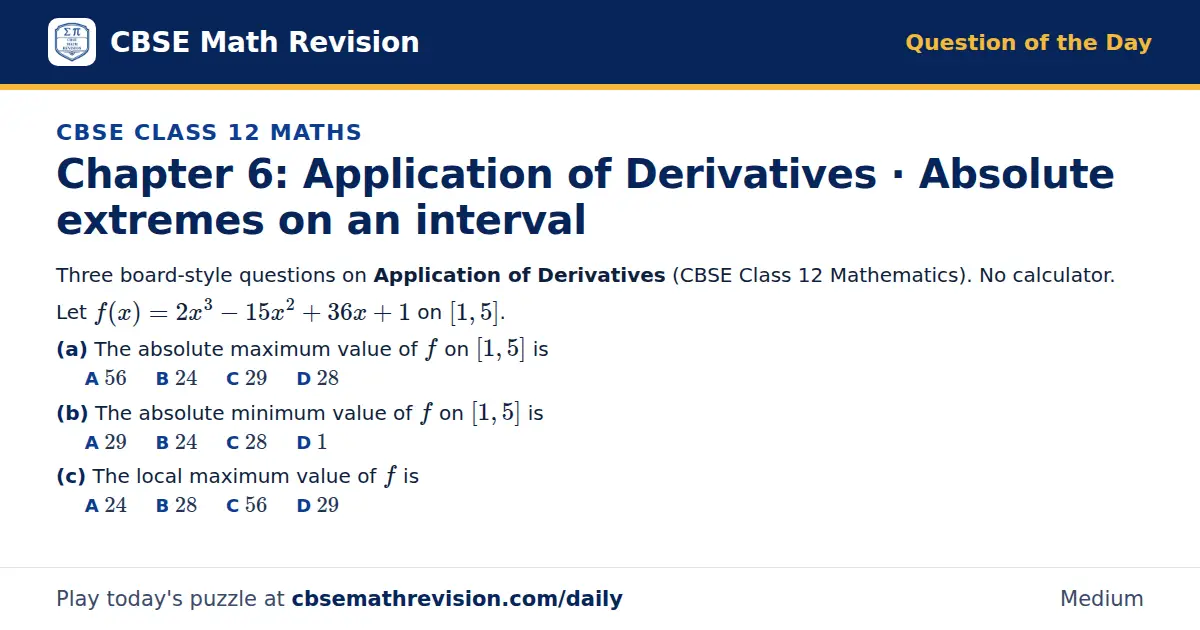
Chapter 6: Application of Derivatives · Absolute extremes on an interval
Three board-style questions on Application of Derivatives (CBSE Class 12 Mathematics). No calculator. Let f(x) = 2x³ - 15x² + 36x + 1 on [1, 5].
- The absolute maximum value of f on [1, 5] is Options: A) 56; B) 24; C) 29; D) 28
- The absolute minimum value of f on [1, 5] is Options: A) 29; B) 24; C) 28; D) 1
- The local maximum value of f is Options: A) 24; B) 28; C) 56; D) 29
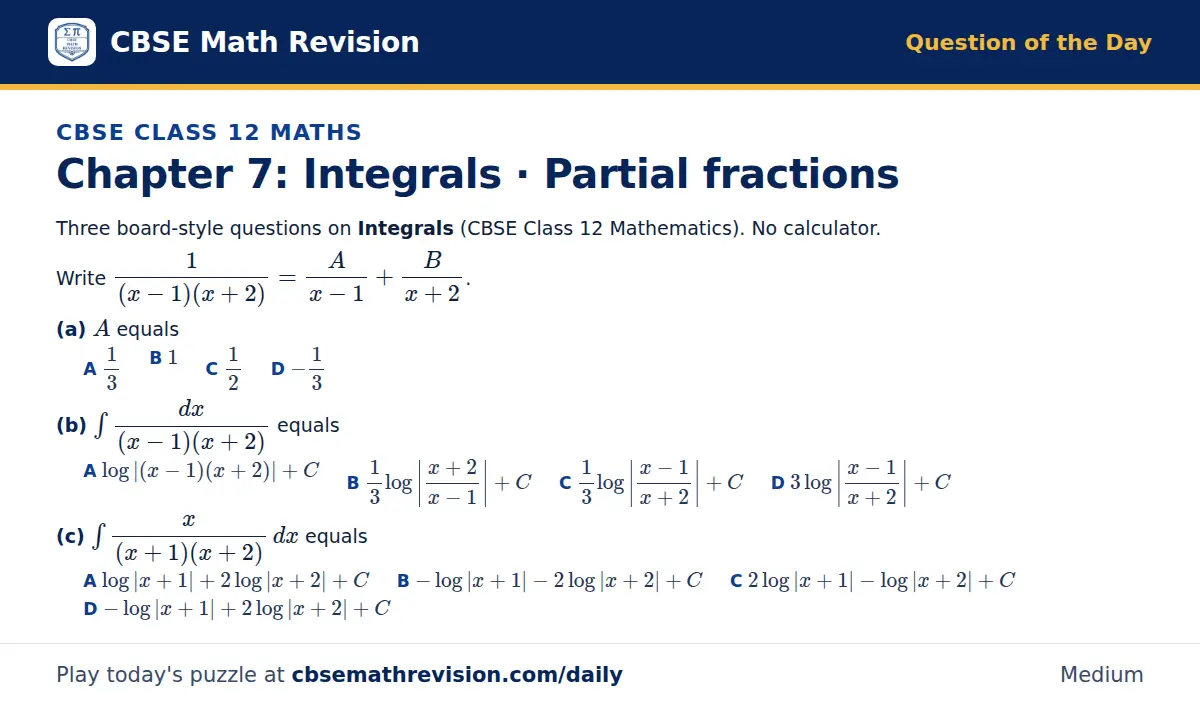
Chapter 7: Integrals · Partial fractions
Three board-style questions on Integrals (CBSE Class 12 Mathematics). No calculator. Write 1/((x - 1)(x + 2)) = A/(x - 1) + B/(x + 2).
- A equals Options: A) 1/3; B) 1; C) 1/2; D) - 1/3
- ∫ dx/((x - 1)(x + 2)) equals Options: A) log|(x - 1)(x + 2)| + C; B) 13log|(x + 2)/(x - 1)| + C; C) 13log|(x - 1)/(x + 2)| + C; D) 3log|(x - 1)/(x + 2)| + C
- ∫ x/((x + 1)(x + 2)) dx equals Options: A) log|x + 1| + 2log|x + 2| + C; B) -log|x + 1| - 2log|x + 2| + C; C) 2log|x + 1| - log|x + 2| + C; D) -log|x + 1| + 2log|x + 2| + C
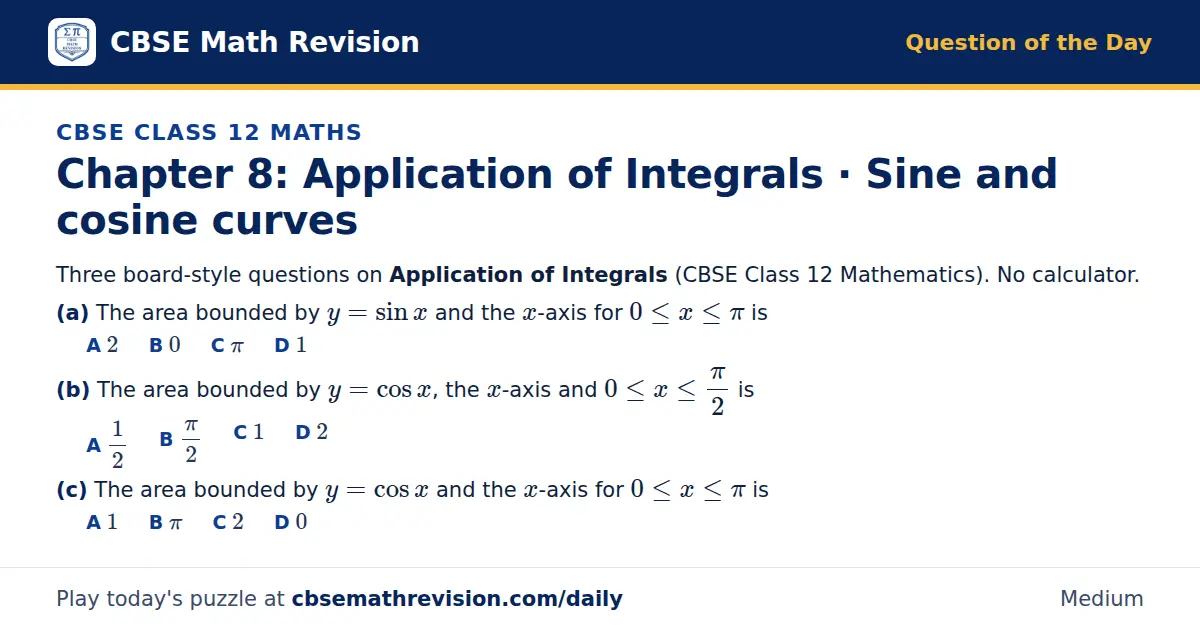
Chapter 8: Application of Integrals · Sine and cosine curves
Three board-style questions on Application of Integrals (CBSE Class 12 Mathematics). No calculator.
- The area bounded by y = sin x and the x-axis for 0 ≤ x ≤ π is Options: A) 2; B) 0; C) π; D) 1
- The area bounded by y = cos x, the x-axis and 0 ≤ x ≤ (π)/2 is Options: A) 1/2; B) (π)/2; C) 1; D) 2
- The area bounded by y = cos x and the x-axis for 0 ≤ x ≤ π is Options: A) 1; B) π; C) 2; D) 0
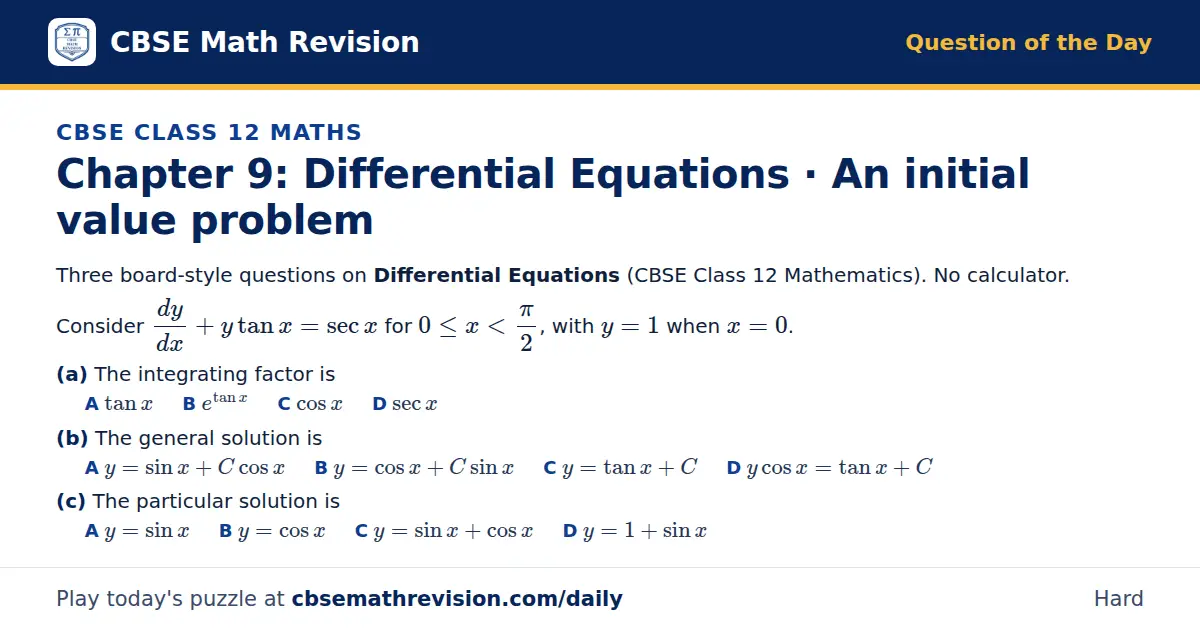
Chapter 9: Differential Equations · An initial value problem
Three board-style questions on Differential Equations (CBSE Class 12 Mathematics). No calculator. Consider dy/dx + ytan x = sec x for 0 ≤ x < (π)/2, with y = 1 when x = 0.
- The integrating factor is Options: A) tan x; B) e^(tan x); C) cos x; D) sec x
- The general solution is Options: A) y = sin x + Ccos x; B) y = cos x + Csin x; C) y = tan x + C; D) ycos x = tan x + C
- The particular solution is Options: A) y = sin x; B) y = cos x; C) y = sin x + cos x; D) y = 1 + sin x
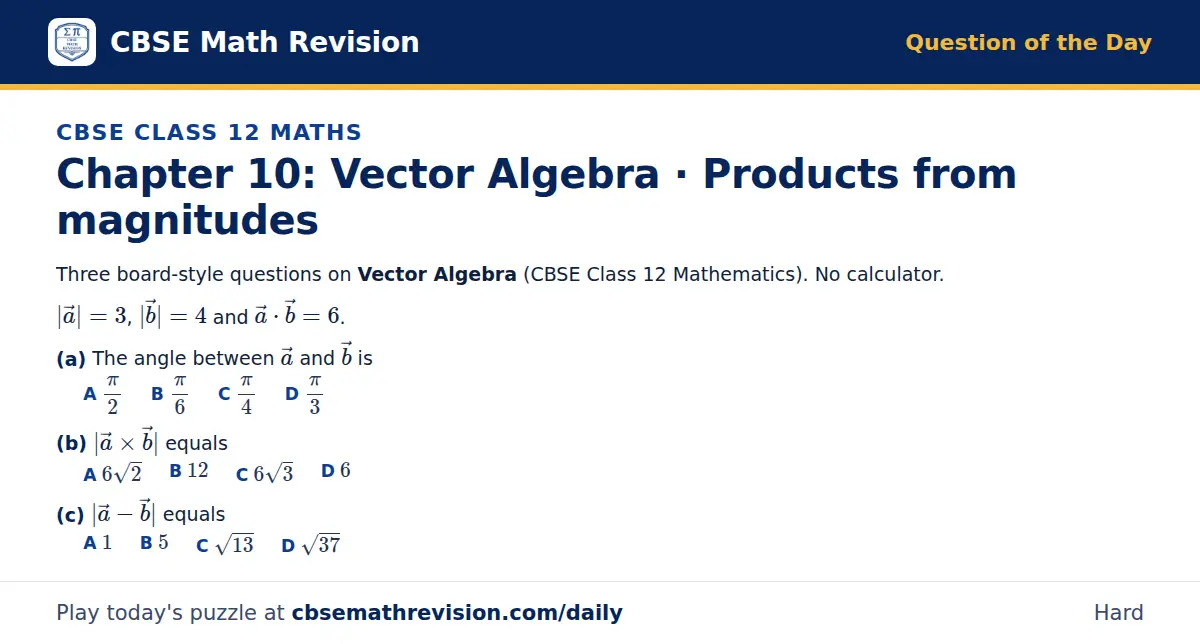
Chapter 10: Vector Algebra · Products from magnitudes
Three board-style questions on Vector Algebra (CBSE Class 12 Mathematics). No calculator. | a| = 3, | b| = 4 and a · b = 6.
- The angle between a and b is Options: A) (π)/2; B) (π)/6; C) (π)/4; D) (π)/3
- | a × b| equals Options: A) 6 √2; B) 12; C) 6 √3; D) 6
- | a - b| equals Options: A) 1; B) 5; C) √13; D) √37
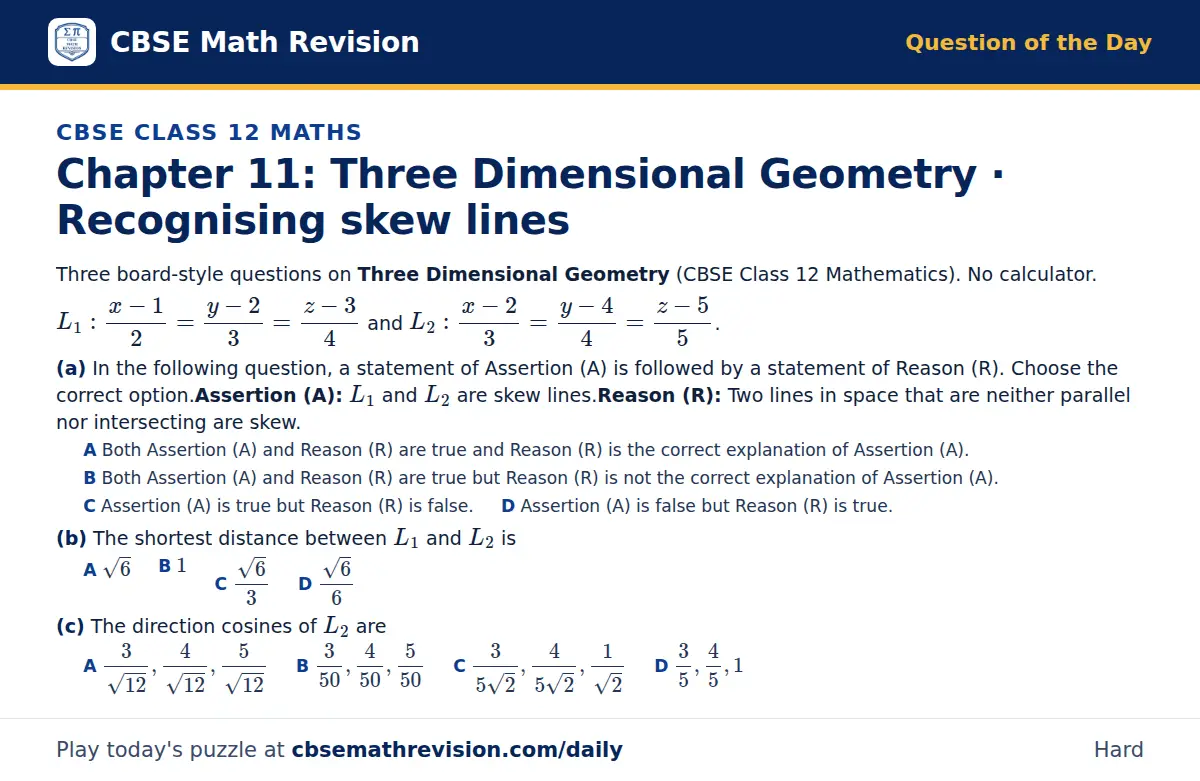
Chapter 11: Three Dimensional Geometry · Recognising skew lines
Three board-style questions on Three Dimensional Geometry (CBSE Class 12 Mathematics). No calculator. L_1: (x - 1)/2 = (y - 2)/3 = (z - 3)/4 and L_2: (x - 2)/3 = (y - 4)/4 = (z - 5)/5.
- In the following question, a statement of Assertion (A) is followed by a statement of Reason (R). Choose the correct option. Assertion (A): L_1 and L_2 are skew lines. Reason (R): Two lines in space that are neither parallel nor intersecting are skew. Options: A) Both Assertion (A) and Reason (R) are true and Reason (R) is the correct explanation of Assertion (A).; B) Both Assertion (A) and Reason (R) are true but Reason (R) is not the correct explanation of Assertion (A).; C) Assertion (A) is true but Reason (R) is false.; D) Assertion (A) is false but Reason (R) is true.
- The shortest distance between L_1 and L_2 is Options: A) √6; B) 1; C) (√6)/3; D) (√6)/6
- The direction cosines of L_2 are Options: A) 3/(√12), 4/(√12), 5/(√12); B) 3/50, 4/50, 5/50; C) 3/(5√2), 4/(5√2), 1/(√2); D) 35, 45, 1
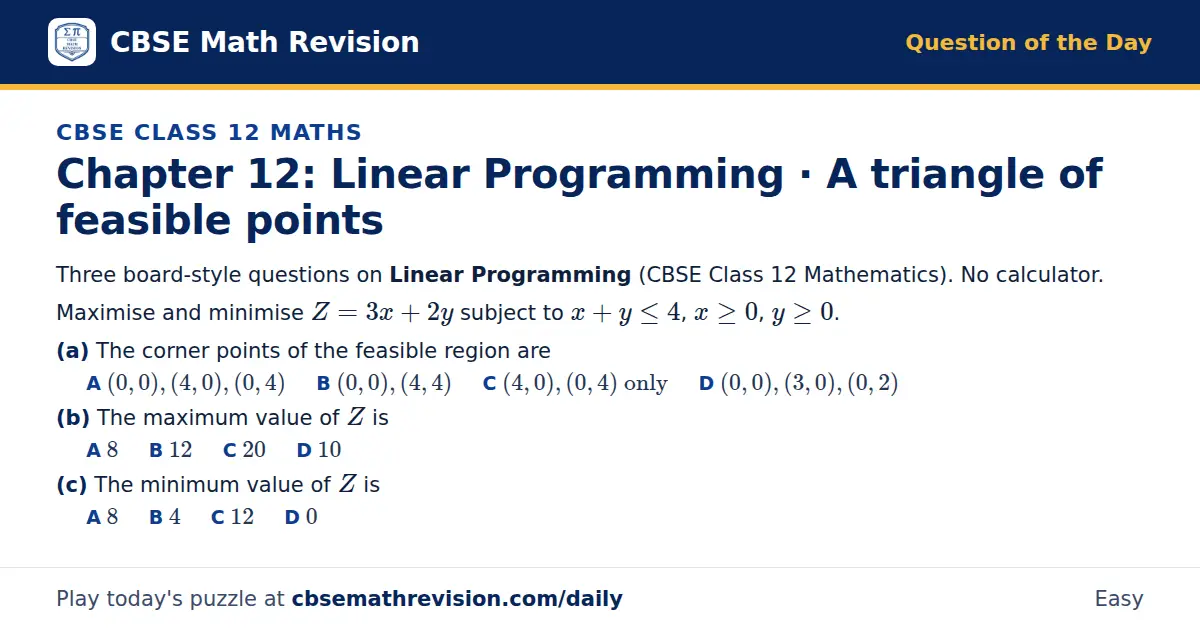
Chapter 12: Linear Programming · A triangle of feasible points
Three board-style questions on Linear Programming (CBSE Class 12 Mathematics). No calculator. Maximise and minimise Z = 3x + 2y subject to x + y ≤ 4, x ≥ 0, y ≥ 0.
- The corner points of the feasible region are Options: A) (0, 0), (4, 0), (0, 4); B) (0, 0), (4, 4); C) (4, 0), (0, 4) only; D) (0, 0), (3, 0), (0, 2)
- The maximum value of Z is Options: A) 8; B) 12; C) 20; D) 10
- The minimum value of Z is Options: A) 8; B) 4; C) 12; D) 0
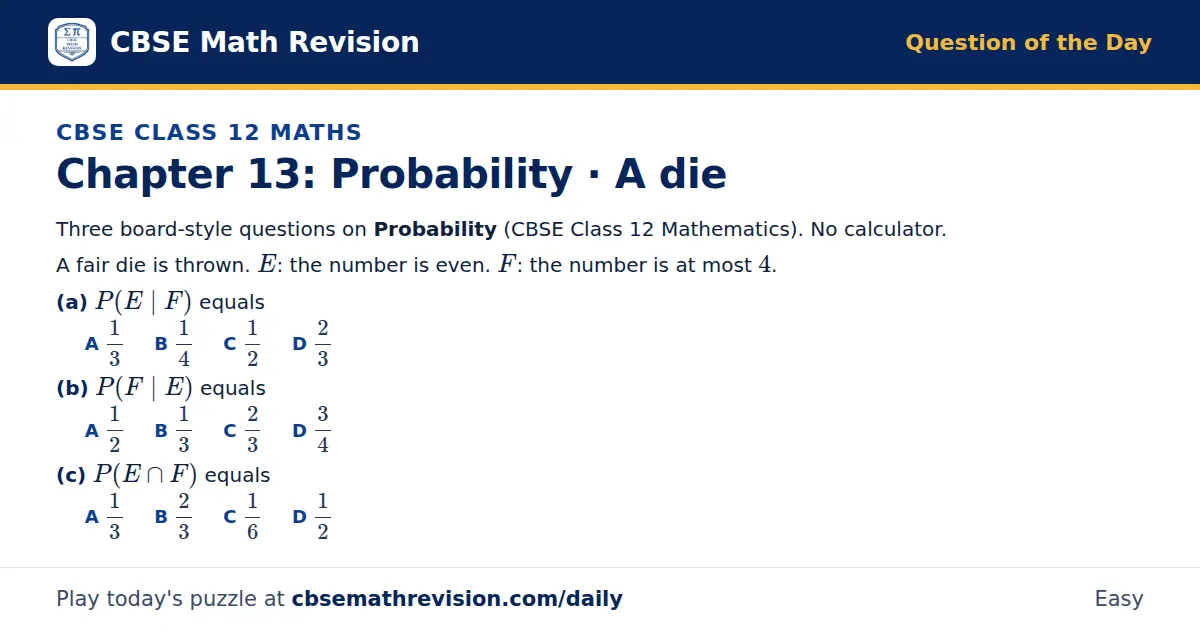
Chapter 13: Probability · A die
Three board-style questions on Probability (CBSE Class 12 Mathematics). No calculator. A fair die is thrown. E: the number is even. F: the number is at most 4.
- P(E | F) equals Options: A) 1/3; B) 1/4; C) 1/2; D) 2/3
- P(F | E) equals Options: A) 1/2; B) 1/3; C) 2/3; D) 3/4
- P(E ∩ F) equals Options: A) 1/3; B) 2/3; C) 1/6; D) 1/2
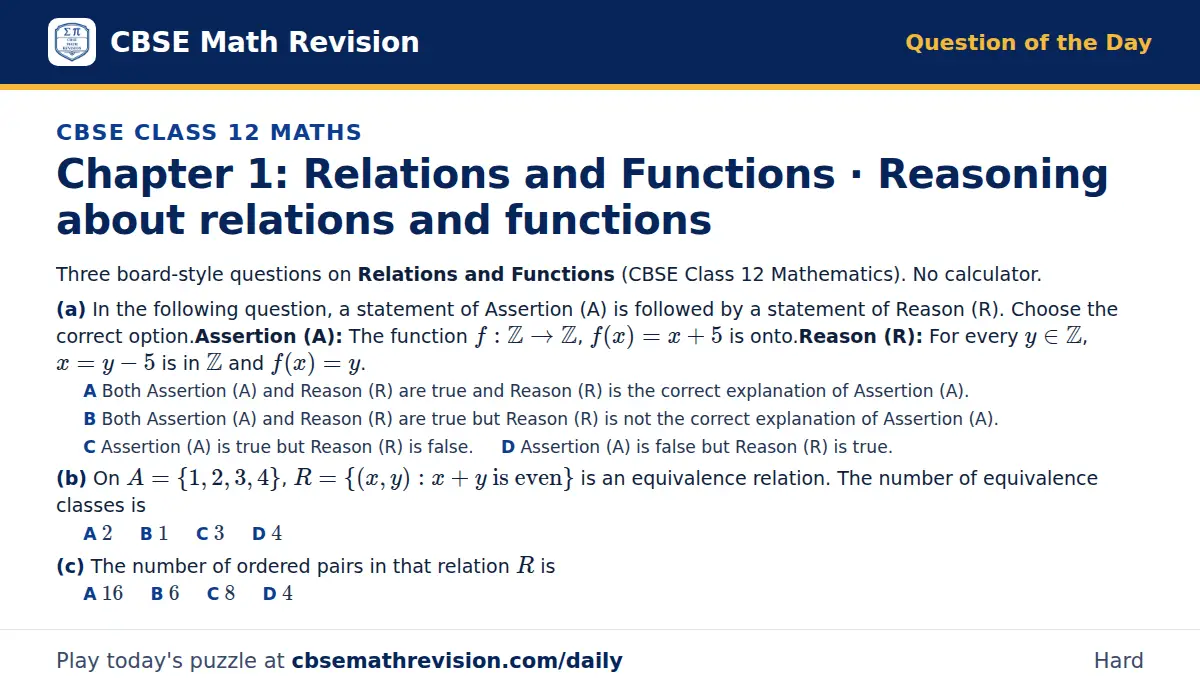
Chapter 1: Relations and Functions · Reasoning about relations and functions
Three board-style questions on Relations and Functions (CBSE Class 12 Mathematics). No calculator.
- In the following question, a statement of Assertion (A) is followed by a statement of Reason (R). Choose the correct option. Assertion (A): The function f: ℤ → ℤ, f(x) = x + 5 is onto. Reason (R): For every y ∈ ℤ, x = y - 5 is in ℤ and f(x) = y. Options: A) Both Assertion (A) and Reason (R) are true and Reason (R) is the correct explanation of Assertion (A).; B) Both Assertion (A) and Reason (R) are true but Reason (R) is not the correct explanation of Assertion (A).; C) Assertion (A) is true but Reason (R) is false.; D) Assertion (A) is false but Reason (R) is true.
- On A = 1, 2, 3, 4, R = (x, y): x + y is even is an equivalence relation. The number of equivalence classes is Options: A) 2; B) 1; C) 3; D) 4
- The number of ordered pairs in that relation R is Options: A) 16; B) 6; C) 8; D) 4
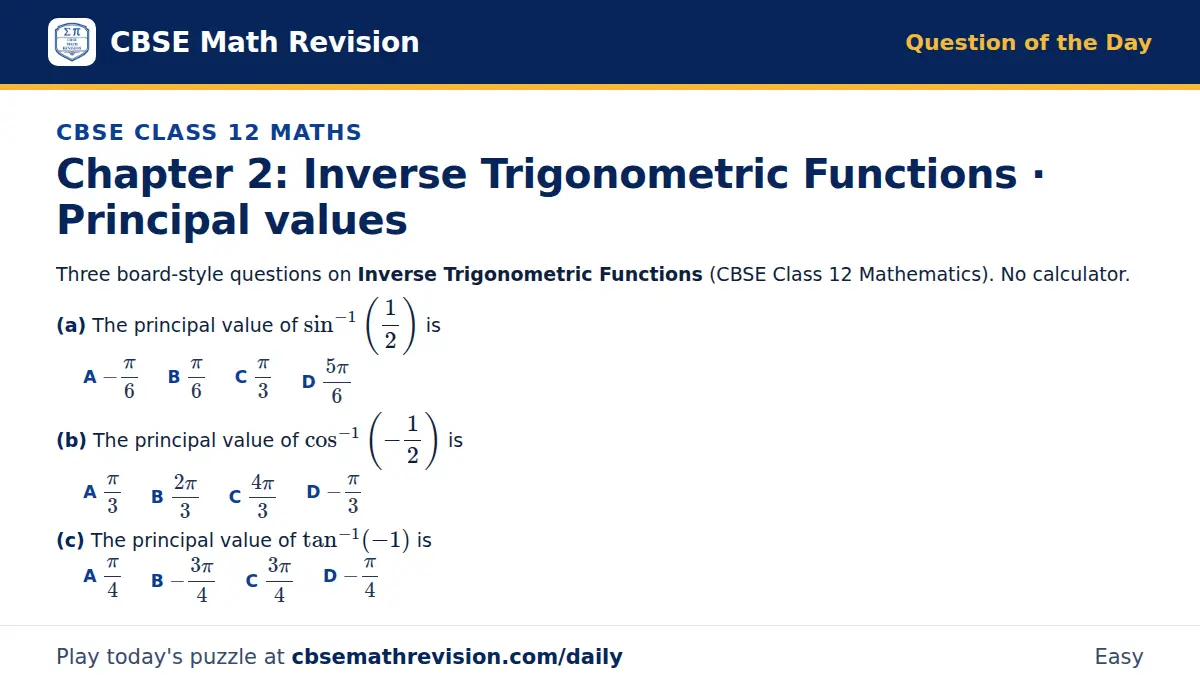
Chapter 2: Inverse Trigonometric Functions · Principal values
Three board-style questions on Inverse Trigonometric Functions (CBSE Class 12 Mathematics). No calculator.
- The principal value of sin⁻¹(12) is Options: A) - (π)/6; B) (π)/6; C) (π)/3; D) (5 π)/6
- The principal value of cos⁻¹(-12) is Options: A) (π)/3; B) (2 π)/3; C) (4 π)/3; D) - (π)/3
- The principal value of tan⁻¹(-1) is Options: A) (π)/4; B) - (3 π)/4; C) (3 π)/4; D) - (π)/4
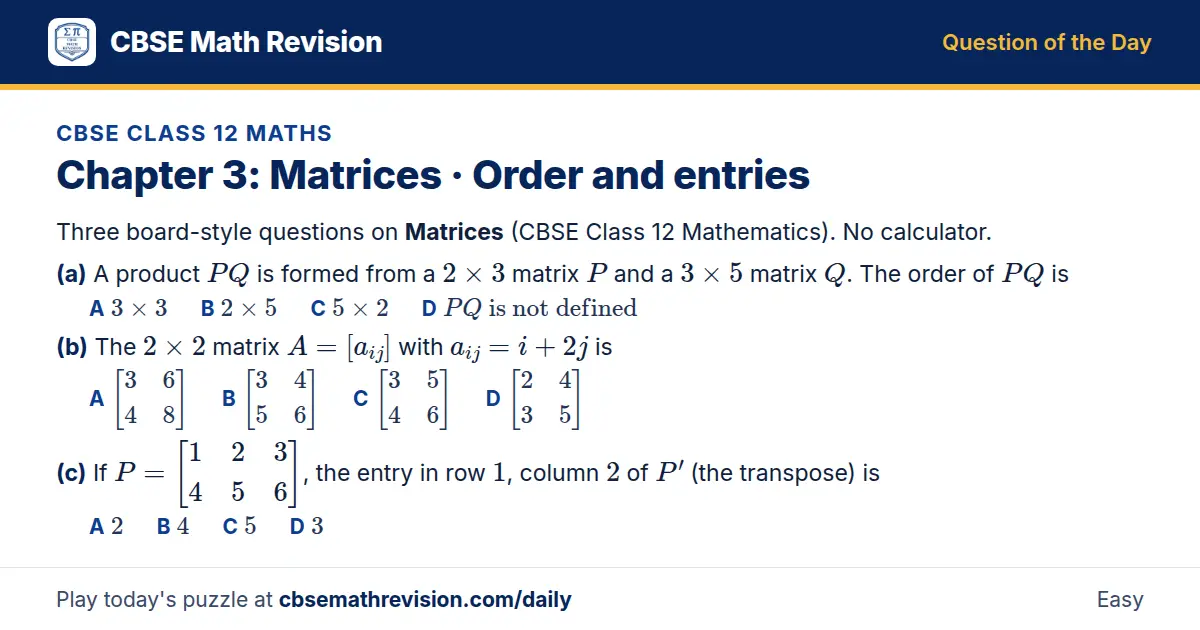
Chapter 3: Matrices · Order and entries
Three board-style questions on Matrices (CBSE Class 12 Mathematics). No calculator.
- A product PQ is formed from a 2 × 3 matrix P and a 3 × 5 matrix Q. The order of PQ is Options: A) 3 × 3; B) 2 × 5; C) 5 × 2; D) PQ is not defined
- The 2 × 2 matrix A = [a_ij] with a_ij = i + 2j is Options: A) 3 6; 4 8; B) 3 4; 5 6; C) 3 5; 4 6; D) 2 4; 3 5
- If P = 1 2 3; 4 5 6, the entry in row 1, column 2 of P' (the transpose) is Options: A) 2; B) 4; C) 5; D) 3
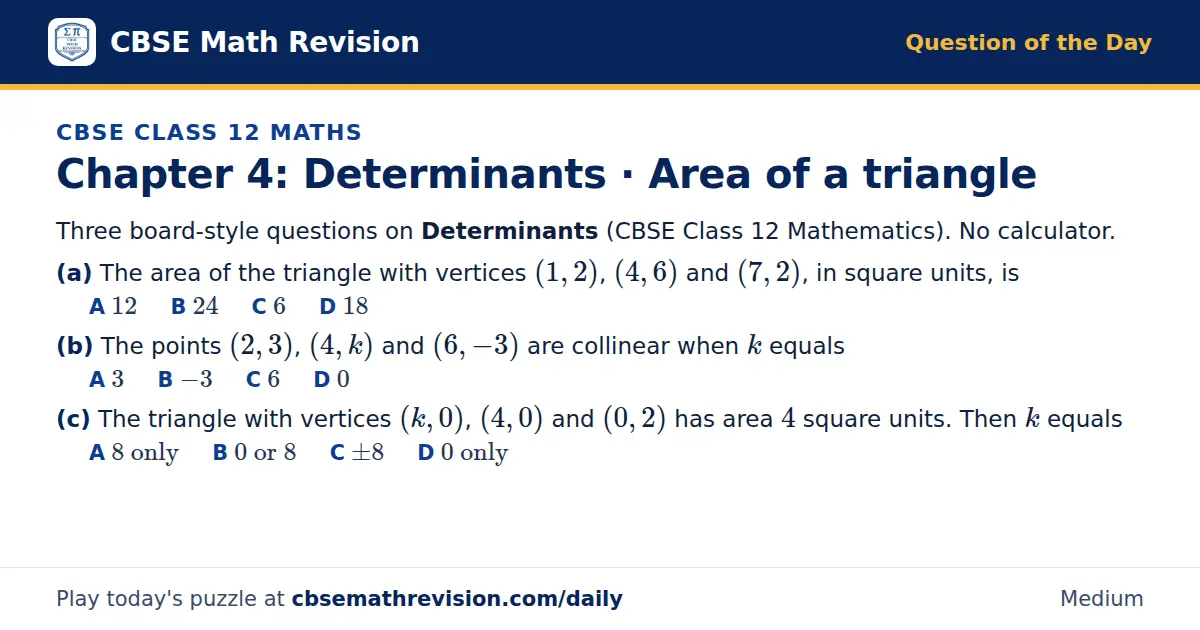
Chapter 4: Determinants · Area of a triangle
Three board-style questions on Determinants (CBSE Class 12 Mathematics). No calculator.
- The area of the triangle with vertices (1, 2), (4, 6) and (7, 2), in square units, is Options: A) 12; B) 24; C) 6; D) 18
- The points (2, 3), (4, k) and (6, -3) are collinear when k equals Options: A) 3; B) -3; C) 6; D) 0
- The triangle with vertices (k, 0), (4, 0) and (0, 2) has area 4 square units. Then k equals Options: A) 8 only; B) 0 or 8; C) ± 8; D) 0 only
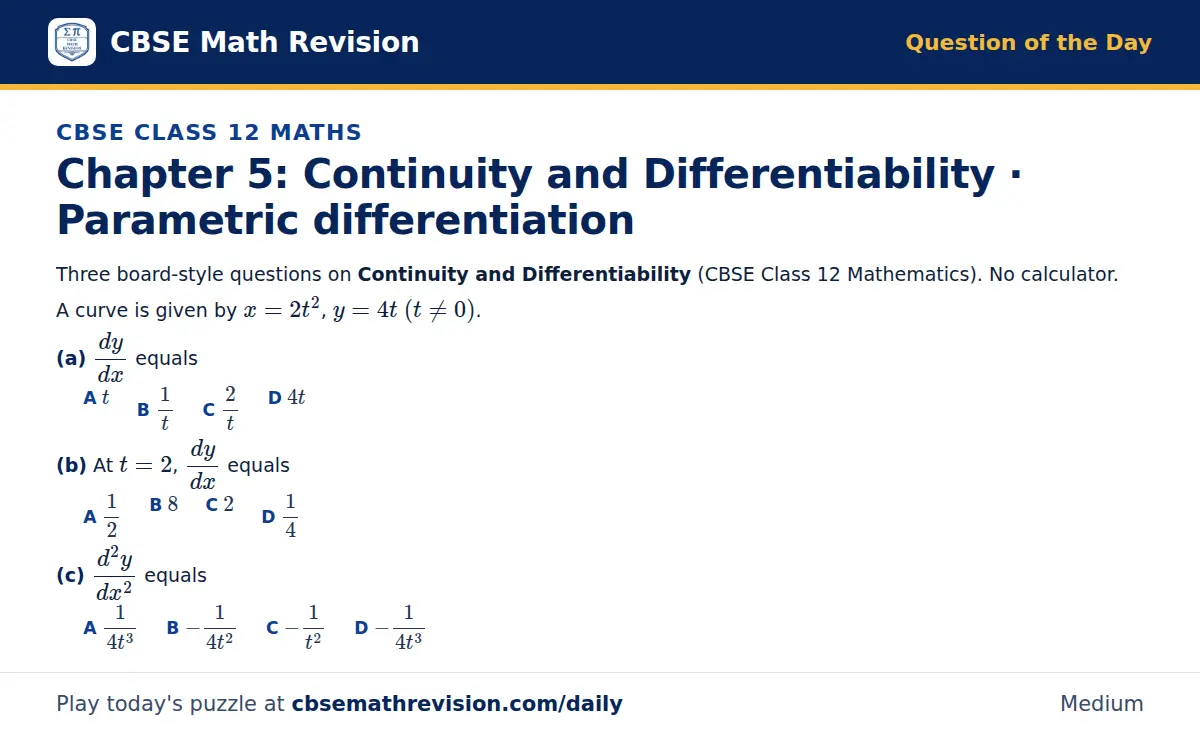
Chapter 5: Continuity and Differentiability · Parametric differentiation
Three board-style questions on Continuity and Differentiability (CBSE Class 12 Mathematics). No calculator. A curve is given by x = 2t², y = 4t (t ≠ 0).
- dy/dx equals Options: A) t; B) 1t; C) 2/t; D) 4t
- At t = 2, dy/dx equals Options: A) 1/2; B) 8; C) 2; D) 1/4
- (d²y)/(dx²) equals Options: A) 1/(4t³); B) -1/(4t²); C) -1/(t²); D) -1/(4t³)
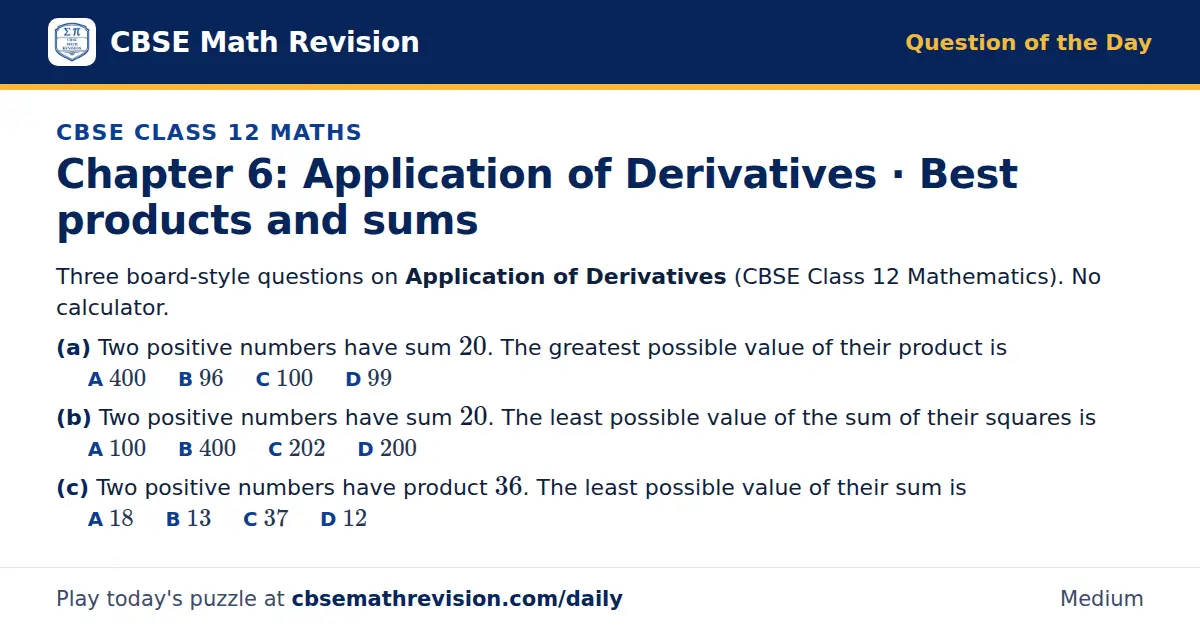
Chapter 6: Application of Derivatives · Best products and sums
Three board-style questions on Application of Derivatives (CBSE Class 12 Mathematics). No calculator.
- Two positive numbers have sum 20. The greatest possible value of their product is Options: A) 400; B) 96; C) 100; D) 99
- Two positive numbers have sum 20. The least possible value of the sum of their squares is Options: A) 100; B) 400; C) 202; D) 200
- Two positive numbers have product 36. The least possible value of their sum is Options: A) 18; B) 13; C) 37; D) 12
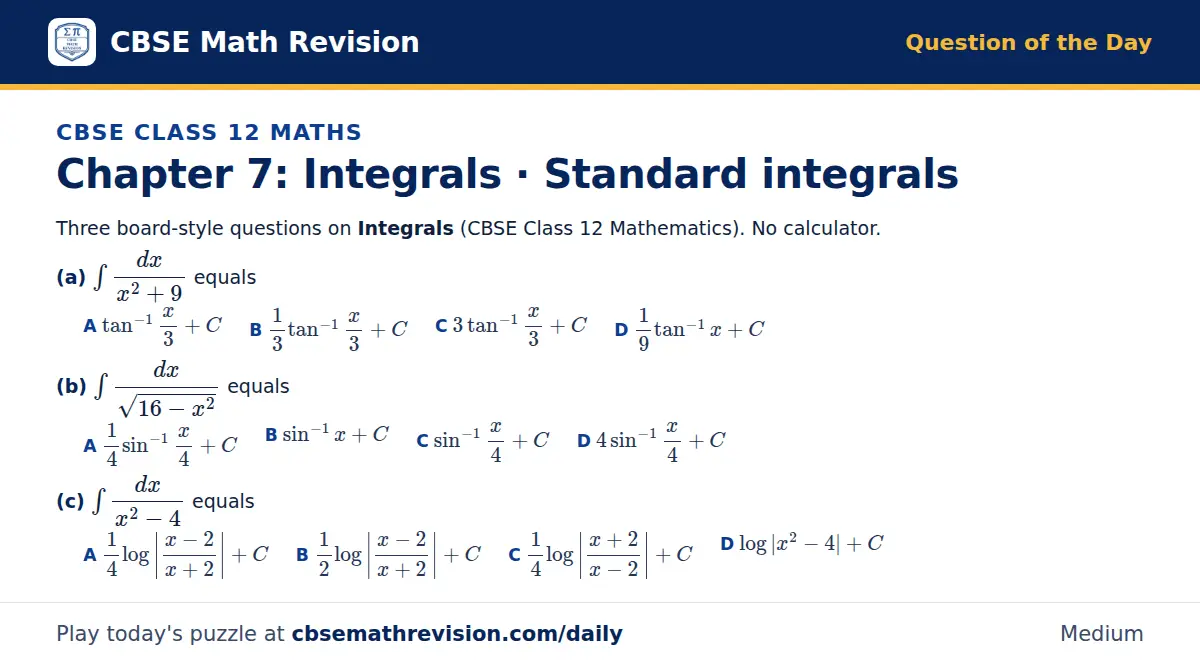
Chapter 7: Integrals · Standard integrals
Three board-style questions on Integrals (CBSE Class 12 Mathematics). No calculator.
- ∫ dx/(x² + 9) equals Options: A) tan⁻¹x/3 + C; B) 13tan⁻¹x/3 + C; C) 3tan⁻¹x/3 + C; D) 19tan⁻¹x + C
- ∫ dx/(√(16 - x²)) equals Options: A) 14sin⁻¹x/4 + C; B) sin⁻¹x + C; C) sin⁻¹x/4 + C; D) 4sin⁻¹x/4 + C
- ∫ dx/(x² - 4) equals Options: A) 14log|(x - 2)/(x + 2)| + C; B) 12log|(x - 2)/(x + 2)| + C; C) 14log|(x + 2)/(x - 2)| + C; D) log|x² - 4| + C
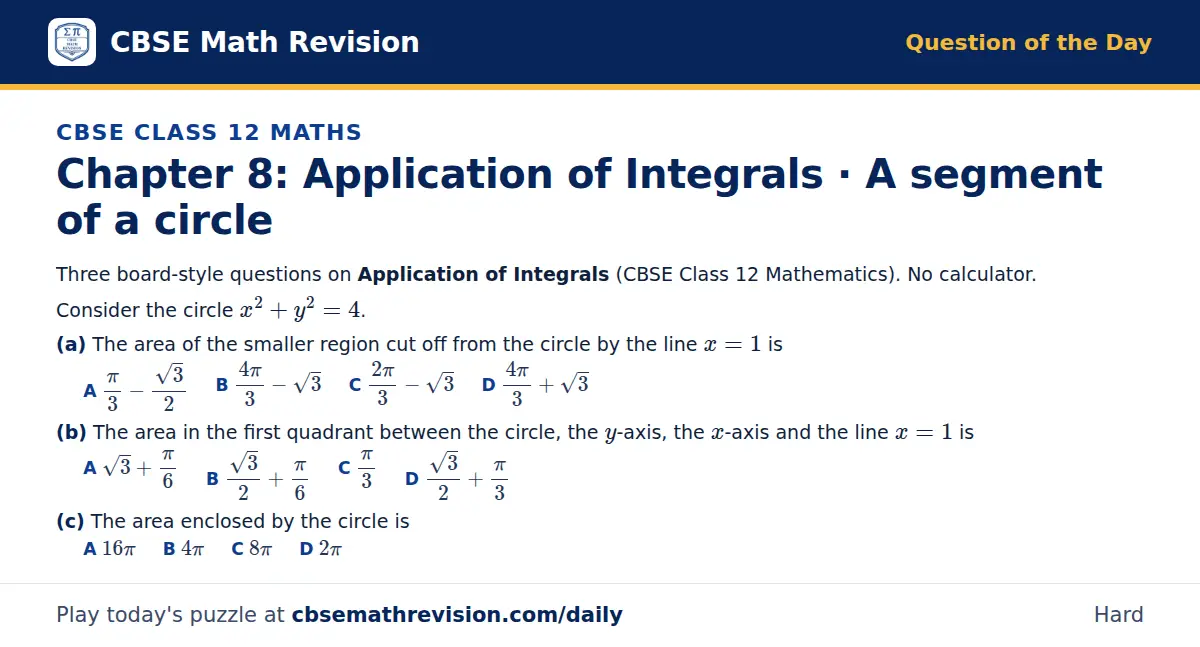
Chapter 8: Application of Integrals · A segment of a circle
Three board-style questions on Application of Integrals (CBSE Class 12 Mathematics). No calculator. Consider the circle x² + y² = 4.
- The area of the smaller region cut off from the circle by the line x = 1 is Options: A) (π)/3 - (√3)/2; B) (4π)/3 - √3; C) (2π)/3 - √3; D) (4π)/3 + √3
- The area in the first quadrant between the circle, the y-axis, the x-axis and the line x = 1 is Options: A) √3 + (π)/6; B) (√3)/2 + (π)/6; C) (π)/3; D) (√3)/2 + (π)/3
- The area enclosed by the circle is Options: A) 16π; B) 4π; C) 8π; D) 2π
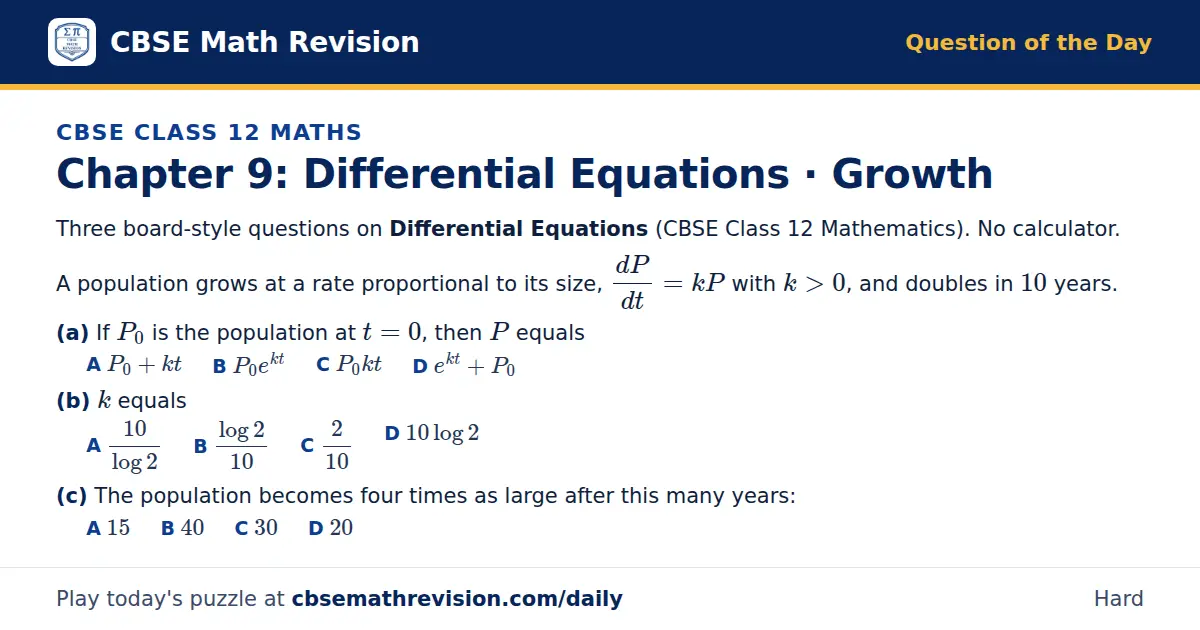
Chapter 9: Differential Equations · Growth
Three board-style questions on Differential Equations (CBSE Class 12 Mathematics). No calculator. A population grows at a rate proportional to its size, dP/dt = kP with k > 0, and doubles in 10 years.
- If P_0 is the population at t = 0, then P equals Options: A) P_0 + kt; B) P_0e^(kt); C) P_0kt; D) e^(kt) + P_0
- k equals Options: A) 10/(log 2); B) (log 2)/10; C) 2/10; D) 10log 2
- The population becomes four times as large after this many years: Options: A) 15; B) 40; C) 30; D) 20
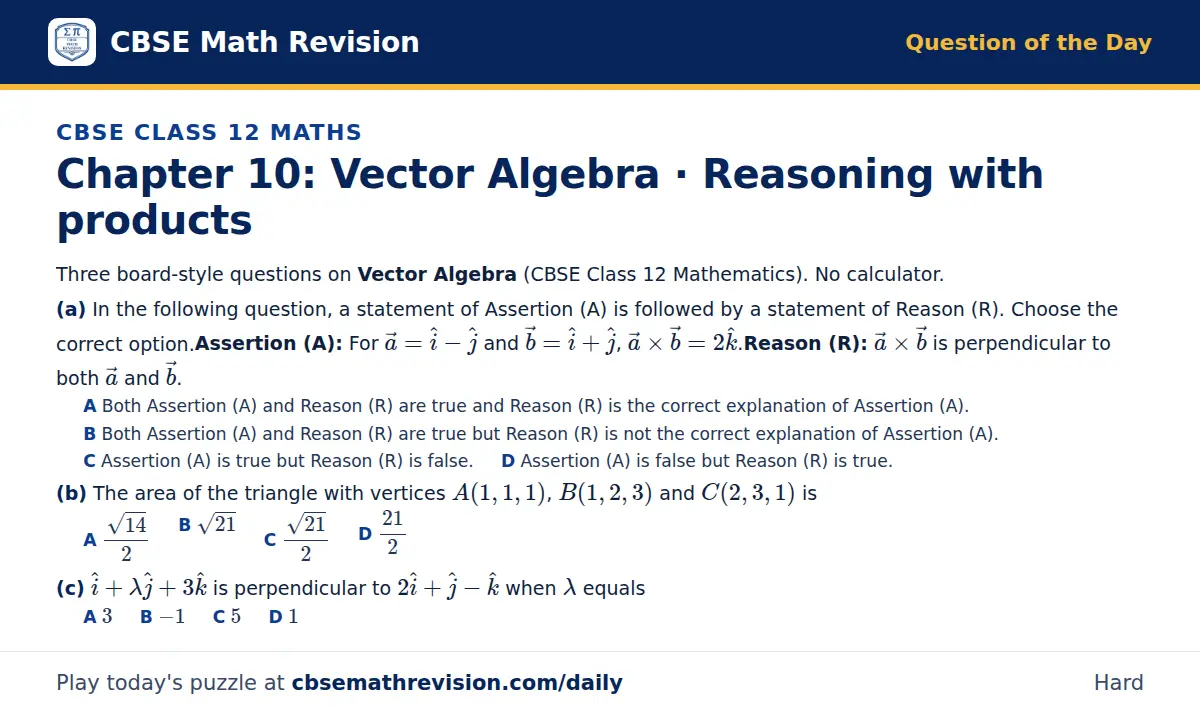
Chapter 10: Vector Algebra · Reasoning with products
Three board-style questions on Vector Algebra (CBSE Class 12 Mathematics). No calculator.
- In the following question, a statement of Assertion (A) is followed by a statement of Reason (R). Choose the correct option. Assertion (A): For a = i - j and b = i + j, a × b = 2 k. Reason (R): a × b is perpendicular to both a and b. Options: A) Both Assertion (A) and Reason (R) are true and Reason (R) is the correct explanation of Assertion (A).; B) Both Assertion (A) and Reason (R) are true but Reason (R) is not the correct explanation of Assertion (A).; C) Assertion (A) is true but Reason (R) is false.; D) Assertion (A) is false but Reason (R) is true.
- The area of the triangle with vertices A(1, 1, 1), B(1, 2, 3) and C(2, 3, 1) is Options: A) (√14)/2; B) √21; C) (√21)/2; D) 21/2
- i + λ j + 3 k is perpendicular to 2 i + j - k when λ equals Options: A) 3; B) -1; C) 5; D) 1
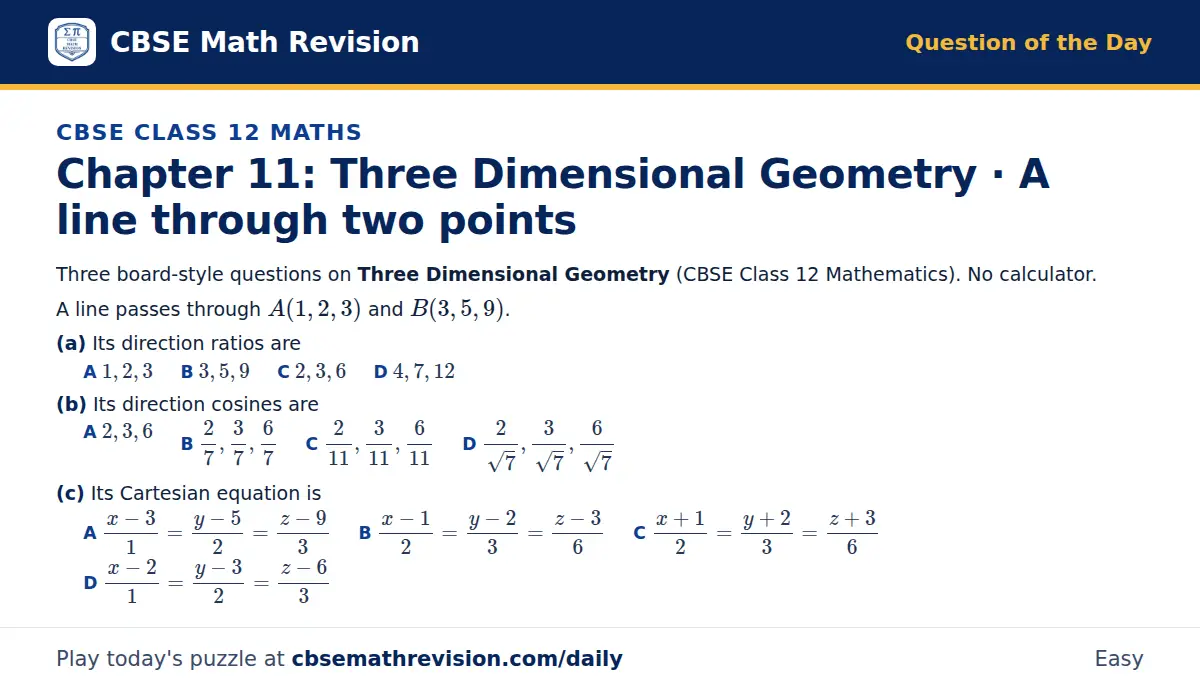
Chapter 11: Three Dimensional Geometry · A line through two points
Three board-style questions on Three Dimensional Geometry (CBSE Class 12 Mathematics). No calculator. A line passes through A(1, 2, 3) and B(3, 5, 9).
- Its direction ratios are Options: A) 1, 2, 3; B) 3, 5, 9; C) 2, 3, 6; D) 4, 7, 12
- Its direction cosines are Options: A) 2, 3, 6; B) 27, 37, 67; C) 211, 311, 611; D) 2/(√7), 3/(√7), 6/(√7)
- Its Cartesian equation is Options: A) (x - 3)/1 = (y - 5)/2 = (z - 9)/3; B) (x - 1)/2 = (y - 2)/3 = (z - 3)/6; C) (x + 1)/2 = (y + 2)/3 = (z + 3)/6; D) (x - 2)/1 = (y - 3)/2 = (z - 6)/3
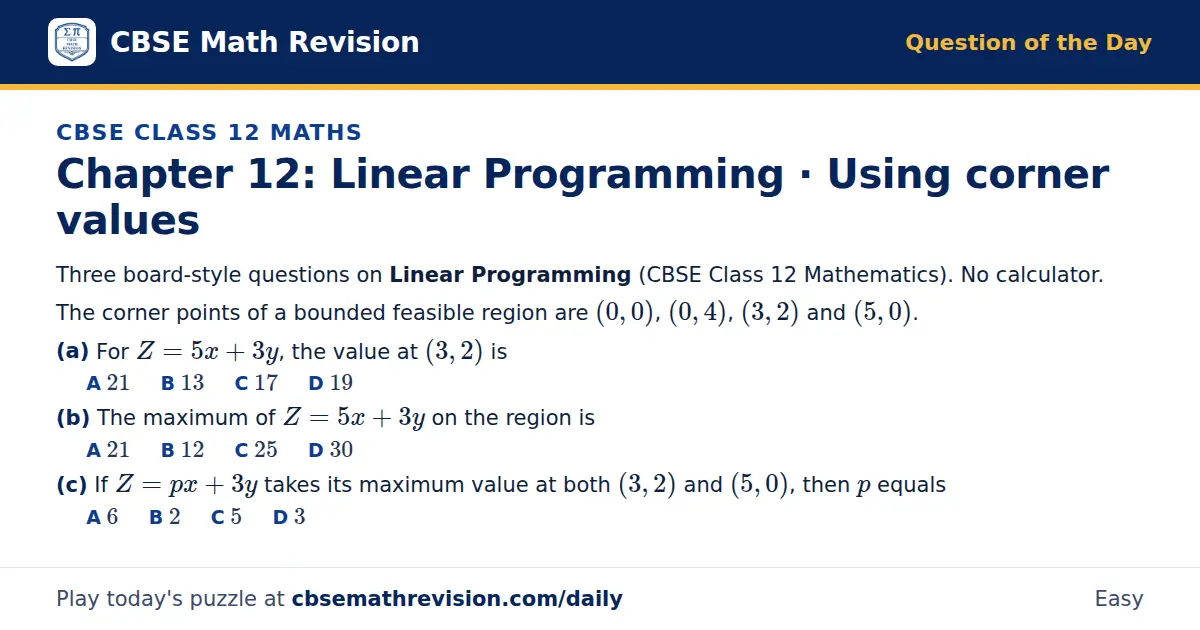
Chapter 12: Linear Programming · Using corner values
Three board-style questions on Linear Programming (CBSE Class 12 Mathematics). No calculator. The corner points of a bounded feasible region are (0, 0), (0, 4), (3, 2) and (5, 0).
- For Z = 5x + 3y, the value at (3, 2) is Options: A) 21; B) 13; C) 17; D) 19
- The maximum of Z = 5x + 3y on the region is Options: A) 21; B) 12; C) 25; D) 30
- If Z = px + 3y takes its maximum value at both (3, 2) and (5, 0), then p equals Options: A) 6; B) 2; C) 5; D) 3
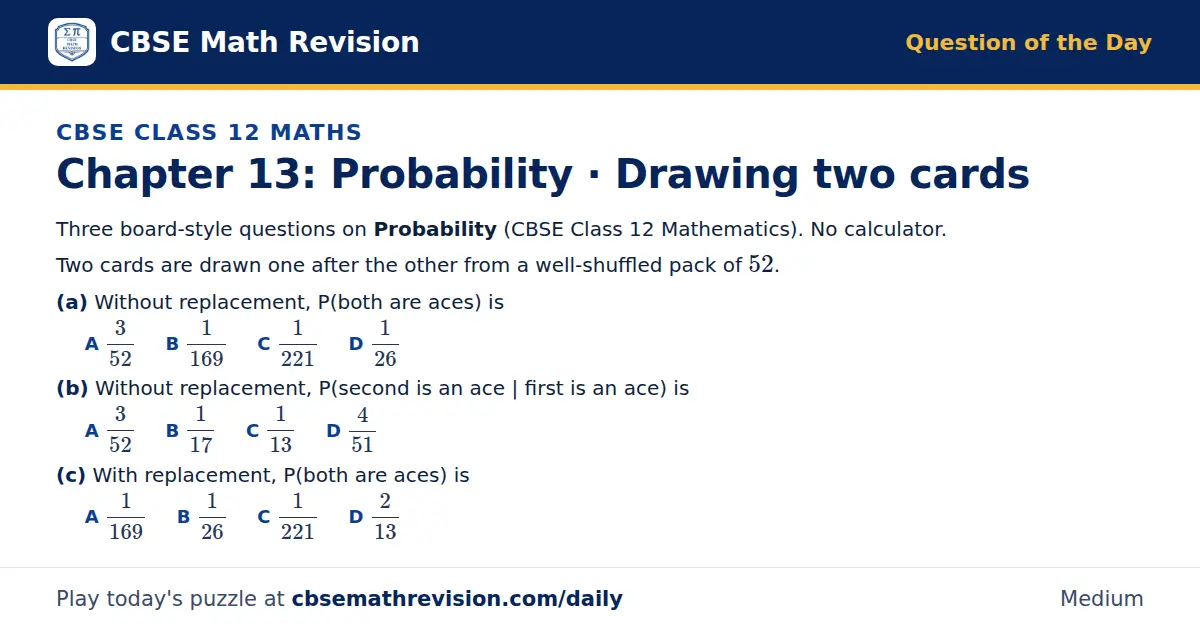
Chapter 13: Probability · Drawing two cards
Three board-style questions on Probability (CBSE Class 12 Mathematics). No calculator. Two cards are drawn one after the other from a well-shuffled pack of 52.
- Without replacement, P(both are aces) is Options: A) 3/52; B) 1/169; C) 1/221; D) 1/26
- Without replacement, P(second is an ace | first is an ace) is Options: A) 3/52; B) 1/17; C) 1/13; D) 4/51
- With replacement, P(both are aces) is Options: A) 1/169; B) 1/26; C) 1/221; D) 2/13
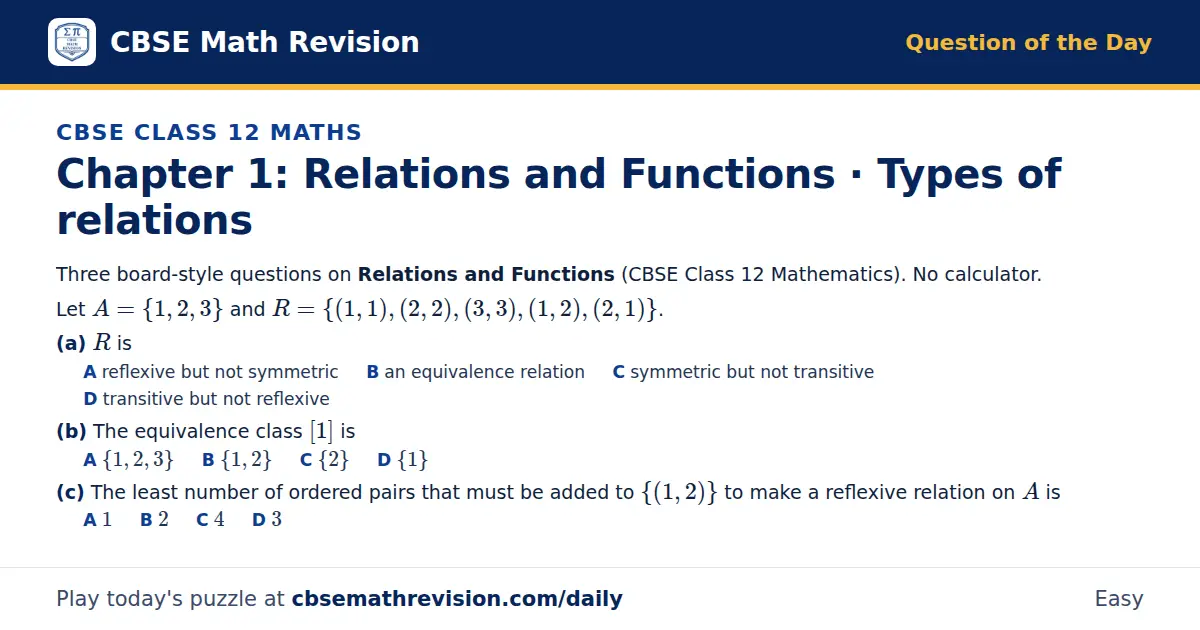
Chapter 1: Relations and Functions · Types of relations
Three board-style questions on Relations and Functions (CBSE Class 12 Mathematics). No calculator. Let A = 1, 2, 3 and R = (1,1), (2,2), (3,3), (1,2), (2,1).
- R is Options: A) reflexive but not symmetric; B) an equivalence relation; C) symmetric but not transitive; D) transitive but not reflexive
- The equivalence class [1] is Options: A) 1, 2, 3; B) 1, 2; C) 2; D) 1
- The least number of ordered pairs that must be added to (1, 2) to make a reflexive relation on A is Options: A) 1; B) 2; C) 4; D) 3
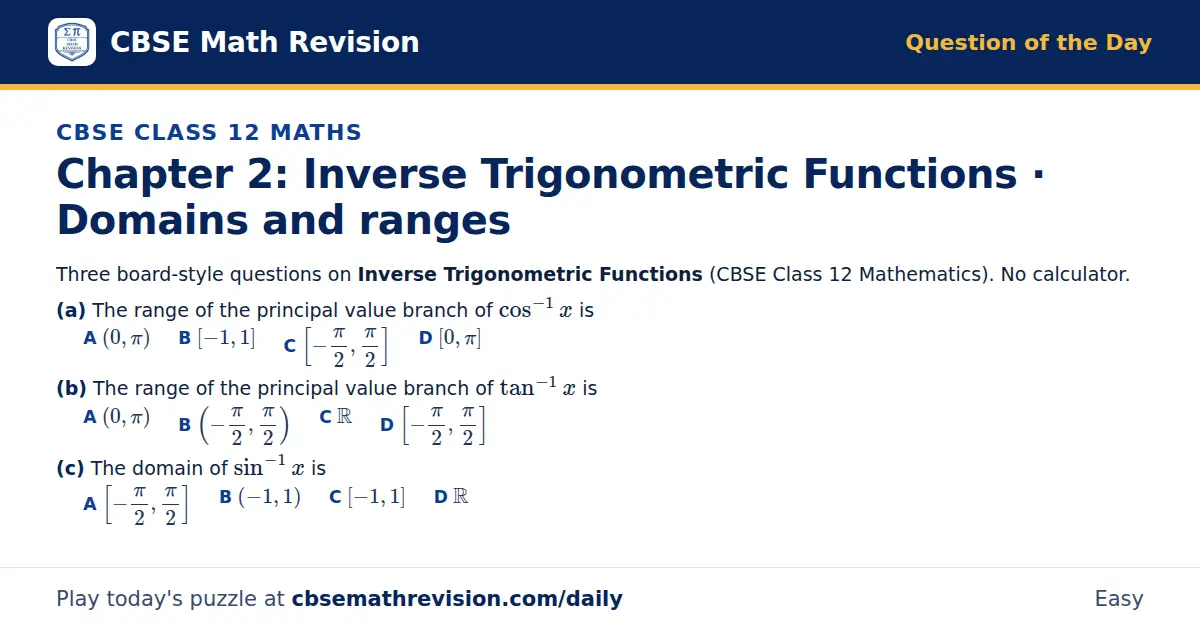
Chapter 2: Inverse Trigonometric Functions · Domains and ranges
Three board-style questions on Inverse Trigonometric Functions (CBSE Class 12 Mathematics). No calculator.
- The range of the principal value branch of cos⁻¹x is Options: A) (0, π); B) [-1, 1]; C) [-(π)/2, (π)/2]; D) [0, π]
- The range of the principal value branch of tan⁻¹x is Options: A) (0, π); B) (-(π)/2, (π)/2); C) ℝ; D) [-(π)/2, (π)/2]
- The domain of sin⁻¹x is Options: A) [-(π)/2, (π)/2]; B) (-1, 1); C) [-1, 1]; D) ℝ
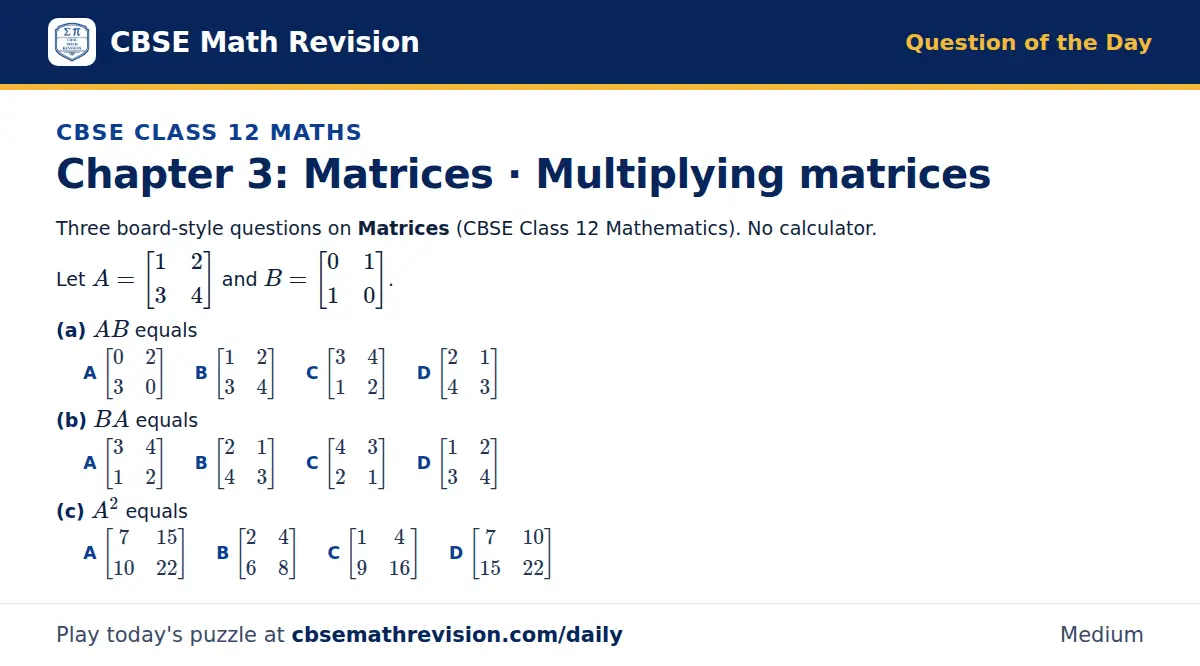
Chapter 3: Matrices · Multiplying matrices
Three board-style questions on Matrices (CBSE Class 12 Mathematics). No calculator. Let A = 1 2; 3 4 and B = 0 1; 1 0.
- AB equals Options: A) 0 2; 3 0; B) 1 2; 3 4; C) 3 4; 1 2; D) 2 1; 4 3
- BA equals Options: A) 3 4; 1 2; B) 2 1; 4 3; C) 4 3; 2 1; D) 1 2; 3 4
- A² equals Options: A) 7 15; 10 22; B) 2 4; 6 8; C) 1 4; 9 16; D) 7 10; 15 22
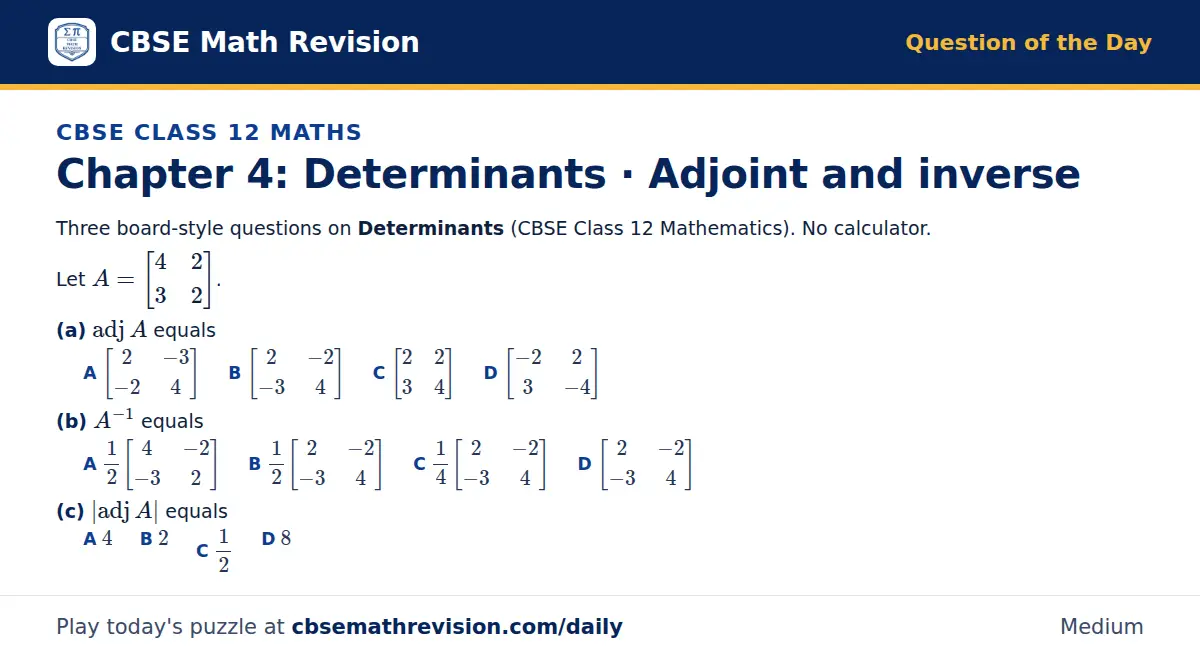
Chapter 4: Determinants · Adjoint and inverse
Three board-style questions on Determinants (CBSE Class 12 Mathematics). No calculator. Let A = 4 2; 3 2.
- adj A equals Options: A) 2 -3; -2 4; B) 2 -2; -3 4; C) 2 2; 3 4; D) -2 2; 3 -4
- A⁻¹ equals Options: A) 12 4 -2; -3 2; B) 12 2 -2; -3 4; C) 14 2 -2; -3 4; D) 2 -2; -3 4
- |adj A| equals Options: A) 4; B) 2; C) 1/2; D) 8
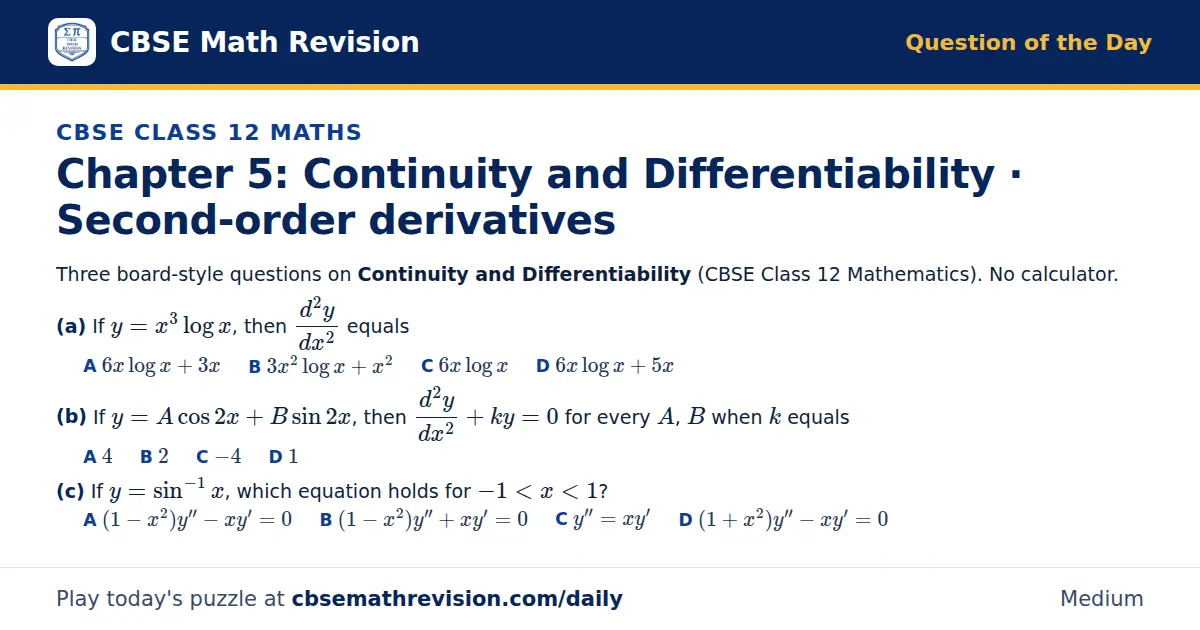
Chapter 5: Continuity and Differentiability · Second-order derivatives
Three board-style questions on Continuity and Differentiability (CBSE Class 12 Mathematics). No calculator.
- If y = x³log x, then (d²y)/(dx²) equals Options: A) 6xlog x + 3x; B) 3x²log x + x²; C) 6xlog x; D) 6xlog x + 5x
- If y = Acos 2x + Bsin 2x, then (d²y)/(dx²) + ky = 0 for every A, B when k equals Options: A) 4; B) 2; C) -4; D) 1
- If y = sin⁻¹x, which equation holds for -1 < x < 1? Options: A) (1 - x²)y'' - xy' = 0; B) (1 - x²)y'' + xy' = 0; C) y'' = xy'; D) (1 + x²)y'' - xy' = 0
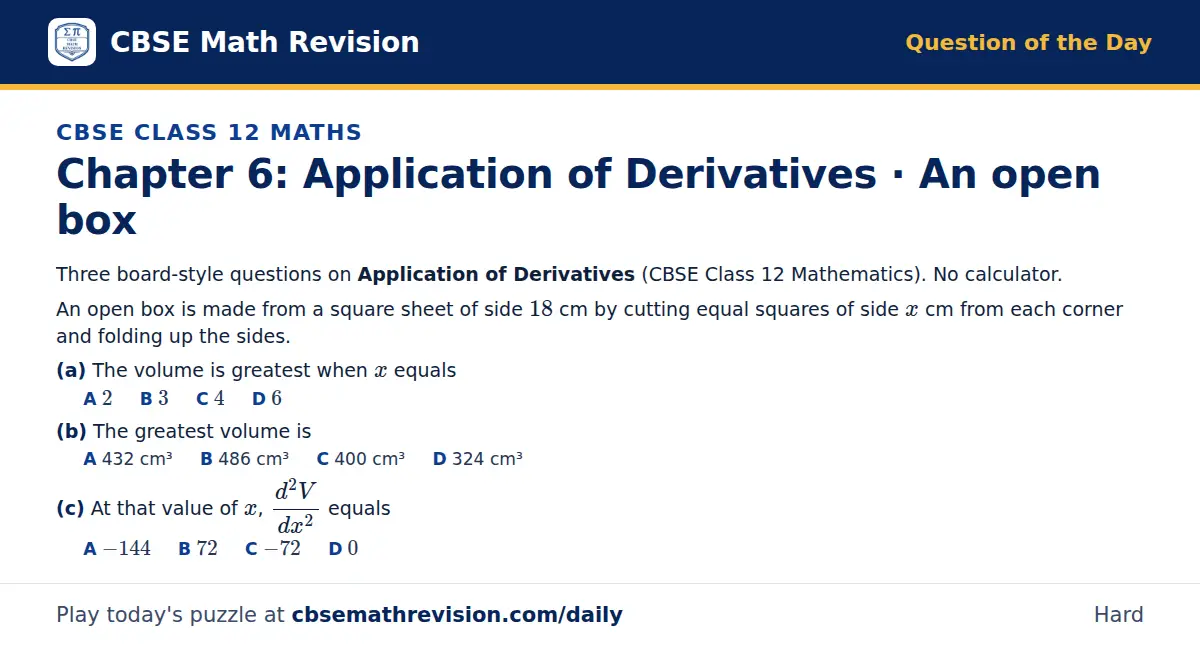
Chapter 6: Application of Derivatives · An open box
Three board-style questions on Application of Derivatives (CBSE Class 12 Mathematics). No calculator. An open box is made from a square sheet of side 18 cm by cutting equal squares of side x cm from each corner and folding up the sides.
- The volume is greatest when x equals Options: A) 2; B) 3; C) 4; D) 6
- The greatest volume is Options: A) 432 cm³; B) 486 cm³; C) 400 cm³; D) 324 cm³
- At that value of x, (d²V)/(dx²) equals Options: A) -144; B) 72; C) -72; D) 0
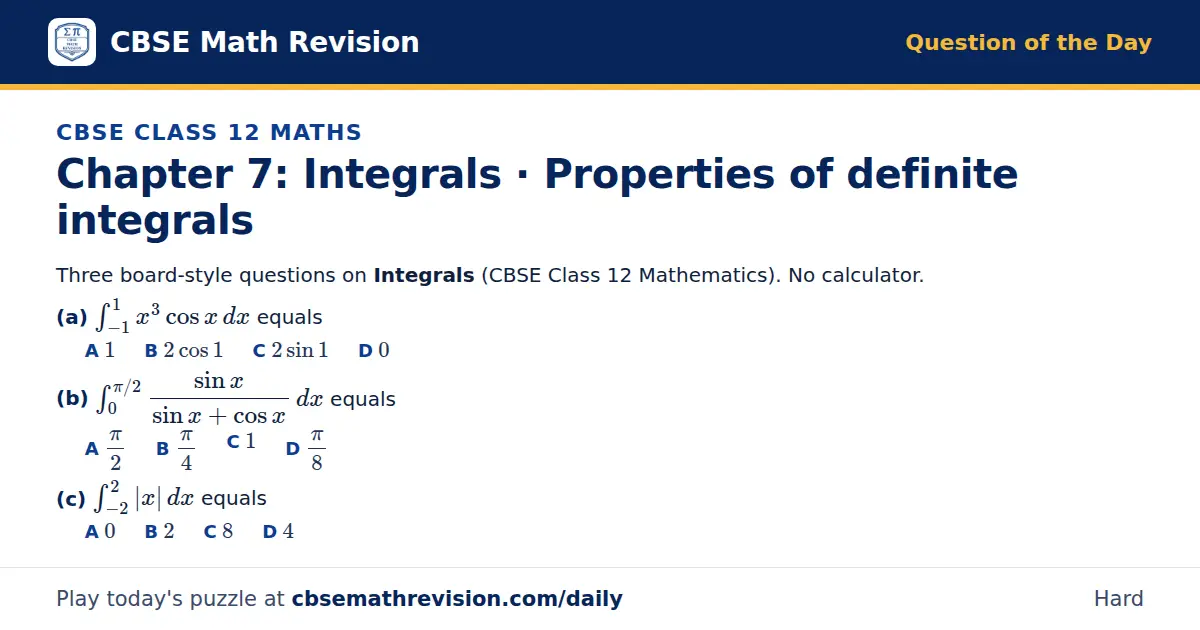
Chapter 7: Integrals · Properties of definite integrals
Three board-style questions on Integrals (CBSE Class 12 Mathematics). No calculator.
- ∫_-1¹ x³cos x dx equals Options: A) 1; B) 2 cos 1; C) 2 sin 1; D) 0
- ∫_0^(π/2) (sin x)/(sin x + cos x) dx equals Options: A) (π)/2; B) (π)/4; C) 1; D) (π)/8
- ∫_-2² |x| dx equals Options: A) 0; B) 2; C) 8; D) 4
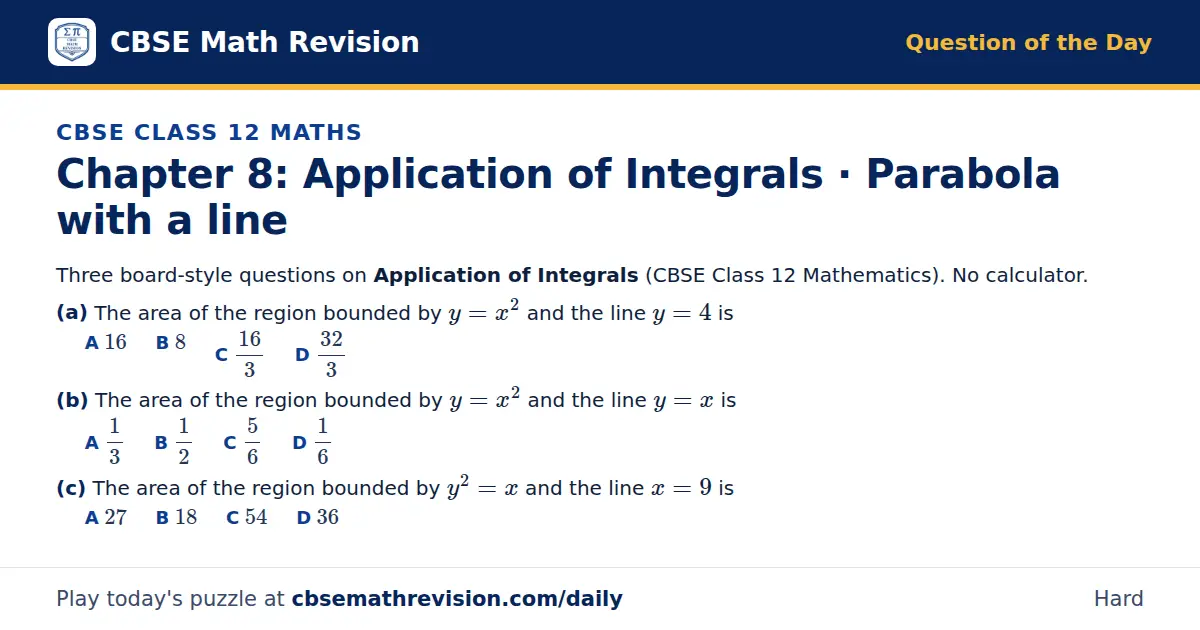
Chapter 8: Application of Integrals · Parabola with a line
Three board-style questions on Application of Integrals (CBSE Class 12 Mathematics). No calculator.
- The area of the region bounded by y = x² and the line y = 4 is Options: A) 16; B) 8; C) 16/3; D) 32/3
- The area of the region bounded by y = x² and the line y = x is Options: A) 1/3; B) 1/2; C) 5/6; D) 1/6
- The area of the region bounded by y² = x and the line x = 9 is Options: A) 27; B) 18; C) 54; D) 36
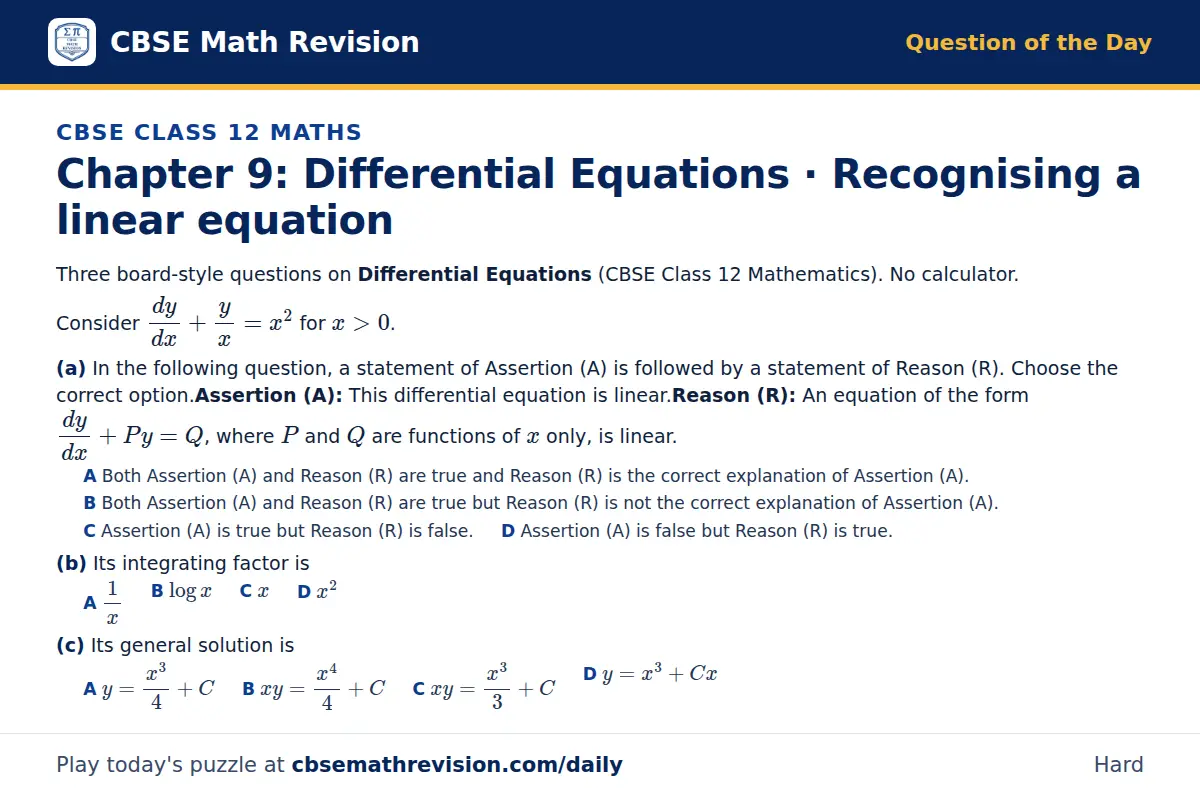
Chapter 9: Differential Equations · Recognising a linear equation
Three board-style questions on Differential Equations (CBSE Class 12 Mathematics). No calculator. Consider dy/dx + y/x = x² for x > 0.
- In the following question, a statement of Assertion (A) is followed by a statement of Reason (R). Choose the correct option. Assertion (A): This differential equation is linear. Reason (R): An equation of the form dy/dx + Py = Q, where P and Q are functions of x only, is linear. Options: A) Both Assertion (A) and Reason (R) are true and Reason (R) is the correct explanation of Assertion (A).; B) Both Assertion (A) and Reason (R) are true but Reason (R) is not the correct explanation of Assertion (A).; C) Assertion (A) is true but Reason (R) is false.; D) Assertion (A) is false but Reason (R) is true.
- Its integrating factor is Options: A) 1x; B) log x; C) x; D) x²
- Its general solution is Options: A) y = (x³)/4 + C; B) xy = (x⁴)/4 + C; C) xy = (x³)/3 + C; D) y = x³ + Cx
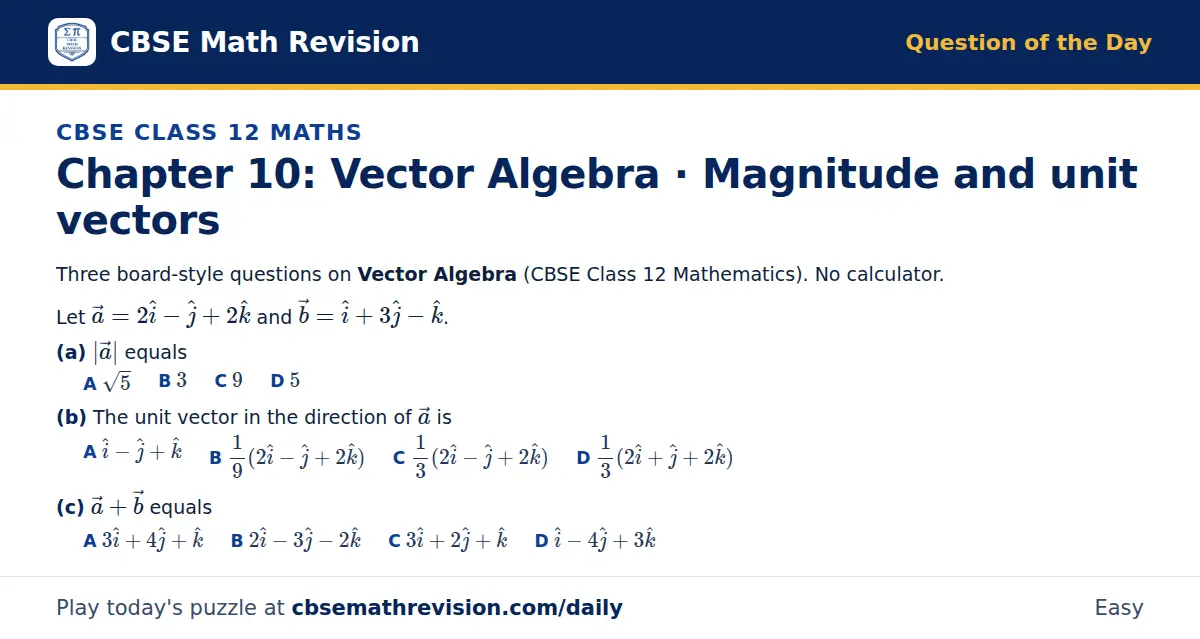
Chapter 10: Vector Algebra · Magnitude and unit vectors
Three board-style questions on Vector Algebra (CBSE Class 12 Mathematics). No calculator. Let a = 2 i - j + 2 k and b = i + 3 j - k.
- | a| equals Options: A) √5; B) 3; C) 9; D) 5
- The unit vector in the direction of a is Options: A) i - j + k; B) 19(2 i - j + 2 k); C) 13(2 i - j + 2 k); D) 13(2 i + j + 2 k)
- a + b equals Options: A) 3 i + 4 j + k; B) 2 i - 3 j - 2 k; C) 3 i + 2 j + k; D) i - 4 j + 3 k
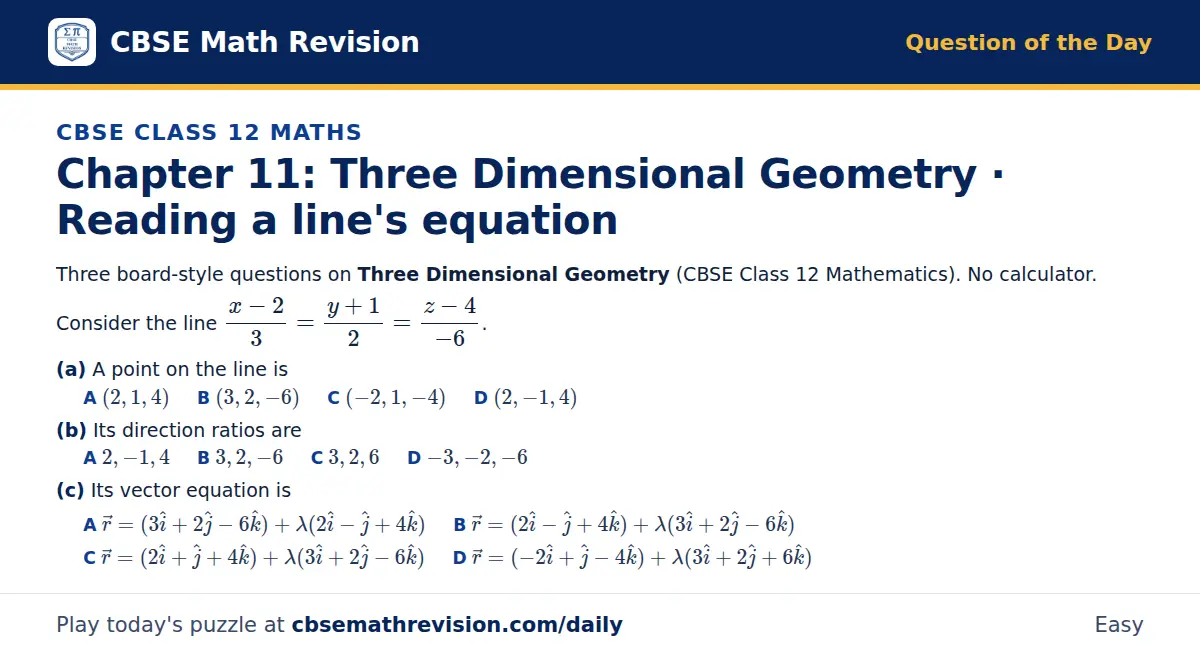
Chapter 11: Three Dimensional Geometry · Reading a line's equation
Three board-style questions on Three Dimensional Geometry (CBSE Class 12 Mathematics). No calculator. Consider the line (x - 2)/3 = (y + 1)/2 = (z - 4)/(-6).
- A point on the line is Options: A) (2, 1, 4); B) (3, 2, -6); C) (-2, 1, -4); D) (2, -1, 4)
- Its direction ratios are Options: A) 2, -1, 4; B) 3, 2, -6; C) 3, 2, 6; D) -3, -2, -6
- Its vector equation is Options: A) r = (3 i + 2 j - 6 k) + λ(2 i - j + 4 k); B) r = (2 i - j + 4 k) + λ(3 i + 2 j - 6 k); C) r = (2 i + j + 4 k) + λ(3 i + 2 j - 6 k); D) r = (-2 i + j - 4 k) + λ(3 i + 2 j + 6 k)
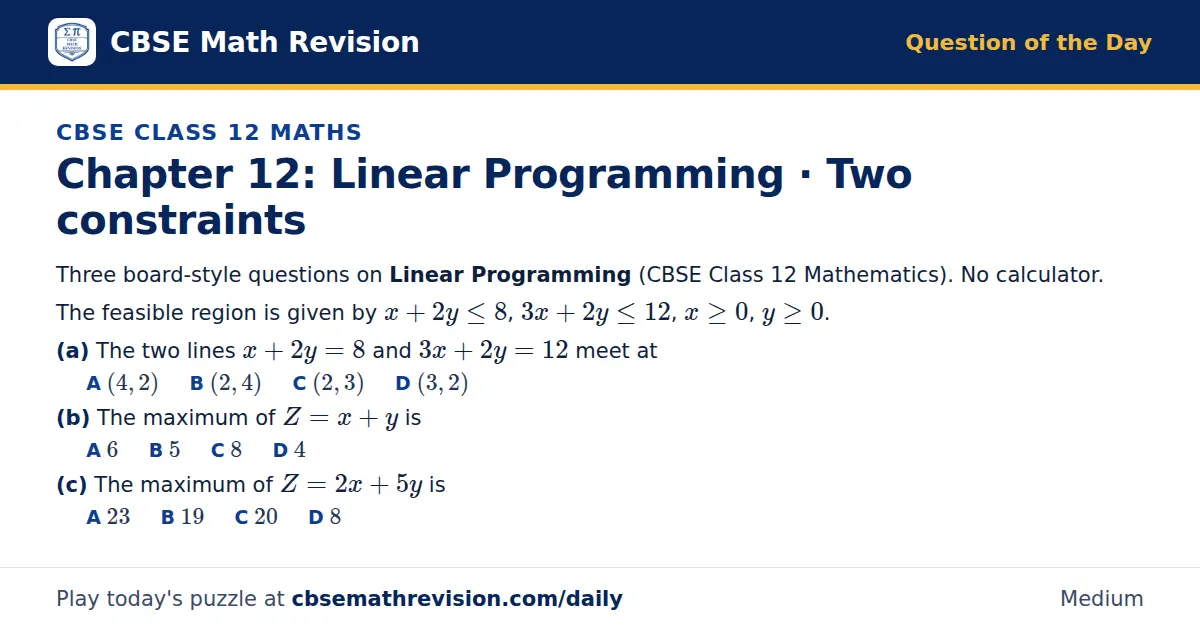
Chapter 12: Linear Programming · Two constraints
Three board-style questions on Linear Programming (CBSE Class 12 Mathematics). No calculator. The feasible region is given by x + 2y ≤ 8, 3x + 2y ≤ 12, x ≥ 0, y ≥ 0.
- The two lines x + 2y = 8 and 3x + 2y = 12 meet at Options: A) (4, 2); B) (2, 4); C) (2, 3); D) (3, 2)
- The maximum of Z = x + y is Options: A) 6; B) 5; C) 8; D) 4
- The maximum of Z = 2x + 5y is Options: A) 23; B) 19; C) 20; D) 8
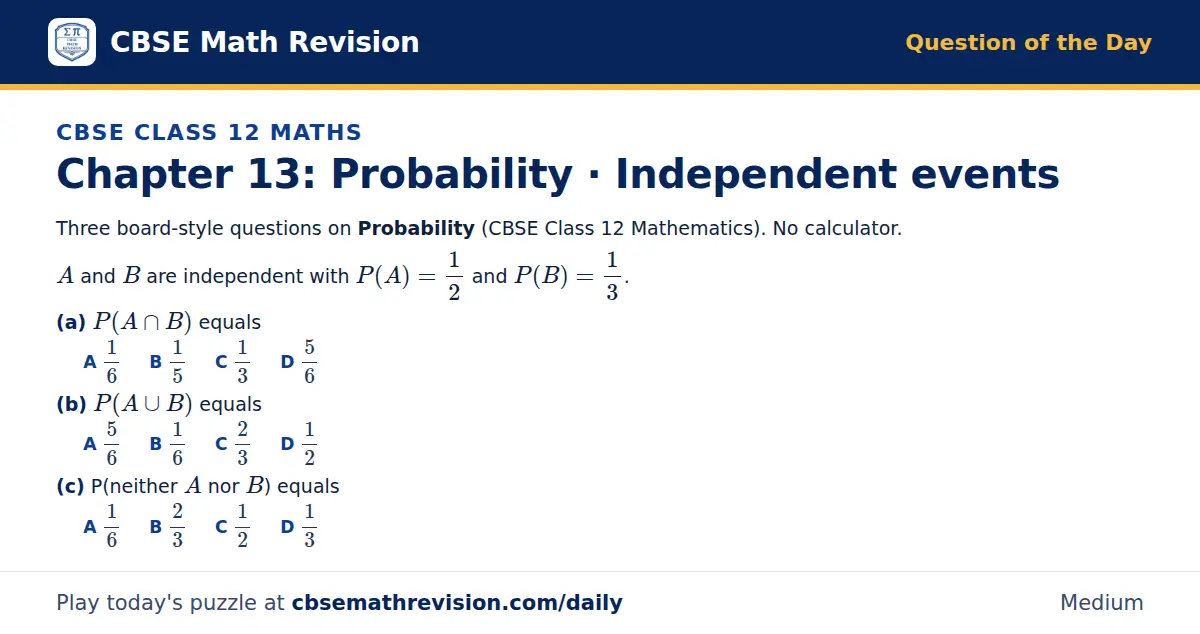
Chapter 13: Probability · Independent events
Three board-style questions on Probability (CBSE Class 12 Mathematics). No calculator. A and B are independent with P(A) = 12 and P(B) = 13.
- P(A ∩ B) equals Options: A) 1/6; B) 1/5; C) 1/3; D) 5/6
- P(A ∪ B) equals Options: A) 5/6; B) 1/6; C) 2/3; D) 1/2
- P(neither A nor B) equals Options: A) 1/6; B) 2/3; C) 1/2; D) 1/3