CBSE Class 11 Maths Question of the Day: all the puzzles
Every CBSE Class 11 Mathematics puzzle in the Question of the Day rotation, as images you can open, save or share. Each puzzle is three board-style questions on one chapter; the question text is written out below each image, and the answers, hints and step-marked solutions are on the daily puzzle page.
- Play today's CBSE Class 11 Maths puzzle
- CBSE Class 10 Maths puzzles
- CBSE Class 12 Maths puzzles
- All CBSE Maths daily and weekly questions
Every puzzle in the rotation
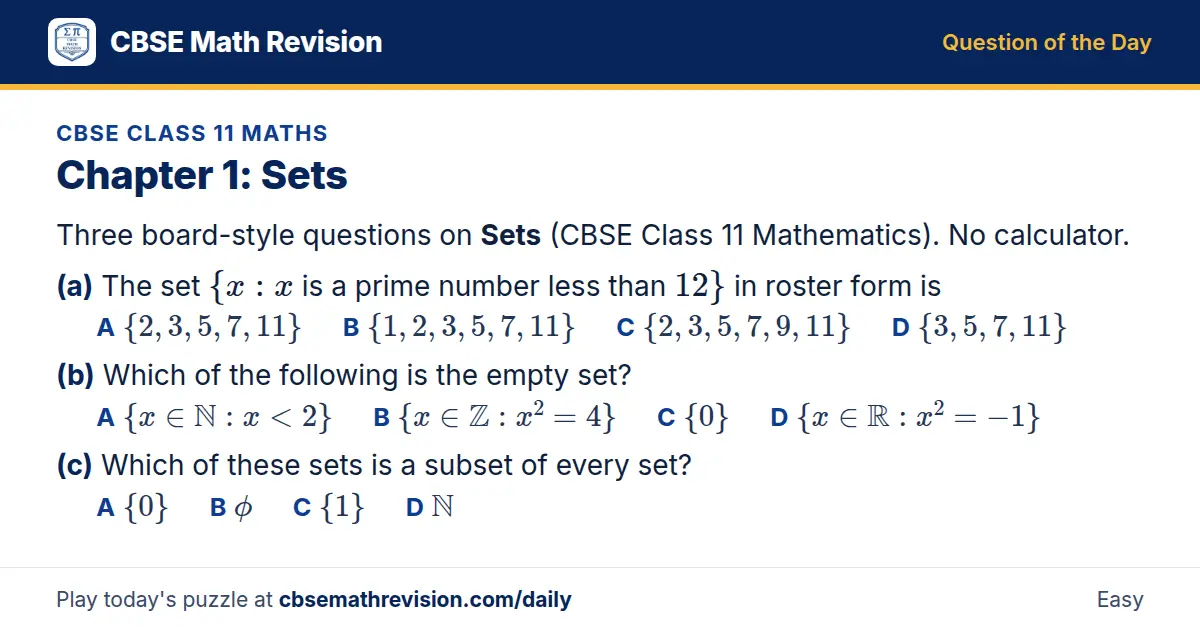
Chapter 1: Sets
Three board-style questions on Sets (CBSE Class 11 Mathematics). No calculator.
- The set x: x is a prime number less than 12 in roster form is Options: A) 2, 3, 5, 7, 11; B) 1, 2, 3, 5, 7, 11; C) 2, 3, 5, 7, 9, 11; D) 3, 5, 7, 11
- Which of the following is the empty set? Options: A) x ∈ ℕ: x < 2; B) x ∈ ℤ: x² = 4; C) 0; D) x ∈ ℝ: x² = -1
- Which of these sets is a subset of every set? Options: A) 0; B) φ; C) 1; D) ℕ
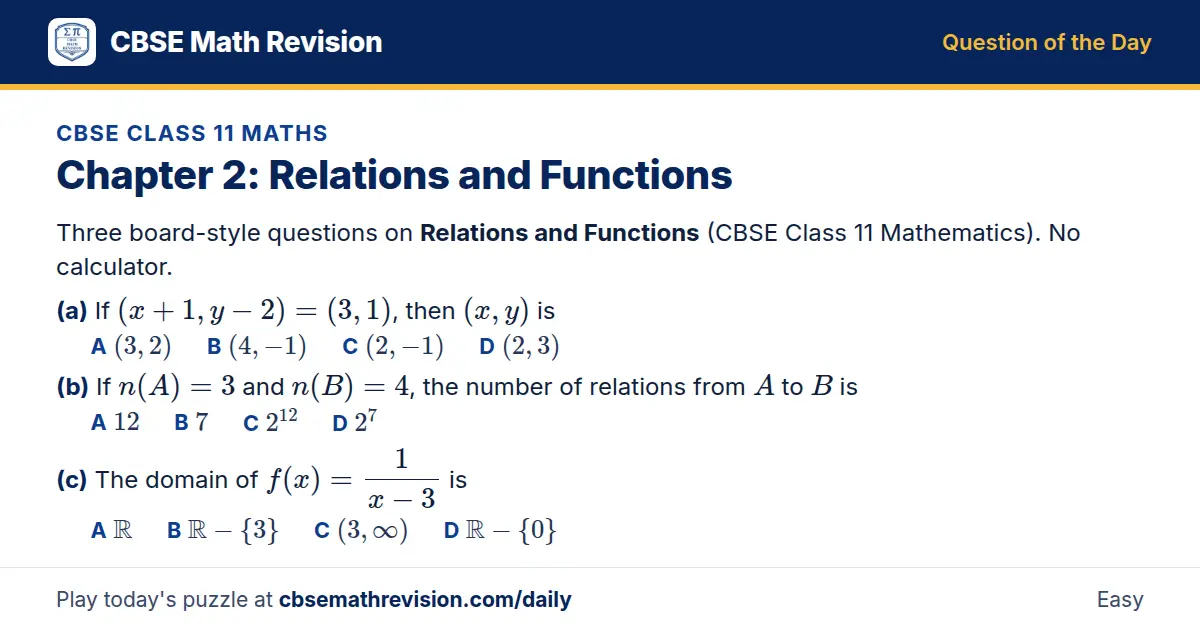
Chapter 2: Relations and Functions
Three board-style questions on Relations and Functions (CBSE Class 11 Mathematics). No calculator.
- If (x + 1, y - 2) = (3, 1), then (x, y) is Options: A) (3, 2); B) (4, -1); C) (2, -1); D) (2, 3)
- If n(A) = 3 and n(B) = 4, the number of relations from A to B is Options: A) 12; B) 7; C) 2¹²; D) 2⁷
- The domain of f(x) = 1/(x - 3) is Options: A) ℝ; B) ℝ - 3; C) (3, ∞); D) ℝ - 0
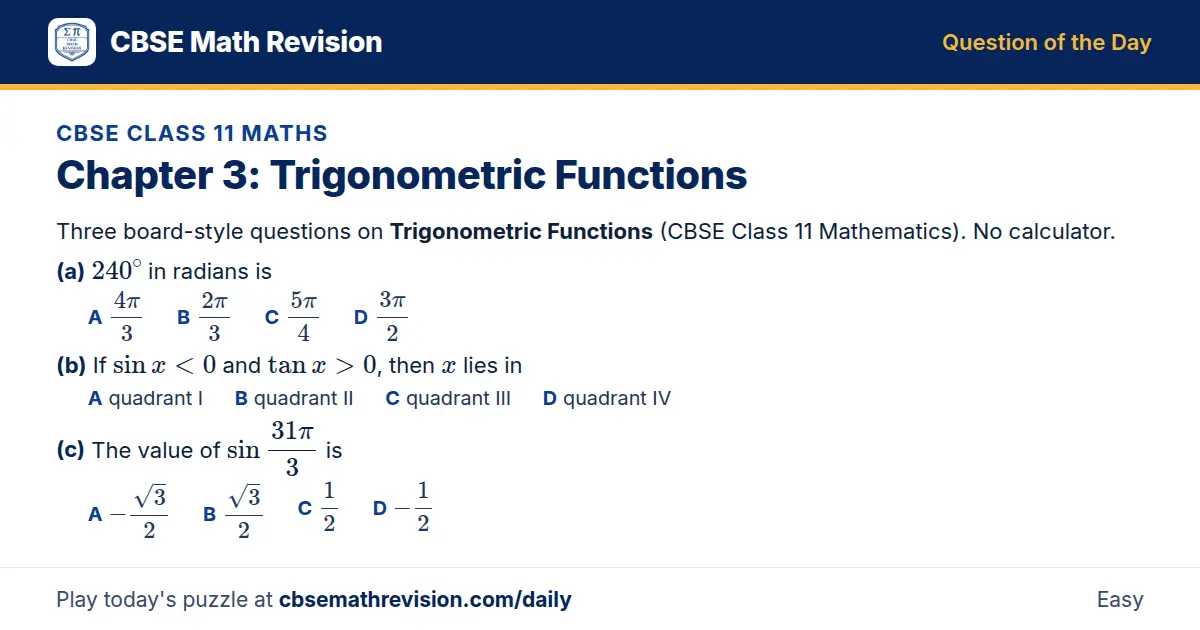
Chapter 3: Trigonometric Functions
Three board-style questions on Trigonometric Functions (CBSE Class 11 Mathematics). No calculator.
- 240^∘ in radians is Options: A) (4π)/3; B) (2π)/3; C) (5π)/4; D) (3π)/2
- If sin x < 0 and tan x > 0, then x lies in Options: A) quadrant I; B) quadrant II; C) quadrant III; D) quadrant IV
- The value of sin(31π)/3 is Options: A) -(√3)/2; B) (√3)/2; C) 12; D) -12
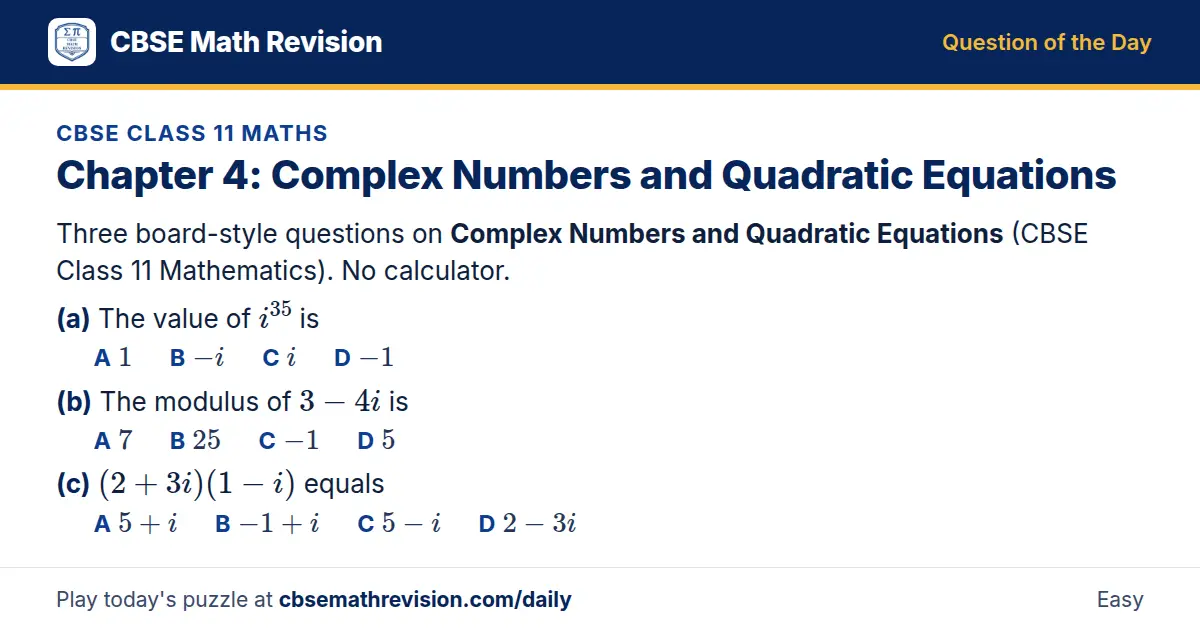
Chapter 4: Complex Numbers and Quadratic Equations
Three board-style questions on Complex Numbers and Quadratic Equations (CBSE Class 11 Mathematics). No calculator.
- The value of i³⁵ is Options: A) 1; B) -i; C) i; D) -1
- The modulus of 3 - 4i is Options: A) 7; B) 25; C) -1; D) 5
- (2 + 3i)(1 - i) equals Options: A) 5 + i; B) -1 + i; C) 5 - i; D) 2 - 3i
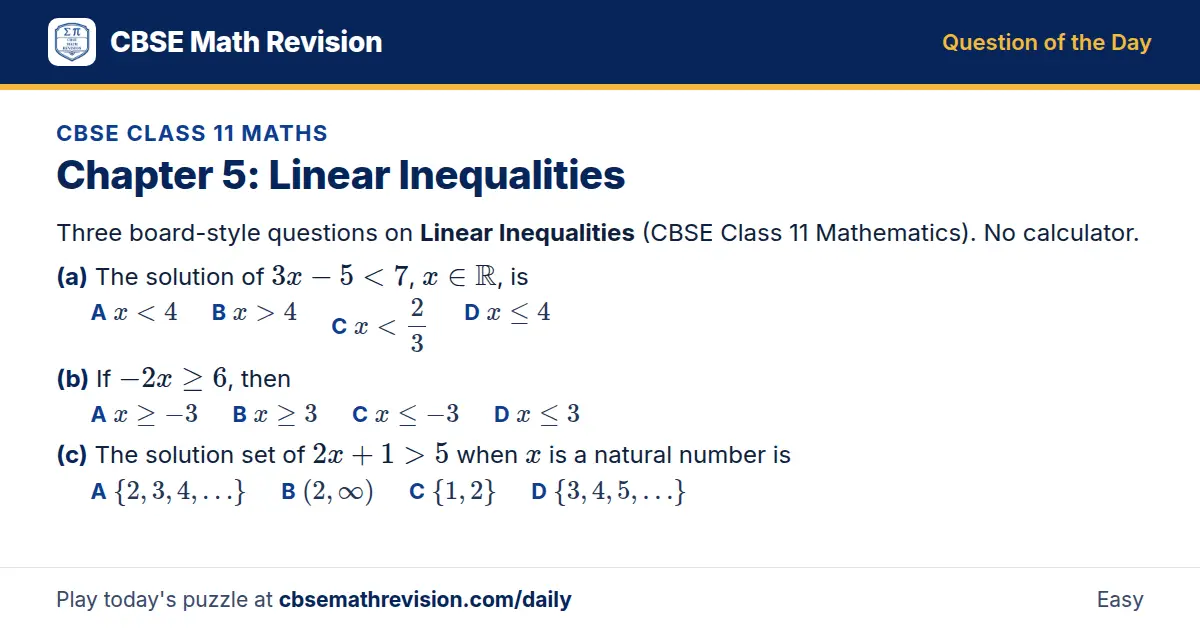
Chapter 5: Linear Inequalities
Three board-style questions on Linear Inequalities (CBSE Class 11 Mathematics). No calculator.
- The solution of 3x - 5 < 7, x ∈ ℝ, is Options: A) x < 4; B) x > 4; C) x < 23; D) x ≤ 4
- If -2x ≥ 6, then Options: A) x ≥ -3; B) x ≥ 3; C) x ≤ -3; D) x ≤ 3
- The solution set of 2x + 1 > 5 when x is a natural number is Options: A) 2, 3, 4, …; B) (2, ∞); C) 1, 2; D) 3, 4, 5, …
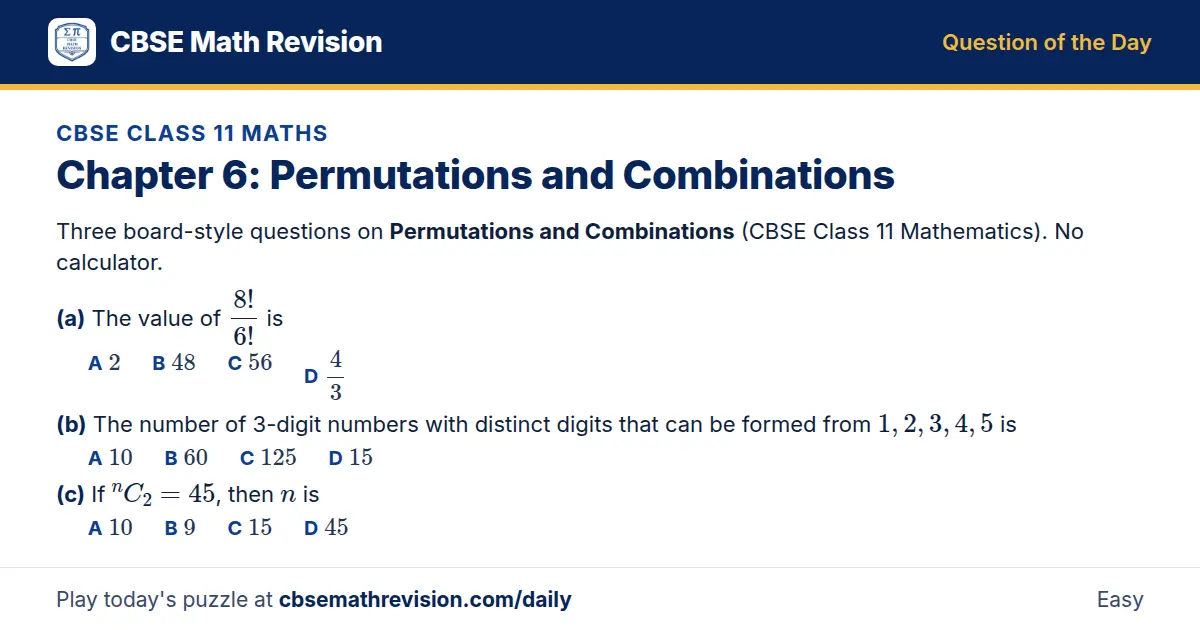
Chapter 6: Permutations and Combinations
Three board-style questions on Permutations and Combinations (CBSE Class 11 Mathematics). No calculator.
- The value of (8!)/(6!) is Options: A) 2; B) 48; C) 56; D) 43
- The number of 3-digit numbers with distinct digits that can be formed from 1, 2, 3, 4, 5 is Options: A) 10; B) 60; C) 125; D) 15
- If ^nC_2 = 45, then n is Options: A) 10; B) 9; C) 15; D) 45
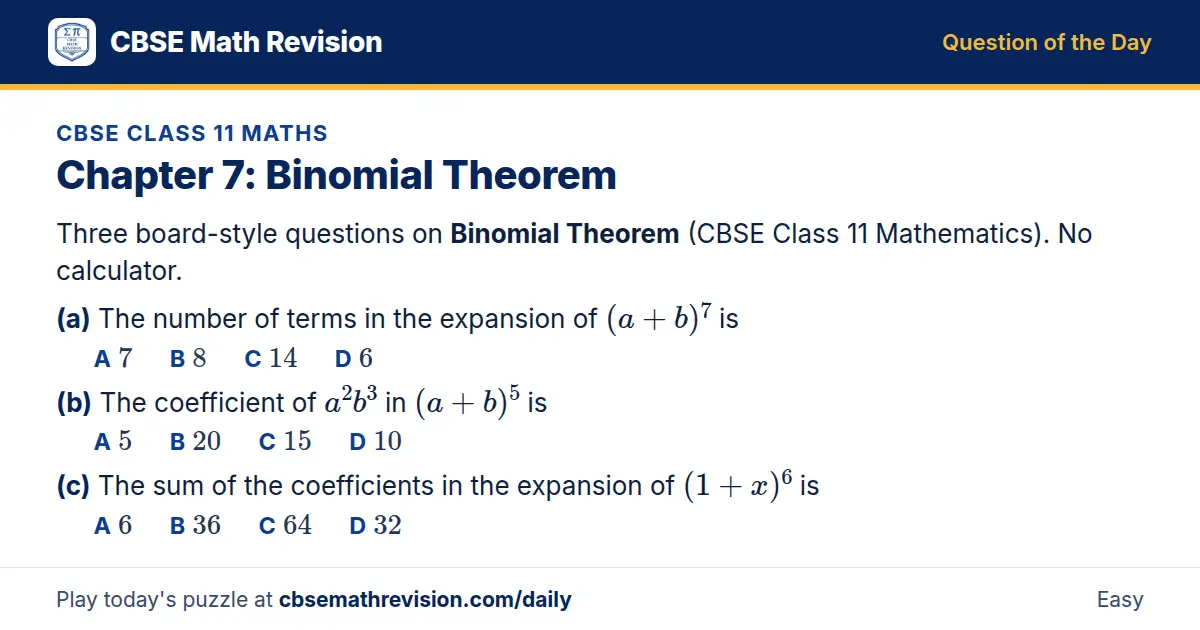
Chapter 7: Binomial Theorem
Three board-style questions on Binomial Theorem (CBSE Class 11 Mathematics). No calculator.
- The number of terms in the expansion of (a + b)⁷ is Options: A) 7; B) 8; C) 14; D) 6
- The coefficient of a²b³ in (a + b)⁵ is Options: A) 5; B) 20; C) 15; D) 10
- The sum of the coefficients in the expansion of (1 + x)⁶ is Options: A) 6; B) 36; C) 64; D) 32
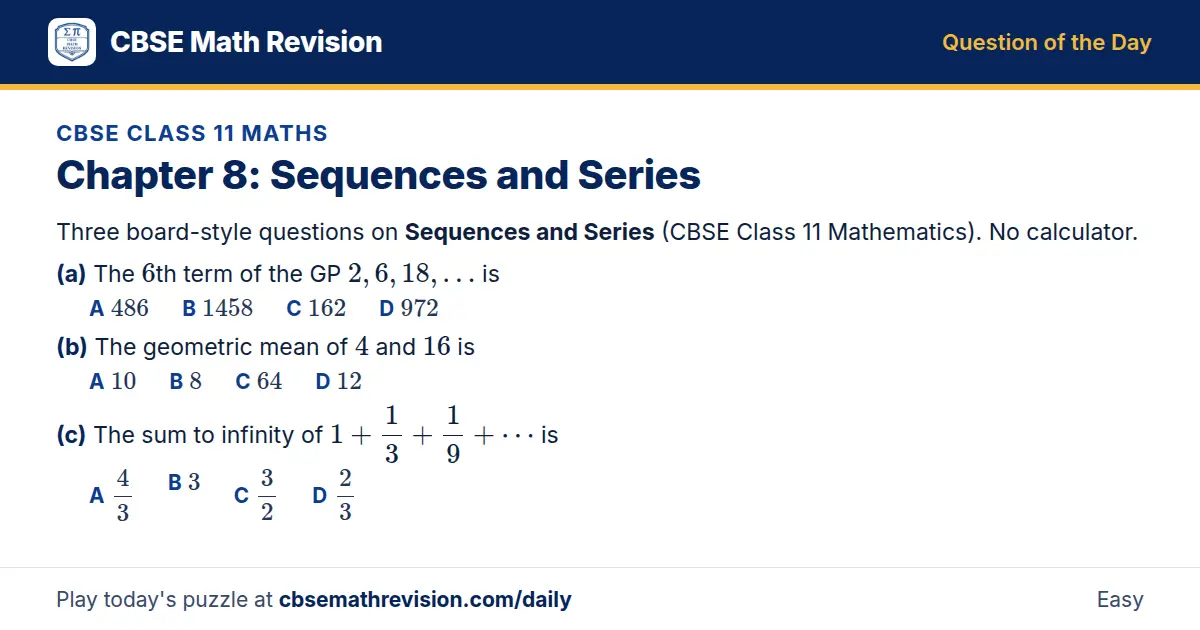
Chapter 8: Sequences and Series
Three board-style questions on Sequences and Series (CBSE Class 11 Mathematics). No calculator.
- The 6th term of the GP 2, 6, 18, … is Options: A) 486; B) 1458; C) 162; D) 972
- The geometric mean of 4 and 16 is Options: A) 10; B) 8; C) 64; D) 12
- The sum to infinity of 1 + 13 + 19 + … is Options: A) 43; B) 3; C) 32; D) 23
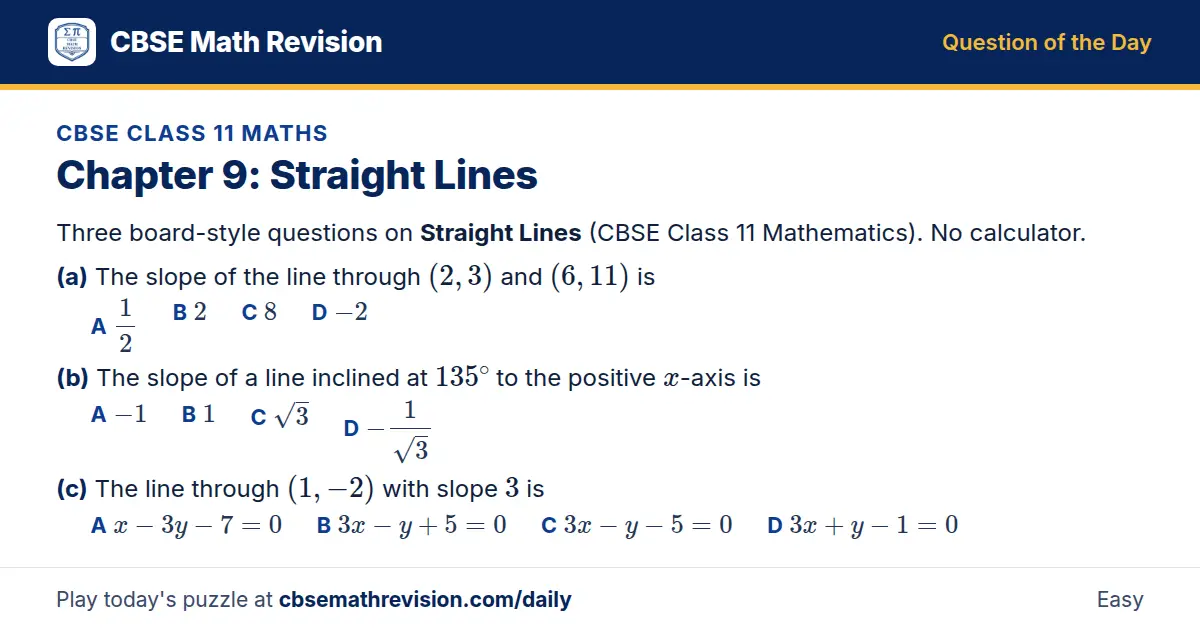
Chapter 9: Straight Lines
Three board-style questions on Straight Lines (CBSE Class 11 Mathematics). No calculator.
- The slope of the line through (2, 3) and (6, 11) is Options: A) 12; B) 2; C) 8; D) -2
- The slope of a line inclined at 135^∘ to the positive x-axis is Options: A) -1; B) 1; C) √3; D) -1/(√3)
- The line through (1, -2) with slope 3 is Options: A) x - 3y - 7 = 0; B) 3x - y + 5 = 0; C) 3x - y - 5 = 0; D) 3x + y - 1 = 0
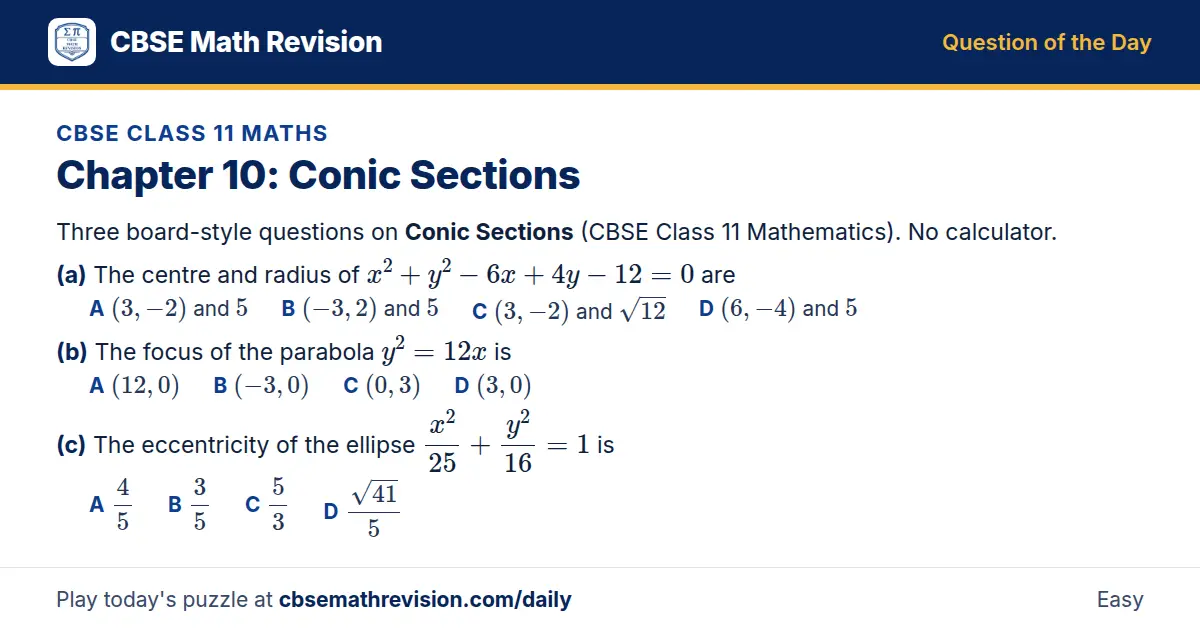
Chapter 10: Conic Sections
Three board-style questions on Conic Sections (CBSE Class 11 Mathematics). No calculator.
- The centre and radius of x² + y² - 6x + 4y - 12 = 0 are Options: A) (3, -2) and 5; B) (-3, 2) and 5; C) (3, -2) and √12; D) (6, -4) and 5
- The focus of the parabola y² = 12x is Options: A) (12, 0); B) (-3, 0); C) (0, 3); D) (3, 0)
- The eccentricity of the ellipse (x²)/25 + (y²)/16 = 1 is Options: A) 45; B) 35; C) 53; D) (√41)/5
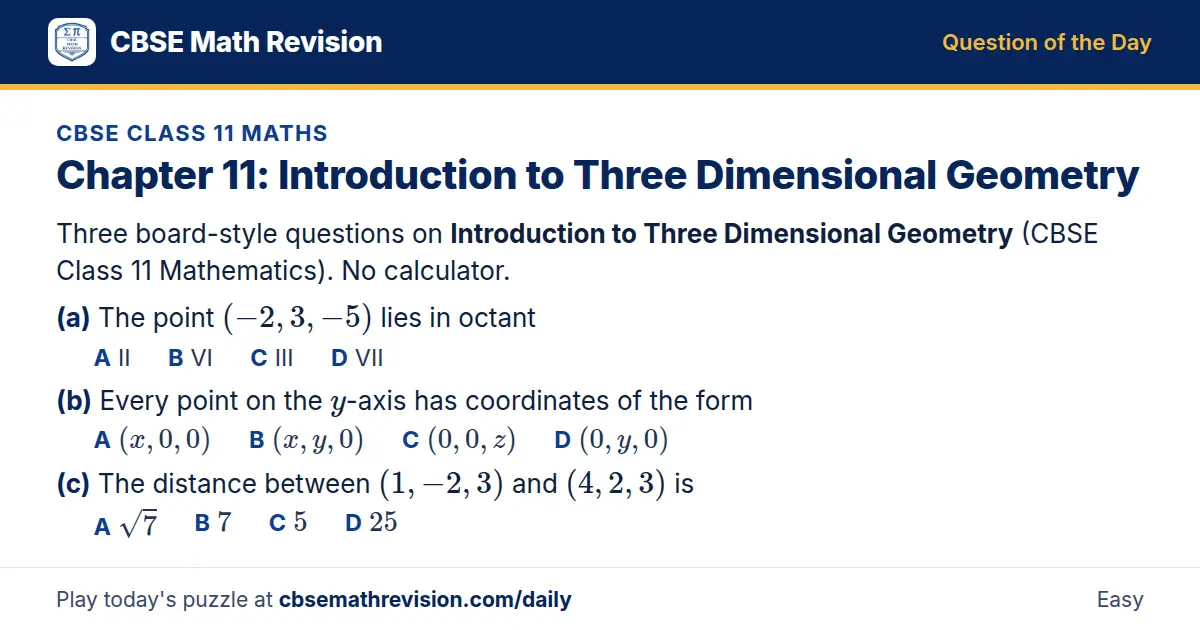
Chapter 11: Introduction to Three Dimensional Geometry
Three board-style questions on Introduction to Three Dimensional Geometry (CBSE Class 11 Mathematics). No calculator.
- The point (-2, 3, -5) lies in octant Options: A) II; B) VI; C) III; D) VII
- Every point on the y-axis has coordinates of the form Options: A) (x, 0, 0); B) (x, y, 0); C) (0, 0, z); D) (0, y, 0)
- The distance between (1, -2, 3) and (4, 2, 3) is Options: A) √7; B) 7; C) 5; D) 25
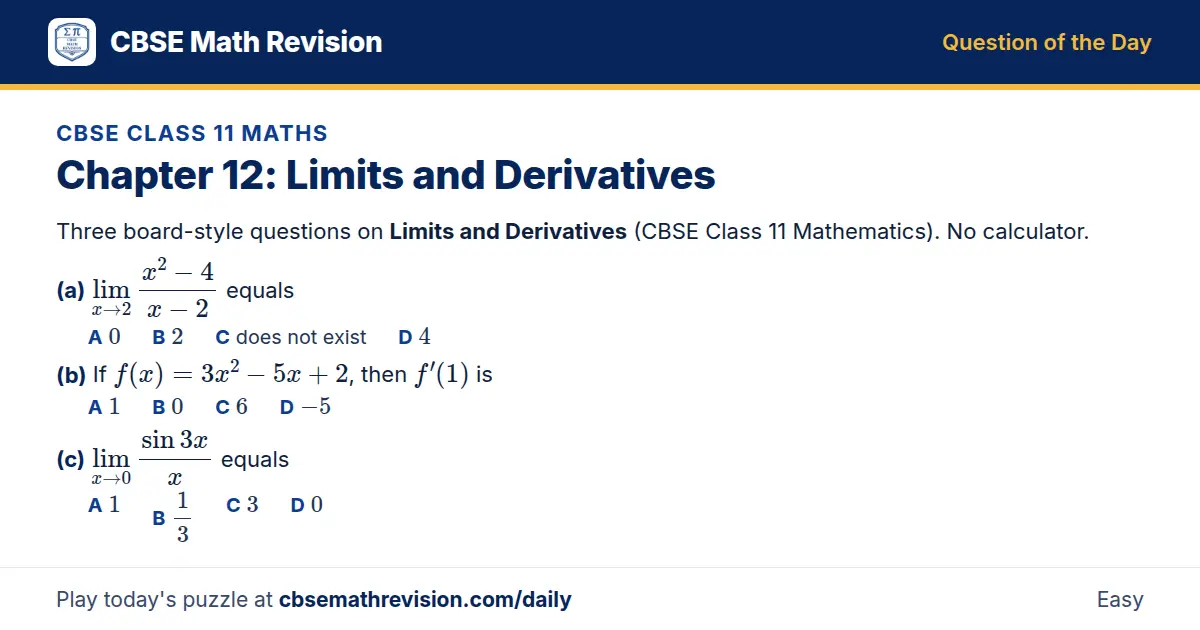
Chapter 12: Limits and Derivatives
Three board-style questions on Limits and Derivatives (CBSE Class 11 Mathematics). No calculator.
- lim_x → 2 (x² - 4)/(x - 2) equals Options: A) 0; B) 2; C) does not exist; D) 4
- If f(x) = 3x² - 5x + 2, then f'(1) is Options: A) 1; B) 0; C) 6; D) -5
- lim_x → 0 (sin 3x)/x equals Options: A) 1; B) 13; C) 3; D) 0
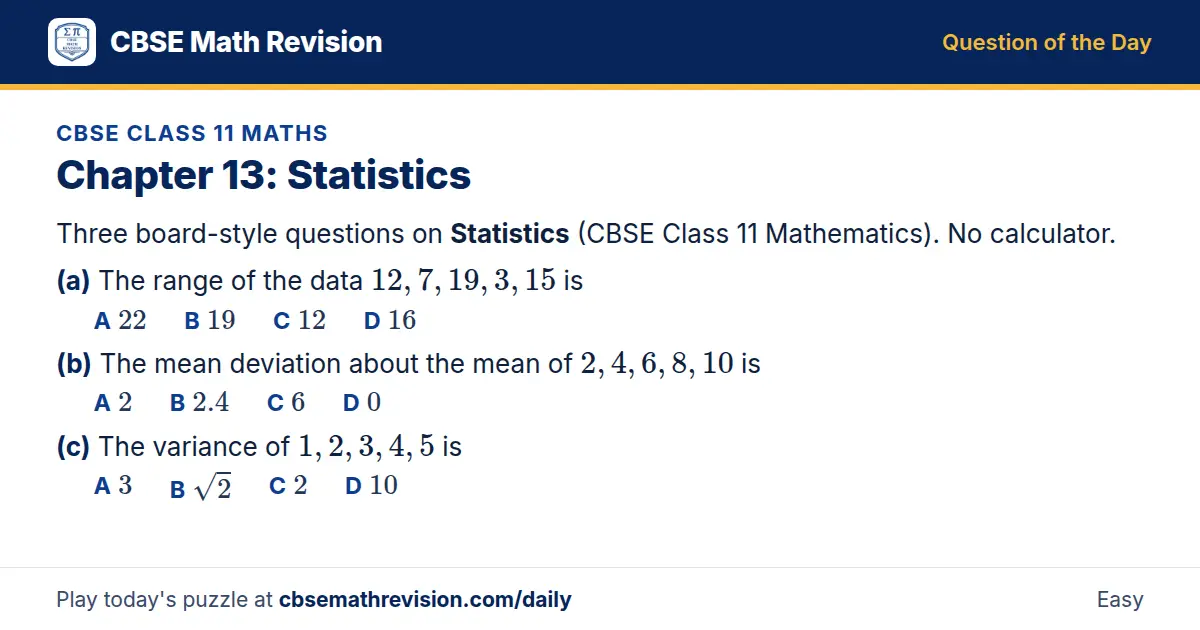
Chapter 13: Statistics
Three board-style questions on Statistics (CBSE Class 11 Mathematics). No calculator.
- The range of the data 12, 7, 19, 3, 15 is Options: A) 22; B) 19; C) 12; D) 16
- The mean deviation about the mean of 2, 4, 6, 8, 10 is Options: A) 2; B) 2.4; C) 6; D) 0
- The variance of 1, 2, 3, 4, 5 is Options: A) 3; B) √2; C) 2; D) 10
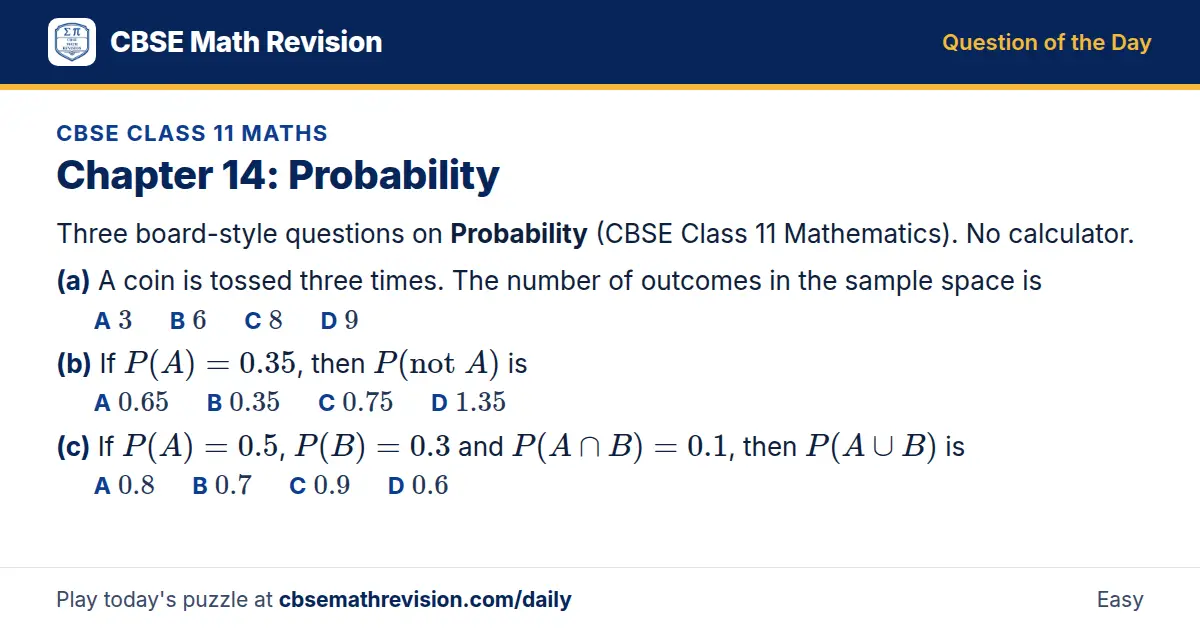
Chapter 14: Probability
Three board-style questions on Probability (CBSE Class 11 Mathematics). No calculator.
- A coin is tossed three times. The number of outcomes in the sample space is Options: A) 3; B) 6; C) 8; D) 9
- If P(A) = 0.35, then P(not A) is Options: A) 0.65; B) 0.35; C) 0.75; D) 1.35
- If P(A) = 0.5, P(B) = 0.3 and P(A ∩ B) = 0.1, then P(A ∪ B) is Options: A) 0.8; B) 0.7; C) 0.9; D) 0.6
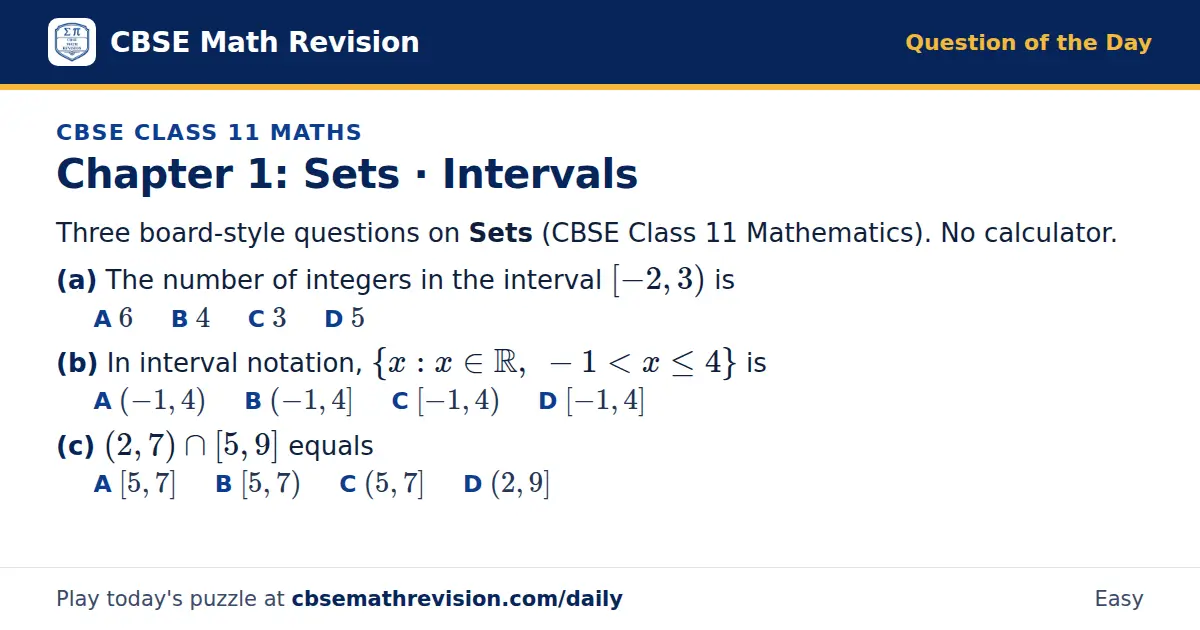
Chapter 1: Sets · Intervals
Three board-style questions on Sets (CBSE Class 11 Mathematics). No calculator.
- The number of integers in the interval [-2, 3) is Options: A) 6; B) 4; C) 3; D) 5
- In interval notation, x: x ∈ ℝ, -1 < x ≤ 4 is Options: A) (-1, 4); B) (-1, 4]; C) [-1, 4); D) [-1, 4]
- (2, 7) ∩ [5, 9] equals Options: A) [5, 7]; B) [5, 7); C) (5, 7]; D) (2, 9]
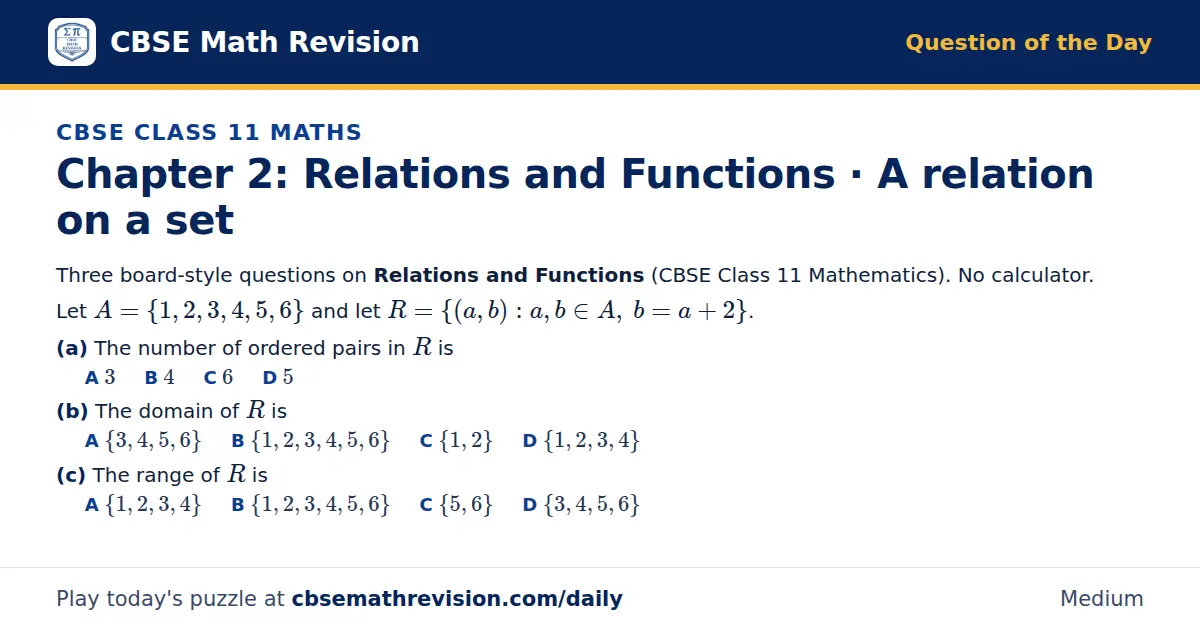
Chapter 2: Relations and Functions · A relation on a set
Three board-style questions on Relations and Functions (CBSE Class 11 Mathematics). No calculator. Let A = 1, 2, 3, 4, 5, 6 and let R = (a, b): a, b ∈ A, b = a + 2.
- The number of ordered pairs in R is Options: A) 3; B) 4; C) 6; D) 5
- The domain of R is Options: A) 3, 4, 5, 6; B) 1, 2, 3, 4, 5, 6; C) 1, 2; D) 1, 2, 3, 4
- The range of R is Options: A) 1, 2, 3, 4; B) 1, 2, 3, 4, 5, 6; C) 5, 6; D) 3, 4, 5, 6
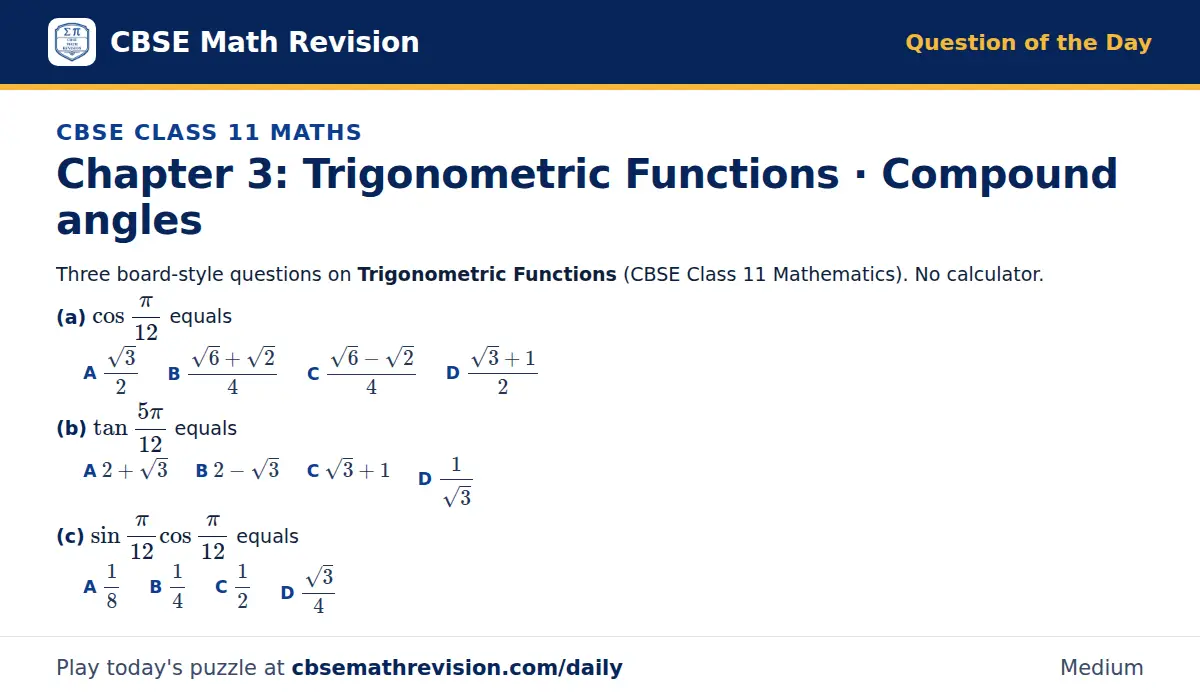
Chapter 3: Trigonometric Functions · Compound angles
Three board-style questions on Trigonometric Functions (CBSE Class 11 Mathematics). No calculator.
- cos(π)/12 equals Options: A) (√3)/2; B) (√6 + √2)/4; C) (√6 - √2)/4; D) (√3 + 1)/2
- tan(5π)/12 equals Options: A) 2 + √3; B) 2 - √3; C) √3 + 1; D) 1/(√3)
- sin(π)/12cos(π)/12 equals Options: A) 1/8; B) 1/4; C) 1/2; D) (√3)/4
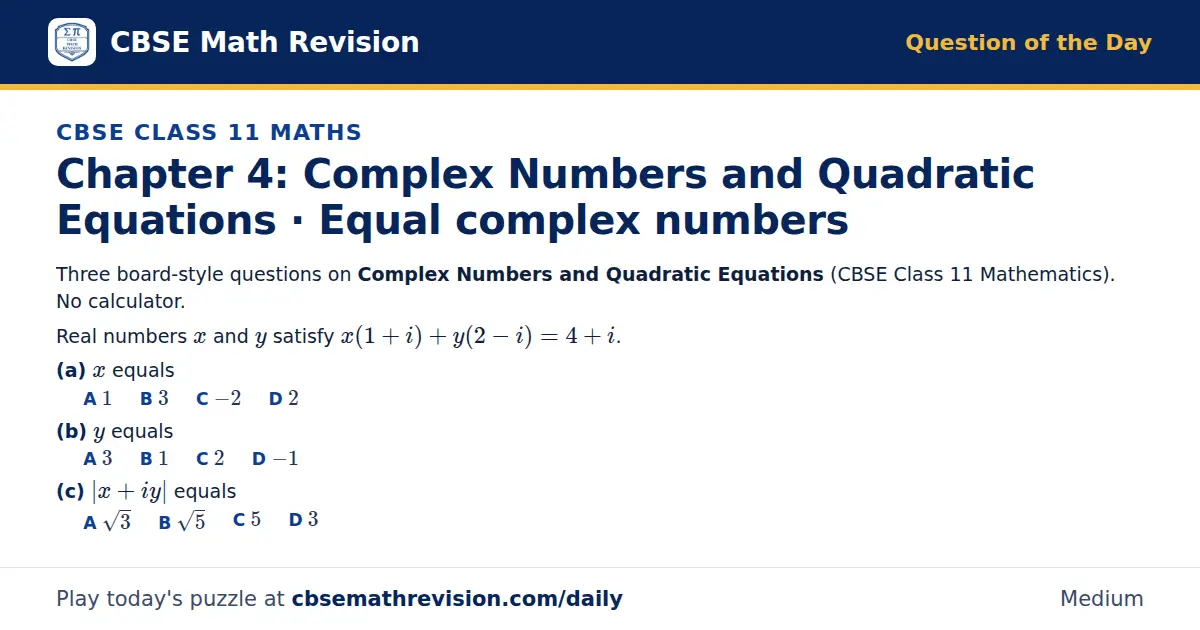
Chapter 4: Complex Numbers and Quadratic Equations · Equal complex numbers
Three board-style questions on Complex Numbers and Quadratic Equations (CBSE Class 11 Mathematics). No calculator. Real numbers x and y satisfy x(1 + i) + y(2 - i) = 4 + i.
- x equals Options: A) 1; B) 3; C) -2; D) 2
- y equals Options: A) 3; B) 1; C) 2; D) -1
- |x + iy| equals Options: A) √3; B) √5; C) 5; D) 3
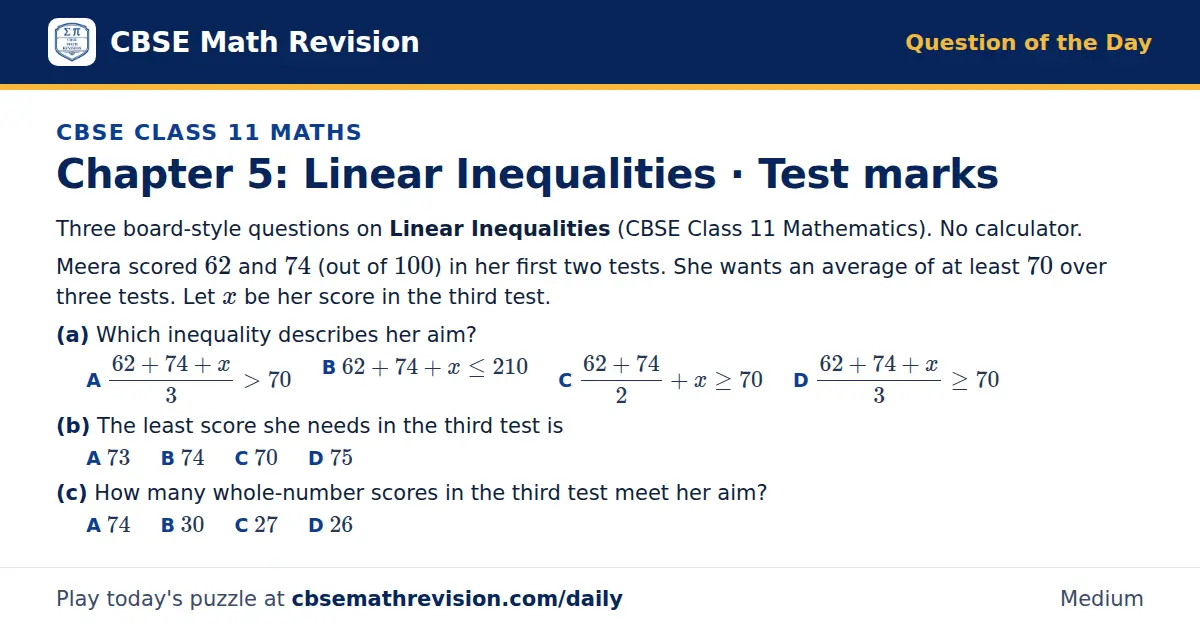
Chapter 5: Linear Inequalities · Test marks
Three board-style questions on Linear Inequalities (CBSE Class 11 Mathematics). No calculator. Meera scored 62 and 74 (out of 100) in her first two tests. She wants an average of at least 70 over three tests. Let x be her score in the third test.
- Which inequality describes her aim? Options: A) (62 + 74 + x)/3 > 70; B) 62 + 74 + x ≤ 210; C) (62 + 74)/2 + x ≥ 70; D) (62 + 74 + x)/3 ≥ 70
- The least score she needs in the third test is Options: A) 73; B) 74; C) 70; D) 75
- How many whole-number scores in the third test meet her aim? Options: A) 74; B) 30; C) 27; D) 26
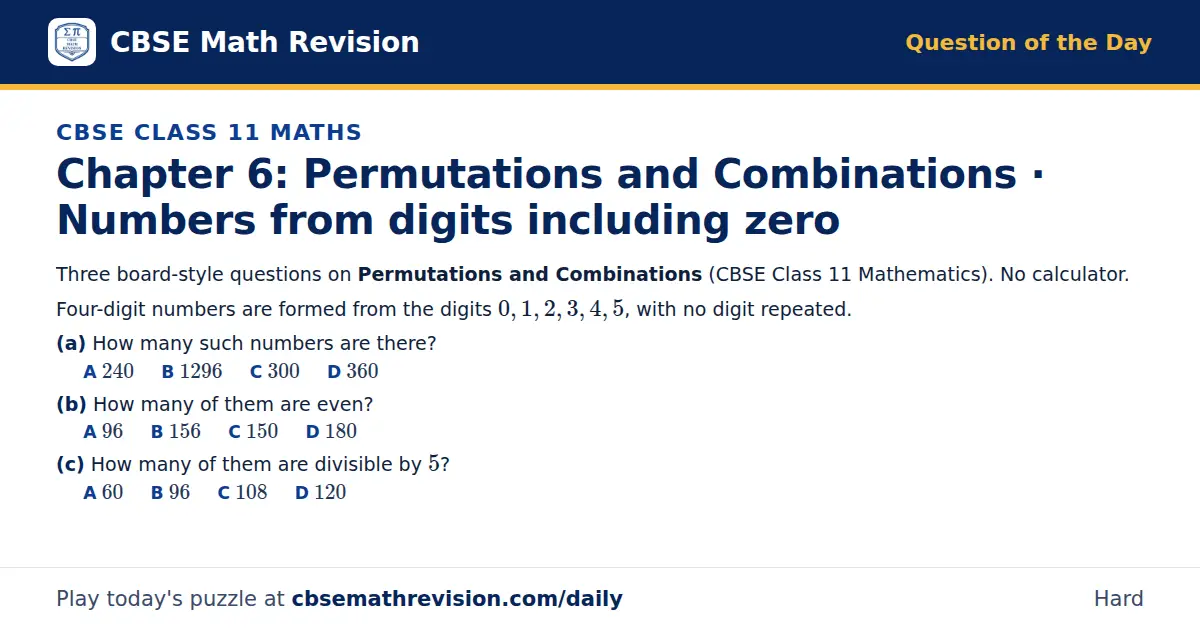
Chapter 6: Permutations and Combinations · Numbers from digits including zero
Three board-style questions on Permutations and Combinations (CBSE Class 11 Mathematics). No calculator. Four-digit numbers are formed from the digits 0, 1, 2, 3, 4, 5, with no digit repeated.
- How many such numbers are there? Options: A) 240; B) 1296; C) 300; D) 360
- How many of them are even? Options: A) 96; B) 156; C) 150; D) 180
- How many of them are divisible by 5? Options: A) 60; B) 96; C) 108; D) 120
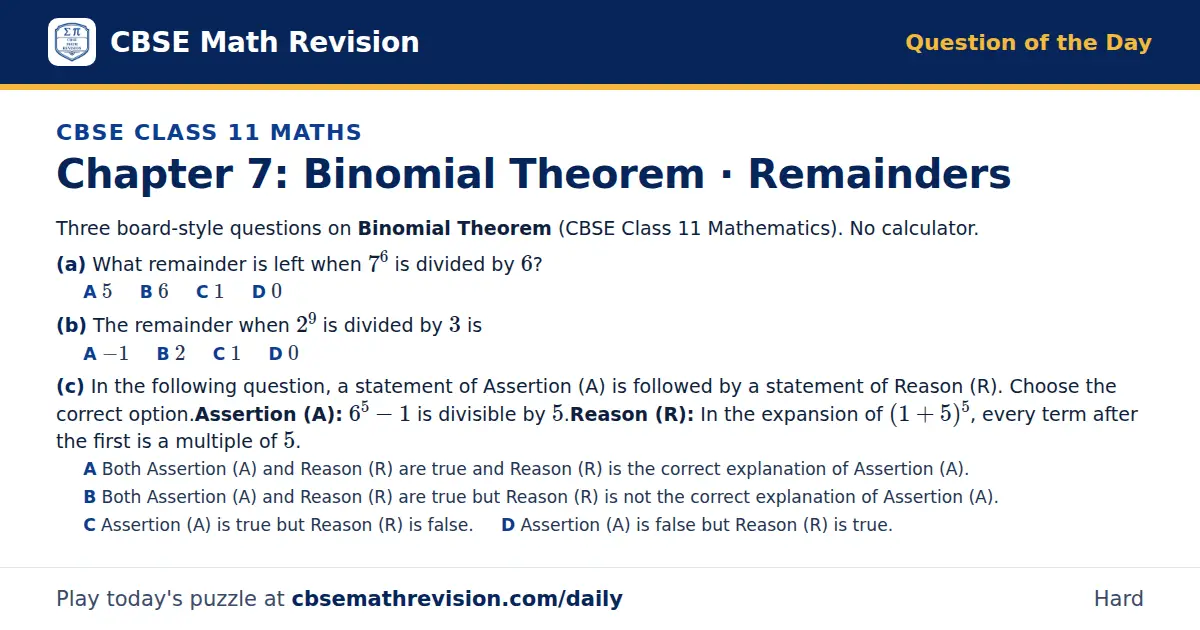
Chapter 7: Binomial Theorem · Remainders
Three board-style questions on Binomial Theorem (CBSE Class 11 Mathematics). No calculator.
- What remainder is left when 7⁶ is divided by 6? Options: A) 5; B) 6; C) 1; D) 0
- The remainder when 2⁹ is divided by 3 is Options: A) -1; B) 2; C) 1; D) 0
- In the following question, a statement of Assertion (A) is followed by a statement of Reason (R). Choose the correct option. Assertion (A): 6⁵ - 1 is divisible by 5. Reason (R): In the expansion of (1 + 5)⁵, every term after the first is a multiple of 5. Options: A) Both Assertion (A) and Reason (R) are true and Reason (R) is the correct explanation of Assertion (A).; B) Both Assertion (A) and Reason (R) are true but Reason (R) is not the correct explanation of Assertion (A).; C) Assertion (A) is true but Reason (R) is false.; D) Assertion (A) is false but Reason (R) is true.
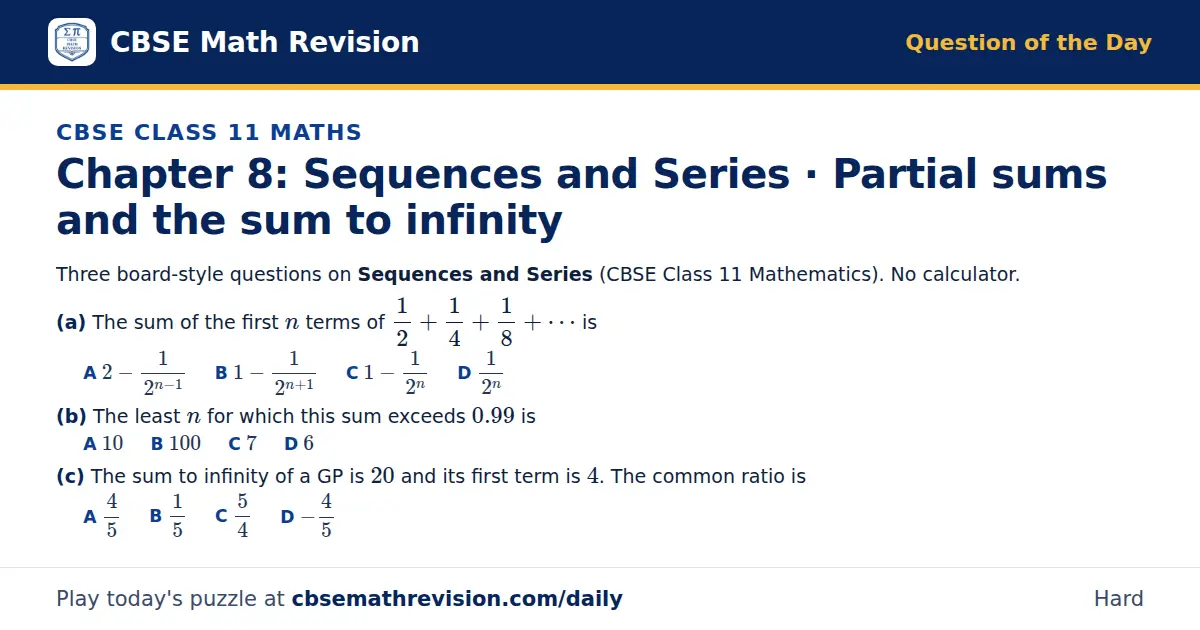
Chapter 8: Sequences and Series · Partial sums and the sum to infinity
Three board-style questions on Sequences and Series (CBSE Class 11 Mathematics). No calculator.
- The sum of the first n terms of 12 + 14 + 18 + … is Options: A) 2 - 1/(2^(n-1)); B) 1 - 1/(2^(n+1)); C) 1 - 1/(2^n); D) 1/(2^n)
- The least n for which this sum exceeds 0.99 is Options: A) 10; B) 100; C) 7; D) 6
- The sum to infinity of a GP is 20 and its first term is 4. The common ratio is Options: A) 4/5; B) 1/5; C) 5/4; D) - 4/5
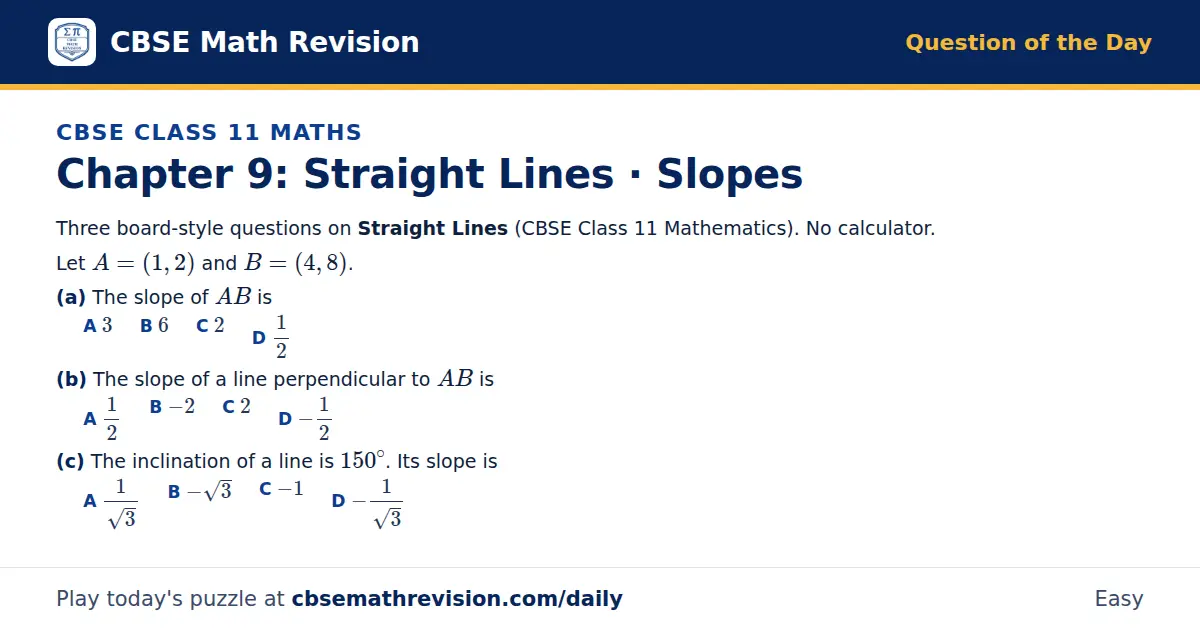
Chapter 9: Straight Lines · Slopes
Three board-style questions on Straight Lines (CBSE Class 11 Mathematics). No calculator. Let A = (1, 2) and B = (4, 8).
- The slope of AB is Options: A) 3; B) 6; C) 2; D) 1/2
- The slope of a line perpendicular to AB is Options: A) 1/2; B) -2; C) 2; D) - 1/2
- The inclination of a line is 150^∘. Its slope is Options: A) 1/(√3); B) -√3; C) -1; D) -1/(√3)
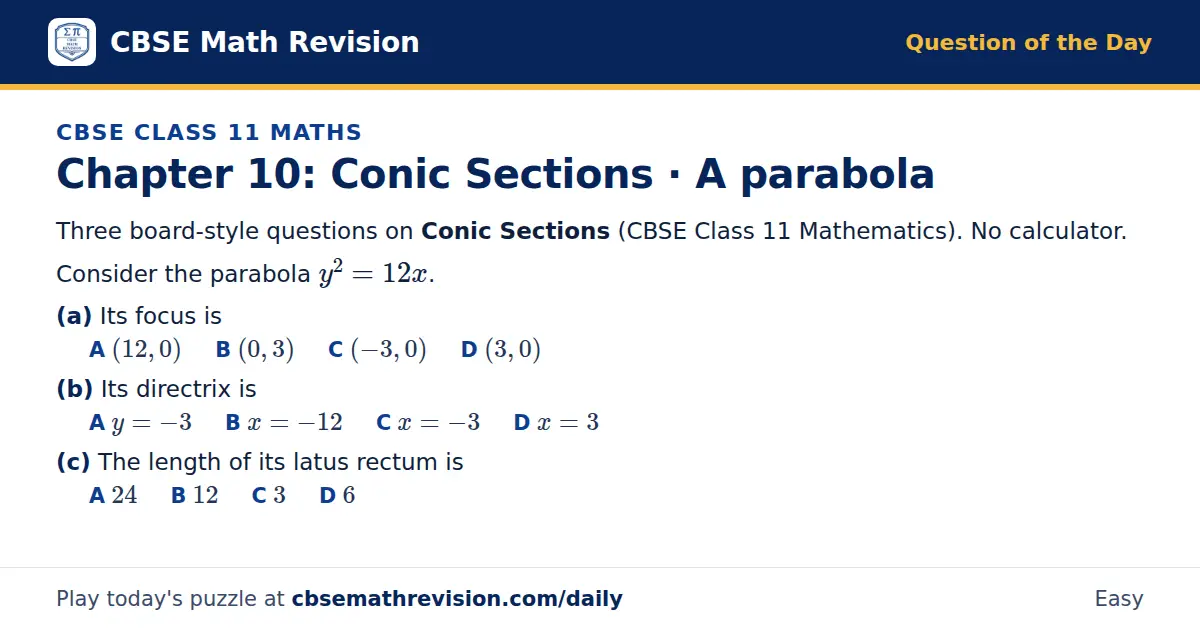
Chapter 10: Conic Sections · A parabola
Three board-style questions on Conic Sections (CBSE Class 11 Mathematics). No calculator. Consider the parabola y² = 12x.
- Its focus is Options: A) (12, 0); B) (0, 3); C) (-3, 0); D) (3, 0)
- Its directrix is Options: A) y = -3; B) x = -12; C) x = -3; D) x = 3
- The length of its latus rectum is Options: A) 24; B) 12; C) 3; D) 6
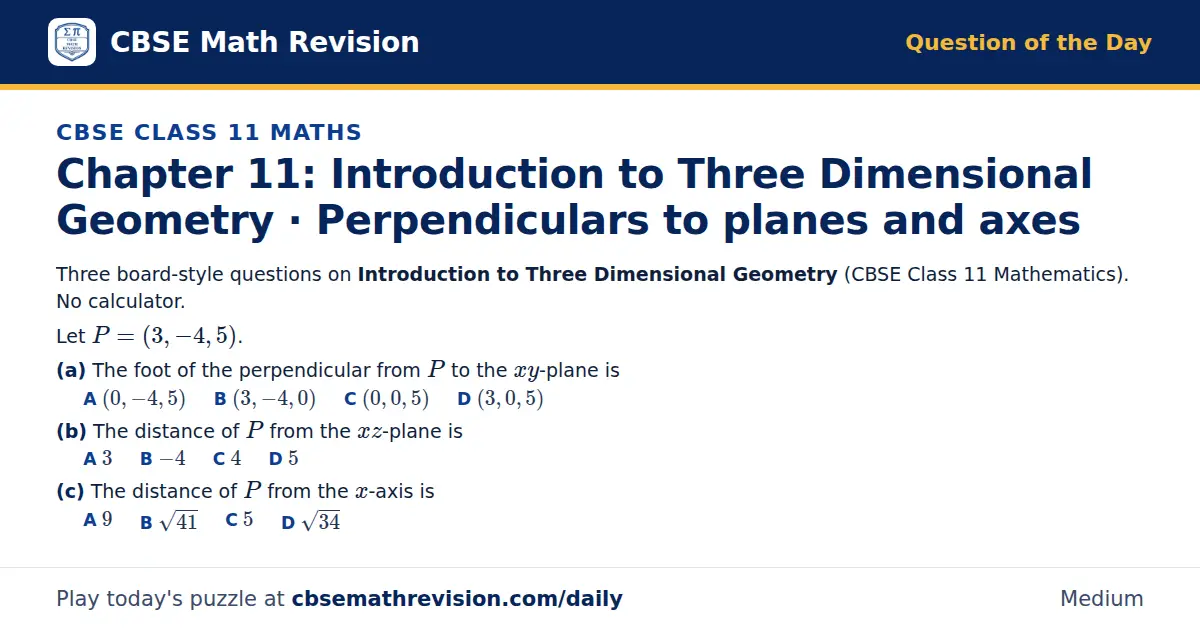
Chapter 11: Introduction to Three Dimensional Geometry · Perpendiculars to planes and axes
Three board-style questions on Introduction to Three Dimensional Geometry (CBSE Class 11 Mathematics). No calculator. Let P = (3, -4, 5).
- The foot of the perpendicular from P to the xy-plane is Options: A) (0, -4, 5); B) (3, -4, 0); C) (0, 0, 5); D) (3, 0, 5)
- The distance of P from the xz-plane is Options: A) 3; B) -4; C) 4; D) 5
- The distance of P from the x-axis is Options: A) 9; B) √41; C) 5; D) √34
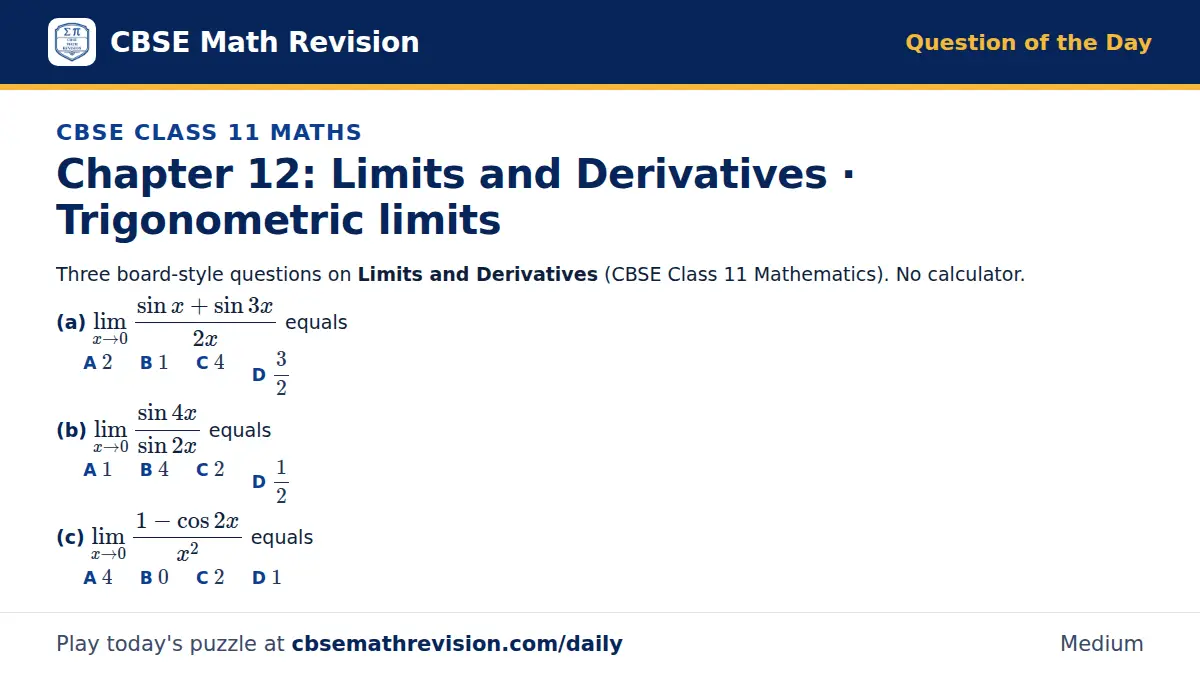
Chapter 12: Limits and Derivatives · Trigonometric limits
Three board-style questions on Limits and Derivatives (CBSE Class 11 Mathematics). No calculator.
- lim_x → 0 (sin x + sin 3x)/2x equals Options: A) 2; B) 1; C) 4; D) 3/2
- lim_x → 0 (sin 4x)/(sin 2x) equals Options: A) 1; B) 4; C) 2; D) 1/2
- lim_x → 0 (1 - cos 2x)/(x²) equals Options: A) 4; B) 0; C) 2; D) 1
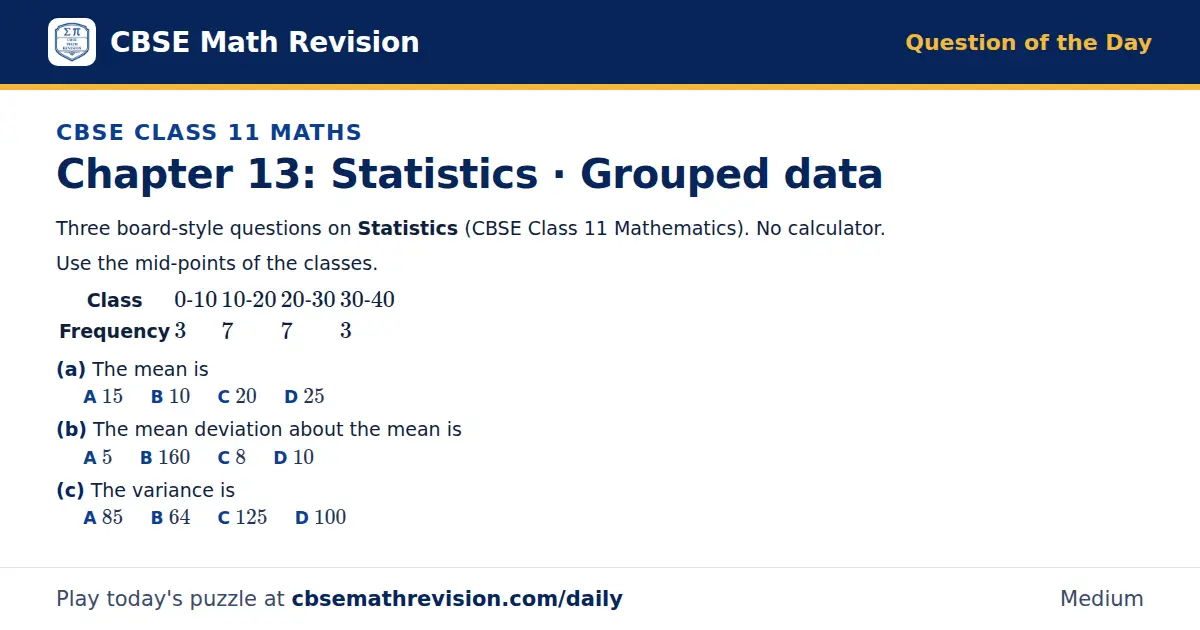
Chapter 13: Statistics · Grouped data
Three board-style questions on Statistics (CBSE Class 11 Mathematics). No calculator. Use the mid-points of the classes. Class0-1010-2020-3030-40Frequency3773
- The mean is Options: A) 15; B) 10; C) 20; D) 25
- The mean deviation about the mean is Options: A) 5; B) 160; C) 8; D) 10
- The variance is Options: A) 85; B) 64; C) 125; D) 100
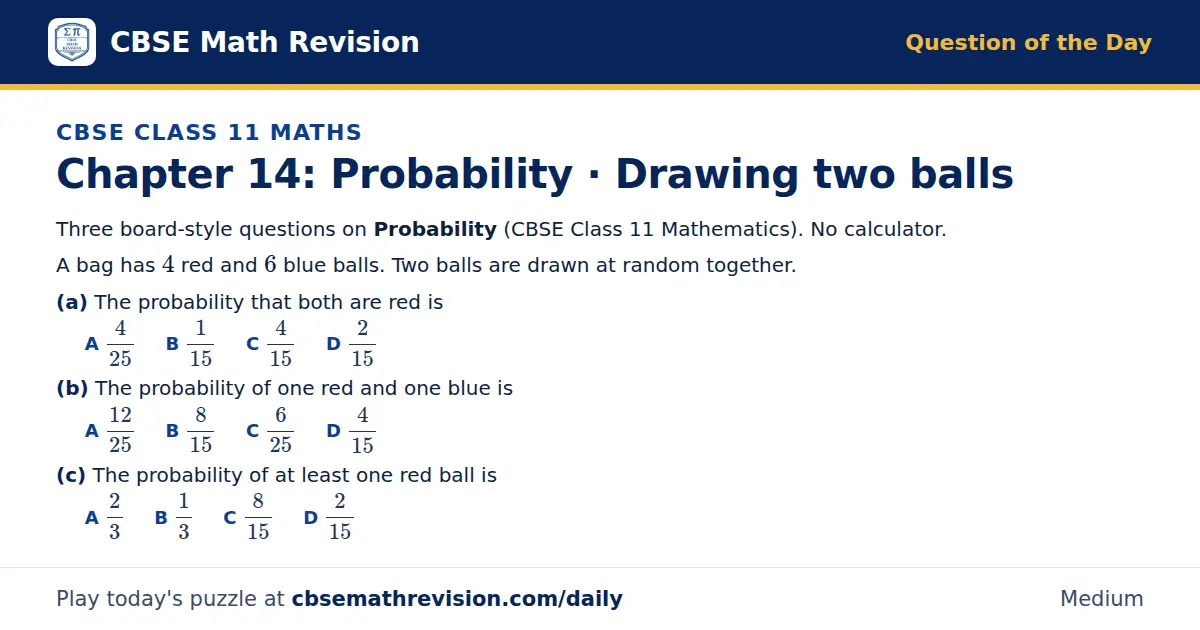
Chapter 14: Probability · Drawing two balls
Three board-style questions on Probability (CBSE Class 11 Mathematics). No calculator. A bag has 4 red and 6 blue balls. Two balls are drawn at random together.
- The probability that both are red is Options: A) 4/25; B) 1/15; C) 4/15; D) 2/15
- The probability of one red and one blue is Options: A) 12/25; B) 8/15; C) 6/25; D) 4/15
- The probability of at least one red ball is Options: A) 2/3; B) 1/3; C) 8/15; D) 2/15
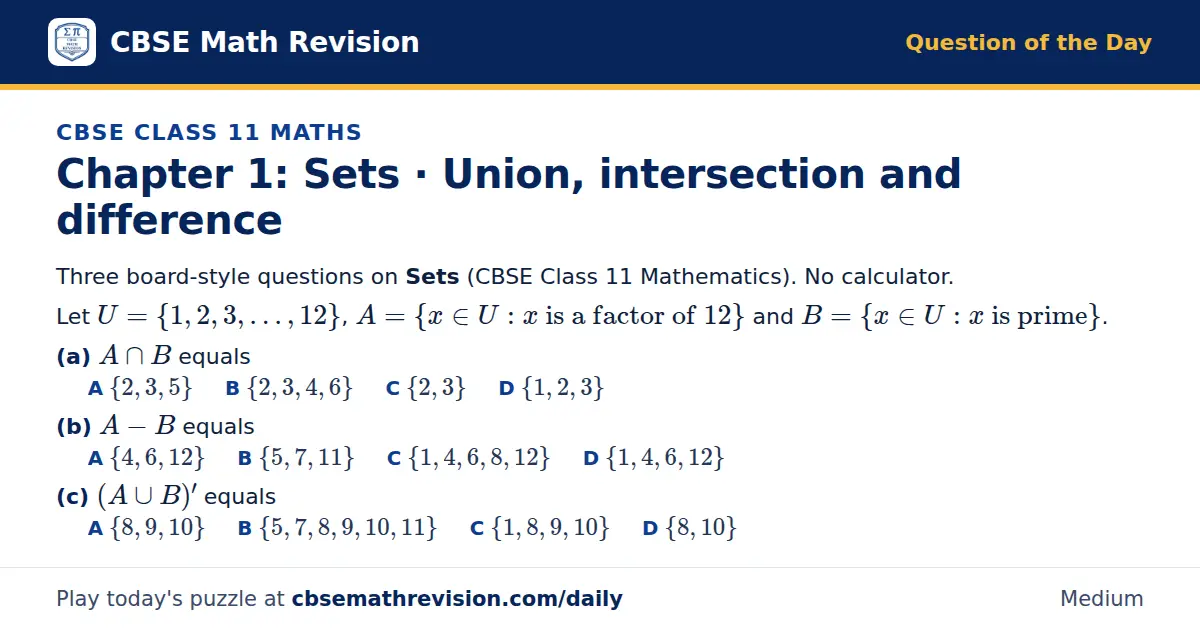
Chapter 1: Sets · Union, intersection and difference
Three board-style questions on Sets (CBSE Class 11 Mathematics). No calculator. Let U = 1, 2, 3, …, 12, A = x ∈ U: x is a factor of 12 and B = x ∈ U: x is prime.
- A ∩ B equals Options: A) 2, 3, 5; B) 2, 3, 4, 6; C) 2, 3; D) 1, 2, 3
- A - B equals Options: A) 4, 6, 12; B) 5, 7, 11; C) 1, 4, 6, 8, 12; D) 1, 4, 6, 12
- (A ∪ B)' equals Options: A) 8, 9, 10; B) 5, 7, 8, 9, 10, 11; C) 1, 8, 9, 10; D) 8, 10
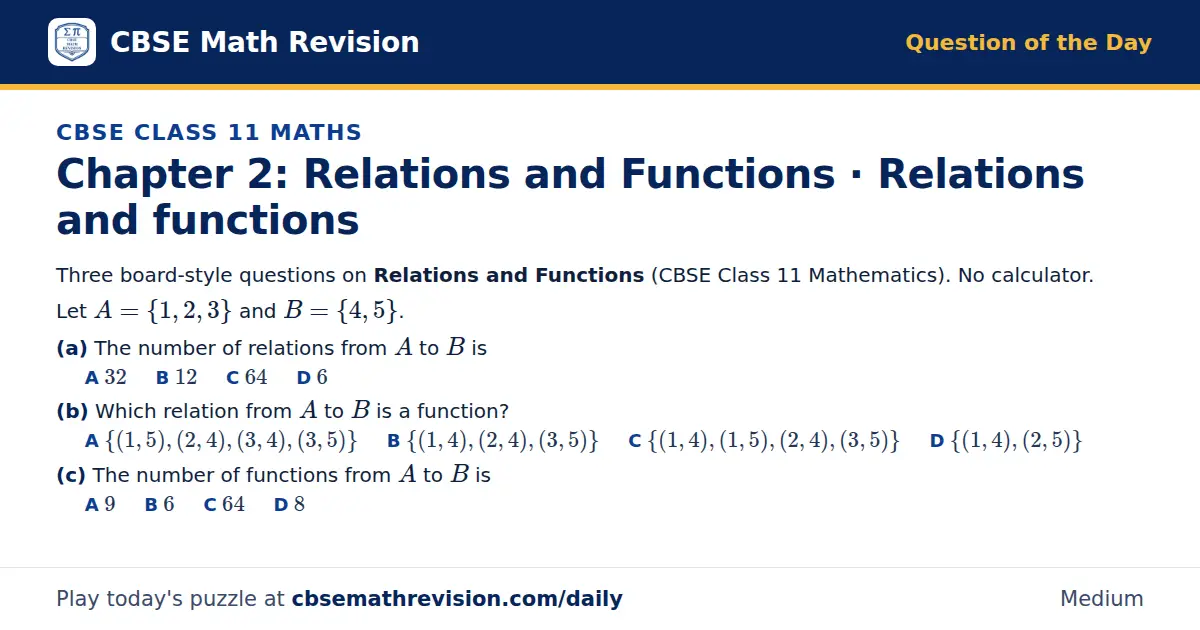
Chapter 2: Relations and Functions · Relations and functions
Three board-style questions on Relations and Functions (CBSE Class 11 Mathematics). No calculator. Let A = 1, 2, 3 and B = 4, 5.
- The number of relations from A to B is Options: A) 32; B) 12; C) 64; D) 6
- Which relation from A to B is a function? Options: A) (1, 5), (2, 4), (3, 4), (3, 5); B) (1, 4), (2, 4), (3, 5); C) (1, 4), (1, 5), (2, 4), (3, 5); D) (1, 4), (2, 5)
- The number of functions from A to B is Options: A) 9; B) 6; C) 64; D) 8
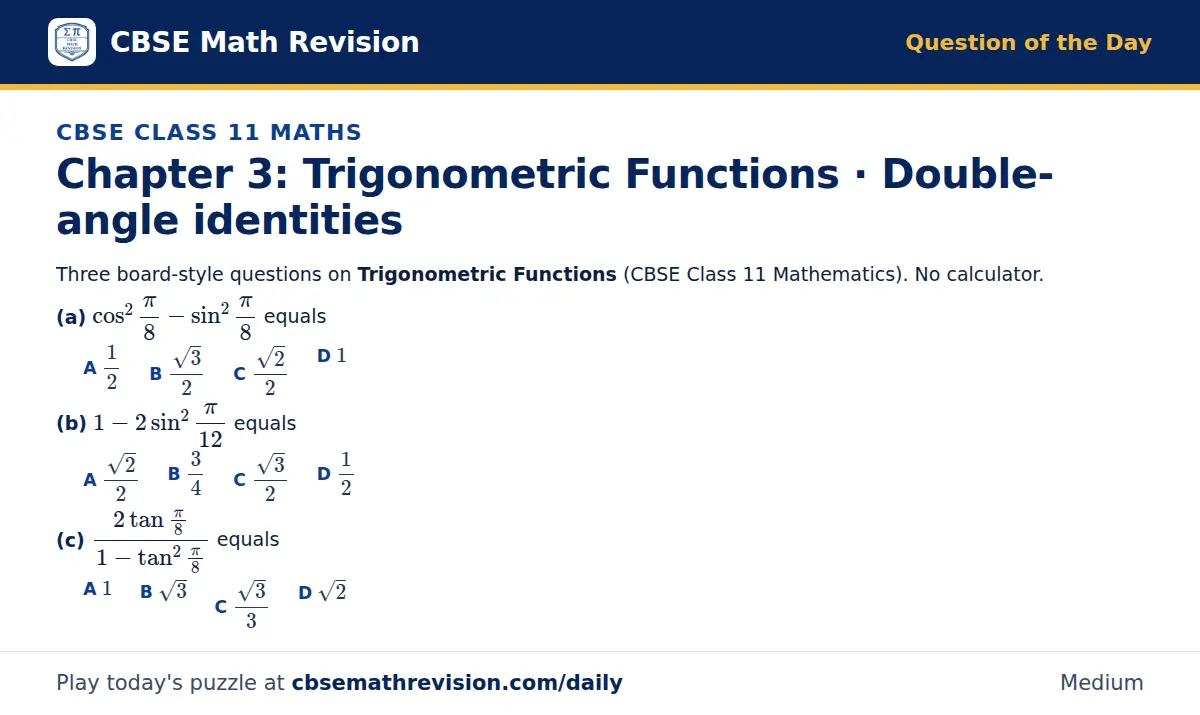
Chapter 3: Trigonometric Functions · Double-angle identities
Three board-style questions on Trigonometric Functions (CBSE Class 11 Mathematics). No calculator.
- cos²(π)/8 - sin²(π)/8 equals Options: A) 1/2; B) (√3)/2; C) (√2)/2; D) 1
- 1 - 2sin²(π)/12 equals Options: A) (√2)/2; B) 3/4; C) (√3)/2; D) 1/2
- (2tan(π)/8)/(1 - tan²(π)/8) equals Options: A) 1; B) √3; C) (√3)/3; D) √2
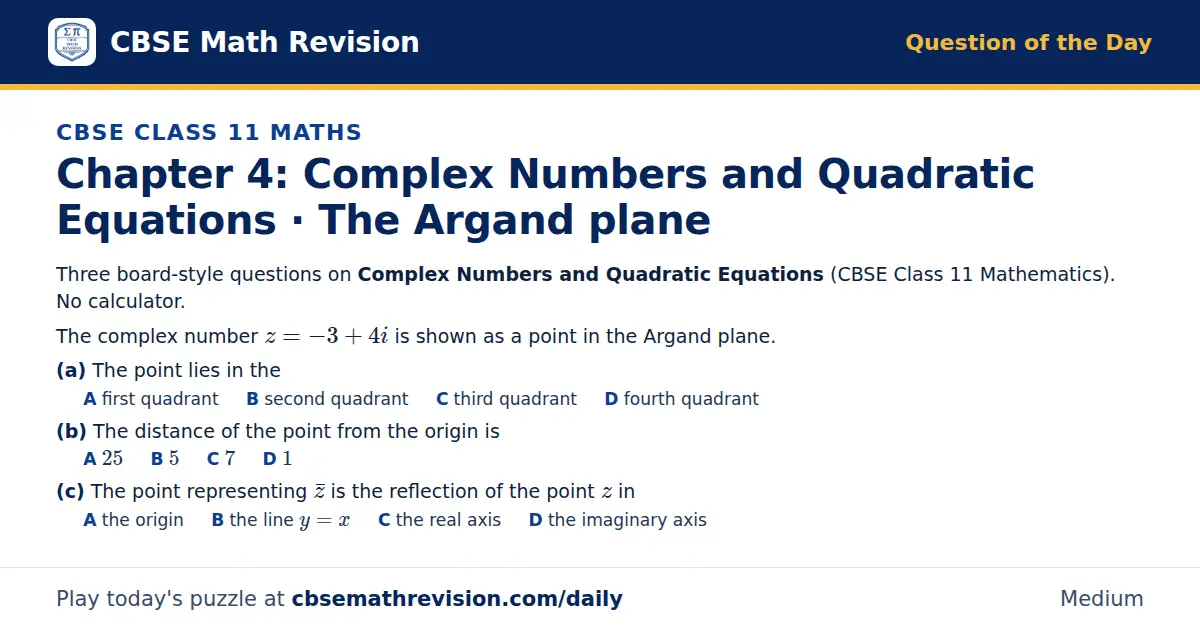
Chapter 4: Complex Numbers and Quadratic Equations · The Argand plane
Three board-style questions on Complex Numbers and Quadratic Equations (CBSE Class 11 Mathematics). No calculator. The complex number z = -3 + 4i is shown as a point in the Argand plane.
- The point lies in the Options: A) first quadrant; B) second quadrant; C) third quadrant; D) fourth quadrant
- The distance of the point from the origin is Options: A) 25; B) 5; C) 7; D) 1
- The point representing z is the reflection of the point z in Options: A) the origin; B) the line y = x; C) the real axis; D) the imaginary axis
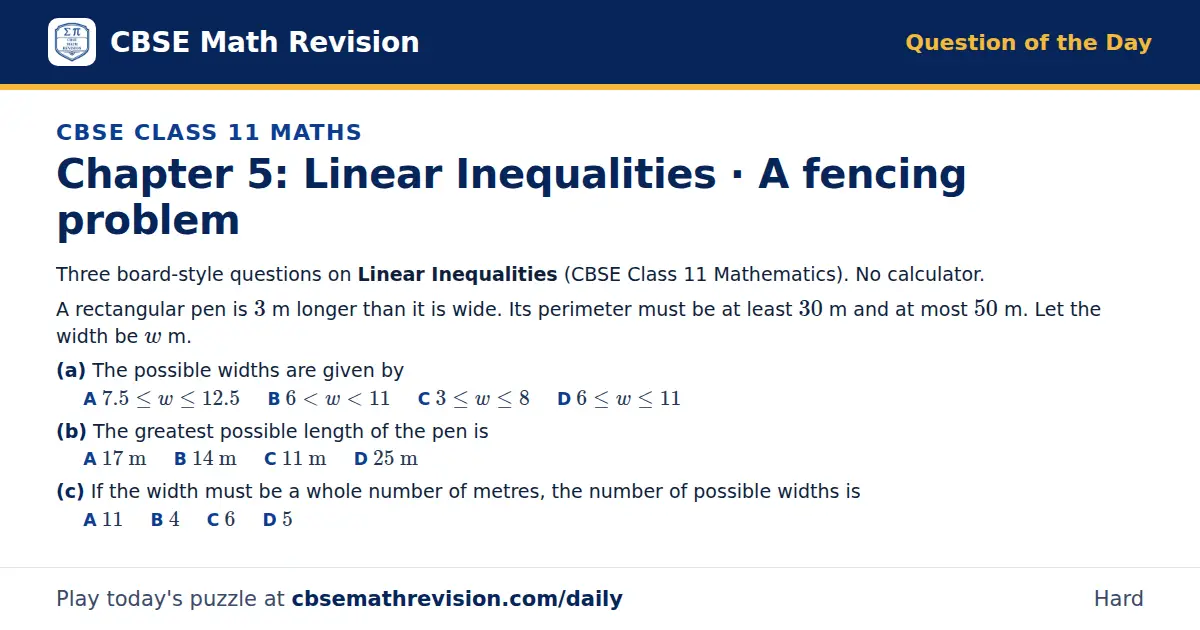
Chapter 5: Linear Inequalities · A fencing problem
Three board-style questions on Linear Inequalities (CBSE Class 11 Mathematics). No calculator. A rectangular pen is 3 m longer than it is wide. Its perimeter must be at least 30 m and at most 50 m. Let the width be w m.
- The possible widths are given by Options: A) 7.5 ≤ w ≤ 12.5; B) 6 < w < 11; C) 3 ≤ w ≤ 8; D) 6 ≤ w ≤ 11
- The greatest possible length of the pen is Options: A) 17 m; B) 14 m; C) 11 m; D) 25 m
- If the width must be a whole number of metres, the number of possible widths is Options: A) 11; B) 4; C) 6; D) 5
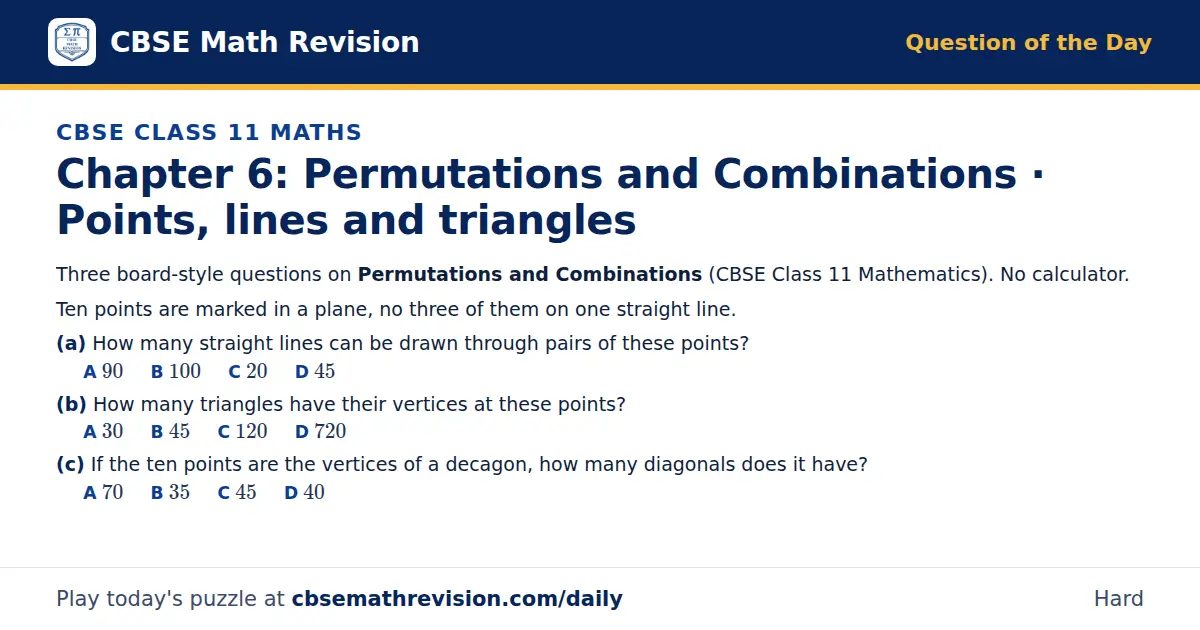
Chapter 6: Permutations and Combinations · Points, lines and triangles
Three board-style questions on Permutations and Combinations (CBSE Class 11 Mathematics). No calculator. Ten points are marked in a plane, no three of them on one straight line.
- How many straight lines can be drawn through pairs of these points? Options: A) 90; B) 100; C) 20; D) 45
- How many triangles have their vertices at these points? Options: A) 30; B) 45; C) 120; D) 720
- If the ten points are the vertices of a decagon, how many diagonals does it have? Options: A) 70; B) 35; C) 45; D) 40
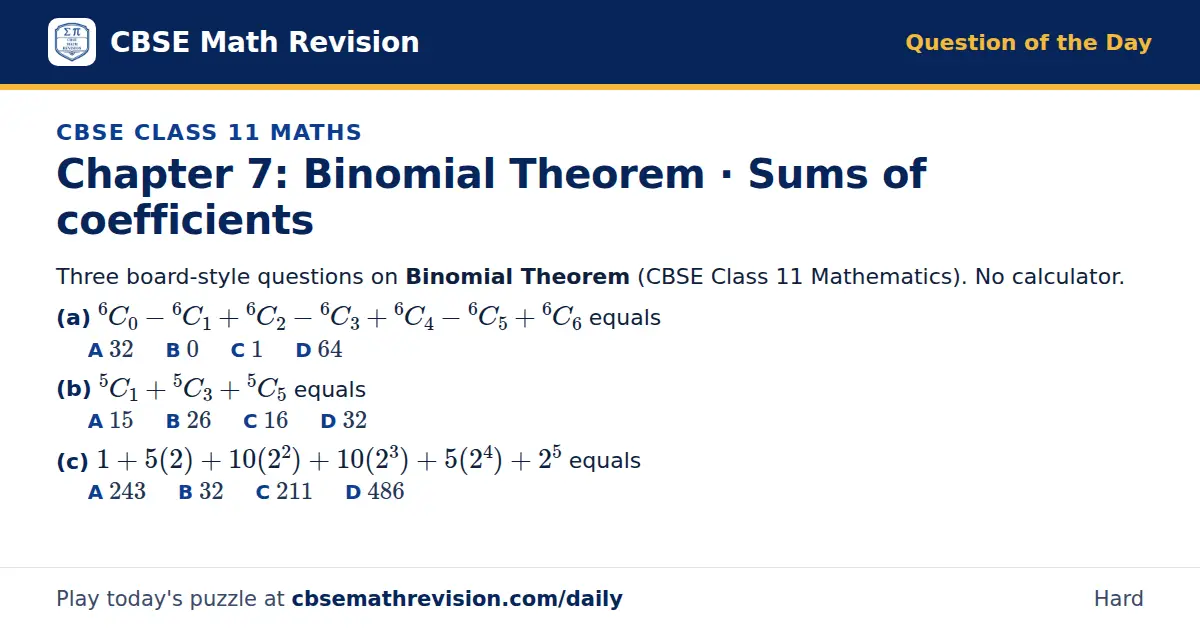
Chapter 7: Binomial Theorem · Sums of coefficients
Three board-style questions on Binomial Theorem (CBSE Class 11 Mathematics). No calculator.
- ⁶C_0 - ⁶C_1 + ⁶C_2 - ⁶C_3 + ⁶C_4 - ⁶C_5 + ⁶C_6 equals Options: A) 32; B) 0; C) 1; D) 64
- ⁵C_1 + ⁵C_3 + ⁵C_5 equals Options: A) 15; B) 26; C) 16; D) 32
- 1 + 5(2) + 10(2²) + 10(2³) + 5(2⁴) + 2⁵ equals Options: A) 243; B) 32; C) 211; D) 486
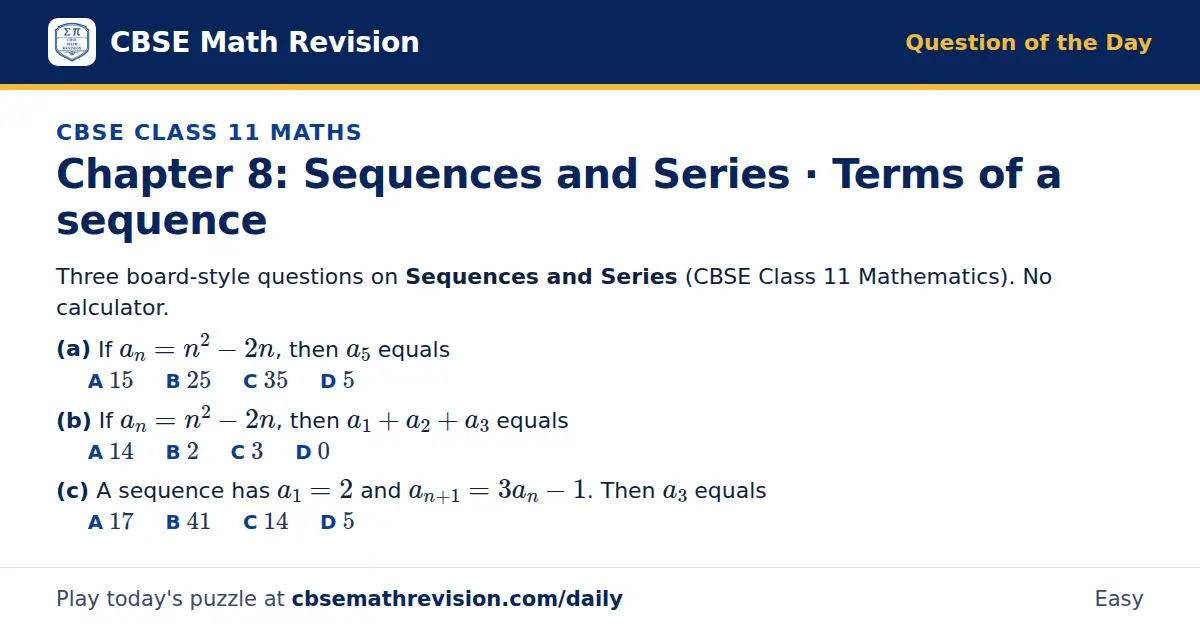
Chapter 8: Sequences and Series · Terms of a sequence
Three board-style questions on Sequences and Series (CBSE Class 11 Mathematics). No calculator.
- If a_n = n² - 2n, then a_5 equals Options: A) 15; B) 25; C) 35; D) 5
- If a_n = n² - 2n, then a_1 + a_2 + a_3 equals Options: A) 14; B) 2; C) 3; D) 0
- A sequence has a_1 = 2 and a_n+1 = 3a_n - 1. Then a_3 equals Options: A) 17; B) 41; C) 14; D) 5
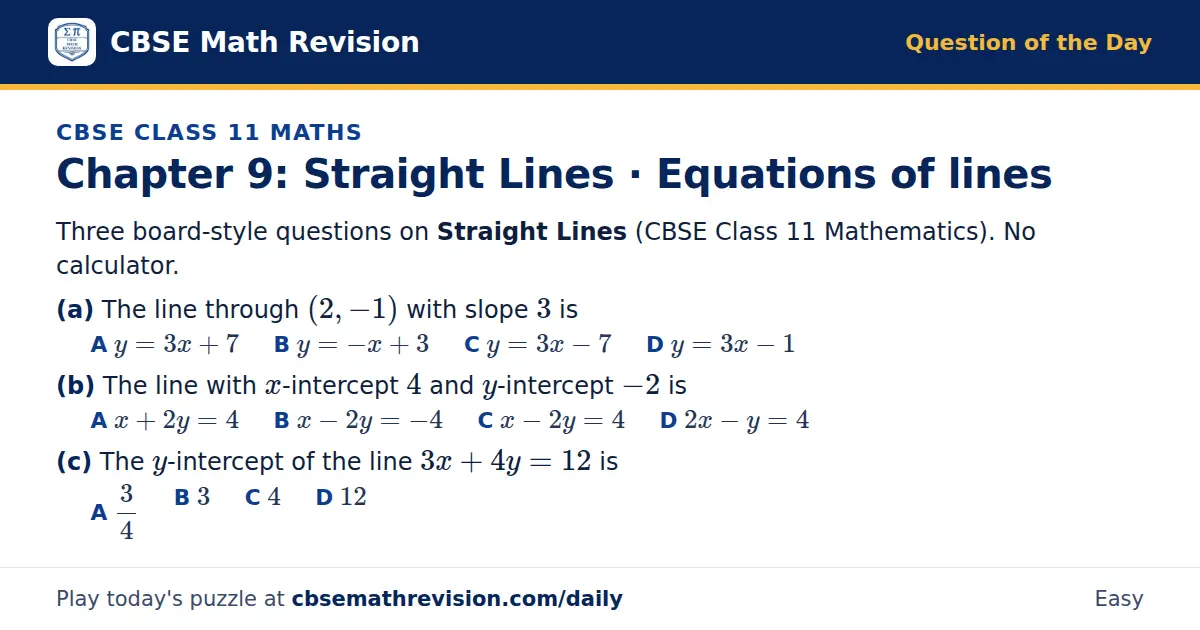
Chapter 9: Straight Lines · Equations of lines
Three board-style questions on Straight Lines (CBSE Class 11 Mathematics). No calculator.
- The line through (2, -1) with slope 3 is Options: A) y = 3x + 7; B) y = -x + 3; C) y = 3x - 7; D) y = 3x - 1
- The line with x-intercept 4 and y-intercept -2 is Options: A) x + 2y = 4; B) x - 2y = -4; C) x - 2y = 4; D) 2x - y = 4
- The y-intercept of the line 3x + 4y = 12 is Options: A) 3/4; B) 3; C) 4; D) 12
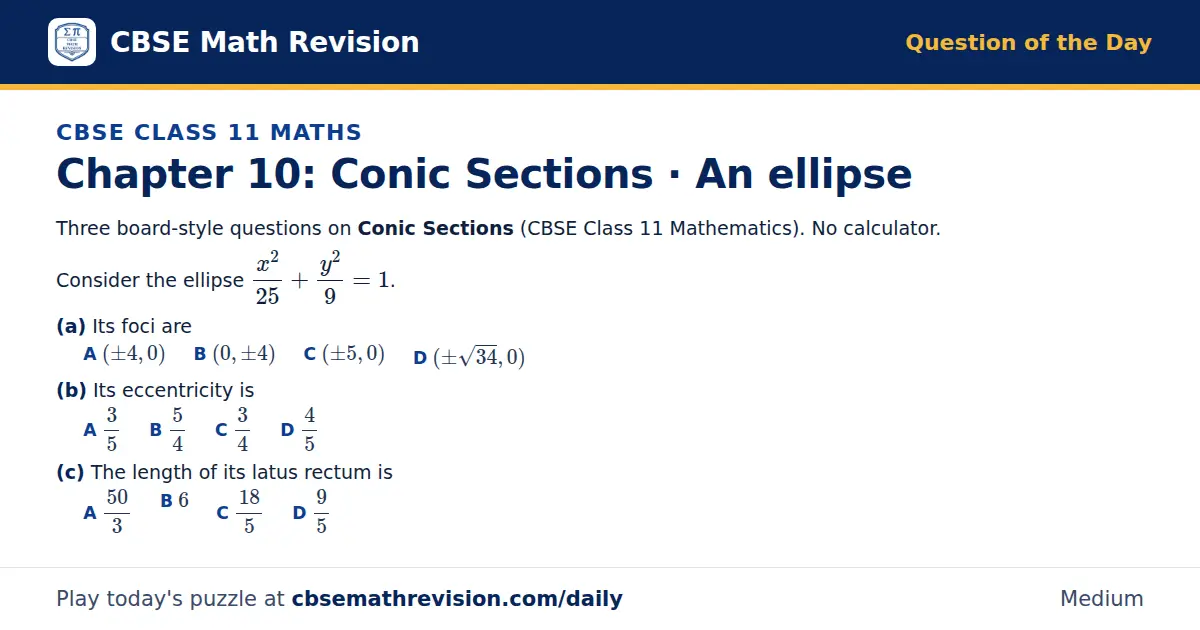
Chapter 10: Conic Sections · An ellipse
Three board-style questions on Conic Sections (CBSE Class 11 Mathematics). No calculator. Consider the ellipse (x²)/25 + (y²)/9 = 1.
- Its foci are Options: A) (± 4, 0); B) (0, ± 4); C) (± 5, 0); D) (± √34, 0)
- Its eccentricity is Options: A) 3/5; B) 5/4; C) 3/4; D) 4/5
- The length of its latus rectum is Options: A) 50/3; B) 6; C) 18/5; D) 9/5
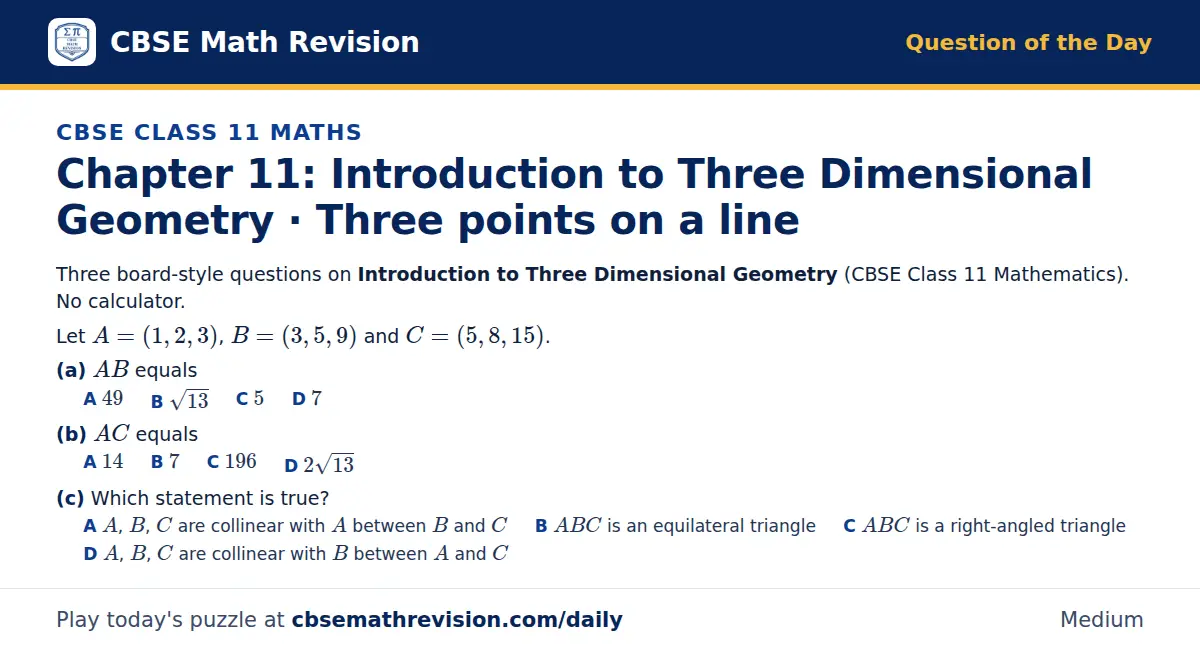
Chapter 11: Introduction to Three Dimensional Geometry · Three points on a line
Three board-style questions on Introduction to Three Dimensional Geometry (CBSE Class 11 Mathematics). No calculator. Let A = (1, 2, 3), B = (3, 5, 9) and C = (5, 8, 15).
- AB equals Options: A) 49; B) √13; C) 5; D) 7
- AC equals Options: A) 14; B) 7; C) 196; D) 2 √13
- Which statement is true? Options: A) A, B, C are collinear with A between B and C; B) ABC is an equilateral triangle; C) ABC is a right-angled triangle; D) A, B, C are collinear with B between A and C
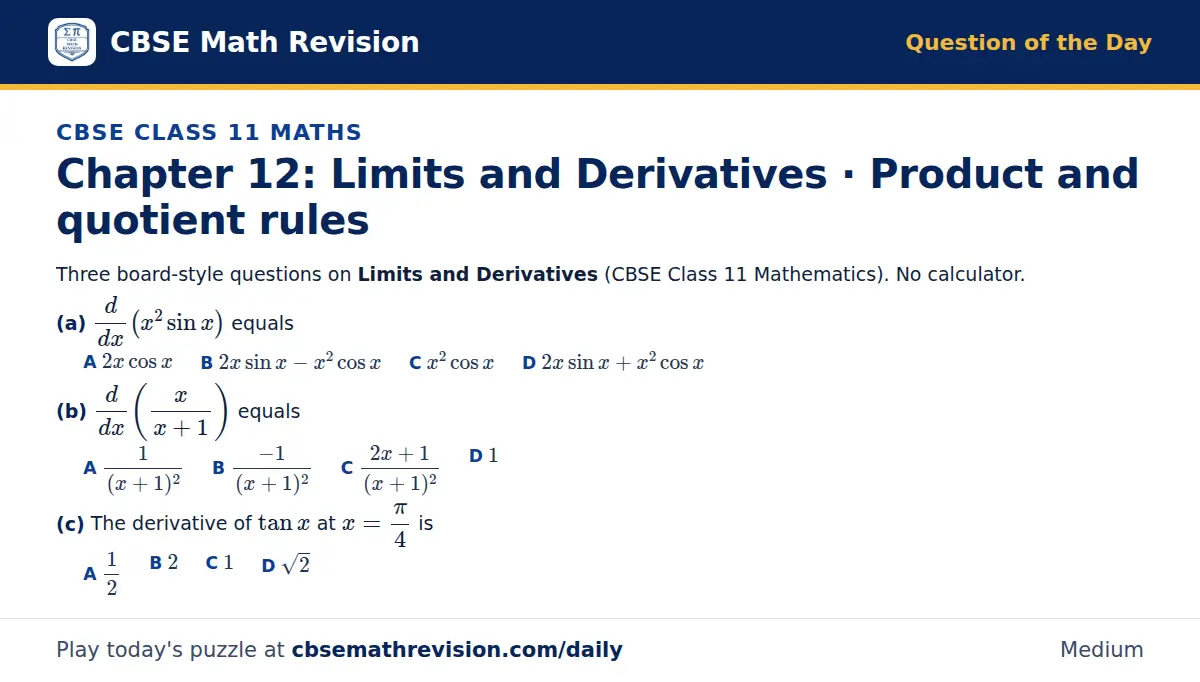
Chapter 12: Limits and Derivatives · Product and quotient rules
Three board-style questions on Limits and Derivatives (CBSE Class 11 Mathematics). No calculator.
- d/dx(x² sin x) equals Options: A) 2xcos x; B) 2xsin x - x²cos x; C) x²cos x; D) 2xsin x + x²cos x
- d/dx(x/(x + 1)) equals Options: A) 1/((x + 1)²); B) (-1)/((x + 1)²); C) (2x + 1)/((x + 1)²); D) 1
- The derivative of tan x at x = (π)/4 is Options: A) 1/2; B) 2; C) 1; D) √2
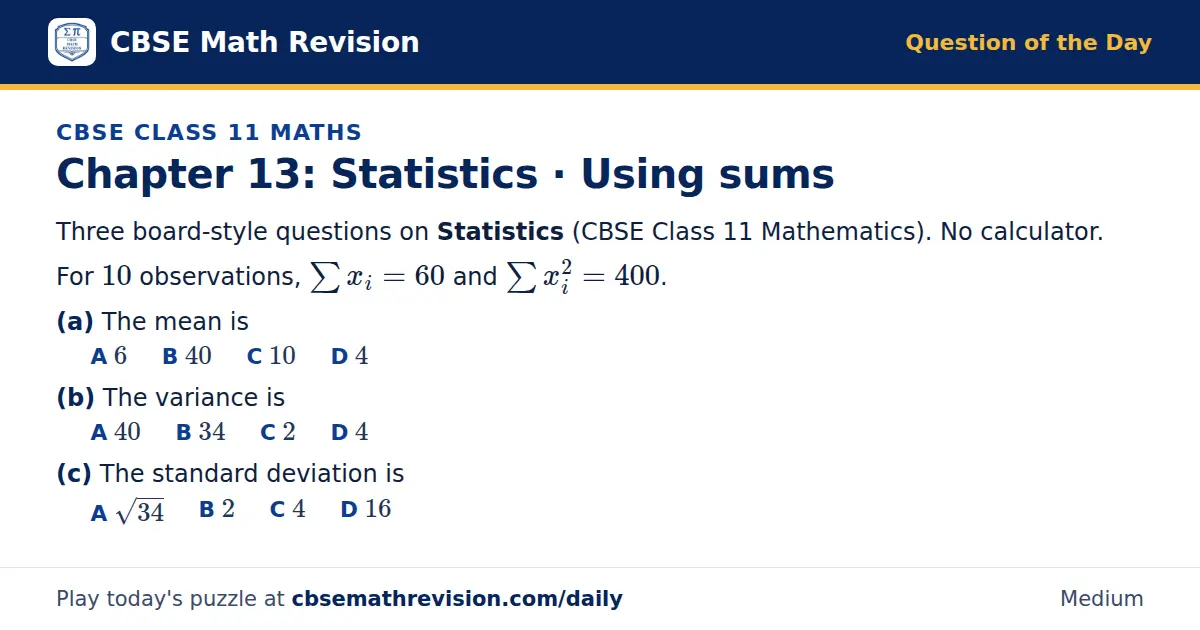
Chapter 13: Statistics · Using sums
Three board-style questions on Statistics (CBSE Class 11 Mathematics). No calculator. For 10 observations, Σ x_i = 60 and Σ x_i² = 400.
- The mean is Options: A) 6; B) 40; C) 10; D) 4
- The variance is Options: A) 40; B) 34; C) 2; D) 4
- The standard deviation is Options: A) √34; B) 2; C) 4; D) 16
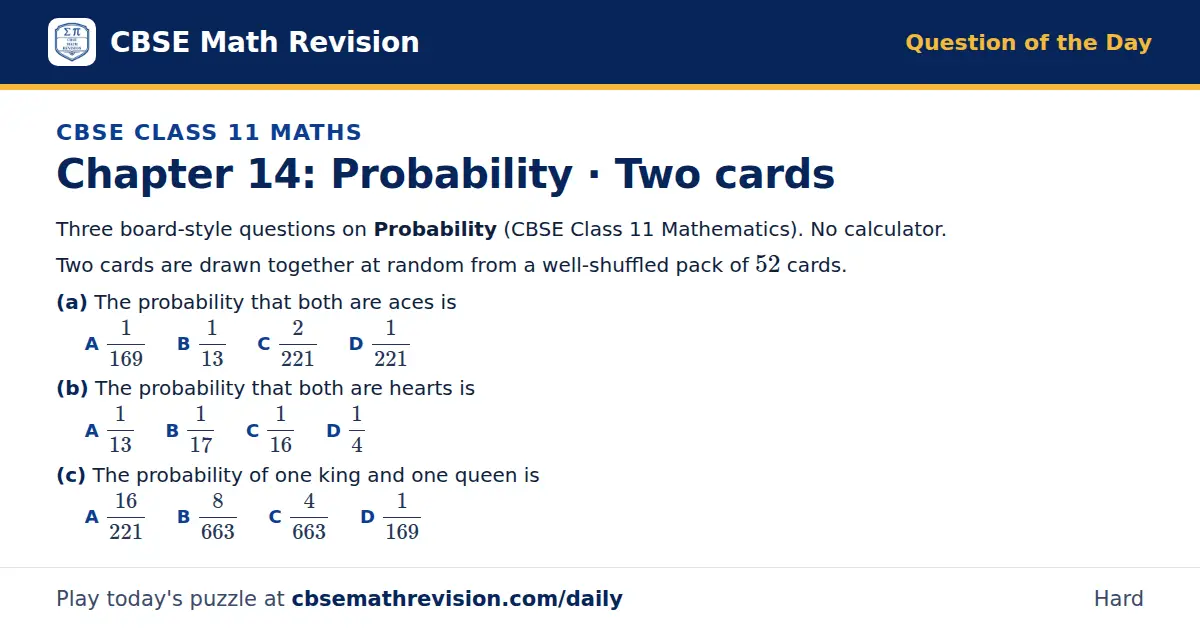
Chapter 14: Probability · Two cards
Three board-style questions on Probability (CBSE Class 11 Mathematics). No calculator. Two cards are drawn together at random from a well-shuffled pack of 52 cards.
- The probability that both are aces is Options: A) 1/169; B) 1/13; C) 2/221; D) 1/221
- The probability that both are hearts is Options: A) 1/13; B) 1/17; C) 1/16; D) 1/4
- The probability of one king and one queen is Options: A) 16/221; B) 8/663; C) 4/663; D) 1/169
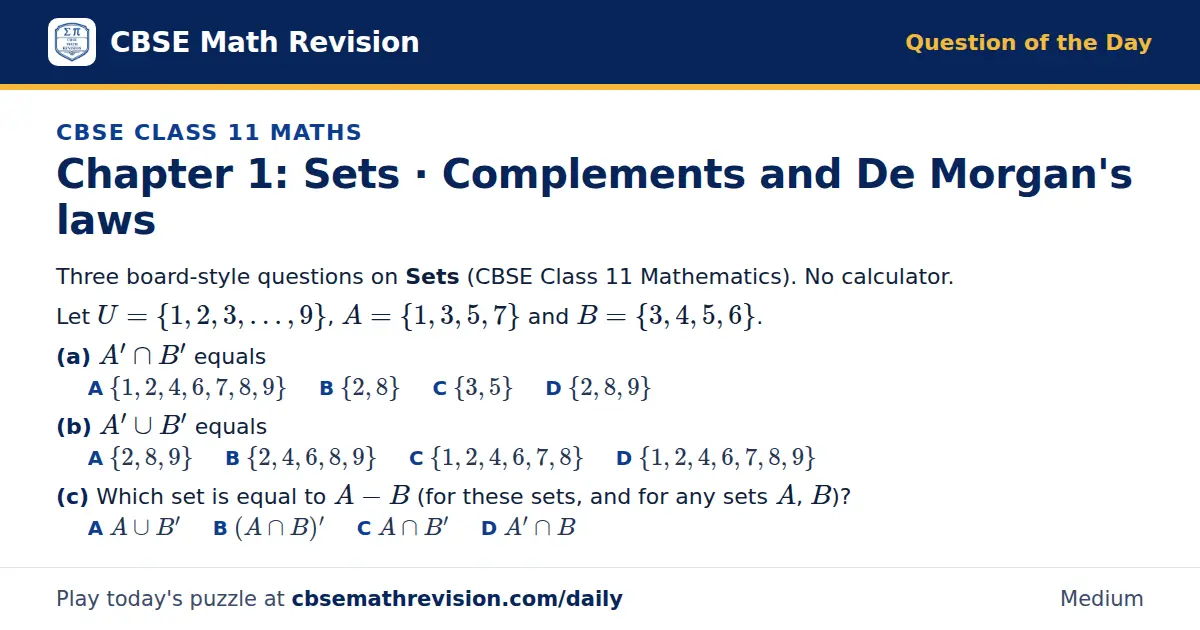
Chapter 1: Sets · Complements and De Morgan's laws
Three board-style questions on Sets (CBSE Class 11 Mathematics). No calculator. Let U = 1, 2, 3, …, 9, A = 1, 3, 5, 7 and B = 3, 4, 5, 6.
- A' ∩ B' equals Options: A) 1, 2, 4, 6, 7, 8, 9; B) 2, 8; C) 3, 5; D) 2, 8, 9
- A' ∪ B' equals Options: A) 2, 8, 9; B) 2, 4, 6, 8, 9; C) 1, 2, 4, 6, 7, 8; D) 1, 2, 4, 6, 7, 8, 9
- Which set is equal to A - B (for these sets, and for any sets A, B)? Options: A) A ∪ B'; B) (A ∩ B)'; C) A ∩ B'; D) A' ∩ B
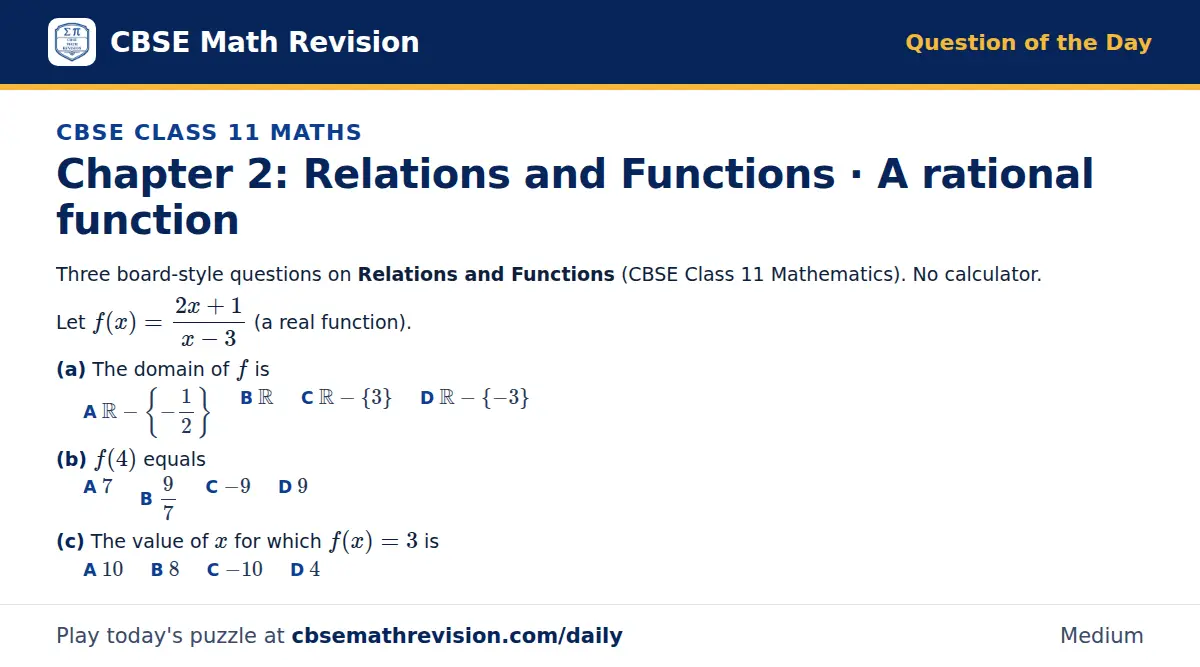
Chapter 2: Relations and Functions · A rational function
Three board-style questions on Relations and Functions (CBSE Class 11 Mathematics). No calculator. Let f(x) = (2x + 1)/(x - 3) (a real function).
- The domain of f is Options: A) ℝ - -12; B) ℝ; C) ℝ - 3; D) ℝ - -3
- f(4) equals Options: A) 7; B) 9/7; C) -9; D) 9
- The value of x for which f(x) = 3 is Options: A) 10; B) 8; C) -10; D) 4
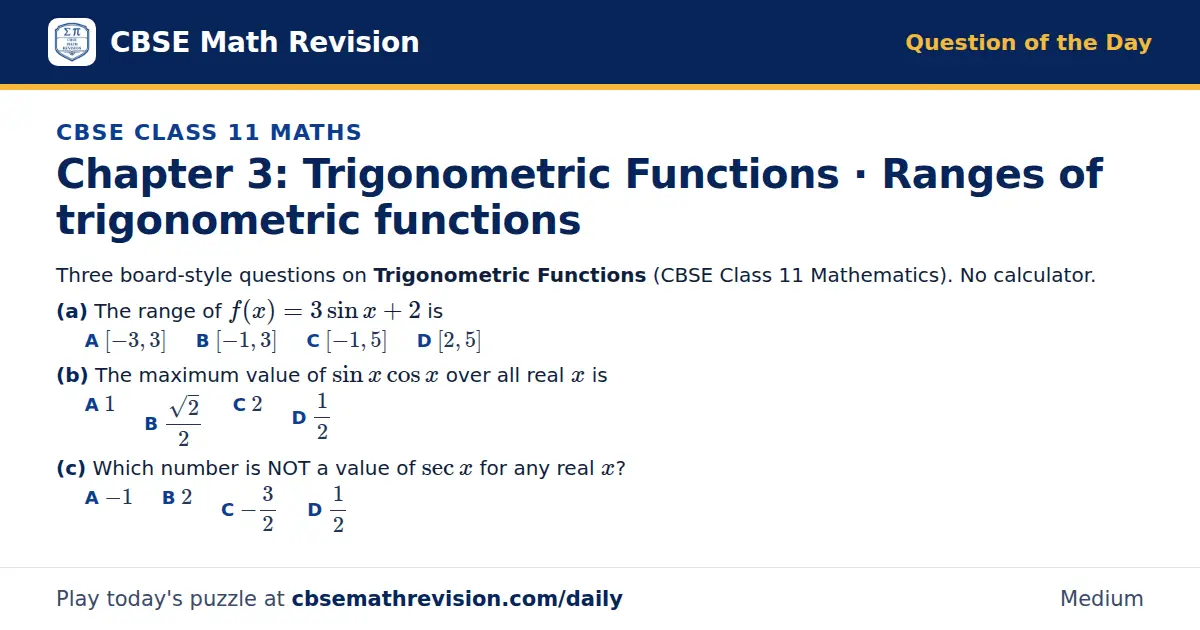
Chapter 3: Trigonometric Functions · Ranges of trigonometric functions
Three board-style questions on Trigonometric Functions (CBSE Class 11 Mathematics). No calculator.
- The range of f(x) = 3sin x + 2 is Options: A) [-3, 3]; B) [-1, 3]; C) [-1, 5]; D) [2, 5]
- The maximum value of sin x cos x over all real x is Options: A) 1; B) (√2)/2; C) 2; D) 1/2
- Which number is NOT a value of sec x for any real x? Options: A) -1; B) 2; C) -32; D) 12
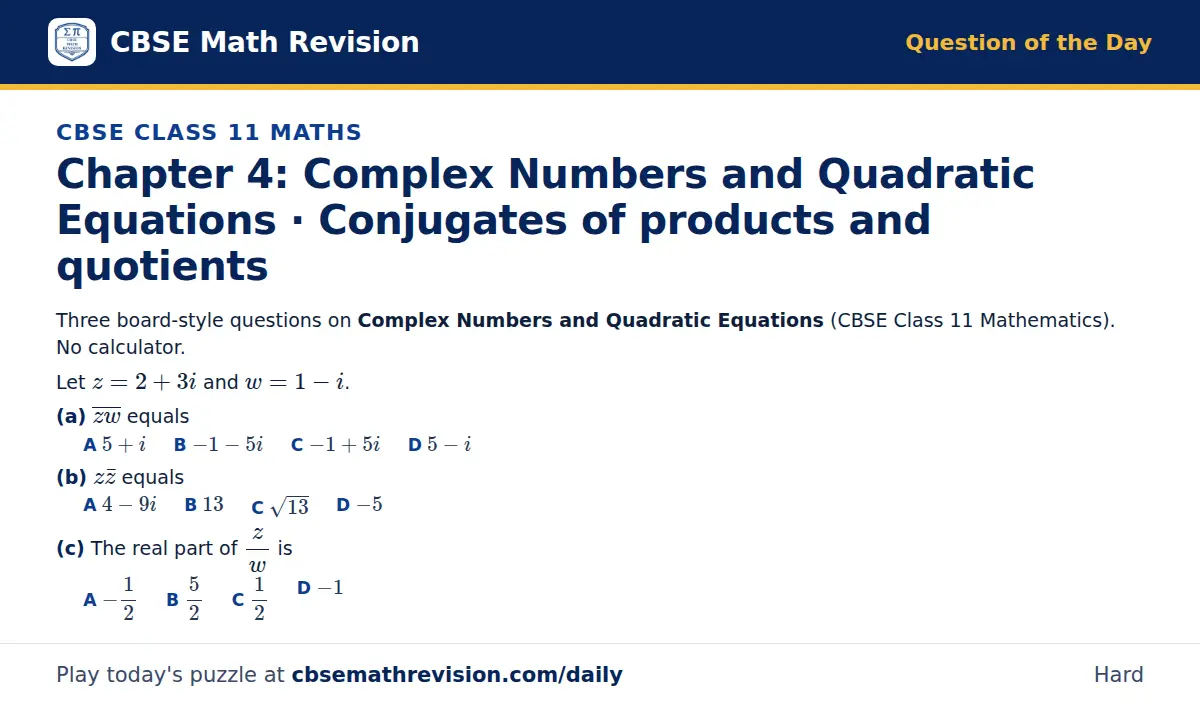
Chapter 4: Complex Numbers and Quadratic Equations · Conjugates of products and quotients
Three board-style questions on Complex Numbers and Quadratic Equations (CBSE Class 11 Mathematics). No calculator. Let z = 2 + 3i and w = 1 - i.
- zw equals Options: A) 5 + i; B) -1 - 5 i; C) -1 + 5 i; D) 5 - i
- z z equals Options: A) 4 - 9 i; B) 13; C) √13; D) -5
- The real part of z/w is Options: A) - 1/2; B) 5/2; C) 1/2; D) -1
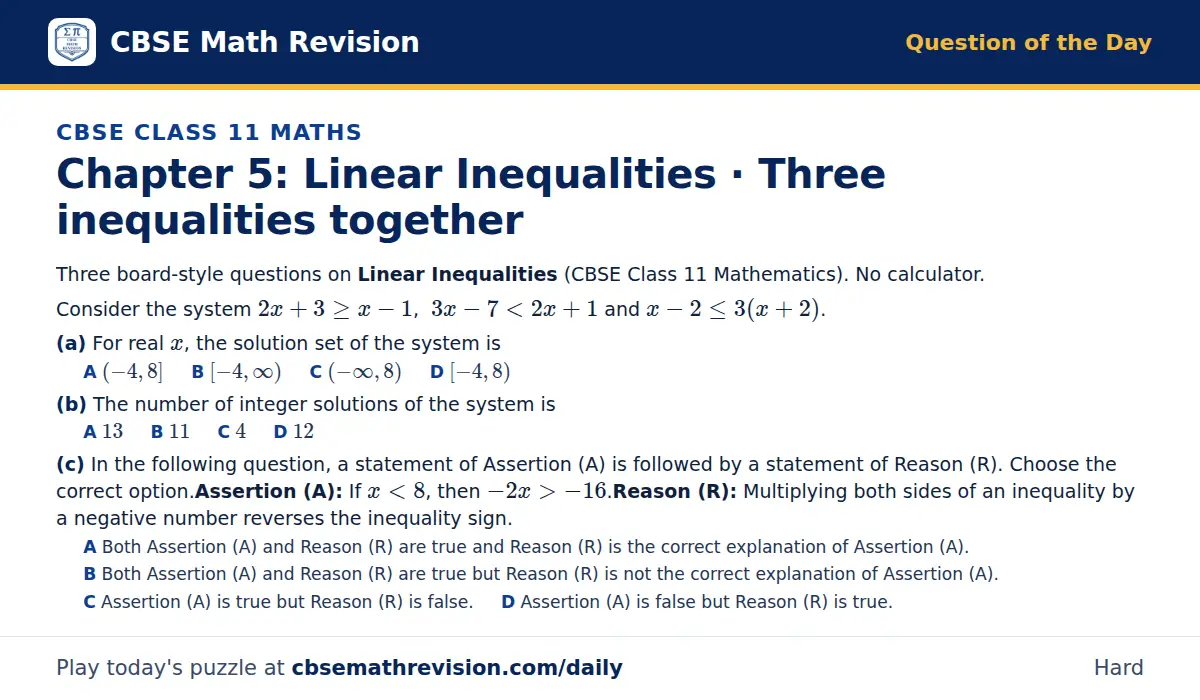
Chapter 5: Linear Inequalities · Three inequalities together
Three board-style questions on Linear Inequalities (CBSE Class 11 Mathematics). No calculator. Consider the system 2x + 3 ≥ x - 1, 3x - 7 < 2x + 1 and x - 2 ≤ 3(x + 2).
- For real x, the solution set of the system is Options: A) (-4, 8]; B) [-4, ∞); C) (-∞, 8); D) [-4, 8)
- The number of integer solutions of the system is Options: A) 13; B) 11; C) 4; D) 12
- In the following question, a statement of Assertion (A) is followed by a statement of Reason (R). Choose the correct option. Assertion (A): If x < 8, then -2x > -16. Reason (R): Multiplying both sides of an inequality by a negative number reverses the inequality sign. Options: A) Both Assertion (A) and Reason (R) are true and Reason (R) is the correct explanation of Assertion (A).; B) Both Assertion (A) and Reason (R) are true but Reason (R) is not the correct explanation of Assertion (A).; C) Assertion (A) is true but Reason (R) is false.; D) Assertion (A) is false but Reason (R) is true.
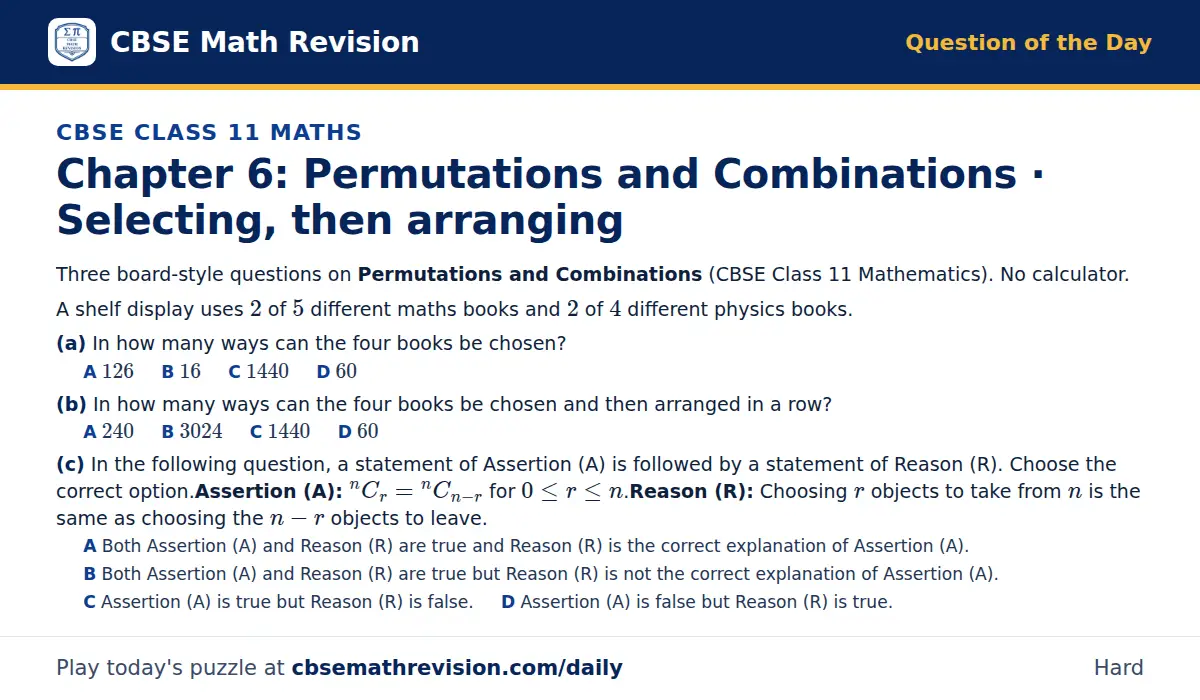
Chapter 6: Permutations and Combinations · Selecting, then arranging
Three board-style questions on Permutations and Combinations (CBSE Class 11 Mathematics). No calculator. A shelf display uses 2 of 5 different maths books and 2 of 4 different physics books.
- In how many ways can the four books be chosen? Options: A) 126; B) 16; C) 1440; D) 60
- In how many ways can the four books be chosen and then arranged in a row? Options: A) 240; B) 3024; C) 1440; D) 60
- In the following question, a statement of Assertion (A) is followed by a statement of Reason (R). Choose the correct option. Assertion (A): ^nC_r = ^nC_n - r for 0 ≤ r ≤ n. Reason (R): Choosing r objects to take from n is the same as choosing the n - r objects to leave. Options: A) Both Assertion (A) and Reason (R) are true and Reason (R) is the correct explanation of Assertion (A).; B) Both Assertion (A) and Reason (R) are true but Reason (R) is not the correct explanation of Assertion (A).; C) Assertion (A) is true but Reason (R) is false.; D) Assertion (A) is false but Reason (R) is true.
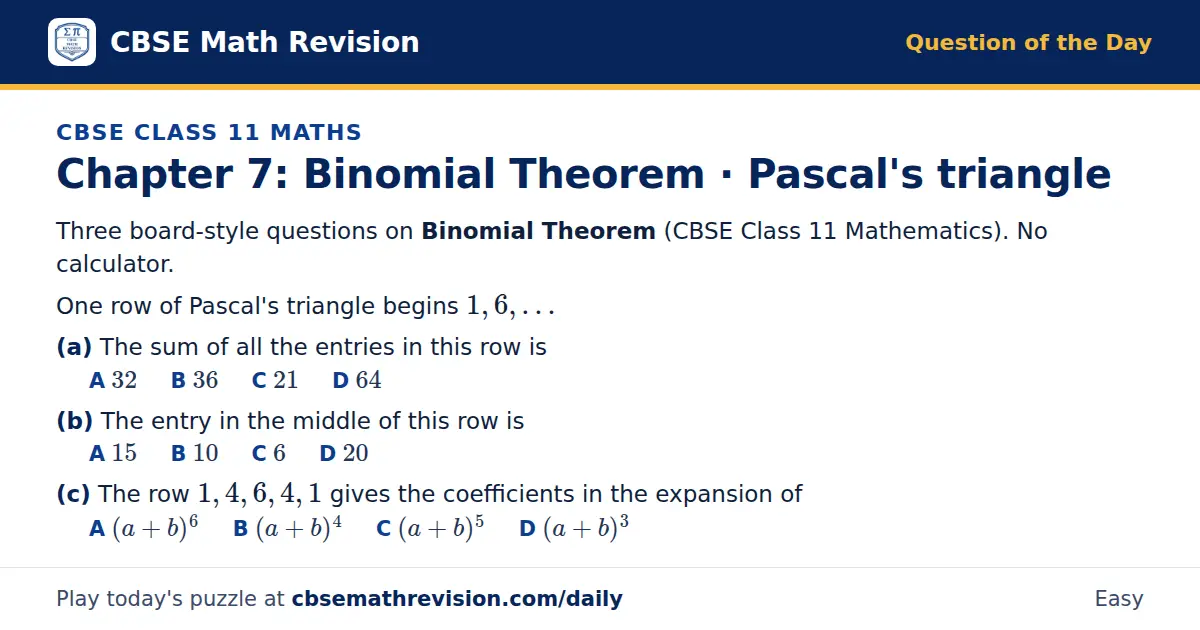
Chapter 7: Binomial Theorem · Pascal's triangle
Three board-style questions on Binomial Theorem (CBSE Class 11 Mathematics). No calculator. One row of Pascal's triangle begins 1, 6, …
- The sum of all the entries in this row is Options: A) 32; B) 36; C) 21; D) 64
- The entry in the middle of this row is Options: A) 15; B) 10; C) 6; D) 20
- The row 1, 4, 6, 4, 1 gives the coefficients in the expansion of Options: A) (a + b)⁶; B) (a + b)⁴; C) (a + b)⁵; D) (a + b)³
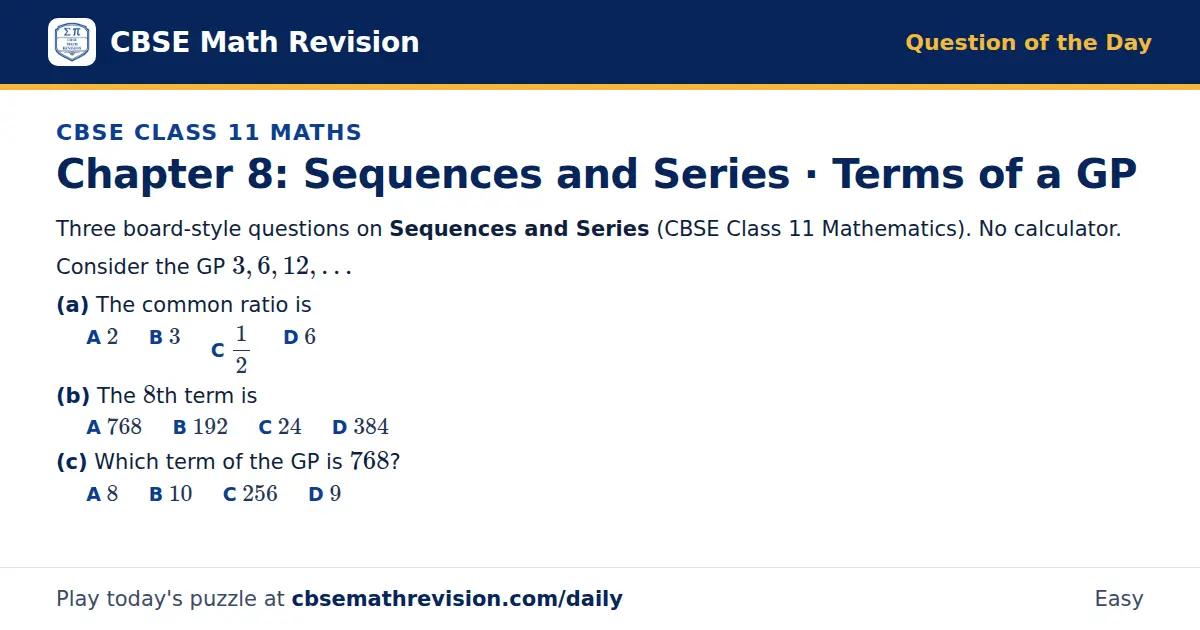
Chapter 8: Sequences and Series · Terms of a GP
Three board-style questions on Sequences and Series (CBSE Class 11 Mathematics). No calculator. Consider the GP 3, 6, 12, …
- The common ratio is Options: A) 2; B) 3; C) 1/2; D) 6
- The 8th term is Options: A) 768; B) 192; C) 24; D) 384
- Which term of the GP is 768? Options: A) 8; B) 10; C) 256; D) 9
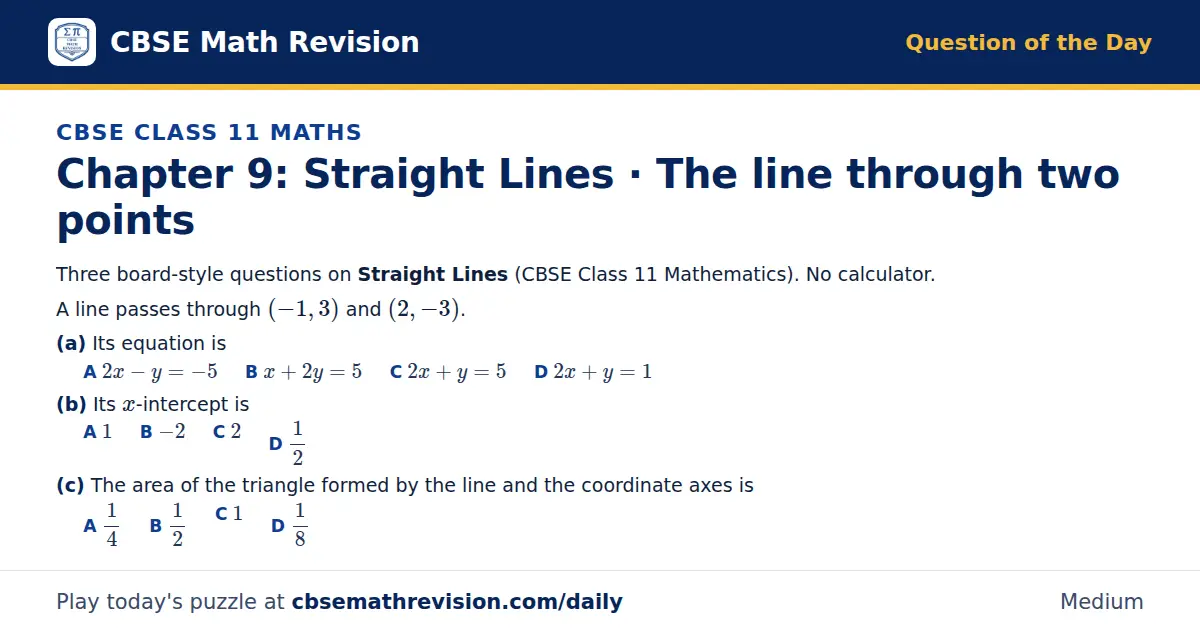
Chapter 9: Straight Lines · The line through two points
Three board-style questions on Straight Lines (CBSE Class 11 Mathematics). No calculator. A line passes through (-1, 3) and (2, -3).
- Its equation is Options: A) 2x - y = -5; B) x + 2y = 5; C) 2x + y = 5; D) 2x + y = 1
- Its x-intercept is Options: A) 1; B) -2; C) 2; D) 1/2
- The area of the triangle formed by the line and the coordinate axes is Options: A) 1/4; B) 1/2; C) 1; D) 1/8
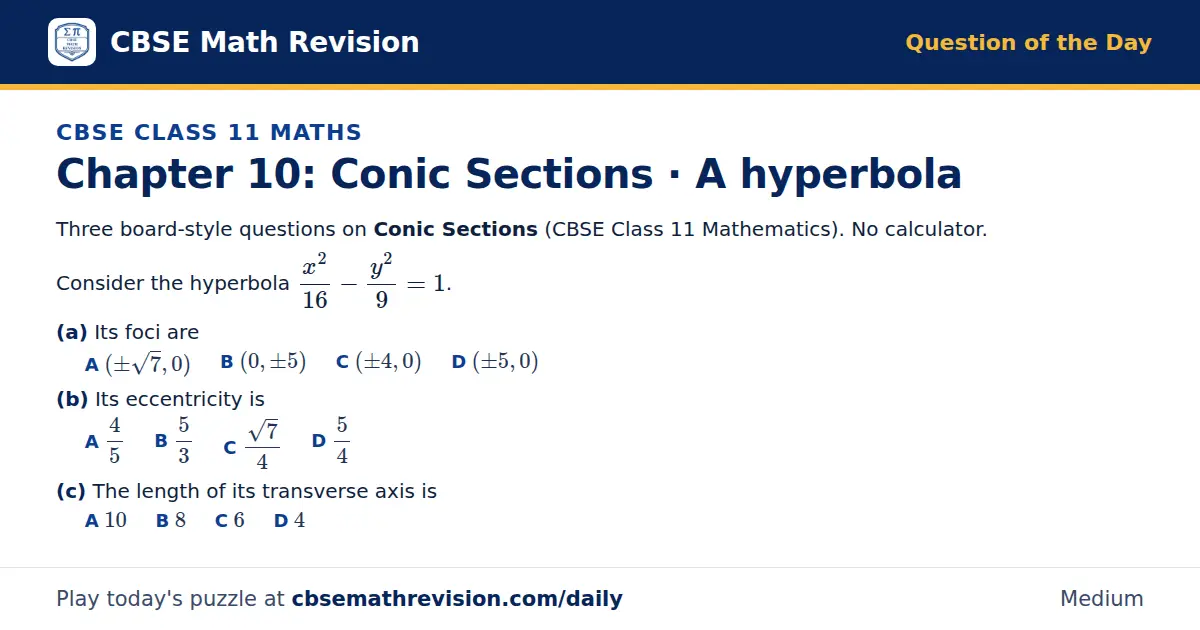
Chapter 10: Conic Sections · A hyperbola
Three board-style questions on Conic Sections (CBSE Class 11 Mathematics). No calculator. Consider the hyperbola (x²)/16 - (y²)/9 = 1.
- Its foci are Options: A) (± √7, 0); B) (0, ± 5); C) (± 4, 0); D) (± 5, 0)
- Its eccentricity is Options: A) 4/5; B) 5/3; C) (√7)/4; D) 5/4
- The length of its transverse axis is Options: A) 10; B) 8; C) 6; D) 4
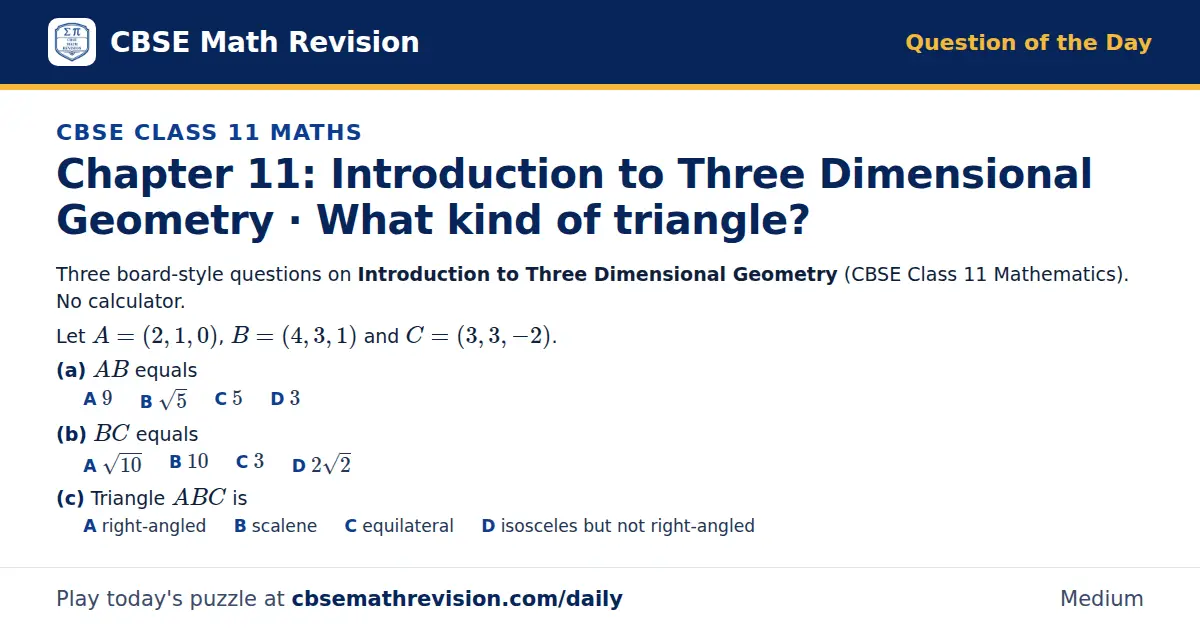
Chapter 11: Introduction to Three Dimensional Geometry · What kind of triangle?
Three board-style questions on Introduction to Three Dimensional Geometry (CBSE Class 11 Mathematics). No calculator. Let A = (2, 1, 0), B = (4, 3, 1) and C = (3, 3, -2).
- AB equals Options: A) 9; B) √5; C) 5; D) 3
- BC equals Options: A) √10; B) 10; C) 3; D) 2 √2
- Triangle ABC is Options: A) right-angled; B) scalene; C) equilateral; D) isosceles but not right-angled
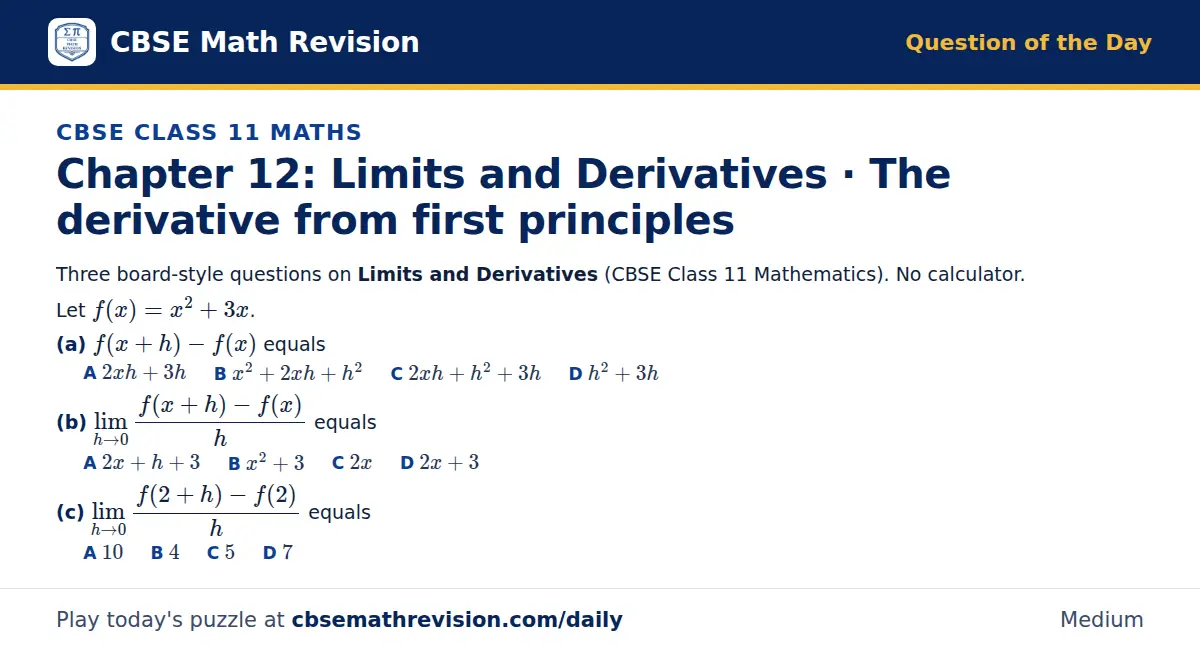
Chapter 12: Limits and Derivatives · The derivative from first principles
Three board-style questions on Limits and Derivatives (CBSE Class 11 Mathematics). No calculator. Let f(x) = x² + 3x.
- f(x + h) - f(x) equals Options: A) 2xh + 3h; B) x² + 2xh + h²; C) 2xh + h² + 3h; D) h² + 3h
- lim_h → 0 (f(x + h) - f(x))/h equals Options: A) 2x + h + 3; B) x² + 3; C) 2x; D) 2x + 3
- lim_h → 0 (f(2 + h) - f(2))/h equals Options: A) 10; B) 4; C) 5; D) 7
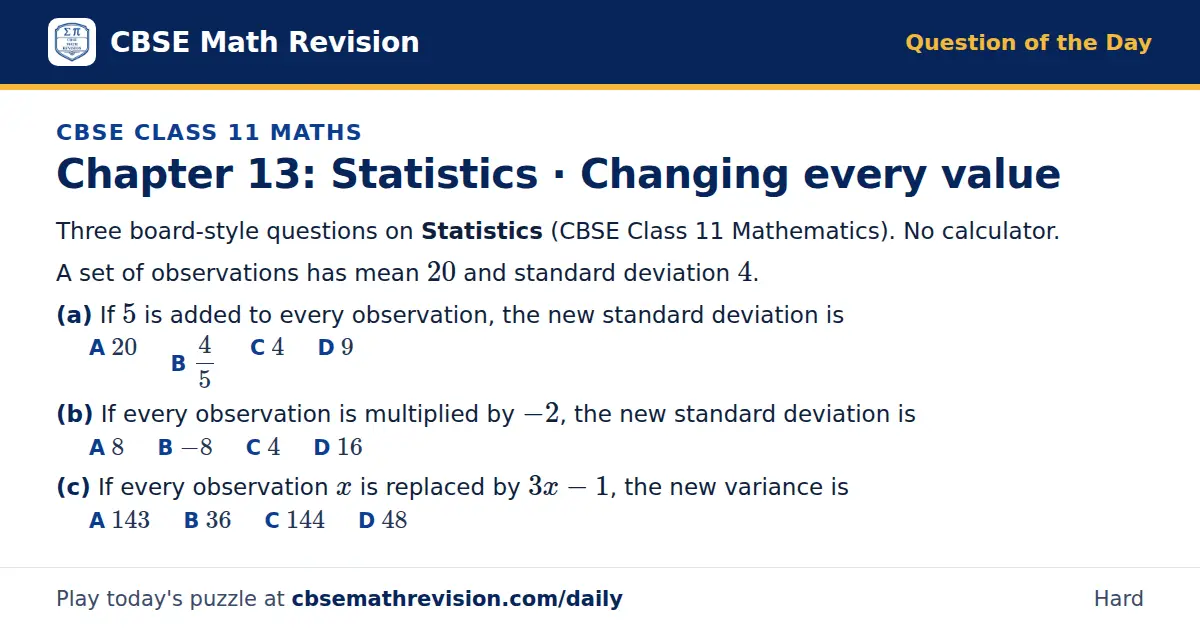
Chapter 13: Statistics · Changing every value
Three board-style questions on Statistics (CBSE Class 11 Mathematics). No calculator. A set of observations has mean 20 and standard deviation 4.
- If 5 is added to every observation, the new standard deviation is Options: A) 20; B) 4/5; C) 4; D) 9
- If every observation is multiplied by -2, the new standard deviation is Options: A) 8; B) -8; C) 4; D) 16
- If every observation x is replaced by 3x - 1, the new variance is Options: A) 143; B) 36; C) 144; D) 48
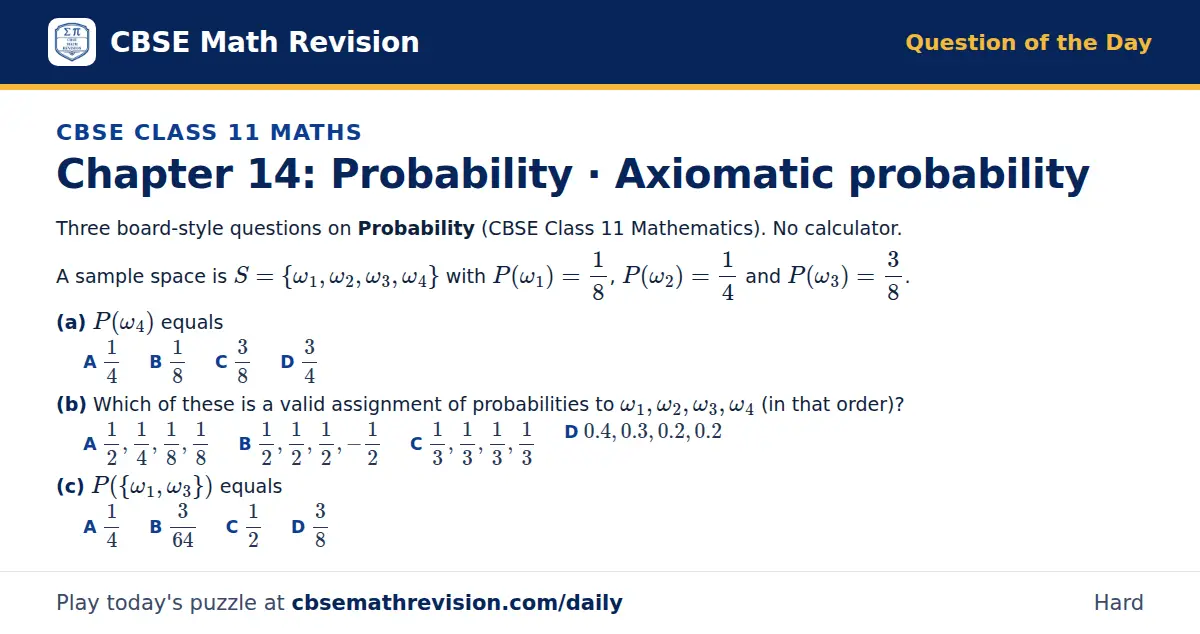
Chapter 14: Probability · Axiomatic probability
Three board-style questions on Probability (CBSE Class 11 Mathematics). No calculator. A sample space is S = ω_1, ω_2, ω_3, ω_4 with P(ω_1) = 18, P(ω_2) = 14 and P(ω_3) = 38.
- P(ω_4) equals Options: A) 1/4; B) 1/8; C) 3/8; D) 3/4
- Which of these is a valid assignment of probabilities to ω_1, ω_2, ω_3, ω_4 (in that order)? Options: A) 12, 14, 18, 18; B) 12, 12, 12, -12; C) 13, 13, 13, 13; D) 0.4, 0.3, 0.2, 0.2
- P(ω_1, ω_3) equals Options: A) 1/4; B) 3/64; C) 1/2; D) 3/8
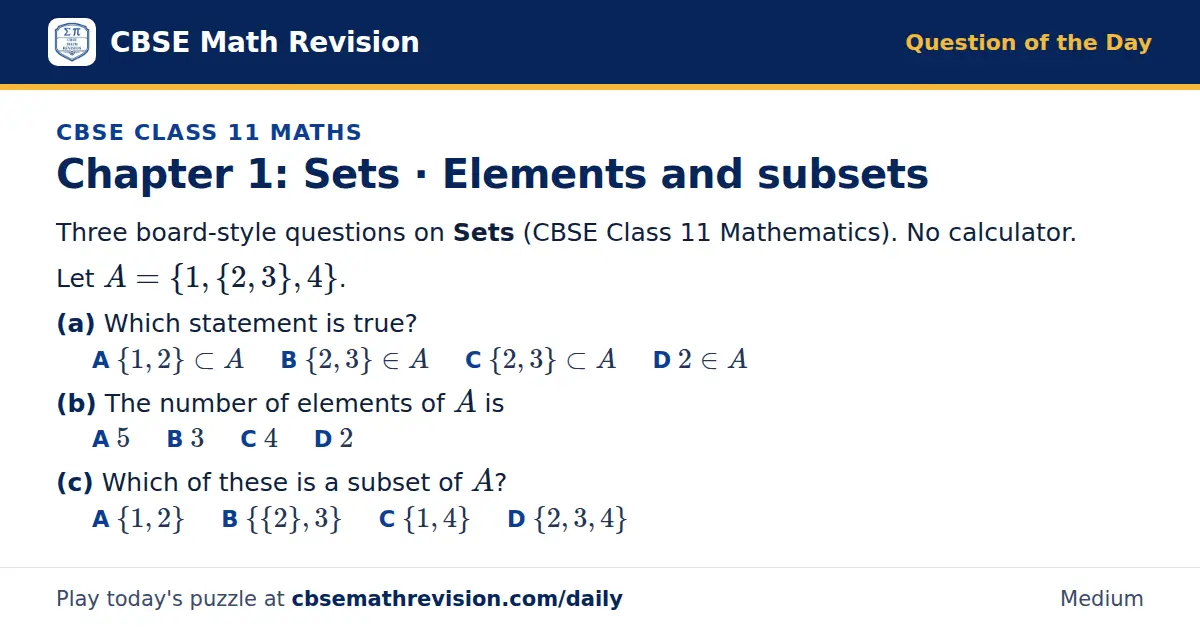
Chapter 1: Sets · Elements and subsets
Three board-style questions on Sets (CBSE Class 11 Mathematics). No calculator. Let A = 1, 2, 3, 4.
- Which statement is true? Options: A) 1, 2 ⊂ A; B) 2, 3 ∈ A; C) 2, 3 ⊂ A; D) 2 ∈ A
- The number of elements of A is Options: A) 5; B) 3; C) 4; D) 2
- Which of these is a subset of A? Options: A) 1, 2; B) 2, 3; C) 1, 4; D) 2, 3, 4
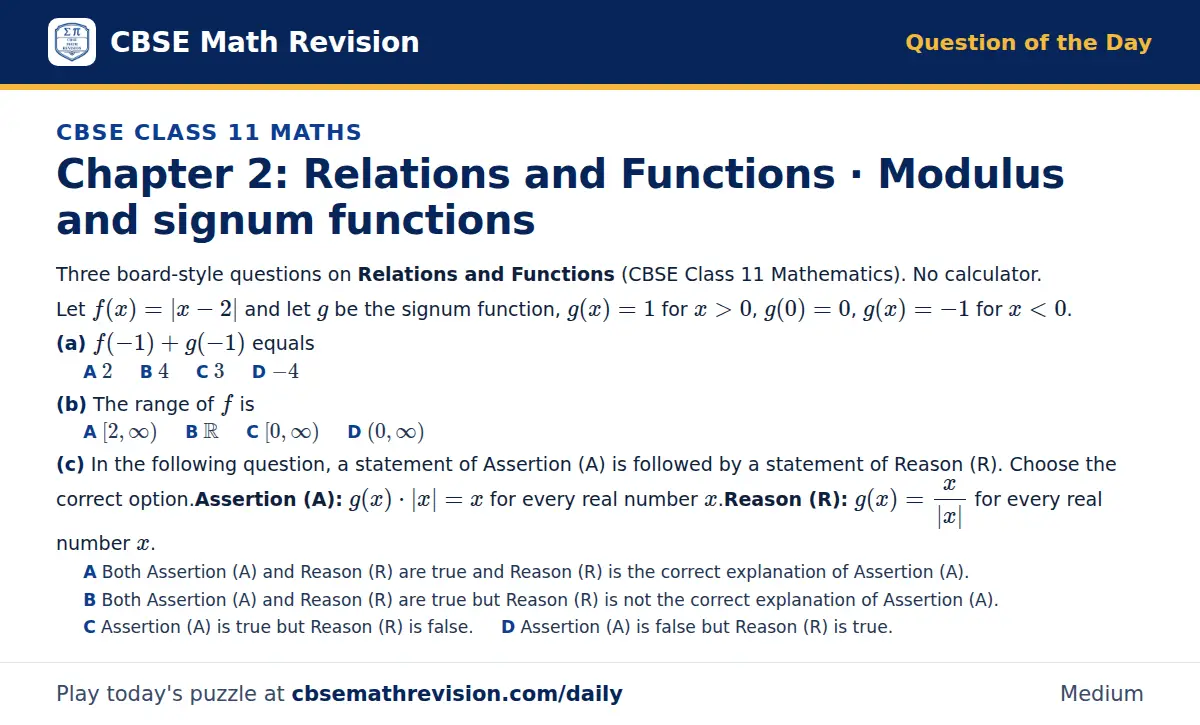
Chapter 2: Relations and Functions · Modulus and signum functions
Three board-style questions on Relations and Functions (CBSE Class 11 Mathematics). No calculator. Let f(x) = |x - 2| and let g be the signum function, g(x) = 1 for x > 0, g(0) = 0, g(x) = -1 for x < 0.
- f(-1) + g(-1) equals Options: A) 2; B) 4; C) 3; D) -4
- The range of f is Options: A) [2, ∞); B) ℝ; C) [0, ∞); D) (0, ∞)
- In the following question, a statement of Assertion (A) is followed by a statement of Reason (R). Choose the correct option. Assertion (A): g(x) · |x| = x for every real number x. Reason (R): g(x) = x/(|x|) for every real number x. Options: A) Both Assertion (A) and Reason (R) are true and Reason (R) is the correct explanation of Assertion (A).; B) Both Assertion (A) and Reason (R) are true but Reason (R) is not the correct explanation of Assertion (A).; C) Assertion (A) is true but Reason (R) is false.; D) Assertion (A) is false but Reason (R) is true.
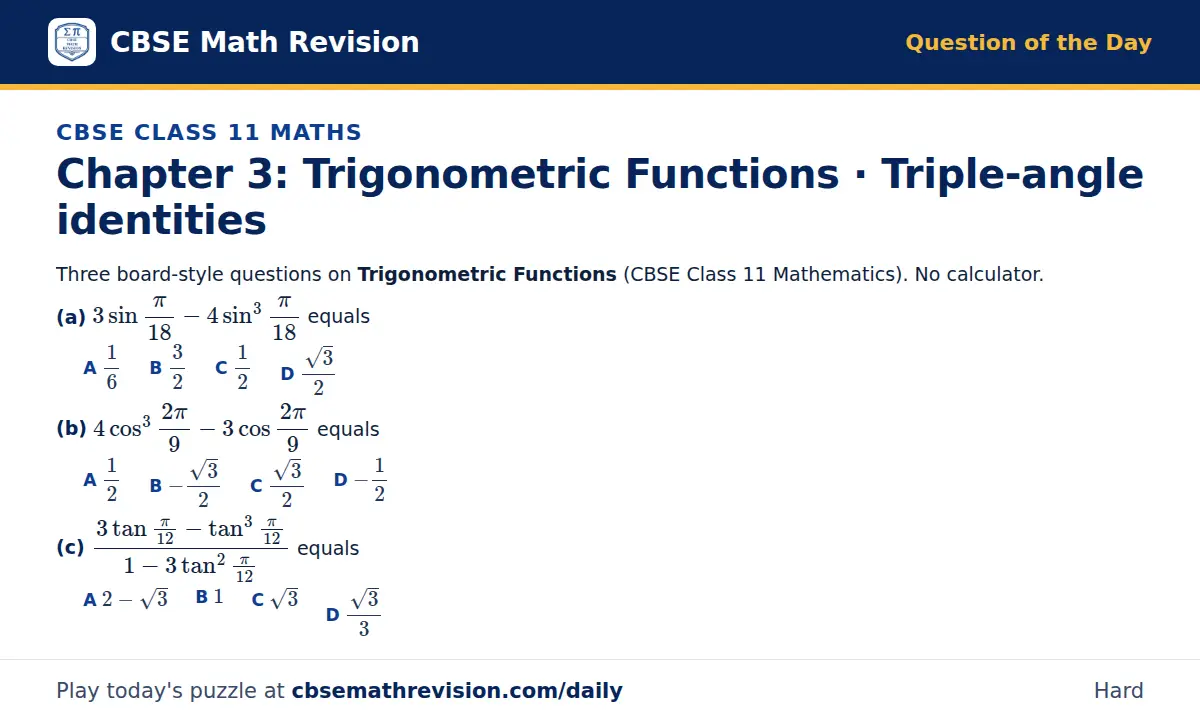
Chapter 3: Trigonometric Functions · Triple-angle identities
Three board-style questions on Trigonometric Functions (CBSE Class 11 Mathematics). No calculator.
- 3sin(π)/18 - 4sin³(π)/18 equals Options: A) 1/6; B) 3/2; C) 1/2; D) (√3)/2
- 4cos³(2π)/9 - 3cos(2π)/9 equals Options: A) 1/2; B) - (√3)/2; C) (√3)/2; D) - 1/2
- (3tan(π)/12 - tan³(π)/12)/(1 - 3tan²(π)/12) equals Options: A) 2 - √3; B) 1; C) √3; D) (√3)/3
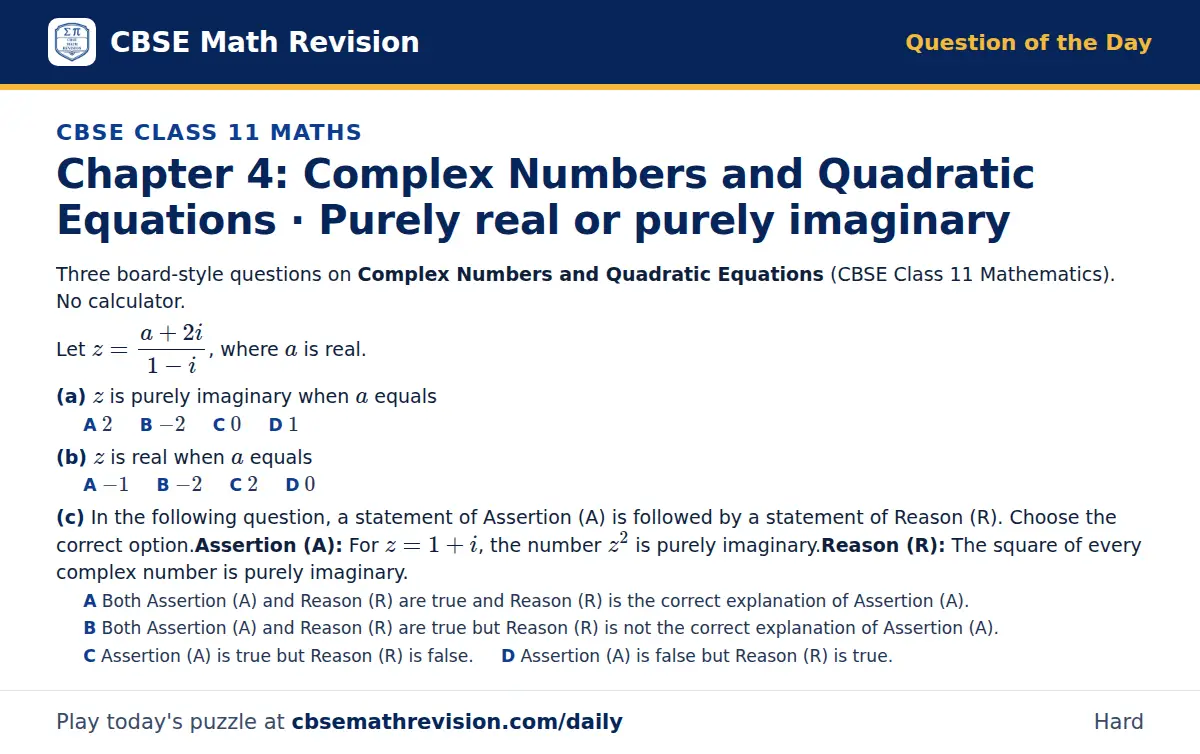
Chapter 4: Complex Numbers and Quadratic Equations · Purely real or purely imaginary
Three board-style questions on Complex Numbers and Quadratic Equations (CBSE Class 11 Mathematics). No calculator. Let z = (a + 2i)/(1 - i), where a is real.
- z is purely imaginary when a equals Options: A) 2; B) -2; C) 0; D) 1
- z is real when a equals Options: A) -1; B) -2; C) 2; D) 0
- In the following question, a statement of Assertion (A) is followed by a statement of Reason (R). Choose the correct option. Assertion (A): For z = 1 + i, the number z² is purely imaginary. Reason (R): The square of every complex number is purely imaginary. Options: A) Both Assertion (A) and Reason (R) are true and Reason (R) is the correct explanation of Assertion (A).; B) Both Assertion (A) and Reason (R) are true but Reason (R) is not the correct explanation of Assertion (A).; C) Assertion (A) is true but Reason (R) is false.; D) Assertion (A) is false but Reason (R) is true.
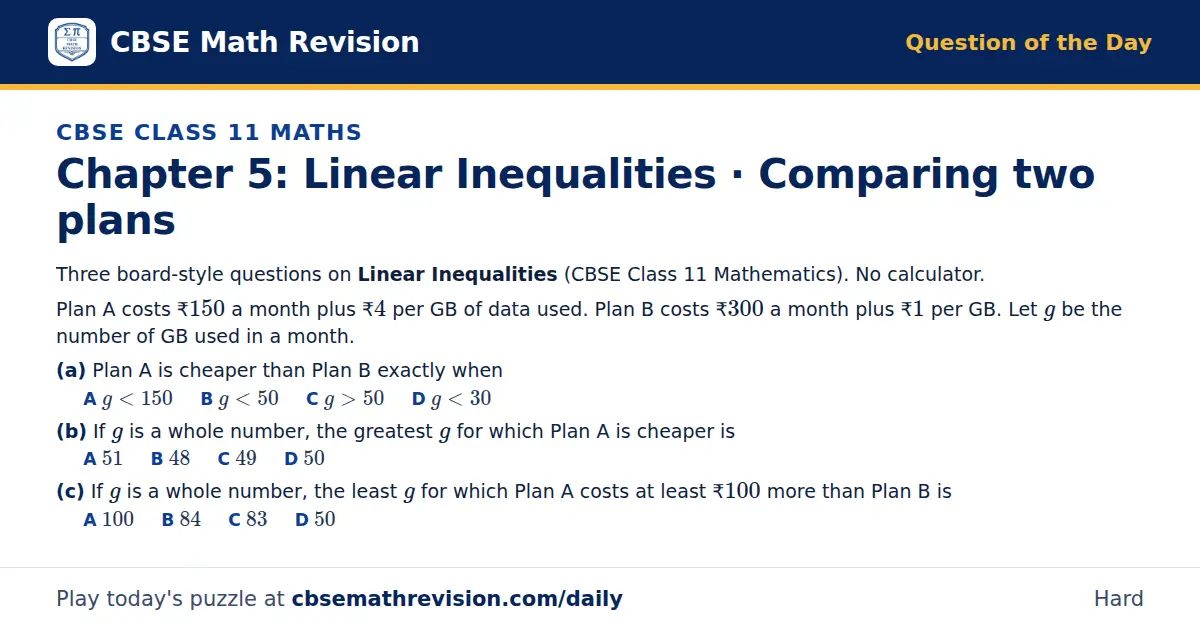
Chapter 5: Linear Inequalities · Comparing two plans
Three board-style questions on Linear Inequalities (CBSE Class 11 Mathematics). No calculator. Plan A costs ₹150 a month plus ₹4 per GB of data used. Plan B costs ₹300 a month plus ₹1 per GB. Let g be the number of GB used in a month.
- Plan A is cheaper than Plan B exactly when Options: A) g < 150; B) g < 50; C) g > 50; D) g < 30
- If g is a whole number, the greatest g for which Plan A is cheaper is Options: A) 51; B) 48; C) 49; D) 50
- If g is a whole number, the least g for which Plan A costs at least ₹100 more than Plan B is Options: A) 100; B) 84; C) 83; D) 50
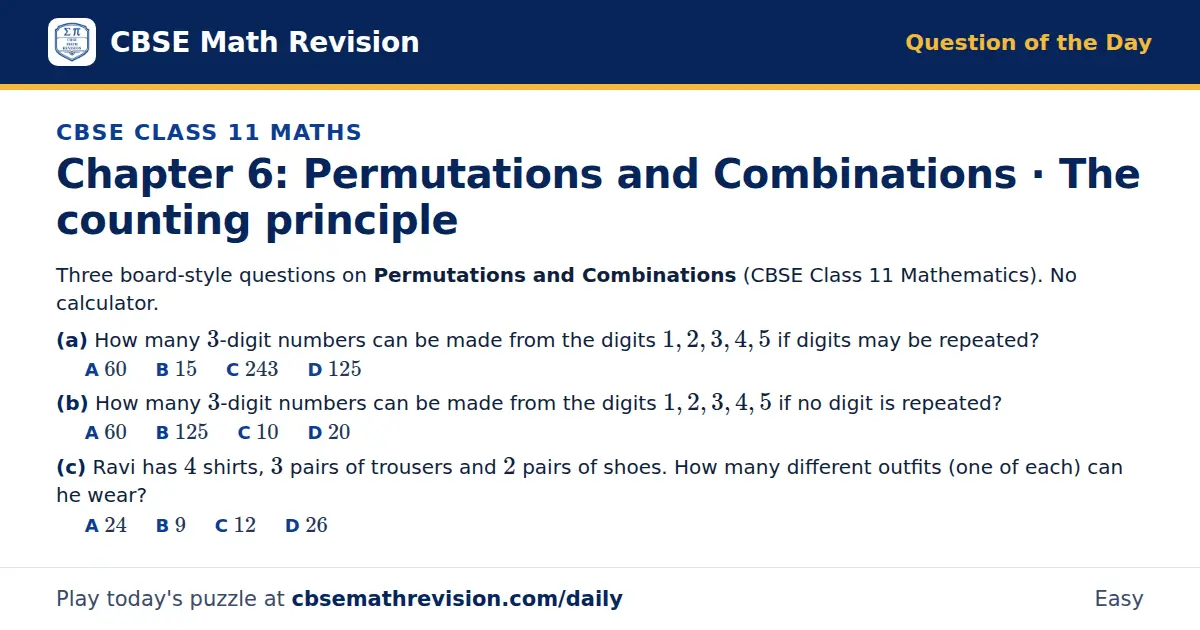
Chapter 6: Permutations and Combinations · The counting principle
Three board-style questions on Permutations and Combinations (CBSE Class 11 Mathematics). No calculator.
- How many 3-digit numbers can be made from the digits 1, 2, 3, 4, 5 if digits may be repeated? Options: A) 60; B) 15; C) 243; D) 125
- How many 3-digit numbers can be made from the digits 1, 2, 3, 4, 5 if no digit is repeated? Options: A) 60; B) 125; C) 10; D) 20
- Ravi has 4 shirts, 3 pairs of trousers and 2 pairs of shoes. How many different outfits (one of each) can he wear? Options: A) 24; B) 9; C) 12; D) 26
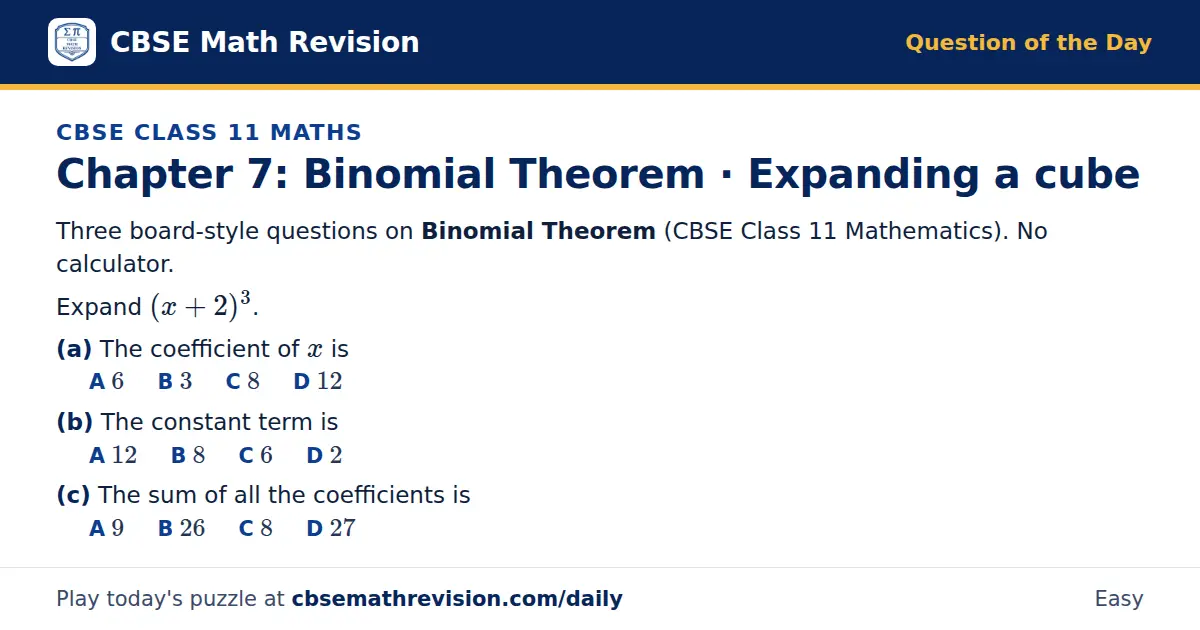
Chapter 7: Binomial Theorem · Expanding a cube
Three board-style questions on Binomial Theorem (CBSE Class 11 Mathematics). No calculator. Expand (x + 2)^3.
- The coefficient of x is Options: A) 6; B) 3; C) 8; D) 12
- The constant term is Options: A) 12; B) 8; C) 6; D) 2
- The sum of all the coefficients is Options: A) 9; B) 26; C) 8; D) 27
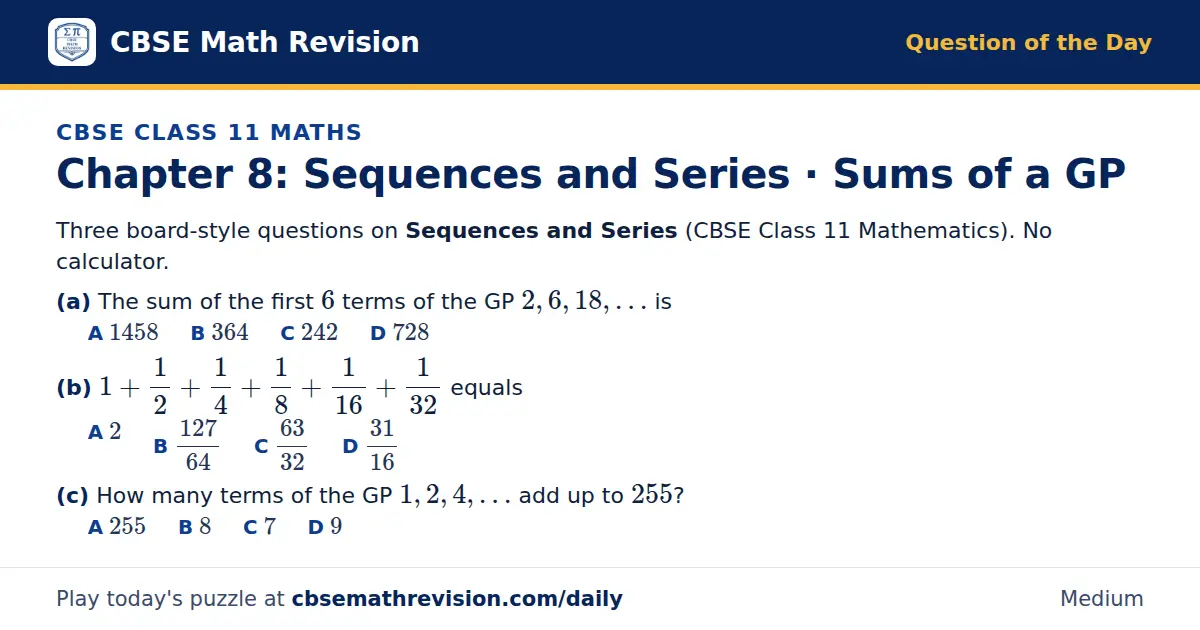
Chapter 8: Sequences and Series · Sums of a GP
Three board-style questions on Sequences and Series (CBSE Class 11 Mathematics). No calculator.
- The sum of the first 6 terms of the GP 2, 6, 18, … is Options: A) 1458; B) 364; C) 242; D) 728
- 1 + 12 + 14 + 18 + 116 + 132 equals Options: A) 2; B) 127/64; C) 63/32; D) 31/16
- How many terms of the GP 1, 2, 4, … add up to 255? Options: A) 255; B) 8; C) 7; D) 9
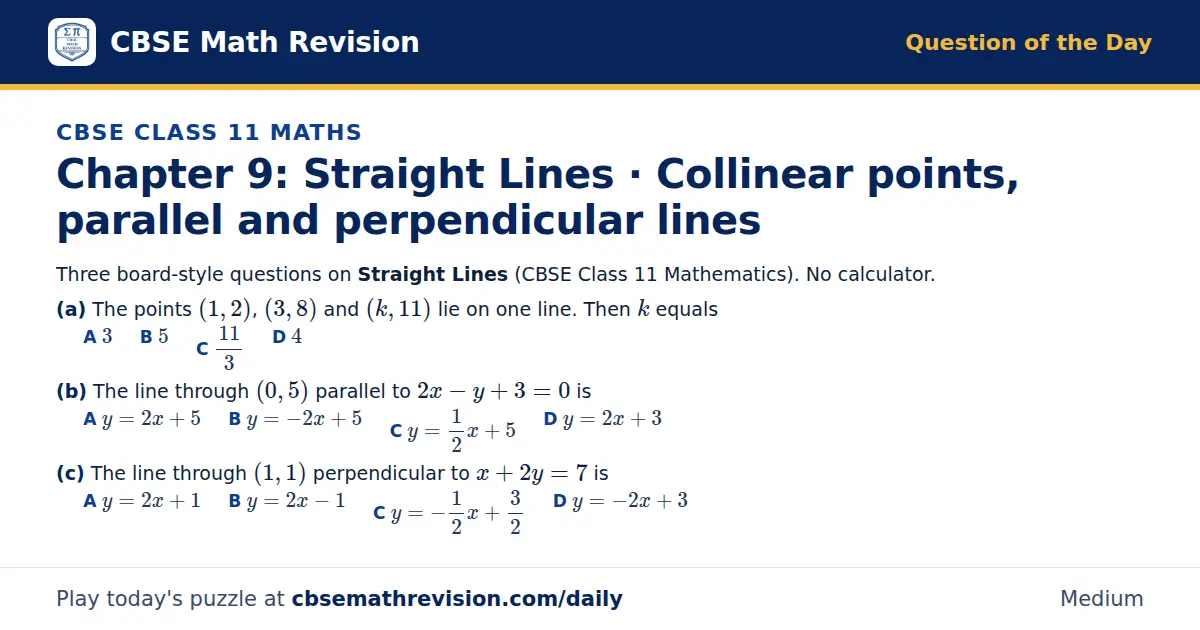
Chapter 9: Straight Lines · Collinear points, parallel and perpendicular lines
Three board-style questions on Straight Lines (CBSE Class 11 Mathematics). No calculator.
- The points (1, 2), (3, 8) and (k, 11) lie on one line. Then k equals Options: A) 3; B) 5; C) 11/3; D) 4
- The line through (0, 5) parallel to 2x - y + 3 = 0 is Options: A) y = 2x + 5; B) y = -2x + 5; C) y = 12 x + 5; D) y = 2x + 3
- The line through (1, 1) perpendicular to x + 2y = 7 is Options: A) y = 2x + 1; B) y = 2x - 1; C) y = -12 x + 32; D) y = -2x + 3
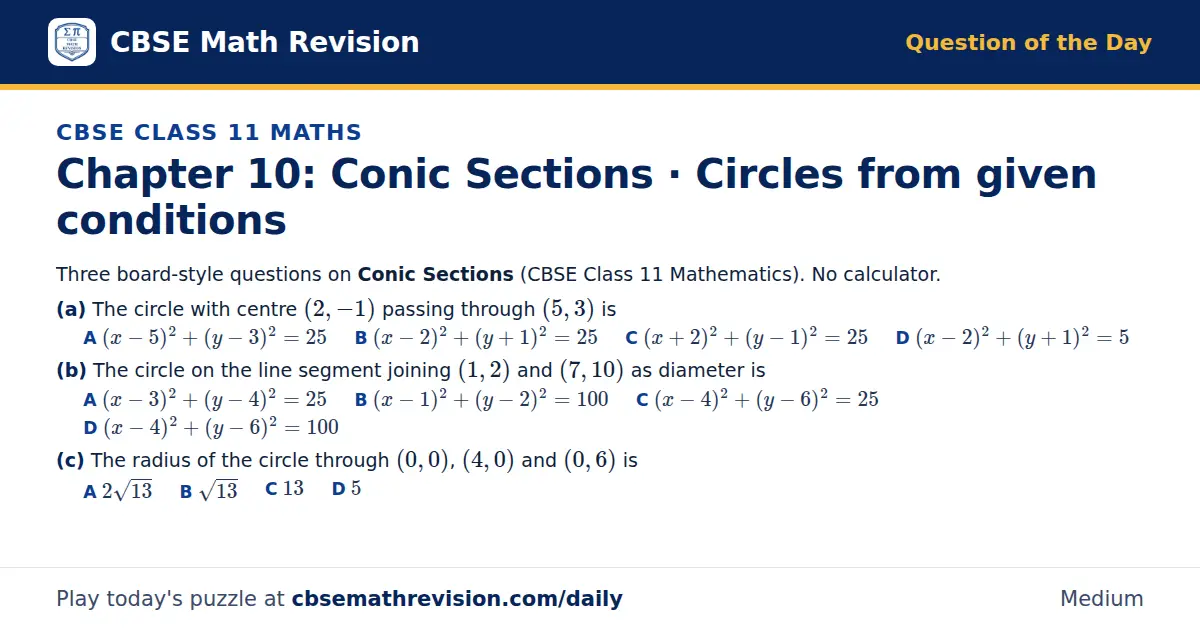
Chapter 10: Conic Sections · Circles from given conditions
Three board-style questions on Conic Sections (CBSE Class 11 Mathematics). No calculator.
- The circle with centre (2, -1) passing through (5, 3) is Options: A) (x - 5)² + (y - 3)² = 25; B) (x - 2)² + (y + 1)² = 25; C) (x + 2)² + (y - 1)² = 25; D) (x - 2)² + (y + 1)² = 5
- The circle on the line segment joining (1, 2) and (7, 10) as diameter is Options: A) (x - 3)² + (y - 4)² = 25; B) (x - 1)² + (y - 2)² = 100; C) (x - 4)² + (y - 6)² = 25; D) (x - 4)² + (y - 6)² = 100
- The radius of the circle through (0, 0), (4, 0) and (0, 6) is Options: A) 2 √13; B) √13; C) 13; D) 5
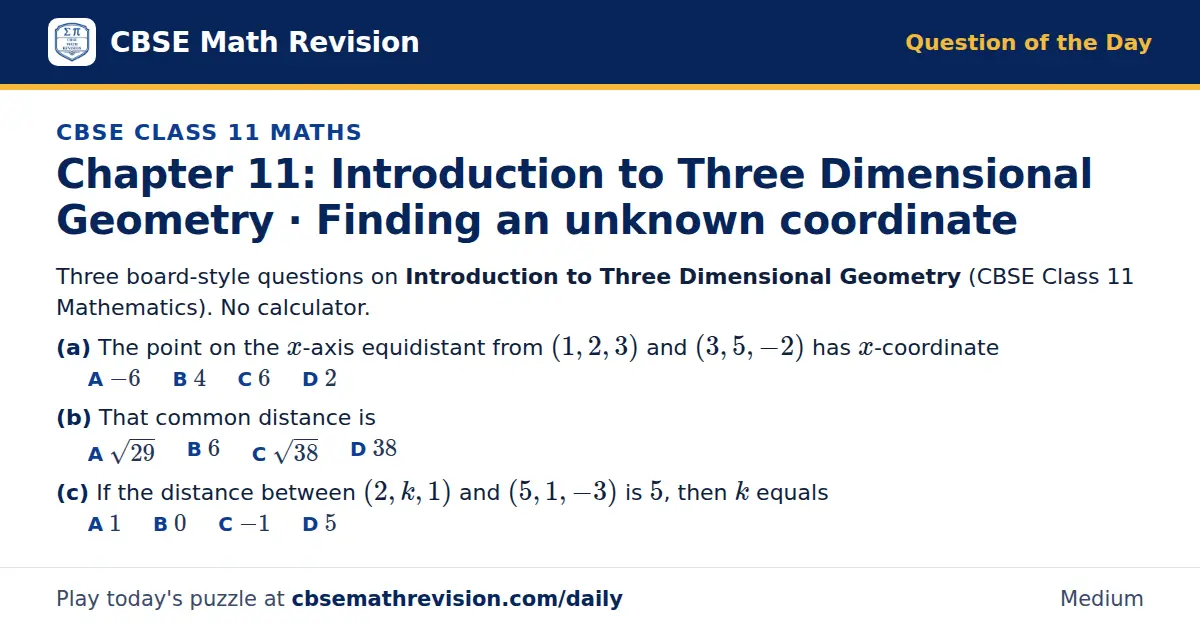
Chapter 11: Introduction to Three Dimensional Geometry · Finding an unknown coordinate
Three board-style questions on Introduction to Three Dimensional Geometry (CBSE Class 11 Mathematics). No calculator.
- The point on the x-axis equidistant from (1, 2, 3) and (3, 5, -2) has x-coordinate Options: A) -6; B) 4; C) 6; D) 2
- That common distance is Options: A) √29; B) 6; C) √38; D) 38
- If the distance between (2, k, 1) and (5, 1, -3) is 5, then k equals Options: A) 1; B) 0; C) -1; D) 5
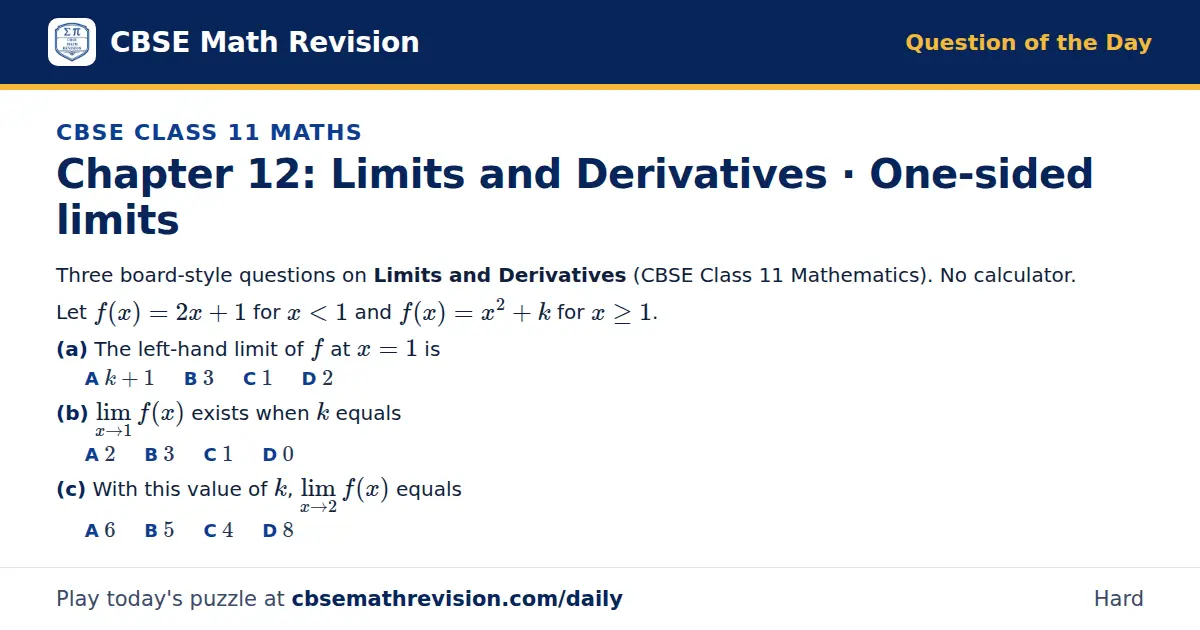
Chapter 12: Limits and Derivatives · One-sided limits
Three board-style questions on Limits and Derivatives (CBSE Class 11 Mathematics). No calculator. Let f(x) = 2x + 1 for x < 1 and f(x) = x² + k for x ≥ 1.
- The left-hand limit of f at x = 1 is Options: A) k + 1; B) 3; C) 1; D) 2
- lim_x → 1 f(x) exists when k equals Options: A) 2; B) 3; C) 1; D) 0
- With this value of k, lim_x → 2 f(x) equals Options: A) 6; B) 5; C) 4; D) 8
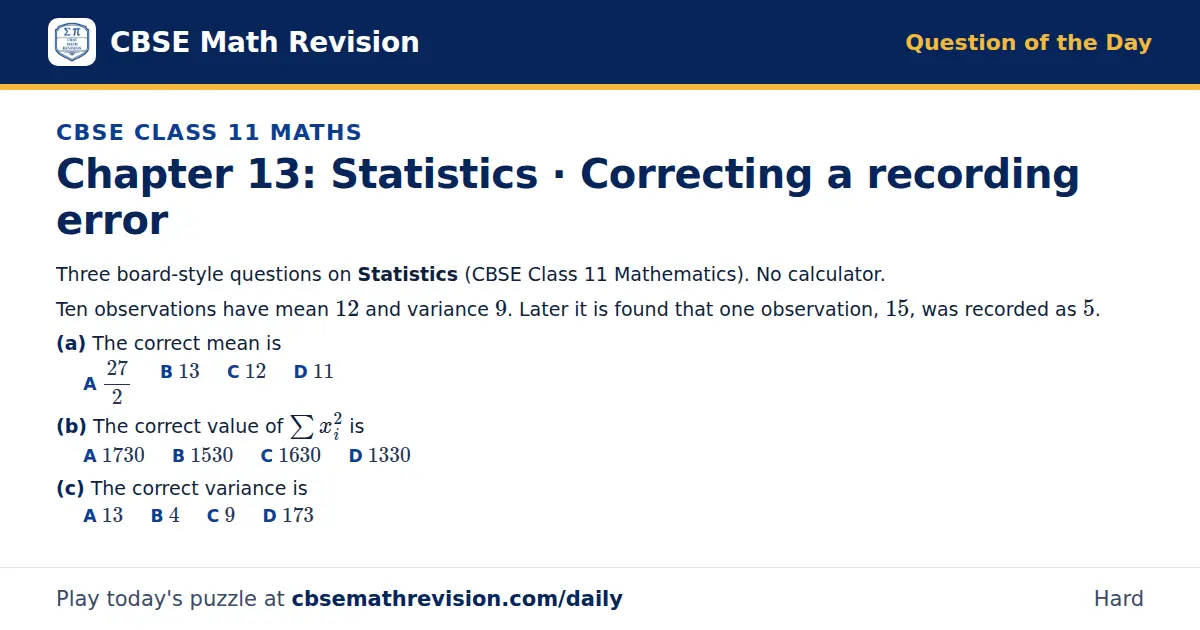
Chapter 13: Statistics · Correcting a recording error
Three board-style questions on Statistics (CBSE Class 11 Mathematics). No calculator. Ten observations have mean 12 and variance 9. Later it is found that one observation, 15, was recorded as 5.
- The correct mean is Options: A) 27/2; B) 13; C) 12; D) 11
- The correct value of Σ x_i² is Options: A) 1730; B) 1530; C) 1630; D) 1330
- The correct variance is Options: A) 13; B) 4; C) 9; D) 173
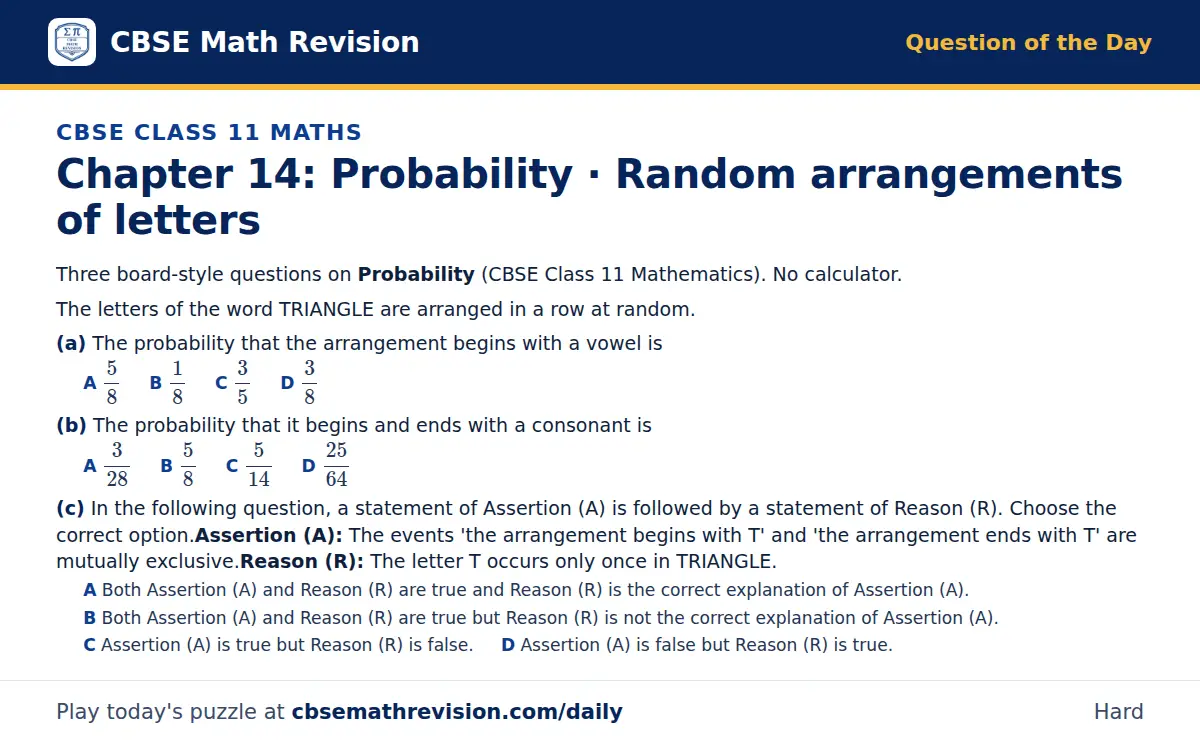
Chapter 14: Probability · Random arrangements of letters
Three board-style questions on Probability (CBSE Class 11 Mathematics). No calculator. The letters of the word TRIANGLE are arranged in a row at random.
- The probability that the arrangement begins with a vowel is Options: A) 5/8; B) 1/8; C) 3/5; D) 3/8
- The probability that it begins and ends with a consonant is Options: A) 3/28; B) 5/8; C) 5/14; D) 25/64
- In the following question, a statement of Assertion (A) is followed by a statement of Reason (R). Choose the correct option. Assertion (A): The events 'the arrangement begins with T' and 'the arrangement ends with T' are mutually exclusive. Reason (R): The letter T occurs only once in TRIANGLE. Options: A) Both Assertion (A) and Reason (R) are true and Reason (R) is the correct explanation of Assertion (A).; B) Both Assertion (A) and Reason (R) are true but Reason (R) is not the correct explanation of Assertion (A).; C) Assertion (A) is true but Reason (R) is false.; D) Assertion (A) is false but Reason (R) is true.
![CBSE Class 11 Maths Question of the Day on Sets · Operations on intervals, a 3-part multiple-choice question: Three board-style questions on Sets (CBSE Class 11 Mathematics). No calculator. Let A = [-3, 5) and B = (1, 8] (subsets of ℝ). (a) A ∪ B…](/cbse-frontend/img/questions/cbse-maths-class-11-sets-operations-on-intervals-question-of-the-day-cbse11-ch01-d06.webp)
Chapter 1: Sets · Operations on intervals
Three board-style questions on Sets (CBSE Class 11 Mathematics). No calculator. Let A = [-3, 5) and B = (1, 8] (subsets of ℝ).
- A ∪ B equals Options: A) [-3, 8); B) (-3, 8]; C) [-3, 8]; D) (1, 5)
- A ∩ B equals Options: A) [-3, 8]; B) (1, 5); C) [1, 5]; D) (1, 5]
- A - B equals Options: A) [-3, 1); B) (5, 8]; C) [5, 8]; D) [-3, 1]
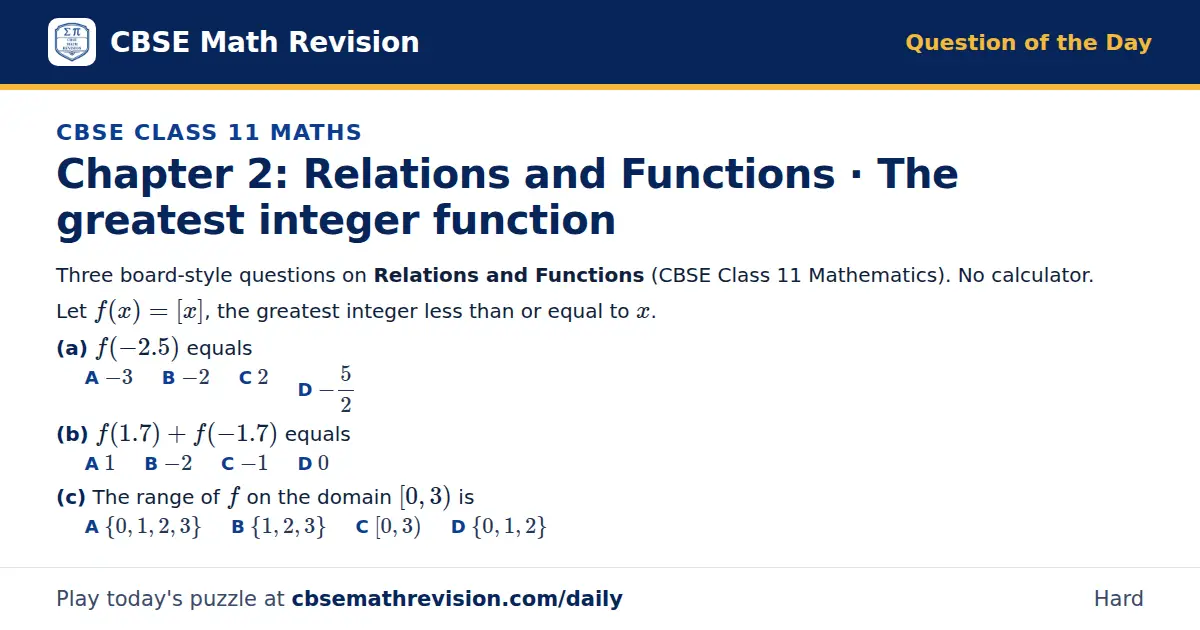
Chapter 2: Relations and Functions · The greatest integer function
Three board-style questions on Relations and Functions (CBSE Class 11 Mathematics). No calculator. Let f(x) = [x], the greatest integer less than or equal to x.
- f(-2.5) equals Options: A) -3; B) -2; C) 2; D) - 5/2
- f(1.7) + f(-1.7) equals Options: A) 1; B) -2; C) -1; D) 0
- The range of f on the domain [0, 3) is Options: A) 0, 1, 2, 3; B) 1, 2, 3; C) [0, 3); D) 0, 1, 2
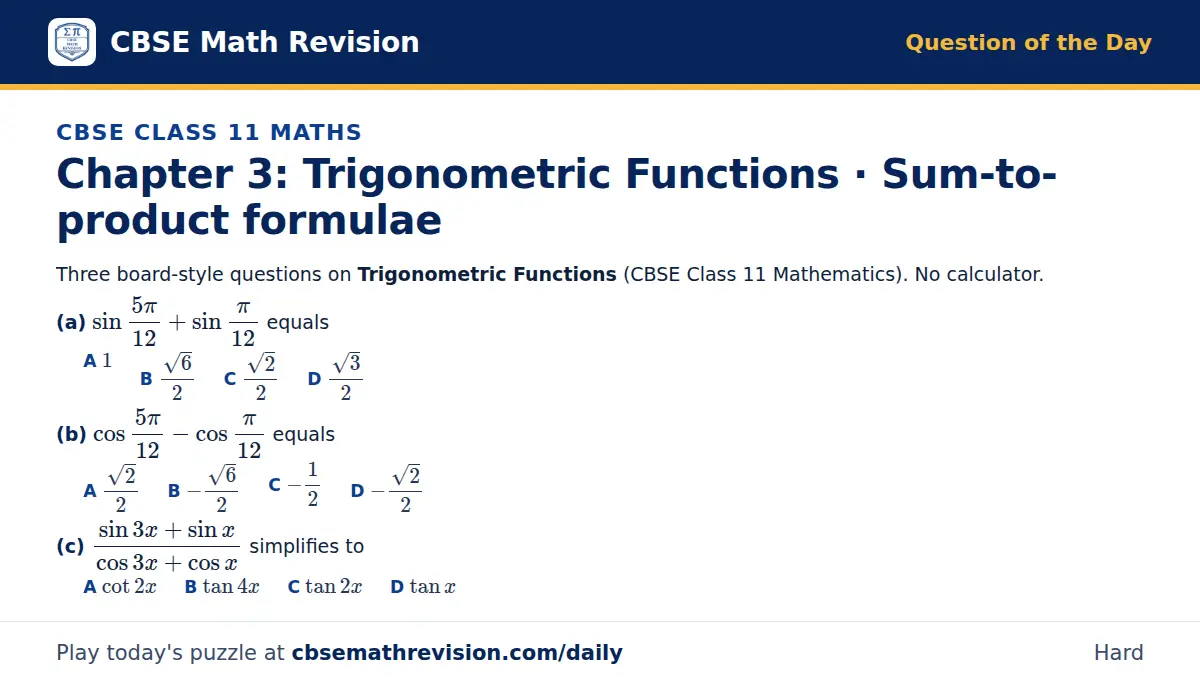
Chapter 3: Trigonometric Functions · Sum-to-product formulae
Three board-style questions on Trigonometric Functions (CBSE Class 11 Mathematics). No calculator.
- sin(5π)/12 + sin(π)/12 equals Options: A) 1; B) (√6)/2; C) (√2)/2; D) (√3)/2
- cos(5π)/12 - cos(π)/12 equals Options: A) (√2)/2; B) - (√6)/2; C) - 1/2; D) - (√2)/2
- (sin 3x + sin x)/(cos 3x + cos x) simplifies to Options: A) cot 2x; B) tan 4x; C) tan 2x; D) tan x
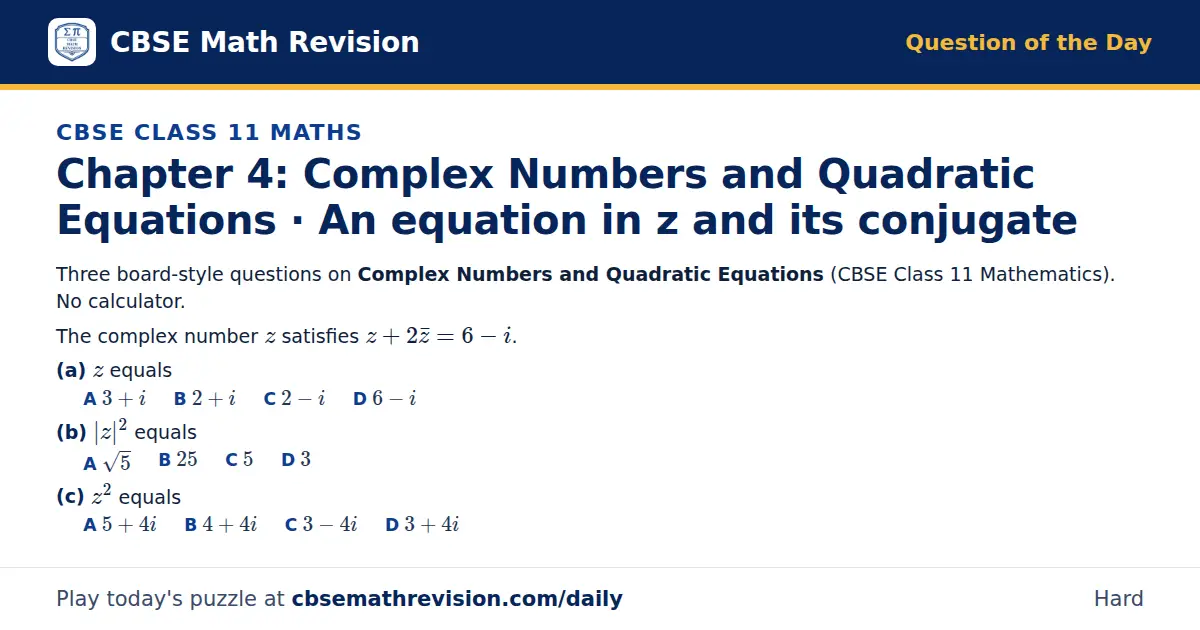
Chapter 4: Complex Numbers and Quadratic Equations · An equation in z and its conjugate
Three board-style questions on Complex Numbers and Quadratic Equations (CBSE Class 11 Mathematics). No calculator. The complex number z satisfies z + 2 z = 6 - i.
- z equals Options: A) 3 + i; B) 2 + i; C) 2 - i; D) 6 - i
- |z|² equals Options: A) √5; B) 25; C) 5; D) 3
- z² equals Options: A) 5 + 4 i; B) 4 + 4 i; C) 3 - 4 i; D) 3 + 4 i
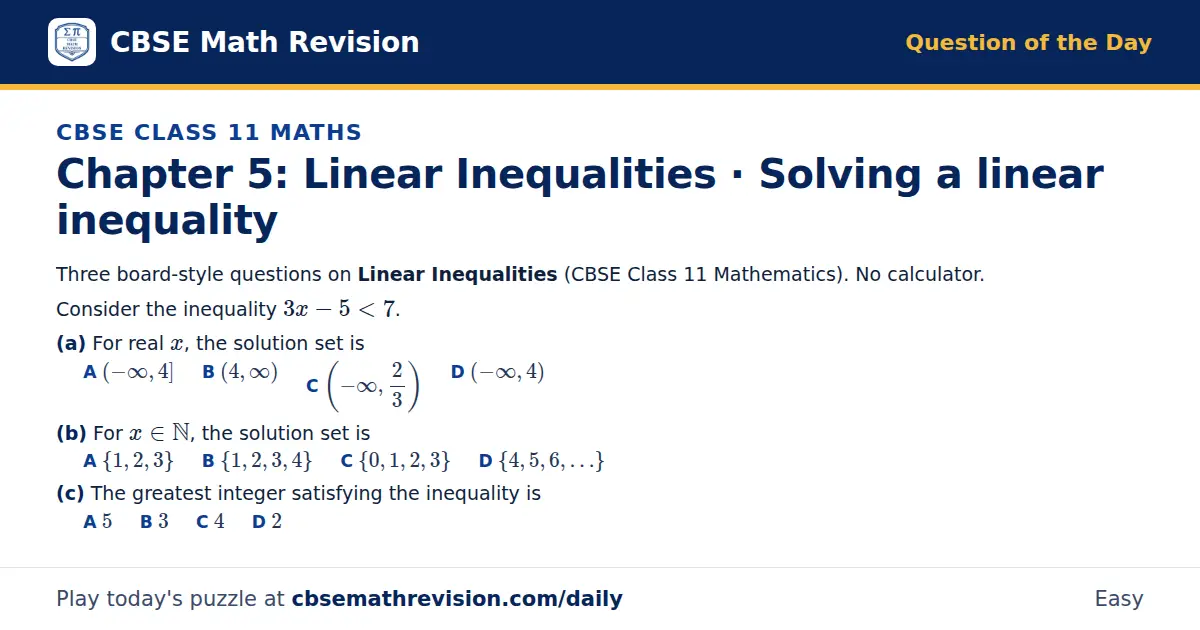
Chapter 5: Linear Inequalities · Solving a linear inequality
Three board-style questions on Linear Inequalities (CBSE Class 11 Mathematics). No calculator. Consider the inequality 3x - 5 < 7.
- For real x, the solution set is Options: A) (-∞, 4]; B) (4, ∞); C) (-∞, 23); D) (-∞, 4)
- For x ∈ ℕ, the solution set is Options: A) 1, 2, 3; B) 1, 2, 3, 4; C) 0, 1, 2, 3; D) 4, 5, 6, …
- The greatest integer satisfying the inequality is Options: A) 5; B) 3; C) 4; D) 2
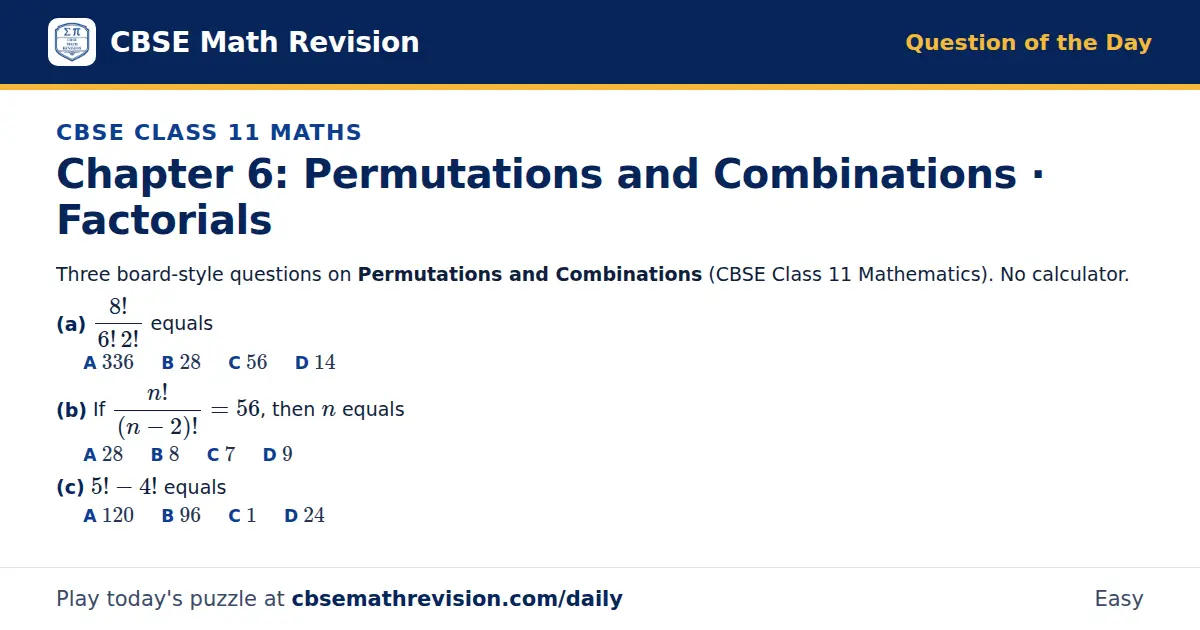
Chapter 6: Permutations and Combinations · Factorials
Three board-style questions on Permutations and Combinations (CBSE Class 11 Mathematics). No calculator.
- (8!)/(6! 2!) equals Options: A) 336; B) 28; C) 56; D) 14
- If (n!)/((n - 2)!) = 56, then n equals Options: A) 28; B) 8; C) 7; D) 9
- 5! - 4! equals Options: A) 120; B) 96; C) 1; D) 24
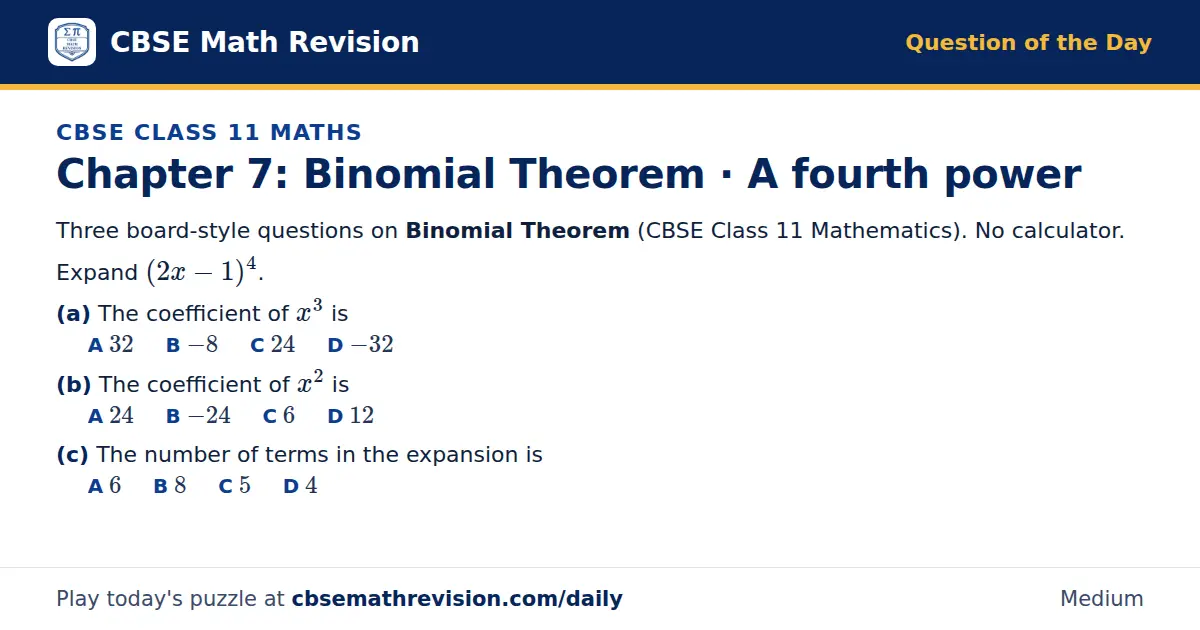
Chapter 7: Binomial Theorem · A fourth power
Three board-style questions on Binomial Theorem (CBSE Class 11 Mathematics). No calculator. Expand (2x - 1)^4.
- The coefficient of x³ is Options: A) 32; B) -8; C) 24; D) -32
- The coefficient of x² is Options: A) 24; B) -24; C) 6; D) 12
- The number of terms in the expansion is Options: A) 6; B) 8; C) 5; D) 4
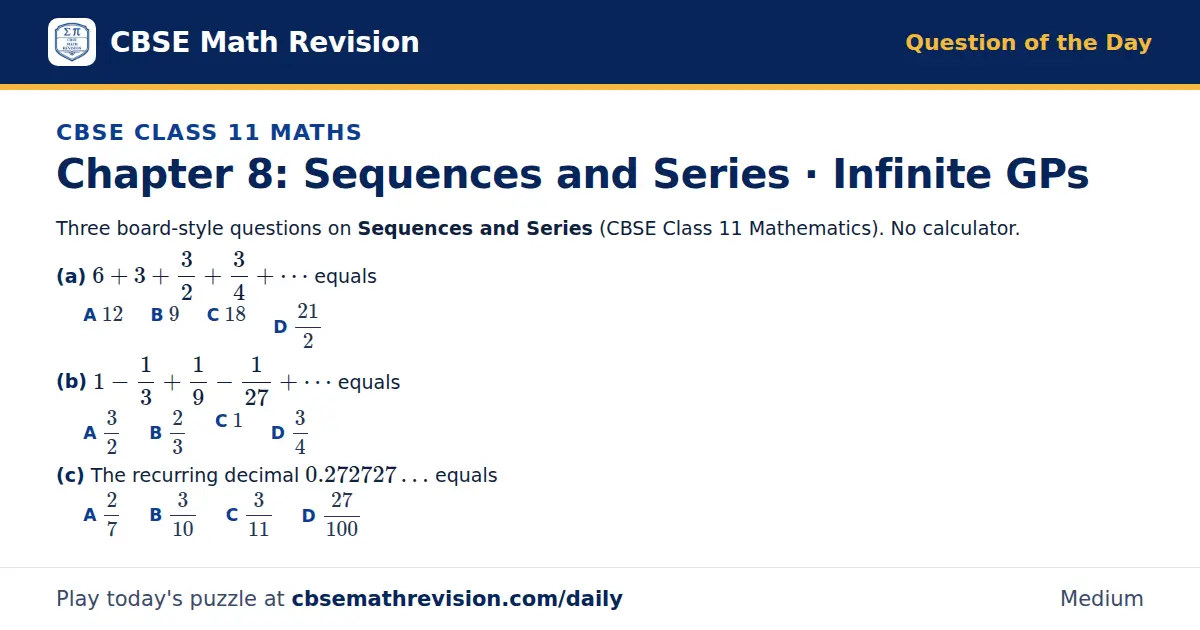
Chapter 8: Sequences and Series · Infinite GPs
Three board-style questions on Sequences and Series (CBSE Class 11 Mathematics). No calculator.
- 6 + 3 + 32 + 34 + … equals Options: A) 12; B) 9; C) 18; D) 21/2
- 1 - 13 + 19 - 127 + … equals Options: A) 3/2; B) 2/3; C) 1; D) 3/4
- The recurring decimal 0.272727… equals Options: A) 2/7; B) 3/10; C) 3/11; D) 27/100
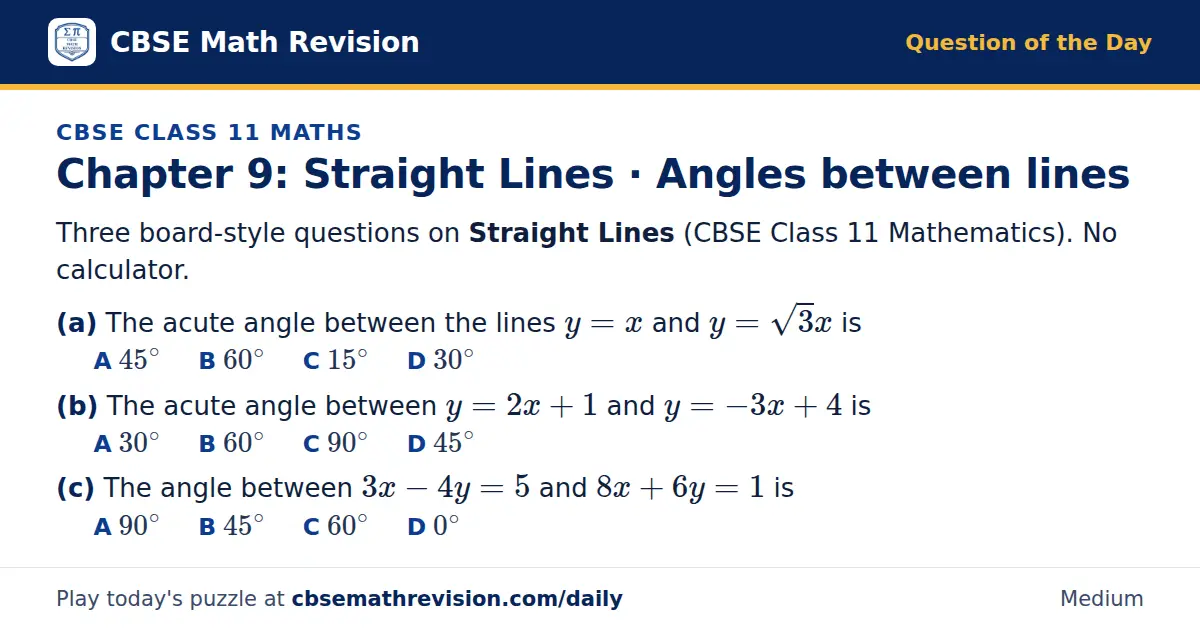
Chapter 9: Straight Lines · Angles between lines
Three board-style questions on Straight Lines (CBSE Class 11 Mathematics). No calculator.
- The acute angle between the lines y = x and y = √3 x is Options: A) 45^∘; B) 60^∘; C) 15^∘; D) 30^∘
- The acute angle between y = 2x + 1 and y = -3x + 4 is Options: A) 30^∘; B) 60^∘; C) 90^∘; D) 45^∘
- The angle between 3x - 4y = 5 and 8x + 6y = 1 is Options: A) 90^∘; B) 45^∘; C) 60^∘; D) 0^∘
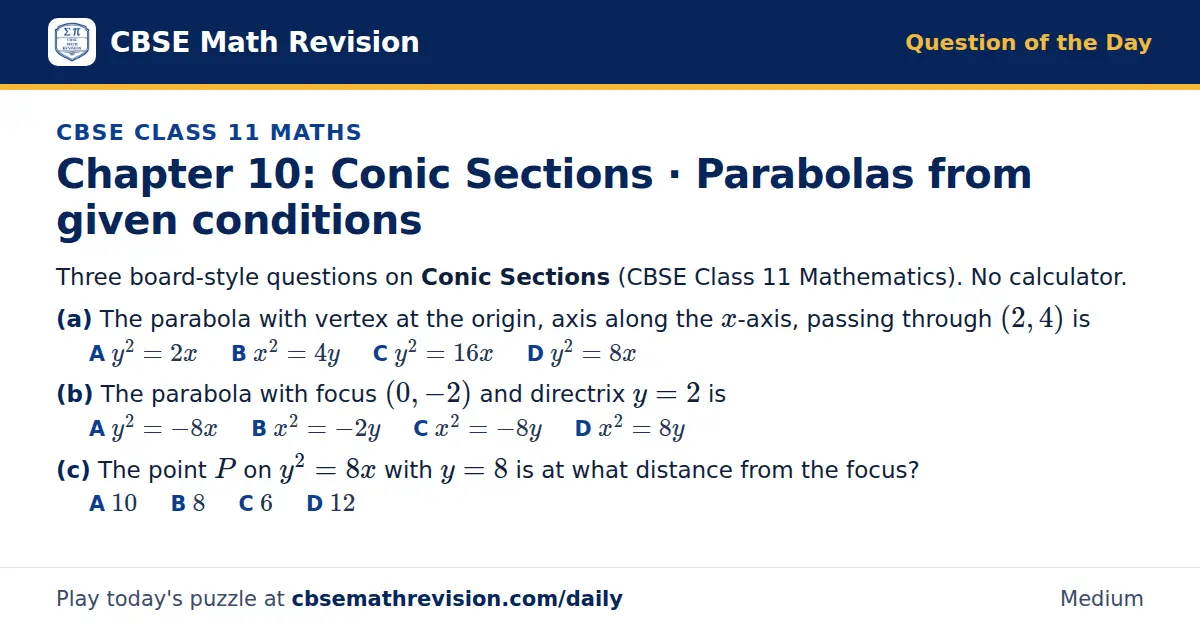
Chapter 10: Conic Sections · Parabolas from given conditions
Three board-style questions on Conic Sections (CBSE Class 11 Mathematics). No calculator.
- The parabola with vertex at the origin, axis along the x-axis, passing through (2, 4) is Options: A) y² = 2x; B) x² = 4y; C) y² = 16x; D) y² = 8x
- The parabola with focus (0, -2) and directrix y = 2 is Options: A) y² = -8x; B) x² = -2y; C) x² = -8y; D) x² = 8y
- The point P on y² = 8x with y = 8 is at what distance from the focus? Options: A) 10; B) 8; C) 6; D) 12
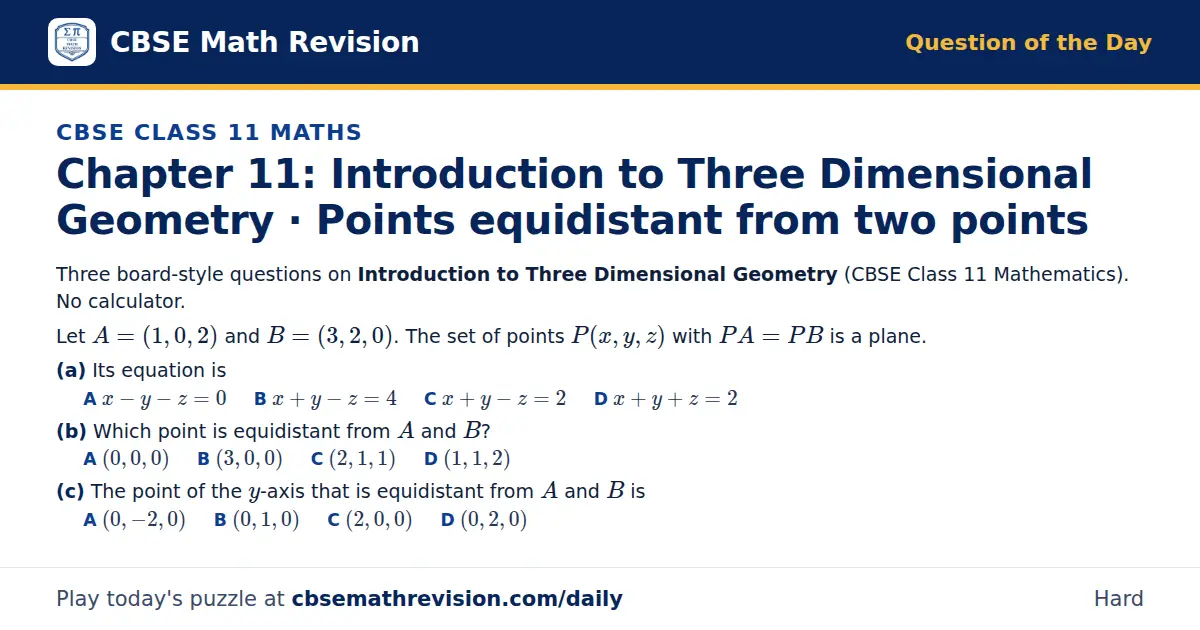
Chapter 11: Introduction to Three Dimensional Geometry · Points equidistant from two points
Three board-style questions on Introduction to Three Dimensional Geometry (CBSE Class 11 Mathematics). No calculator. Let A = (1, 0, 2) and B = (3, 2, 0). The set of points P(x, y, z) with PA = PB is a plane.
- Its equation is Options: A) x - y - z = 0; B) x + y - z = 4; C) x + y - z = 2; D) x + y + z = 2
- Which point is equidistant from A and B? Options: A) (0, 0, 0); B) (3, 0, 0); C) (2, 1, 1); D) (1, 1, 2)
- The point of the y-axis that is equidistant from A and B is Options: A) (0, -2, 0); B) (0, 1, 0); C) (2, 0, 0); D) (0, 2, 0)
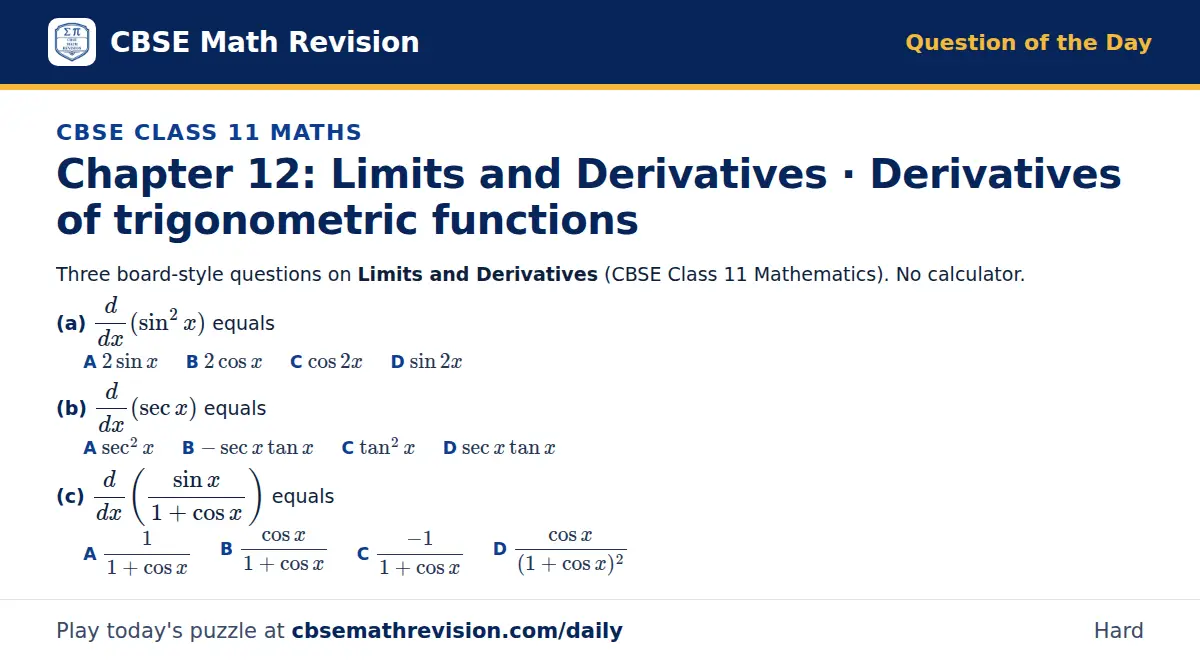
Chapter 12: Limits and Derivatives · Derivatives of trigonometric functions
Three board-style questions on Limits and Derivatives (CBSE Class 11 Mathematics). No calculator.
- d/dx(sin² x) equals Options: A) 2sin x; B) 2cos x; C) cos 2x; D) sin 2x
- d/dx(sec x) equals Options: A) sec² x; B) -sec xtan x; C) tan² x; D) sec xtan x
- d/dx((sin x)/(1 + cos x)) equals Options: A) 1/(1 + cos x); B) (cos x)/(1 + cos x); C) (-1)/(1 + cos x); D) (cos x)/((1 + cos x)²)
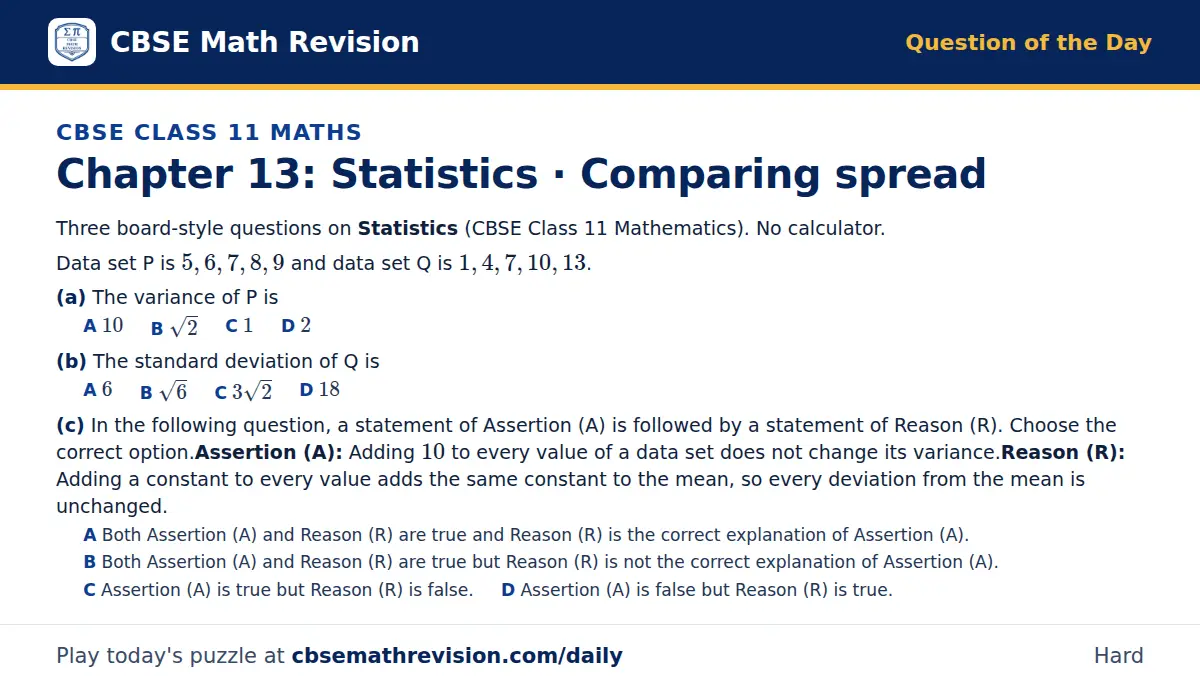
Chapter 13: Statistics · Comparing spread
Three board-style questions on Statistics (CBSE Class 11 Mathematics). No calculator. Data set P is 5, 6, 7, 8, 9 and data set Q is 1, 4, 7, 10, 13.
- The variance of P is Options: A) 10; B) √2; C) 1; D) 2
- The standard deviation of Q is Options: A) 6; B) √6; C) 3 √2; D) 18
- In the following question, a statement of Assertion (A) is followed by a statement of Reason (R). Choose the correct option. Assertion (A): Adding 10 to every value of a data set does not change its variance. Reason (R): Adding a constant to every value adds the same constant to the mean, so every deviation from the mean is unchanged. Options: A) Both Assertion (A) and Reason (R) are true and Reason (R) is the correct explanation of Assertion (A).; B) Both Assertion (A) and Reason (R) are true but Reason (R) is not the correct explanation of Assertion (A).; C) Assertion (A) is true but Reason (R) is false.; D) Assertion (A) is false but Reason (R) is true.
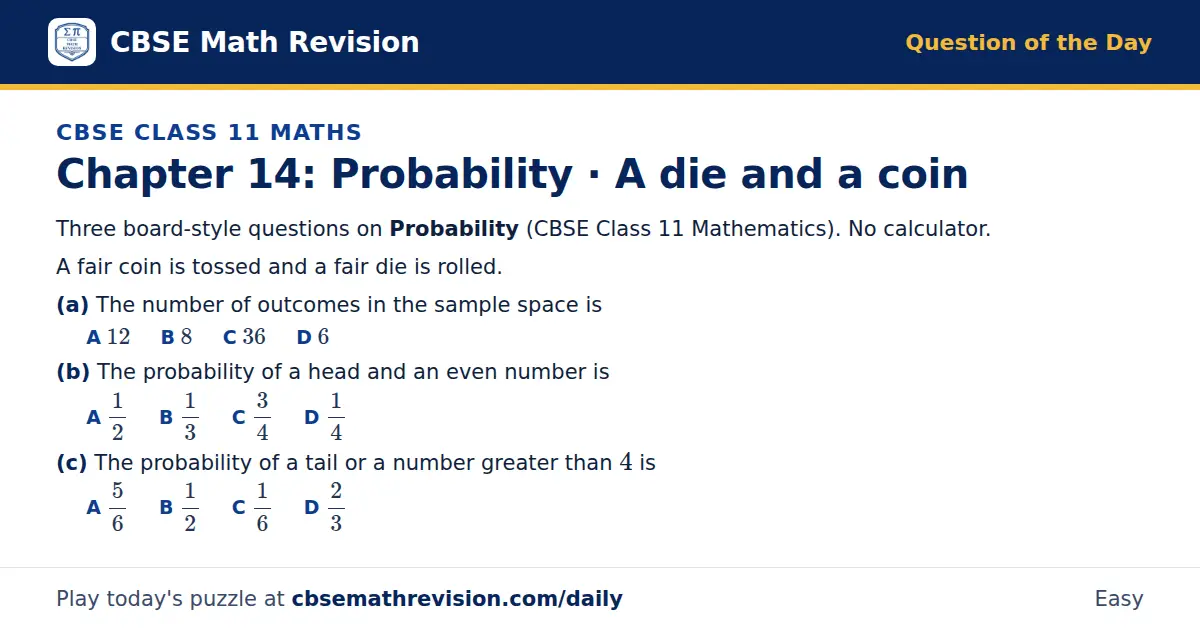
Chapter 14: Probability · A die and a coin
Three board-style questions on Probability (CBSE Class 11 Mathematics). No calculator. A fair coin is tossed and a fair die is rolled.
- The number of outcomes in the sample space is Options: A) 12; B) 8; C) 36; D) 6
- The probability of a head and an even number is Options: A) 1/2; B) 1/3; C) 3/4; D) 1/4
- The probability of a tail or a number greater than 4 is Options: A) 5/6; B) 1/2; C) 1/6; D) 2/3
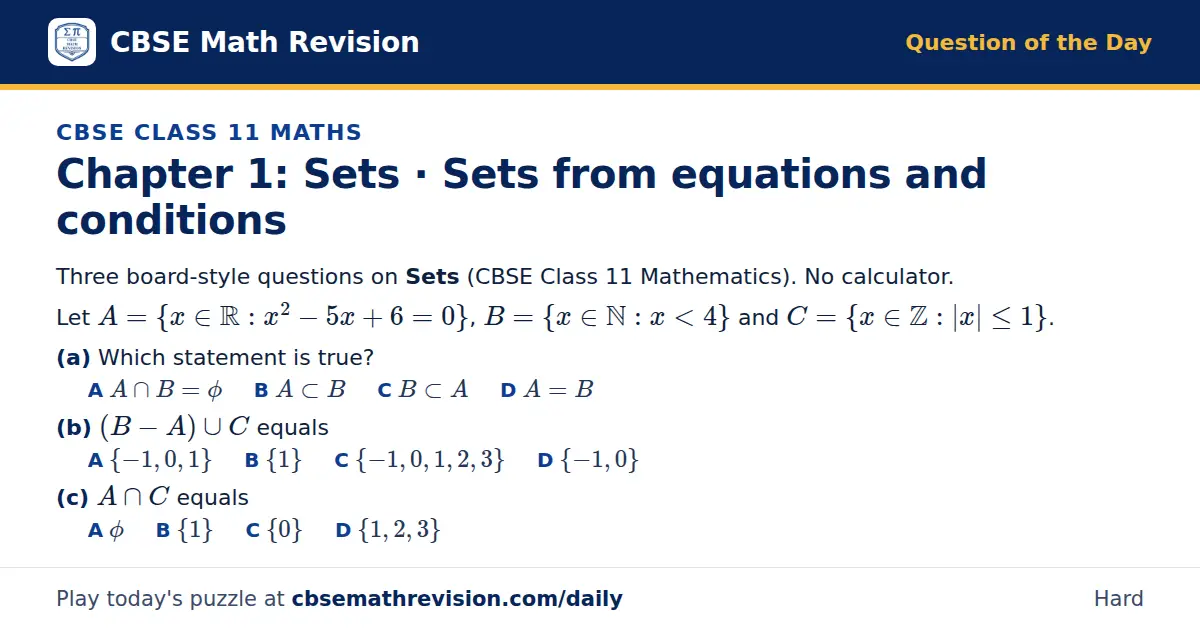
Chapter 1: Sets · Sets from equations and conditions
Three board-style questions on Sets (CBSE Class 11 Mathematics). No calculator. Let A = x ∈ ℝ: x² - 5x + 6 = 0, B = x ∈ ℕ: x < 4 and C = x ∈ ℤ: |x| ≤ 1.
- Which statement is true? Options: A) A ∩ B = φ; B) A ⊂ B; C) B ⊂ A; D) A = B
- (B - A) ∪ C equals Options: A) -1, 0, 1; B) 1; C) -1, 0, 1, 2, 3; D) -1, 0
- A ∩ C equals Options: A) φ; B) 1; C) 0; D) 1, 2, 3
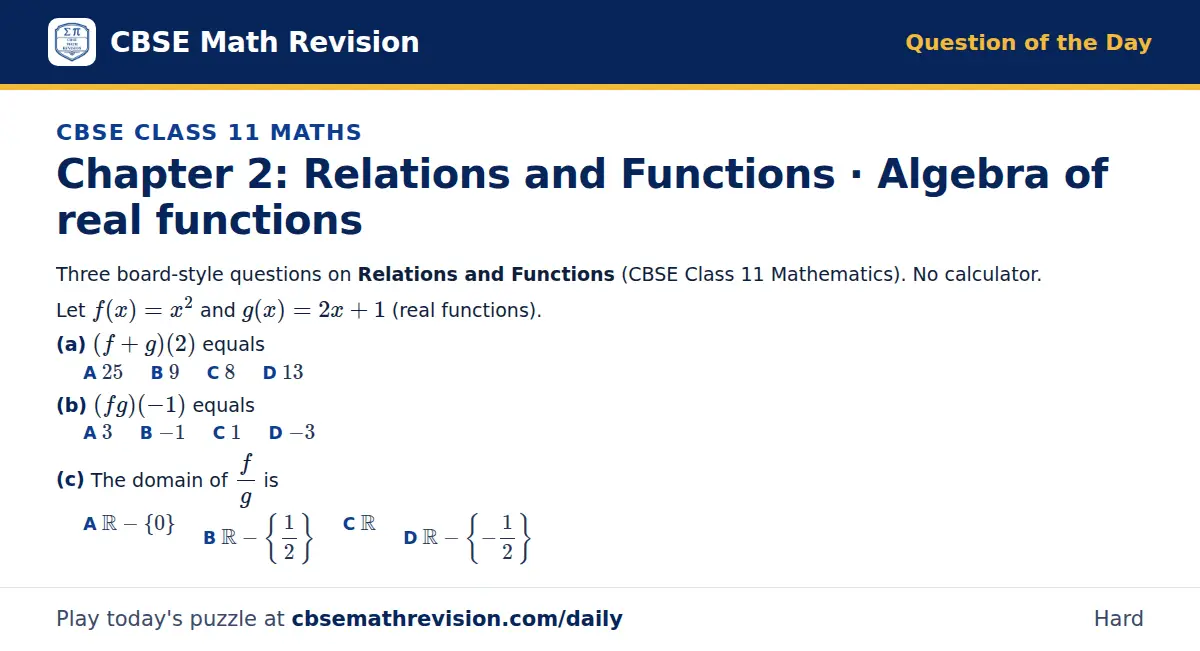
Chapter 2: Relations and Functions · Algebra of real functions
Three board-style questions on Relations and Functions (CBSE Class 11 Mathematics). No calculator. Let f(x) = x² and g(x) = 2x + 1 (real functions).
- (f + g)(2) equals Options: A) 25; B) 9; C) 8; D) 13
- (fg)(-1) equals Options: A) 3; B) -1; C) 1; D) -3
- The domain of f/g is Options: A) ℝ - 0; B) ℝ - 12; C) ℝ; D) ℝ - -12
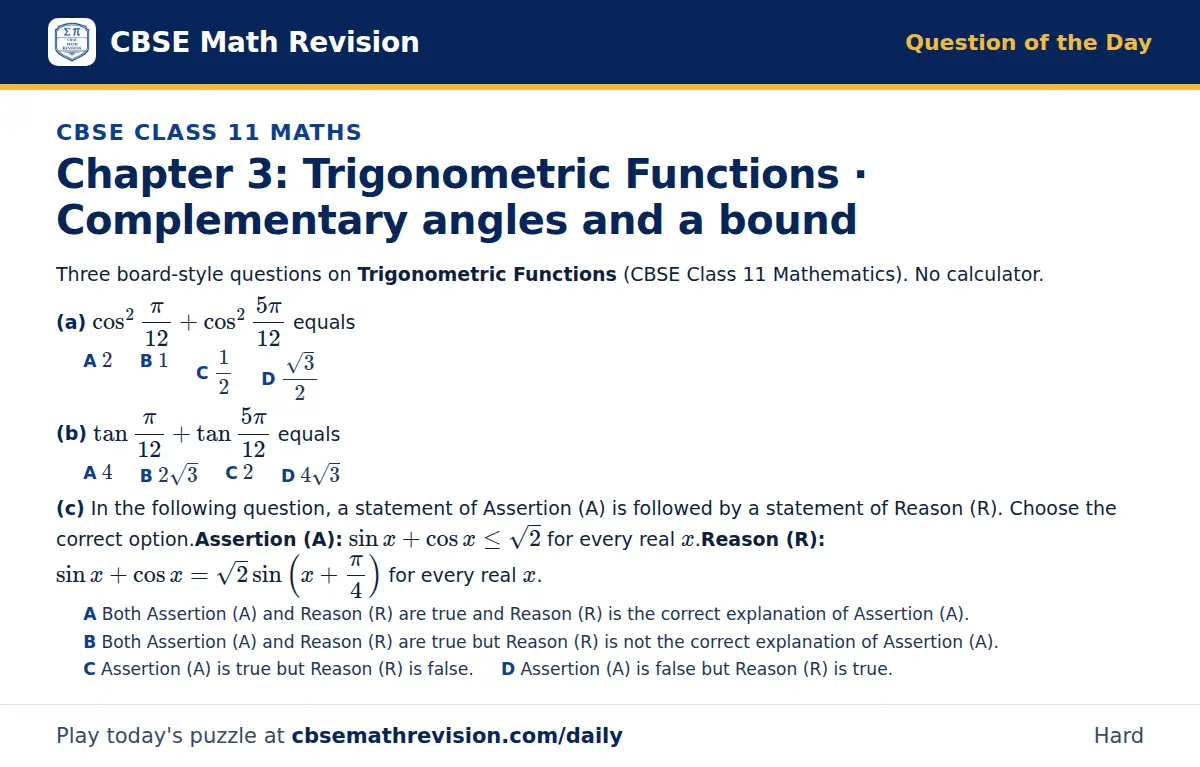
Chapter 3: Trigonometric Functions · Complementary angles and a bound
Three board-style questions on Trigonometric Functions (CBSE Class 11 Mathematics). No calculator.
- cos²(π)/12 + cos²(5π)/12 equals Options: A) 2; B) 1; C) 1/2; D) (√3)/2
- tan(π)/12 + tan(5π)/12 equals Options: A) 4; B) 2 √3; C) 2; D) 4 √3
- In the following question, a statement of Assertion (A) is followed by a statement of Reason (R). Choose the correct option. Assertion (A): sin x + cos x ≤ √2 for every real x. Reason (R): sin x + cos x = √2sin(x + (π)/4) for every real x. Options: A) Both Assertion (A) and Reason (R) are true and Reason (R) is the correct explanation of Assertion (A).; B) Both Assertion (A) and Reason (R) are true but Reason (R) is not the correct explanation of Assertion (A).; C) Assertion (A) is true but Reason (R) is false.; D) Assertion (A) is false but Reason (R) is true.
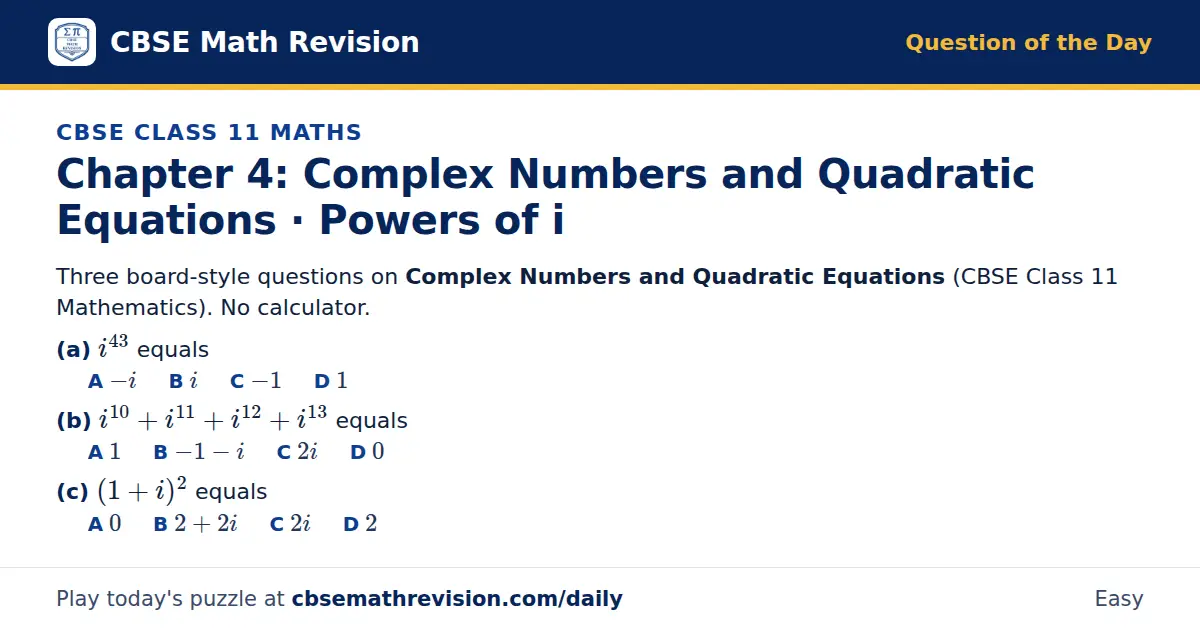
Chapter 4: Complex Numbers and Quadratic Equations · Powers of i
Three board-style questions on Complex Numbers and Quadratic Equations (CBSE Class 11 Mathematics). No calculator.
- i⁴³ equals Options: A) - i; B) i; C) -1; D) 1
- i¹⁰ + i¹¹ + i¹² + i¹³ equals Options: A) 1; B) -1 - i; C) 2 i; D) 0
- (1 + i)² equals Options: A) 0; B) 2 + 2 i; C) 2 i; D) 2
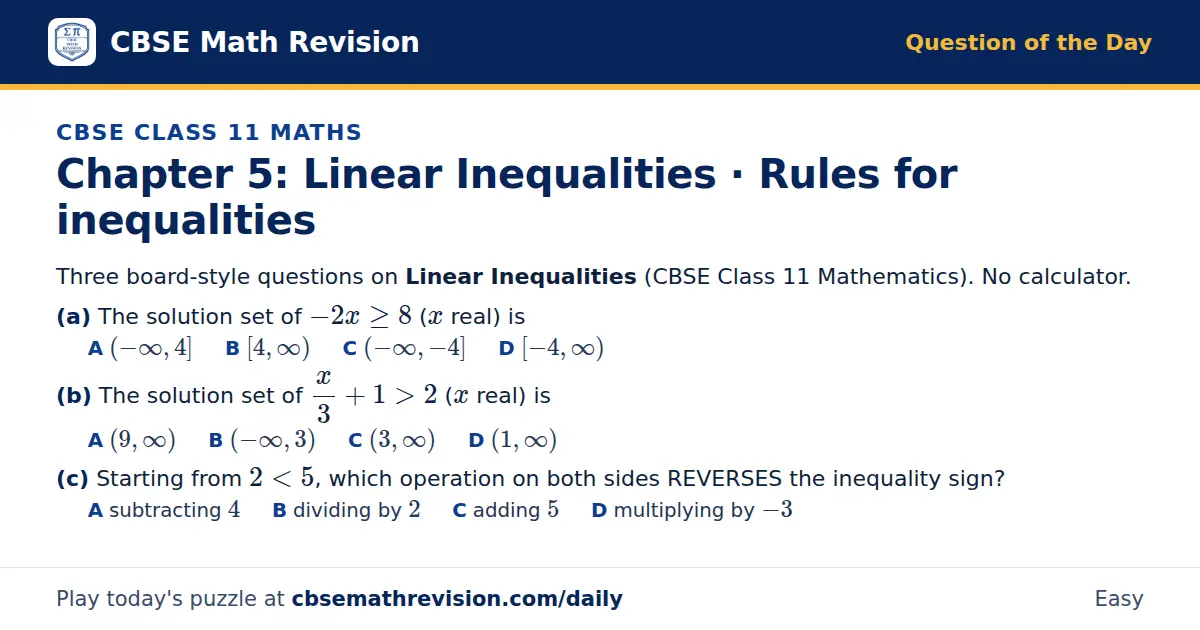
Chapter 5: Linear Inequalities · Rules for inequalities
Three board-style questions on Linear Inequalities (CBSE Class 11 Mathematics). No calculator.
- The solution set of -2x ≥ 8 (x real) is Options: A) (-∞, 4]; B) [4, ∞); C) (-∞, -4]; D) [-4, ∞)
- The solution set of x/3 + 1 > 2 (x real) is Options: A) (9, ∞); B) (-∞, 3); C) (3, ∞); D) (1, ∞)
- Starting from 2 < 5, which operation on both sides REVERSES the inequality sign? Options: A) subtracting 4; B) dividing by 2; C) adding 5; D) multiplying by -3
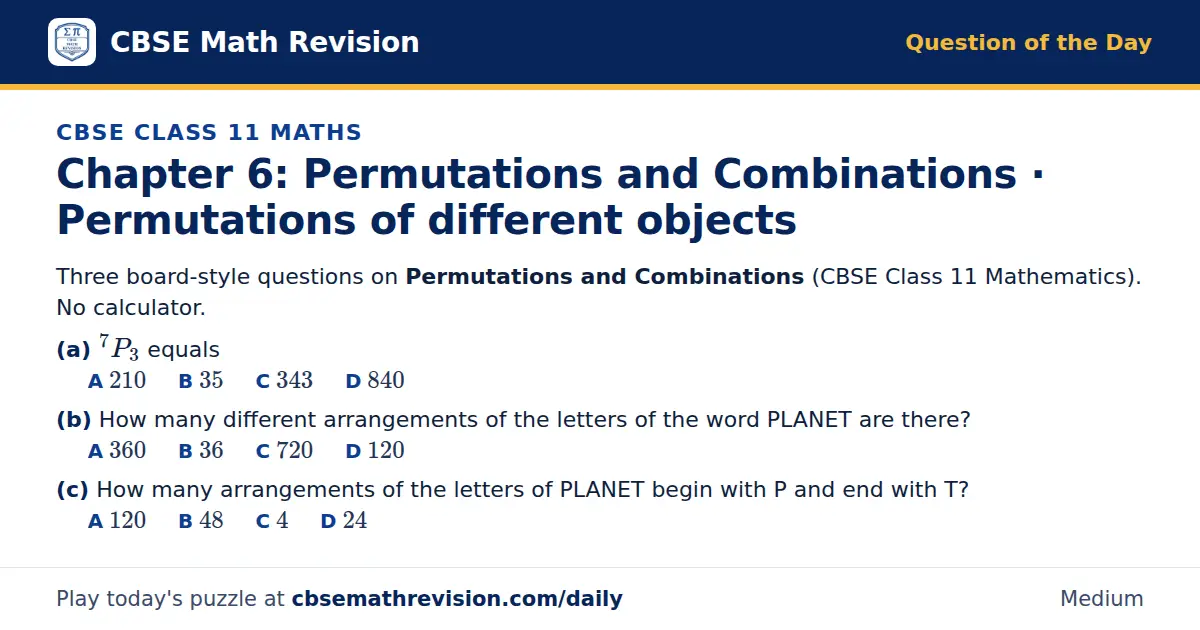
Chapter 6: Permutations and Combinations · Permutations of different objects
Three board-style questions on Permutations and Combinations (CBSE Class 11 Mathematics). No calculator.
- ⁷P_3 equals Options: A) 210; B) 35; C) 343; D) 840
- How many different arrangements of the letters of the word PLANET are there? Options: A) 360; B) 36; C) 720; D) 120
- How many arrangements of the letters of PLANET begin with P and end with T? Options: A) 120; B) 48; C) 4; D) 24
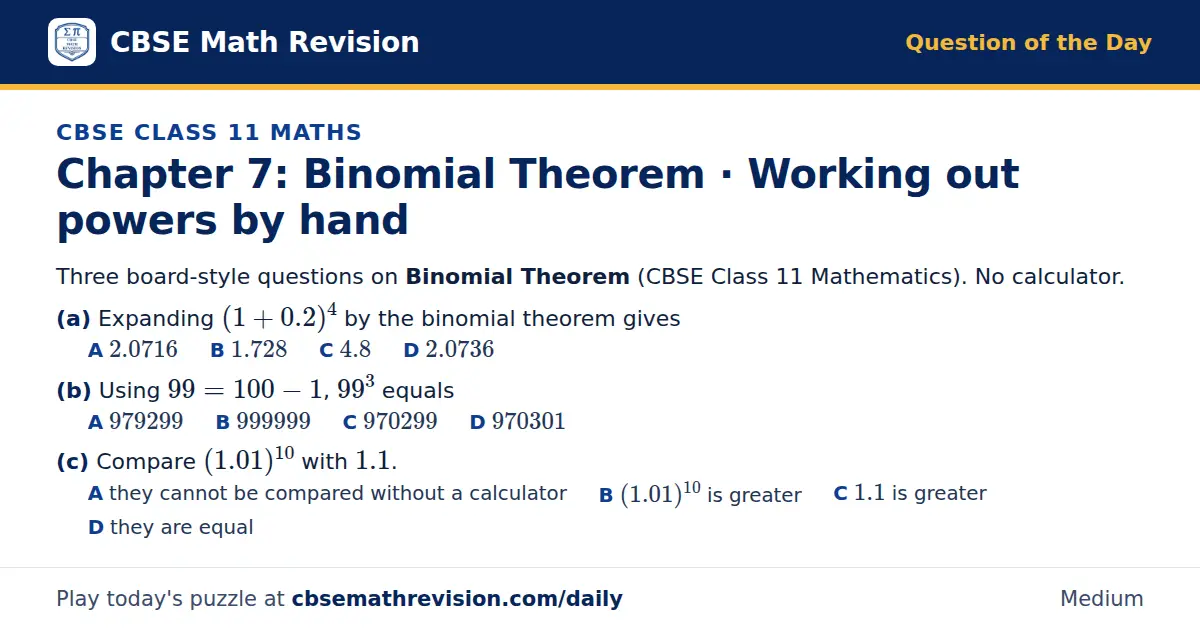
Chapter 7: Binomial Theorem · Working out powers by hand
Three board-style questions on Binomial Theorem (CBSE Class 11 Mathematics). No calculator.
- Expanding (1 + 0.2)⁴ by the binomial theorem gives Options: A) 2.0716; B) 1.728; C) 4.8; D) 2.0736
- Using 99 = 100 - 1, 99³ equals Options: A) 979299; B) 999999; C) 970299; D) 970301
- Compare (1.01)¹⁰ with 1.1. Options: A) they cannot be compared without a calculator; B) (1.01)¹⁰ is greater; C) 1.1 is greater; D) they are equal
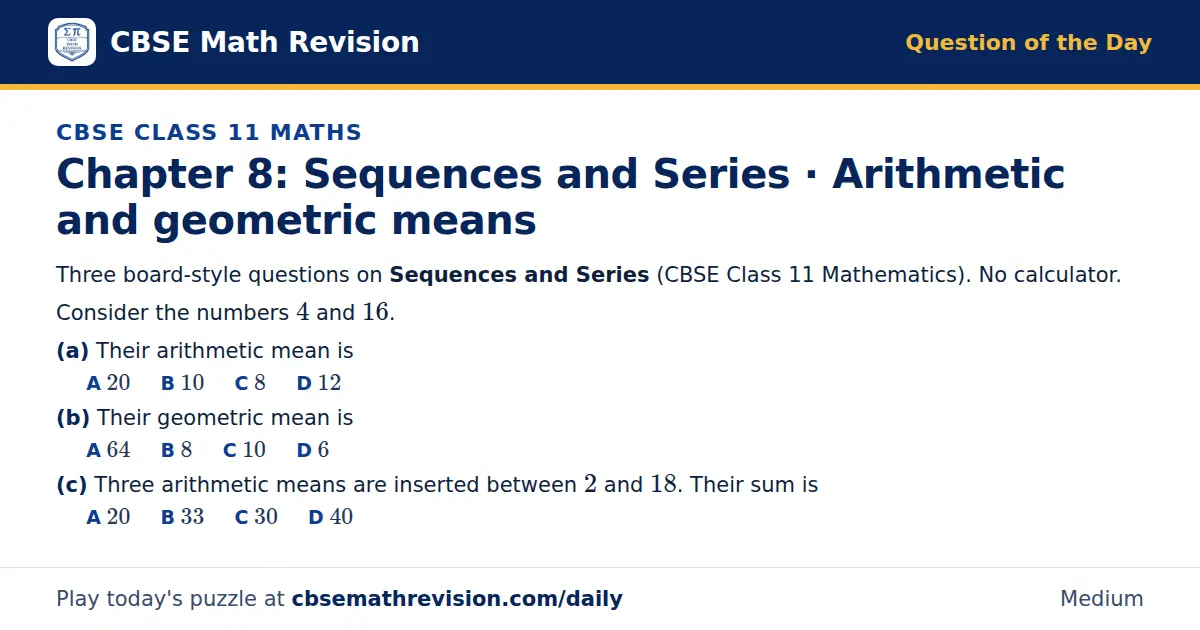
Chapter 8: Sequences and Series · Arithmetic and geometric means
Three board-style questions on Sequences and Series (CBSE Class 11 Mathematics). No calculator. Consider the numbers 4 and 16.
- Their arithmetic mean is Options: A) 20; B) 10; C) 8; D) 12
- Their geometric mean is Options: A) 64; B) 8; C) 10; D) 6
- Three arithmetic means are inserted between 2 and 18. Their sum is Options: A) 20; B) 33; C) 30; D) 40
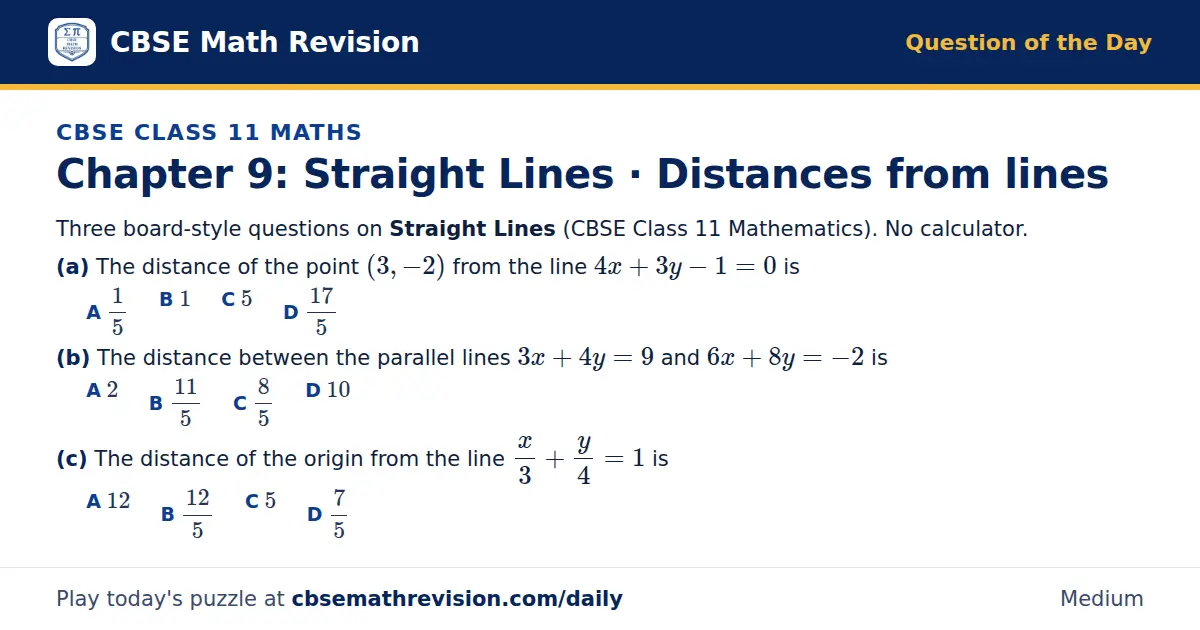
Chapter 9: Straight Lines · Distances from lines
Three board-style questions on Straight Lines (CBSE Class 11 Mathematics). No calculator.
- The distance of the point (3, -2) from the line 4x + 3y - 1 = 0 is Options: A) 1/5; B) 1; C) 5; D) 17/5
- The distance between the parallel lines 3x + 4y = 9 and 6x + 8y = -2 is Options: A) 2; B) 11/5; C) 8/5; D) 10
- The distance of the origin from the line x3 + y4 = 1 is Options: A) 12; B) 12/5; C) 5; D) 7/5
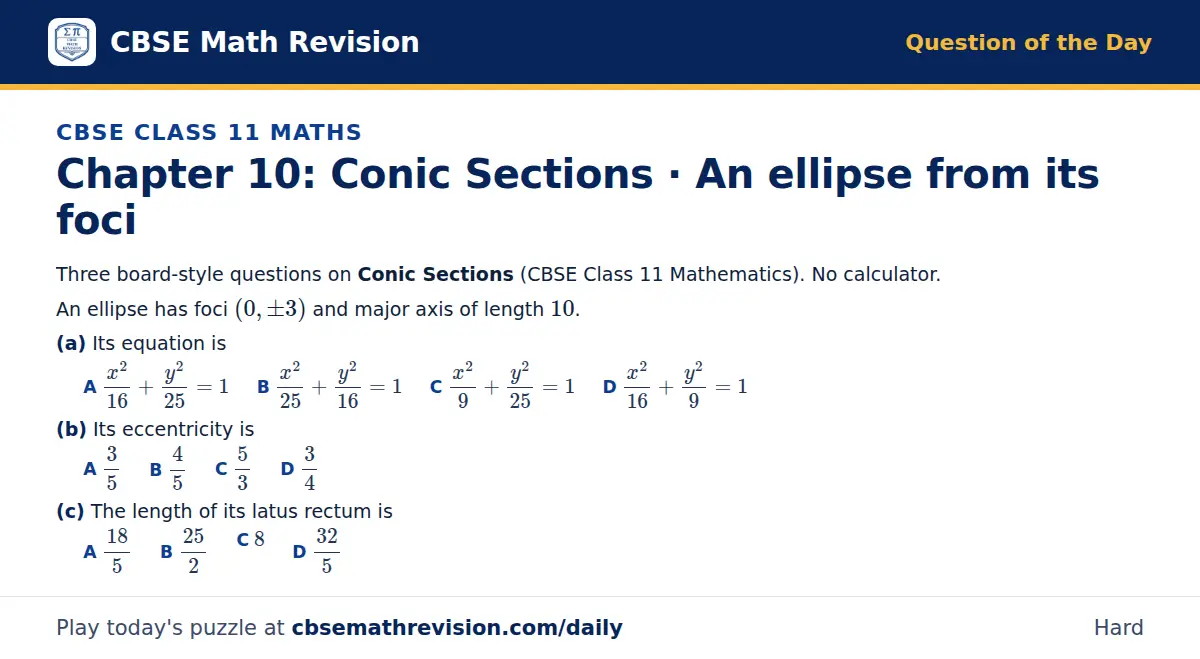
Chapter 10: Conic Sections · An ellipse from its foci
Three board-style questions on Conic Sections (CBSE Class 11 Mathematics). No calculator. An ellipse has foci (0, ± 3) and major axis of length 10.
- Its equation is Options: A) (x²)/16 + (y²)/25 = 1; B) (x²)/25 + (y²)/16 = 1; C) (x²)/9 + (y²)/25 = 1; D) (x²)/16 + (y²)/9 = 1
- Its eccentricity is Options: A) 3/5; B) 4/5; C) 5/3; D) 3/4
- The length of its latus rectum is Options: A) 18/5; B) 25/2; C) 8; D) 32/5
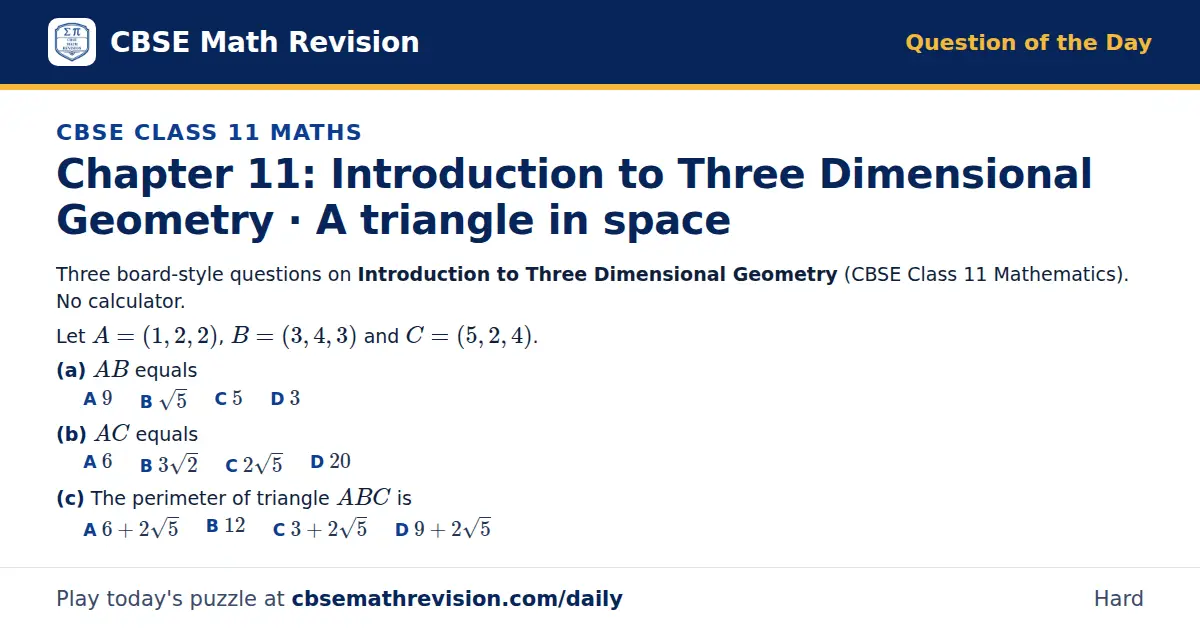
Chapter 11: Introduction to Three Dimensional Geometry · A triangle in space
Three board-style questions on Introduction to Three Dimensional Geometry (CBSE Class 11 Mathematics). No calculator. Let A = (1, 2, 2), B = (3, 4, 3) and C = (5, 2, 4).
- AB equals Options: A) 9; B) √5; C) 5; D) 3
- AC equals Options: A) 6; B) 3 √2; C) 2 √5; D) 20
- The perimeter of triangle ABC is Options: A) 6 + 2√5; B) 12; C) 3 + 2√5; D) 9 + 2√5
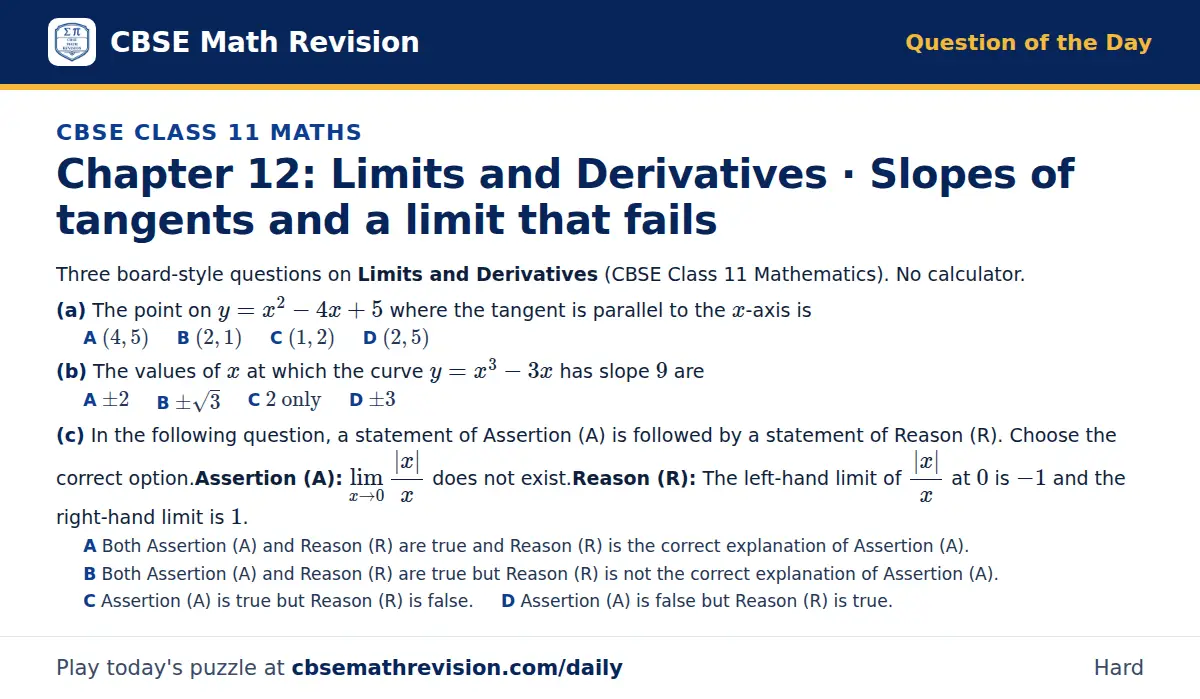
Chapter 12: Limits and Derivatives · Slopes of tangents and a limit that fails
Three board-style questions on Limits and Derivatives (CBSE Class 11 Mathematics). No calculator.
- The point on y = x² - 4x + 5 where the tangent is parallel to the x-axis is Options: A) (4, 5); B) (2, 1); C) (1, 2); D) (2, 5)
- The values of x at which the curve y = x³ - 3x has slope 9 are Options: A) ± 2; B) ± √3; C) 2 only; D) ± 3
- In the following question, a statement of Assertion (A) is followed by a statement of Reason (R). Choose the correct option. Assertion (A): lim_x → 0 (|x|)/x does not exist. Reason (R): The left-hand limit of (|x|)/x at 0 is -1 and the right-hand limit is 1. Options: A) Both Assertion (A) and Reason (R) are true and Reason (R) is the correct explanation of Assertion (A).; B) Both Assertion (A) and Reason (R) are true but Reason (R) is not the correct explanation of Assertion (A).; C) Assertion (A) is true but Reason (R) is false.; D) Assertion (A) is false but Reason (R) is true.
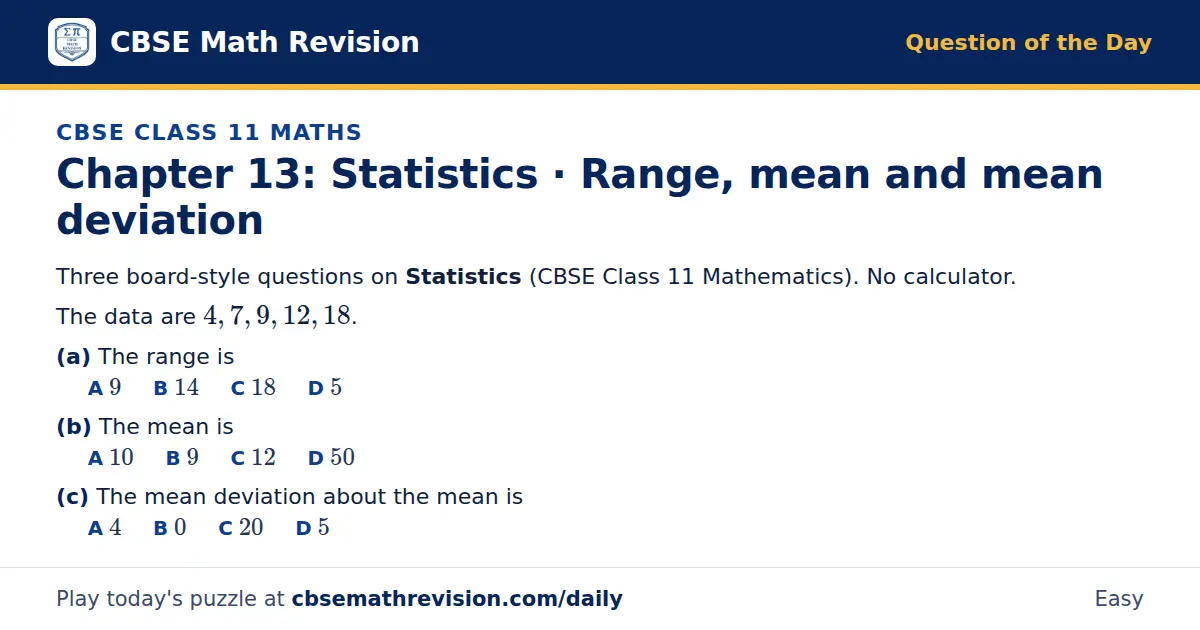
Chapter 13: Statistics · Range, mean and mean deviation
Three board-style questions on Statistics (CBSE Class 11 Mathematics). No calculator. The data are 4, 7, 9, 12, 18.
- The range is Options: A) 9; B) 14; C) 18; D) 5
- The mean is Options: A) 10; B) 9; C) 12; D) 50
- The mean deviation about the mean is Options: A) 4; B) 0; C) 20; D) 5
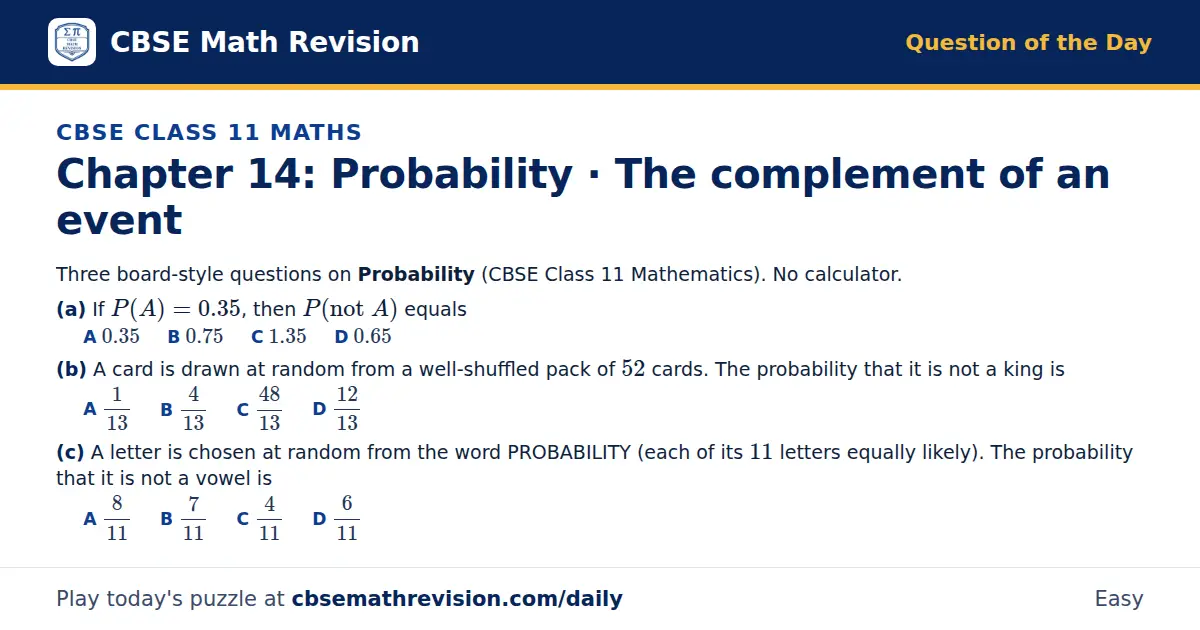
Chapter 14: Probability · The complement of an event
Three board-style questions on Probability (CBSE Class 11 Mathematics). No calculator.
- If P(A) = 0.35, then P(not A) equals Options: A) 0.35; B) 0.75; C) 1.35; D) 0.65
- A card is drawn at random from a well-shuffled pack of 52 cards. The probability that it is not a king is Options: A) 1/13; B) 4/13; C) 48/13; D) 12/13
- A letter is chosen at random from the word PROBABILITY (each of its 11 letters equally likely). The probability that it is not a vowel is Options: A) 8/11; B) 7/11; C) 4/11; D) 6/11
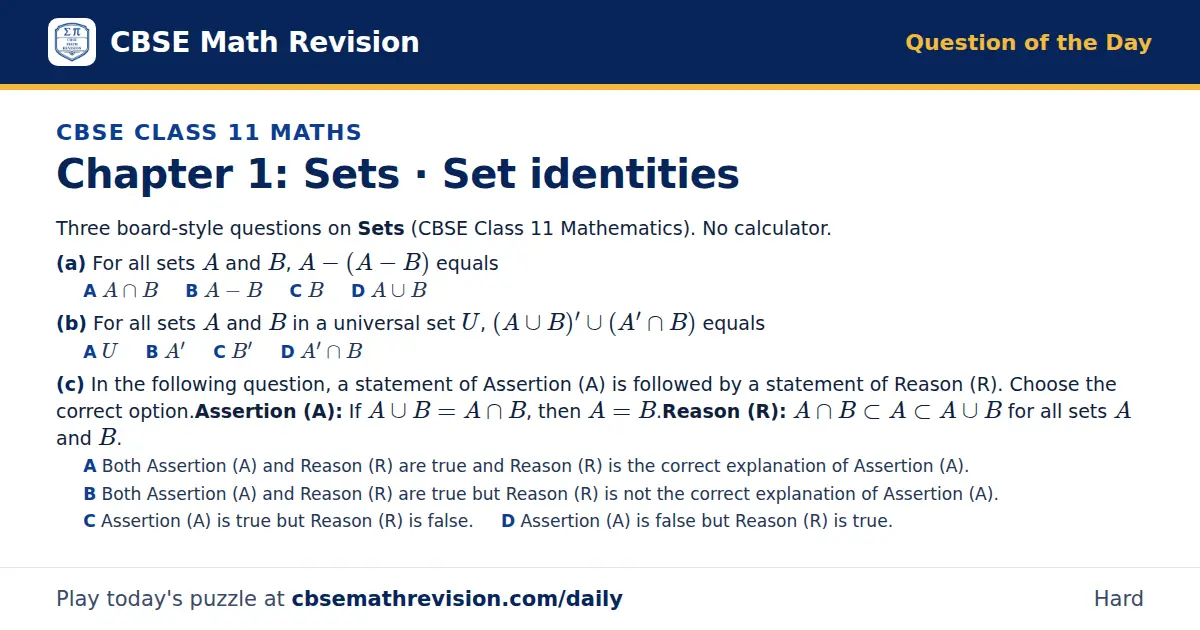
Chapter 1: Sets · Set identities
Three board-style questions on Sets (CBSE Class 11 Mathematics). No calculator.
- For all sets A and B, A - (A - B) equals Options: A) A ∩ B; B) A - B; C) B; D) A ∪ B
- For all sets A and B in a universal set U, (A ∪ B)' ∪ (A' ∩ B) equals Options: A) U; B) A'; C) B'; D) A' ∩ B
- In the following question, a statement of Assertion (A) is followed by a statement of Reason (R). Choose the correct option. Assertion (A): If A ∪ B = A ∩ B, then A = B. Reason (R): A ∩ B ⊂ A ⊂ A ∪ B for all sets A and B. Options: A) Both Assertion (A) and Reason (R) are true and Reason (R) is the correct explanation of Assertion (A).; B) Both Assertion (A) and Reason (R) are true but Reason (R) is not the correct explanation of Assertion (A).; C) Assertion (A) is true but Reason (R) is false.; D) Assertion (A) is false but Reason (R) is true.
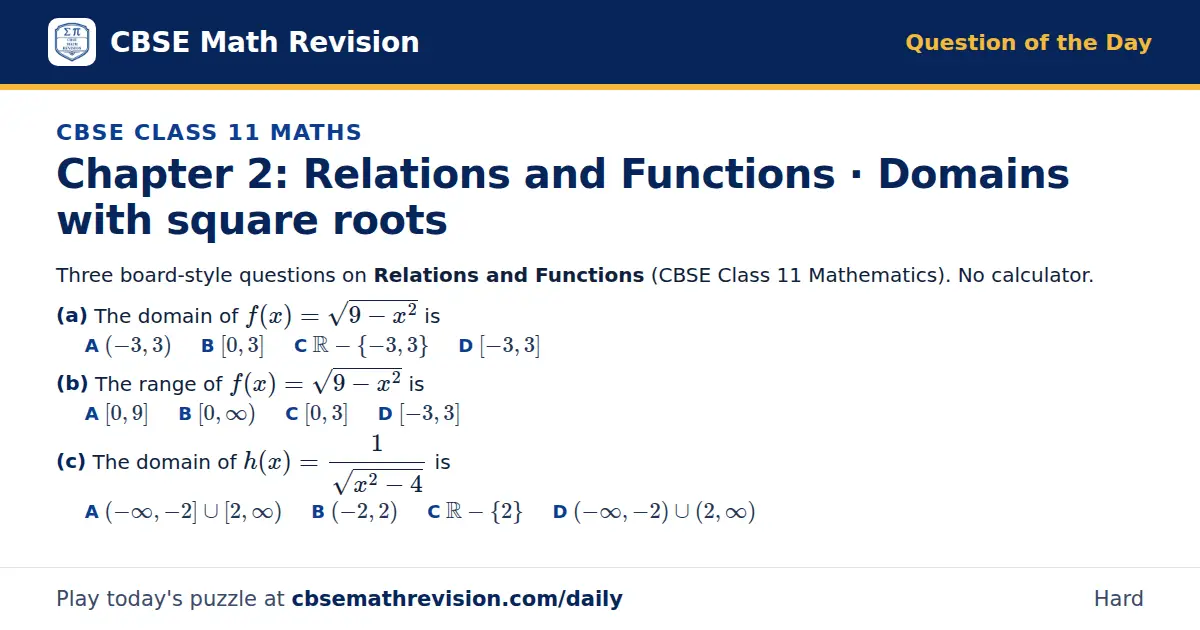
Chapter 2: Relations and Functions · Domains with square roots
Three board-style questions on Relations and Functions (CBSE Class 11 Mathematics). No calculator.
- The domain of f(x) = √(9 - x²) is Options: A) (-3, 3); B) [0, 3]; C) ℝ - -3, 3; D) [-3, 3]
- The range of f(x) = √(9 - x²) is Options: A) [0, 9]; B) [0, ∞); C) [0, 3]; D) [-3, 3]
- The domain of h(x) = 1/(√(x² - 4)) is Options: A) (-∞, -2] ∪ [2, ∞); B) (-2, 2); C) ℝ - 2; D) (-∞, -2) ∪ (2, ∞)
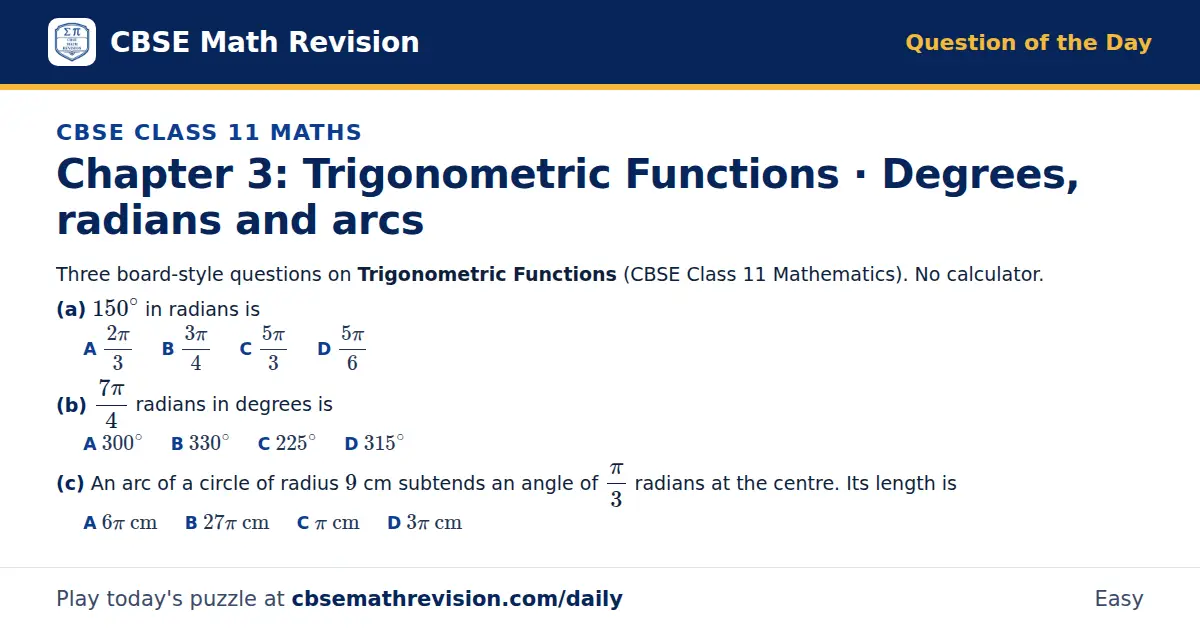
Chapter 3: Trigonometric Functions · Degrees, radians and arcs
Three board-style questions on Trigonometric Functions (CBSE Class 11 Mathematics). No calculator.
- 150^∘ in radians is Options: A) (2 π)/3; B) (3 π)/4; C) (5 π)/3; D) (5 π)/6
- (7π)/4 radians in degrees is Options: A) 300^∘; B) 330^∘; C) 225^∘; D) 315^∘
- An arc of a circle of radius 9 cm subtends an angle of (π)/3 radians at the centre. Its length is Options: A) 6 π cm; B) 27 π cm; C) π cm; D) 3 π cm
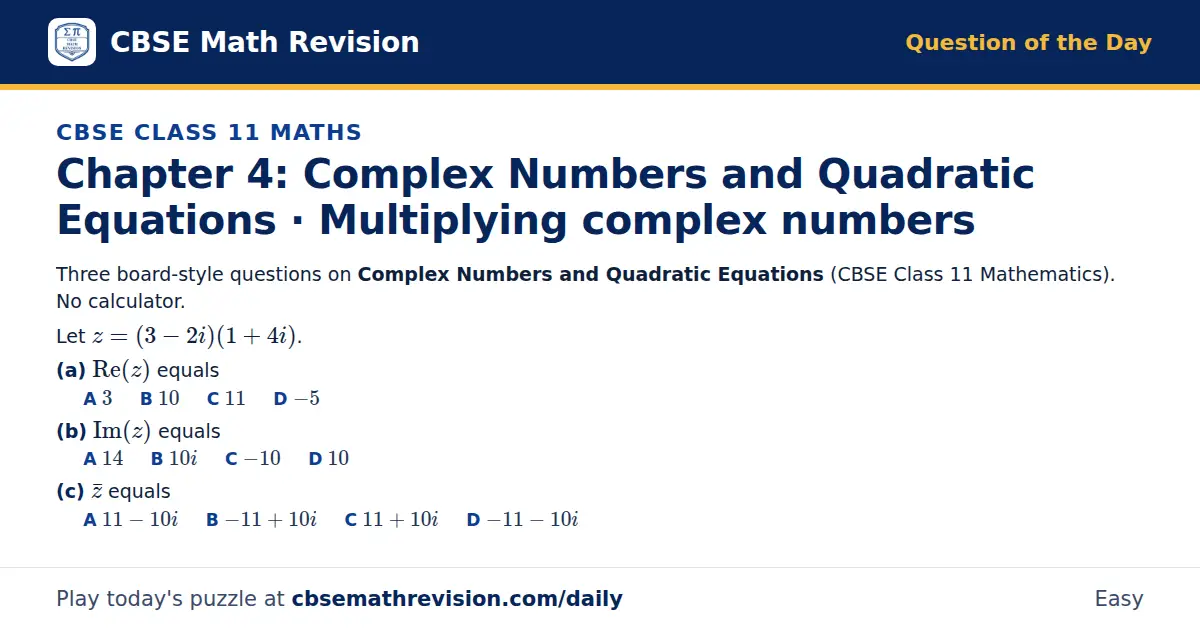
Chapter 4: Complex Numbers and Quadratic Equations · Multiplying complex numbers
Three board-style questions on Complex Numbers and Quadratic Equations (CBSE Class 11 Mathematics). No calculator. Let z = (3 - 2i)(1 + 4i).
- Re(z) equals Options: A) 3; B) 10; C) 11; D) -5
- Im(z) equals Options: A) 14; B) 10 i; C) -10; D) 10
- z equals Options: A) 11 - 10 i; B) -11 + 10 i; C) 11 + 10 i; D) -11 - 10 i
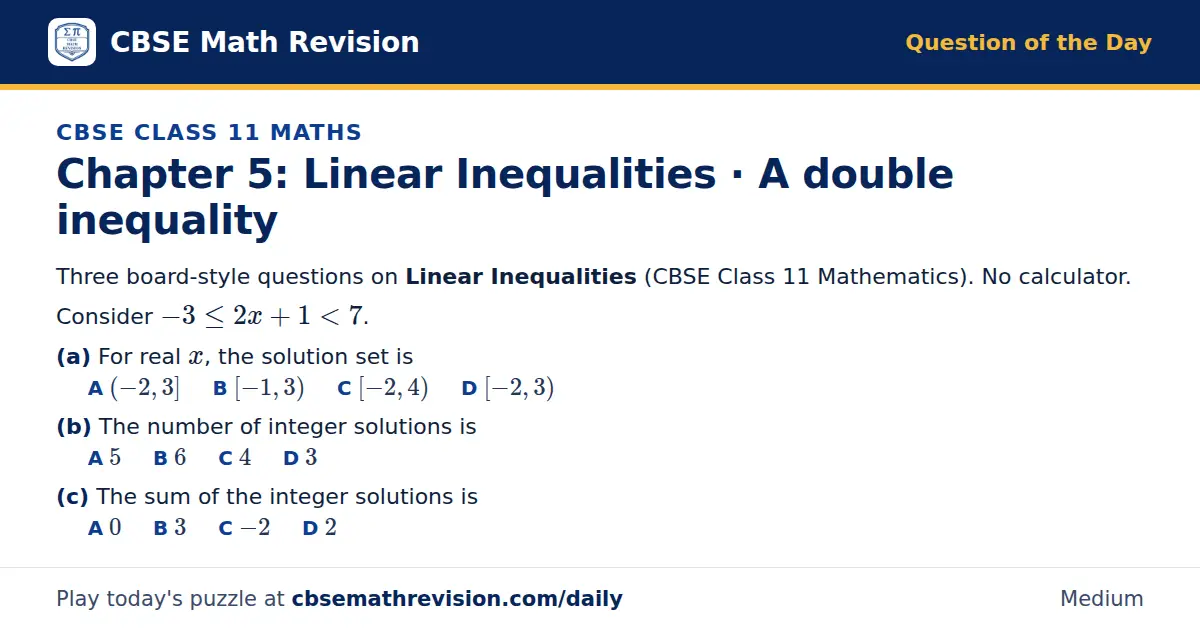
Chapter 5: Linear Inequalities · A double inequality
Three board-style questions on Linear Inequalities (CBSE Class 11 Mathematics). No calculator. Consider -3 ≤ 2x + 1 < 7.
- For real x, the solution set is Options: A) (-2, 3]; B) [-1, 3); C) [-2, 4); D) [-2, 3)
- The number of integer solutions is Options: A) 5; B) 6; C) 4; D) 3
- The sum of the integer solutions is Options: A) 0; B) 3; C) -2; D) 2
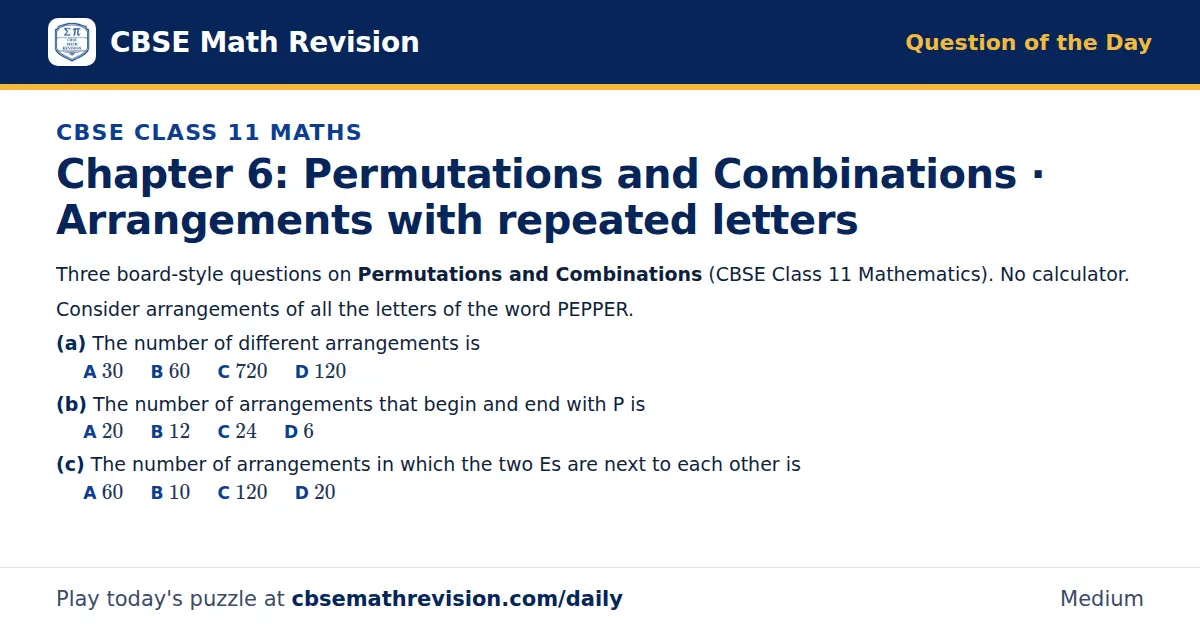
Chapter 6: Permutations and Combinations · Arrangements with repeated letters
Three board-style questions on Permutations and Combinations (CBSE Class 11 Mathematics). No calculator. Consider arrangements of all the letters of the word PEPPER.
- The number of different arrangements is Options: A) 30; B) 60; C) 720; D) 120
- The number of arrangements that begin and end with P is Options: A) 20; B) 12; C) 24; D) 6
- The number of arrangements in which the two Es are next to each other is Options: A) 60; B) 10; C) 120; D) 20
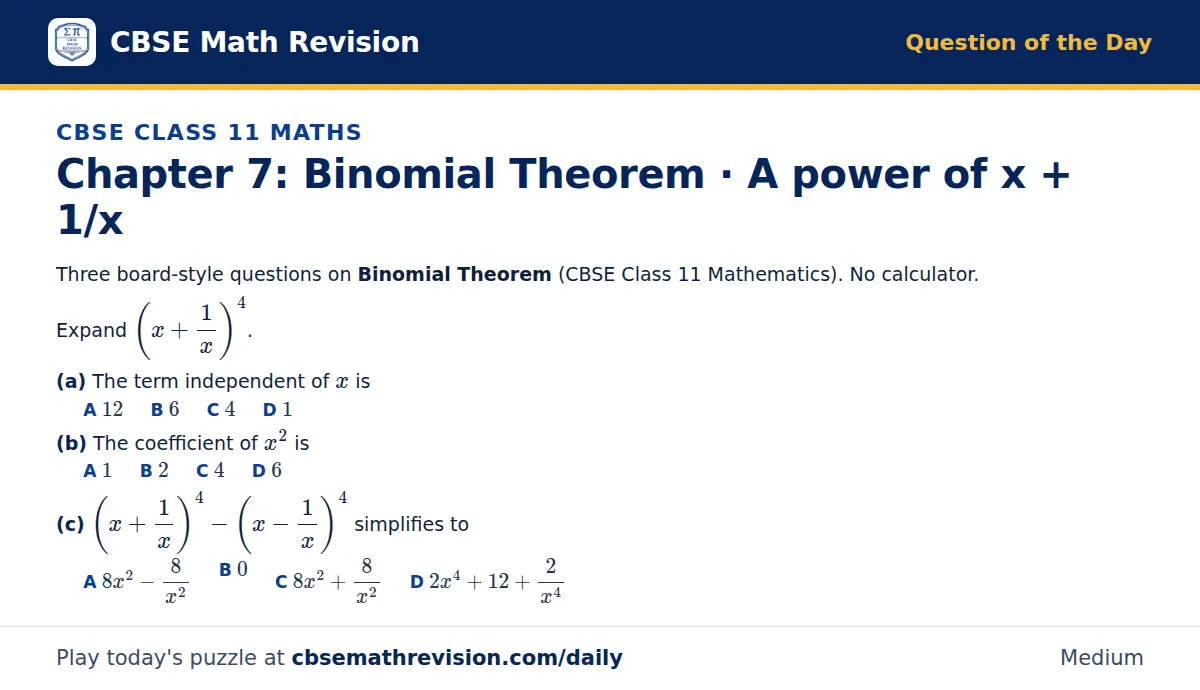
Chapter 7: Binomial Theorem · A power of x + 1/x
Three board-style questions on Binomial Theorem (CBSE Class 11 Mathematics). No calculator. Expand (x + 1x)^4.
- The term independent of x is Options: A) 12; B) 6; C) 4; D) 1
- The coefficient of x² is Options: A) 1; B) 2; C) 4; D) 6
- (x + 1x)⁴ - (x - 1x)⁴ simplifies to Options: A) 8x² - 8/(x²); B) 0; C) 8x² + 8/(x²); D) 2x⁴ + 12 + 2/(x⁴)
Chapter 8: Sequences and Series · A GP from two terms
Three board-style questions on Sequences and Series (CBSE Class 11 Mathematics). No calculator. In a GP of positive terms, the 3rd term is 12 and the 6th term is 96.
- The common ratio is Options: A) 3; B) 8; C) 4; D) 2
- The first term is Options: A) 12; B) 3; C) 6; D) 4
- The sum of the first 5 terms is Options: A) 96; B) 48; C) 45; D) 93
Chapter 9: Straight Lines · Lines in a triangle
Three board-style questions on Straight Lines (CBSE Class 11 Mathematics). No calculator. A triangle has vertices A(0, 0), B(6, 0) and C(2, 4).
- The median from C has equation Options: A) y = 2x; B) 4x + y = 12; C) x + 4y = 18; D) 4x - y = 4
- The length of the perpendicular from C to AB is Options: A) 2 √5; B) 6; C) 4; D) 2
- The foot of the perpendicular from B to the line AC is Options: A) (125, 65); B) (1, 2); C) (65, 125); D) (2, 4)
Chapter 10: Conic Sections · A hyperbola from its vertices and foci
Three board-style questions on Conic Sections (CBSE Class 11 Mathematics). No calculator. A hyperbola has vertices (± 2, 0) and foci (± 3, 0).
- Its equation is Options: A) (x²)/9 - (y²)/4 = 1; B) (x²)/4 + (y²)/5 = 1; C) (x²)/4 - (y²)/5 = 1; D) (x²)/4 - (y²)/9 = 1
- Its eccentricity is Options: A) 2/3; B) (√5)/2; C) 9/4; D) 3/2
- The length of its latus rectum is Options: A) 5; B) 5/2; C) 10; D) 4/3
Chapter 11: Introduction to Three Dimensional Geometry · Planes, axes and lattice points
Three board-style questions on Introduction to Three Dimensional Geometry (CBSE Class 11 Mathematics). No calculator.
- The distance of (1, -2, 2) from the origin is Options: A) 9; B) 1; C) √5; D) 3
- How many points with integer coordinates are at distance exactly 1 from the origin? Options: A) 8; B) 3; C) 26; D) 6
- In the following question, a statement of Assertion (A) is followed by a statement of Reason (R). Choose the correct option. Assertion (A): The point (-3, 0, 4) lies in the xz-plane. Reason (R): Every point of the xz-plane has z = 0. Options: A) Both Assertion (A) and Reason (R) are true and Reason (R) is the correct explanation of Assertion (A).; B) Both Assertion (A) and Reason (R) are true but Reason (R) is not the correct explanation of Assertion (A).; C) Assertion (A) is true but Reason (R) is false.; D) Assertion (A) is false but Reason (R) is true.
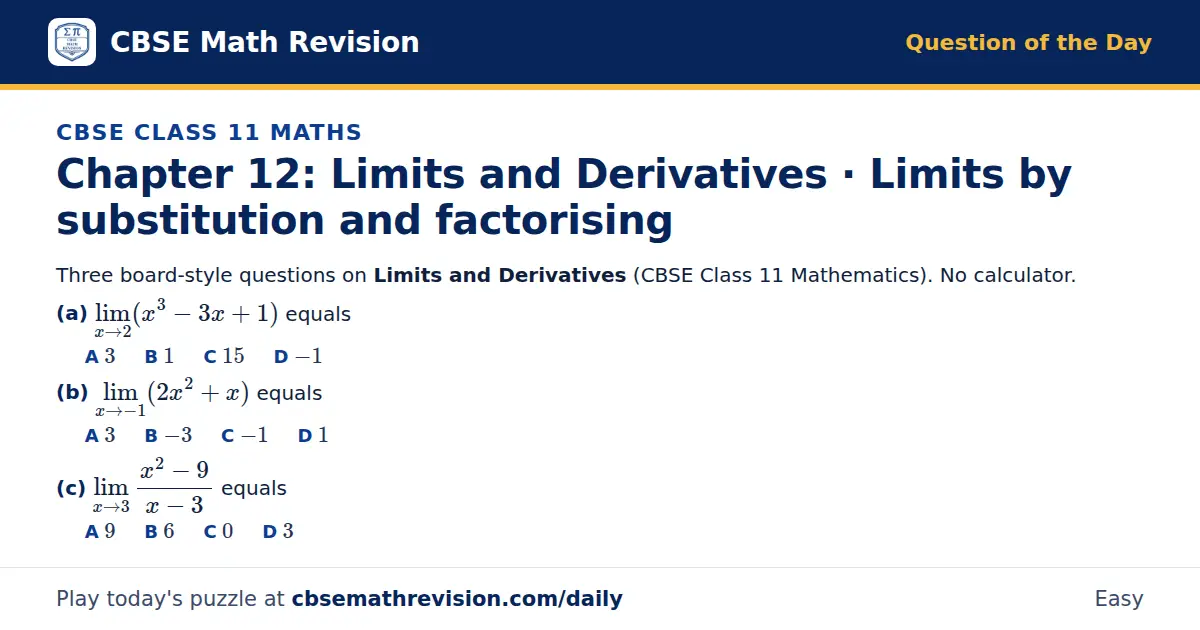
Chapter 12: Limits and Derivatives · Limits by substitution and factorising
Three board-style questions on Limits and Derivatives (CBSE Class 11 Mathematics). No calculator.
- lim_x → 2 (x³ - 3x + 1) equals Options: A) 3; B) 1; C) 15; D) -1
- lim_x → -1 (2x² + x) equals Options: A) 3; B) -3; C) -1; D) 1
- lim_x → 3 (x² - 9)/(x - 3) equals Options: A) 9; B) 6; C) 0; D) 3
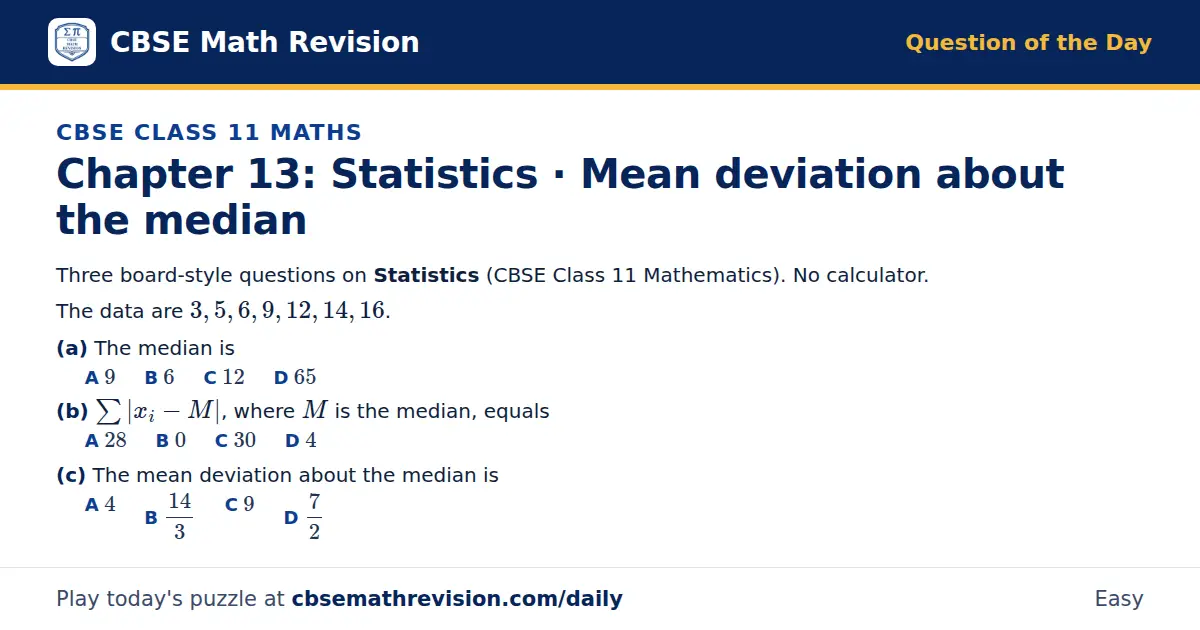
Chapter 13: Statistics · Mean deviation about the median
Three board-style questions on Statistics (CBSE Class 11 Mathematics). No calculator. The data are 3, 5, 6, 9, 12, 14, 16.
- The median is Options: A) 9; B) 6; C) 12; D) 65
- Σ |x_i - M|, where M is the median, equals Options: A) 28; B) 0; C) 30; D) 4
- The mean deviation about the median is Options: A) 4; B) 14/3; C) 9; D) 7/2
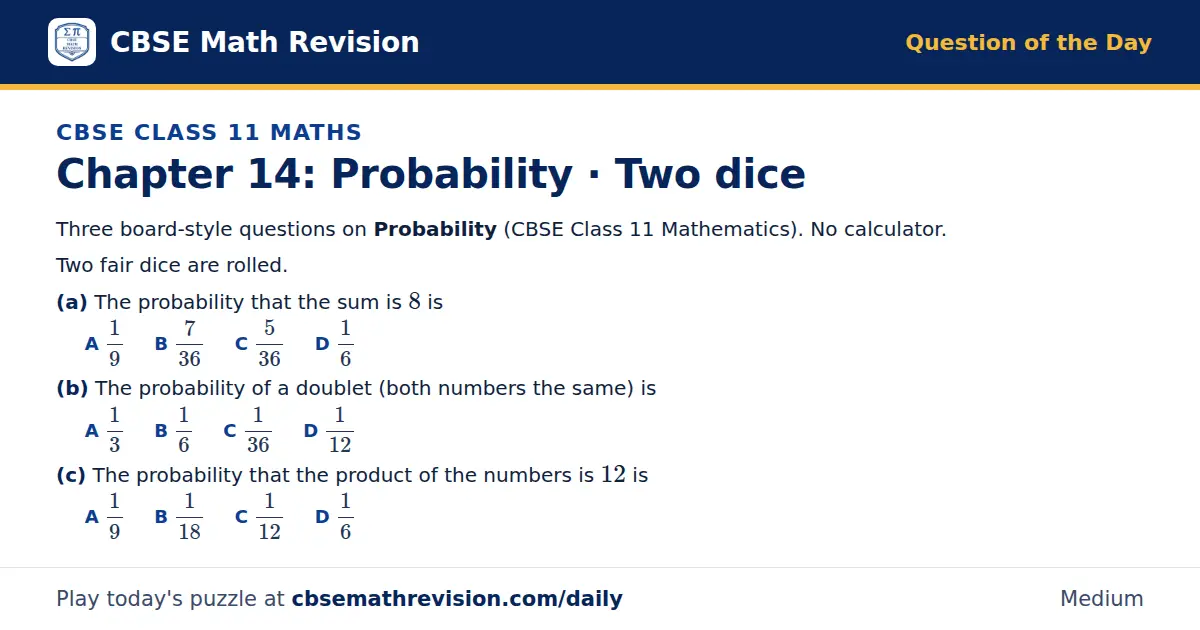
Chapter 14: Probability · Two dice
Three board-style questions on Probability (CBSE Class 11 Mathematics). No calculator. Two fair dice are rolled.
- The probability that the sum is 8 is Options: A) 1/9; B) 7/36; C) 5/36; D) 1/6
- The probability of a doublet (both numbers the same) is Options: A) 1/3; B) 1/6; C) 1/36; D) 1/12
- The probability that the product of the numbers is 12 is Options: A) 1/9; B) 1/18; C) 1/12; D) 1/6
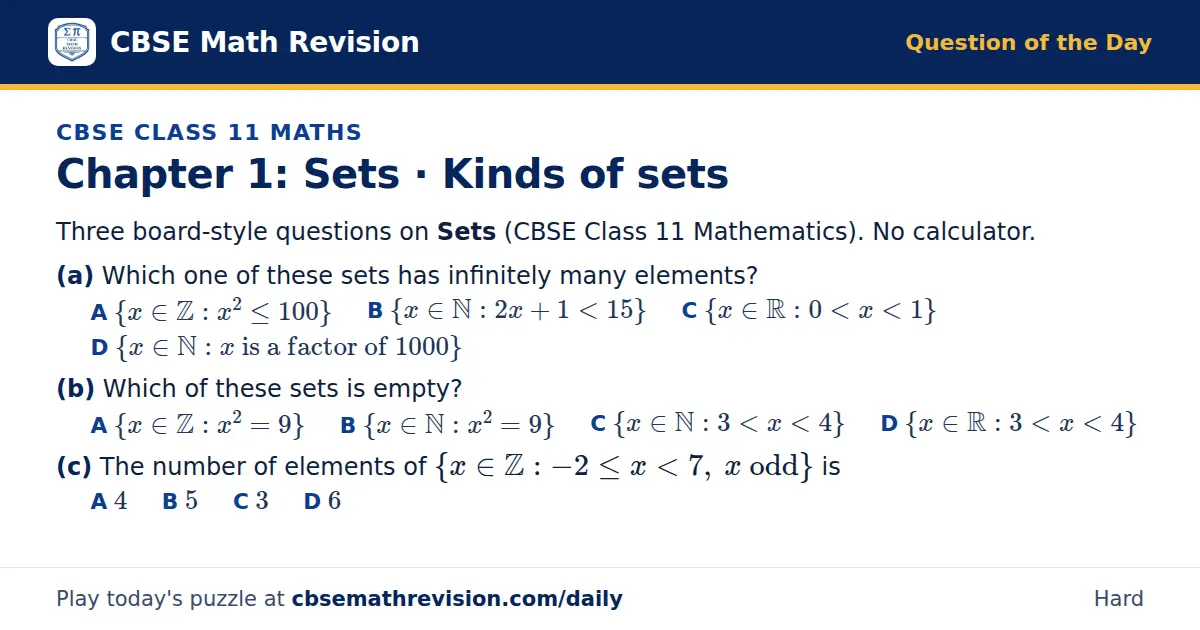
Chapter 1: Sets · Kinds of sets
Three board-style questions on Sets (CBSE Class 11 Mathematics). No calculator.
- Which one of these sets has infinitely many elements? Options: A) x ∈ ℤ: x² ≤ 100; B) x ∈ ℕ: 2x + 1 < 15; C) x ∈ ℝ: 0 < x < 1; D) x ∈ ℕ: x is a factor of 1000
- Which of these sets is empty? Options: A) x ∈ ℤ: x² = 9; B) x ∈ ℕ: x² = 9; C) x ∈ ℕ: 3 < x < 4; D) x ∈ ℝ: 3 < x < 4
- The number of elements of x ∈ ℤ: -2 ≤ x < 7, x odd is Options: A) 4; B) 5; C) 3; D) 6
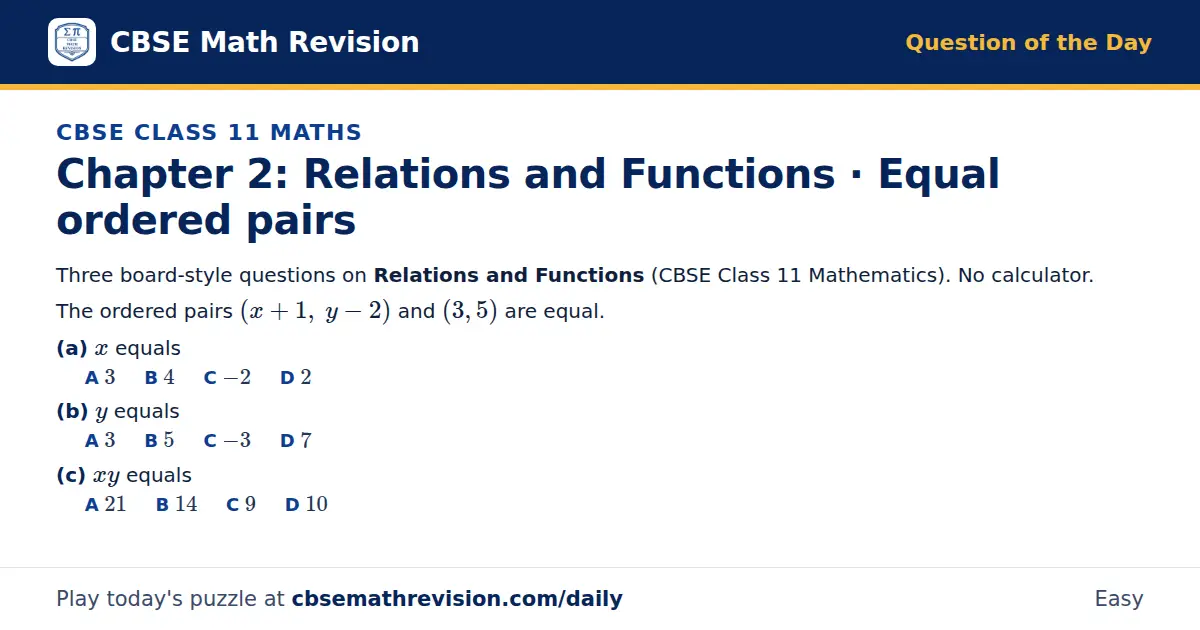
Chapter 2: Relations and Functions · Equal ordered pairs
Three board-style questions on Relations and Functions (CBSE Class 11 Mathematics). No calculator. The ordered pairs (x + 1, y - 2) and (3, 5) are equal.
- x equals Options: A) 3; B) 4; C) -2; D) 2
- y equals Options: A) 3; B) 5; C) -3; D) 7
- xy equals Options: A) 21; B) 14; C) 9; D) 10
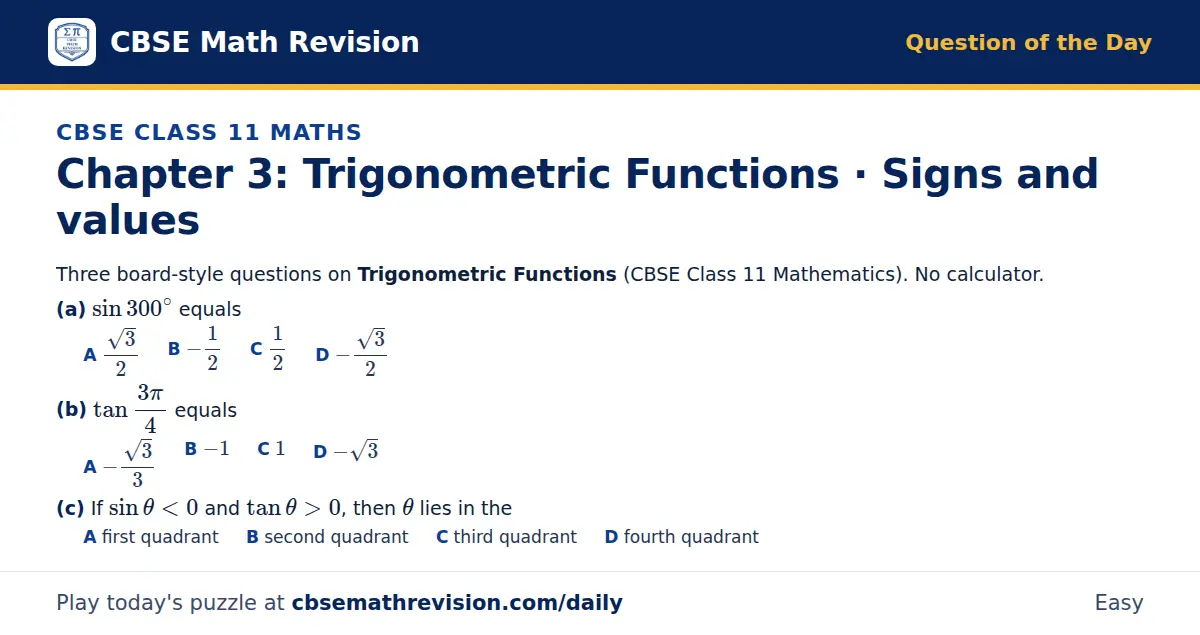
Chapter 3: Trigonometric Functions · Signs and values
Three board-style questions on Trigonometric Functions (CBSE Class 11 Mathematics). No calculator.
- sin 300^∘ equals Options: A) (√3)/2; B) - 1/2; C) 1/2; D) - (√3)/2
- tan (3π)/4 equals Options: A) - (√3)/3; B) -1; C) 1; D) - √3
- If sinθ < 0 and tanθ > 0, then θ lies in the Options: A) first quadrant; B) second quadrant; C) third quadrant; D) fourth quadrant
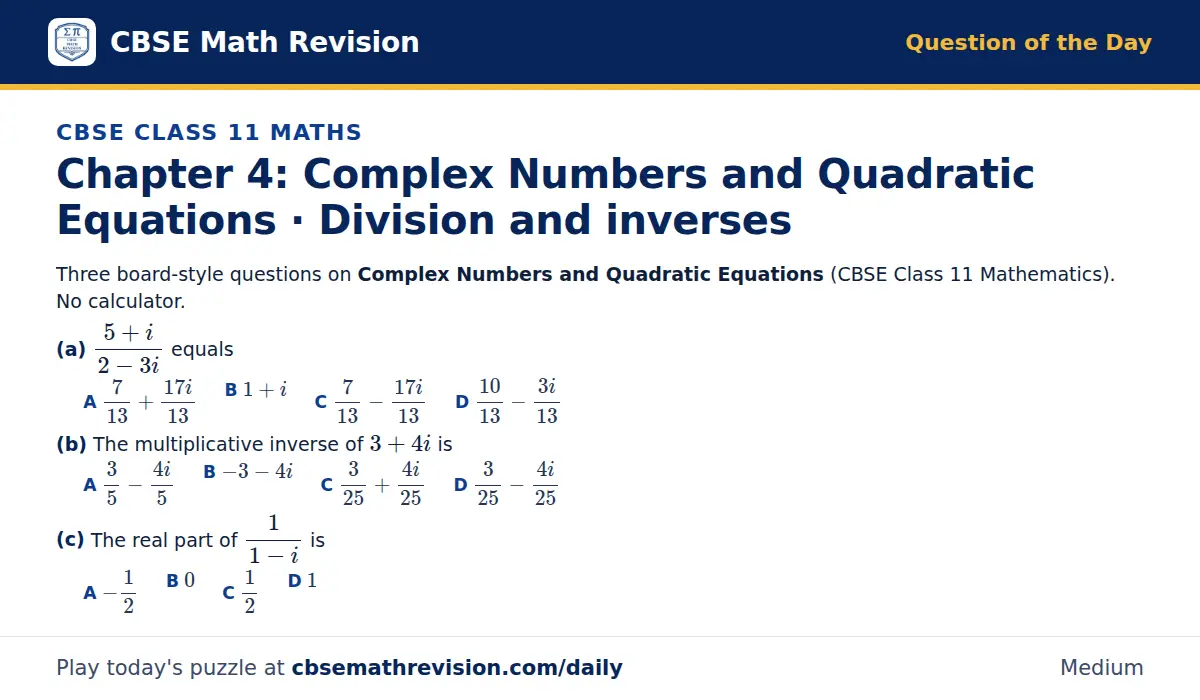
Chapter 4: Complex Numbers and Quadratic Equations · Division and inverses
Three board-style questions on Complex Numbers and Quadratic Equations (CBSE Class 11 Mathematics). No calculator.
- (5 + i)/(2 - 3i) equals Options: A) 7/13 + (17 i)/13; B) 1 + i; C) 7/13 - (17 i)/13; D) 10/13 - (3 i)/13
- The multiplicative inverse of 3 + 4i is Options: A) 3/5 - (4 i)/5; B) -3 - 4 i; C) 3/25 + (4 i)/25; D) 3/25 - (4 i)/25
- The real part of 1/(1 - i) is Options: A) - 1/2; B) 0; C) 1/2; D) 1
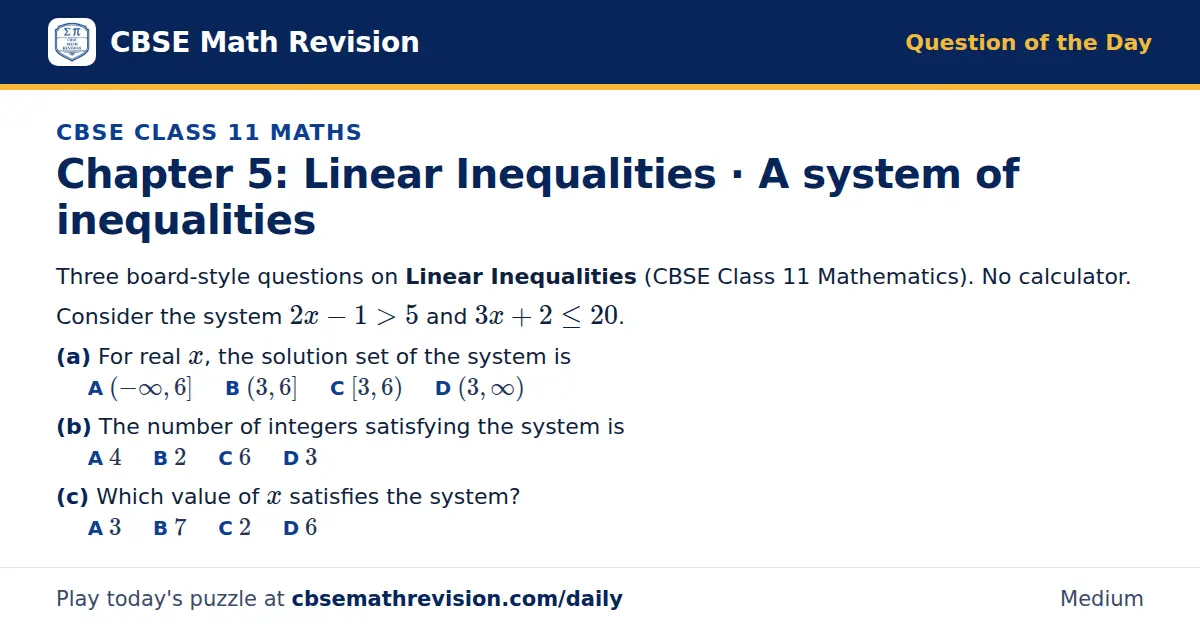
Chapter 5: Linear Inequalities · A system of inequalities
Three board-style questions on Linear Inequalities (CBSE Class 11 Mathematics). No calculator. Consider the system 2x - 1 > 5 and 3x + 2 ≤ 20.
- For real x, the solution set of the system is Options: A) (-∞, 6]; B) (3, 6]; C) [3, 6); D) (3, ∞)
- The number of integers satisfying the system is Options: A) 4; B) 2; C) 6; D) 3
- Which value of x satisfies the system? Options: A) 3; B) 7; C) 2; D) 6
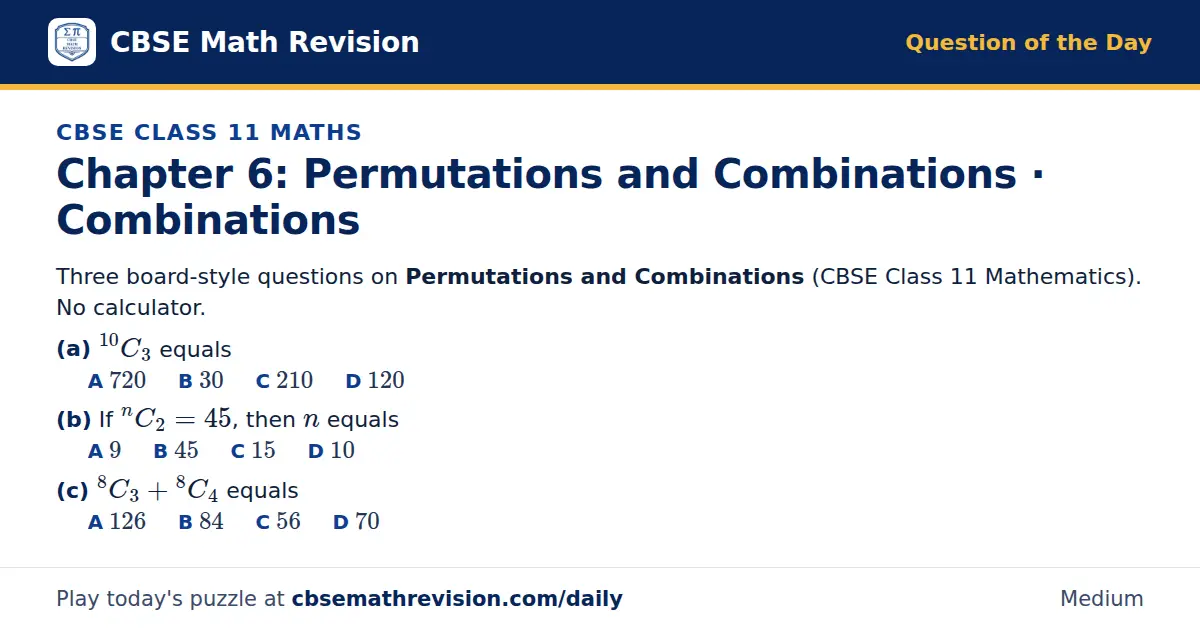
Chapter 6: Permutations and Combinations · Combinations
Three board-style questions on Permutations and Combinations (CBSE Class 11 Mathematics). No calculator.
- ¹⁰C_3 equals Options: A) 720; B) 30; C) 210; D) 120
- If ^nC_2 = 45, then n equals Options: A) 9; B) 45; C) 15; D) 10
- ⁸C_3 + ⁸C_4 equals Options: A) 126; B) 84; C) 56; D) 70
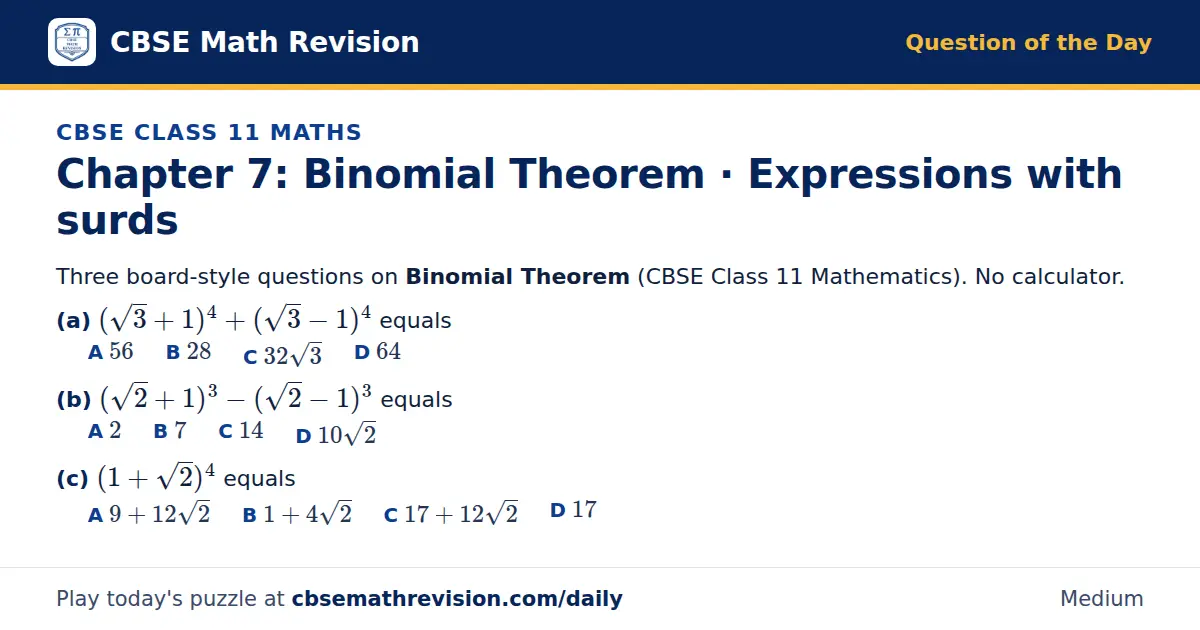
Chapter 7: Binomial Theorem · Expressions with surds
Three board-style questions on Binomial Theorem (CBSE Class 11 Mathematics). No calculator.
- (√3 + 1)⁴ + (√3 - 1)⁴ equals Options: A) 56; B) 28; C) 32 √3; D) 64
- (√2 + 1)³ - (√2 - 1)³ equals Options: A) 2; B) 7; C) 14; D) 10 √2
- (1 + √2)⁴ equals Options: A) 9 + 12√2; B) 1 + 4√2; C) 17 + 12√2; D) 17
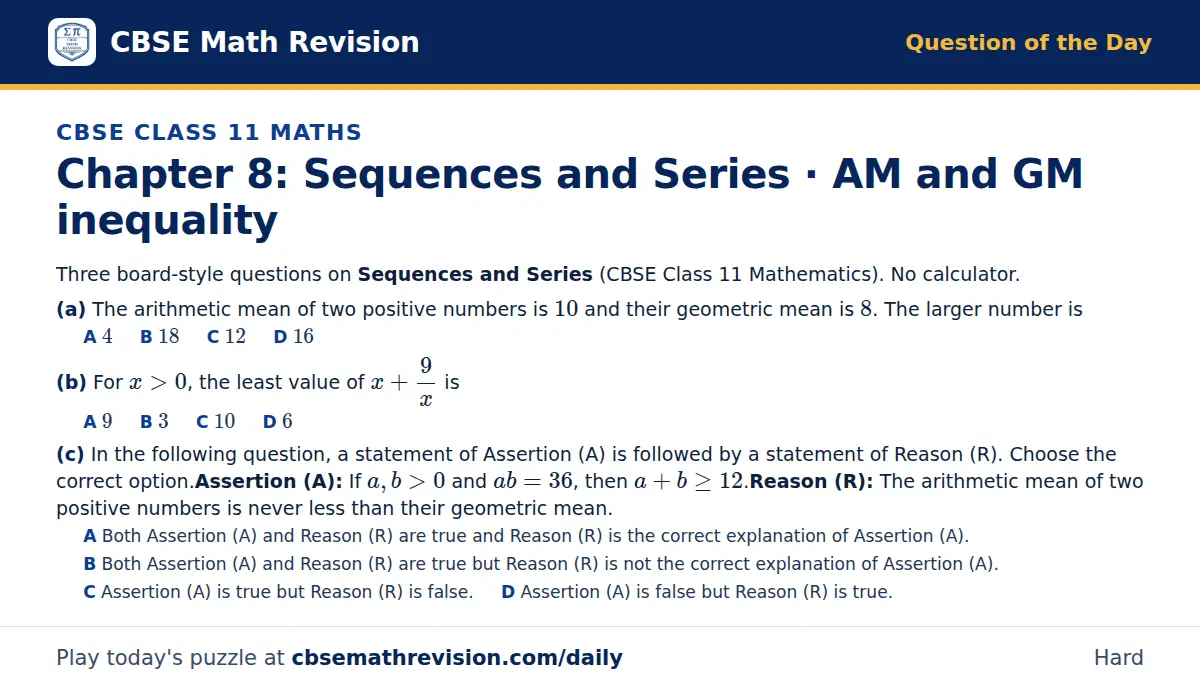
Chapter 8: Sequences and Series · AM and GM inequality
Three board-style questions on Sequences and Series (CBSE Class 11 Mathematics). No calculator.
- The arithmetic mean of two positive numbers is 10 and their geometric mean is 8. The larger number is Options: A) 4; B) 18; C) 12; D) 16
- For x > 0, the least value of x + 9x is Options: A) 9; B) 3; C) 10; D) 6
- In the following question, a statement of Assertion (A) is followed by a statement of Reason (R). Choose the correct option. Assertion (A): If a, b > 0 and ab = 36, then a + b ≥ 12. Reason (R): The arithmetic mean of two positive numbers is never less than their geometric mean. Options: A) Both Assertion (A) and Reason (R) are true and Reason (R) is the correct explanation of Assertion (A).; B) Both Assertion (A) and Reason (R) are true but Reason (R) is not the correct explanation of Assertion (A).; C) Assertion (A) is true but Reason (R) is false.; D) Assertion (A) is false but Reason (R) is true.
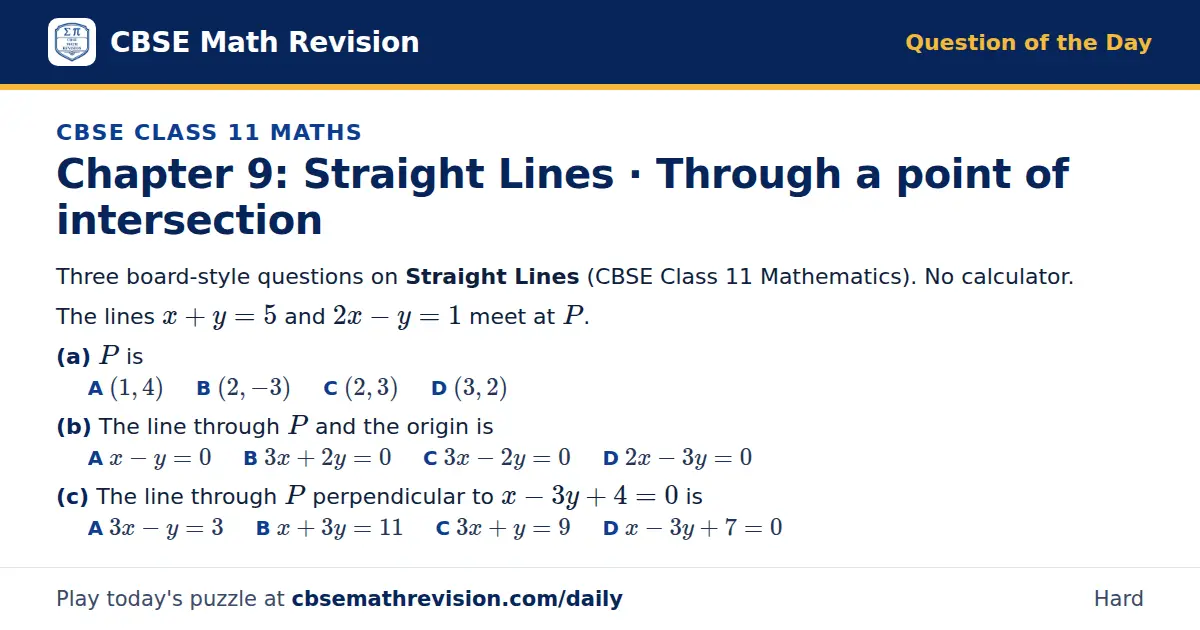
Chapter 9: Straight Lines · Through a point of intersection
Three board-style questions on Straight Lines (CBSE Class 11 Mathematics). No calculator. The lines x + y = 5 and 2x - y = 1 meet at P.
- P is Options: A) (1, 4); B) (2, -3); C) (2, 3); D) (3, 2)
- The line through P and the origin is Options: A) x - y = 0; B) 3x + 2y = 0; C) 3x - 2y = 0; D) 2x - 3y = 0
- The line through P perpendicular to x - 3y + 4 = 0 is Options: A) 3x - y = 3; B) x + 3y = 11; C) 3x + y = 9; D) x - 3y + 7 = 0
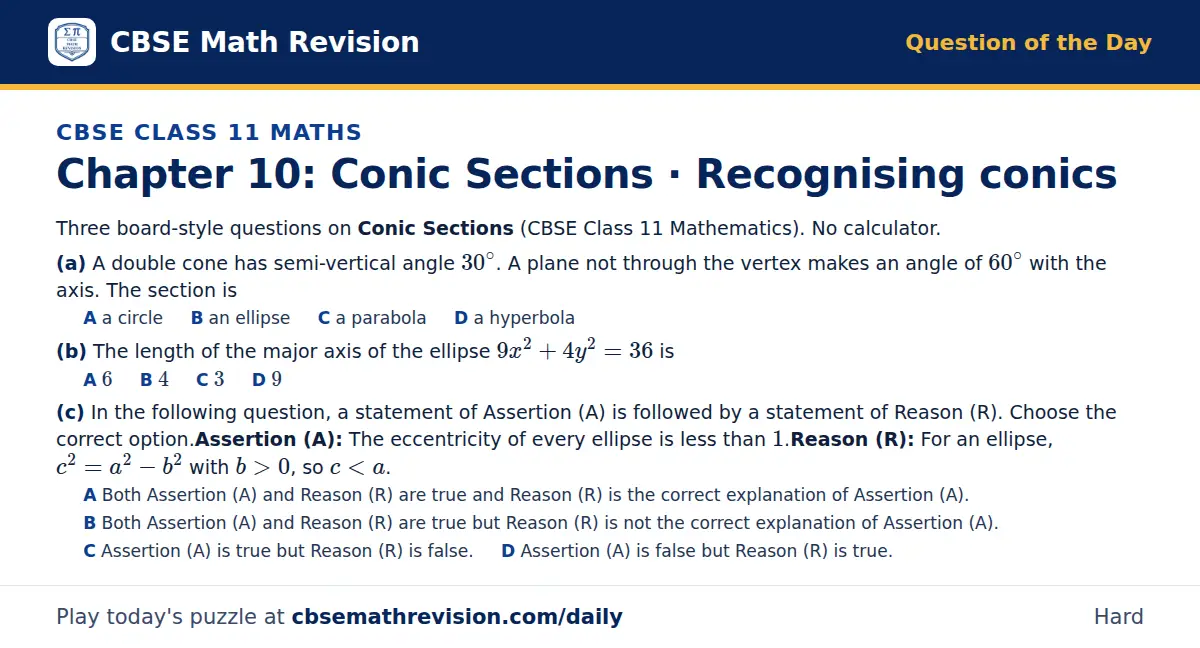
Chapter 10: Conic Sections · Recognising conics
Three board-style questions on Conic Sections (CBSE Class 11 Mathematics). No calculator.
- A double cone has semi-vertical angle 30^∘. A plane not through the vertex makes an angle of 60^∘ with the axis. The section is Options: A) a circle; B) an ellipse; C) a parabola; D) a hyperbola
- The length of the major axis of the ellipse 9x² + 4y² = 36 is Options: A) 6; B) 4; C) 3; D) 9
- In the following question, a statement of Assertion (A) is followed by a statement of Reason (R). Choose the correct option. Assertion (A): The eccentricity of every ellipse is less than 1. Reason (R): For an ellipse, c² = a² - b² with b > 0, so c < a. Options: A) Both Assertion (A) and Reason (R) are true and Reason (R) is the correct explanation of Assertion (A).; B) Both Assertion (A) and Reason (R) are true but Reason (R) is not the correct explanation of Assertion (A).; C) Assertion (A) is true but Reason (R) is false.; D) Assertion (A) is false but Reason (R) is true.
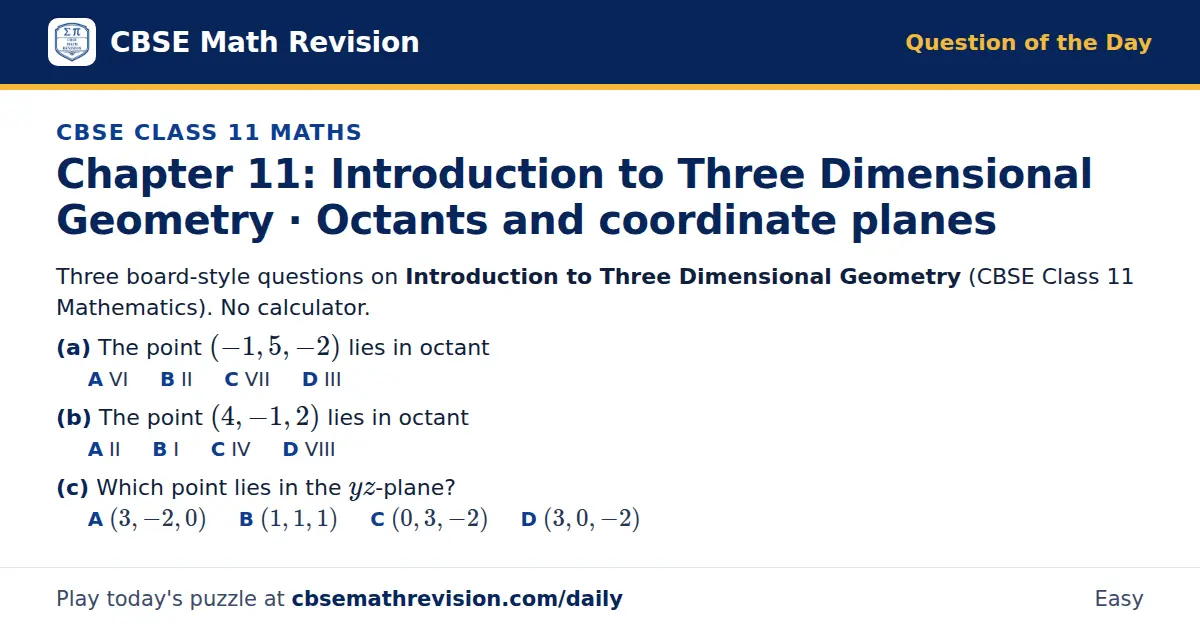
Chapter 11: Introduction to Three Dimensional Geometry · Octants and coordinate planes
Three board-style questions on Introduction to Three Dimensional Geometry (CBSE Class 11 Mathematics). No calculator.
- The point (-1, 5, -2) lies in octant Options: A) VI; B) II; C) VII; D) III
- The point (4, -1, 2) lies in octant Options: A) II; B) I; C) IV; D) VIII
- Which point lies in the yz-plane? Options: A) (3, -2, 0); B) (1, 1, 1); C) (0, 3, -2); D) (3, 0, -2)
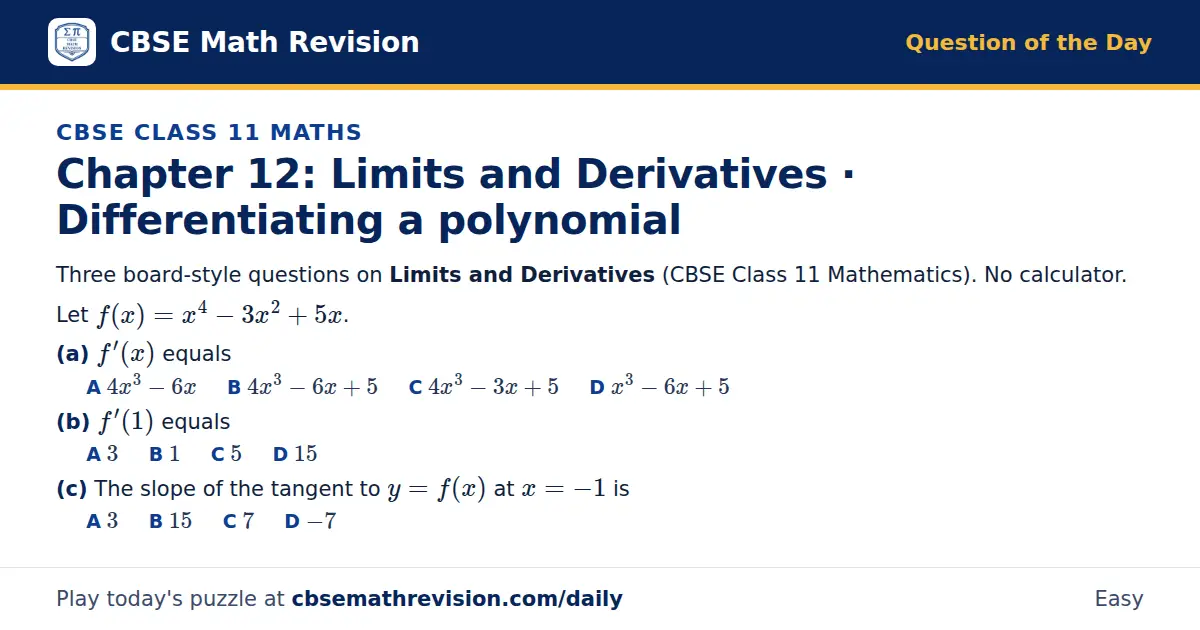
Chapter 12: Limits and Derivatives · Differentiating a polynomial
Three board-style questions on Limits and Derivatives (CBSE Class 11 Mathematics). No calculator. Let f(x) = x⁴ - 3x² + 5x.
- f'(x) equals Options: A) 4x³ - 6x; B) 4x³ - 6x + 5; C) 4x³ - 3x + 5; D) x³ - 6x + 5
- f'(1) equals Options: A) 3; B) 1; C) 5; D) 15
- The slope of the tangent to y = f(x) at x = -1 is Options: A) 3; B) 15; C) 7; D) -7
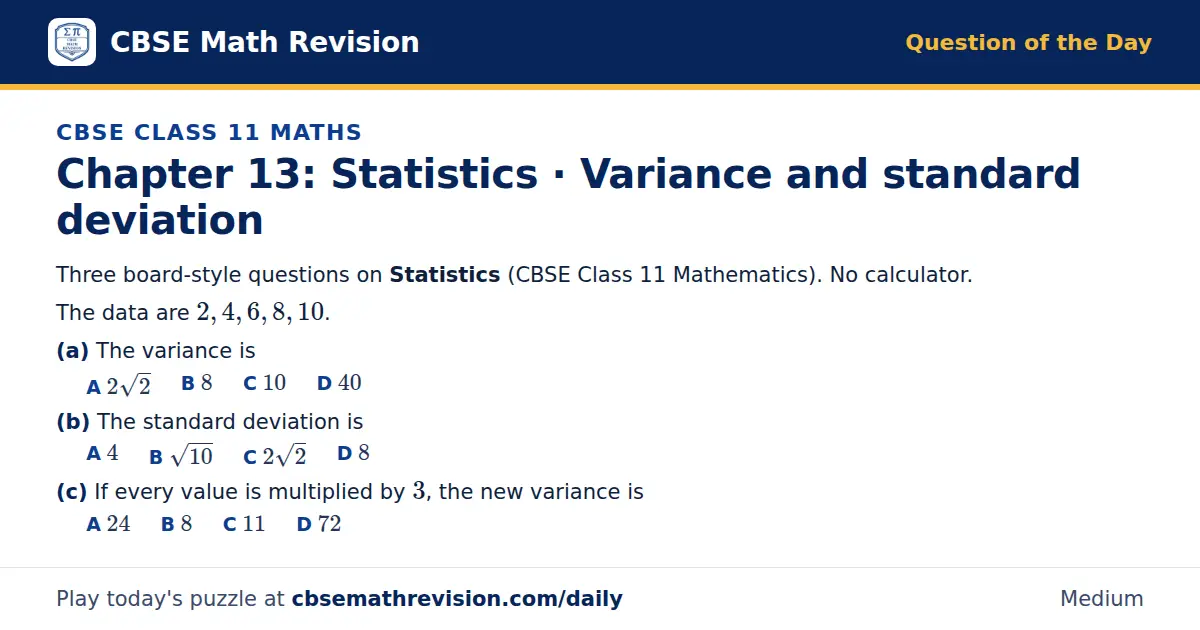
Chapter 13: Statistics · Variance and standard deviation
Three board-style questions on Statistics (CBSE Class 11 Mathematics). No calculator. The data are 2, 4, 6, 8, 10.
- The variance is Options: A) 2 √2; B) 8; C) 10; D) 40
- The standard deviation is Options: A) 4; B) √10; C) 2 √2; D) 8
- If every value is multiplied by 3, the new variance is Options: A) 24; B) 8; C) 11; D) 72
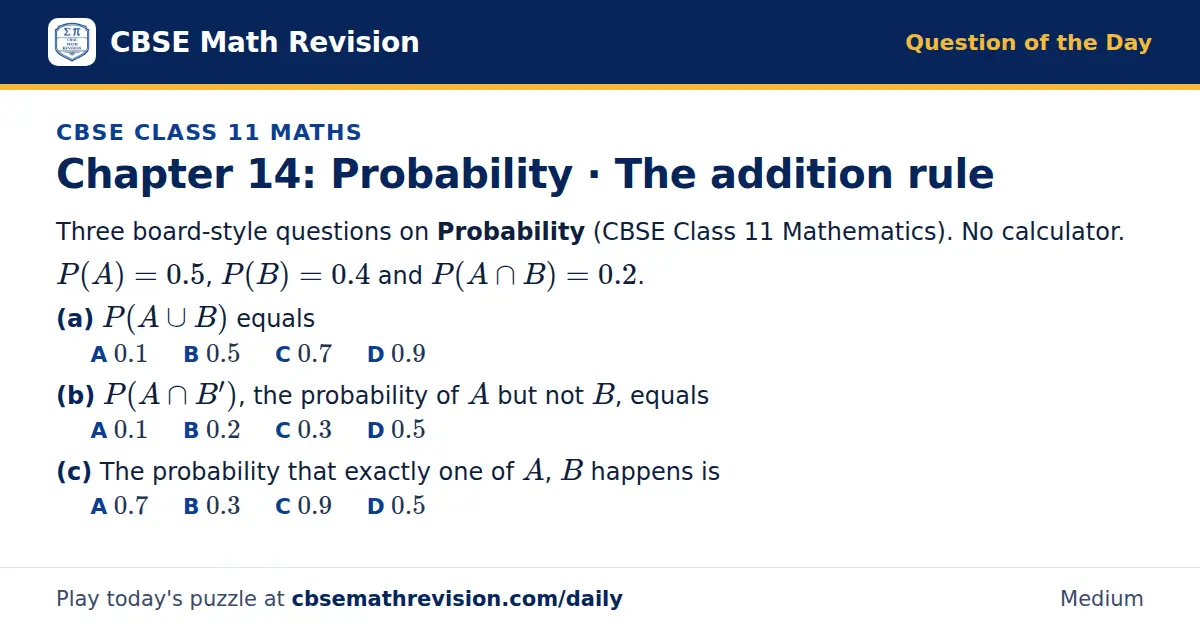
Chapter 14: Probability · The addition rule
Three board-style questions on Probability (CBSE Class 11 Mathematics). No calculator. P(A) = 0.5, P(B) = 0.4 and P(A ∩ B) = 0.2.
- P(A ∪ B) equals Options: A) 0.1; B) 0.5; C) 0.7; D) 0.9
- P(A ∩ B'), the probability of A but not B, equals Options: A) 0.1; B) 0.2; C) 0.3; D) 0.5
- The probability that exactly one of A, B happens is Options: A) 0.7; B) 0.3; C) 0.9; D) 0.5
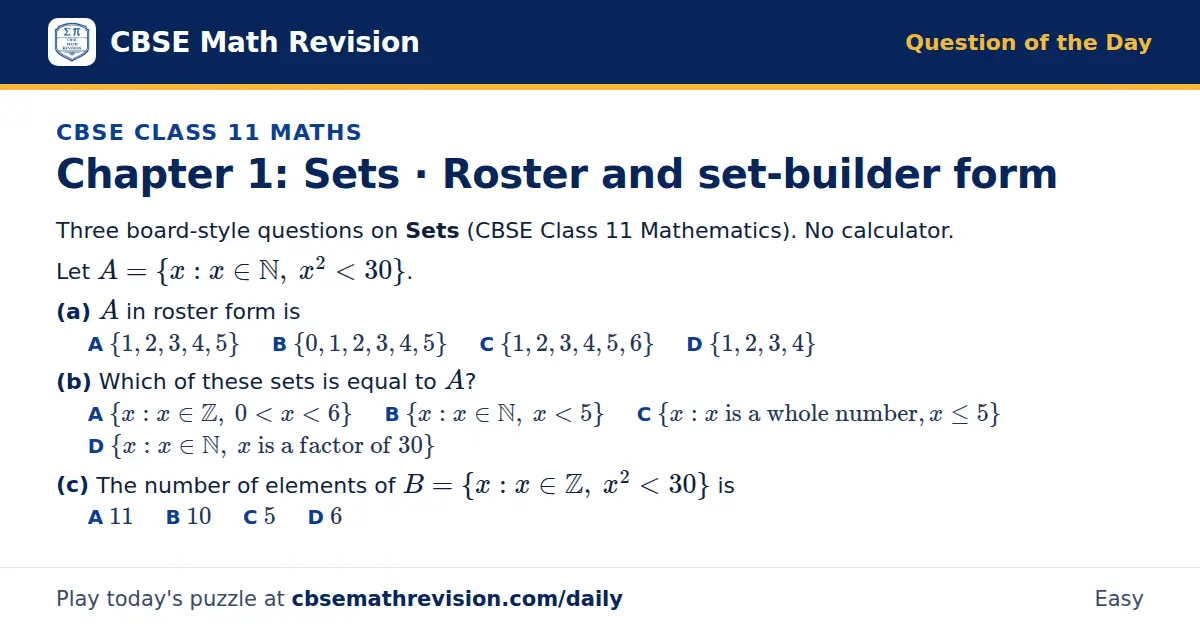
Chapter 1: Sets · Roster and set-builder form
Three board-style questions on Sets (CBSE Class 11 Mathematics). No calculator. Let A = x: x ∈ ℕ, x² < 30.
- A in roster form is Options: A) 1, 2, 3, 4, 5; B) 0, 1, 2, 3, 4, 5; C) 1, 2, 3, 4, 5, 6; D) 1, 2, 3, 4
- Which of these sets is equal to A? Options: A) x: x ∈ ℤ, 0 < x < 6; B) x: x ∈ ℕ, x < 5; C) x: x is a whole number, x ≤ 5; D) x: x ∈ ℕ, x is a factor of 30
- The number of elements of B = x: x ∈ ℤ, x² < 30 is Options: A) 11; B) 10; C) 5; D) 6
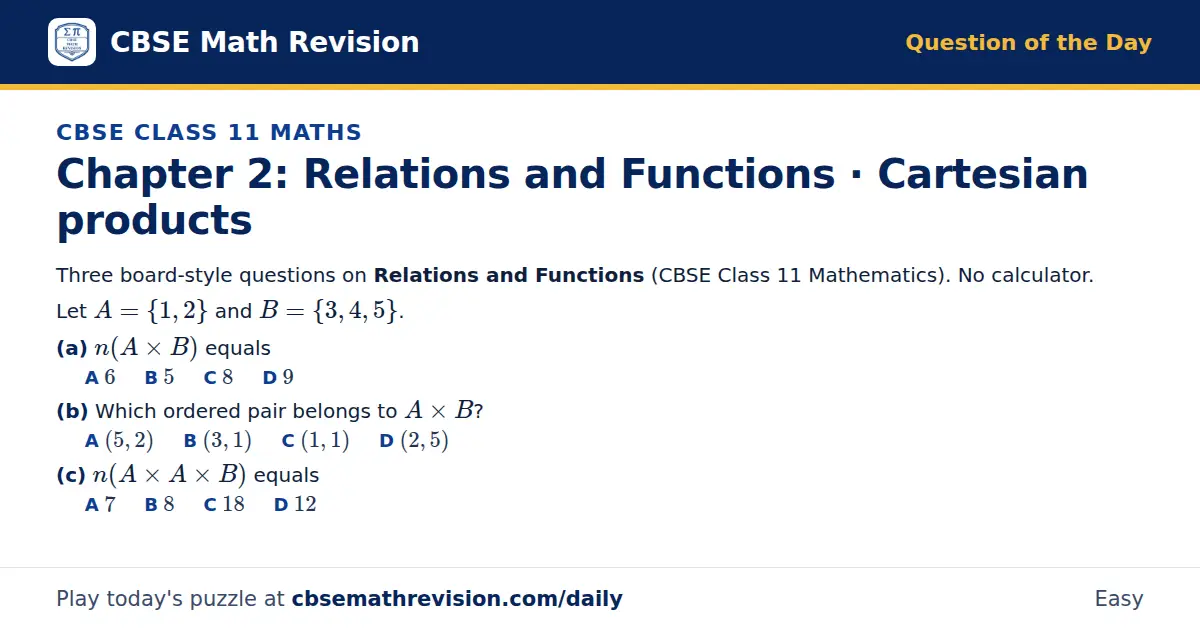
Chapter 2: Relations and Functions · Cartesian products
Three board-style questions on Relations and Functions (CBSE Class 11 Mathematics). No calculator. Let A = 1, 2 and B = 3, 4, 5.
- n(A × B) equals Options: A) 6; B) 5; C) 8; D) 9
- Which ordered pair belongs to A × B? Options: A) (5, 2); B) (3, 1); C) (1, 1); D) (2, 5)
- n(A × A × B) equals Options: A) 7; B) 8; C) 18; D) 12
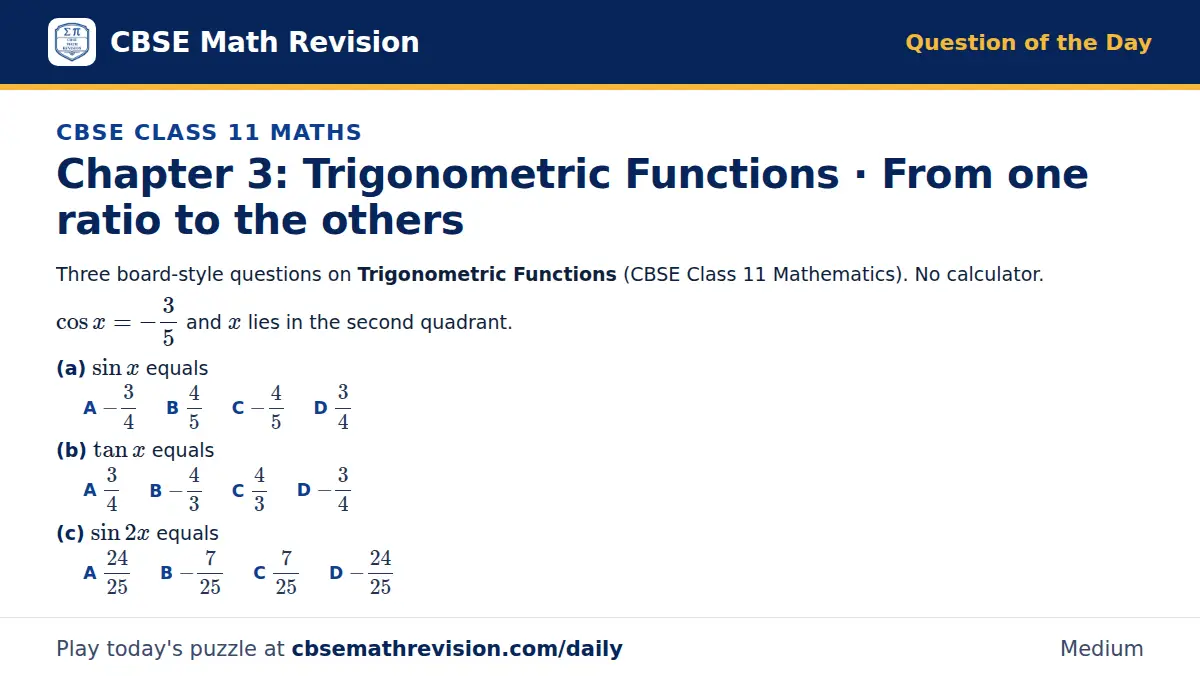
Chapter 3: Trigonometric Functions · From one ratio to the others
Three board-style questions on Trigonometric Functions (CBSE Class 11 Mathematics). No calculator. cos x = -35 and x lies in the second quadrant.
- sin x equals Options: A) - 3/4; B) 4/5; C) - 4/5; D) 3/4
- tan x equals Options: A) 3/4; B) - 4/3; C) 4/3; D) - 3/4
- sin 2x equals Options: A) 24/25; B) - 7/25; C) 7/25; D) - 24/25
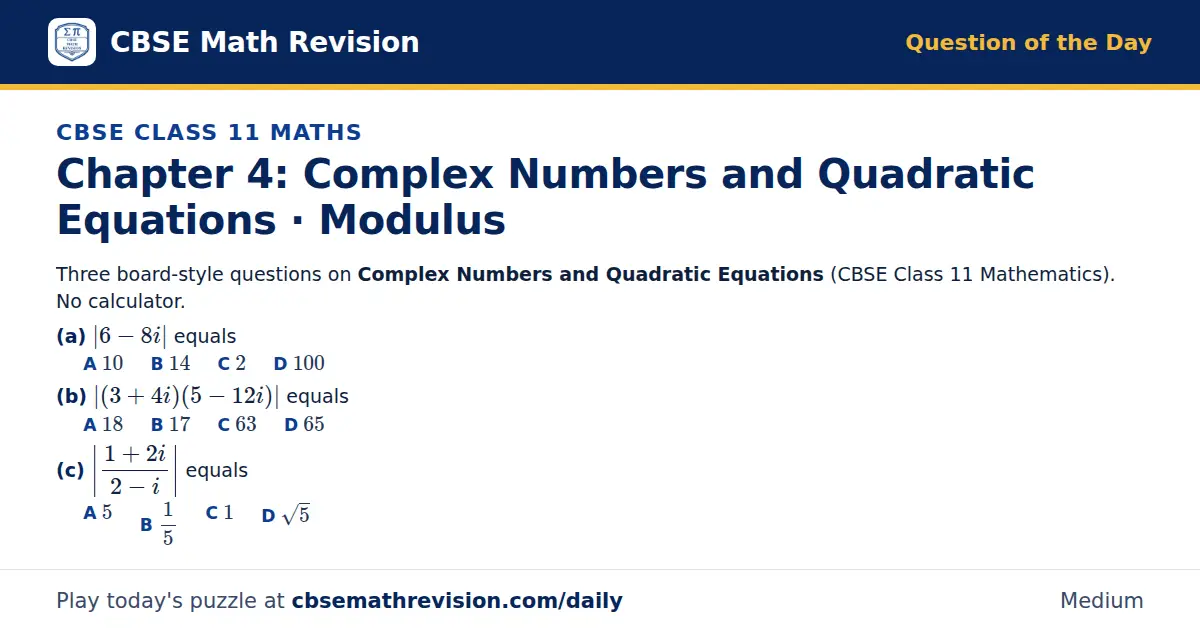
Chapter 4: Complex Numbers and Quadratic Equations · Modulus
Three board-style questions on Complex Numbers and Quadratic Equations (CBSE Class 11 Mathematics). No calculator.
- |6 - 8i| equals Options: A) 10; B) 14; C) 2; D) 100
- |(3 + 4i)(5 - 12i)| equals Options: A) 18; B) 17; C) 63; D) 65
- |(1 + 2i)/(2 - i)| equals Options: A) 5; B) 1/5; C) 1; D) √5
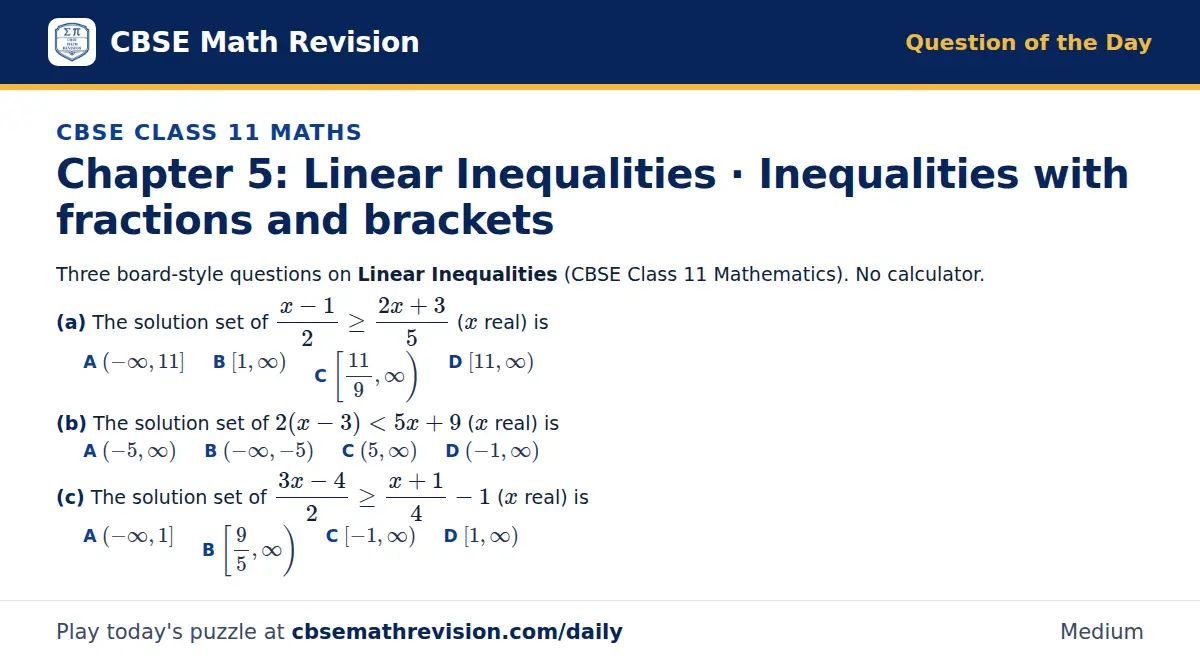
Chapter 5: Linear Inequalities · Inequalities with fractions and brackets
Three board-style questions on Linear Inequalities (CBSE Class 11 Mathematics). No calculator.
- The solution set of (x - 1)/2 ≥ (2x + 3)/5 (x real) is Options: A) (-∞, 11]; B) [1, ∞); C) [11/9, ∞); D) [11, ∞)
- The solution set of 2(x - 3) < 5x + 9 (x real) is Options: A) (-5, ∞); B) (-∞, -5); C) (5, ∞); D) (-1, ∞)
- The solution set of (3x - 4)/2 ≥ (x + 1)/4 - 1 (x real) is Options: A) (-∞, 1]; B) [9/5, ∞); C) [-1, ∞); D) [1, ∞)
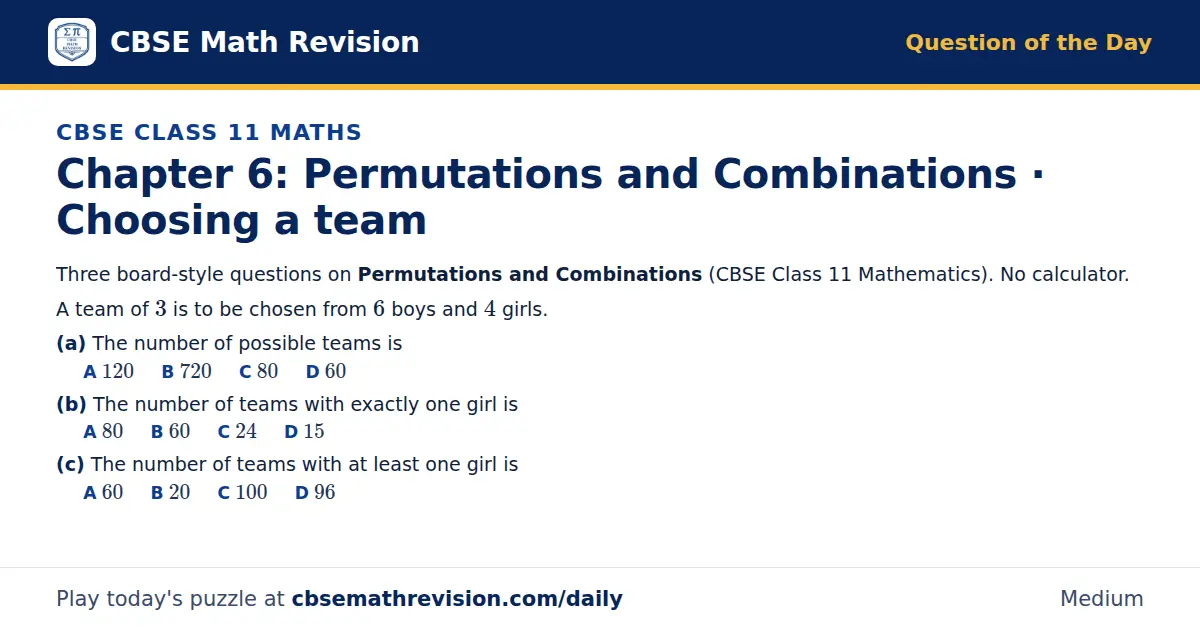
Chapter 6: Permutations and Combinations · Choosing a team
Three board-style questions on Permutations and Combinations (CBSE Class 11 Mathematics). No calculator. A team of 3 is to be chosen from 6 boys and 4 girls.
- The number of possible teams is Options: A) 120; B) 720; C) 80; D) 60
- The number of teams with exactly one girl is Options: A) 80; B) 60; C) 24; D) 15
- The number of teams with at least one girl is Options: A) 60; B) 20; C) 100; D) 96
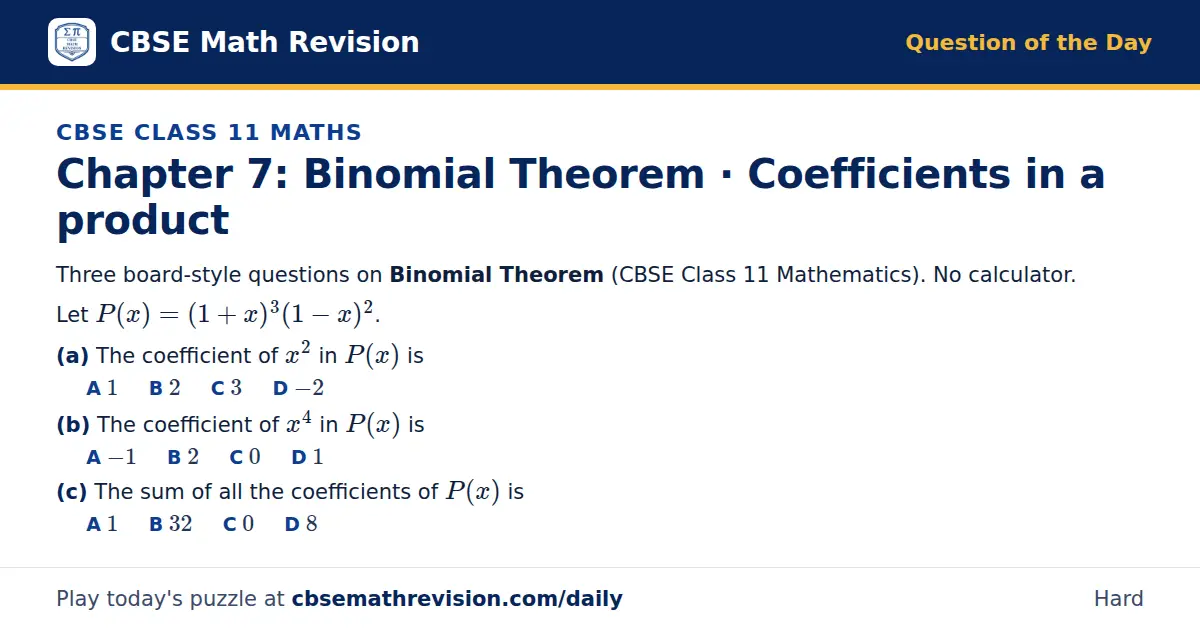
Chapter 7: Binomial Theorem · Coefficients in a product
Three board-style questions on Binomial Theorem (CBSE Class 11 Mathematics). No calculator. Let P(x) = (1 + x)³(1 - x)^2.
- The coefficient of x² in P(x) is Options: A) 1; B) 2; C) 3; D) -2
- The coefficient of x⁴ in P(x) is Options: A) -1; B) 2; C) 0; D) 1
- The sum of all the coefficients of P(x) is Options: A) 1; B) 32; C) 0; D) 8
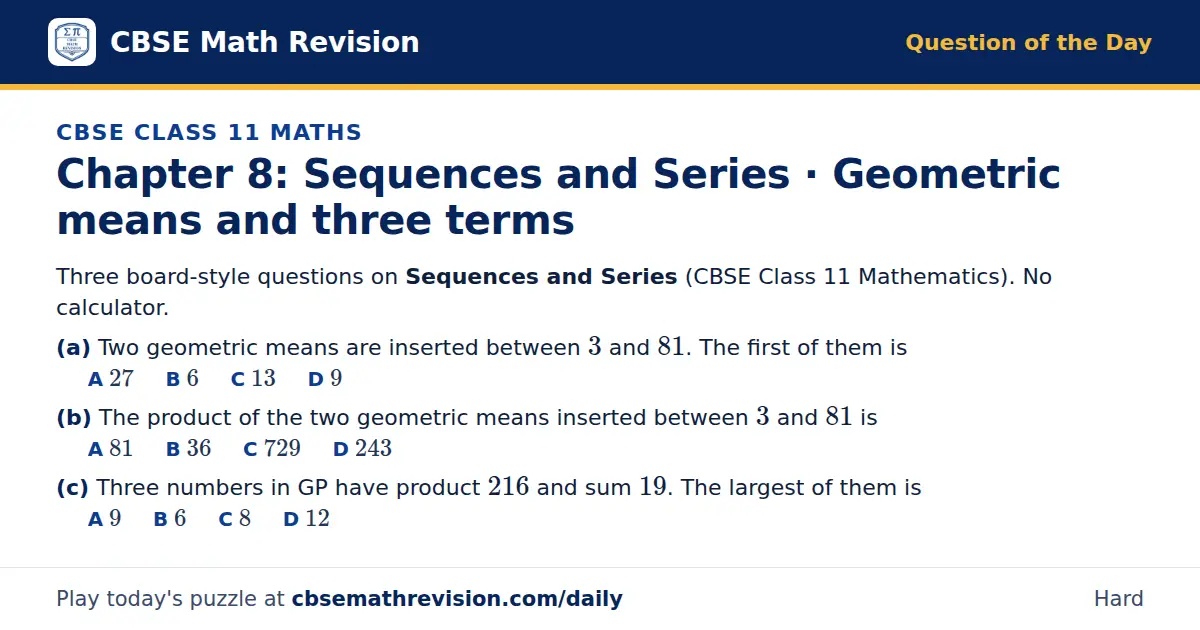
Chapter 8: Sequences and Series · Geometric means and three terms
Three board-style questions on Sequences and Series (CBSE Class 11 Mathematics). No calculator.
- Two geometric means are inserted between 3 and 81. The first of them is Options: A) 27; B) 6; C) 13; D) 9
- The product of the two geometric means inserted between 3 and 81 is Options: A) 81; B) 36; C) 729; D) 243
- Three numbers in GP have product 216 and sum 19. The largest of them is Options: A) 9; B) 6; C) 8; D) 12
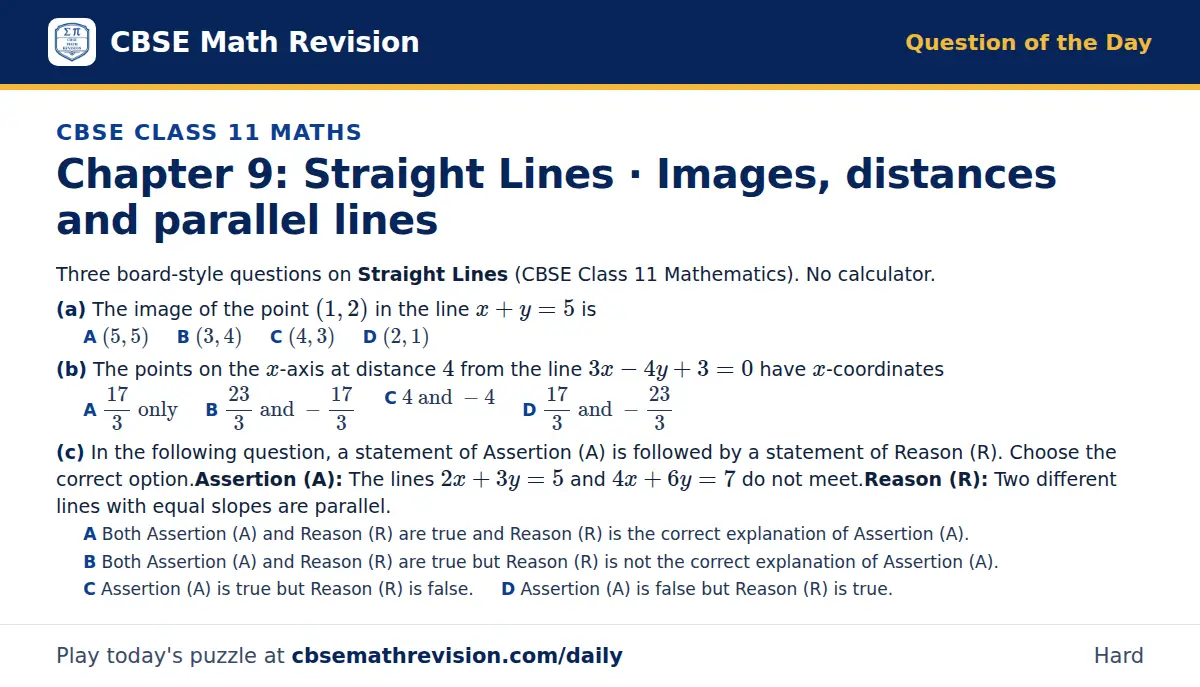
Chapter 9: Straight Lines · Images, distances and parallel lines
Three board-style questions on Straight Lines (CBSE Class 11 Mathematics). No calculator.
- The image of the point (1, 2) in the line x + y = 5 is Options: A) (5, 5); B) (3, 4); C) (4, 3); D) (2, 1)
- The points on the x-axis at distance 4 from the line 3x - 4y + 3 = 0 have x-coordinates Options: A) 17/3 only; B) 23/3 and -17/3; C) 4 and -4; D) 17/3 and -23/3
- In the following question, a statement of Assertion (A) is followed by a statement of Reason (R). Choose the correct option. Assertion (A): The lines 2x + 3y = 5 and 4x + 6y = 7 do not meet. Reason (R): Two different lines with equal slopes are parallel. Options: A) Both Assertion (A) and Reason (R) are true and Reason (R) is the correct explanation of Assertion (A).; B) Both Assertion (A) and Reason (R) are true but Reason (R) is not the correct explanation of Assertion (A).; C) Assertion (A) is true but Reason (R) is false.; D) Assertion (A) is false but Reason (R) is true.
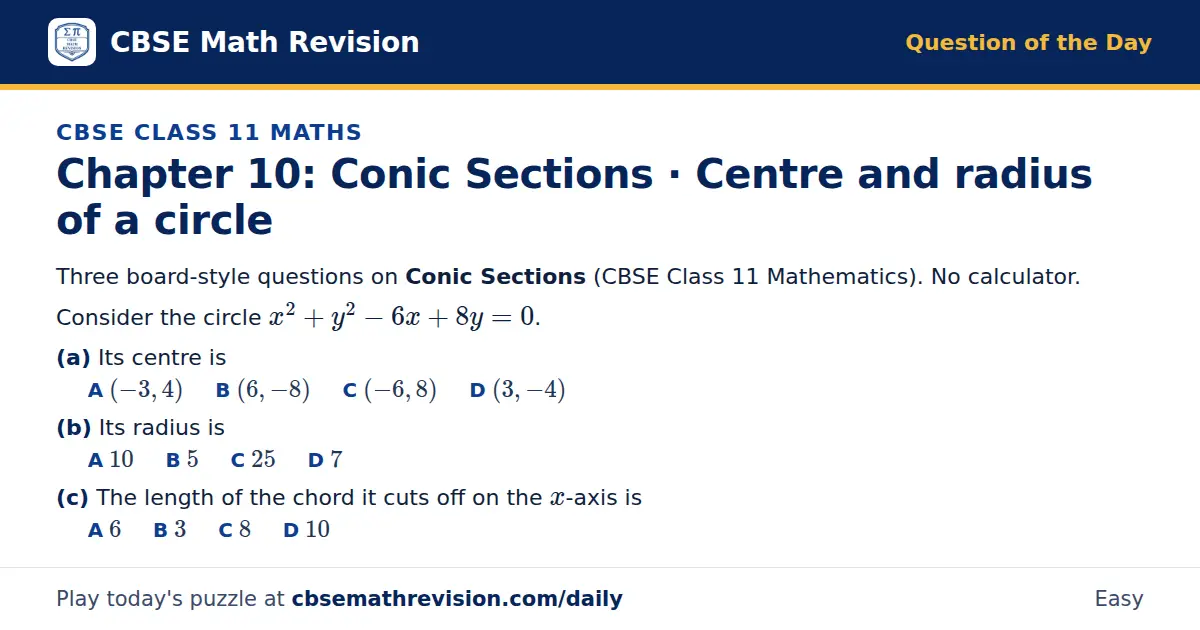
Chapter 10: Conic Sections · Centre and radius of a circle
Three board-style questions on Conic Sections (CBSE Class 11 Mathematics). No calculator. Consider the circle x² + y² - 6x + 8y = 0.
- Its centre is Options: A) (-3, 4); B) (6, -8); C) (-6, 8); D) (3, -4)
- Its radius is Options: A) 10; B) 5; C) 25; D) 7
- The length of the chord it cuts off on the x-axis is Options: A) 6; B) 3; C) 8; D) 10
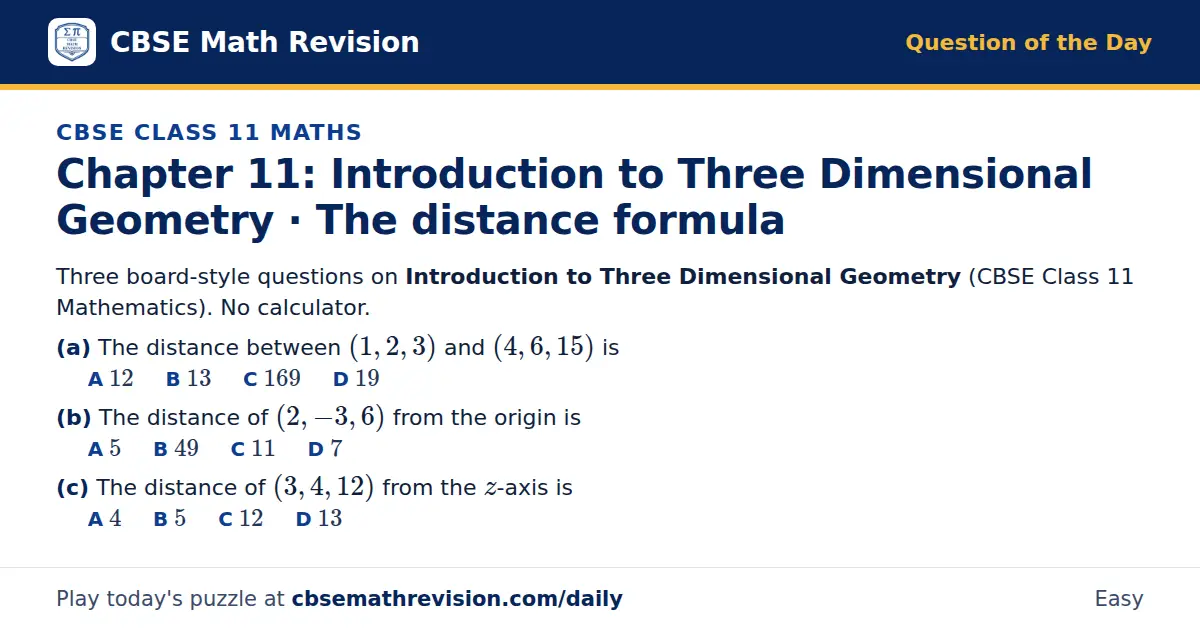
Chapter 11: Introduction to Three Dimensional Geometry · The distance formula
Three board-style questions on Introduction to Three Dimensional Geometry (CBSE Class 11 Mathematics). No calculator.
- The distance between (1, 2, 3) and (4, 6, 15) is Options: A) 12; B) 13; C) 169; D) 19
- The distance of (2, -3, 6) from the origin is Options: A) 5; B) 49; C) 11; D) 7
- The distance of (3, 4, 12) from the z-axis is Options: A) 4; B) 5; C) 12; D) 13
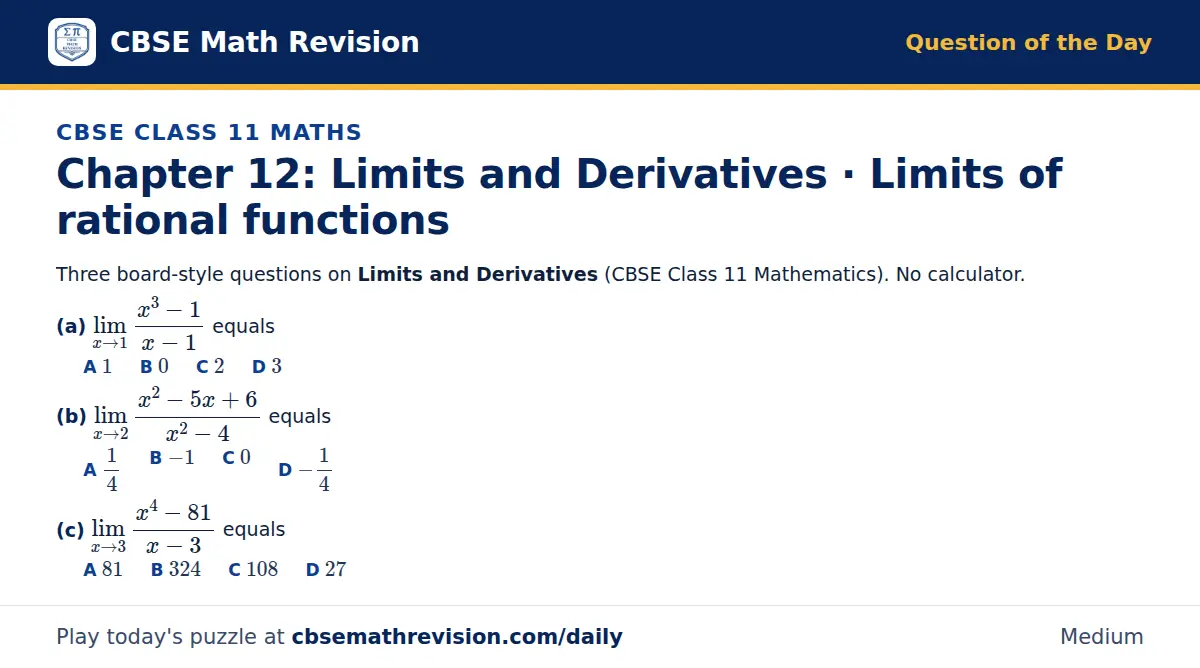
Chapter 12: Limits and Derivatives · Limits of rational functions
Three board-style questions on Limits and Derivatives (CBSE Class 11 Mathematics). No calculator.
- lim_x → 1 (x³ - 1)/(x - 1) equals Options: A) 1; B) 0; C) 2; D) 3
- lim_x → 2 (x² - 5x + 6)/(x² - 4) equals Options: A) 1/4; B) -1; C) 0; D) - 1/4
- lim_x → 3 (x⁴ - 81)/(x - 3) equals Options: A) 81; B) 324; C) 108; D) 27
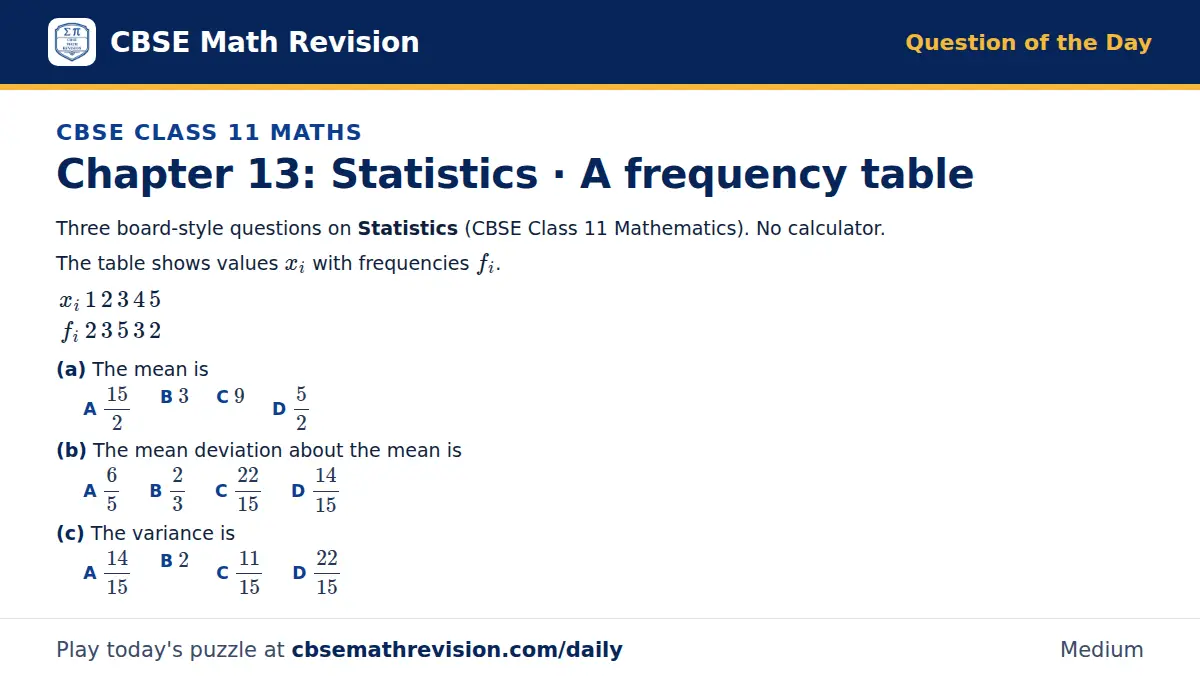
Chapter 13: Statistics · A frequency table
Three board-style questions on Statistics (CBSE Class 11 Mathematics). No calculator. The table shows values x_i with frequencies f_i. x_i12345f_i23532
- The mean is Options: A) 15/2; B) 3; C) 9; D) 5/2
- The mean deviation about the mean is Options: A) 6/5; B) 2/3; C) 22/15; D) 14/15
- The variance is Options: A) 14/15; B) 2; C) 11/15; D) 22/15
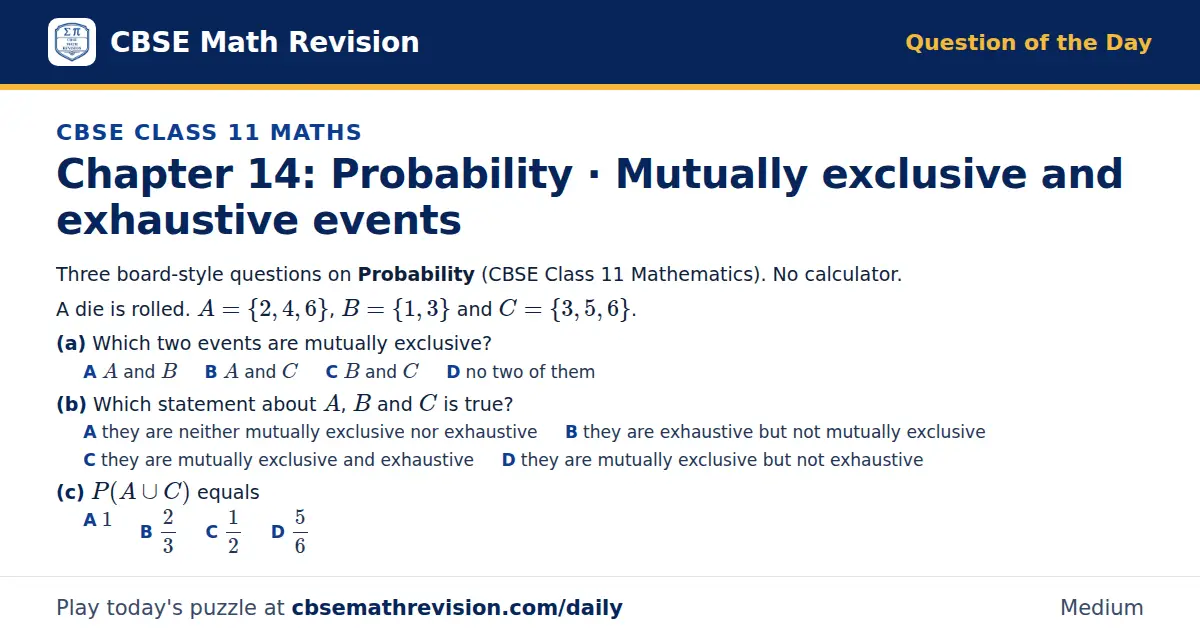
Chapter 14: Probability · Mutually exclusive and exhaustive events
Three board-style questions on Probability (CBSE Class 11 Mathematics). No calculator. A die is rolled. A = 2, 4, 6, B = 1, 3 and C = 3, 5, 6.
- Which two events are mutually exclusive? Options: A) A and B; B) A and C; C) B and C; D) no two of them
- Which statement about A, B and C is true? Options: A) they are neither mutually exclusive nor exhaustive; B) they are exhaustive but not mutually exclusive; C) they are mutually exclusive and exhaustive; D) they are mutually exclusive but not exhaustive
- P(A ∪ C) equals Options: A) 1; B) 2/3; C) 1/2; D) 5/6