CBSE Class 11 Maths Question of the Day: chapters 5–8
40 CBSE Class 11 Mathematics puzzles from the Question of the Day rotation, chapters 5–8. Each puzzle is three board-style questions on one chapter, shown as an image with the question text written out below it; the answers, hints and step-marked solutions are on the daily puzzle page.
- Play today's CBSE Class 11 Maths puzzle
- ← Chapters 1–4
- Chapters 9–11 →
- All CBSE Class 11 Maths puzzles by chapter
Chapter 5: Linear Inequalities
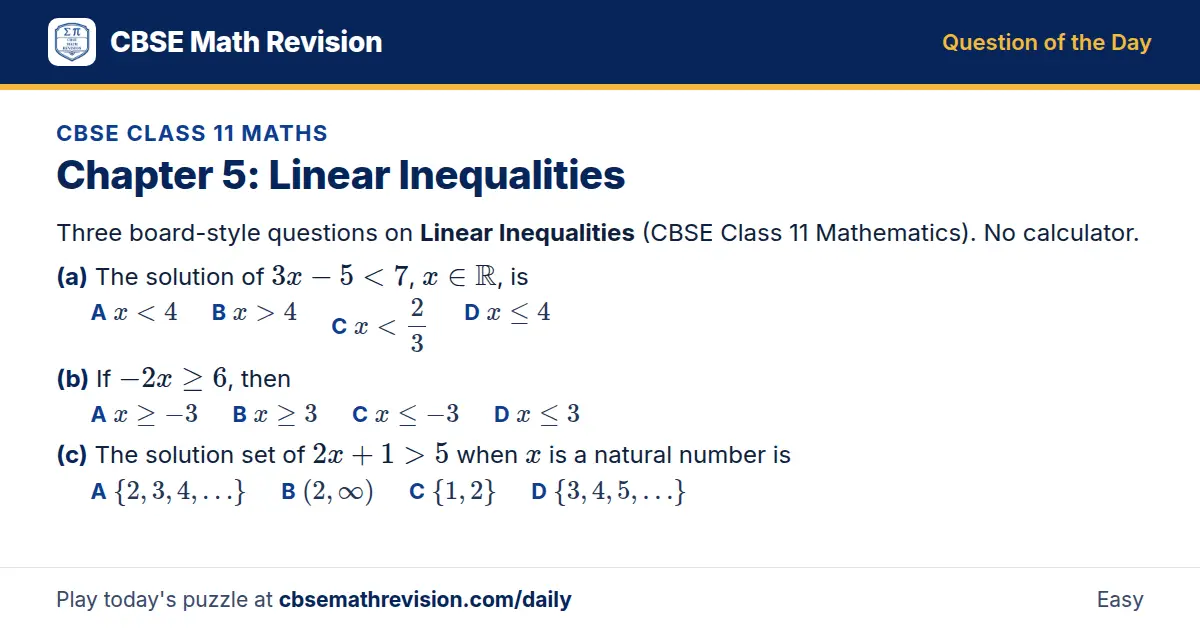
Chapter 5: Linear Inequalities
Three board-style questions on Linear Inequalities (CBSE Class 11 Mathematics). No calculator.
- The solution of 3x - 5 < 7, x ∈ ℝ, is Options: A) x < 4; B) x > 4; C) x < 23; D) x ≤ 4
- If -2x ≥ 6, then Options: A) x ≥ -3; B) x ≥ 3; C) x ≤ -3; D) x ≤ 3
- The solution set of 2x + 1 > 5 when x is a natural number is Options: A) 2, 3, 4, …; B) (2, ∞); C) 1, 2; D) 3, 4, 5, …
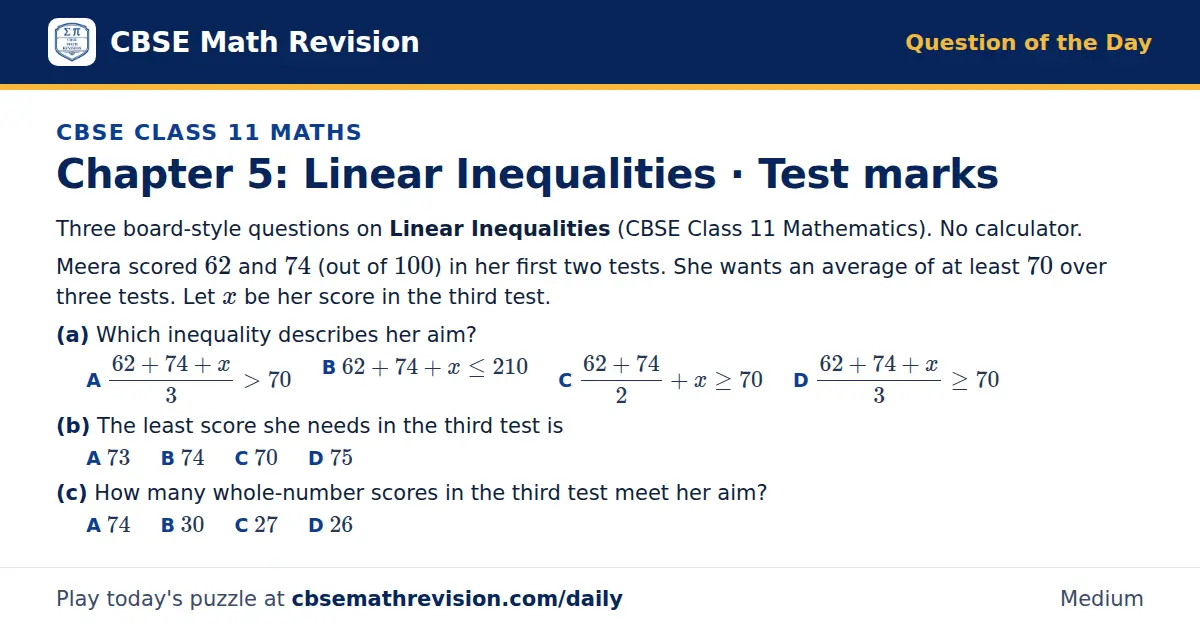
Chapter 5: Linear Inequalities · Test marks
Three board-style questions on Linear Inequalities (CBSE Class 11 Mathematics). No calculator. Meera scored 62 and 74 (out of 100) in her first two tests. She wants an average of at least 70 over three tests. Let x be her score in the third test.
- Which inequality describes her aim? Options: A) (62 + 74 + x)/3 > 70; B) 62 + 74 + x ≤ 210; C) (62 + 74)/2 + x ≥ 70; D) (62 + 74 + x)/3 ≥ 70
- The least score she needs in the third test is Options: A) 73; B) 74; C) 70; D) 75
- How many whole-number scores in the third test meet her aim? Options: A) 74; B) 30; C) 27; D) 26
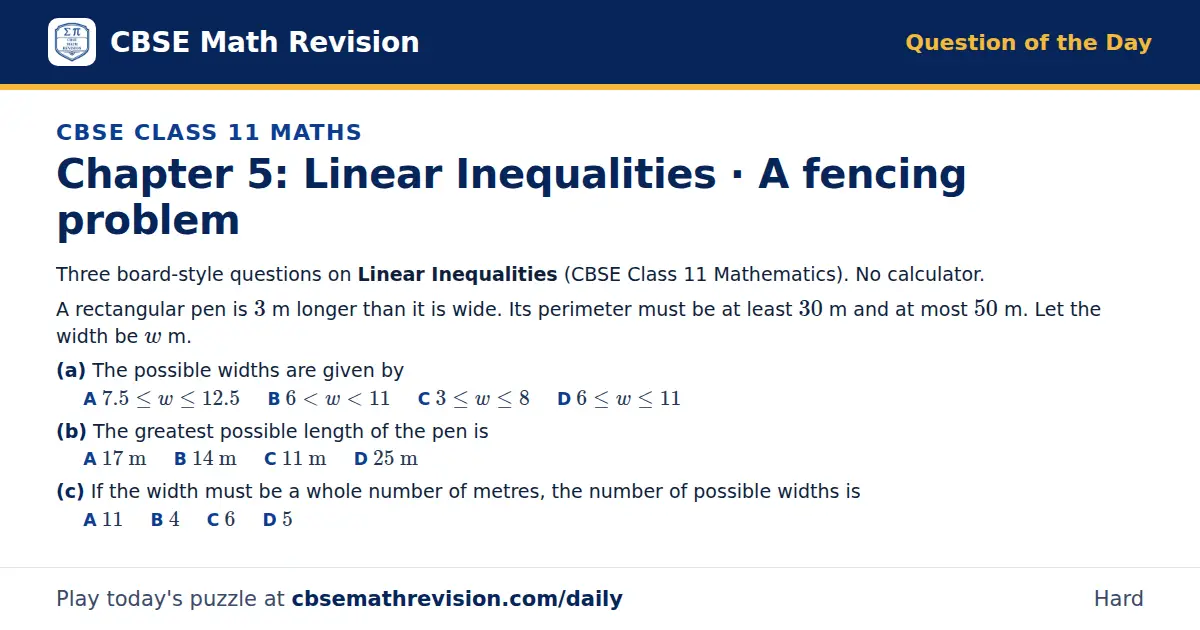
Chapter 5: Linear Inequalities · A fencing problem
Three board-style questions on Linear Inequalities (CBSE Class 11 Mathematics). No calculator. A rectangular pen is 3 m longer than it is wide. Its perimeter must be at least 30 m and at most 50 m. Let the width be w m.
- The possible widths are given by Options: A) 7.5 ≤ w ≤ 12.5; B) 6 < w < 11; C) 3 ≤ w ≤ 8; D) 6 ≤ w ≤ 11
- The greatest possible length of the pen is Options: A) 17 m; B) 14 m; C) 11 m; D) 25 m
- If the width must be a whole number of metres, the number of possible widths is Options: A) 11; B) 4; C) 6; D) 5
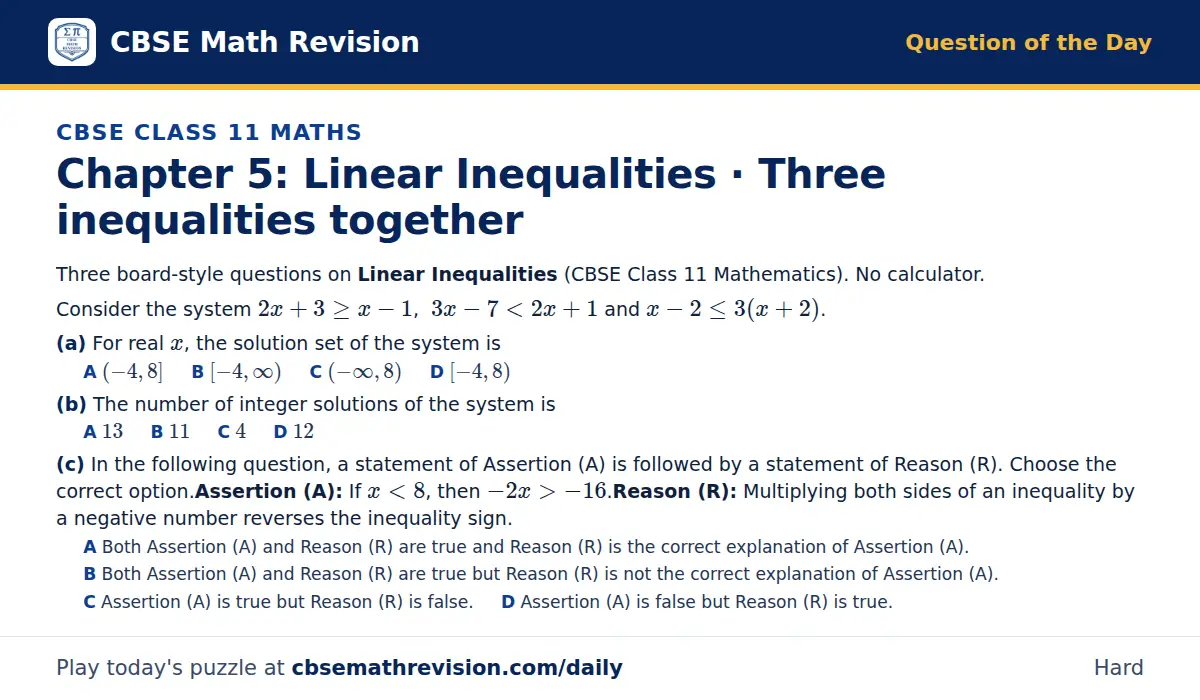
Chapter 5: Linear Inequalities · Three inequalities together
Three board-style questions on Linear Inequalities (CBSE Class 11 Mathematics). No calculator. Consider the system 2x + 3 ≥ x - 1, 3x - 7 < 2x + 1 and x - 2 ≤ 3(x + 2).
- For real x, the solution set of the system is Options: A) (-4, 8]; B) [-4, ∞); C) (-∞, 8); D) [-4, 8)
- The number of integer solutions of the system is Options: A) 13; B) 11; C) 4; D) 12
- In the following question, a statement of Assertion (A) is followed by a statement of Reason (R). Choose the correct option. Assertion (A): If x < 8, then -2x > -16. Reason (R): Multiplying both sides of an inequality by a negative number reverses the inequality sign. Options: A) Both Assertion (A) and Reason (R) are true and Reason (R) is the correct explanation of Assertion (A).; B) Both Assertion (A) and Reason (R) are true but Reason (R) is not the correct explanation of Assertion (A).; C) Assertion (A) is true but Reason (R) is false.; D) Assertion (A) is false but Reason (R) is true.
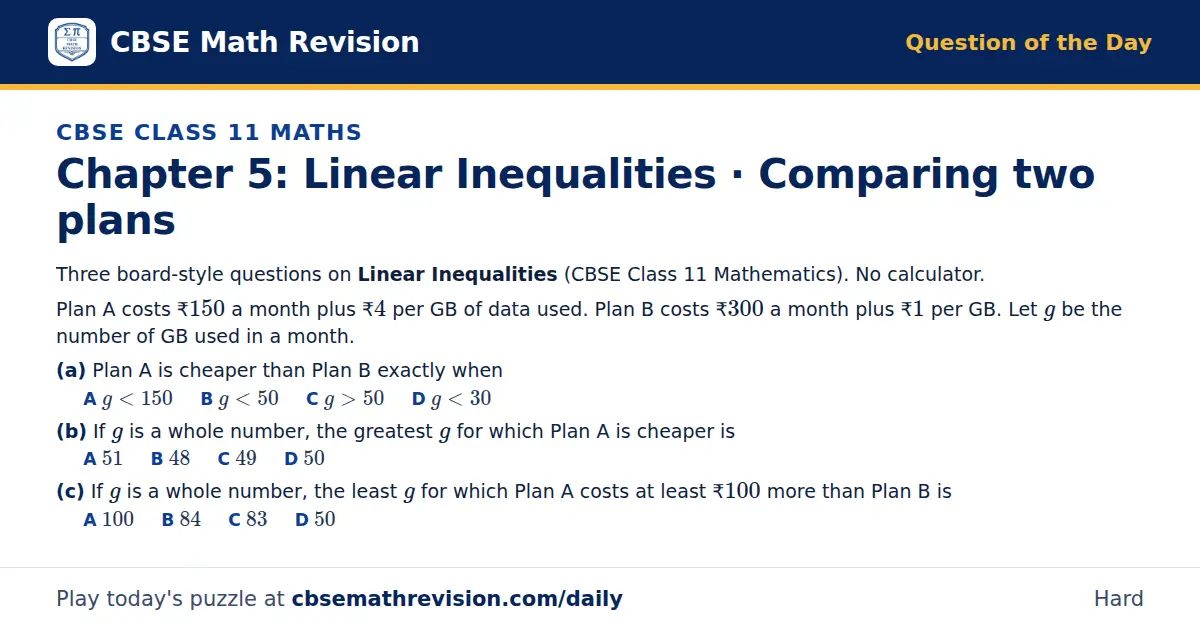
Chapter 5: Linear Inequalities · Comparing two plans
Three board-style questions on Linear Inequalities (CBSE Class 11 Mathematics). No calculator. Plan A costs ₹150 a month plus ₹4 per GB of data used. Plan B costs ₹300 a month plus ₹1 per GB. Let g be the number of GB used in a month.
- Plan A is cheaper than Plan B exactly when Options: A) g < 150; B) g < 50; C) g > 50; D) g < 30
- If g is a whole number, the greatest g for which Plan A is cheaper is Options: A) 51; B) 48; C) 49; D) 50
- If g is a whole number, the least g for which Plan A costs at least ₹100 more than Plan B is Options: A) 100; B) 84; C) 83; D) 50
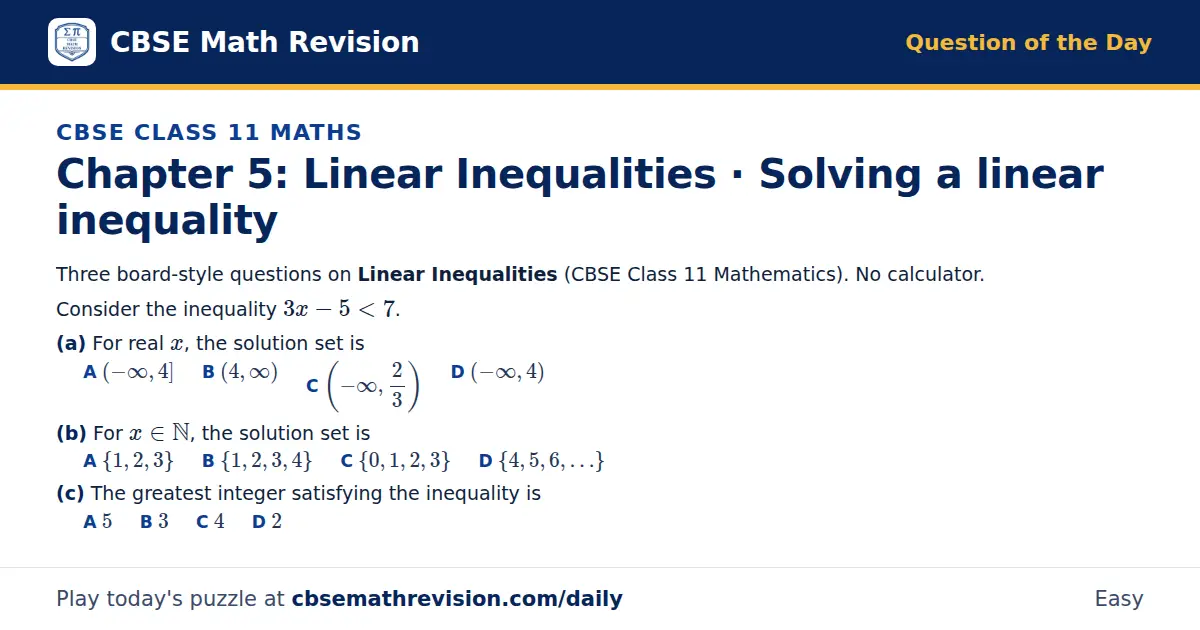
Chapter 5: Linear Inequalities · Solving a linear inequality
Three board-style questions on Linear Inequalities (CBSE Class 11 Mathematics). No calculator. Consider the inequality 3x - 5 < 7.
- For real x, the solution set is Options: A) (-∞, 4]; B) (4, ∞); C) (-∞, 23); D) (-∞, 4)
- For x ∈ ℕ, the solution set is Options: A) 1, 2, 3; B) 1, 2, 3, 4; C) 0, 1, 2, 3; D) 4, 5, 6, …
- The greatest integer satisfying the inequality is Options: A) 5; B) 3; C) 4; D) 2
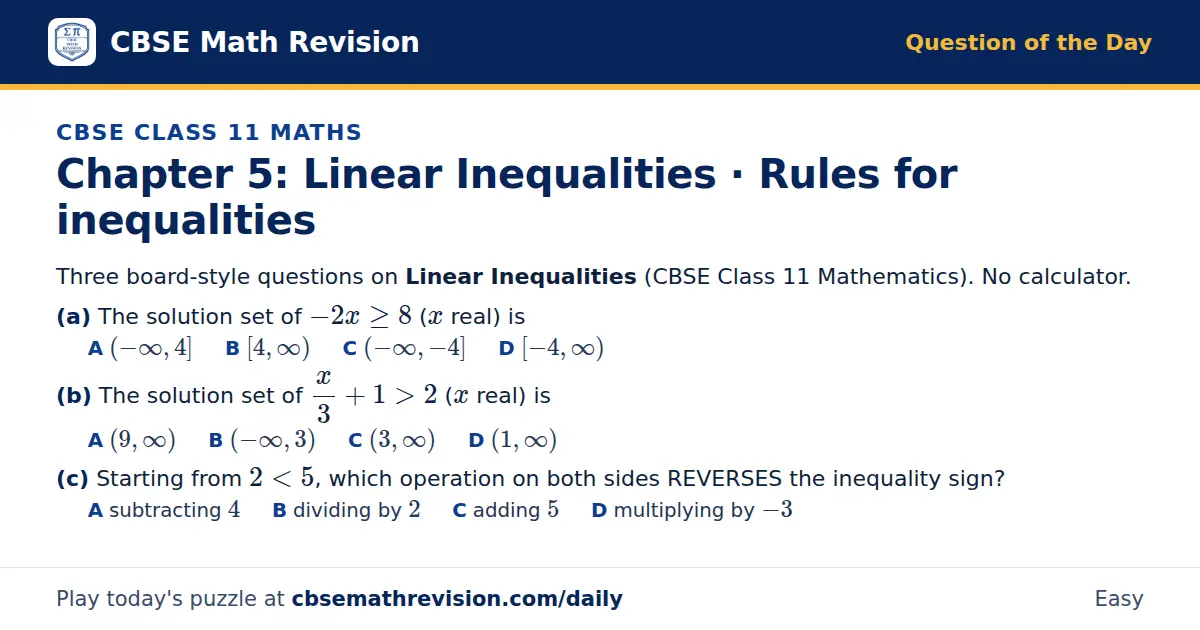
Chapter 5: Linear Inequalities · Rules for inequalities
Three board-style questions on Linear Inequalities (CBSE Class 11 Mathematics). No calculator.
- The solution set of -2x ≥ 8 (x real) is Options: A) (-∞, 4]; B) [4, ∞); C) (-∞, -4]; D) [-4, ∞)
- The solution set of x/3 + 1 > 2 (x real) is Options: A) (9, ∞); B) (-∞, 3); C) (3, ∞); D) (1, ∞)
- Starting from 2 < 5, which operation on both sides REVERSES the inequality sign? Options: A) subtracting 4; B) dividing by 2; C) adding 5; D) multiplying by -3
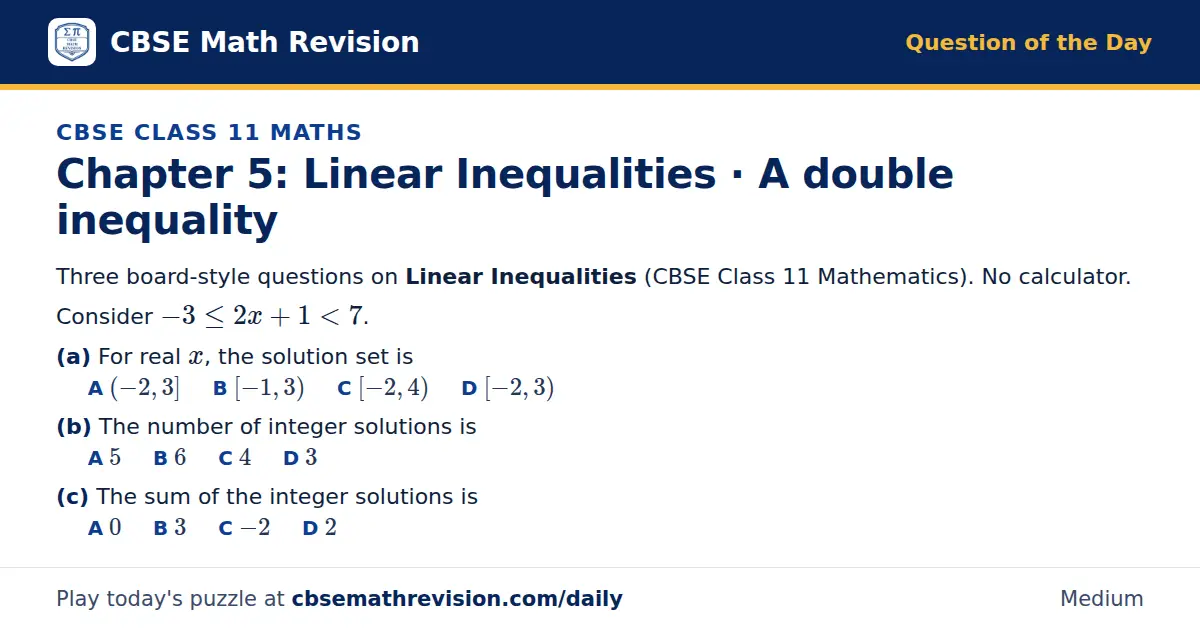
Chapter 5: Linear Inequalities · A double inequality
Three board-style questions on Linear Inequalities (CBSE Class 11 Mathematics). No calculator. Consider -3 ≤ 2x + 1 < 7.
- For real x, the solution set is Options: A) (-2, 3]; B) [-1, 3); C) [-2, 4); D) [-2, 3)
- The number of integer solutions is Options: A) 5; B) 6; C) 4; D) 3
- The sum of the integer solutions is Options: A) 0; B) 3; C) -2; D) 2
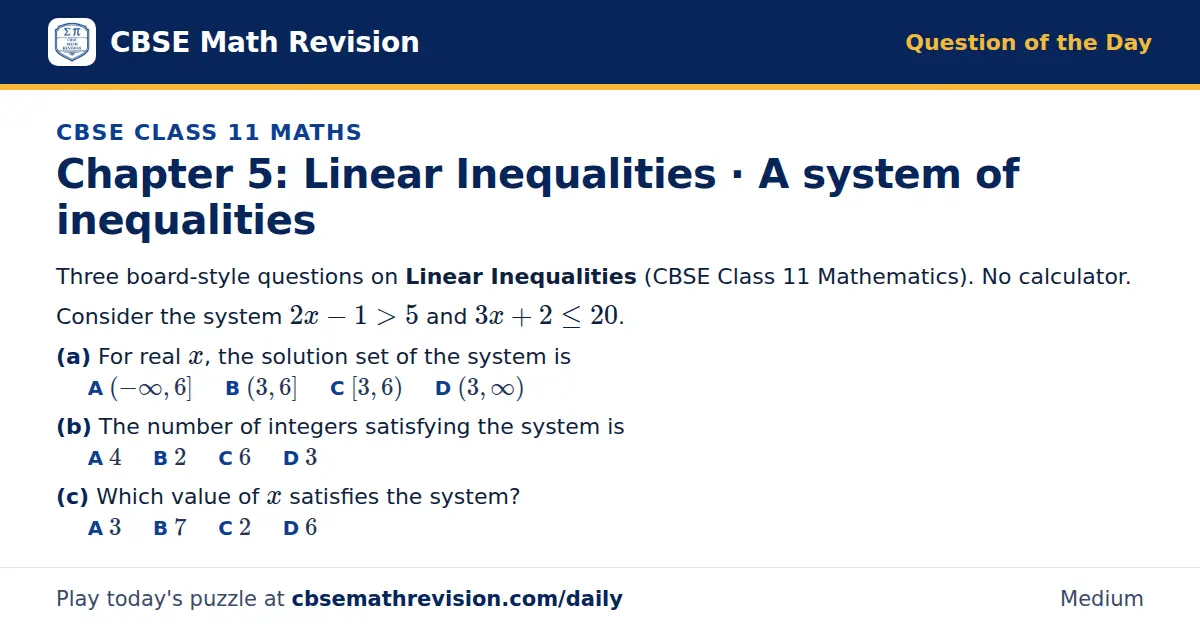
Chapter 5: Linear Inequalities · A system of inequalities
Three board-style questions on Linear Inequalities (CBSE Class 11 Mathematics). No calculator. Consider the system 2x - 1 > 5 and 3x + 2 ≤ 20.
- For real x, the solution set of the system is Options: A) (-∞, 6]; B) (3, 6]; C) [3, 6); D) (3, ∞)
- The number of integers satisfying the system is Options: A) 4; B) 2; C) 6; D) 3
- Which value of x satisfies the system? Options: A) 3; B) 7; C) 2; D) 6
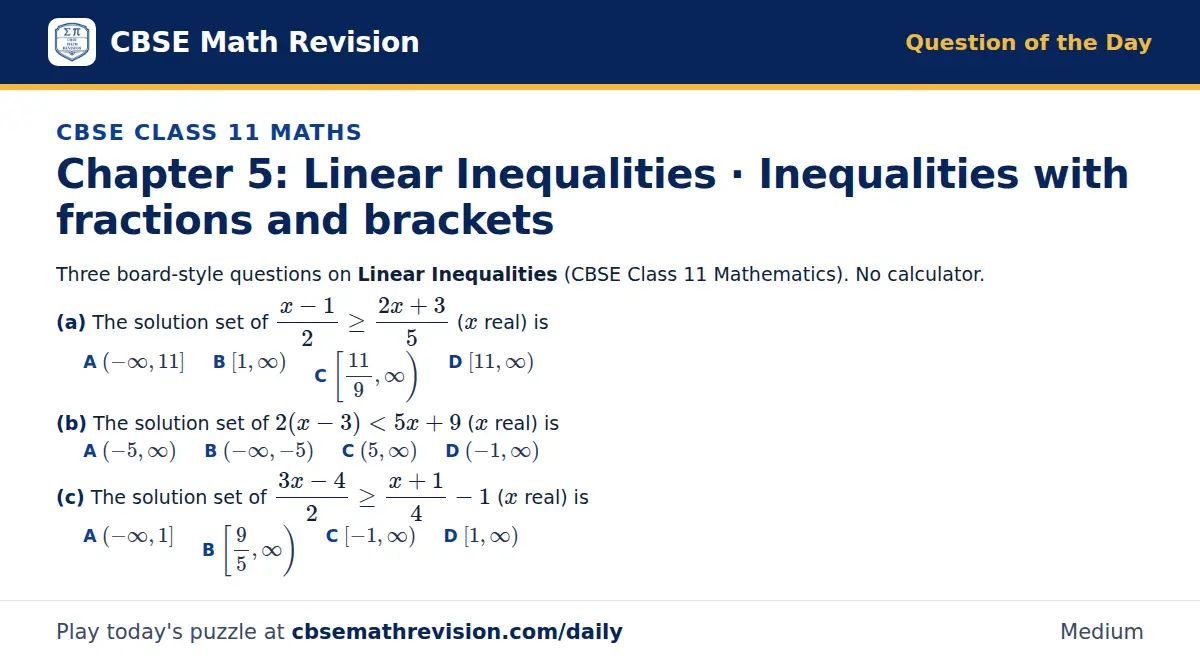
Chapter 5: Linear Inequalities · Inequalities with fractions and brackets
Three board-style questions on Linear Inequalities (CBSE Class 11 Mathematics). No calculator.
- The solution set of (x - 1)/2 ≥ (2x + 3)/5 (x real) is Options: A) (-∞, 11]; B) [1, ∞); C) [11/9, ∞); D) [11, ∞)
- The solution set of 2(x - 3) < 5x + 9 (x real) is Options: A) (-5, ∞); B) (-∞, -5); C) (5, ∞); D) (-1, ∞)
- The solution set of (3x - 4)/2 ≥ (x + 1)/4 - 1 (x real) is Options: A) (-∞, 1]; B) [9/5, ∞); C) [-1, ∞); D) [1, ∞)
Chapter 6: Permutations and Combinations
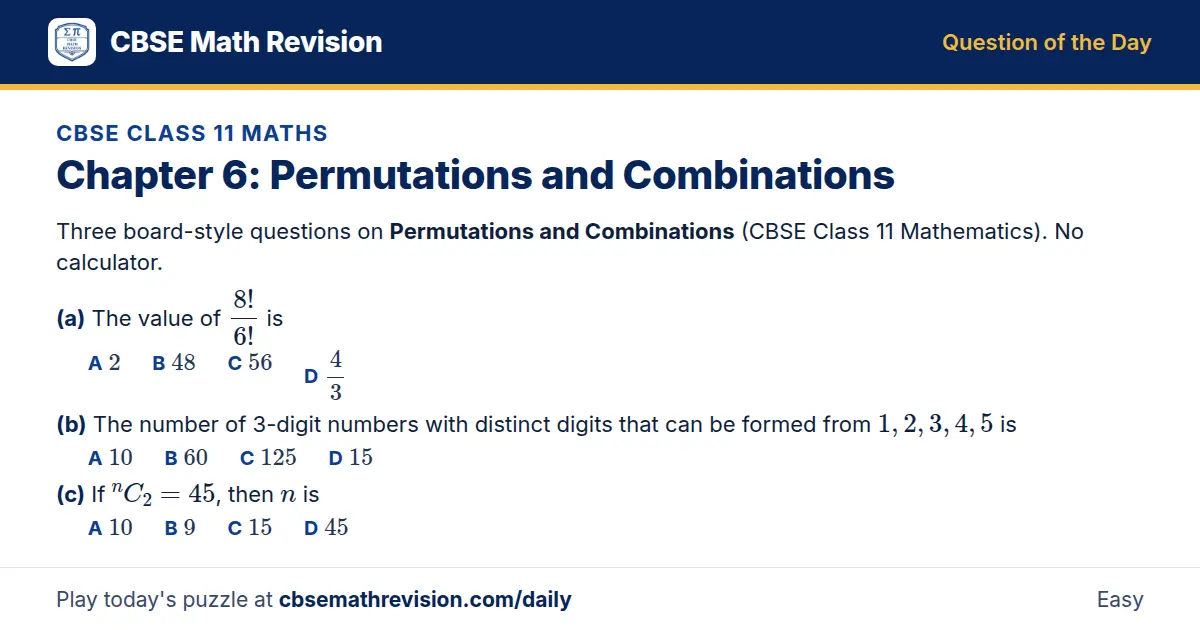
Chapter 6: Permutations and Combinations
Three board-style questions on Permutations and Combinations (CBSE Class 11 Mathematics). No calculator.
- The value of (8!)/(6!) is Options: A) 2; B) 48; C) 56; D) 43
- The number of 3-digit numbers with distinct digits that can be formed from 1, 2, 3, 4, 5 is Options: A) 10; B) 60; C) 125; D) 15
- If ^nC_2 = 45, then n is Options: A) 10; B) 9; C) 15; D) 45
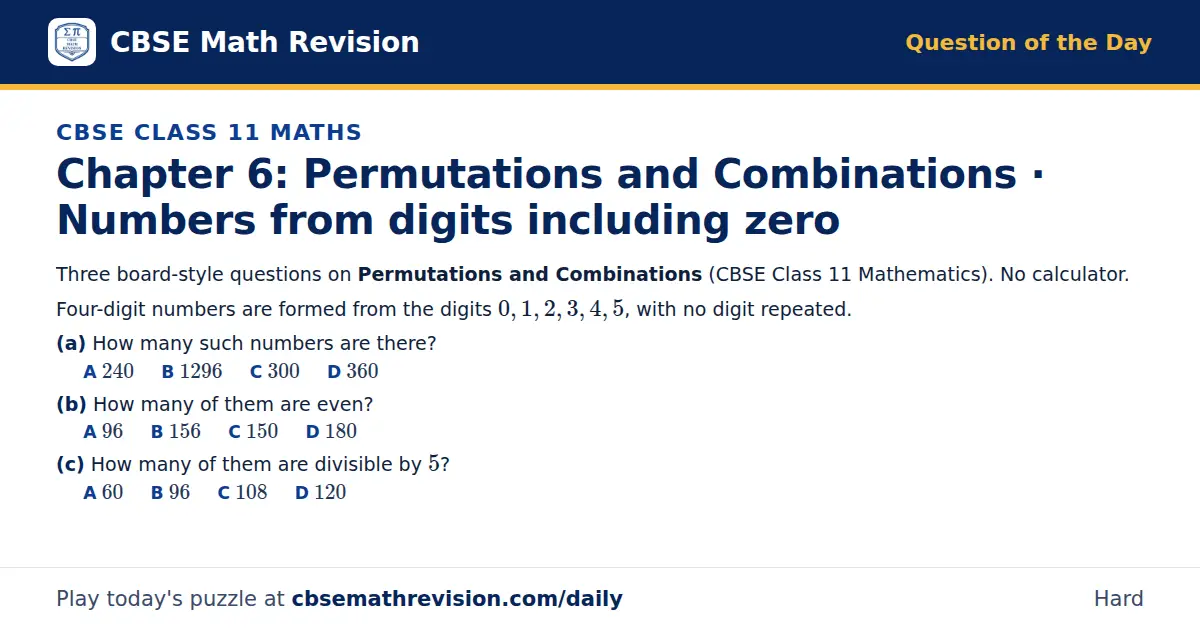
Chapter 6: Permutations and Combinations · Numbers from digits including zero
Three board-style questions on Permutations and Combinations (CBSE Class 11 Mathematics). No calculator. Four-digit numbers are formed from the digits 0, 1, 2, 3, 4, 5, with no digit repeated.
- How many such numbers are there? Options: A) 240; B) 1296; C) 300; D) 360
- How many of them are even? Options: A) 96; B) 156; C) 150; D) 180
- How many of them are divisible by 5? Options: A) 60; B) 96; C) 108; D) 120
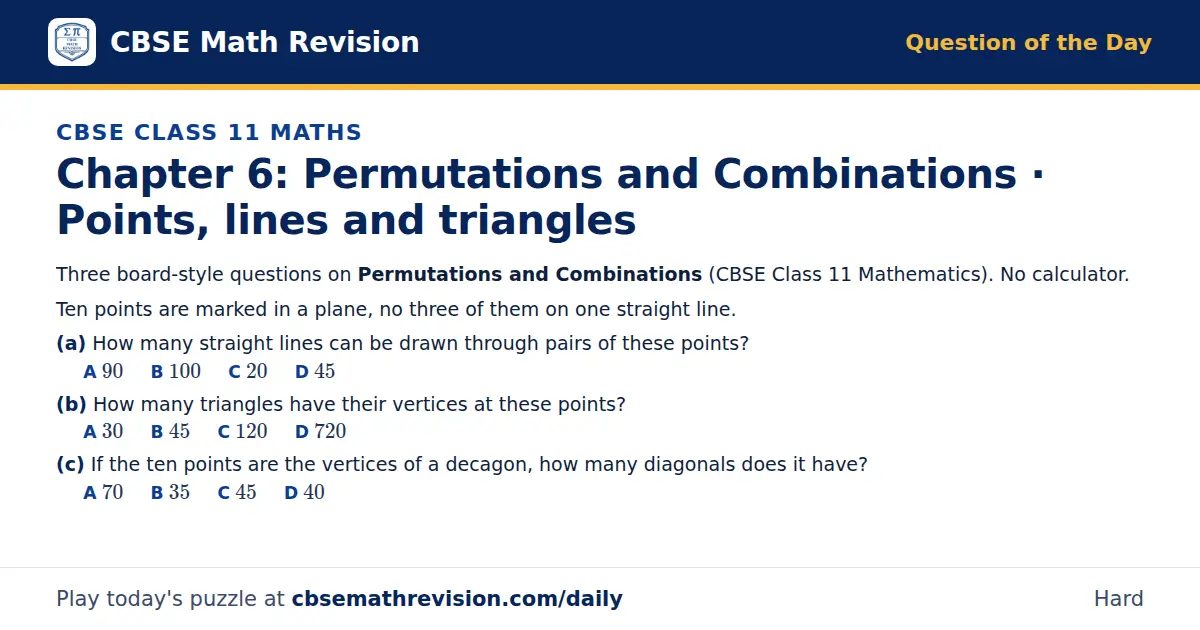
Chapter 6: Permutations and Combinations · Points, lines and triangles
Three board-style questions on Permutations and Combinations (CBSE Class 11 Mathematics). No calculator. Ten points are marked in a plane, no three of them on one straight line.
- How many straight lines can be drawn through pairs of these points? Options: A) 90; B) 100; C) 20; D) 45
- How many triangles have their vertices at these points? Options: A) 30; B) 45; C) 120; D) 720
- If the ten points are the vertices of a decagon, how many diagonals does it have? Options: A) 70; B) 35; C) 45; D) 40
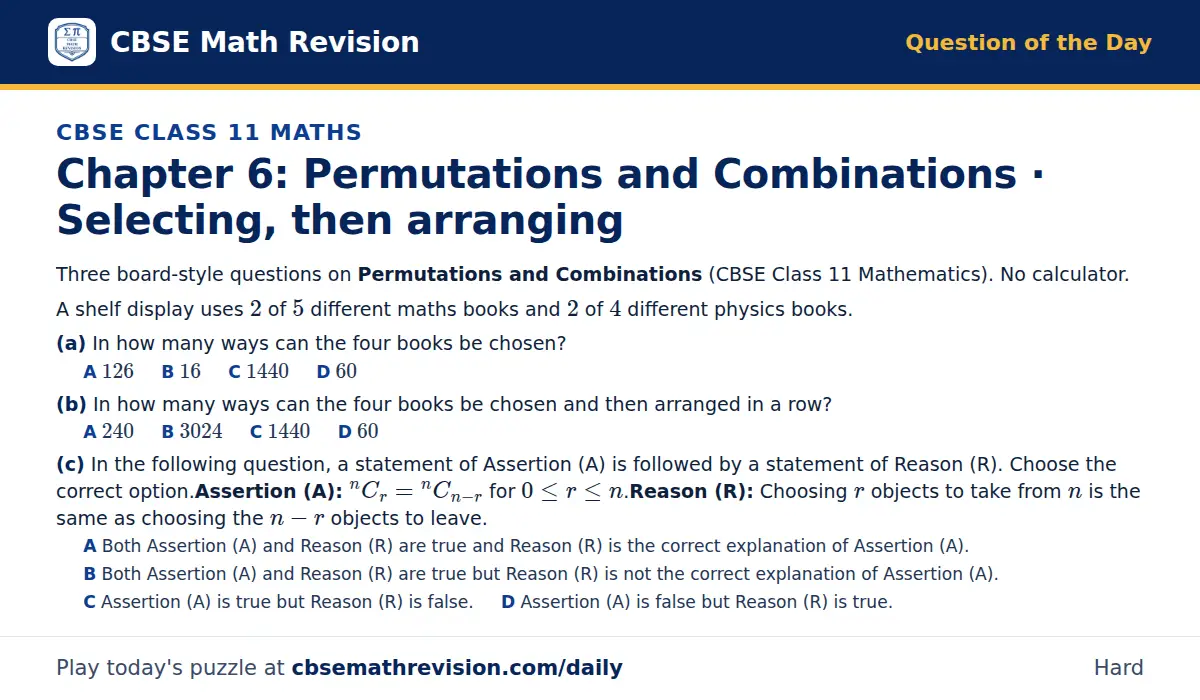
Chapter 6: Permutations and Combinations · Selecting, then arranging
Three board-style questions on Permutations and Combinations (CBSE Class 11 Mathematics). No calculator. A shelf display uses 2 of 5 different maths books and 2 of 4 different physics books.
- In how many ways can the four books be chosen? Options: A) 126; B) 16; C) 1440; D) 60
- In how many ways can the four books be chosen and then arranged in a row? Options: A) 240; B) 3024; C) 1440; D) 60
- In the following question, a statement of Assertion (A) is followed by a statement of Reason (R). Choose the correct option. Assertion (A): ^nC_r = ^nC_n - r for 0 ≤ r ≤ n. Reason (R): Choosing r objects to take from n is the same as choosing the n - r objects to leave. Options: A) Both Assertion (A) and Reason (R) are true and Reason (R) is the correct explanation of Assertion (A).; B) Both Assertion (A) and Reason (R) are true but Reason (R) is not the correct explanation of Assertion (A).; C) Assertion (A) is true but Reason (R) is false.; D) Assertion (A) is false but Reason (R) is true.
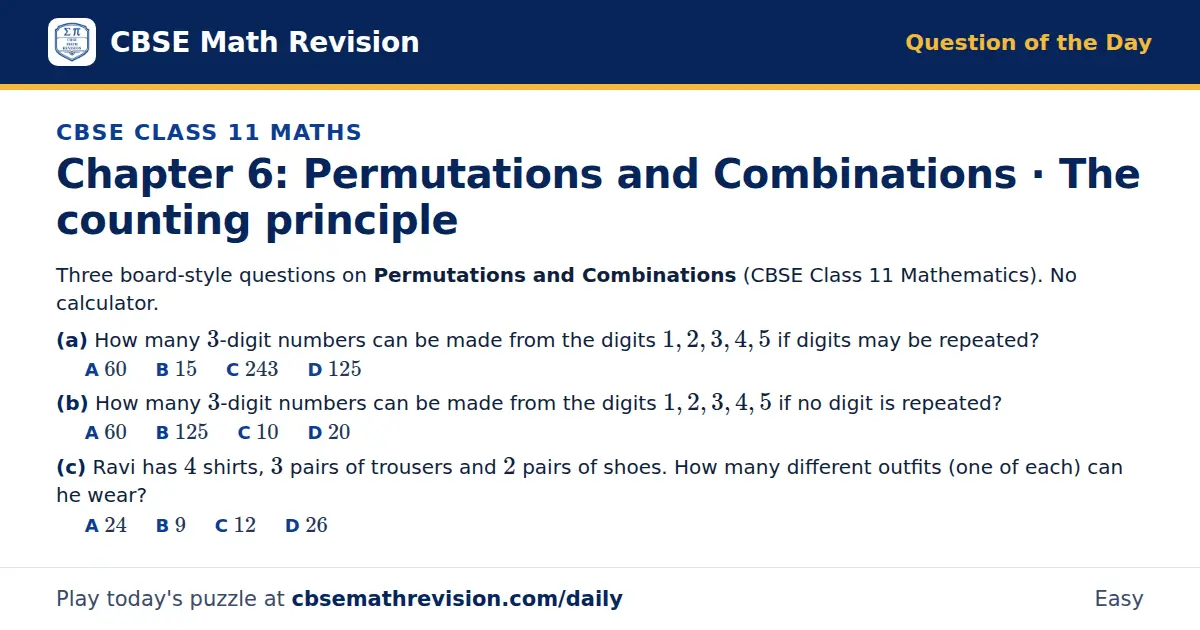
Chapter 6: Permutations and Combinations · The counting principle
Three board-style questions on Permutations and Combinations (CBSE Class 11 Mathematics). No calculator.
- How many 3-digit numbers can be made from the digits 1, 2, 3, 4, 5 if digits may be repeated? Options: A) 60; B) 15; C) 243; D) 125
- How many 3-digit numbers can be made from the digits 1, 2, 3, 4, 5 if no digit is repeated? Options: A) 60; B) 125; C) 10; D) 20
- Ravi has 4 shirts, 3 pairs of trousers and 2 pairs of shoes. How many different outfits (one of each) can he wear? Options: A) 24; B) 9; C) 12; D) 26
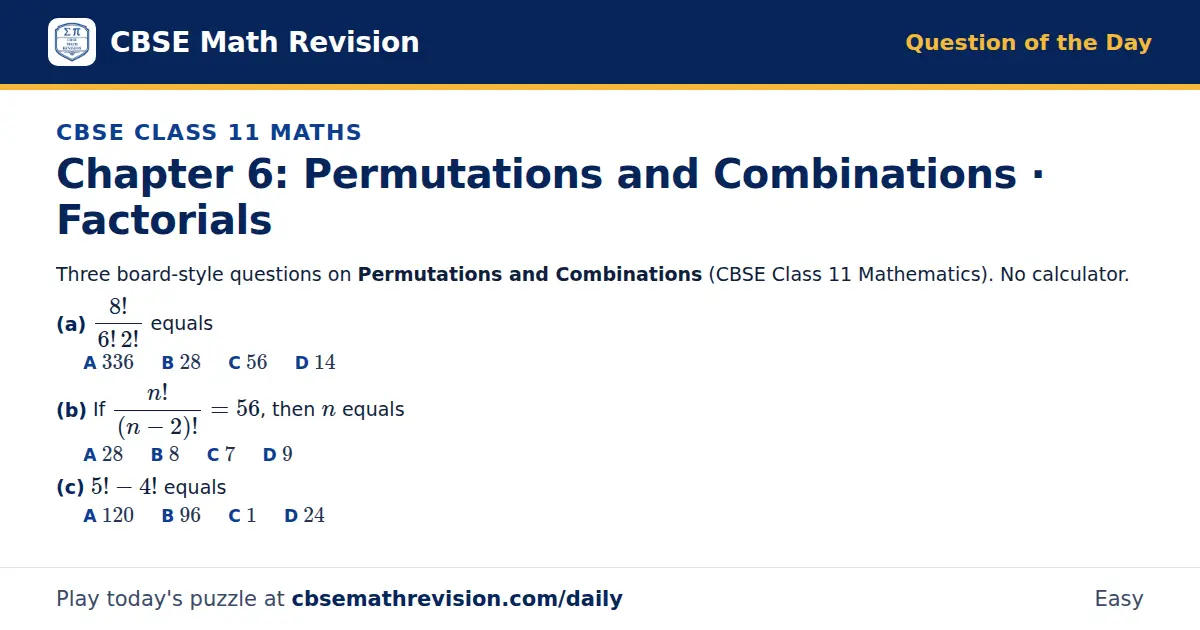
Chapter 6: Permutations and Combinations · Factorials
Three board-style questions on Permutations and Combinations (CBSE Class 11 Mathematics). No calculator.
- (8!)/(6! 2!) equals Options: A) 336; B) 28; C) 56; D) 14
- If (n!)/((n - 2)!) = 56, then n equals Options: A) 28; B) 8; C) 7; D) 9
- 5! - 4! equals Options: A) 120; B) 96; C) 1; D) 24
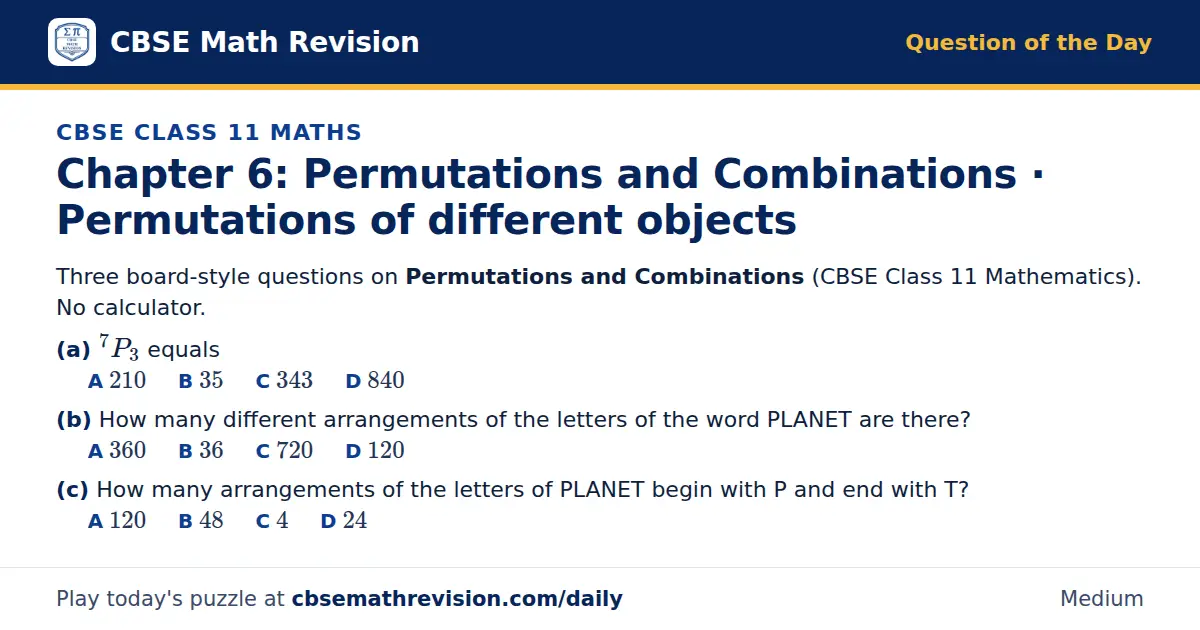
Chapter 6: Permutations and Combinations · Permutations of different objects
Three board-style questions on Permutations and Combinations (CBSE Class 11 Mathematics). No calculator.
- ⁷P_3 equals Options: A) 210; B) 35; C) 343; D) 840
- How many different arrangements of the letters of the word PLANET are there? Options: A) 360; B) 36; C) 720; D) 120
- How many arrangements of the letters of PLANET begin with P and end with T? Options: A) 120; B) 48; C) 4; D) 24
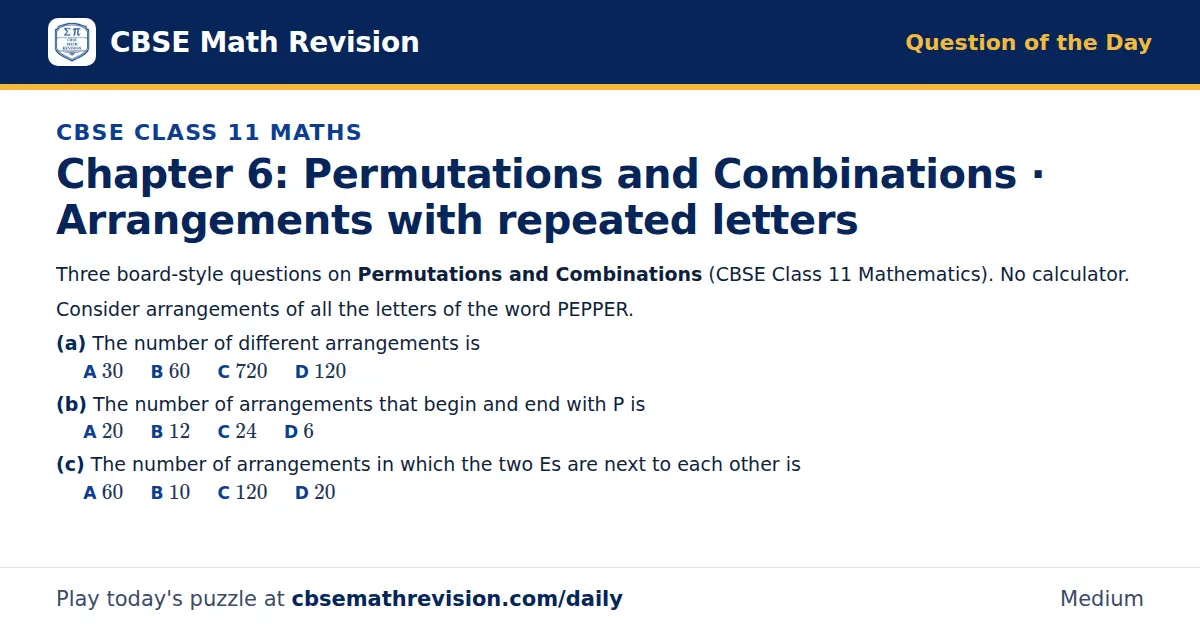
Chapter 6: Permutations and Combinations · Arrangements with repeated letters
Three board-style questions on Permutations and Combinations (CBSE Class 11 Mathematics). No calculator. Consider arrangements of all the letters of the word PEPPER.
- The number of different arrangements is Options: A) 30; B) 60; C) 720; D) 120
- The number of arrangements that begin and end with P is Options: A) 20; B) 12; C) 24; D) 6
- The number of arrangements in which the two Es are next to each other is Options: A) 60; B) 10; C) 120; D) 20
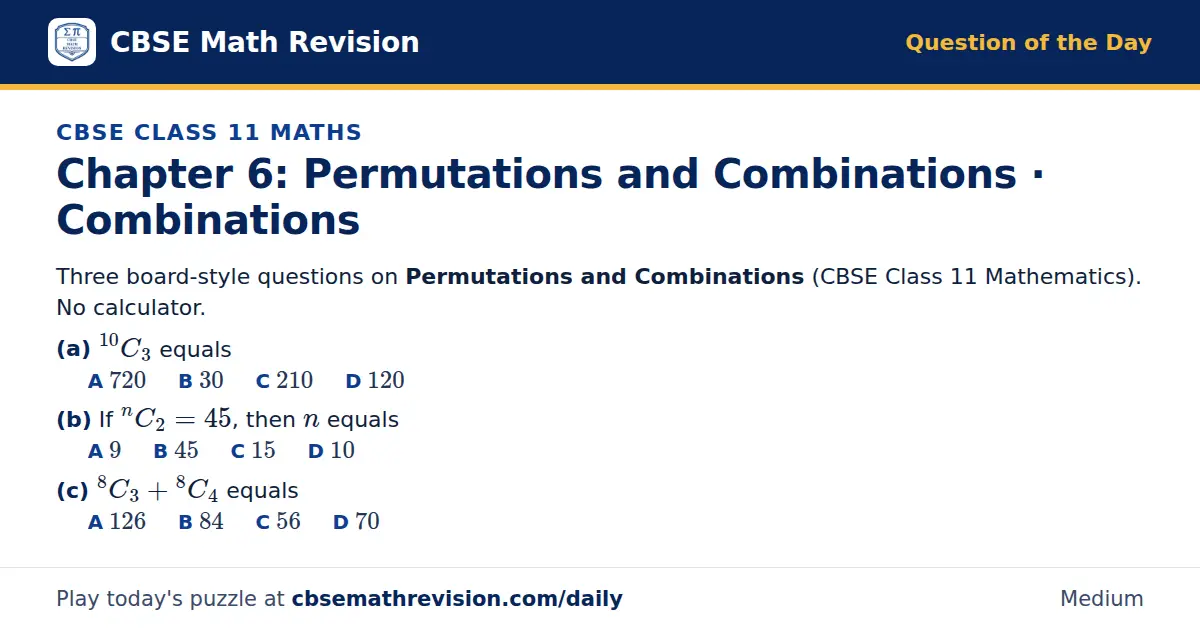
Chapter 6: Permutations and Combinations · Combinations
Three board-style questions on Permutations and Combinations (CBSE Class 11 Mathematics). No calculator.
- ¹⁰C_3 equals Options: A) 720; B) 30; C) 210; D) 120
- If ^nC_2 = 45, then n equals Options: A) 9; B) 45; C) 15; D) 10
- ⁸C_3 + ⁸C_4 equals Options: A) 126; B) 84; C) 56; D) 70
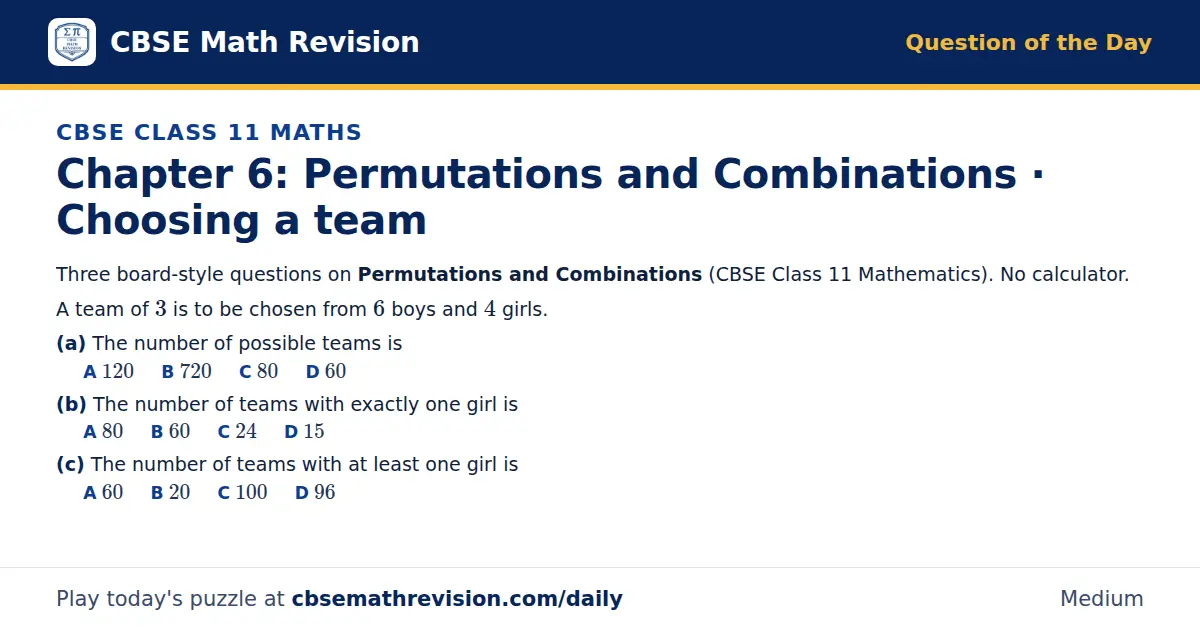
Chapter 6: Permutations and Combinations · Choosing a team
Three board-style questions on Permutations and Combinations (CBSE Class 11 Mathematics). No calculator. A team of 3 is to be chosen from 6 boys and 4 girls.
- The number of possible teams is Options: A) 120; B) 720; C) 80; D) 60
- The number of teams with exactly one girl is Options: A) 80; B) 60; C) 24; D) 15
- The number of teams with at least one girl is Options: A) 60; B) 20; C) 100; D) 96
Chapter 7: Binomial Theorem
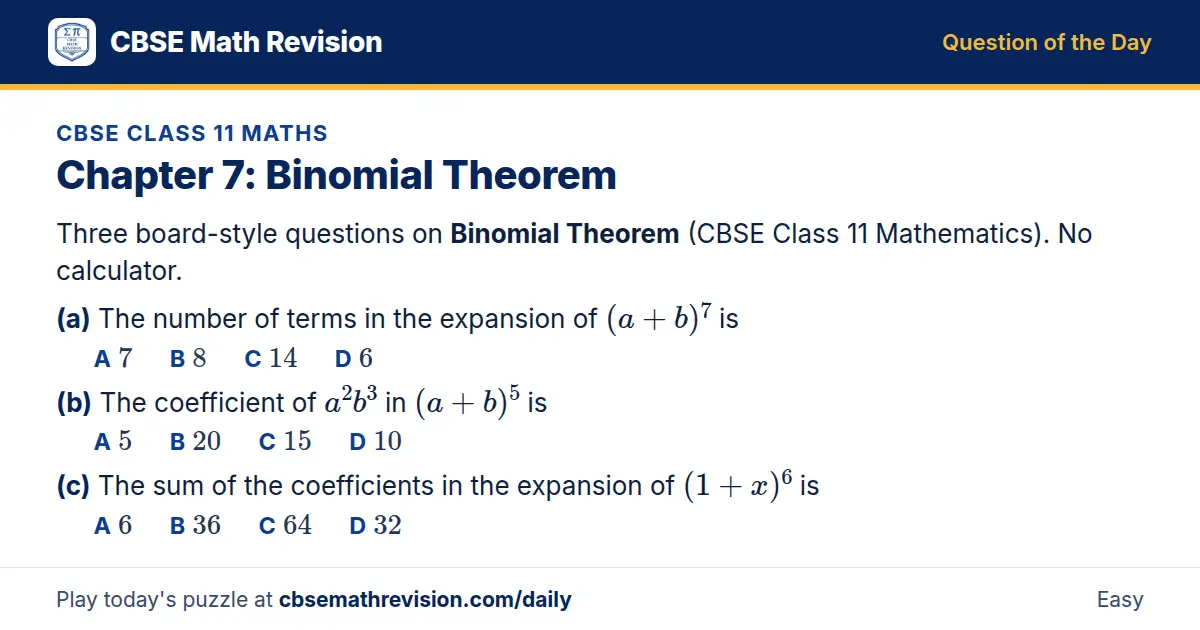
Chapter 7: Binomial Theorem
Three board-style questions on Binomial Theorem (CBSE Class 11 Mathematics). No calculator.
- The number of terms in the expansion of (a + b)⁷ is Options: A) 7; B) 8; C) 14; D) 6
- The coefficient of a²b³ in (a + b)⁵ is Options: A) 5; B) 20; C) 15; D) 10
- The sum of the coefficients in the expansion of (1 + x)⁶ is Options: A) 6; B) 36; C) 64; D) 32
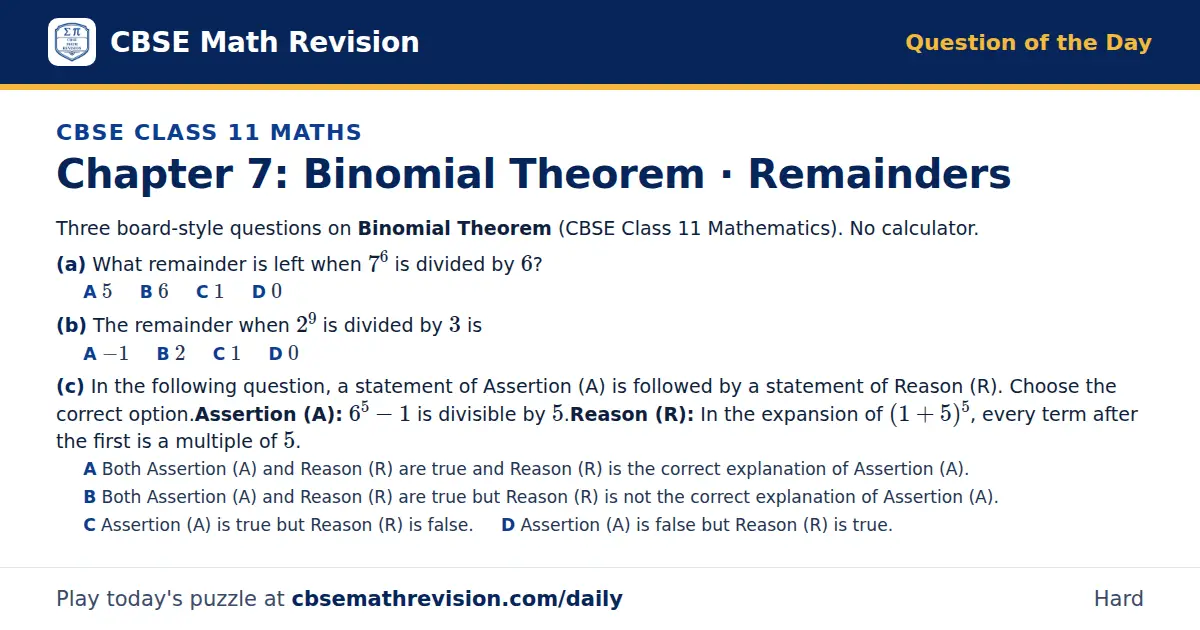
Chapter 7: Binomial Theorem · Remainders
Three board-style questions on Binomial Theorem (CBSE Class 11 Mathematics). No calculator.
- What remainder is left when 7⁶ is divided by 6? Options: A) 5; B) 6; C) 1; D) 0
- The remainder when 2⁹ is divided by 3 is Options: A) -1; B) 2; C) 1; D) 0
- In the following question, a statement of Assertion (A) is followed by a statement of Reason (R). Choose the correct option. Assertion (A): 6⁵ - 1 is divisible by 5. Reason (R): In the expansion of (1 + 5)⁵, every term after the first is a multiple of 5. Options: A) Both Assertion (A) and Reason (R) are true and Reason (R) is the correct explanation of Assertion (A).; B) Both Assertion (A) and Reason (R) are true but Reason (R) is not the correct explanation of Assertion (A).; C) Assertion (A) is true but Reason (R) is false.; D) Assertion (A) is false but Reason (R) is true.
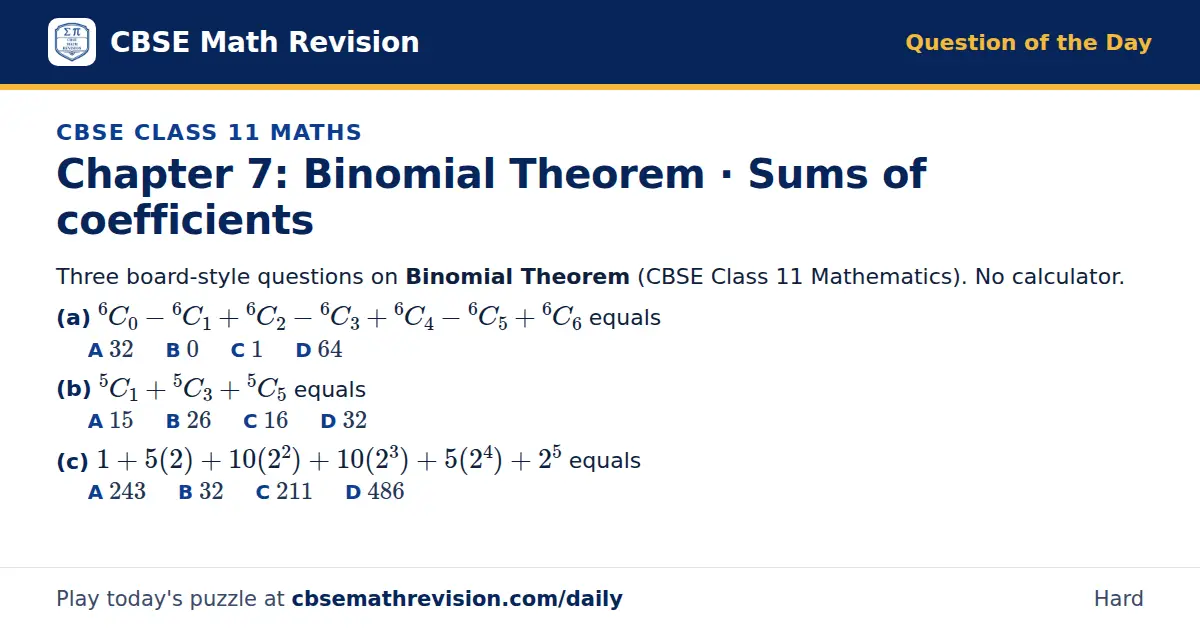
Chapter 7: Binomial Theorem · Sums of coefficients
Three board-style questions on Binomial Theorem (CBSE Class 11 Mathematics). No calculator.
- ⁶C_0 - ⁶C_1 + ⁶C_2 - ⁶C_3 + ⁶C_4 - ⁶C_5 + ⁶C_6 equals Options: A) 32; B) 0; C) 1; D) 64
- ⁵C_1 + ⁵C_3 + ⁵C_5 equals Options: A) 15; B) 26; C) 16; D) 32
- 1 + 5(2) + 10(2²) + 10(2³) + 5(2⁴) + 2⁵ equals Options: A) 243; B) 32; C) 211; D) 486
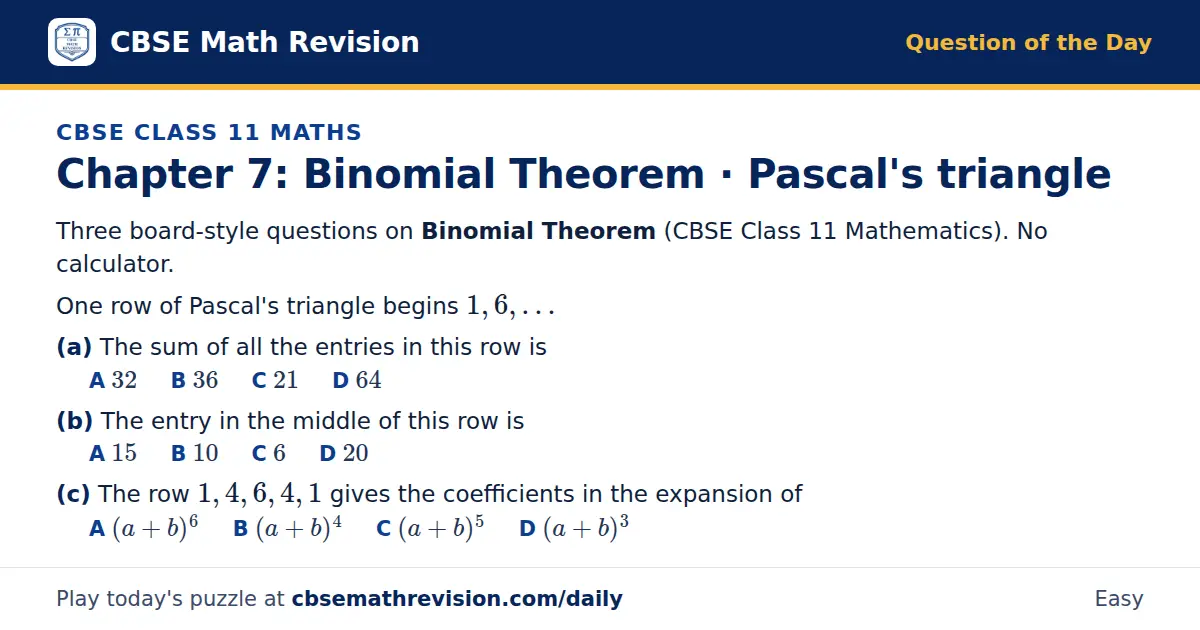
Chapter 7: Binomial Theorem · Pascal's triangle
Three board-style questions on Binomial Theorem (CBSE Class 11 Mathematics). No calculator. One row of Pascal's triangle begins 1, 6, …
- The sum of all the entries in this row is Options: A) 32; B) 36; C) 21; D) 64
- The entry in the middle of this row is Options: A) 15; B) 10; C) 6; D) 20
- The row 1, 4, 6, 4, 1 gives the coefficients in the expansion of Options: A) (a + b)⁶; B) (a + b)⁴; C) (a + b)⁵; D) (a + b)³
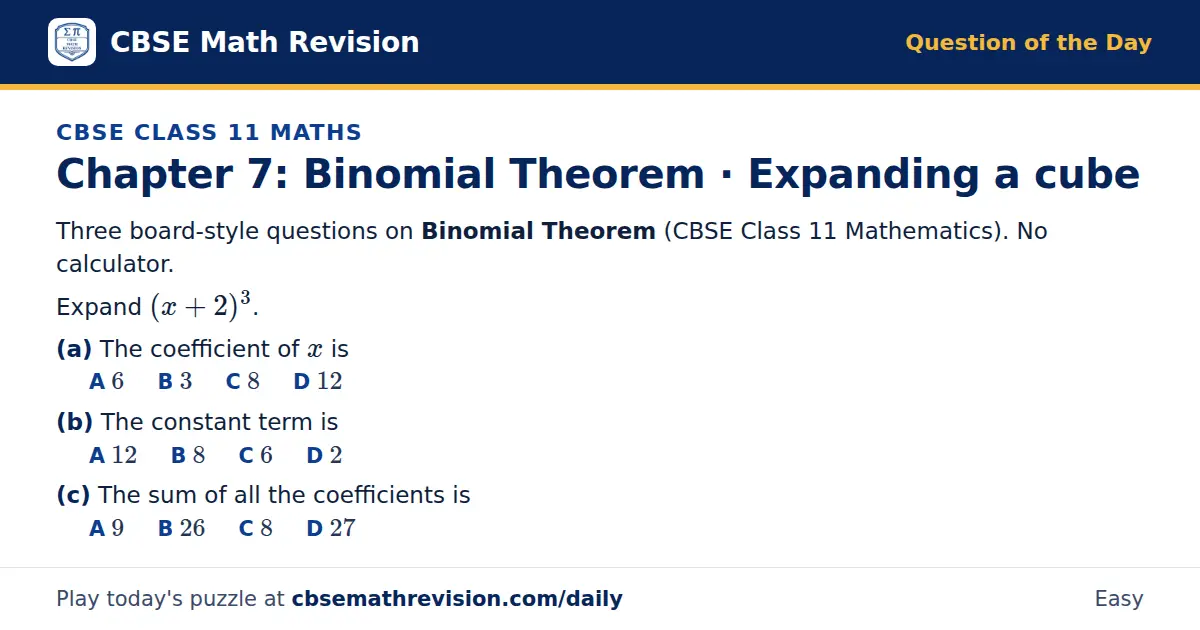
Chapter 7: Binomial Theorem · Expanding a cube
Three board-style questions on Binomial Theorem (CBSE Class 11 Mathematics). No calculator. Expand (x + 2)^3.
- The coefficient of x is Options: A) 6; B) 3; C) 8; D) 12
- The constant term is Options: A) 12; B) 8; C) 6; D) 2
- The sum of all the coefficients is Options: A) 9; B) 26; C) 8; D) 27
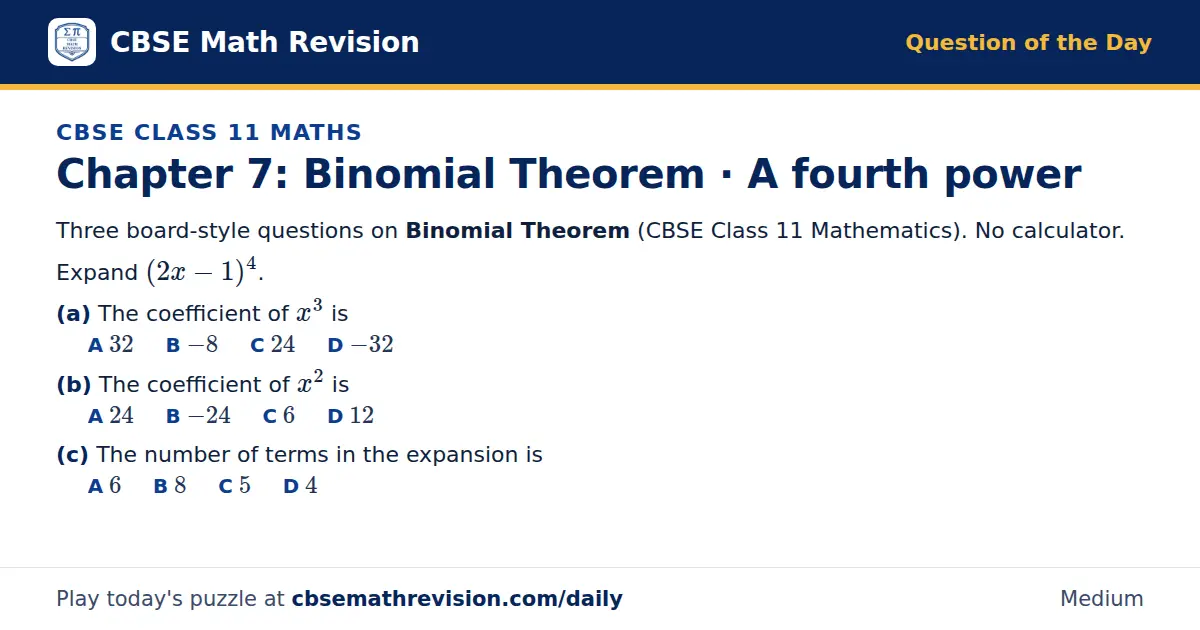
Chapter 7: Binomial Theorem · A fourth power
Three board-style questions on Binomial Theorem (CBSE Class 11 Mathematics). No calculator. Expand (2x - 1)^4.
- The coefficient of x³ is Options: A) 32; B) -8; C) 24; D) -32
- The coefficient of x² is Options: A) 24; B) -24; C) 6; D) 12
- The number of terms in the expansion is Options: A) 6; B) 8; C) 5; D) 4
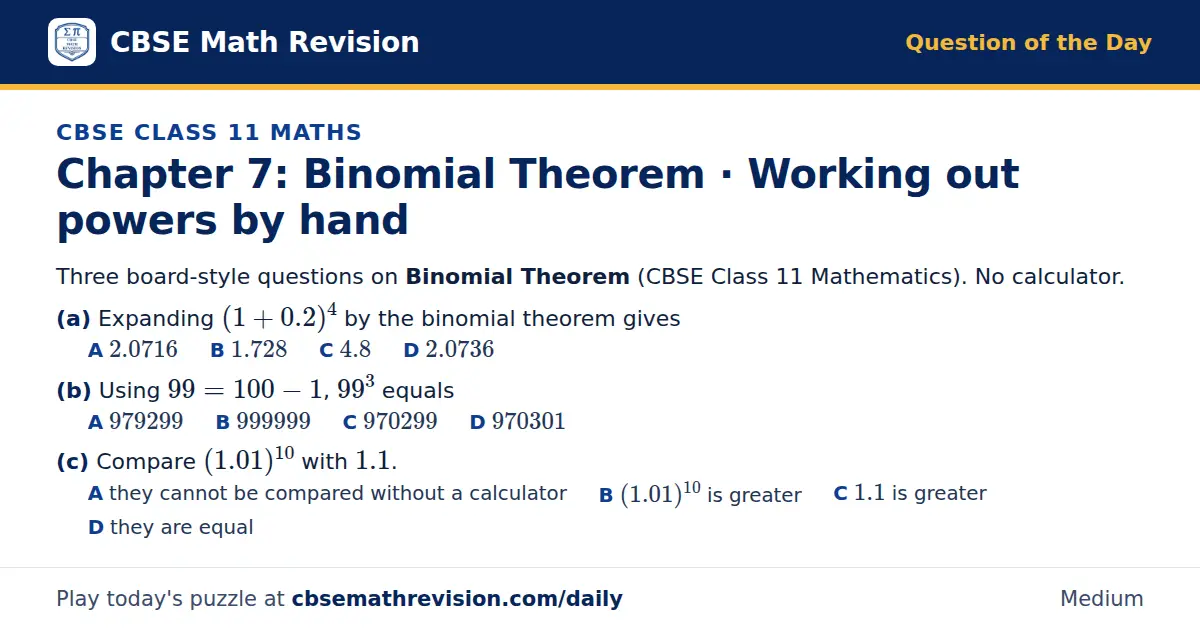
Chapter 7: Binomial Theorem · Working out powers by hand
Three board-style questions on Binomial Theorem (CBSE Class 11 Mathematics). No calculator.
- Expanding (1 + 0.2)⁴ by the binomial theorem gives Options: A) 2.0716; B) 1.728; C) 4.8; D) 2.0736
- Using 99 = 100 - 1, 99³ equals Options: A) 979299; B) 999999; C) 970299; D) 970301
- Compare (1.01)¹⁰ with 1.1. Options: A) they cannot be compared without a calculator; B) (1.01)¹⁰ is greater; C) 1.1 is greater; D) they are equal
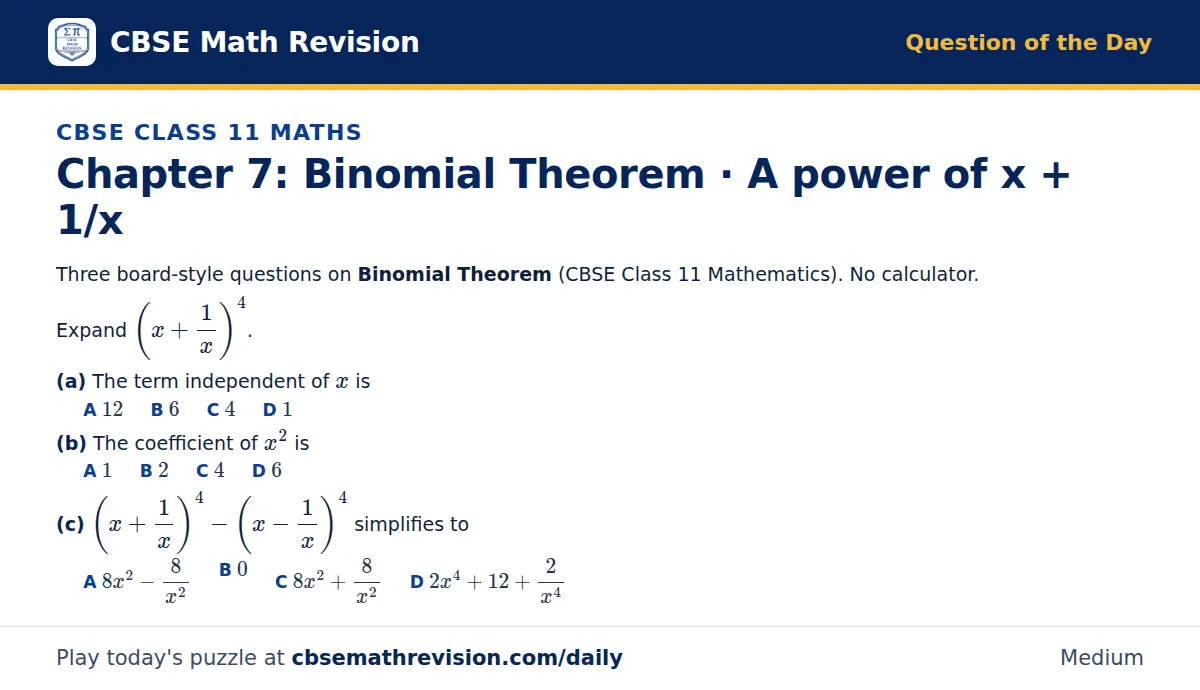
Chapter 7: Binomial Theorem · A power of x + 1/x
Three board-style questions on Binomial Theorem (CBSE Class 11 Mathematics). No calculator. Expand (x + 1x)^4.
- The term independent of x is Options: A) 12; B) 6; C) 4; D) 1
- The coefficient of x² is Options: A) 1; B) 2; C) 4; D) 6
- (x + 1x)⁴ - (x - 1x)⁴ simplifies to Options: A) 8x² - 8/(x²); B) 0; C) 8x² + 8/(x²); D) 2x⁴ + 12 + 2/(x⁴)
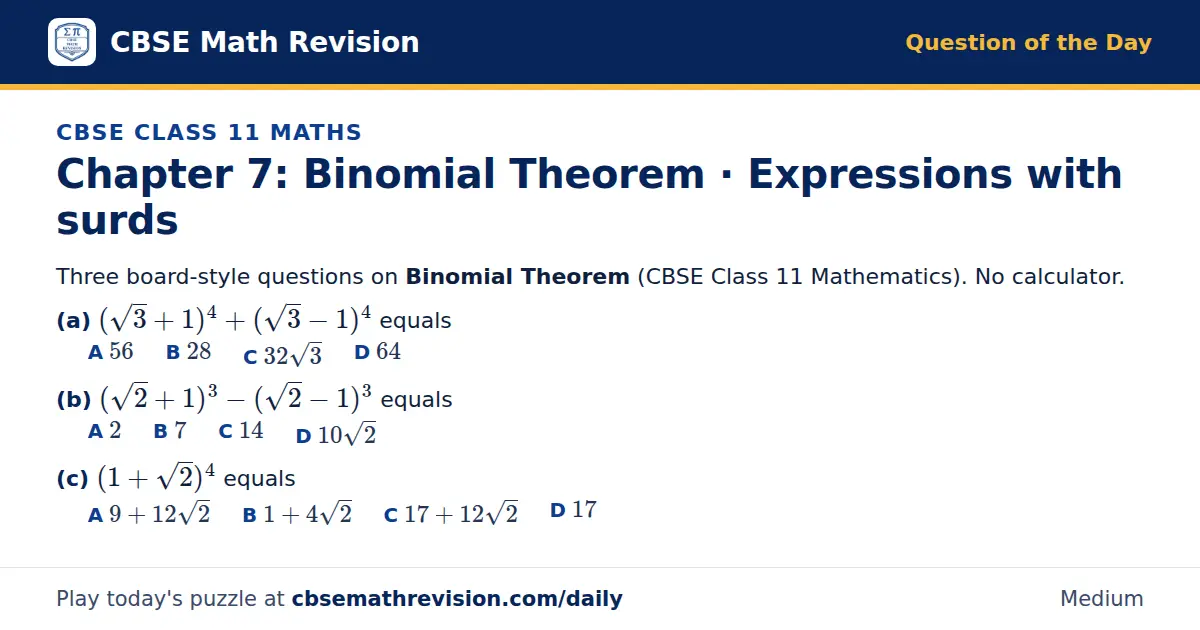
Chapter 7: Binomial Theorem · Expressions with surds
Three board-style questions on Binomial Theorem (CBSE Class 11 Mathematics). No calculator.
- (√3 + 1)⁴ + (√3 - 1)⁴ equals Options: A) 56; B) 28; C) 32 √3; D) 64
- (√2 + 1)³ - (√2 - 1)³ equals Options: A) 2; B) 7; C) 14; D) 10 √2
- (1 + √2)⁴ equals Options: A) 9 + 12√2; B) 1 + 4√2; C) 17 + 12√2; D) 17
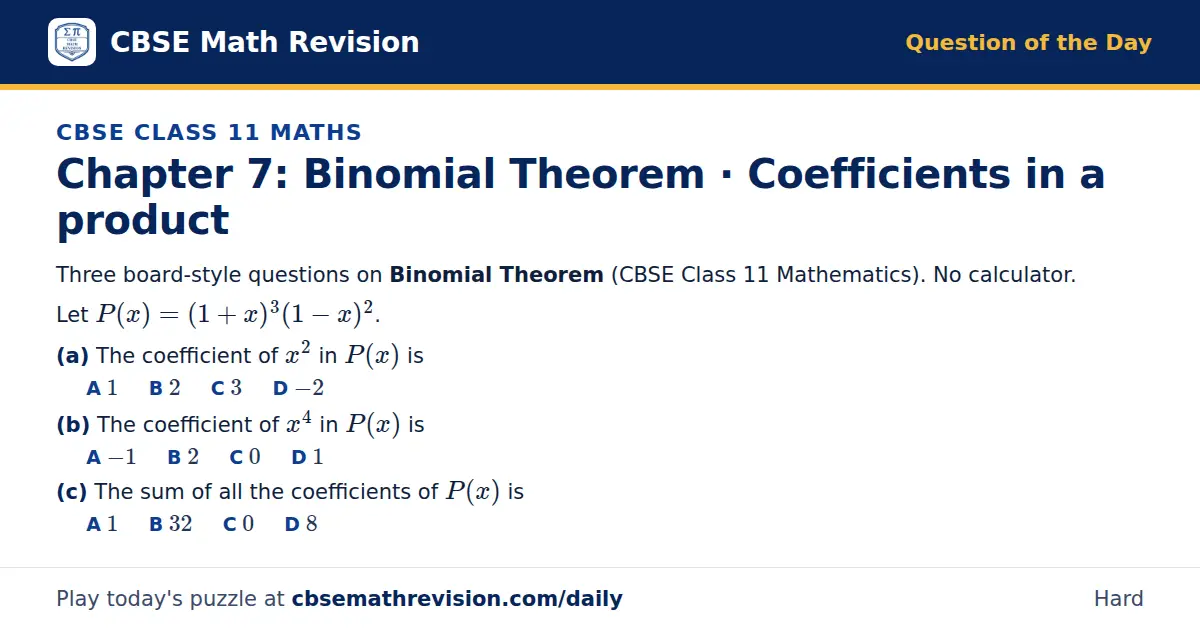
Chapter 7: Binomial Theorem · Coefficients in a product
Three board-style questions on Binomial Theorem (CBSE Class 11 Mathematics). No calculator. Let P(x) = (1 + x)³(1 - x)^2.
- The coefficient of x² in P(x) is Options: A) 1; B) 2; C) 3; D) -2
- The coefficient of x⁴ in P(x) is Options: A) -1; B) 2; C) 0; D) 1
- The sum of all the coefficients of P(x) is Options: A) 1; B) 32; C) 0; D) 8
Chapter 8: Sequences and Series
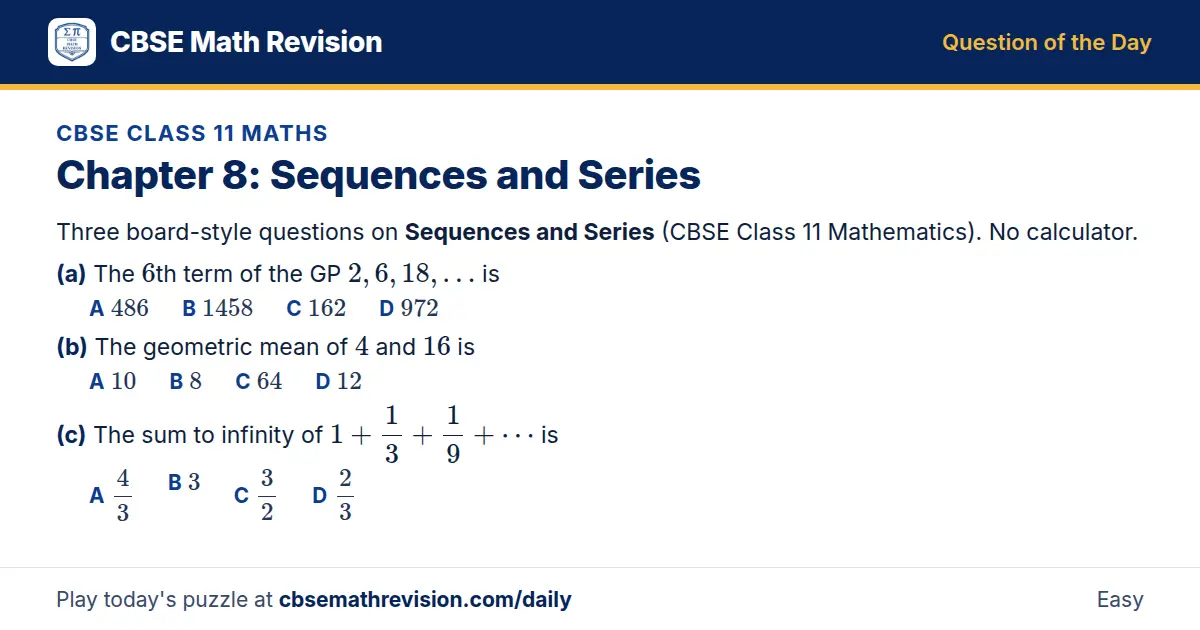
Chapter 8: Sequences and Series
Three board-style questions on Sequences and Series (CBSE Class 11 Mathematics). No calculator.
- The 6th term of the GP 2, 6, 18, … is Options: A) 486; B) 1458; C) 162; D) 972
- The geometric mean of 4 and 16 is Options: A) 10; B) 8; C) 64; D) 12
- The sum to infinity of 1 + 13 + 19 + … is Options: A) 43; B) 3; C) 32; D) 23
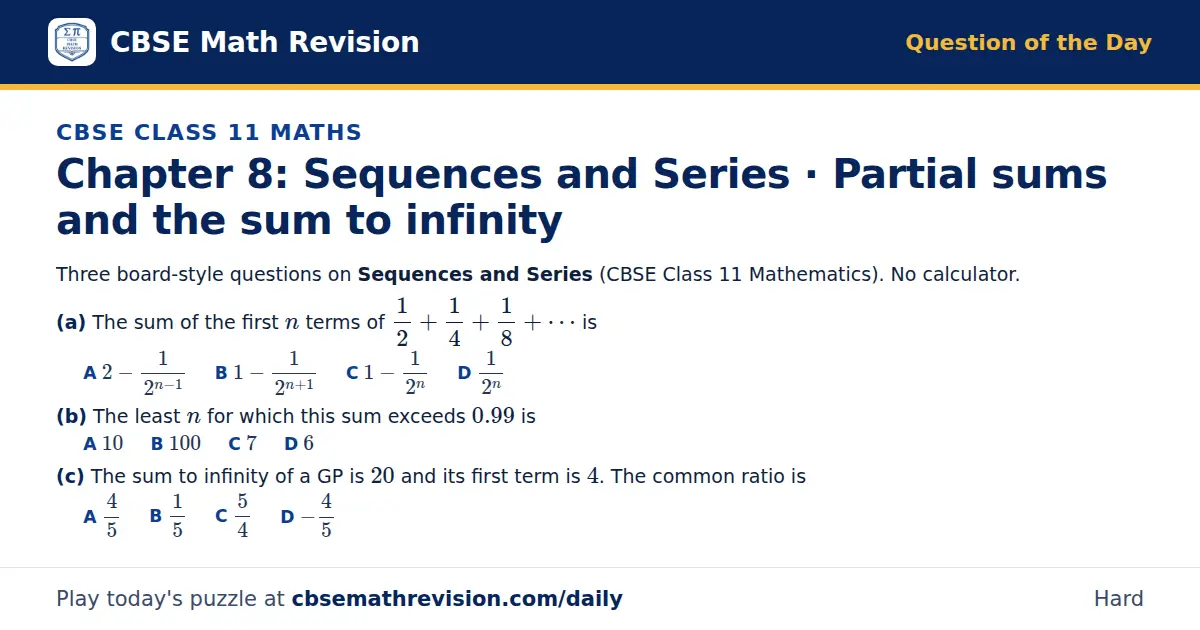
Chapter 8: Sequences and Series · Partial sums and the sum to infinity
Three board-style questions on Sequences and Series (CBSE Class 11 Mathematics). No calculator.
- The sum of the first n terms of 12 + 14 + 18 + … is Options: A) 2 - 1/(2^(n-1)); B) 1 - 1/(2^(n+1)); C) 1 - 1/(2^n); D) 1/(2^n)
- The least n for which this sum exceeds 0.99 is Options: A) 10; B) 100; C) 7; D) 6
- The sum to infinity of a GP is 20 and its first term is 4. The common ratio is Options: A) 4/5; B) 1/5; C) 5/4; D) - 4/5
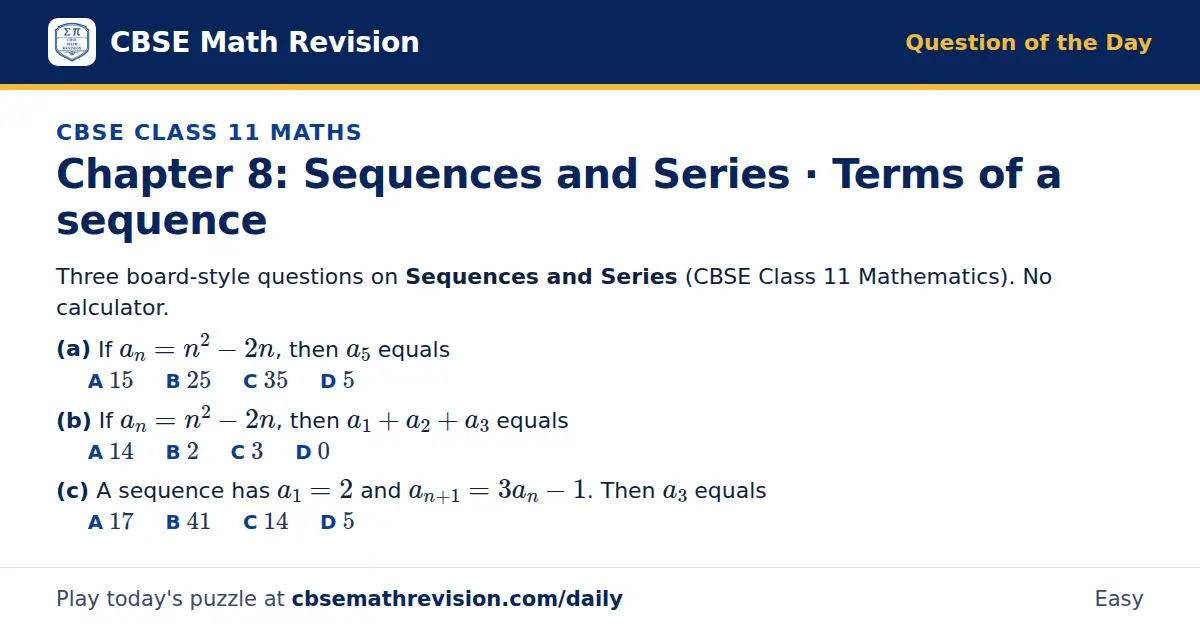
Chapter 8: Sequences and Series · Terms of a sequence
Three board-style questions on Sequences and Series (CBSE Class 11 Mathematics). No calculator.
- If a_n = n² - 2n, then a_5 equals Options: A) 15; B) 25; C) 35; D) 5
- If a_n = n² - 2n, then a_1 + a_2 + a_3 equals Options: A) 14; B) 2; C) 3; D) 0
- A sequence has a_1 = 2 and a_n+1 = 3a_n - 1. Then a_3 equals Options: A) 17; B) 41; C) 14; D) 5
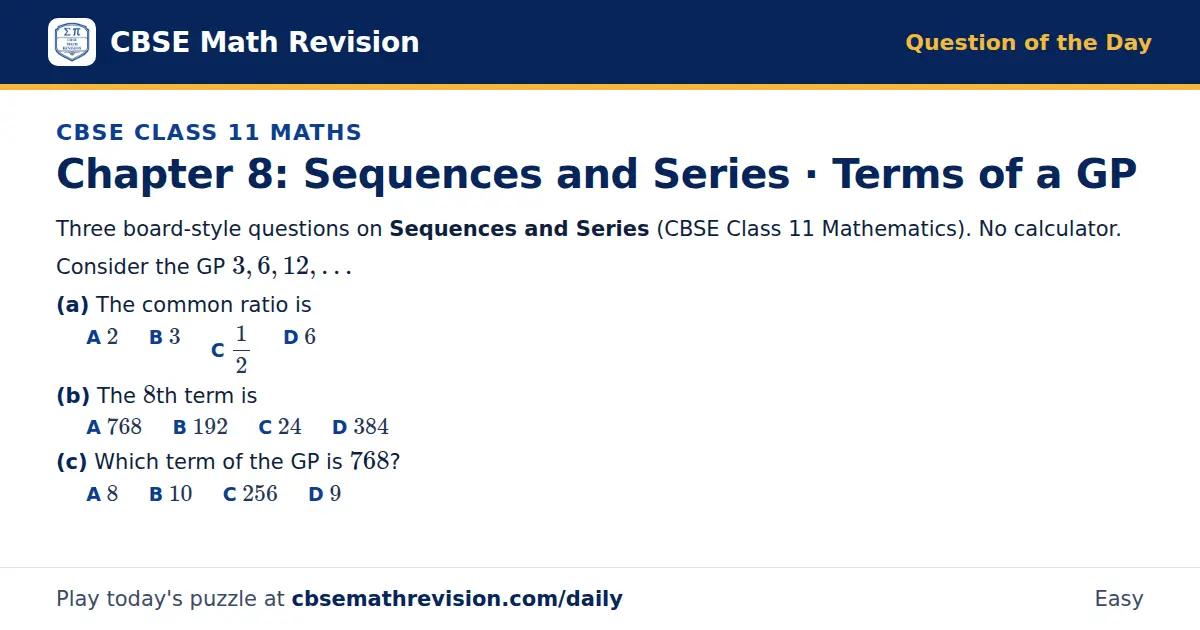
Chapter 8: Sequences and Series · Terms of a GP
Three board-style questions on Sequences and Series (CBSE Class 11 Mathematics). No calculator. Consider the GP 3, 6, 12, …
- The common ratio is Options: A) 2; B) 3; C) 1/2; D) 6
- The 8th term is Options: A) 768; B) 192; C) 24; D) 384
- Which term of the GP is 768? Options: A) 8; B) 10; C) 256; D) 9
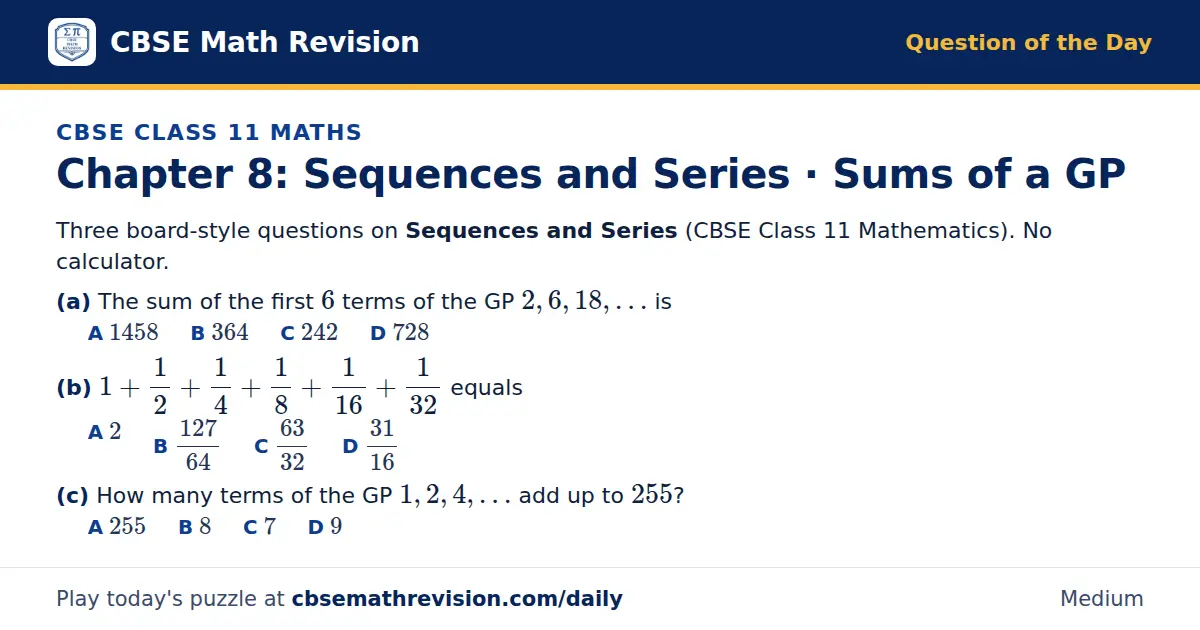
Chapter 8: Sequences and Series · Sums of a GP
Three board-style questions on Sequences and Series (CBSE Class 11 Mathematics). No calculator.
- The sum of the first 6 terms of the GP 2, 6, 18, … is Options: A) 1458; B) 364; C) 242; D) 728
- 1 + 12 + 14 + 18 + 116 + 132 equals Options: A) 2; B) 127/64; C) 63/32; D) 31/16
- How many terms of the GP 1, 2, 4, … add up to 255? Options: A) 255; B) 8; C) 7; D) 9
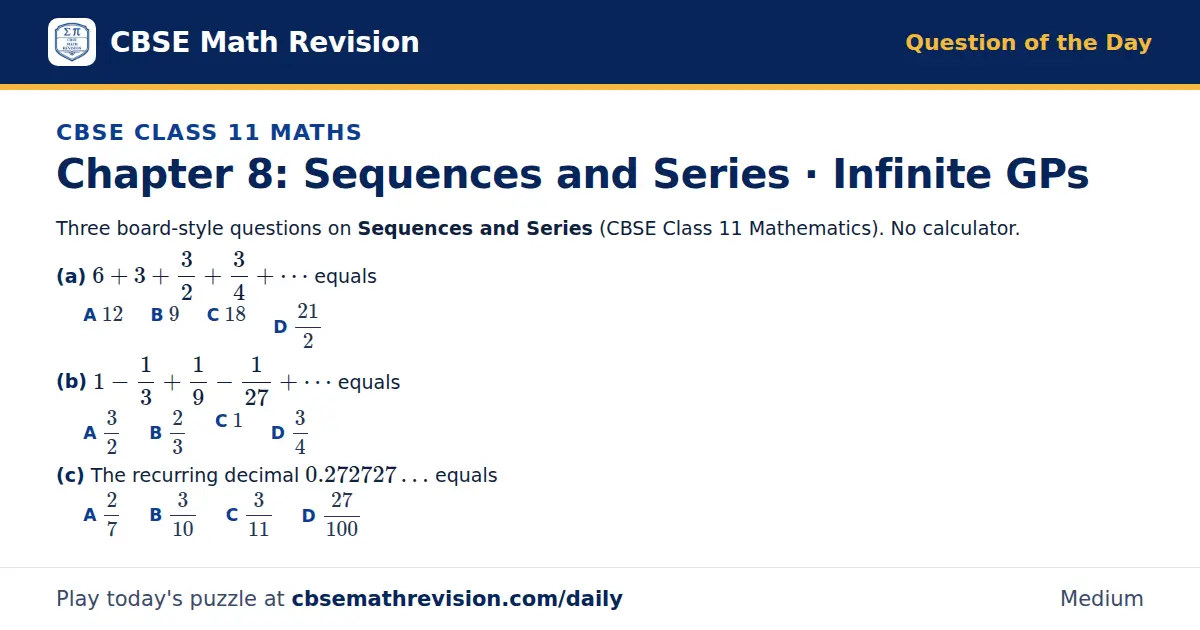
Chapter 8: Sequences and Series · Infinite GPs
Three board-style questions on Sequences and Series (CBSE Class 11 Mathematics). No calculator.
- 6 + 3 + 32 + 34 + … equals Options: A) 12; B) 9; C) 18; D) 21/2
- 1 - 13 + 19 - 127 + … equals Options: A) 3/2; B) 2/3; C) 1; D) 3/4
- The recurring decimal 0.272727… equals Options: A) 2/7; B) 3/10; C) 3/11; D) 27/100
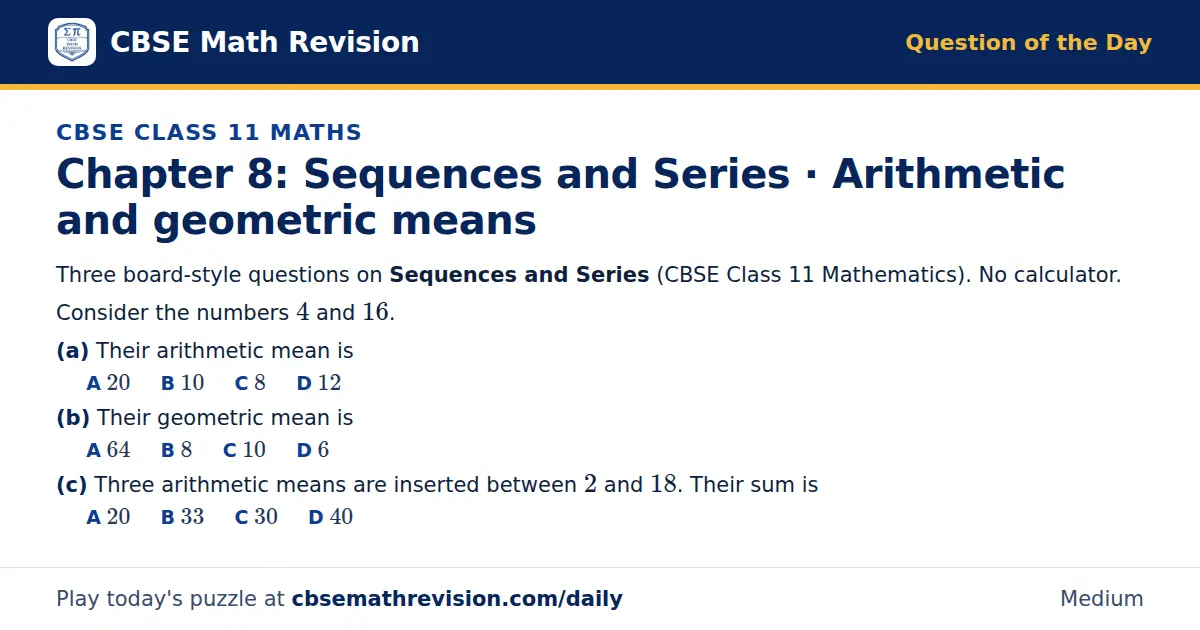
Chapter 8: Sequences and Series · Arithmetic and geometric means
Three board-style questions on Sequences and Series (CBSE Class 11 Mathematics). No calculator. Consider the numbers 4 and 16.
- Their arithmetic mean is Options: A) 20; B) 10; C) 8; D) 12
- Their geometric mean is Options: A) 64; B) 8; C) 10; D) 6
- Three arithmetic means are inserted between 2 and 18. Their sum is Options: A) 20; B) 33; C) 30; D) 40
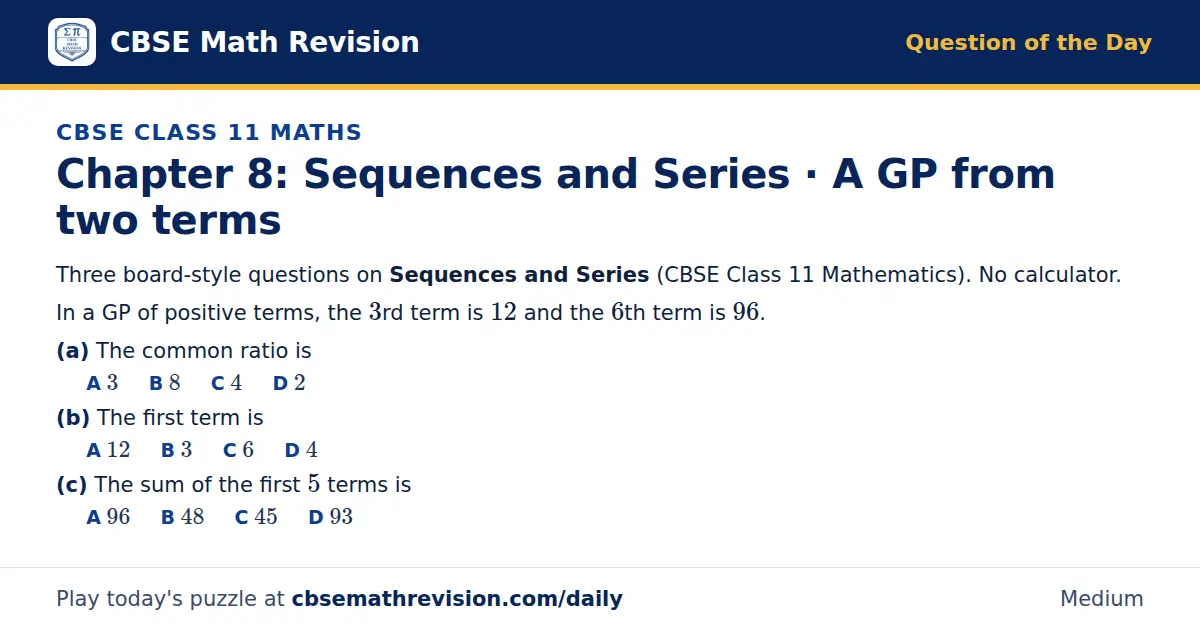
Chapter 8: Sequences and Series · A GP from two terms
Three board-style questions on Sequences and Series (CBSE Class 11 Mathematics). No calculator. In a GP of positive terms, the 3rd term is 12 and the 6th term is 96.
- The common ratio is Options: A) 3; B) 8; C) 4; D) 2
- The first term is Options: A) 12; B) 3; C) 6; D) 4
- The sum of the first 5 terms is Options: A) 96; B) 48; C) 45; D) 93
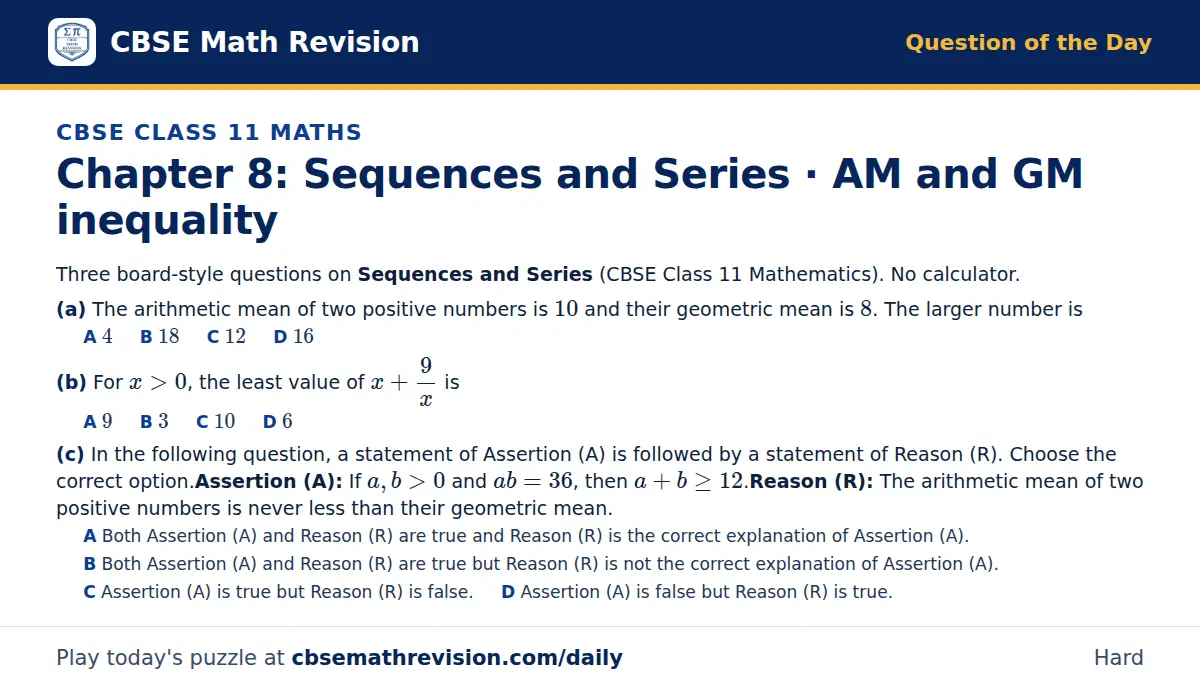
Chapter 8: Sequences and Series · AM and GM inequality
Three board-style questions on Sequences and Series (CBSE Class 11 Mathematics). No calculator.
- The arithmetic mean of two positive numbers is 10 and their geometric mean is 8. The larger number is Options: A) 4; B) 18; C) 12; D) 16
- For x > 0, the least value of x + 9x is Options: A) 9; B) 3; C) 10; D) 6
- In the following question, a statement of Assertion (A) is followed by a statement of Reason (R). Choose the correct option. Assertion (A): If a, b > 0 and ab = 36, then a + b ≥ 12. Reason (R): The arithmetic mean of two positive numbers is never less than their geometric mean. Options: A) Both Assertion (A) and Reason (R) are true and Reason (R) is the correct explanation of Assertion (A).; B) Both Assertion (A) and Reason (R) are true but Reason (R) is not the correct explanation of Assertion (A).; C) Assertion (A) is true but Reason (R) is false.; D) Assertion (A) is false but Reason (R) is true.
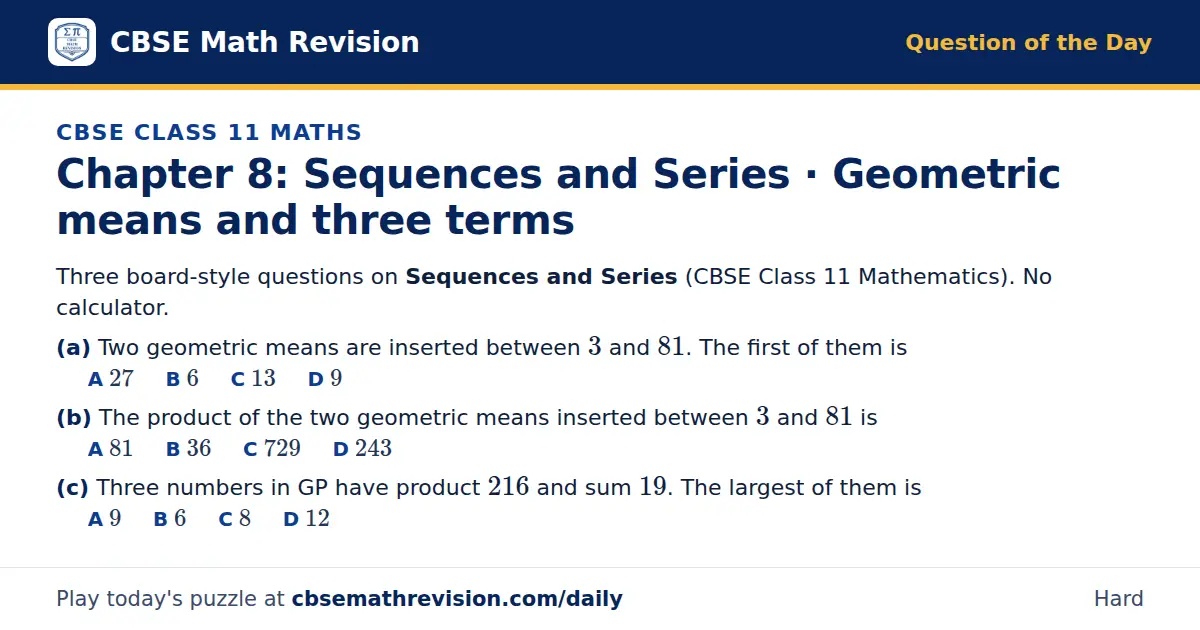
Chapter 8: Sequences and Series · Geometric means and three terms
Three board-style questions on Sequences and Series (CBSE Class 11 Mathematics). No calculator.
- Two geometric means are inserted between 3 and 81. The first of them is Options: A) 27; B) 6; C) 13; D) 9
- The product of the two geometric means inserted between 3 and 81 is Options: A) 81; B) 36; C) 729; D) 243
- Three numbers in GP have product 216 and sum 19. The largest of them is Options: A) 9; B) 6; C) 8; D) 12
More Question of the Day puzzles
Other chapters: Chapters 1–4 · Chapters 5–8 · Chapters 9–11 · Chapters 12–14. See all CBSE Maths daily and weekly questions.