CBSE Class 11 Maths Question of the Day: chapters 12–14
30 CBSE Class 11 Mathematics puzzles from the Question of the Day rotation, chapters 12–14. Each puzzle is three board-style questions on one chapter, shown as an image with the question text written out below it; the answers, hints and step-marked solutions are on the daily puzzle page.
Chapter 12: Limits and Derivatives
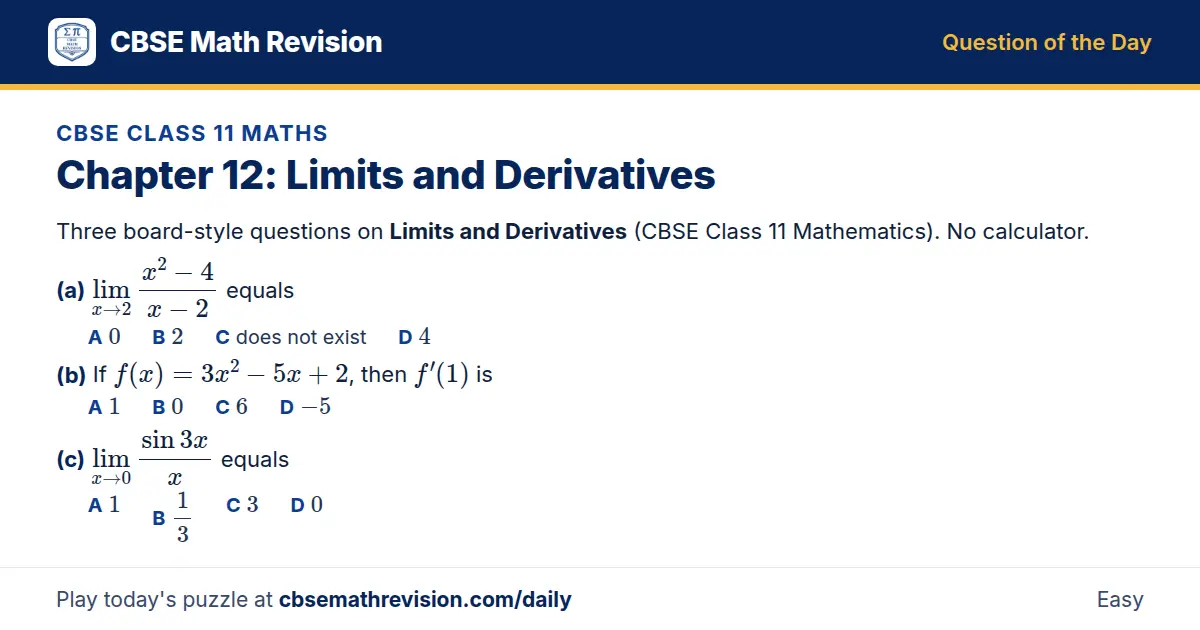
Chapter 12: Limits and Derivatives
Three board-style questions on Limits and Derivatives (CBSE Class 11 Mathematics). No calculator.
- lim_x → 2 (x² - 4)/(x - 2) equals Options: A) 0; B) 2; C) does not exist; D) 4
- If f(x) = 3x² - 5x + 2, then f'(1) is Options: A) 1; B) 0; C) 6; D) -5
- lim_x → 0 (sin 3x)/x equals Options: A) 1; B) 13; C) 3; D) 0
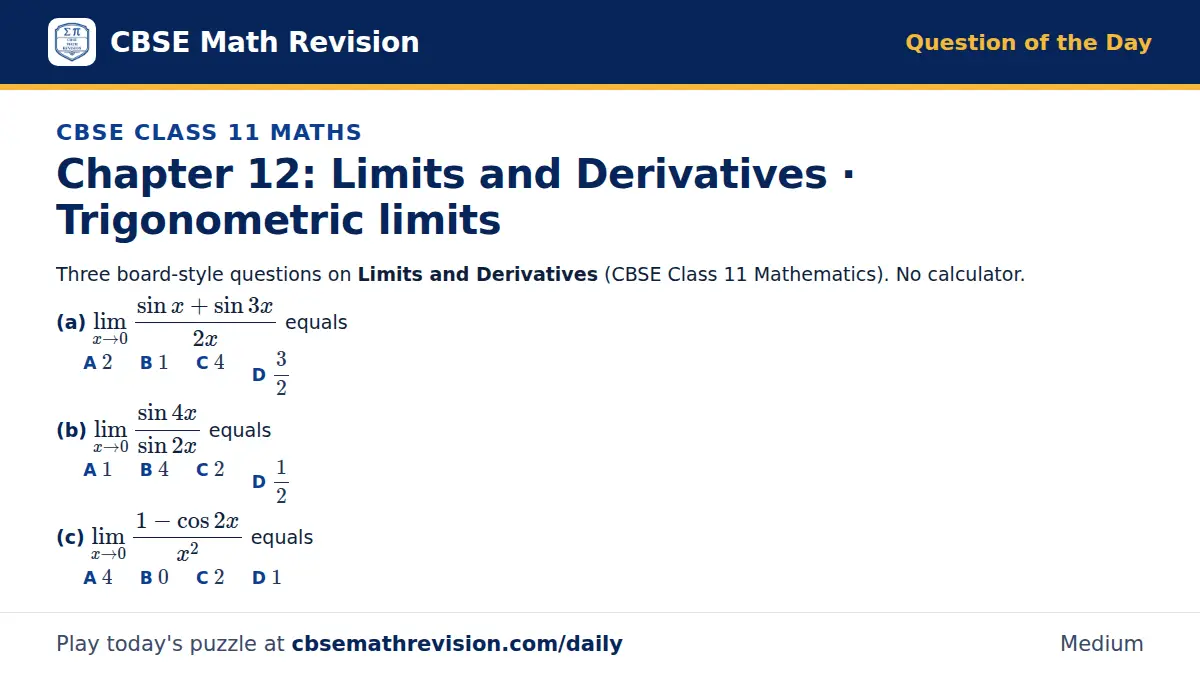
Chapter 12: Limits and Derivatives · Trigonometric limits
Three board-style questions on Limits and Derivatives (CBSE Class 11 Mathematics). No calculator.
- lim_x → 0 (sin x + sin 3x)/2x equals Options: A) 2; B) 1; C) 4; D) 3/2
- lim_x → 0 (sin 4x)/(sin 2x) equals Options: A) 1; B) 4; C) 2; D) 1/2
- lim_x → 0 (1 - cos 2x)/(x²) equals Options: A) 4; B) 0; C) 2; D) 1
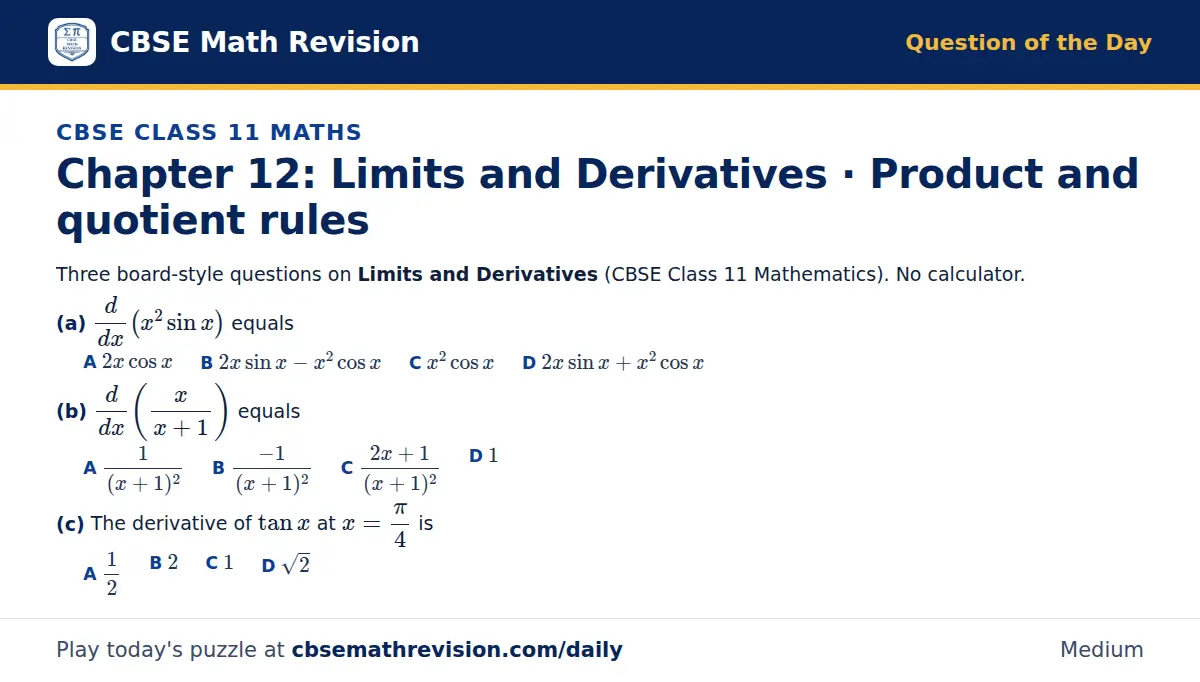
Chapter 12: Limits and Derivatives · Product and quotient rules
Three board-style questions on Limits and Derivatives (CBSE Class 11 Mathematics). No calculator.
- d/dx(x² sin x) equals Options: A) 2xcos x; B) 2xsin x - x²cos x; C) x²cos x; D) 2xsin x + x²cos x
- d/dx(x/(x + 1)) equals Options: A) 1/((x + 1)²); B) (-1)/((x + 1)²); C) (2x + 1)/((x + 1)²); D) 1
- The derivative of tan x at x = (π)/4 is Options: A) 1/2; B) 2; C) 1; D) √2
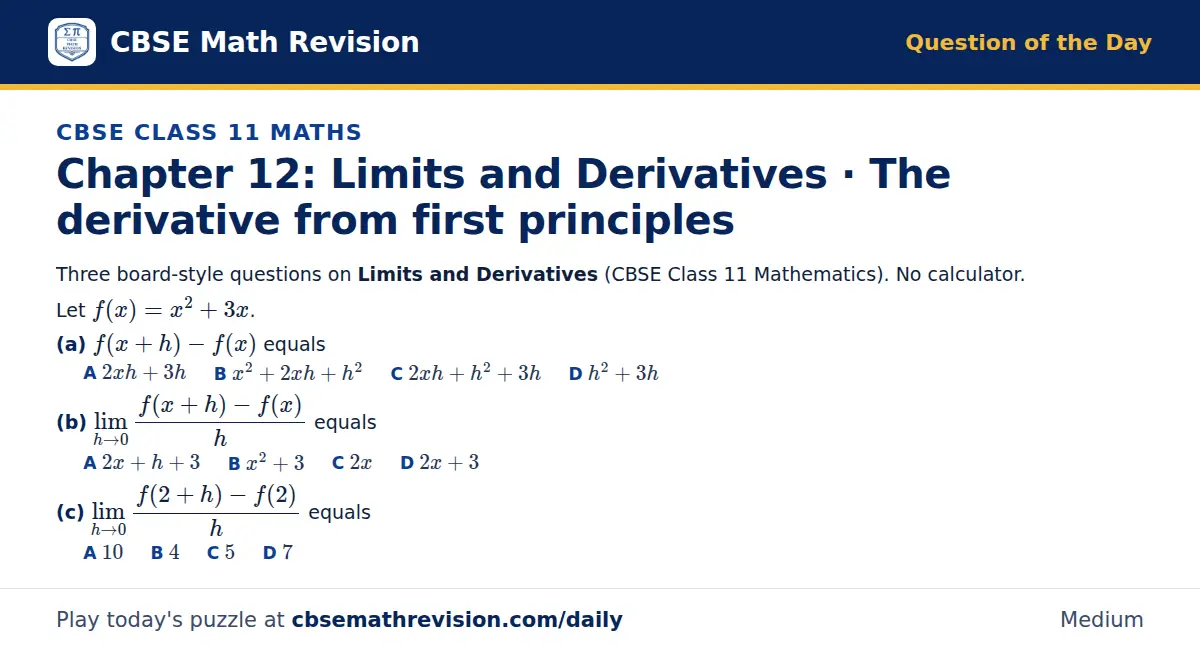
Chapter 12: Limits and Derivatives · The derivative from first principles
Three board-style questions on Limits and Derivatives (CBSE Class 11 Mathematics). No calculator. Let f(x) = x² + 3x.
- f(x + h) - f(x) equals Options: A) 2xh + 3h; B) x² + 2xh + h²; C) 2xh + h² + 3h; D) h² + 3h
- lim_h → 0 (f(x + h) - f(x))/h equals Options: A) 2x + h + 3; B) x² + 3; C) 2x; D) 2x + 3
- lim_h → 0 (f(2 + h) - f(2))/h equals Options: A) 10; B) 4; C) 5; D) 7
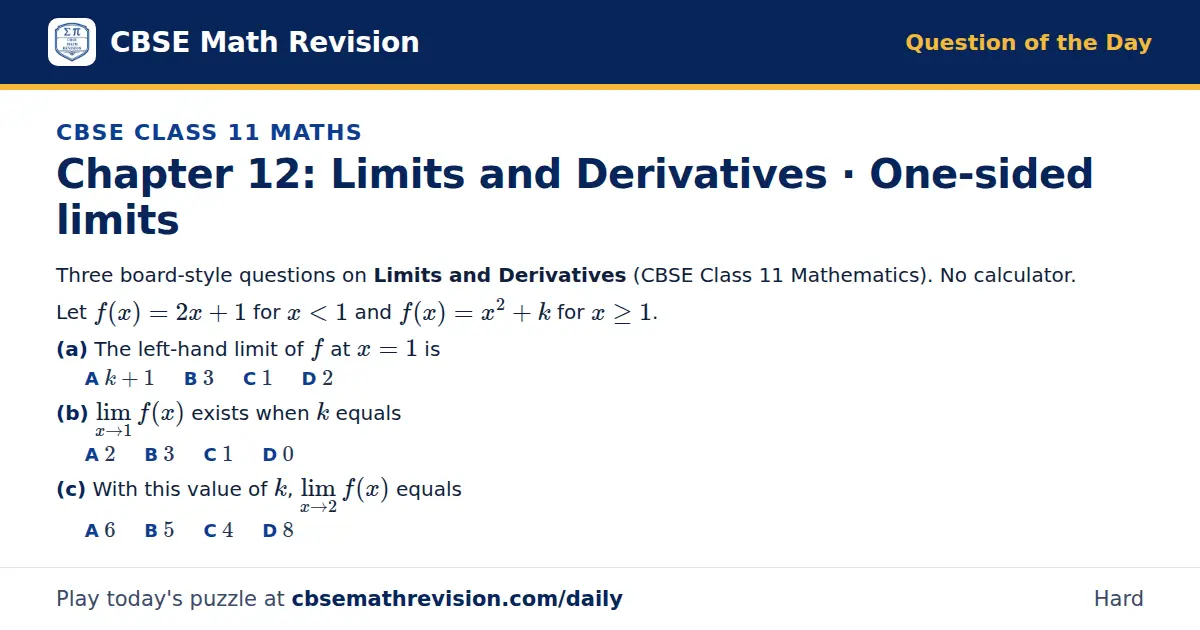
Chapter 12: Limits and Derivatives · One-sided limits
Three board-style questions on Limits and Derivatives (CBSE Class 11 Mathematics). No calculator. Let f(x) = 2x + 1 for x < 1 and f(x) = x² + k for x ≥ 1.
- The left-hand limit of f at x = 1 is Options: A) k + 1; B) 3; C) 1; D) 2
- lim_x → 1 f(x) exists when k equals Options: A) 2; B) 3; C) 1; D) 0
- With this value of k, lim_x → 2 f(x) equals Options: A) 6; B) 5; C) 4; D) 8
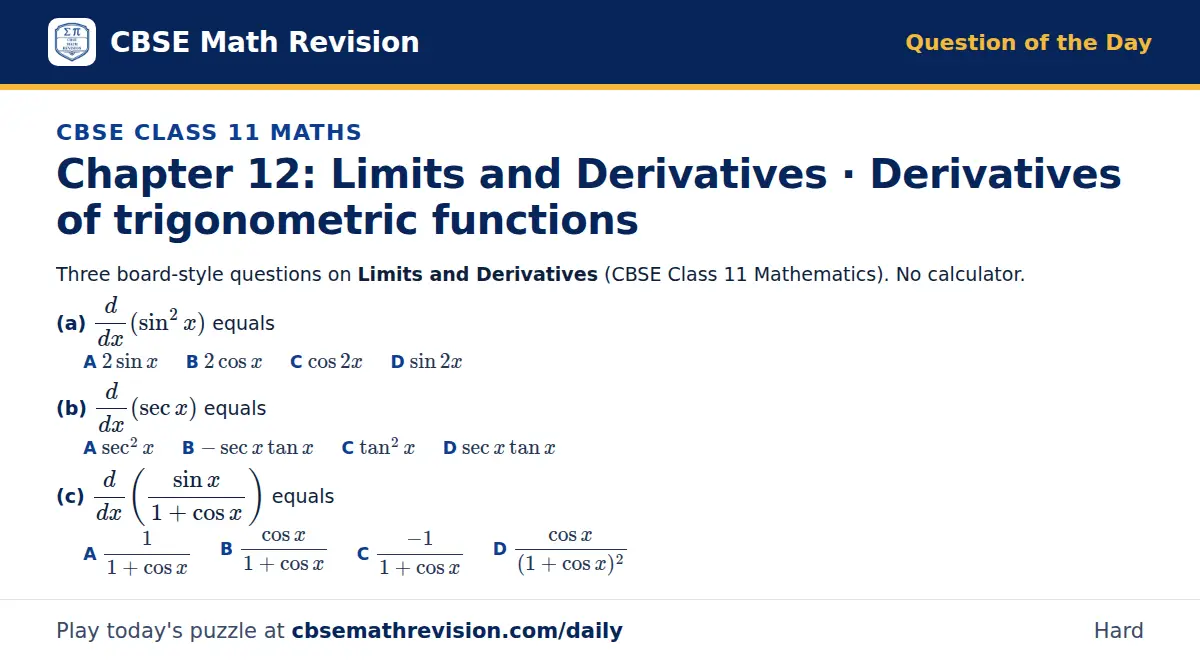
Chapter 12: Limits and Derivatives · Derivatives of trigonometric functions
Three board-style questions on Limits and Derivatives (CBSE Class 11 Mathematics). No calculator.
- d/dx(sin² x) equals Options: A) 2sin x; B) 2cos x; C) cos 2x; D) sin 2x
- d/dx(sec x) equals Options: A) sec² x; B) -sec xtan x; C) tan² x; D) sec xtan x
- d/dx((sin x)/(1 + cos x)) equals Options: A) 1/(1 + cos x); B) (cos x)/(1 + cos x); C) (-1)/(1 + cos x); D) (cos x)/((1 + cos x)²)
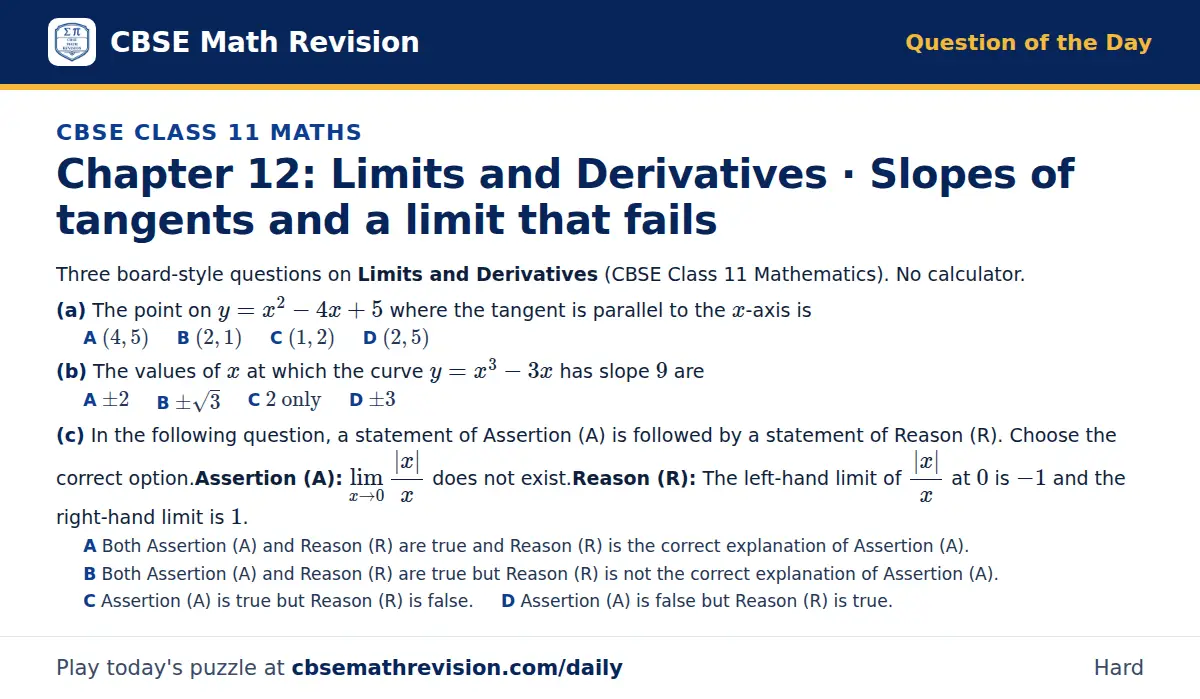
Chapter 12: Limits and Derivatives · Slopes of tangents and a limit that fails
Three board-style questions on Limits and Derivatives (CBSE Class 11 Mathematics). No calculator.
- The point on y = x² - 4x + 5 where the tangent is parallel to the x-axis is Options: A) (4, 5); B) (2, 1); C) (1, 2); D) (2, 5)
- The values of x at which the curve y = x³ - 3x has slope 9 are Options: A) ± 2; B) ± √3; C) 2 only; D) ± 3
- In the following question, a statement of Assertion (A) is followed by a statement of Reason (R). Choose the correct option. Assertion (A): lim_x → 0 (|x|)/x does not exist. Reason (R): The left-hand limit of (|x|)/x at 0 is -1 and the right-hand limit is 1. Options: A) Both Assertion (A) and Reason (R) are true and Reason (R) is the correct explanation of Assertion (A).; B) Both Assertion (A) and Reason (R) are true but Reason (R) is not the correct explanation of Assertion (A).; C) Assertion (A) is true but Reason (R) is false.; D) Assertion (A) is false but Reason (R) is true.
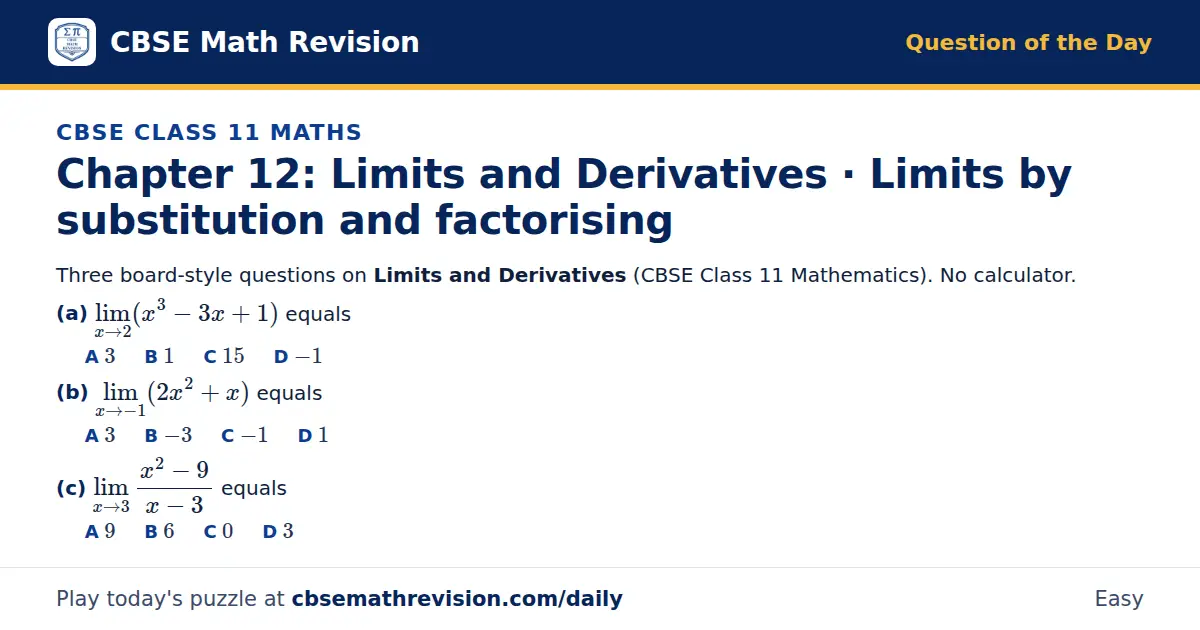
Chapter 12: Limits and Derivatives · Limits by substitution and factorising
Three board-style questions on Limits and Derivatives (CBSE Class 11 Mathematics). No calculator.
- lim_x → 2 (x³ - 3x + 1) equals Options: A) 3; B) 1; C) 15; D) -1
- lim_x → -1 (2x² + x) equals Options: A) 3; B) -3; C) -1; D) 1
- lim_x → 3 (x² - 9)/(x - 3) equals Options: A) 9; B) 6; C) 0; D) 3
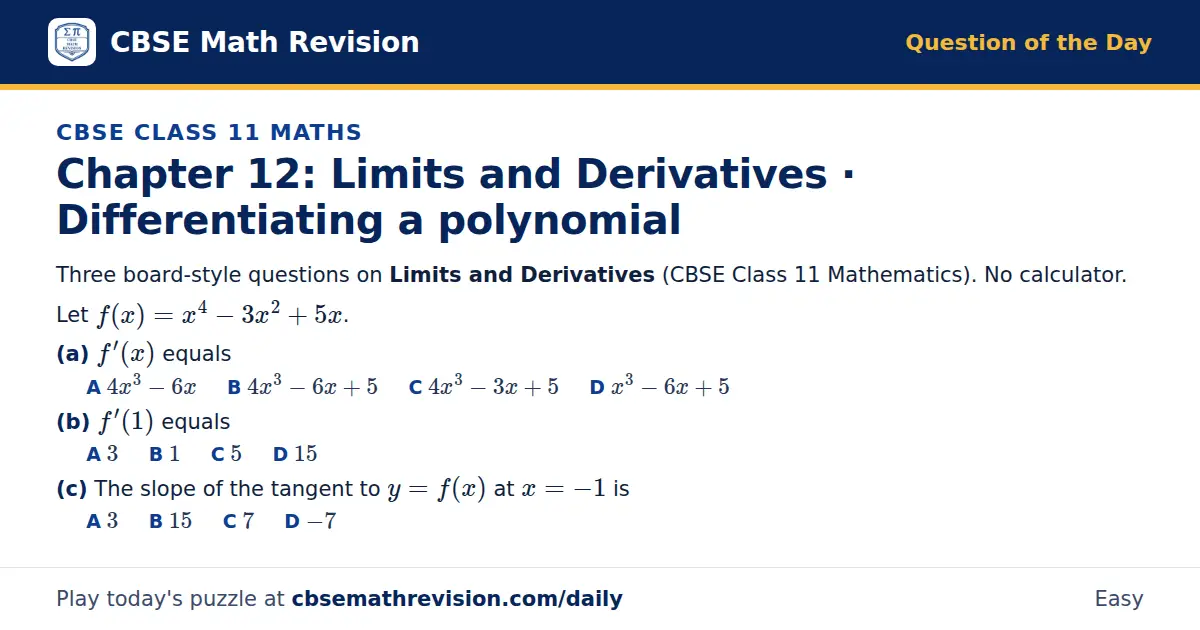
Chapter 12: Limits and Derivatives · Differentiating a polynomial
Three board-style questions on Limits and Derivatives (CBSE Class 11 Mathematics). No calculator. Let f(x) = x⁴ - 3x² + 5x.
- f'(x) equals Options: A) 4x³ - 6x; B) 4x³ - 6x + 5; C) 4x³ - 3x + 5; D) x³ - 6x + 5
- f'(1) equals Options: A) 3; B) 1; C) 5; D) 15
- The slope of the tangent to y = f(x) at x = -1 is Options: A) 3; B) 15; C) 7; D) -7
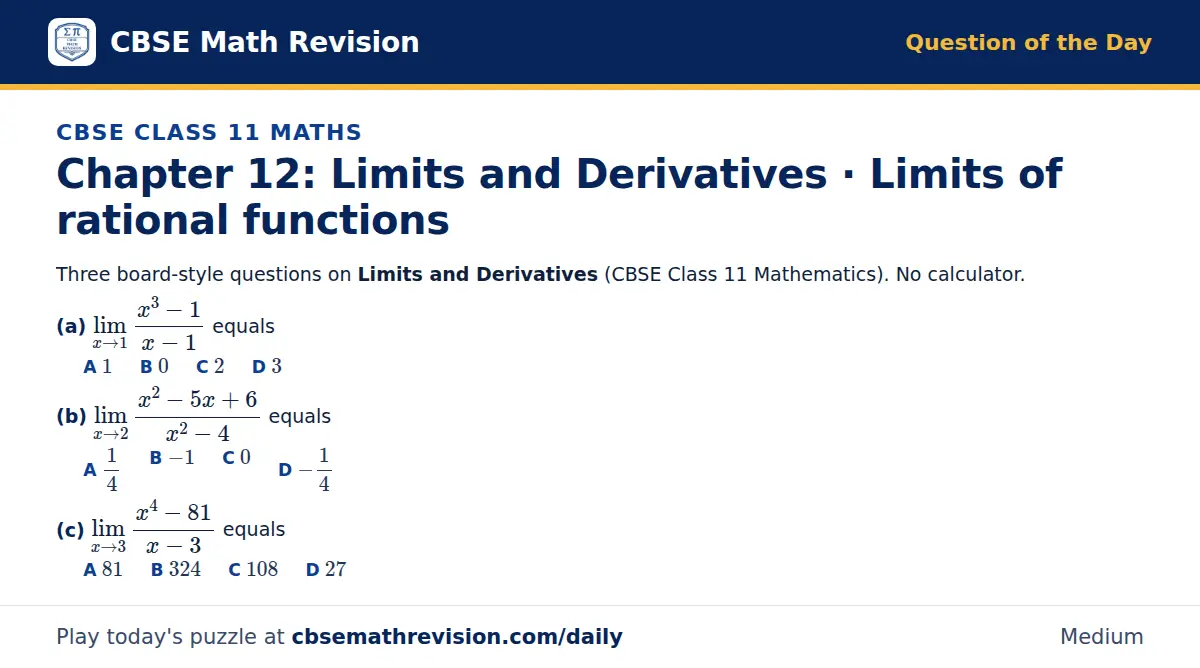
Chapter 12: Limits and Derivatives · Limits of rational functions
Three board-style questions on Limits and Derivatives (CBSE Class 11 Mathematics). No calculator.
- lim_x → 1 (x³ - 1)/(x - 1) equals Options: A) 1; B) 0; C) 2; D) 3
- lim_x → 2 (x² - 5x + 6)/(x² - 4) equals Options: A) 1/4; B) -1; C) 0; D) - 1/4
- lim_x → 3 (x⁴ - 81)/(x - 3) equals Options: A) 81; B) 324; C) 108; D) 27
Chapter 13: Statistics
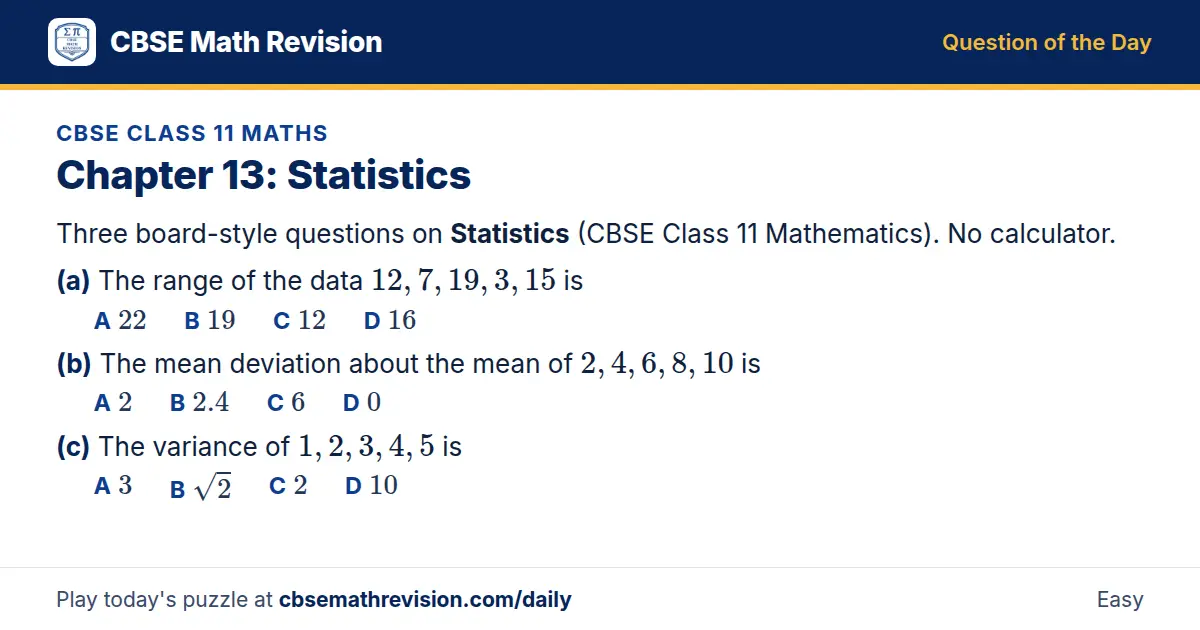
Chapter 13: Statistics
Three board-style questions on Statistics (CBSE Class 11 Mathematics). No calculator.
- The range of the data 12, 7, 19, 3, 15 is Options: A) 22; B) 19; C) 12; D) 16
- The mean deviation about the mean of 2, 4, 6, 8, 10 is Options: A) 2; B) 2.4; C) 6; D) 0
- The variance of 1, 2, 3, 4, 5 is Options: A) 3; B) √2; C) 2; D) 10
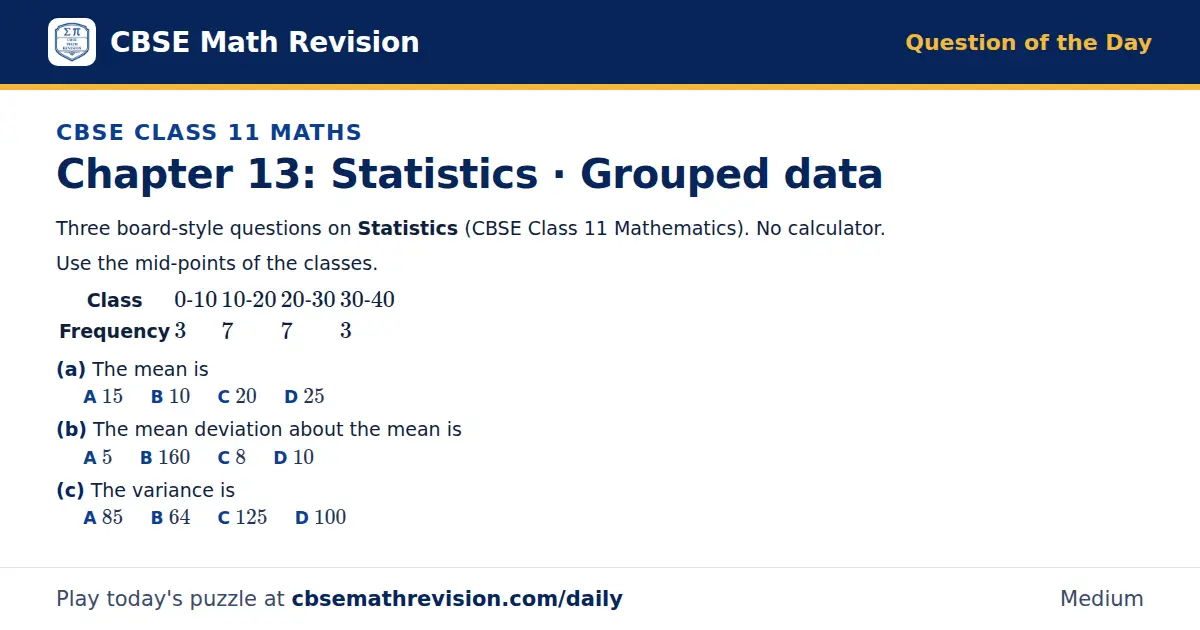
Chapter 13: Statistics · Grouped data
Three board-style questions on Statistics (CBSE Class 11 Mathematics). No calculator. Use the mid-points of the classes. Class0-1010-2020-3030-40Frequency3773
- The mean is Options: A) 15; B) 10; C) 20; D) 25
- The mean deviation about the mean is Options: A) 5; B) 160; C) 8; D) 10
- The variance is Options: A) 85; B) 64; C) 125; D) 100
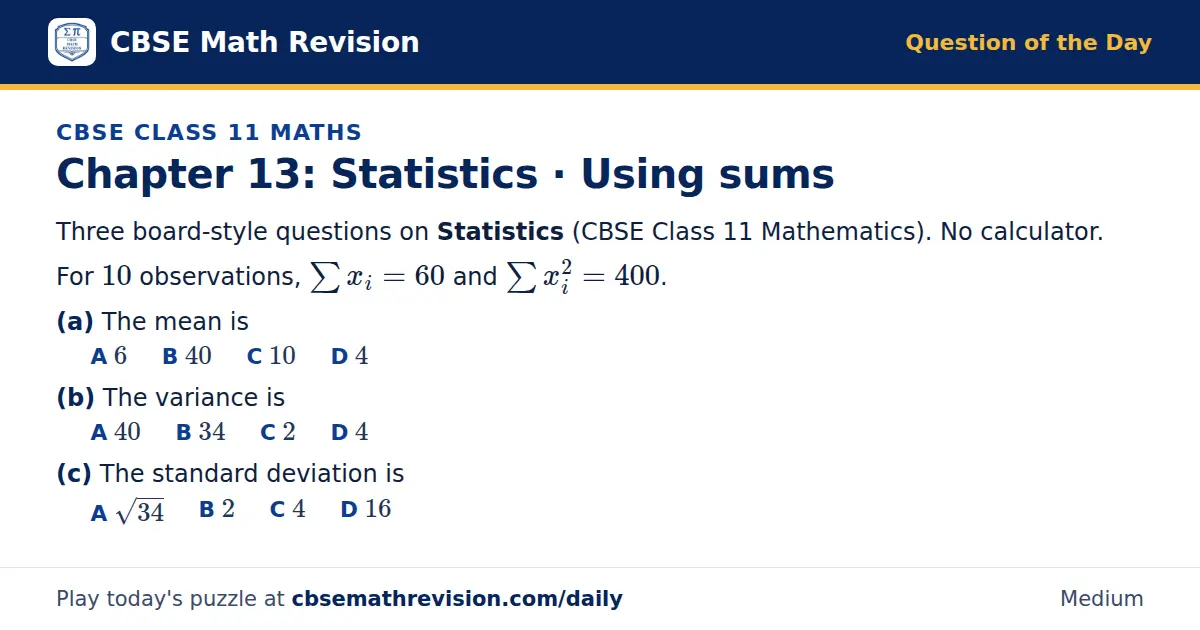
Chapter 13: Statistics · Using sums
Three board-style questions on Statistics (CBSE Class 11 Mathematics). No calculator. For 10 observations, Σ x_i = 60 and Σ x_i² = 400.
- The mean is Options: A) 6; B) 40; C) 10; D) 4
- The variance is Options: A) 40; B) 34; C) 2; D) 4
- The standard deviation is Options: A) √34; B) 2; C) 4; D) 16
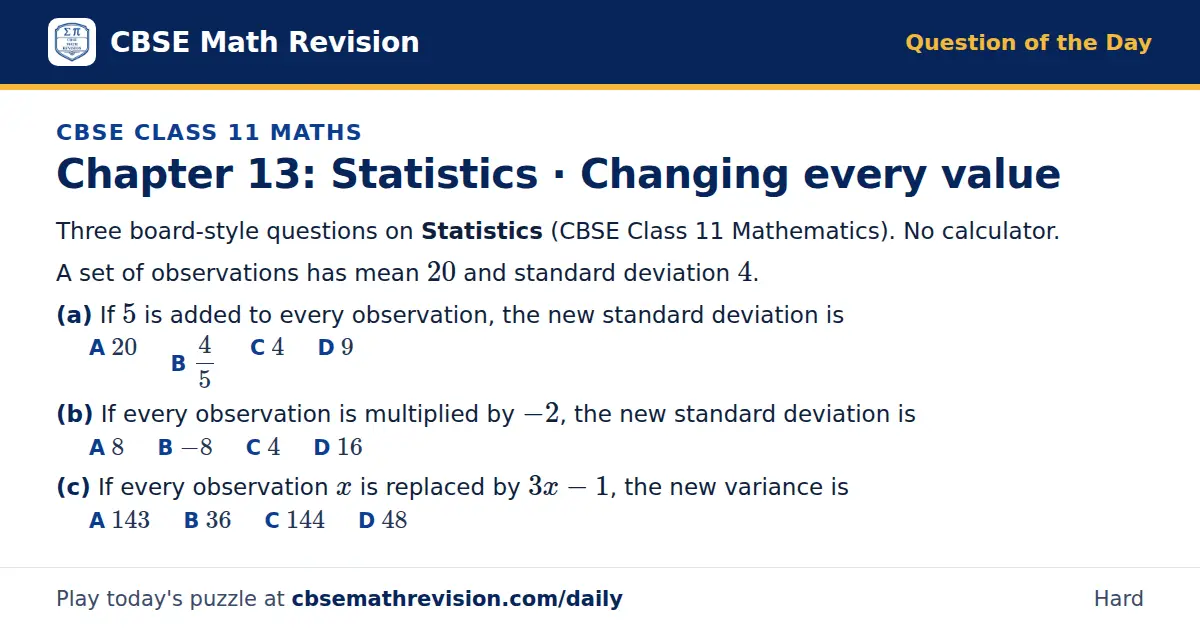
Chapter 13: Statistics · Changing every value
Three board-style questions on Statistics (CBSE Class 11 Mathematics). No calculator. A set of observations has mean 20 and standard deviation 4.
- If 5 is added to every observation, the new standard deviation is Options: A) 20; B) 4/5; C) 4; D) 9
- If every observation is multiplied by -2, the new standard deviation is Options: A) 8; B) -8; C) 4; D) 16
- If every observation x is replaced by 3x - 1, the new variance is Options: A) 143; B) 36; C) 144; D) 48
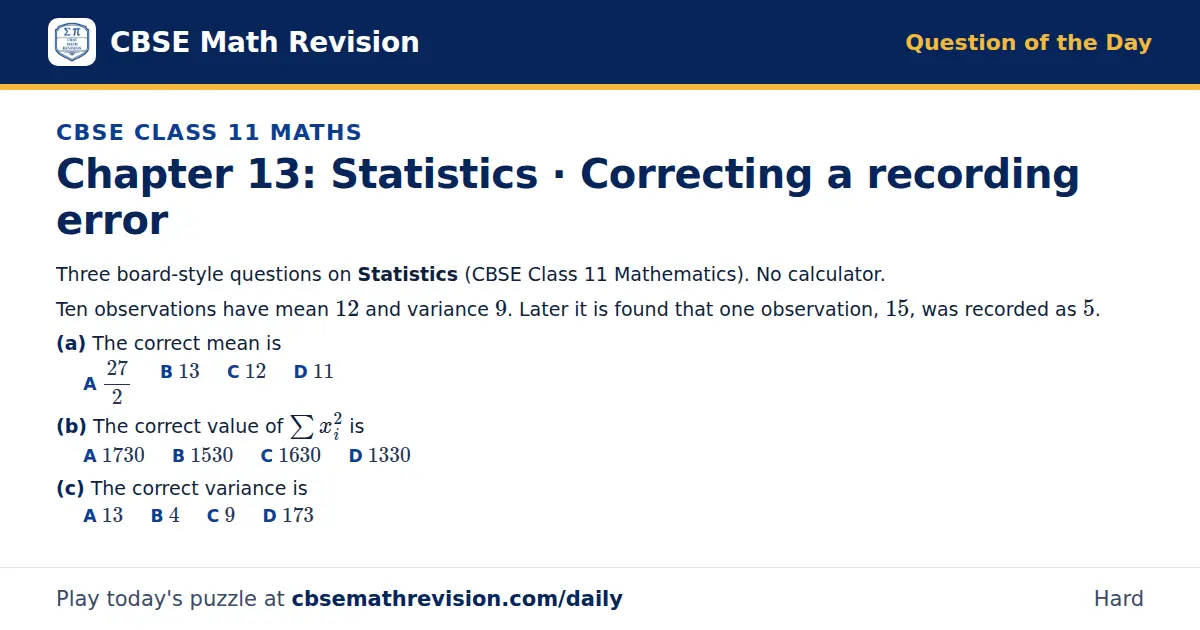
Chapter 13: Statistics · Correcting a recording error
Three board-style questions on Statistics (CBSE Class 11 Mathematics). No calculator. Ten observations have mean 12 and variance 9. Later it is found that one observation, 15, was recorded as 5.
- The correct mean is Options: A) 27/2; B) 13; C) 12; D) 11
- The correct value of Σ x_i² is Options: A) 1730; B) 1530; C) 1630; D) 1330
- The correct variance is Options: A) 13; B) 4; C) 9; D) 173
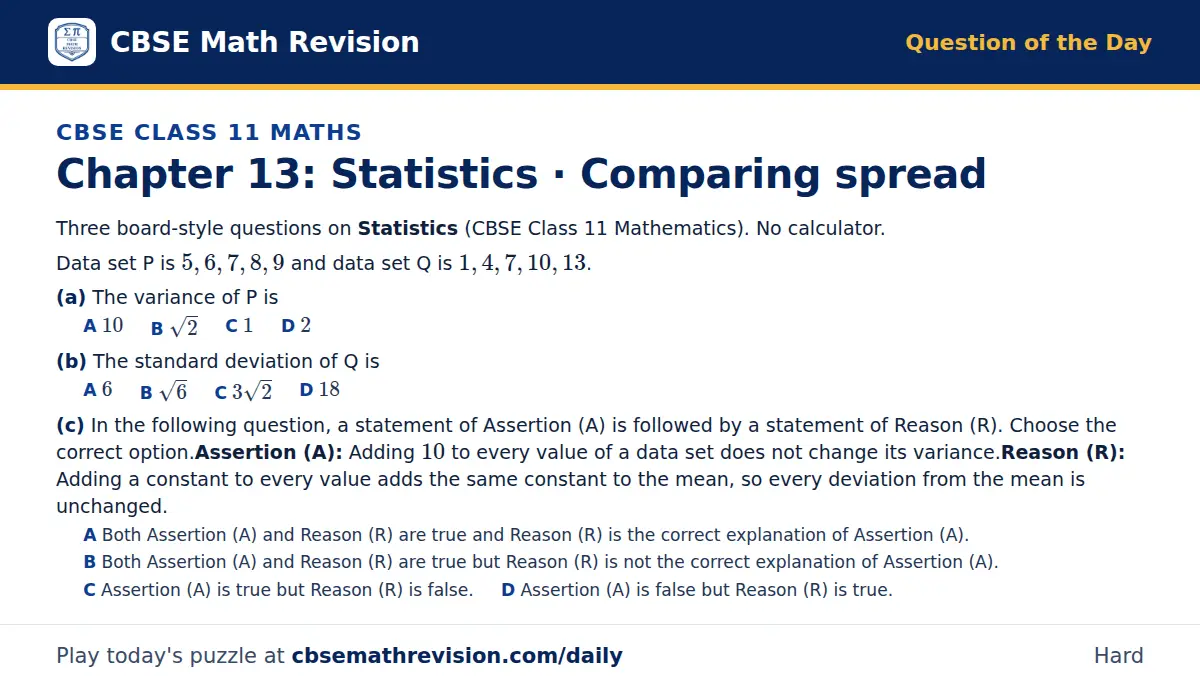
Chapter 13: Statistics · Comparing spread
Three board-style questions on Statistics (CBSE Class 11 Mathematics). No calculator. Data set P is 5, 6, 7, 8, 9 and data set Q is 1, 4, 7, 10, 13.
- The variance of P is Options: A) 10; B) √2; C) 1; D) 2
- The standard deviation of Q is Options: A) 6; B) √6; C) 3 √2; D) 18
- In the following question, a statement of Assertion (A) is followed by a statement of Reason (R). Choose the correct option. Assertion (A): Adding 10 to every value of a data set does not change its variance. Reason (R): Adding a constant to every value adds the same constant to the mean, so every deviation from the mean is unchanged. Options: A) Both Assertion (A) and Reason (R) are true and Reason (R) is the correct explanation of Assertion (A).; B) Both Assertion (A) and Reason (R) are true but Reason (R) is not the correct explanation of Assertion (A).; C) Assertion (A) is true but Reason (R) is false.; D) Assertion (A) is false but Reason (R) is true.
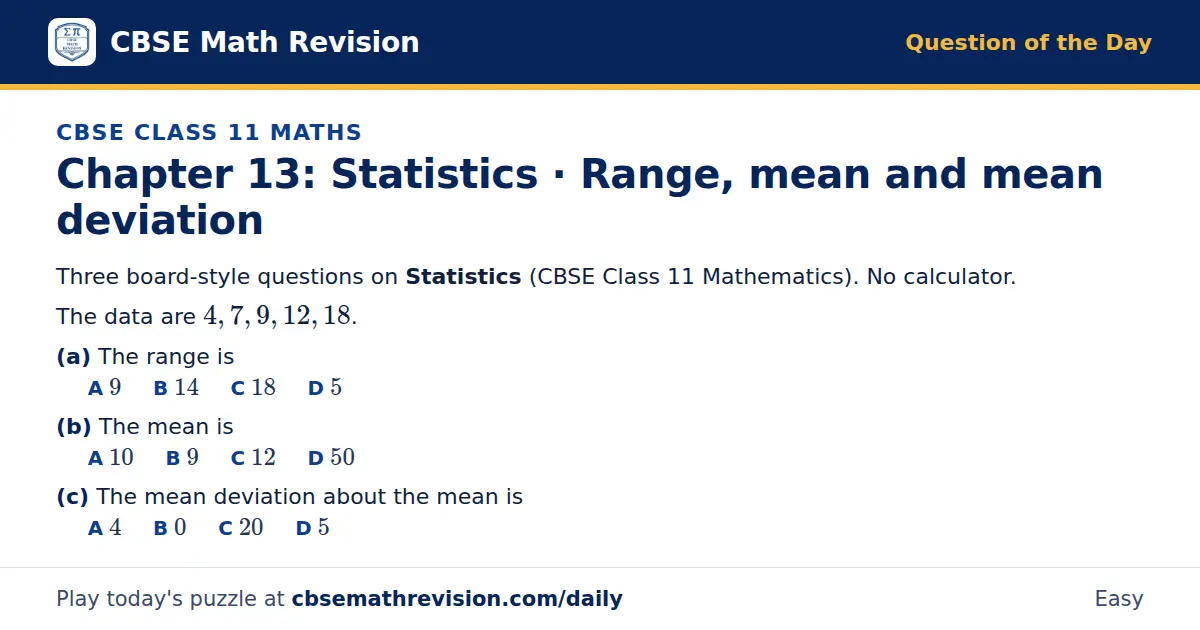
Chapter 13: Statistics · Range, mean and mean deviation
Three board-style questions on Statistics (CBSE Class 11 Mathematics). No calculator. The data are 4, 7, 9, 12, 18.
- The range is Options: A) 9; B) 14; C) 18; D) 5
- The mean is Options: A) 10; B) 9; C) 12; D) 50
- The mean deviation about the mean is Options: A) 4; B) 0; C) 20; D) 5
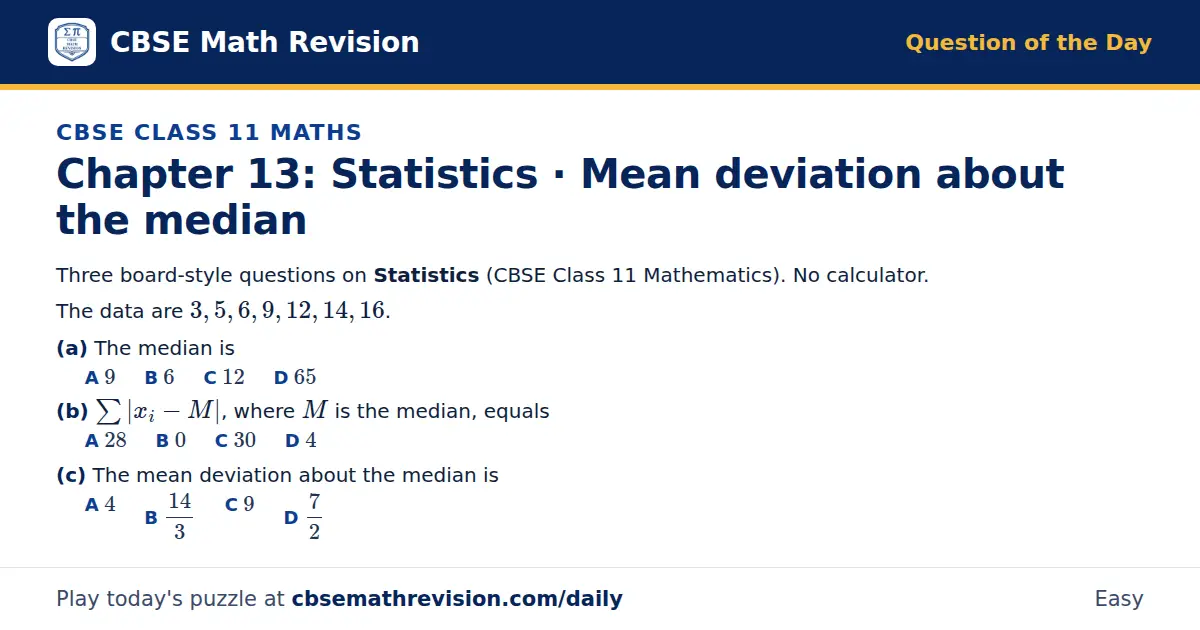
Chapter 13: Statistics · Mean deviation about the median
Three board-style questions on Statistics (CBSE Class 11 Mathematics). No calculator. The data are 3, 5, 6, 9, 12, 14, 16.
- The median is Options: A) 9; B) 6; C) 12; D) 65
- Σ |x_i - M|, where M is the median, equals Options: A) 28; B) 0; C) 30; D) 4
- The mean deviation about the median is Options: A) 4; B) 14/3; C) 9; D) 7/2
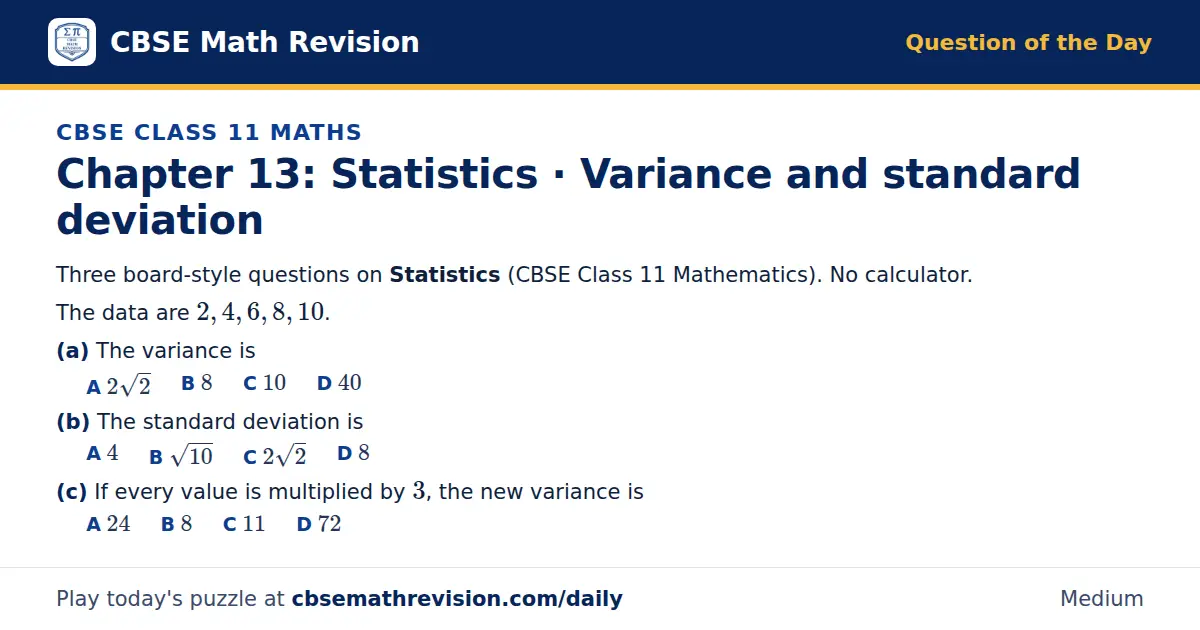
Chapter 13: Statistics · Variance and standard deviation
Three board-style questions on Statistics (CBSE Class 11 Mathematics). No calculator. The data are 2, 4, 6, 8, 10.
- The variance is Options: A) 2 √2; B) 8; C) 10; D) 40
- The standard deviation is Options: A) 4; B) √10; C) 2 √2; D) 8
- If every value is multiplied by 3, the new variance is Options: A) 24; B) 8; C) 11; D) 72
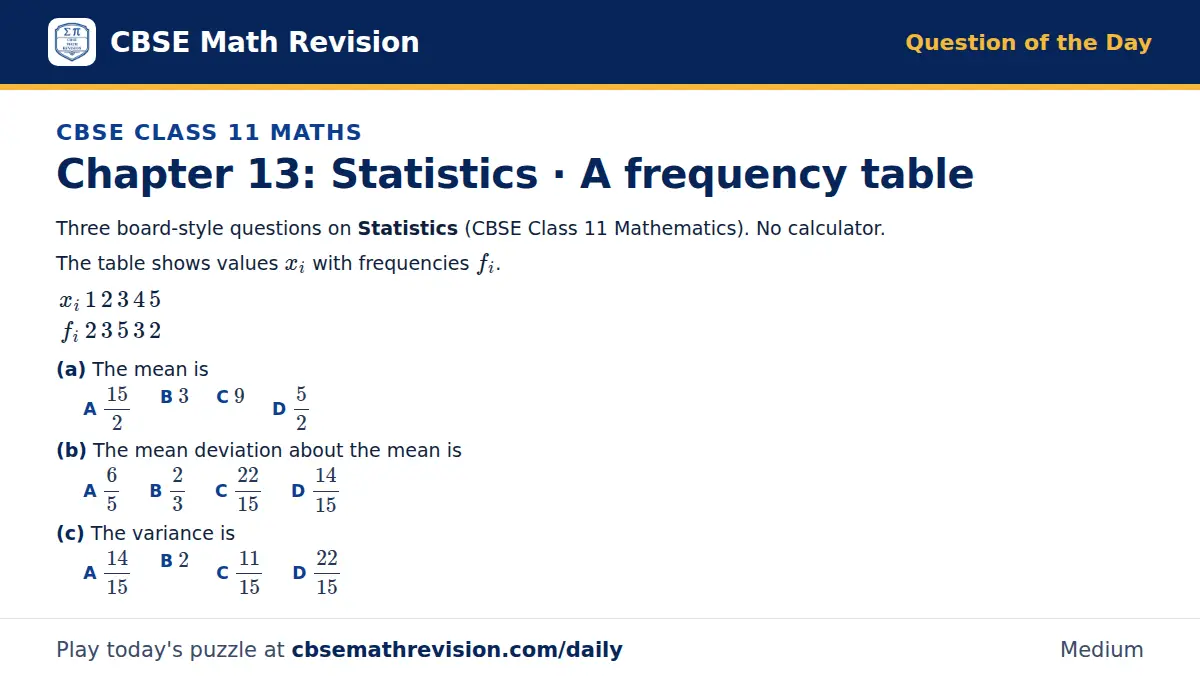
Chapter 13: Statistics · A frequency table
Three board-style questions on Statistics (CBSE Class 11 Mathematics). No calculator. The table shows values x_i with frequencies f_i. x_i12345f_i23532
- The mean is Options: A) 15/2; B) 3; C) 9; D) 5/2
- The mean deviation about the mean is Options: A) 6/5; B) 2/3; C) 22/15; D) 14/15
- The variance is Options: A) 14/15; B) 2; C) 11/15; D) 22/15
Chapter 14: Probability
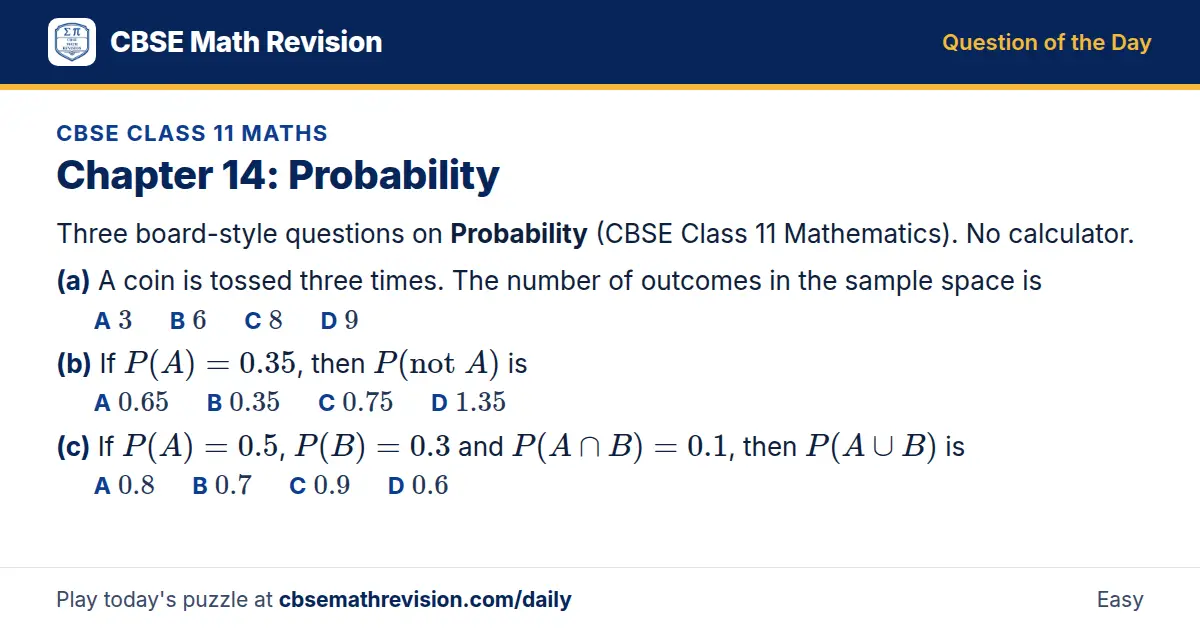
Chapter 14: Probability
Three board-style questions on Probability (CBSE Class 11 Mathematics). No calculator.
- A coin is tossed three times. The number of outcomes in the sample space is Options: A) 3; B) 6; C) 8; D) 9
- If P(A) = 0.35, then P(not A) is Options: A) 0.65; B) 0.35; C) 0.75; D) 1.35
- If P(A) = 0.5, P(B) = 0.3 and P(A ∩ B) = 0.1, then P(A ∪ B) is Options: A) 0.8; B) 0.7; C) 0.9; D) 0.6
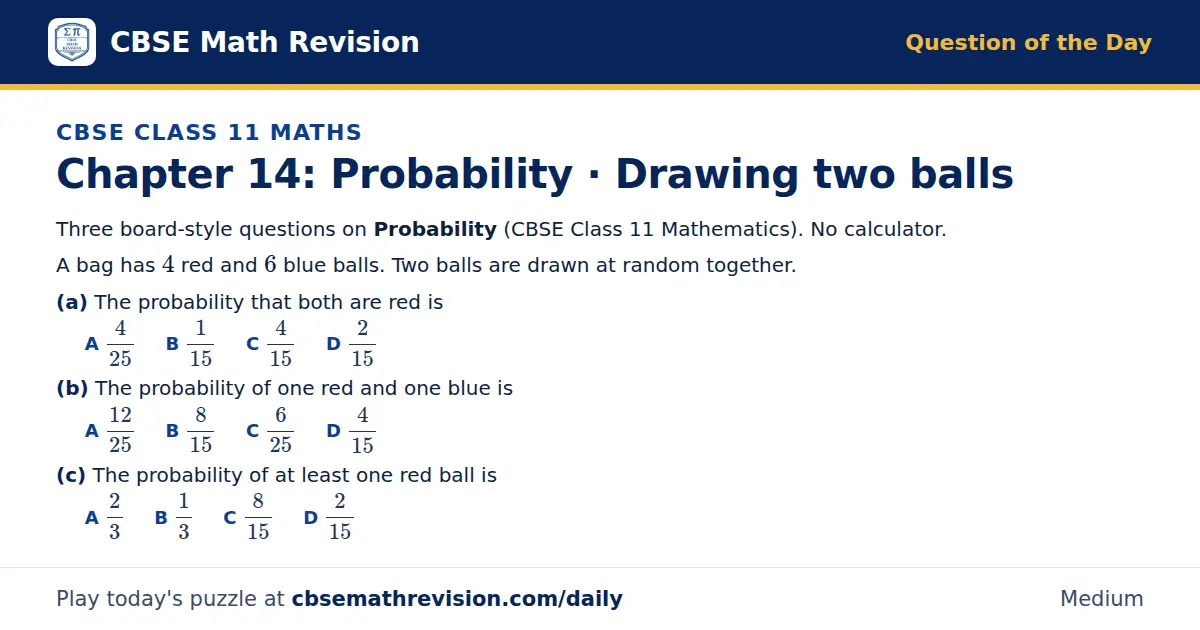
Chapter 14: Probability · Drawing two balls
Three board-style questions on Probability (CBSE Class 11 Mathematics). No calculator. A bag has 4 red and 6 blue balls. Two balls are drawn at random together.
- The probability that both are red is Options: A) 4/25; B) 1/15; C) 4/15; D) 2/15
- The probability of one red and one blue is Options: A) 12/25; B) 8/15; C) 6/25; D) 4/15
- The probability of at least one red ball is Options: A) 2/3; B) 1/3; C) 8/15; D) 2/15
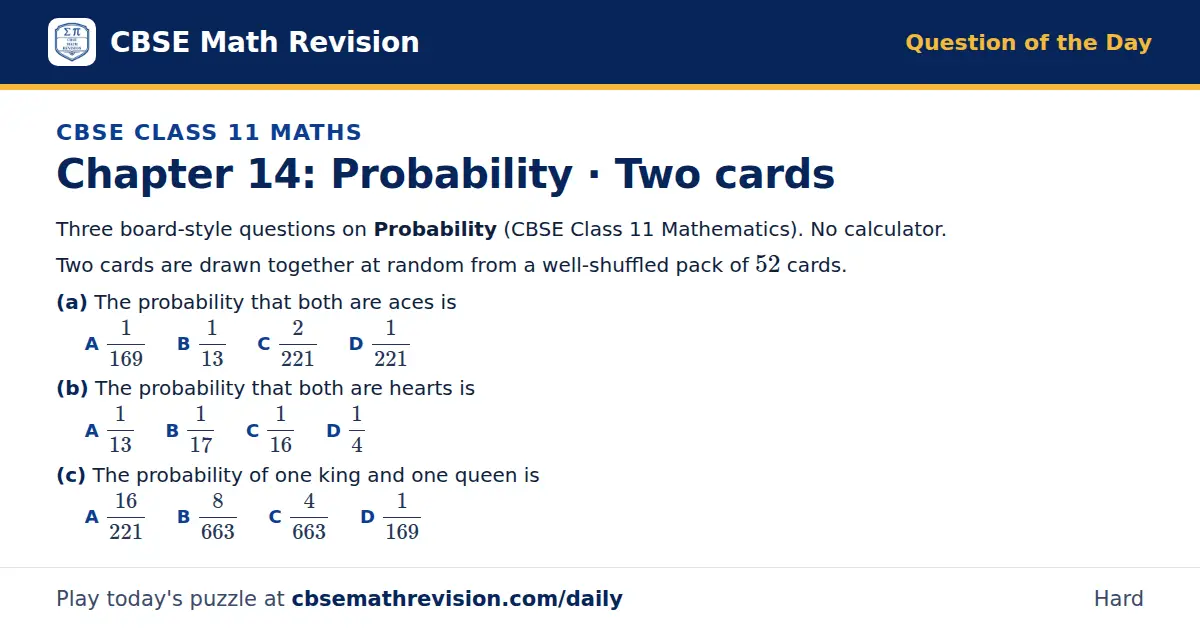
Chapter 14: Probability · Two cards
Three board-style questions on Probability (CBSE Class 11 Mathematics). No calculator. Two cards are drawn together at random from a well-shuffled pack of 52 cards.
- The probability that both are aces is Options: A) 1/169; B) 1/13; C) 2/221; D) 1/221
- The probability that both are hearts is Options: A) 1/13; B) 1/17; C) 1/16; D) 1/4
- The probability of one king and one queen is Options: A) 16/221; B) 8/663; C) 4/663; D) 1/169
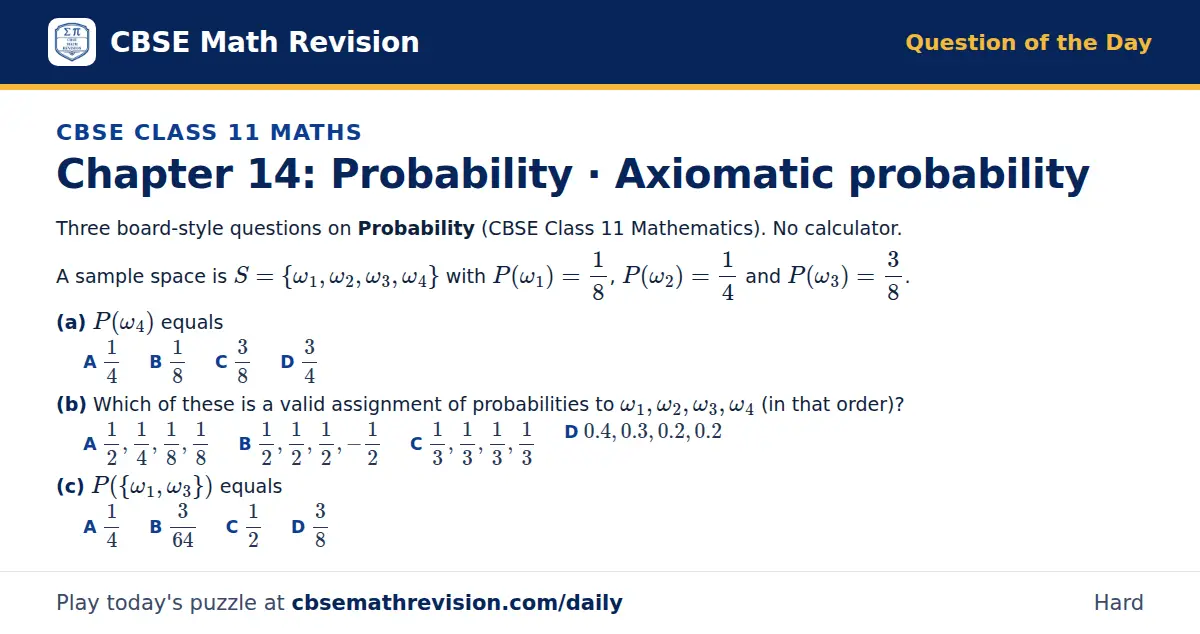
Chapter 14: Probability · Axiomatic probability
Three board-style questions on Probability (CBSE Class 11 Mathematics). No calculator. A sample space is S = ω_1, ω_2, ω_3, ω_4 with P(ω_1) = 18, P(ω_2) = 14 and P(ω_3) = 38.
- P(ω_4) equals Options: A) 1/4; B) 1/8; C) 3/8; D) 3/4
- Which of these is a valid assignment of probabilities to ω_1, ω_2, ω_3, ω_4 (in that order)? Options: A) 12, 14, 18, 18; B) 12, 12, 12, -12; C) 13, 13, 13, 13; D) 0.4, 0.3, 0.2, 0.2
- P(ω_1, ω_3) equals Options: A) 1/4; B) 3/64; C) 1/2; D) 3/8
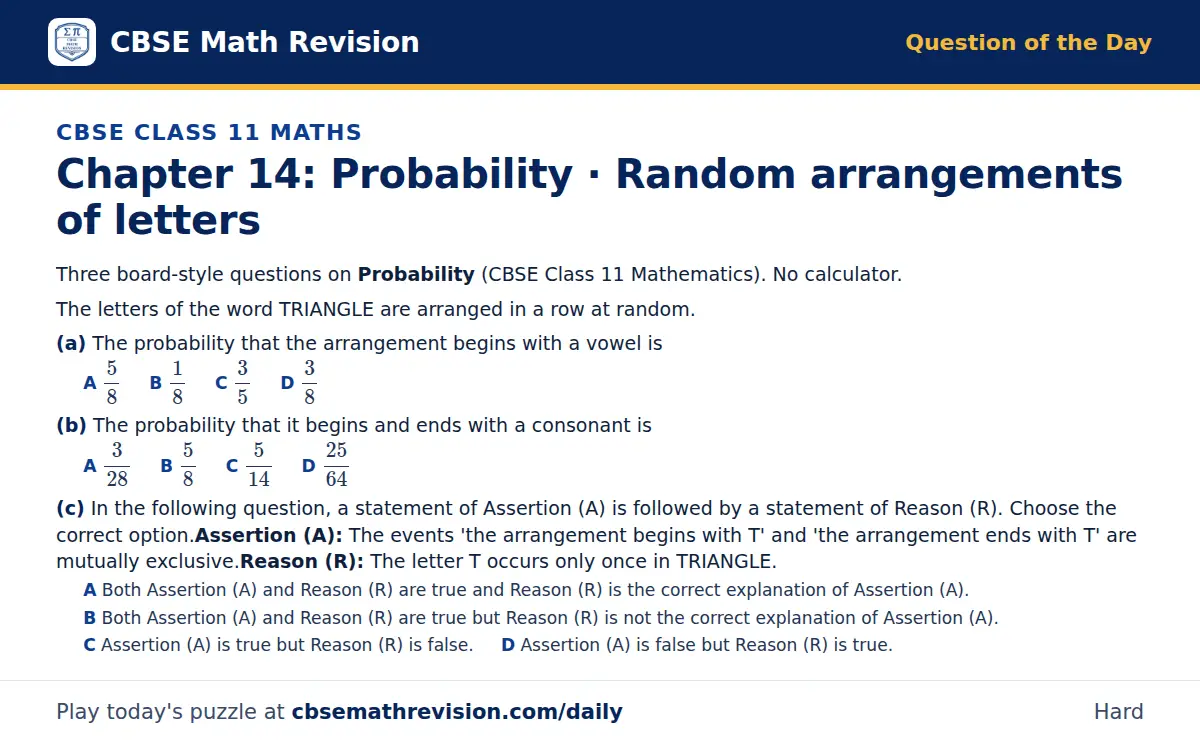
Chapter 14: Probability · Random arrangements of letters
Three board-style questions on Probability (CBSE Class 11 Mathematics). No calculator. The letters of the word TRIANGLE are arranged in a row at random.
- The probability that the arrangement begins with a vowel is Options: A) 5/8; B) 1/8; C) 3/5; D) 3/8
- The probability that it begins and ends with a consonant is Options: A) 3/28; B) 5/8; C) 5/14; D) 25/64
- In the following question, a statement of Assertion (A) is followed by a statement of Reason (R). Choose the correct option. Assertion (A): The events 'the arrangement begins with T' and 'the arrangement ends with T' are mutually exclusive. Reason (R): The letter T occurs only once in TRIANGLE. Options: A) Both Assertion (A) and Reason (R) are true and Reason (R) is the correct explanation of Assertion (A).; B) Both Assertion (A) and Reason (R) are true but Reason (R) is not the correct explanation of Assertion (A).; C) Assertion (A) is true but Reason (R) is false.; D) Assertion (A) is false but Reason (R) is true.
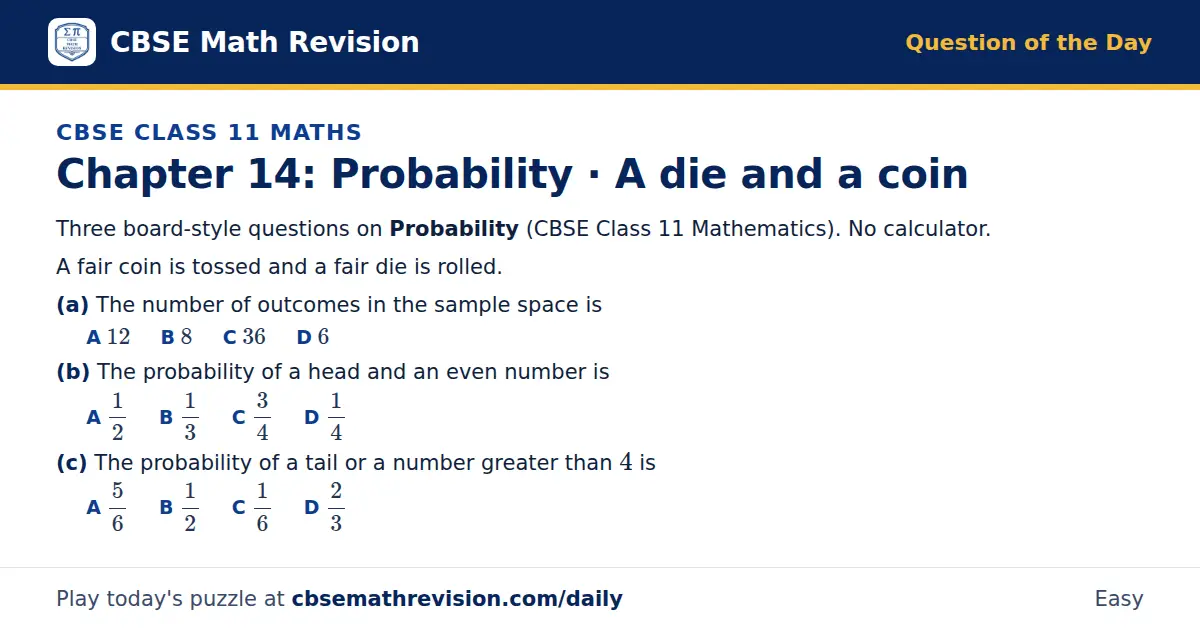
Chapter 14: Probability · A die and a coin
Three board-style questions on Probability (CBSE Class 11 Mathematics). No calculator. A fair coin is tossed and a fair die is rolled.
- The number of outcomes in the sample space is Options: A) 12; B) 8; C) 36; D) 6
- The probability of a head and an even number is Options: A) 1/2; B) 1/3; C) 3/4; D) 1/4
- The probability of a tail or a number greater than 4 is Options: A) 5/6; B) 1/2; C) 1/6; D) 2/3
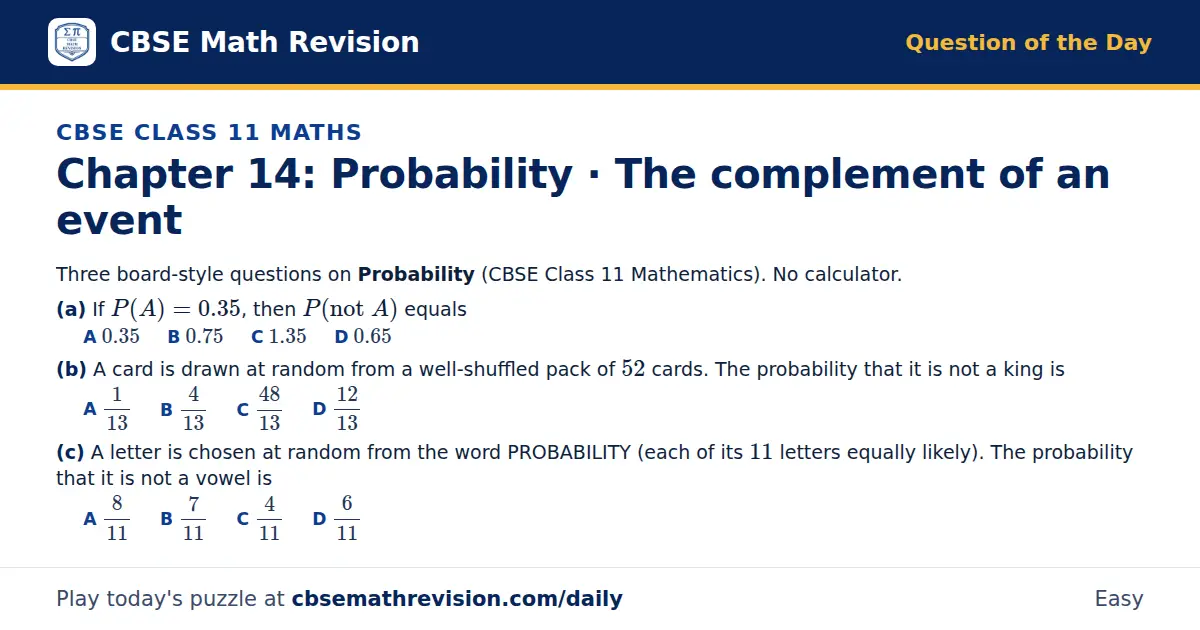
Chapter 14: Probability · The complement of an event
Three board-style questions on Probability (CBSE Class 11 Mathematics). No calculator.
- If P(A) = 0.35, then P(not A) equals Options: A) 0.35; B) 0.75; C) 1.35; D) 0.65
- A card is drawn at random from a well-shuffled pack of 52 cards. The probability that it is not a king is Options: A) 1/13; B) 4/13; C) 48/13; D) 12/13
- A letter is chosen at random from the word PROBABILITY (each of its 11 letters equally likely). The probability that it is not a vowel is Options: A) 8/11; B) 7/11; C) 4/11; D) 6/11
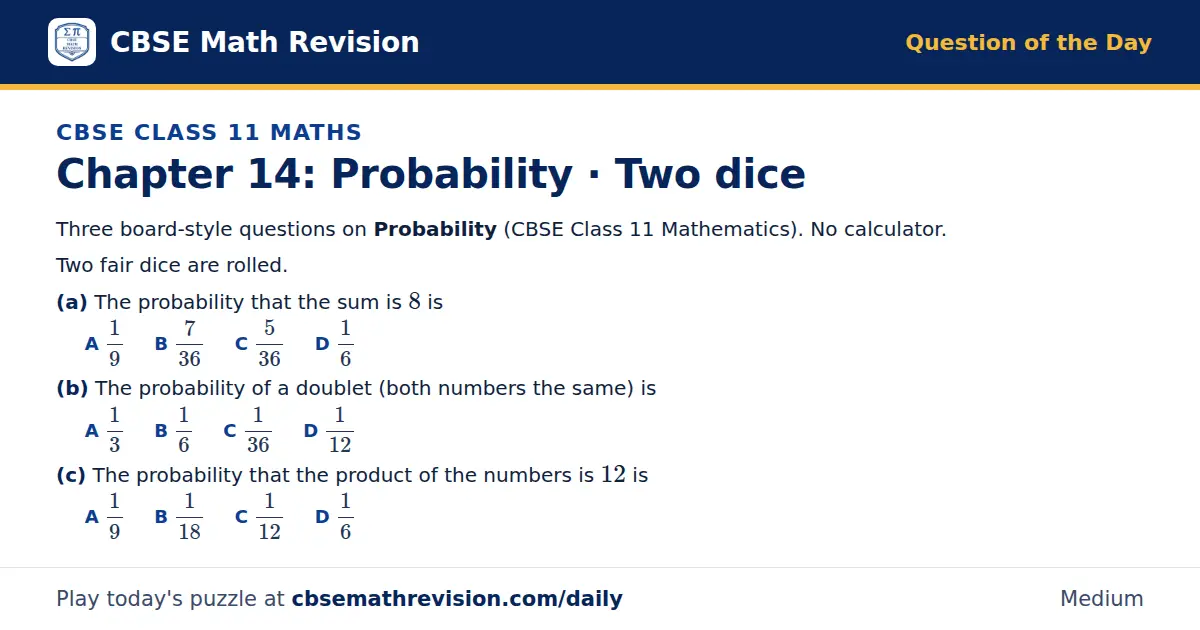
Chapter 14: Probability · Two dice
Three board-style questions on Probability (CBSE Class 11 Mathematics). No calculator. Two fair dice are rolled.
- The probability that the sum is 8 is Options: A) 1/9; B) 7/36; C) 5/36; D) 1/6
- The probability of a doublet (both numbers the same) is Options: A) 1/3; B) 1/6; C) 1/36; D) 1/12
- The probability that the product of the numbers is 12 is Options: A) 1/9; B) 1/18; C) 1/12; D) 1/6
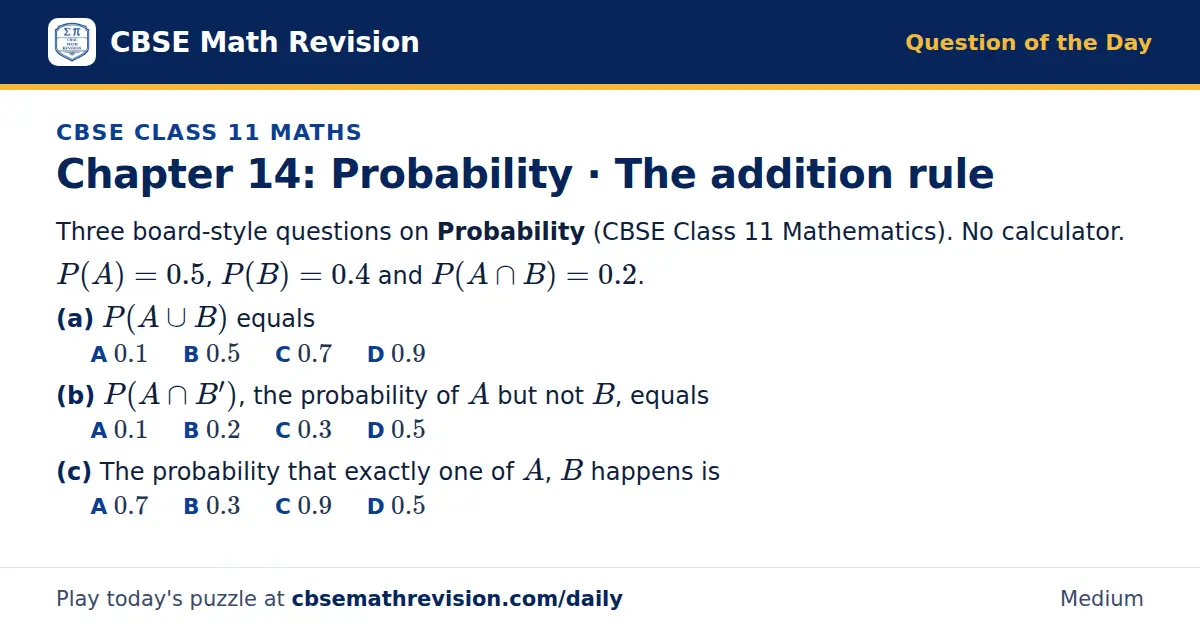
Chapter 14: Probability · The addition rule
Three board-style questions on Probability (CBSE Class 11 Mathematics). No calculator. P(A) = 0.5, P(B) = 0.4 and P(A ∩ B) = 0.2.
- P(A ∪ B) equals Options: A) 0.1; B) 0.5; C) 0.7; D) 0.9
- P(A ∩ B'), the probability of A but not B, equals Options: A) 0.1; B) 0.2; C) 0.3; D) 0.5
- The probability that exactly one of A, B happens is Options: A) 0.7; B) 0.3; C) 0.9; D) 0.5
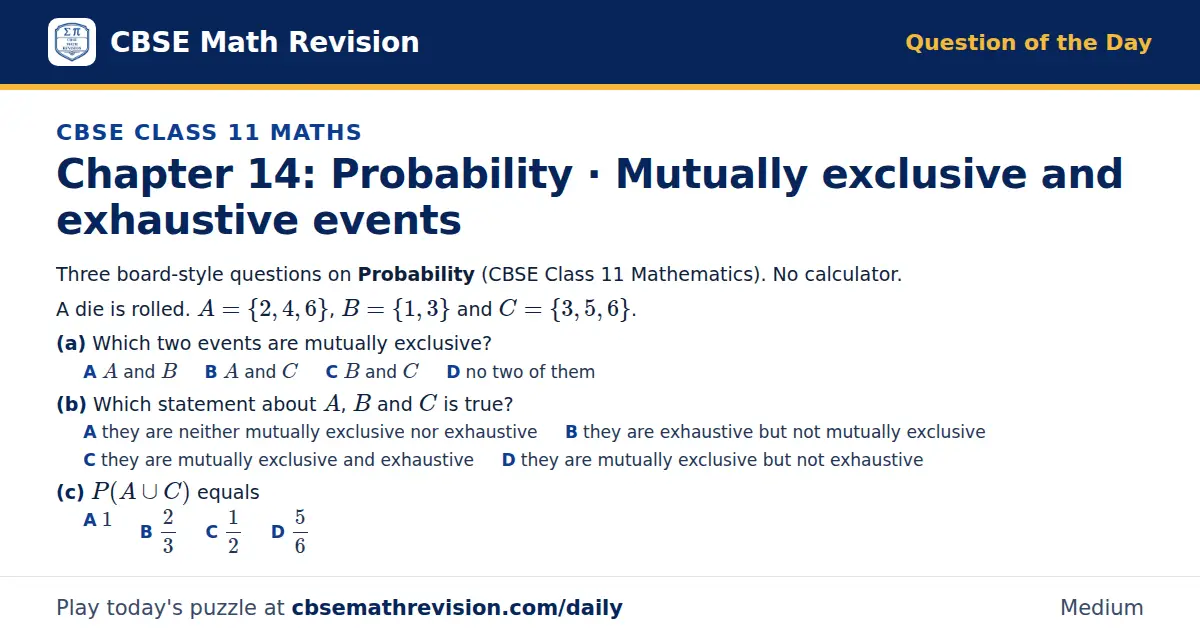
Chapter 14: Probability · Mutually exclusive and exhaustive events
Three board-style questions on Probability (CBSE Class 11 Mathematics). No calculator. A die is rolled. A = 2, 4, 6, B = 1, 3 and C = 3, 5, 6.
- Which two events are mutually exclusive? Options: A) A and B; B) A and C; C) B and C; D) no two of them
- Which statement about A, B and C is true? Options: A) they are neither mutually exclusive nor exhaustive; B) they are exhaustive but not mutually exclusive; C) they are mutually exclusive and exhaustive; D) they are mutually exclusive but not exhaustive
- P(A ∪ C) equals Options: A) 1; B) 2/3; C) 1/2; D) 5/6
More Question of the Day puzzles
Other chapters: Chapters 1–4 · Chapters 5–8 · Chapters 9–11 · Chapters 12–14. See all CBSE Maths daily and weekly questions.