CBSE Class 10 Maths Question of the Day: all the puzzles
Every CBSE Class 10 Mathematics puzzle in the Question of the Day rotation, as images you can open, save or share. Each puzzle is three board-style questions on one chapter; the question text is written out below each image, and the answers, hints and step-marked solutions are on the daily puzzle page.
- Play today's CBSE Class 10 Maths puzzle
- CBSE Class 11 Maths puzzles
- CBSE Class 12 Maths puzzles
- All CBSE Maths daily and weekly questions
Every puzzle in the rotation
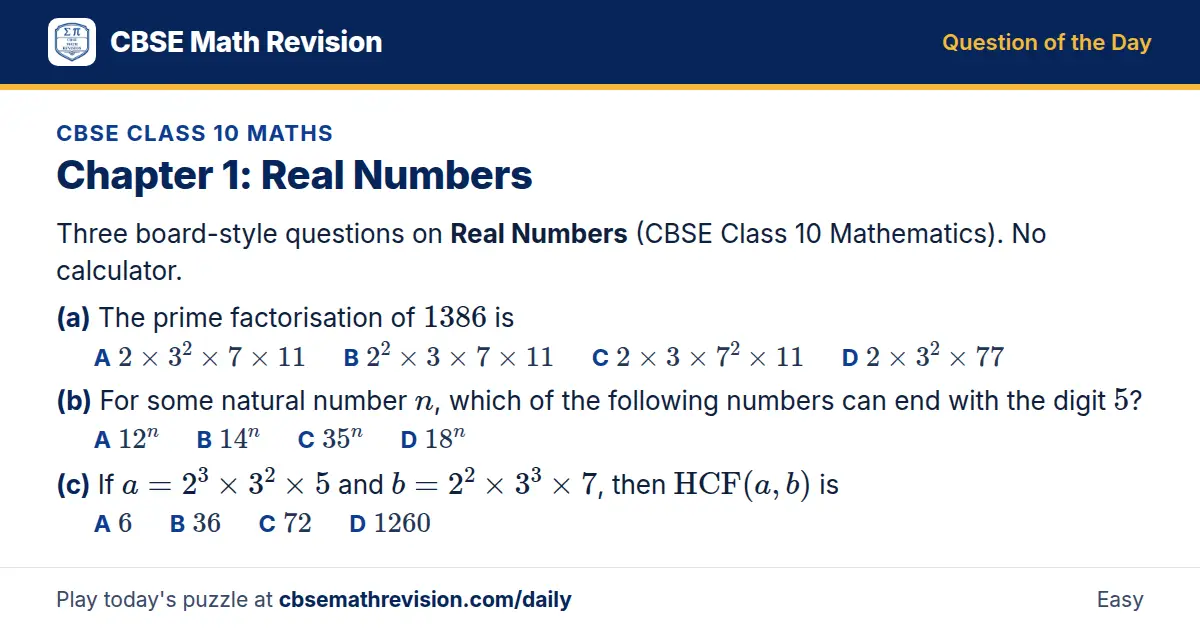
Chapter 1: Real Numbers
Three board-style questions on Real Numbers (CBSE Class 10 Mathematics). No calculator.
- The prime factorisation of 1386 is Options: A) 2 × 3² × 7 × 11; B) 2² × 3 × 7 × 11; C) 2 × 3 × 7² × 11; D) 2 × 3² × 77
- For some natural number n, which of the following numbers can end with the digit 5? Options: A) 12^n; B) 14^n; C) 35^n; D) 18^n
- If a = 2³ × 3² × 5 and b = 2² × 3³ × 7, then HCF(a, b) is Options: A) 6; B) 36; C) 72; D) 1260
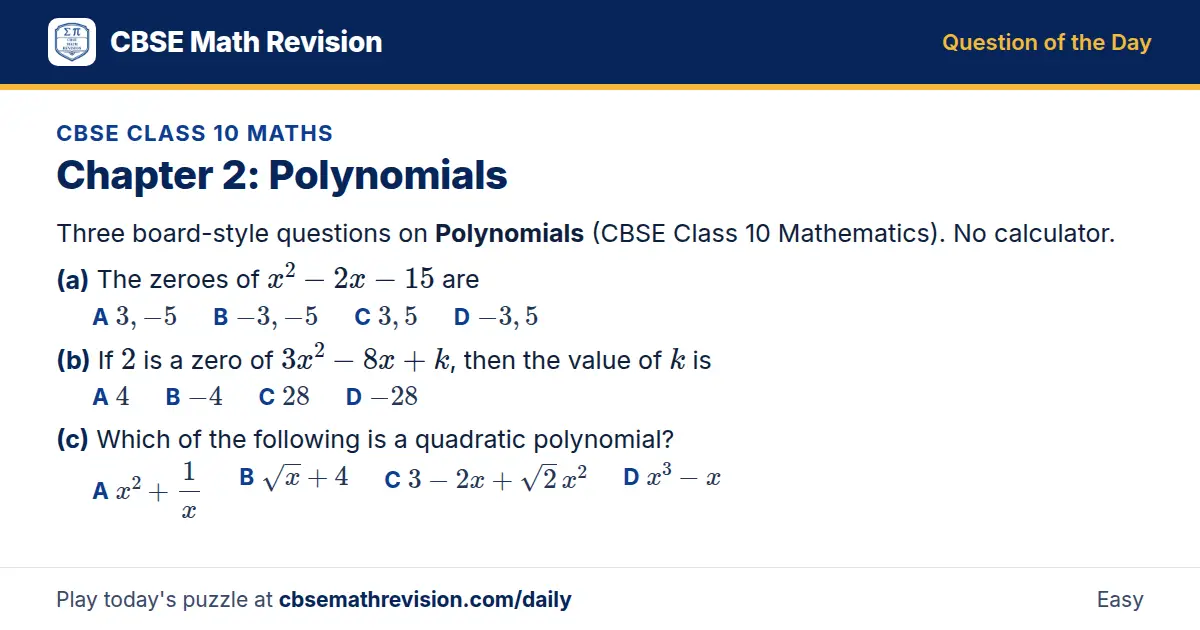
Chapter 2: Polynomials
Three board-style questions on Polynomials (CBSE Class 10 Mathematics). No calculator.
- The zeroes of x² - 2x - 15 are Options: A) 3, -5; B) -3, -5; C) 3, 5; D) -3, 5
- If 2 is a zero of 3x² - 8x + k, then the value of k is Options: A) 4; B) -4; C) 28; D) -28
- Which of the following is a quadratic polynomial? Options: A) x² + 1x; B) √x + 4; C) 3 - 2x + √2 x²; D) x³ - x
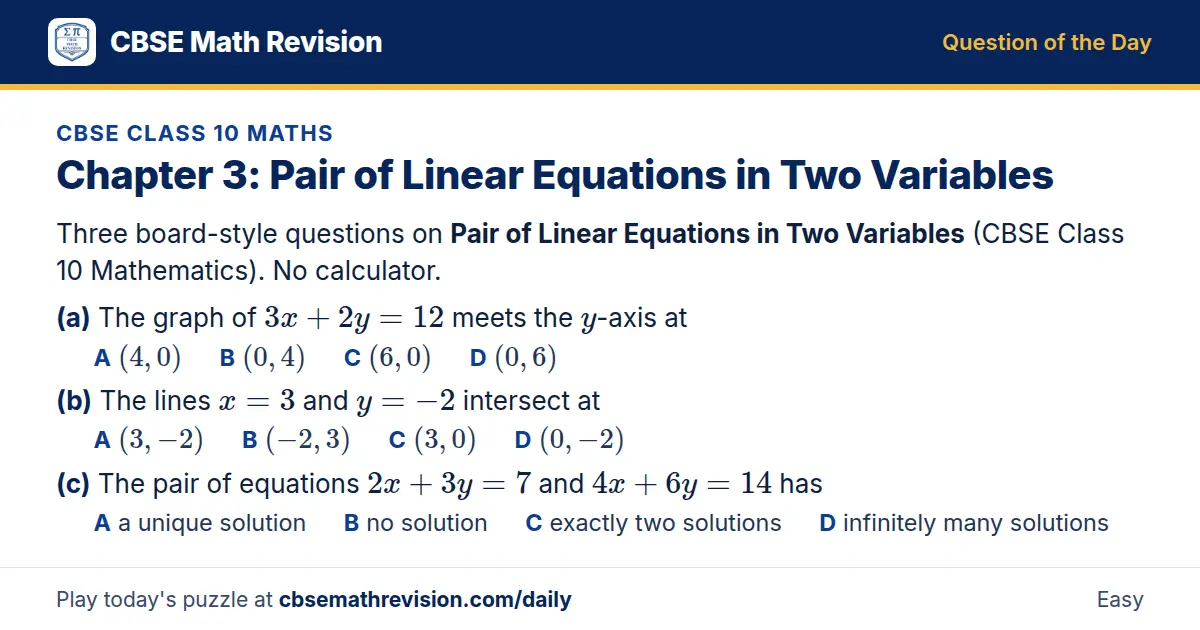
Chapter 3: Pair of Linear Equations in Two Variables
Three board-style questions on Pair of Linear Equations in Two Variables (CBSE Class 10 Mathematics). No calculator.
- The graph of 3x + 2y = 12 meets the y-axis at Options: A) (4, 0); B) (0, 4); C) (6, 0); D) (0, 6)
- The lines x = 3 and y = -2 intersect at Options: A) (3, -2); B) (-2, 3); C) (3, 0); D) (0, -2)
- The pair of equations 2x + 3y = 7 and 4x + 6y = 14 has Options: A) a unique solution; B) no solution; C) exactly two solutions; D) infinitely many solutions
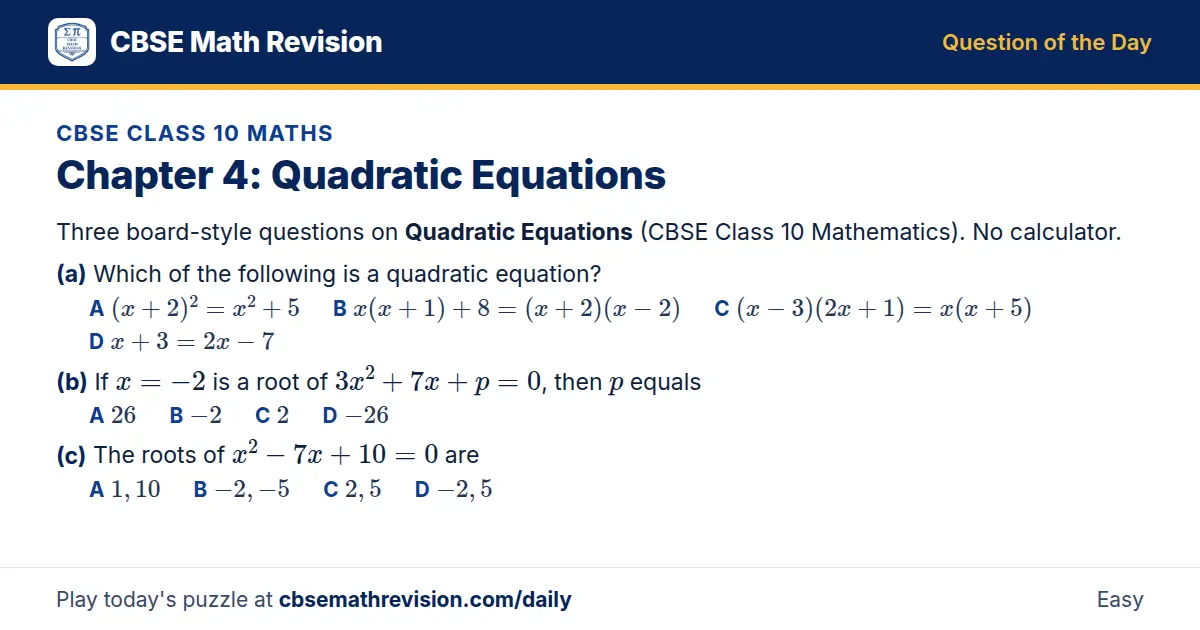
Chapter 4: Quadratic Equations
Three board-style questions on Quadratic Equations (CBSE Class 10 Mathematics). No calculator.
- Which of the following is a quadratic equation? Options: A) (x + 2)² = x² + 5; B) x(x + 1) + 8 = (x + 2)(x - 2); C) (x - 3)(2x + 1) = x(x + 5); D) x + 3 = 2x - 7
- If x = -2 is a root of 3x² + 7x + p = 0, then p equals Options: A) 26; B) -2; C) 2; D) -26
- The roots of x² - 7x + 10 = 0 are Options: A) 1, 10; B) -2, -5; C) 2, 5; D) -2, 5
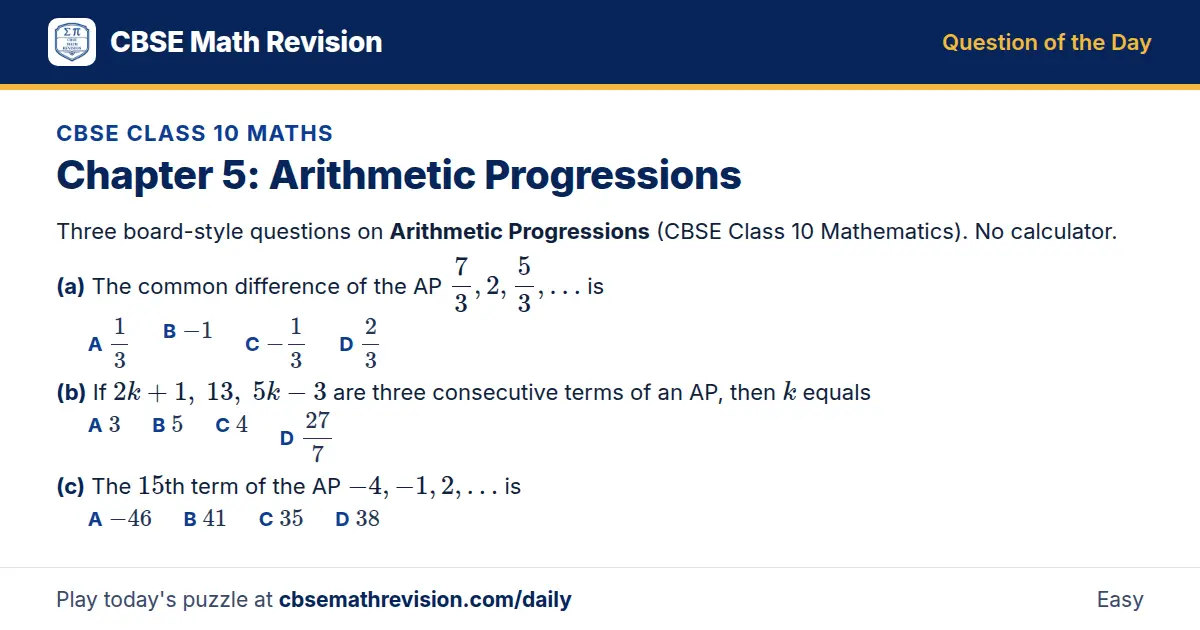
Chapter 5: Arithmetic Progressions
Three board-style questions on Arithmetic Progressions (CBSE Class 10 Mathematics). No calculator.
- The common difference of the AP 73, 2, 53, … is Options: A) 13; B) -1; C) -13; D) 23
- If 2k + 1, 13, 5k - 3 are three consecutive terms of an AP, then k equals Options: A) 3; B) 5; C) 4; D) 27/7
- The 15th term of the AP -4, -1, 2, … is Options: A) -46; B) 41; C) 35; D) 38
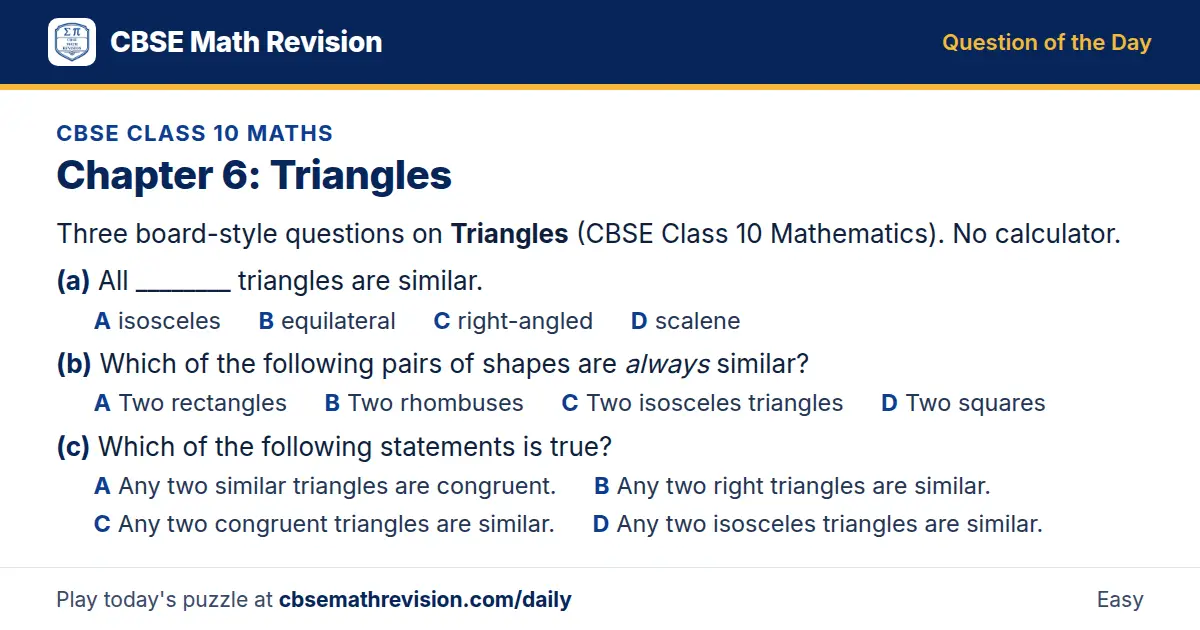
Chapter 6: Triangles
Three board-style questions on Triangles (CBSE Class 10 Mathematics). No calculator.
- All ________ triangles are similar. Options: A) isosceles; B) equilateral; C) right-angled; D) scalene
- Which of the following pairs of shapes are always similar? Options: A) Two rectangles; B) Two rhombuses; C) Two isosceles triangles; D) Two squares
- Which of the following statements is true? Options: A) Any two similar triangles are congruent.; B) Any two right triangles are similar.; C) Any two congruent triangles are similar.; D) Any two isosceles triangles are similar.
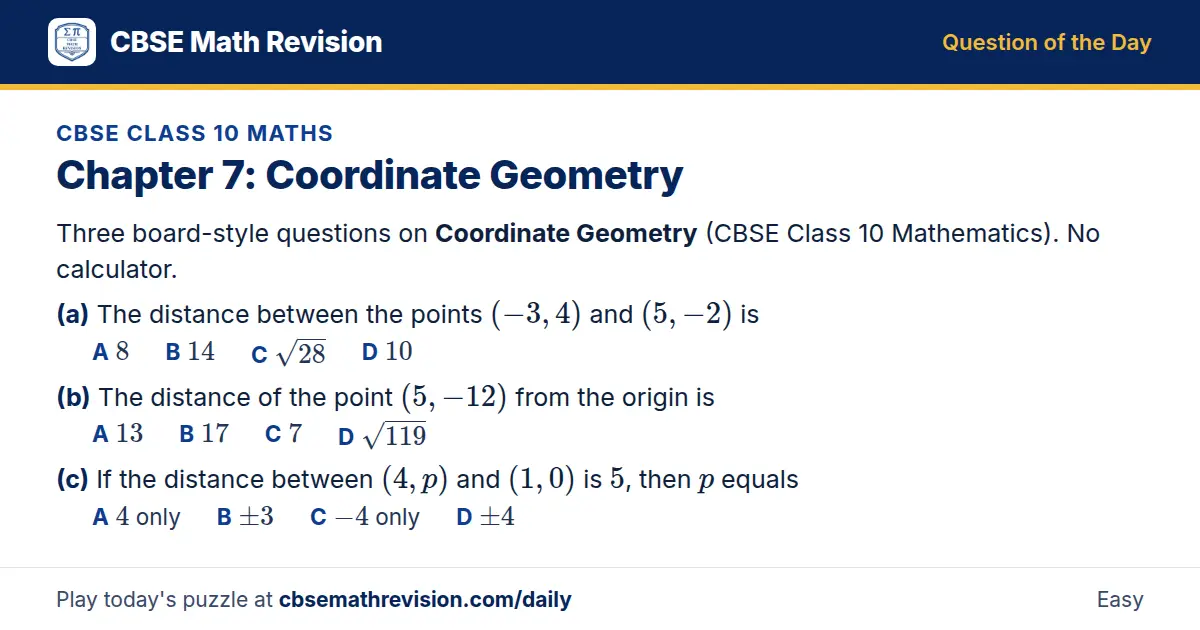
Chapter 7: Coordinate Geometry
Three board-style questions on Coordinate Geometry (CBSE Class 10 Mathematics). No calculator.
- The distance between the points (-3, 4) and (5, -2) is Options: A) 8; B) 14; C) √28; D) 10
- The distance of the point (5, -12) from the origin is Options: A) 13; B) 17; C) 7; D) √119
- If the distance between (4, p) and (1, 0) is 5, then p equals Options: A) 4 only; B) ± 3; C) -4 only; D) ± 4
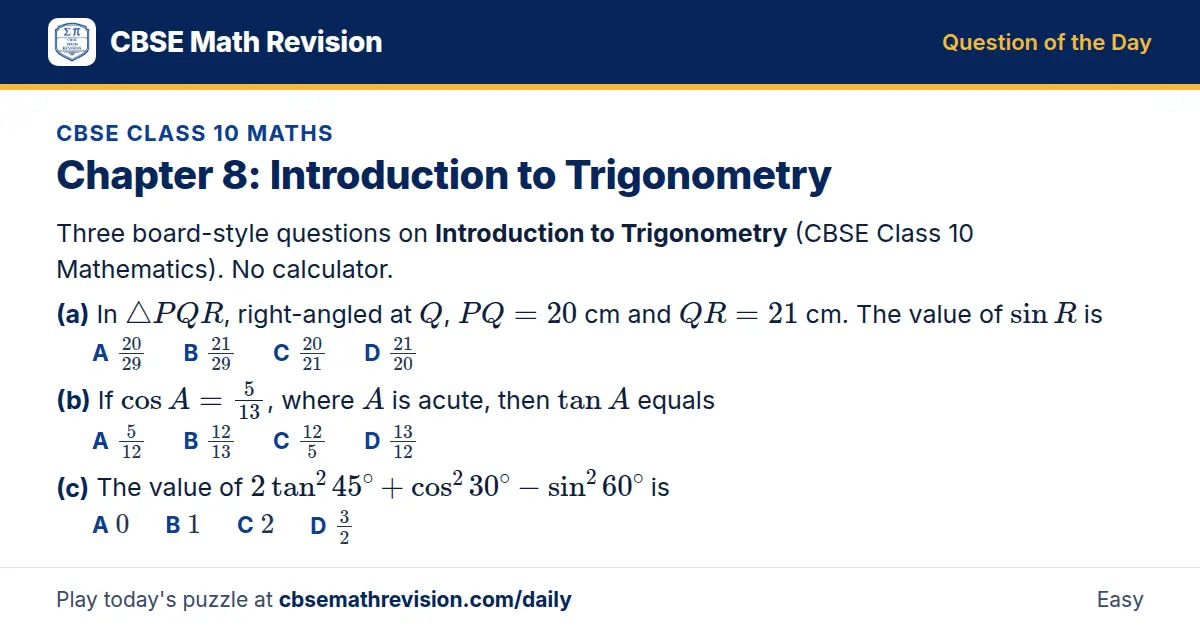
Chapter 8: Introduction to Trigonometry
Three board-style questions on Introduction to Trigonometry (CBSE Class 10 Mathematics). No calculator.
- In △ PQR, right-angled at Q, PQ = 20 cm and QR = 21 cm. The value of sin R is Options: A) 20/29; B) 21/29; C) 20/21; D) 21/20
- If cos A = 5/13, where A is acute, then tan A equals Options: A) 5/12; B) 12/13; C) 12/5; D) 13/12
- The value of 2tan² 45^∘ + cos² 30^∘ - sin² 60^∘ is Options: A) 0; B) 1; C) 2; D) 3/2
Chapter 9: Some Applications of Trigonometry
Three board-style questions on Some Applications of Trigonometry (CBSE Class 10 Mathematics). No calculator.
- The shadow of a vertical tower on level ground is equal to its height. The angle of elevation of the Sun is Options: A) 30^∘; B) 45^∘; C) 60^∘; D) 90^∘
- A straight zip-line cable, 80 m long, runs from the top of a platform down to a point on level ground and makes an angle of 30^∘ with the ground. The height of the platform is Options: A) 40 m; B) 40√3 m; C) 80√3 m; D) 40/(√3) m
- A 14 m ladder leans against a wall and makes an angle of 60^∘ with the ground. The distance of its foot from the wall is Options: A) 7√3 m; B) 7 m; C) 14√3 m; D) 7/(√3) m
Chapter 10: Circles
Three board-style questions on Circles (CBSE Class 10 Mathematics). No calculator.
- The number of tangents to a circle that are parallel to a given secant is Options: A) 1; B) 2; C) infinitely many; D) 0
- The common point of a tangent and a circle is called the Options: A) centre; B) point of contact; C) end of a secant; D) chord point
- The number of tangents that can be drawn to a circle from a point inside it is Options: A) 0; B) 1; C) 2; D) infinitely many
Chapter 11: Areas Related to Circles
Three board-style questions on Areas Related to Circles (CBSE Class 10 Mathematics). No calculator.
- The length of an arc of a circle of radius 21 cm subtending an angle of 60^∘ at the centre is (π=22/7) Options: A) 44 cm; B) 22 cm; C) 231 cm; D) 66 cm
- The perimeter of a sector of radius r and central angle θ is Options: A) (θ)/360×2π r; B) 2r+(θ)/360×2π r; C) r+(θ)/360×2π r; D) 2r+(θ)/360×π r²
- The area of a sector of angle 90^∘ of a circle of radius 14 cm is (π=22/7) Options: A) 154 cm²; B) 308 cm²; C) 44 cm²; D) 616 cm²
Chapter 12: Surface Areas and Volumes
Three board-style questions on Surface Areas and Volumes (CBSE Class 10 Mathematics). No calculator.
- The total surface area of a solid hemisphere of radius r is Options: A) 2π r²; B) 4π r²; C) 3π r²; D) π r²
- The slant height of a cone with base radius 5 cm and height 12 cm is Options: A) 13 cm; B) 17 cm; C) √119 cm; D) 7 cm
- The volume of a hemisphere of radius 21 cm is (π=22/7) Options: A) 38808 cm³; B) 19404 cm³; C) 2772 cm³; D) 9702 cm³
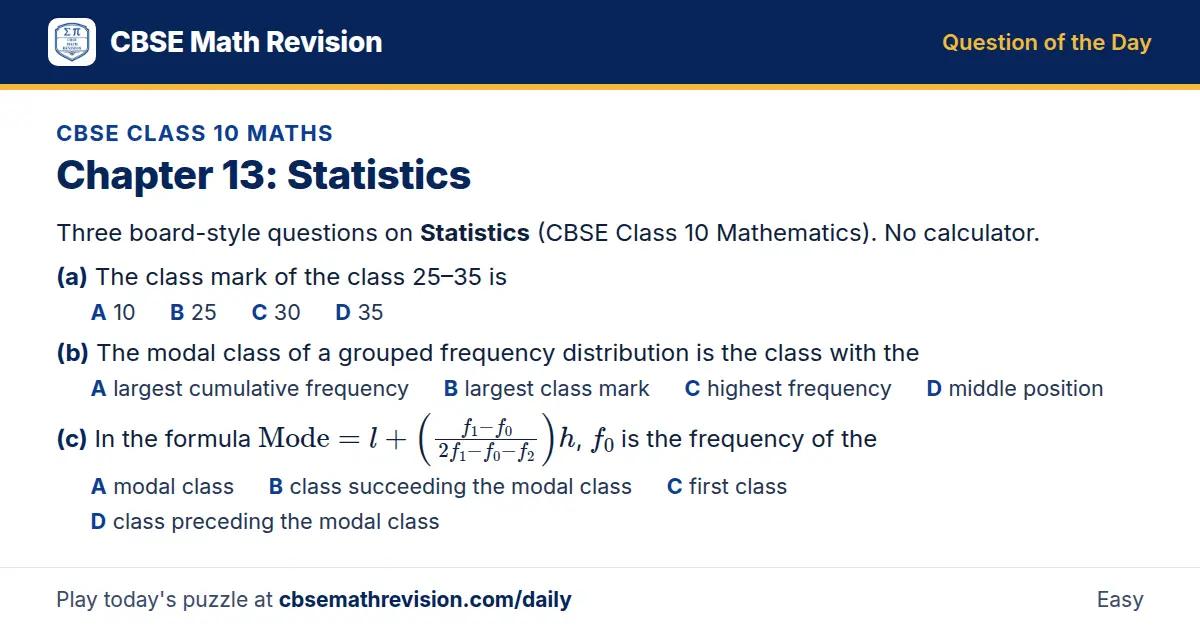
Chapter 13: Statistics
Three board-style questions on Statistics (CBSE Class 10 Mathematics). No calculator.
- The class mark of the class 25–35 is Options: A) 10; B) 25; C) 30; D) 35
- The modal class of a grouped frequency distribution is the class with the Options: A) largest cumulative frequency; B) largest class mark; C) highest frequency; D) middle position
- In the formula Mode=l+((f_1-f_0)/(2f_1-f_0-f_2))h, f_0 is the frequency of the Options: A) modal class; B) class succeeding the modal class; C) first class; D) class preceding the modal class
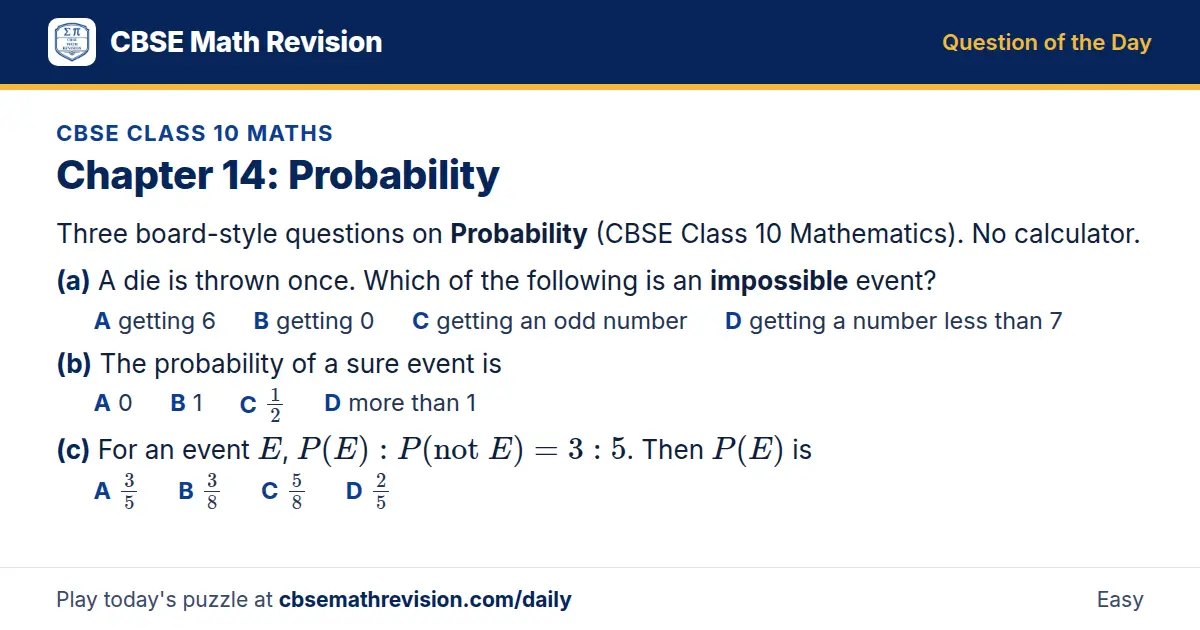
Chapter 14: Probability
Three board-style questions on Probability (CBSE Class 10 Mathematics). No calculator.
- A die is thrown once. Which of the following is an impossible event? Options: A) getting 6; B) getting 0; C) getting an odd number; D) getting a number less than 7
- The probability of a sure event is Options: A) 0; B) 1; C) 12; D) more than 1
- For an event E, P(E): P(not E) = 3: 5. Then P(E) is Options: A) 35; B) 38; C) 58; D) 25
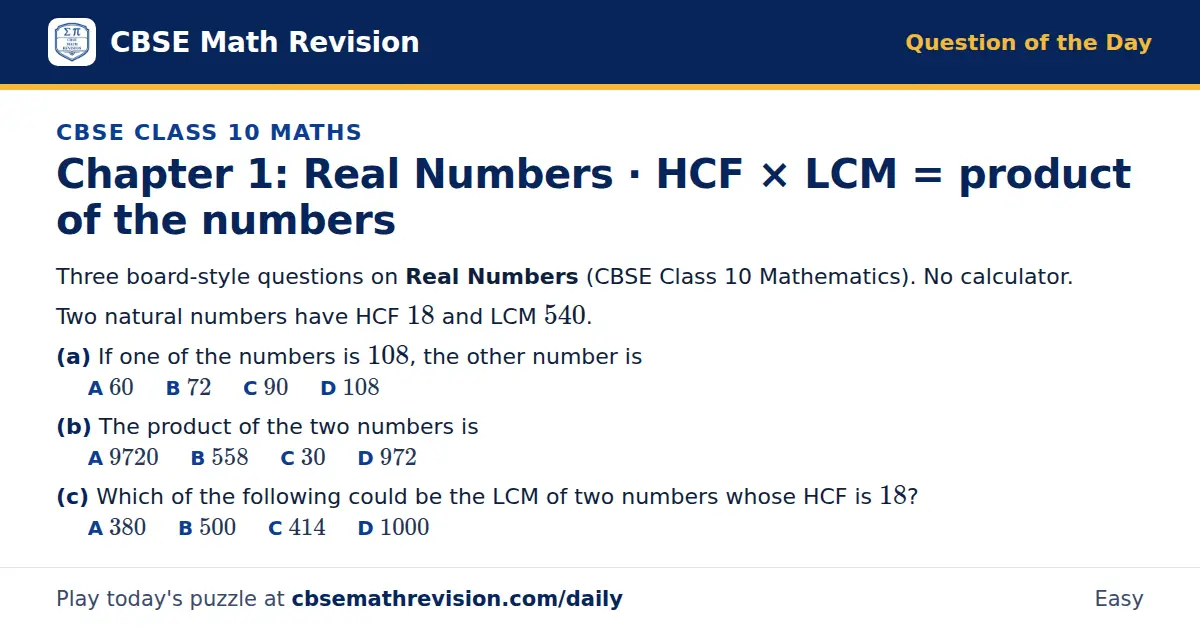
Chapter 1: Real Numbers · HCF × LCM = product of the numbers
Three board-style questions on Real Numbers (CBSE Class 10 Mathematics). No calculator. Two natural numbers have HCF 18 and LCM 540.
- If one of the numbers is 108, the other number is Options: A) 60; B) 72; C) 90; D) 108
- The product of the two numbers is Options: A) 9720; B) 558; C) 30; D) 972
- Which of the following could be the LCM of two numbers whose HCF is 18? Options: A) 380; B) 500; C) 414; D) 1000
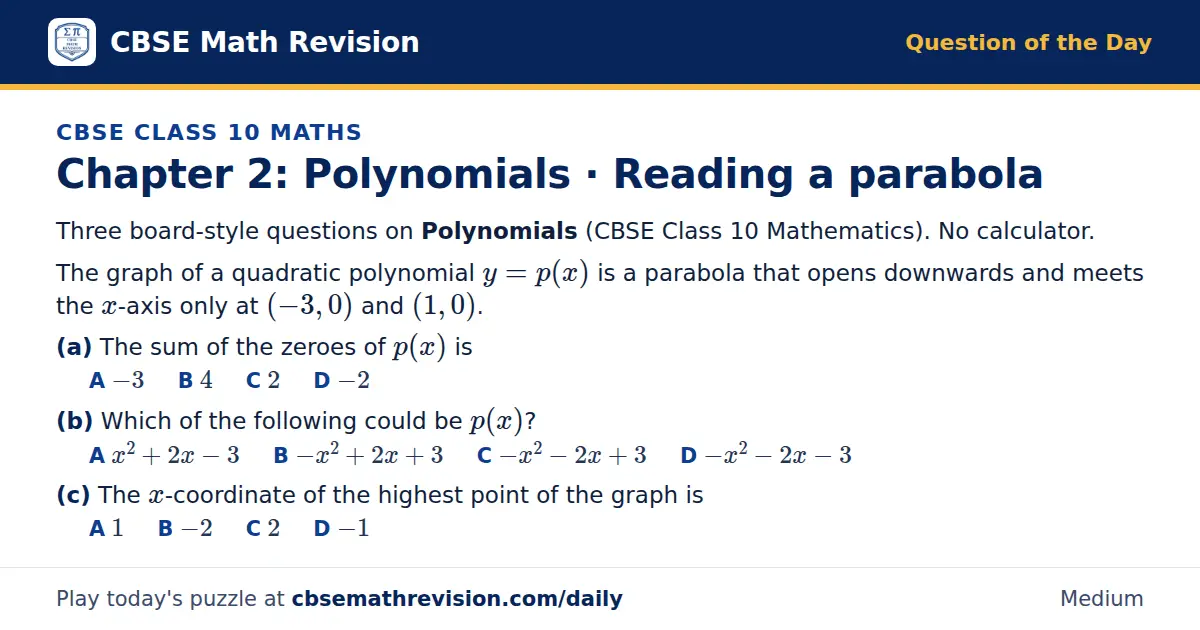
Chapter 2: Polynomials · Reading a parabola
Three board-style questions on Polynomials (CBSE Class 10 Mathematics). No calculator. The graph of a quadratic polynomial y = p(x) is a parabola that opens downwards and meets the x-axis only at (-3, 0) and (1, 0).
- The sum of the zeroes of p(x) is Options: A) -3; B) 4; C) 2; D) -2
- Which of the following could be p(x)? Options: A) x² + 2x - 3; B) -x² + 2x + 3; C) -x² - 2x + 3; D) -x² - 2x - 3
- The x-coordinate of the highest point of the graph is Options: A) 1; B) -2; C) 2; D) -1
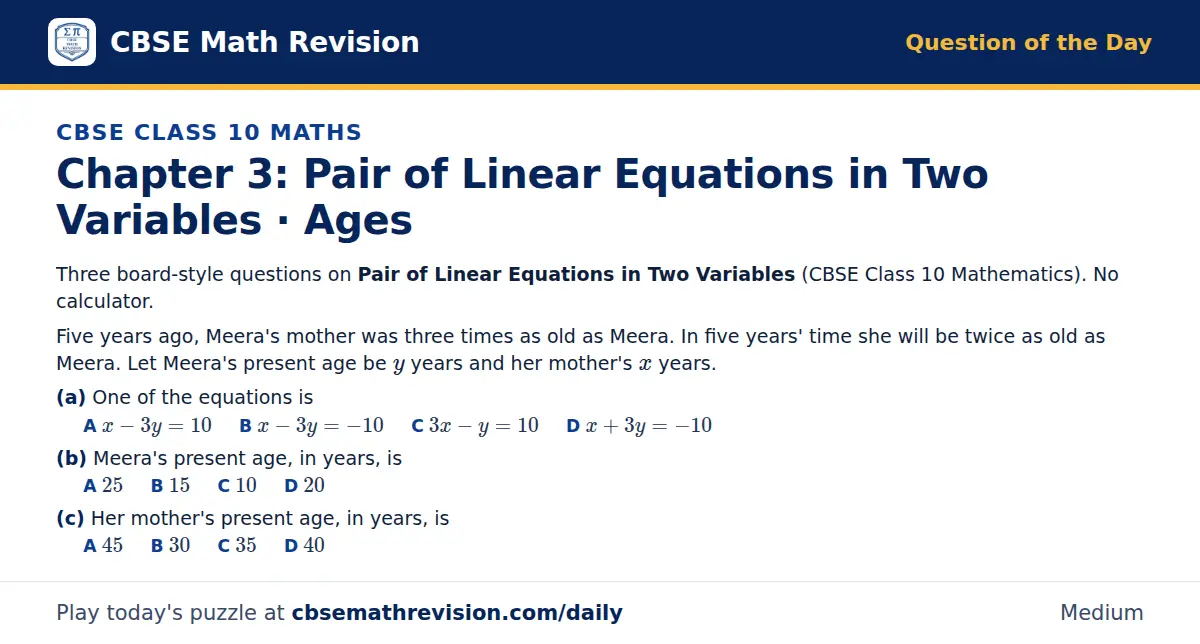
Chapter 3: Pair of Linear Equations in Two Variables · Ages
Three board-style questions on Pair of Linear Equations in Two Variables (CBSE Class 10 Mathematics). No calculator. Five years ago, Meera's mother was three times as old as Meera. In five years' time she will be twice as old as Meera. Let Meera's present age be y years and her mother's x years.
- One of the equations is Options: A) x - 3y = 10; B) x - 3y = -10; C) 3x - y = 10; D) x + 3y = -10
- Meera's present age, in years, is Options: A) 25; B) 15; C) 10; D) 20
- Her mother's present age, in years, is Options: A) 45; B) 30; C) 35; D) 40
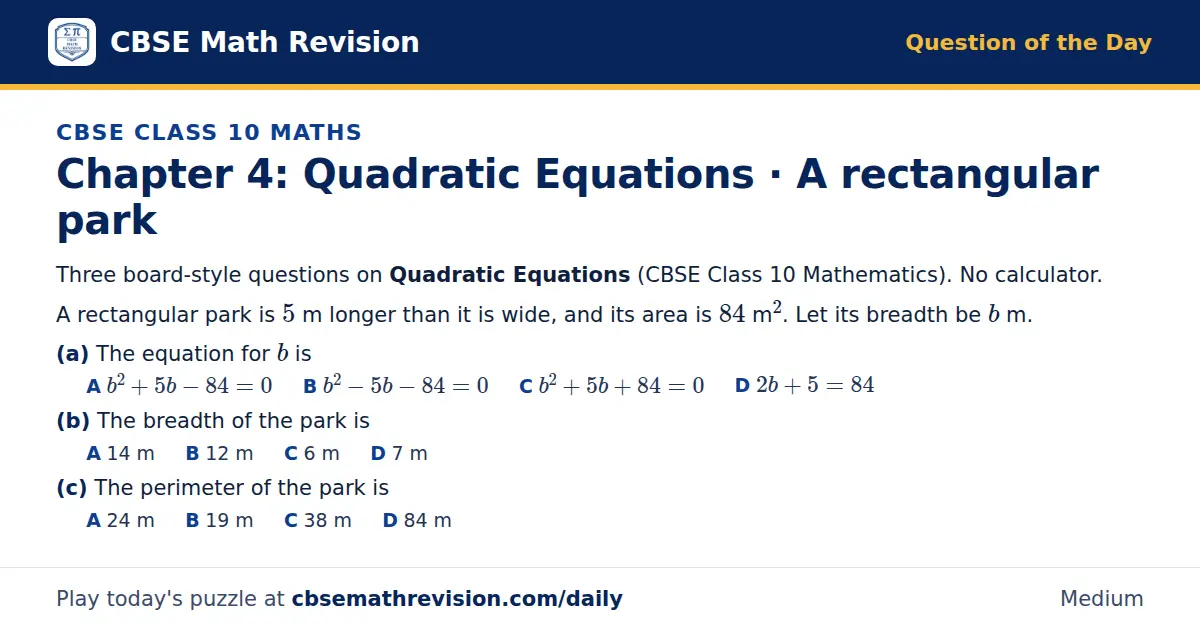
Chapter 4: Quadratic Equations · A rectangular park
Three board-style questions on Quadratic Equations (CBSE Class 10 Mathematics). No calculator. A rectangular park is 5 m longer than it is wide, and its area is 84 m^2. Let its breadth be b m.
- The equation for b is Options: A) b² + 5b - 84 = 0; B) b² - 5b - 84 = 0; C) b² + 5b + 84 = 0; D) 2b + 5 = 84
- The breadth of the park is Options: A) 14 m; B) 12 m; C) 6 m; D) 7 m
- The perimeter of the park is Options: A) 24 m; B) 19 m; C) 38 m; D) 84 m
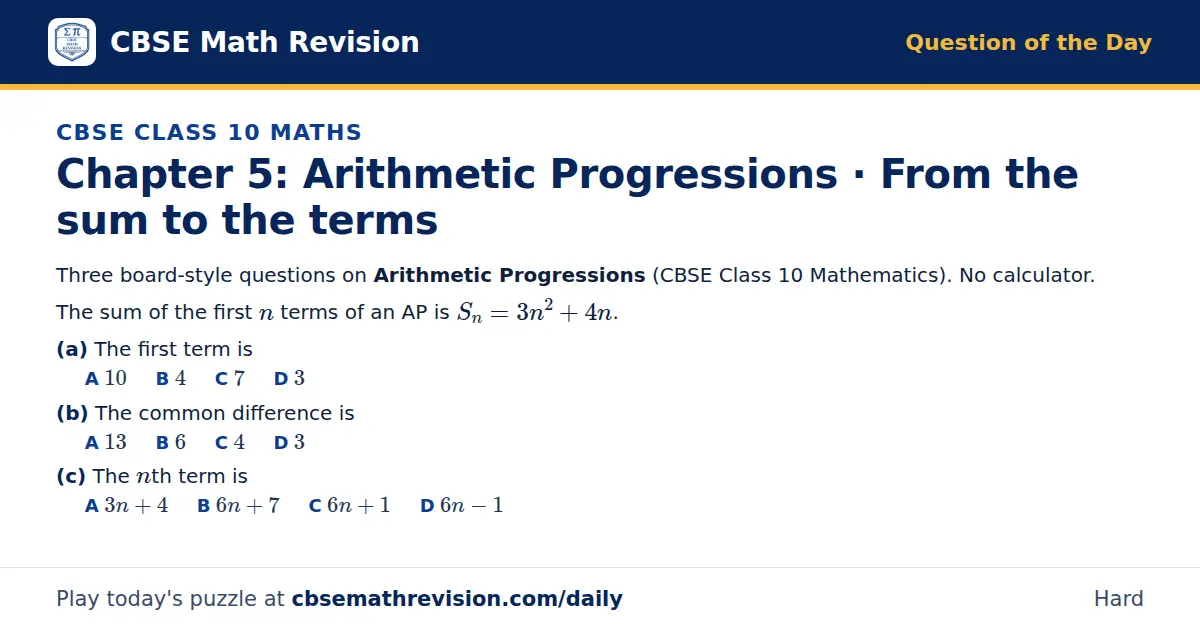
Chapter 5: Arithmetic Progressions · From the sum to the terms
Three board-style questions on Arithmetic Progressions (CBSE Class 10 Mathematics). No calculator. The sum of the first n terms of an AP is S_n = 3n² + 4n.
- The first term is Options: A) 10; B) 4; C) 7; D) 3
- The common difference is Options: A) 13; B) 6; C) 4; D) 3
- The nth term is Options: A) 3n + 4; B) 6n + 7; C) 6n + 1; D) 6n - 1
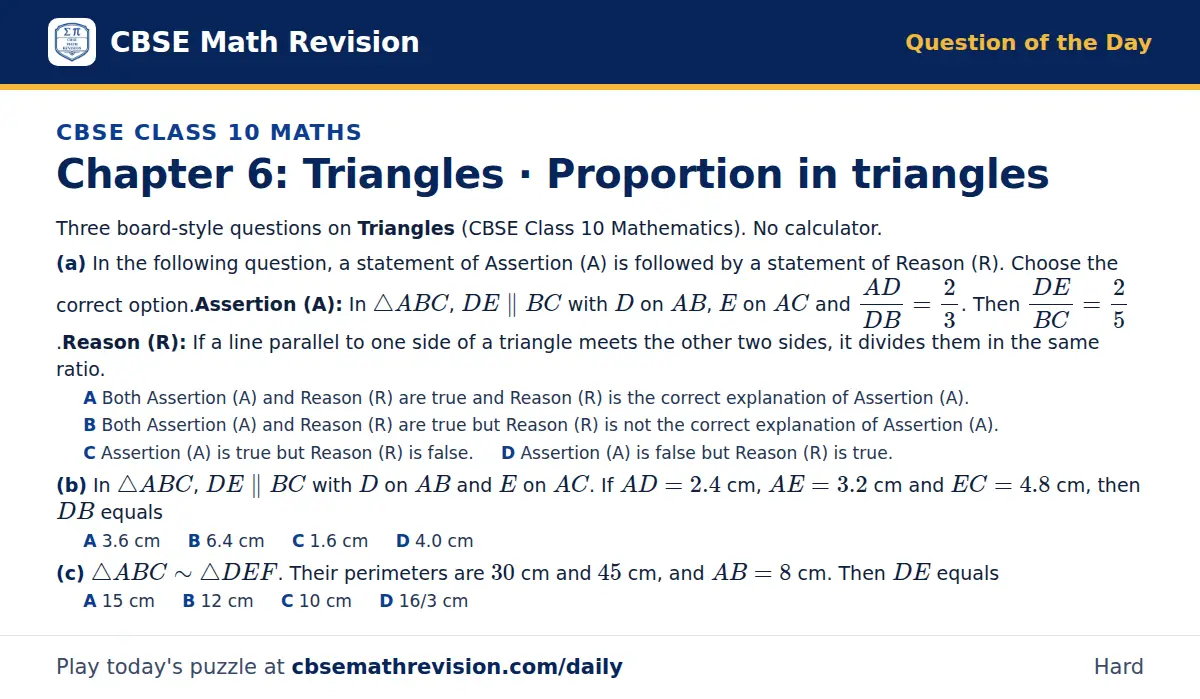
Chapter 6: Triangles · Proportion in triangles
Three board-style questions on Triangles (CBSE Class 10 Mathematics). No calculator.
- In the following question, a statement of Assertion (A) is followed by a statement of Reason (R). Choose the correct option. Assertion (A): In △ ABC, DE ∥ BC with D on AB, E on AC and AD/DB = 23. Then DE/BC = 25. Reason (R): If a line parallel to one side of a triangle meets the other two sides, it divides them in the same ratio. Options: A) Both Assertion (A) and Reason (R) are true and Reason (R) is the correct explanation of Assertion (A).; B) Both Assertion (A) and Reason (R) are true but Reason (R) is not the correct explanation of Assertion (A).; C) Assertion (A) is true but Reason (R) is false.; D) Assertion (A) is false but Reason (R) is true.
- In △ ABC, DE ∥ BC with D on AB and E on AC. If AD = 2.4 cm, AE = 3.2 cm and EC = 4.8 cm, then DB equals Options: A) 3.6 cm; B) 6.4 cm; C) 1.6 cm; D) 4.0 cm
- △ ABC △ DEF. Their perimeters are 30 cm and 45 cm, and AB = 8 cm. Then DE equals Options: A) 15 cm; B) 12 cm; C) 10 cm; D) 16/3 cm
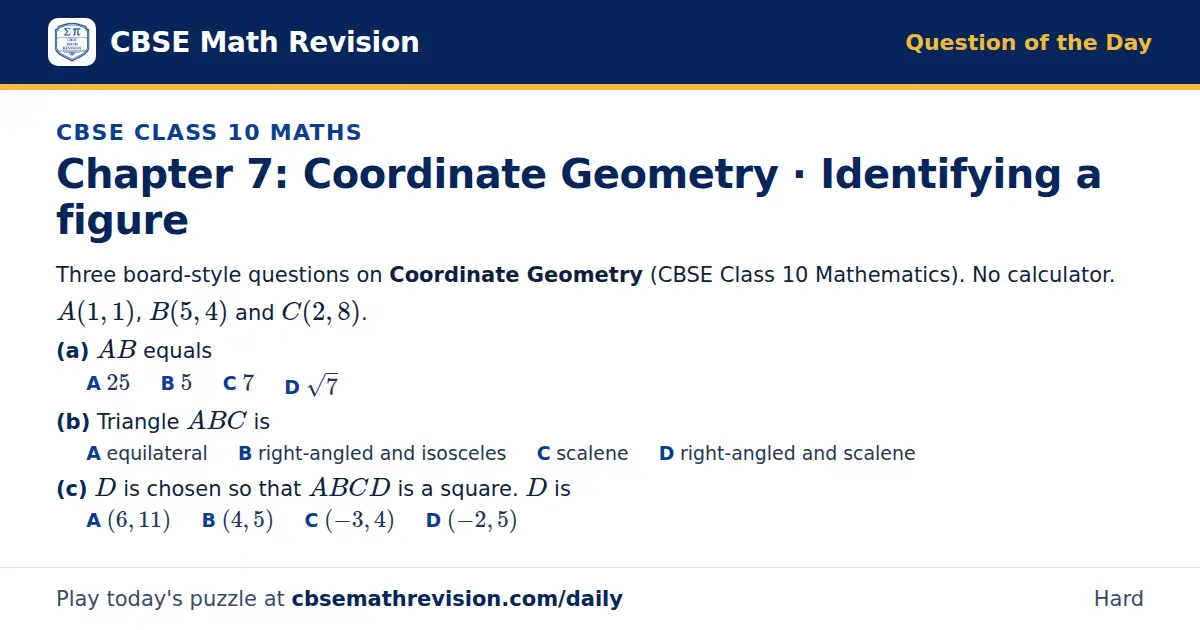
Chapter 7: Coordinate Geometry · Identifying a figure
Three board-style questions on Coordinate Geometry (CBSE Class 10 Mathematics). No calculator. A(1, 1), B(5, 4) and C(2, 8).
- AB equals Options: A) 25; B) 5; C) 7; D) √7
- Triangle ABC is Options: A) equilateral; B) right-angled and isosceles; C) scalene; D) right-angled and scalene
- D is chosen so that ABCD is a square. D is Options: A) (6, 11); B) (4, 5); C) (-3, 4); D) (-2, 5)
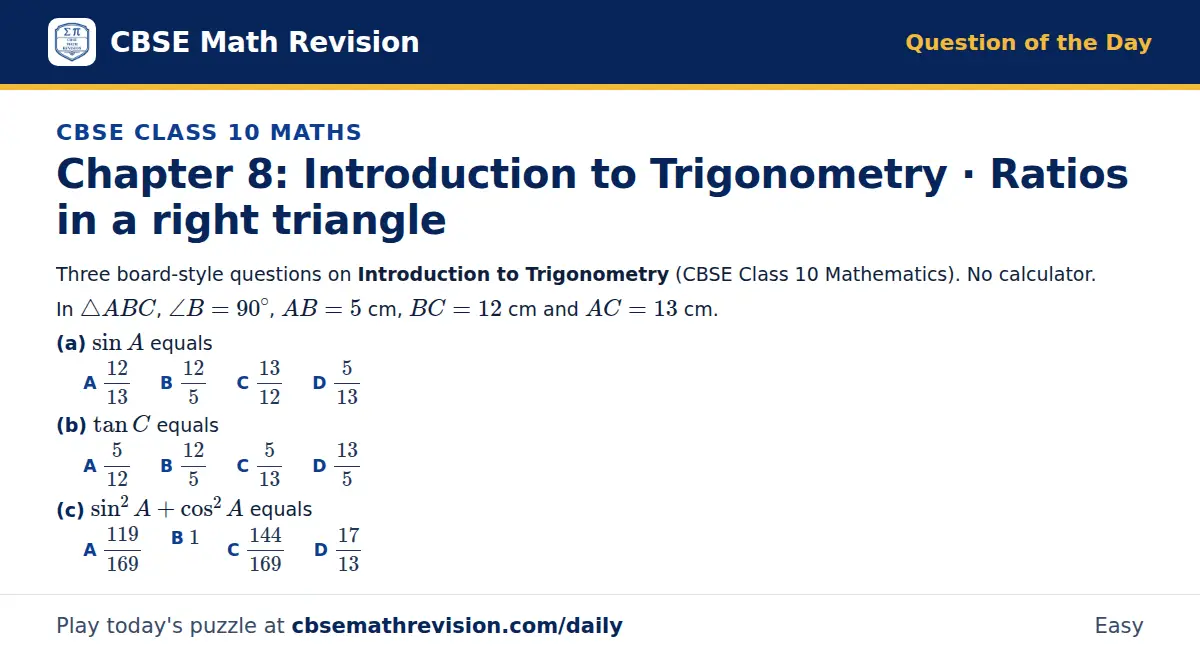
Chapter 8: Introduction to Trigonometry · Ratios in a right triangle
Three board-style questions on Introduction to Trigonometry (CBSE Class 10 Mathematics). No calculator. In △ ABC, ∠ B = 90^∘, AB = 5 cm, BC = 12 cm and AC = 13 cm.
- sin A equals Options: A) 12/13; B) 12/5; C) 13/12; D) 5/13
- tan C equals Options: A) 5/12; B) 12/5; C) 5/13; D) 13/5
- sin² A + cos² A equals Options: A) 119/169; B) 1; C) 144/169; D) 17/13
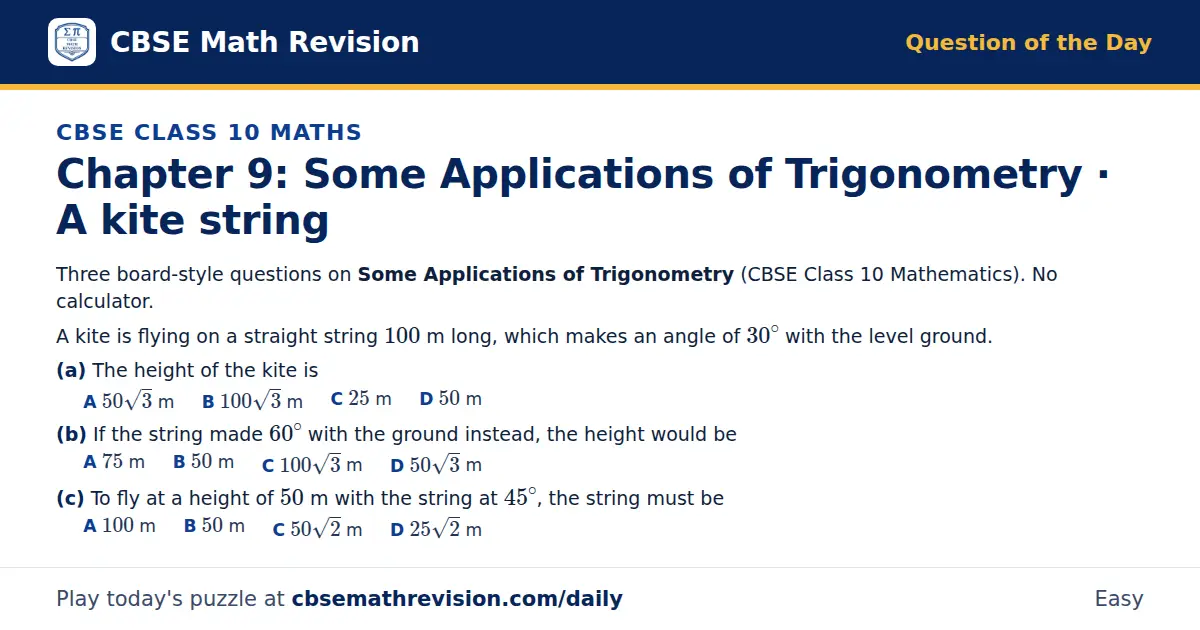
Chapter 9: Some Applications of Trigonometry · A kite string
Three board-style questions on Some Applications of Trigonometry (CBSE Class 10 Mathematics). No calculator. A kite is flying on a straight string 100 m long, which makes an angle of 30^∘ with the level ground.
- The height of the kite is Options: A) 50√3 m; B) 100√3 m; C) 25 m; D) 50 m
- If the string made 60^∘ with the ground instead, the height would be Options: A) 75 m; B) 50 m; C) 100√3 m; D) 50√3 m
- To fly at a height of 50 m with the string at 45^∘, the string must be Options: A) 100 m; B) 50 m; C) 50√2 m; D) 25√2 m
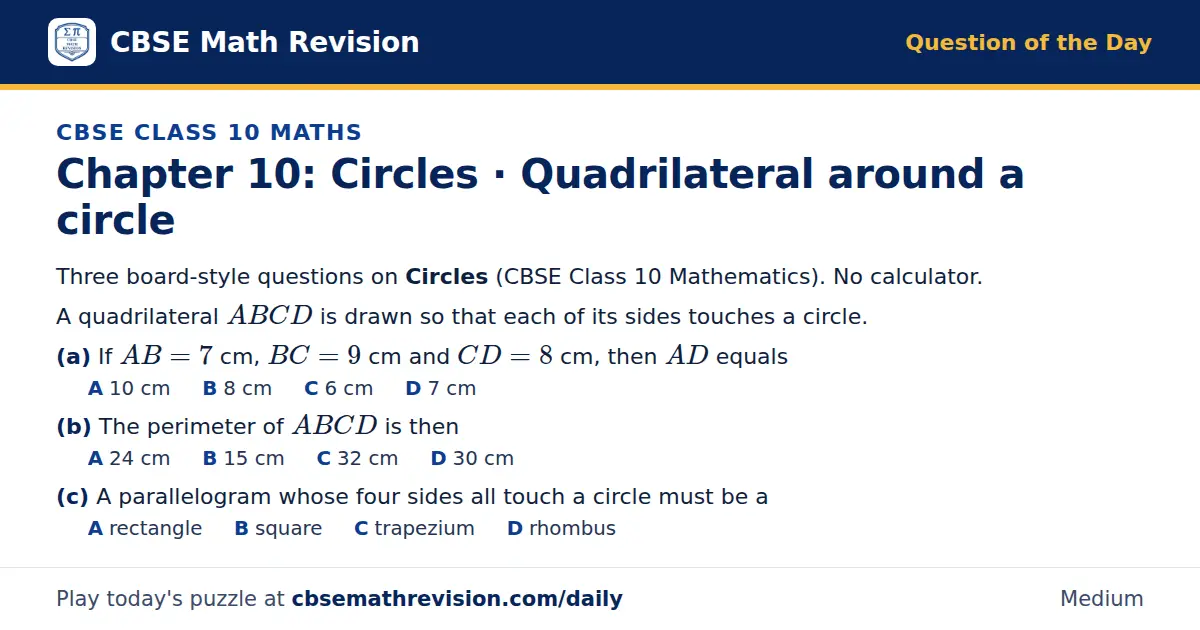
Chapter 10: Circles · Quadrilateral around a circle
Three board-style questions on Circles (CBSE Class 10 Mathematics). No calculator. A quadrilateral ABCD is drawn so that each of its sides touches a circle.
- If AB = 7 cm, BC = 9 cm and CD = 8 cm, then AD equals Options: A) 10 cm; B) 8 cm; C) 6 cm; D) 7 cm
- The perimeter of ABCD is then Options: A) 24 cm; B) 15 cm; C) 32 cm; D) 30 cm
- A parallelogram whose four sides all touch a circle must be a Options: A) rectangle; B) square; C) trapezium; D) rhombus
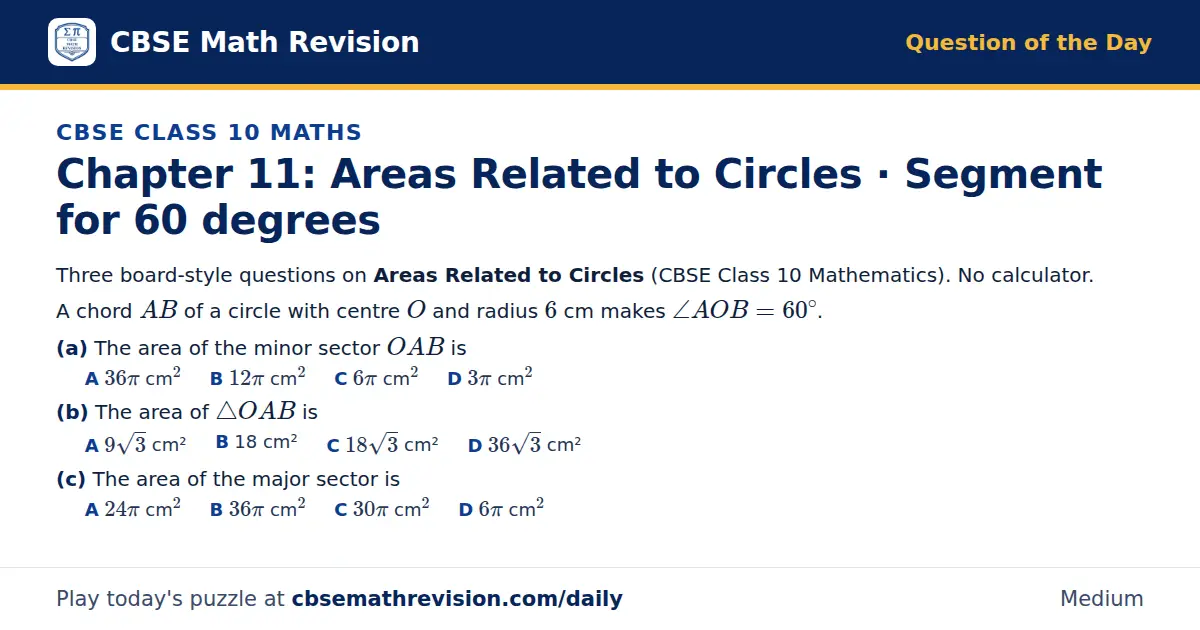
Chapter 11: Areas Related to Circles · Segment for 60 degrees
Three board-style questions on Areas Related to Circles (CBSE Class 10 Mathematics). No calculator. A chord AB of a circle with centre O and radius 6 cm makes ∠ AOB = 60^∘.
- The area of the minor sector OAB is Options: A) 36π cm²; B) 12π cm²; C) 6π cm²; D) 3π cm²
- The area of △ OAB is Options: A) 9√3 cm²; B) 18 cm²; C) 18√3 cm²; D) 36√3 cm²
- The area of the major sector is Options: A) 24π cm²; B) 36π cm²; C) 30π cm²; D) 6π cm²
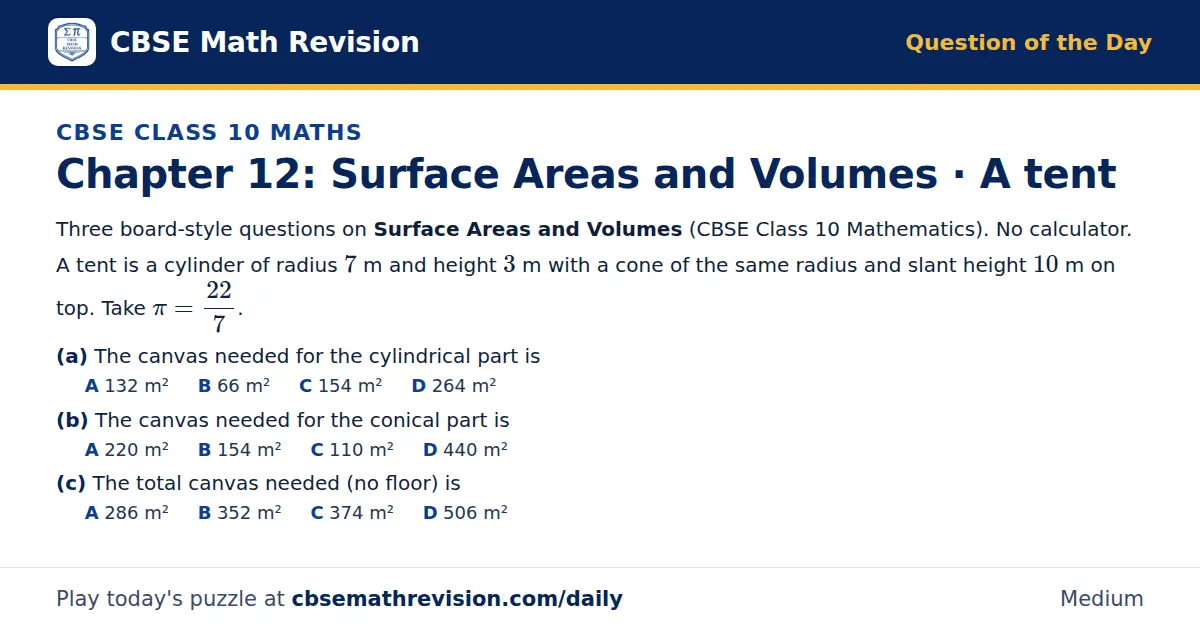
Chapter 12: Surface Areas and Volumes · A tent
Three board-style questions on Surface Areas and Volumes (CBSE Class 10 Mathematics). No calculator. A tent is a cylinder of radius 7 m and height 3 m with a cone of the same radius and slant height 10 m on top. Take π = 22/7.
- The canvas needed for the cylindrical part is Options: A) 132 m²; B) 66 m²; C) 154 m²; D) 264 m²
- The canvas needed for the conical part is Options: A) 220 m²; B) 154 m²; C) 110 m²; D) 440 m²
- The total canvas needed (no floor) is Options: A) 286 m²; B) 352 m²; C) 374 m²; D) 506 m²
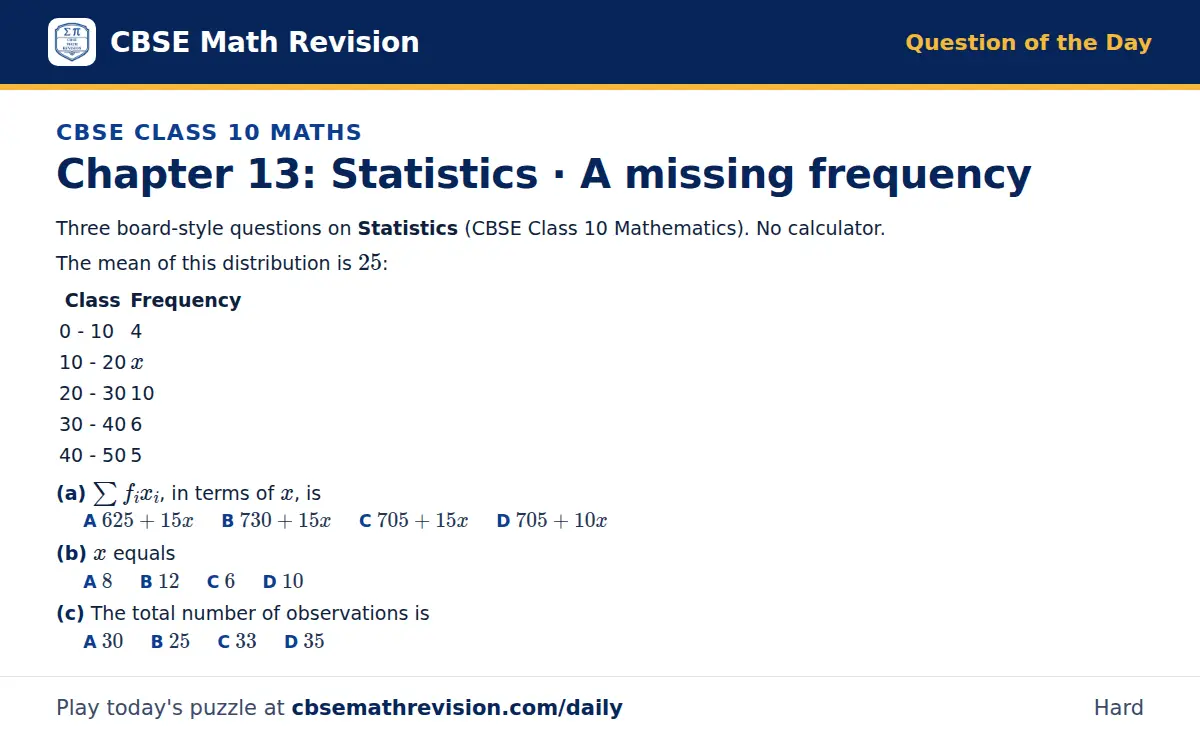
Chapter 13: Statistics · A missing frequency
Three board-style questions on Statistics (CBSE Class 10 Mathematics). No calculator. The mean of this distribution is 25: ClassFrequency0 - 10410 - 20x20 - 301030 - 40640 - 505
- Σ f_i x_i, in terms of x, is Options: A) 625 + 15x; B) 730 + 15x; C) 705 + 15x; D) 705 + 10x
- x equals Options: A) 8; B) 12; C) 6; D) 10
- The total number of observations is Options: A) 30; B) 25; C) 33; D) 35
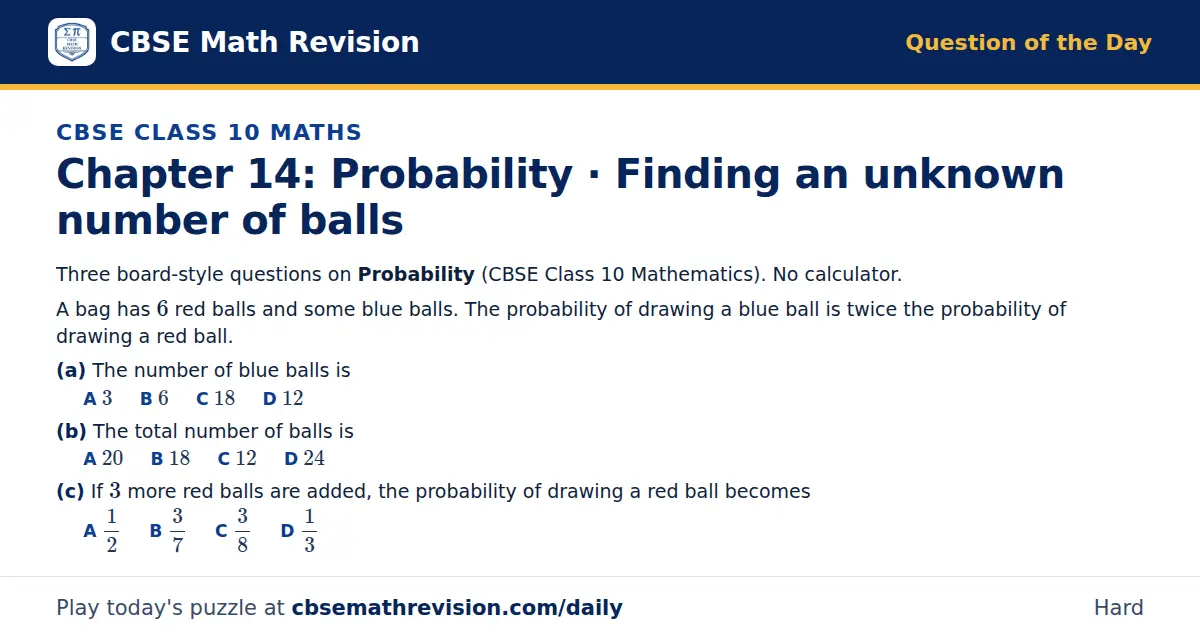
Chapter 14: Probability · Finding an unknown number of balls
Three board-style questions on Probability (CBSE Class 10 Mathematics). No calculator. A bag has 6 red balls and some blue balls. The probability of drawing a blue ball is twice the probability of drawing a red ball.
- The number of blue balls is Options: A) 3; B) 6; C) 18; D) 12
- The total number of balls is Options: A) 20; B) 18; C) 12; D) 24
- If 3 more red balls are added, the probability of drawing a red ball becomes Options: A) 1/2; B) 3/7; C) 3/8; D) 1/3
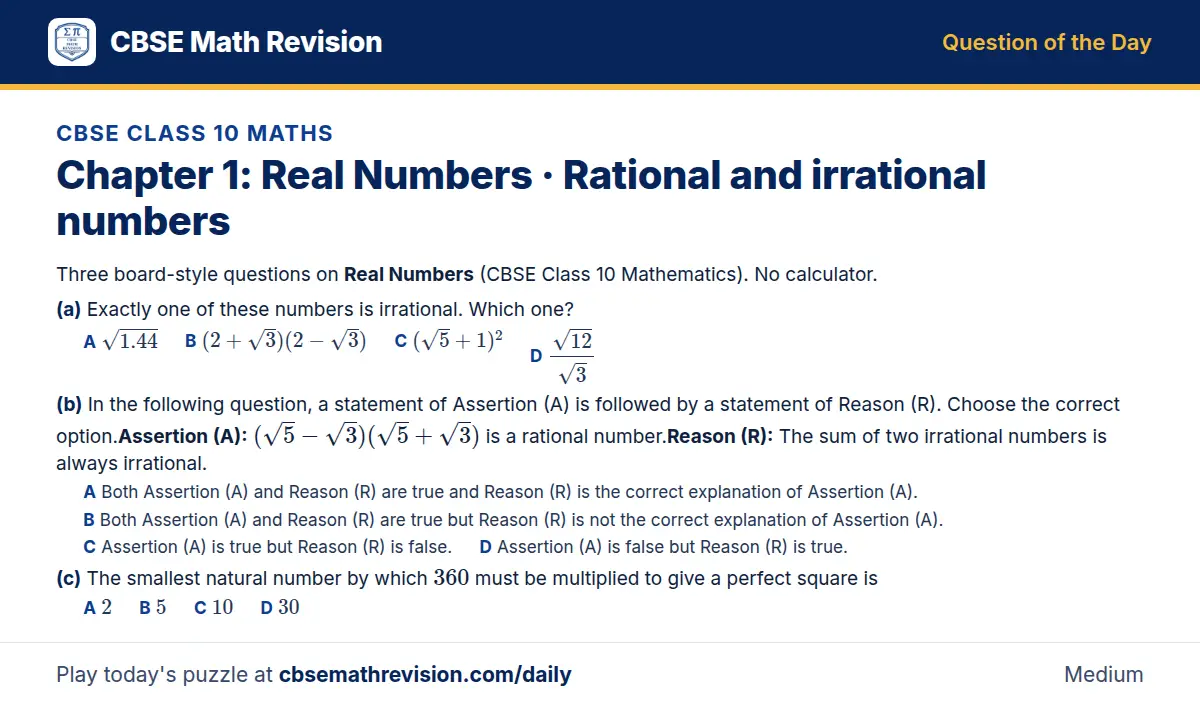
Chapter 1: Real Numbers · Rational and irrational numbers
Three board-style questions on Real Numbers (CBSE Class 10 Mathematics). No calculator.
- Exactly one of these numbers is irrational. Which one? Options: A) √(1.44); B) (2+√3)(2-√3); C) (√5+1)²; D) (√12)/(√3)
- In the following question, a statement of Assertion (A) is followed by a statement of Reason (R). Choose the correct option. Assertion (A): (√5 - √3)(√5 + √3) is a rational number. Reason (R): The sum of two irrational numbers is always irrational. Options: A) Both Assertion (A) and Reason (R) are true and Reason (R) is the correct explanation of Assertion (A).; B) Both Assertion (A) and Reason (R) are true but Reason (R) is not the correct explanation of Assertion (A).; C) Assertion (A) is true but Reason (R) is false.; D) Assertion (A) is false but Reason (R) is true.
- The smallest natural number by which 360 must be multiplied to give a perfect square is Options: A) 2; B) 5; C) 10; D) 30
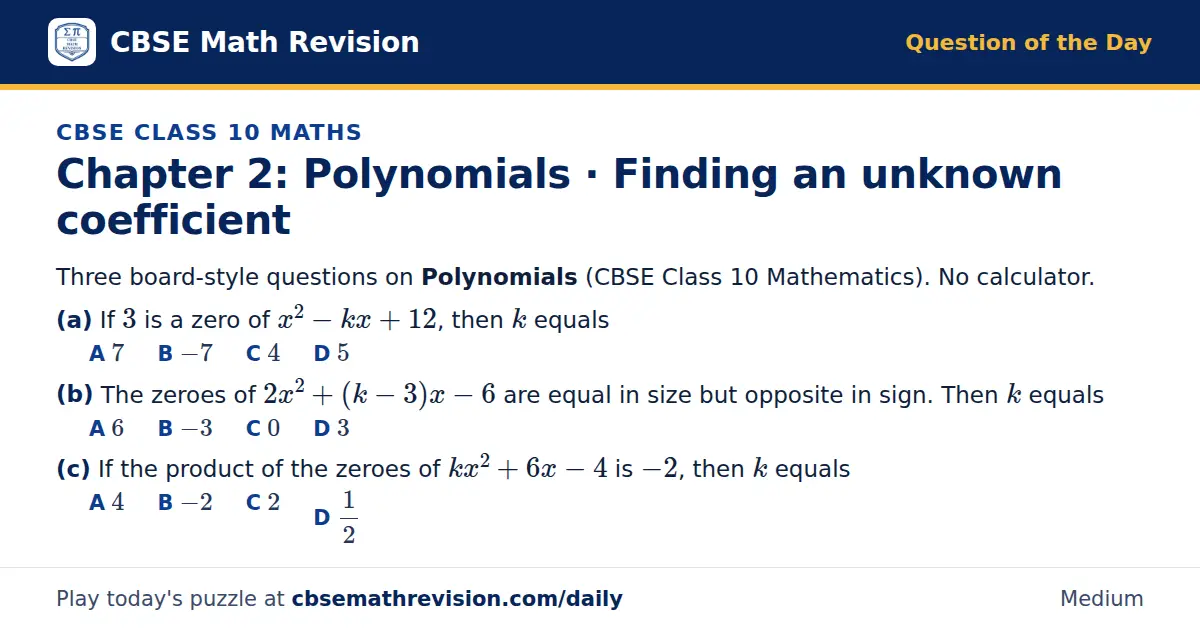
Chapter 2: Polynomials · Finding an unknown coefficient
Three board-style questions on Polynomials (CBSE Class 10 Mathematics). No calculator.
- If 3 is a zero of x² - kx + 12, then k equals Options: A) 7; B) -7; C) 4; D) 5
- The zeroes of 2x² + (k - 3)x - 6 are equal in size but opposite in sign. Then k equals Options: A) 6; B) -3; C) 0; D) 3
- If the product of the zeroes of kx² + 6x - 4 is -2, then k equals Options: A) 4; B) -2; C) 2; D) 1/2
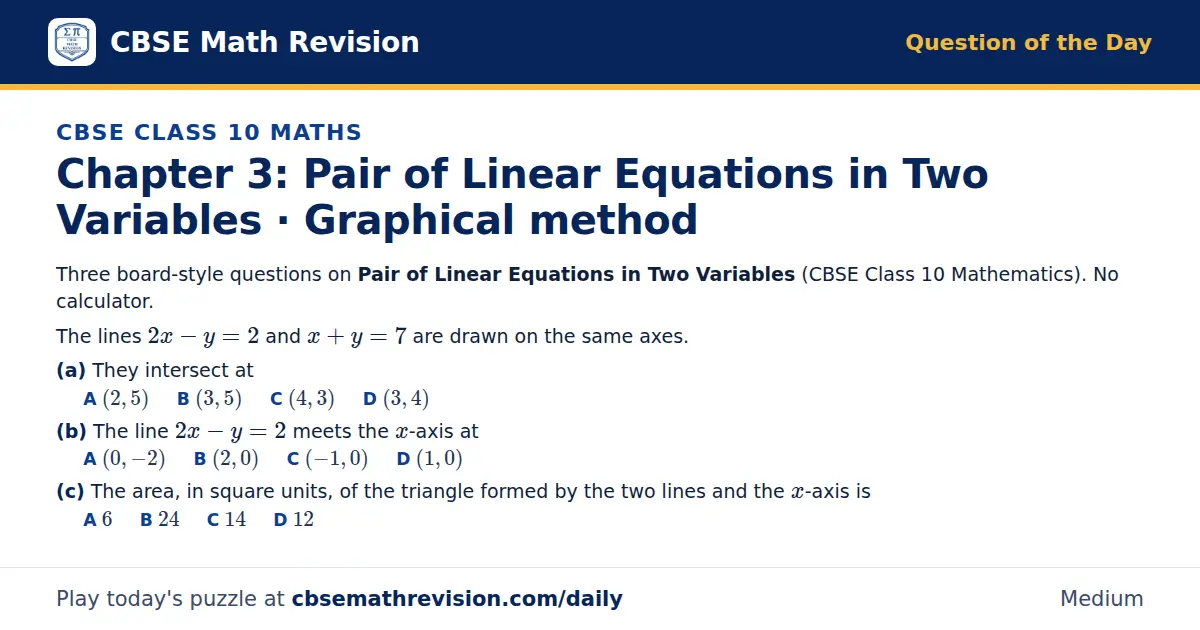
Chapter 3: Pair of Linear Equations in Two Variables · Graphical method
Three board-style questions on Pair of Linear Equations in Two Variables (CBSE Class 10 Mathematics). No calculator. The lines 2x - y = 2 and x + y = 7 are drawn on the same axes.
- They intersect at Options: A) (2, 5); B) (3, 5); C) (4, 3); D) (3, 4)
- The line 2x - y = 2 meets the x-axis at Options: A) (0, -2); B) (2, 0); C) (-1, 0); D) (1, 0)
- The area, in square units, of the triangle formed by the two lines and the x-axis is Options: A) 6; B) 24; C) 14; D) 12
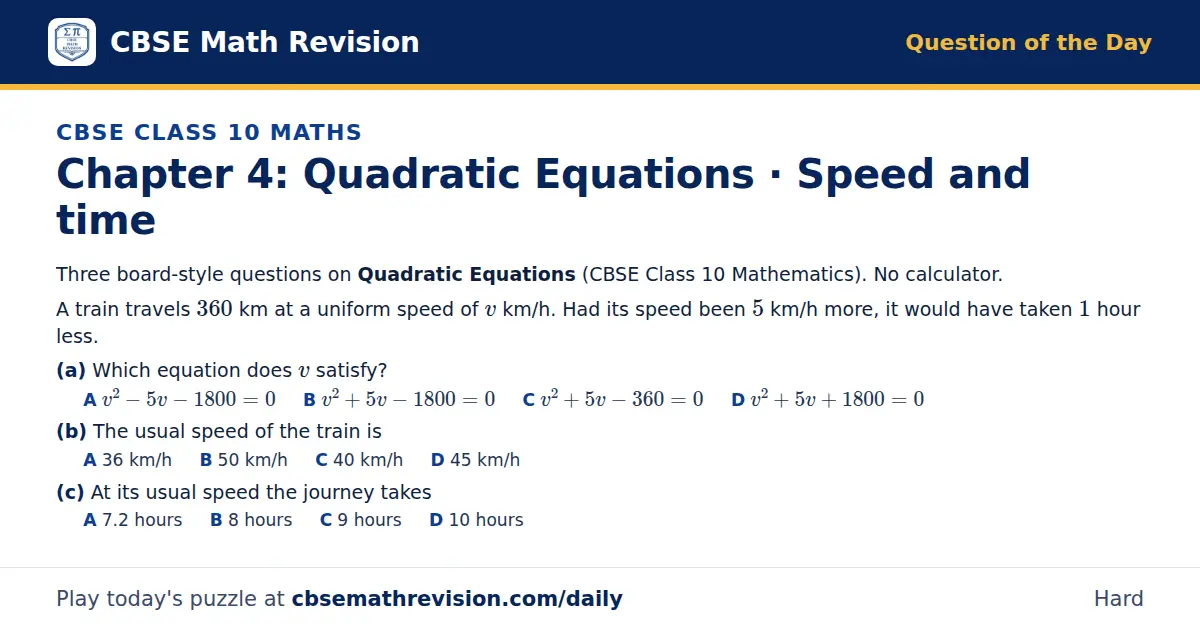
Chapter 4: Quadratic Equations · Speed and time
Three board-style questions on Quadratic Equations (CBSE Class 10 Mathematics). No calculator. A train travels 360 km at a uniform speed of v km/h. Had its speed been 5 km/h more, it would have taken 1 hour less.
- Which equation does v satisfy? Options: A) v² - 5v - 1800 = 0; B) v² + 5v - 1800 = 0; C) v² + 5v - 360 = 0; D) v² + 5v + 1800 = 0
- The usual speed of the train is Options: A) 36 km/h; B) 50 km/h; C) 40 km/h; D) 45 km/h
- At its usual speed the journey takes Options: A) 7.2 hours; B) 8 hours; C) 9 hours; D) 10 hours
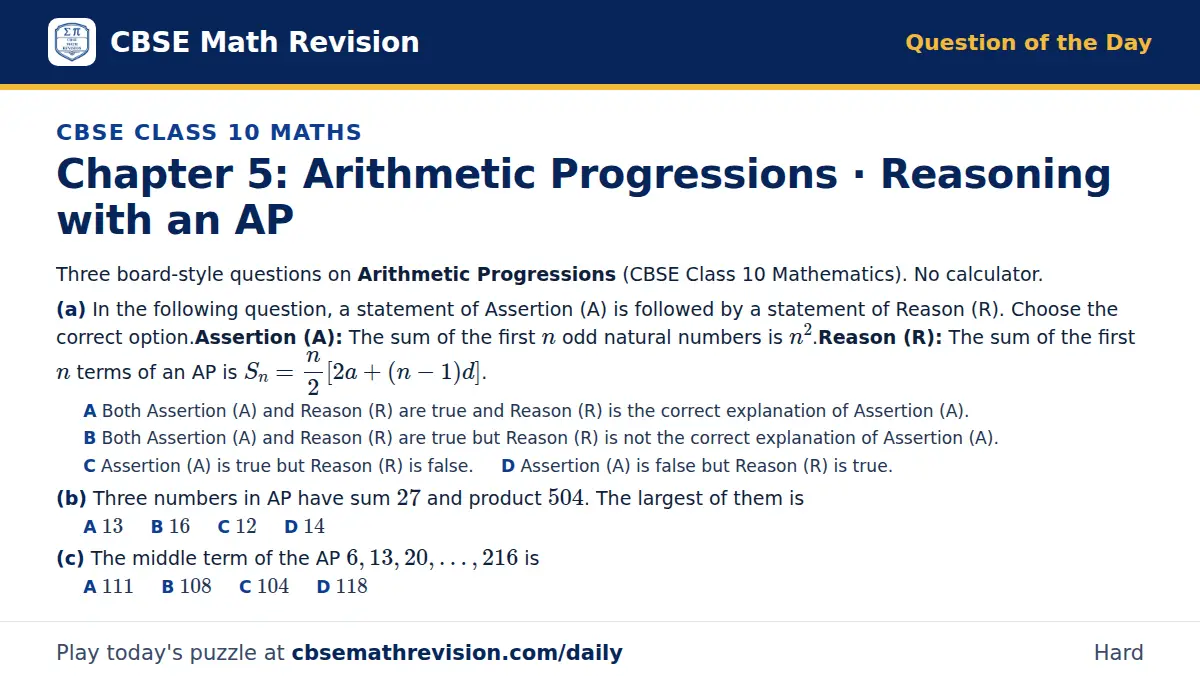
Chapter 5: Arithmetic Progressions · Reasoning with an AP
Three board-style questions on Arithmetic Progressions (CBSE Class 10 Mathematics). No calculator.
- In the following question, a statement of Assertion (A) is followed by a statement of Reason (R). Choose the correct option. Assertion (A): The sum of the first n odd natural numbers is n^2. Reason (R): The sum of the first n terms of an AP is S_n = n/2[2a + (n - 1)d]. Options: A) Both Assertion (A) and Reason (R) are true and Reason (R) is the correct explanation of Assertion (A).; B) Both Assertion (A) and Reason (R) are true but Reason (R) is not the correct explanation of Assertion (A).; C) Assertion (A) is true but Reason (R) is false.; D) Assertion (A) is false but Reason (R) is true.
- Three numbers in AP have sum 27 and product 504. The largest of them is Options: A) 13; B) 16; C) 12; D) 14
- The middle term of the AP 6, 13, 20, …, 216 is Options: A) 111; B) 108; C) 104; D) 118
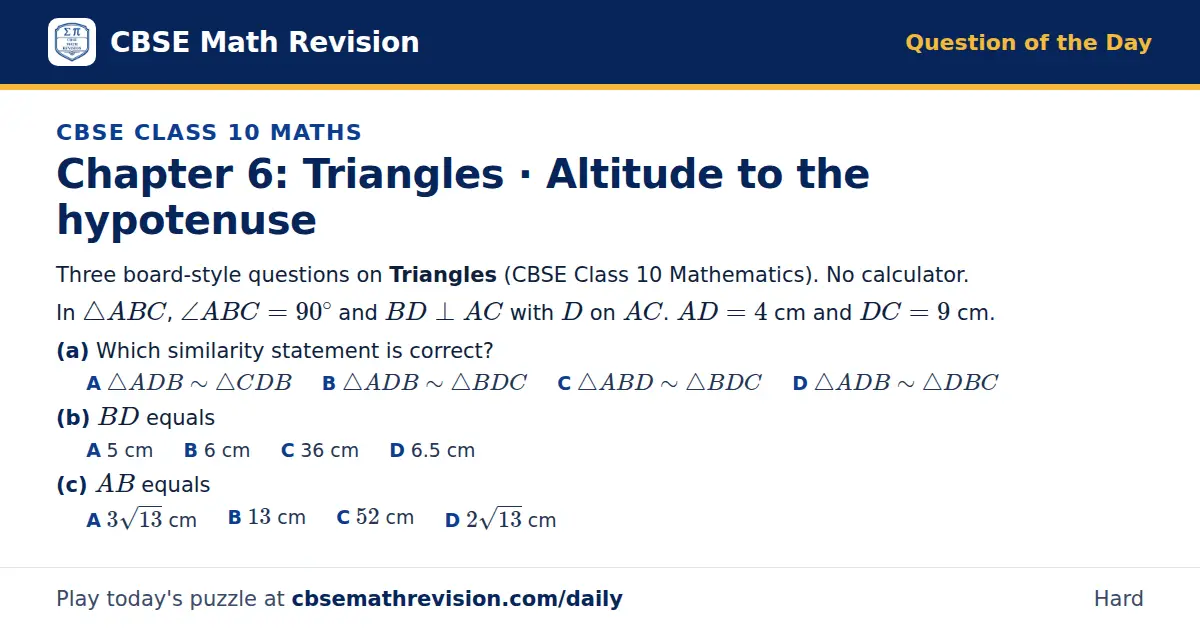
Chapter 6: Triangles · Altitude to the hypotenuse
Three board-style questions on Triangles (CBSE Class 10 Mathematics). No calculator. In △ ABC, ∠ ABC = 90^∘ and BD ⊥ AC with D on AC. AD = 4 cm and DC = 9 cm.
- Which similarity statement is correct? Options: A) △ ADB △ CDB; B) △ ADB △ BDC; C) △ ABD △ BDC; D) △ ADB △ DBC
- BD equals Options: A) 5 cm; B) 6 cm; C) 36 cm; D) 6.5 cm
- AB equals Options: A) 3√13 cm; B) 13 cm; C) 52 cm; D) 2√13 cm
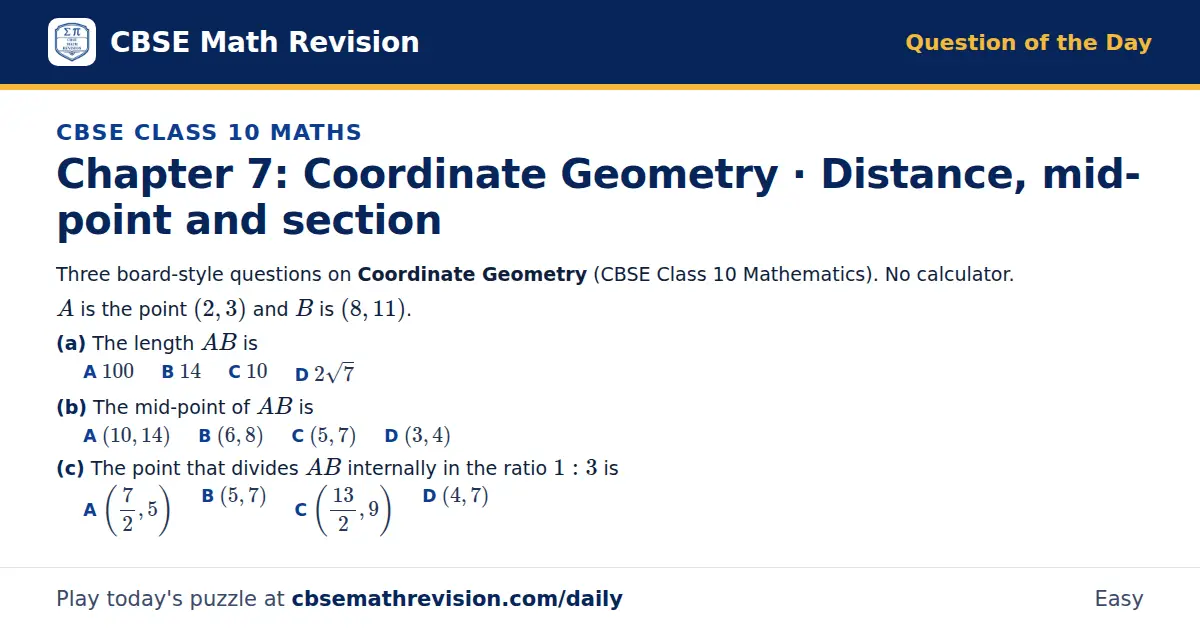
Chapter 7: Coordinate Geometry · Distance, mid-point and section
Three board-style questions on Coordinate Geometry (CBSE Class 10 Mathematics). No calculator. A is the point (2, 3) and B is (8, 11).
- The length AB is Options: A) 100; B) 14; C) 10; D) 2 √7
- The mid-point of AB is Options: A) (10, 14); B) (6, 8); C) (5, 7); D) (3, 4)
- The point that divides AB internally in the ratio 1: 3 is Options: A) (72, 5); B) (5, 7); C) (13/2, 9); D) (4, 7)
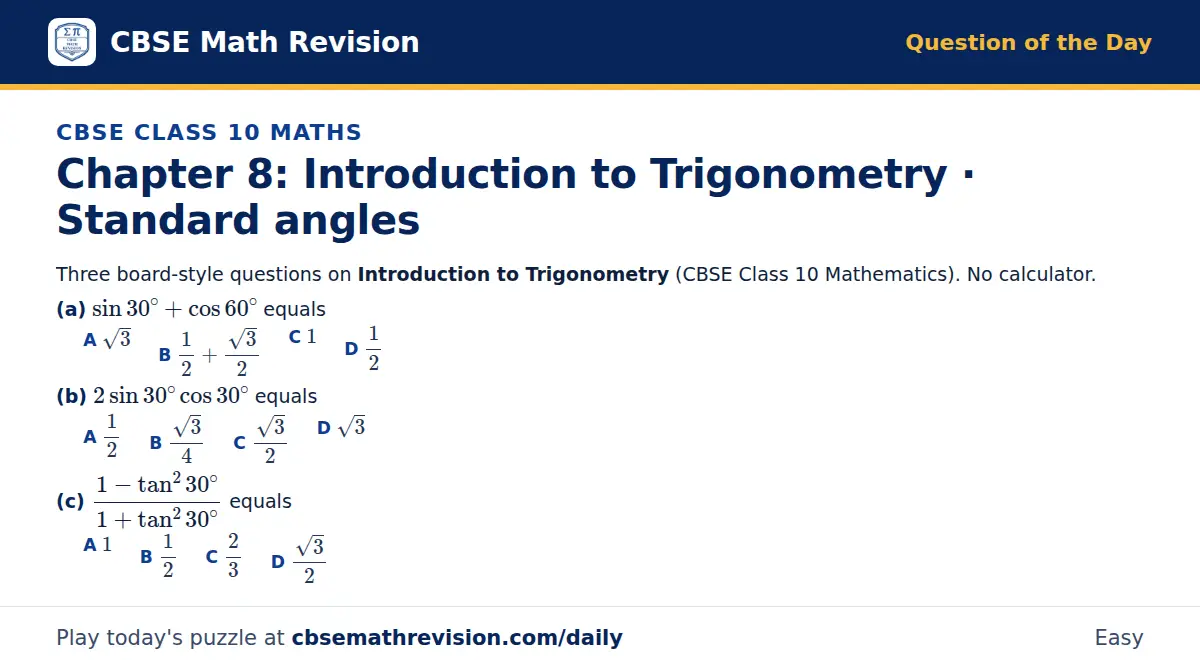
Chapter 8: Introduction to Trigonometry · Standard angles
Three board-style questions on Introduction to Trigonometry (CBSE Class 10 Mathematics). No calculator.
- sin 30^∘ + cos 60^∘ equals Options: A) √3; B) 1/2 + (√3)/2; C) 1; D) 1/2
- 2 sin 30^∘ cos 30^∘ equals Options: A) 1/2; B) (√3)/4; C) (√3)/2; D) √3
- (1 - tan² 30^∘)/(1 + tan² 30^∘) equals Options: A) 1; B) 1/2; C) 2/3; D) (√3)/2
Chapter 9: Some Applications of Trigonometry · Angle of depression
Three board-style questions on Some Applications of Trigonometry (CBSE Class 10 Mathematics). No calculator. From the top of a cliff 75 m high, the angle of depression of a boat is 30^∘. Later it is 60^∘.
- At first the boat is this far from the foot of the cliff: Options: A) 150 m; B) 75 m; C) 25√3 m; D) 75√3 m
- Later the boat is this far from the foot of the cliff: Options: A) 25 m; B) 50 m; C) 25√3 m; D) 75√3 m
- The distance the boat moved towards the cliff is Options: A) 50 m; B) 100√3 m; C) 75 m; D) 50√3 m
Chapter 10: Circles · Concentric circles
Three board-style questions on Circles (CBSE Class 10 Mathematics). No calculator.
- Two concentric circles have radii 5 cm and 3 cm. A chord of the larger circle touches the smaller circle. Its length is Options: A) 4 cm; B) 8 cm; C) 6 cm; D) 2√34 cm
- For concentric circles of radii 13 cm and 5 cm, such a chord has length Options: A) 24 cm; B) 16 cm; C) 12 cm; D) 18 cm
- A chord of length 16 cm of a circle of radius 10 cm touches a smaller concentric circle. The smaller radius is Options: A) 2√41 cm; B) 6 cm; C) 8 cm; D) 4 cm
Chapter 11: Areas Related to Circles · Segment for 120 degrees
Three board-style questions on Areas Related to Circles (CBSE Class 10 Mathematics). No calculator. A chord AB of a circle with centre O and radius 12 cm makes ∠ AOB = 120^∘. M is the foot of the perpendicular from O to AB.
- The length of the chord AB is Options: A) 24√3 cm; B) 12√3 cm; C) 6√3 cm; D) 12 cm
- The area of △ OAB is Options: A) 36√3 cm²; B) 18√3 cm²; C) 72√3 cm²; D) 72 cm²
- The area of the minor segment is Options: A) (144π - 36√3) cm²; B) (48π + 36√3) cm²; C) (48π - 36√3) cm²; D) (48π - 72√3) cm²
Chapter 12: Surface Areas and Volumes · Cone cut out of a cylinder
Three board-style questions on Surface Areas and Volumes (CBSE Class 10 Mathematics). No calculator. From a solid cylinder of radius 6 cm and height 8 cm, a cone of the same radius and height is hollowed out from one end. Leave answers in terms of π.
- The volume of the remaining solid is Options: A) 288π cm³; B) 192π cm³; C) 144π cm³; D) 96π cm³
- The slant height of the cone is Options: A) 10 cm; B) 14 cm; C) 2√7 cm; D) 12 cm
- The total surface area of the remaining solid is Options: A) 156π cm²; B) 132π cm²; C) 192π cm²; D) 228π cm²
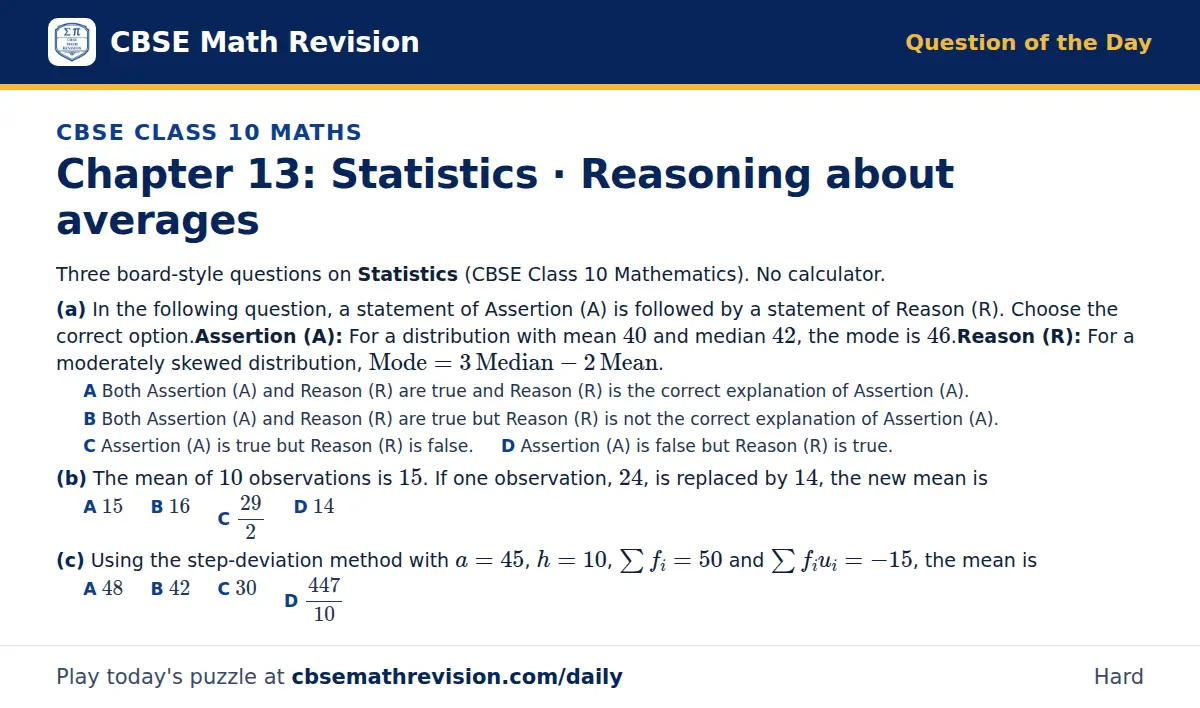
Chapter 13: Statistics · Reasoning about averages
Three board-style questions on Statistics (CBSE Class 10 Mathematics). No calculator.
- In the following question, a statement of Assertion (A) is followed by a statement of Reason (R). Choose the correct option. Assertion (A): For a distribution with mean 40 and median 42, the mode is 46. Reason (R): For a moderately skewed distribution, Mode = 3 Median - 2 Mean. Options: A) Both Assertion (A) and Reason (R) are true and Reason (R) is the correct explanation of Assertion (A).; B) Both Assertion (A) and Reason (R) are true but Reason (R) is not the correct explanation of Assertion (A).; C) Assertion (A) is true but Reason (R) is false.; D) Assertion (A) is false but Reason (R) is true.
- The mean of 10 observations is 15. If one observation, 24, is replaced by 14, the new mean is Options: A) 15; B) 16; C) 29/2; D) 14
- Using the step-deviation method with a = 45, h = 10, Σ f_i = 50 and Σ f_i u_i = -15, the mean is Options: A) 48; B) 42; C) 30; D) 447/10
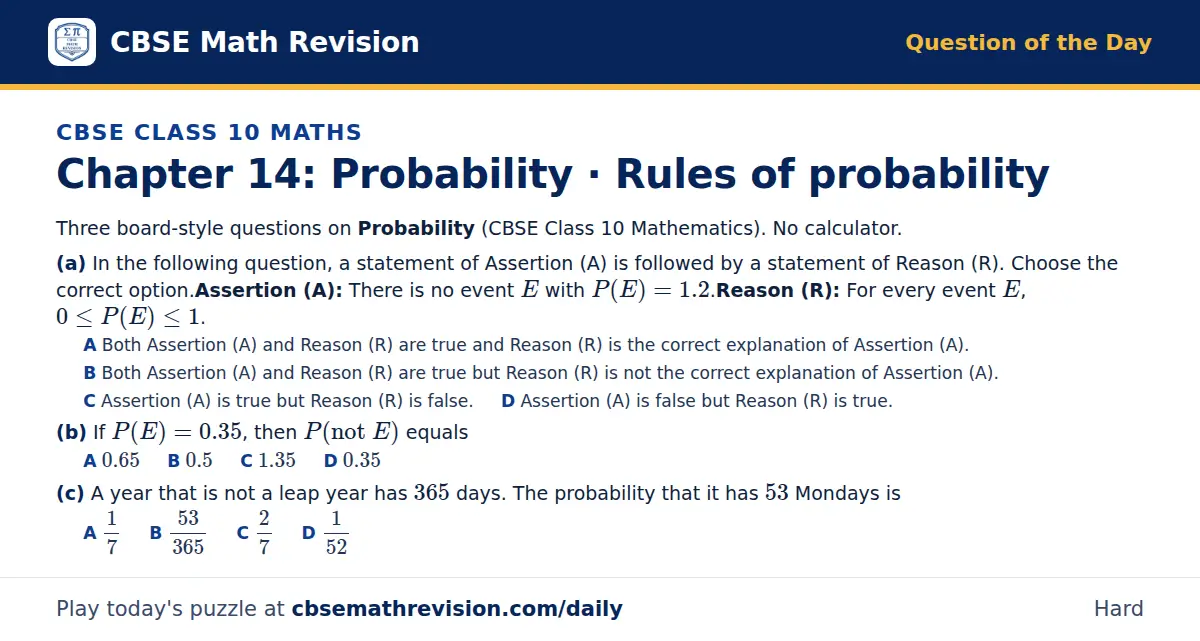
Chapter 14: Probability · Rules of probability
Three board-style questions on Probability (CBSE Class 10 Mathematics). No calculator.
- In the following question, a statement of Assertion (A) is followed by a statement of Reason (R). Choose the correct option. Assertion (A): There is no event E with P(E) = 1.2. Reason (R): For every event E, 0 ≤ P(E) ≤ 1. Options: A) Both Assertion (A) and Reason (R) are true and Reason (R) is the correct explanation of Assertion (A).; B) Both Assertion (A) and Reason (R) are true but Reason (R) is not the correct explanation of Assertion (A).; C) Assertion (A) is true but Reason (R) is false.; D) Assertion (A) is false but Reason (R) is true.
- If P(E) = 0.35, then P(not E) equals Options: A) 0.65; B) 0.5; C) 1.35; D) 0.35
- A year that is not a leap year has 365 days. The probability that it has 53 Mondays is Options: A) 1/7; B) 53/365; C) 2/7; D) 1/52
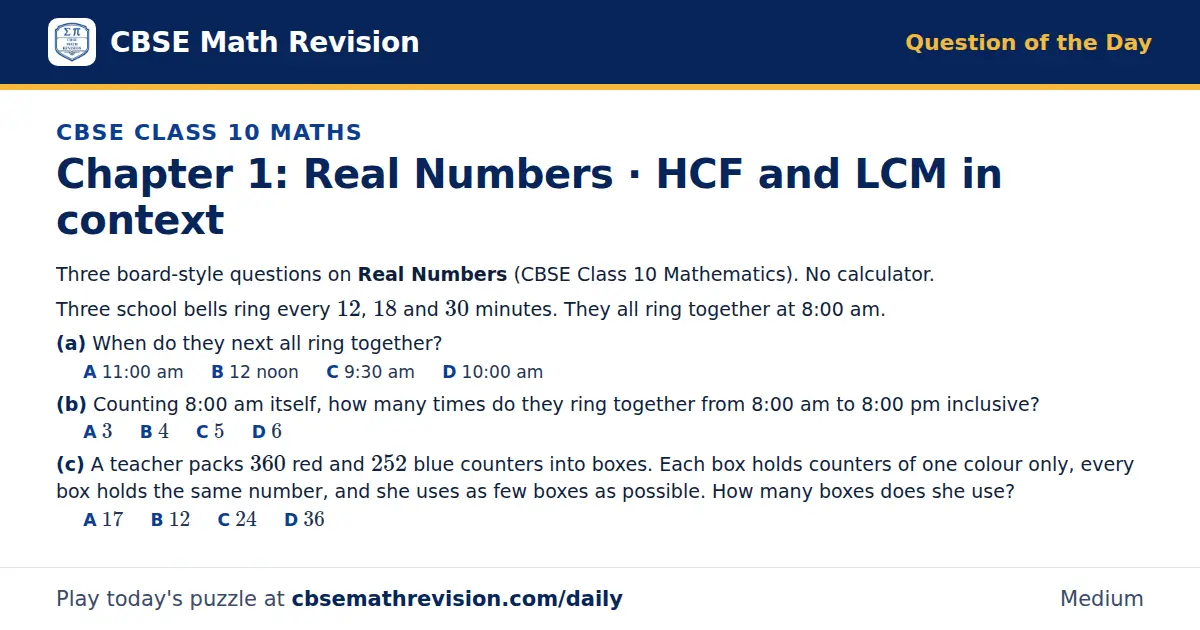
Chapter 1: Real Numbers · HCF and LCM in context
Three board-style questions on Real Numbers (CBSE Class 10 Mathematics). No calculator. Three school bells ring every 12, 18 and 30 minutes. They all ring together at 8:00 am.
- When do they next all ring together? Options: A) 11:00 am; B) 12 noon; C) 9:30 am; D) 10:00 am
- Counting 8:00 am itself, how many times do they ring together from 8:00 am to 8:00 pm inclusive? Options: A) 3; B) 4; C) 5; D) 6
- A teacher packs 360 red and 252 blue counters into boxes. Each box holds counters of one colour only, every box holds the same number, and she uses as few boxes as possible. How many boxes does she use? Options: A) 17; B) 12; C) 24; D) 36
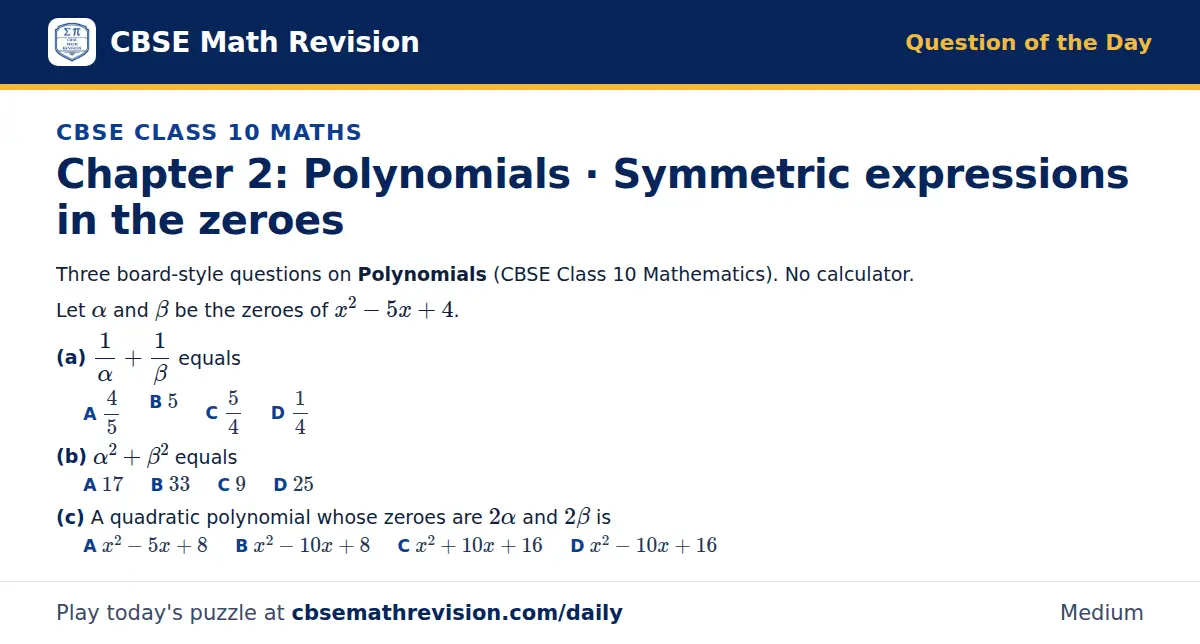
Chapter 2: Polynomials · Symmetric expressions in the zeroes
Three board-style questions on Polynomials (CBSE Class 10 Mathematics). No calculator. Let α and β be the zeroes of x² - 5x + 4.
- 1/(α) + 1/(β) equals Options: A) 4/5; B) 5; C) 5/4; D) 1/4
- α² + β² equals Options: A) 17; B) 33; C) 9; D) 25
- A quadratic polynomial whose zeroes are 2α and 2β is Options: A) x² - 5x + 8; B) x² - 10x + 8; C) x² + 10x + 16; D) x² - 10x + 16
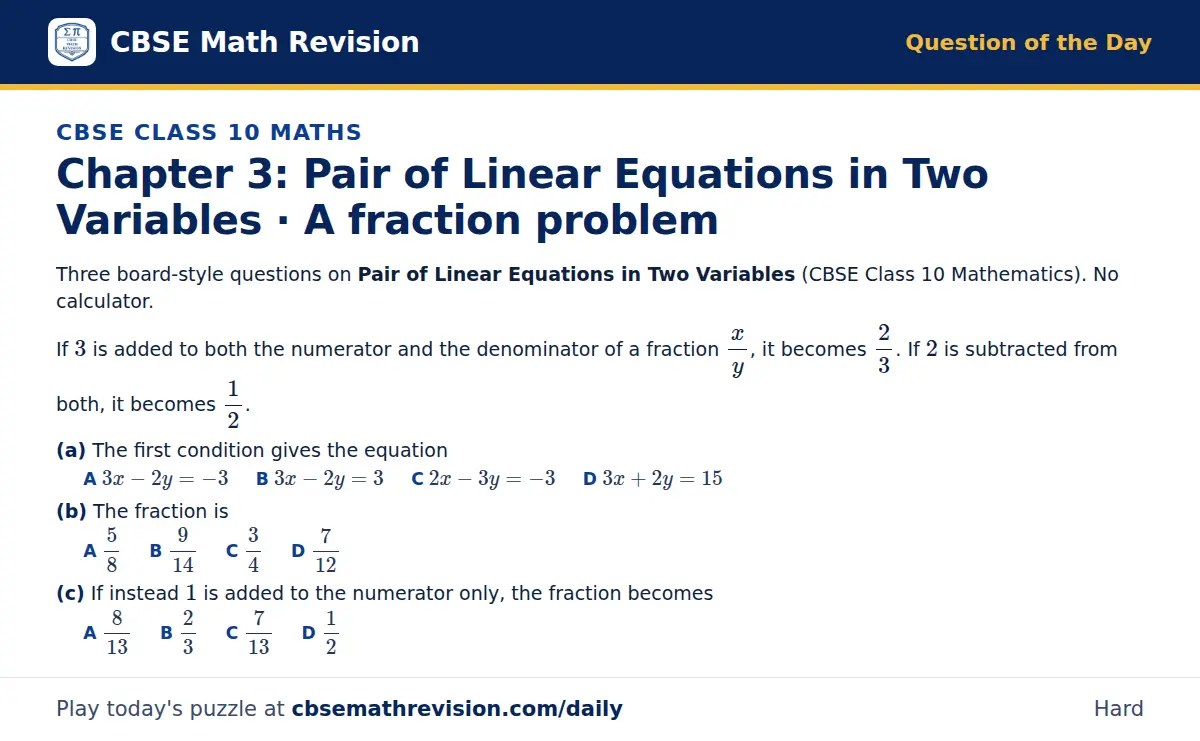
Chapter 3: Pair of Linear Equations in Two Variables · A fraction problem
Three board-style questions on Pair of Linear Equations in Two Variables (CBSE Class 10 Mathematics). No calculator. If 3 is added to both the numerator and the denominator of a fraction x/y, it becomes 23. If 2 is subtracted from both, it becomes 12.
- The first condition gives the equation Options: A) 3x - 2y = -3; B) 3x - 2y = 3; C) 2x - 3y = -3; D) 3x + 2y = 15
- The fraction is Options: A) 5/8; B) 9/14; C) 3/4; D) 7/12
- If instead 1 is added to the numerator only, the fraction becomes Options: A) 8/13; B) 2/3; C) 7/13; D) 1/2
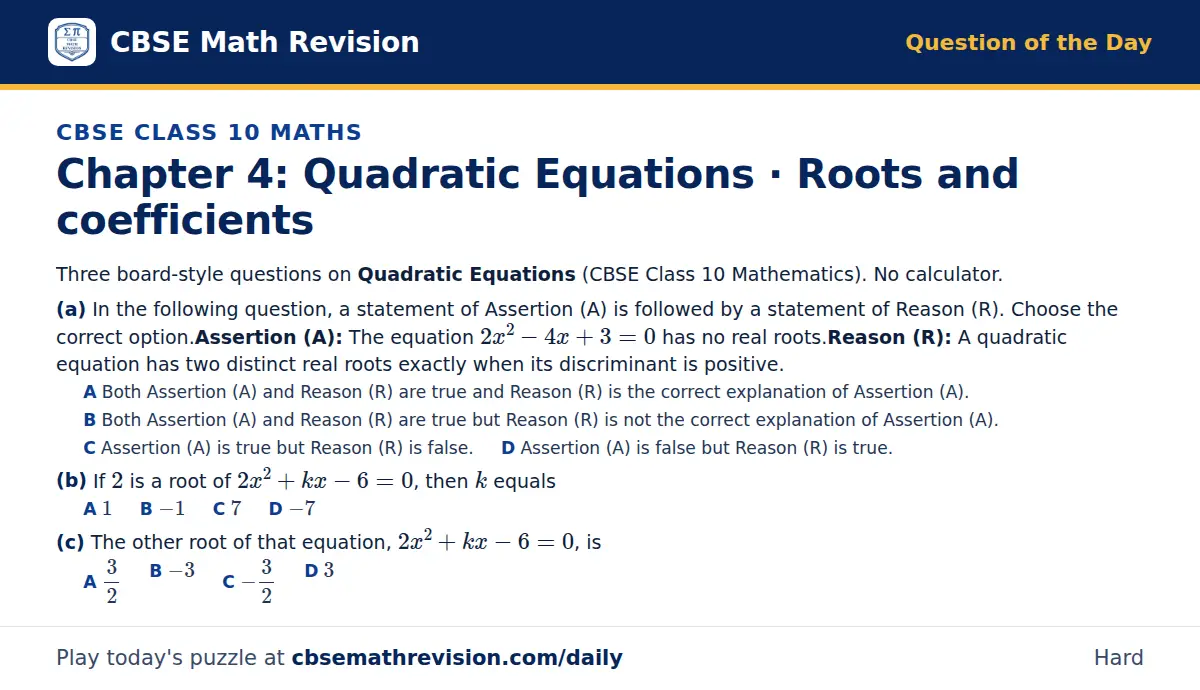
Chapter 4: Quadratic Equations · Roots and coefficients
Three board-style questions on Quadratic Equations (CBSE Class 10 Mathematics). No calculator.
- In the following question, a statement of Assertion (A) is followed by a statement of Reason (R). Choose the correct option. Assertion (A): The equation 2x² - 4x + 3 = 0 has no real roots. Reason (R): A quadratic equation has two distinct real roots exactly when its discriminant is positive. Options: A) Both Assertion (A) and Reason (R) are true and Reason (R) is the correct explanation of Assertion (A).; B) Both Assertion (A) and Reason (R) are true but Reason (R) is not the correct explanation of Assertion (A).; C) Assertion (A) is true but Reason (R) is false.; D) Assertion (A) is false but Reason (R) is true.
- If 2 is a root of 2x² + kx - 6 = 0, then k equals Options: A) 1; B) -1; C) 7; D) -7
- The other root of that equation, 2x² + kx - 6 = 0, is Options: A) 3/2; B) -3; C) - 3/2; D) 3
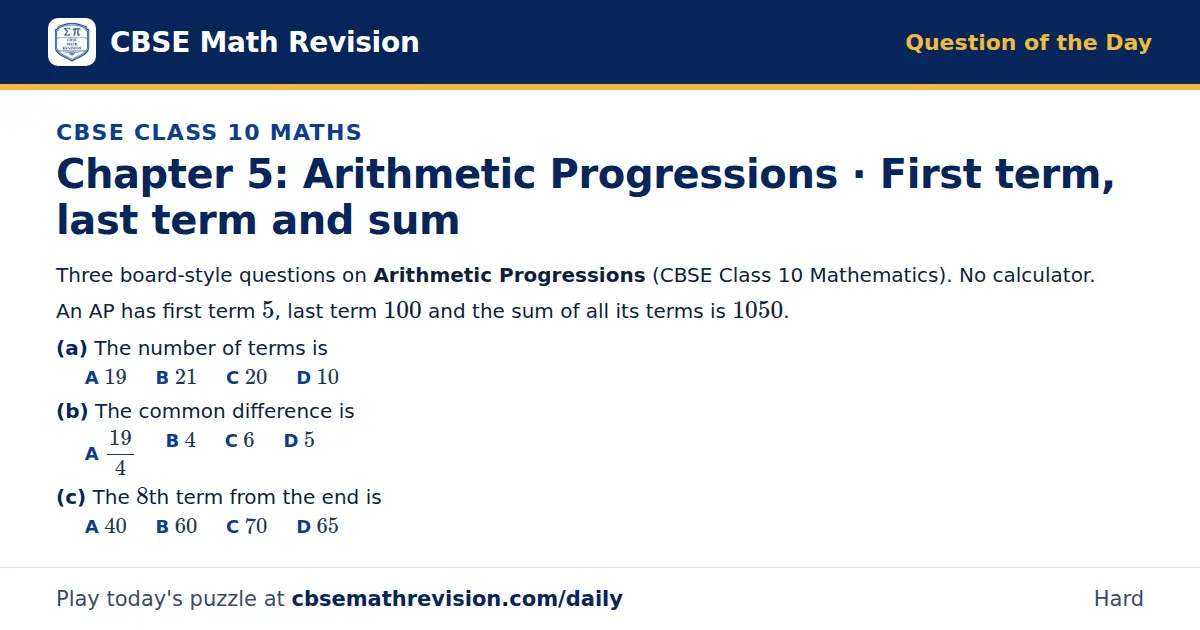
Chapter 5: Arithmetic Progressions · First term, last term and sum
Three board-style questions on Arithmetic Progressions (CBSE Class 10 Mathematics). No calculator. An AP has first term 5, last term 100 and the sum of all its terms is 1050.
- The number of terms is Options: A) 19; B) 21; C) 20; D) 10
- The common difference is Options: A) 19/4; B) 4; C) 6; D) 5
- The 8th term from the end is Options: A) 40; B) 60; C) 70; D) 65
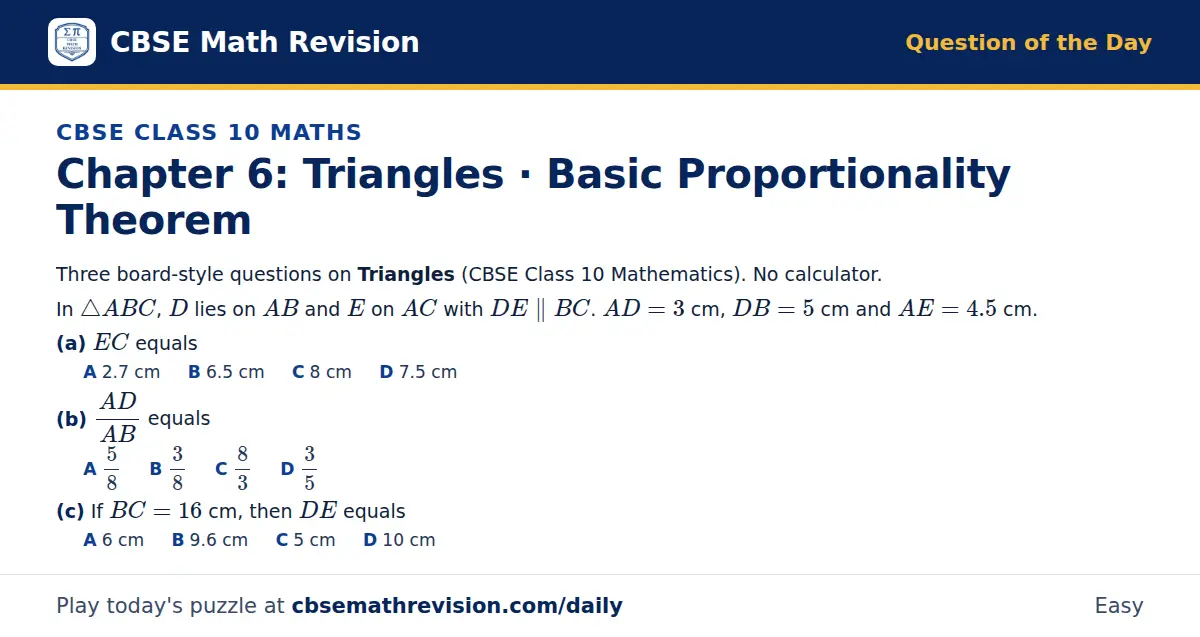
Chapter 6: Triangles · Basic Proportionality Theorem
Three board-style questions on Triangles (CBSE Class 10 Mathematics). No calculator. In △ ABC, D lies on AB and E on AC with DE ∥ BC. AD = 3 cm, DB = 5 cm and AE = 4.5 cm.
- EC equals Options: A) 2.7 cm; B) 6.5 cm; C) 8 cm; D) 7.5 cm
- AD/AB equals Options: A) 5/8; B) 3/8; C) 8/3; D) 3/5
- If BC = 16 cm, then DE equals Options: A) 6 cm; B) 9.6 cm; C) 5 cm; D) 10 cm
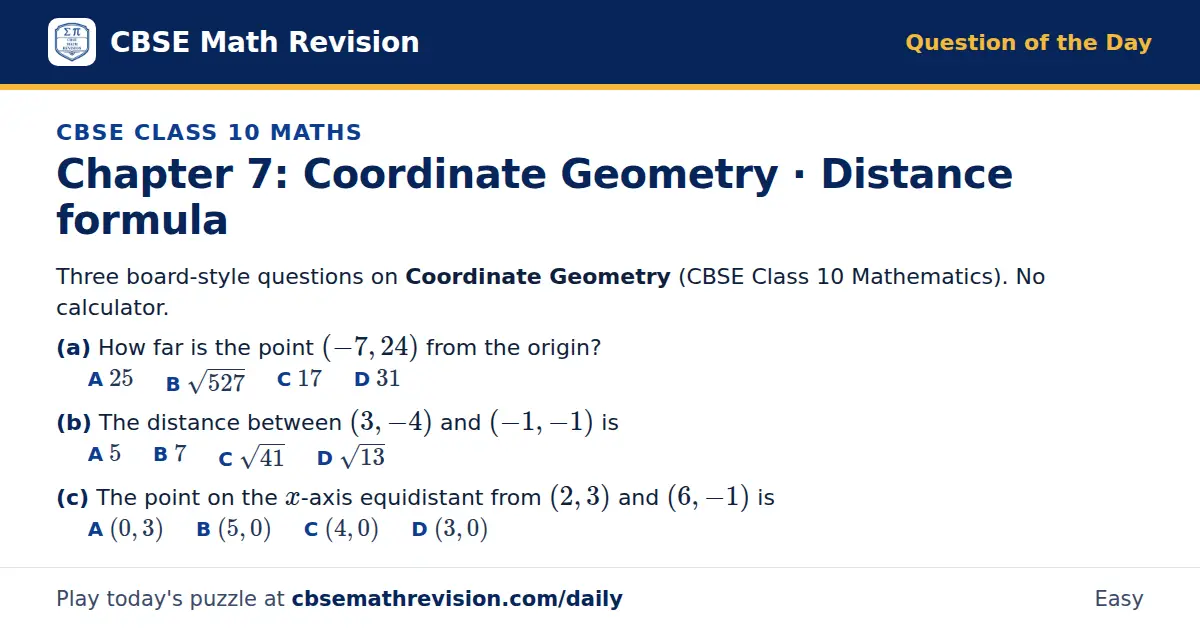
Chapter 7: Coordinate Geometry · Distance formula
Three board-style questions on Coordinate Geometry (CBSE Class 10 Mathematics). No calculator.
- How far is the point (-7, 24) from the origin? Options: A) 25; B) √527; C) 17; D) 31
- The distance between (3, -4) and (-1, -1) is Options: A) 5; B) 7; C) √41; D) √13
- The point on the x-axis equidistant from (2, 3) and (6, -1) is Options: A) (0, 3); B) (5, 0); C) (4, 0); D) (3, 0)
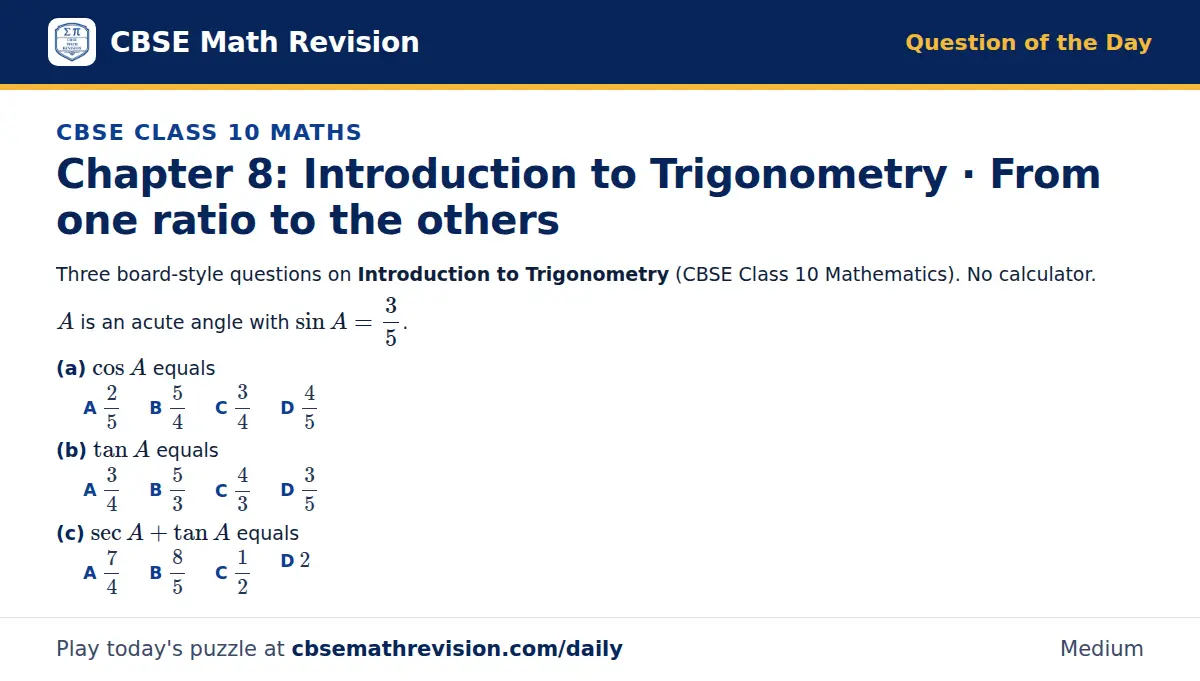
Chapter 8: Introduction to Trigonometry · From one ratio to the others
Three board-style questions on Introduction to Trigonometry (CBSE Class 10 Mathematics). No calculator. A is an acute angle with sin A = 35.
- cos A equals Options: A) 2/5; B) 5/4; C) 3/4; D) 4/5
- tan A equals Options: A) 3/4; B) 5/3; C) 4/3; D) 3/5
- sec A + tan A equals Options: A) 7/4; B) 8/5; C) 1/2; D) 2
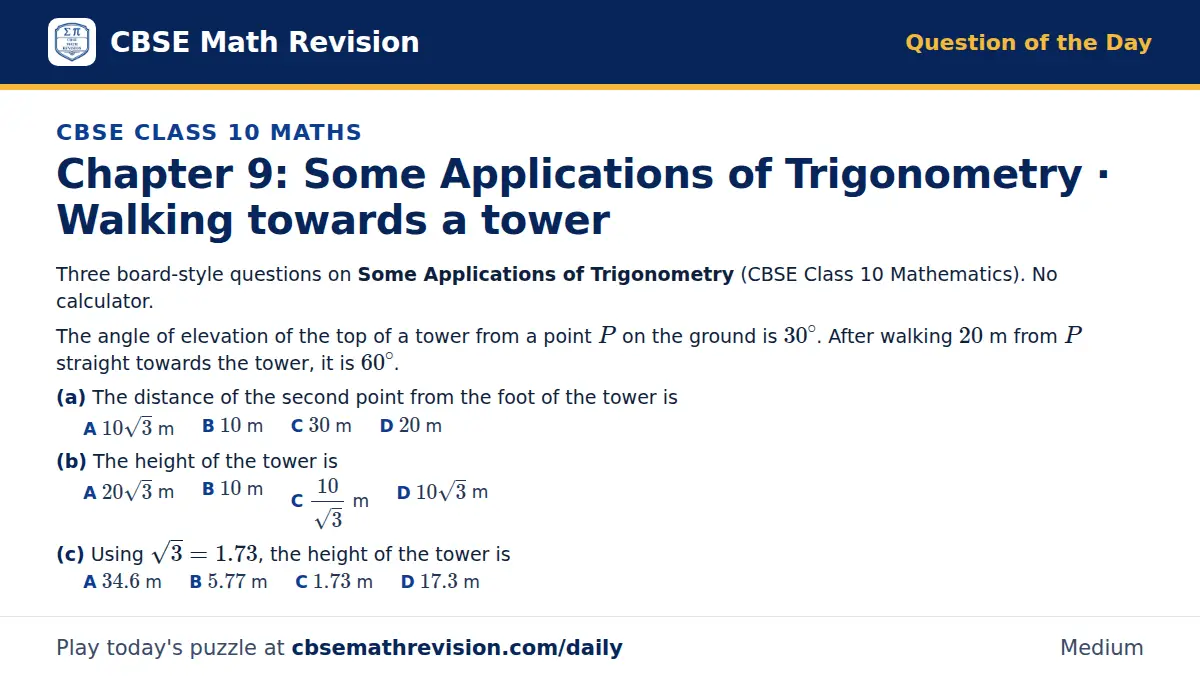
Chapter 9: Some Applications of Trigonometry · Walking towards a tower
Three board-style questions on Some Applications of Trigonometry (CBSE Class 10 Mathematics). No calculator. The angle of elevation of the top of a tower from a point P on the ground is 30^∘. After walking 20 m from P straight towards the tower, it is 60^∘.
- The distance of the second point from the foot of the tower is Options: A) 10√3 m; B) 10 m; C) 30 m; D) 20 m
- The height of the tower is Options: A) 20√3 m; B) 10 m; C) 10/(√3) m; D) 10√3 m
- Using √3 = 1.73, the height of the tower is Options: A) 34.6 m; B) 5.77 m; C) 1.73 m; D) 17.3 m
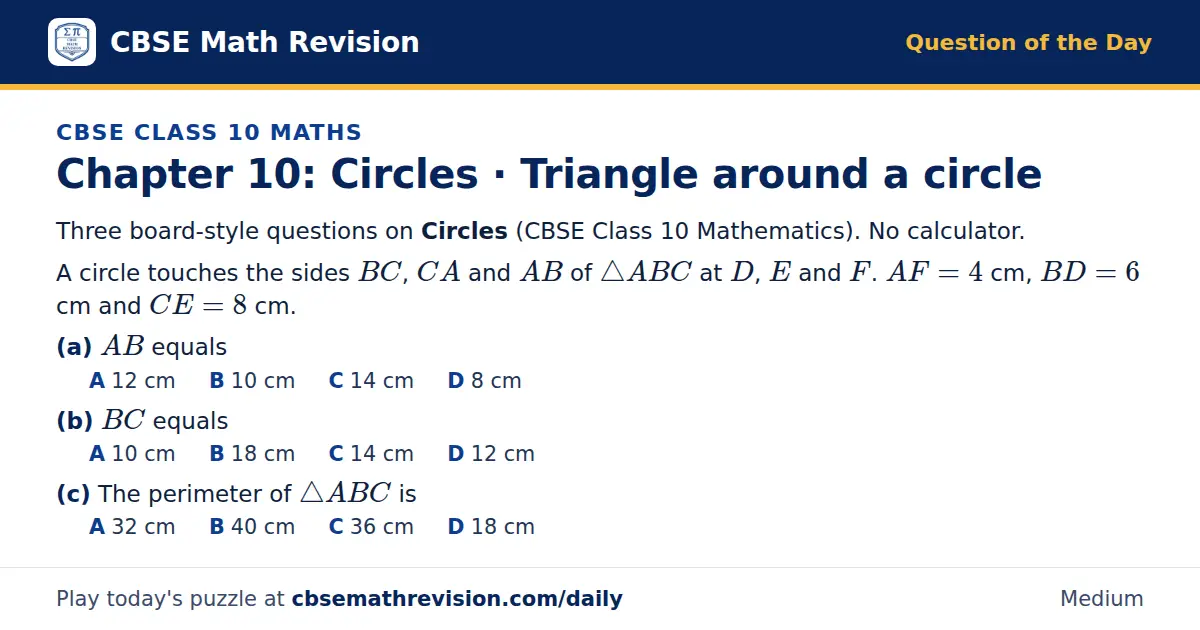
Chapter 10: Circles · Triangle around a circle
Three board-style questions on Circles (CBSE Class 10 Mathematics). No calculator. A circle touches the sides BC, CA and AB of △ ABC at D, E and F. AF = 4 cm, BD = 6 cm and CE = 8 cm.
- AB equals Options: A) 12 cm; B) 10 cm; C) 14 cm; D) 8 cm
- BC equals Options: A) 10 cm; B) 18 cm; C) 14 cm; D) 12 cm
- The perimeter of △ ABC is Options: A) 32 cm; B) 40 cm; C) 36 cm; D) 18 cm
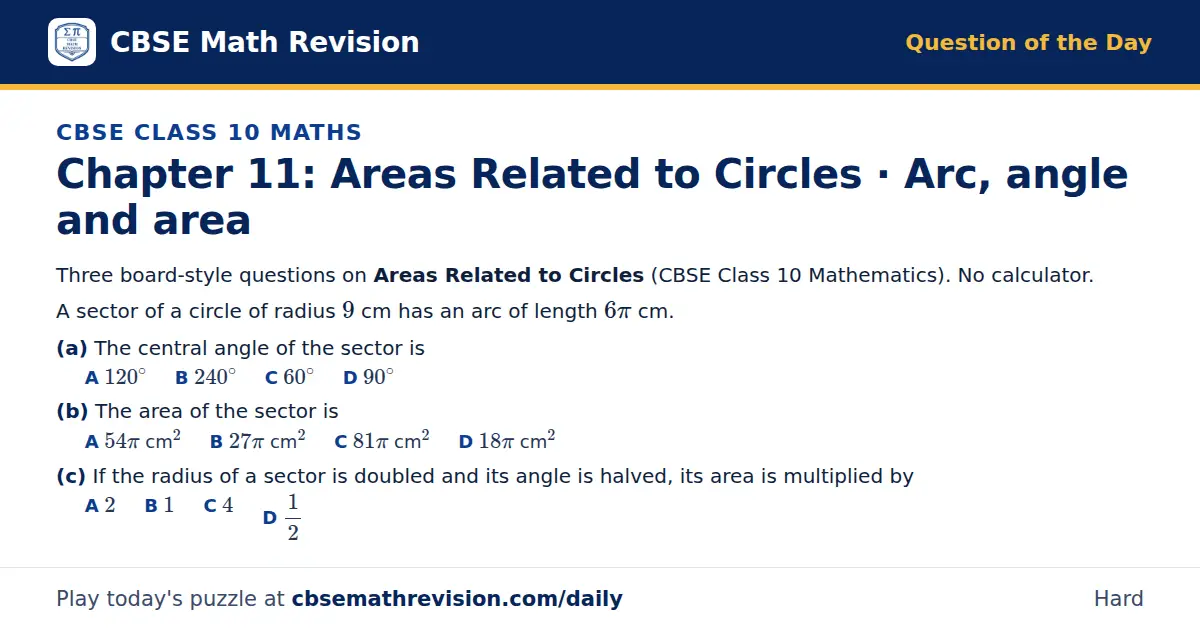
Chapter 11: Areas Related to Circles · Arc, angle and area
Three board-style questions on Areas Related to Circles (CBSE Class 10 Mathematics). No calculator. A sector of a circle of radius 9 cm has an arc of length 6π cm.
- The central angle of the sector is Options: A) 120^∘; B) 240^∘; C) 60^∘; D) 90^∘
- The area of the sector is Options: A) 54π cm²; B) 27π cm²; C) 81π cm²; D) 18π cm²
- If the radius of a sector is doubled and its angle is halved, its area is multiplied by Options: A) 2; B) 1; C) 4; D) 1/2
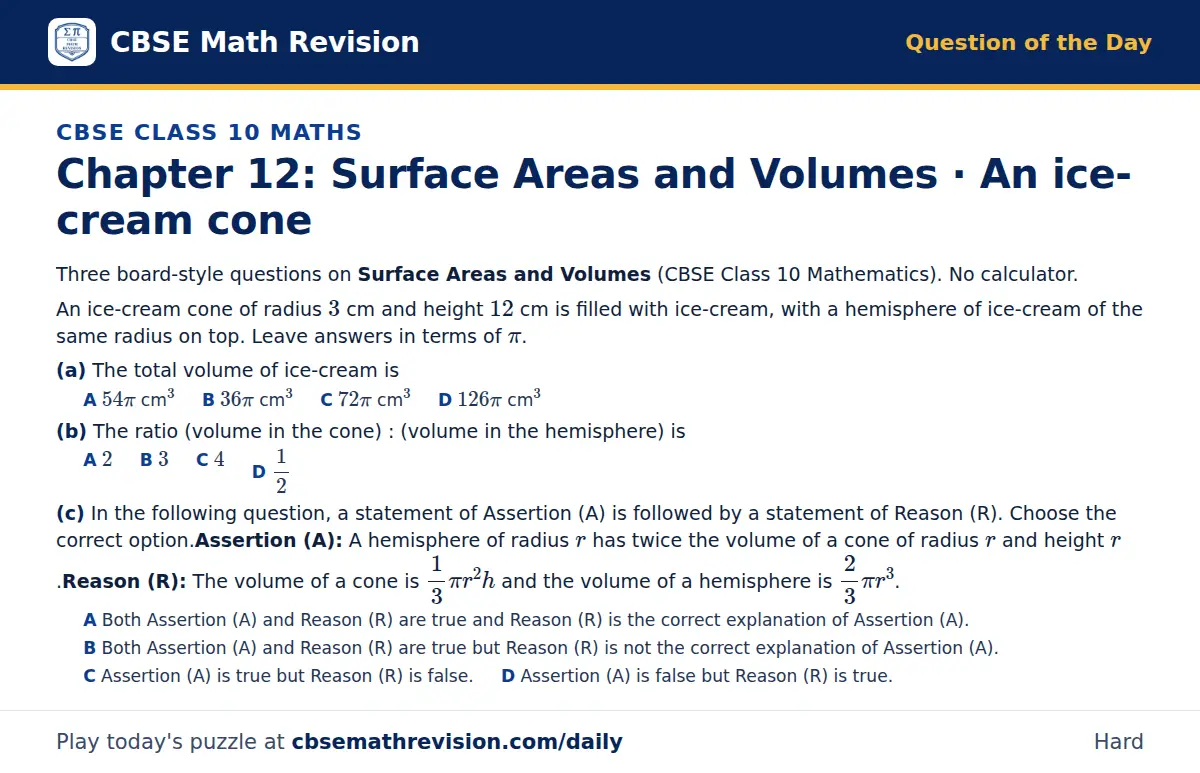
Chapter 12: Surface Areas and Volumes · An ice-cream cone
Three board-style questions on Surface Areas and Volumes (CBSE Class 10 Mathematics). No calculator. An ice-cream cone of radius 3 cm and height 12 cm is filled with ice-cream, with a hemisphere of ice-cream of the same radius on top. Leave answers in terms of π.
- The total volume of ice-cream is Options: A) 54π cm³; B) 36π cm³; C) 72π cm³; D) 126π cm³
- The ratio (volume in the cone): (volume in the hemisphere) is Options: A) 2; B) 3; C) 4; D) 1/2
- In the following question, a statement of Assertion (A) is followed by a statement of Reason (R). Choose the correct option. Assertion (A): A hemisphere of radius r has twice the volume of a cone of radius r and height r. Reason (R): The volume of a cone is 13 π r² h and the volume of a hemisphere is 23 π r^3. Options: A) Both Assertion (A) and Reason (R) are true and Reason (R) is the correct explanation of Assertion (A).; B) Both Assertion (A) and Reason (R) are true but Reason (R) is not the correct explanation of Assertion (A).; C) Assertion (A) is true but Reason (R) is false.; D) Assertion (A) is false but Reason (R) is true.
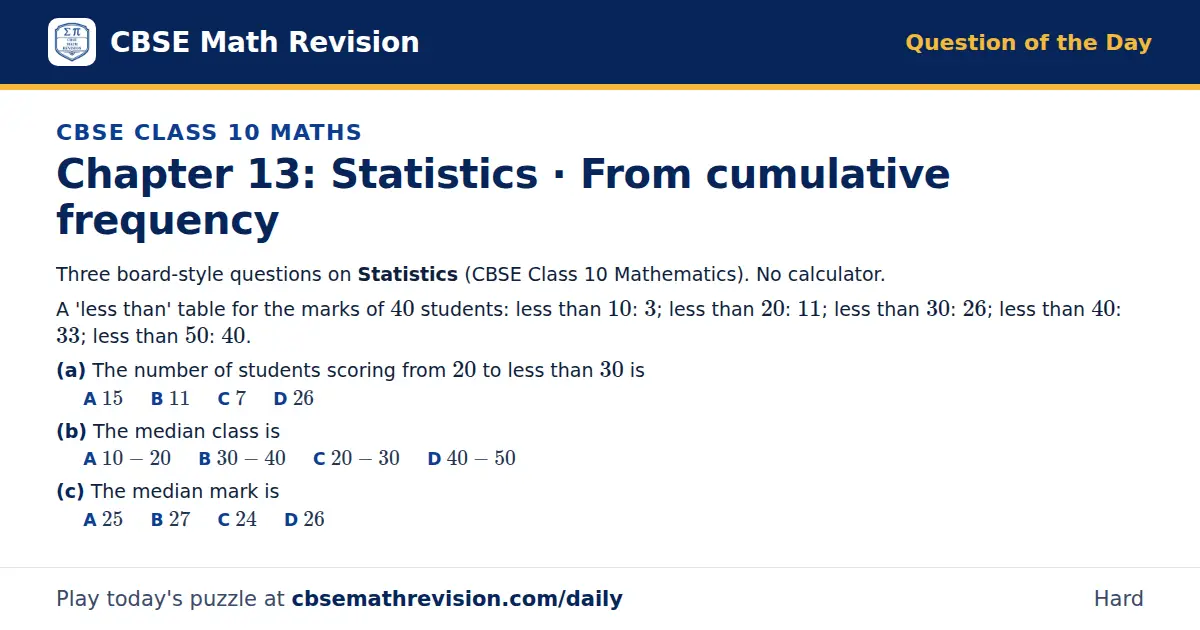
Chapter 13: Statistics · From cumulative frequency
Three board-style questions on Statistics (CBSE Class 10 Mathematics). No calculator. A 'less than' table for the marks of 40 students: less than 10: 3; less than 20: 11; less than 30: 26; less than 40: 33; less than 50: 40.
- The number of students scoring from 20 to less than 30 is Options: A) 15; B) 11; C) 7; D) 26
- The median class is Options: A) 10 - 20; B) 30 - 40; C) 20 - 30; D) 40 - 50
- The median mark is Options: A) 25; B) 27; C) 24; D) 26
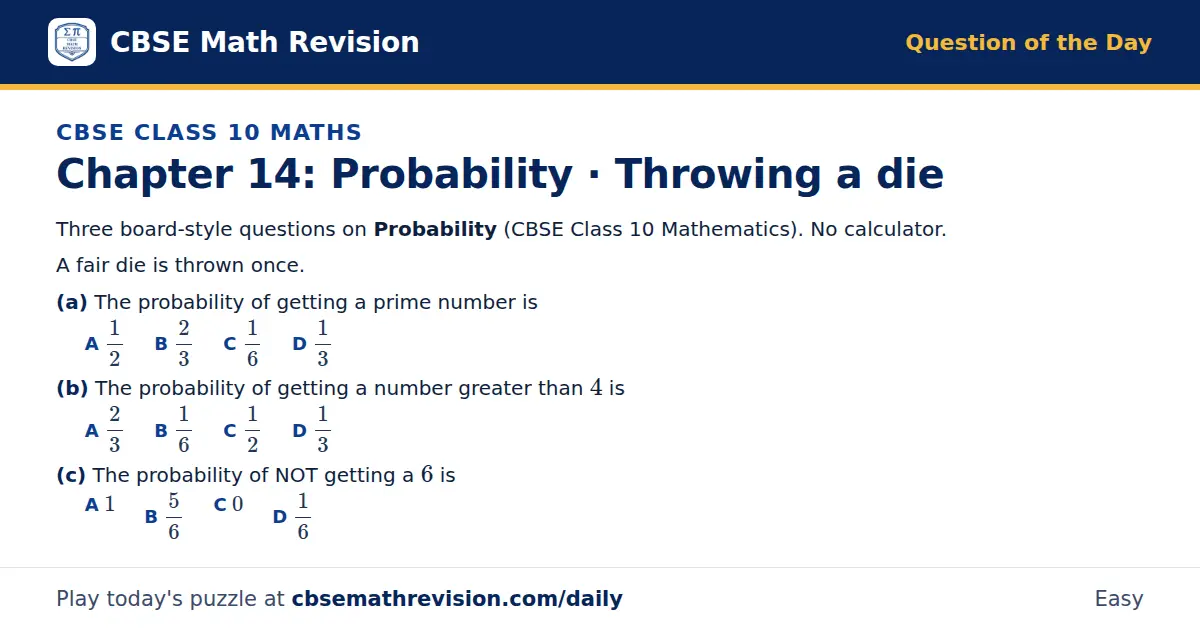
Chapter 14: Probability · Throwing a die
Three board-style questions on Probability (CBSE Class 10 Mathematics). No calculator. A fair die is thrown once.
- The probability of getting a prime number is Options: A) 1/2; B) 2/3; C) 1/6; D) 1/3
- The probability of getting a number greater than 4 is Options: A) 2/3; B) 1/6; C) 1/2; D) 1/3
- The probability of NOT getting a 6 is Options: A) 1; B) 5/6; C) 0; D) 1/6
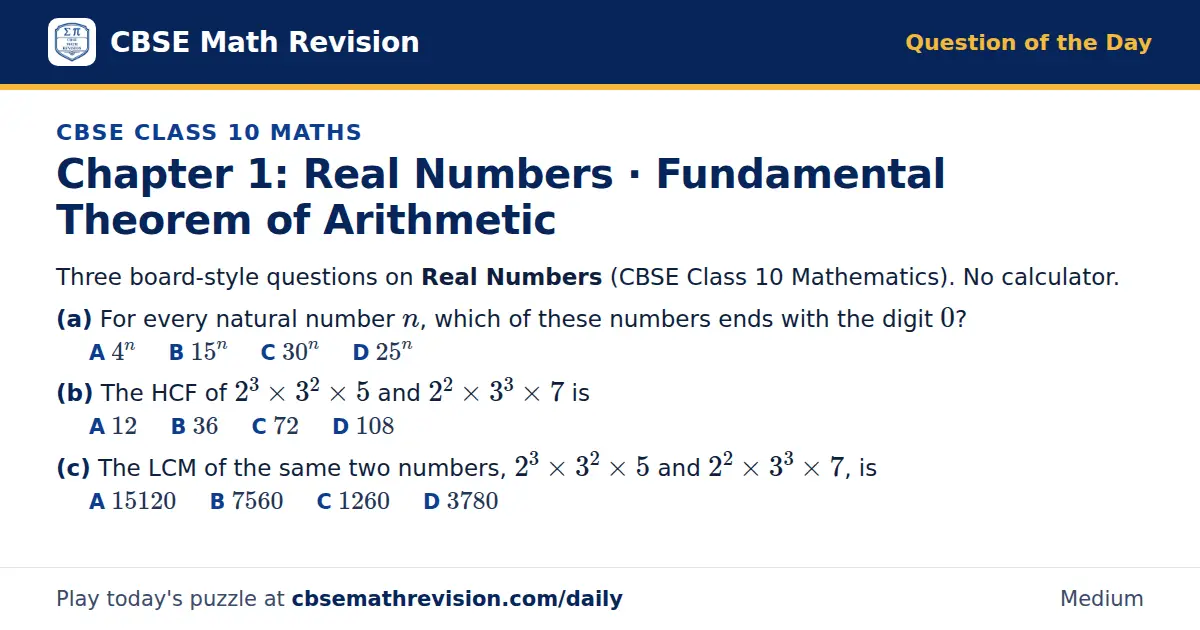
Chapter 1: Real Numbers · Fundamental Theorem of Arithmetic
Three board-style questions on Real Numbers (CBSE Class 10 Mathematics). No calculator.
- For every natural number n, which of these numbers ends with the digit 0? Options: A) 4^n; B) 15^n; C) 30^n; D) 25^n
- The HCF of 2³ × 3² × 5 and 2² × 3³ × 7 is Options: A) 12; B) 36; C) 72; D) 108
- The LCM of the same two numbers, 2³ × 3² × 5 and 2² × 3³ × 7, is Options: A) 15120; B) 7560; C) 1260; D) 3780
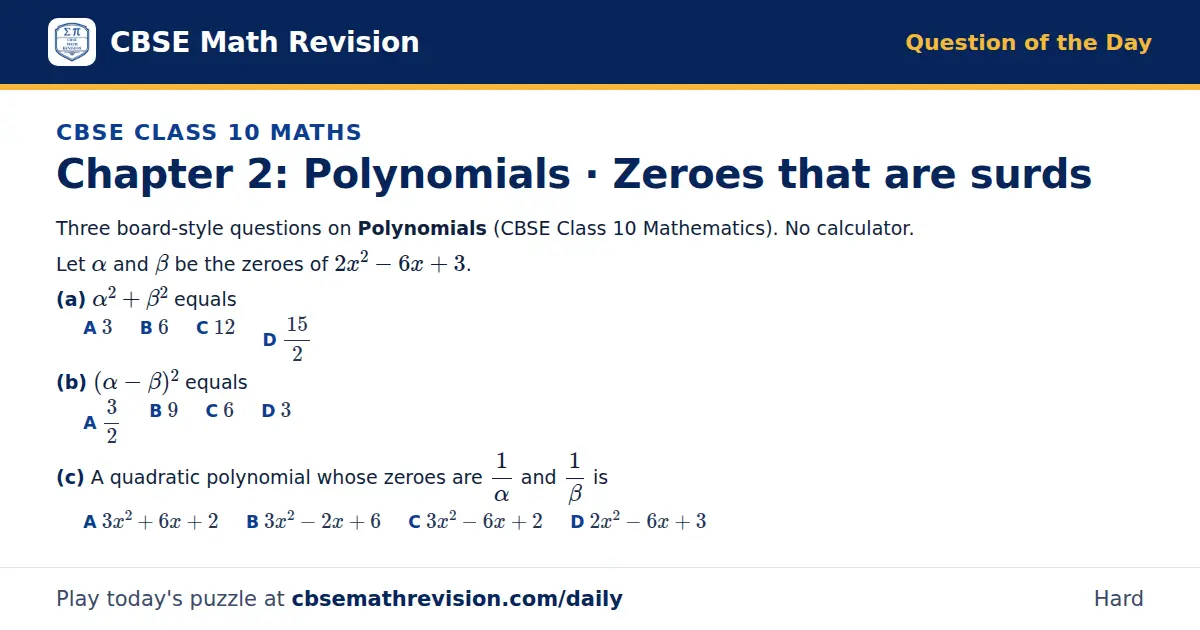
Chapter 2: Polynomials · Zeroes that are surds
Three board-style questions on Polynomials (CBSE Class 10 Mathematics). No calculator. Let α and β be the zeroes of 2x² - 6x + 3.
- α² + β² equals Options: A) 3; B) 6; C) 12; D) 15/2
- (α - β)² equals Options: A) 3/2; B) 9; C) 6; D) 3
- A quadratic polynomial whose zeroes are 1/(α) and 1/(β) is Options: A) 3x² + 6x + 2; B) 3x² - 2x + 6; C) 3x² - 6x + 2; D) 2x² - 6x + 3
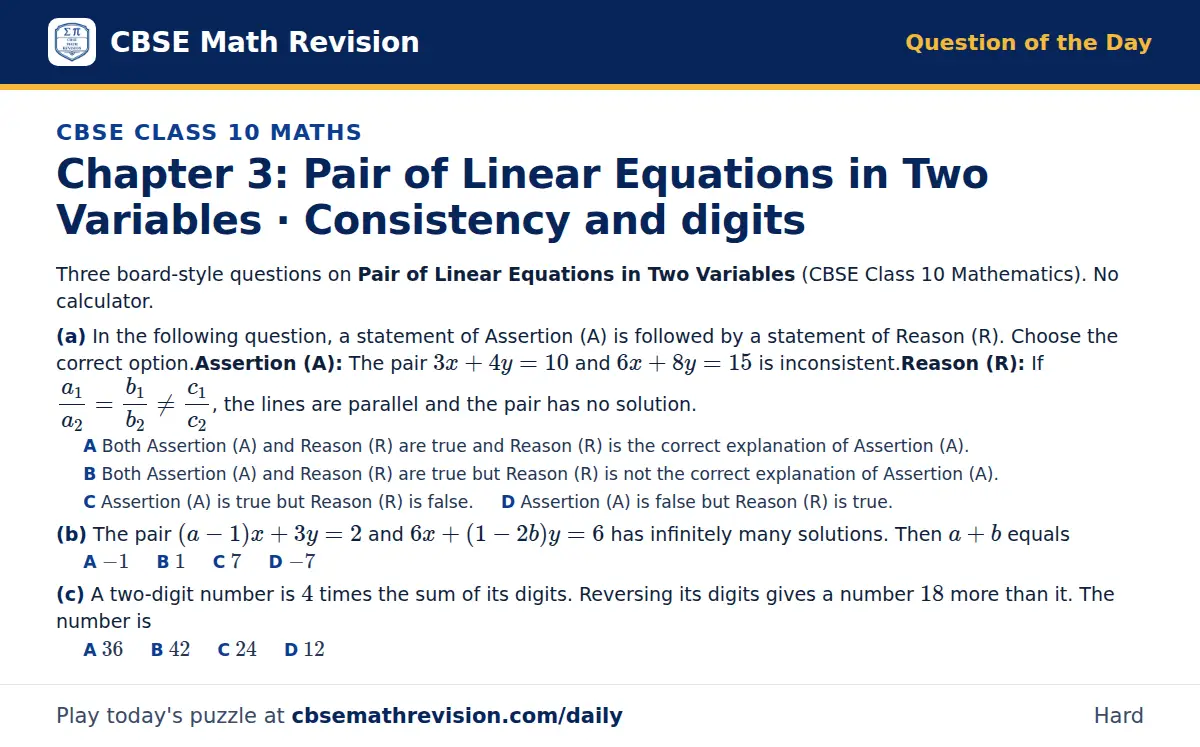
Chapter 3: Pair of Linear Equations in Two Variables · Consistency and digits
Three board-style questions on Pair of Linear Equations in Two Variables (CBSE Class 10 Mathematics). No calculator.
- In the following question, a statement of Assertion (A) is followed by a statement of Reason (R). Choose the correct option. Assertion (A): The pair 3x + 4y = 10 and 6x + 8y = 15 is inconsistent. Reason (R): If a_1/a_2 = b_1/b_2 ≠ c_1/c_2, the lines are parallel and the pair has no solution. Options: A) Both Assertion (A) and Reason (R) are true and Reason (R) is the correct explanation of Assertion (A).; B) Both Assertion (A) and Reason (R) are true but Reason (R) is not the correct explanation of Assertion (A).; C) Assertion (A) is true but Reason (R) is false.; D) Assertion (A) is false but Reason (R) is true.
- The pair (a - 1)x + 3y = 2 and 6x + (1 - 2b)y = 6 has infinitely many solutions. Then a + b equals Options: A) -1; B) 1; C) 7; D) -7
- A two-digit number is 4 times the sum of its digits. Reversing its digits gives a number 18 more than it. The number is Options: A) 36; B) 42; C) 24; D) 12
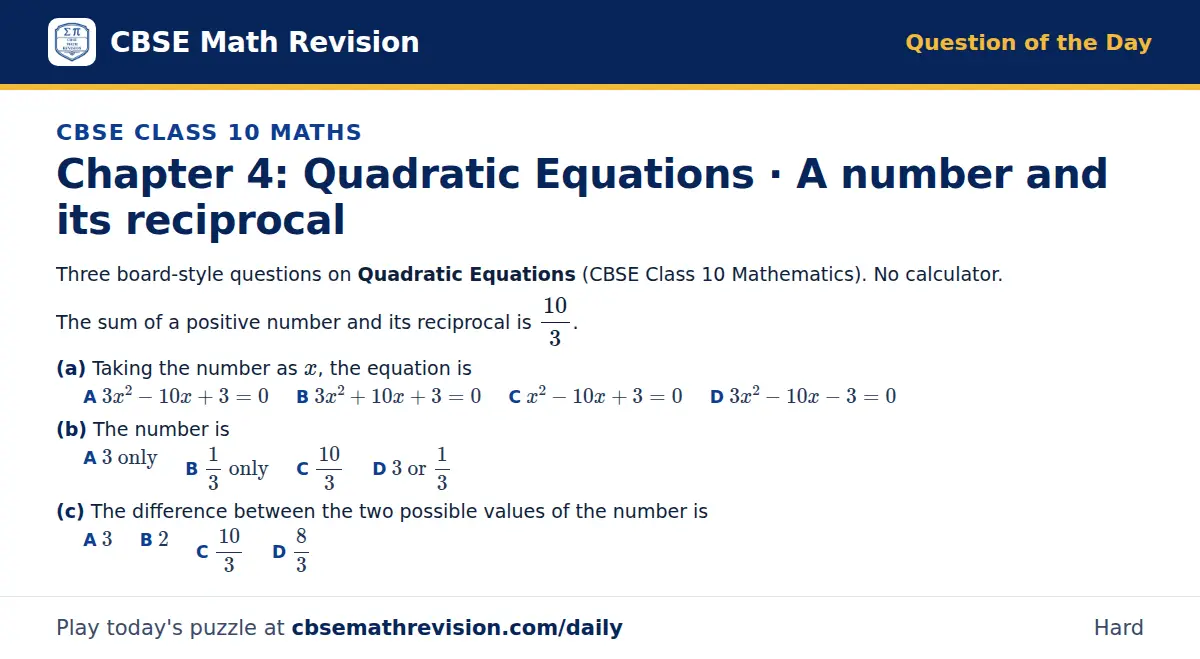
Chapter 4: Quadratic Equations · A number and its reciprocal
Three board-style questions on Quadratic Equations (CBSE Class 10 Mathematics). No calculator. The sum of a positive number and its reciprocal is 10/3.
- Taking the number as x, the equation is Options: A) 3x² - 10x + 3 = 0; B) 3x² + 10x + 3 = 0; C) x² - 10x + 3 = 0; D) 3x² - 10x - 3 = 0
- The number is Options: A) 3 only; B) 13 only; C) 10/3; D) 3 or 13
- The difference between the two possible values of the number is Options: A) 3; B) 2; C) 10/3; D) 8/3
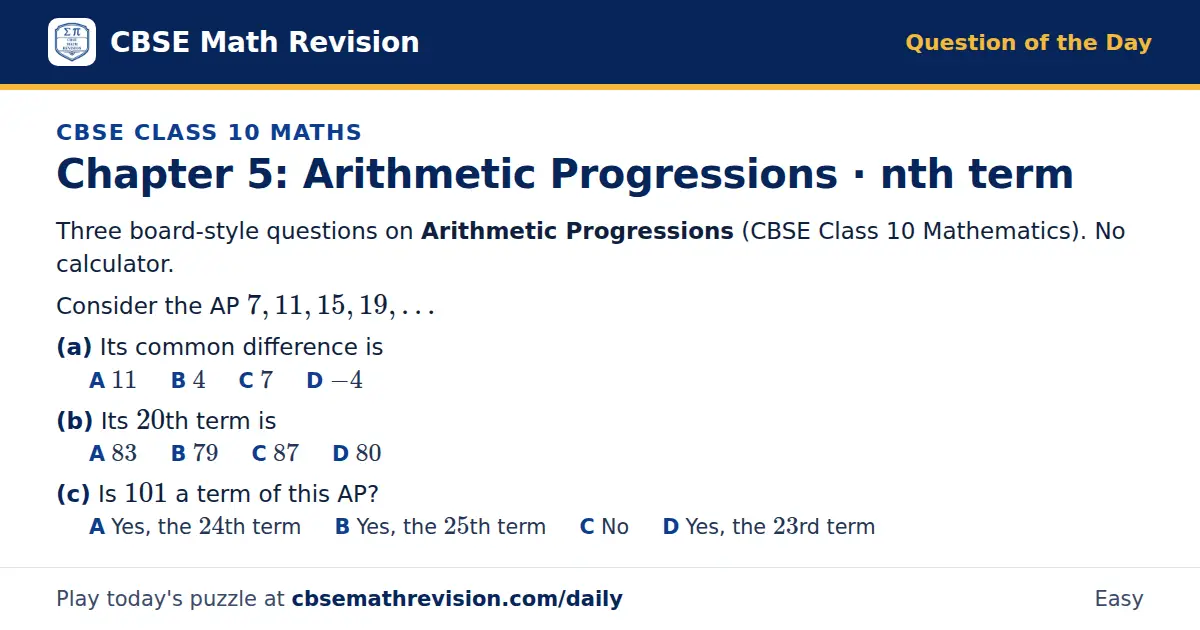
Chapter 5: Arithmetic Progressions · nth term
Three board-style questions on Arithmetic Progressions (CBSE Class 10 Mathematics). No calculator. Consider the AP 7, 11, 15, 19, …
- Its common difference is Options: A) 11; B) 4; C) 7; D) -4
- Its 20th term is Options: A) 83; B) 79; C) 87; D) 80
- Is 101 a term of this AP? Options: A) Yes, the 24th term; B) Yes, the 25th term; C) No; D) Yes, the 23rd term
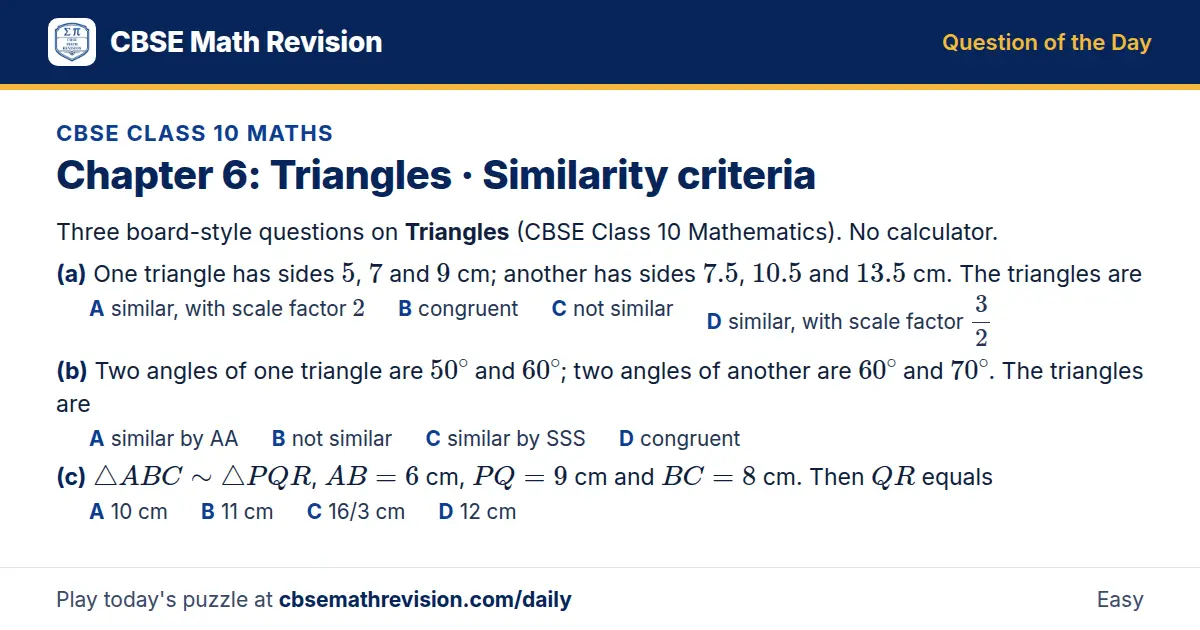
Chapter 6: Triangles · Similarity criteria
Three board-style questions on Triangles (CBSE Class 10 Mathematics). No calculator.
- One triangle has sides 5, 7 and 9 cm; another has sides 7.5, 10.5 and 13.5 cm. The triangles are Options: A) similar, with scale factor 2; B) congruent; C) not similar; D) similar, with scale factor 32
- Two angles of one triangle are 50^∘ and 60^∘; two angles of another are 60^∘ and 70^∘. The triangles are Options: A) similar by AA; B) not similar; C) similar by SSS; D) congruent
- △ ABC △ PQR, AB = 6 cm, PQ = 9 cm and BC = 8 cm. Then QR equals Options: A) 10 cm; B) 11 cm; C) 16/3 cm; D) 12 cm
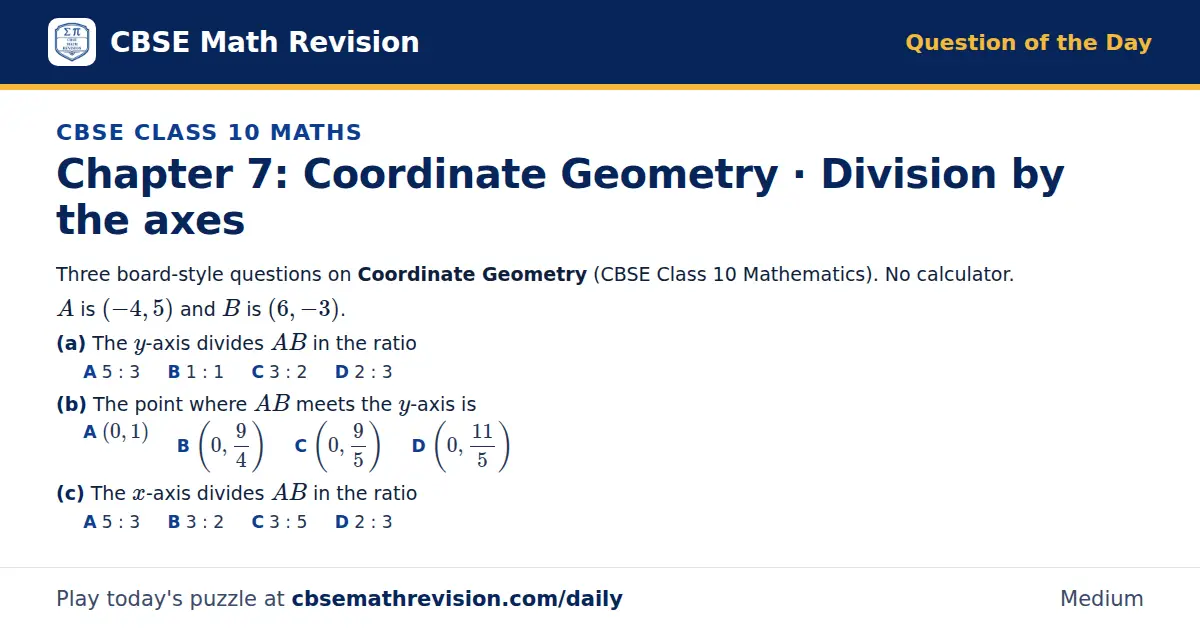
Chapter 7: Coordinate Geometry · Division by the axes
Three board-style questions on Coordinate Geometry (CBSE Class 10 Mathematics). No calculator. A is (-4, 5) and B is (6, -3).
- The y-axis divides AB in the ratio Options: A) 5: 3; B) 1: 1; C) 3: 2; D) 2: 3
- The point where AB meets the y-axis is Options: A) (0, 1); B) (0, 9/4); C) (0, 95); D) (0, 11/5)
- The x-axis divides AB in the ratio Options: A) 5: 3; B) 3: 2; C) 3: 5; D) 2: 3
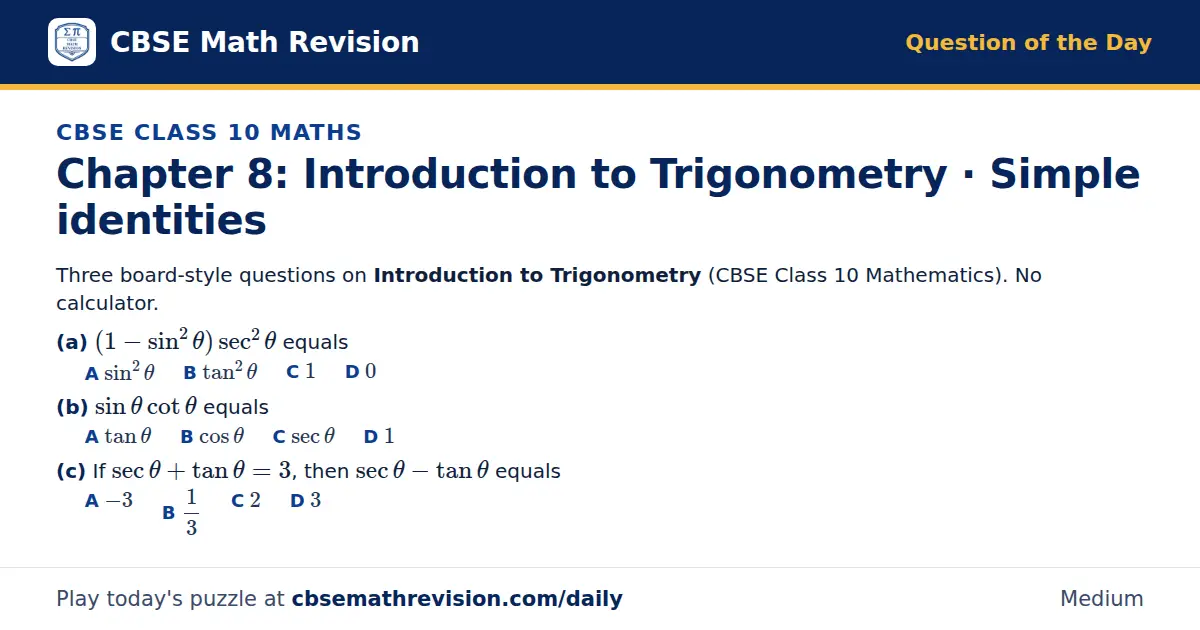
Chapter 8: Introduction to Trigonometry · Simple identities
Three board-style questions on Introduction to Trigonometry (CBSE Class 10 Mathematics). No calculator.
- (1 - sin²θ)sec²θ equals Options: A) sin² θ; B) tan² θ; C) 1; D) 0
- sinθ cotθ equals Options: A) tanθ; B) cosθ; C) secθ; D) 1
- If secθ + tanθ = 3, then secθ - tanθ equals Options: A) -3; B) 1/3; C) 2; D) 3
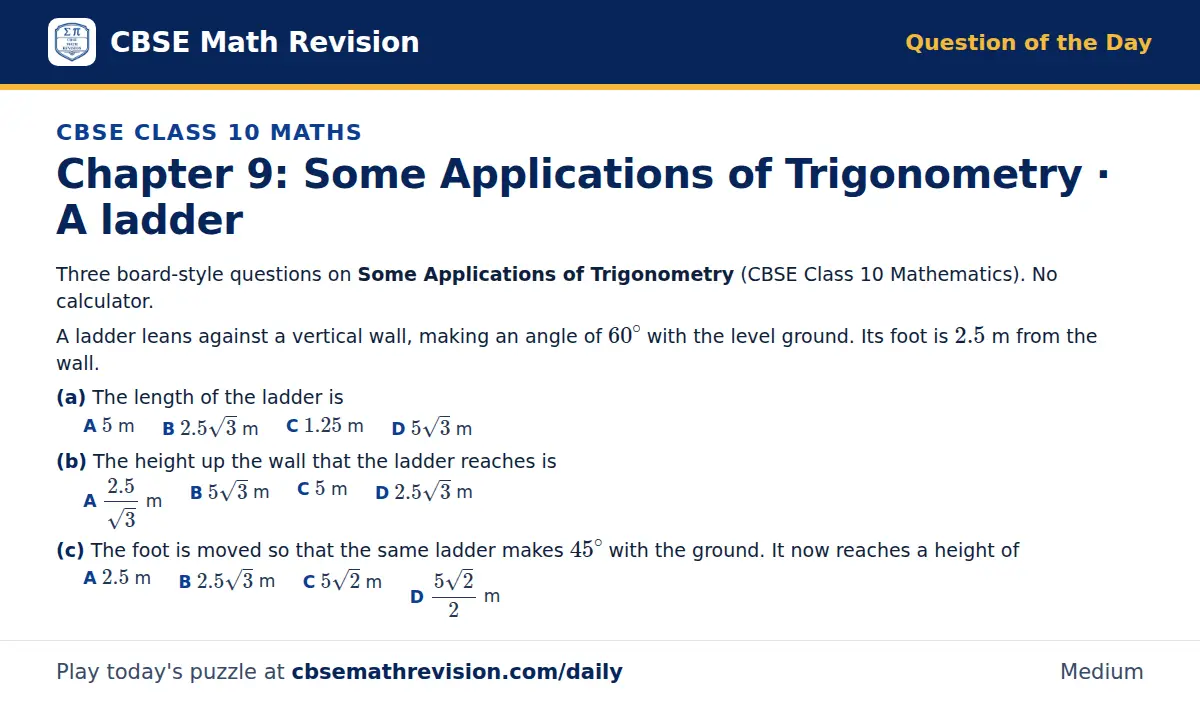
Chapter 9: Some Applications of Trigonometry · A ladder
Three board-style questions on Some Applications of Trigonometry (CBSE Class 10 Mathematics). No calculator. A ladder leans against a vertical wall, making an angle of 60^∘ with the level ground. Its foot is 2.5 m from the wall.
- The length of the ladder is Options: A) 5 m; B) 2.5√3 m; C) 1.25 m; D) 5√3 m
- The height up the wall that the ladder reaches is Options: A) 2.5/(√3) m; B) 5√3 m; C) 5 m; D) 2.5√3 m
- The foot is moved so that the same ladder makes 45^∘ with the ground. It now reaches a height of Options: A) 2.5 m; B) 2.5√3 m; C) 5√2 m; D) (5√2)/2 m
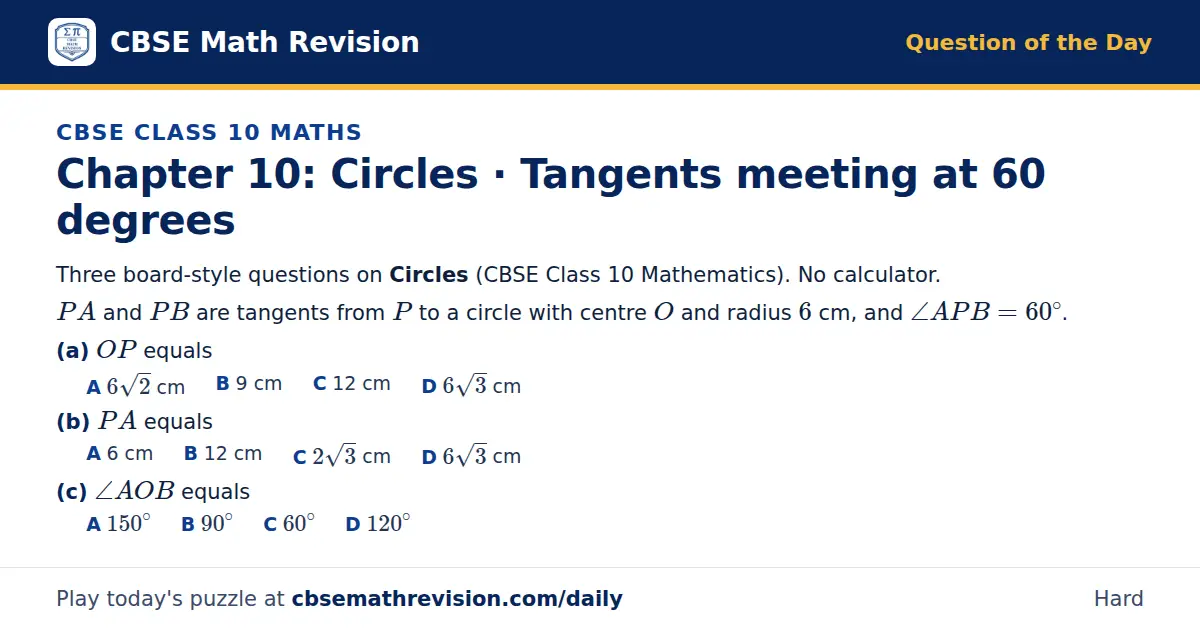
Chapter 10: Circles · Tangents meeting at 60 degrees
Three board-style questions on Circles (CBSE Class 10 Mathematics). No calculator. PA and PB are tangents from P to a circle with centre O and radius 6 cm, and ∠ APB = 60^∘.
- OP equals Options: A) 6√2 cm; B) 9 cm; C) 12 cm; D) 6√3 cm
- PA equals Options: A) 6 cm; B) 12 cm; C) 2√3 cm; D) 6√3 cm
- ∠ AOB equals Options: A) 150^∘; B) 90^∘; C) 60^∘; D) 120^∘
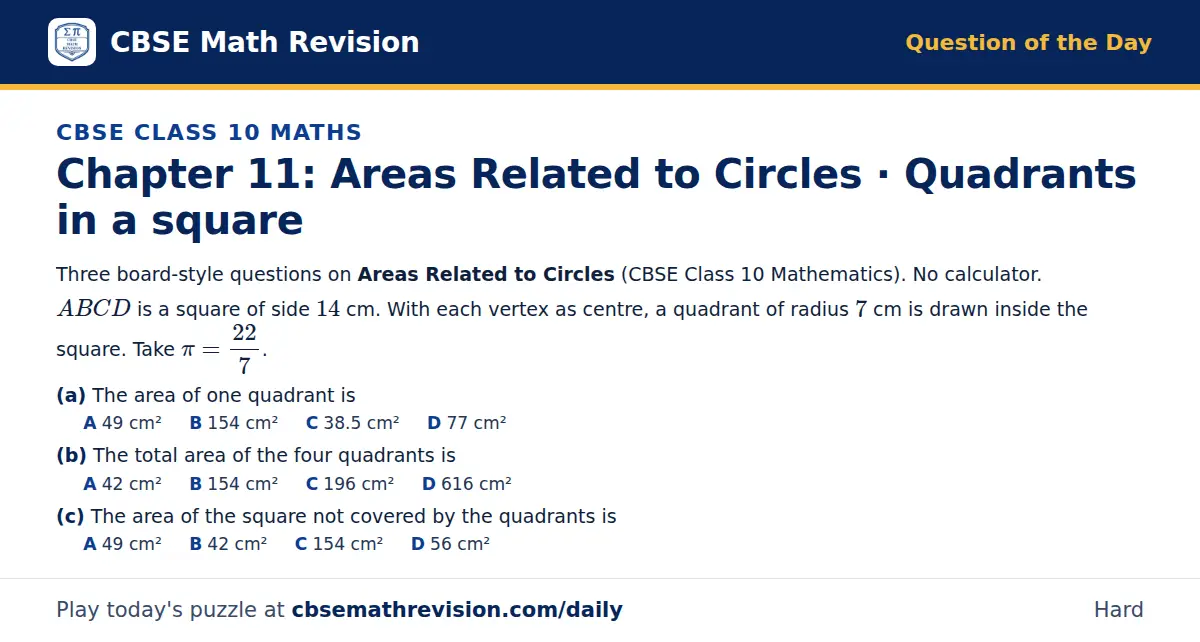
Chapter 11: Areas Related to Circles · Quadrants in a square
Three board-style questions on Areas Related to Circles (CBSE Class 10 Mathematics). No calculator. ABCD is a square of side 14 cm. With each vertex as centre, a quadrant of radius 7 cm is drawn inside the square. Take π = 22/7.
- The area of one quadrant is Options: A) 49 cm²; B) 154 cm²; C) 38.5 cm²; D) 77 cm²
- The total area of the four quadrants is Options: A) 42 cm²; B) 154 cm²; C) 196 cm²; D) 616 cm²
- The area of the square not covered by the quadrants is Options: A) 49 cm²; B) 42 cm²; C) 154 cm²; D) 56 cm²
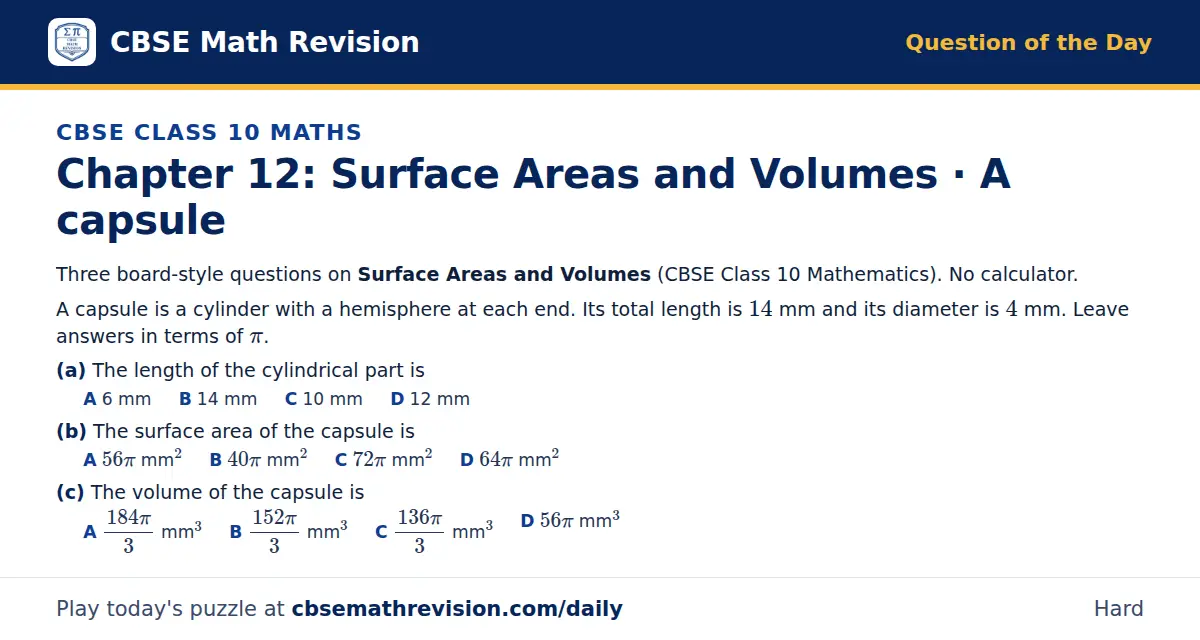
Chapter 12: Surface Areas and Volumes · A capsule
Three board-style questions on Surface Areas and Volumes (CBSE Class 10 Mathematics). No calculator. A capsule is a cylinder with a hemisphere at each end. Its total length is 14 mm and its diameter is 4 mm. Leave answers in terms of π.
- The length of the cylindrical part is Options: A) 6 mm; B) 14 mm; C) 10 mm; D) 12 mm
- The surface area of the capsule is Options: A) 56π mm²; B) 40π mm²; C) 72π mm²; D) 64π mm²
- The volume of the capsule is Options: A) (184π)/3 mm³; B) (152π)/3 mm³; C) (136π)/3 mm³; D) 56π mm³
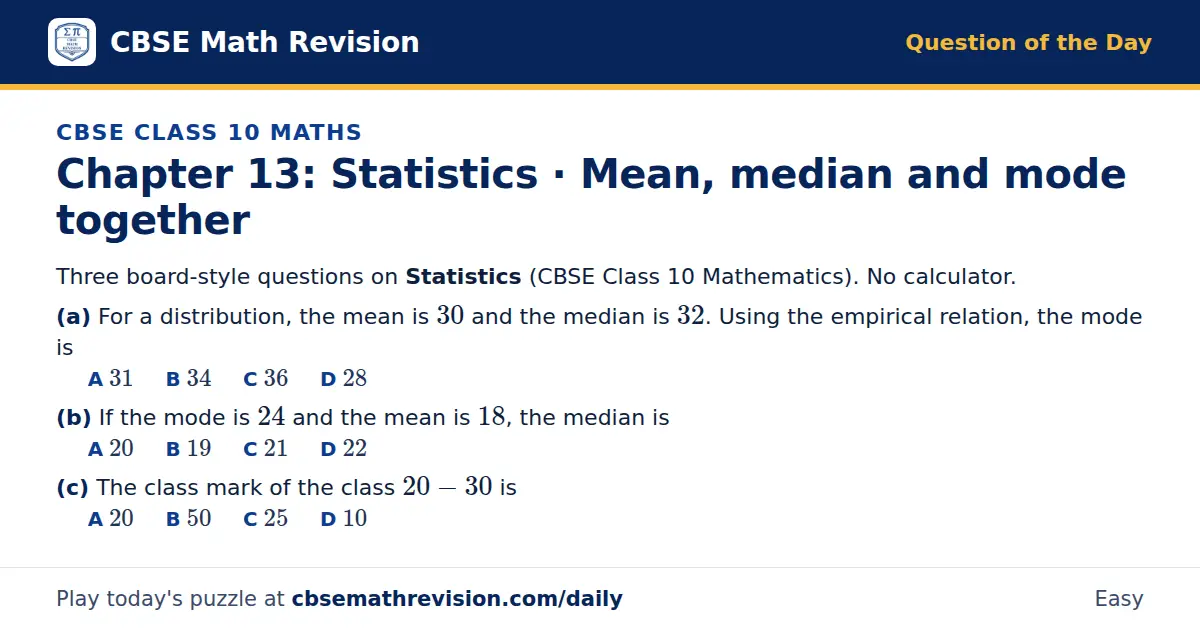
Chapter 13: Statistics · Mean, median and mode together
Three board-style questions on Statistics (CBSE Class 10 Mathematics). No calculator.
- For a distribution, the mean is 30 and the median is 32. Using the empirical relation, the mode is Options: A) 31; B) 34; C) 36; D) 28
- If the mode is 24 and the mean is 18, the median is Options: A) 20; B) 19; C) 21; D) 22
- The class mark of the class 20 - 30 is Options: A) 20; B) 50; C) 25; D) 10
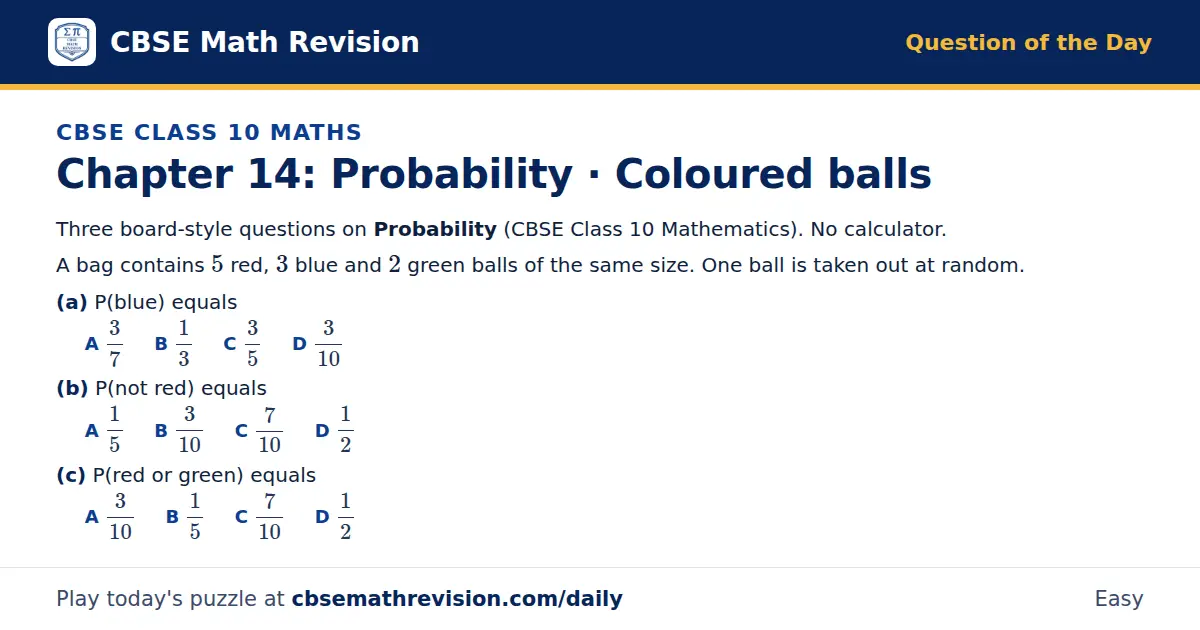
Chapter 14: Probability · Coloured balls
Three board-style questions on Probability (CBSE Class 10 Mathematics). No calculator. A bag contains 5 red, 3 blue and 2 green balls of the same size. One ball is taken out at random.
- P(blue) equals Options: A) 3/7; B) 1/3; C) 3/5; D) 3/10
- P(not red) equals Options: A) 1/5; B) 3/10; C) 7/10; D) 1/2
- P(red or green) equals Options: A) 3/10; B) 1/5; C) 7/10; D) 1/2
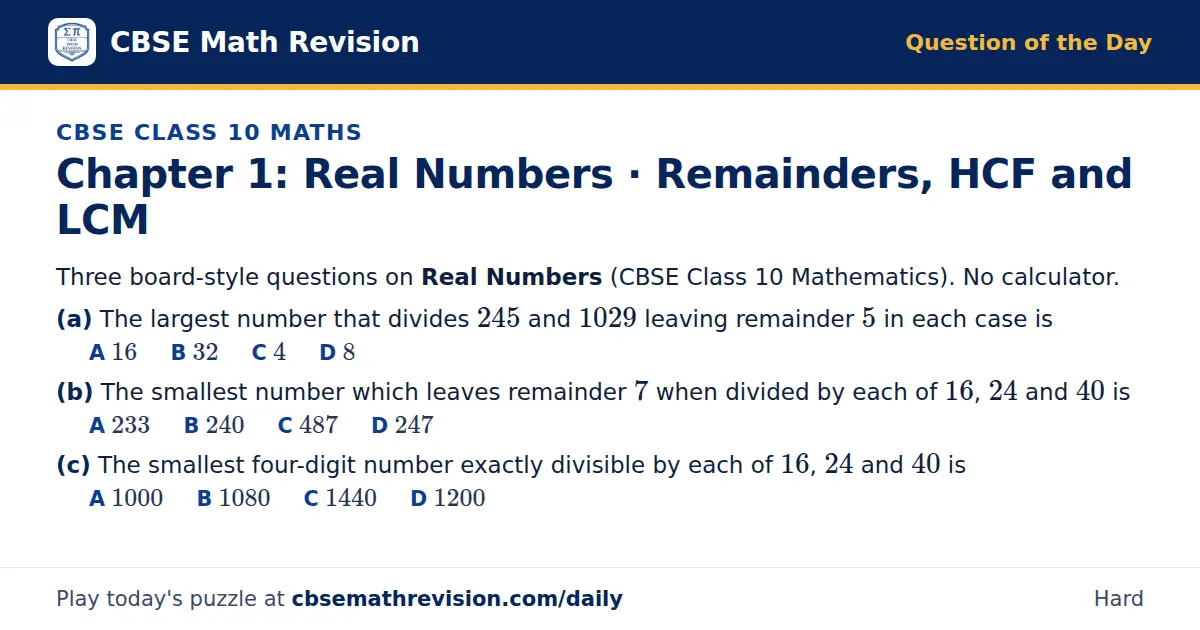
Chapter 1: Real Numbers · Remainders, HCF and LCM
Three board-style questions on Real Numbers (CBSE Class 10 Mathematics). No calculator.
- The largest number that divides 245 and 1029 leaving remainder 5 in each case is Options: A) 16; B) 32; C) 4; D) 8
- The smallest number which leaves remainder 7 when divided by each of 16, 24 and 40 is Options: A) 233; B) 240; C) 487; D) 247
- The smallest four-digit number exactly divisible by each of 16, 24 and 40 is Options: A) 1000; B) 1080; C) 1440; D) 1200
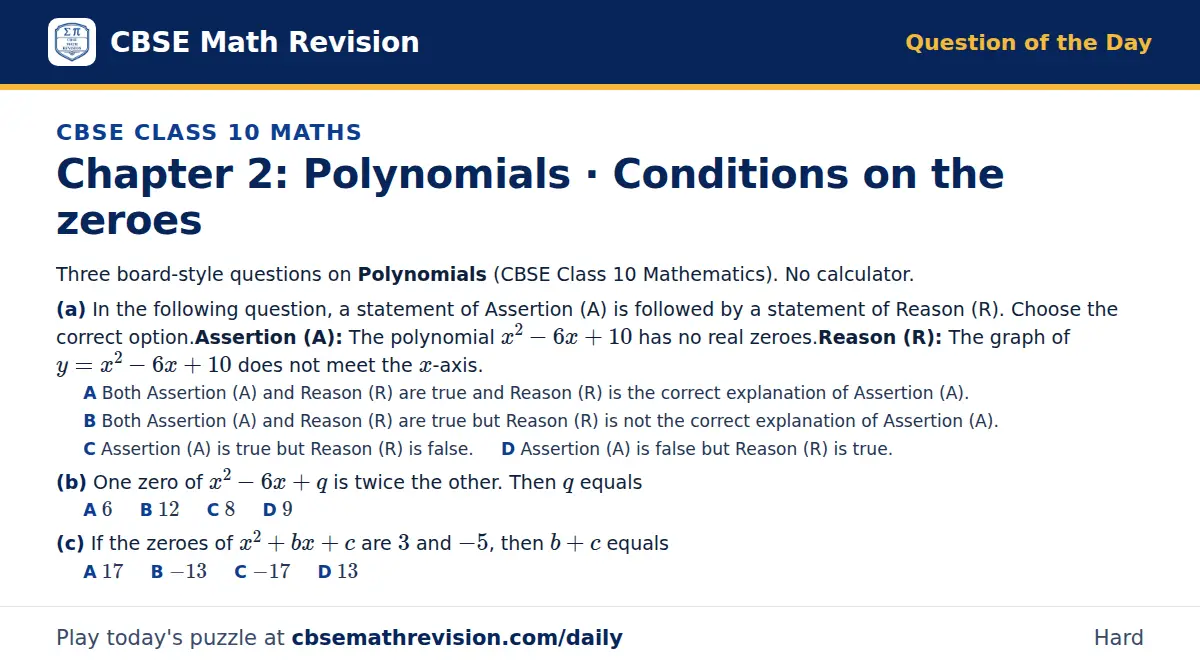
Chapter 2: Polynomials · Conditions on the zeroes
Three board-style questions on Polynomials (CBSE Class 10 Mathematics). No calculator.
- In the following question, a statement of Assertion (A) is followed by a statement of Reason (R). Choose the correct option. Assertion (A): The polynomial x² - 6x + 10 has no real zeroes. Reason (R): The graph of y = x² - 6x + 10 does not meet the x-axis. Options: A) Both Assertion (A) and Reason (R) are true and Reason (R) is the correct explanation of Assertion (A).; B) Both Assertion (A) and Reason (R) are true but Reason (R) is not the correct explanation of Assertion (A).; C) Assertion (A) is true but Reason (R) is false.; D) Assertion (A) is false but Reason (R) is true.
- One zero of x² - 6x + q is twice the other. Then q equals Options: A) 6; B) 12; C) 8; D) 9
- If the zeroes of x² + bx + c are 3 and -5, then b + c equals Options: A) 17; B) -13; C) -17; D) 13
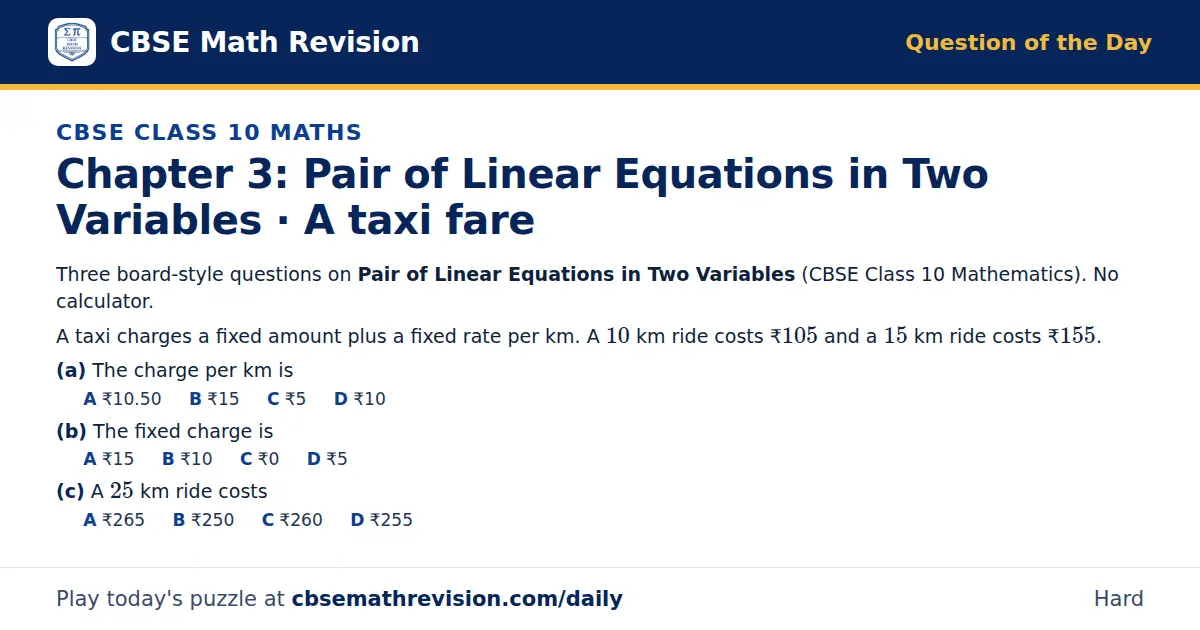
Chapter 3: Pair of Linear Equations in Two Variables · A taxi fare
Three board-style questions on Pair of Linear Equations in Two Variables (CBSE Class 10 Mathematics). No calculator. A taxi charges a fixed amount plus a fixed rate per km. A 10 km ride costs ₹105 and a 15 km ride costs ₹155.
- The charge per km is Options: A) ₹10.50; B) ₹15; C) ₹5; D) ₹10
- The fixed charge is Options: A) ₹15; B) ₹10; C) ₹0; D) ₹5
- A 25 km ride costs Options: A) ₹265; B) ₹250; C) ₹260; D) ₹255
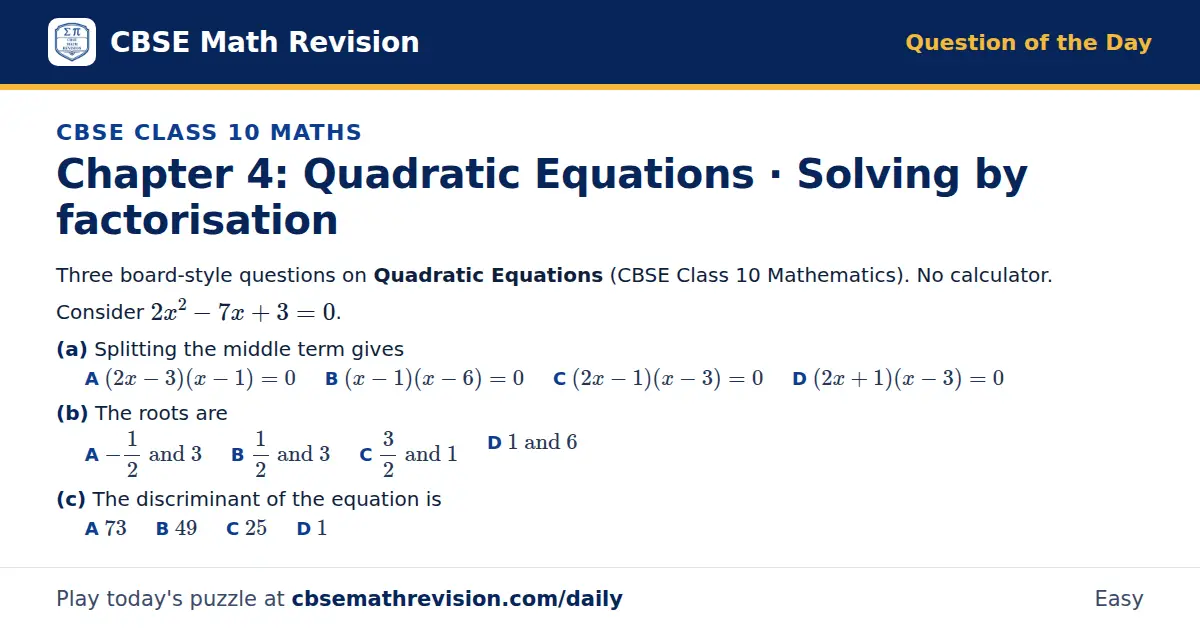
Chapter 4: Quadratic Equations · Solving by factorisation
Three board-style questions on Quadratic Equations (CBSE Class 10 Mathematics). No calculator. Consider 2x² - 7x + 3 = 0.
- Splitting the middle term gives Options: A) (2x - 3)(x - 1) = 0; B) (x - 1)(x - 6) = 0; C) (2x - 1)(x - 3) = 0; D) (2x + 1)(x - 3) = 0
- The roots are Options: A) -12 and 3; B) 12 and 3; C) 32 and 1; D) 1 and 6
- The discriminant of the equation is Options: A) 73; B) 49; C) 25; D) 1
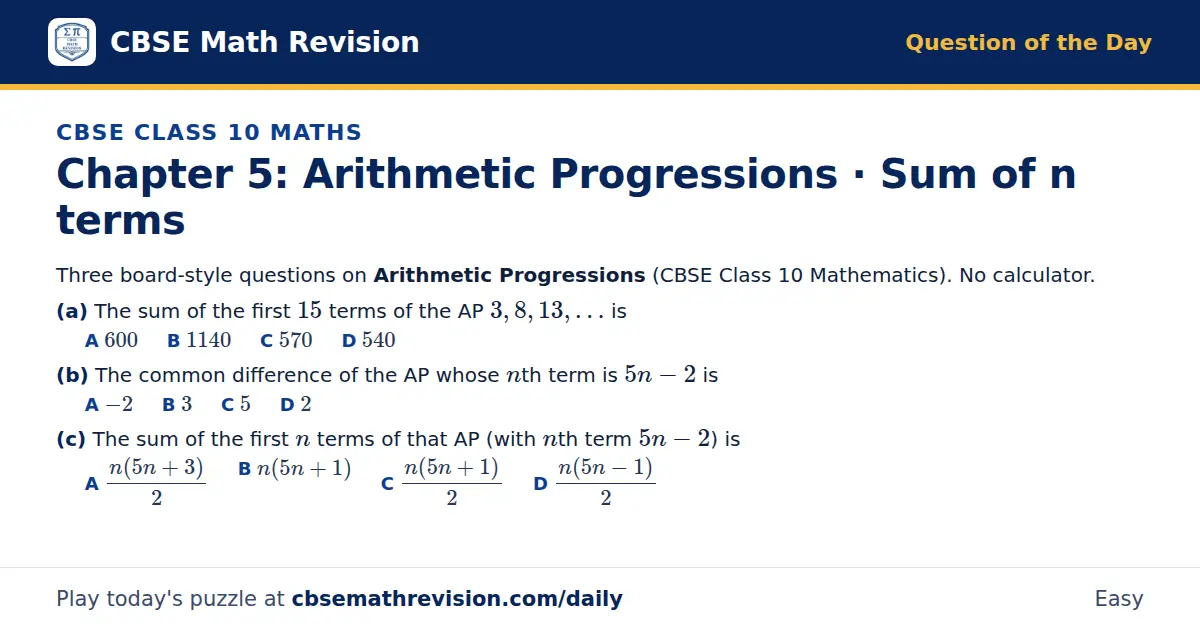
Chapter 5: Arithmetic Progressions · Sum of n terms
Three board-style questions on Arithmetic Progressions (CBSE Class 10 Mathematics). No calculator.
- The sum of the first 15 terms of the AP 3, 8, 13, … is Options: A) 600; B) 1140; C) 570; D) 540
- The common difference of the AP whose nth term is 5n - 2 is Options: A) -2; B) 3; C) 5; D) 2
- The sum of the first n terms of that AP (with nth term 5n - 2) is Options: A) (n(5n + 3))/2; B) n(5n + 1); C) (n(5n + 1))/2; D) (n(5n - 1))/2
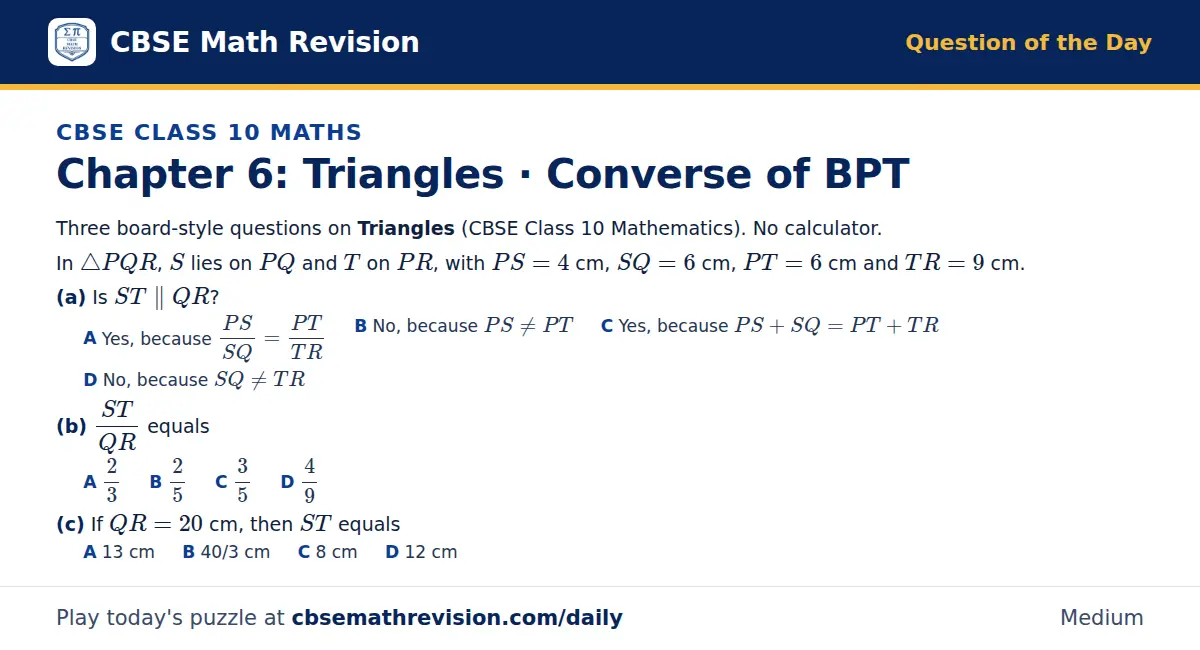
Chapter 6: Triangles · Converse of BPT
Three board-style questions on Triangles (CBSE Class 10 Mathematics). No calculator. In △ PQR, S lies on PQ and T on PR, with PS = 4 cm, SQ = 6 cm, PT = 6 cm and TR = 9 cm.
- Is ST ∥ QR? Options: A) Yes, because PS/SQ = PT/TR; B) No, because PS ≠ PT; C) Yes, because PS + SQ = PT + TR; D) No, because SQ ≠ TR
- ST/QR equals Options: A) 2/3; B) 2/5; C) 3/5; D) 4/9
- If QR = 20 cm, then ST equals Options: A) 13 cm; B) 40/3 cm; C) 8 cm; D) 12 cm
Chapter 7: Coordinate Geometry · Parallelogram vertices
Three board-style questions on Coordinate Geometry (CBSE Class 10 Mathematics). No calculator. A(1, 2), B(4, 3), C(6, 6) and D are the vertices, in order, of a parallelogram ABCD.
- The mid-point of the diagonal AC is Options: A) (5, 4); B) (52, 52); C) (7, 8); D) (72, 4)
- The vertex D is Options: A) (3, 5); B) (4, 5); C) (9, 7); D) (-1, -1)
- The length of side AD is Options: A) 5; B) √5; C) √10; D) √13
Chapter 8: Introduction to Trigonometry · Finding angles
Three board-style questions on Introduction to Trigonometry (CBSE Class 10 Mathematics). No calculator.
- If tan 2A = √3 and 2A is acute, then A equals Options: A) 30^∘; B) 60^∘; C) 15^∘; D) 45^∘
- If sin(A - B) = 12 and cos(A + B) = 12, where 0^∘ < A + B ≤ 90^∘ and A > B, then A equals Options: A) 45^∘; B) 15^∘; C) 30^∘; D) 60^∘
- With the same conditions, B equals Options: A) 60^∘; B) 30^∘; C) 15^∘; D) 45^∘
Chapter 9: Some Applications of Trigonometry · A broken tree
Three board-style questions on Some Applications of Trigonometry (CBSE Class 10 Mathematics). No calculator. A storm breaks a tree. The top part bends over without separating, and its top touches the ground 12 m from the foot of the tree, making an angle of 30^∘ with the ground.
- The height of the part still standing is Options: A) 12√3 m; B) 6 m; C) 8√3 m; D) 4√3 m
- The length of the broken part is Options: A) 4√3 m; B) 24 m; C) 8√3 m; D) 12 m
- The original height of the tree was Options: A) 10√3 m; B) 16√3 m; C) 12√3 m; D) (12 + 4√3) m
Chapter 10: Circles · Tangent and radius
Three board-style questions on Circles (CBSE Class 10 Mathematics). No calculator.
- In the following question, a statement of Assertion (A) is followed by a statement of Reason (R). Choose the correct option. Assertion (A): PA and PB are tangents from P to a circle with centre O and ∠ APB = 80^∘. Then ∠ AOB = 100^∘. Reason (R): The tangent at any point of a circle is perpendicular to the radius through the point of contact. Options: A) Both Assertion (A) and Reason (R) are true and Reason (R) is the correct explanation of Assertion (A).; B) Both Assertion (A) and Reason (R) are true but Reason (R) is not the correct explanation of Assertion (A).; C) Assertion (A) is true but Reason (R) is false.; D) Assertion (A) is false but Reason (R) is true.
- The tangent from P touches a circle with centre O at Q. If OP = 25 cm and PQ = 24 cm, the radius is Options: A) 12 cm; B) 49 cm; C) 1 cm; D) 7 cm
- A tangent at Q meets a line through the centre O at P, with ∠ POQ = 60^∘. If the radius is 7 cm, PQ equals Options: A) 14 cm; B) 7/(√3) cm; C) 7√3 cm; D) 7√2 cm
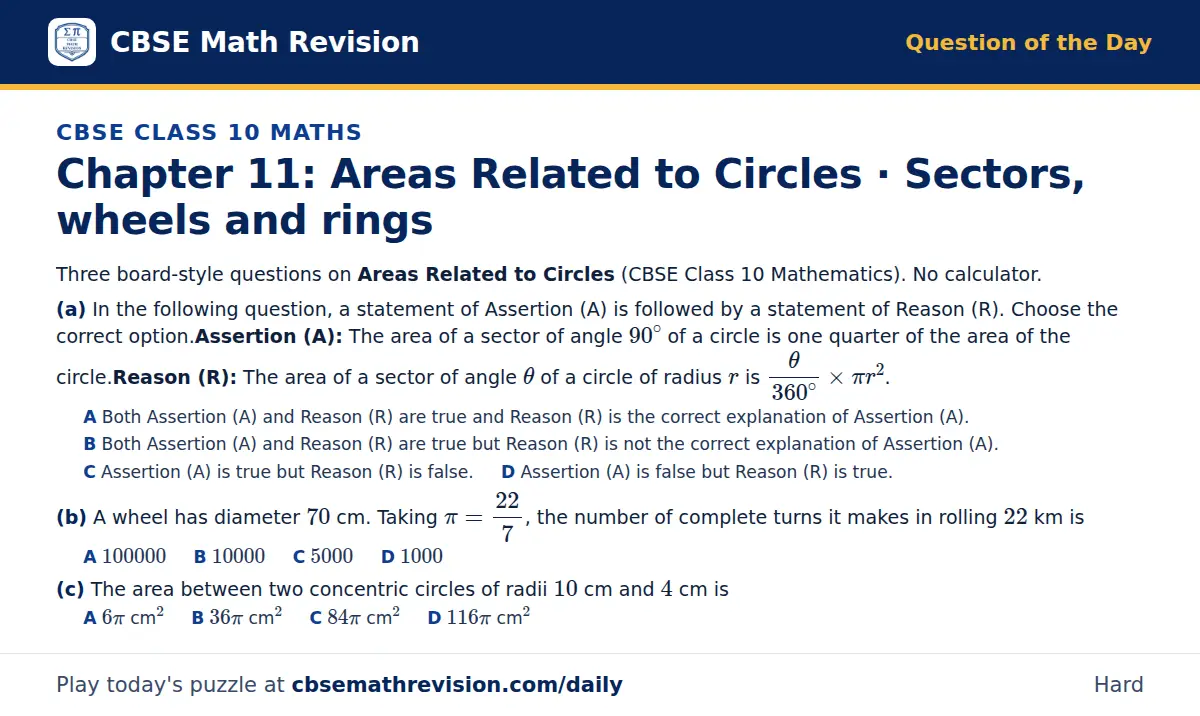
Chapter 11: Areas Related to Circles · Sectors, wheels and rings
Three board-style questions on Areas Related to Circles (CBSE Class 10 Mathematics). No calculator.
- In the following question, a statement of Assertion (A) is followed by a statement of Reason (R). Choose the correct option. Assertion (A): The area of a sector of angle 90^∘ of a circle is one quarter of the area of the circle. Reason (R): The area of a sector of angle θ of a circle of radius r is (θ)/(360^∘) × π r^2. Options: A) Both Assertion (A) and Reason (R) are true and Reason (R) is the correct explanation of Assertion (A).; B) Both Assertion (A) and Reason (R) are true but Reason (R) is not the correct explanation of Assertion (A).; C) Assertion (A) is true but Reason (R) is false.; D) Assertion (A) is false but Reason (R) is true.
- A wheel has diameter 70 cm. Taking π = 22/7, the number of complete turns it makes in rolling 22 km is Options: A) 100000; B) 10000; C) 5000; D) 1000
- The area between two concentric circles of radii 10 cm and 4 cm is Options: A) 6π cm²; B) 36π cm²; C) 84π cm²; D) 116π cm²
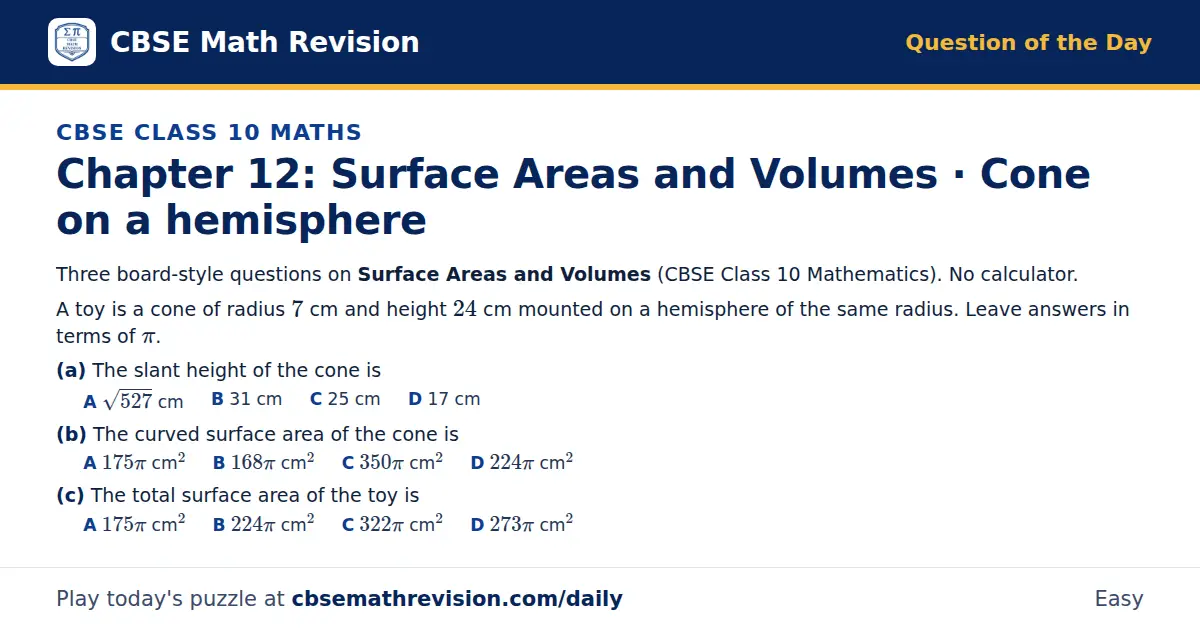
Chapter 12: Surface Areas and Volumes · Cone on a hemisphere
Three board-style questions on Surface Areas and Volumes (CBSE Class 10 Mathematics). No calculator. A toy is a cone of radius 7 cm and height 24 cm mounted on a hemisphere of the same radius. Leave answers in terms of π.
- The slant height of the cone is Options: A) √527 cm; B) 31 cm; C) 25 cm; D) 17 cm
- The curved surface area of the cone is Options: A) 175π cm²; B) 168π cm²; C) 350π cm²; D) 224π cm²
- The total surface area of the toy is Options: A) 175π cm²; B) 224π cm²; C) 322π cm²; D) 273π cm²
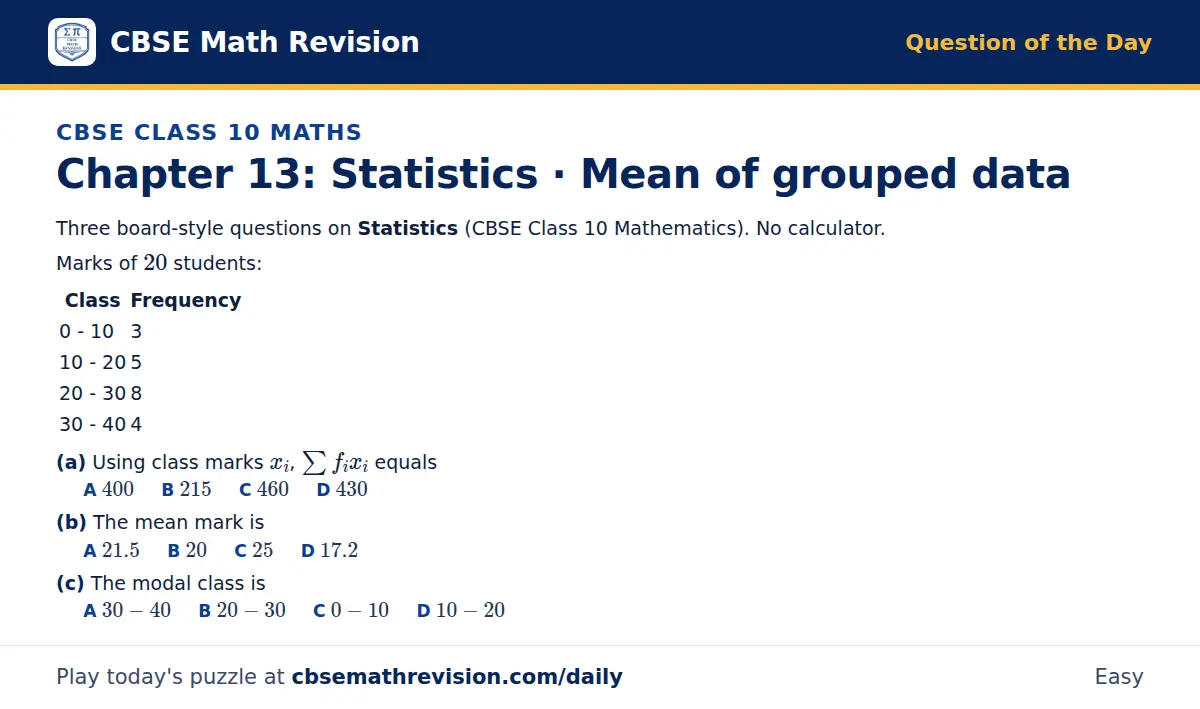
Chapter 13: Statistics · Mean of grouped data
Three board-style questions on Statistics (CBSE Class 10 Mathematics). No calculator. Marks of 20 students: ClassFrequency0 - 10310 - 20520 - 30830 - 404
- Using class marks x_i, Σ f_i x_i equals Options: A) 400; B) 215; C) 460; D) 430
- The mean mark is Options: A) 21.5; B) 20; C) 25; D) 17.2
- The modal class is Options: A) 30 - 40; B) 20 - 30; C) 0 - 10; D) 10 - 20
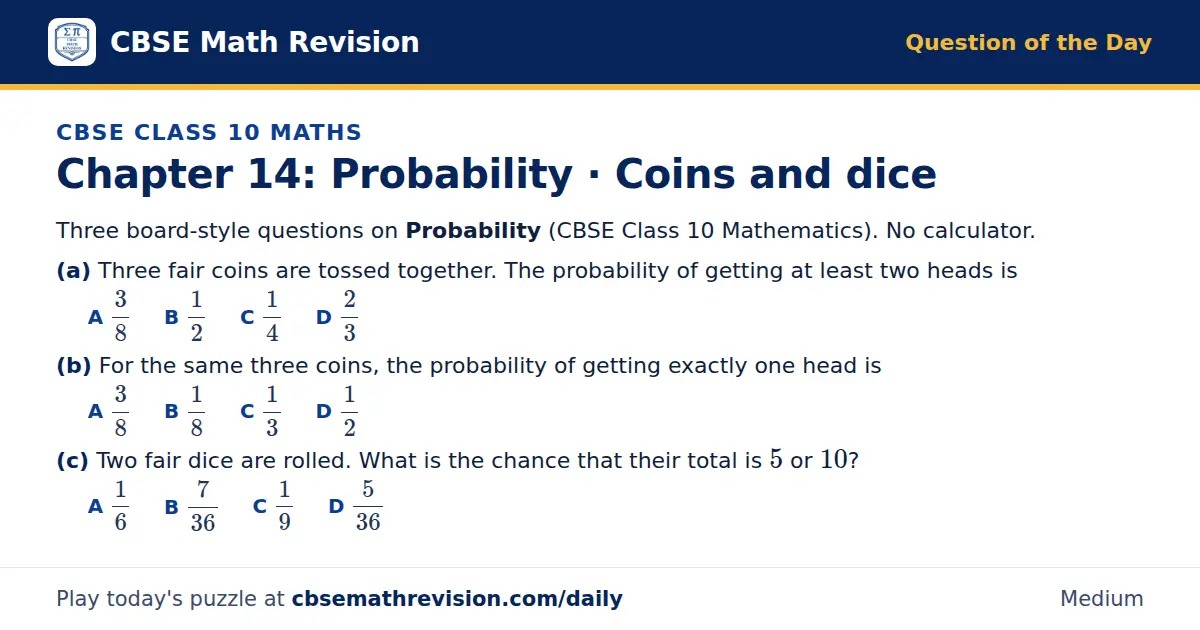
Chapter 14: Probability · Coins and dice
Three board-style questions on Probability (CBSE Class 10 Mathematics). No calculator.
- Three fair coins are tossed together. The probability of getting at least two heads is Options: A) 3/8; B) 1/2; C) 1/4; D) 2/3
- For the same three coins, the probability of getting exactly one head is Options: A) 3/8; B) 1/8; C) 1/3; D) 1/2
- Two fair dice are rolled. What is the chance that their total is 5 or 10? Options: A) 1/6; B) 7/36; C) 1/9; D) 5/36
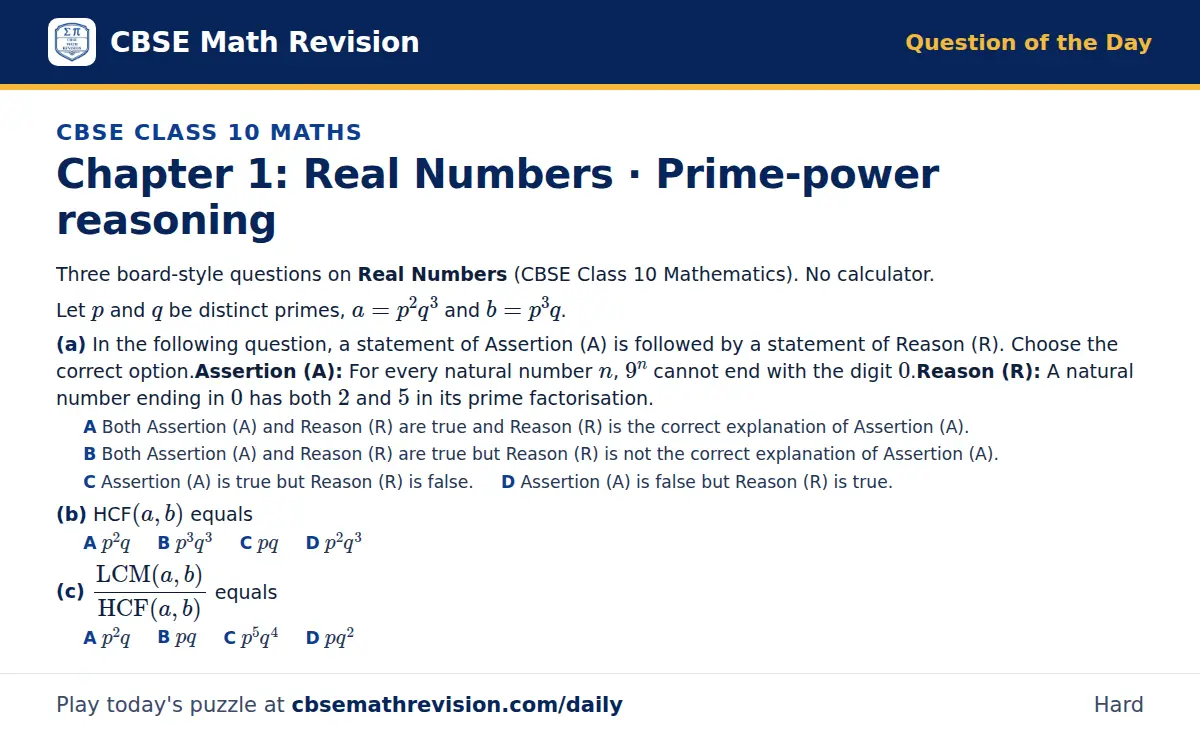
Chapter 1: Real Numbers · Prime-power reasoning
Three board-style questions on Real Numbers (CBSE Class 10 Mathematics). No calculator. Let p and q be distinct primes, a = p²q³ and b = p³q.
- In the following question, a statement of Assertion (A) is followed by a statement of Reason (R). Choose the correct option. Assertion (A): For every natural number n, 9^n cannot end with the digit 0. Reason (R): A natural number ending in 0 has both 2 and 5 in its prime factorisation. Options: A) Both Assertion (A) and Reason (R) are true and Reason (R) is the correct explanation of Assertion (A).; B) Both Assertion (A) and Reason (R) are true but Reason (R) is not the correct explanation of Assertion (A).; C) Assertion (A) is true but Reason (R) is false.; D) Assertion (A) is false but Reason (R) is true.
- HCF(a, b) equals Options: A) p²q; B) p³q³; C) pq; D) p²q³
- (LCM(a, b))/(HCF(a, b)) equals Options: A) p²q; B) pq; C) p⁵q⁴; D) pq²
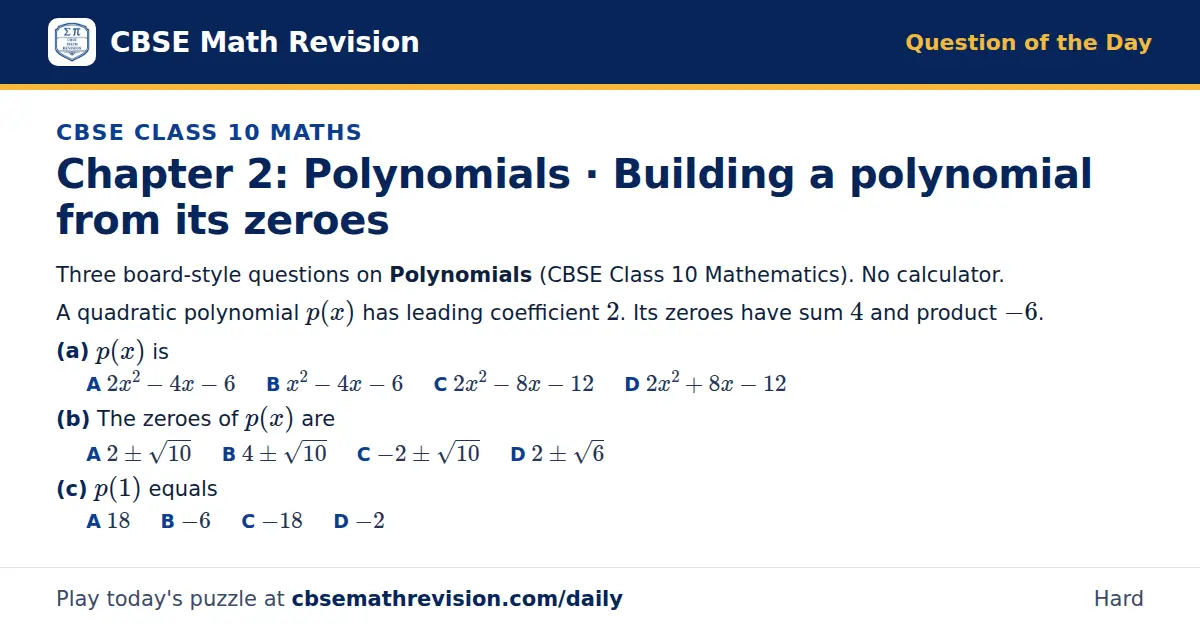
Chapter 2: Polynomials · Building a polynomial from its zeroes
Three board-style questions on Polynomials (CBSE Class 10 Mathematics). No calculator. A quadratic polynomial p(x) has leading coefficient 2. Its zeroes have sum 4 and product -6.
- p(x) is Options: A) 2x² - 4x - 6; B) x² - 4x - 6; C) 2x² - 8x - 12; D) 2x² + 8x - 12
- The zeroes of p(x) are Options: A) 2 ± √10; B) 4 ± √10; C) -2 ± √10; D) 2 ± √6
- p(1) equals Options: A) 18; B) -6; C) -18; D) -2
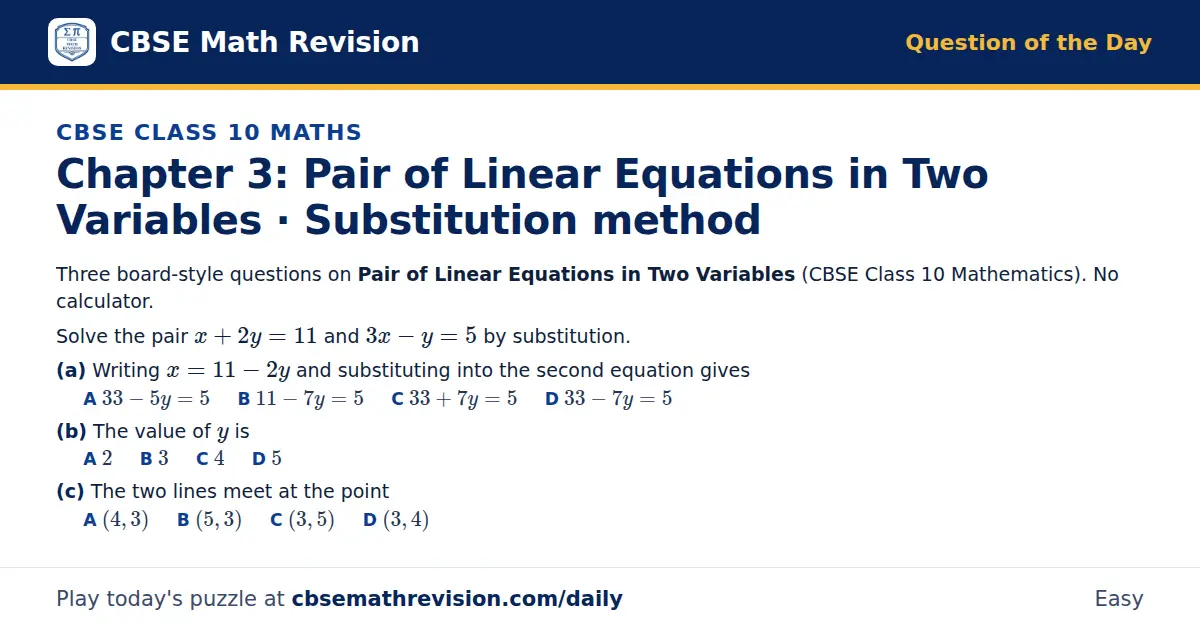
Chapter 3: Pair of Linear Equations in Two Variables · Substitution method
Three board-style questions on Pair of Linear Equations in Two Variables (CBSE Class 10 Mathematics). No calculator. Solve the pair x + 2y = 11 and 3x - y = 5 by substitution.
- Writing x = 11 - 2y and substituting into the second equation gives Options: A) 33 - 5y = 5; B) 11 - 7y = 5; C) 33 + 7y = 5; D) 33 - 7y = 5
- The value of y is Options: A) 2; B) 3; C) 4; D) 5
- The two lines meet at the point Options: A) (4, 3); B) (5, 3); C) (3, 5); D) (3, 4)
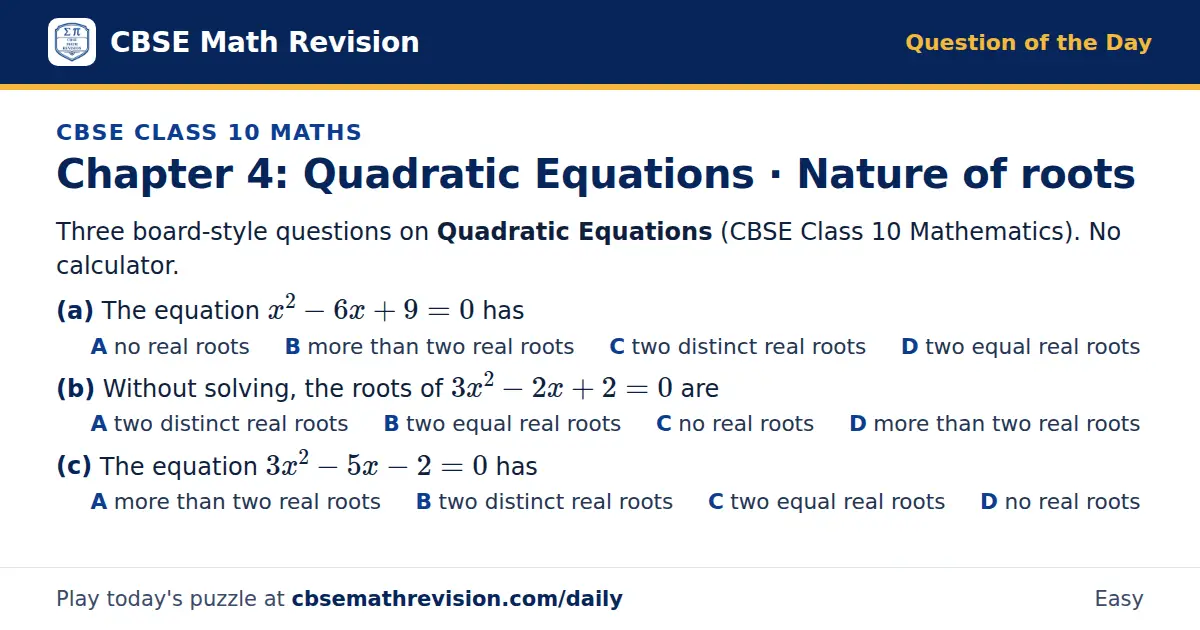
Chapter 4: Quadratic Equations · Nature of roots
Three board-style questions on Quadratic Equations (CBSE Class 10 Mathematics). No calculator.
- The equation x² - 6x + 9 = 0 has Options: A) no real roots; B) more than two real roots; C) two distinct real roots; D) two equal real roots
- Without solving, the roots of 3x² - 2x + 2 = 0 are Options: A) two distinct real roots; B) two equal real roots; C) no real roots; D) more than two real roots
- The equation 3x² - 5x - 2 = 0 has Options: A) more than two real roots; B) two distinct real roots; C) two equal real roots; D) no real roots
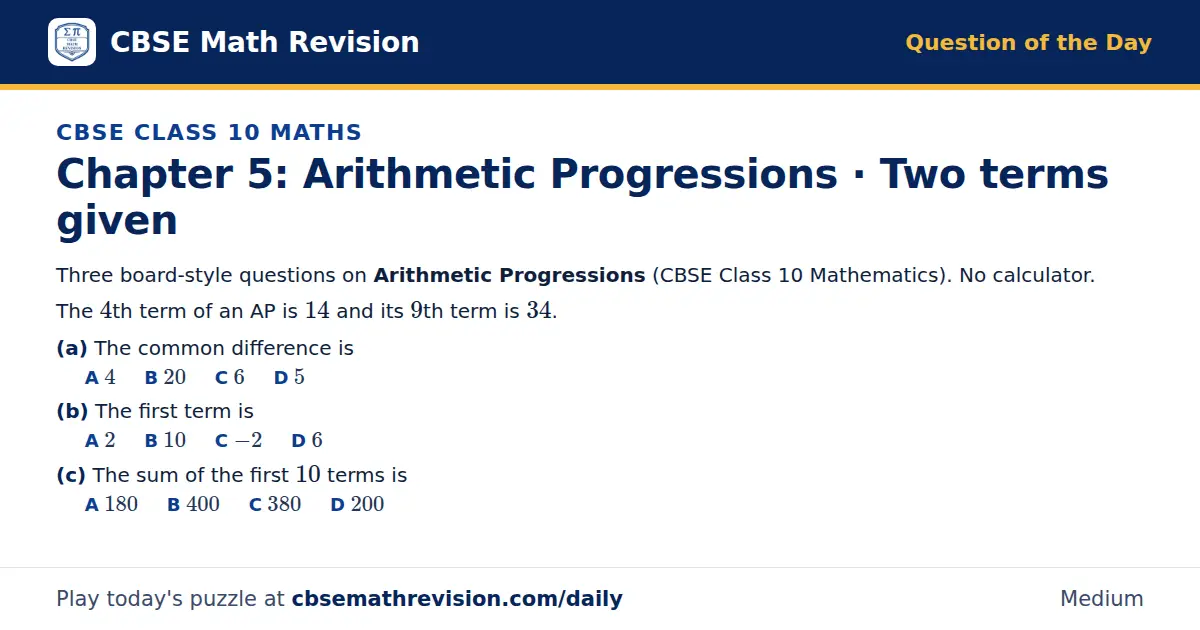
Chapter 5: Arithmetic Progressions · Two terms given
Three board-style questions on Arithmetic Progressions (CBSE Class 10 Mathematics). No calculator. The 4th term of an AP is 14 and its 9th term is 34.
- The common difference is Options: A) 4; B) 20; C) 6; D) 5
- The first term is Options: A) 2; B) 10; C) -2; D) 6
- The sum of the first 10 terms is Options: A) 180; B) 400; C) 380; D) 200
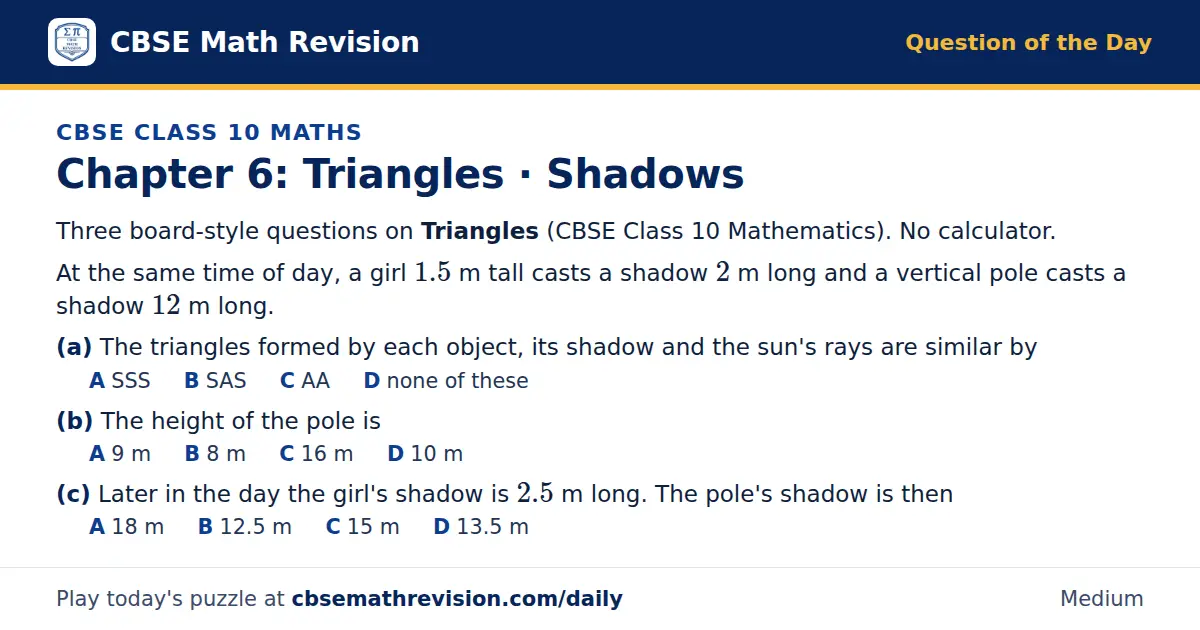
Chapter 6: Triangles · Shadows
Three board-style questions on Triangles (CBSE Class 10 Mathematics). No calculator. At the same time of day, a girl 1.5 m tall casts a shadow 2 m long and a vertical pole casts a shadow 12 m long.
- The triangles formed by each object, its shadow and the sun's rays are similar by Options: A) SSS; B) SAS; C) AA; D) none of these
- The height of the pole is Options: A) 9 m; B) 8 m; C) 16 m; D) 10 m
- Later in the day the girl's shadow is 2.5 m long. The pole's shadow is then Options: A) 18 m; B) 12.5 m; C) 15 m; D) 13.5 m
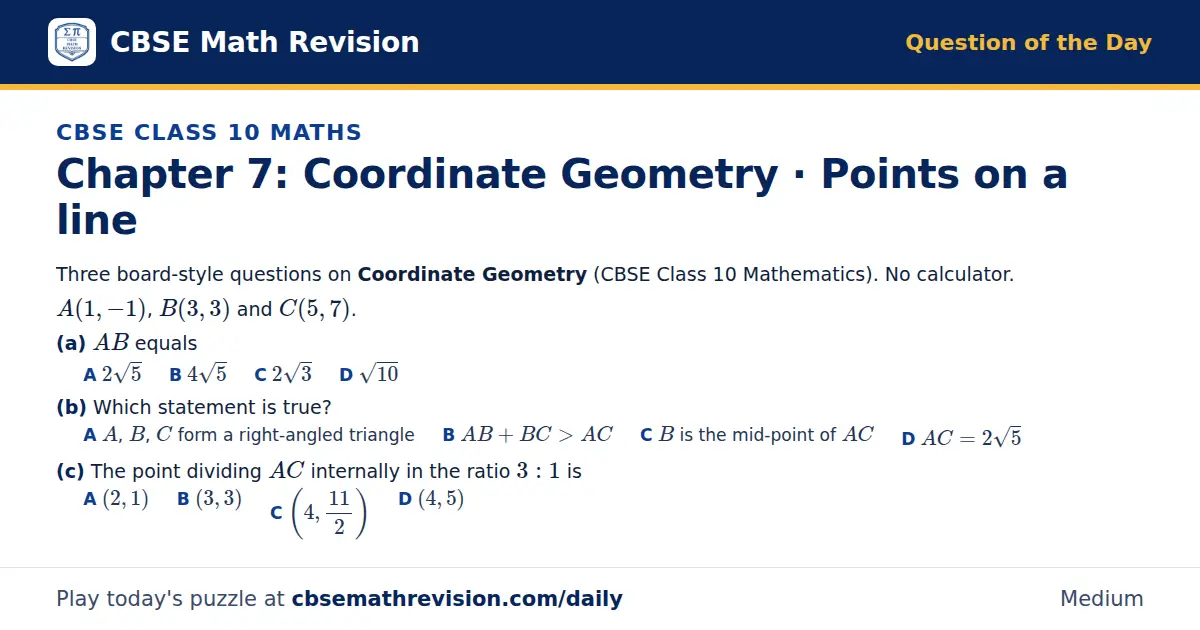
Chapter 7: Coordinate Geometry · Points on a line
Three board-style questions on Coordinate Geometry (CBSE Class 10 Mathematics). No calculator. A(1, -1), B(3, 3) and C(5, 7).
- AB equals Options: A) 2 √5; B) 4 √5; C) 2 √3; D) √10
- Which statement is true? Options: A) A, B, C form a right-angled triangle; B) AB + BC > AC; C) B is the mid-point of AC; D) AC = 2√5
- The point dividing AC internally in the ratio 3: 1 is Options: A) (2, 1); B) (3, 3); C) (4, 11/2); D) (4, 5)
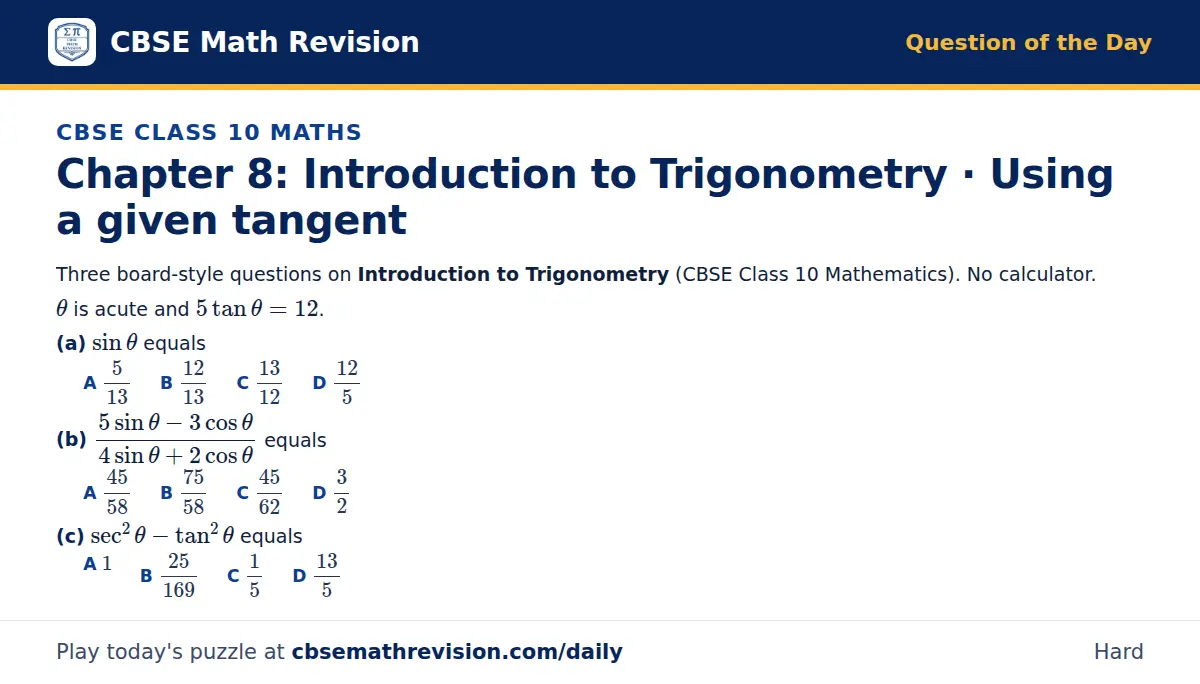
Chapter 8: Introduction to Trigonometry · Using a given tangent
Three board-style questions on Introduction to Trigonometry (CBSE Class 10 Mathematics). No calculator. θ is acute and 5tanθ = 12.
- sinθ equals Options: A) 5/13; B) 12/13; C) 13/12; D) 12/5
- (5sinθ - 3cosθ)/(4sinθ + 2cosθ) equals Options: A) 45/58; B) 75/58; C) 45/62; D) 3/2
- sec²θ - tan²θ equals Options: A) 1; B) 25/169; C) 1/5; D) 13/5
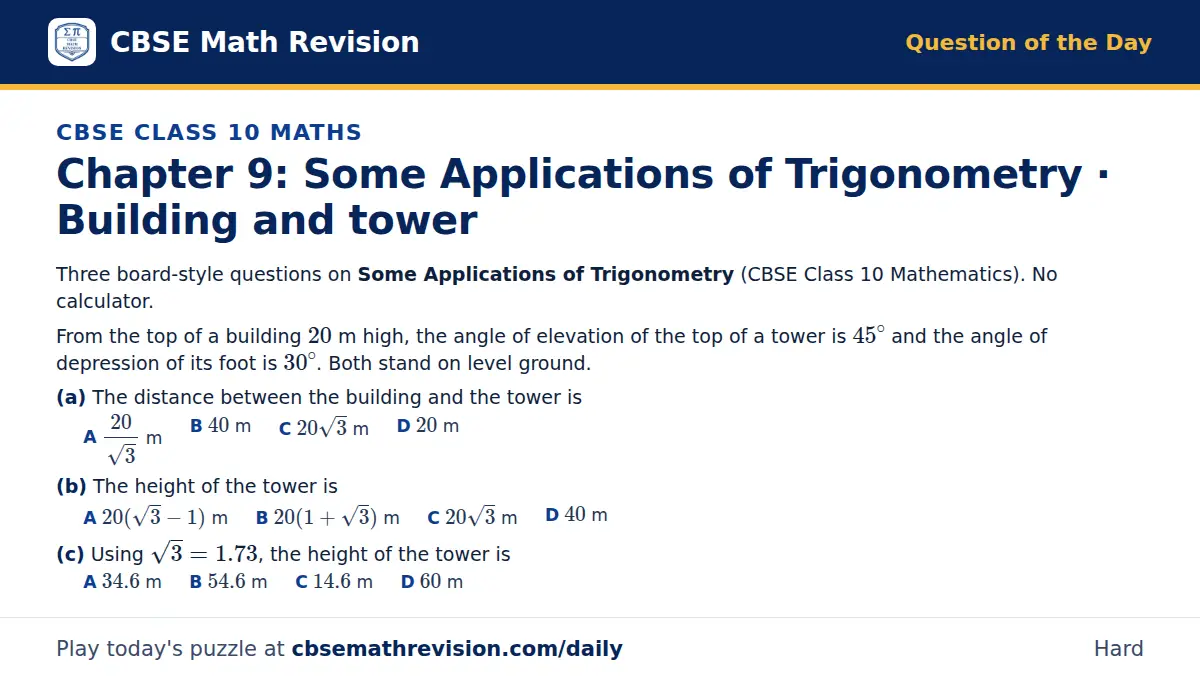
Chapter 9: Some Applications of Trigonometry · Building and tower
Three board-style questions on Some Applications of Trigonometry (CBSE Class 10 Mathematics). No calculator. From the top of a building 20 m high, the angle of elevation of the top of a tower is 45^∘ and the angle of depression of its foot is 30^∘. Both stand on level ground.
- The distance between the building and the tower is Options: A) 20/(√3) m; B) 40 m; C) 20√3 m; D) 20 m
- The height of the tower is Options: A) 20(√3 - 1) m; B) 20(1 + √3) m; C) 20√3 m; D) 40 m
- Using √3 = 1.73, the height of the tower is Options: A) 34.6 m; B) 54.6 m; C) 14.6 m; D) 60 m
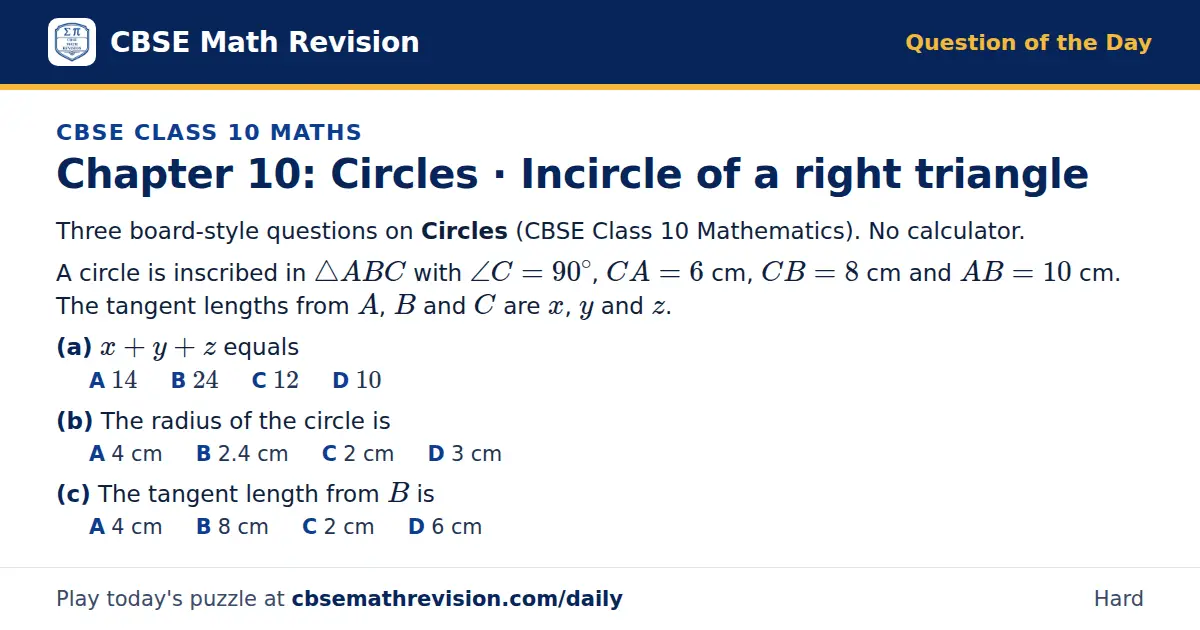
Chapter 10: Circles · Incircle of a right triangle
Three board-style questions on Circles (CBSE Class 10 Mathematics). No calculator. A circle is inscribed in △ ABC with ∠ C = 90^∘, CA = 6 cm, CB = 8 cm and AB = 10 cm. The tangent lengths from A, B and C are x, y and z.
- x + y + z equals Options: A) 14; B) 24; C) 12; D) 10
- The radius of the circle is Options: A) 4 cm; B) 2.4 cm; C) 2 cm; D) 3 cm
- The tangent length from B is Options: A) 4 cm; B) 8 cm; C) 2 cm; D) 6 cm
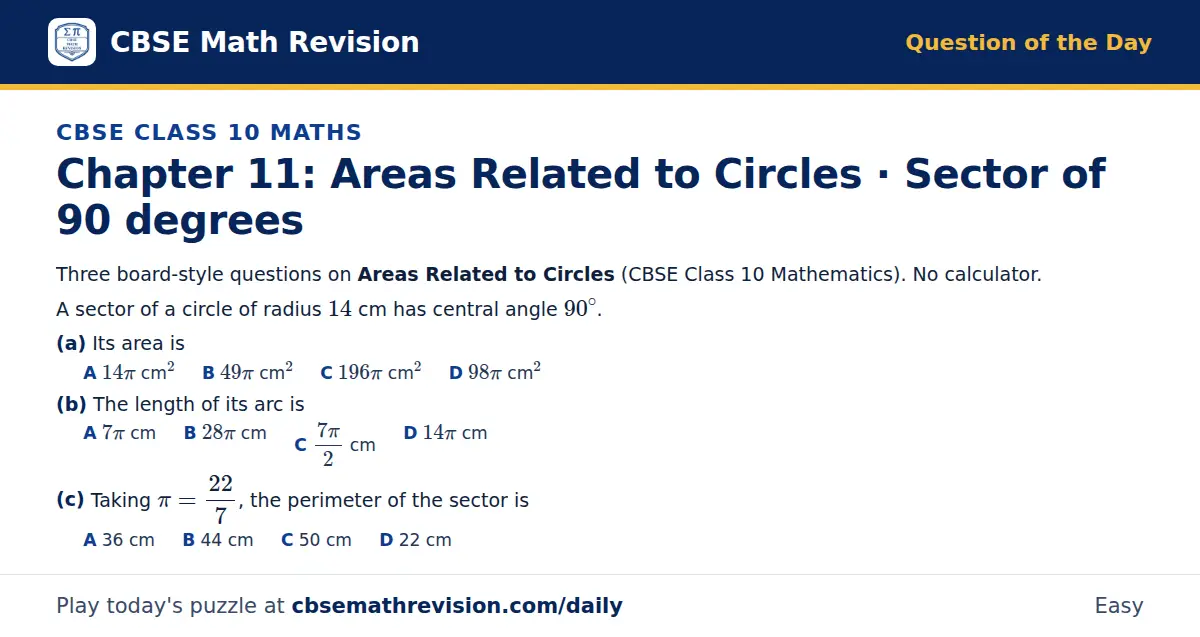
Chapter 11: Areas Related to Circles · Sector of 90 degrees
Three board-style questions on Areas Related to Circles (CBSE Class 10 Mathematics). No calculator. A sector of a circle of radius 14 cm has central angle 90^∘.
- Its area is Options: A) 14π cm²; B) 49π cm²; C) 196π cm²; D) 98π cm²
- The length of its arc is Options: A) 7π cm; B) 28π cm; C) (7π)/2 cm; D) 14π cm
- Taking π = 22/7, the perimeter of the sector is Options: A) 36 cm; B) 44 cm; C) 50 cm; D) 22 cm
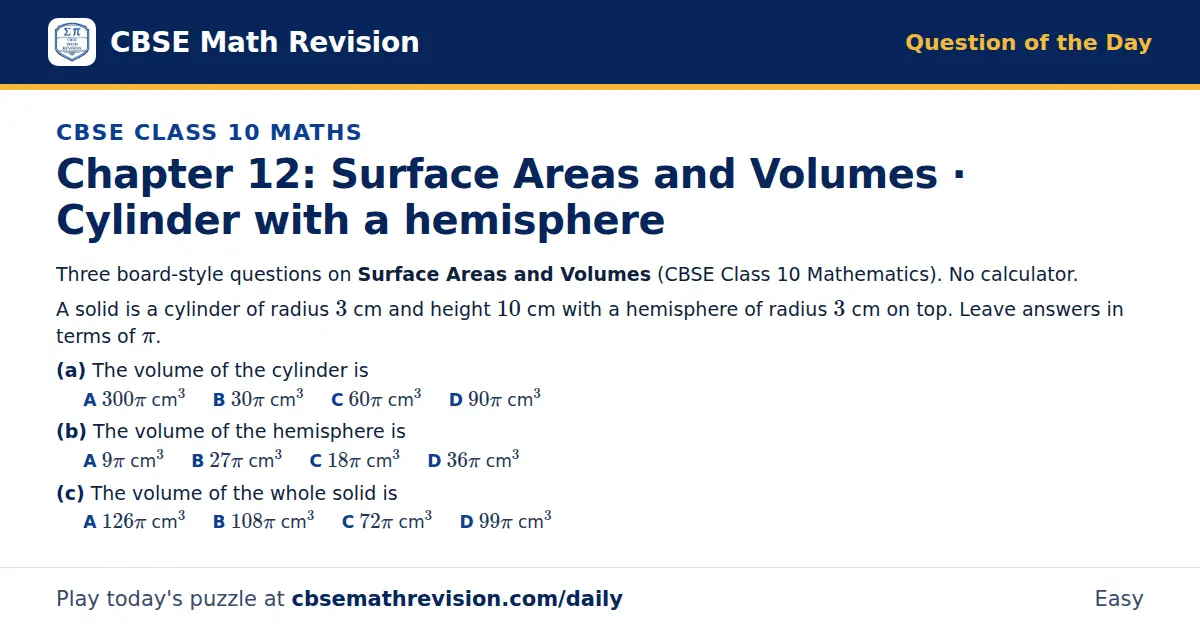
Chapter 12: Surface Areas and Volumes · Cylinder with a hemisphere
Three board-style questions on Surface Areas and Volumes (CBSE Class 10 Mathematics). No calculator. A solid is a cylinder of radius 3 cm and height 10 cm with a hemisphere of radius 3 cm on top. Leave answers in terms of π.
- The volume of the cylinder is Options: A) 300π cm³; B) 30π cm³; C) 60π cm³; D) 90π cm³
- The volume of the hemisphere is Options: A) 9π cm³; B) 27π cm³; C) 18π cm³; D) 36π cm³
- The volume of the whole solid is Options: A) 126π cm³; B) 108π cm³; C) 72π cm³; D) 99π cm³
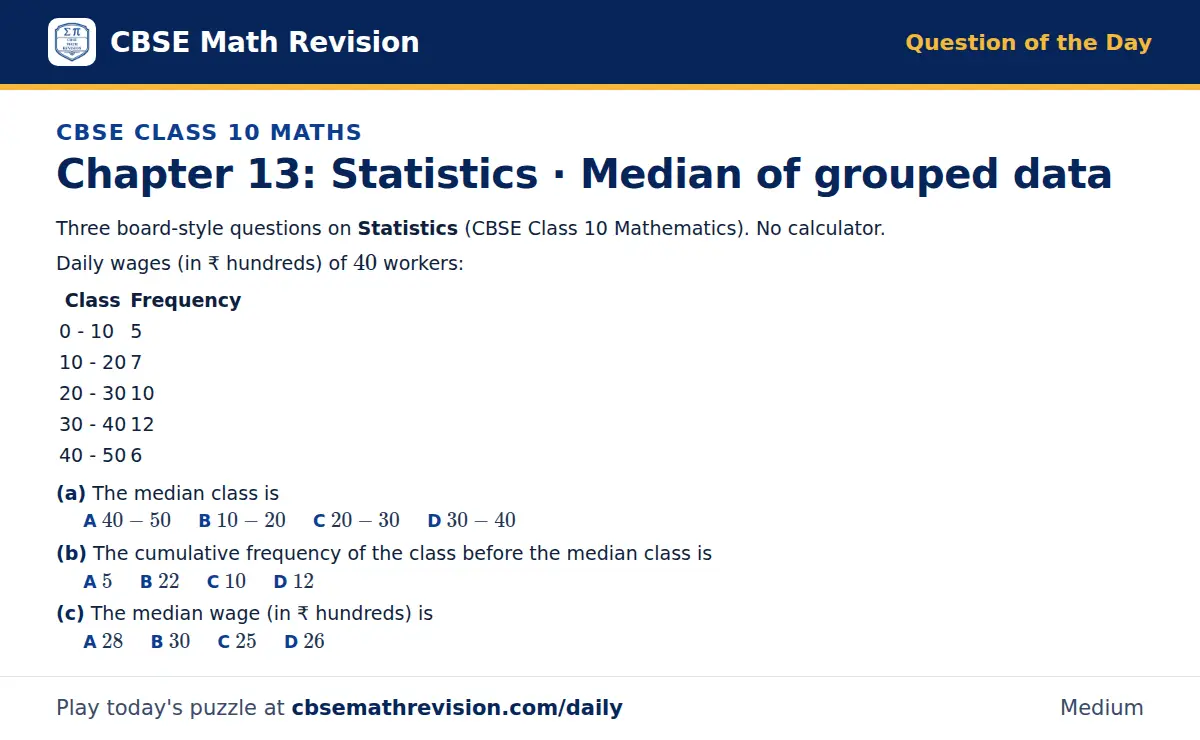
Chapter 13: Statistics · Median of grouped data
Three board-style questions on Statistics (CBSE Class 10 Mathematics). No calculator. Daily wages (in ₹ hundreds) of 40 workers: ClassFrequency0 - 10510 - 20720 - 301030 - 401240 - 506
- The median class is Options: A) 40 - 50; B) 10 - 20; C) 20 - 30; D) 30 - 40
- The cumulative frequency of the class before the median class is Options: A) 5; B) 22; C) 10; D) 12
- The median wage (in ₹ hundreds) is Options: A) 28; B) 30; C) 25; D) 26
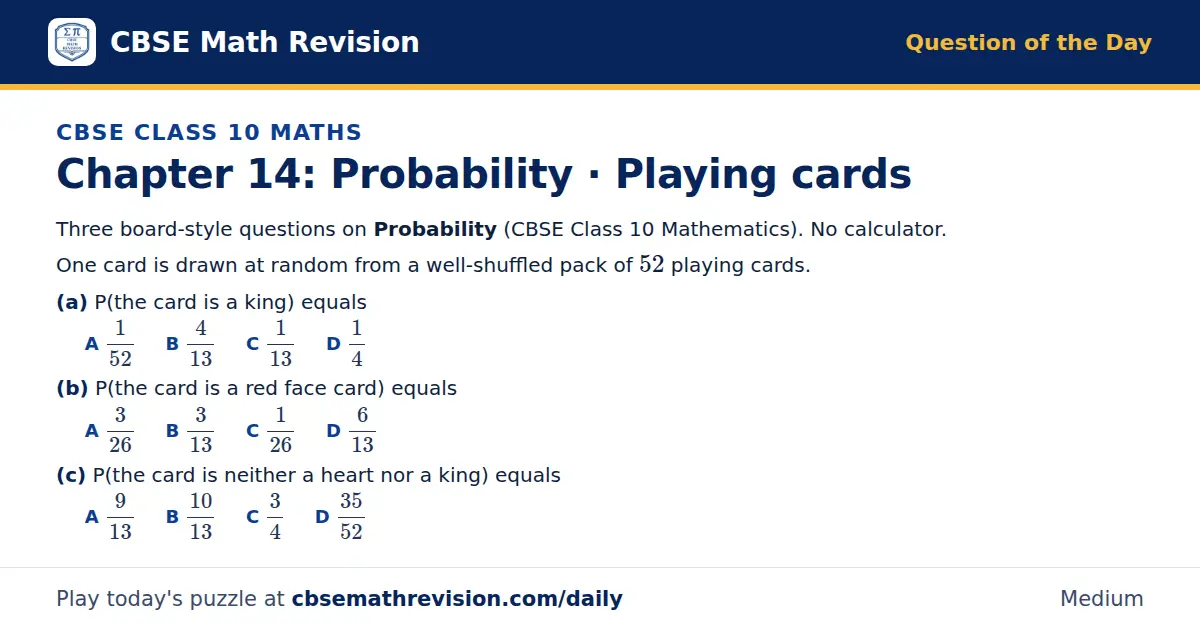
Chapter 14: Probability · Playing cards
Three board-style questions on Probability (CBSE Class 10 Mathematics). No calculator. One card is drawn at random from a well-shuffled pack of 52 playing cards.
- P(the card is a king) equals Options: A) 1/52; B) 4/13; C) 1/13; D) 1/4
- P(the card is a red face card) equals Options: A) 3/26; B) 3/13; C) 1/26; D) 6/13
- P(the card is neither a heart nor a king) equals Options: A) 9/13; B) 10/13; C) 3/4; D) 35/52
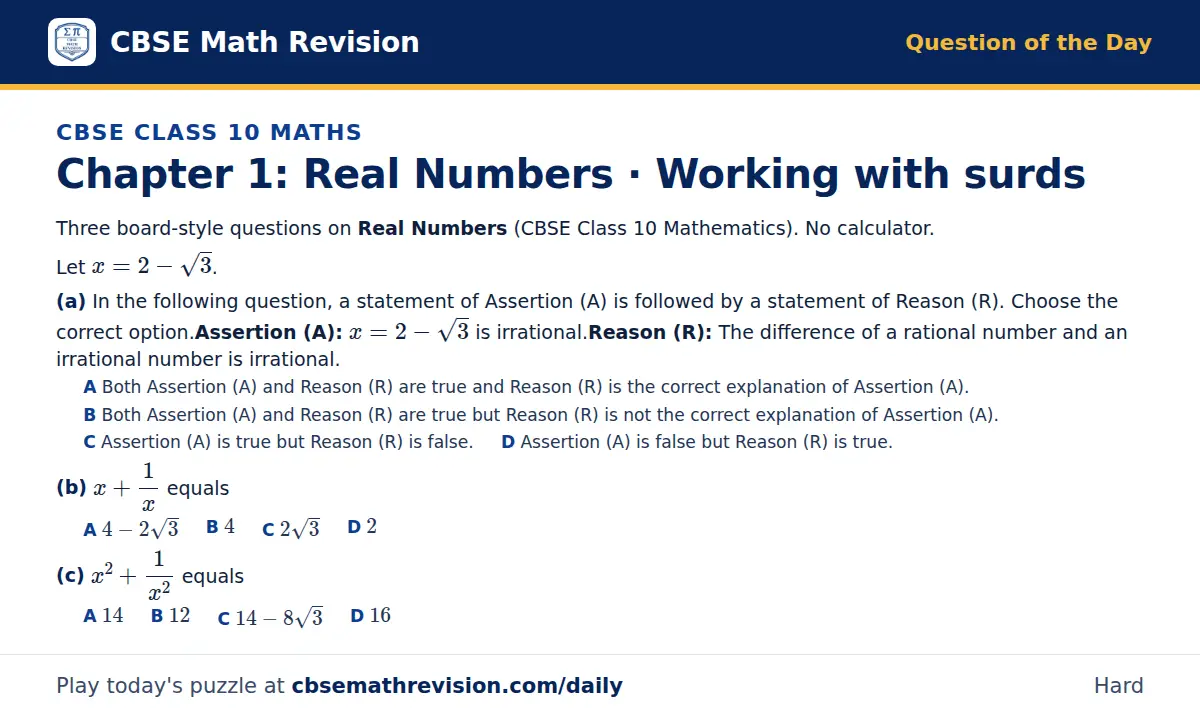
Chapter 1: Real Numbers · Working with surds
Three board-style questions on Real Numbers (CBSE Class 10 Mathematics). No calculator. Let x = 2 - √3.
- In the following question, a statement of Assertion (A) is followed by a statement of Reason (R). Choose the correct option. Assertion (A): x = 2 - √3 is irrational. Reason (R): The difference of a rational number and an irrational number is irrational. Options: A) Both Assertion (A) and Reason (R) are true and Reason (R) is the correct explanation of Assertion (A).; B) Both Assertion (A) and Reason (R) are true but Reason (R) is not the correct explanation of Assertion (A).; C) Assertion (A) is true but Reason (R) is false.; D) Assertion (A) is false but Reason (R) is true.
- x + 1/x equals Options: A) 4 - 2 √3; B) 4; C) 2 √3; D) 2
- x² + 1/(x²) equals Options: A) 14; B) 12; C) 14 - 8 √3; D) 16
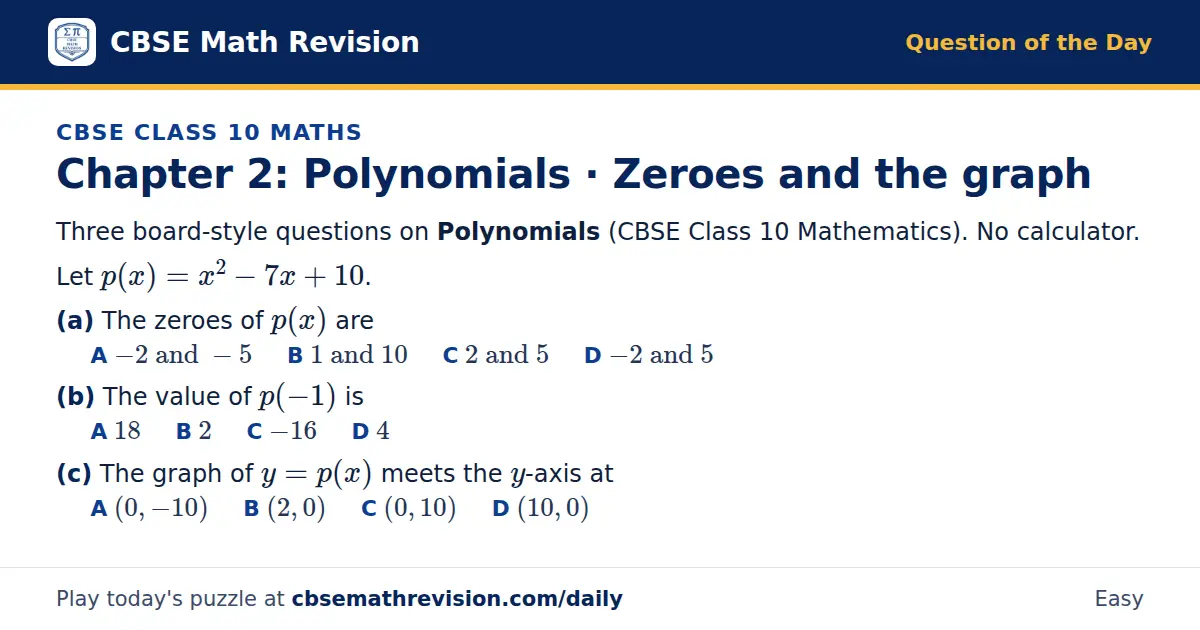
Chapter 2: Polynomials · Zeroes and the graph
Three board-style questions on Polynomials (CBSE Class 10 Mathematics). No calculator. Let p(x) = x² - 7x + 10.
- The zeroes of p(x) are Options: A) -2 and -5; B) 1 and 10; C) 2 and 5; D) -2 and 5
- The value of p(-1) is Options: A) 18; B) 2; C) -16; D) 4
- The graph of y = p(x) meets the y-axis at Options: A) (0, -10); B) (2, 0); C) (0, 10); D) (10, 0)
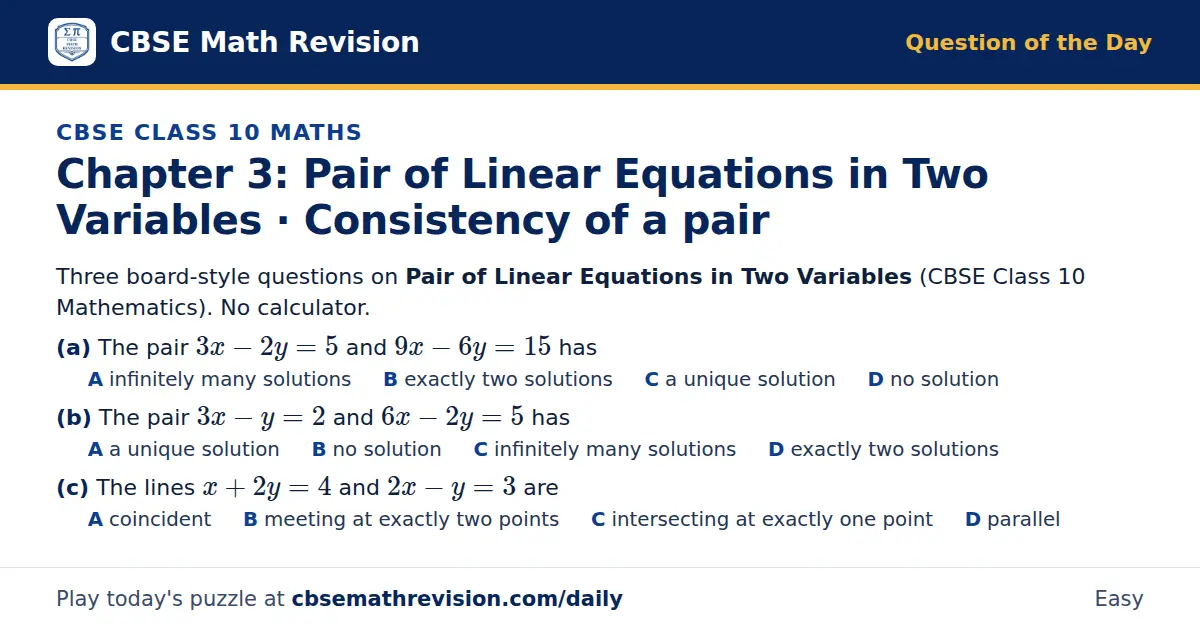
Chapter 3: Pair of Linear Equations in Two Variables · Consistency of a pair
Three board-style questions on Pair of Linear Equations in Two Variables (CBSE Class 10 Mathematics). No calculator.
- The pair 3x - 2y = 5 and 9x - 6y = 15 has Options: A) infinitely many solutions; B) exactly two solutions; C) a unique solution; D) no solution
- The pair 3x - y = 2 and 6x - 2y = 5 has Options: A) a unique solution; B) no solution; C) infinitely many solutions; D) exactly two solutions
- The lines x + 2y = 4 and 2x - y = 3 are Options: A) coincident; B) meeting at exactly two points; C) intersecting at exactly one point; D) parallel
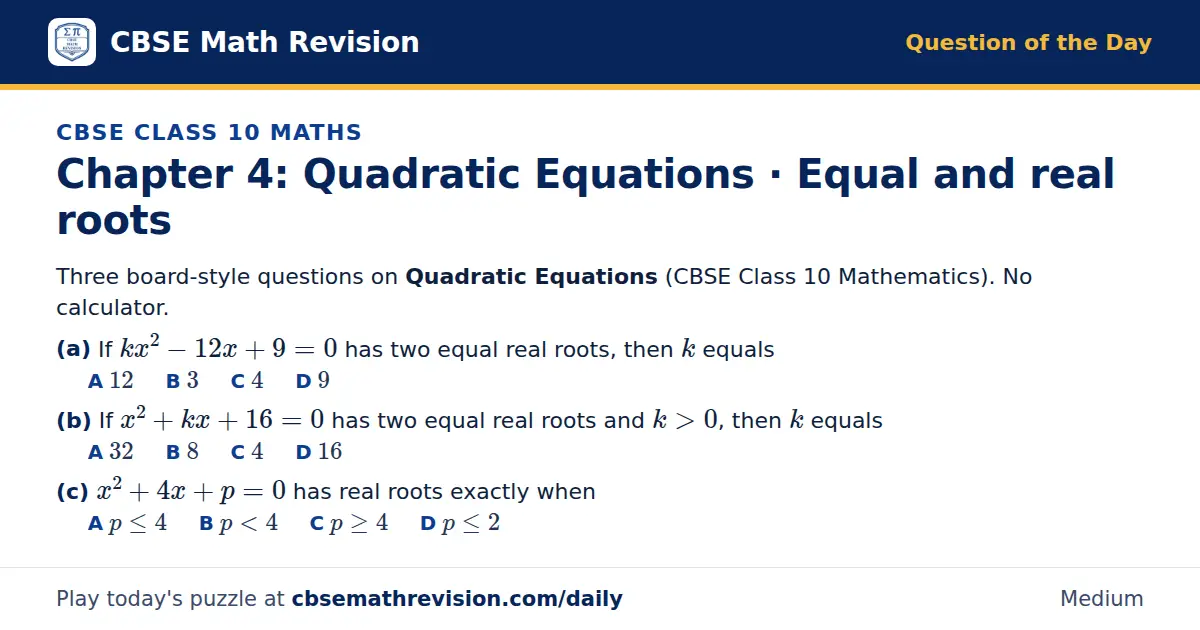
Chapter 4: Quadratic Equations · Equal and real roots
Three board-style questions on Quadratic Equations (CBSE Class 10 Mathematics). No calculator.
- If kx² - 12x + 9 = 0 has two equal real roots, then k equals Options: A) 12; B) 3; C) 4; D) 9
- If x² + kx + 16 = 0 has two equal real roots and k > 0, then k equals Options: A) 32; B) 8; C) 4; D) 16
- x² + 4x + p = 0 has real roots exactly when Options: A) p ≤ 4; B) p < 4; C) p ≥ 4; D) p ≤ 2
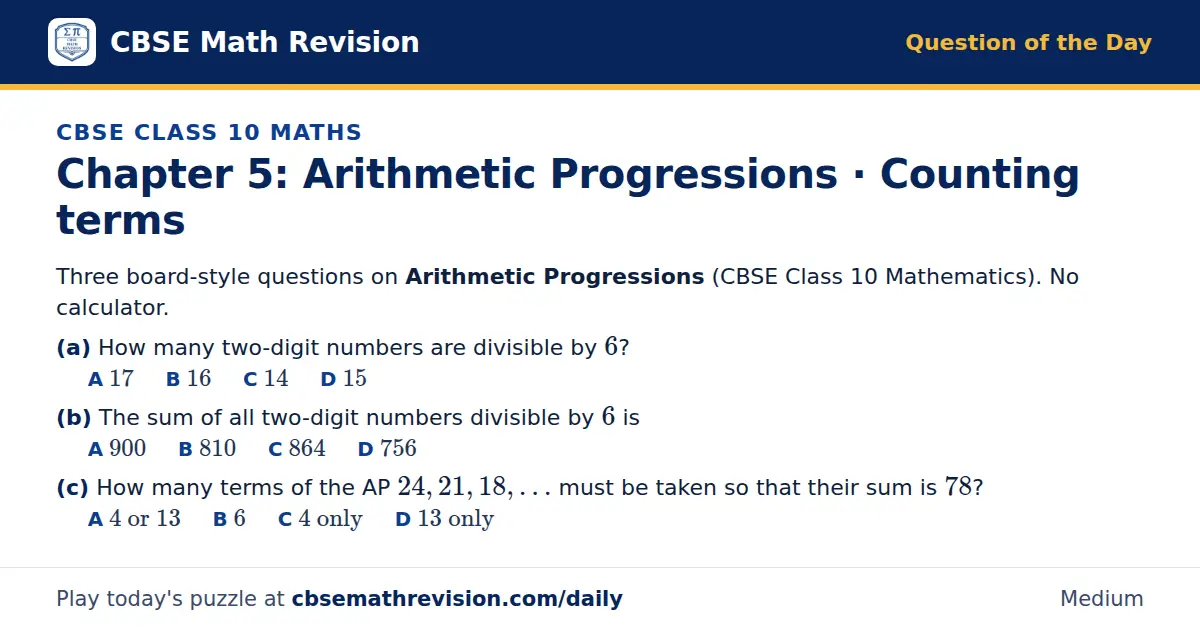
Chapter 5: Arithmetic Progressions · Counting terms
Three board-style questions on Arithmetic Progressions (CBSE Class 10 Mathematics). No calculator.
- How many two-digit numbers are divisible by 6? Options: A) 17; B) 16; C) 14; D) 15
- The sum of all two-digit numbers divisible by 6 is Options: A) 900; B) 810; C) 864; D) 756
- How many terms of the AP 24, 21, 18, … must be taken so that their sum is 78? Options: A) 4 or 13; B) 6; C) 4 only; D) 13 only
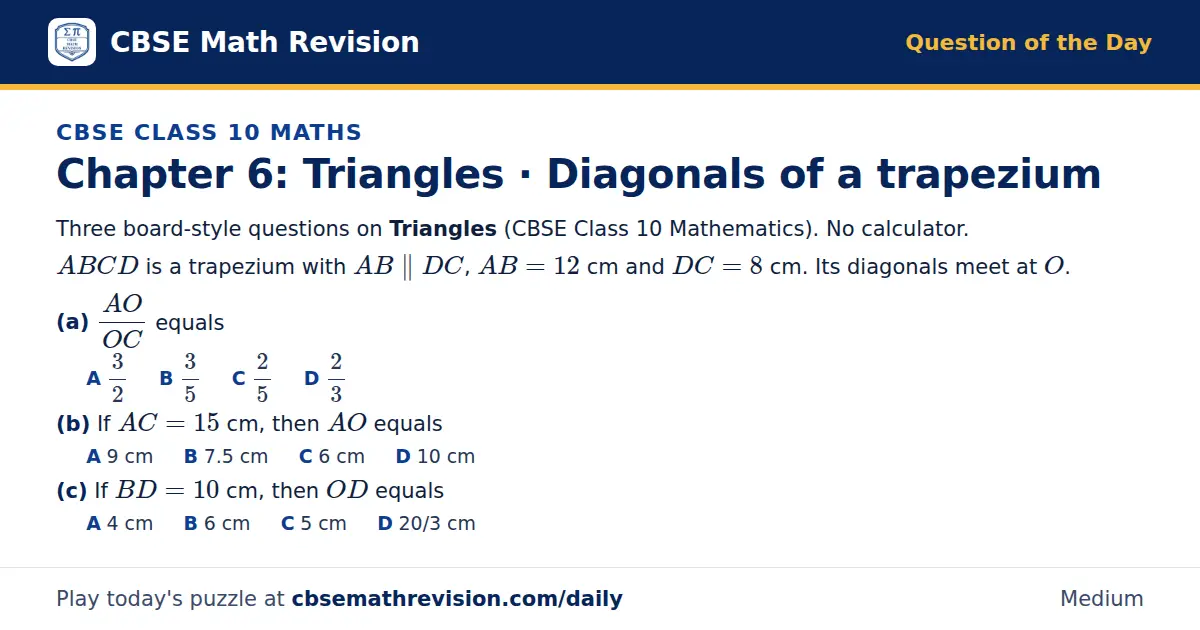
Chapter 6: Triangles · Diagonals of a trapezium
Three board-style questions on Triangles (CBSE Class 10 Mathematics). No calculator. ABCD is a trapezium with AB ∥ DC, AB = 12 cm and DC = 8 cm. Its diagonals meet at O.
- AO/OC equals Options: A) 3/2; B) 3/5; C) 2/5; D) 2/3
- If AC = 15 cm, then AO equals Options: A) 9 cm; B) 7.5 cm; C) 6 cm; D) 10 cm
- If BD = 10 cm, then OD equals Options: A) 4 cm; B) 6 cm; C) 5 cm; D) 20/3 cm
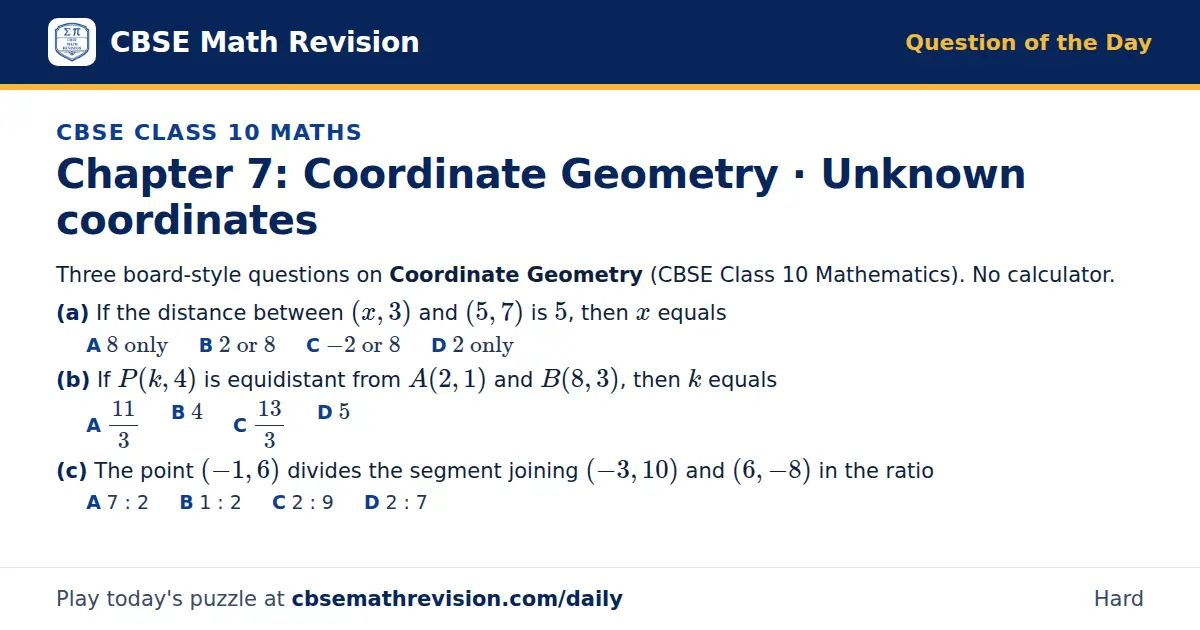
Chapter 7: Coordinate Geometry · Unknown coordinates
Three board-style questions on Coordinate Geometry (CBSE Class 10 Mathematics). No calculator.
- If the distance between (x, 3) and (5, 7) is 5, then x equals Options: A) 8 only; B) 2 or 8; C) -2 or 8; D) 2 only
- If P(k, 4) is equidistant from A(2, 1) and B(8, 3), then k equals Options: A) 11/3; B) 4; C) 13/3; D) 5
- The point (-1, 6) divides the segment joining (-3, 10) and (6, -8) in the ratio Options: A) 7: 2; B) 1: 2; C) 2: 9; D) 2: 7
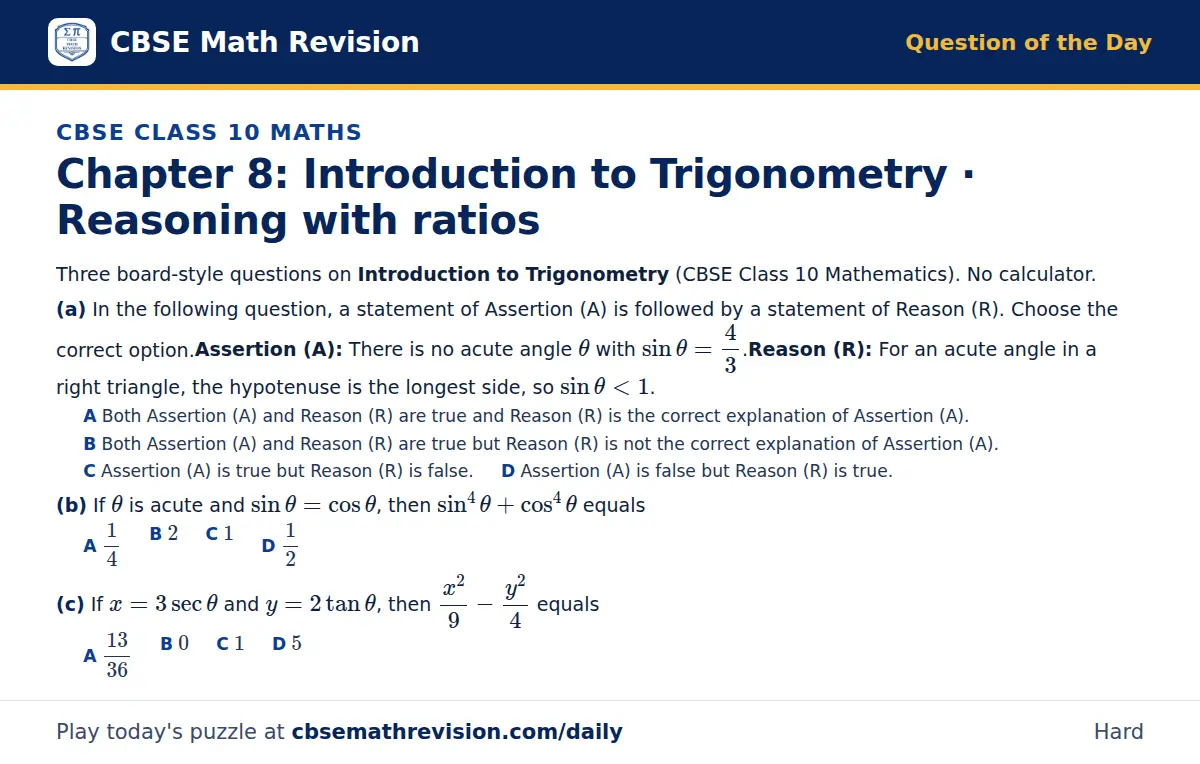
Chapter 8: Introduction to Trigonometry · Reasoning with ratios
Three board-style questions on Introduction to Trigonometry (CBSE Class 10 Mathematics). No calculator.
- In the following question, a statement of Assertion (A) is followed by a statement of Reason (R). Choose the correct option. Assertion (A): There is no acute angle θ with sinθ = 43. Reason (R): For an acute angle in a right triangle, the hypotenuse is the longest side, so sinθ < 1. Options: A) Both Assertion (A) and Reason (R) are true and Reason (R) is the correct explanation of Assertion (A).; B) Both Assertion (A) and Reason (R) are true but Reason (R) is not the correct explanation of Assertion (A).; C) Assertion (A) is true but Reason (R) is false.; D) Assertion (A) is false but Reason (R) is true.
- If θ is acute and sinθ = cosθ, then sin⁴θ + cos⁴θ equals Options: A) 1/4; B) 2; C) 1; D) 1/2
- If x = 3secθ and y = 2tanθ, then (x²)/9 - (y²)/4 equals Options: A) 13/36; B) 0; C) 1; D) 5
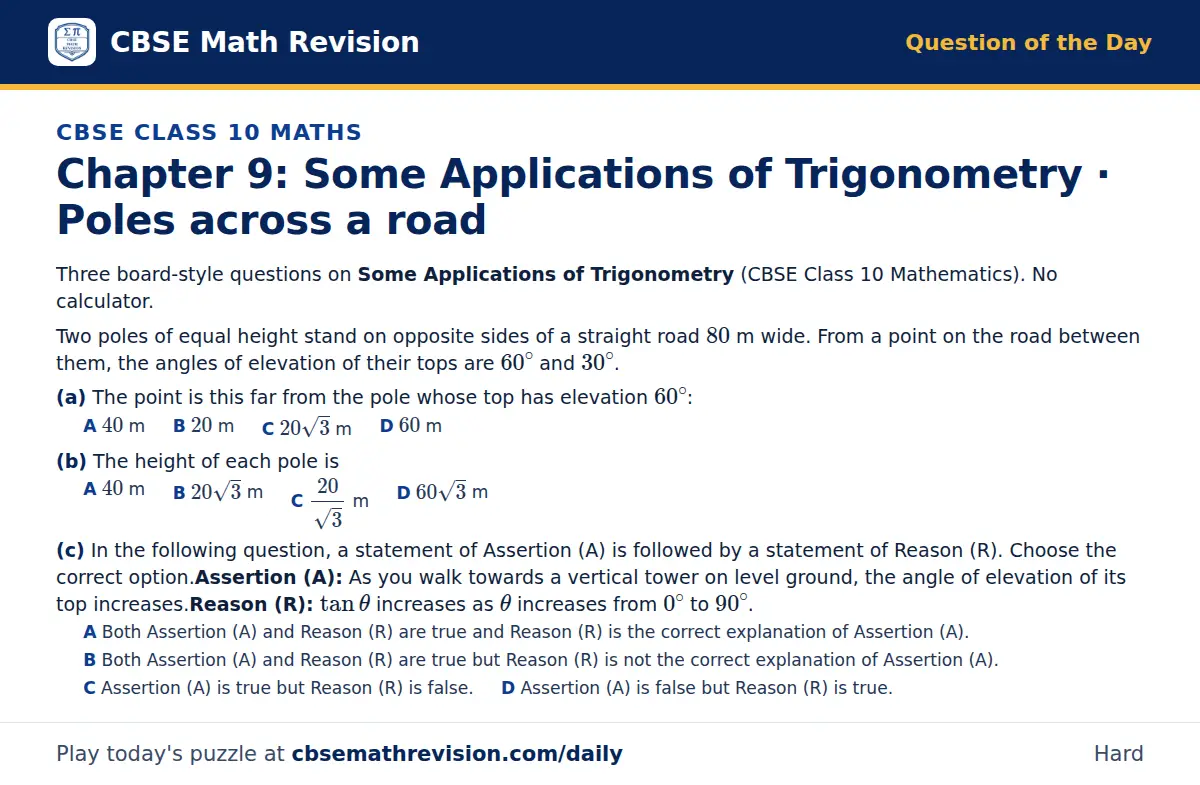
Chapter 9: Some Applications of Trigonometry · Poles across a road
Three board-style questions on Some Applications of Trigonometry (CBSE Class 10 Mathematics). No calculator. Two poles of equal height stand on opposite sides of a straight road 80 m wide. From a point on the road between them, the angles of elevation of their tops are 60^∘ and 30^∘.
- The point is this far from the pole whose top has elevation 60^∘: Options: A) 40 m; B) 20 m; C) 20√3 m; D) 60 m
- The height of each pole is Options: A) 40 m; B) 20√3 m; C) 20/(√3) m; D) 60√3 m
- In the following question, a statement of Assertion (A) is followed by a statement of Reason (R). Choose the correct option. Assertion (A): As you walk towards a vertical tower on level ground, the angle of elevation of its top increases. Reason (R): tanθ increases as θ increases from 0^∘ to 90^∘. Options: A) Both Assertion (A) and Reason (R) are true and Reason (R) is the correct explanation of Assertion (A).; B) Both Assertion (A) and Reason (R) are true but Reason (R) is not the correct explanation of Assertion (A).; C) Assertion (A) is true but Reason (R) is false.; D) Assertion (A) is false but Reason (R) is true.
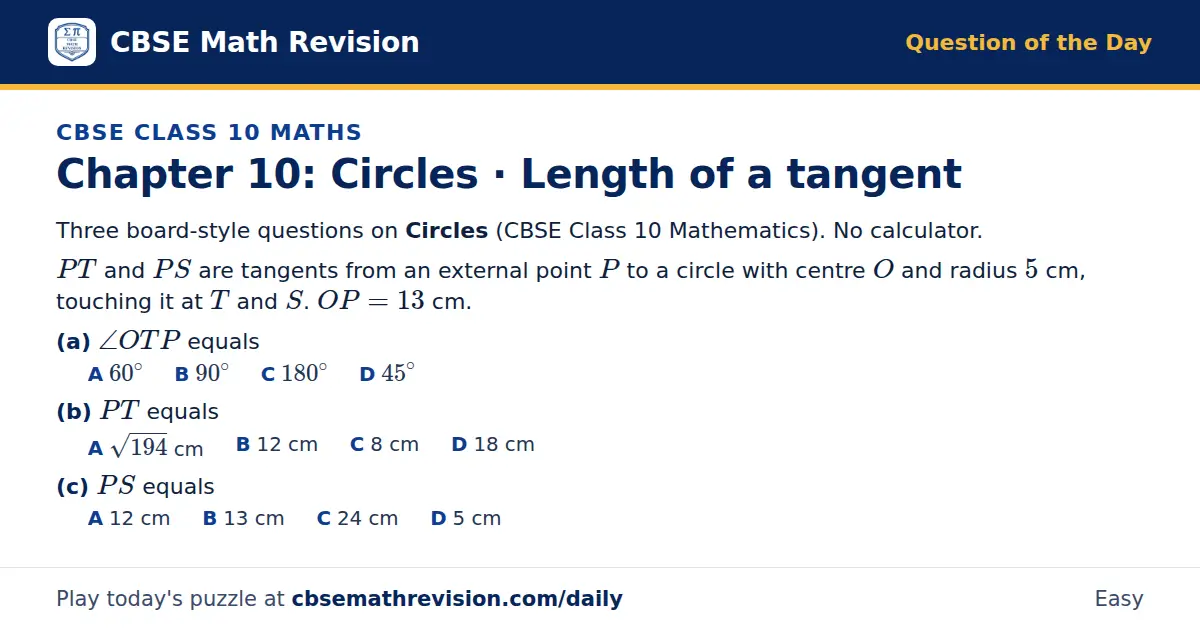
Chapter 10: Circles · Length of a tangent
Three board-style questions on Circles (CBSE Class 10 Mathematics). No calculator. PT and PS are tangents from an external point P to a circle with centre O and radius 5 cm, touching it at T and S. OP = 13 cm.
- ∠ OTP equals Options: A) 60^∘; B) 90^∘; C) 180^∘; D) 45^∘
- PT equals Options: A) √194 cm; B) 12 cm; C) 8 cm; D) 18 cm
- PS equals Options: A) 12 cm; B) 13 cm; C) 24 cm; D) 5 cm
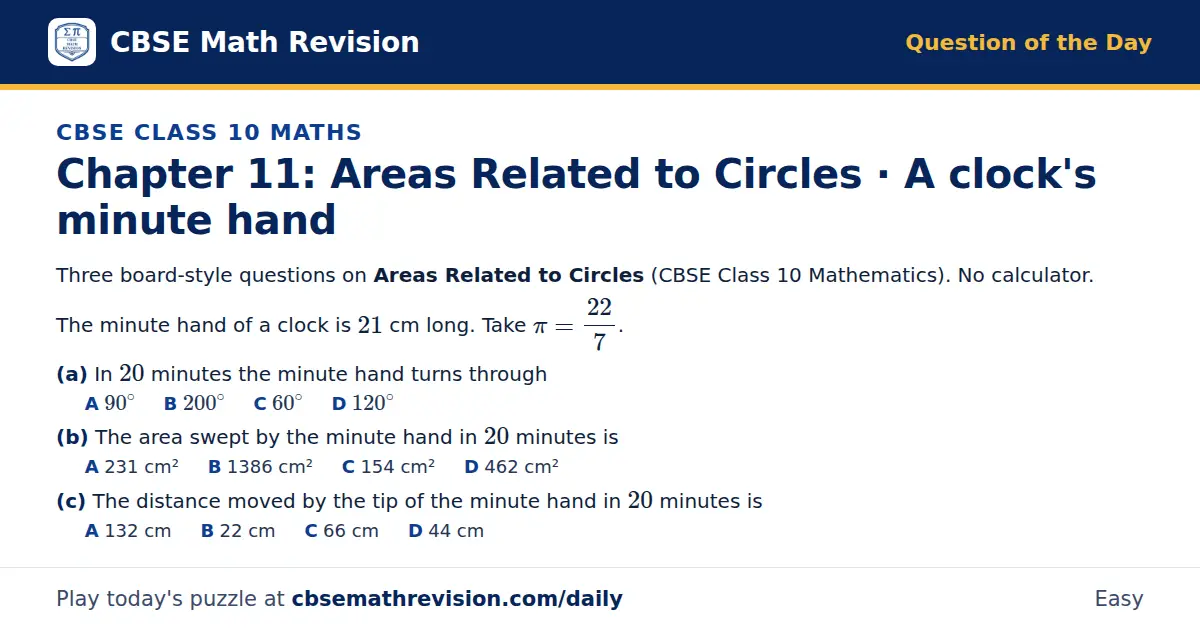
Chapter 11: Areas Related to Circles · A clock's minute hand
Three board-style questions on Areas Related to Circles (CBSE Class 10 Mathematics). No calculator. The minute hand of a clock is 21 cm long. Take π = 22/7.
- In 20 minutes the minute hand turns through Options: A) 90^∘; B) 200^∘; C) 60^∘; D) 120^∘
- The area swept by the minute hand in 20 minutes is Options: A) 231 cm²; B) 1386 cm²; C) 154 cm²; D) 462 cm²
- The distance moved by the tip of the minute hand in 20 minutes is Options: A) 132 cm; B) 22 cm; C) 66 cm; D) 44 cm
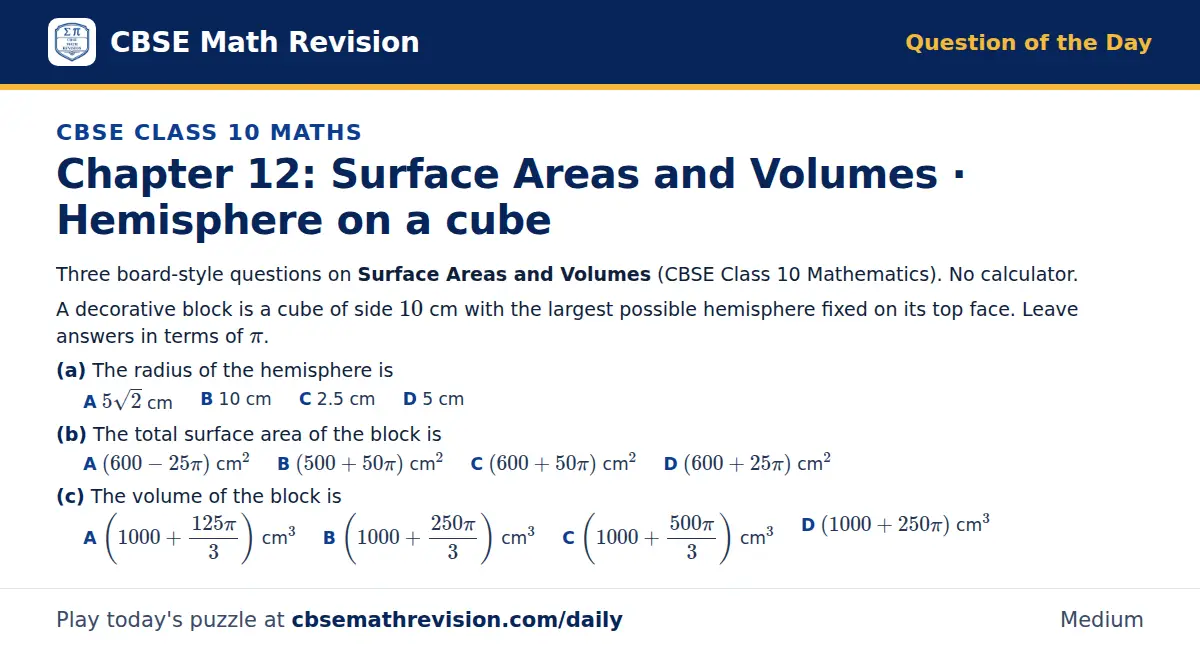
Chapter 12: Surface Areas and Volumes · Hemisphere on a cube
Three board-style questions on Surface Areas and Volumes (CBSE Class 10 Mathematics). No calculator. A decorative block is a cube of side 10 cm with the largest possible hemisphere fixed on its top face. Leave answers in terms of π.
- The radius of the hemisphere is Options: A) 5√2 cm; B) 10 cm; C) 2.5 cm; D) 5 cm
- The total surface area of the block is Options: A) (600 - 25π) cm²; B) (500 + 50π) cm²; C) (600 + 50π) cm²; D) (600 + 25π) cm²
- The volume of the block is Options: A) (1000 + (125π)/3) cm³; B) (1000 + (250π)/3) cm³; C) (1000 + (500π)/3) cm³; D) (1000 + 250π) cm³
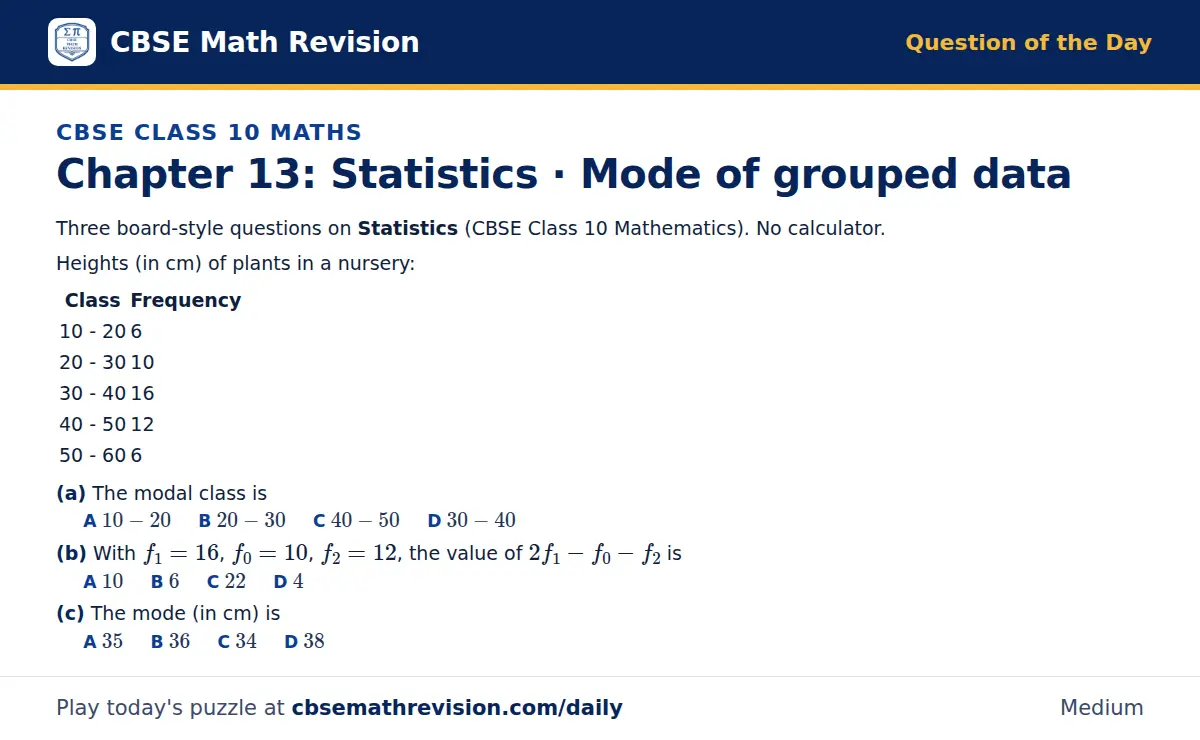
Chapter 13: Statistics · Mode of grouped data
Three board-style questions on Statistics (CBSE Class 10 Mathematics). No calculator. Heights (in cm) of plants in a nursery: ClassFrequency10 - 20620 - 301030 - 401640 - 501250 - 606
- The modal class is Options: A) 10 - 20; B) 20 - 30; C) 40 - 50; D) 30 - 40
- With f_1 = 16, f_0 = 10, f_2 = 12, the value of 2f_1 - f_0 - f_2 is Options: A) 10; B) 6; C) 22; D) 4
- The mode (in cm) is Options: A) 35; B) 36; C) 34; D) 38
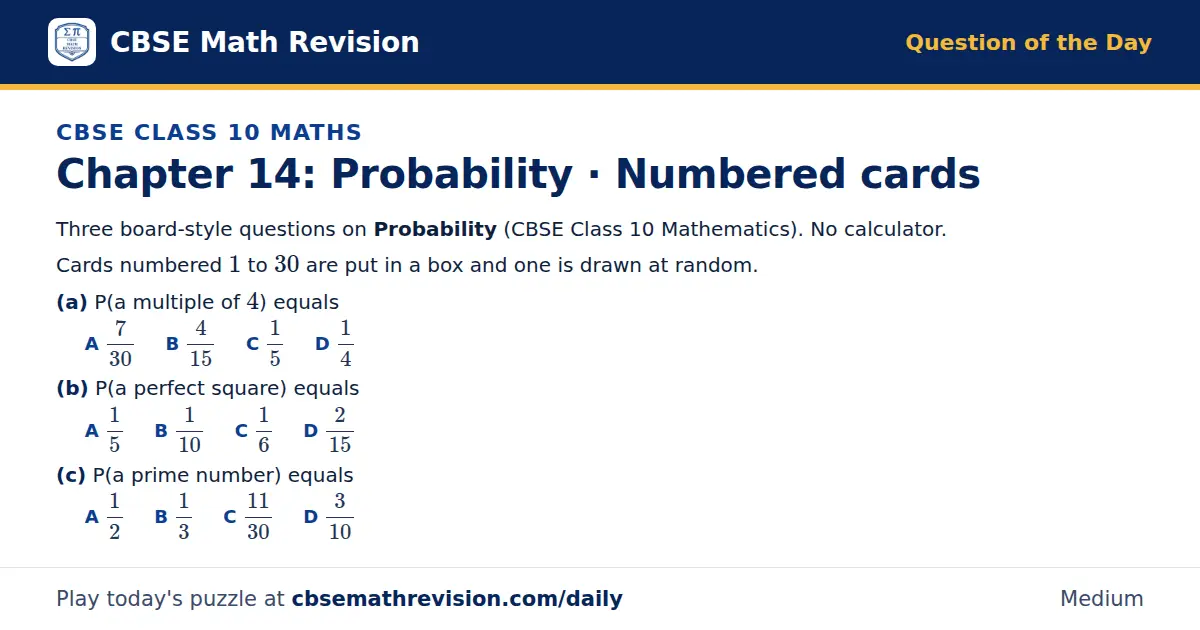
Chapter 14: Probability · Numbered cards
Three board-style questions on Probability (CBSE Class 10 Mathematics). No calculator. Cards numbered 1 to 30 are put in a box and one is drawn at random.
- P(a multiple of 4) equals Options: A) 7/30; B) 4/15; C) 1/5; D) 1/4
- P(a perfect square) equals Options: A) 1/5; B) 1/10; C) 1/6; D) 2/15
- P(a prime number) equals Options: A) 1/2; B) 1/3; C) 11/30; D) 3/10
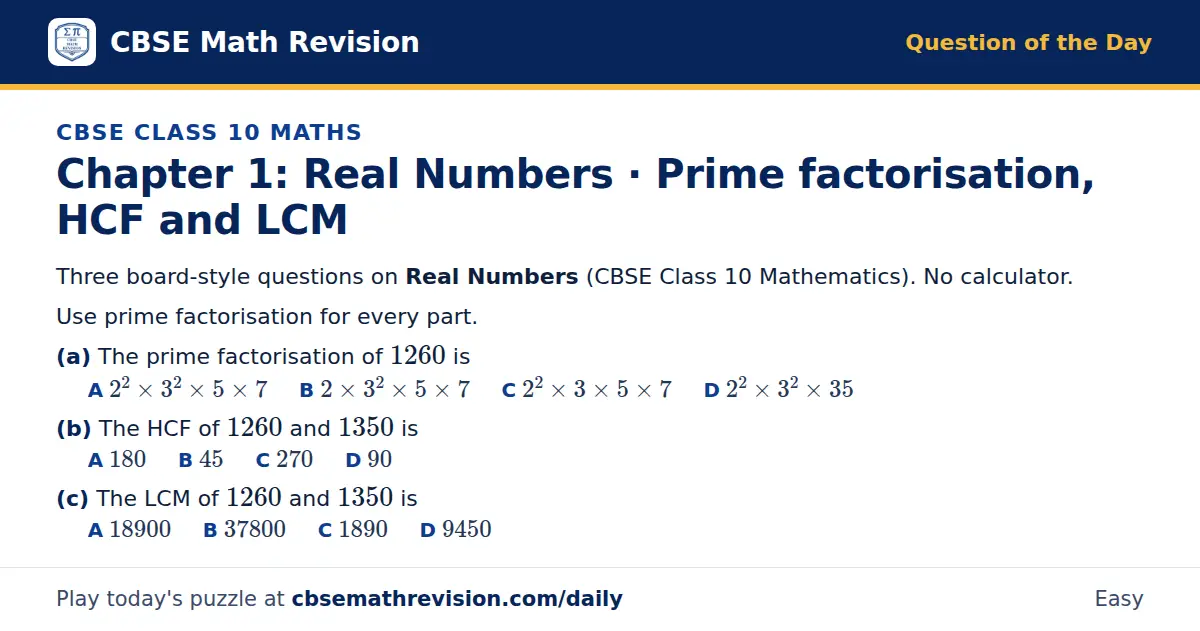
Chapter 1: Real Numbers · Prime factorisation, HCF and LCM
Three board-style questions on Real Numbers (CBSE Class 10 Mathematics). No calculator. Use prime factorisation for every part.
- The prime factorisation of 1260 is Options: A) 2² × 3² × 5 × 7; B) 2 × 3² × 5 × 7; C) 2² × 3 × 5 × 7; D) 2² × 3² × 35
- The HCF of 1260 and 1350 is Options: A) 180; B) 45; C) 270; D) 90
- The LCM of 1260 and 1350 is Options: A) 18900; B) 37800; C) 1890; D) 9450
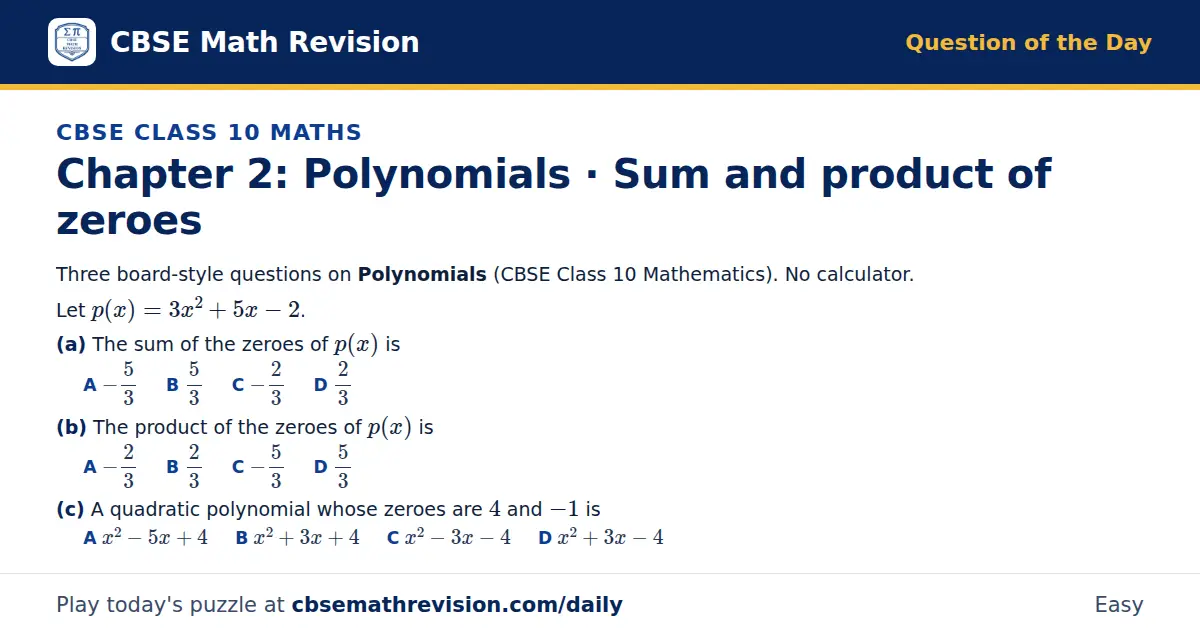
Chapter 2: Polynomials · Sum and product of zeroes
Three board-style questions on Polynomials (CBSE Class 10 Mathematics). No calculator. Let p(x) = 3x² + 5x - 2.
- The sum of the zeroes of p(x) is Options: A) - 5/3; B) 5/3; C) - 2/3; D) 2/3
- The product of the zeroes of p(x) is Options: A) - 2/3; B) 2/3; C) - 5/3; D) 5/3
- A quadratic polynomial whose zeroes are 4 and -1 is Options: A) x² - 5x + 4; B) x² + 3x + 4; C) x² - 3x - 4; D) x² + 3x - 4
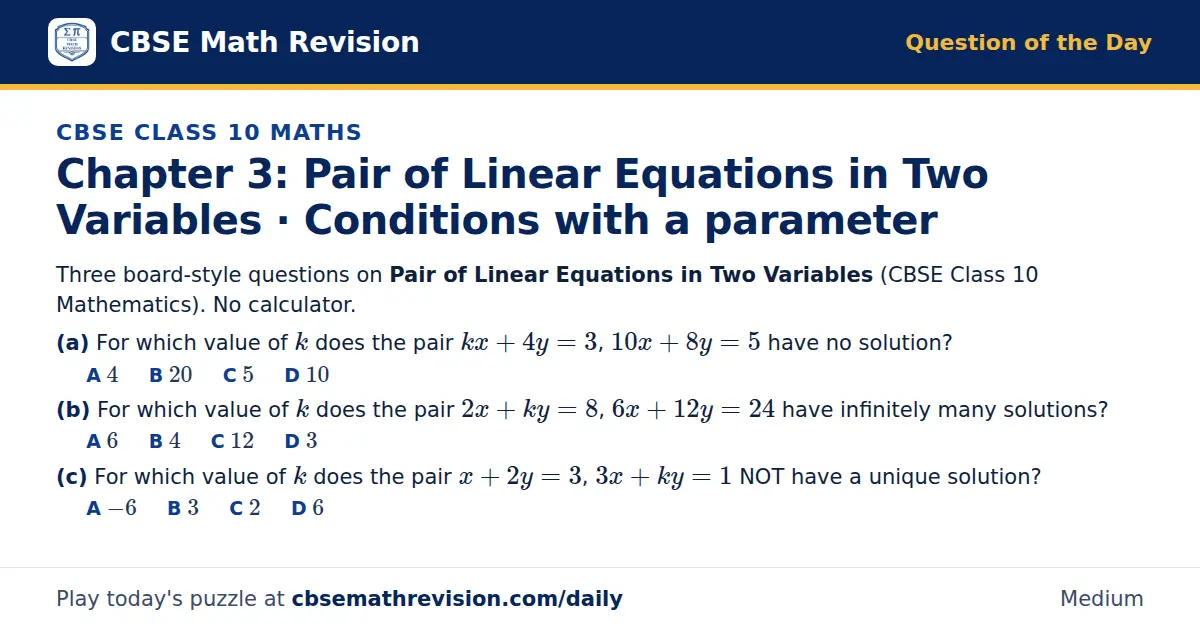
Chapter 3: Pair of Linear Equations in Two Variables · Conditions with a parameter
Three board-style questions on Pair of Linear Equations in Two Variables (CBSE Class 10 Mathematics). No calculator.
- For which value of k does the pair kx + 4y = 3, 10x + 8y = 5 have no solution? Options: A) 4; B) 20; C) 5; D) 10
- For which value of k does the pair 2x + ky = 8, 6x + 12y = 24 have infinitely many solutions? Options: A) 6; B) 4; C) 12; D) 3
- For which value of k does the pair x + 2y = 3, 3x + ky = 1 NOT have a unique solution? Options: A) -6; B) 3; C) 2; D) 6
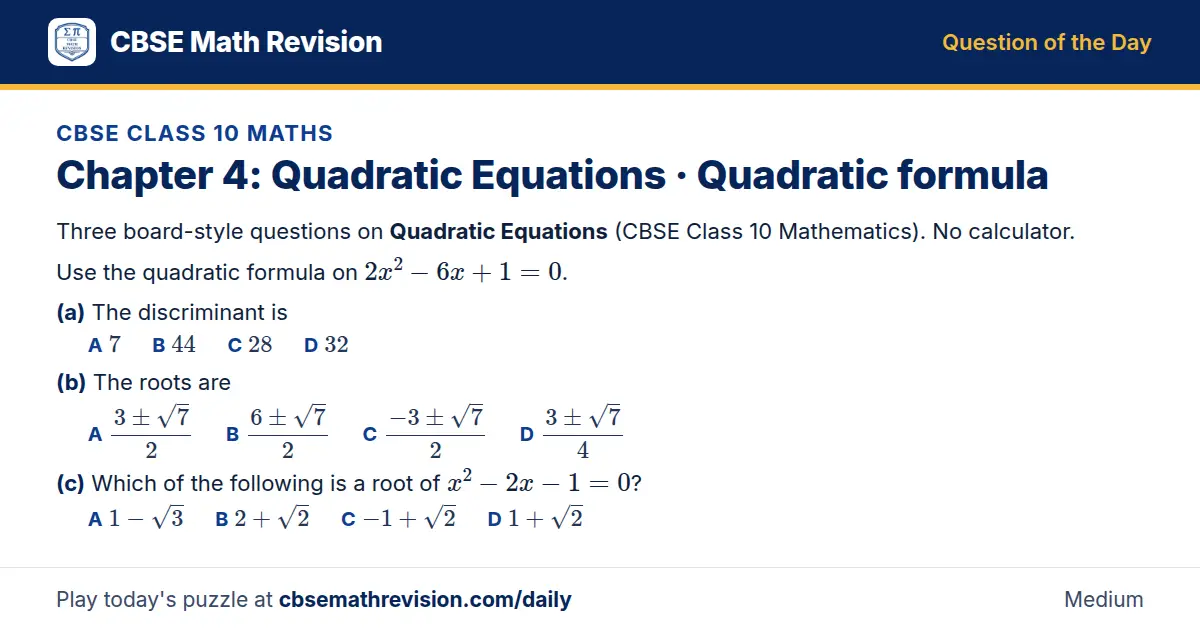
Chapter 4: Quadratic Equations · Quadratic formula
Three board-style questions on Quadratic Equations (CBSE Class 10 Mathematics). No calculator. Use the quadratic formula on 2x² - 6x + 1 = 0.
- The discriminant is Options: A) 7; B) 44; C) 28; D) 32
- The roots are Options: A) (3 ± √7)/2; B) (6 ± √7)/2; C) (-3 ± √7)/2; D) (3 ± √7)/4
- Which of the following is a root of x² - 2x - 1 = 0? Options: A) 1 - √3; B) 2 + √2; C) -1 + √2; D) 1 + √2
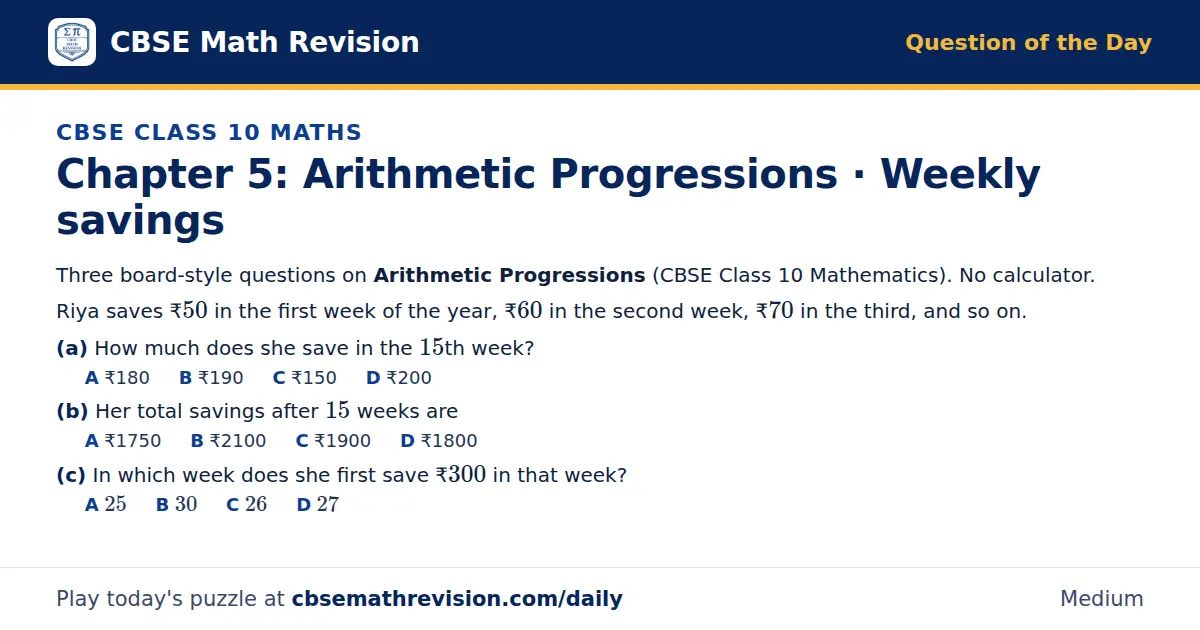
Chapter 5: Arithmetic Progressions · Weekly savings
Three board-style questions on Arithmetic Progressions (CBSE Class 10 Mathematics). No calculator. Riya saves ₹50 in the first week of the year, ₹60 in the second week, ₹70 in the third, and so on.
- How much does she save in the 15th week? Options: A) ₹180; B) ₹190; C) ₹150; D) ₹200
- Her total savings after 15 weeks are Options: A) ₹1750; B) ₹2100; C) ₹1900; D) ₹1800
- In which week does she first save ₹300 in that week? Options: A) 25; B) 30; C) 26; D) 27
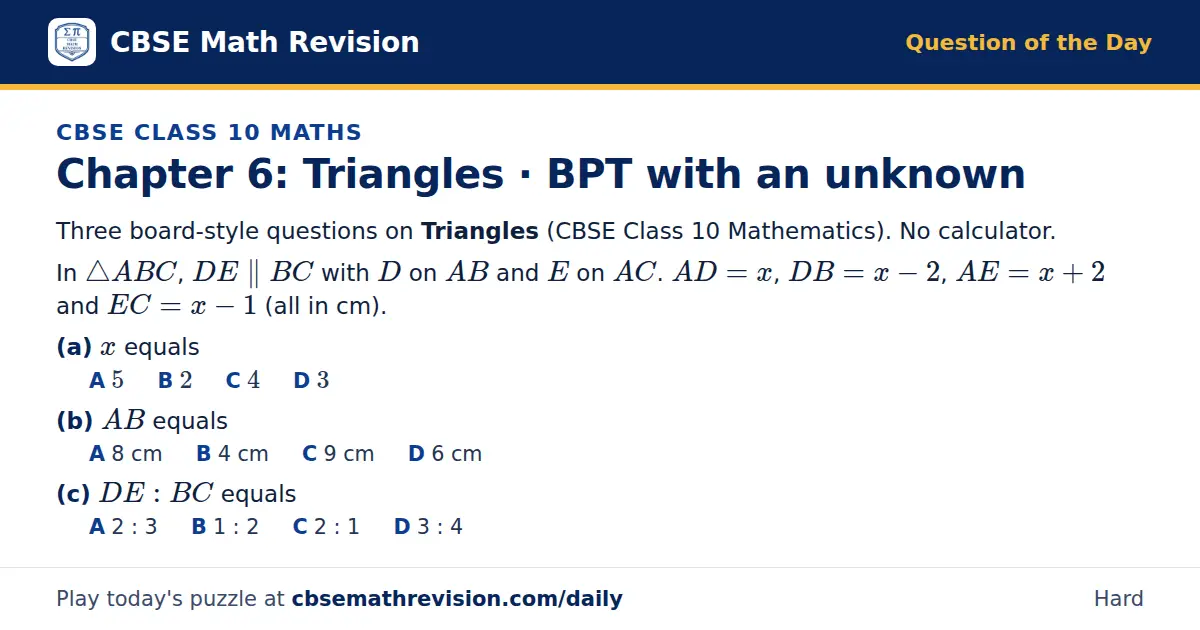
Chapter 6: Triangles · BPT with an unknown
Three board-style questions on Triangles (CBSE Class 10 Mathematics). No calculator. In △ ABC, DE ∥ BC with D on AB and E on AC. AD = x, DB = x - 2, AE = x + 2 and EC = x - 1 (all in cm).
- x equals Options: A) 5; B) 2; C) 4; D) 3
- AB equals Options: A) 8 cm; B) 4 cm; C) 9 cm; D) 6 cm
- DE: BC equals Options: A) 2: 3; B) 1: 2; C) 2: 1; D) 3: 4
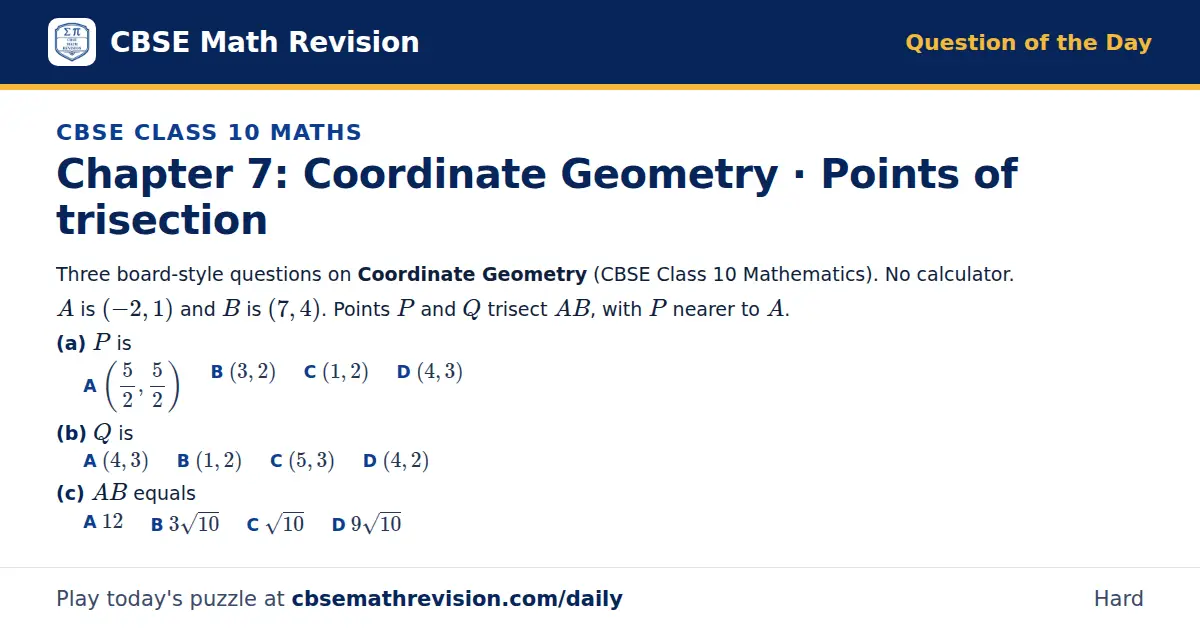
Chapter 7: Coordinate Geometry · Points of trisection
Three board-style questions on Coordinate Geometry (CBSE Class 10 Mathematics). No calculator. A is (-2, 1) and B is (7, 4). Points P and Q trisect AB, with P nearer to A.
- P is Options: A) (52, 52); B) (3, 2); C) (1, 2); D) (4, 3)
- Q is Options: A) (4, 3); B) (1, 2); C) (5, 3); D) (4, 2)
- AB equals Options: A) 12; B) 3 √10; C) √10; D) 9 √10
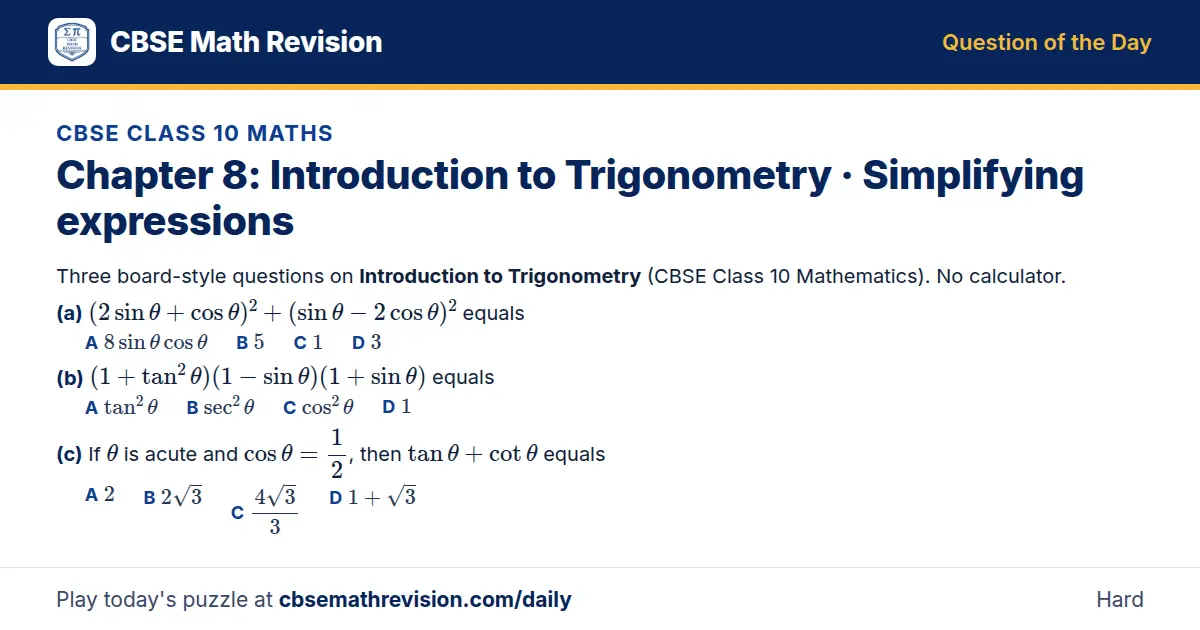
Chapter 8: Introduction to Trigonometry · Simplifying expressions
Three board-style questions on Introduction to Trigonometry (CBSE Class 10 Mathematics). No calculator.
- (2sinθ + cosθ)² + (sinθ - 2cosθ)² equals Options: A) 8 sin θ cos θ; B) 5; C) 1; D) 3
- (1 + tan²θ)(1 - sinθ)(1 + sinθ) equals Options: A) tan² θ; B) sec² θ; C) cos² θ; D) 1
- If θ is acute and cosθ = 12, then tanθ + cotθ equals Options: A) 2; B) 2 √3; C) (4 √3)/3; D) 1 + √3
Chapter 9: Some Applications of Trigonometry · Angle of elevation
Three board-style questions on Some Applications of Trigonometry (CBSE Class 10 Mathematics). No calculator. From a point on level ground 30 m from the foot of a vertical tower, the angle of elevation of its top is 60^∘.
- The height of the tower is Options: A) 10√3 m; B) 30√3 m; C) 60 m; D) 15 m
- The distance from the point to the top of the tower is Options: A) 20√3 m; B) 45 m; C) 60 m; D) 30√3 m
- From how far away from the foot would the angle of elevation of the top be 45^∘? Options: A) 30 m; B) 60 m; C) 10√3 m; D) 30√3 m
Chapter 10: Circles · Angles with tangents
Three board-style questions on Circles (CBSE Class 10 Mathematics). No calculator. PT and PS are tangents from P to a circle with centre O, and ∠ TPS = 70^∘.
- ∠ TOS equals Options: A) 70^∘; B) 140^∘; C) 110^∘; D) 90^∘
- ∠ OPT equals Options: A) 20^∘; B) 35^∘; C) 70^∘; D) 55^∘
- ∠ OTS equals Options: A) 35^∘; B) 55^∘; C) 45^∘; D) 70^∘
Chapter 11: Areas Related to Circles · Segment for a right angle
Three board-style questions on Areas Related to Circles (CBSE Class 10 Mathematics). No calculator. A chord AB of a circle with centre O and radius 10 cm makes ∠ AOB = 90^∘.
- The area of sector OAB is Options: A) 5π cm²; B) 25π cm²; C) 50π cm²; D) 100π cm²
- The area of △ OAB is Options: A) 25√3 cm²; B) 100 cm²; C) 25 cm²; D) 50 cm²
- Taking π = 3.14, the area of the minor segment is Options: A) 50 cm²; B) 28.5 cm²; C) 78.5 cm²; D) 21.5 cm²
Chapter 12: Surface Areas and Volumes · Two cubes joined
Three board-style questions on Surface Areas and Volumes (CBSE Class 10 Mathematics). No calculator. Two cubes, each of side 4 cm, are joined face to face to make a cuboid.
- The dimensions of the cuboid are Options: A) 4 × 4 × 4 cm; B) 8 × 4 × 4 cm; C) 16 × 4 × 4 cm; D) 8 × 8 × 4 cm
- The surface area of the cuboid is Options: A) 192 cm²; B) 128 cm²; C) 176 cm²; D) 160 cm²
- Compared with the two separate cubes, the total surface area has decreased by Options: A) 16 cm²; B) 0 cm²; C) 64 cm²; D) 32 cm²
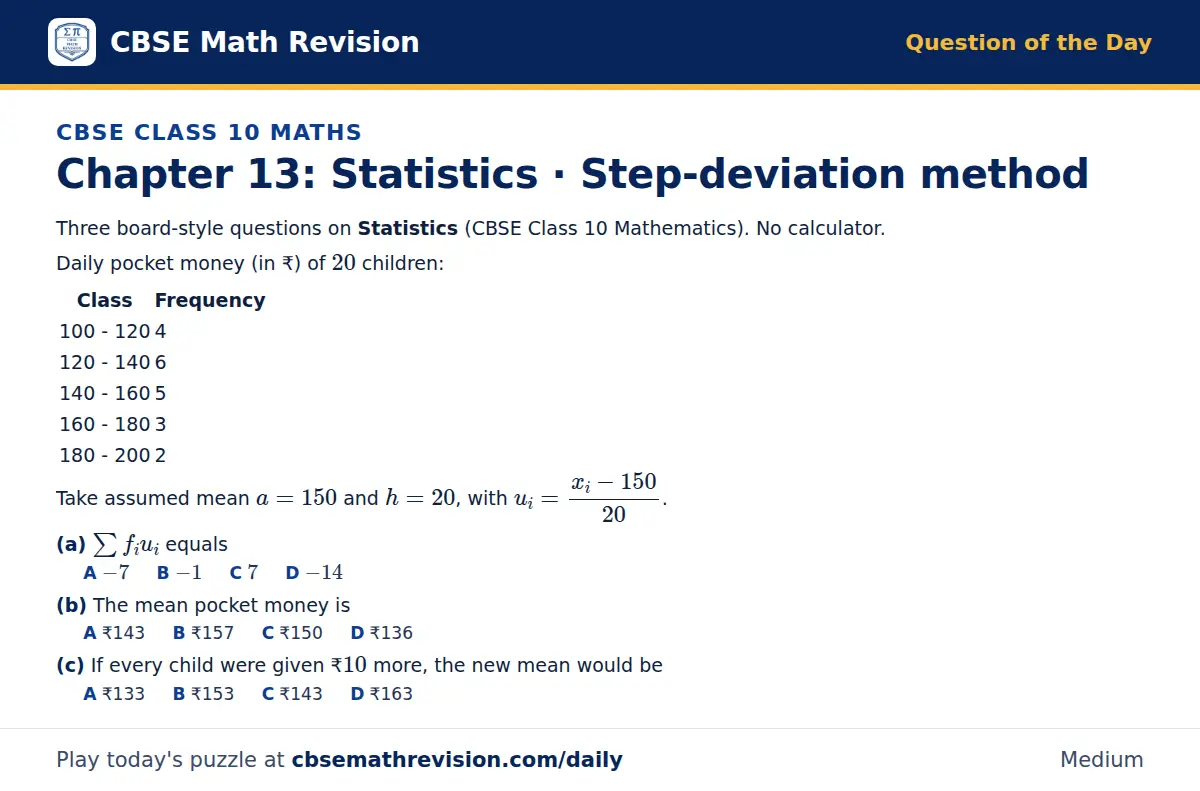
Chapter 13: Statistics · Step-deviation method
Three board-style questions on Statistics (CBSE Class 10 Mathematics). No calculator. Daily pocket money (in ₹) of 20 children: ClassFrequency100 - 1204120 - 1406140 - 1605160 - 1803180 - 2002Take assumed mean a = 150 and h = 20, with u_i = (x_i - 150)/20.
- Σ f_i u_i equals Options: A) -7; B) -1; C) 7; D) -14
- The mean pocket money is Options: A) ₹143; B) ₹157; C) ₹150; D) ₹136
- If every child were given ₹10 more, the new mean would be Options: A) ₹133; B) ₹153; C) ₹143; D) ₹163
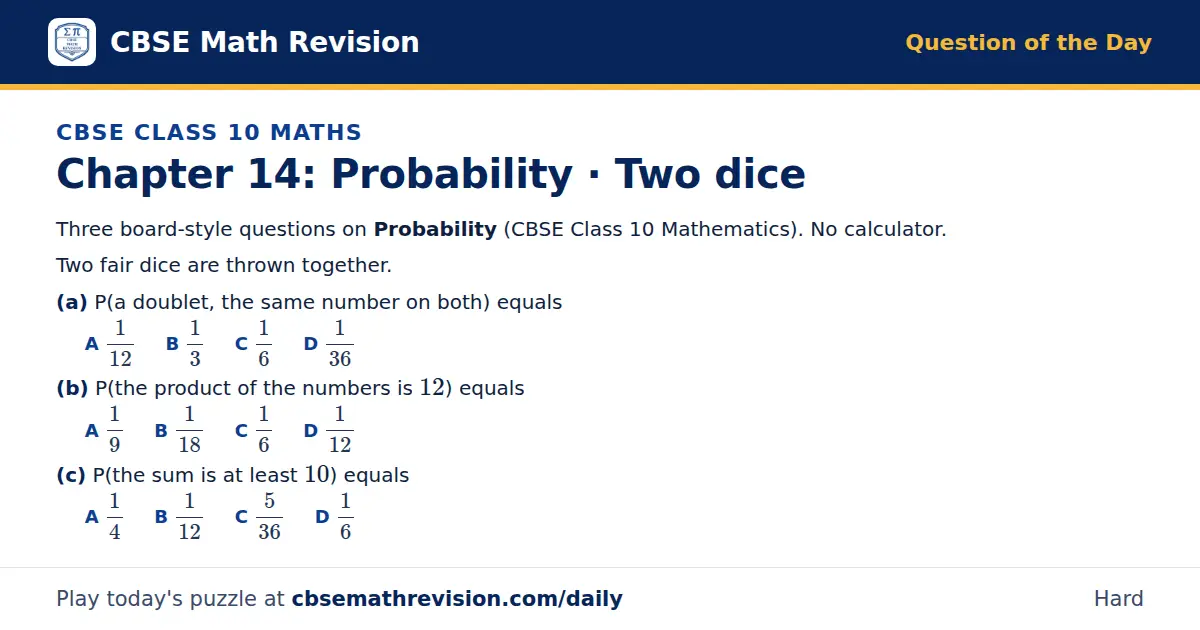
Chapter 14: Probability · Two dice
Three board-style questions on Probability (CBSE Class 10 Mathematics). No calculator. Two fair dice are thrown together.
- P(a doublet, the same number on both) equals Options: A) 1/12; B) 1/3; C) 1/6; D) 1/36
- P(the product of the numbers is 12) equals Options: A) 1/9; B) 1/18; C) 1/6; D) 1/12
- P(the sum is at least 10) equals Options: A) 1/4; B) 1/12; C) 5/36; D) 1/6