CBSE Class 12 Maths Question of the Day: chapters 8–10
30 CBSE Class 12 Mathematics puzzles from the Question of the Day rotation, chapters 8–10. Each puzzle is three board-style questions on one chapter, shown as an image with the question text written out below it; the answers, hints and step-marked solutions are on the daily puzzle page.
- Play today's CBSE Class 12 Maths puzzle
- ← Chapters 5–7
- Chapters 11–13 →
- All CBSE Class 12 Maths puzzles by chapter
Chapter 8: Application of Integrals
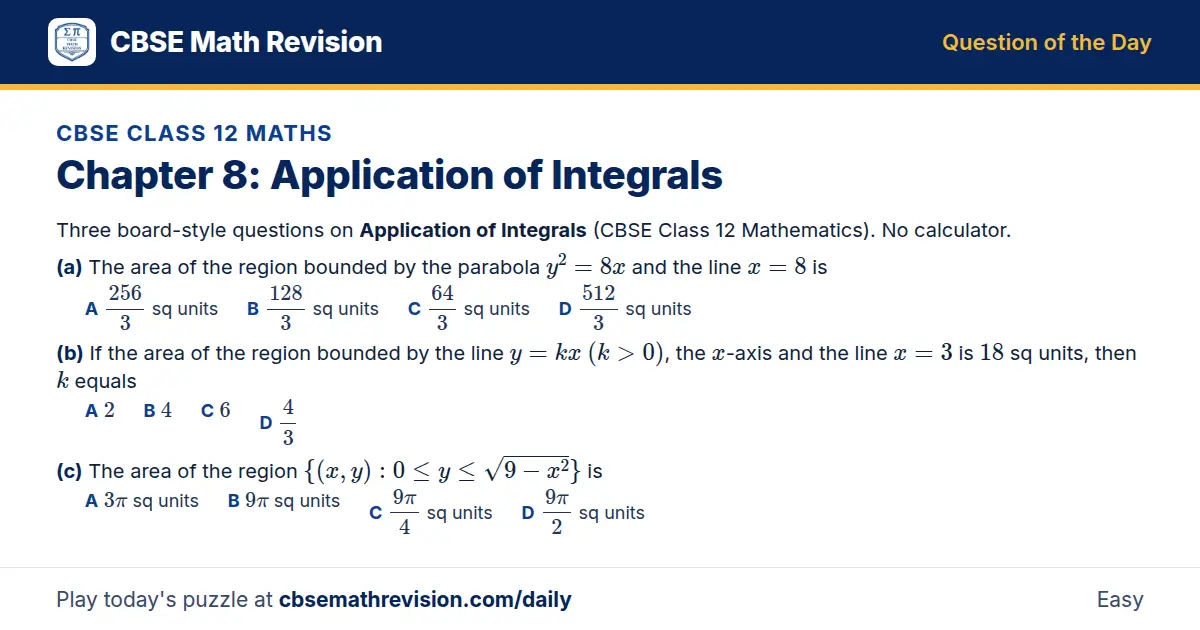
Chapter 8: Application of Integrals
Three board-style questions on Application of Integrals (CBSE Class 12 Mathematics). No calculator.
- The area of the region bounded by the parabola y² = 8x and the line x = 8 is Options: A) 256/3 sq units; B) 128/3 sq units; C) 64/3 sq units; D) 512/3 sq units
- If the area of the region bounded by the line y = kx (k > 0), the x-axis and the line x = 3 is 18 sq units, then k equals Options: A) 2; B) 4; C) 6; D) 4/3
- The area of the region (x, y): 0 ≤ y ≤ √(9 - x²) is Options: A) 3π sq units; B) 9π sq units; C) (9π)/4 sq units; D) (9π)/2 sq units
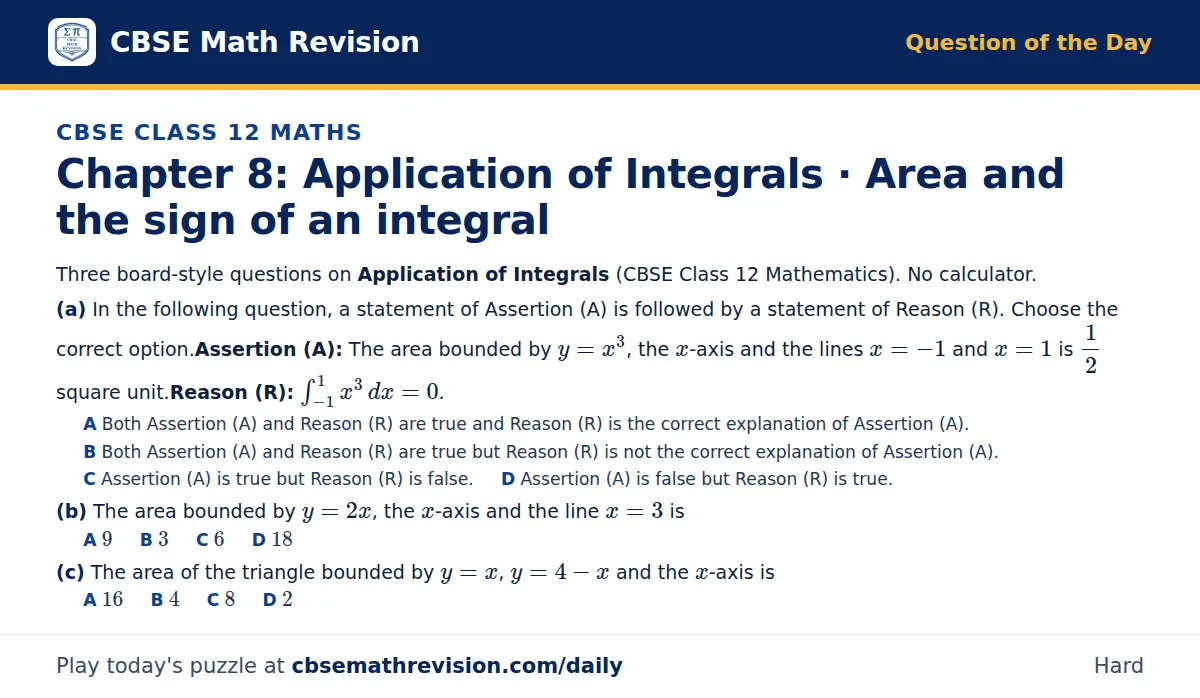
Chapter 8: Application of Integrals · Area and the sign of an integral
Three board-style questions on Application of Integrals (CBSE Class 12 Mathematics). No calculator.
- In the following question, a statement of Assertion (A) is followed by a statement of Reason (R). Choose the correct option. Assertion (A): The area bounded by y = x³, the x-axis and the lines x = -1 and x = 1 is 12 square unit. Reason (R): ∫_-1¹ x³ dx = 0. Options: A) Both Assertion (A) and Reason (R) are true and Reason (R) is the correct explanation of Assertion (A).; B) Both Assertion (A) and Reason (R) are true but Reason (R) is not the correct explanation of Assertion (A).; C) Assertion (A) is true but Reason (R) is false.; D) Assertion (A) is false but Reason (R) is true.
- The area bounded by y = 2x, the x-axis and the line x = 3 is Options: A) 9; B) 3; C) 6; D) 18
- The area of the triangle bounded by y = x, y = 4 - x and the x-axis is Options: A) 16; B) 4; C) 8; D) 2
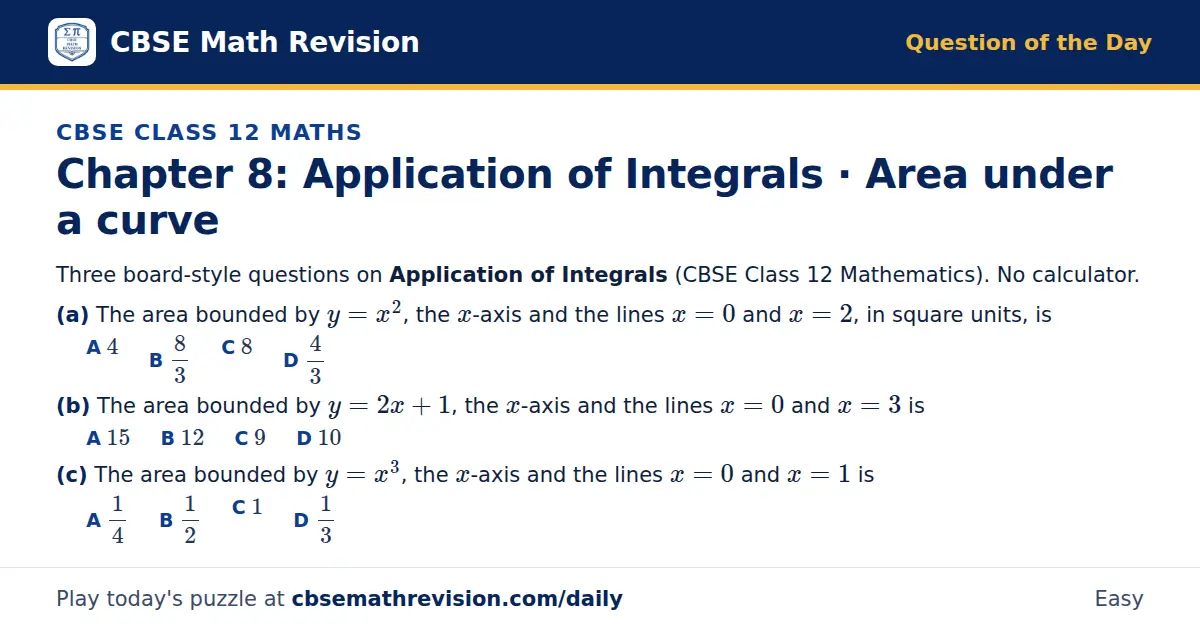
Chapter 8: Application of Integrals · Area under a curve
Three board-style questions on Application of Integrals (CBSE Class 12 Mathematics). No calculator.
- The area bounded by y = x², the x-axis and the lines x = 0 and x = 2, in square units, is Options: A) 4; B) 8/3; C) 8; D) 4/3
- The area bounded by y = 2x + 1, the x-axis and the lines x = 0 and x = 3 is Options: A) 15; B) 12; C) 9; D) 10
- The area bounded by y = x³, the x-axis and the lines x = 0 and x = 1 is Options: A) 1/4; B) 1/2; C) 1; D) 1/3
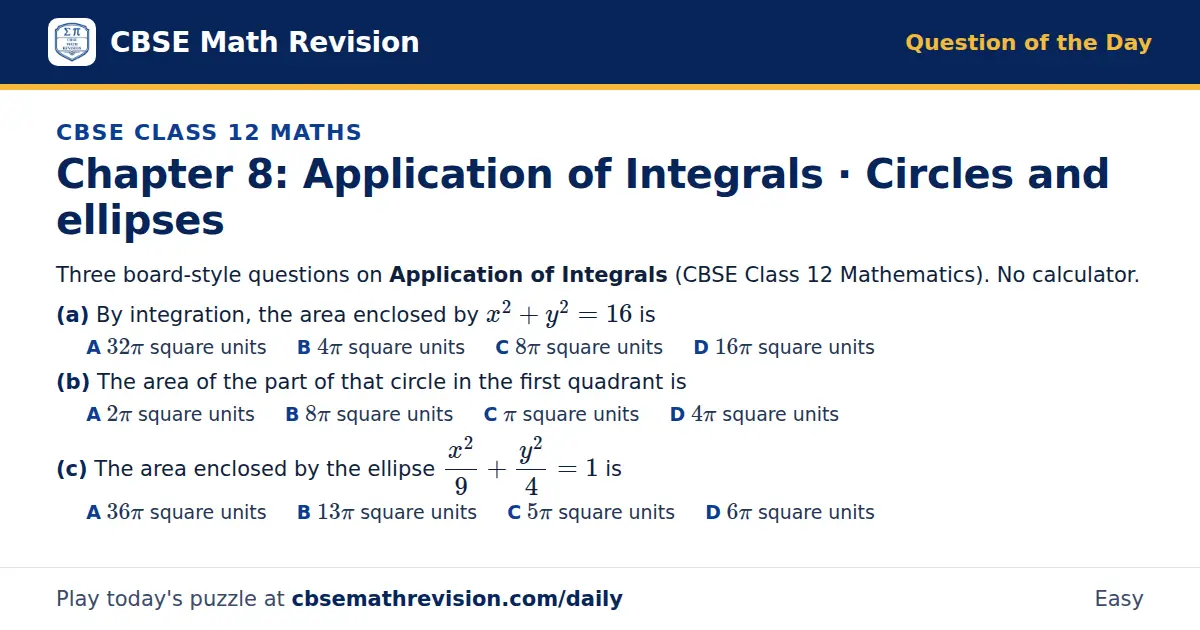
Chapter 8: Application of Integrals · Circles and ellipses
Three board-style questions on Application of Integrals (CBSE Class 12 Mathematics). No calculator.
- By integration, the area enclosed by x² + y² = 16 is Options: A) 32π square units; B) 4π square units; C) 8π square units; D) 16π square units
- The area of the part of that circle in the first quadrant is Options: A) 2π square units; B) 8π square units; C) π square units; D) 4π square units
- The area enclosed by the ellipse (x²)/9 + (y²)/4 = 1 is Options: A) 36π square units; B) 13π square units; C) 5π square units; D) 6π square units
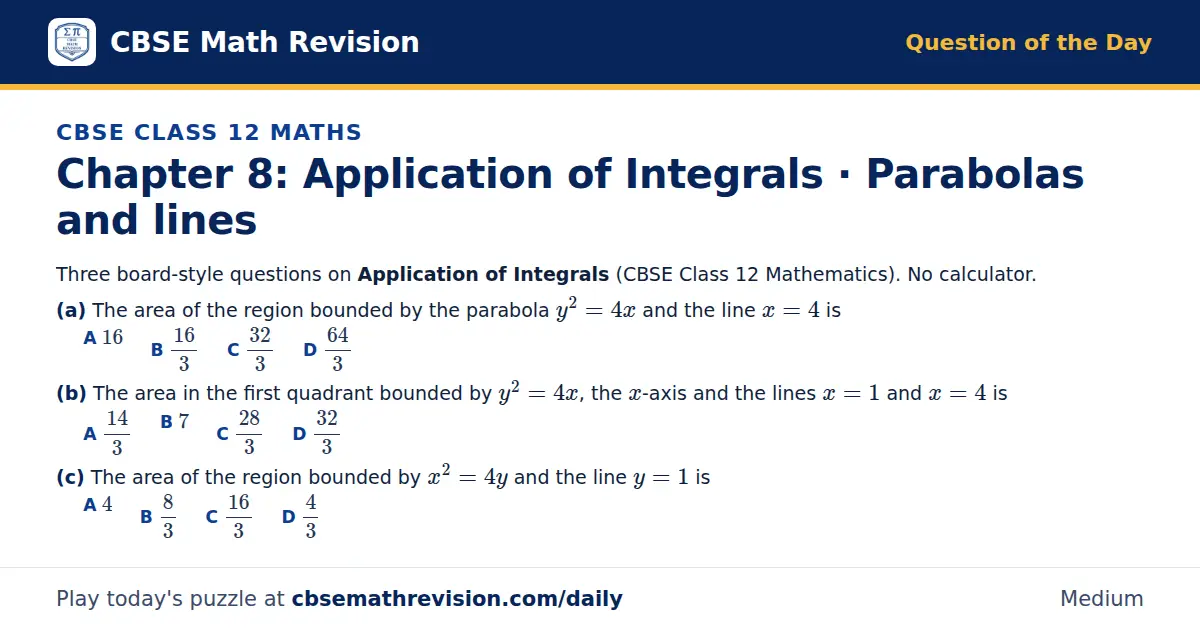
Chapter 8: Application of Integrals · Parabolas and lines
Three board-style questions on Application of Integrals (CBSE Class 12 Mathematics). No calculator.
- The area of the region bounded by the parabola y² = 4x and the line x = 4 is Options: A) 16; B) 16/3; C) 32/3; D) 64/3
- The area in the first quadrant bounded by y² = 4x, the x-axis and the lines x = 1 and x = 4 is Options: A) 14/3; B) 7; C) 28/3; D) 32/3
- The area of the region bounded by x² = 4y and the line y = 1 is Options: A) 4; B) 8/3; C) 16/3; D) 4/3
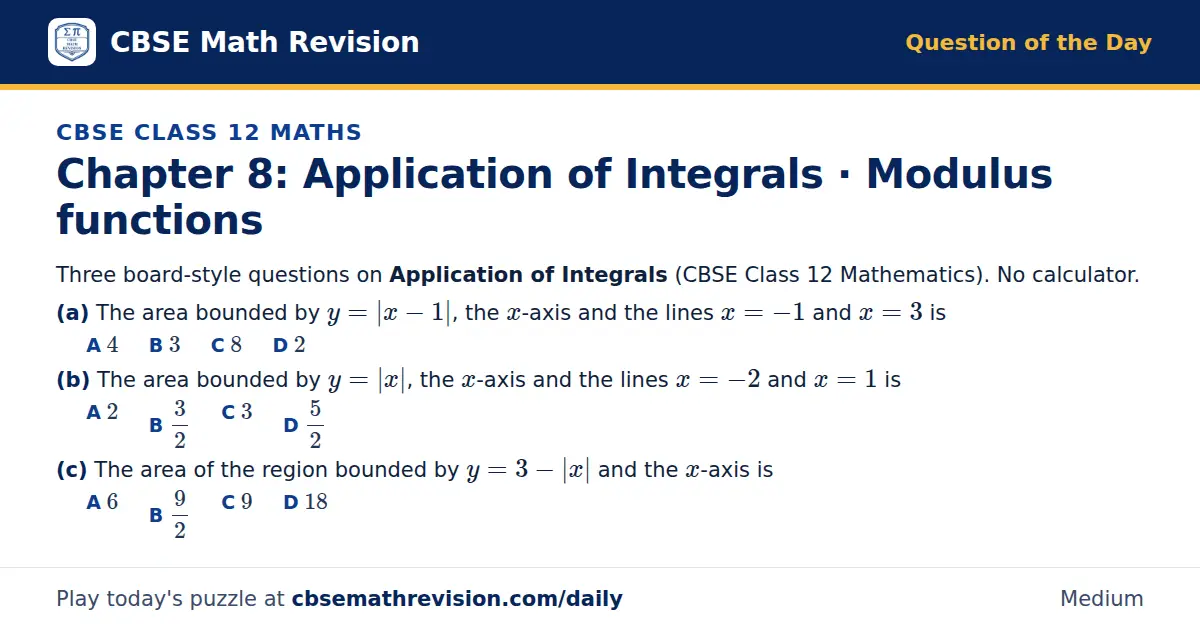
Chapter 8: Application of Integrals · Modulus functions
Three board-style questions on Application of Integrals (CBSE Class 12 Mathematics). No calculator.
- The area bounded by y = |x - 1|, the x-axis and the lines x = -1 and x = 3 is Options: A) 4; B) 3; C) 8; D) 2
- The area bounded by y = |x|, the x-axis and the lines x = -2 and x = 1 is Options: A) 2; B) 3/2; C) 3; D) 5/2
- The area of the region bounded by y = 3 - |x| and the x-axis is Options: A) 6; B) 9/2; C) 9; D) 18
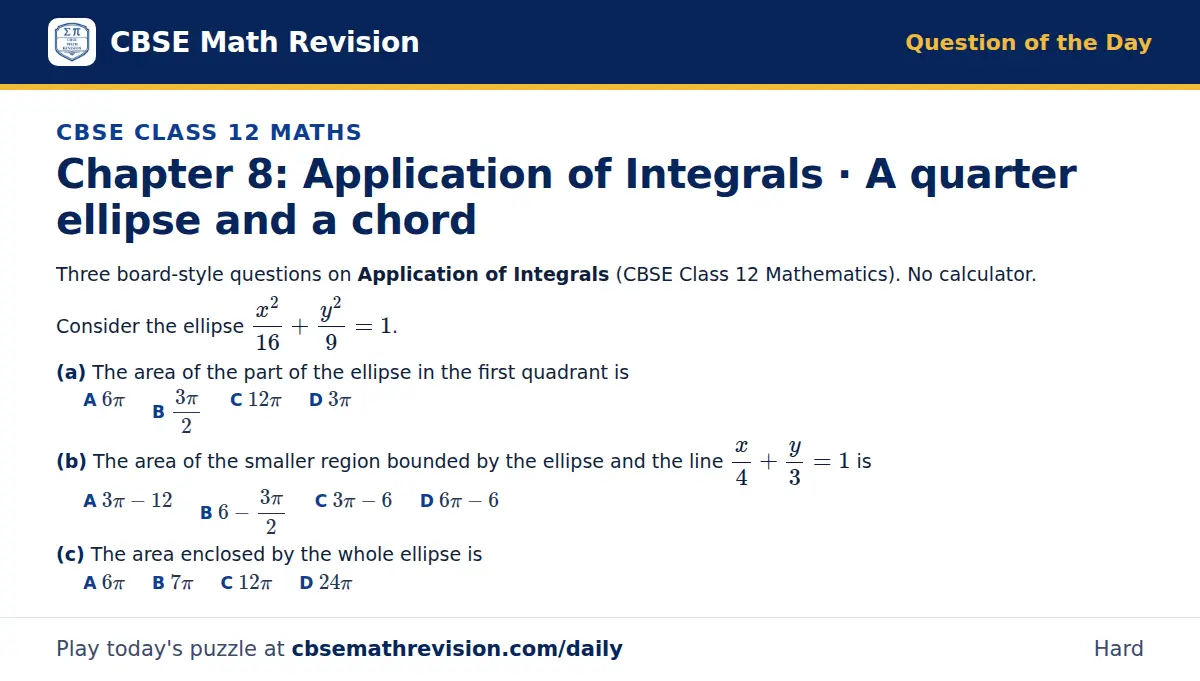
Chapter 8: Application of Integrals · A quarter ellipse and a chord
Three board-style questions on Application of Integrals (CBSE Class 12 Mathematics). No calculator. Consider the ellipse (x²)/16 + (y²)/9 = 1.
- The area of the part of the ellipse in the first quadrant is Options: A) 6π; B) (3π)/2; C) 12π; D) 3π
- The area of the smaller region bounded by the ellipse and the line x/4 + y/3 = 1 is Options: A) 3π - 12; B) 6 - (3π)/2; C) 3π - 6; D) 6π - 6
- The area enclosed by the whole ellipse is Options: A) 6π; B) 7π; C) 12π; D) 24π
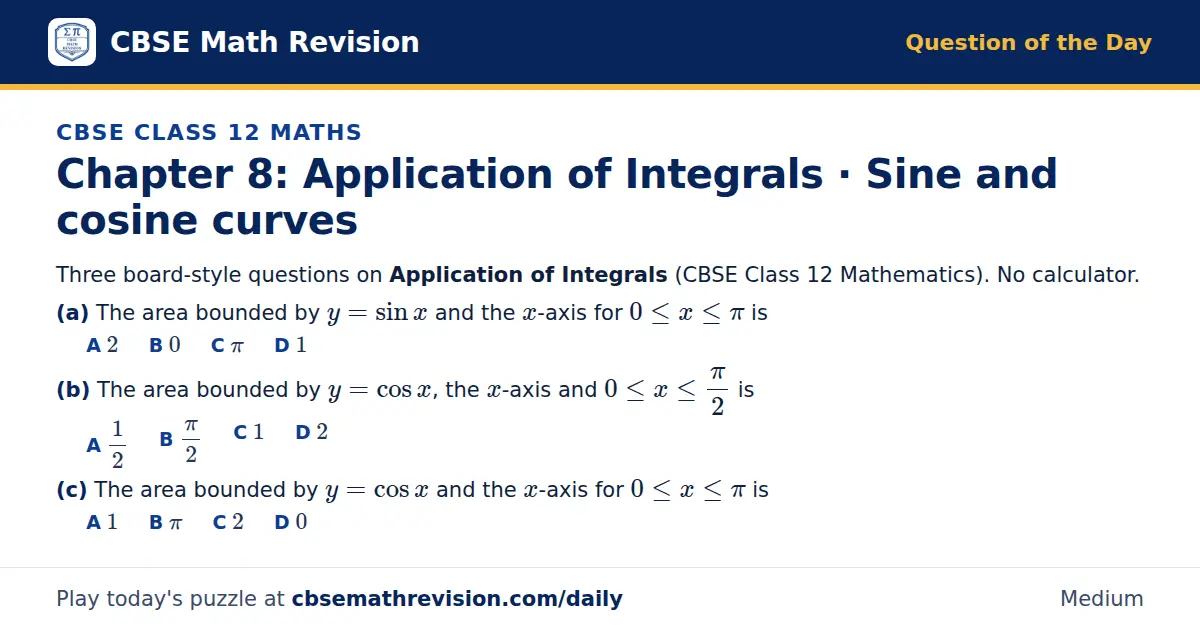
Chapter 8: Application of Integrals · Sine and cosine curves
Three board-style questions on Application of Integrals (CBSE Class 12 Mathematics). No calculator.
- The area bounded by y = sin x and the x-axis for 0 ≤ x ≤ π is Options: A) 2; B) 0; C) π; D) 1
- The area bounded by y = cos x, the x-axis and 0 ≤ x ≤ (π)/2 is Options: A) 1/2; B) (π)/2; C) 1; D) 2
- The area bounded by y = cos x and the x-axis for 0 ≤ x ≤ π is Options: A) 1; B) π; C) 2; D) 0
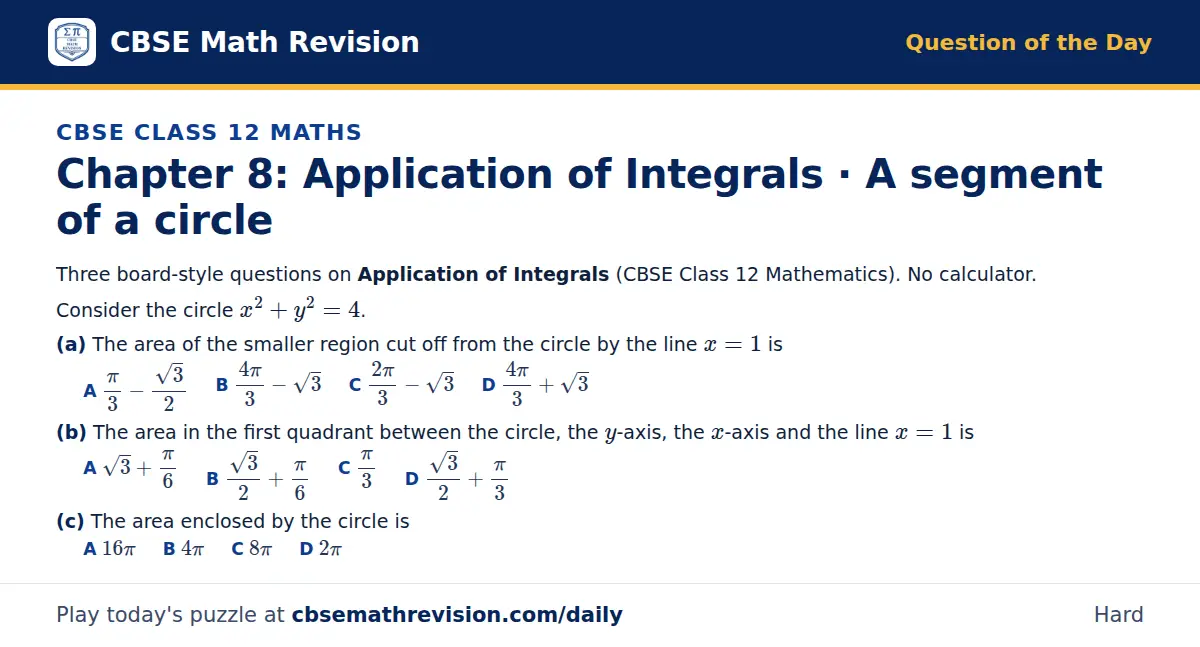
Chapter 8: Application of Integrals · A segment of a circle
Three board-style questions on Application of Integrals (CBSE Class 12 Mathematics). No calculator. Consider the circle x² + y² = 4.
- The area of the smaller region cut off from the circle by the line x = 1 is Options: A) (π)/3 - (√3)/2; B) (4π)/3 - √3; C) (2π)/3 - √3; D) (4π)/3 + √3
- The area in the first quadrant between the circle, the y-axis, the x-axis and the line x = 1 is Options: A) √3 + (π)/6; B) (√3)/2 + (π)/6; C) (π)/3; D) (√3)/2 + (π)/3
- The area enclosed by the circle is Options: A) 16π; B) 4π; C) 8π; D) 2π
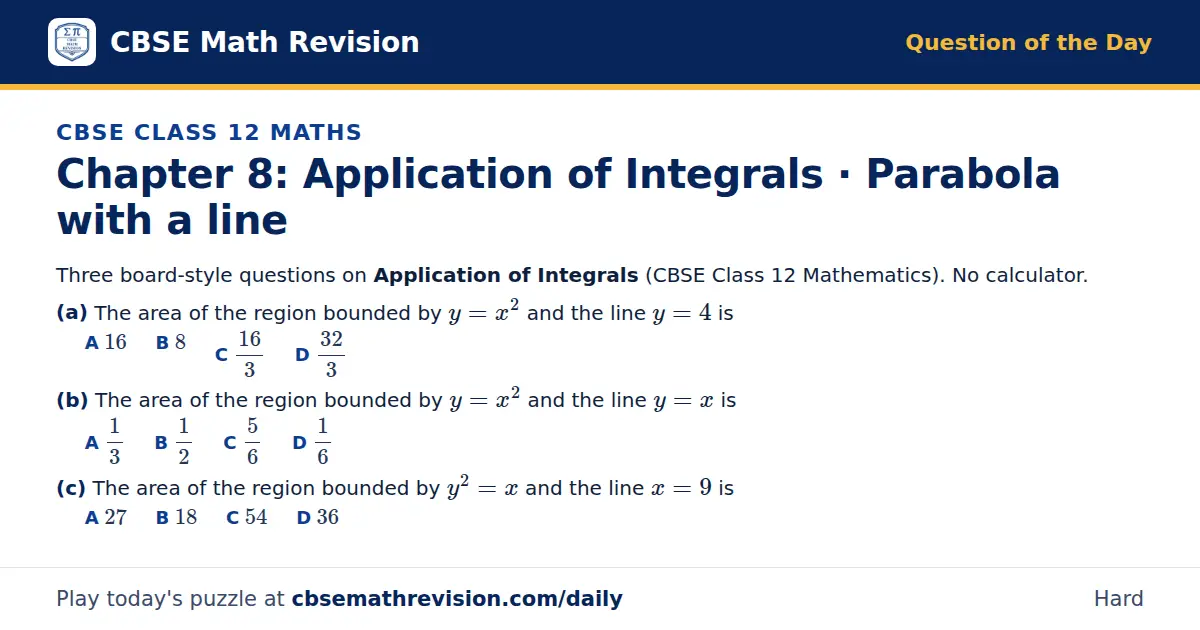
Chapter 8: Application of Integrals · Parabola with a line
Three board-style questions on Application of Integrals (CBSE Class 12 Mathematics). No calculator.
- The area of the region bounded by y = x² and the line y = 4 is Options: A) 16; B) 8; C) 16/3; D) 32/3
- The area of the region bounded by y = x² and the line y = x is Options: A) 1/3; B) 1/2; C) 5/6; D) 1/6
- The area of the region bounded by y² = x and the line x = 9 is Options: A) 27; B) 18; C) 54; D) 36
Chapter 9: Differential Equations
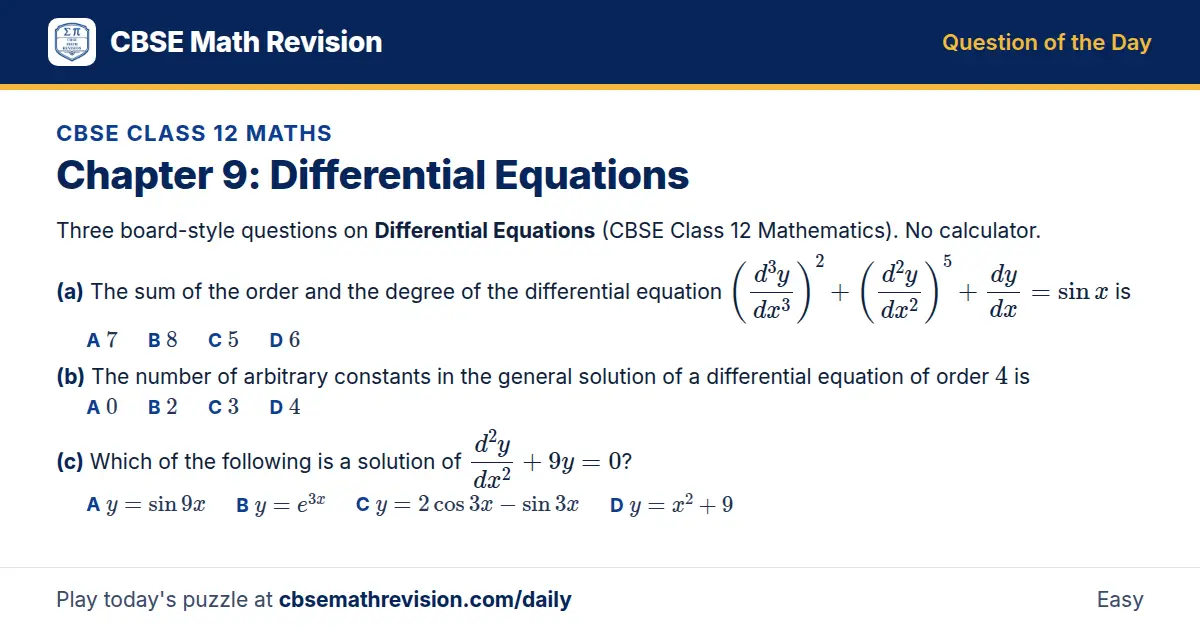
Chapter 9: Differential Equations
Three board-style questions on Differential Equations (CBSE Class 12 Mathematics). No calculator.
- The sum of the order and the degree of the differential equation ((d³y)/(dx³))² + ((d²y)/(dx²))⁵ + dy/dx = sin x is Options: A) 7; B) 8; C) 5; D) 6
- The number of arbitrary constants in the general solution of a differential equation of order 4 is Options: A) 0; B) 2; C) 3; D) 4
- Which of the following is a solution of (d²y)/(dx²) + 9y = 0? Options: A) y = sin 9x; B) y = e^(3x); C) y = 2cos 3x - sin 3x; D) y = x² + 9
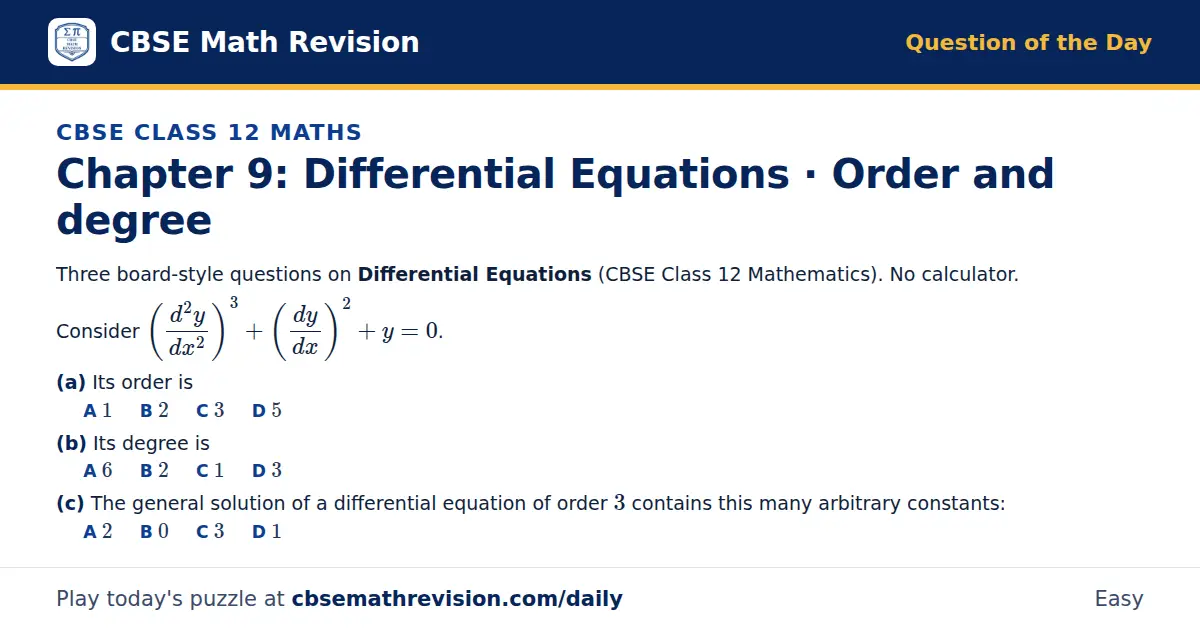
Chapter 9: Differential Equations · Order and degree
Three board-style questions on Differential Equations (CBSE Class 12 Mathematics). No calculator. Consider ((d²y)/(dx²))³ + (dy/dx)² + y = 0.
- Its order is Options: A) 1; B) 2; C) 3; D) 5
- Its degree is Options: A) 6; B) 2; C) 1; D) 3
- The general solution of a differential equation of order 3 contains this many arbitrary constants: Options: A) 2; B) 0; C) 3; D) 1
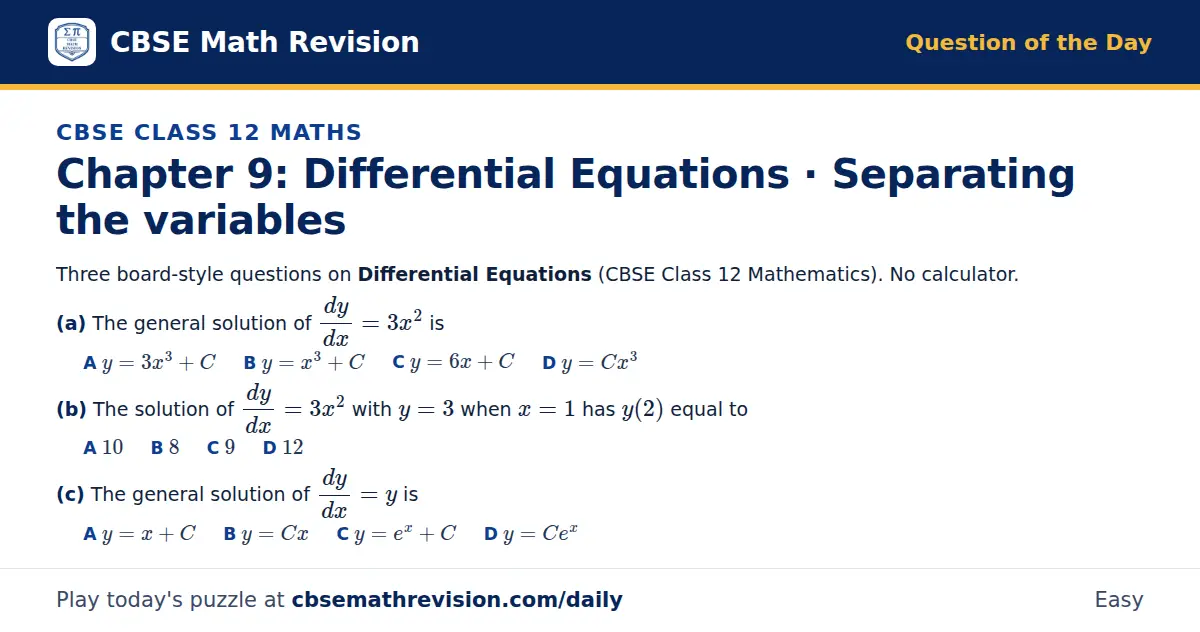
Chapter 9: Differential Equations · Separating the variables
Three board-style questions on Differential Equations (CBSE Class 12 Mathematics). No calculator.
- The general solution of dy/dx = 3x² is Options: A) y = 3x³ + C; B) y = x³ + C; C) y = 6x + C; D) y = Cx³
- The solution of dy/dx = 3x² with y = 3 when x = 1 has y(2) equal to Options: A) 10; B) 8; C) 9; D) 12
- The general solution of dy/dx = y is Options: A) y = x + C; B) y = Cx; C) y = e^x + C; D) y = Ce^x
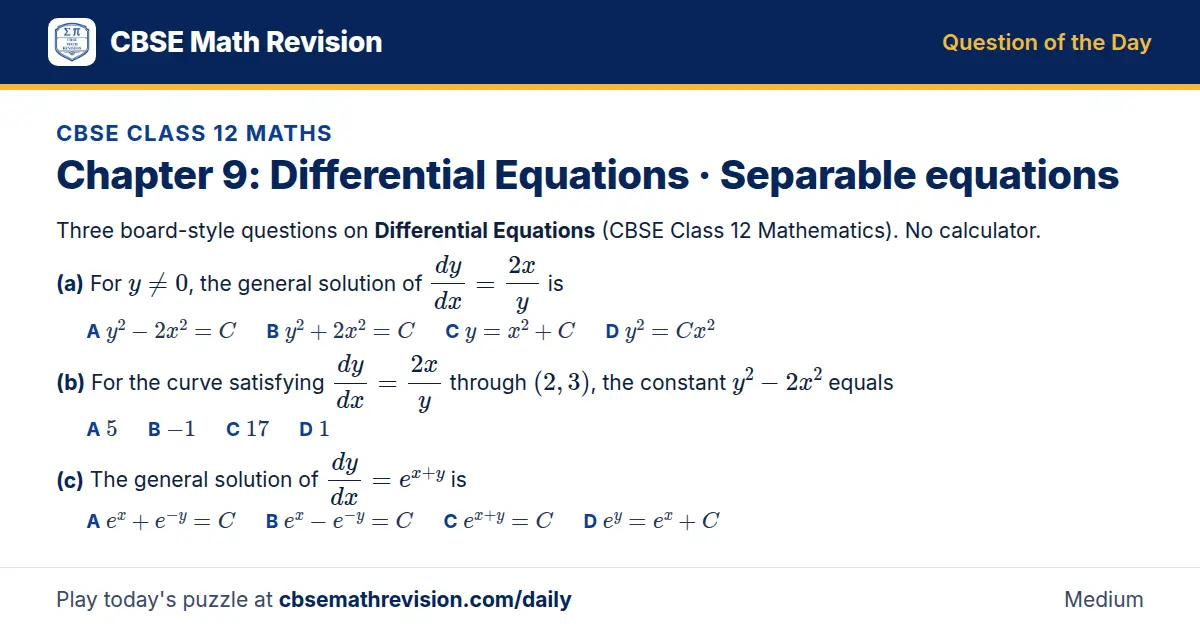
Chapter 9: Differential Equations · Separable equations
Three board-style questions on Differential Equations (CBSE Class 12 Mathematics). No calculator.
- For y ≠ 0, the general solution of dy/dx = 2x/y is Options: A) y² - 2x² = C; B) y² + 2x² = C; C) y = x² + C; D) y² = Cx²
- For the curve satisfying dy/dx = 2x/y through (2, 3), the constant y² - 2x² equals Options: A) 5; B) -1; C) 17; D) 1
- The general solution of dy/dx = e^(x + y) is Options: A) e^x + e^(-y) = C; B) e^x - e^(-y) = C; C) e^(x + y) = C; D) e^y = e^x + C
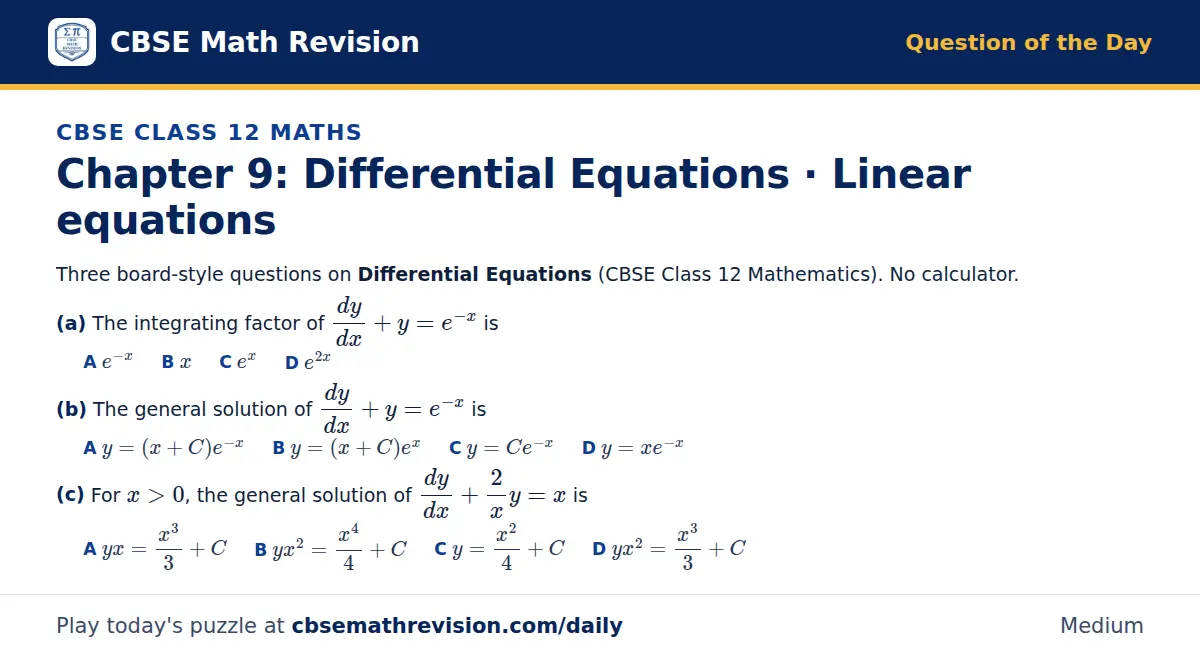
Chapter 9: Differential Equations · Linear equations
Three board-style questions on Differential Equations (CBSE Class 12 Mathematics). No calculator.
- The integrating factor of dy/dx + y = e^(-x) is Options: A) e^(-x); B) x; C) e^x; D) e^(2x)
- The general solution of dy/dx + y = e^(-x) is Options: A) y = (x + C)e^(-x); B) y = (x + C)e^x; C) y = Ce^(-x); D) y = xe^(-x)
- For x > 0, the general solution of dy/dx + 2/xy = x is Options: A) yx = (x³)/3 + C; B) yx² = (x⁴)/4 + C; C) y = (x²)/4 + C; D) yx² = (x³)/3 + C
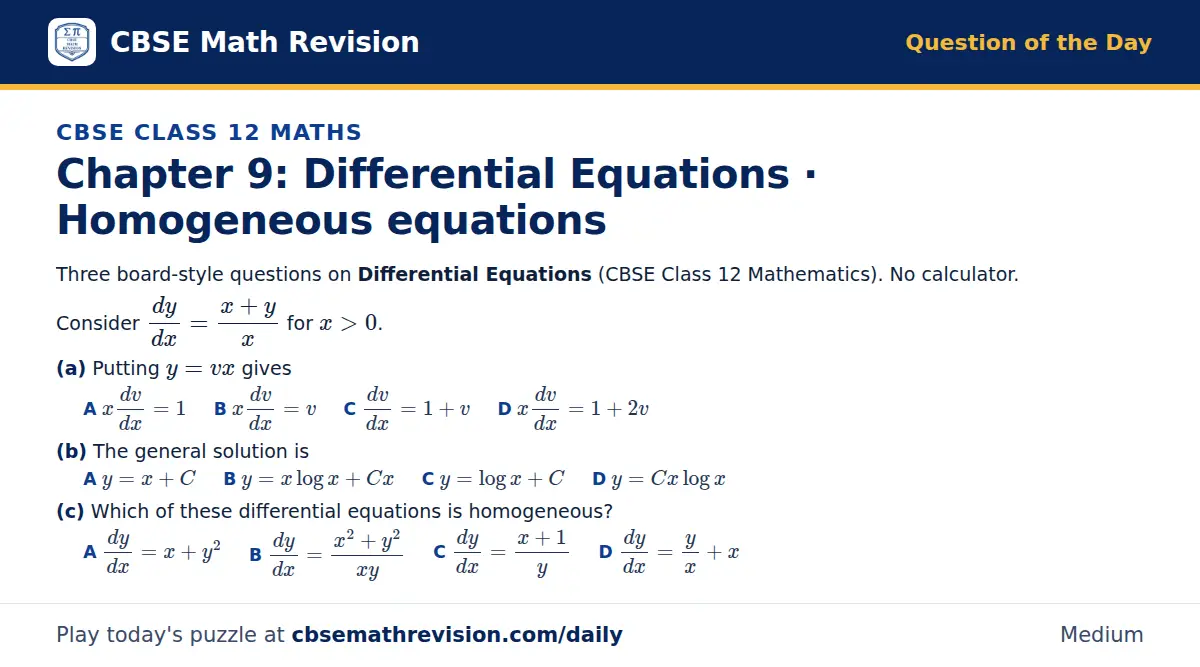
Chapter 9: Differential Equations · Homogeneous equations
Three board-style questions on Differential Equations (CBSE Class 12 Mathematics). No calculator. Consider dy/dx = (x + y)/x for x > 0.
- Putting y = vx gives Options: A) xdv/dx = 1; B) xdv/dx = v; C) dv/dx = 1 + v; D) xdv/dx = 1 + 2v
- The general solution is Options: A) y = x + C; B) y = xlog x + Cx; C) y = log x + C; D) y = Cxlog x
- Which of these differential equations is homogeneous? Options: A) dy/dx = x + y²; B) dy/dx = (x² + y²)/xy; C) dy/dx = (x + 1)/y; D) dy/dx = y/x + x
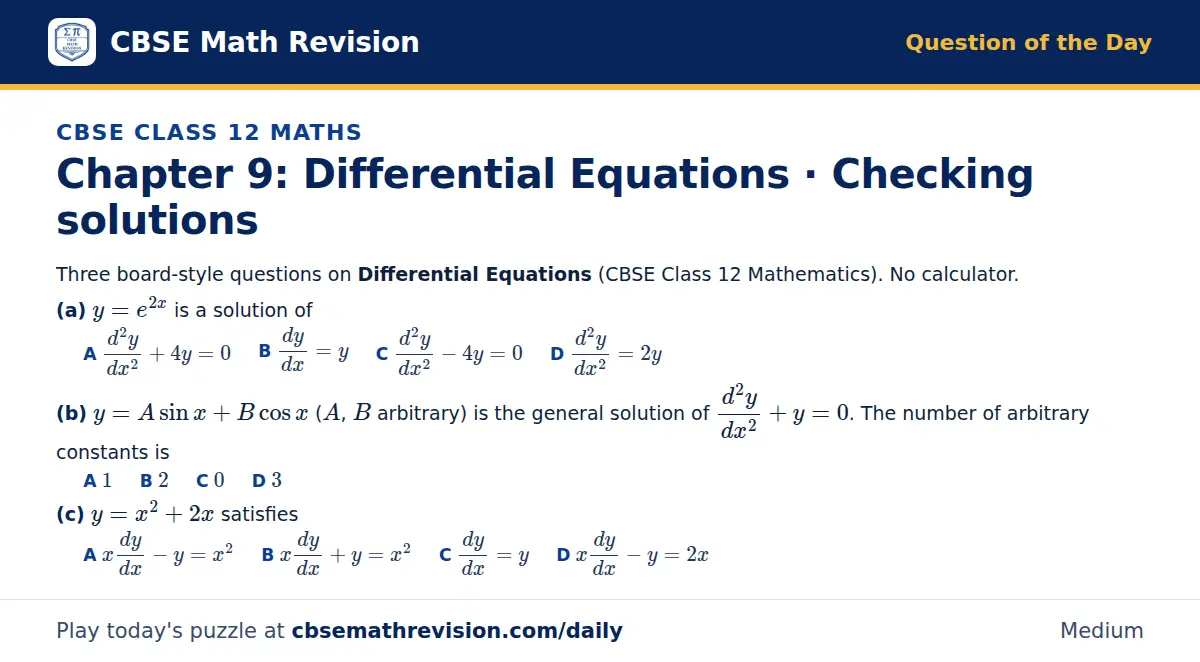
Chapter 9: Differential Equations · Checking solutions
Three board-style questions on Differential Equations (CBSE Class 12 Mathematics). No calculator.
- y = e^(2x) is a solution of Options: A) (d²y)/(dx²) + 4y = 0; B) dy/dx = y; C) (d²y)/(dx²) - 4y = 0; D) (d²y)/(dx²) = 2y
- y = Asin x + Bcos x (A, B arbitrary) is the general solution of (d²y)/(dx²) + y = 0. The number of arbitrary constants is Options: A) 1; B) 2; C) 0; D) 3
- y = x² + 2x satisfies Options: A) xdy/dx - y = x²; B) xdy/dx + y = x²; C) dy/dx = y; D) xdy/dx - y = 2x
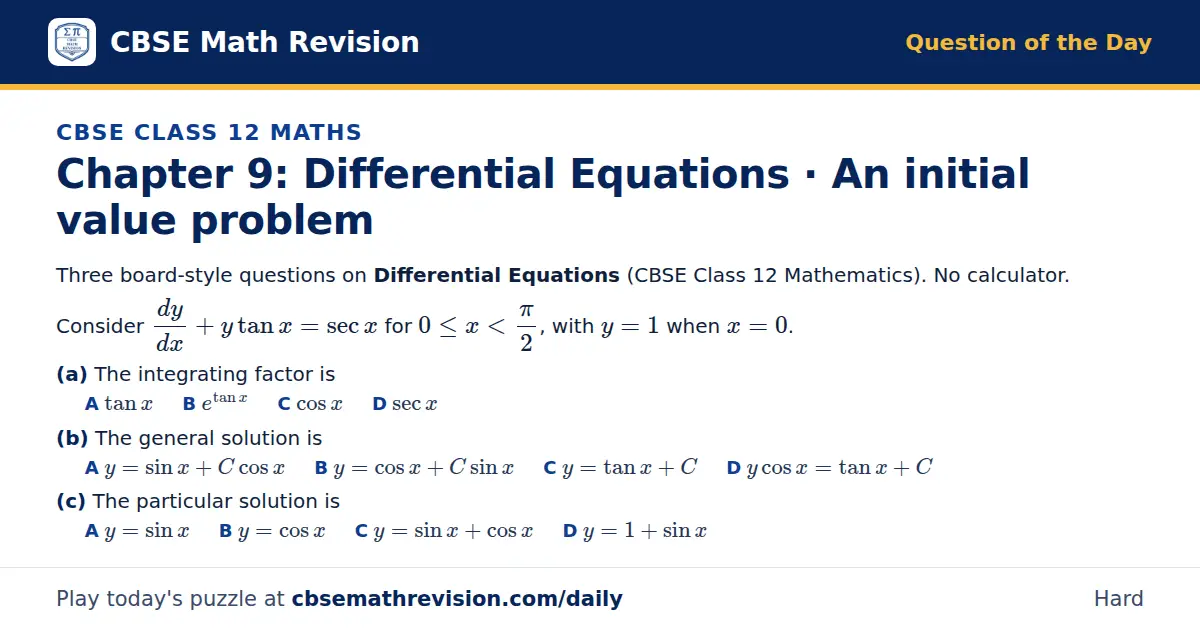
Chapter 9: Differential Equations · An initial value problem
Three board-style questions on Differential Equations (CBSE Class 12 Mathematics). No calculator. Consider dy/dx + ytan x = sec x for 0 ≤ x < (π)/2, with y = 1 when x = 0.
- The integrating factor is Options: A) tan x; B) e^(tan x); C) cos x; D) sec x
- The general solution is Options: A) y = sin x + Ccos x; B) y = cos x + Csin x; C) y = tan x + C; D) ycos x = tan x + C
- The particular solution is Options: A) y = sin x; B) y = cos x; C) y = sin x + cos x; D) y = 1 + sin x
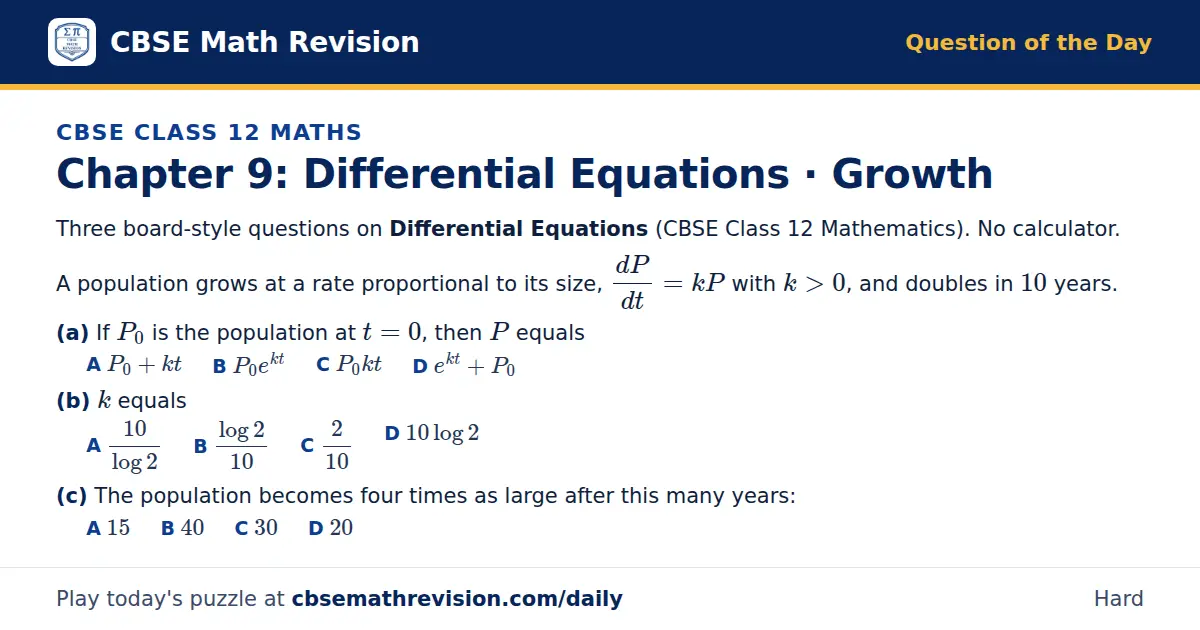
Chapter 9: Differential Equations · Growth
Three board-style questions on Differential Equations (CBSE Class 12 Mathematics). No calculator. A population grows at a rate proportional to its size, dP/dt = kP with k > 0, and doubles in 10 years.
- If P_0 is the population at t = 0, then P equals Options: A) P_0 + kt; B) P_0e^(kt); C) P_0kt; D) e^(kt) + P_0
- k equals Options: A) 10/(log 2); B) (log 2)/10; C) 2/10; D) 10log 2
- The population becomes four times as large after this many years: Options: A) 15; B) 40; C) 30; D) 20
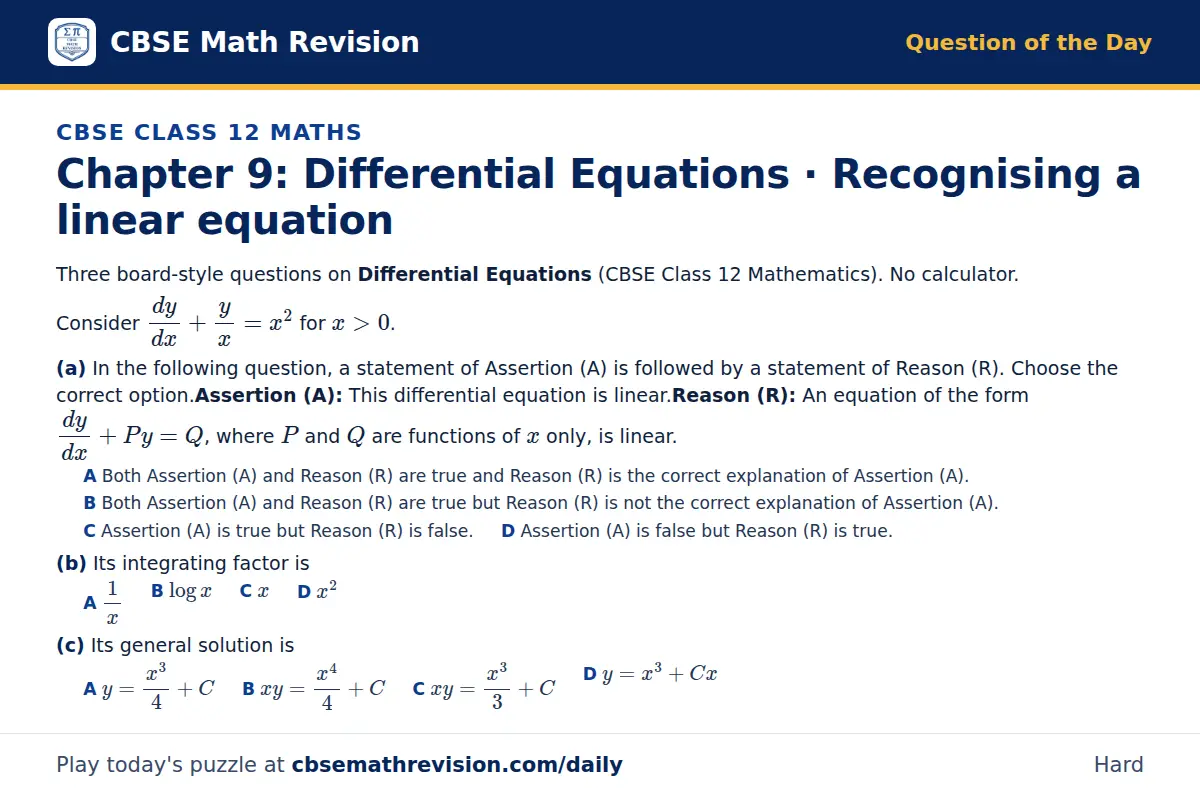
Chapter 9: Differential Equations · Recognising a linear equation
Three board-style questions on Differential Equations (CBSE Class 12 Mathematics). No calculator. Consider dy/dx + y/x = x² for x > 0.
- In the following question, a statement of Assertion (A) is followed by a statement of Reason (R). Choose the correct option. Assertion (A): This differential equation is linear. Reason (R): An equation of the form dy/dx + Py = Q, where P and Q are functions of x only, is linear. Options: A) Both Assertion (A) and Reason (R) are true and Reason (R) is the correct explanation of Assertion (A).; B) Both Assertion (A) and Reason (R) are true but Reason (R) is not the correct explanation of Assertion (A).; C) Assertion (A) is true but Reason (R) is false.; D) Assertion (A) is false but Reason (R) is true.
- Its integrating factor is Options: A) 1x; B) log x; C) x; D) x²
- Its general solution is Options: A) y = (x³)/4 + C; B) xy = (x⁴)/4 + C; C) xy = (x³)/3 + C; D) y = x³ + Cx
Chapter 10: Vector Algebra
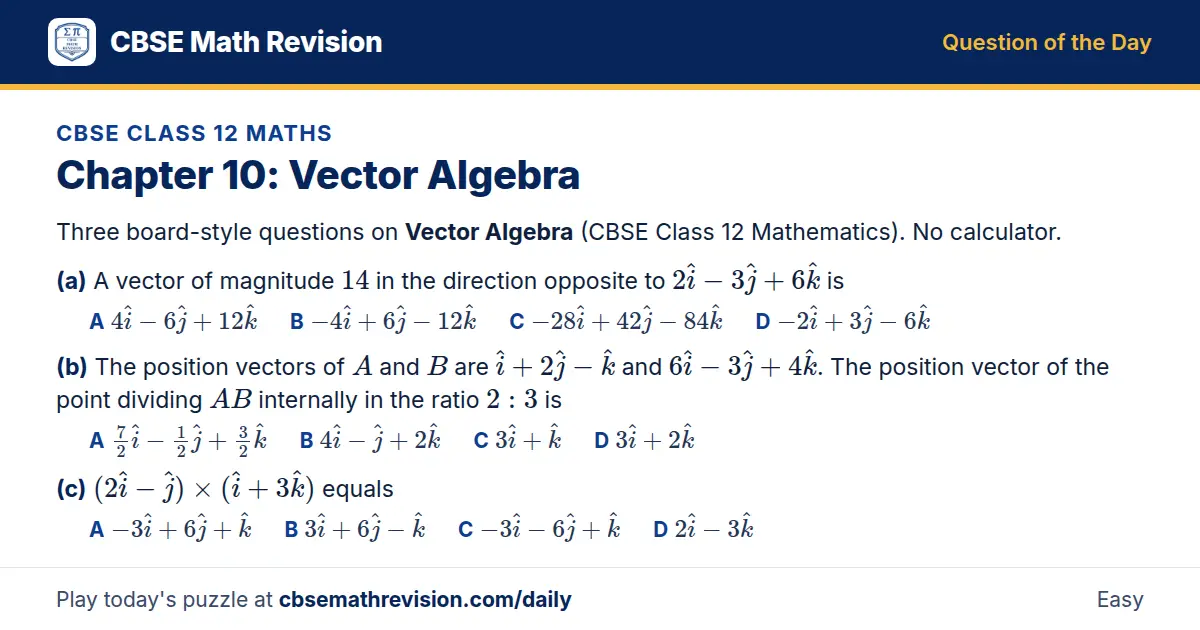
Chapter 10: Vector Algebra
Three board-style questions on Vector Algebra (CBSE Class 12 Mathematics). No calculator.
- A vector of magnitude 14 in the direction opposite to 2i - 3j + 6k is Options: A) 4i - 6j + 12k; B) -4i + 6j - 12k; C) -28i + 42j - 84k; D) -2i + 3j - 6k
- The position vectors of A and B are i + 2j - k and 6i - 3j + 4k. The position vector of the point dividing AB internally in the ratio 2: 3 is Options: A) 72i - 12j + 32k; B) 4i - j + 2k; C) 3i + k; D) 3i + 2k
- (2i - j) × (i + 3k) equals Options: A) -3i + 6j + k; B) 3i + 6j - k; C) -3i - 6j + k; D) 2i - 3k
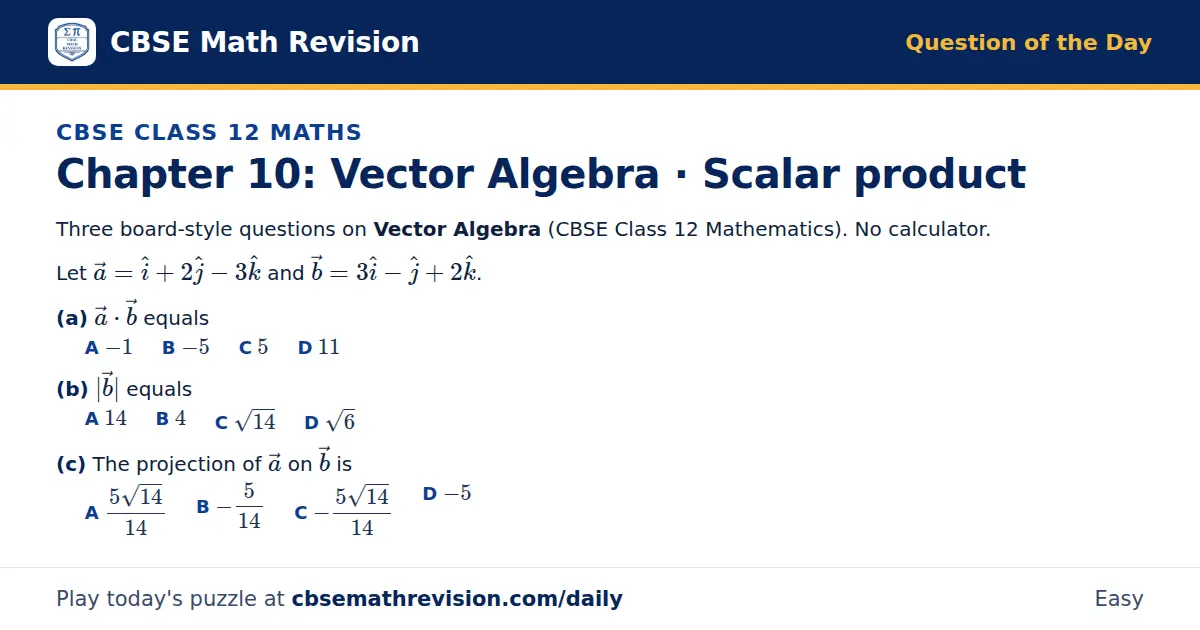
Chapter 10: Vector Algebra · Scalar product
Three board-style questions on Vector Algebra (CBSE Class 12 Mathematics). No calculator. Let a = i + 2 j - 3 k and b = 3 i - j + 2 k.
- a · b equals Options: A) -1; B) -5; C) 5; D) 11
- | b| equals Options: A) 14; B) 4; C) √14; D) √6
- The projection of a on b is Options: A) (5 √14)/14; B) - 5/14; C) - (5 √14)/14; D) -5
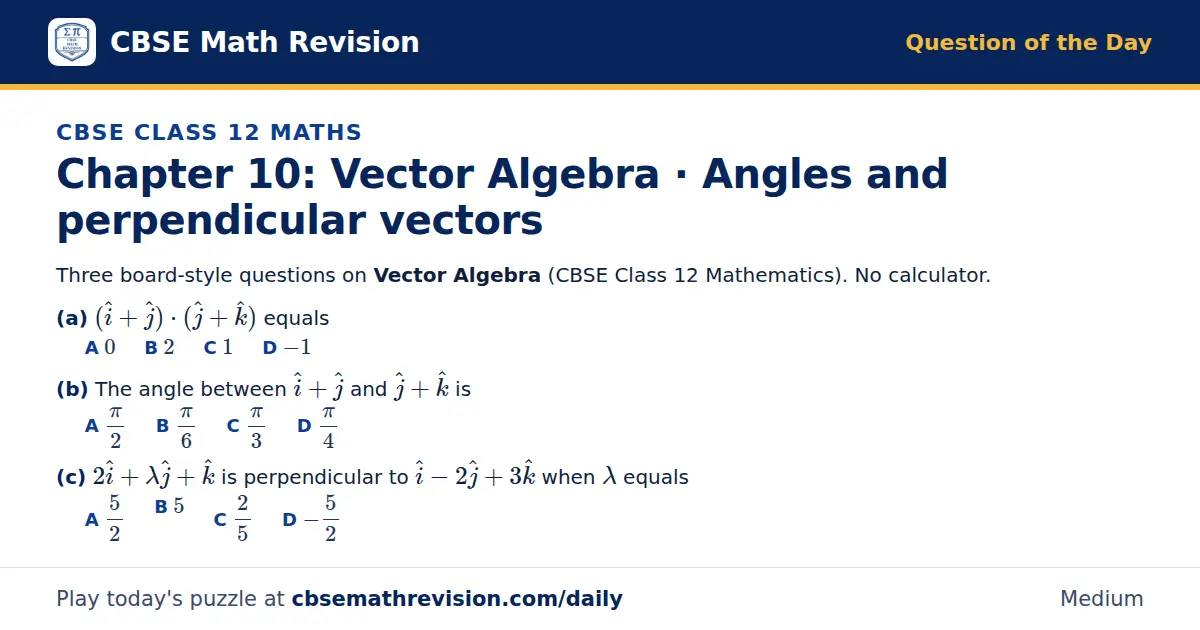
Chapter 10: Vector Algebra · Angles and perpendicular vectors
Three board-style questions on Vector Algebra (CBSE Class 12 Mathematics). No calculator.
- (i + j) · (j + k) equals Options: A) 0; B) 2; C) 1; D) -1
- The angle between i + j and j + k is Options: A) (π)/2; B) (π)/6; C) (π)/3; D) (π)/4
- 2 i + λ j + k is perpendicular to i - 2 j + 3 k when λ equals Options: A) 5/2; B) 5; C) 2/5; D) - 5/2
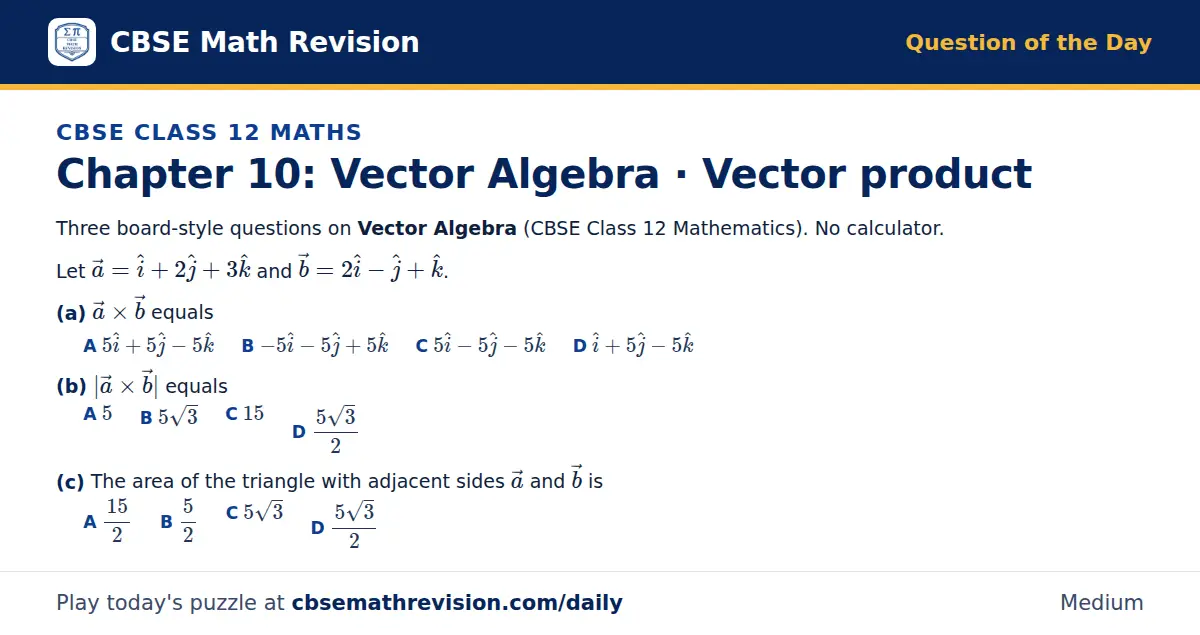
Chapter 10: Vector Algebra · Vector product
Three board-style questions on Vector Algebra (CBSE Class 12 Mathematics). No calculator. Let a = i + 2 j + 3 k and b = 2 i - j + k.
- a × b equals Options: A) 5 i + 5 j - 5 k; B) -5 i - 5 j + 5 k; C) 5 i - 5 j - 5 k; D) i + 5 j - 5 k
- | a × b| equals Options: A) 5; B) 5 √3; C) 15; D) (5 √3)/2
- The area of the triangle with adjacent sides a and b is Options: A) 15/2; B) 5/2; C) 5 √3; D) (5 √3)/2
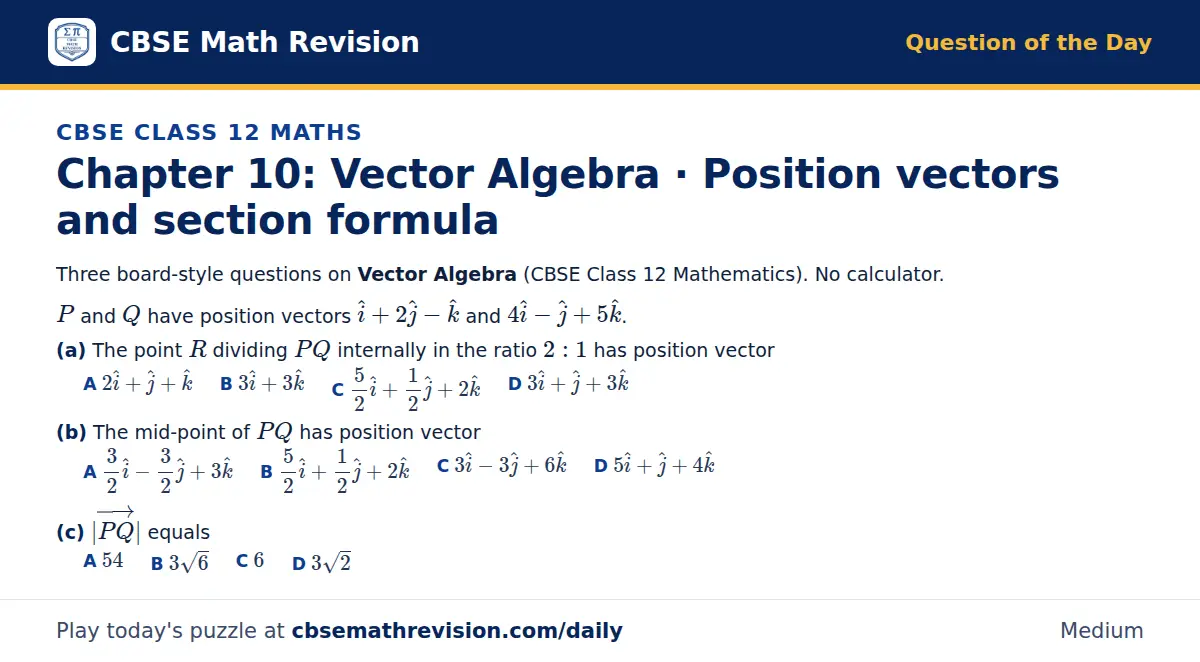
Chapter 10: Vector Algebra · Position vectors and section formula
Three board-style questions on Vector Algebra (CBSE Class 12 Mathematics). No calculator. P and Q have position vectors i + 2 j - k and 4 i - j + 5 k.
- The point R dividing PQ internally in the ratio 2: 1 has position vector Options: A) 2 i + j + k; B) 3 i + 3 k; C) 52 i + 12 j + 2 k; D) 3 i + j + 3 k
- The mid-point of PQ has position vector Options: A) 32 i - 32 j + 3 k; B) 52 i + 12 j + 2 k; C) 3 i - 3 j + 6 k; D) 5 i + j + 4 k
- |PQ| equals Options: A) 54; B) 3 √6; C) 6; D) 3 √2
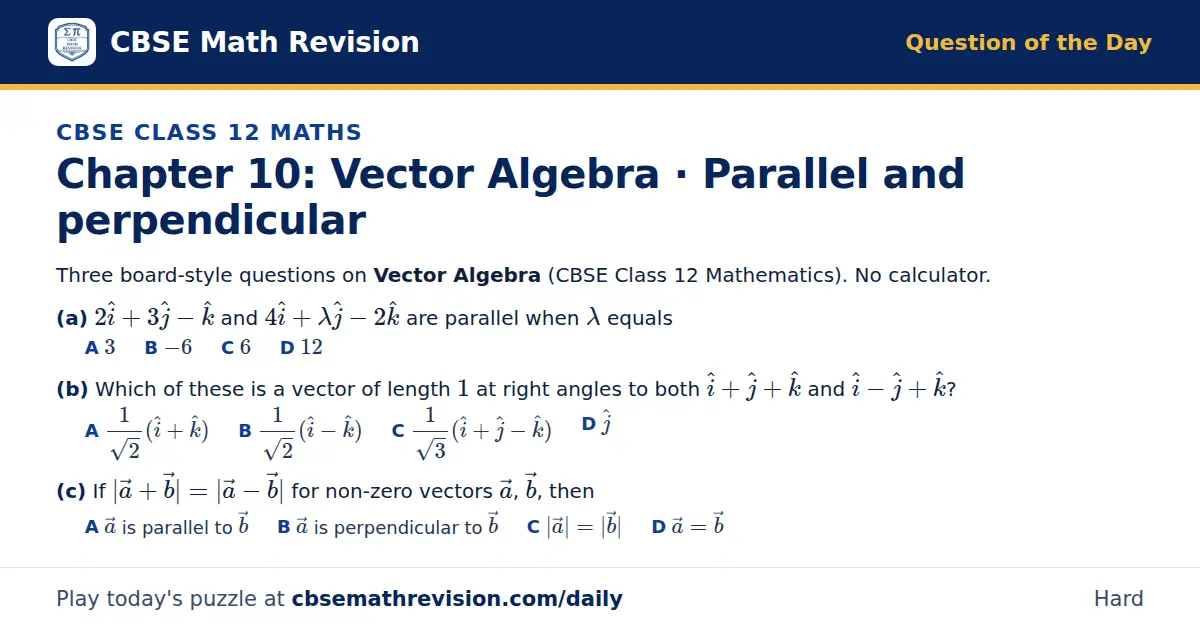
Chapter 10: Vector Algebra · Parallel and perpendicular
Three board-style questions on Vector Algebra (CBSE Class 12 Mathematics). No calculator.
- 2 i + 3 j - k and 4 i + λ j - 2 k are parallel when λ equals Options: A) 3; B) -6; C) 6; D) 12
- Which of these is a vector of length 1 at right angles to both i + j + k and i - j + k? Options: A) 1/(√2)(i + k); B) 1/(√2)(i - k); C) 1/(√3)(i + j - k); D) j
- If | a + b| = | a - b| for non-zero vectors a, b, then Options: A) a is parallel to b; B) a is perpendicular to b; C) | a| = | b|; D) a = b
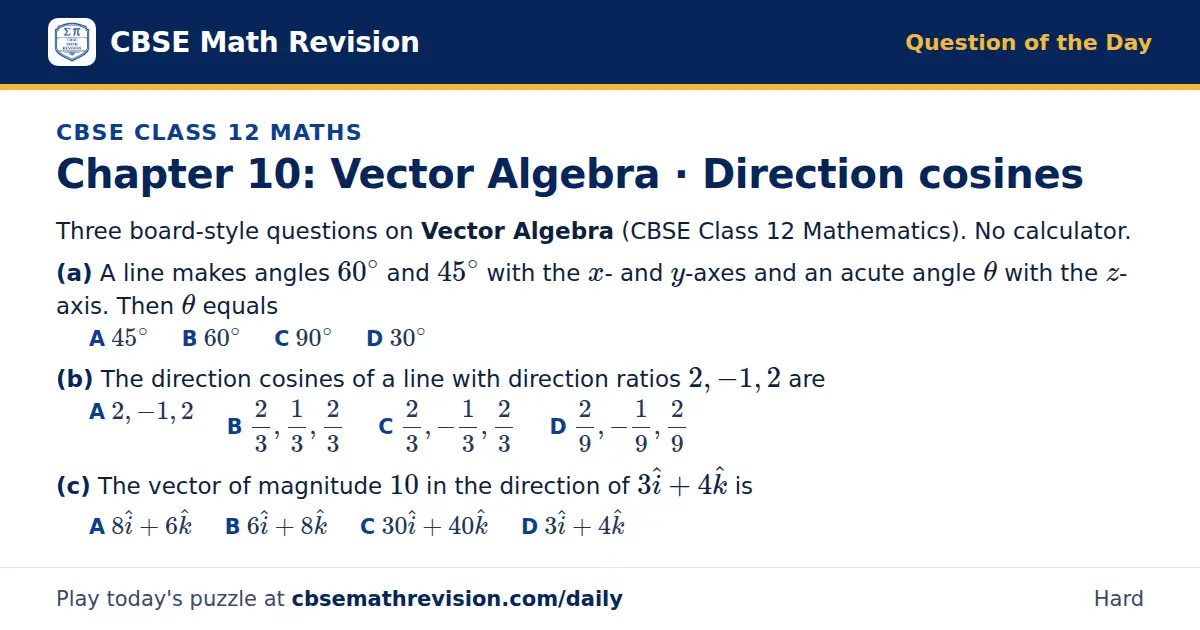
Chapter 10: Vector Algebra · Direction cosines
Three board-style questions on Vector Algebra (CBSE Class 12 Mathematics). No calculator.
- A line makes angles 60^∘ and 45^∘ with the x- and y-axes and an acute angle θ with the z-axis. Then θ equals Options: A) 45^∘; B) 60^∘; C) 90^∘; D) 30^∘
- The direction cosines of a line with direction ratios 2, -1, 2 are Options: A) 2, -1, 2; B) 23, 13, 23; C) 23, -13, 23; D) 29, -19, 29
- The vector of magnitude 10 in the direction of 3 i + 4 k is Options: A) 8 i + 6 k; B) 6 i + 8 k; C) 30 i + 40 k; D) 3 i + 4 k
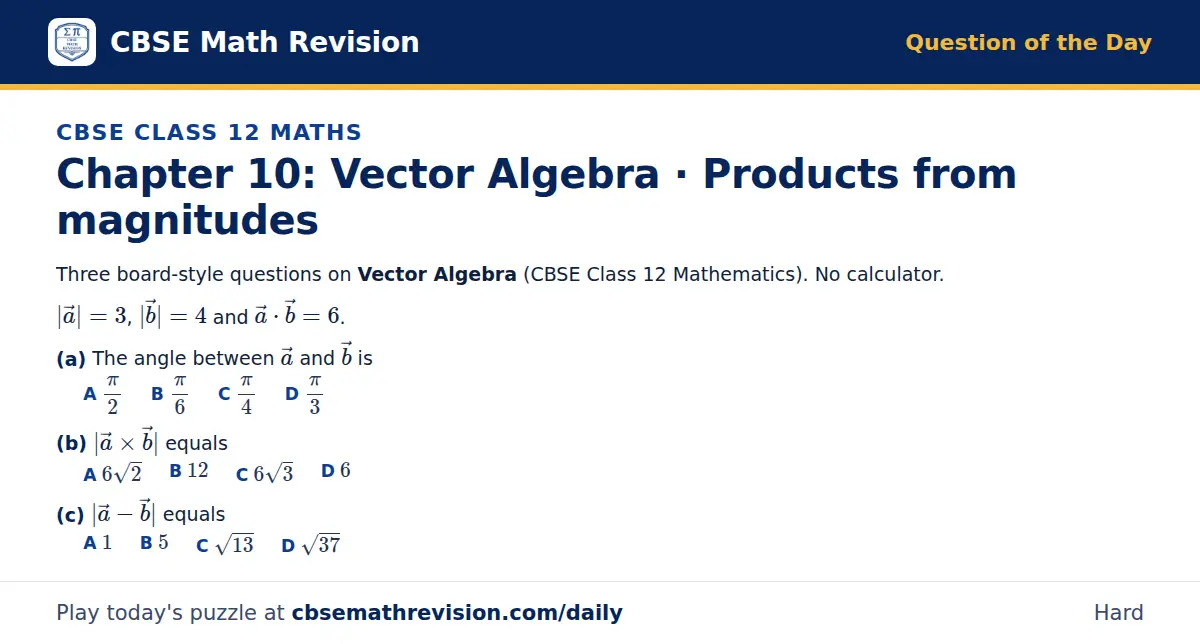
Chapter 10: Vector Algebra · Products from magnitudes
Three board-style questions on Vector Algebra (CBSE Class 12 Mathematics). No calculator. | a| = 3, | b| = 4 and a · b = 6.
- The angle between a and b is Options: A) (π)/2; B) (π)/6; C) (π)/4; D) (π)/3
- | a × b| equals Options: A) 6 √2; B) 12; C) 6 √3; D) 6
- | a - b| equals Options: A) 1; B) 5; C) √13; D) √37
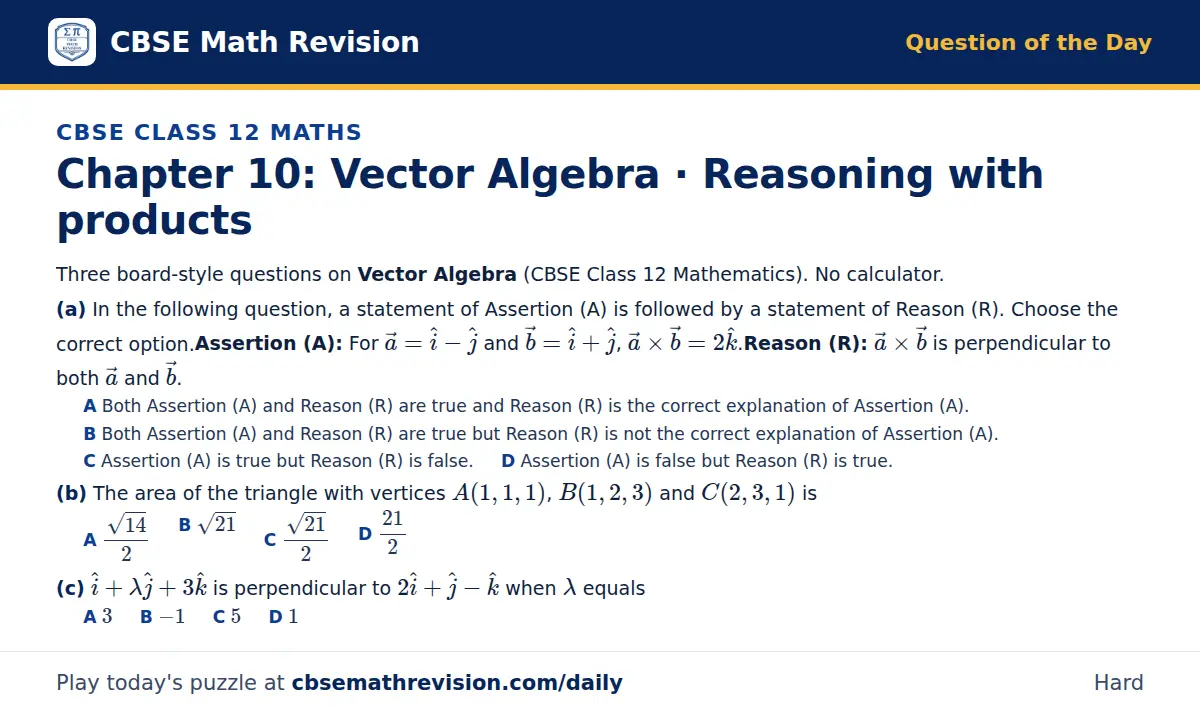
Chapter 10: Vector Algebra · Reasoning with products
Three board-style questions on Vector Algebra (CBSE Class 12 Mathematics). No calculator.
- In the following question, a statement of Assertion (A) is followed by a statement of Reason (R). Choose the correct option. Assertion (A): For a = i - j and b = i + j, a × b = 2 k. Reason (R): a × b is perpendicular to both a and b. Options: A) Both Assertion (A) and Reason (R) are true and Reason (R) is the correct explanation of Assertion (A).; B) Both Assertion (A) and Reason (R) are true but Reason (R) is not the correct explanation of Assertion (A).; C) Assertion (A) is true but Reason (R) is false.; D) Assertion (A) is false but Reason (R) is true.
- The area of the triangle with vertices A(1, 1, 1), B(1, 2, 3) and C(2, 3, 1) is Options: A) (√14)/2; B) √21; C) (√21)/2; D) 21/2
- i + λ j + 3 k is perpendicular to 2 i + j - k when λ equals Options: A) 3; B) -1; C) 5; D) 1
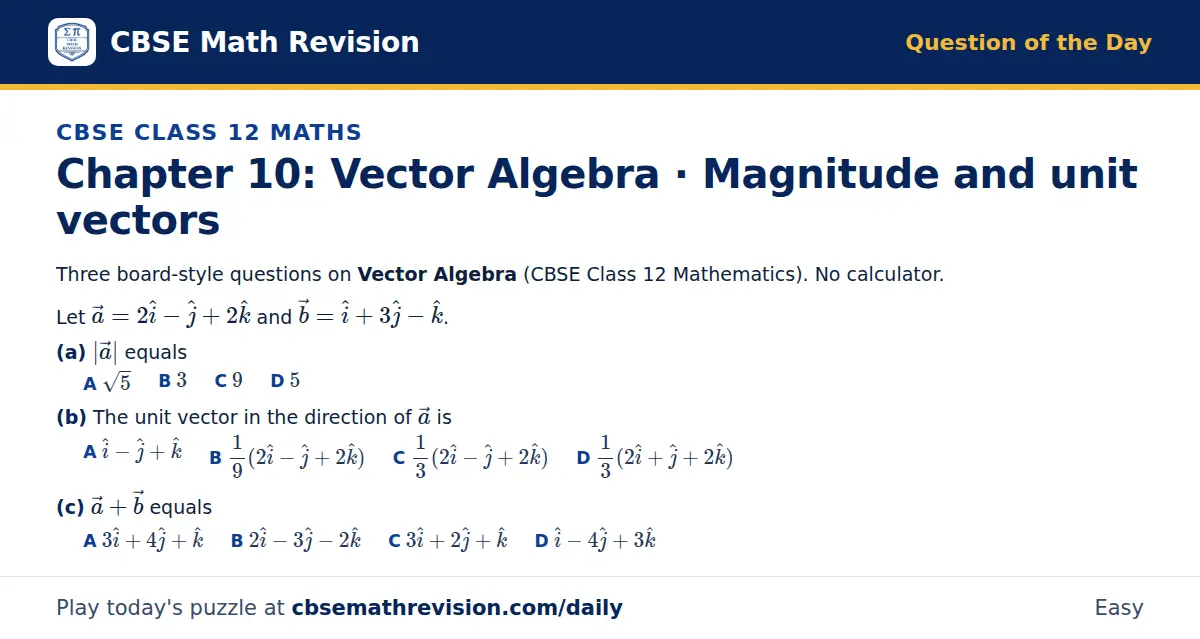
Chapter 10: Vector Algebra · Magnitude and unit vectors
Three board-style questions on Vector Algebra (CBSE Class 12 Mathematics). No calculator. Let a = 2 i - j + 2 k and b = i + 3 j - k.
- | a| equals Options: A) √5; B) 3; C) 9; D) 5
- The unit vector in the direction of a is Options: A) i - j + k; B) 19(2 i - j + 2 k); C) 13(2 i - j + 2 k); D) 13(2 i + j + 2 k)
- a + b equals Options: A) 3 i + 4 j + k; B) 2 i - 3 j - 2 k; C) 3 i + 2 j + k; D) i - 4 j + 3 k
More Question of the Day puzzles
Other chapters: Chapters 1–4 · Chapters 5–7 · Chapters 8–10 · Chapters 11–13. See all CBSE Maths daily and weekly questions.