CBSE Class 12 Maths Question of the Day: chapters 11–13
30 CBSE Class 12 Mathematics puzzles from the Question of the Day rotation, chapters 11–13. Each puzzle is three board-style questions on one chapter, shown as an image with the question text written out below it; the answers, hints and step-marked solutions are on the daily puzzle page.
Chapter 11: Three Dimensional Geometry
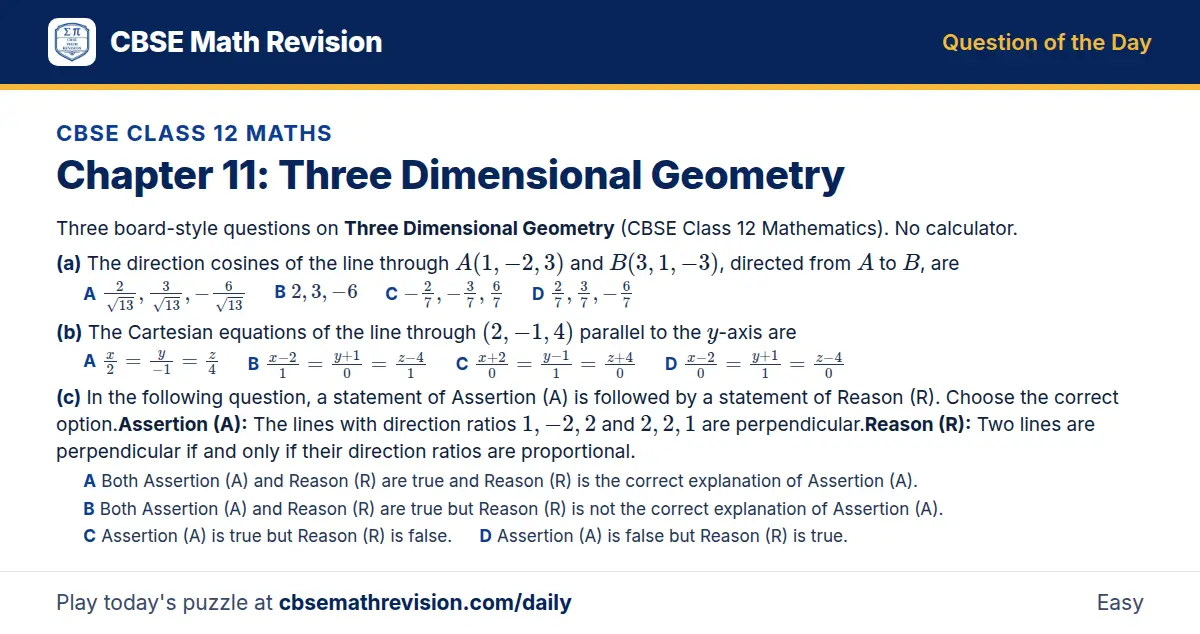
Chapter 11: Three Dimensional Geometry
Three board-style questions on Three Dimensional Geometry (CBSE Class 12 Mathematics). No calculator.
- The direction cosines of the line through A(1, -2, 3) and B(3, 1, -3), directed from A to B, are Options: A) 2/(√13), 3/(√13), -6/(√13); B) 2, 3, -6; C) -27, -37, 67; D) 27, 37, -67
- The Cartesian equations of the line through (2, -1, 4) parallel to the y-axis are Options: A) x/2 = y/(-1) = z/4; B) (x - 2)/1 = (y + 1)/0 = (z - 4)/1; C) (x + 2)/0 = (y - 1)/1 = (z + 4)/0; D) (x - 2)/0 = (y + 1)/1 = (z - 4)/0
- In the following question, a statement of Assertion (A) is followed by a statement of Reason (R). Choose the correct option. Assertion (A): The lines with direction ratios 1, -2, 2 and 2, 2, 1 are perpendicular. Reason (R): Two lines are perpendicular if and only if their direction ratios are proportional. Options: A) Both Assertion (A) and Reason (R) are true and Reason (R) is the correct explanation of Assertion (A).; B) Both Assertion (A) and Reason (R) are true but Reason (R) is not the correct explanation of Assertion (A).; C) Assertion (A) is true but Reason (R) is false.; D) Assertion (A) is false but Reason (R) is true.
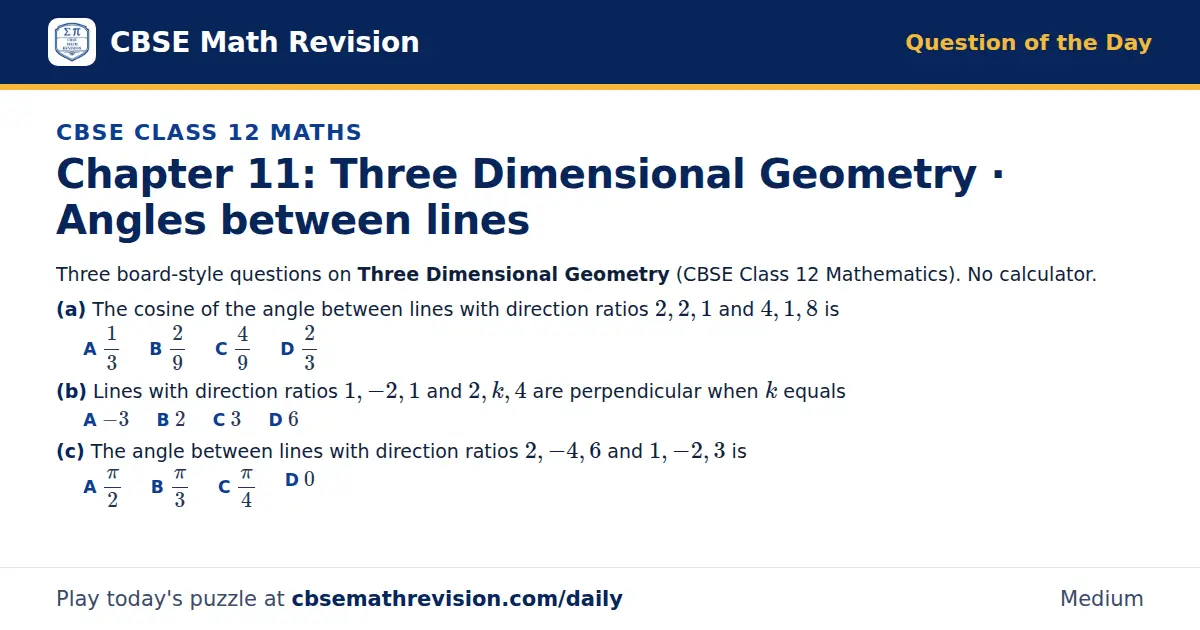
Chapter 11: Three Dimensional Geometry · Angles between lines
Three board-style questions on Three Dimensional Geometry (CBSE Class 12 Mathematics). No calculator.
- The cosine of the angle between lines with direction ratios 2, 2, 1 and 4, 1, 8 is Options: A) 1/3; B) 2/9; C) 4/9; D) 2/3
- Lines with direction ratios 1, -2, 1 and 2, k, 4 are perpendicular when k equals Options: A) -3; B) 2; C) 3; D) 6
- The angle between lines with direction ratios 2, -4, 6 and 1, -2, 3 is Options: A) (π)/2; B) (π)/3; C) (π)/4; D) 0
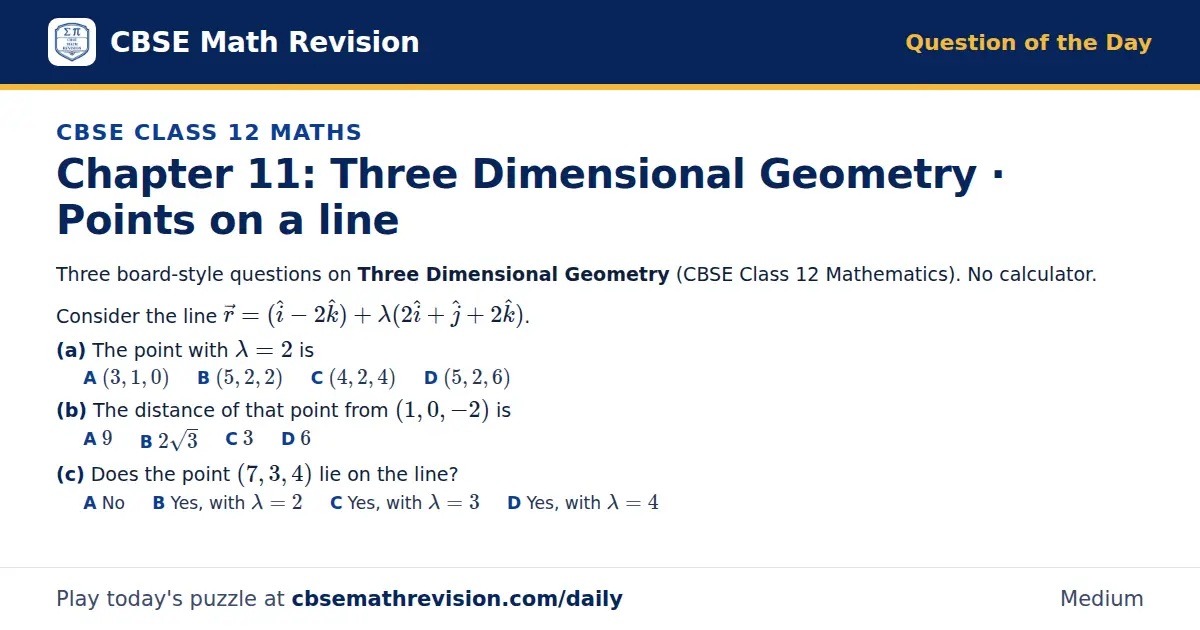
Chapter 11: Three Dimensional Geometry · Points on a line
Three board-style questions on Three Dimensional Geometry (CBSE Class 12 Mathematics). No calculator. Consider the line r = (i - 2 k) + λ(2 i + j + 2 k).
- The point with λ = 2 is Options: A) (3, 1, 0); B) (5, 2, 2); C) (4, 2, 4); D) (5, 2, 6)
- The distance of that point from (1, 0, -2) is Options: A) 9; B) 2 √3; C) 3; D) 6
- Does the point (7, 3, 4) lie on the line? Options: A) No; B) Yes, with λ = 2; C) Yes, with λ = 3; D) Yes, with λ = 4
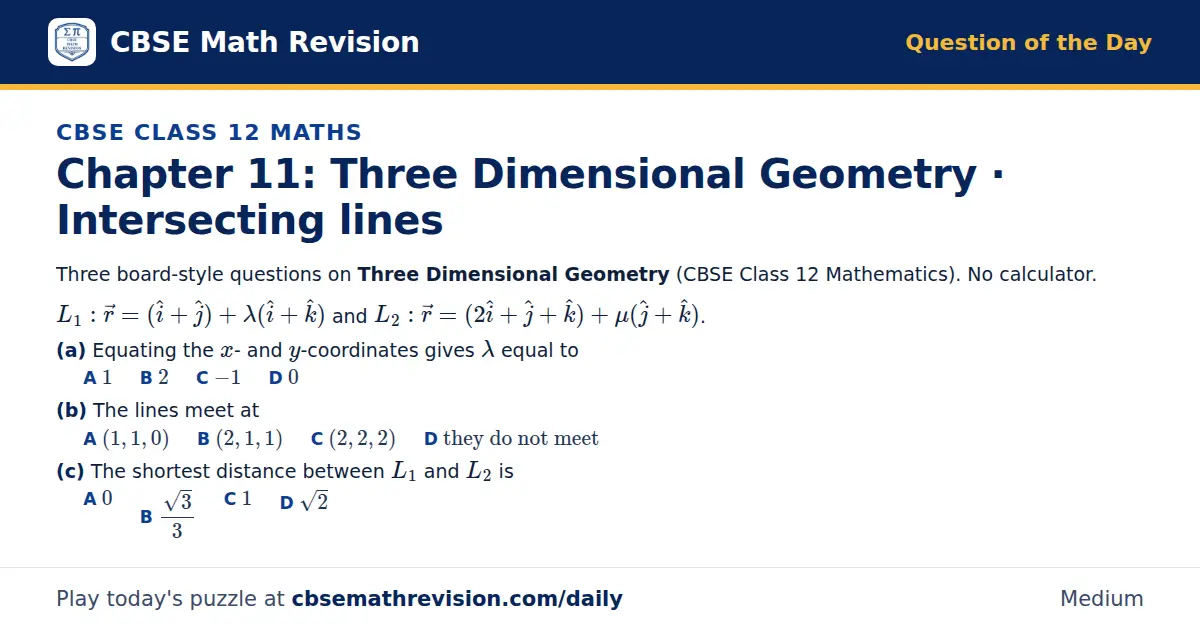
Chapter 11: Three Dimensional Geometry · Intersecting lines
Three board-style questions on Three Dimensional Geometry (CBSE Class 12 Mathematics). No calculator. L_1: r = (i + j) + λ(i + k) and L_2: r = (2 i + j + k) + μ(j + k).
- Equating the x- and y-coordinates gives λ equal to Options: A) 1; B) 2; C) -1; D) 0
- The lines meet at Options: A) (1, 1, 0); B) (2, 1, 1); C) (2, 2, 2); D) they do not meet
- The shortest distance between L_1 and L_2 is Options: A) 0; B) (√3)/3; C) 1; D) √2
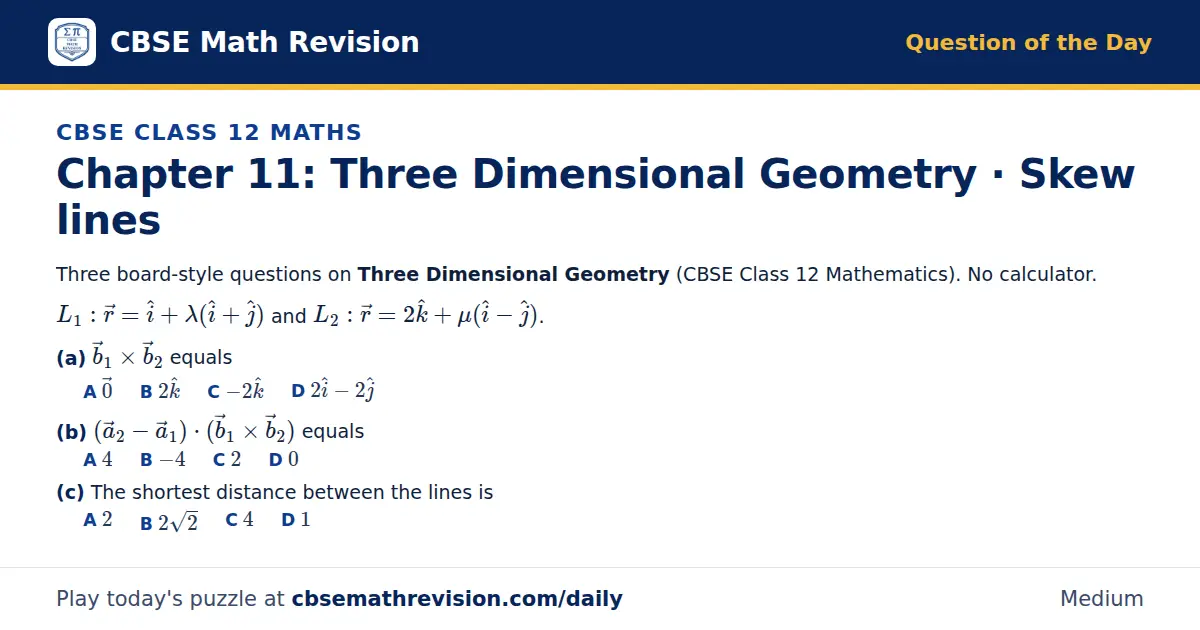
Chapter 11: Three Dimensional Geometry · Skew lines
Three board-style questions on Three Dimensional Geometry (CBSE Class 12 Mathematics). No calculator. L_1: r = i + λ(i + j) and L_2: r = 2 k + μ(i - j).
- b_1 × b_2 equals Options: A) 0; B) 2 k; C) -2 k; D) 2 i - 2 j
- (a_2 - a_1) · (b_1 × b_2) equals Options: A) 4; B) -4; C) 2; D) 0
- The shortest distance between the lines is Options: A) 2; B) 2 √2; C) 4; D) 1
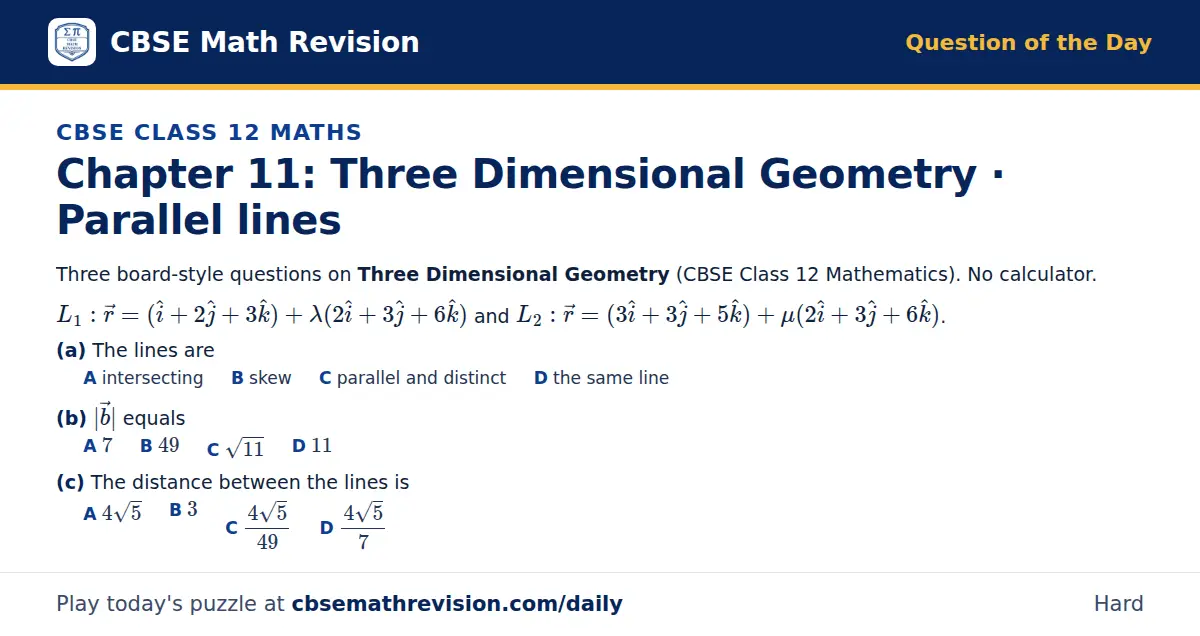
Chapter 11: Three Dimensional Geometry · Parallel lines
Three board-style questions on Three Dimensional Geometry (CBSE Class 12 Mathematics). No calculator. L_1: r = (i + 2 j + 3 k) + λ(2 i + 3 j + 6 k) and L_2: r = (3 i + 3 j + 5 k) + μ(2 i + 3 j + 6 k).
- The lines are Options: A) intersecting; B) skew; C) parallel and distinct; D) the same line
- | b| equals Options: A) 7; B) 49; C) √11; D) 11
- The distance between the lines is Options: A) 4 √5; B) 3; C) (4 √5)/49; D) (4 √5)/7
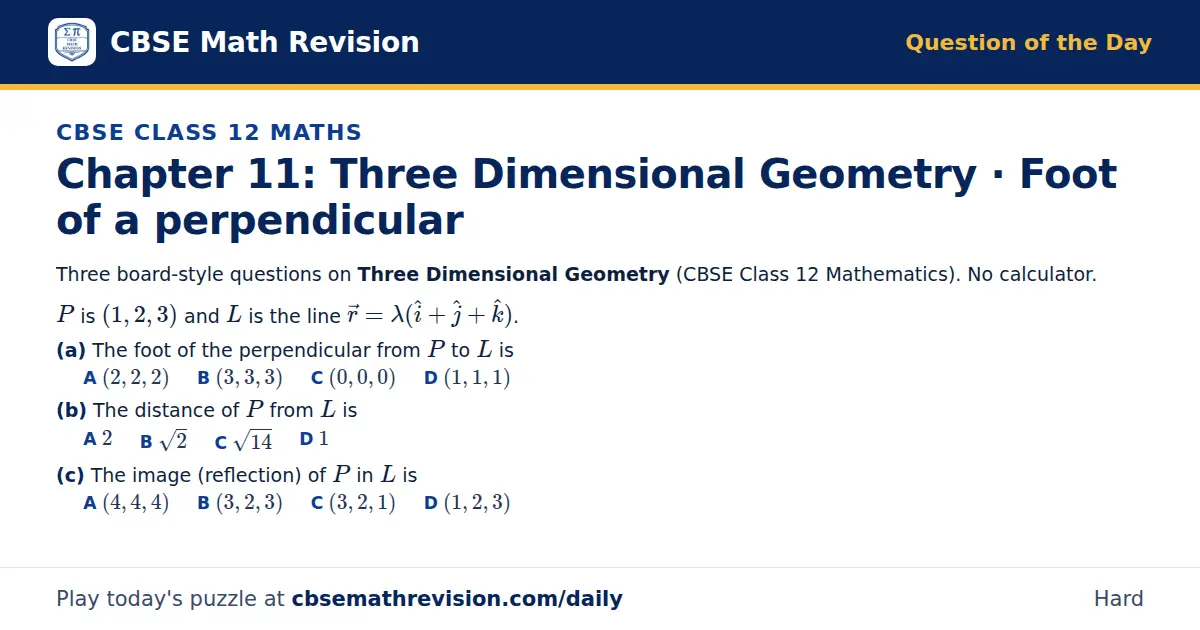
Chapter 11: Three Dimensional Geometry · Foot of a perpendicular
Three board-style questions on Three Dimensional Geometry (CBSE Class 12 Mathematics). No calculator. P is (1, 2, 3) and L is the line r = λ(i + j + k).
- The foot of the perpendicular from P to L is Options: A) (2, 2, 2); B) (3, 3, 3); C) (0, 0, 0); D) (1, 1, 1)
- The distance of P from L is Options: A) 2; B) √2; C) √14; D) 1
- The image (reflection) of P in L is Options: A) (4, 4, 4); B) (3, 2, 3); C) (3, 2, 1); D) (1, 2, 3)
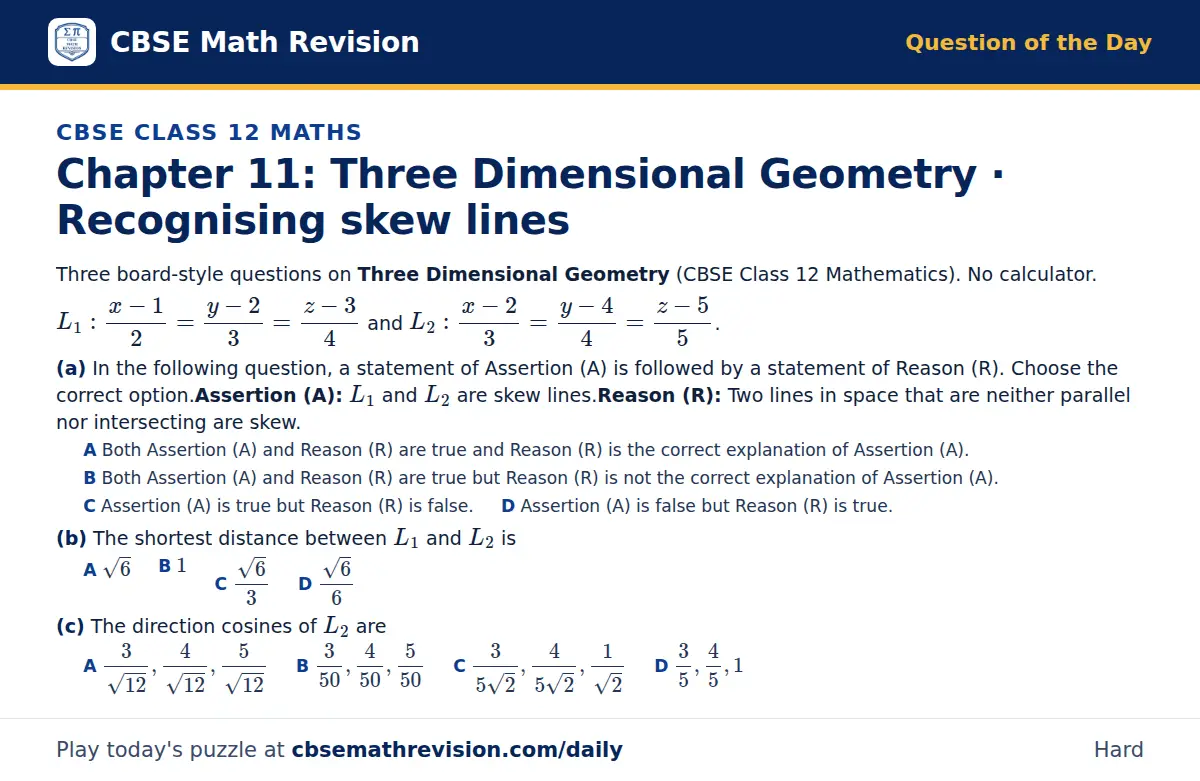
Chapter 11: Three Dimensional Geometry · Recognising skew lines
Three board-style questions on Three Dimensional Geometry (CBSE Class 12 Mathematics). No calculator. L_1: (x - 1)/2 = (y - 2)/3 = (z - 3)/4 and L_2: (x - 2)/3 = (y - 4)/4 = (z - 5)/5.
- In the following question, a statement of Assertion (A) is followed by a statement of Reason (R). Choose the correct option. Assertion (A): L_1 and L_2 are skew lines. Reason (R): Two lines in space that are neither parallel nor intersecting are skew. Options: A) Both Assertion (A) and Reason (R) are true and Reason (R) is the correct explanation of Assertion (A).; B) Both Assertion (A) and Reason (R) are true but Reason (R) is not the correct explanation of Assertion (A).; C) Assertion (A) is true but Reason (R) is false.; D) Assertion (A) is false but Reason (R) is true.
- The shortest distance between L_1 and L_2 is Options: A) √6; B) 1; C) (√6)/3; D) (√6)/6
- The direction cosines of L_2 are Options: A) 3/(√12), 4/(√12), 5/(√12); B) 3/50, 4/50, 5/50; C) 3/(5√2), 4/(5√2), 1/(√2); D) 35, 45, 1
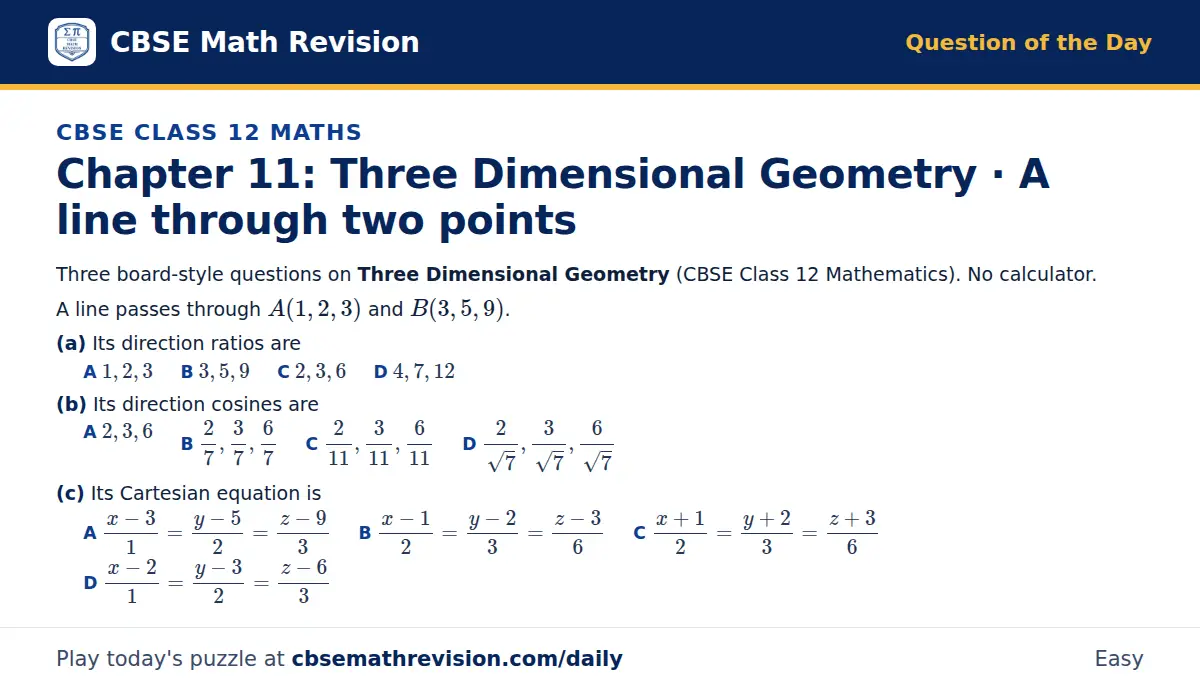
Chapter 11: Three Dimensional Geometry · A line through two points
Three board-style questions on Three Dimensional Geometry (CBSE Class 12 Mathematics). No calculator. A line passes through A(1, 2, 3) and B(3, 5, 9).
- Its direction ratios are Options: A) 1, 2, 3; B) 3, 5, 9; C) 2, 3, 6; D) 4, 7, 12
- Its direction cosines are Options: A) 2, 3, 6; B) 27, 37, 67; C) 211, 311, 611; D) 2/(√7), 3/(√7), 6/(√7)
- Its Cartesian equation is Options: A) (x - 3)/1 = (y - 5)/2 = (z - 9)/3; B) (x - 1)/2 = (y - 2)/3 = (z - 3)/6; C) (x + 1)/2 = (y + 2)/3 = (z + 3)/6; D) (x - 2)/1 = (y - 3)/2 = (z - 6)/3
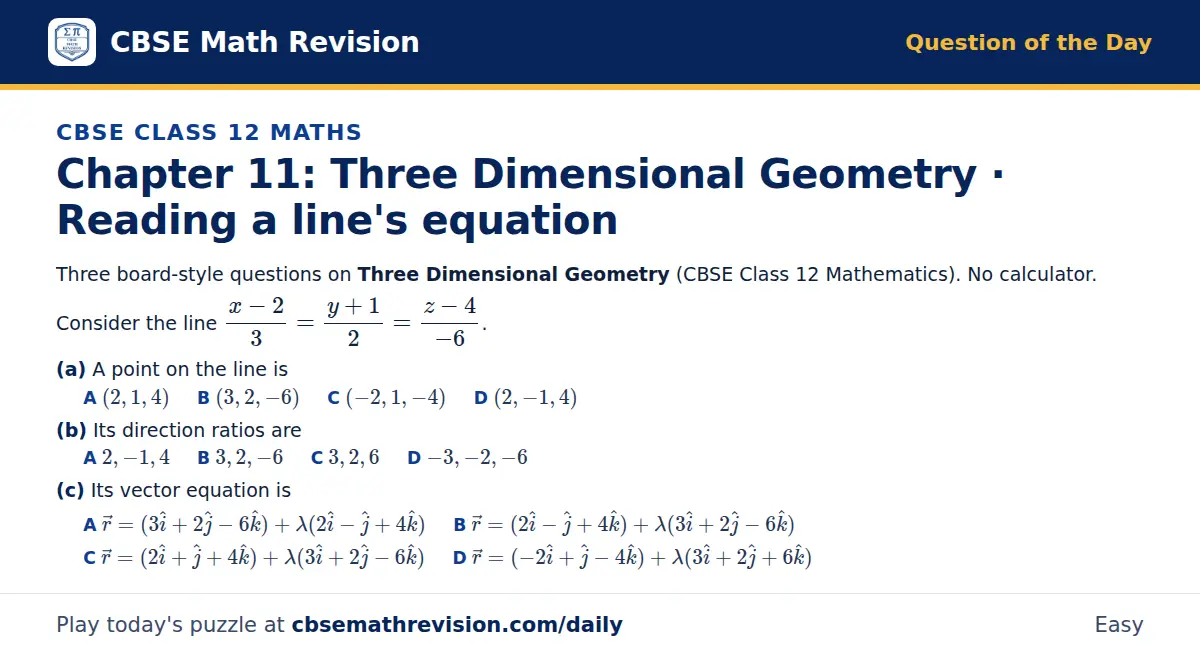
Chapter 11: Three Dimensional Geometry · Reading a line's equation
Three board-style questions on Three Dimensional Geometry (CBSE Class 12 Mathematics). No calculator. Consider the line (x - 2)/3 = (y + 1)/2 = (z - 4)/(-6).
- A point on the line is Options: A) (2, 1, 4); B) (3, 2, -6); C) (-2, 1, -4); D) (2, -1, 4)
- Its direction ratios are Options: A) 2, -1, 4; B) 3, 2, -6; C) 3, 2, 6; D) -3, -2, -6
- Its vector equation is Options: A) r = (3 i + 2 j - 6 k) + λ(2 i - j + 4 k); B) r = (2 i - j + 4 k) + λ(3 i + 2 j - 6 k); C) r = (2 i + j + 4 k) + λ(3 i + 2 j - 6 k); D) r = (-2 i + j - 4 k) + λ(3 i + 2 j + 6 k)
Chapter 12: Linear Programming
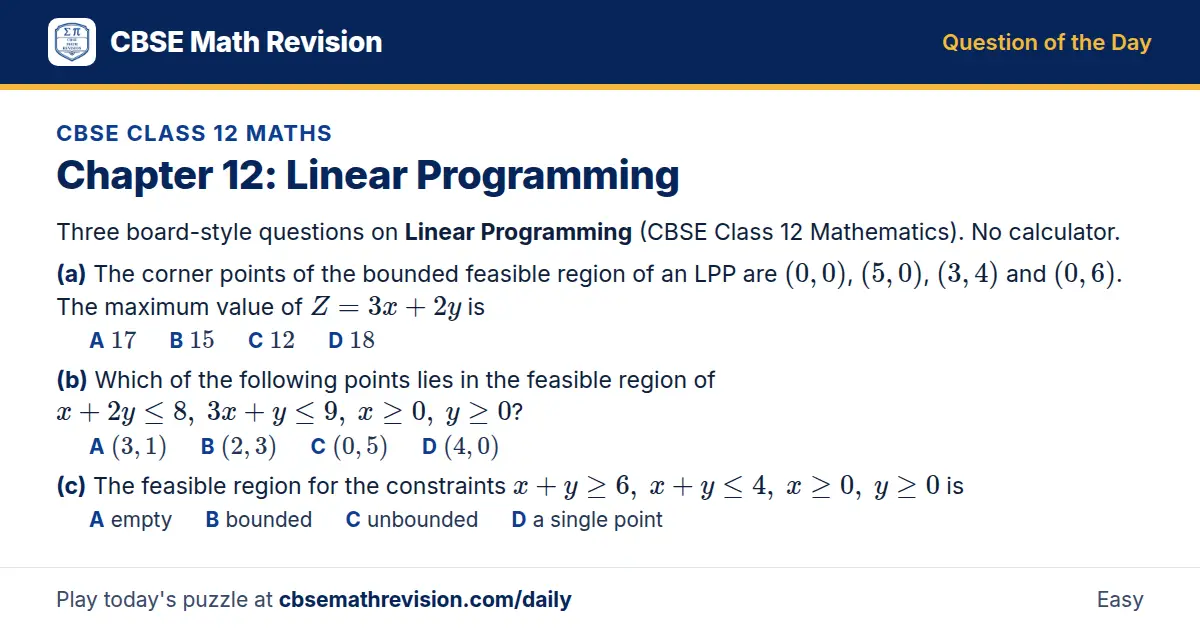
Chapter 12: Linear Programming
Three board-style questions on Linear Programming (CBSE Class 12 Mathematics). No calculator.
- The corner points of the bounded feasible region of an LPP are (0, 0), (5, 0), (3, 4) and (0, 6). The maximum value of Z = 3x + 2y is Options: A) 17; B) 15; C) 12; D) 18
- Which of the following points lies in the feasible region of x + 2y ≤ 8, 3x + y ≤ 9, x ≥ 0, y ≥ 0? Options: A) (3, 1); B) (2, 3); C) (0, 5); D) (4, 0)
- The feasible region for the constraints x + y ≥ 6, x + y ≤ 4, x ≥ 0, y ≥ 0 is Options: A) empty; B) bounded; C) unbounded; D) a single point
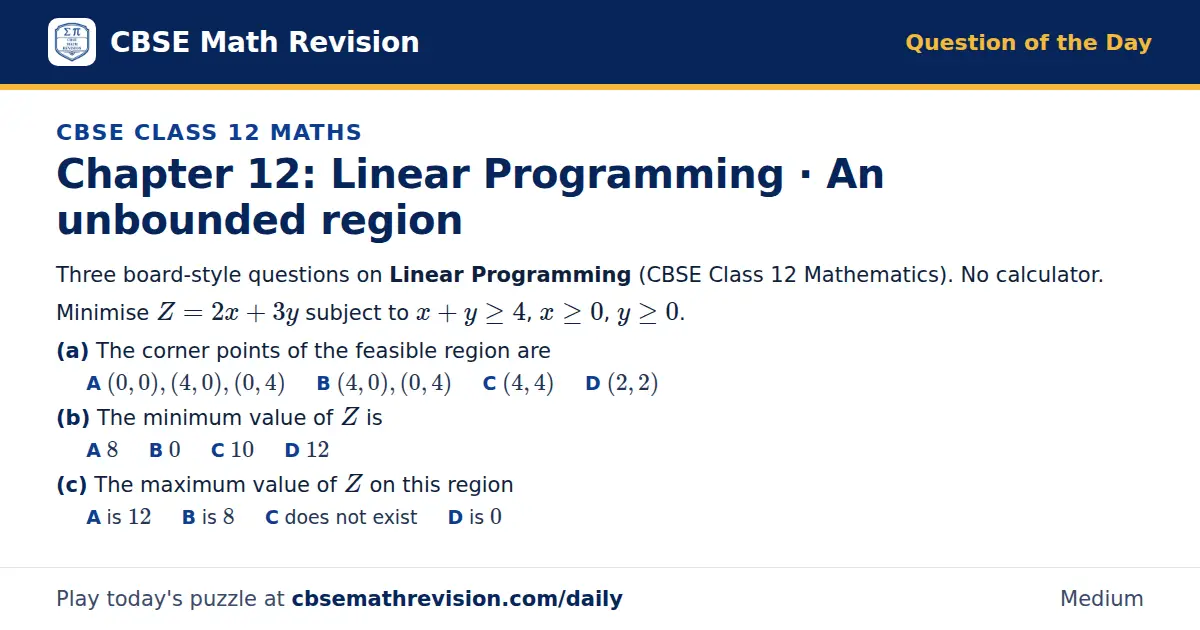
Chapter 12: Linear Programming · An unbounded region
Three board-style questions on Linear Programming (CBSE Class 12 Mathematics). No calculator. Minimise Z = 2x + 3y subject to x + y ≥ 4, x ≥ 0, y ≥ 0.
- The corner points of the feasible region are Options: A) (0, 0), (4, 0), (0, 4); B) (4, 0), (0, 4); C) (4, 4); D) (2, 2)
- The minimum value of Z is Options: A) 8; B) 0; C) 10; D) 12
- The maximum value of Z on this region Options: A) is 12; B) is 8; C) does not exist; D) is 0
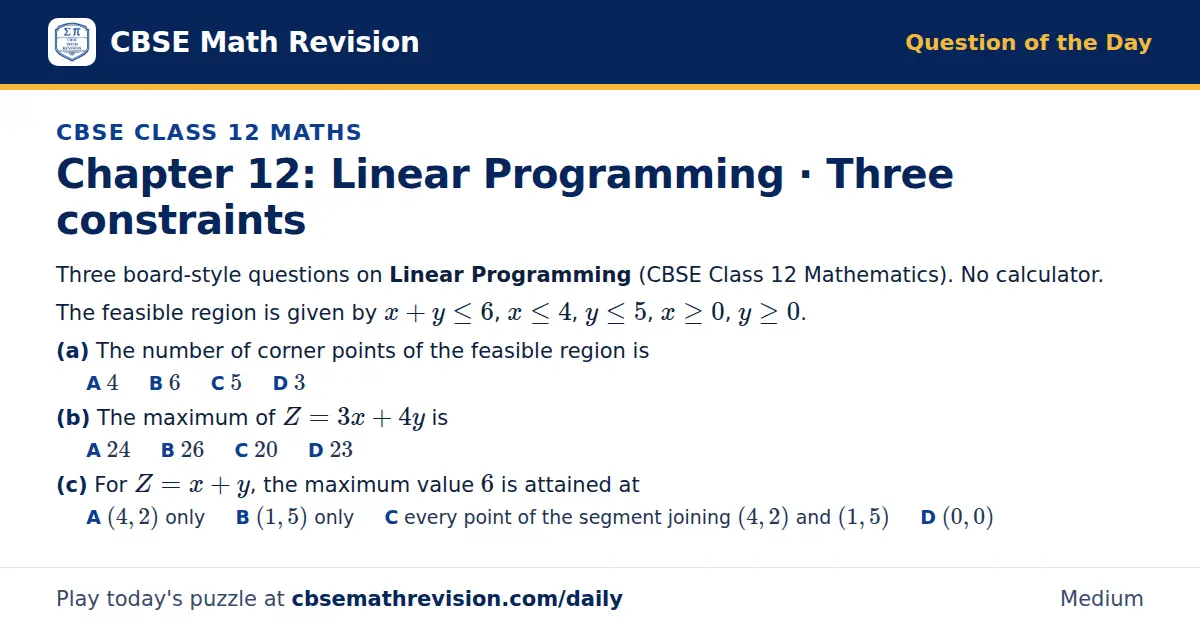
Chapter 12: Linear Programming · Three constraints
Three board-style questions on Linear Programming (CBSE Class 12 Mathematics). No calculator. The feasible region is given by x + y ≤ 6, x ≤ 4, y ≤ 5, x ≥ 0, y ≥ 0.
- The number of corner points of the feasible region is Options: A) 4; B) 6; C) 5; D) 3
- The maximum of Z = 3x + 4y is Options: A) 24; B) 26; C) 20; D) 23
- For Z = x + y, the maximum value 6 is attained at Options: A) (4, 2) only; B) (1, 5) only; C) every point of the segment joining (4, 2) and (1, 5); D) (0, 0)
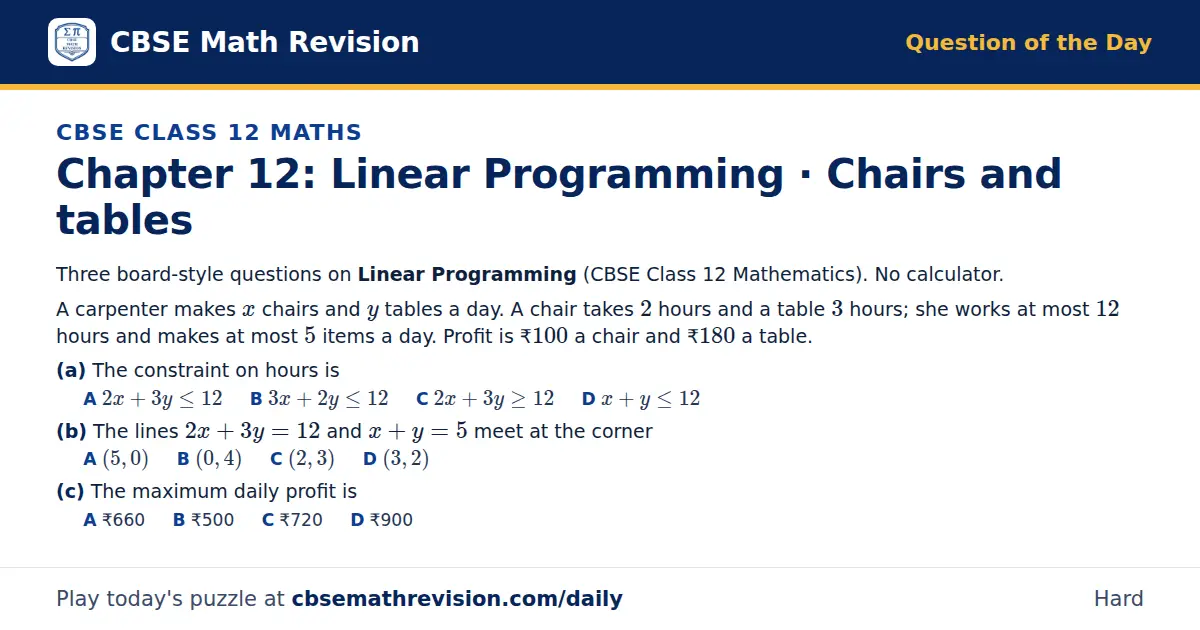
Chapter 12: Linear Programming · Chairs and tables
Three board-style questions on Linear Programming (CBSE Class 12 Mathematics). No calculator. A carpenter makes x chairs and y tables a day. A chair takes 2 hours and a table 3 hours; she works at most 12 hours and makes at most 5 items a day. Profit is ₹100 a chair and ₹180 a table.
- The constraint on hours is Options: A) 2x + 3y ≤ 12; B) 3x + 2y ≤ 12; C) 2x + 3y ≥ 12; D) x + y ≤ 12
- The lines 2x + 3y = 12 and x + y = 5 meet at the corner Options: A) (5, 0); B) (0, 4); C) (2, 3); D) (3, 2)
- The maximum daily profit is Options: A) ₹660; B) ₹500; C) ₹720; D) ₹900
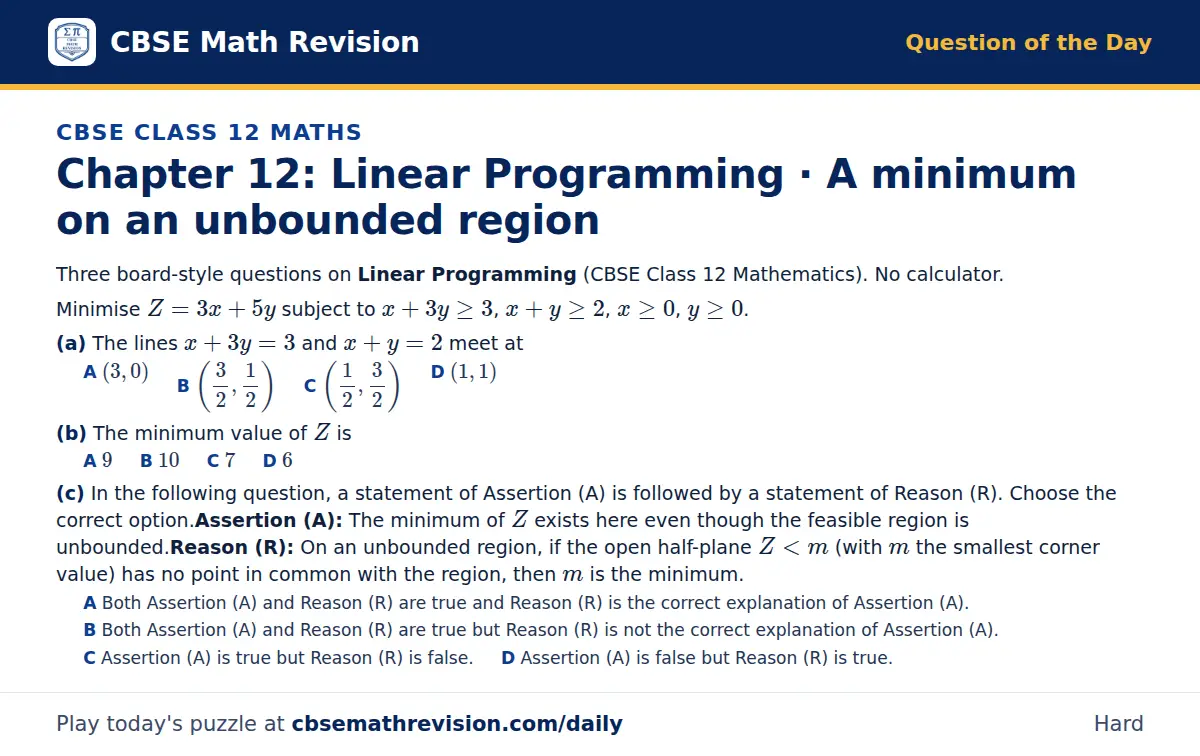
Chapter 12: Linear Programming · A minimum on an unbounded region
Three board-style questions on Linear Programming (CBSE Class 12 Mathematics). No calculator. Minimise Z = 3x + 5y subject to x + 3y ≥ 3, x + y ≥ 2, x ≥ 0, y ≥ 0.
- The lines x + 3y = 3 and x + y = 2 meet at Options: A) (3, 0); B) (32, 12); C) (12, 32); D) (1, 1)
- The minimum value of Z is Options: A) 9; B) 10; C) 7; D) 6
- In the following question, a statement of Assertion (A) is followed by a statement of Reason (R). Choose the correct option. Assertion (A): The minimum of Z exists here even though the feasible region is unbounded. Reason (R): On an unbounded region, if the open half-plane Z < m (with m the smallest corner value) has no point in common with the region, then m is the minimum. Options: A) Both Assertion (A) and Reason (R) are true and Reason (R) is the correct explanation of Assertion (A).; B) Both Assertion (A) and Reason (R) are true but Reason (R) is not the correct explanation of Assertion (A).; C) Assertion (A) is true but Reason (R) is false.; D) Assertion (A) is false but Reason (R) is true.
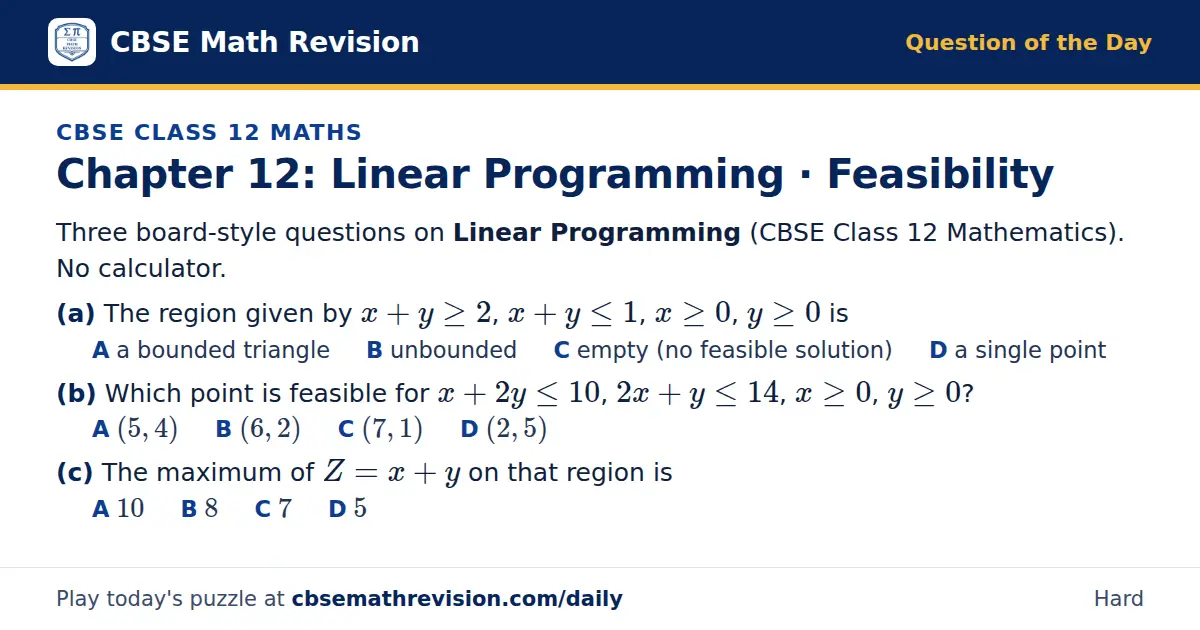
Chapter 12: Linear Programming · Feasibility
Three board-style questions on Linear Programming (CBSE Class 12 Mathematics). No calculator.
- The region given by x + y ≥ 2, x + y ≤ 1, x ≥ 0, y ≥ 0 is Options: A) a bounded triangle; B) unbounded; C) empty (no feasible solution); D) a single point
- Which point is feasible for x + 2y ≤ 10, 2x + y ≤ 14, x ≥ 0, y ≥ 0? Options: A) (5, 4); B) (6, 2); C) (7, 1); D) (2, 5)
- The maximum of Z = x + y on that region is Options: A) 10; B) 8; C) 7; D) 5
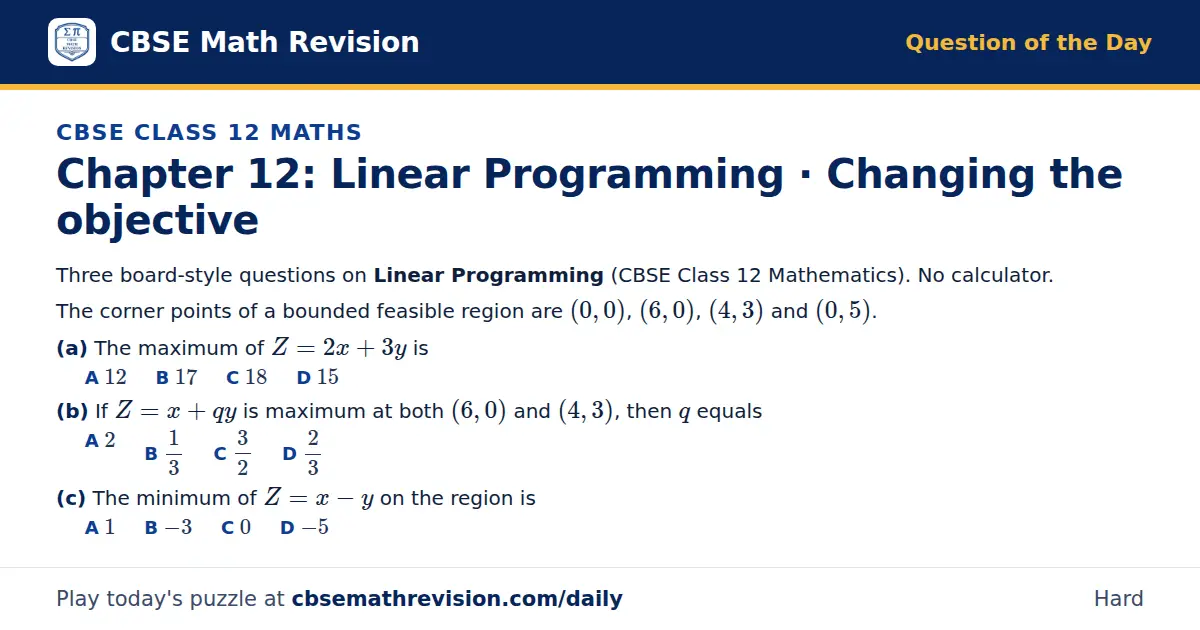
Chapter 12: Linear Programming · Changing the objective
Three board-style questions on Linear Programming (CBSE Class 12 Mathematics). No calculator. The corner points of a bounded feasible region are (0, 0), (6, 0), (4, 3) and (0, 5).
- The maximum of Z = 2x + 3y is Options: A) 12; B) 17; C) 18; D) 15
- If Z = x + qy is maximum at both (6, 0) and (4, 3), then q equals Options: A) 2; B) 1/3; C) 3/2; D) 2/3
- The minimum of Z = x - y on the region is Options: A) 1; B) -3; C) 0; D) -5
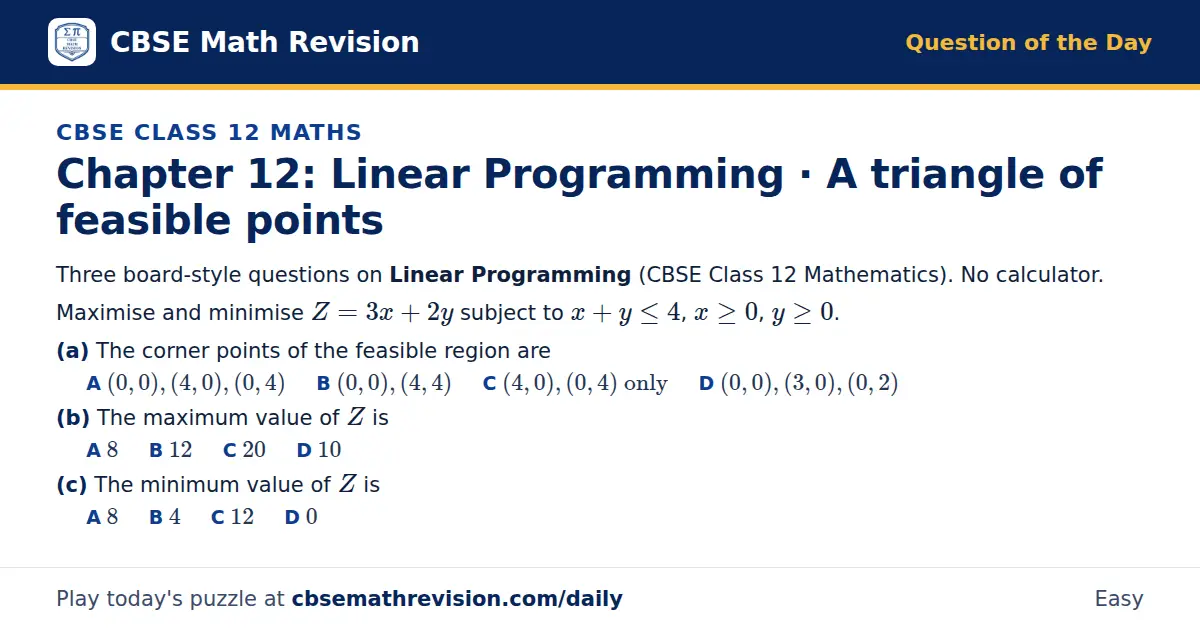
Chapter 12: Linear Programming · A triangle of feasible points
Three board-style questions on Linear Programming (CBSE Class 12 Mathematics). No calculator. Maximise and minimise Z = 3x + 2y subject to x + y ≤ 4, x ≥ 0, y ≥ 0.
- The corner points of the feasible region are Options: A) (0, 0), (4, 0), (0, 4); B) (0, 0), (4, 4); C) (4, 0), (0, 4) only; D) (0, 0), (3, 0), (0, 2)
- The maximum value of Z is Options: A) 8; B) 12; C) 20; D) 10
- The minimum value of Z is Options: A) 8; B) 4; C) 12; D) 0
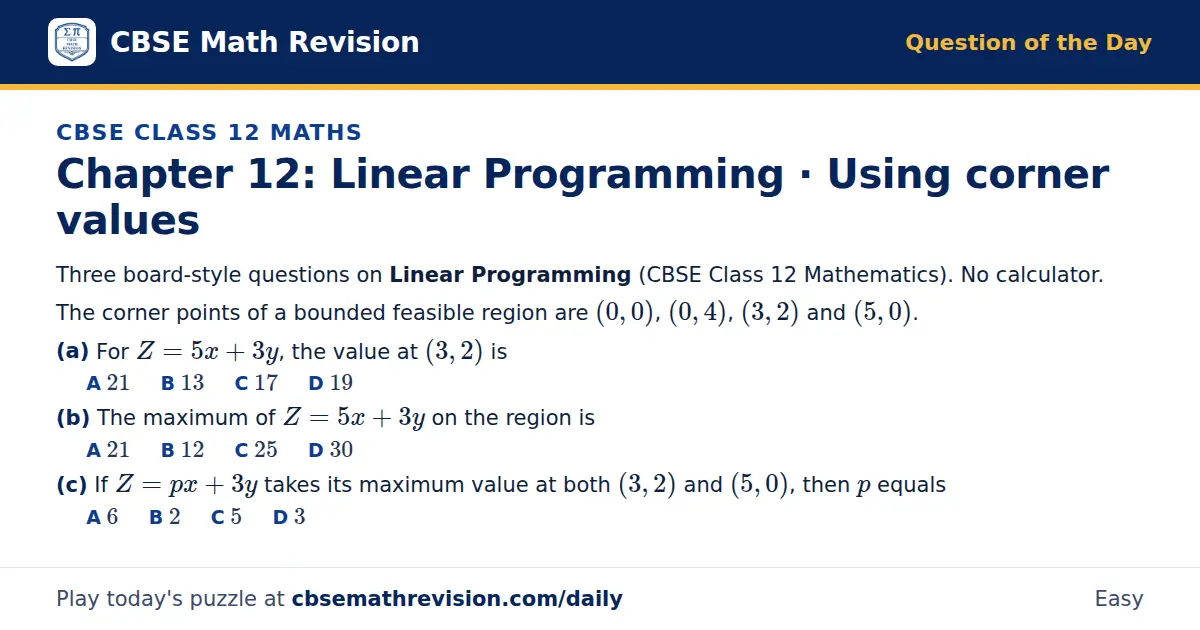
Chapter 12: Linear Programming · Using corner values
Three board-style questions on Linear Programming (CBSE Class 12 Mathematics). No calculator. The corner points of a bounded feasible region are (0, 0), (0, 4), (3, 2) and (5, 0).
- For Z = 5x + 3y, the value at (3, 2) is Options: A) 21; B) 13; C) 17; D) 19
- The maximum of Z = 5x + 3y on the region is Options: A) 21; B) 12; C) 25; D) 30
- If Z = px + 3y takes its maximum value at both (3, 2) and (5, 0), then p equals Options: A) 6; B) 2; C) 5; D) 3
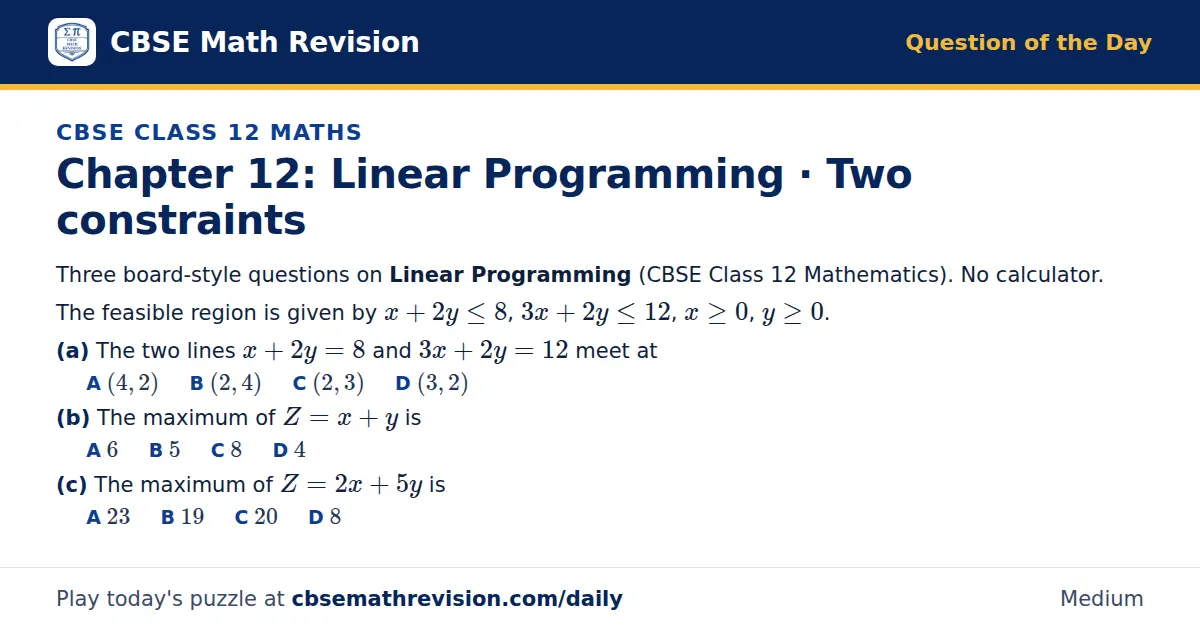
Chapter 12: Linear Programming · Two constraints
Three board-style questions on Linear Programming (CBSE Class 12 Mathematics). No calculator. The feasible region is given by x + 2y ≤ 8, 3x + 2y ≤ 12, x ≥ 0, y ≥ 0.
- The two lines x + 2y = 8 and 3x + 2y = 12 meet at Options: A) (4, 2); B) (2, 4); C) (2, 3); D) (3, 2)
- The maximum of Z = x + y is Options: A) 6; B) 5; C) 8; D) 4
- The maximum of Z = 2x + 5y is Options: A) 23; B) 19; C) 20; D) 8
Chapter 13: Probability
Chapter 13: Probability
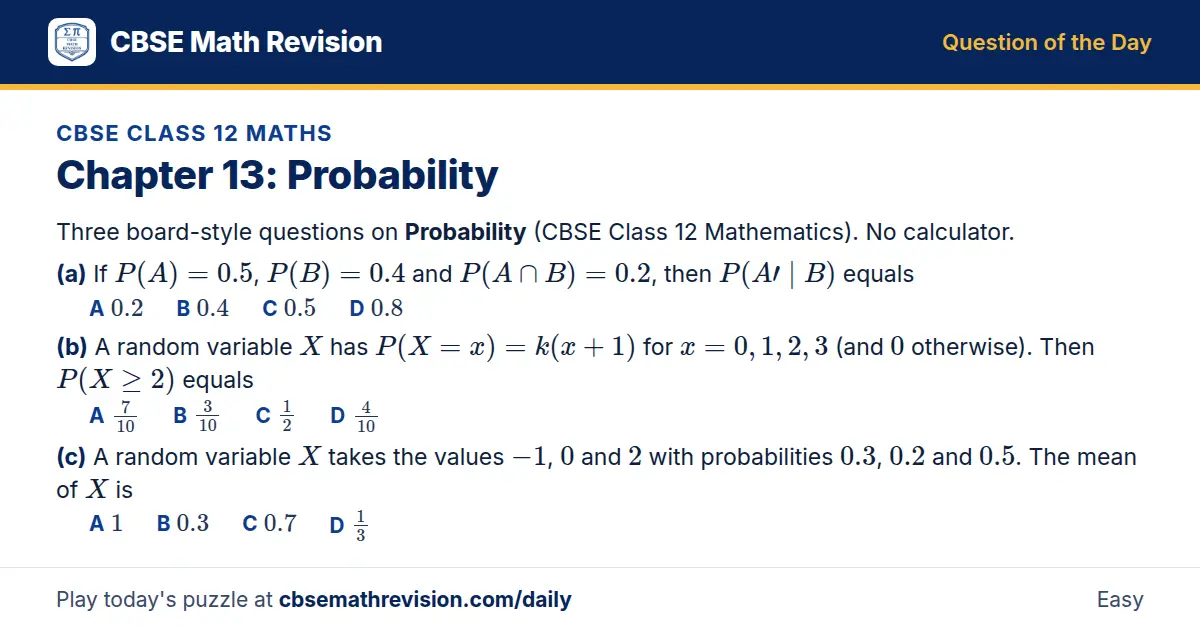
Three board-style questions on Probability (CBSE Class 12 Mathematics). No calculator.
- If P(A) = 0.5, P(B) = 0.4 and P(A ∩ B) = 0.2, then P(A′ | B) equals Options: A) 0.2; B) 0.4; C) 0.5; D) 0.8
- A random variable X has P(X = x) = k(x + 1) for x = 0, 1, 2, 3 (and 0 otherwise). Then P(X ≥ 2) equals Options: A) 7/10; B) 3/10; C) 12; D) 4/10
- A random variable X takes the values -1, 0 and 2 with probabilities 0.3, 0.2 and 0.5. The mean of X is Options: A) 1; B) 0.3; C) 0.7; D) 13
Chapter 13: Probability · Two bags
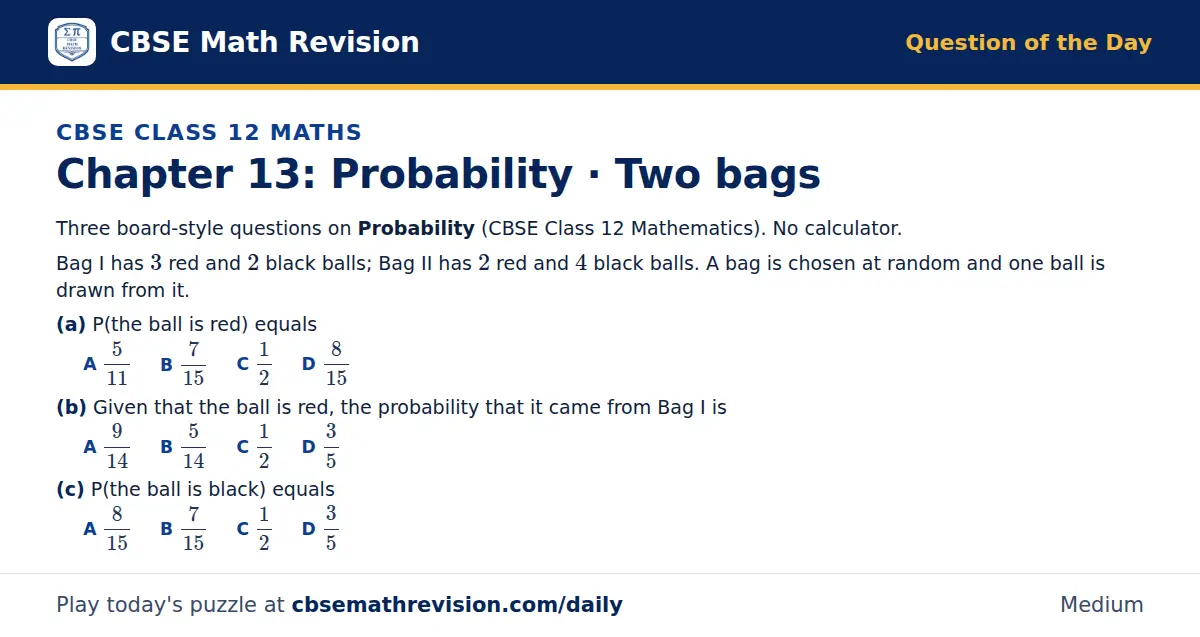
Three board-style questions on Probability (CBSE Class 12 Mathematics). No calculator. Bag I has 3 red and 2 black balls; Bag II has 2 red and 4 black balls. A bag is chosen at random and one ball is drawn from it.
- P(the ball is red) equals Options: A) 5/11; B) 7/15; C) 1/2; D) 8/15
- Given that the ball is red, the probability that it came from Bag I is Options: A) 9/14; B) 5/14; C) 1/2; D) 3/5
- P(the ball is black) equals Options: A) 8/15; B) 7/15; C) 1/2; D) 3/5
Chapter 13: Probability · Random variables
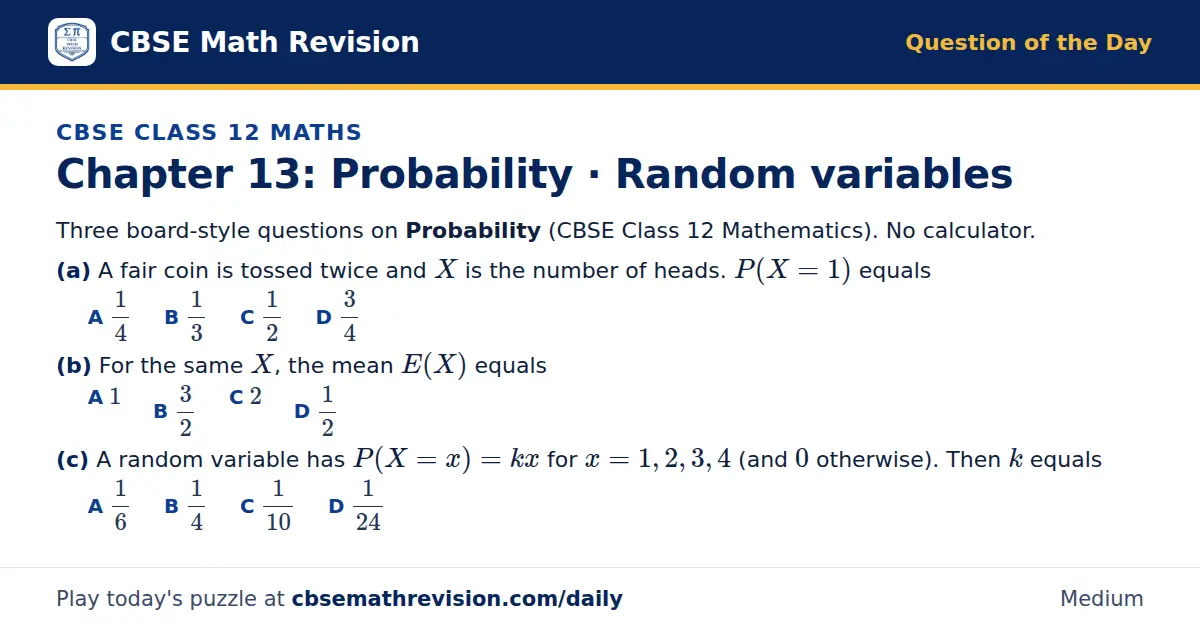
Three board-style questions on Probability (CBSE Class 12 Mathematics). No calculator.
- A fair coin is tossed twice and X is the number of heads. P(X = 1) equals Options: A) 1/4; B) 1/3; C) 1/2; D) 3/4
- For the same X, the mean E(X) equals Options: A) 1; B) 3/2; C) 2; D) 1/2
- A random variable has P(X = x) = kx for x = 1, 2, 3, 4 (and 0 otherwise). Then k equals Options: A) 1/6; B) 1/4; C) 1/10; D) 1/24
Chapter 13: Probability · A screening test
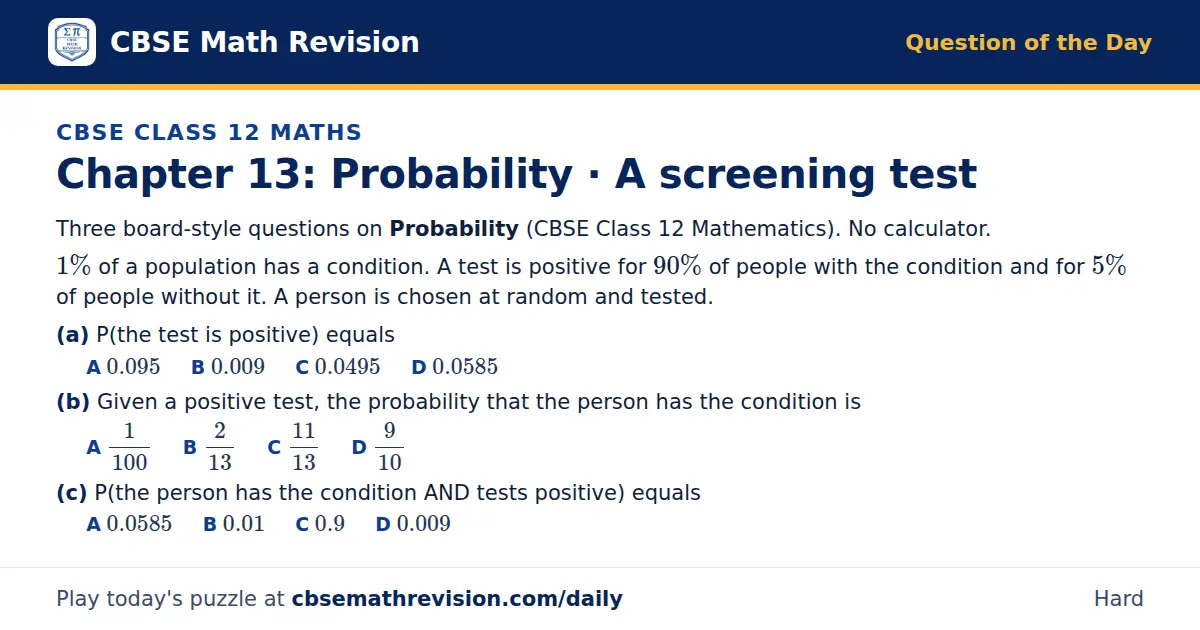
Three board-style questions on Probability (CBSE Class 12 Mathematics). No calculator. 1% of a population has a condition. A test is positive for 90% of people with the condition and for 5% of people without it. A person is chosen at random and tested.
- P(the test is positive) equals Options: A) 0.095; B) 0.009; C) 0.0495; D) 0.0585
- Given a positive test, the probability that the person has the condition is Options: A) 1/100; B) 2/13; C) 11/13; D) 9/10
- P(the person has the condition AND tests positive) equals Options: A) 0.0585; B) 0.01; C) 0.9; D) 0.009
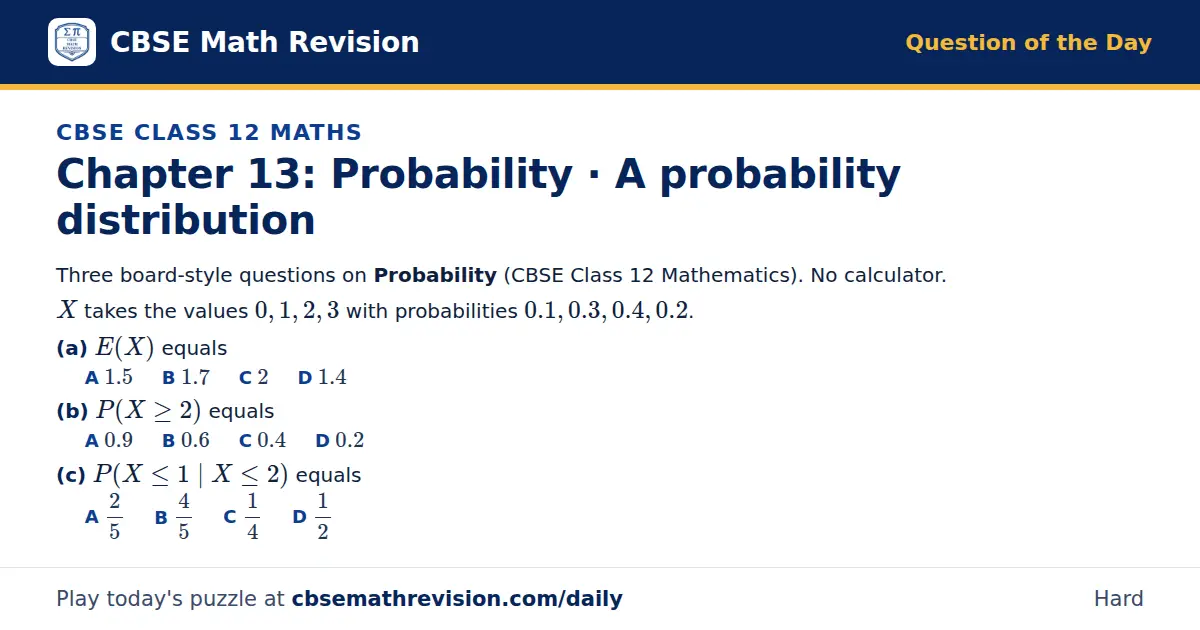
Chapter 13: Probability · A probability distribution
Three board-style questions on Probability (CBSE Class 12 Mathematics). No calculator. X takes the values 0, 1, 2, 3 with probabilities 0.1, 0.3, 0.4, 0.2.
- E(X) equals Options: A) 1.5; B) 1.7; C) 2; D) 1.4
- P(X ≥ 2) equals Options: A) 0.9; B) 0.6; C) 0.4; D) 0.2
- P(X ≤ 1 | X ≤ 2) equals Options: A) 2/5; B) 4/5; C) 1/4; D) 1/2
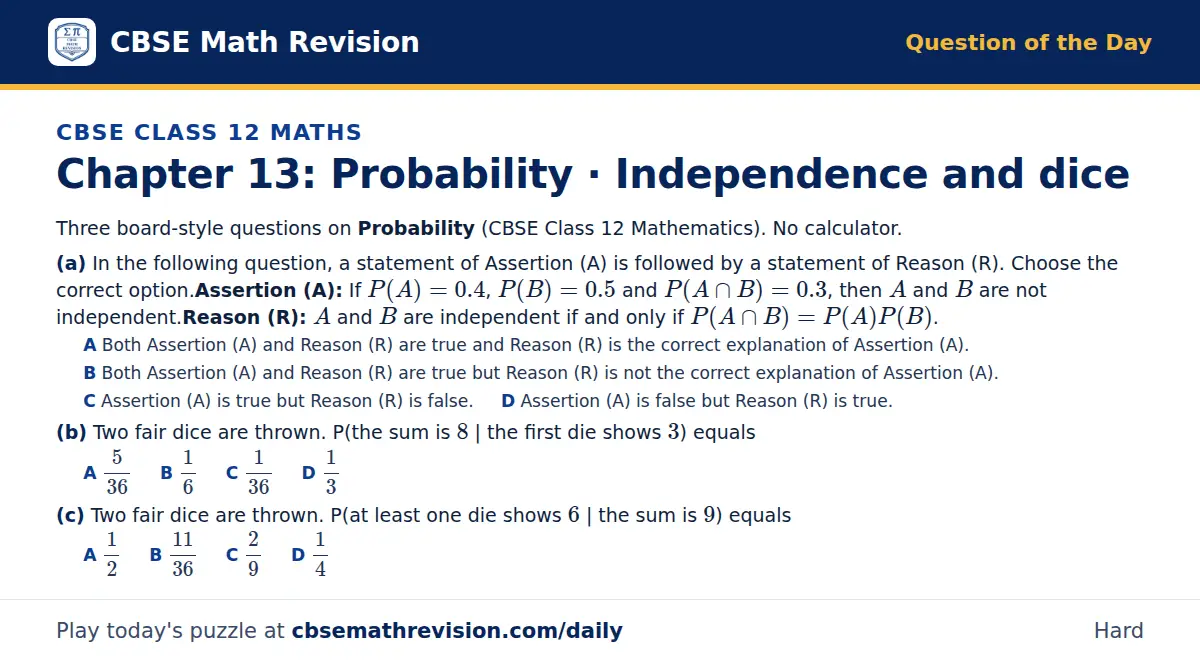
Chapter 13: Probability · Independence and dice
Three board-style questions on Probability (CBSE Class 12 Mathematics). No calculator.
- In the following question, a statement of Assertion (A) is followed by a statement of Reason (R). Choose the correct option. Assertion (A): If P(A) = 0.4, P(B) = 0.5 and P(A ∩ B) = 0.3, then A and B are not independent. Reason (R): A and B are independent if and only if P(A ∩ B) = P(A)P(B). Options: A) Both Assertion (A) and Reason (R) are true and Reason (R) is the correct explanation of Assertion (A).; B) Both Assertion (A) and Reason (R) are true but Reason (R) is not the correct explanation of Assertion (A).; C) Assertion (A) is true but Reason (R) is false.; D) Assertion (A) is false but Reason (R) is true.
- Two fair dice are thrown. P(the sum is 8 | the first die shows 3) equals Options: A) 5/36; B) 1/6; C) 1/36; D) 1/3
- Two fair dice are thrown. P(at least one die shows 6 | the sum is 9) equals Options: A) 1/2; B) 11/36; C) 2/9; D) 1/4
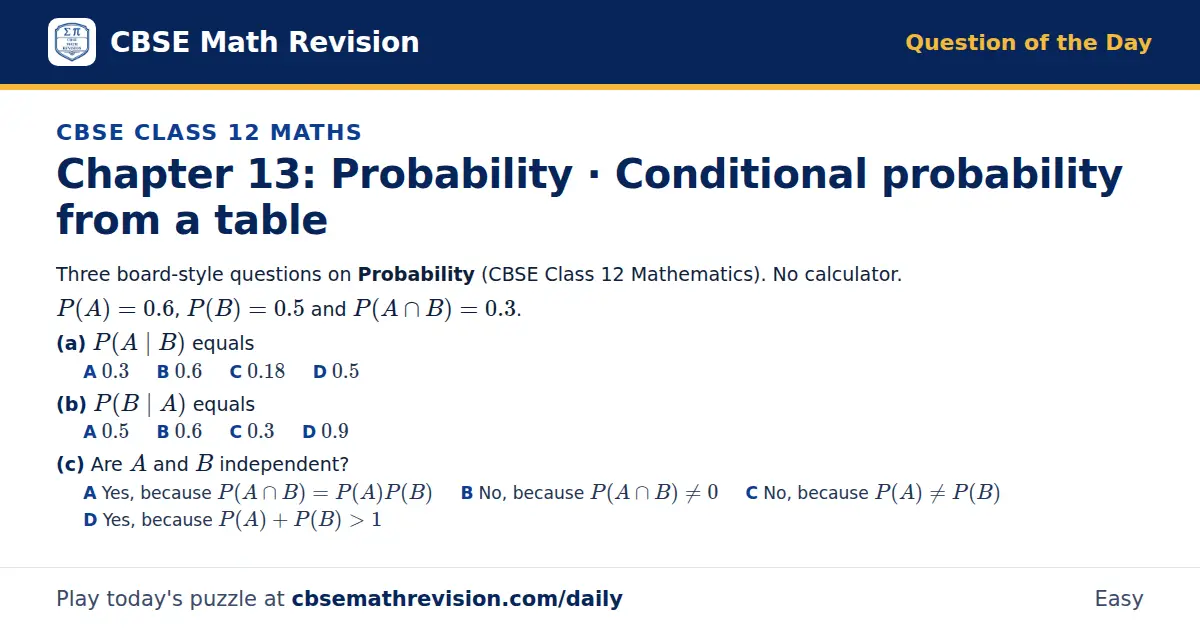
Chapter 13: Probability · Conditional probability from a table
Three board-style questions on Probability (CBSE Class 12 Mathematics). No calculator. P(A) = 0.6, P(B) = 0.5 and P(A ∩ B) = 0.3.
- P(A | B) equals Options: A) 0.3; B) 0.6; C) 0.18; D) 0.5
- P(B | A) equals Options: A) 0.5; B) 0.6; C) 0.3; D) 0.9
- Are A and B independent? Options: A) Yes, because P(A ∩ B) = P(A)P(B); B) No, because P(A ∩ B) ≠ 0; C) No, because P(A) ≠ P(B); D) Yes, because P(A) + P(B) > 1
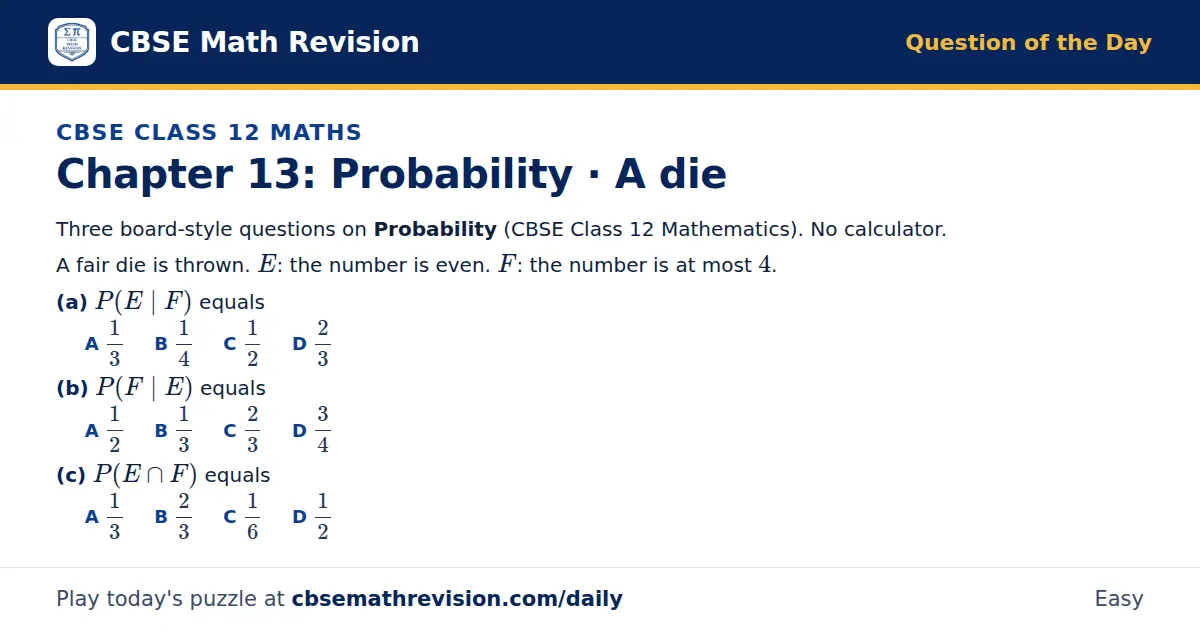
Chapter 13: Probability · A die
Three board-style questions on Probability (CBSE Class 12 Mathematics). No calculator. A fair die is thrown. E: the number is even. F: the number is at most 4.
- P(E | F) equals Options: A) 1/3; B) 1/4; C) 1/2; D) 2/3
- P(F | E) equals Options: A) 1/2; B) 1/3; C) 2/3; D) 3/4
- P(E ∩ F) equals Options: A) 1/3; B) 2/3; C) 1/6; D) 1/2
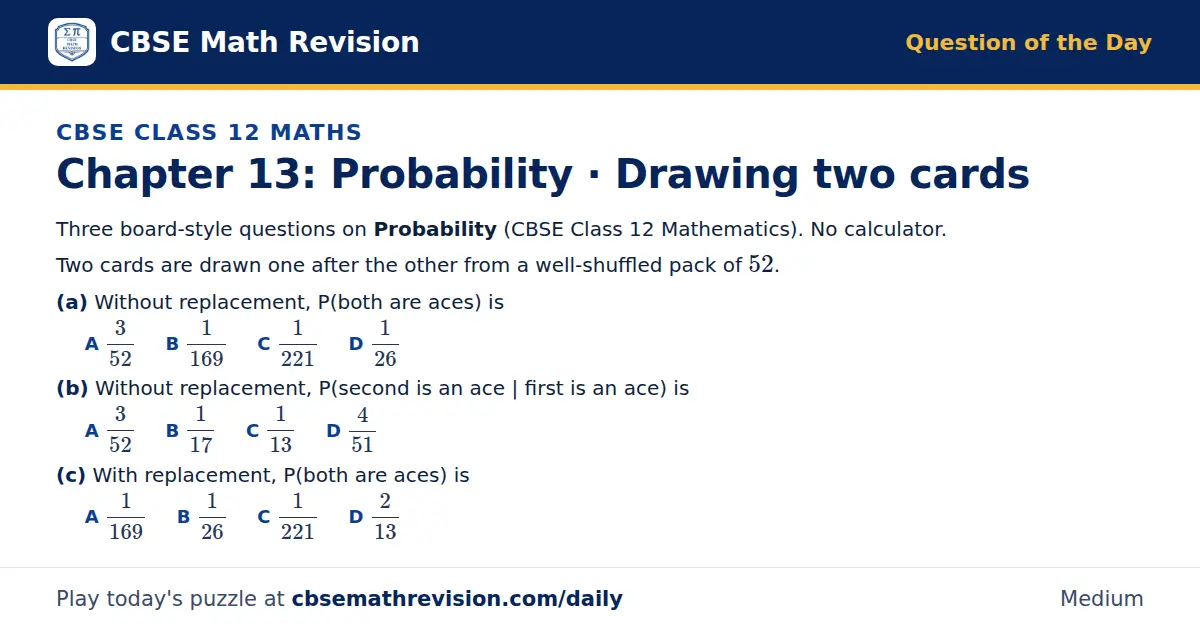
Chapter 13: Probability · Drawing two cards
Three board-style questions on Probability (CBSE Class 12 Mathematics). No calculator. Two cards are drawn one after the other from a well-shuffled pack of 52.
- Without replacement, P(both are aces) is Options: A) 3/52; B) 1/169; C) 1/221; D) 1/26
- Without replacement, P(second is an ace | first is an ace) is Options: A) 3/52; B) 1/17; C) 1/13; D) 4/51
- With replacement, P(both are aces) is Options: A) 1/169; B) 1/26; C) 1/221; D) 2/13
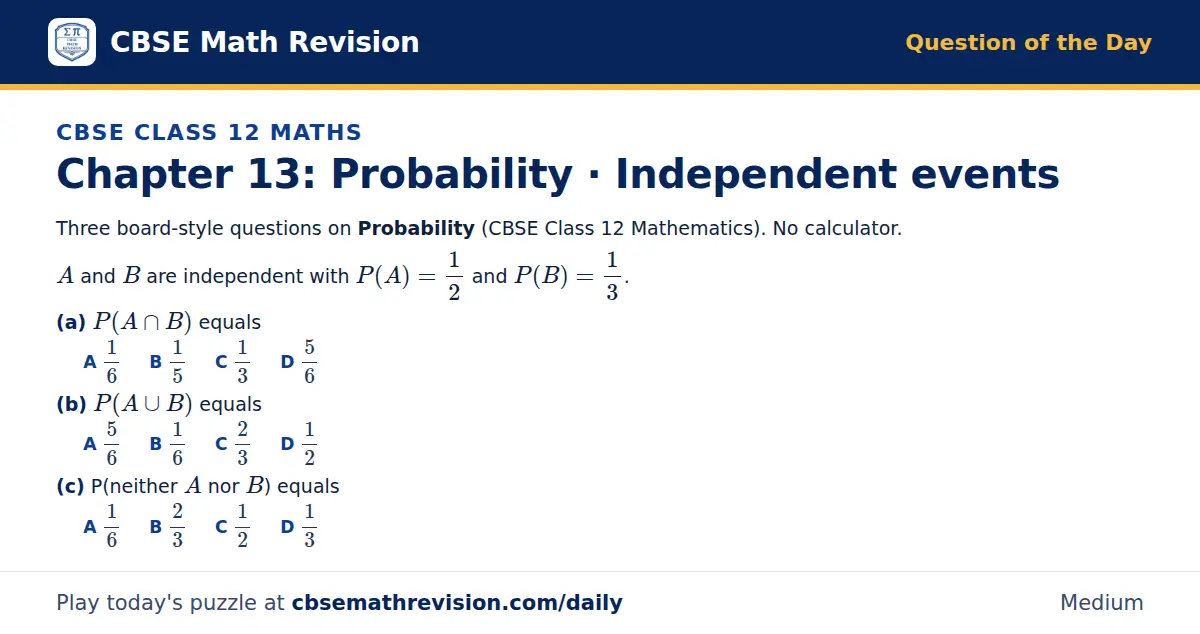
Chapter 13: Probability · Independent events
Three board-style questions on Probability (CBSE Class 12 Mathematics). No calculator. A and B are independent with P(A) = 12 and P(B) = 13.
- P(A ∩ B) equals Options: A) 1/6; B) 1/5; C) 1/3; D) 5/6
- P(A ∪ B) equals Options: A) 5/6; B) 1/6; C) 2/3; D) 1/2
- P(neither A nor B) equals Options: A) 1/6; B) 2/3; C) 1/2; D) 1/3
More Question of the Day puzzles
Other chapters: Chapters 1–4 · Chapters 5–7 · Chapters 8–10 · Chapters 11–13. See all CBSE Maths daily and weekly questions.