CBSE Class 12 Maths starter questions: weeks 32–46
30 short questions to open a lesson for CBSE Class 12 Mathematics, weeks 32–46 of the teaching year, three or four a week. Each question is shown as an image with its text underneath; answers and mark schemes stay with teachers.
Week 32
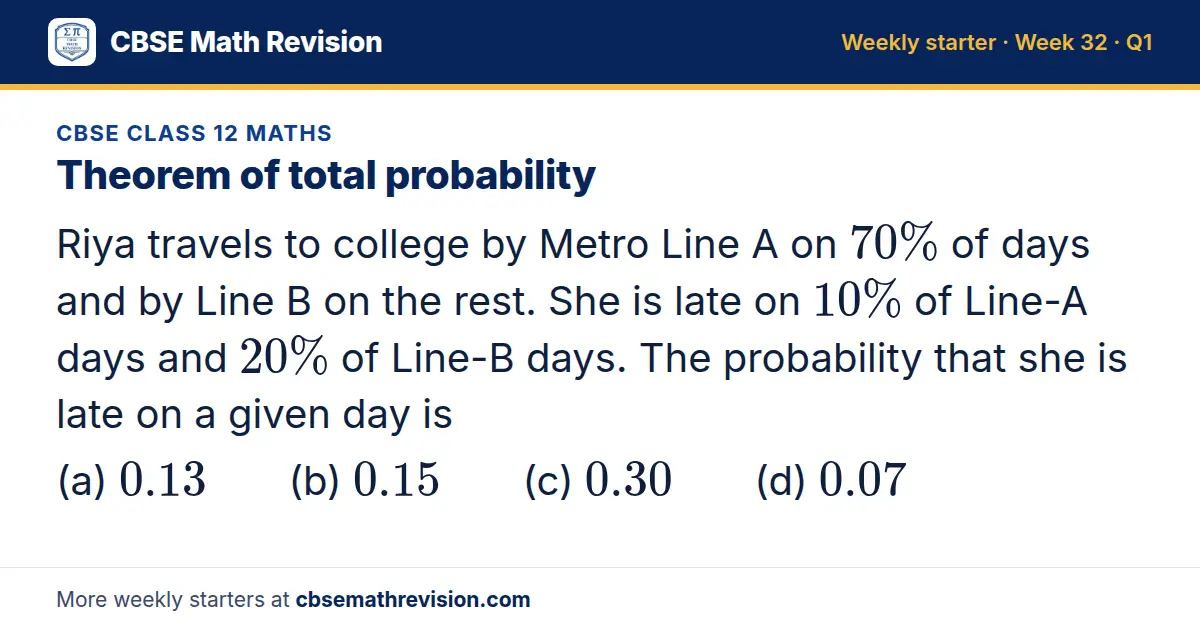
Question 1: Theorem of total probability
Riya travels to college by Metro Line A on 70% of days and by Line B on the rest. She is late on 10% of Line-A days and 20% of Line-B days. The probability that she is late on a given day is (a) 0.13 (b) 0.15 (c) 0.30 (d) 0.07
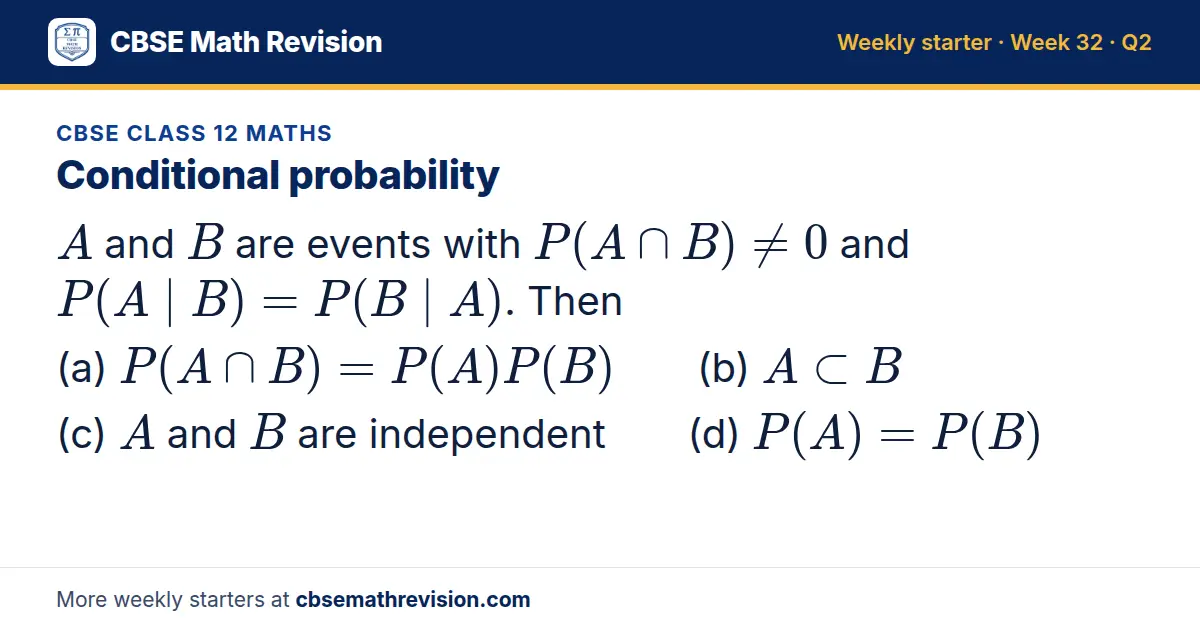
Question 2: Conditional probability
A and B are events with P(A ∩ B) ≠ 0 and P(A | B) = P(B | A). Then (a) P(A ∩ B) = P(A)P(B) (b) A ⊂ B (c) A and B are independent (d) P(A) = P(B)
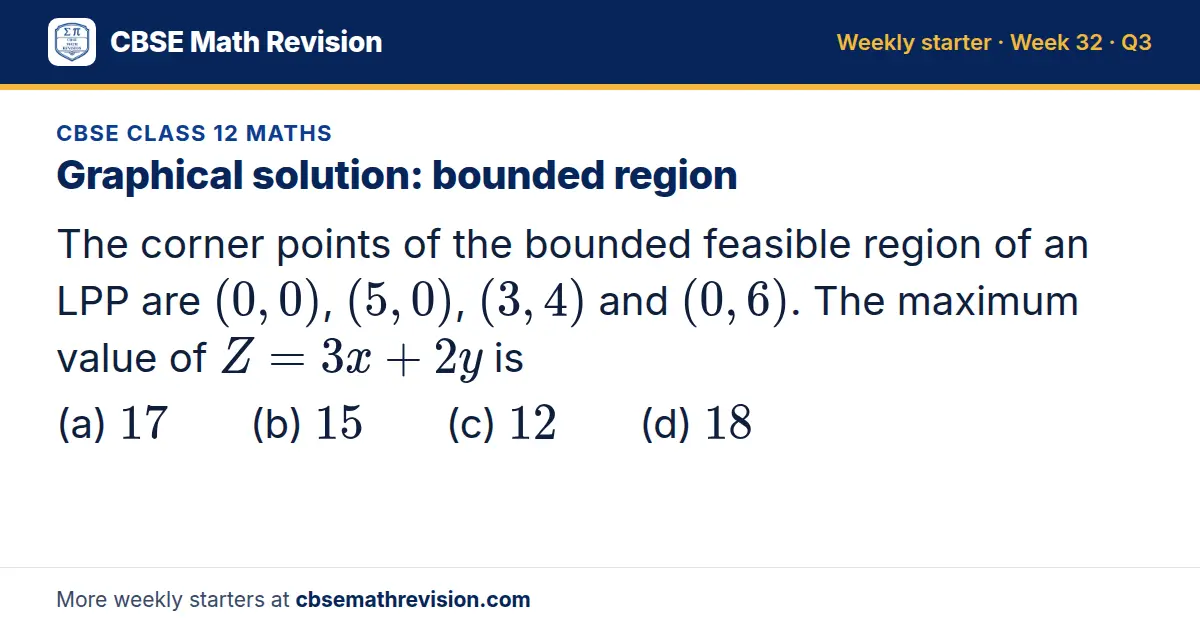
Question 3: Graphical solution: bounded region
The corner points of the bounded feasible region of an LPP are (0, 0), (5, 0), (3, 4) and (0, 6). The maximum value of Z = 3x + 2y is (a) 17 (b) 15 (c) 12 (d) 18
Week 34
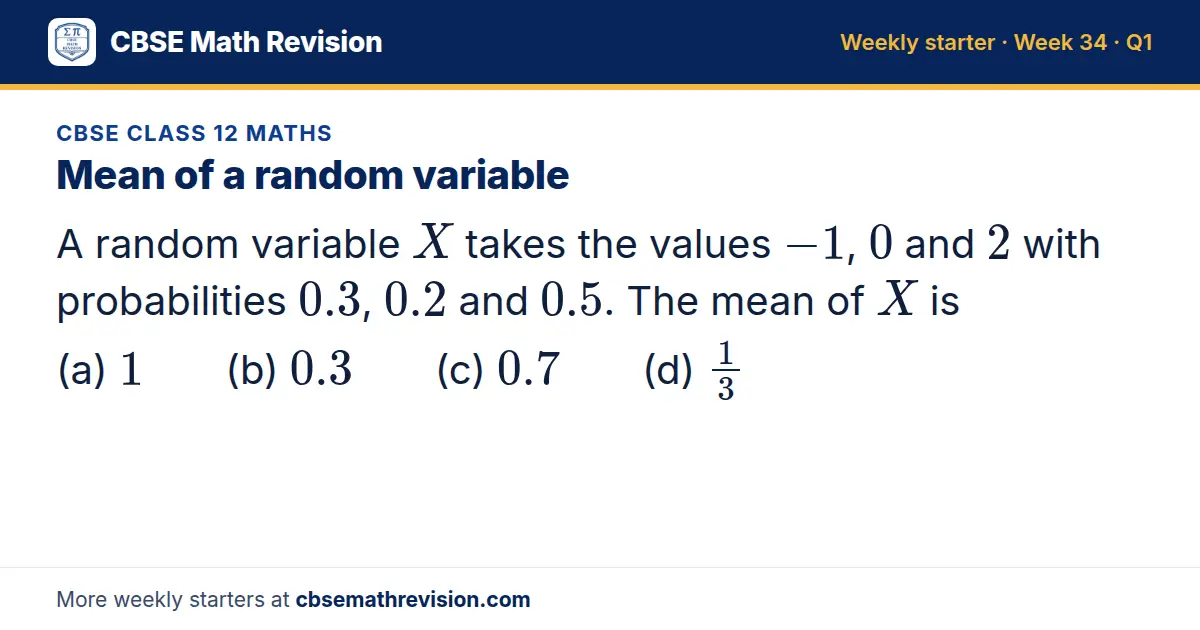
Question 1: Mean of a random variable
A random variable X takes the values -1, 0 and 2 with probabilities 0.3, 0.2 and 0.5. The mean of X is (a) 1 (b) 0.3 (c) 0.7 (d) 13
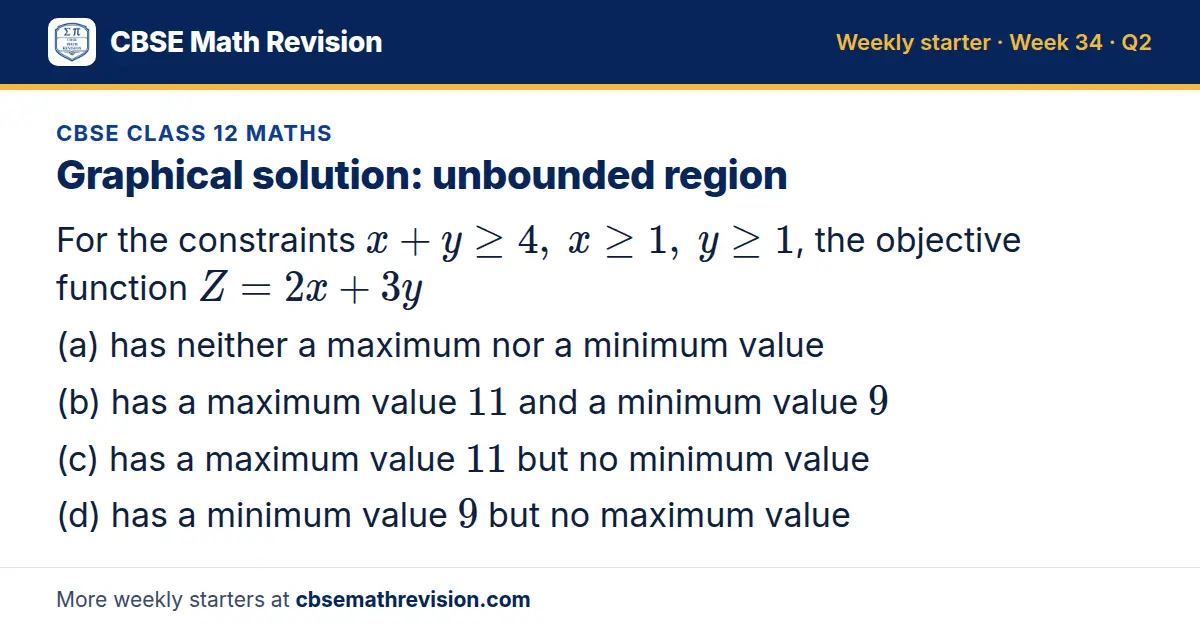
Question 2: Graphical solution: unbounded region
For the constraints x + y ≥ 4, x ≥ 1, y ≥ 1, the objective function Z = 2x + 3y (a) has neither a maximum nor a minimum value (b) has a maximum value 11 and a minimum value 9 (c) has a maximum value 11 but no minimum value (d) has a minimum value 9 but no maximum value
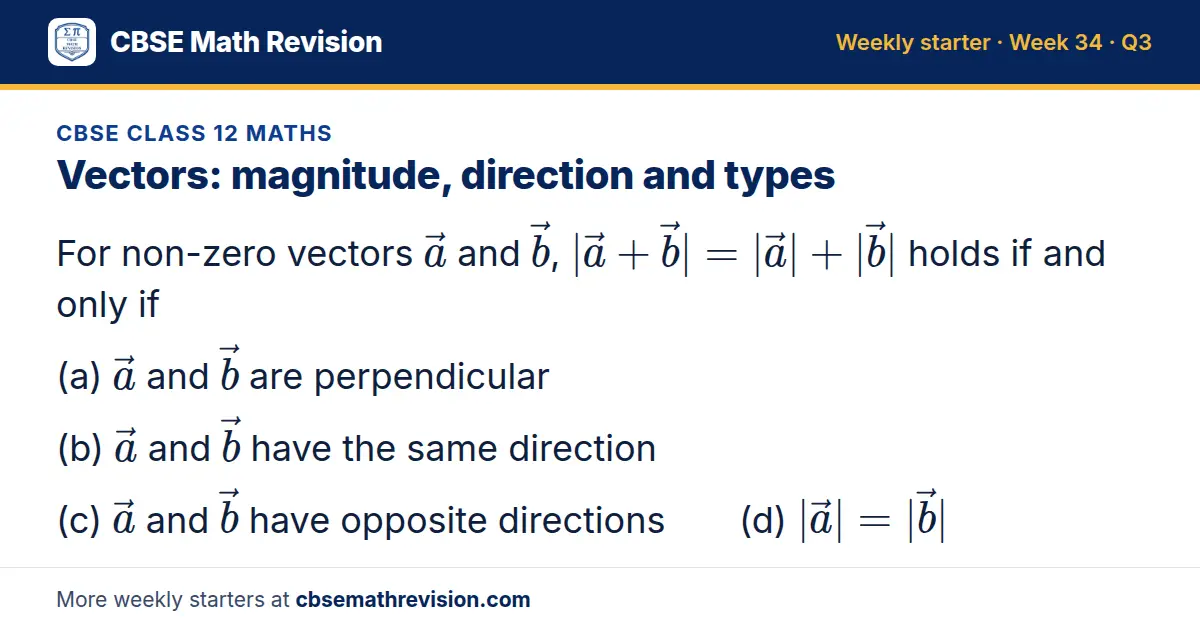
Question 3: Vectors: magnitude, direction and types
For non-zero vectors a and b, |a + b| = |a| + |b| holds if and only if (a) a and b are perpendicular (b) a and b have the same direction (c) a and b have opposite directions (d) |a| = |b|
Week 35
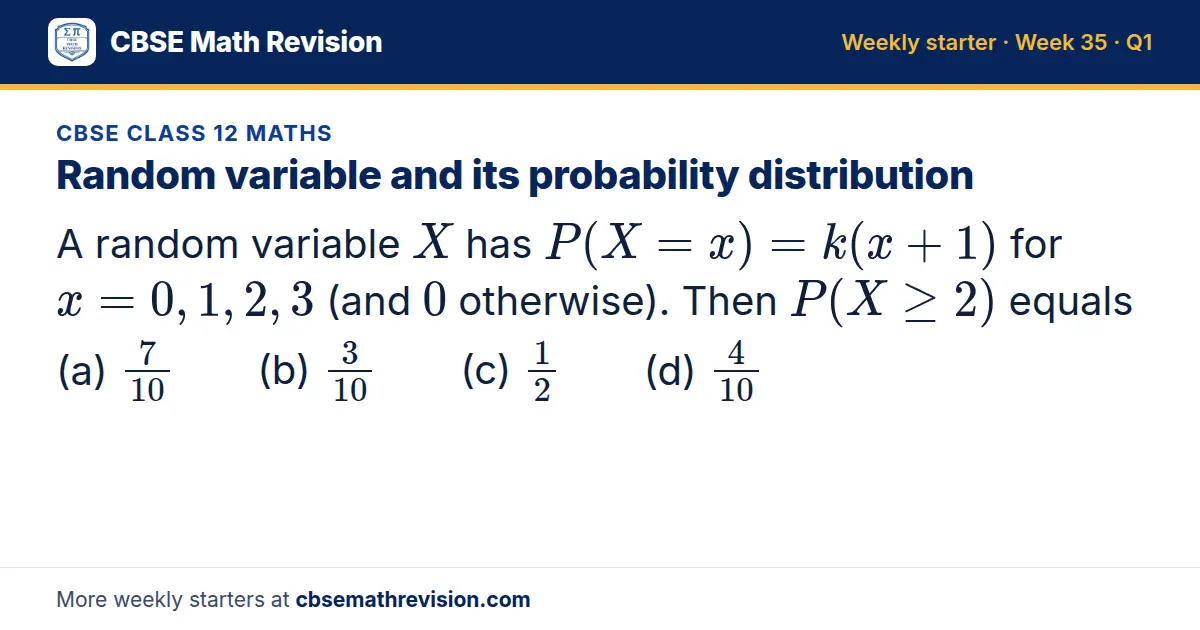
Question 1: Random variable and its probability distribution
A random variable X has P(X = x) = k(x + 1) for x = 0, 1, 2, 3 (and 0 otherwise). Then P(X ≥ 2) equals (a) 7/10 (b) 3/10 (c) 12 (d) 4/10
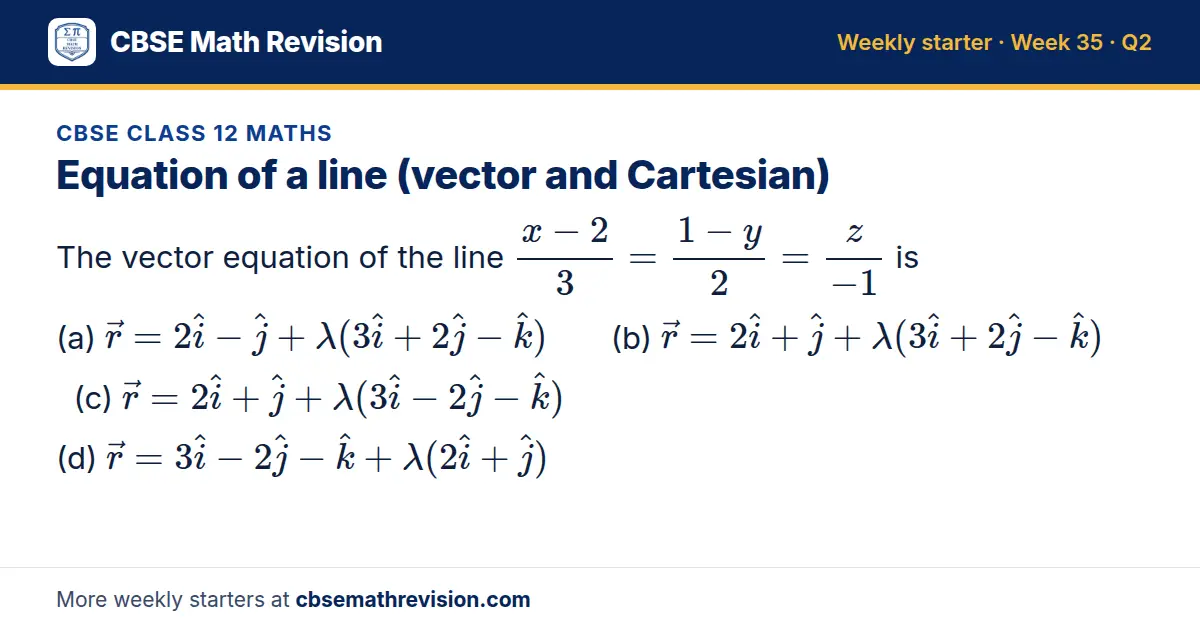
Question 2: Equation of a line (vector and Cartesian)
The vector equation of the line (x - 2)/3 = (1 - y)/2 = z/(-1) is (a) r = 2i - j + λ(3i + 2j - k) (b) r = 2i + j + λ(3i + 2j - k) (c) r = 2i + j + λ(3i - 2j - k) (d) r = 3i - 2j - k + λ(2i + j)
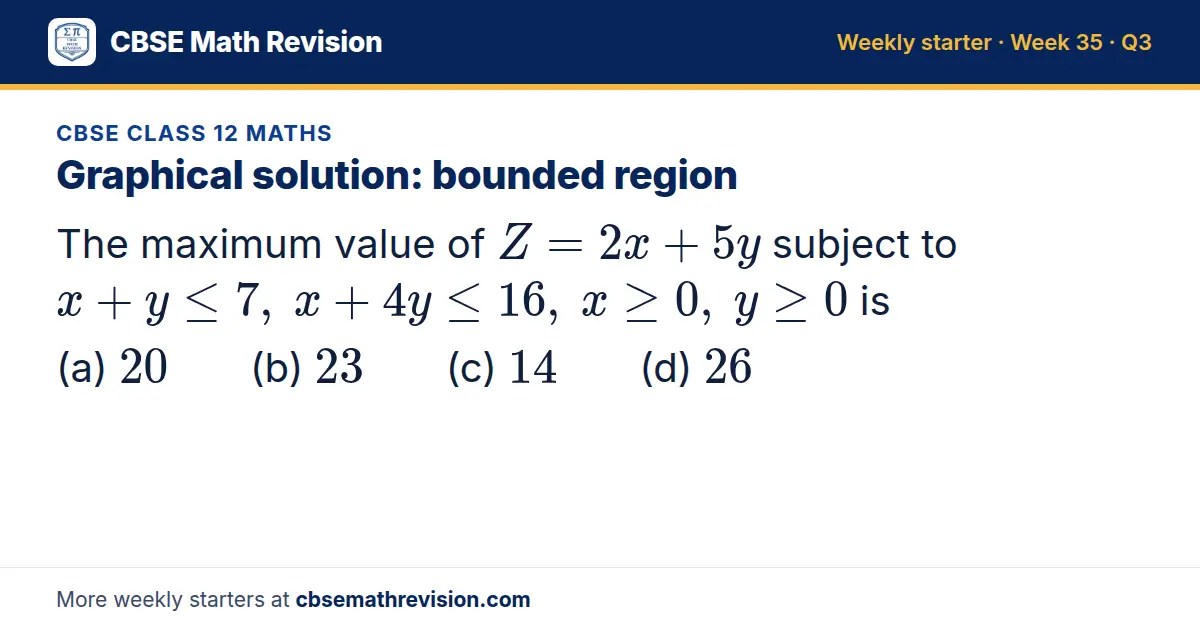
Question 3: Graphical solution: bounded region
The maximum value of Z = 2x + 5y subject to x + y ≤ 7, x + 4y ≤ 16, x ≥ 0, y ≥ 0 is (a) 20 (b) 23 (c) 14 (d) 26
Week 36
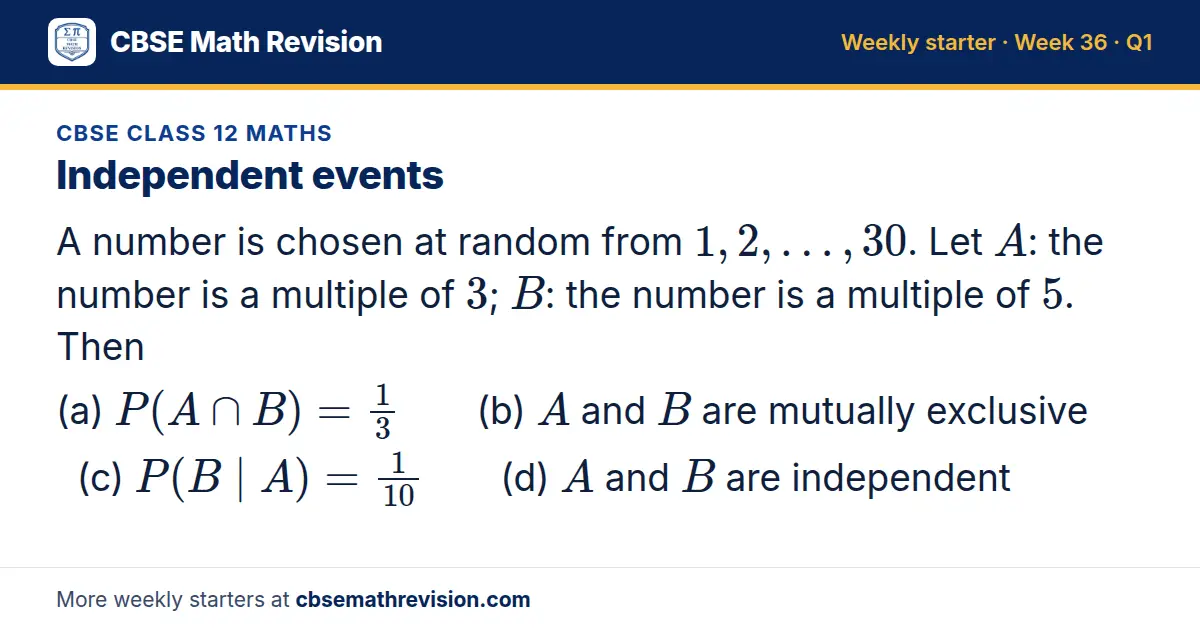
Question 1: Independent events
A number is chosen at random from 1, 2, …, 30. Let A: the number is a multiple of 3; B: the number is a multiple of 5. Then (a) P(A ∩ B) = 1/3 (b) A and B are mutually exclusive (c) P(B | A) = 1/10 (d) A and B are independent
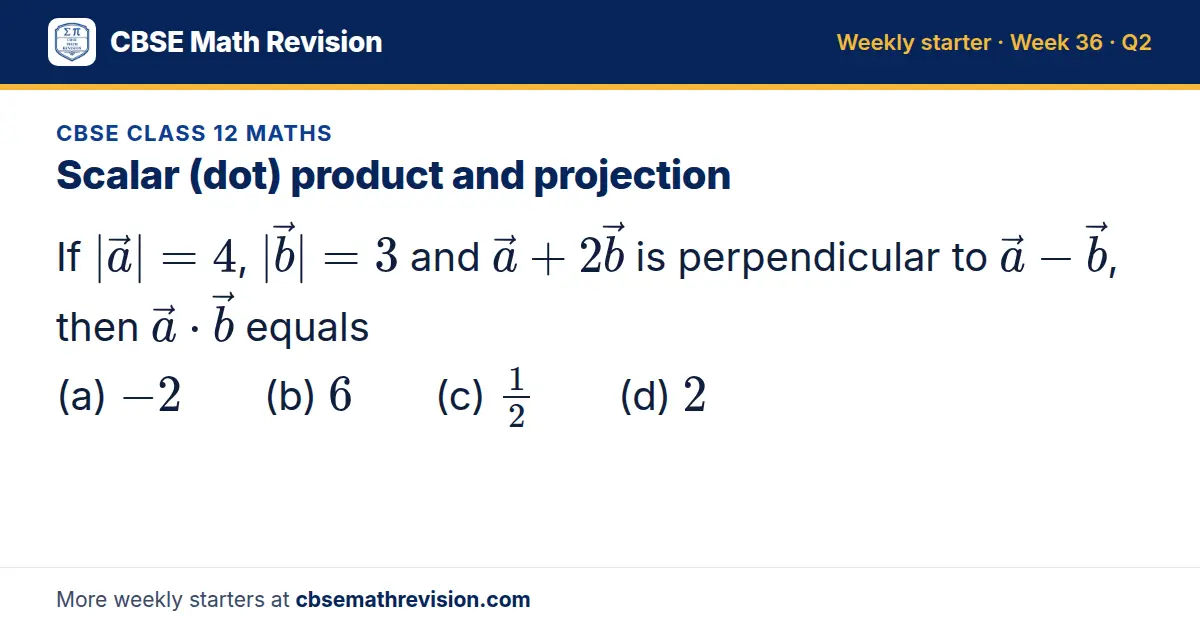
Question 2: Scalar (dot) product and projection
If |a| = 4, |b| = 3 and a + 2b is perpendicular to a - b, then a equals (a) -2 (b) 6 (c) 12 (d) 2
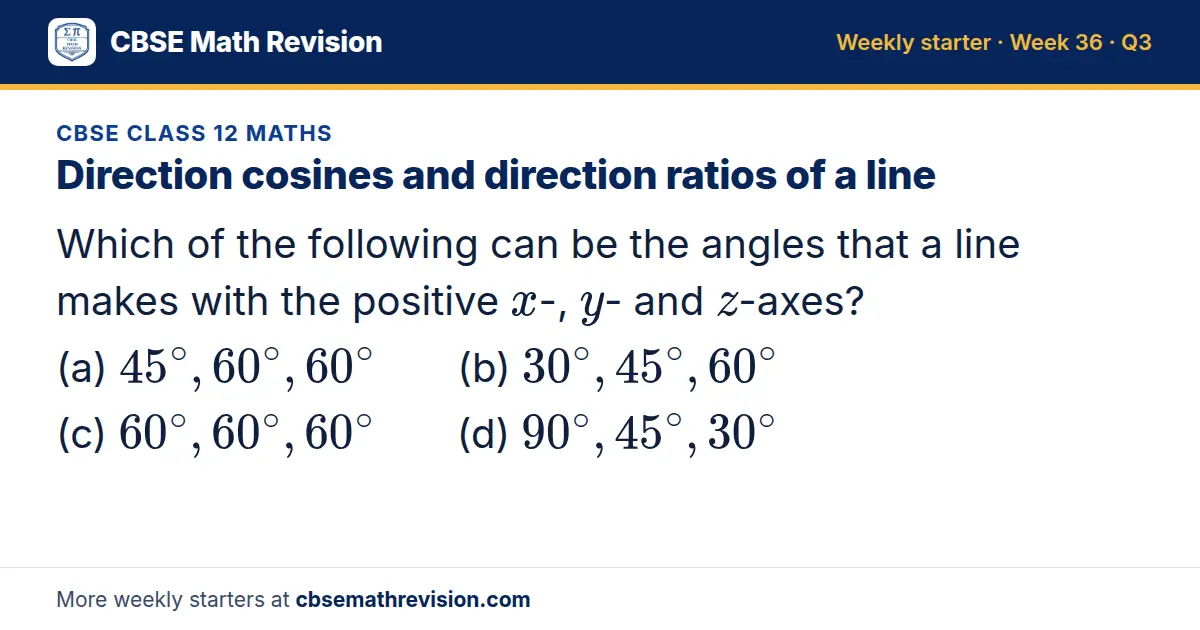
Question 3: Direction cosines and direction ratios of a line
Which of the following can be the angles that a line makes with the positive x-, y- and z-axes? (a) 45^∘, 60^∘, 60^∘ (b) 30^∘, 45^∘, 60^∘ (c) 60^∘, 60^∘, 60^∘ (d) 90^∘, 45^∘, 30^∘
Week 39
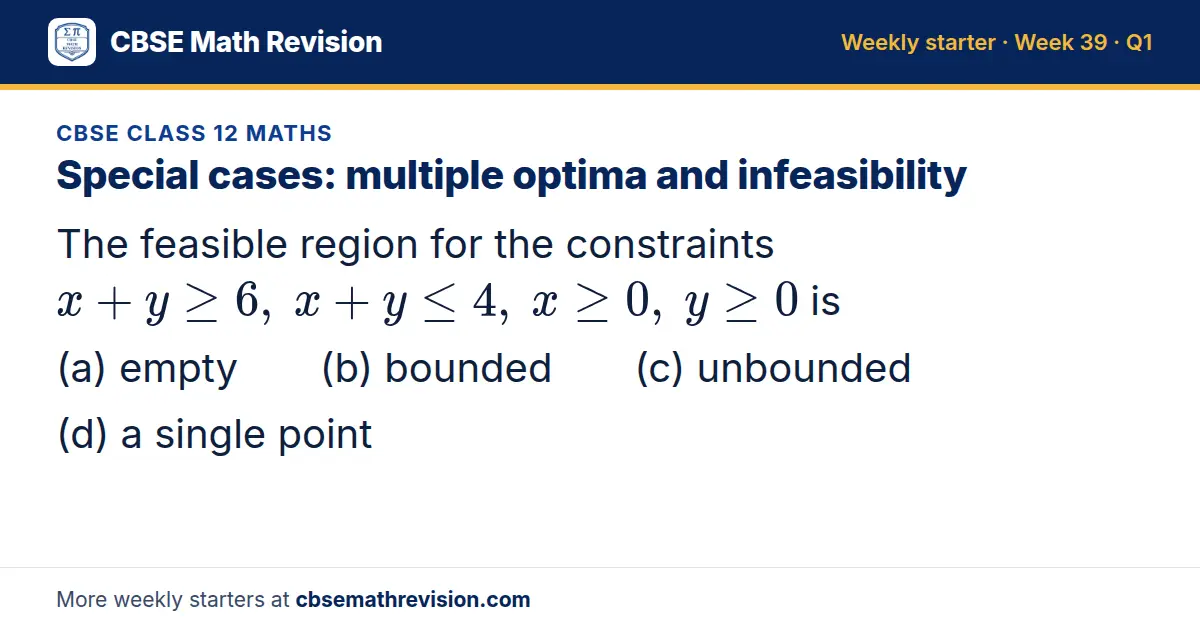
Question 1: Special cases: multiple optima and infeasibility
The feasible region for the constraints x + y ≥ 6, x + y ≤ 4, x ≥ 0, y ≥ 0 is (a) empty (b) bounded (c) unbounded (d) a single point
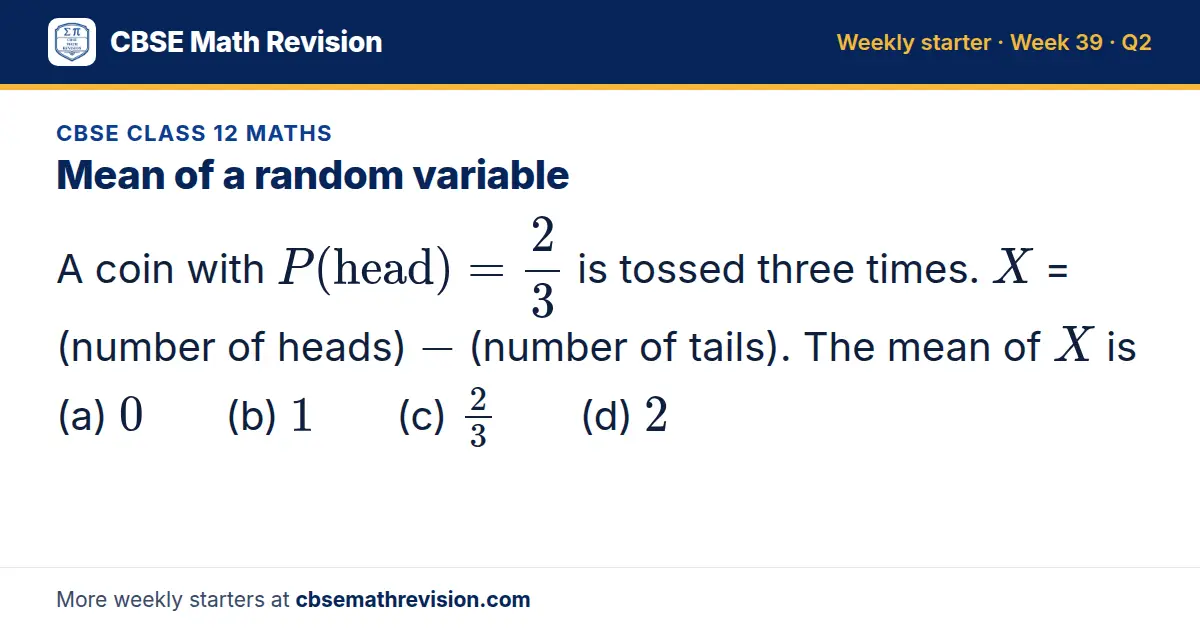
Question 2: Mean of a random variable
A coin with P(head) = 23 is tossed three times. X = (number of heads) - (number of tails). The mean of X is (a) 0 (b) 1 (c) 23 (d) 2
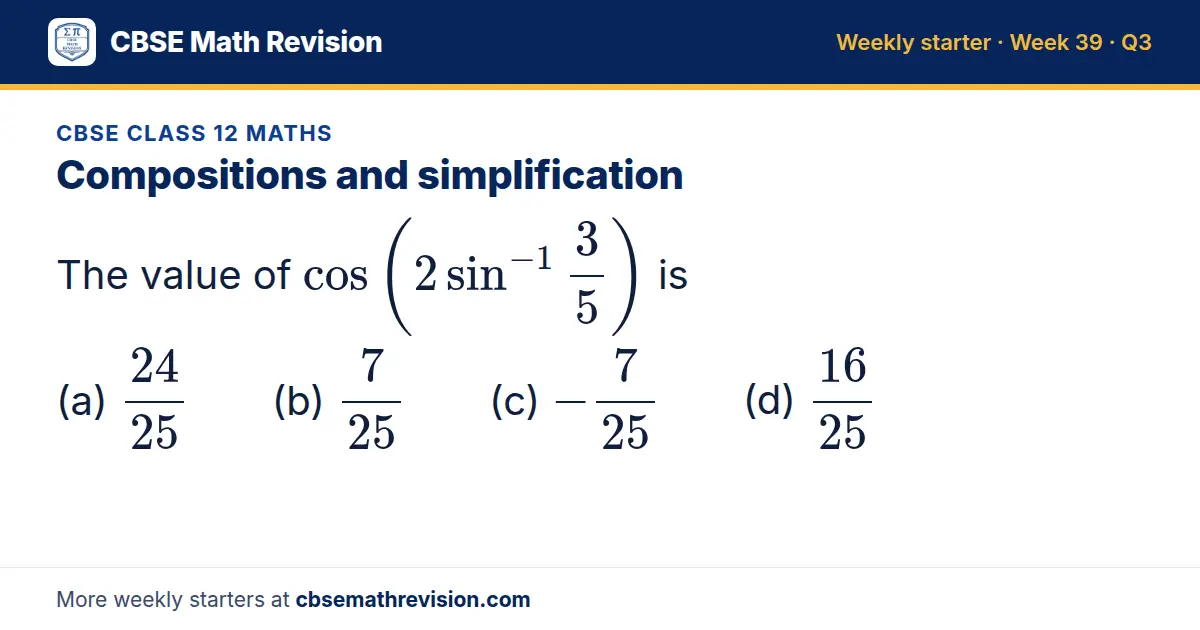
Question 3: Compositions and simplification
The value of cos(2sin⁻¹35) is (a) 24/25 (b) 7/25 (c) -7/25 (d) 16/25
Week 40
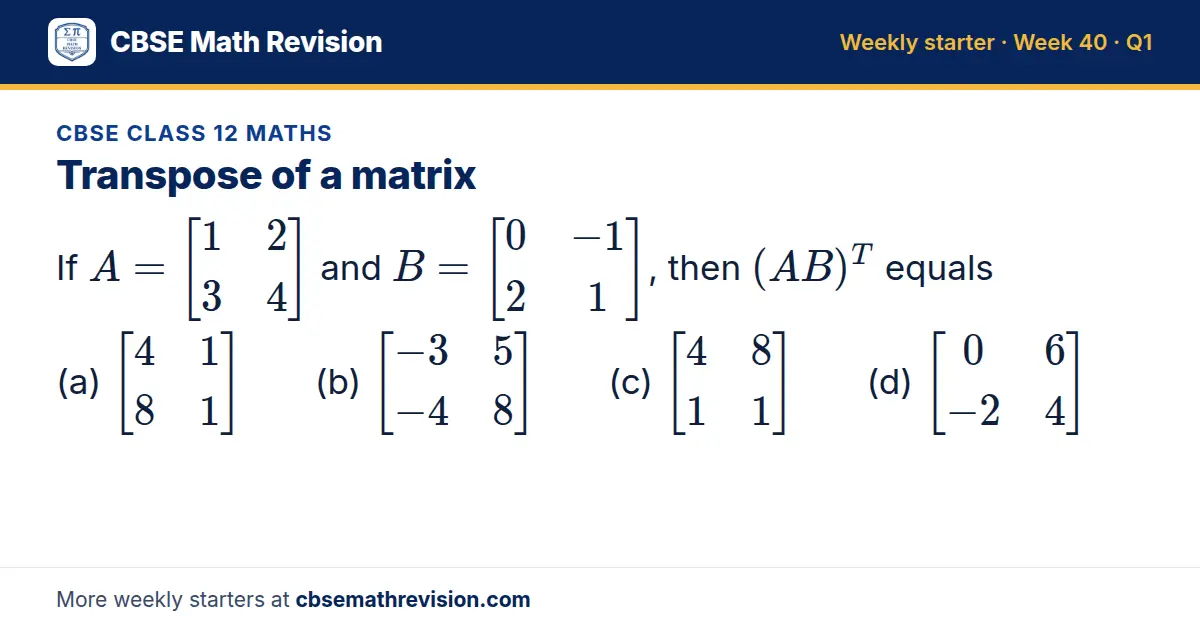
Question 1: Transpose of a matrix
If A = 1 2; 3 4 and B = 0 -1; 2 1, then (AB)^T equals (a) 4 1; 8 1 (b) -3 5; -4 8 (c) 4 8; 1 1 (d) 0 6; -2 4
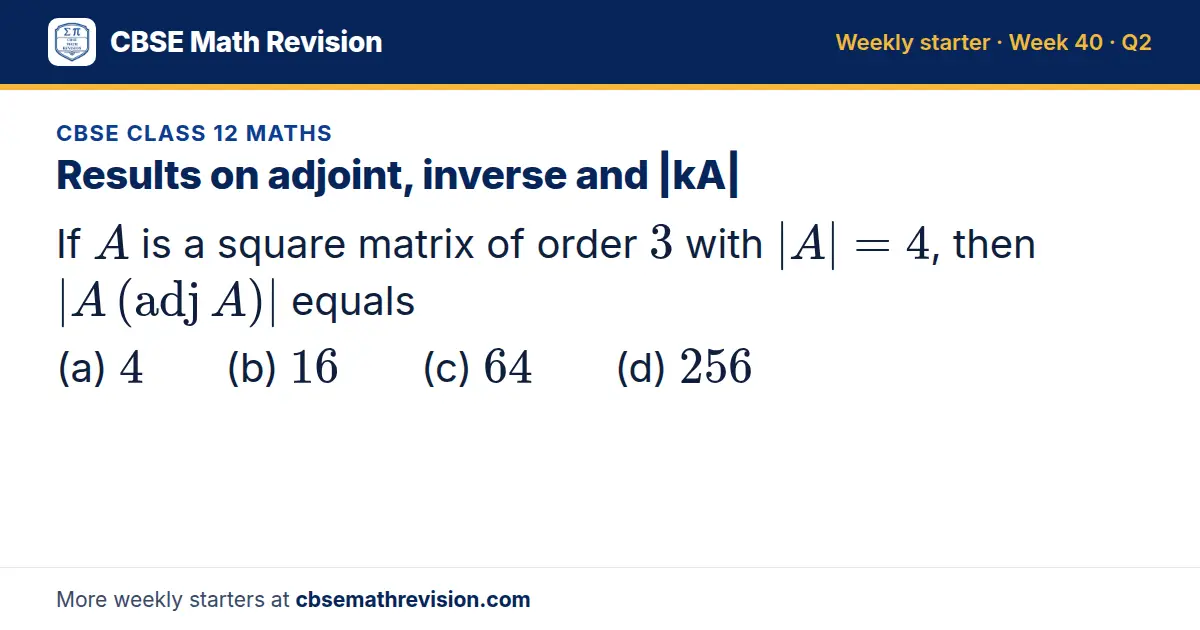
Question 2: Results on adjoint, inverse and |kA|
If A is a square matrix of order 3 with |A| = 4, then |A (adj A)| equals (a) 4 (b) 16 (c) 64 (d) 256
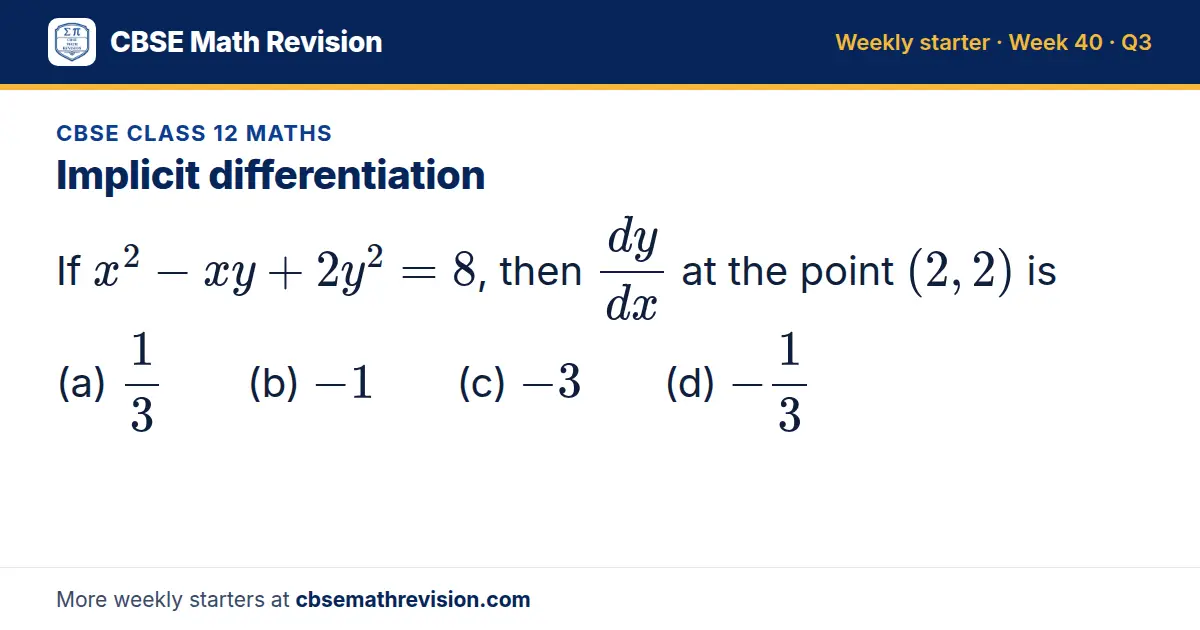
Question 3: Implicit differentiation
If x² - xy + 2y² = 8, then dy/dx at the point (2, 2) is (a) 13 (b) -1 (c) -3 (d) -13
Week 43
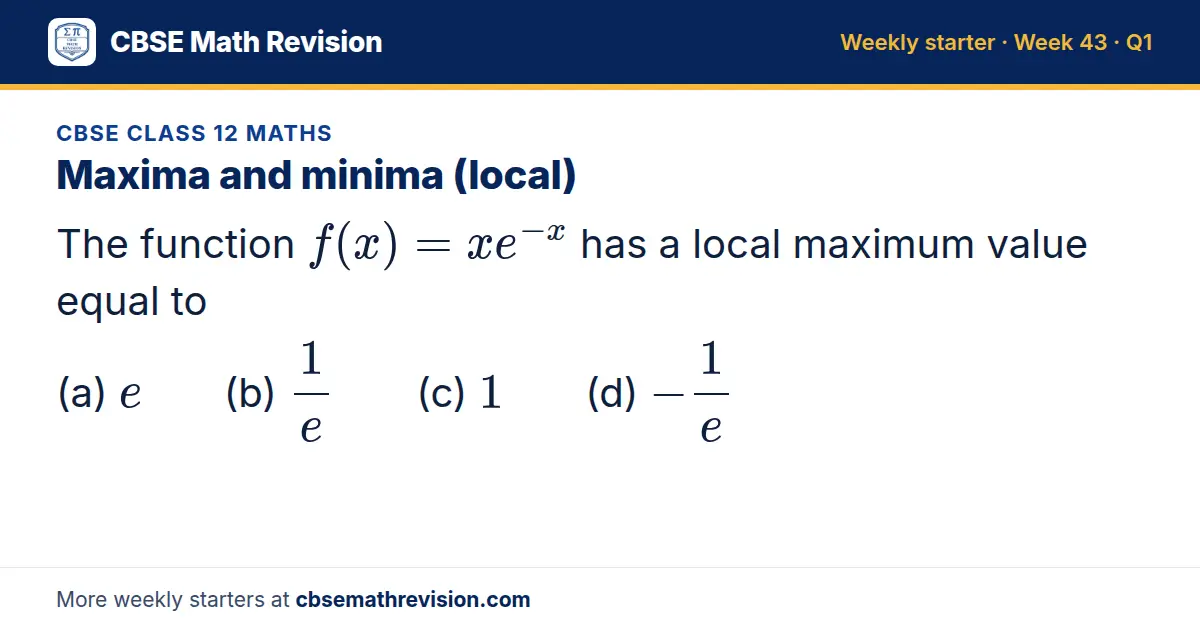
Question 1: Maxima and minima (local)
The function f(x) = xe^(-x) has a local maximum value equal to (a) e (b) 1e (c) 1 (d) -1e
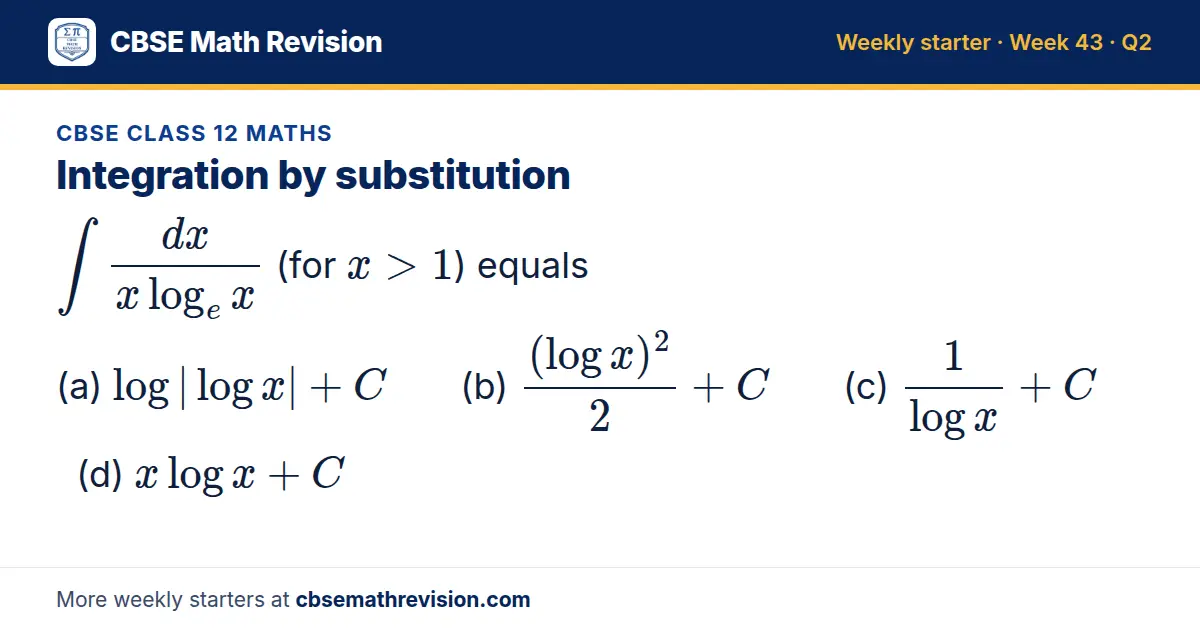
Question 2: Integration by substitution
/(xlog_e x) (for x > 1) equals (a) log|log x| + C (b) ((log x)²)/2 + C (c) 1/(log x) + C (d) xlog x + C
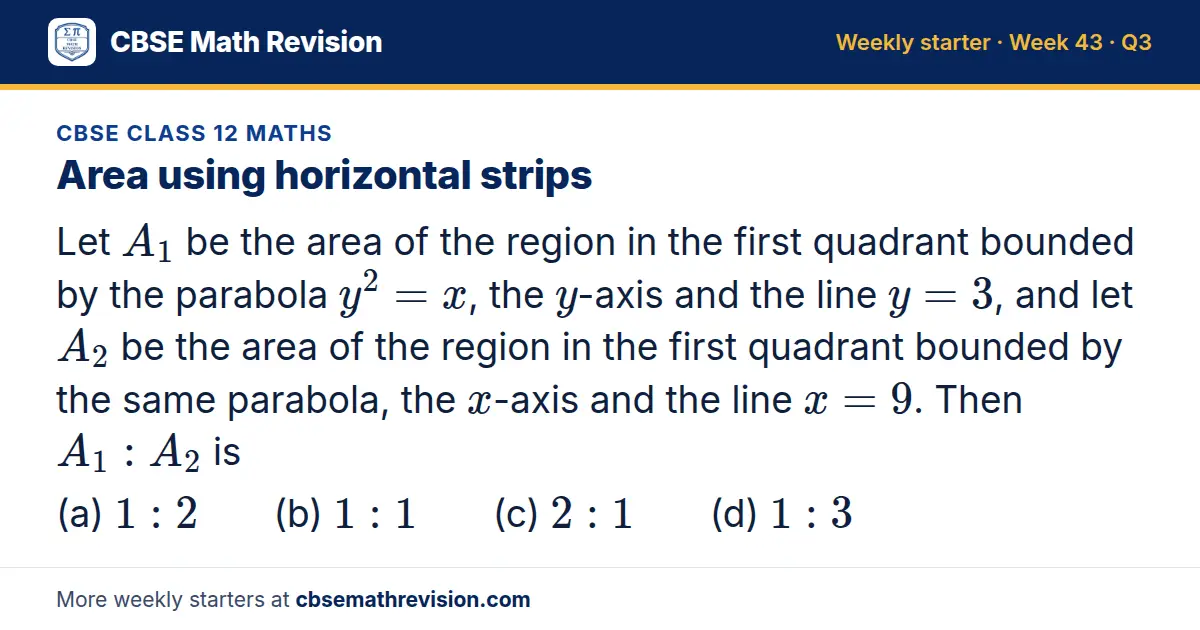
Question 3: Area using horizontal strips
Let A_1 be the area of the region in the first quadrant bounded by the parabola y² = x, the y-axis and the line y = 3, and let A_2 be the area of the region in the first quadrant bounded by the same parabola, the x-axis and the line x = 9. Then A_1: A_2 is (a) 1: 2 (b) 1: 1 (c) 2: 1 (d) 1: 3
Week 44
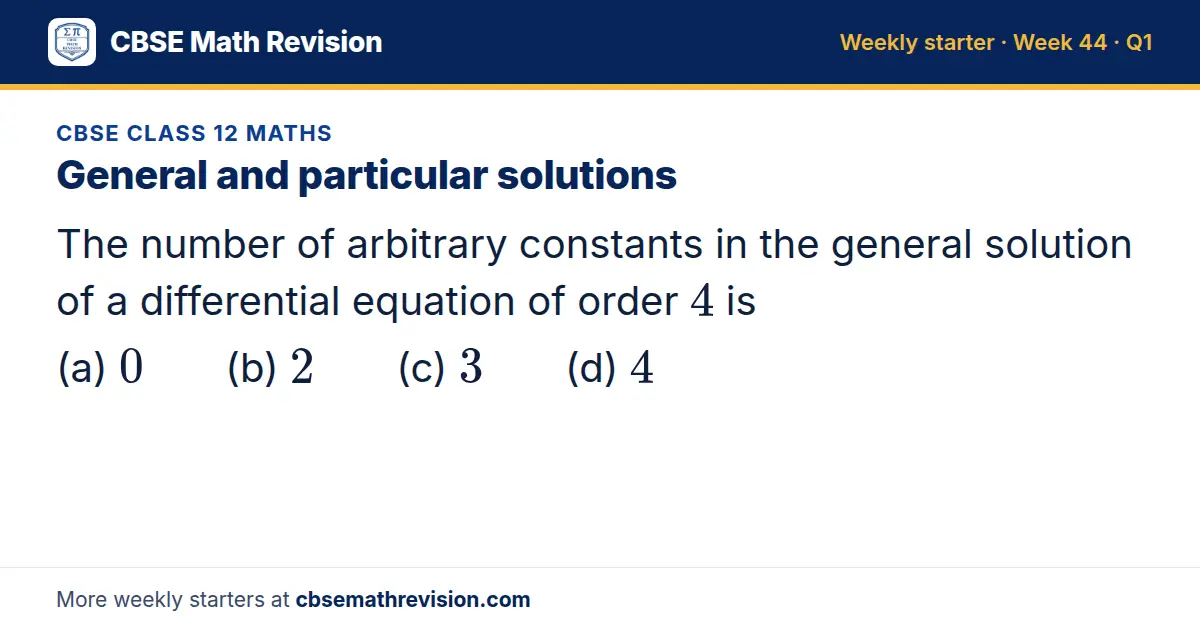
Question 1: General and particular solutions
The number of arbitrary constants in the general solution of a differential equation of order 4 is (a) 0 (b) 2 (c) 3 (d) 4
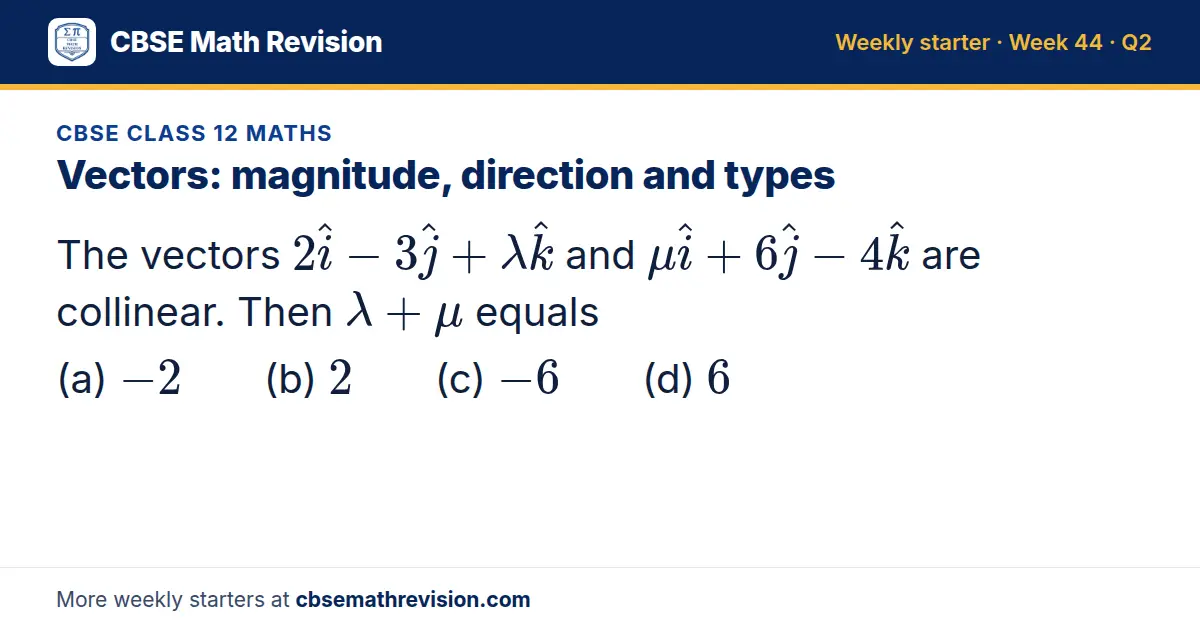
Question 2: Vectors: magnitude, direction and types
The vectors 2i - 3j + and + 6j - 4k are collinear. Then λ + μ equals (a) -2 (b) 2 (c) -6 (d) 6
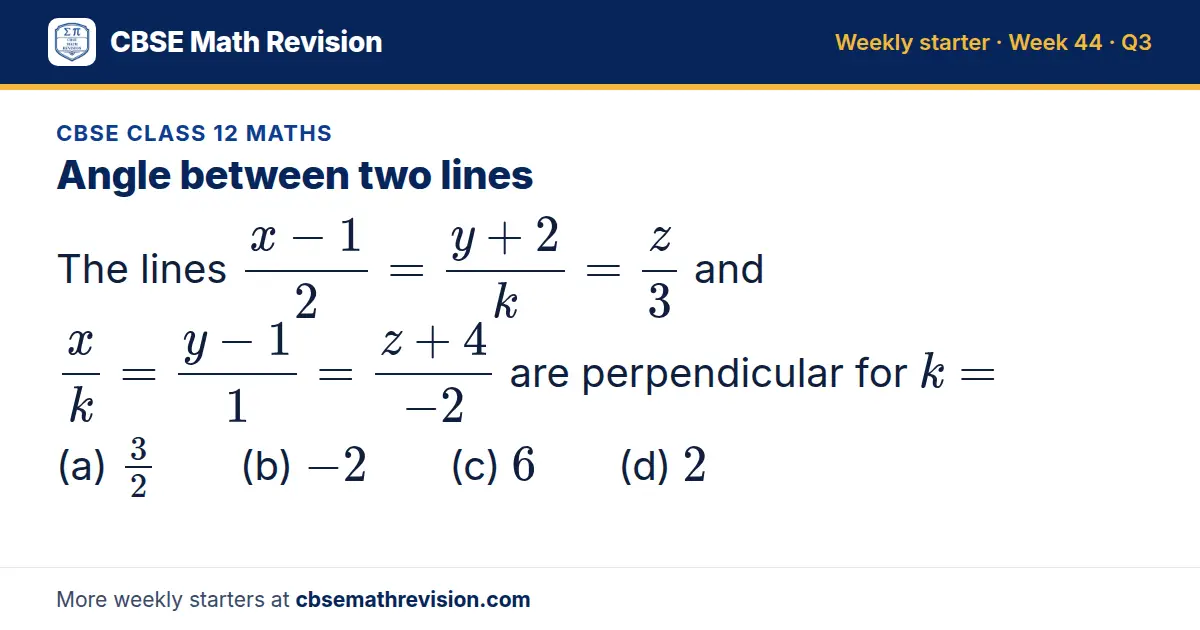
Question 3: Angle between two lines
The lines (x - 1)/2 = (y + 2)/k = z/3 and x/k = (y - 1)/1 = (z + 4)/(-2) are perpendicular for k = (a) 32 (b) -2 (c) 6 (d) 2
Week 45
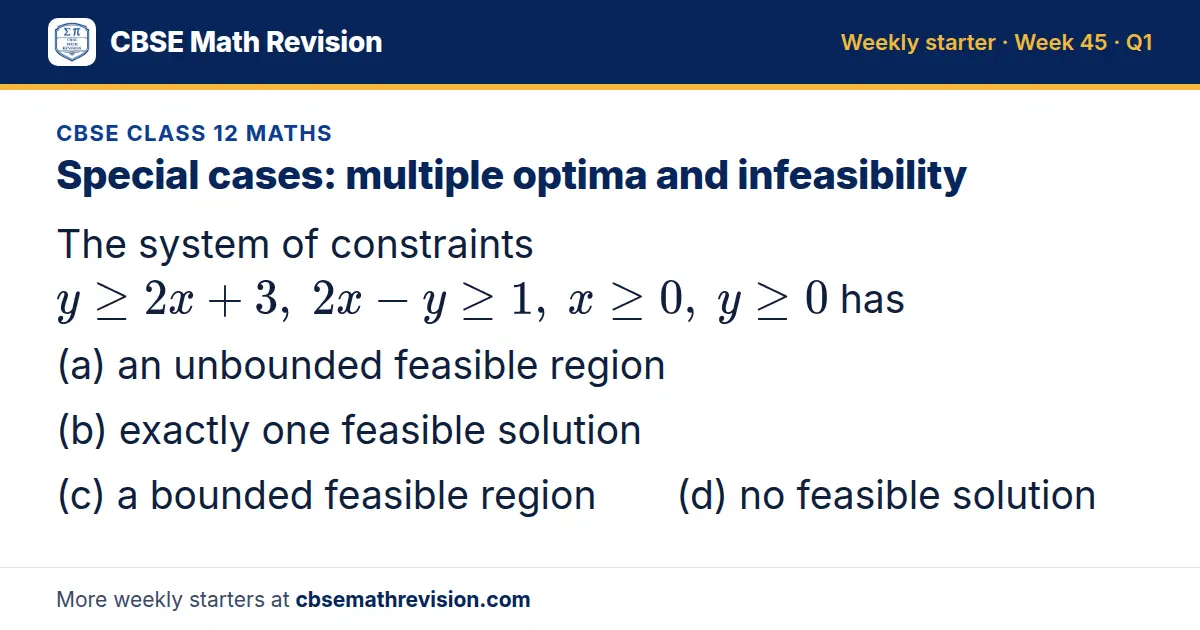
Question 1: Special cases: multiple optima and infeasibility
The system of constraints y ≥ 2x + 3, 2x - y ≥ 1, x ≥ 0, y ≥ 0 has (a) an unbounded feasible region (b) exactly one feasible solution (c) a bounded feasible region (d) no feasible solution
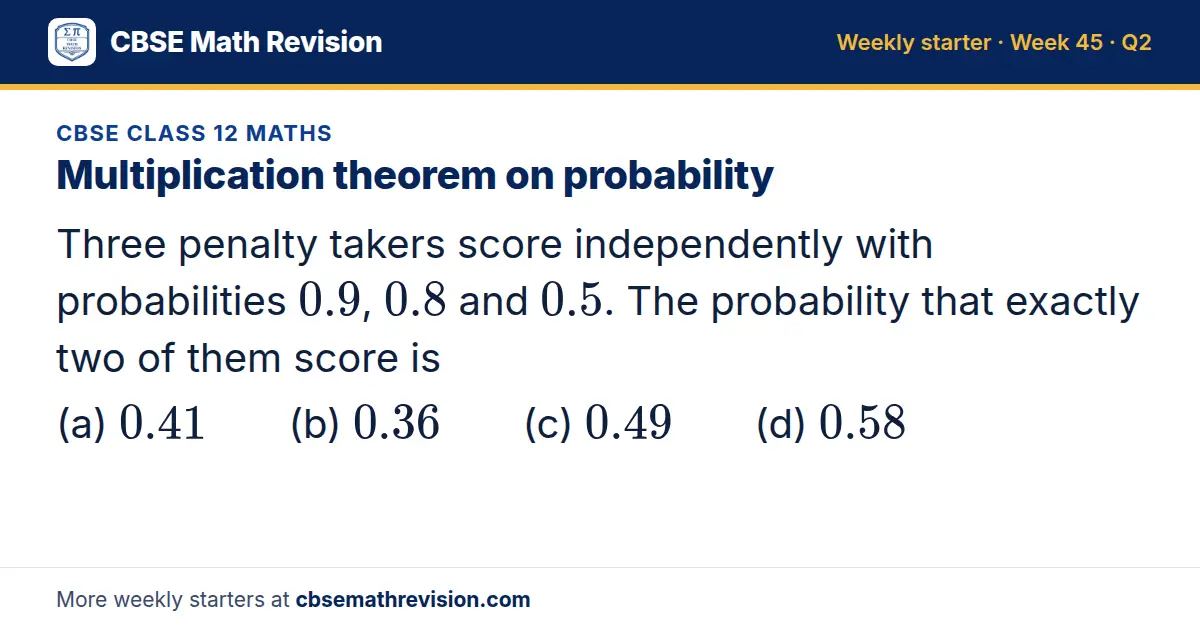
Question 2: Multiplication theorem on probability
Three penalty takers score independently with probabilities 0.9, 0.8 and 0.5. The probability that exactly two of them score is (a) 0.41 (b) 0.36 (c) 0.49 (d) 0.58
![CBSE Class 12 Maths starter question on Domain and range (principal value branches): The range of the principal value branch of sec⁻¹x is (a) [-(π)/2, (π)/2] (b) [0, π] - (π)/2 (c) (0, π) (d) [-(π)/2, (π)/2] - 0](/cbse-frontend/img/questions/cbse-maths-class-12-domain-and-range-principal-value-branches-starter-question-cbse12-w45-q3.webp)
Question 3: Domain and range (principal value branches)
The range of the principal value branch of sec⁻¹x is (a) [-(π)/2, (π)/2] (b) [0, π] - (π)/2 (c) (0, π) (d) [-(π)/2, (π)/2] - 0
Week 46
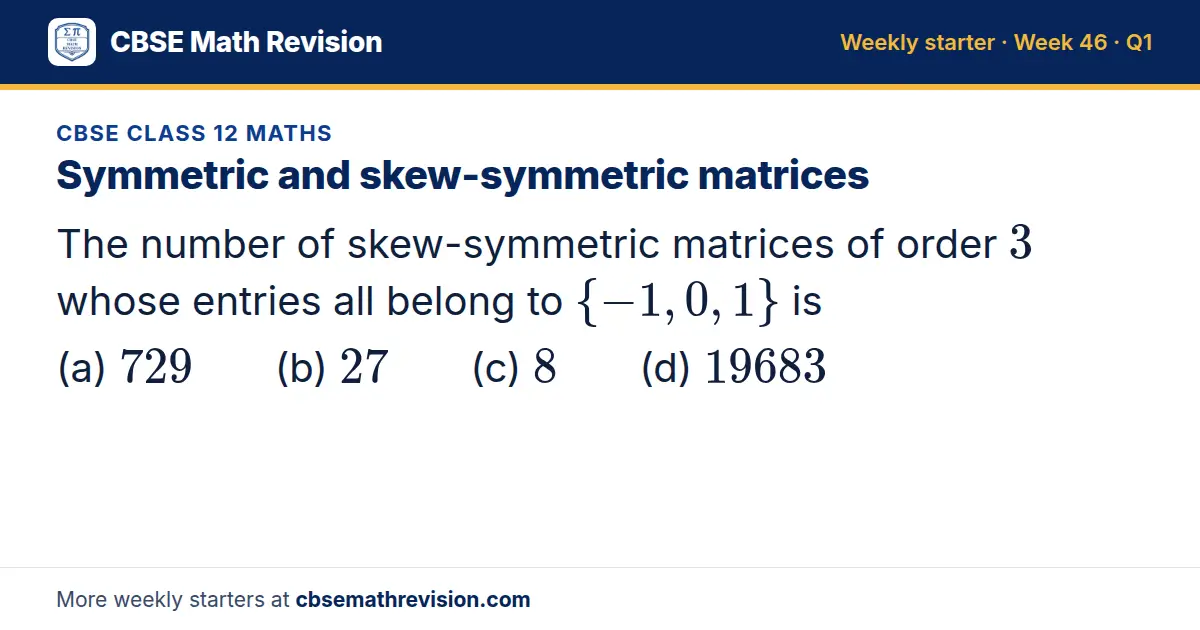
Question 1: Symmetric and skew-symmetric matrices
The number of skew-symmetric matrices of order 3 whose entries all belong to -1, 0, 1 is (a) 729 (b) 27 (c) 8 (d) 19683
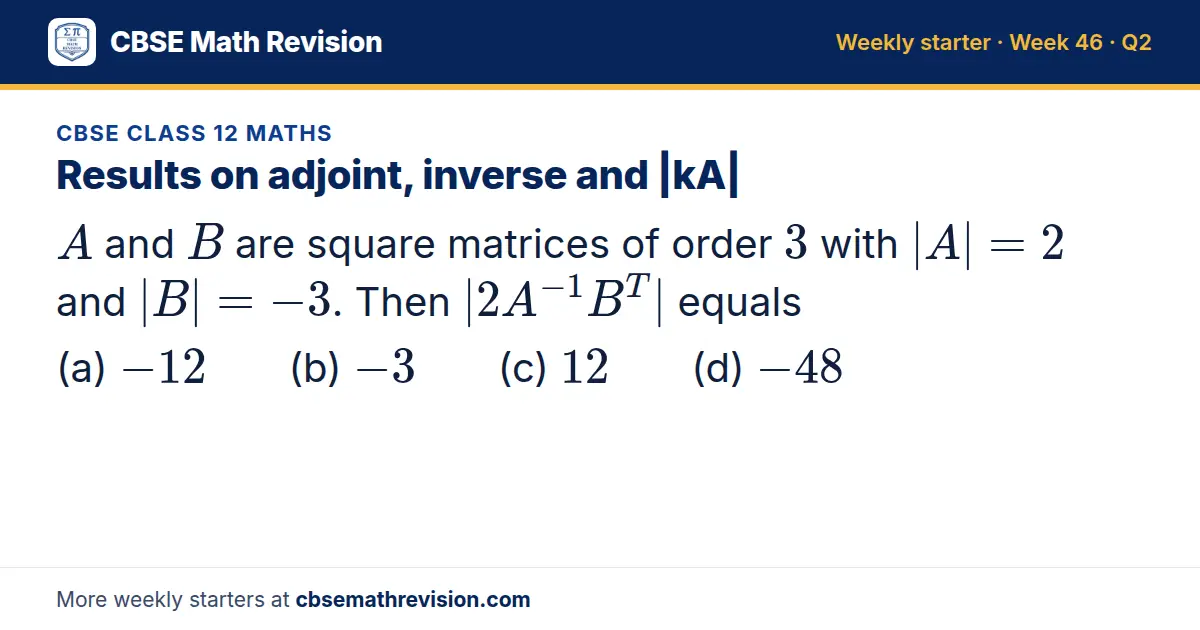
Question 2: Results on adjoint, inverse and |kA|
A and B are square matrices of order 3 with |A| = 2 and |B| = -3. Then |2A⁻¹B^T| equals (a) -12 (b) -3 (c) 12 (d) -48
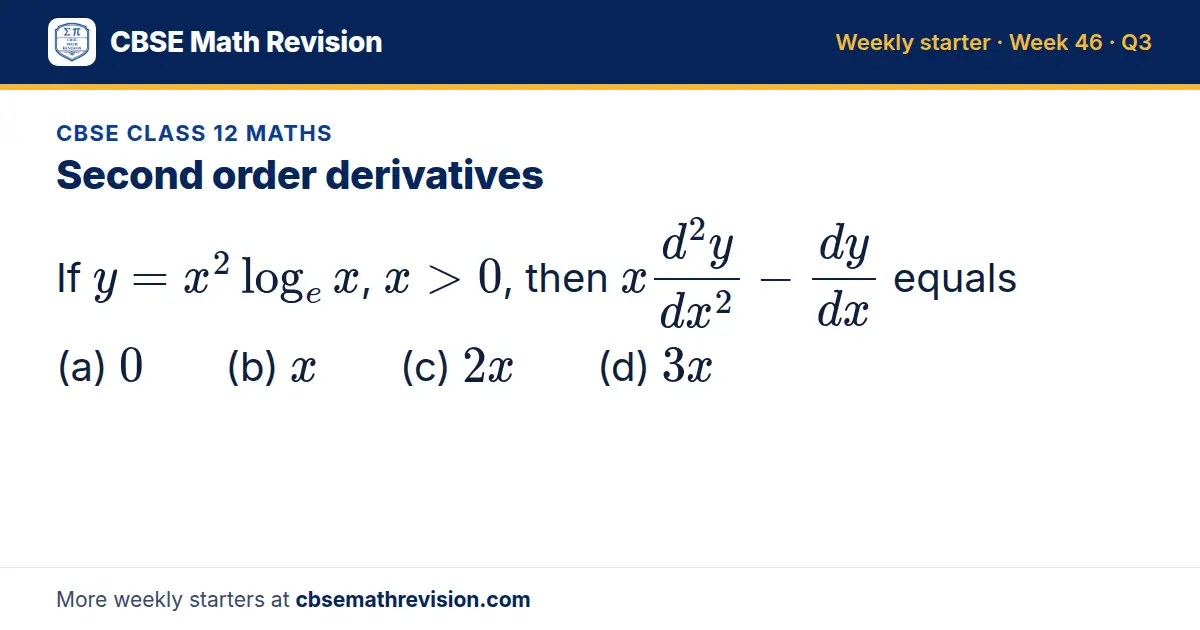
Question 3: Second order derivatives
If y = x²log_e x, x > 0, then x(d²y)/(dx²) - dy/dx equals (a) 0 (b) x (c) 2x (d) 3x
More starter questions
Other weeks: Weeks 1–18 · Weeks 19–31 · Weeks 32–46. Answers and mark schemes are in the teacher tools.