CBSE Class 12 Maths starter questions: weeks 1–18
33 short questions to open a lesson for CBSE Class 12 Mathematics, weeks 1–18 of the teaching year, three or four a week. Each question is shown as an image with its text underneath; answers and mark schemes stay with teachers.
Week 1
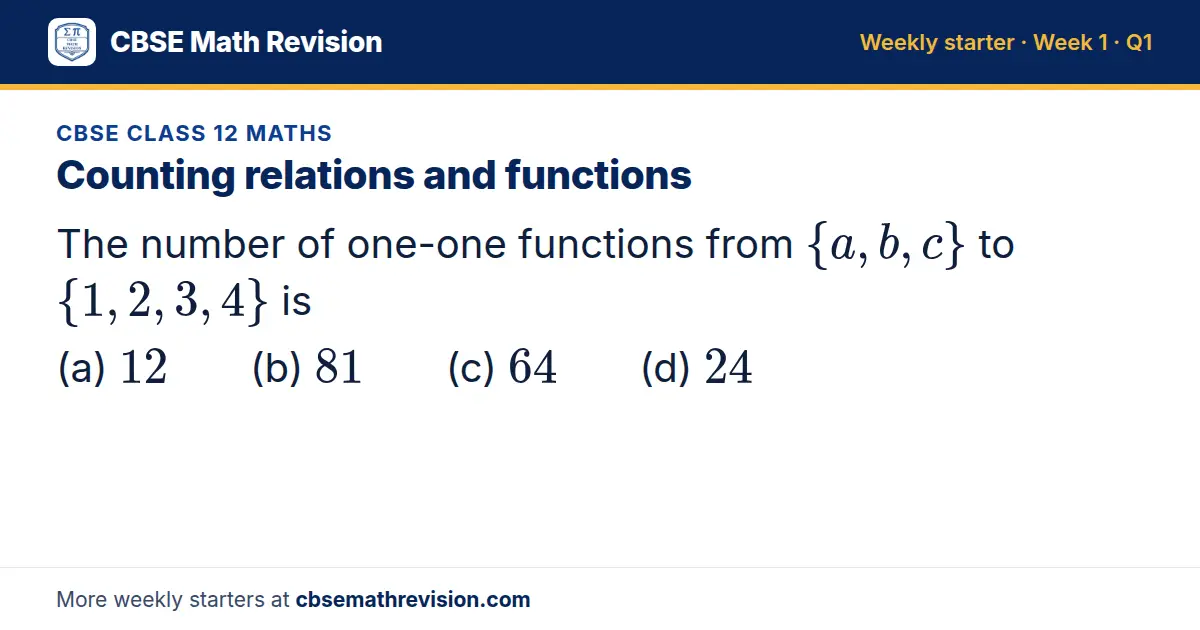
Question 1: Counting relations and functions
The number of one-one functions from a, b, c to 1, 2, 3, 4 is (a) 12 (b) 81 (c) 64 (d) 24
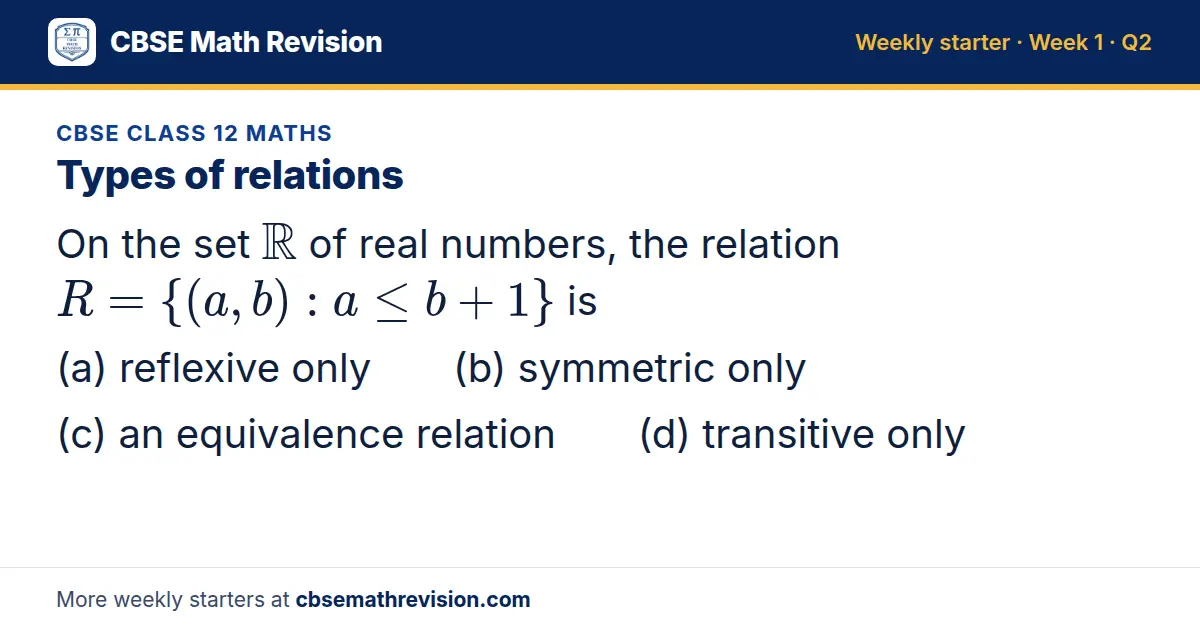
Question 2: Types of relations
On the set ℝ of real numbers, the relation R = (a, b): a ≤ b + 1 is (a) reflexive only (b) symmetric only (c) an equivalence relation (d) transitive only
![CBSE Class 12 Maths starter question on One-one and onto functions: The function f: ℝ → [-1, 1], f(x) = sin x, is (a) one-one but not onto (b) neither one-one nor onto (c) bijective (d) onto but not one-one](/cbse-frontend/img/questions/cbse-maths-class-12-one-one-and-onto-functions-starter-question-cbse12-w1-q3.webp)
Question 3: One-one and onto functions
The function f: ℝ → [-1, 1], f(x) = sin x, is (a) one-one but not onto (b) neither one-one nor onto (c) bijective (d) onto but not one-one
Week 2
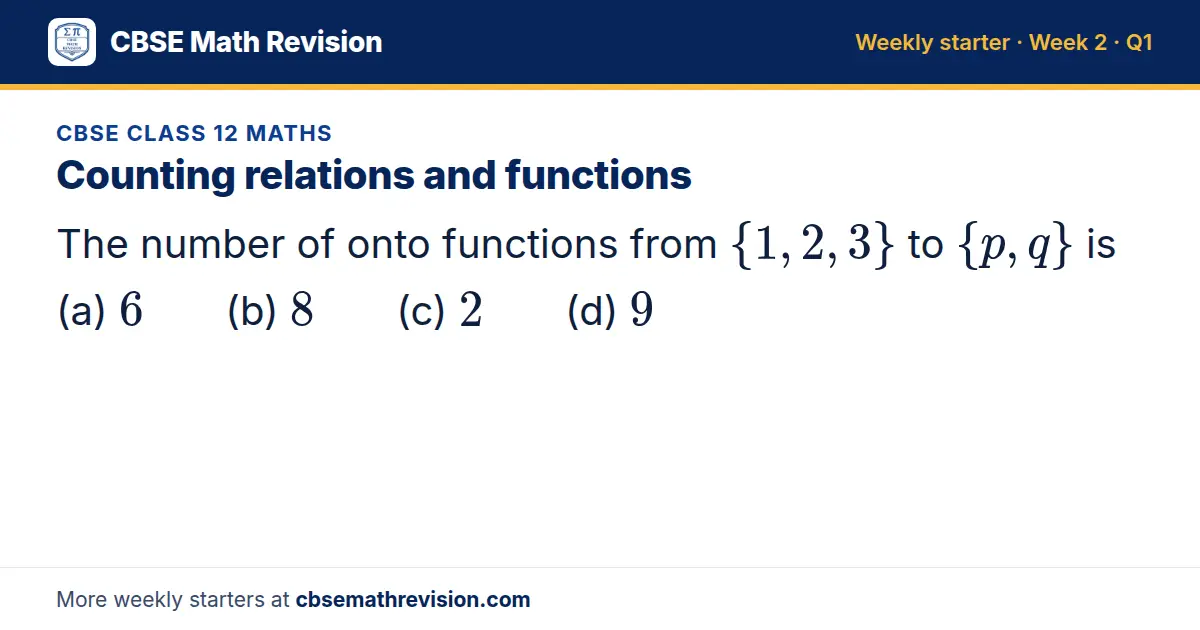
Question 1: Counting relations and functions
The number of onto functions from 1, 2, 3 to p, q is (a) 6 (b) 8 (c) 2 (d) 9
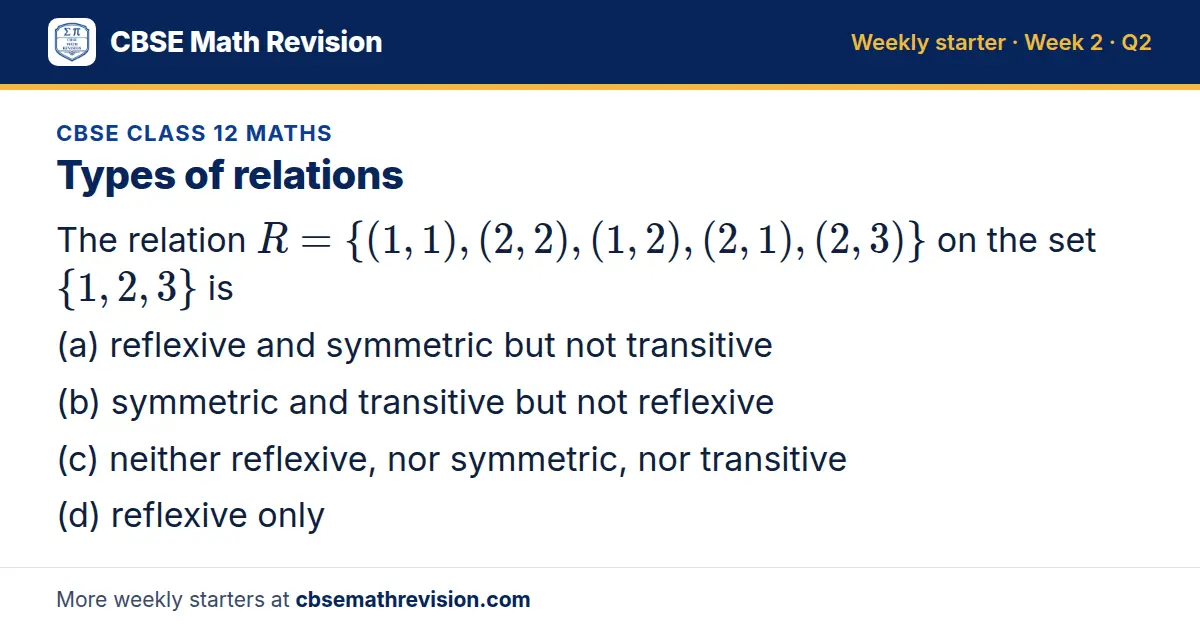
Question 2: Types of relations
The relation R = (1, 1), (2, 2), (1, 2), (2, 1), (2, 3) on the set 1, 2, 3 is (a) reflexive and symmetric but not transitive (b) symmetric and transitive but not reflexive (c) neither reflexive, nor symmetric, nor transitive (d) reflexive only
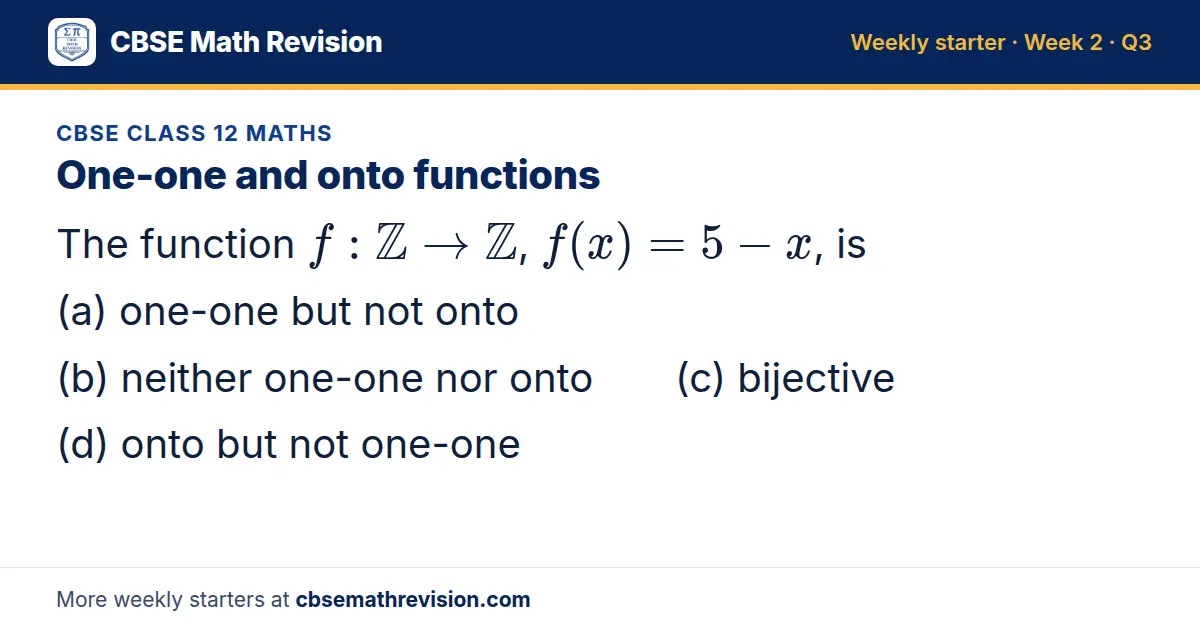
Question 3: One-one and onto functions
The function f: ℤ → ℤ, f(x) = 5 - x, is (a) one-one but not onto (b) neither one-one nor onto (c) bijective (d) onto but not one-one
Week 3
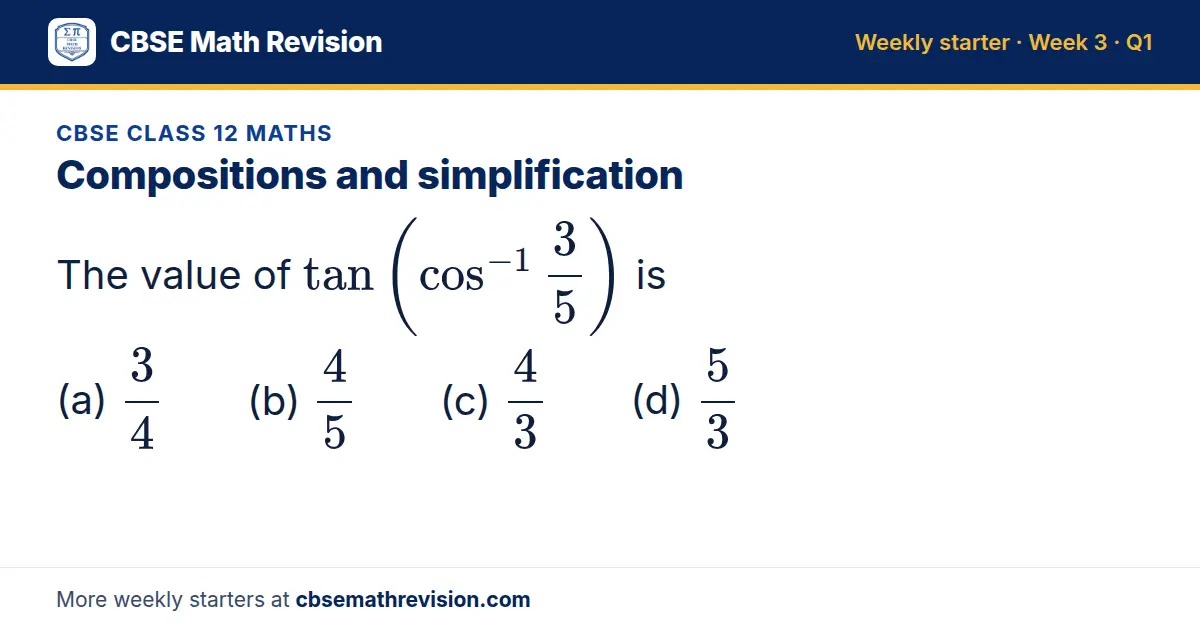
Question 1: Compositions and simplification
The value of tan(cos⁻¹35) is (a) 34 (b) 45 (c) 43 (d) 53
![CBSE Class 12 Maths starter question on Domain and range (principal value branches): The domain of f(x) = sin⁻¹x + cos⁻¹(x - 1) + tan⁻¹x is (a) [-1, 1] (b) [-1, 2] (c) [0, 1] (d) [0, 2]](/cbse-frontend/img/questions/cbse-maths-class-12-domain-and-range-principal-value-branches-starter-question-cbse12-w3-q2.webp)
Question 2: Domain and range (principal value branches)
The domain of f(x) = sin⁻¹x + cos⁻¹(x - 1) + tan⁻¹x is (a) [-1, 1] (b) [-1, 2] (c) [0, 1] (d) [0, 2]
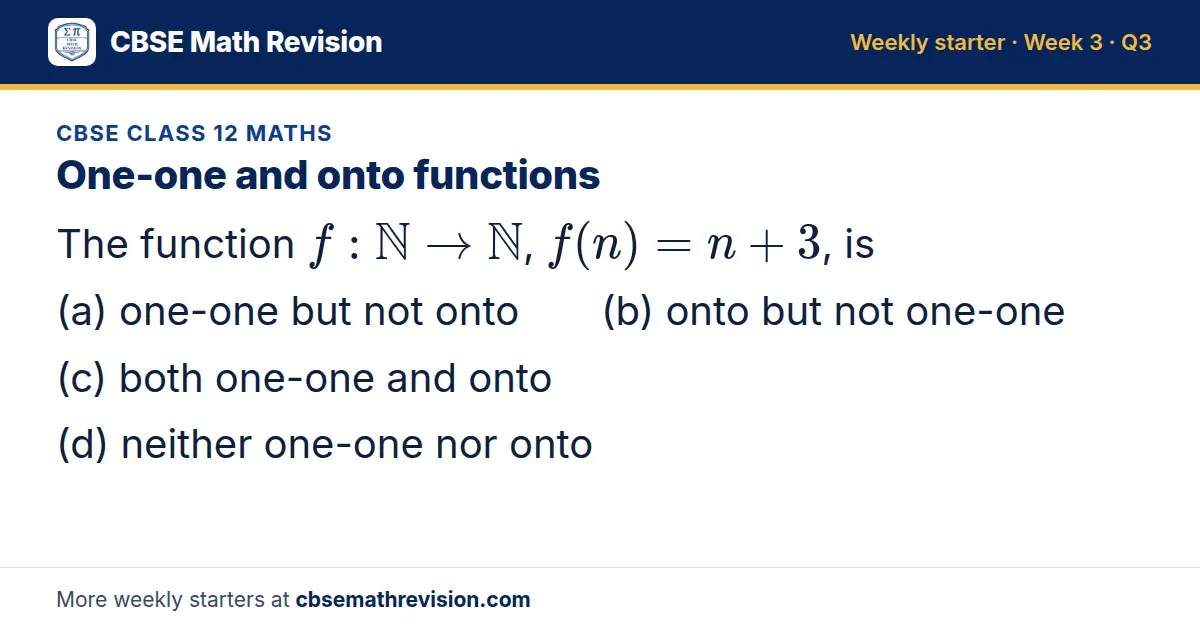
Question 3: One-one and onto functions
The function f: ℕ → ℕ, f(n) = n + 3, is (a) one-one but not onto (b) onto but not one-one (c) both one-one and onto (d) neither one-one nor onto
Week 4
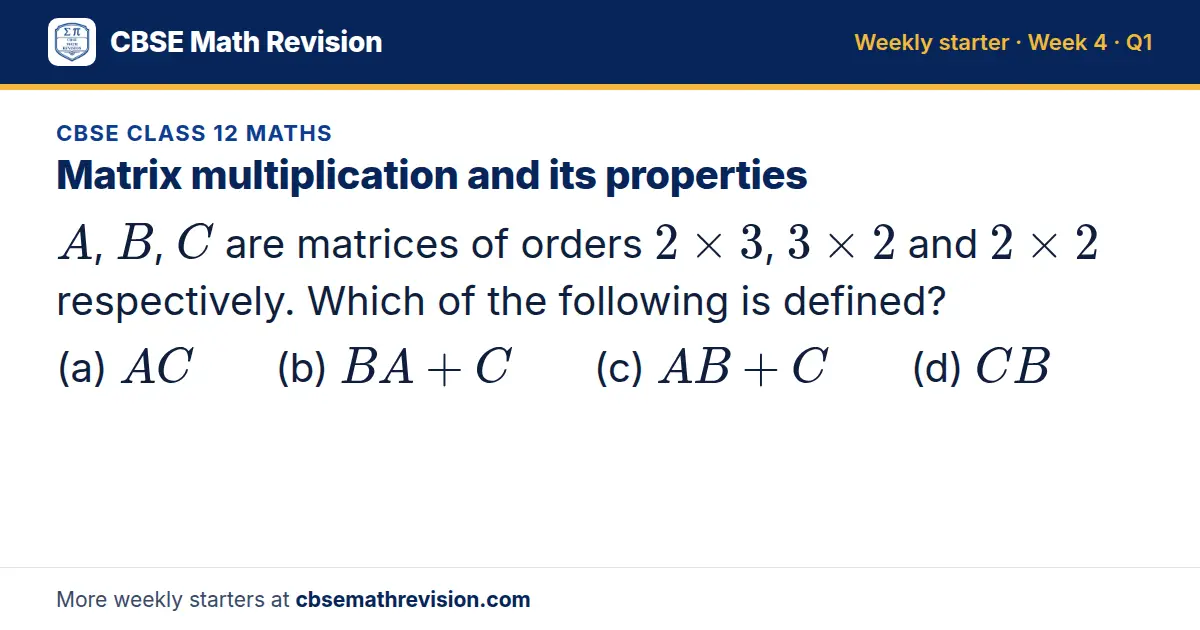
Question 1: Matrix multiplication and its properties
A, B, C are matrices of orders 2 × 3, 3 × 2 and 2 × 2 respectively. Which of the following is defined? (a) AC (b) BA + C (c) AB + C (d) CB
Question 2: Compositions and simplification
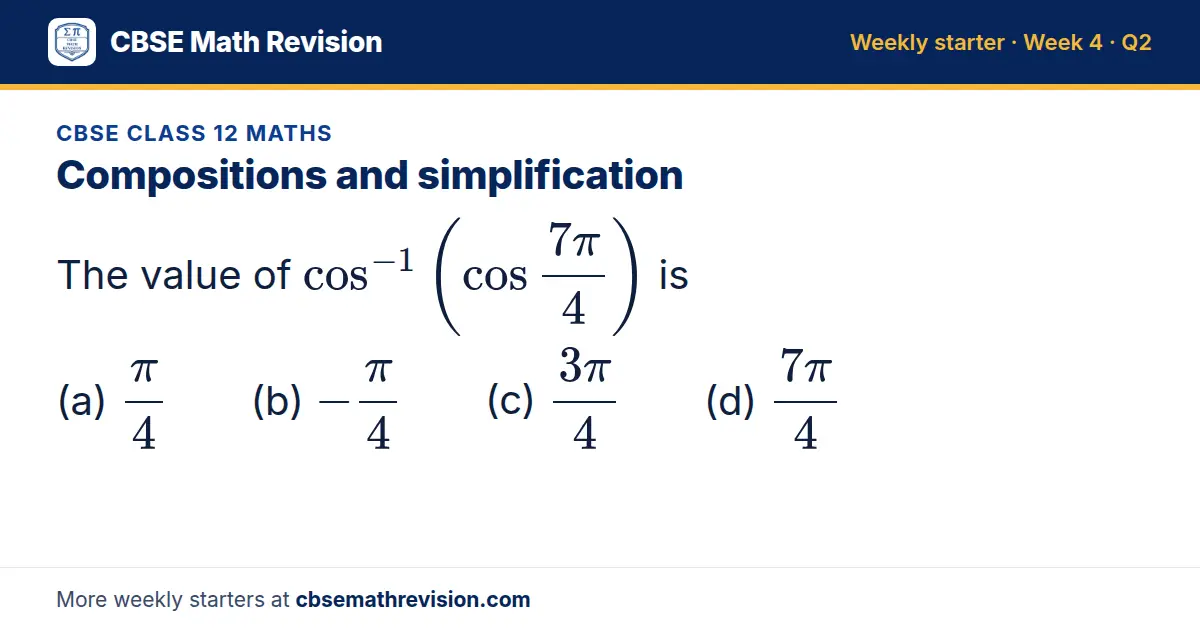
The value of cos⁻¹(cos(7π)/4) is (a) (π)/4 (b) -(π)/4 (c) (3π)/4 (d) (7π)/4
Question 3: One-one and onto functions
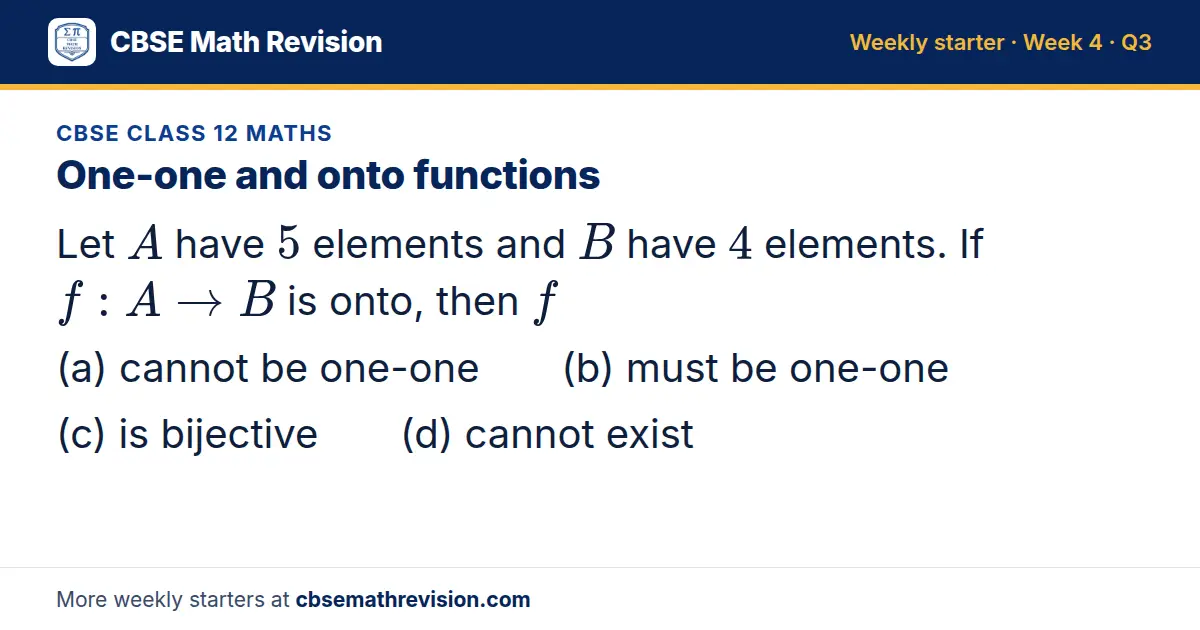
Let A have 5 elements and B have 4 elements. If f: A → B is onto, then f (a) cannot be one-one (b) must be one-one (c) is bijective (d) cannot exist
Week 5
Question 1: Invertible matrices
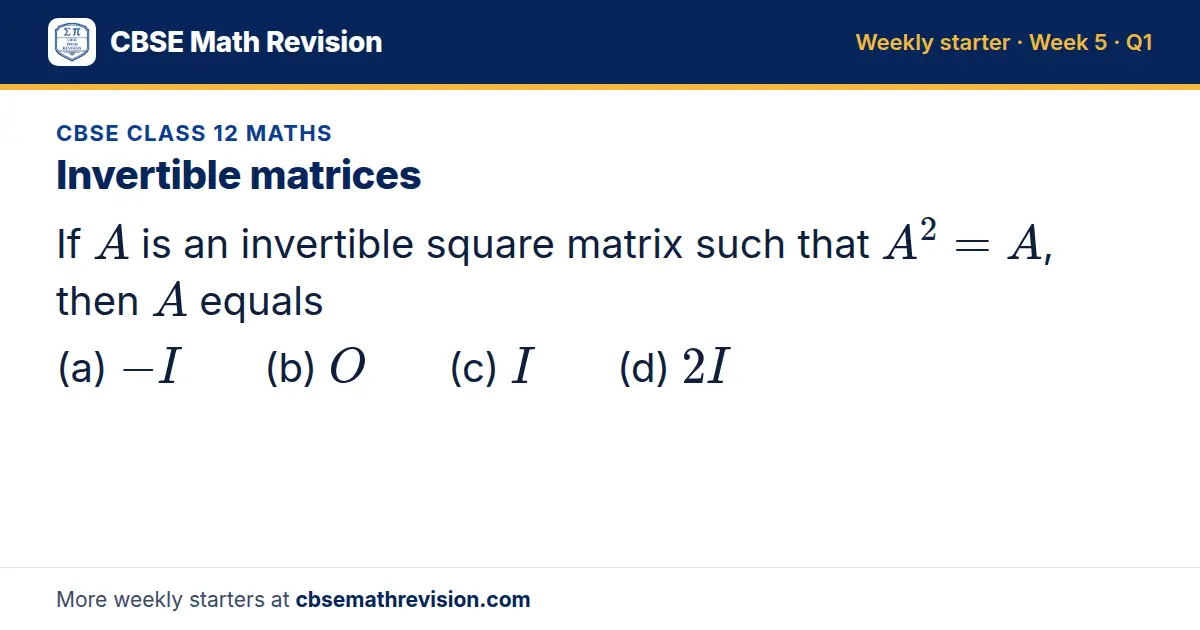
If A is an invertible square matrix such that A² = A, then A equals (a) -I (b) O (c) I (d) 2I
Question 2: Matrix multiplication and its properties
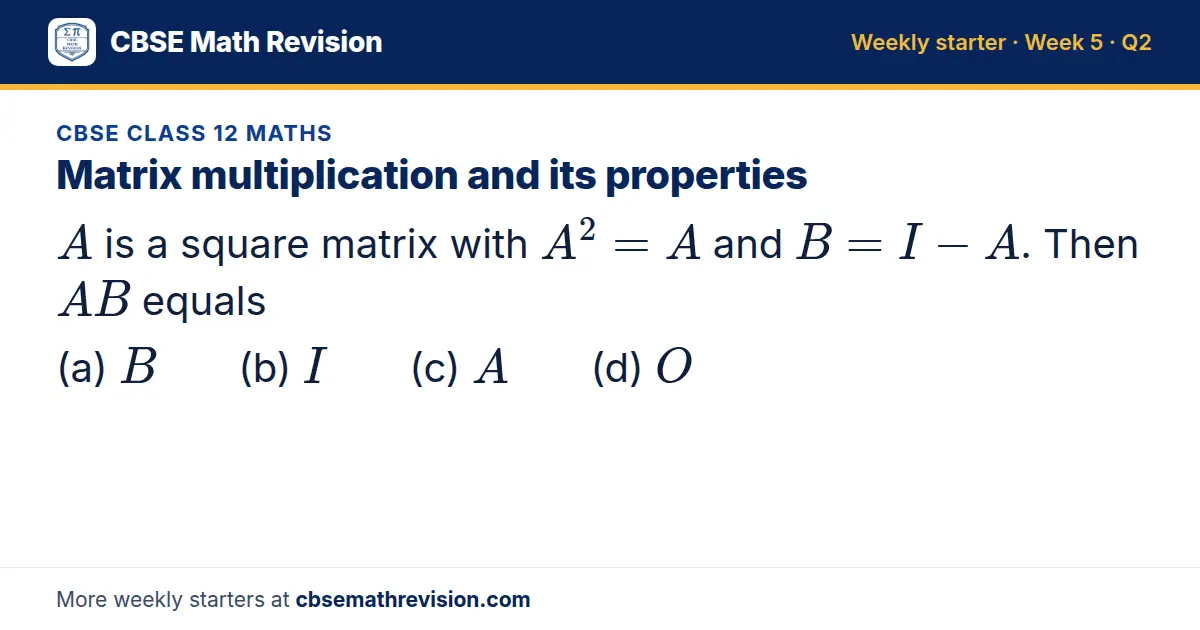
A is a square matrix with A² = A and B = I - A. Then AB equals (a) B (b) I (c) A (d) O
Question 3: Principal values
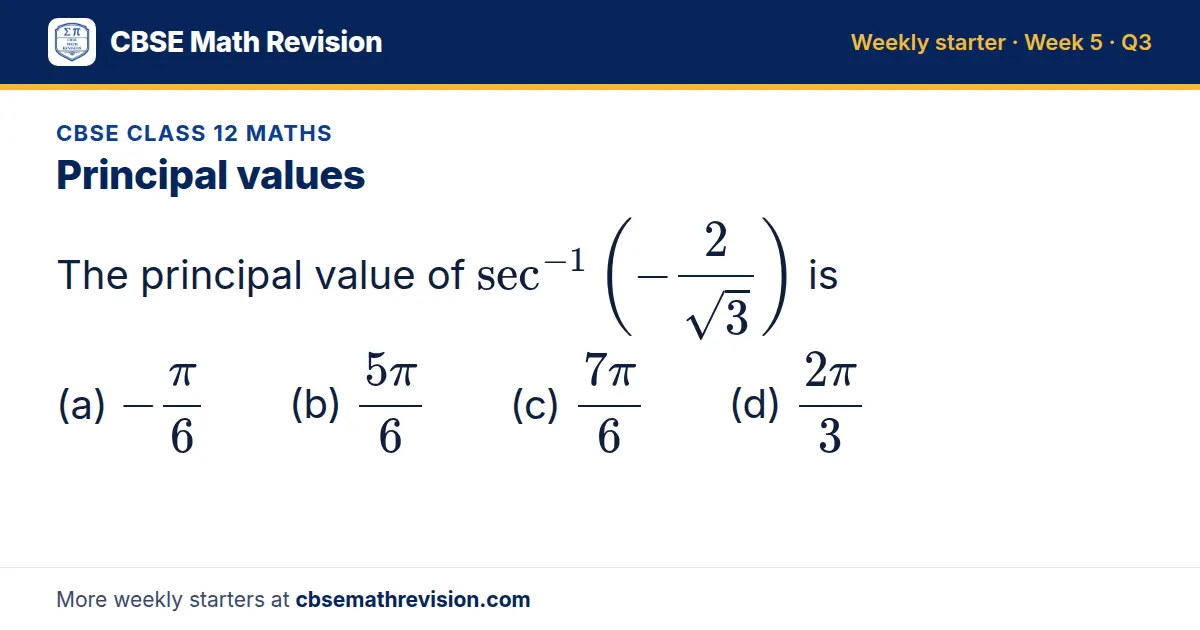
The principal value of sec⁻¹(-2/(√3)) is (a) -(π)/6 (b) (5π)/6 (c) (7π)/6 (d) (2π)/3
Week 6
Question 1: Adjoint and inverse of a matrix
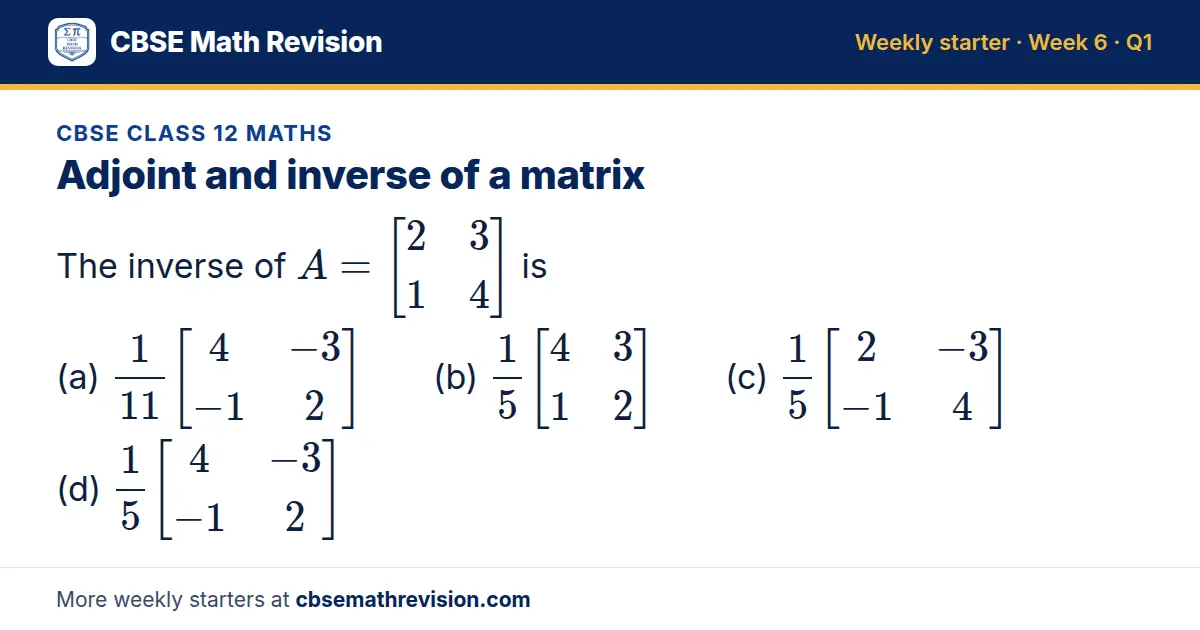
The inverse of A = 2 3; 1 4 is (a) 1/11 4 -3; -1 2 (b) 15 4 3; 1 2 (c) 15 2 -3; -1 4 (d) 15 4 -3; -1 2
Question 2: Evaluating determinants
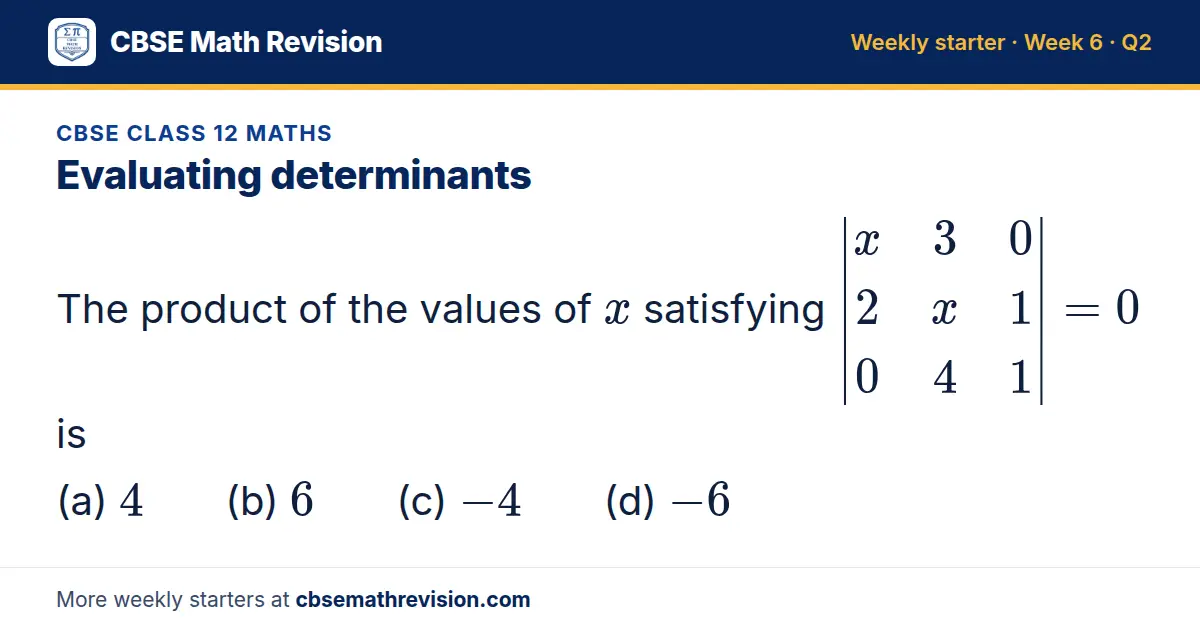
The product of the values of x satisfying x 3 0; 2 x 1; 0 4 1 = 0 is (a) 4 (b) 6 (c) -4 (d) -6
Question 3: Types of matrices and equality
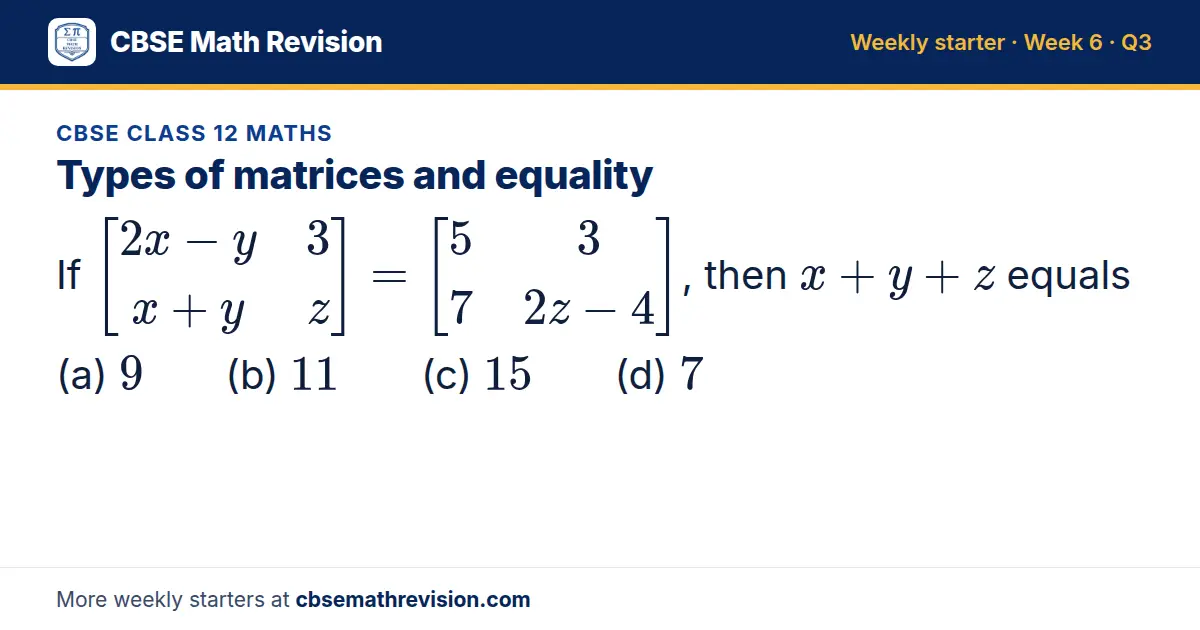
If 2x - y 3; x + y z = 5 3; 7 2z - 4, then x + y + z equals (a) 9 (b) 11 (c) 15 (d) 7
Week 13
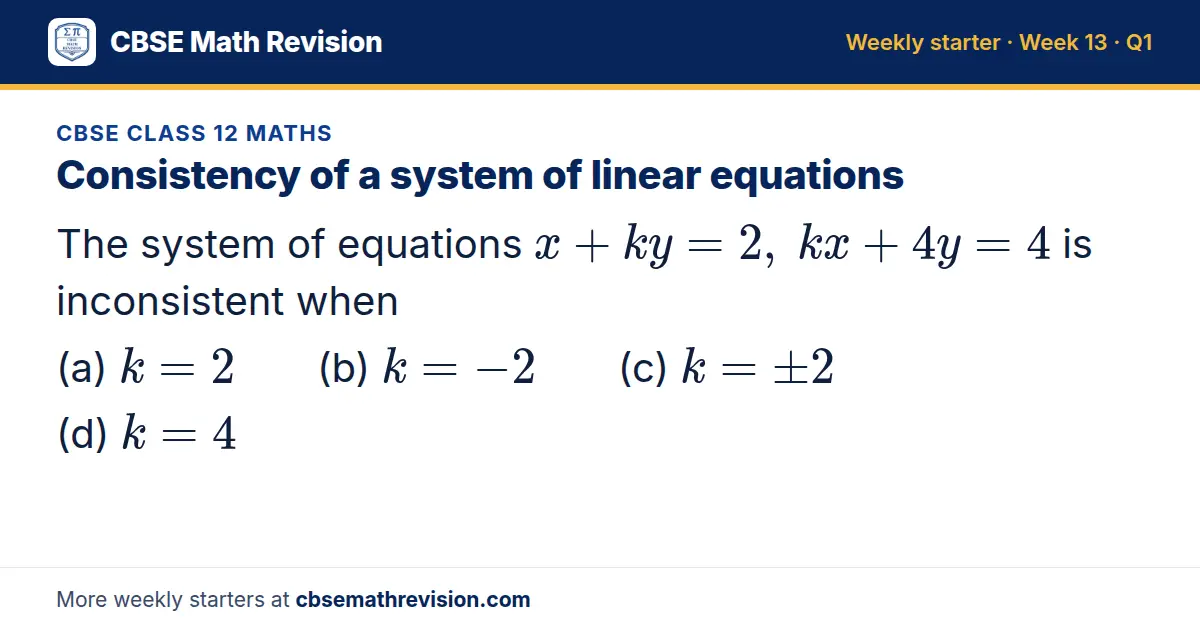
Question 1: Consistency of a system of linear equations
The system of equations x + ky = 2, kx + 4y = 4 is inconsistent when (a) k = 2 (b) k = -2 (c) k = ± 2 (d) k = 4
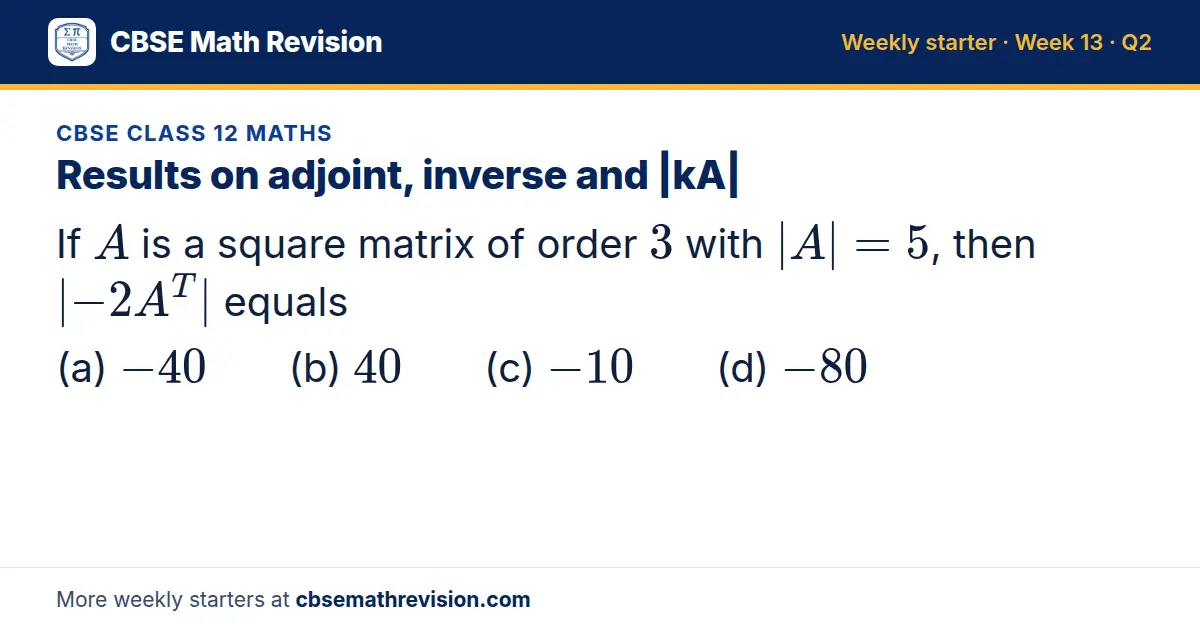
Question 2: Results on adjoint, inverse and |kA|
If A is a square matrix of order 3 with |A| = 5, then |-2A^T| equals (a) -40 (b) 40 (c) -10 (d) -80
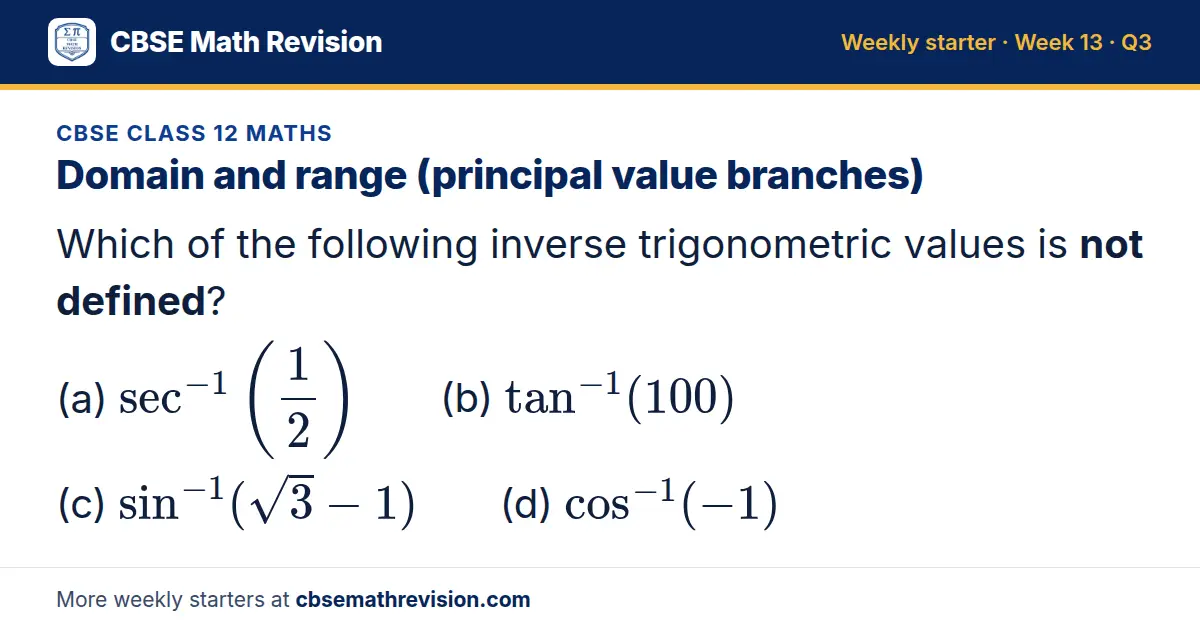
Question 3: Domain and range (principal value branches)
Which of the following inverse trigonometric values is not defined? (a) sec⁻¹(12) (b) tan⁻¹(100) (c) sin⁻¹(√3 - 1) (d) cos⁻¹(-1)
Week 14
![CBSE Class 12 Maths starter question on Chain rule and composite functions: d/dx[sin² (3x)] equals (a) sin 6x (b) 2sin 3x (c) 6sin 6x (d) 3sin 6x](/cbse-frontend/img/questions/cbse-maths-class-12-chain-rule-and-composite-functions-starter-question-cbse12-w14-q1.webp)
Question 1: Chain rule and composite functions
d/dx[sin² (3x)] equals (a) sin 6x (b) 2sin 3x (c) 6sin 6x (d) 3sin 6x
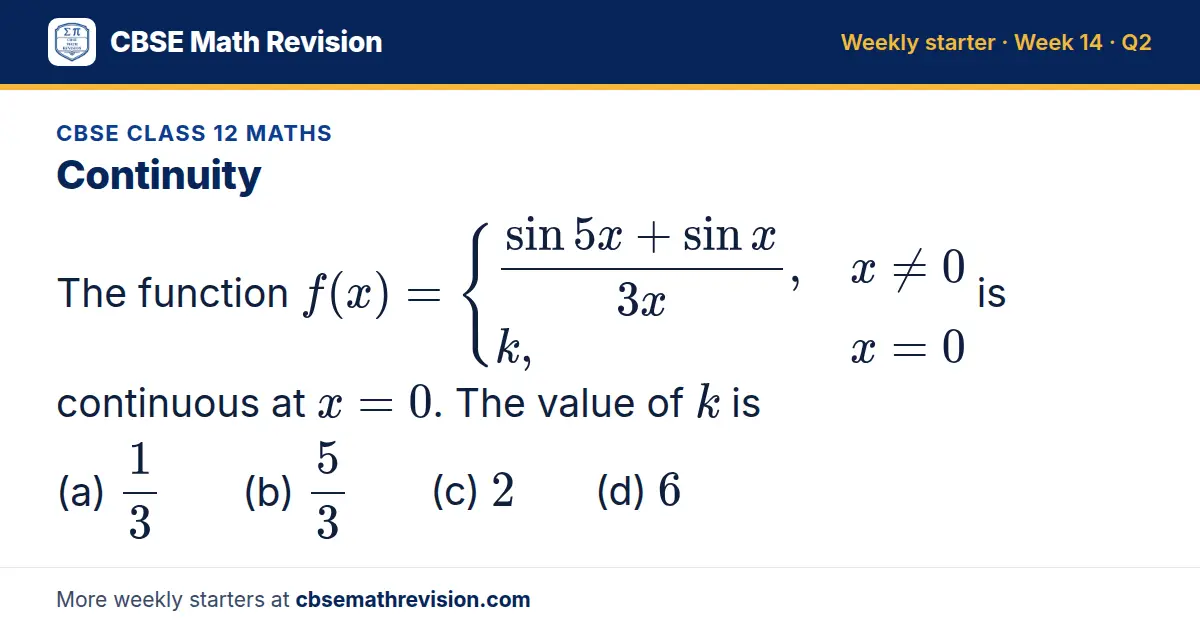
Question 2: Continuity
The function f(x) = (sin 5x + sin x)/3x, x ≠ 0; k, x = 0 is continuous at x = 0. The value of k is (a) 13 (b) 53 (c) 2 (d) 6
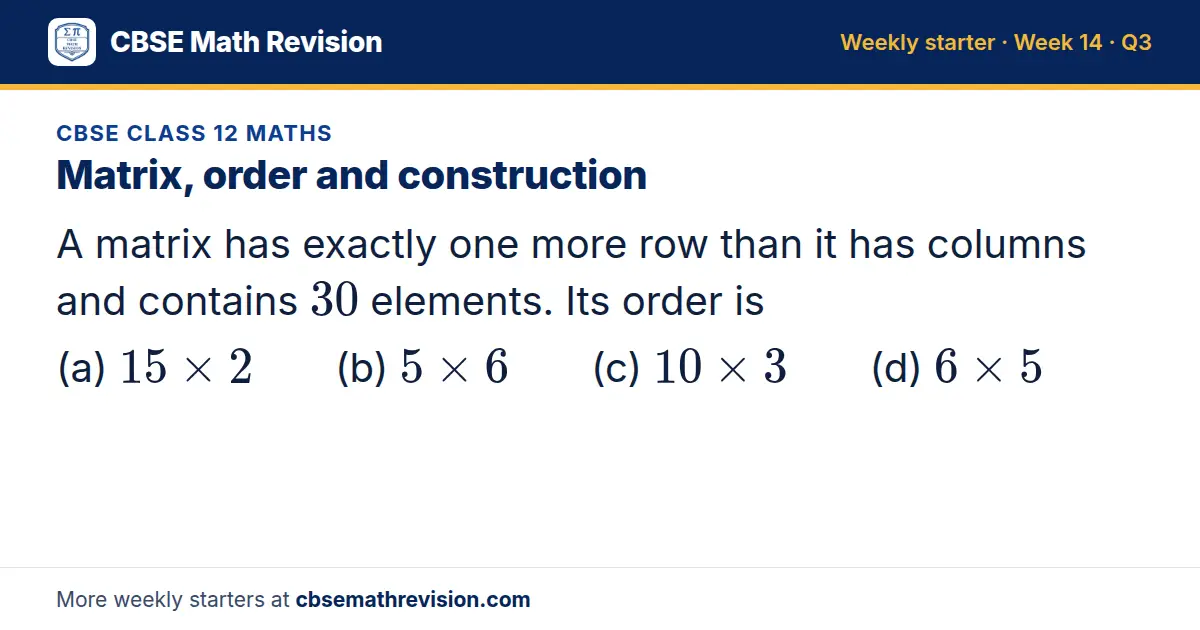
Question 3: Matrix, order and construction
A matrix has exactly one more row than it has columns and contains 30 elements. Its order is (a) 15 × 2 (b) 5 × 6 (c) 10 × 3 (d) 6 × 5
Week 16
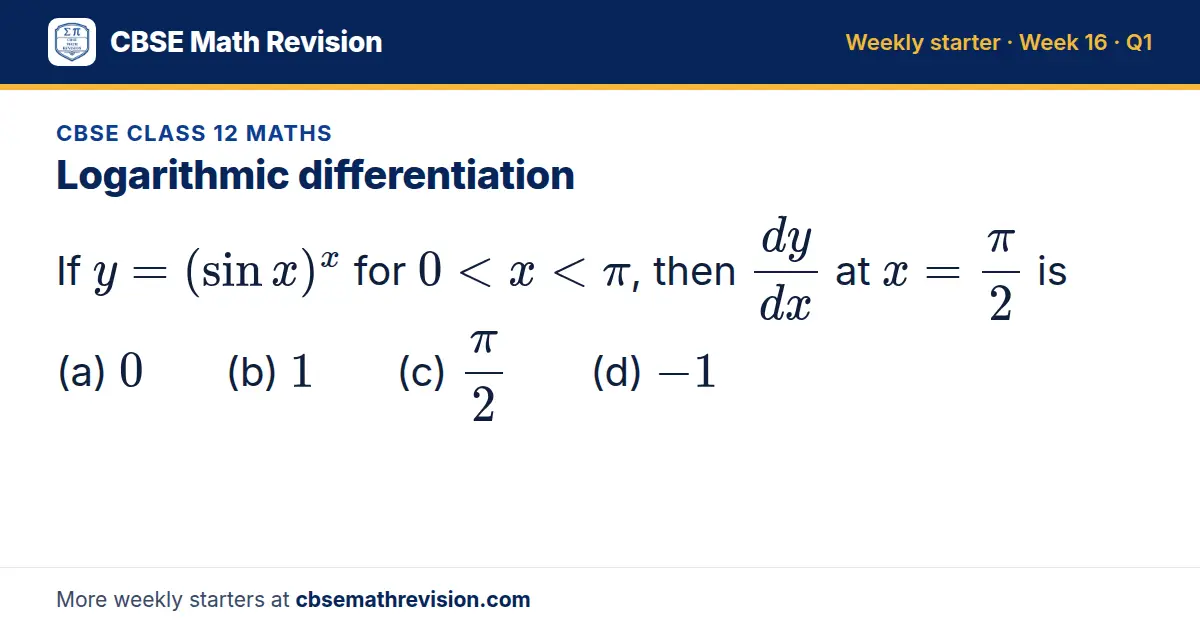
Question 1: Logarithmic differentiation
If y = (sin x)^x for 0 < x < π, then dy/dx at x = (π)/2 is (a) 0 (b) 1 (c) (π)/2 (d) -1
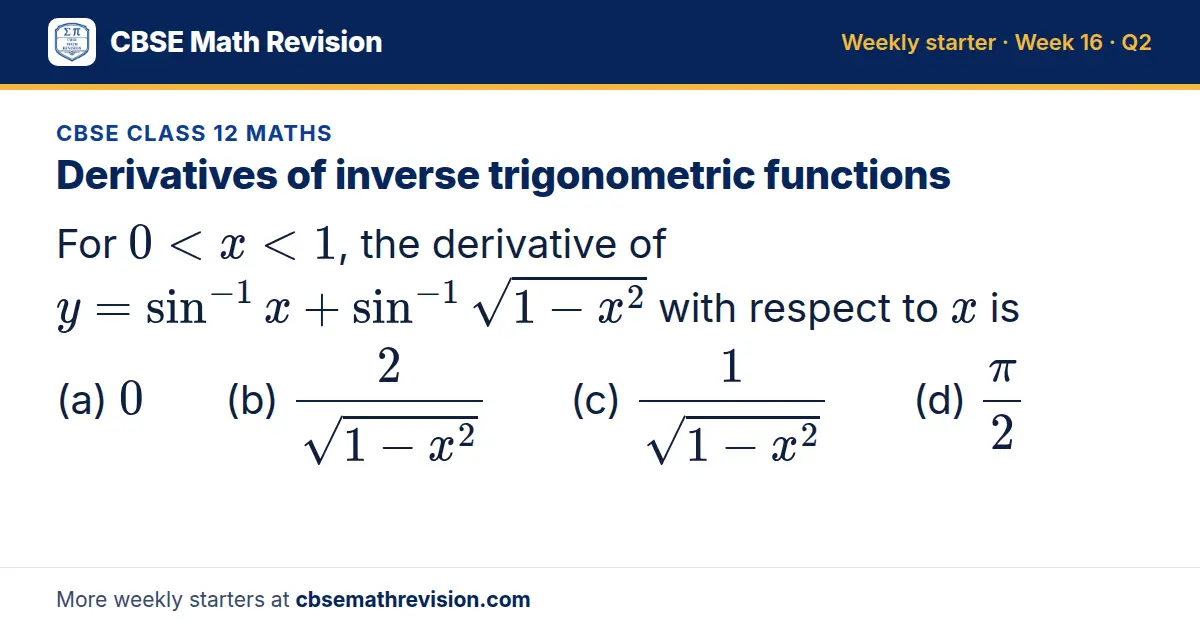
Question 2: Derivatives of inverse trigonometric functions
For 0 < x < 1, the derivative of y = sin⁻¹ x + sin⁻¹√(1 - x²) with respect to x is (a) 0 (b) 2/(√(1-x²)) (c) 1/(√(1-x²)) (d) (π)/2
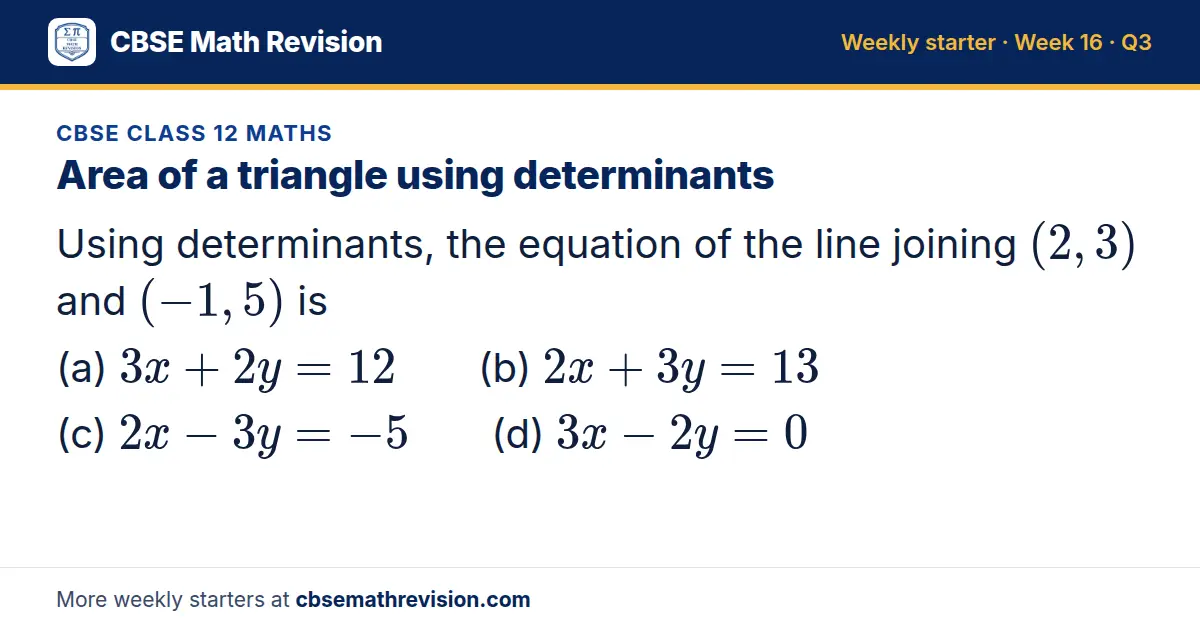
Question 3: Area of a triangle using determinants
Using determinants, the equation of the line joining (2, 3) and (-1, 5) is (a) 3x + 2y = 12 (b) 2x + 3y = 13 (c) 2x - 3y = -5 (d) 3x - 2y = 0
Week 17
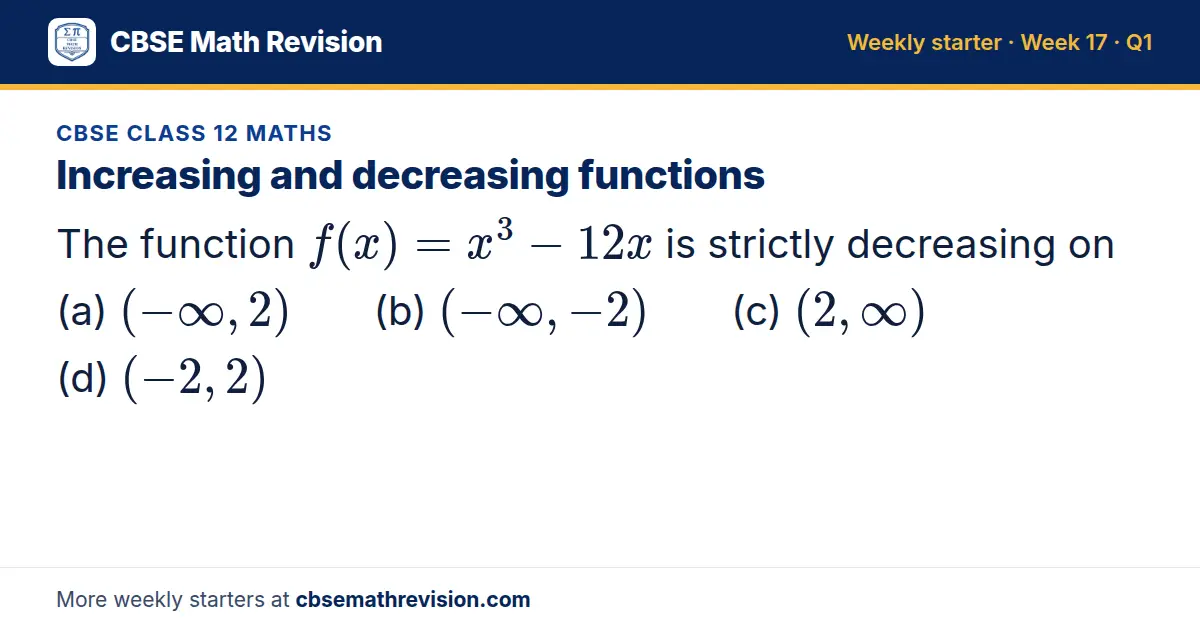
Question 1: Increasing and decreasing functions
The function f(x) = x³ - 12x is strictly decreasing on (a) (-∞, 2) (b) (-∞, -2) (c) (2, ∞) (d) (-2, 2)
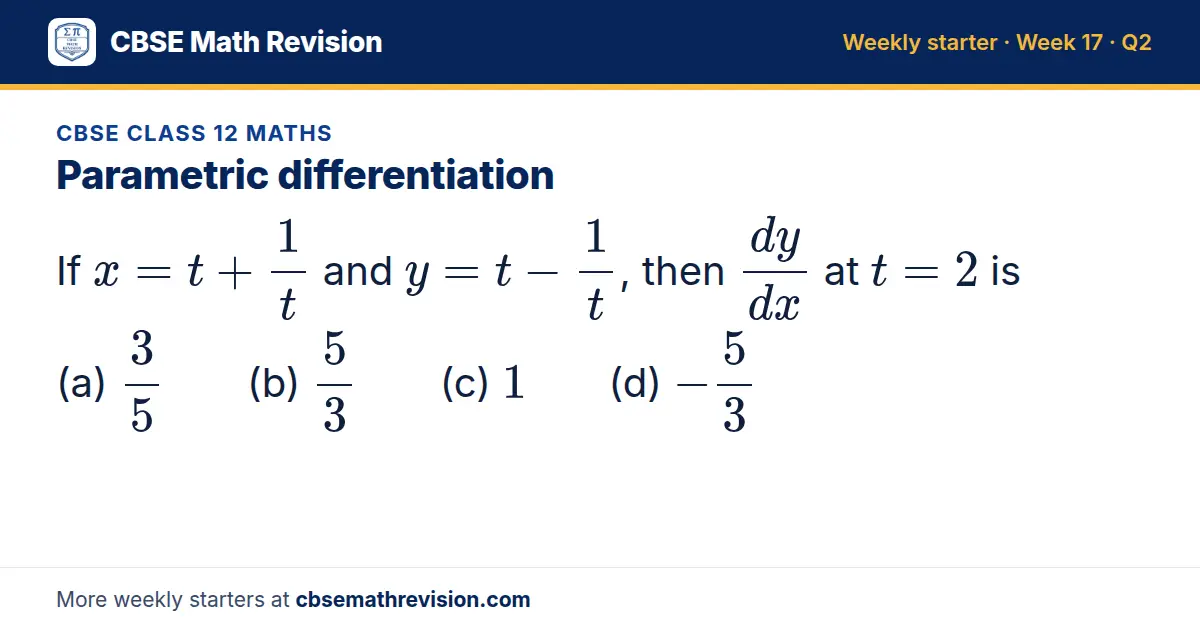
Question 2: Parametric differentiation
If x = t + 1t and y = t - 1t, then dy/dx at t = 2 is (a) 35 (b) 53 (c) 1 (d) -53
![CBSE Class 12 Maths starter question on Domain and range (principal value branches): The set of all real x for which sin⁻¹(3x - 1) is defined and non-negative is (a) [13, 23] (b) [0, 23] (c) [13, ∞) (d) [0, 13]](/cbse-frontend/img/questions/cbse-maths-class-12-domain-and-range-principal-value-branches-starter-question-cbse12-w17-q3.webp)
Question 3: Domain and range (principal value branches)
The set of all real x for which sin⁻¹(3x - 1) is defined and non-negative is (a) [13, 23] (b) [0, 23] (c) [13, ∞) (d) [0, 13]
Week 18
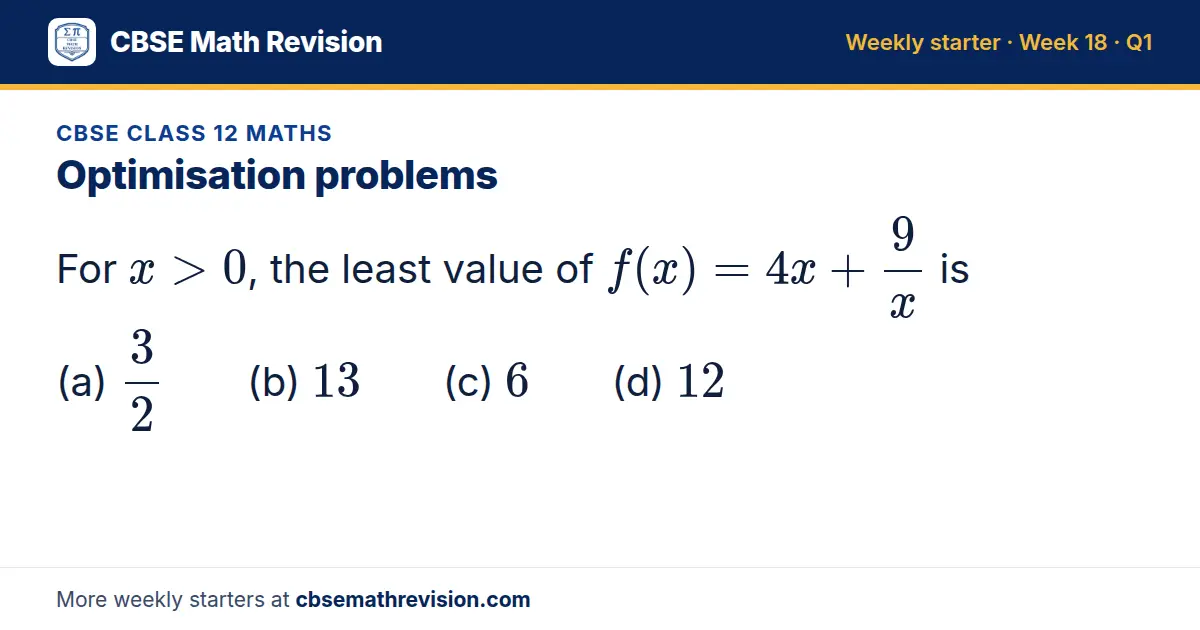
Question 1: Optimisation problems
For x > 0, the least value of f(x) = 4x + 9/x is (a) 32 (b) 13 (c) 6 (d) 12
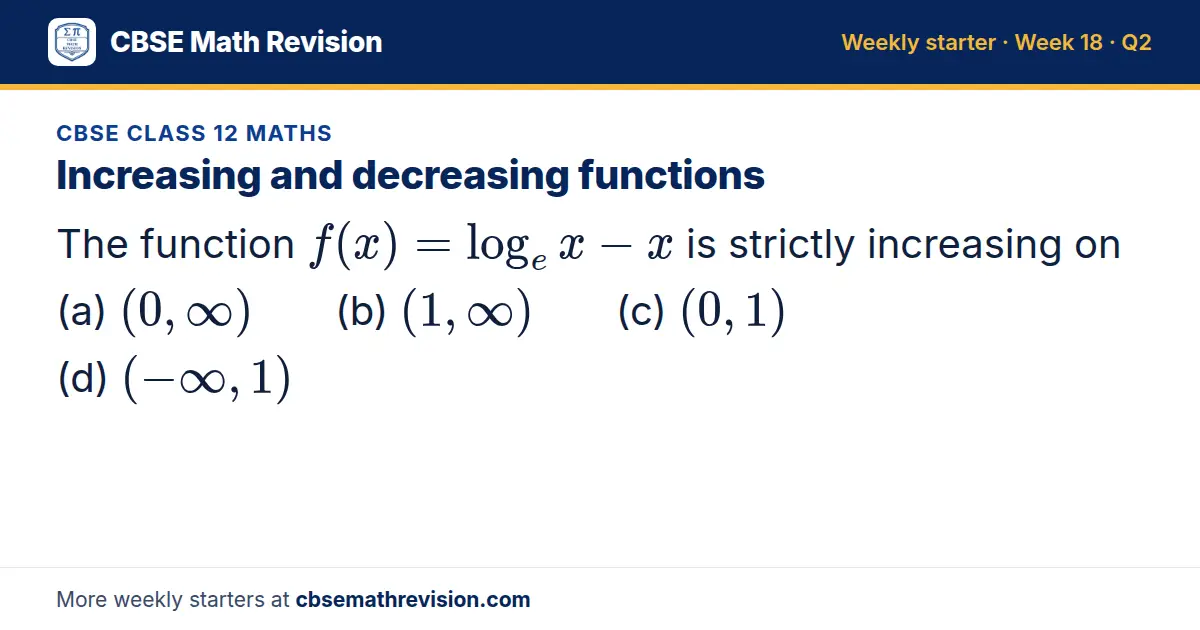
Question 2: Increasing and decreasing functions
The function f(x) = log_e x - x is strictly increasing on (a) (0, ∞) (b) (1, ∞) (c) (0, 1) (d) (-∞, 1)
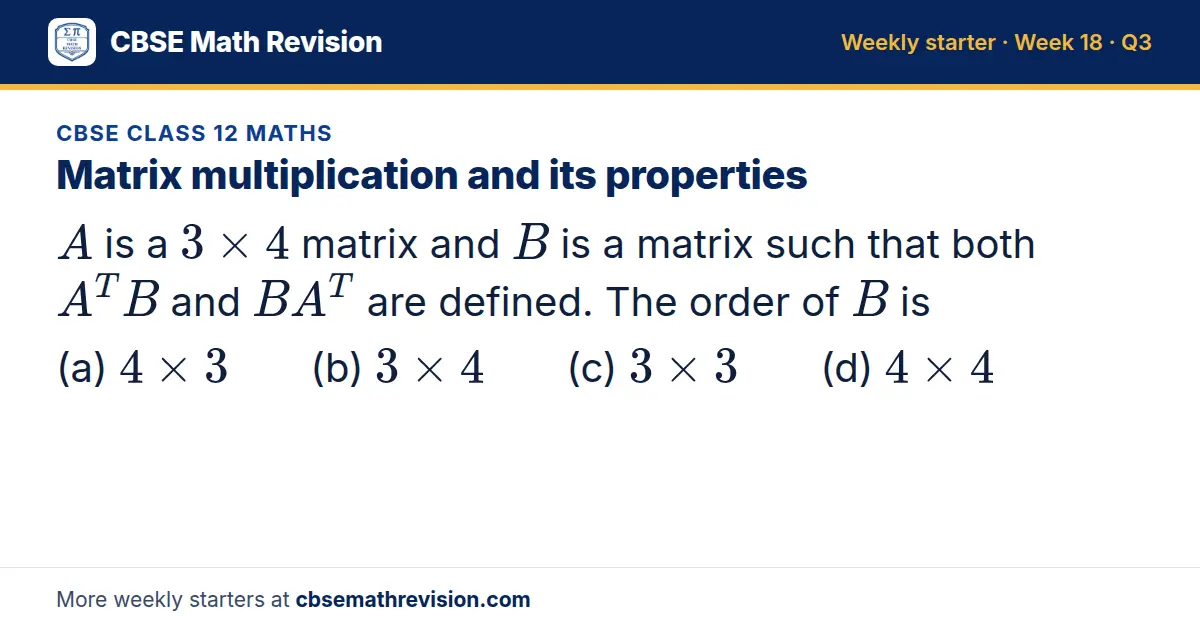
Question 3: Matrix multiplication and its properties
A is a 3 × 4 matrix and B is a matrix such that both A^TB and BA^T are defined. The order of B is (a) 4 × 3 (b) 3 × 4 (c) 3 × 3 (d) 4 × 4
More starter questions
Other weeks: Weeks 1–18 · Weeks 19–31 · Weeks 32–46. Answers and mark schemes are in the teacher tools.