CBSE Class 10 Maths starter questions: weeks 1–18
33 short questions to open a lesson for CBSE Class 10 Mathematics, weeks 1–18 of the teaching year, three or four a week. Each question is shown as an image with its text underneath; answers and mark schemes stay with teachers.
Week 1
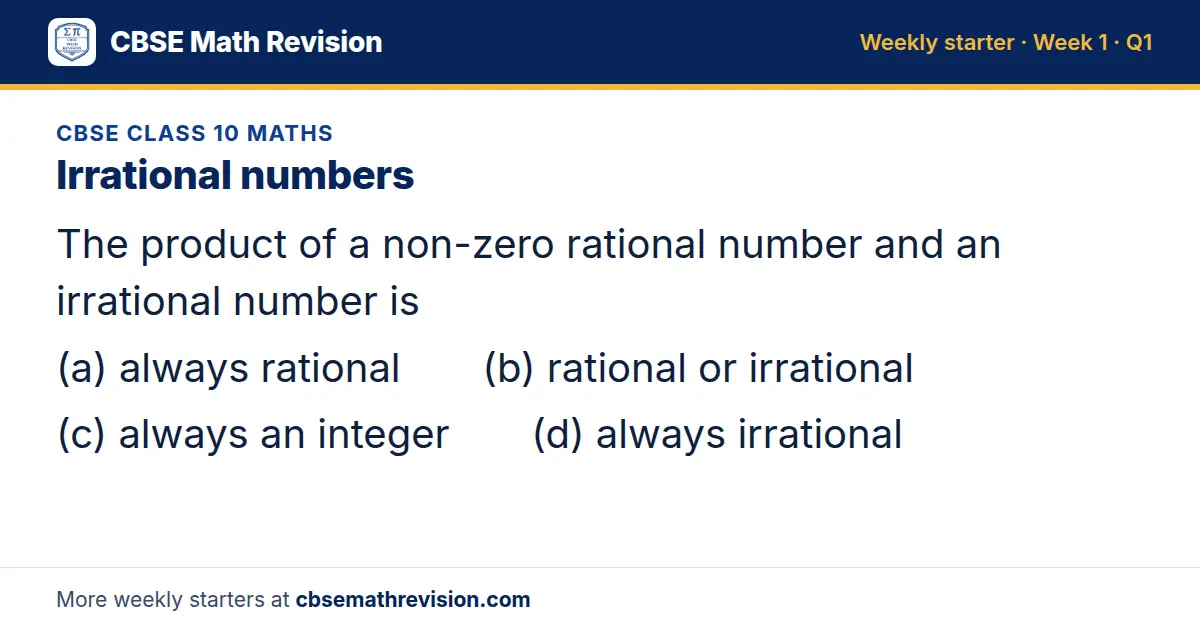
Question 1: Irrational numbers
The product of a non-zero rational number and an irrational number is (a) always rational (b) rational or irrational (c) always an integer (d) always irrational
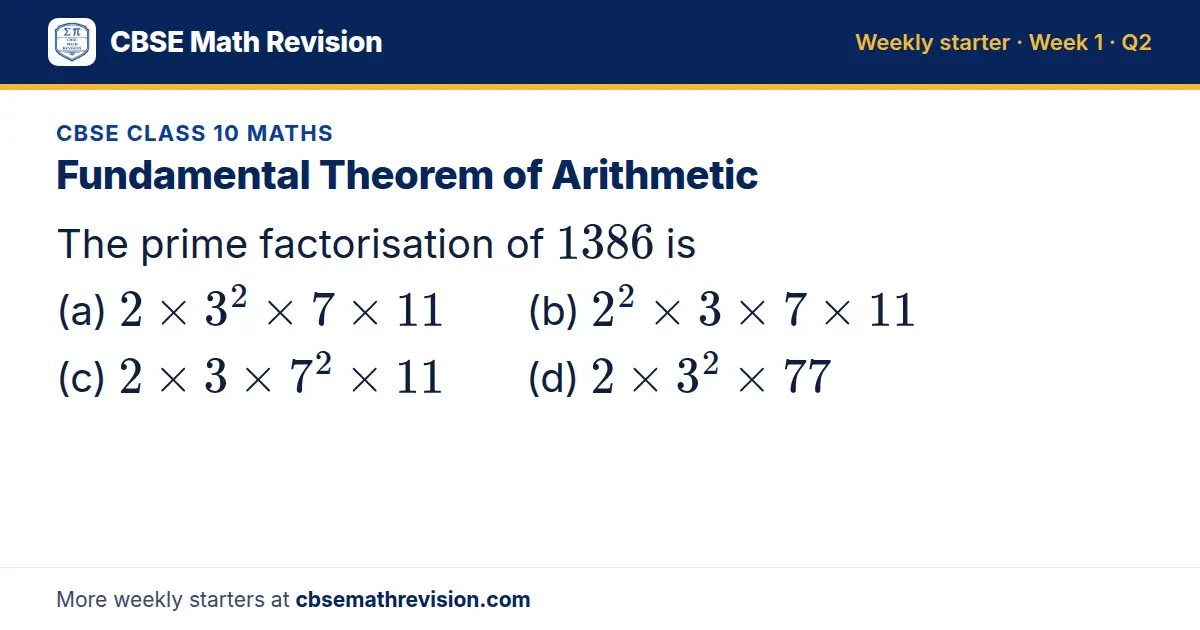
Question 2: Fundamental Theorem of Arithmetic
The prime factorisation of 1386 is (a) 2 × 3² × 7 × 11 (b) 2² × 3 × 7 × 11 (c) 2 × 3 × 7² × 11 (d) 2 × 3² × 77
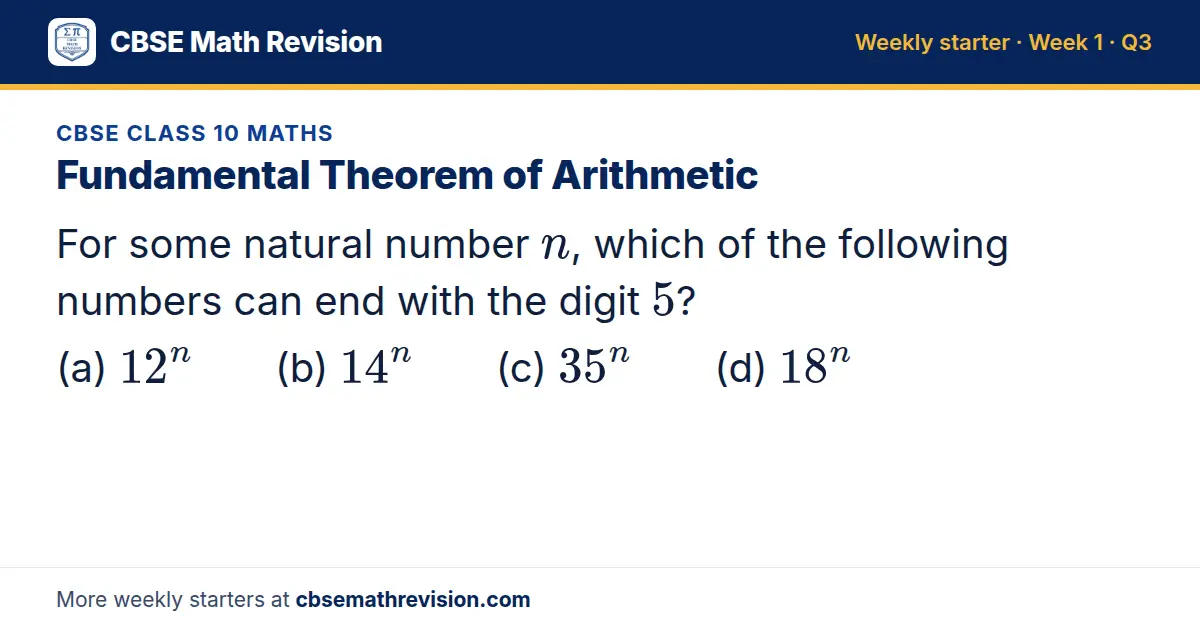
Question 3: Fundamental Theorem of Arithmetic
For some natural number n, which of the following numbers can end with the digit 5? (a) 12^n (b) 14^n (c) 35^n (d) 18^n
Week 2
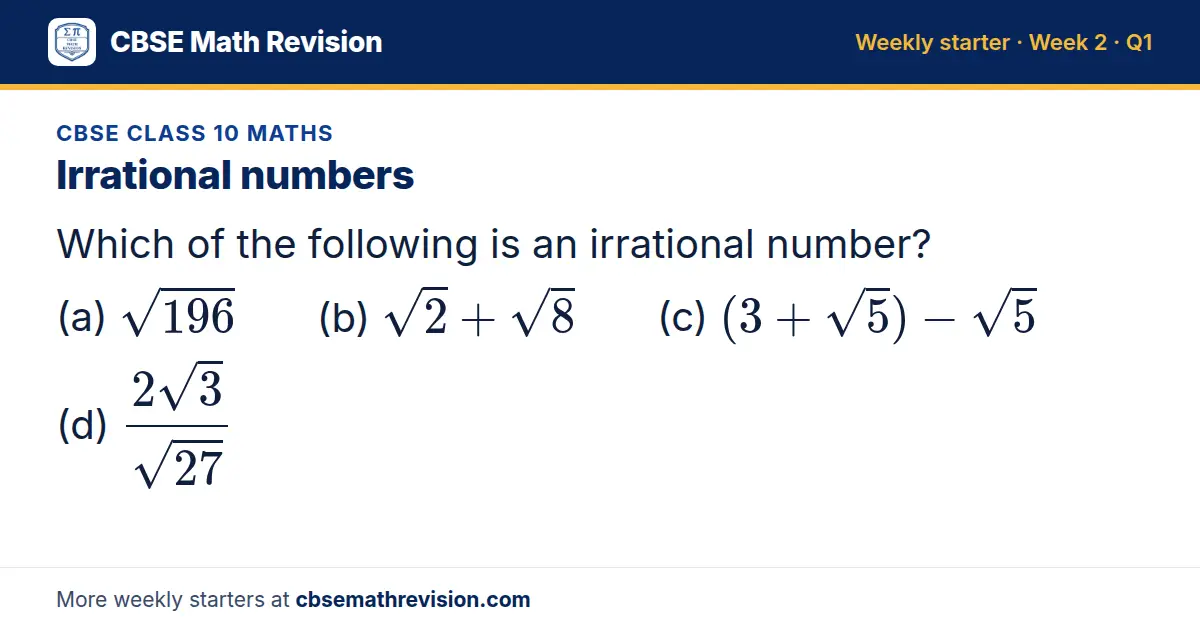
Question 1: Irrational numbers
Which of the following is an irrational number? (a) √196 (b) √2 + √8 (c) (3+√5) - √5 (d) (2√3)/(√27)
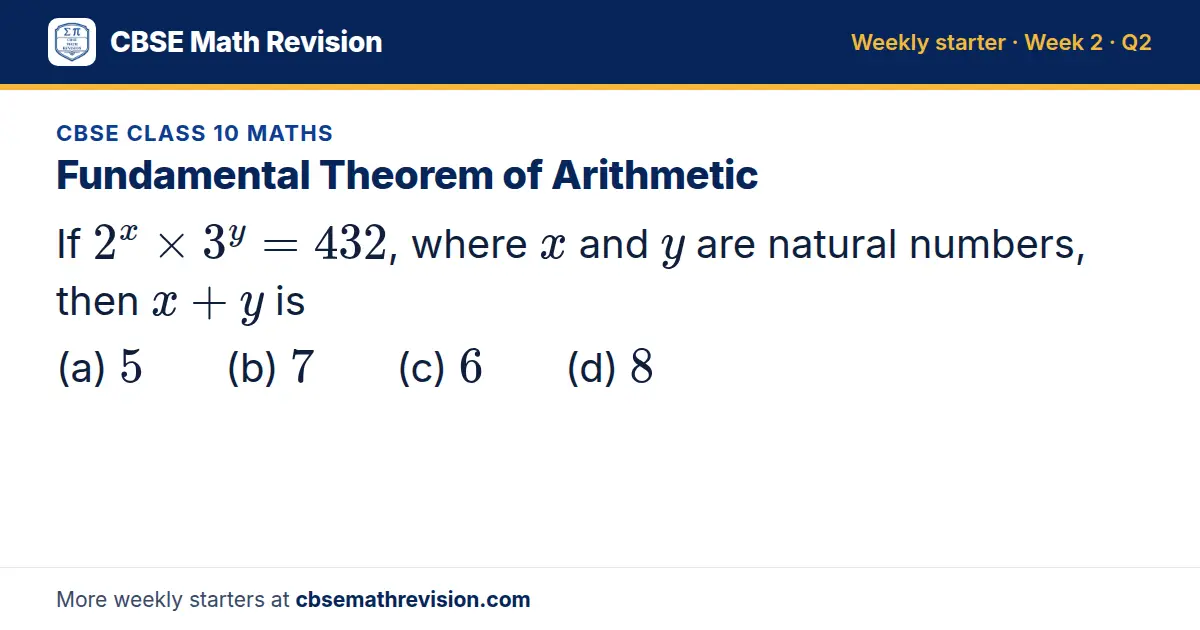
Question 2: Fundamental Theorem of Arithmetic
If 2^x × 3^y = 432, where x and y are natural numbers, then x + y is (a) 5 (b) 7 (c) 6 (d) 8
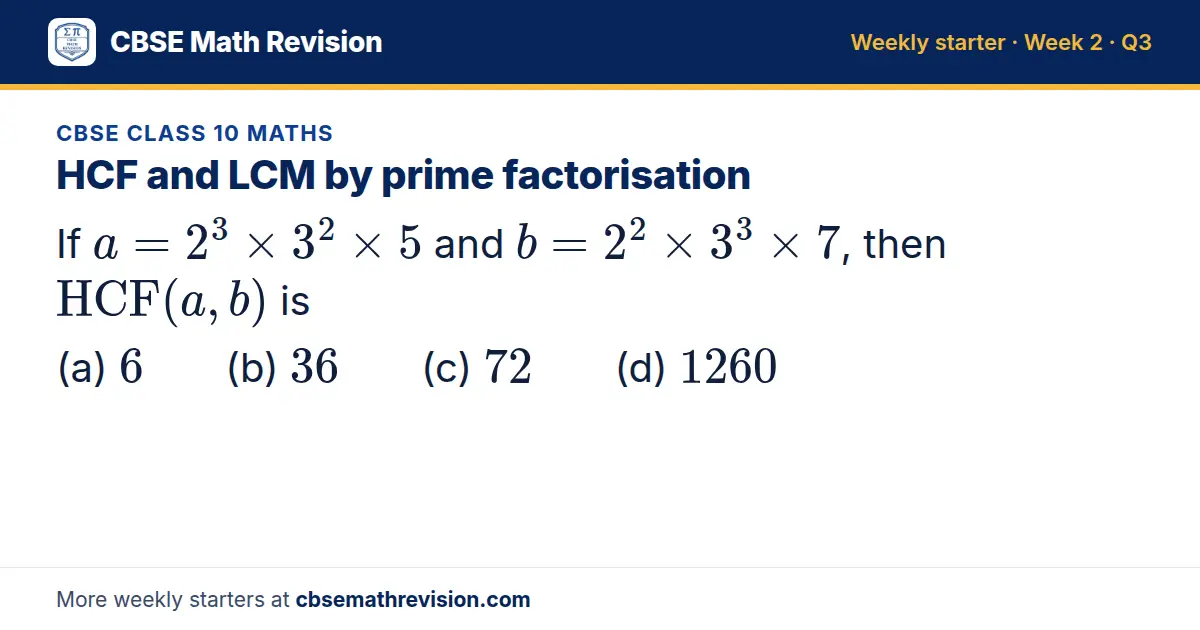
Question 3: HCF and LCM by prime factorisation
If a = 2³ × 3² × 5 and b = 2² × 3³ × 7, then HCF(a, b) is (a) 6 (b) 36 (c) 72 (d) 1260
Week 3
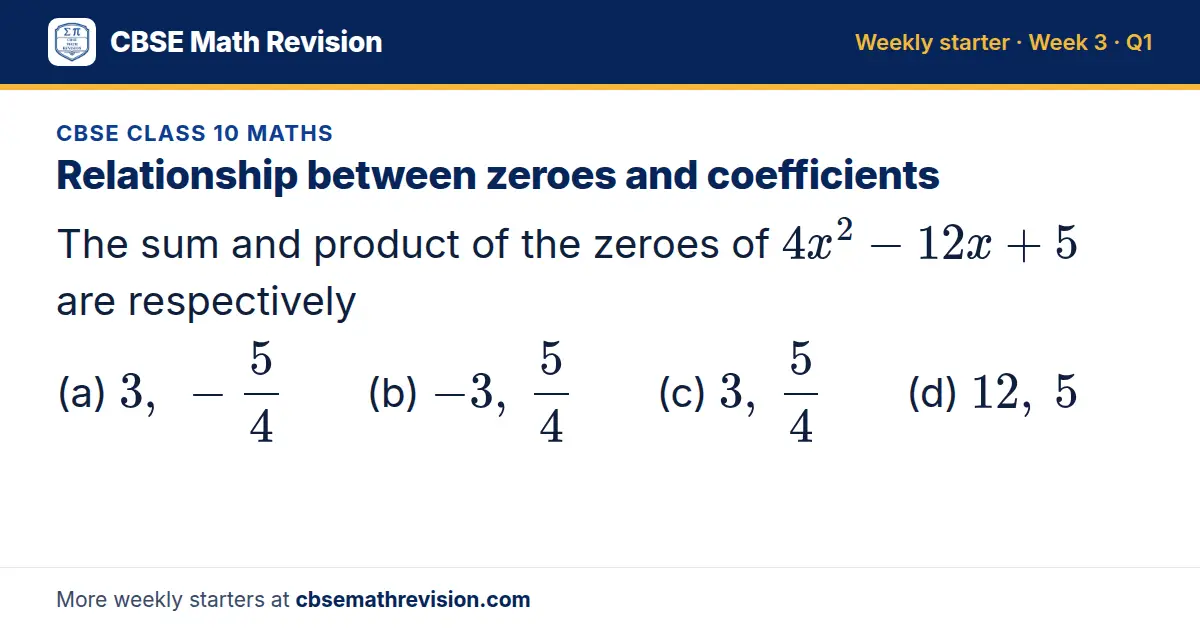
Question 1: Relationship between zeroes and coefficients
The sum and product of the zeroes of 4x² - 12x + 5 are respectively (a) 3, -54 (b) -3, 54 (c) 3, 54 (d) 12, 5
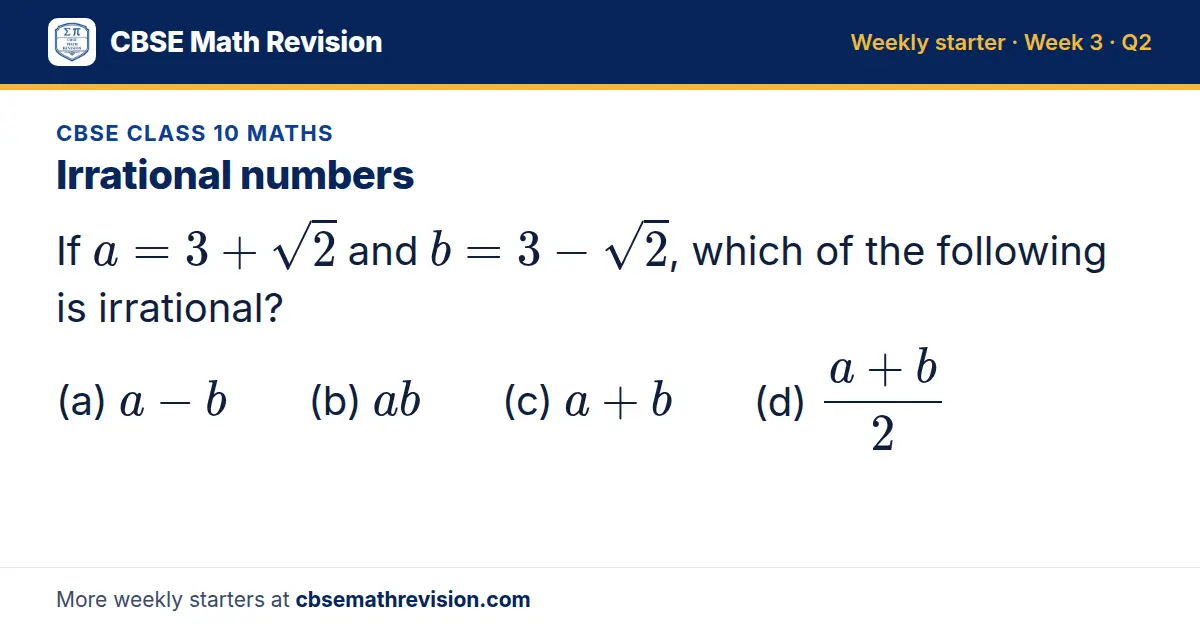
Question 2: Irrational numbers
If a = 3 + √2 and b = 3 - √2, which of the following is irrational? (a) a - b (b) ab (c) a + b (d) (a+b)/2
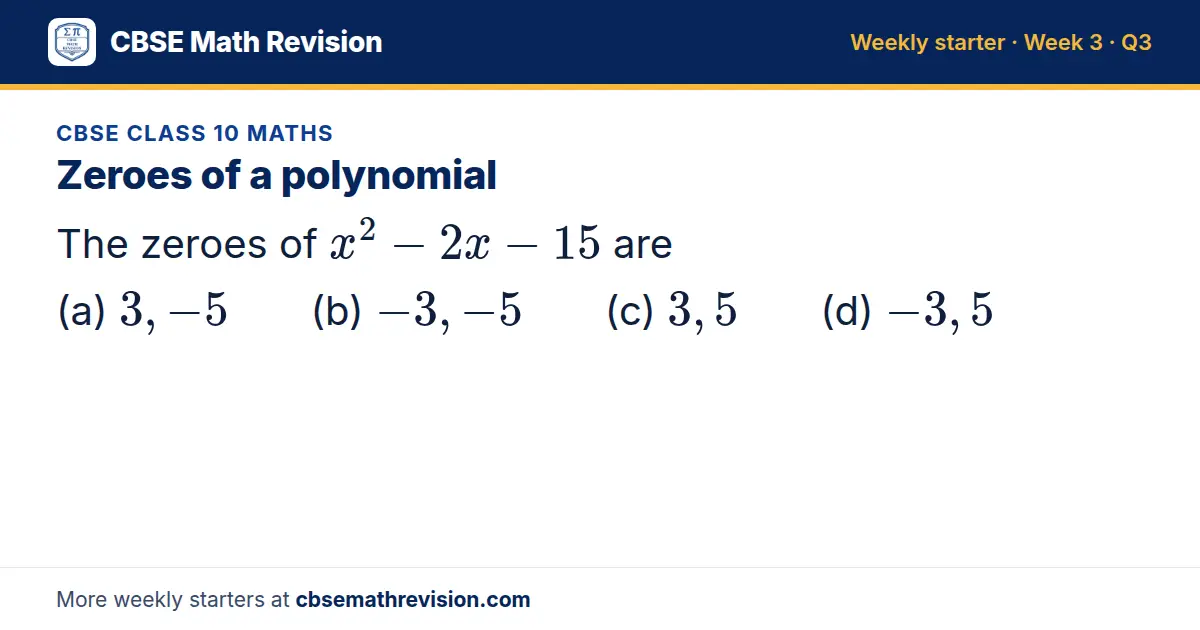
Question 3: Zeroes of a polynomial
The zeroes of x² - 2x - 15 are (a) 3, -5 (b) -3, -5 (c) 3, 5 (d) -3, 5
Week 4
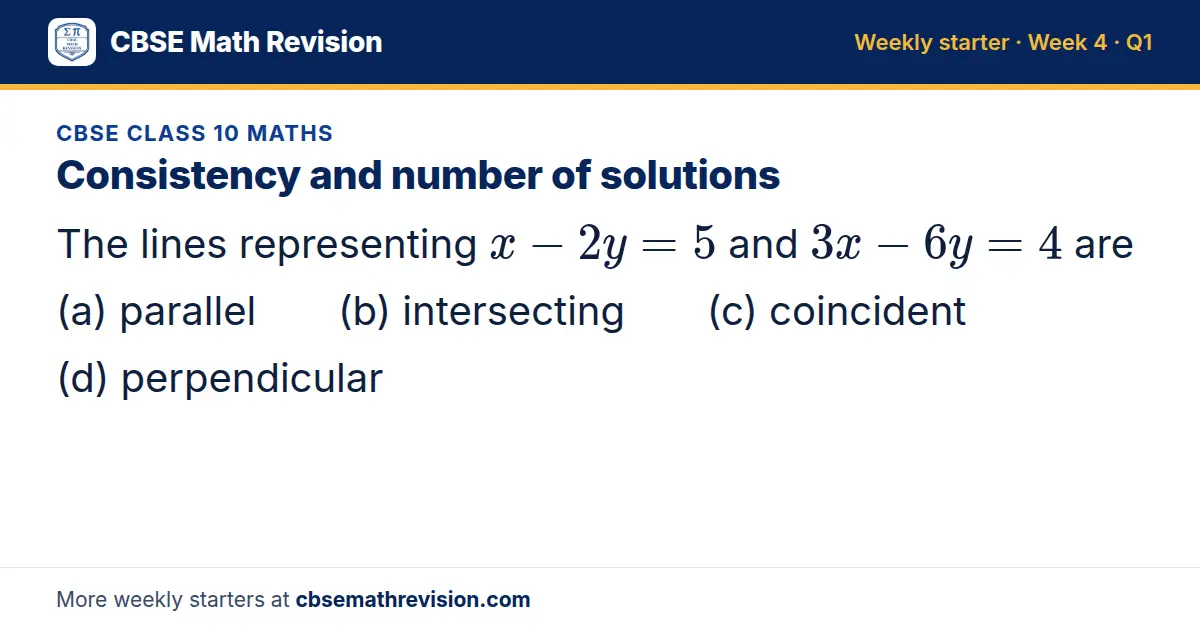
Question 1: Consistency and number of solutions
The lines representing x - 2y = 5 and 3x - 6y = 4 are (a) parallel (b) intersecting (c) coincident (d) perpendicular
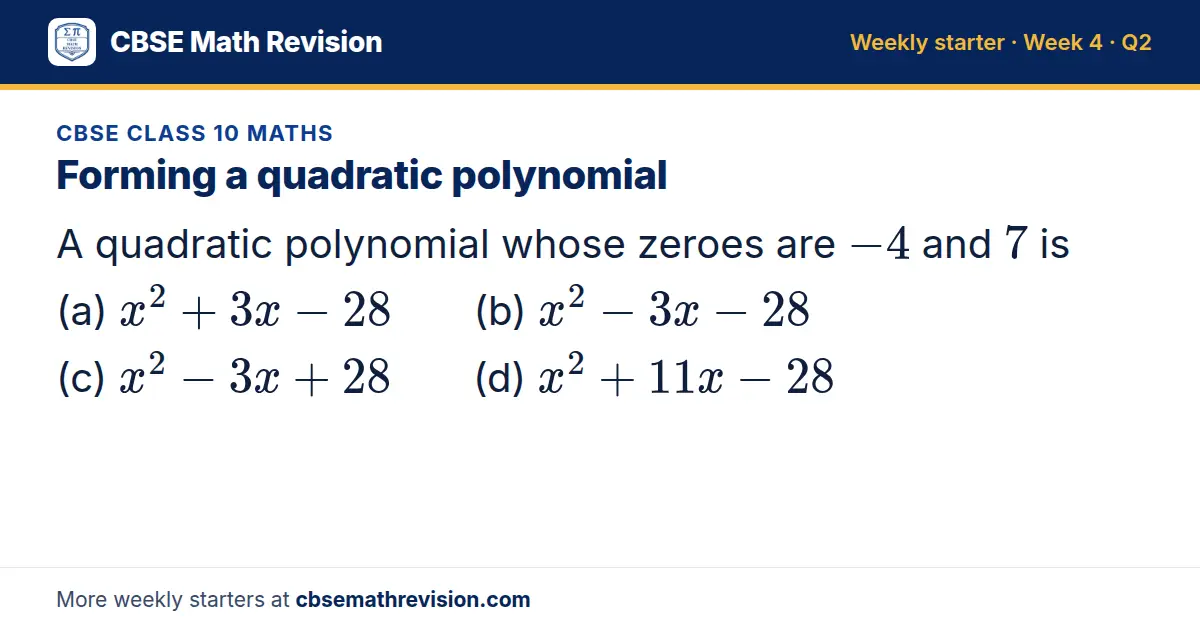
Question 2: Forming a quadratic polynomial
A quadratic polynomial whose zeroes are -4 and 7 is (a) x² + 3x - 28 (b) x² - 3x - 28 (c) x² - 3x + 28 (d) x² + 11x - 28
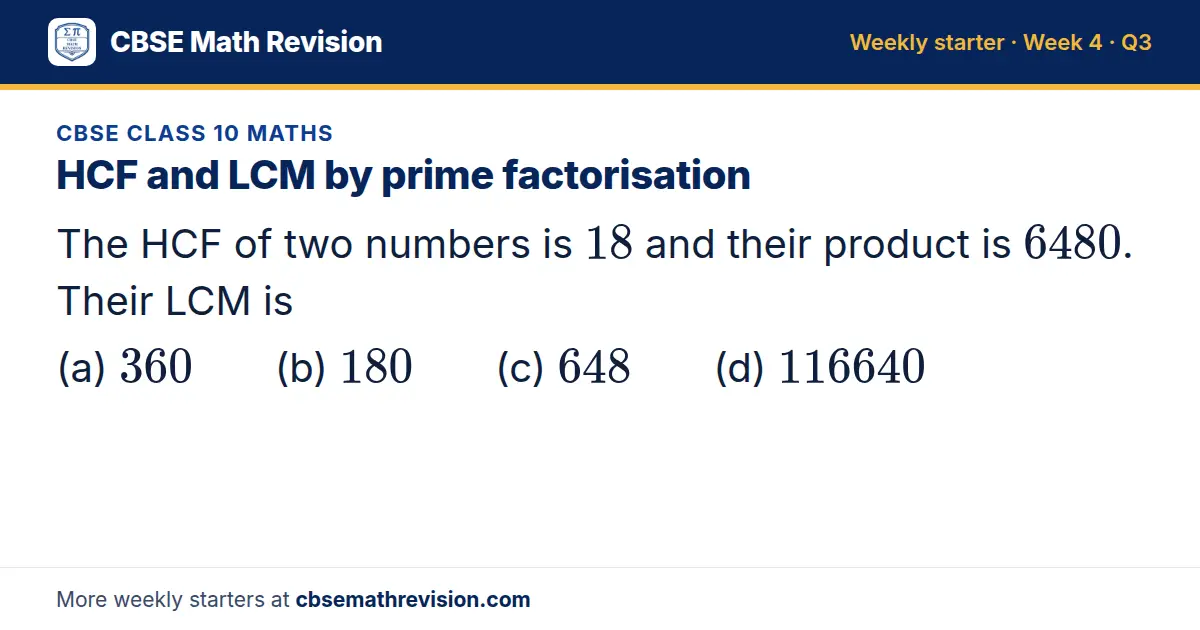
Question 3: HCF and LCM by prime factorisation
The HCF of two numbers is 18 and their product is 6480. Their LCM is (a) 360 (b) 180 (c) 648 (d) 116640
Week 5
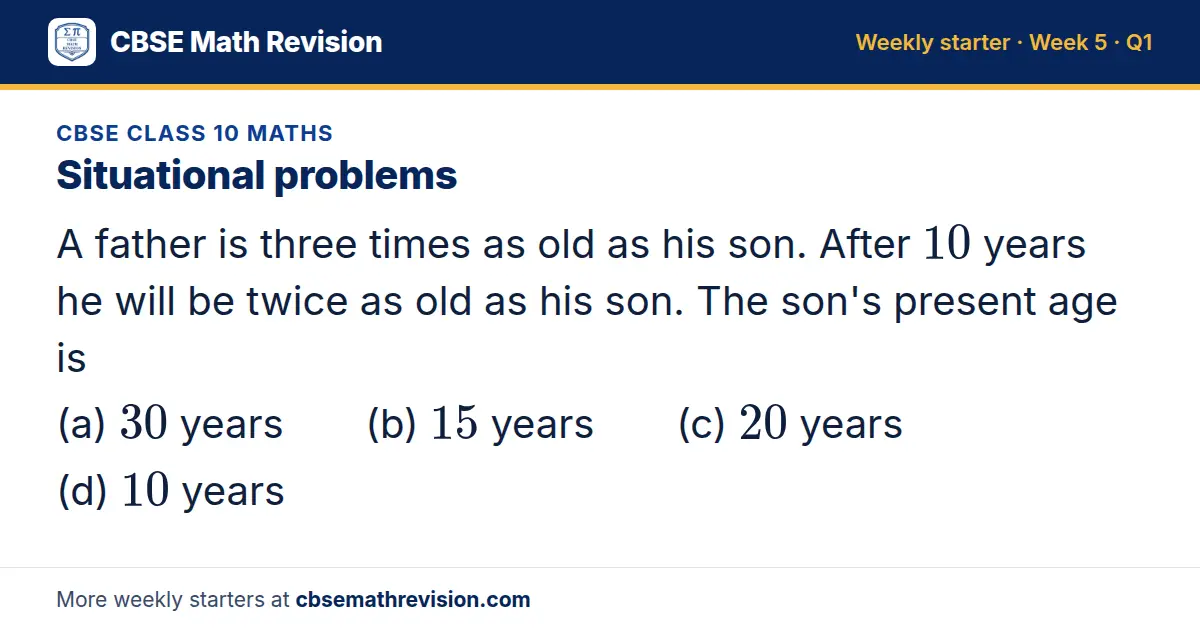
Question 1: Situational problems
A father is three times as old as his son. After 10 years he will be twice as old as his son. The son's present age is (a) 30 years (b) 15 years (c) 20 years (d) 10 years
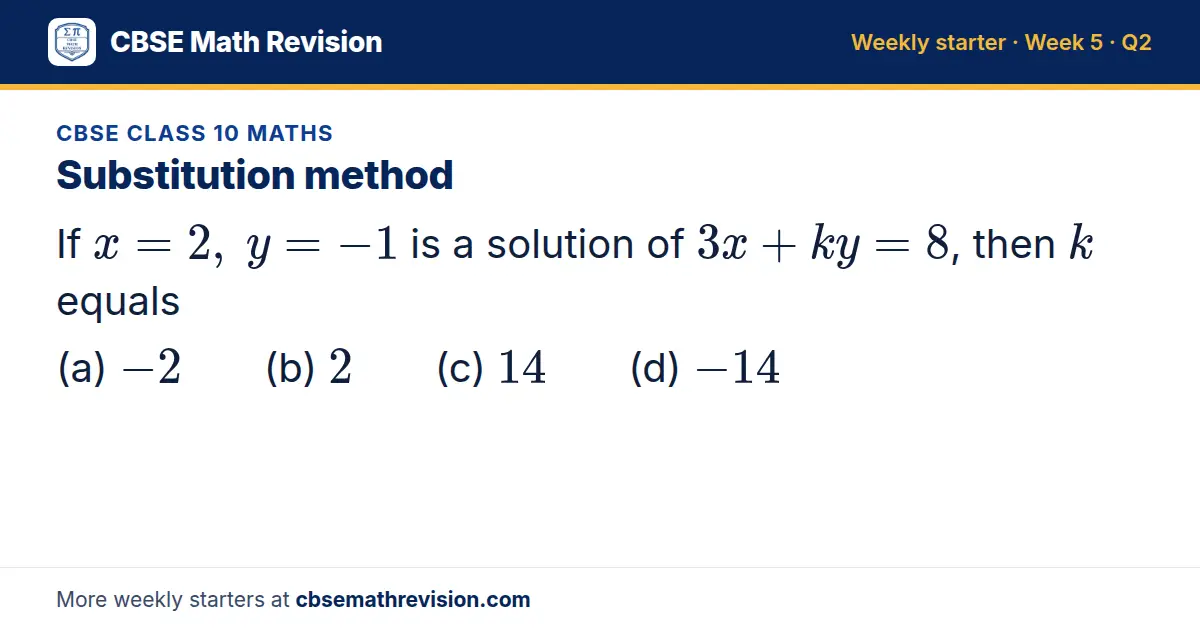
Question 2: Substitution method
If x = 2, y = -1 is a solution of 3x + ky = 8, then k equals (a) -2 (b) 2 (c) 14 (d) -14
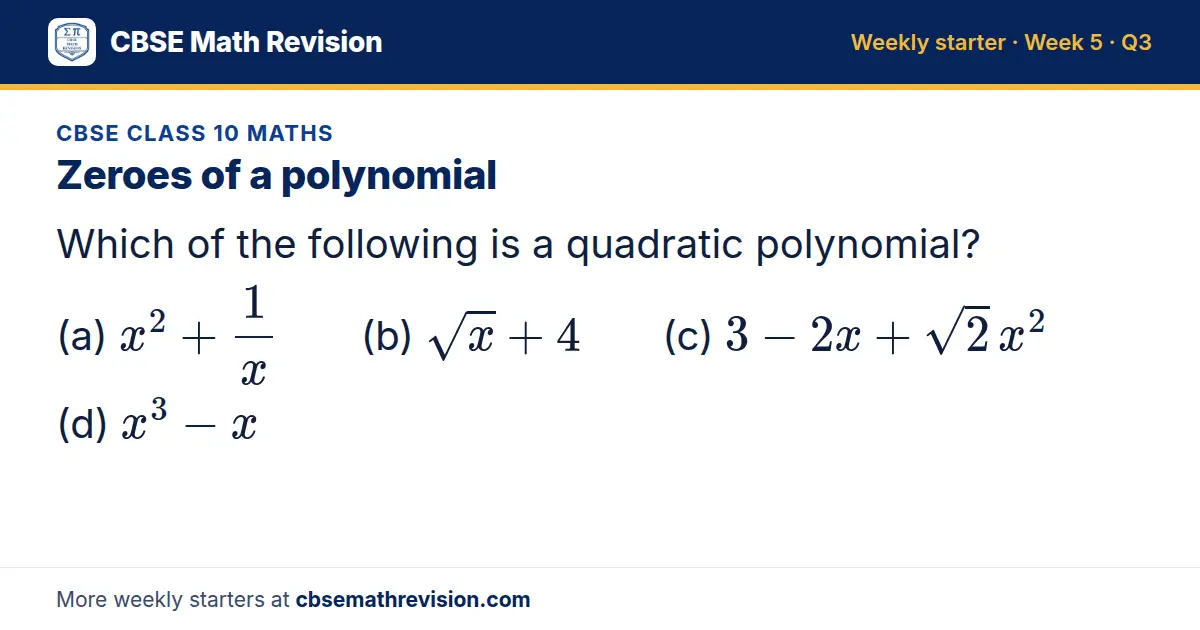
Question 3: Zeroes of a polynomial
Which of the following is a quadratic polynomial? (a) x² + 1x (b) √x + 4 (c) 3 - 2x + √2 x² (d) x³ - x
Week 6
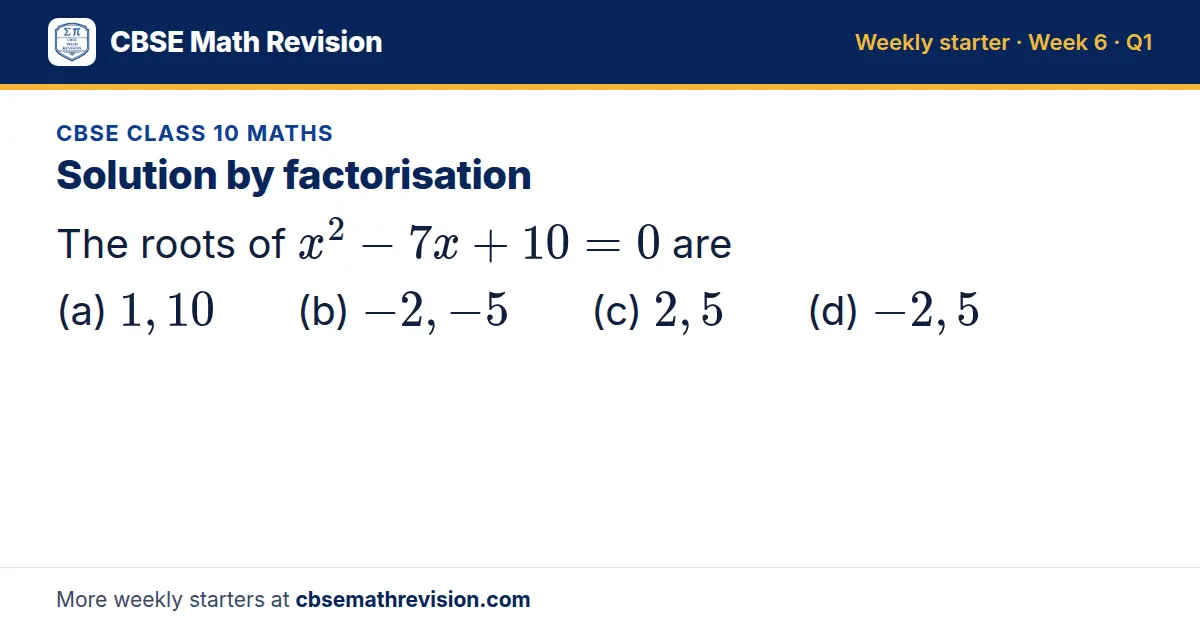
Question 1: Solution by factorisation
The roots of x² - 7x + 10 = 0 are (a) 1, 10 (b) -2, -5 (c) 2, 5 (d) -2, 5
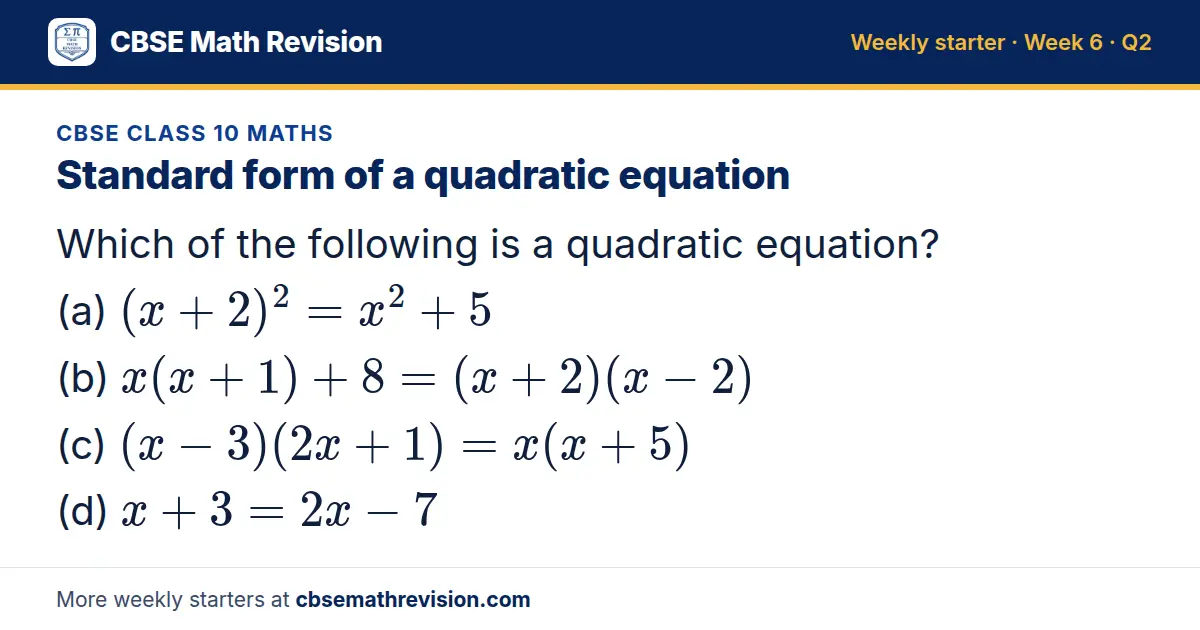
Question 2: Standard form of a quadratic equation
Which of the following is a quadratic equation? (a) (x + 2)² = x² + 5 (b) x(x + 1) + 8 = (x + 2)(x - 2) (c) (x - 3)(2x + 1) = x(x + 5) (d) x + 3 = 2x - 7
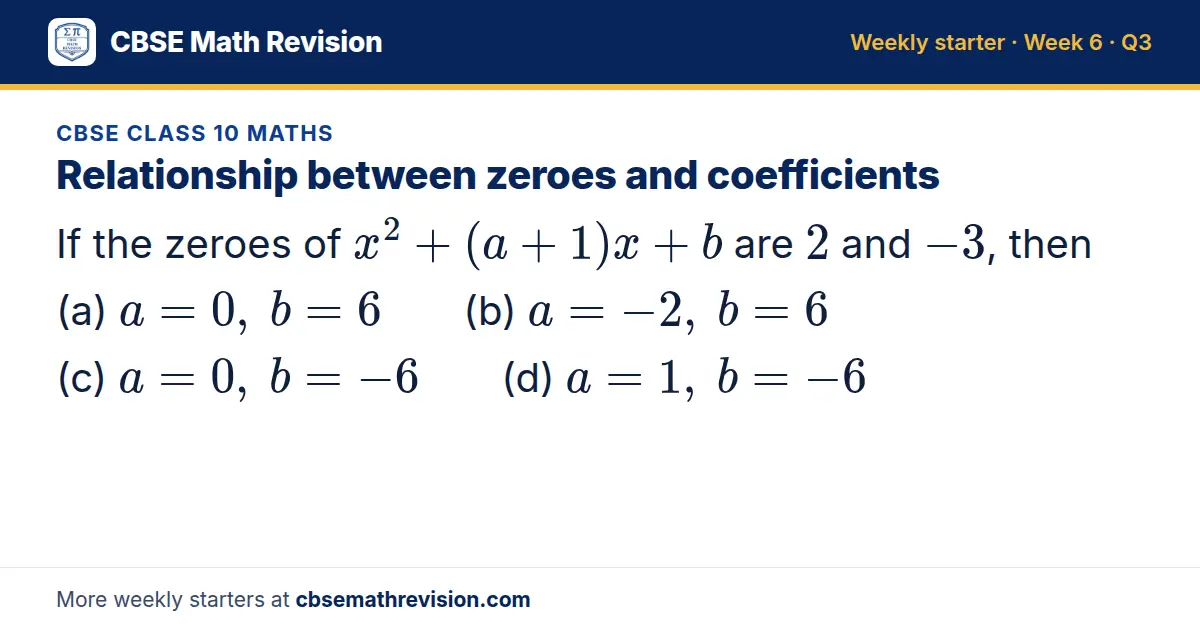
Question 3: Relationship between zeroes and coefficients
If the zeroes of x² + (a+1)x + b are 2 and -3, then (a) a = 0, b = 6 (b) a = -2, b = 6 (c) a = 0, b = -6 (d) a = 1, b = -6
Week 13
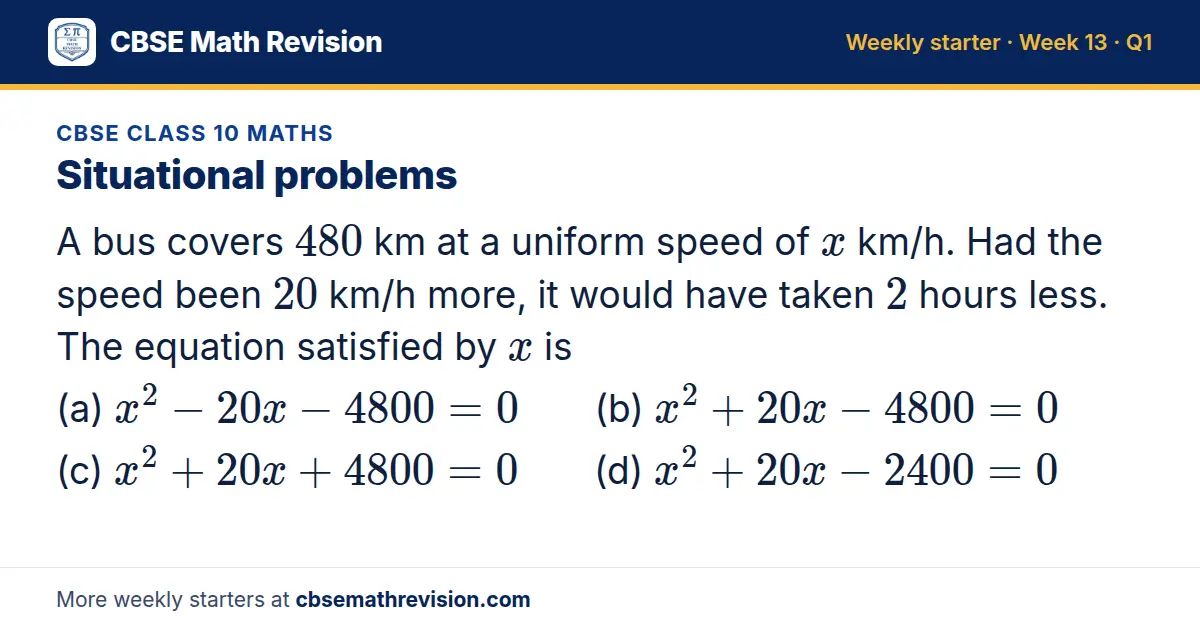
Question 1: Situational problems
A bus covers 480 km at a uniform speed of x km/h. Had the speed been 20 km/h more, it would have taken 2 hours less. The equation satisfied by x is (a) x² - 20x - 4800 = 0 (b) x² + 20x - 4800 = 0 (c) x² + 20x + 4800 = 0 (d) x² + 20x - 2400 = 0
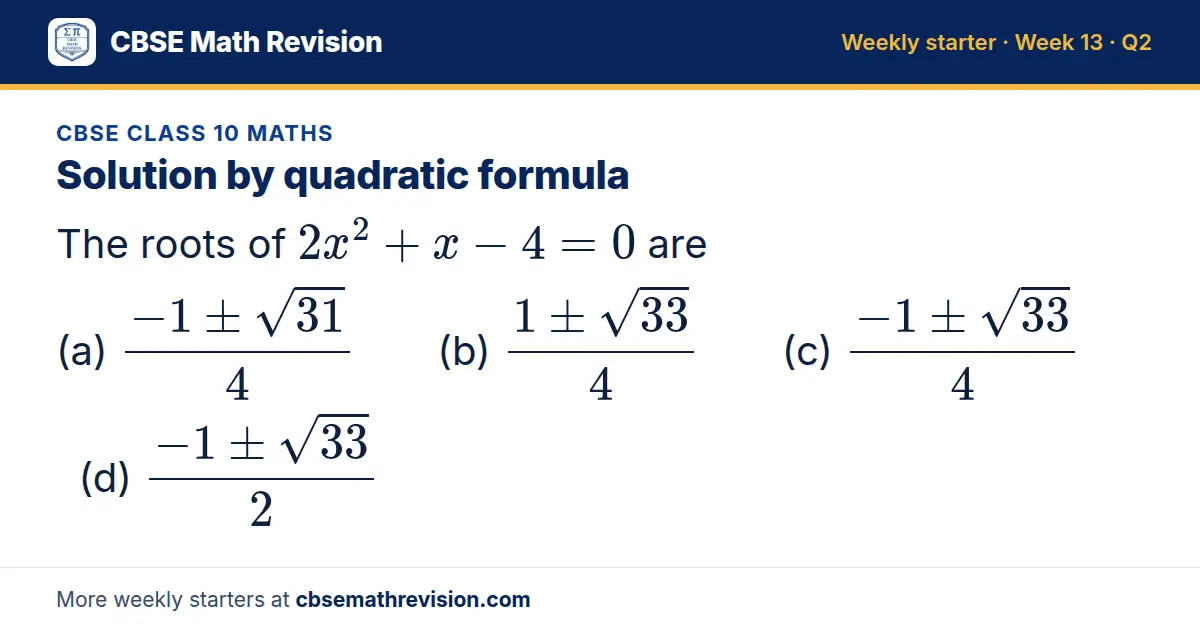
Question 2: Solution by quadratic formula
The roots of 2x² + x - 4 = 0 are (a) (-1 ± √31)/4 (b) (1 ± √33)/4 (c) (-1 ± √33)/4 (d) (-1 ± √33)/2
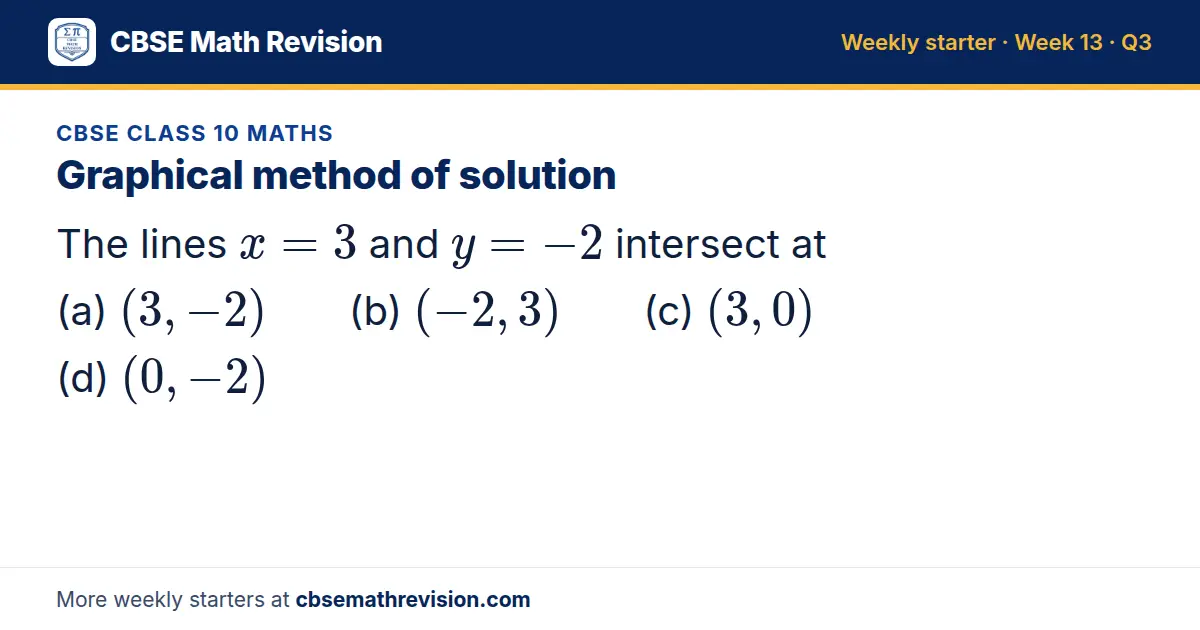
Question 3: Graphical method of solution
The lines x = 3 and y = -2 intersect at (a) (3, -2) (b) (-2, 3) (c) (3, 0) (d) (0, -2)
Week 15
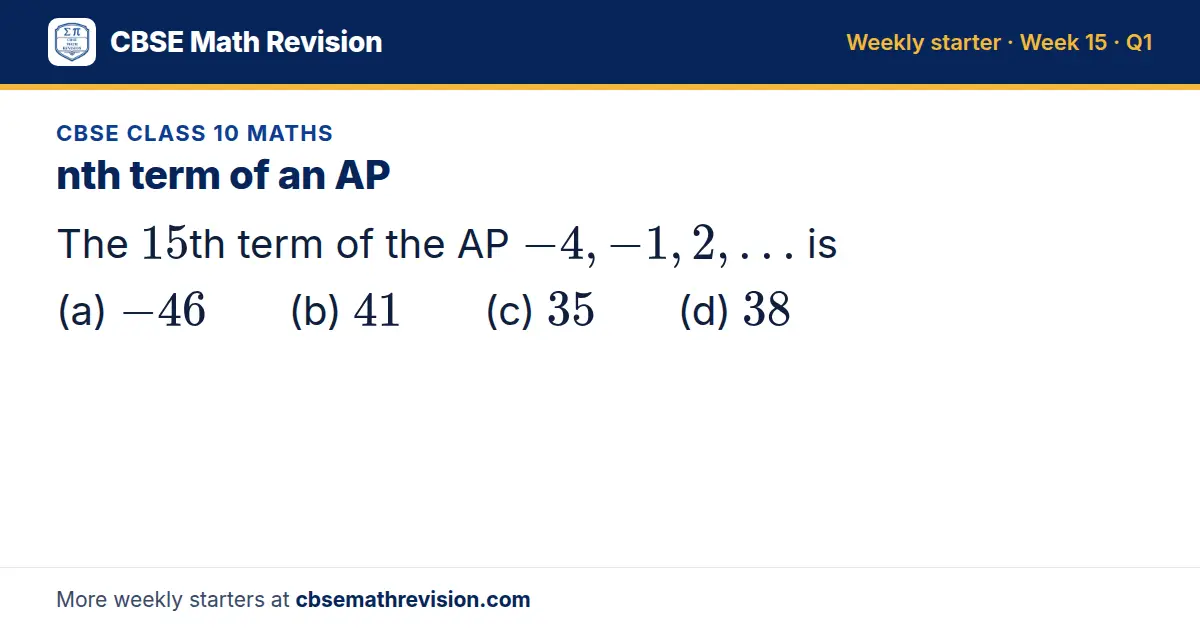
Question 1: nth term of an AP
The 15th term of the AP -4, -1, 2, … is (a) -46 (b) 41 (c) 35 (d) 38
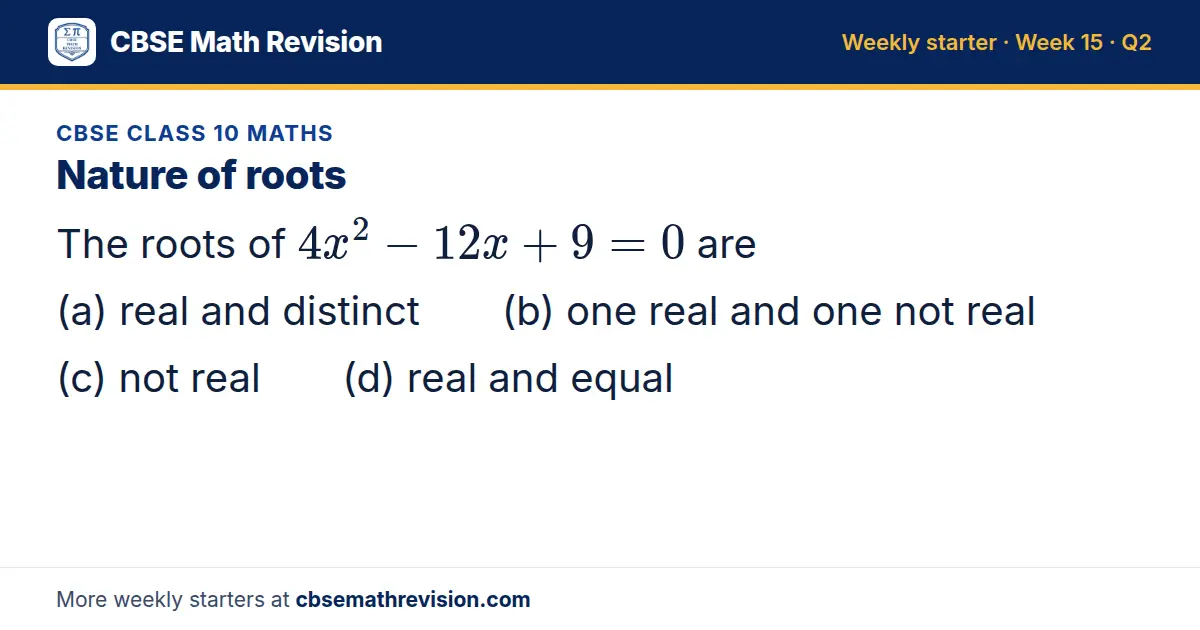
Question 2: Nature of roots
The roots of 4x² - 12x + 9 = 0 are (a) real and distinct (b) one real and one not real (c) not real (d) real and equal
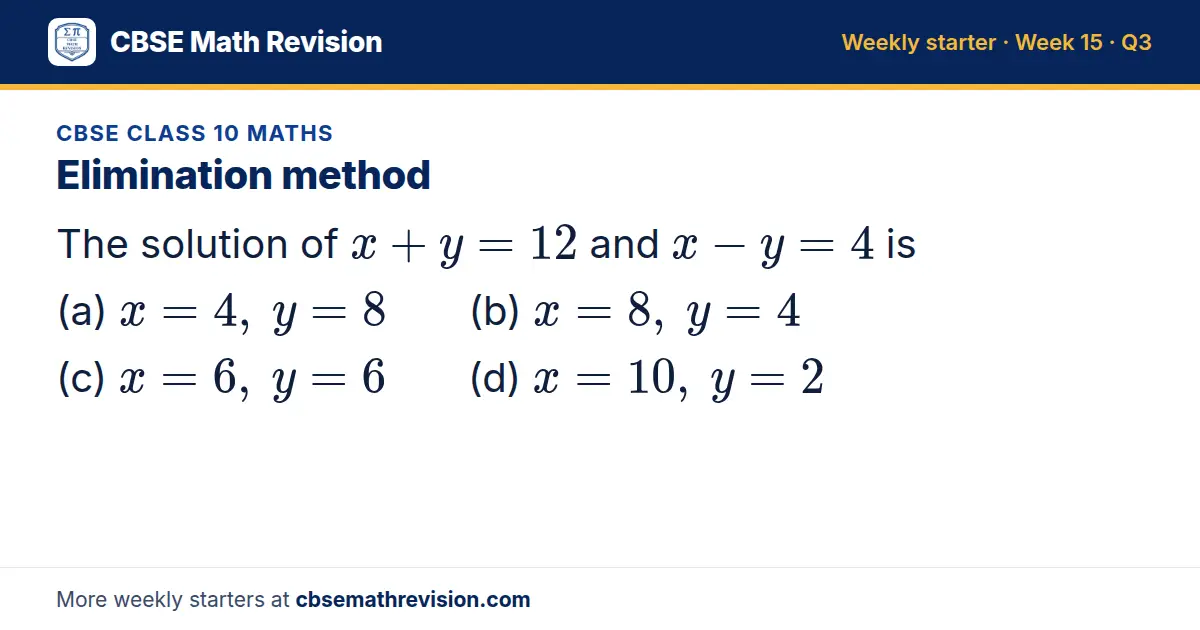
Question 3: Elimination method
The solution of x + y = 12 and x - y = 4 is (a) x = 4, y = 8 (b) x = 8, y = 4 (c) x = 6, y = 6 (d) x = 10, y = 2
Week 16
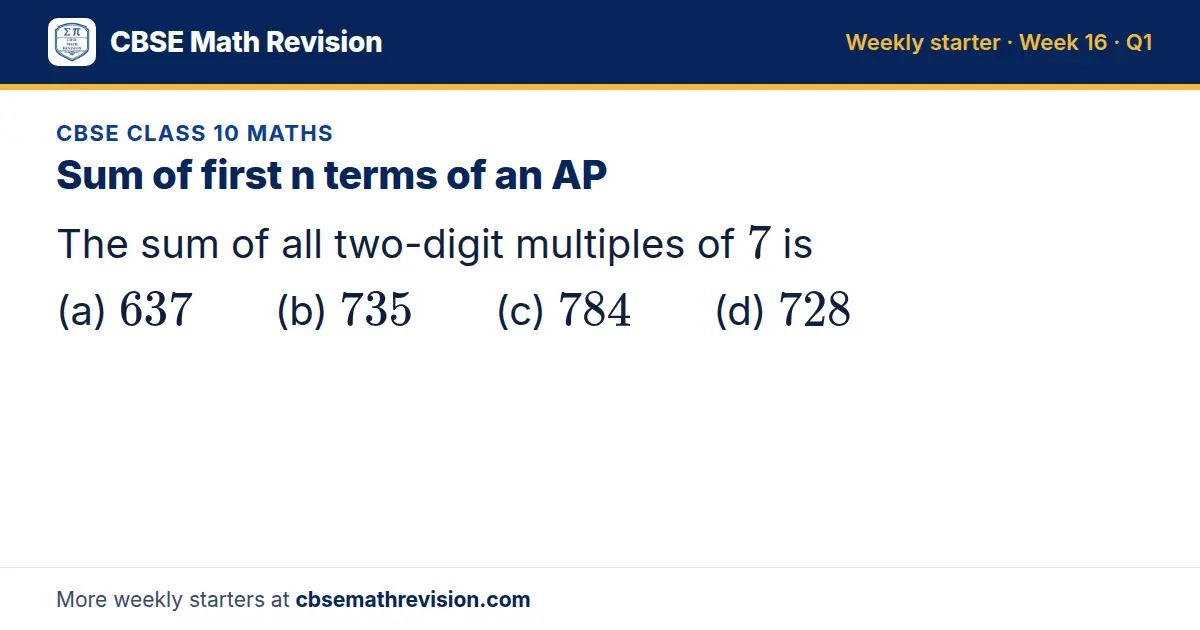
Question 1: Sum of first n terms of an AP
The sum of all two-digit multiples of 7 is (a) 637 (b) 735 (c) 784 (d) 728
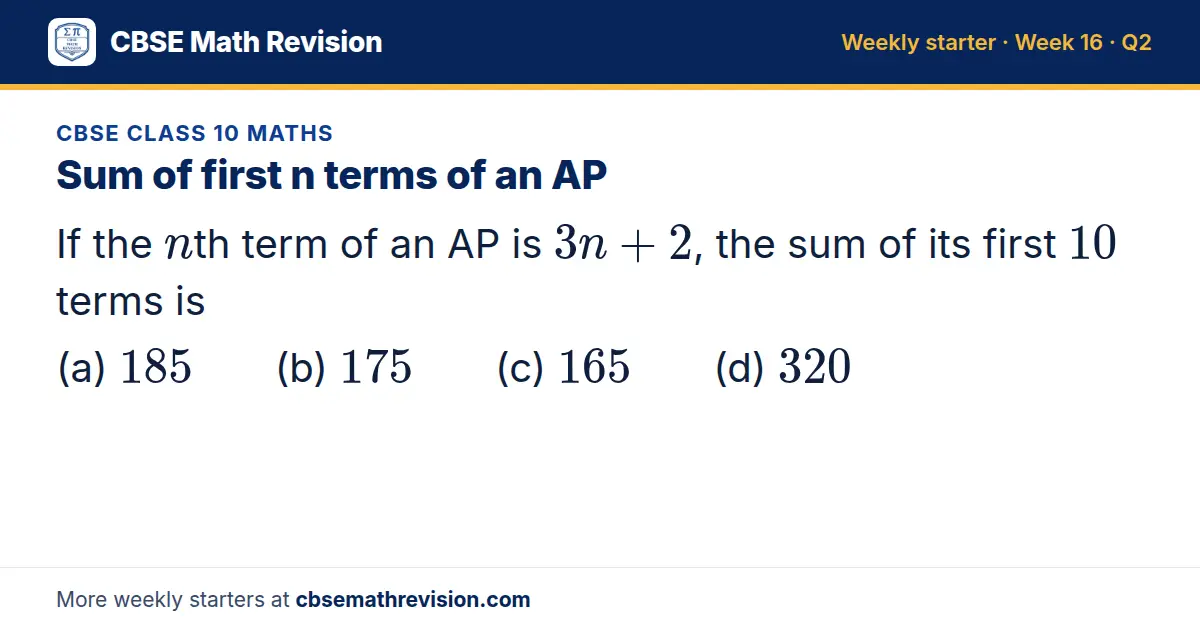
Question 2: Sum of first n terms of an AP
If the nth term of an AP is 3n + 2, the sum of its first 10 terms is (a) 185 (b) 175 (c) 165 (d) 320
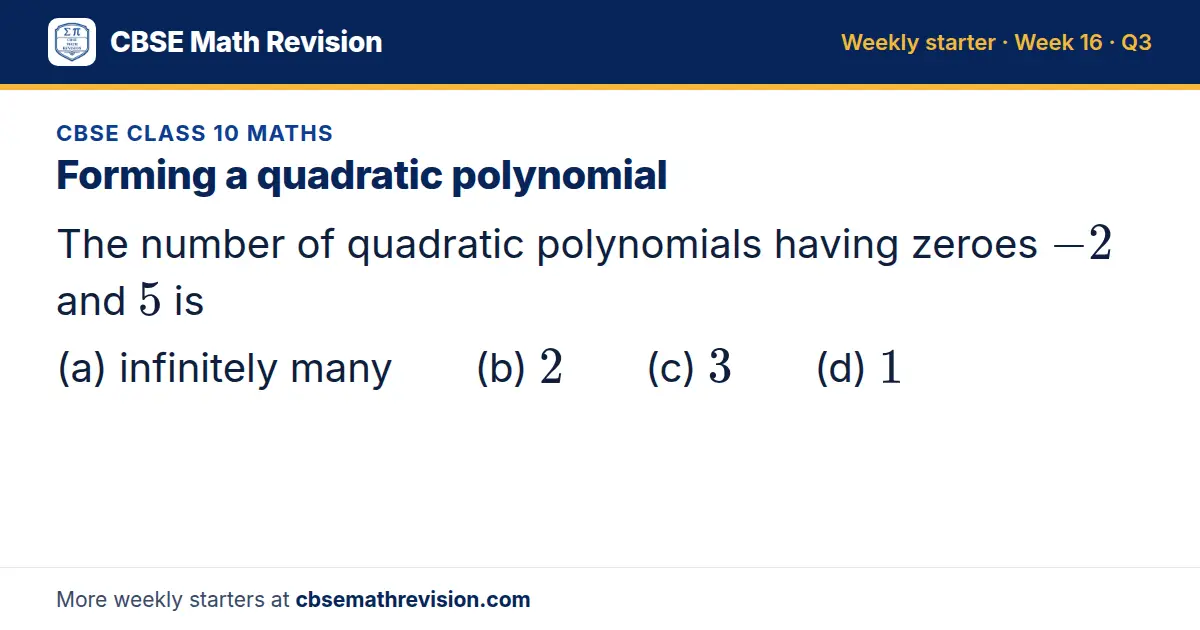
Question 3: Forming a quadratic polynomial
The number of quadratic polynomials having zeroes -2 and 5 is (a) infinitely many (b) 2 (c) 3 (d) 1
Week 17
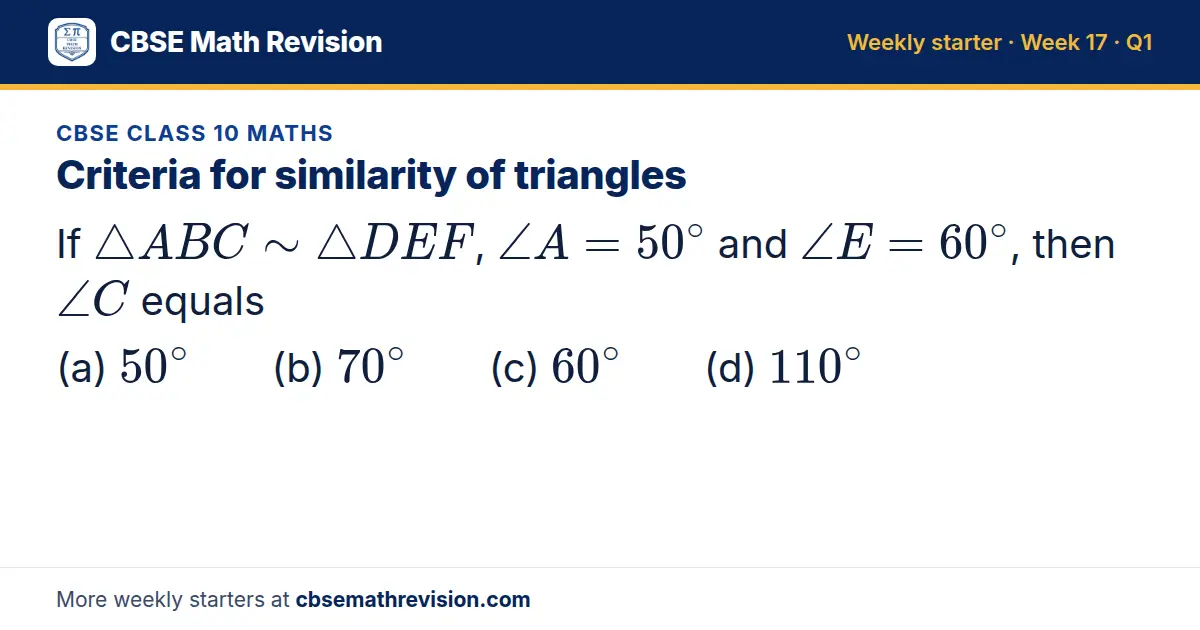
Question 1: Criteria for similarity of triangles
If △ ABC △ DEF, ∠ A = 50^∘ and ∠ E = 60^∘, then ∠ C equals (a) 50^∘ (b) 70^∘ (c) 60^∘ (d) 110^∘
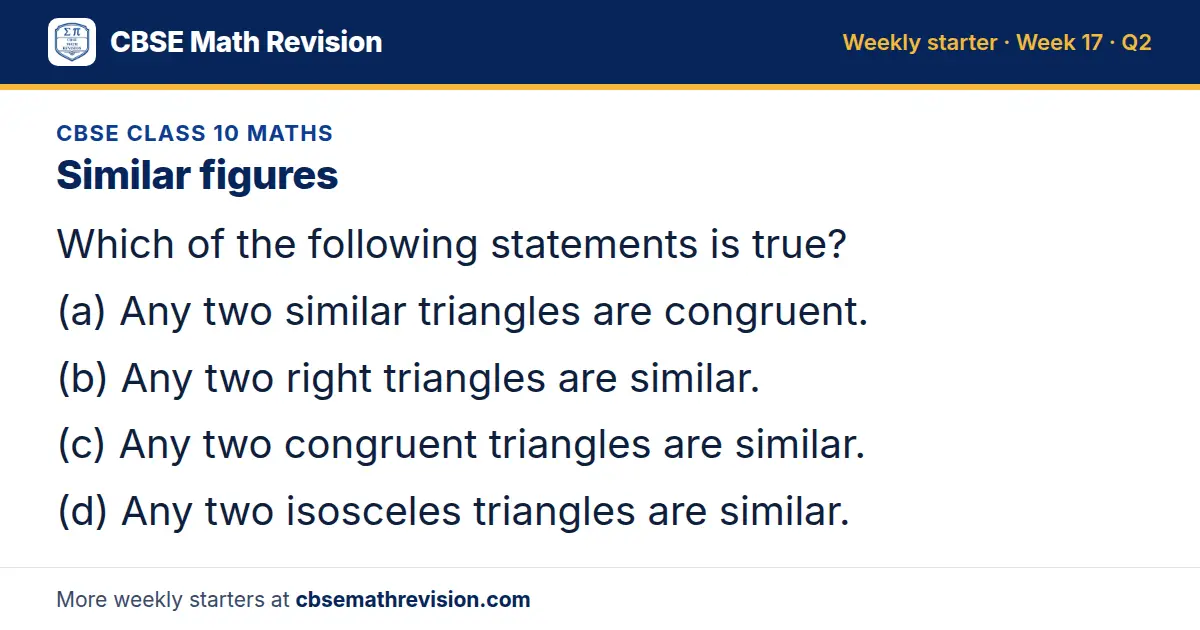
Question 2: Similar figures
Which of the following statements is true? (a) Any two similar triangles are congruent. (b) Any two right triangles are similar. (c) Any two congruent triangles are similar. (d) Any two isosceles triangles are similar.
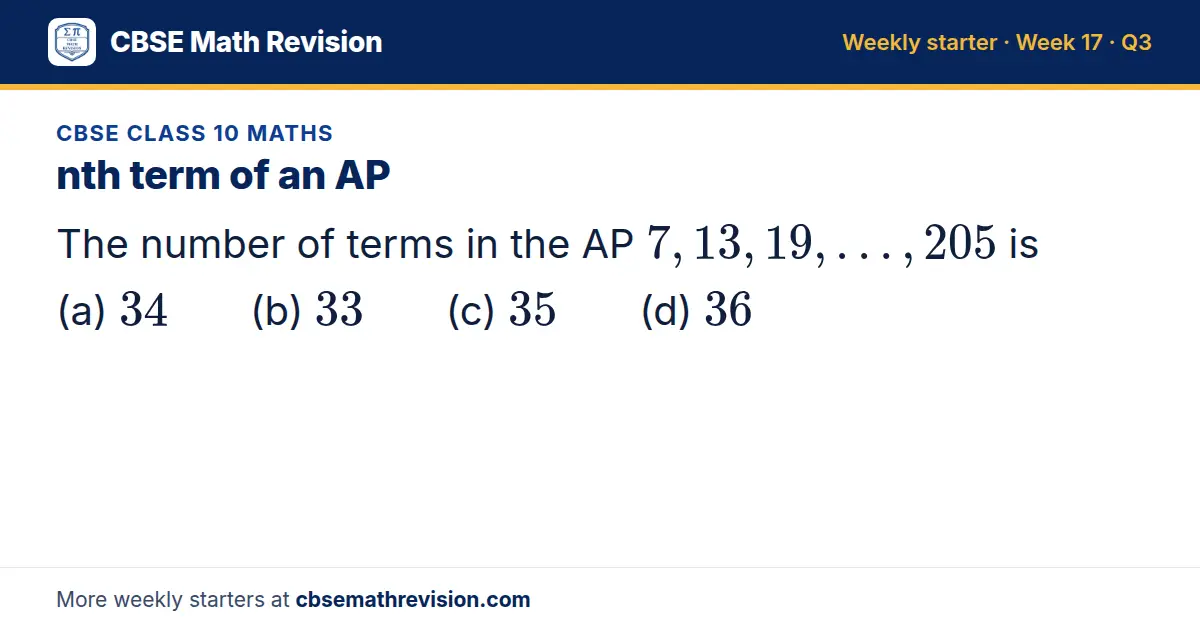
Question 3: nth term of an AP
The number of terms in the AP 7, 13, 19, …, 205 is (a) 34 (b) 33 (c) 35 (d) 36
Week 18
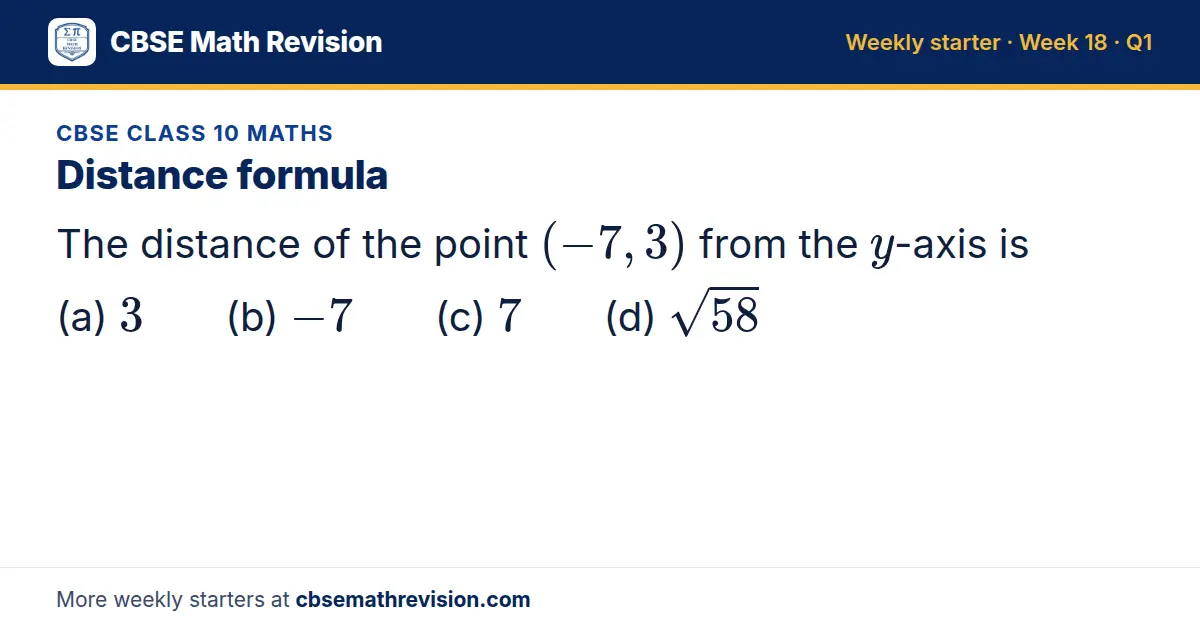
Question 1: Distance formula
The distance of the point (-7, 3) from the y-axis is (a) 3 (b) -7 (c) 7 (d) √58
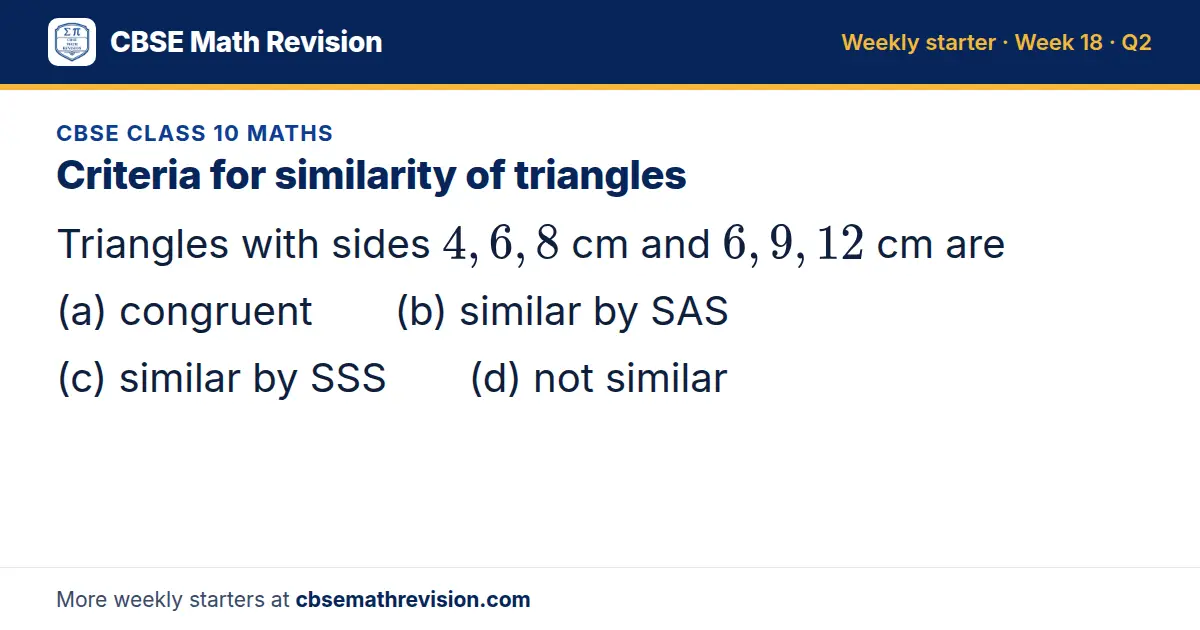
Question 2: Criteria for similarity of triangles
Triangles with sides 4, 6, 8 cm and 6, 9, 12 cm are (a) congruent (b) similar by SAS (c) similar by SSS (d) not similar
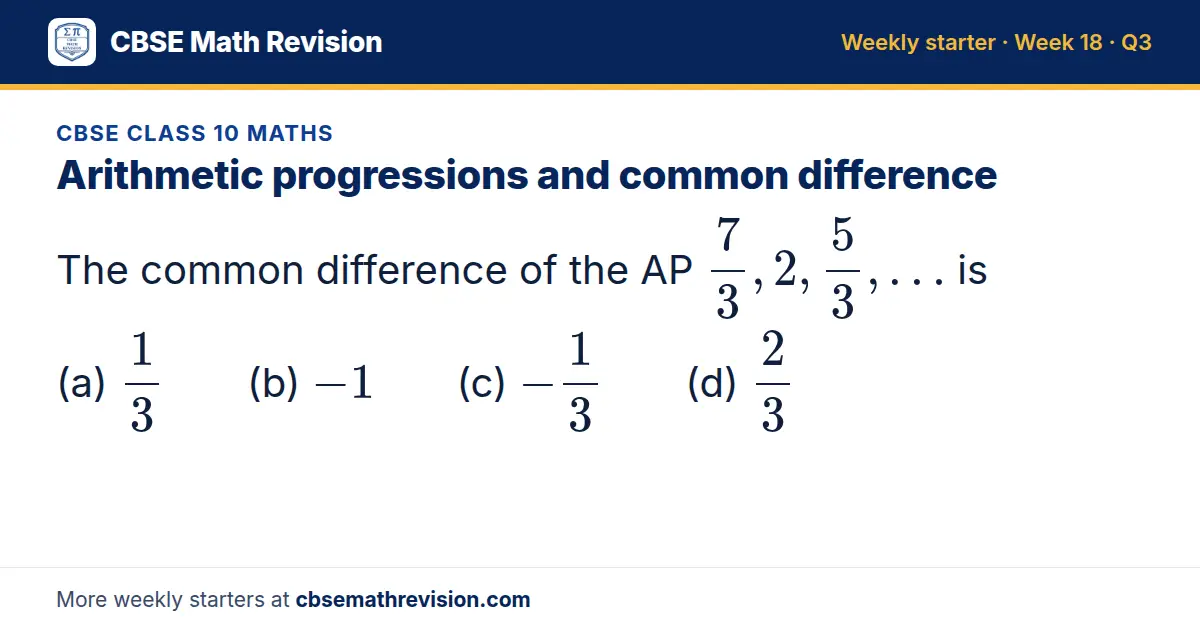
Question 3: Arithmetic progressions and common difference
The common difference of the AP 73, 2, 53, … is (a) 13 (b) -1 (c) -13 (d) 23
More starter questions
Other weeks: Weeks 1–18 · Weeks 19–31 · Weeks 33–46. Answers and mark schemes are in the teacher tools.