CBSE Class 10 Maths starter questions: weeks 19–31
33 short questions to open a lesson for CBSE Class 10 Mathematics, weeks 19–31 of the teaching year, three or four a week. Each question is shown as an image with its text underneath; answers and mark schemes stay with teachers.
- ← CBSE Class 10 Maths, weeks 1–18
- CBSE Class 10 Maths, weeks 33–46 →
- All CBSE Maths daily and weekly questions
Week 19
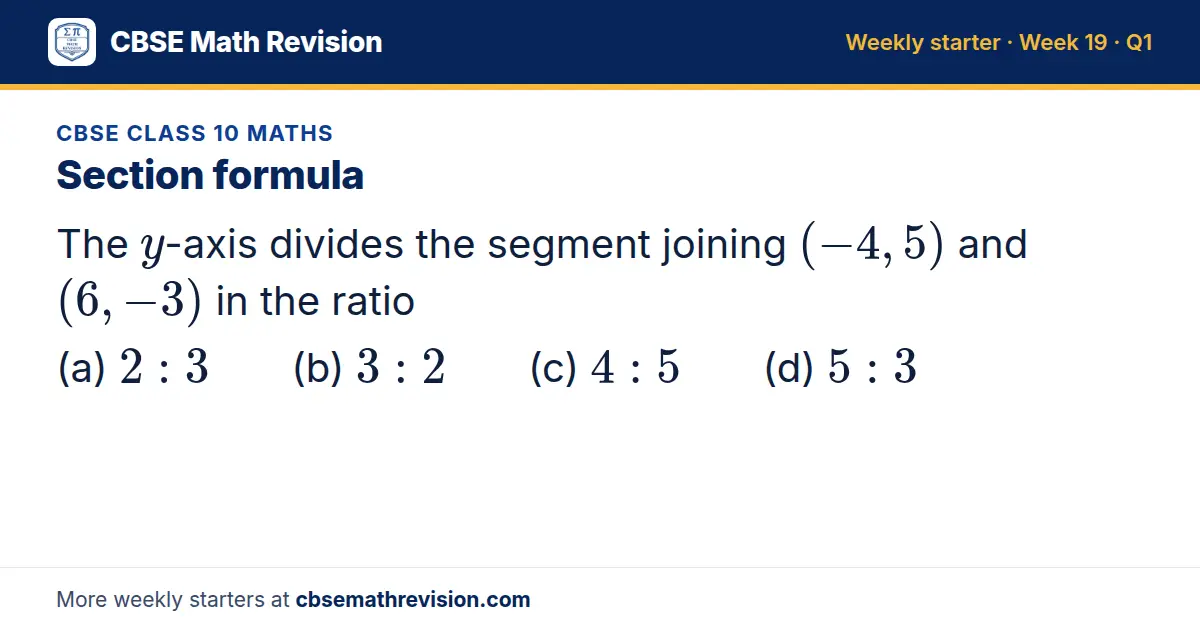
Question 1: Section formula
The y-axis divides the segment joining (-4, 5) and (6, -3) in the ratio (a) 2: 3 (b) 3: 2 (c) 4: 5 (d) 5: 3
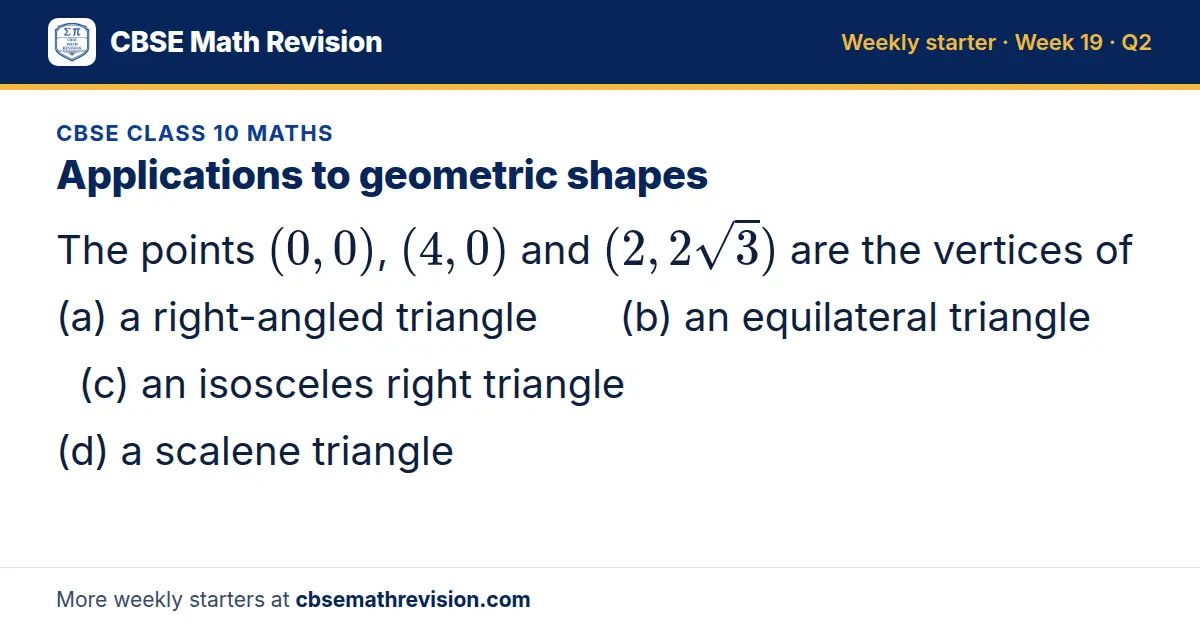
Question 2: Applications to geometric shapes
The points (0, 0), (4, 0) and (2, 2√3) are the vertices of (a) a right-angled triangle (b) an equilateral triangle (c) an isosceles right triangle (d) a scalene triangle
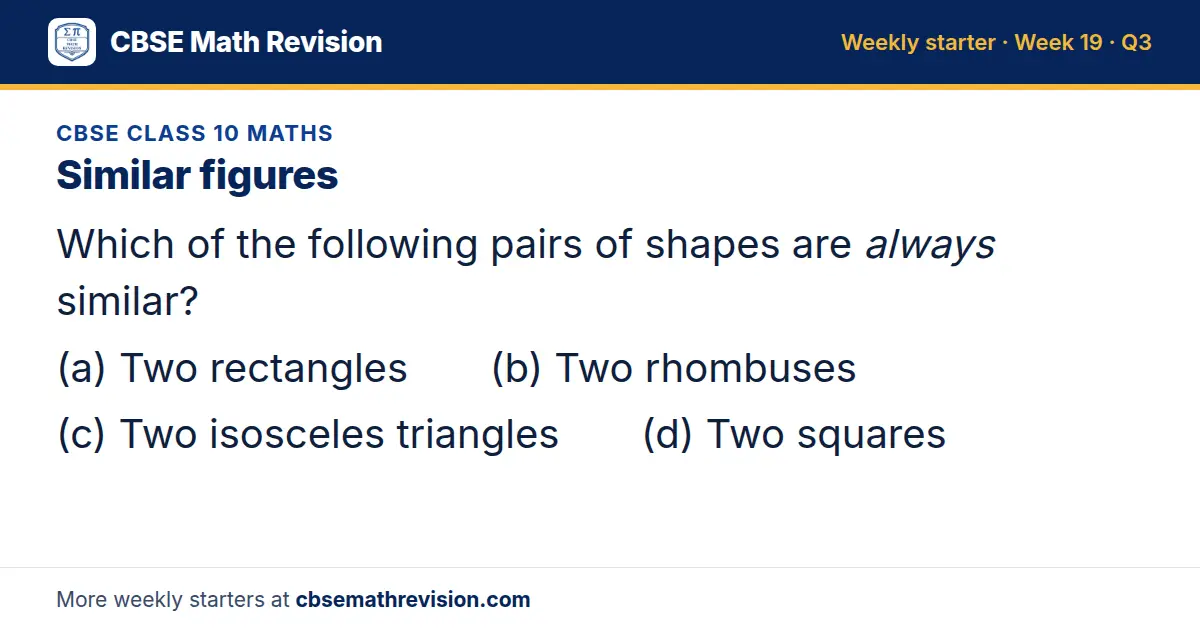
Question 3: Similar figures
Which of the following pairs of shapes are always similar? (a) Two rectangles (b) Two rhombuses (c) Two isosceles triangles (d) Two squares
Week 20
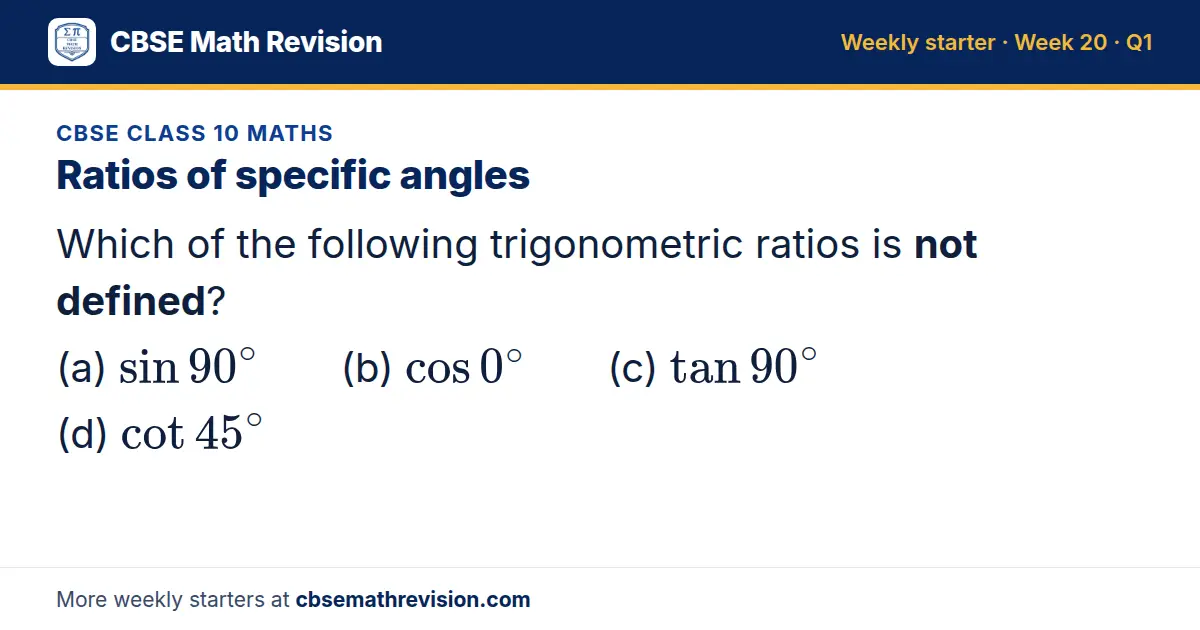
Question 1: Ratios of specific angles
Which of the following trigonometric ratios is not defined? (a) sin 90^∘ (b) cos 0^∘ (c) tan 90^∘ (d) cot 45^∘
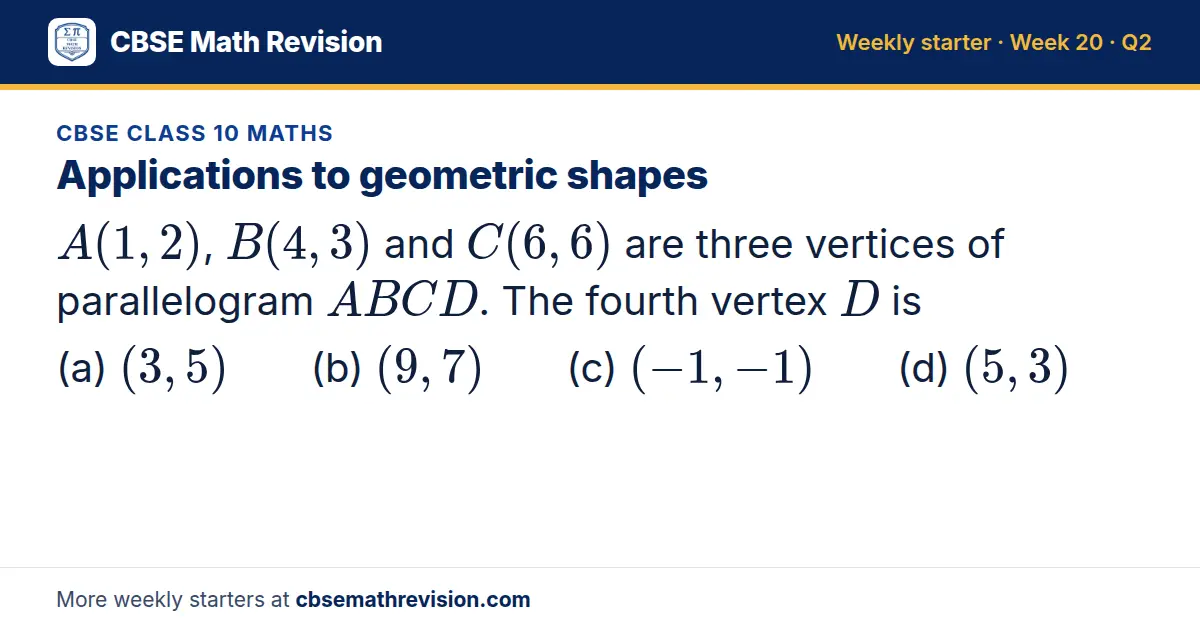
Question 2: Applications to geometric shapes
A(1, 2), B(4, 3) and C(6, 6) are three vertices of parallelogram ABCD. The fourth vertex D is (a) (3, 5) (b) (9, 7) (c) (-1, -1) (d) (5, 3)
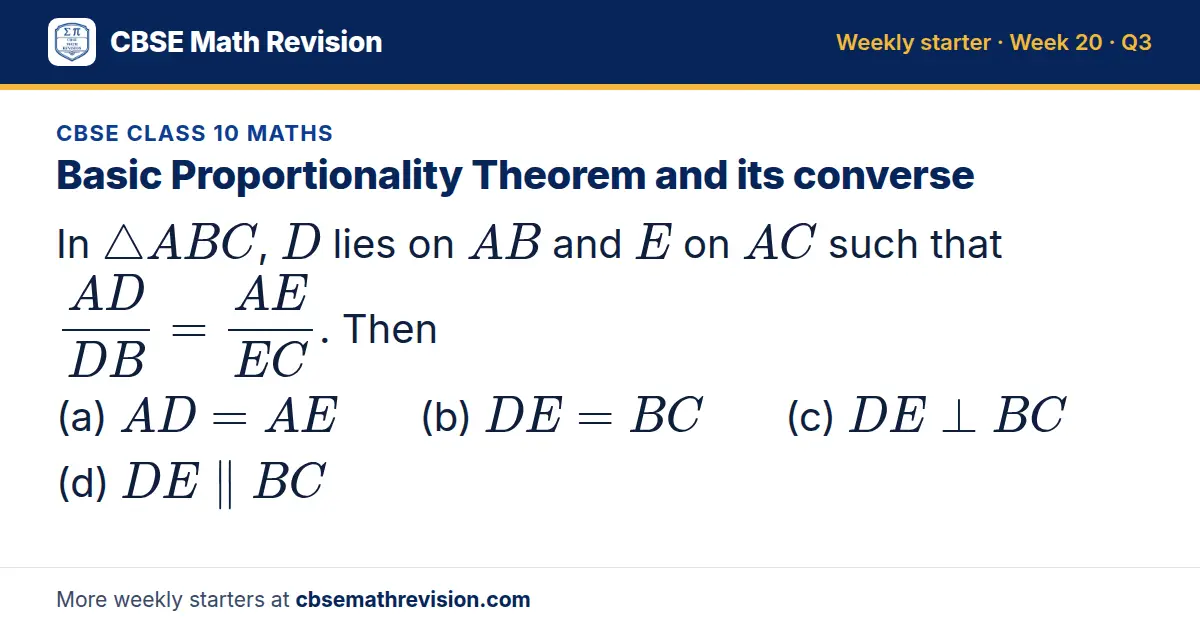
Question 3: Basic Proportionality Theorem and its converse
In △ ABC, D lies on AB and E on AC such that AD/DB = AE/EC. Then (a) AD = AE (b) DE = BC (c) DE ⊥ BC (d) DE ∥ BC
Week 21
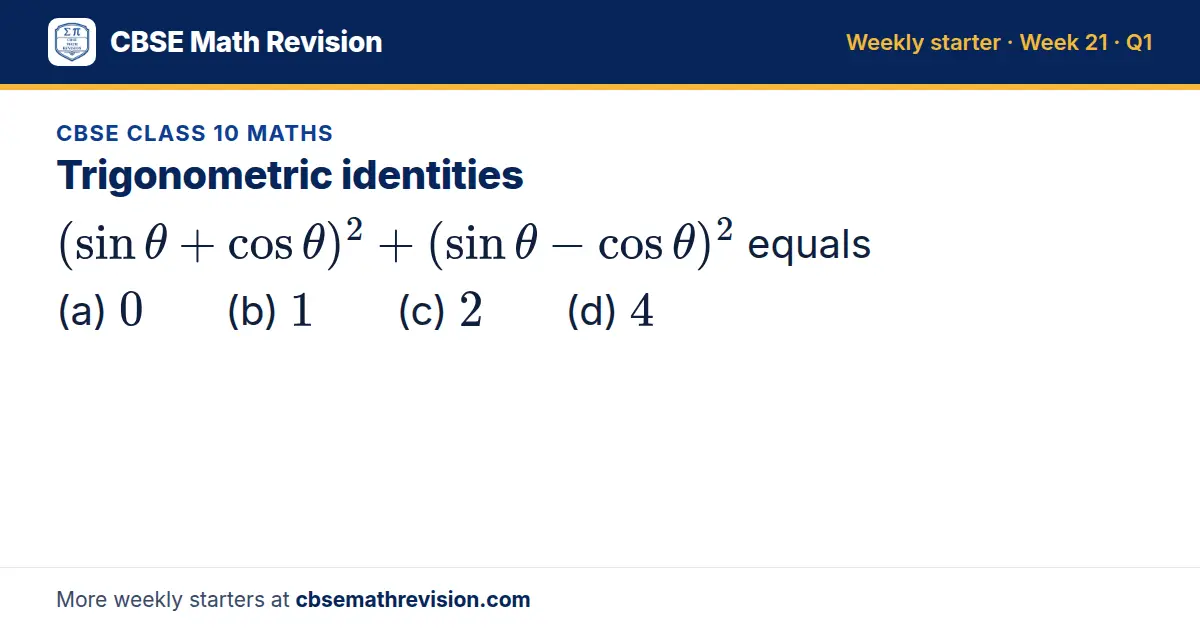
Question 1: Trigonometric identities
(sinθ+cosθ)²+(sinθ-cosθ)² equals (a) 0 (b) 1 (c) 2 (d) 4
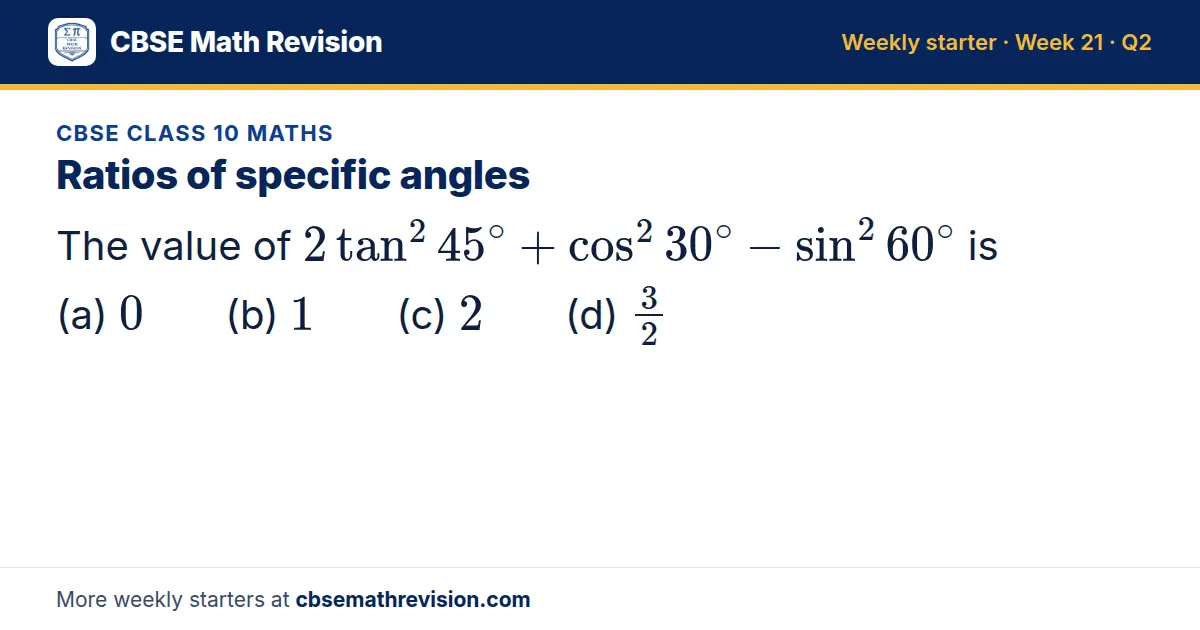
Question 2: Ratios of specific angles
The value of 2tan² 45^∘ + cos² 30^∘ - sin² 60^∘ is (a) 0 (b) 1 (c) 2 (d) 3/2
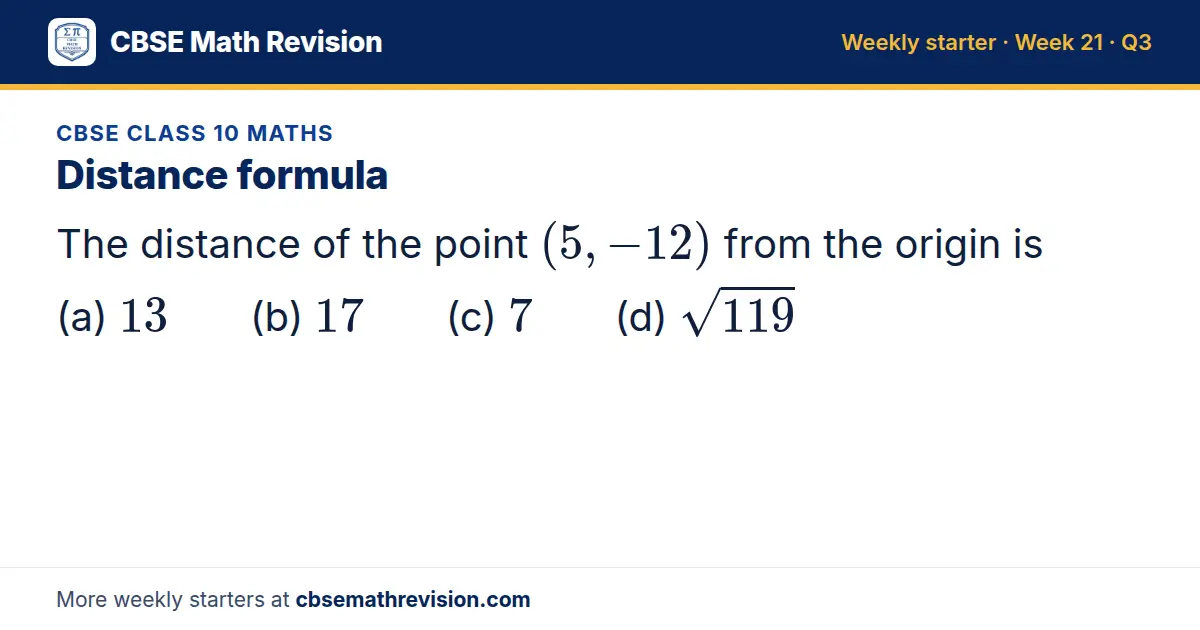
Question 3: Distance formula
The distance of the point (5, -12) from the origin is (a) 13 (b) 17 (c) 7 (d) √119
Week 22
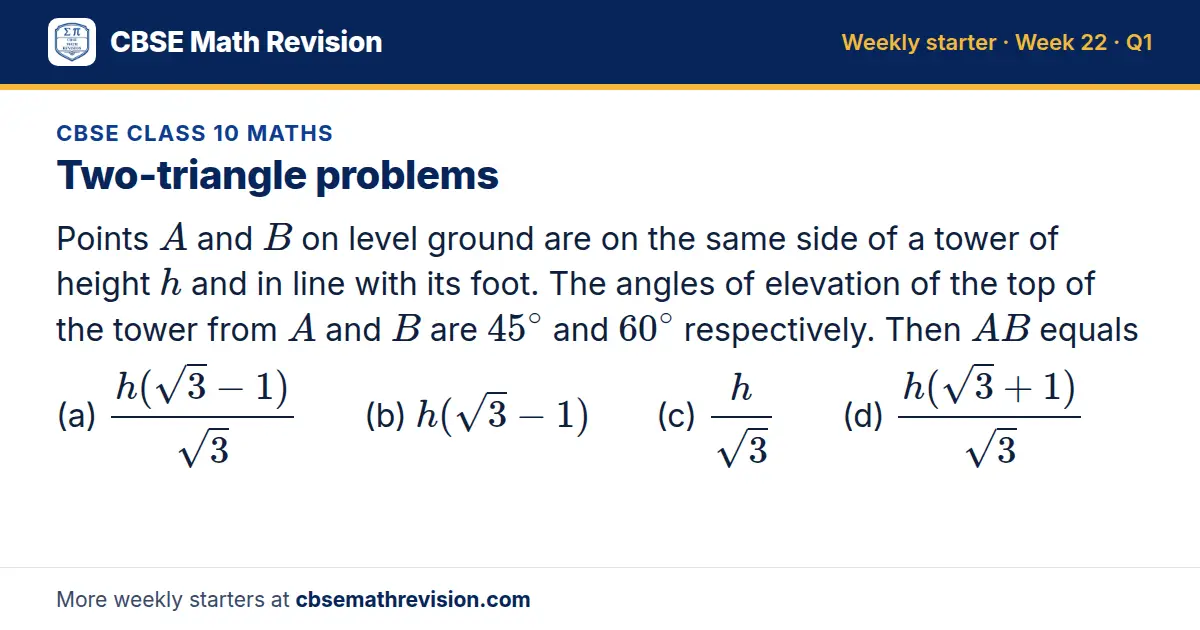
Question 1: Two-triangle problems
Points A and B on level ground are on the same side of a tower of height h and in line with its foot. The angles of elevation of the top of the tower from A and B are 45^∘ and 60^∘ respectively. Then AB equals (a) (h(√3-1))/(√3) (b) h(√3-1) (c) h/(√3) (d) (h(√3+1))/(√3)
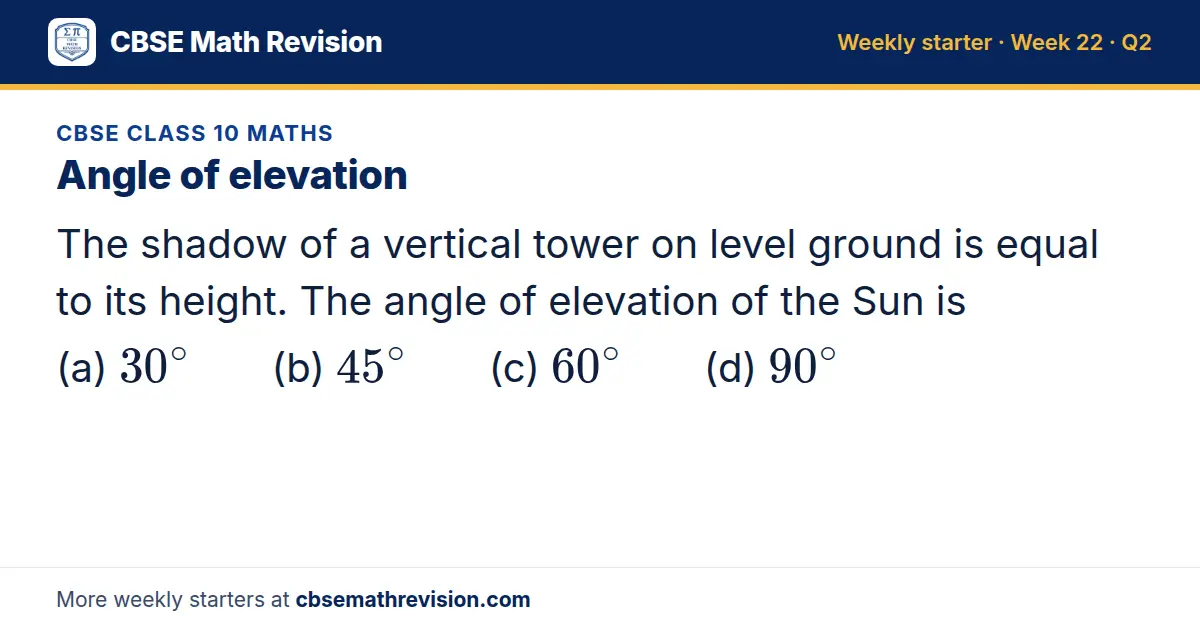
Question 2: Angle of elevation
The shadow of a vertical tower on level ground is equal to its height. The angle of elevation of the Sun is (a) 30^∘ (b) 45^∘ (c) 60^∘ (d) 90^∘
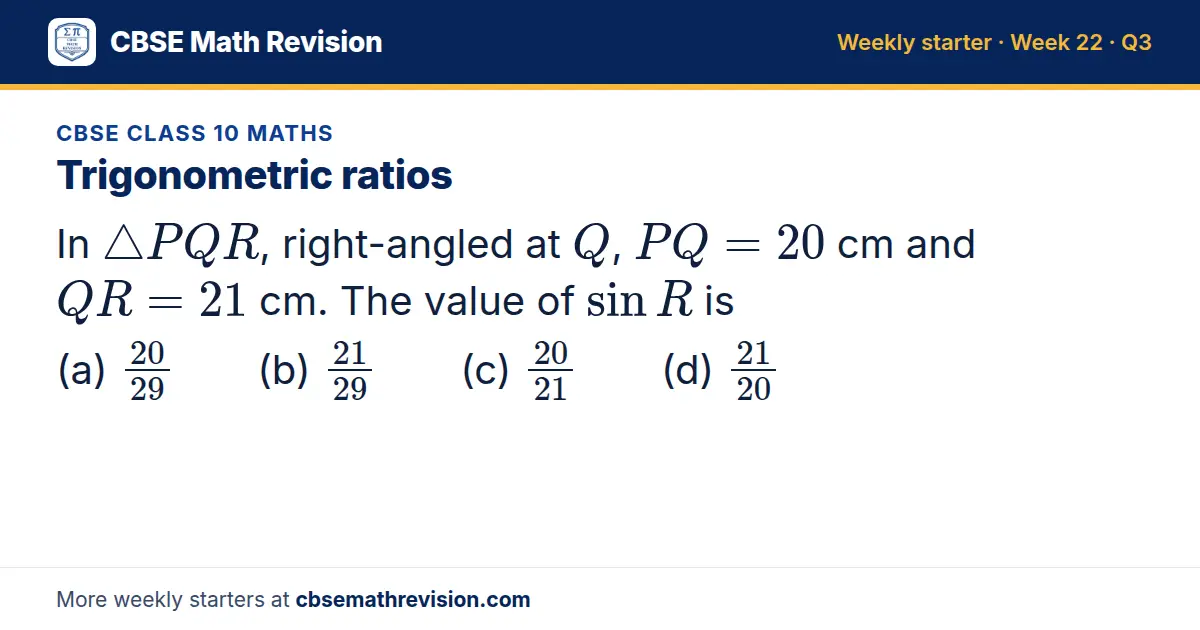
Question 3: Trigonometric ratios
In △ PQR, right-angled at Q, PQ = 20 cm and QR = 21 cm. The value of sin R is (a) 20/29 (b) 21/29 (c) 20/21 (d) 21/20
Week 23
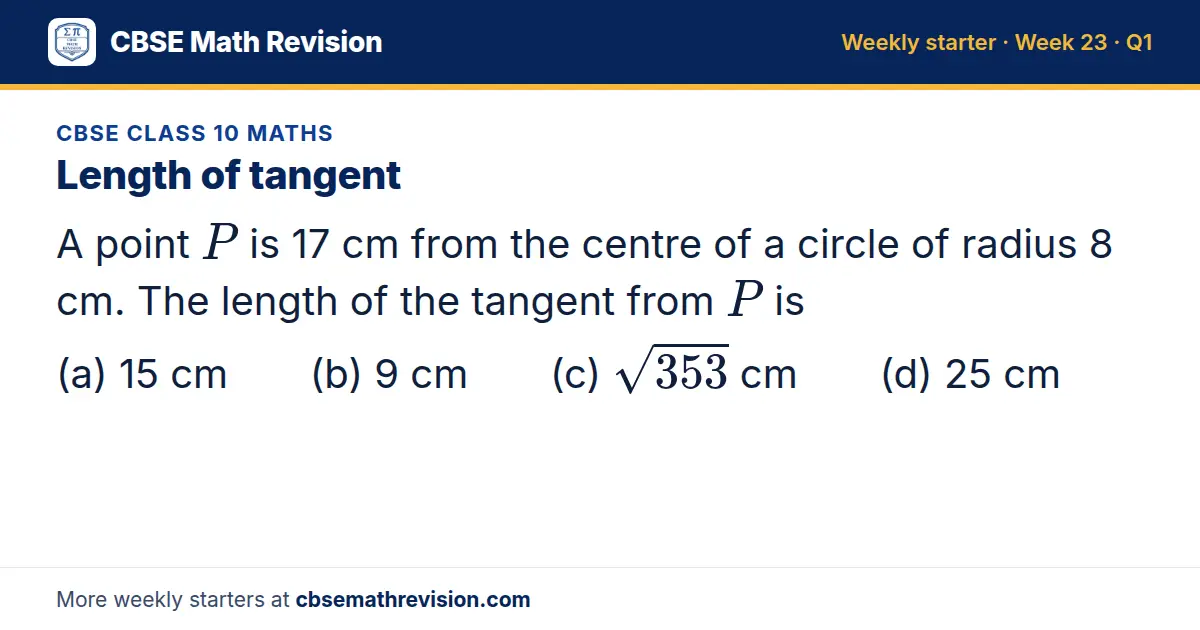
Question 1: Length of tangent
A point P is 17 cm from the centre of a circle of radius 8 cm. The length of the tangent from P is (a) 15 cm (b) 9 cm (c) √353 cm (d) 25 cm
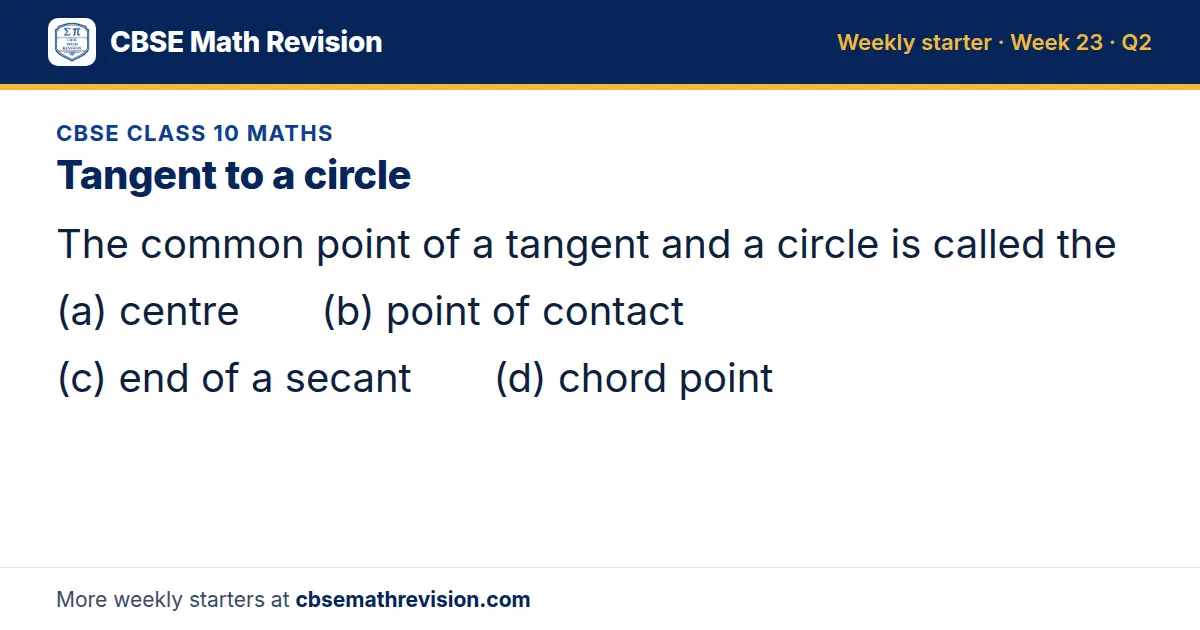
Question 2: Tangent to a circle
The common point of a tangent and a circle is called the (a) centre (b) point of contact (c) end of a secant (d) chord point
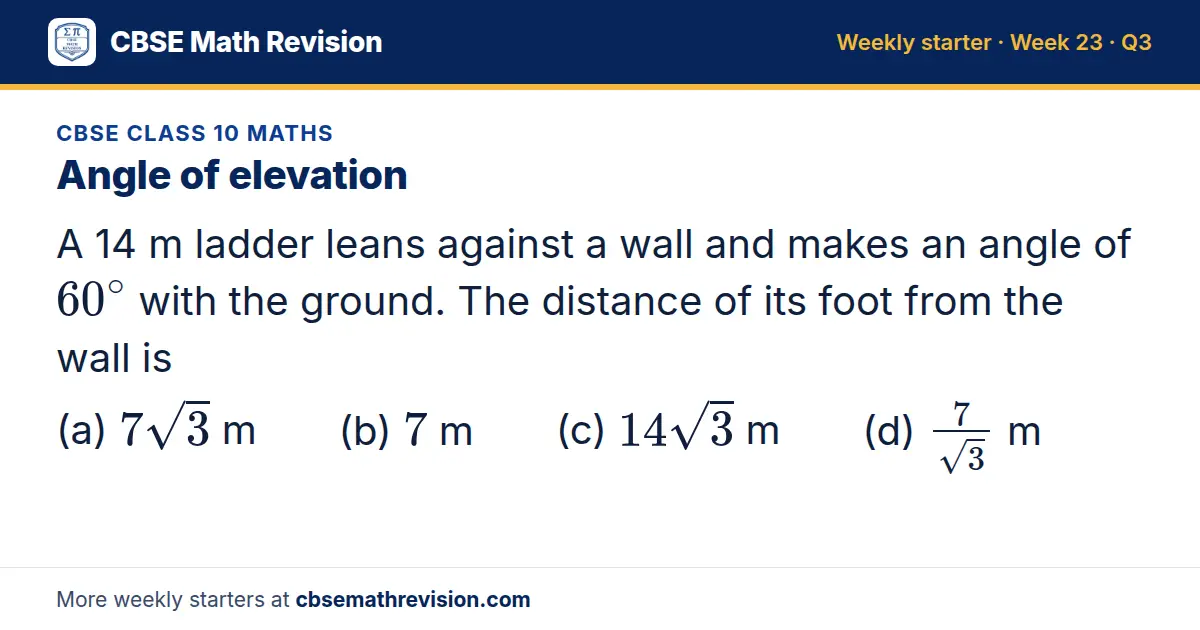
Question 3: Angle of elevation
A 14 m ladder leans against a wall and makes an angle of 60^∘ with the ground. The distance of its foot from the wall is (a) 7√3 m (b) 7 m (c) 14√3 m (d) 7/(√3) m
Week 24
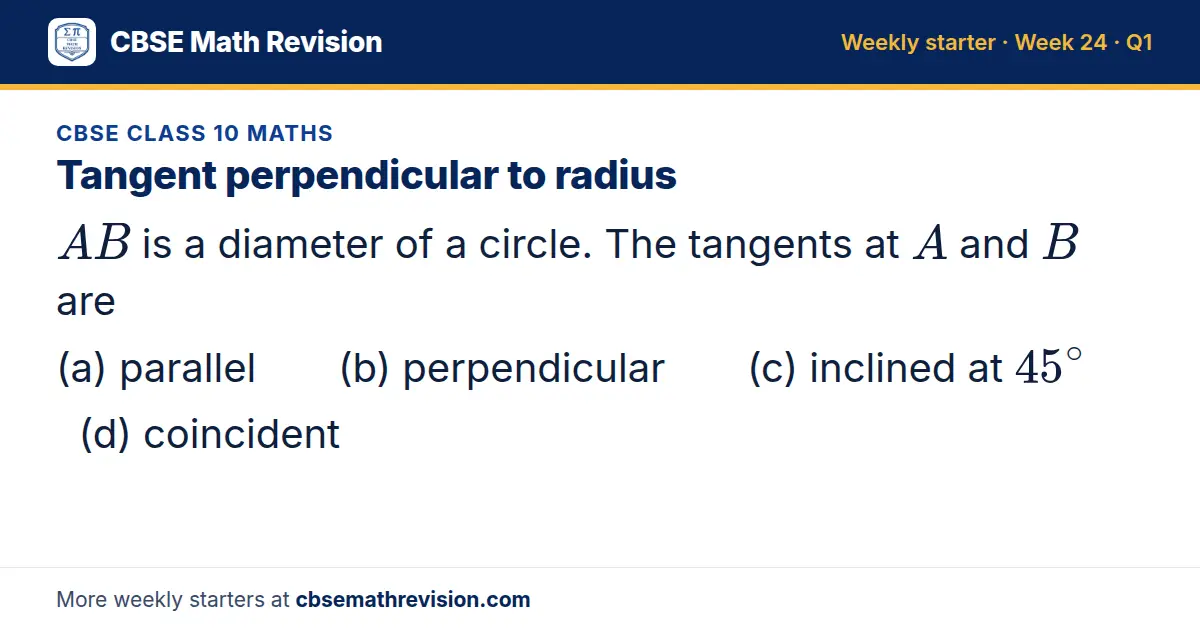
Question 1: Tangent perpendicular to radius
AB is a diameter of a circle. The tangents at A and B are (a) parallel (b) perpendicular (c) inclined at 45^∘ (d) coincident
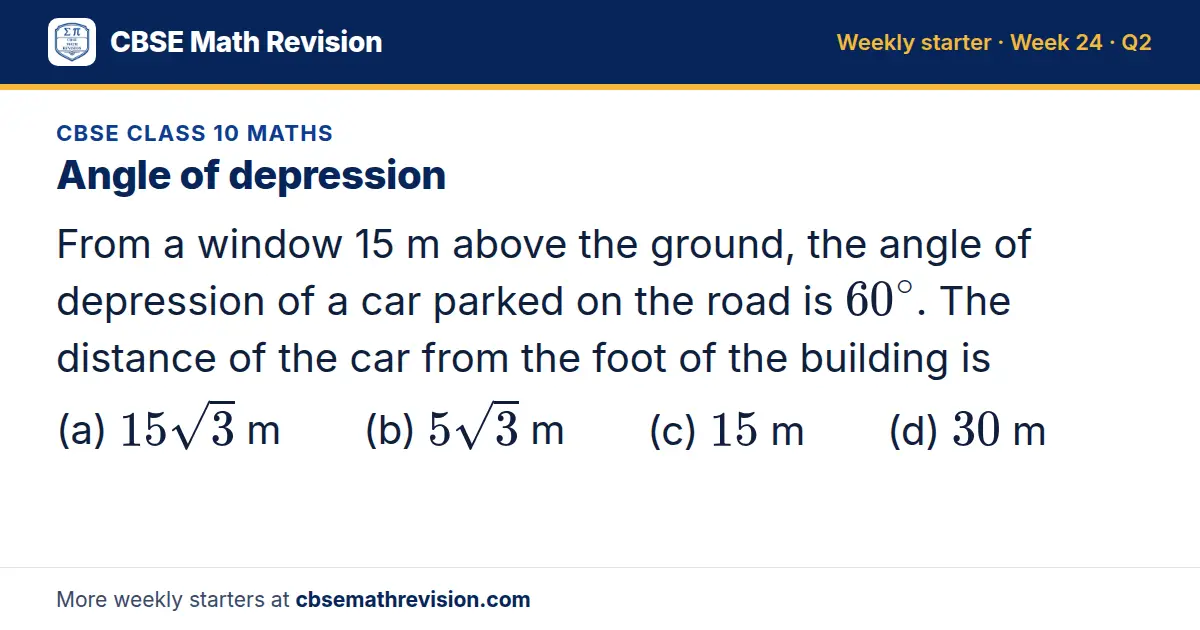
Question 2: Angle of depression
From a window 15 m above the ground, the angle of depression of a car parked on the road is 60^∘. The distance of the car from the foot of the building is (a) 15√3 m (b) 5√3 m (c) 15 m (d) 30 m
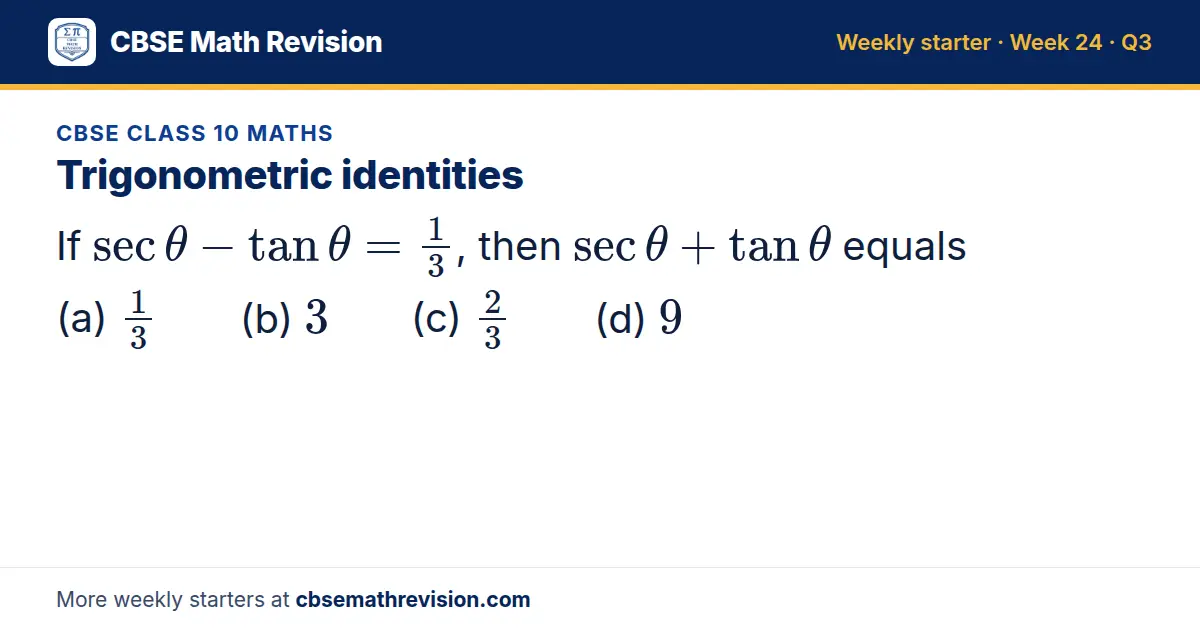
Question 3: Trigonometric identities
If secθ - tanθ = 1/3, then secθ + tanθ equals (a) 1/3 (b) 3 (c) 2/3 (d) 9
Week 27
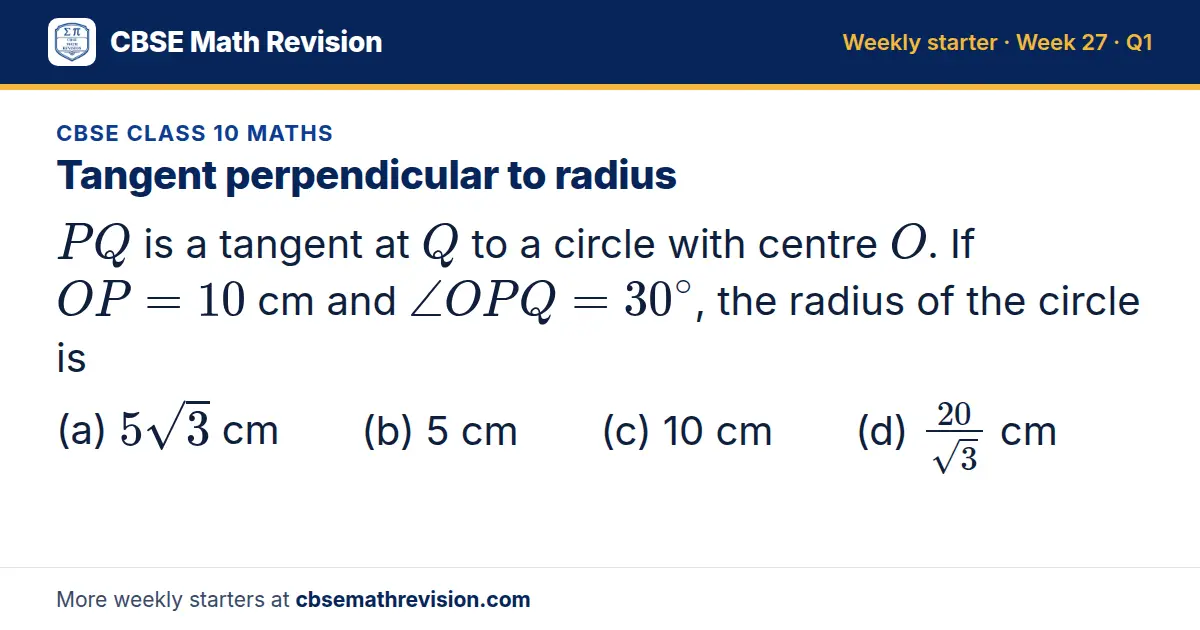
Question 1: Tangent perpendicular to radius
PQ is a tangent at Q to a circle with centre O. If OP = 10 cm and ∠ OPQ = 30^∘, the radius of the circle is (a) 5√3 cm (b) 5 cm (c) 10 cm (d) 20/(√3) cm
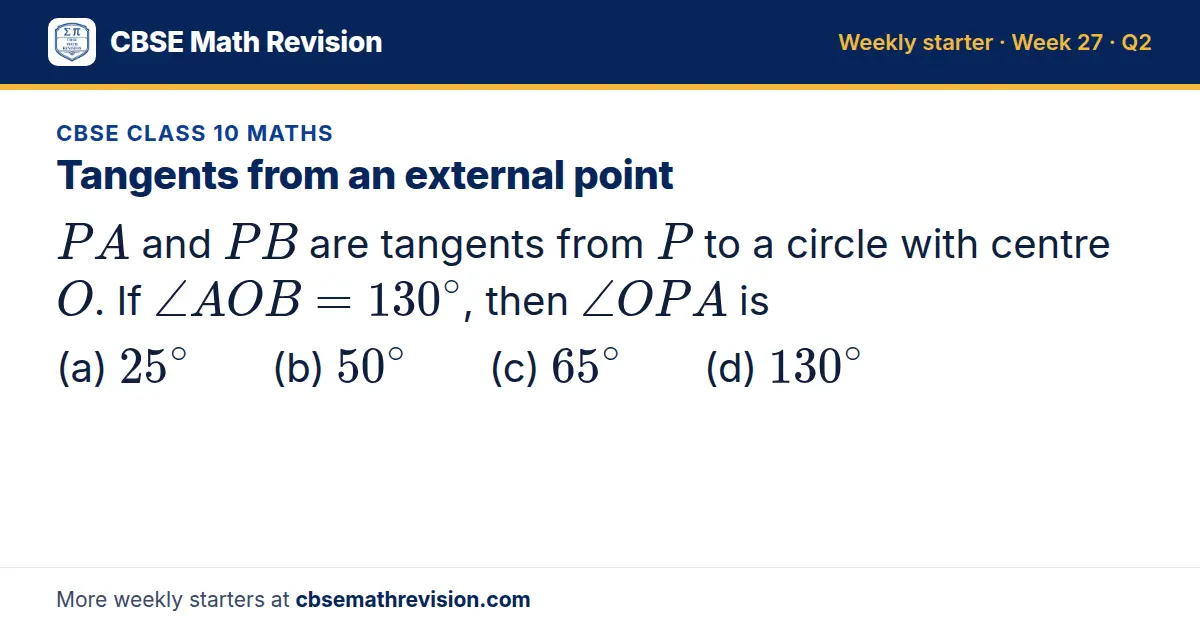
Question 2: Tangents from an external point
PA and PB are tangents from P to a circle with centre O. If ∠ AOB = 130^∘, then ∠ OPA is (a) 25^∘ (b) 50^∘ (c) 65^∘ (d) 130^∘
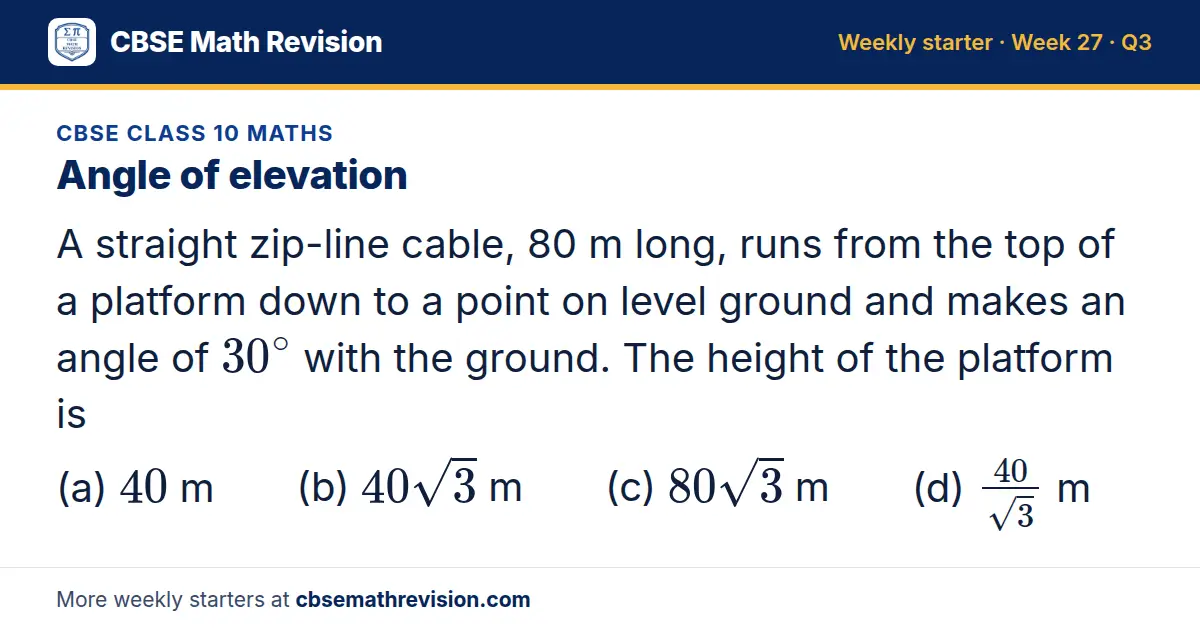
Question 3: Angle of elevation
A straight zip-line cable, 80 m long, runs from the top of a platform down to a point on level ground and makes an angle of 30^∘ with the ground. The height of the platform is (a) 40 m (b) 40√3 m (c) 80√3 m (d) 40/(√3) m
Week 28
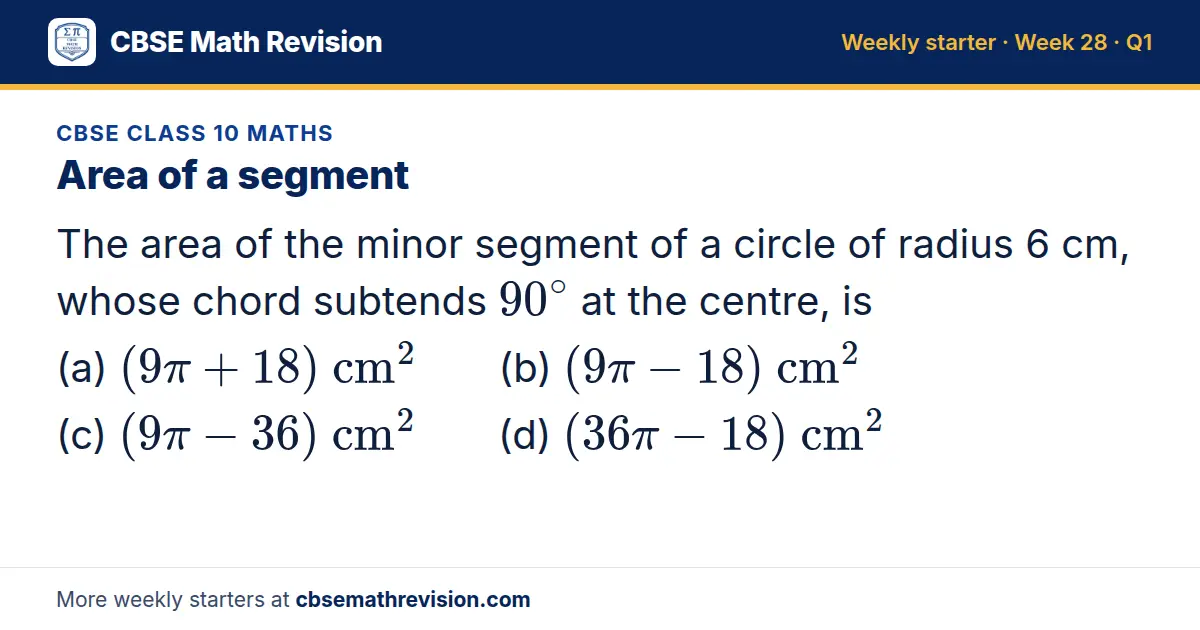
Question 1: Area of a segment
The area of the minor segment of a circle of radius 6 cm, whose chord subtends 90^∘ at the centre, is (a) (9π+18) cm² (b) (9π-18) cm² (c) (9π-36) cm² (d) (36π-18) cm²
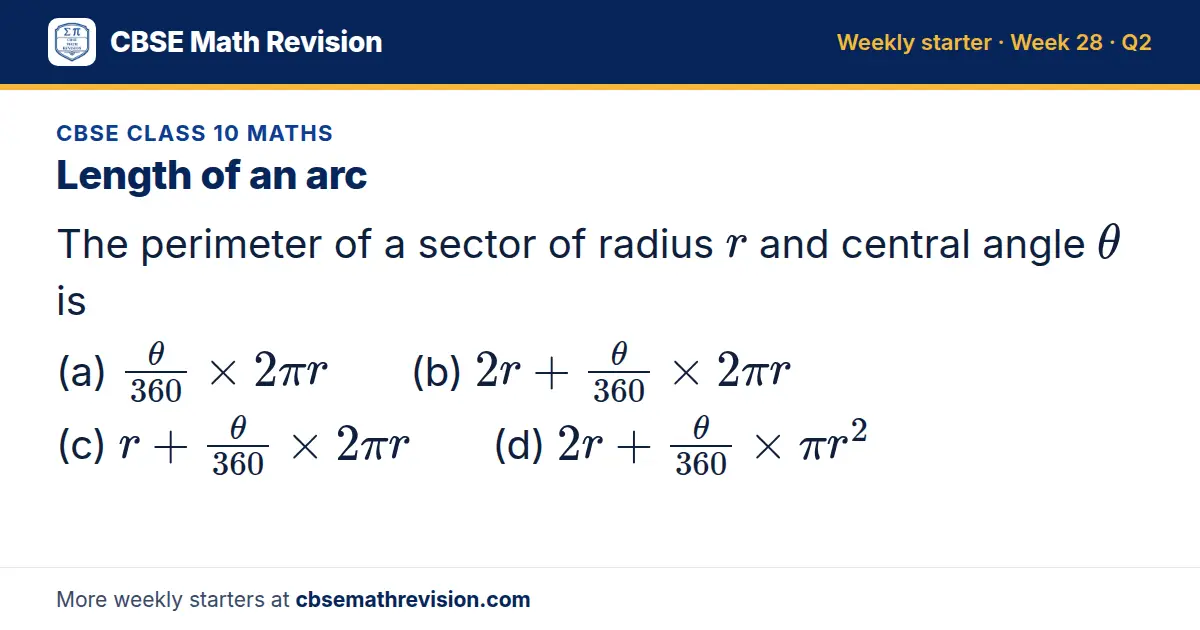
Question 2: Length of an arc
The perimeter of a sector of radius r and central angle θ is (a) (θ)/360×2π r (b) 2r+(θ)/360×2π r (c) r+(θ)/360×2π r (d) 2r+(θ)/360×π r²
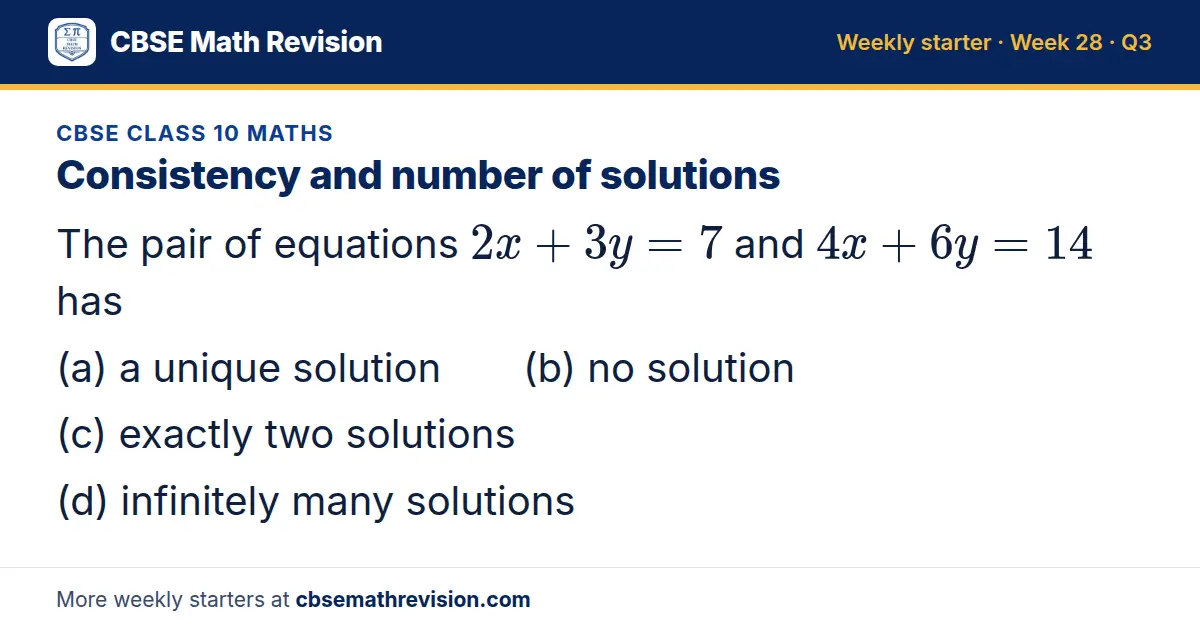
Question 3: Consistency and number of solutions
The pair of equations 2x + 3y = 7 and 4x + 6y = 14 has (a) a unique solution (b) no solution (c) exactly two solutions (d) infinitely many solutions
Week 29
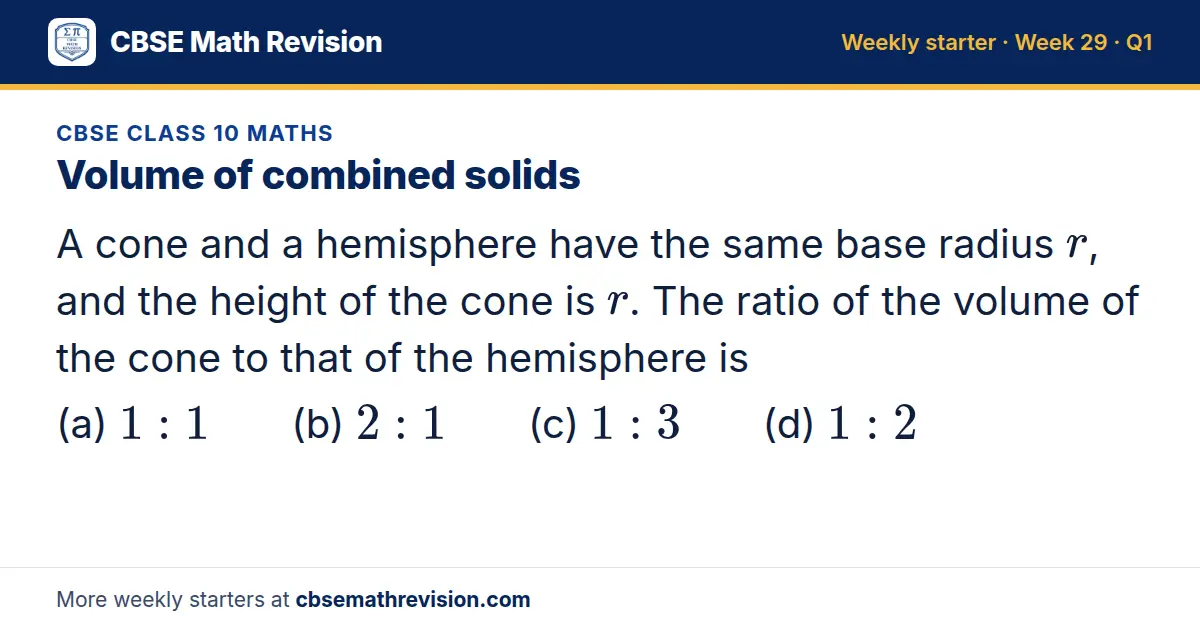
Question 1: Volume of combined solids
A cone and a hemisphere have the same base radius r, and the height of the cone is r. The ratio of the volume of the cone to that of the hemisphere is (a) 1:1 (b) 2:1 (c) 1:3 (d) 1:2
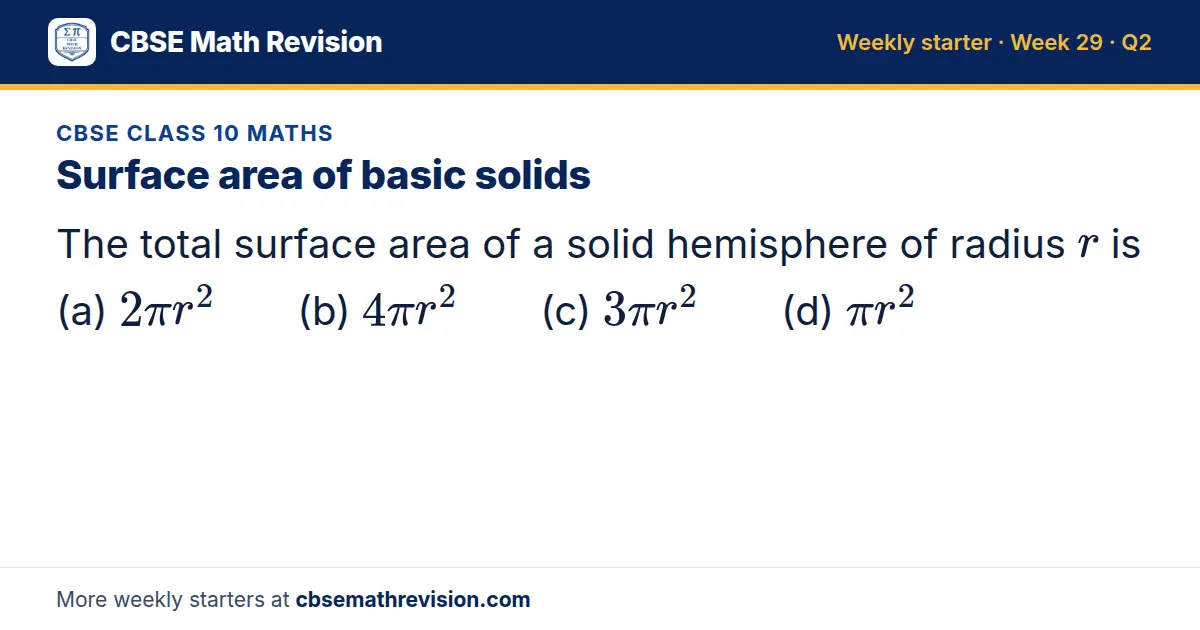
Question 2: Surface area of basic solids
The total surface area of a solid hemisphere of radius r is (a) 2π r² (b) 4π r² (c) 3π r² (d) π r²
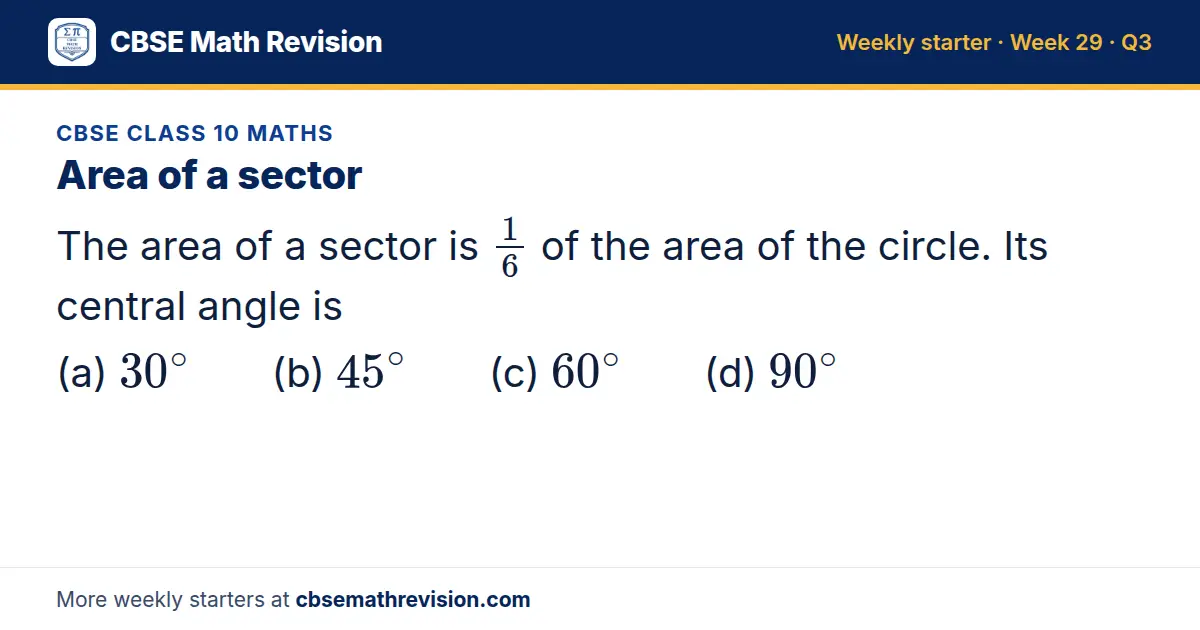
Question 3: Area of a sector
The area of a sector is 16 of the area of the circle. Its central angle is (a) 30^∘ (b) 45^∘ (c) 60^∘ (d) 90^∘
Week 30
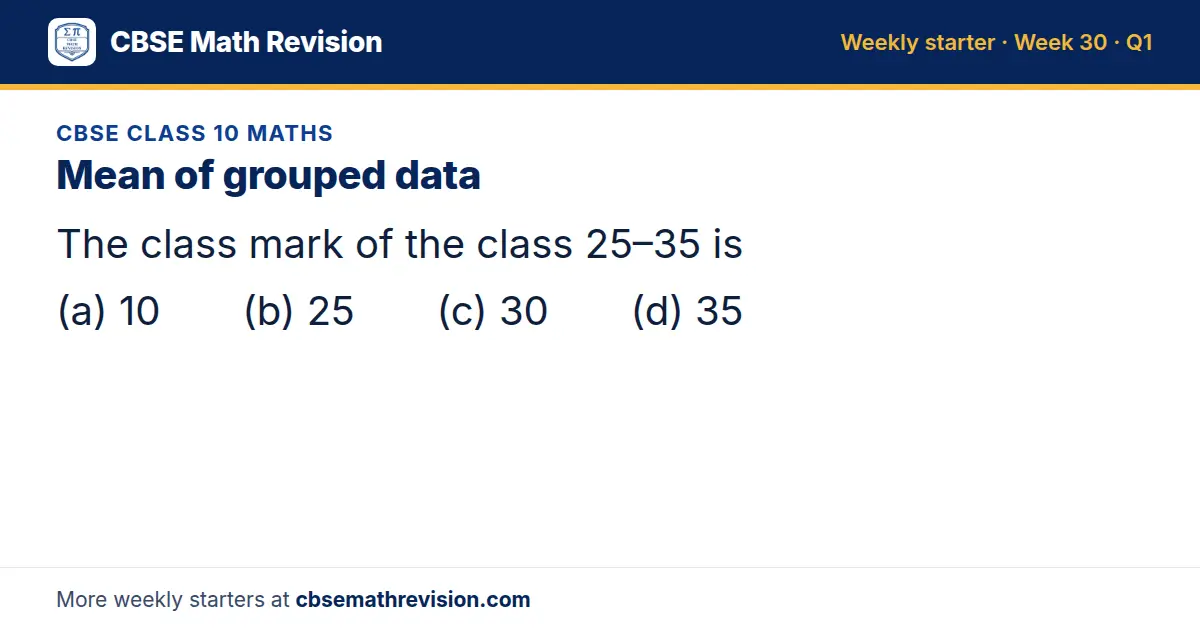
Question 1: Mean of grouped data
The class mark of the class 25–35 is (a) 10 (b) 25 (c) 30 (d) 35
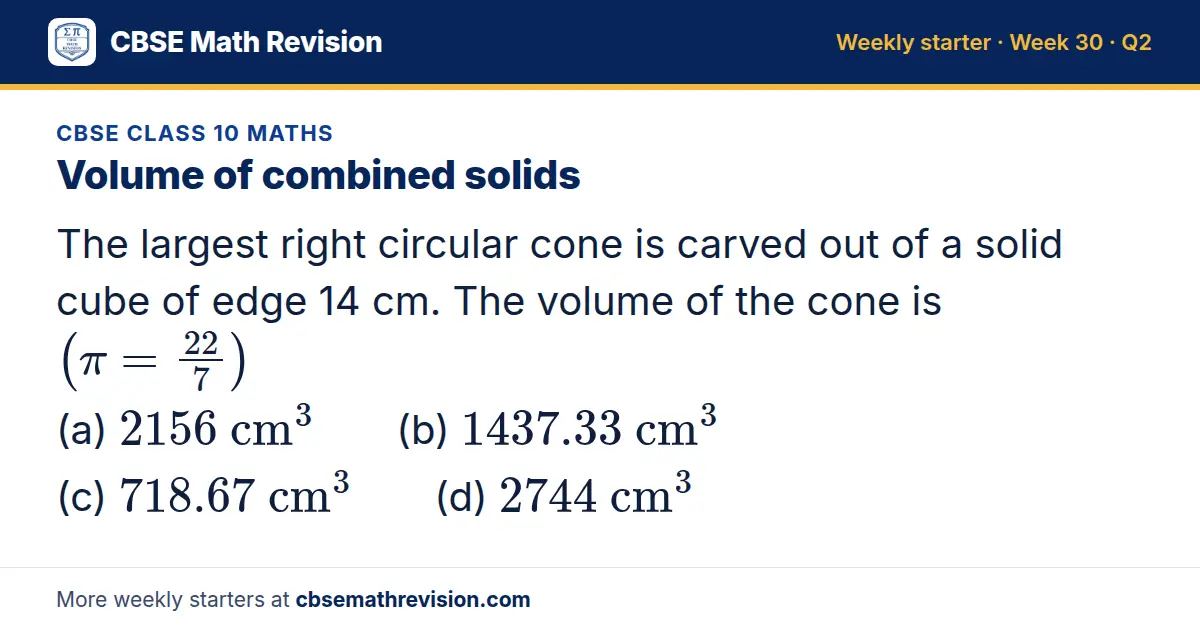
Question 2: Volume of combined solids
The largest right circular cone is carved out of a solid cube of edge 14 cm. The volume of the cone is (π=22/7) (a) 2156 cm³ (b) 1437.33 cm³ (c) 718.67 cm³ (d) 2744 cm³
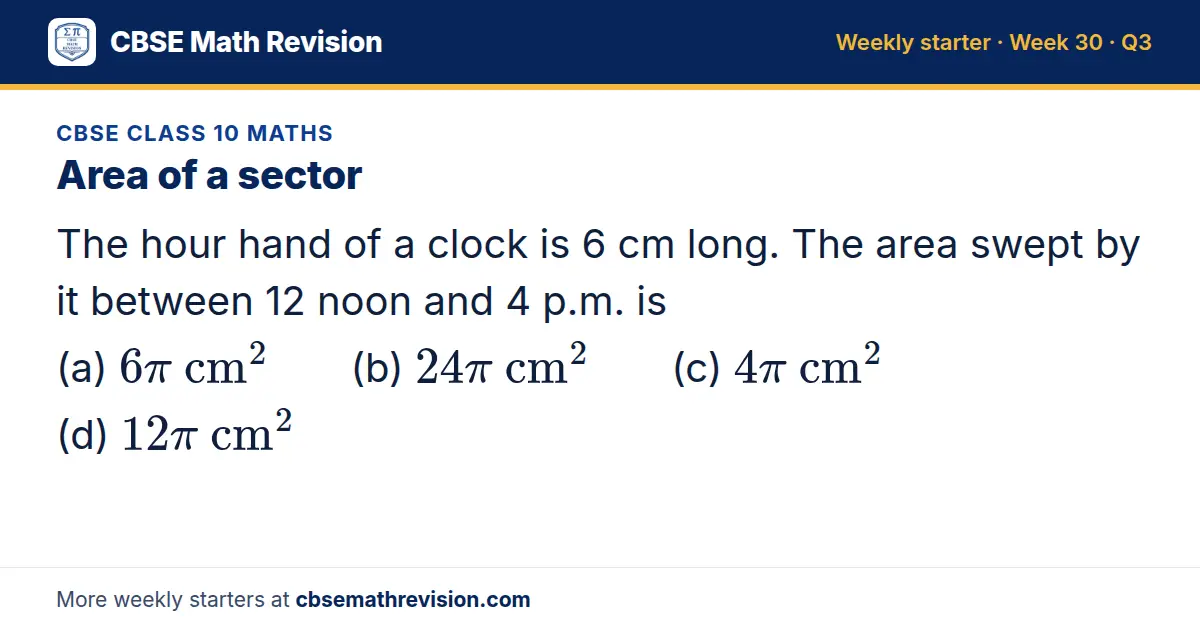
Question 3: Area of a sector
The hour hand of a clock is 6 cm long. The area swept by it between 12 noon and 4 p.m. is (a) 6π cm² (b) 24π cm² (c) 4π cm² (d) 12π cm²
Week 31
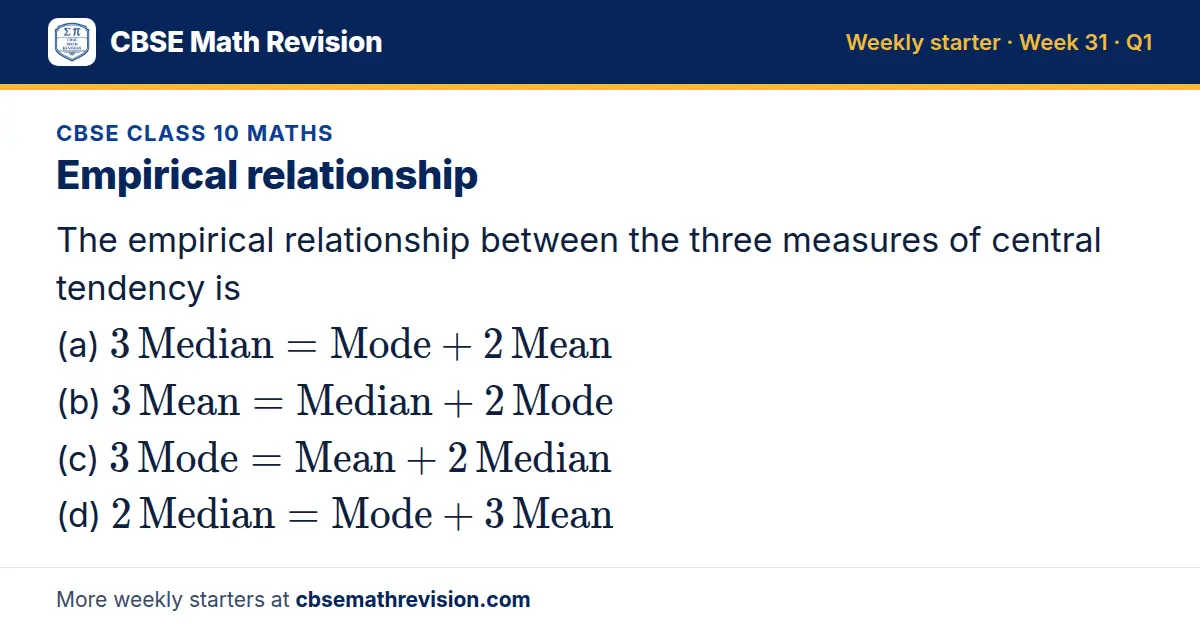
Question 1: Empirical relationship
The empirical relationship between the three measures of central tendency is (a) 3 Median=Mode+2 Mean (b) 3 Mean=Median+2 Mode (c) 3 Mode=Mean+2 Median (d) 2 Median=Mode+3 Mean
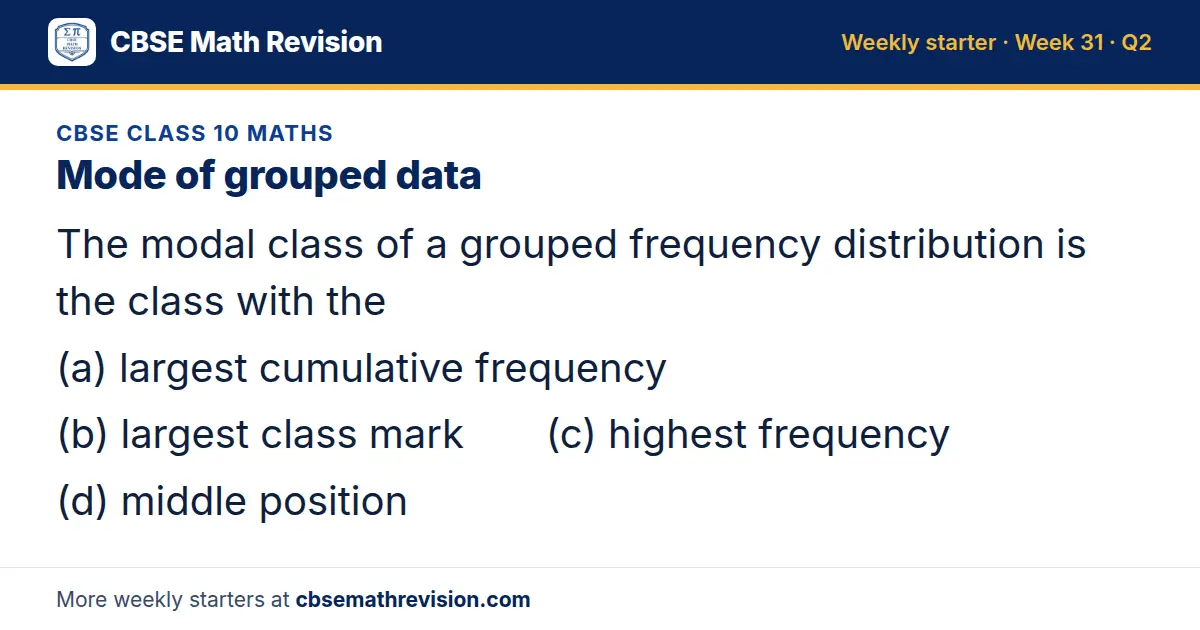
Question 2: Mode of grouped data
The modal class of a grouped frequency distribution is the class with the (a) largest cumulative frequency (b) largest class mark (c) highest frequency (d) middle position
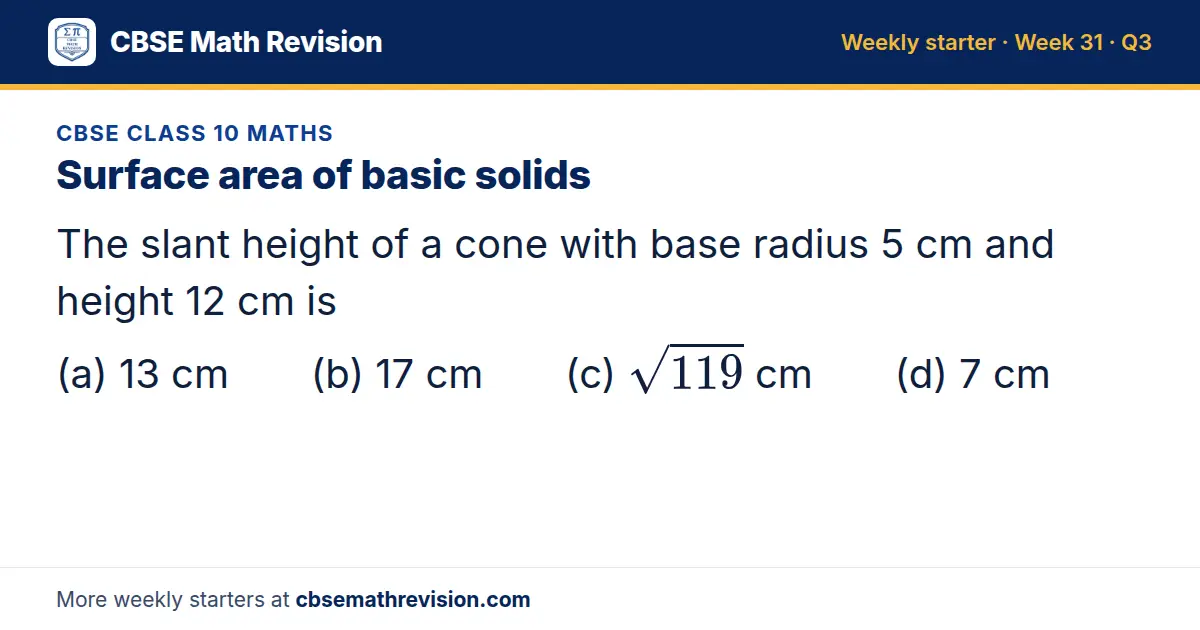
Question 3: Surface area of basic solids
The slant height of a cone with base radius 5 cm and height 12 cm is (a) 13 cm (b) 17 cm (c) √119 cm (d) 7 cm
More starter questions
Other weeks: Weeks 1–18 · Weeks 19–31 · Weeks 33–46. Answers and mark schemes are in the teacher tools.