CBSE Class 10 Maths starter questions: weeks 33–46
30 short questions to open a lesson for CBSE Class 10 Mathematics, weeks 33–46 of the teaching year, three or four a week. Each question is shown as an image with its text underneath; the answers and mark schemes are free on the free weekly starters page, to show or project in class.
- Answers and mark schemes (free)
- ← CBSE Class 10 Maths, weeks 19–31
- All CBSE Maths daily and weekly questions
Week 33
Question 1: Complementary events
If P(E) = 0.05, then P(not E) is (a) 0.5 (b) 0.05 (c) 0.95 (d) 1.05
Question 2: Mode of grouped data
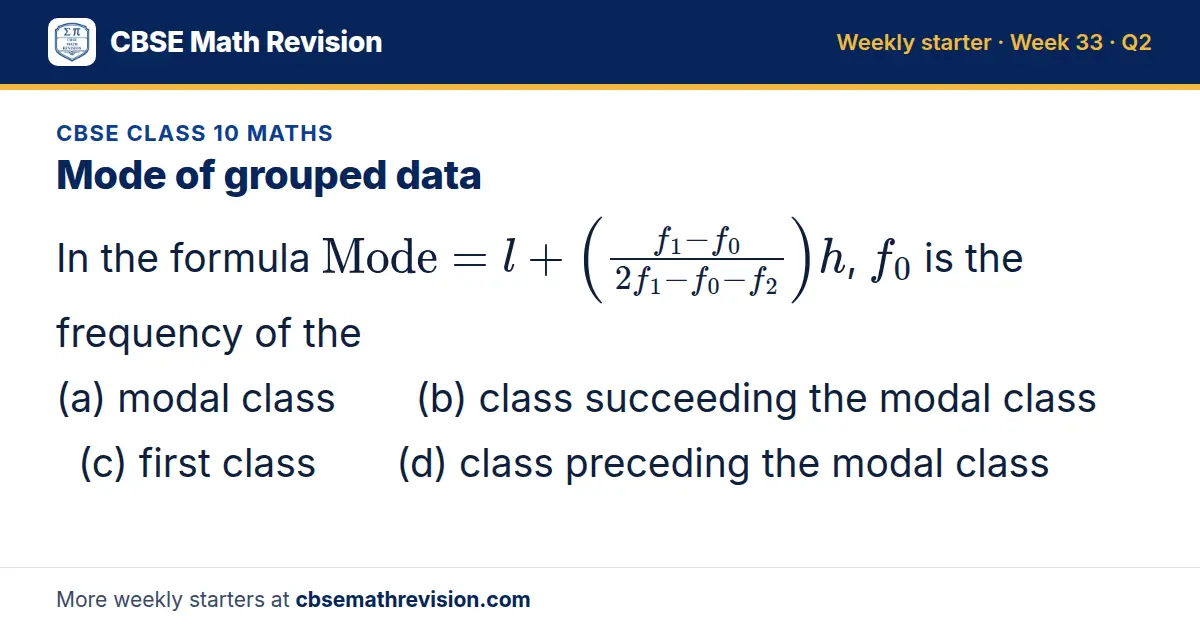
In the formula Mode=l+((f_1-f_0)/(2f_1-f_0-f_2))h, f_0 is the frequency of the (a) modal class (b) class succeeding the modal class (c) first class (d) class preceding the modal class
Question 3: Area of a sector
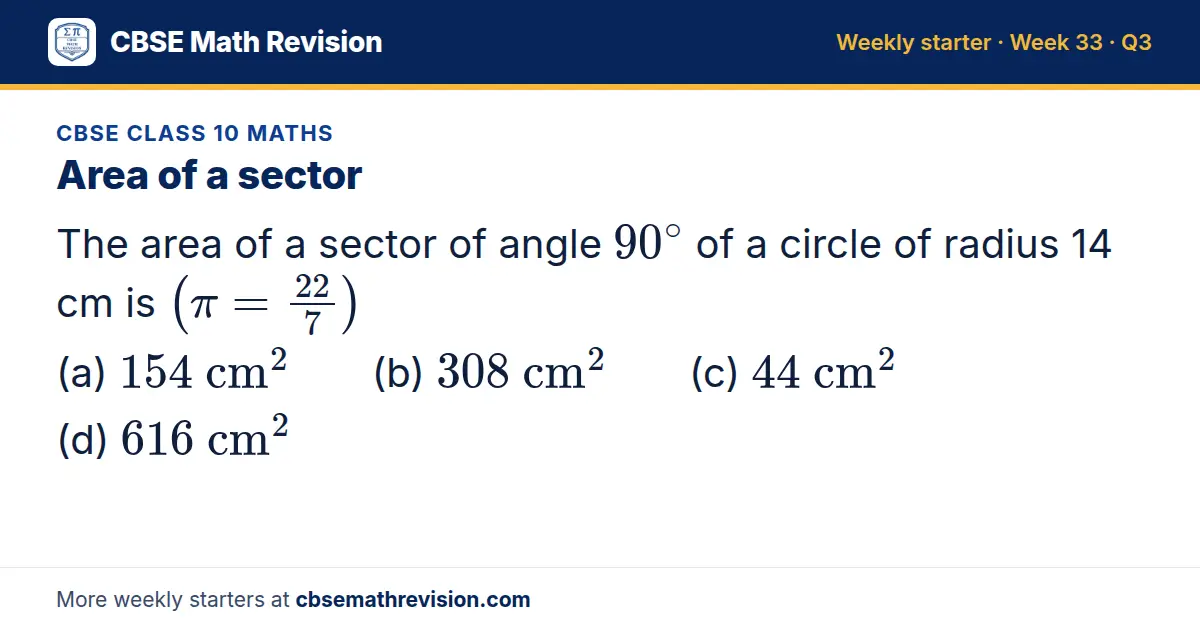
The area of a sector of angle 90° of a circle of radius 14 cm is (π=22/7) (a) 154 cm² (b) 308 cm² (c) 44 cm² (d) 616 cm²
Week 34
Question 1: Complementary events
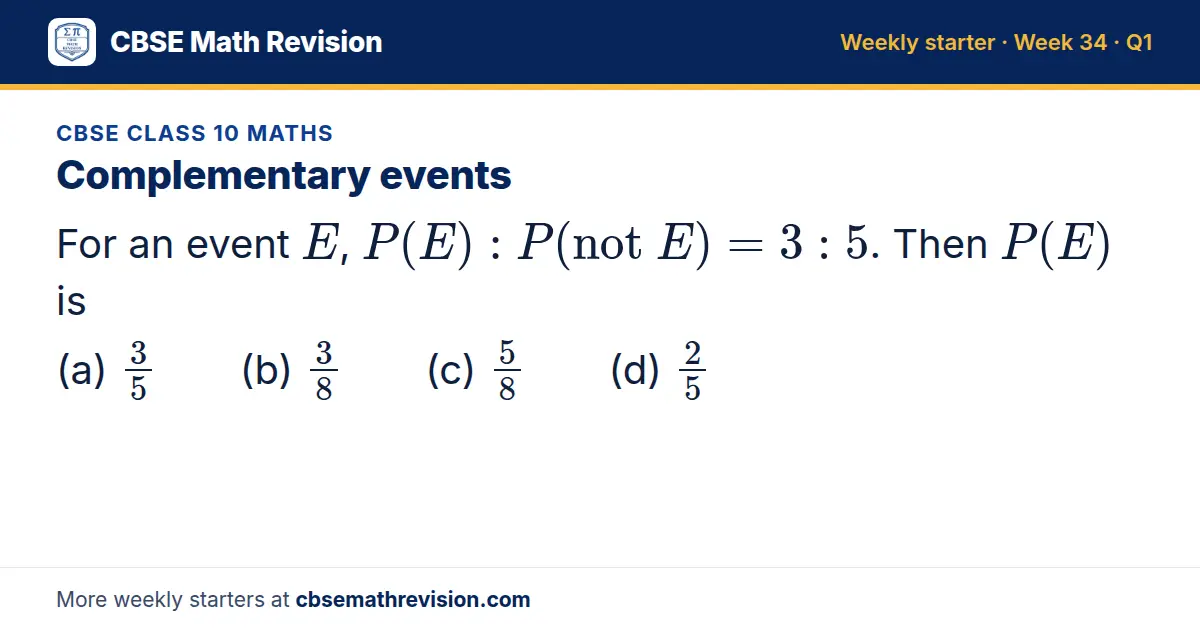
For an event E, P(E): P(not E) = 3: 5. Then P(E) is (a) 3/5 (b) 3/8 (c) 5/8 (d) 2/5
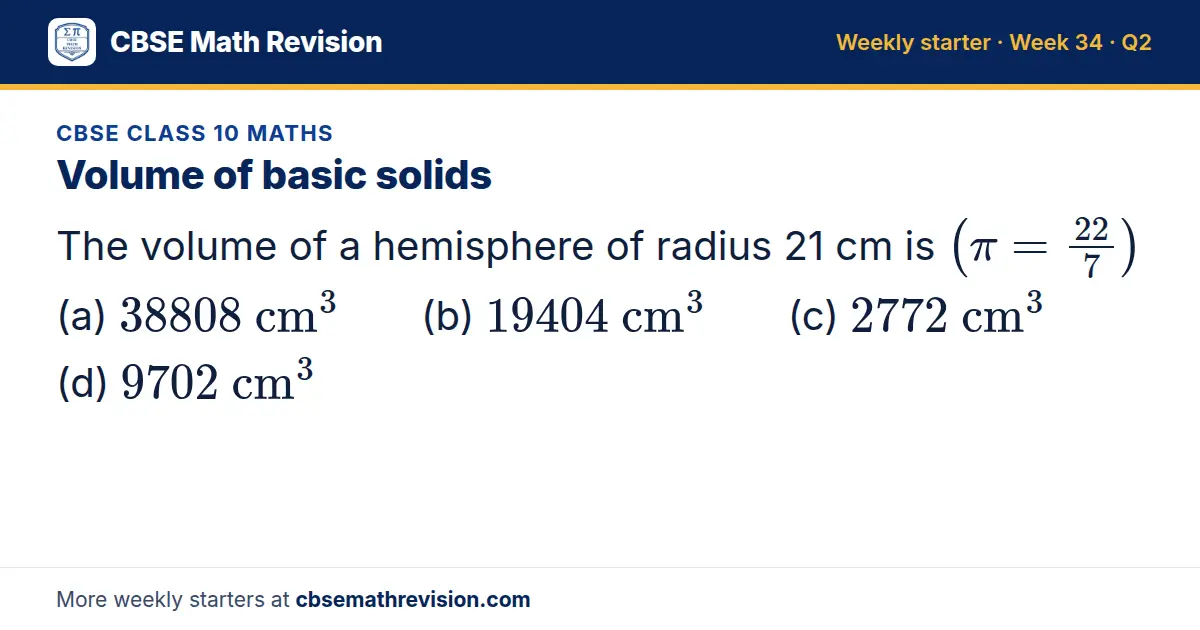
Question 2: Volume of basic solids
The volume of a hemisphere of radius 21 cm is (π=22/7) (a) 38808 cm³ (b) 19404 cm³ (c) 2772 cm³ (d) 9702 cm³
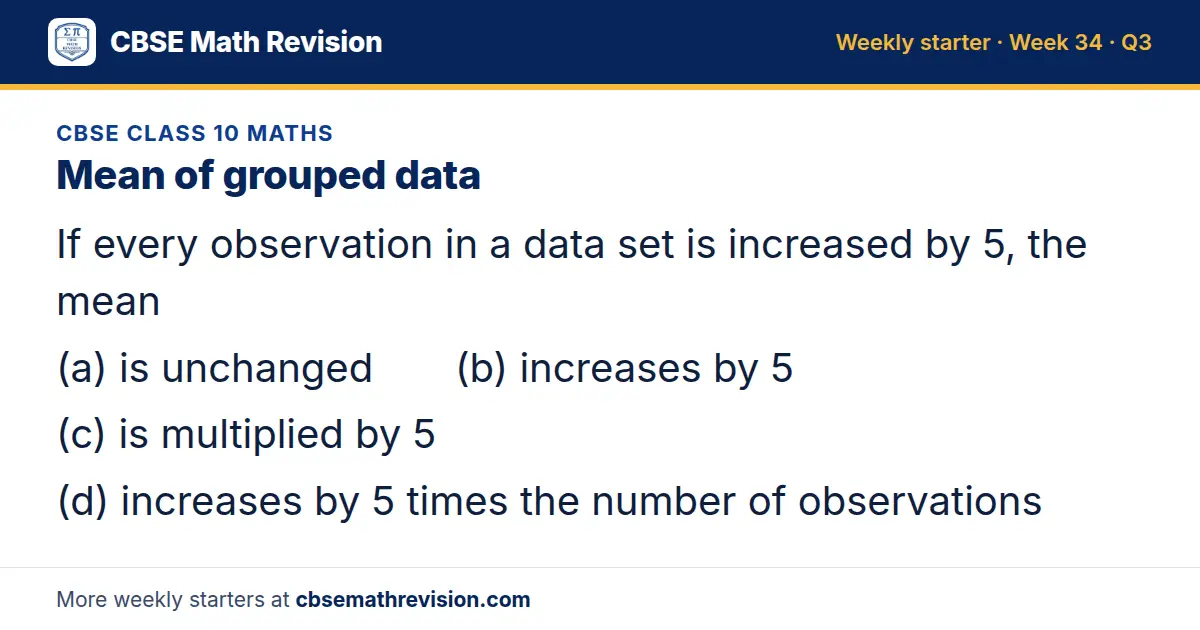
Question 3: Mean of grouped data
If every observation in a data set is increased by 5, the mean (a) is unchanged (b) increases by 5 (c) is multiplied by 5 (d) increases by 5 times the number of observations
Week 35
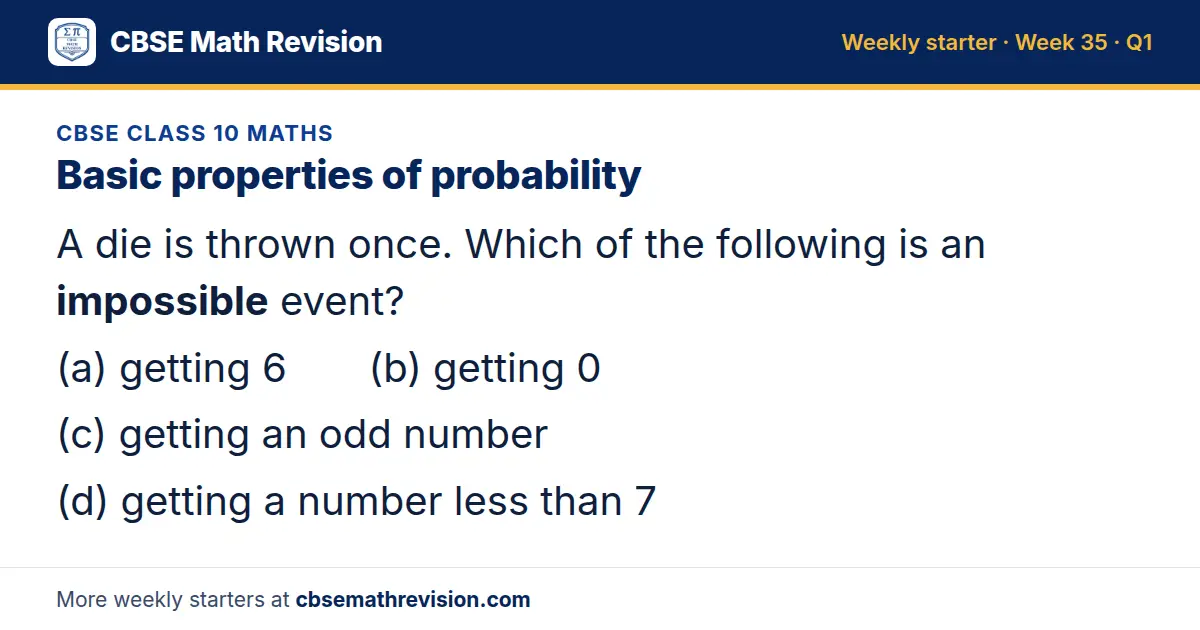
Question 1: Basic properties of probability
A die is thrown once. Which of the following is an impossible event? (a) getting 6 (b) getting 0 (c) getting an odd number (d) getting a number less than 7
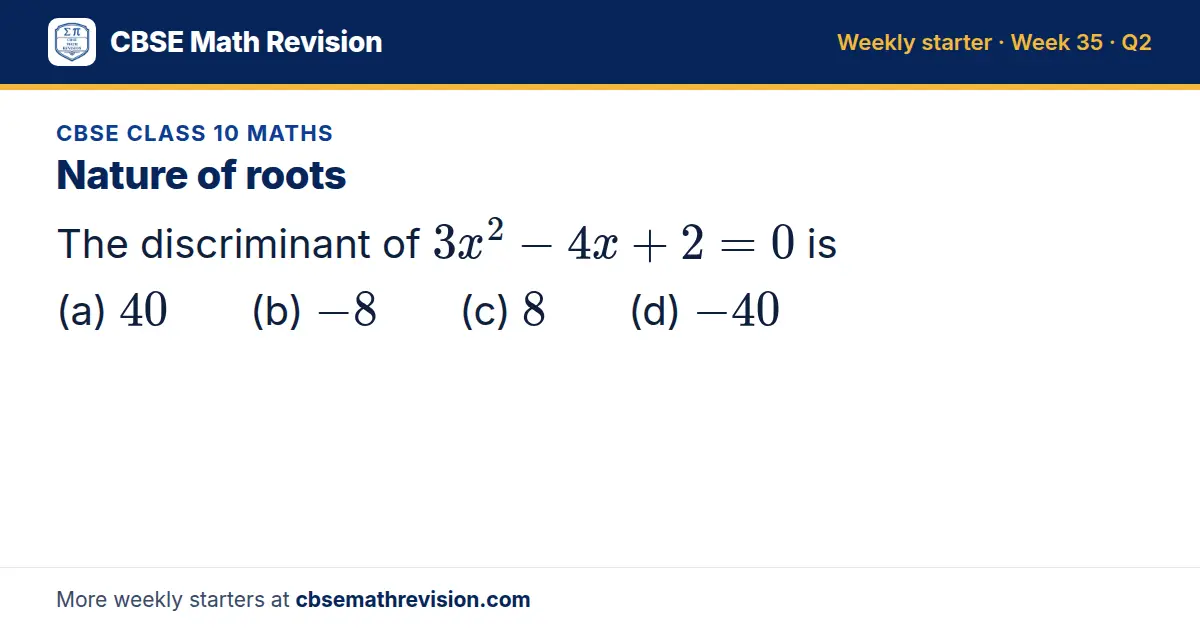
Question 2: Nature of roots
The discriminant of 3x² - 4x + 2 = 0 is (a) 40 (b) -8 (c) 8 (d) -40
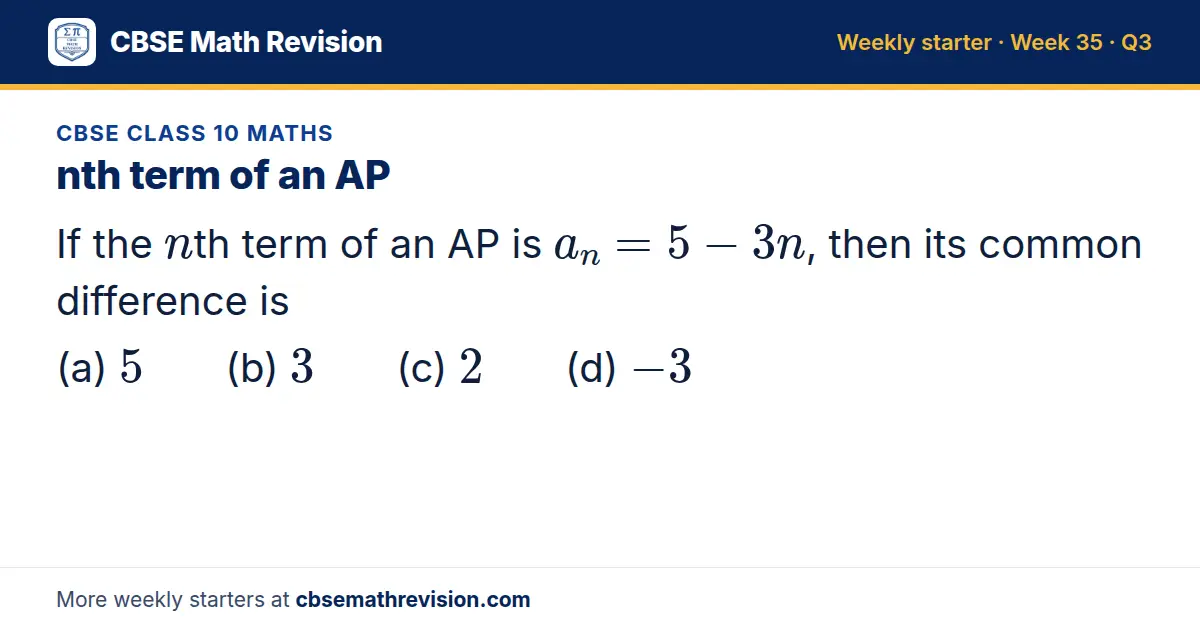
Question 3: nth term of an AP
If the nth term of an AP is a_n = 5 - 3n, then its common difference is (a) 5 (b) 3 (c) 2 (d) -3
Week 38
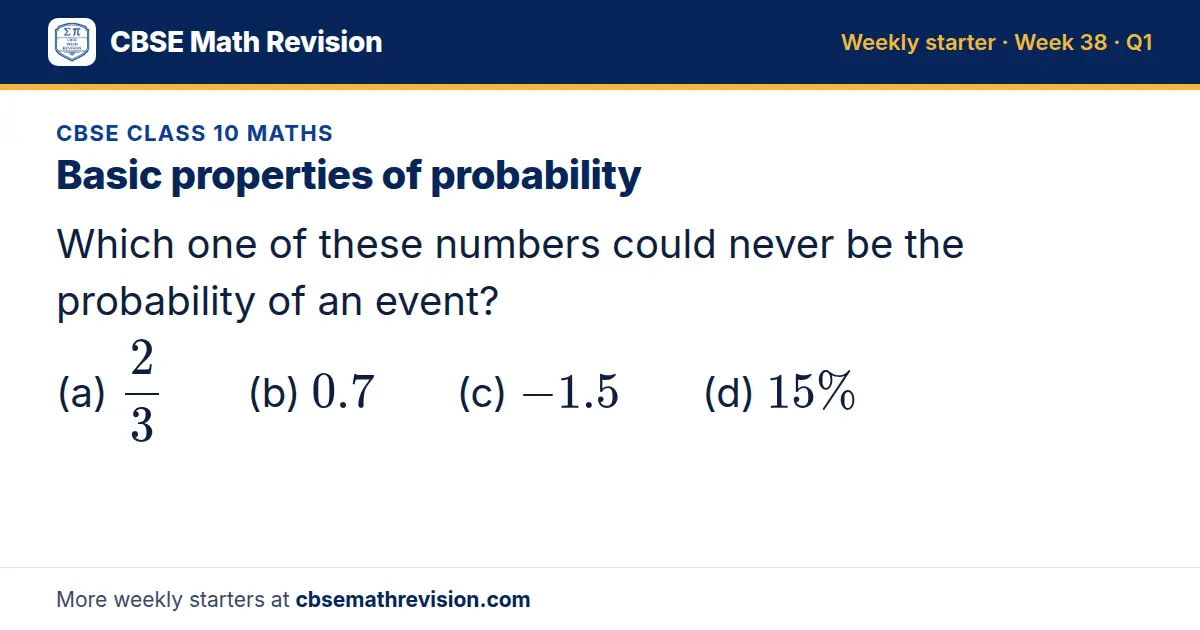
Question 1: Basic properties of probability
Which one of these numbers could never be the probability of an event? (a) 2/3 (b) 0.7 (c) -1.5 (d) 15%
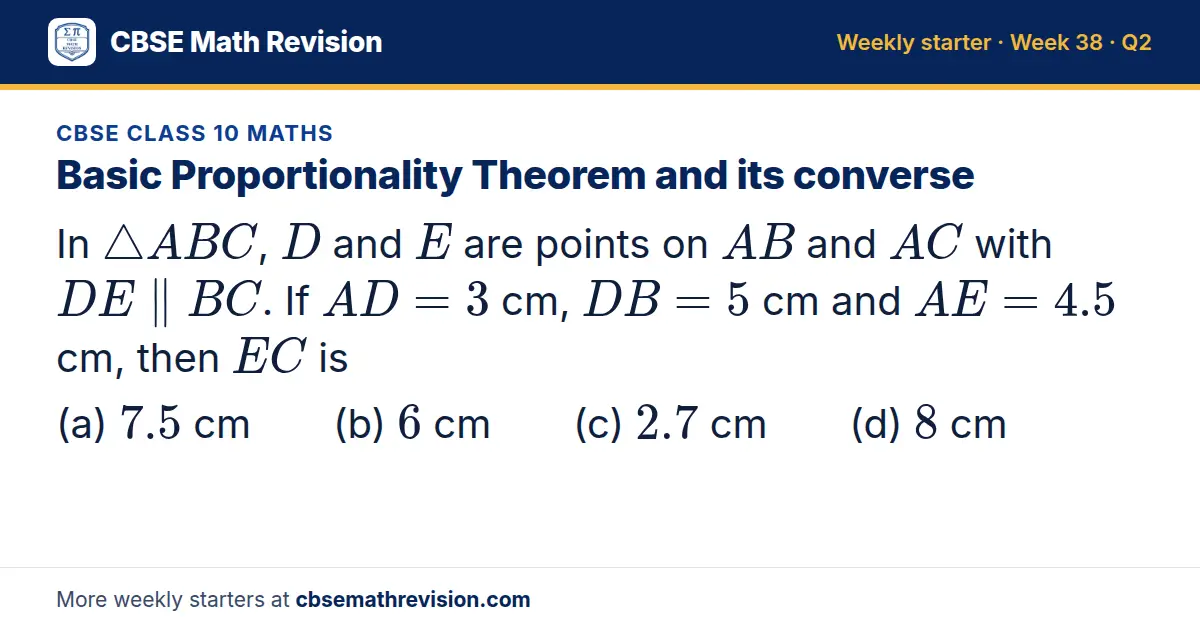
Question 2: Basic Proportionality Theorem and its converse
In △ ABC, D and E are points on AB and AC with DE ∥ BC. If AD = 3 cm, DB = 5 cm and AE = 4.5 cm, then EC is (a) 7.5 cm (b) 6 cm (c) 2.7 cm (d) 8 cm
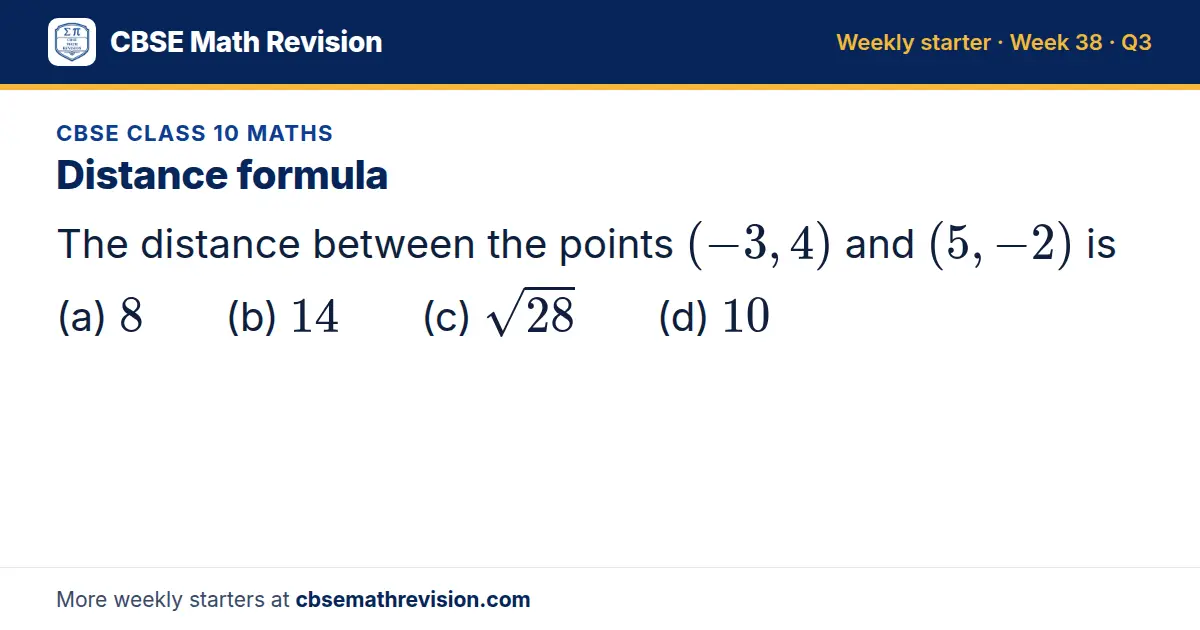
Question 3: Distance formula
The distance between the points (-3, 4) and (5, -2) is (a) 8 (b) 14 (c) √28 (d) 10
Week 39
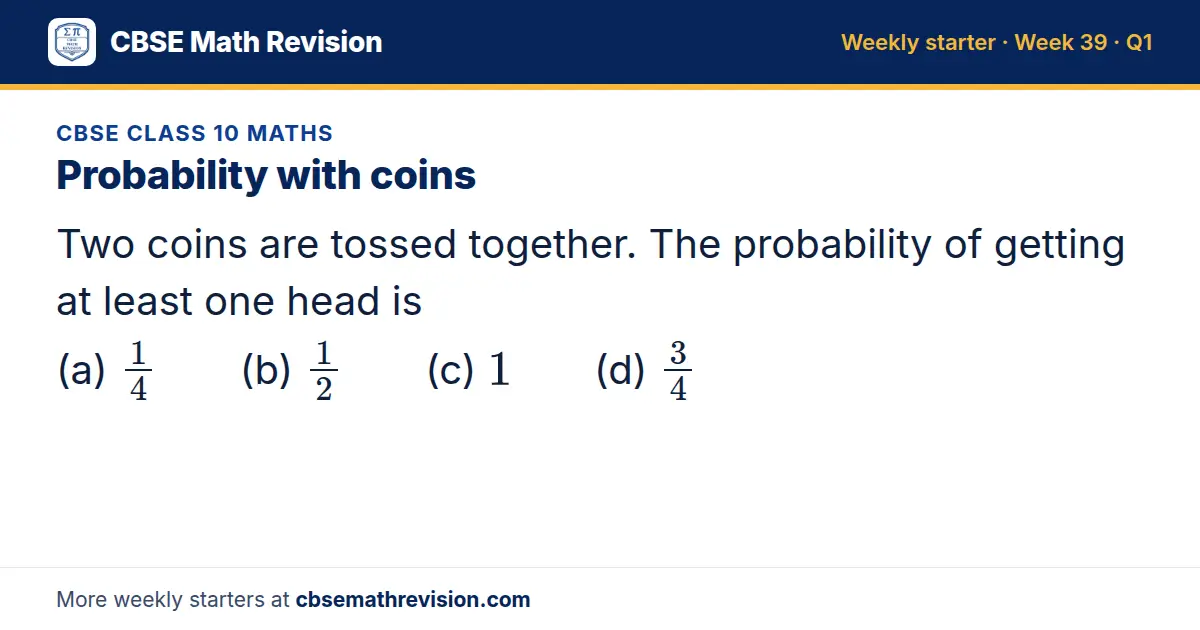
Question 1: Probability with coins
Two coins are tossed together. The probability of getting at least one head is (a) 1/4 (b) 1/2 (c) 1 (d) 3/4
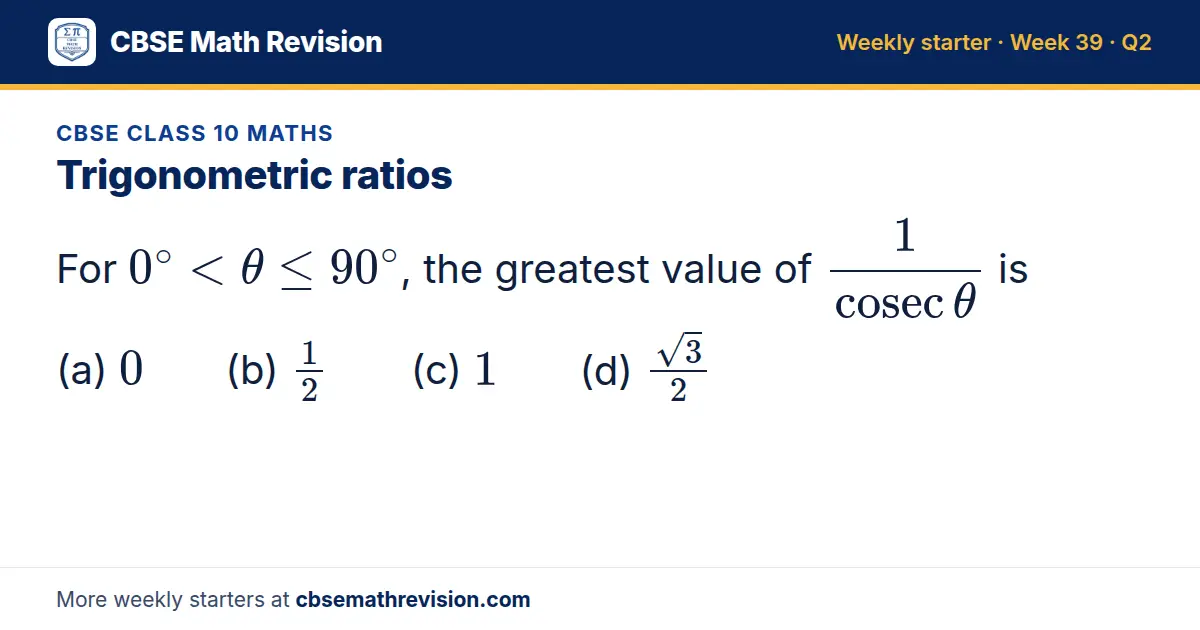
Question 2: Trigonometric ratios
For 0° < θ ≤ 90°, the greatest value of 1/(cosecθ) is (a) 0 (b) 1/2 (c) 1 (d) (√3)/2
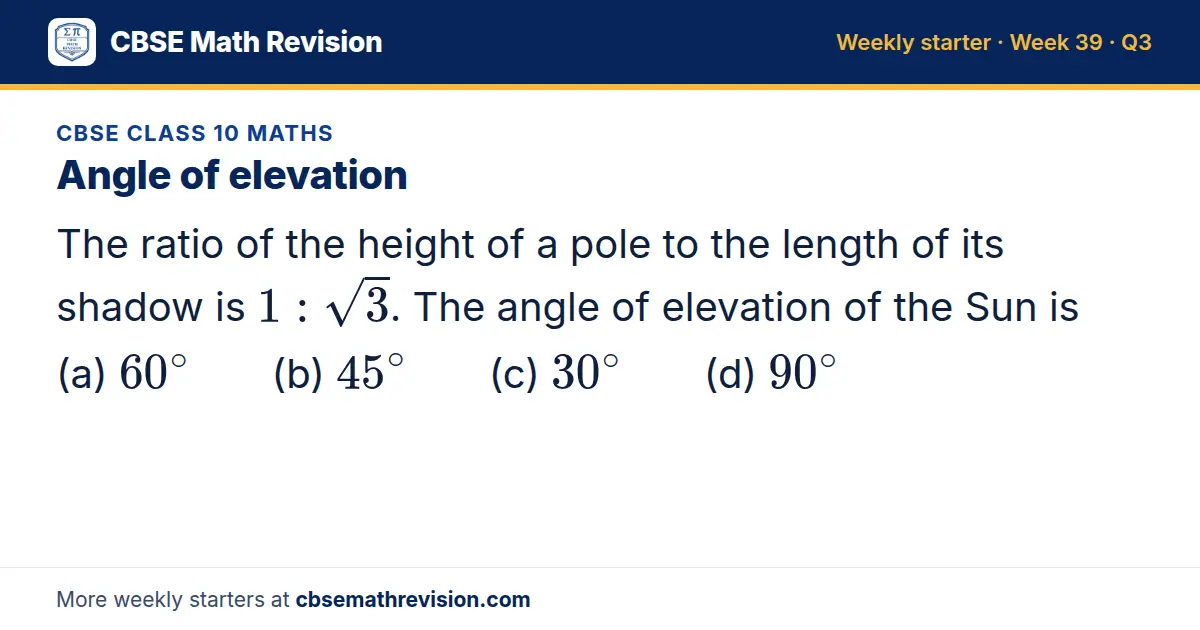
Question 3: Angle of elevation
The ratio of the height of a pole to the length of its shadow is 1:√3. The angle of elevation of the Sun is (a) 60° (b) 45° (c) 30° (d) 90°
Week 42
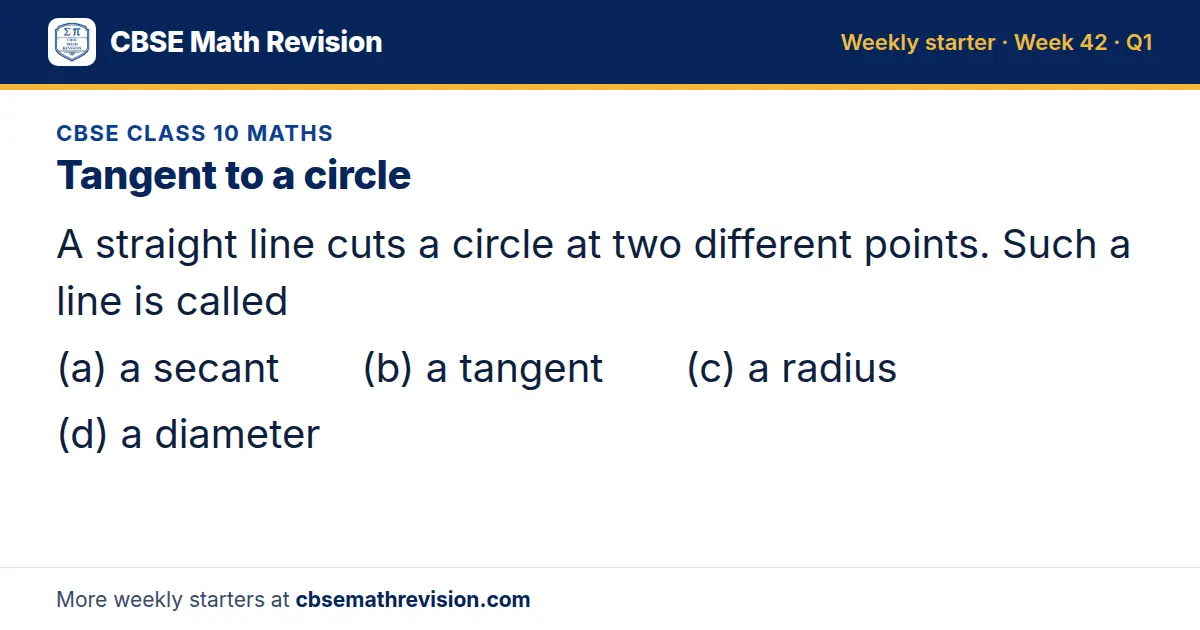
Question 1: Tangent to a circle
A straight line cuts a circle at two different points. Such a line is called (a) a secant (b) a tangent (c) a radius (d) a diameter
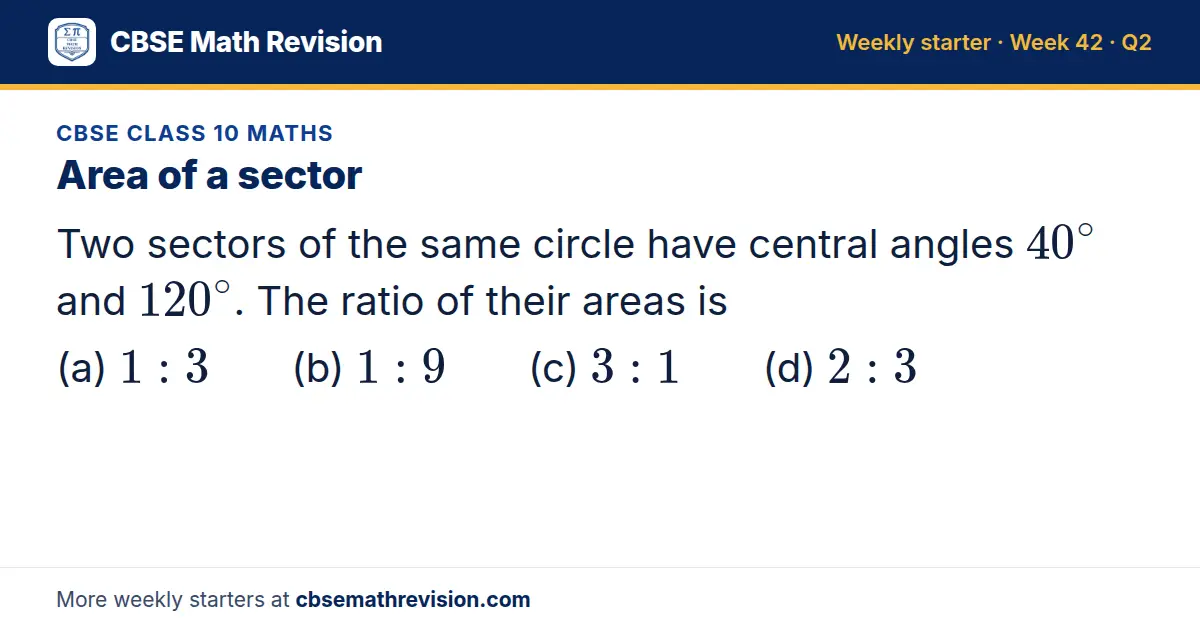
Question 2: Area of a sector
Two sectors of the same circle have central angles 40° and 120°. The ratio of their areas is (a) 1:3 (b) 1:9 (c) 3:1 (d) 2:3
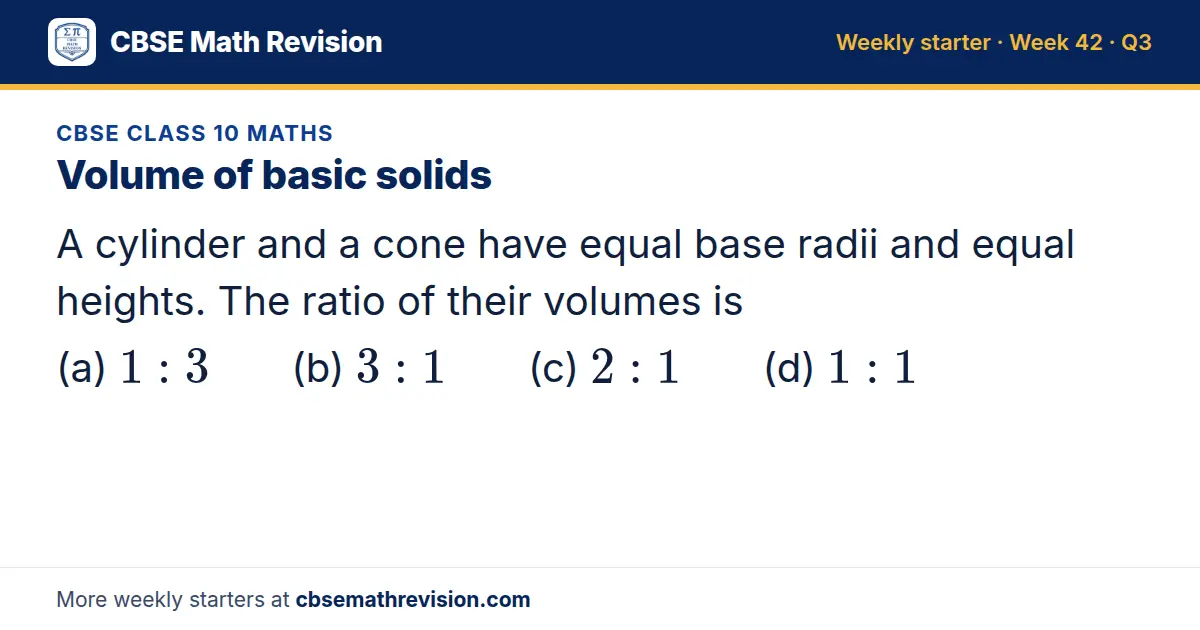
Question 3: Volume of basic solids
A cylinder and a cone have equal base radii and equal heights. The ratio of their volumes is (a) 1:3 (b) 3:1 (c) 2:1 (d) 1:1
Week 43
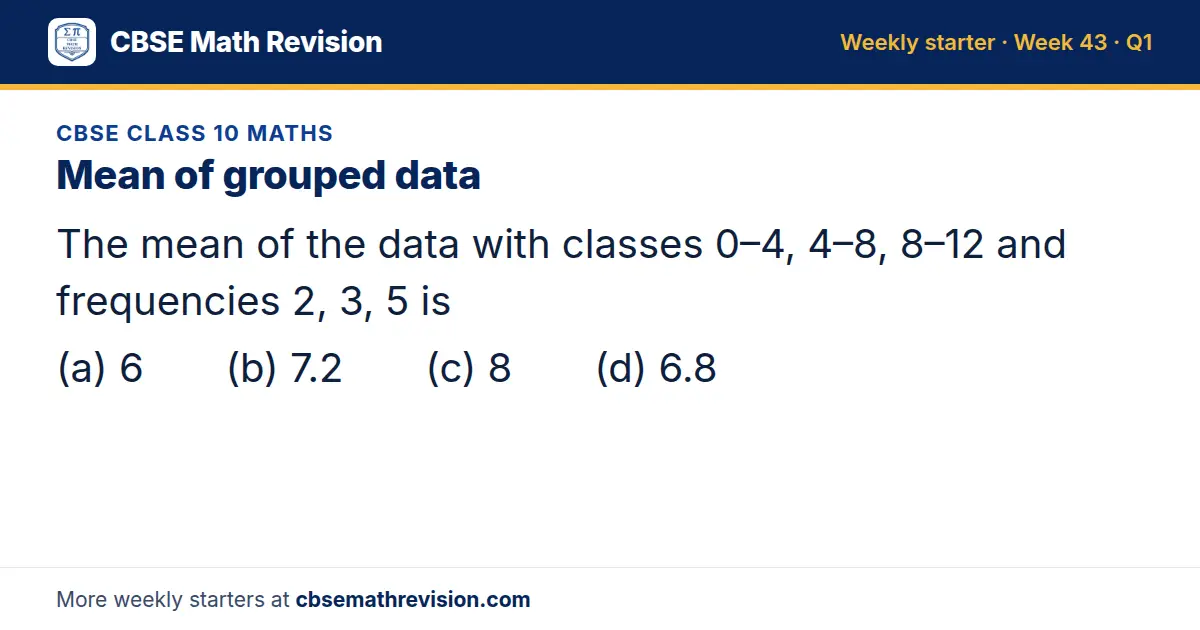
Question 1: Mean of grouped data
The mean of the data with classes 0–4, 4–8, 8–12 and frequencies 2, 3, 5 is (a) 6 (b) 7.2 (c) 8 (d) 6.8
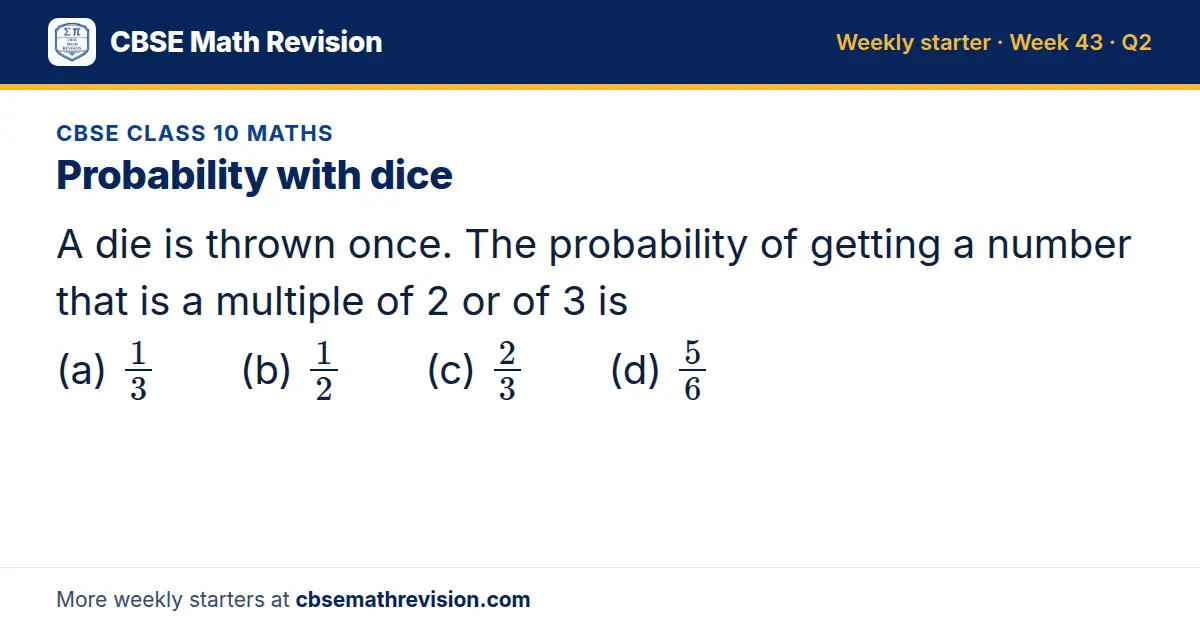
Question 2: Probability with dice
A die is thrown once. The probability of getting a number that is a multiple of 2 or of 3 is (a) 1/3 (b) 1/2 (c) 2/3 (d) 5/6
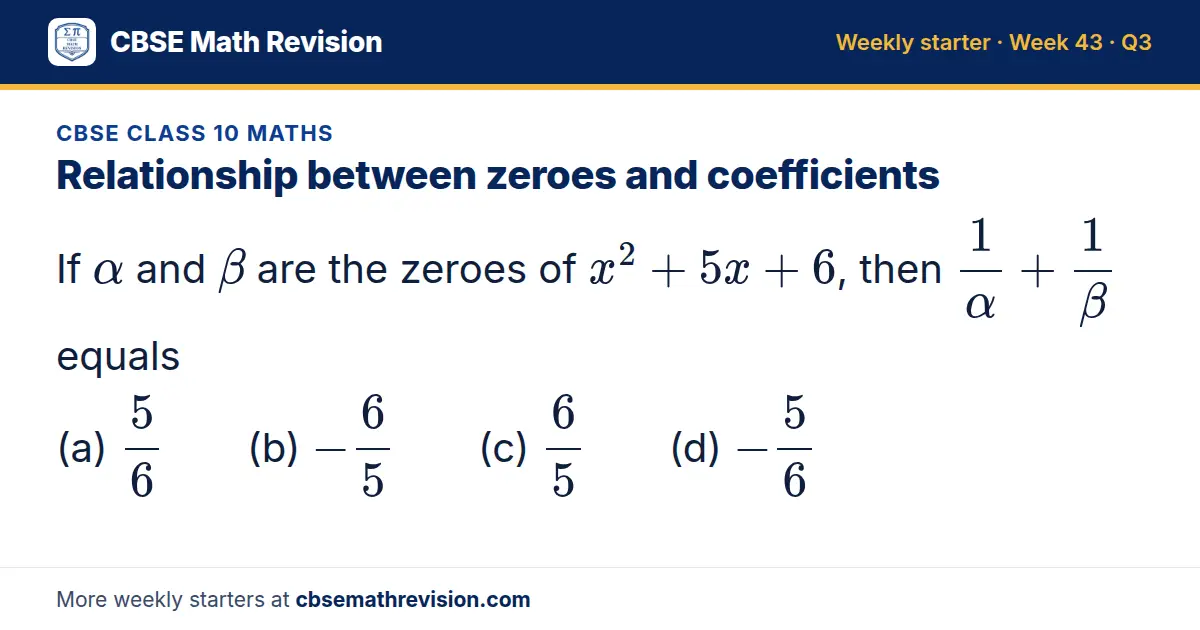
Question 3: Relationship between zeroes and coefficients
If α and β are the zeroes of x² + 5x + 6, then 1α + 1β equals (a) 5/6 (b) -6/5 (c) 6/5 (d) -5/6
Week 44
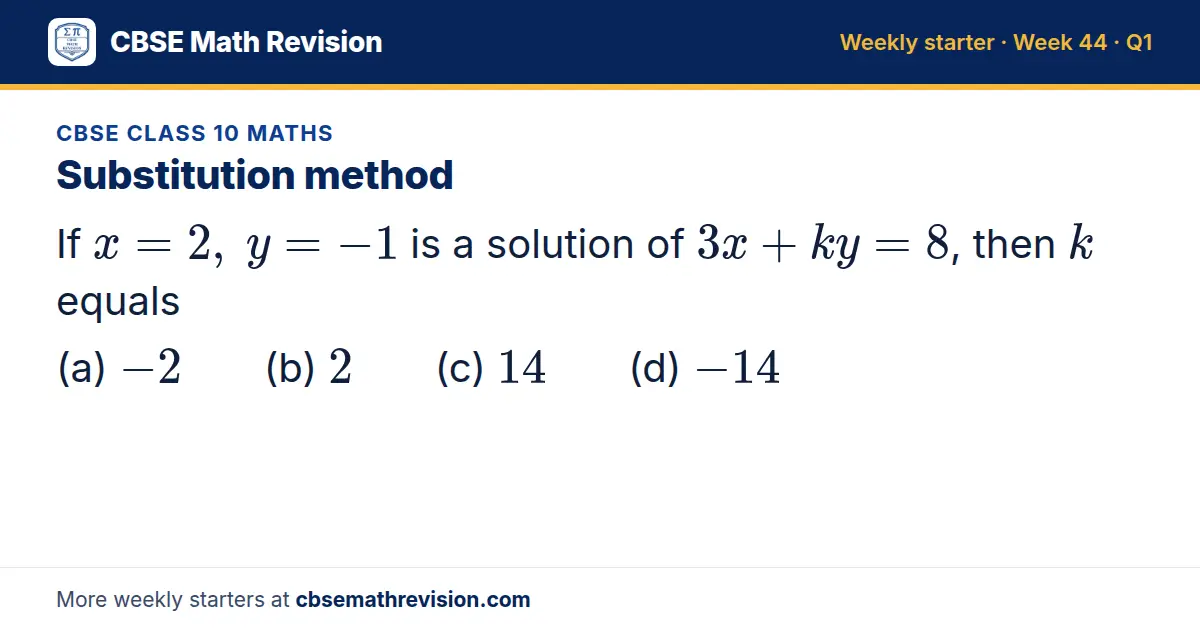
Question 1: Substitution method
If x = 2, y = -1 is a solution of 3x + ky = 8, then k equals (a) -2 (b) 2 (c) 14 (d) -14
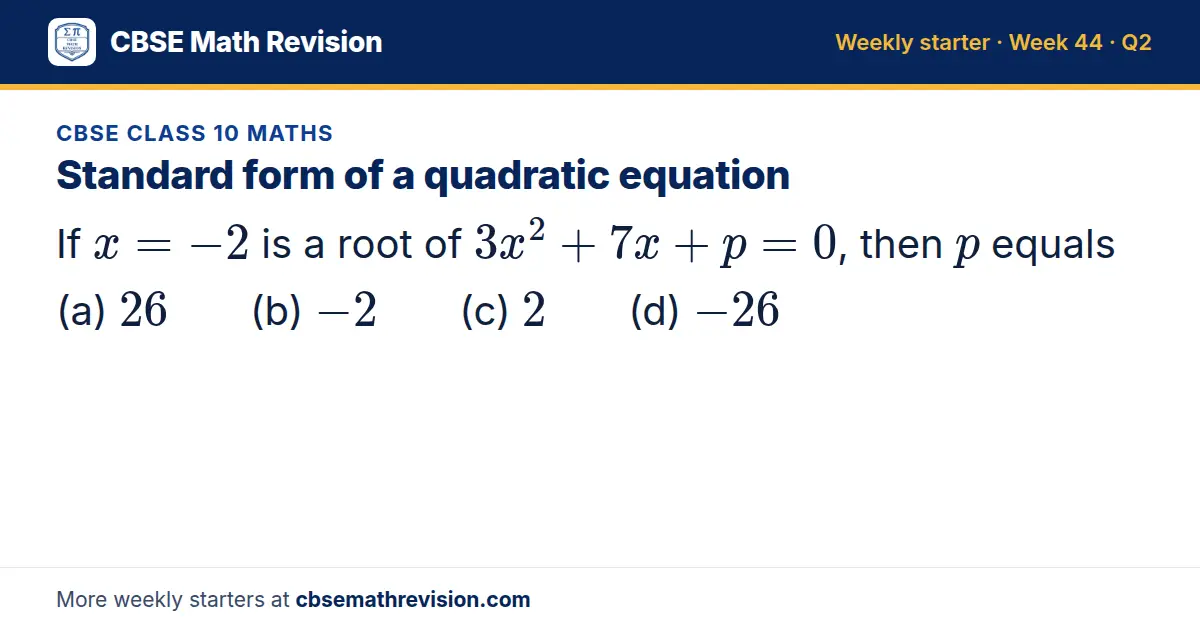
Question 2: Standard form of a quadratic equation
If x = -2 is a root of 3x² + 7x + p = 0, then p equals (a) 26 (b) -2 (c) 2 (d) -26
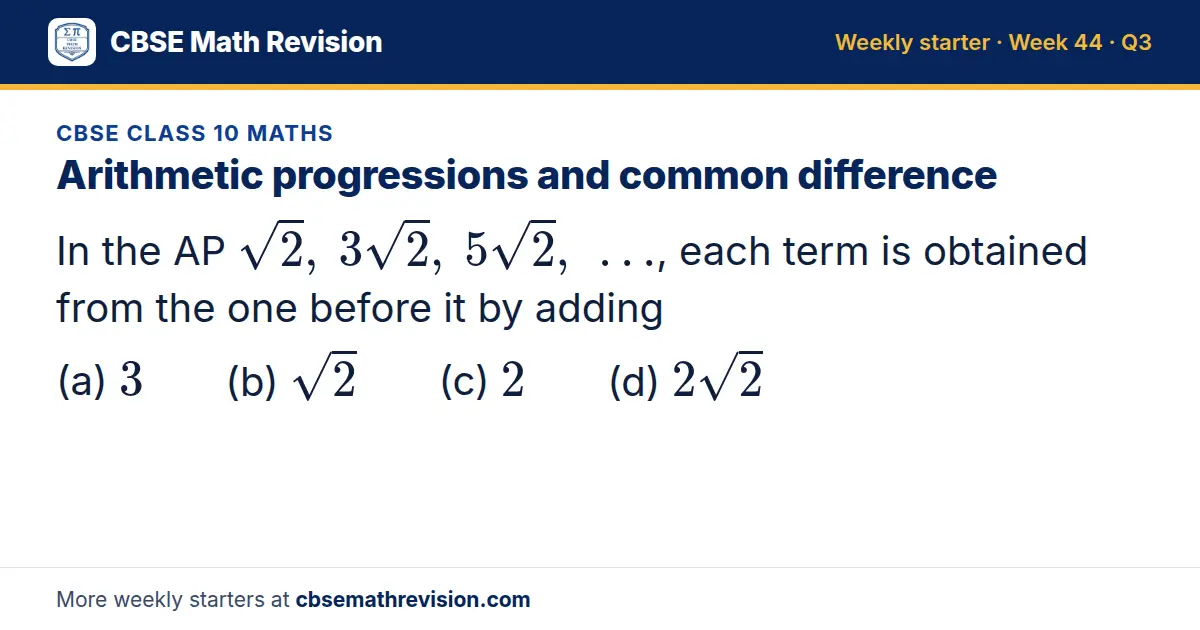
Question 3: Arithmetic progressions and common difference
In the AP √2, 3√2, 5√2, …, each term is obtained from the one before it by adding (a) 3 (b) √2 (c) 2 (d) 2√2
Week 45
Question 1: Criteria for similarity of triangles
ABCD is a trapezium with AB ∥ DC and AB = 2 DC. Its diagonals meet at O. If OC = 4 cm, then OA is (a) 2 cm (b) 4 cm (c) 6 cm (d) 8 cm
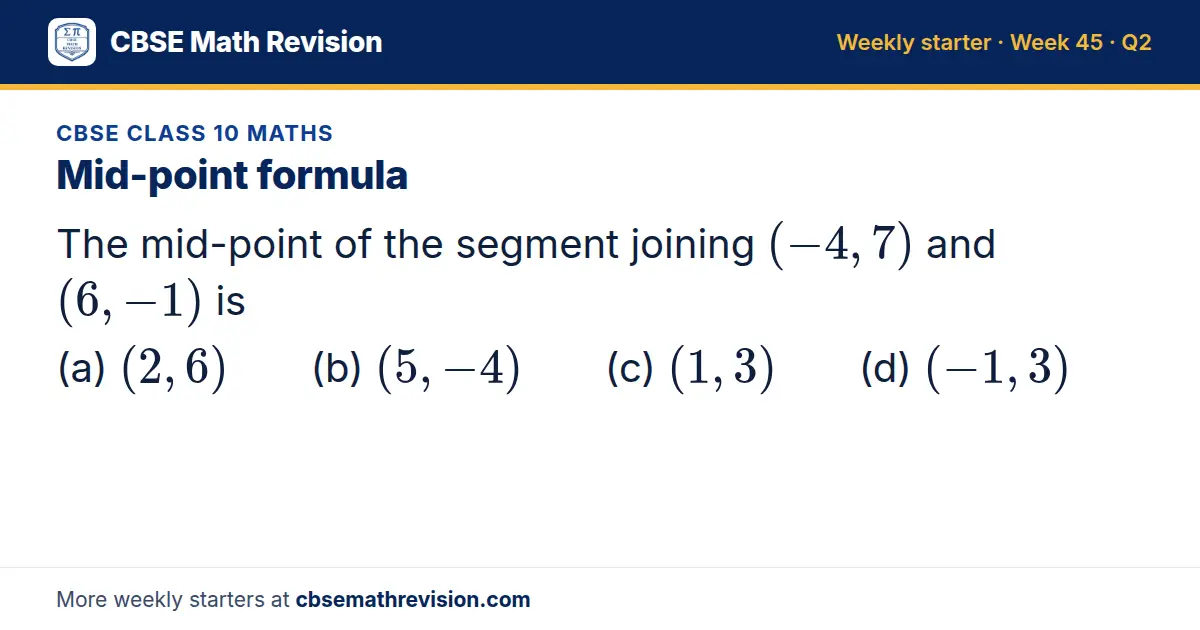
Question 2: Mid-point formula
The mid-point of the segment joining (-4, 7) and (6, -1) is (a) (2, 6) (b) (5, -4) (c) (1, 3) (d) (-1, 3)
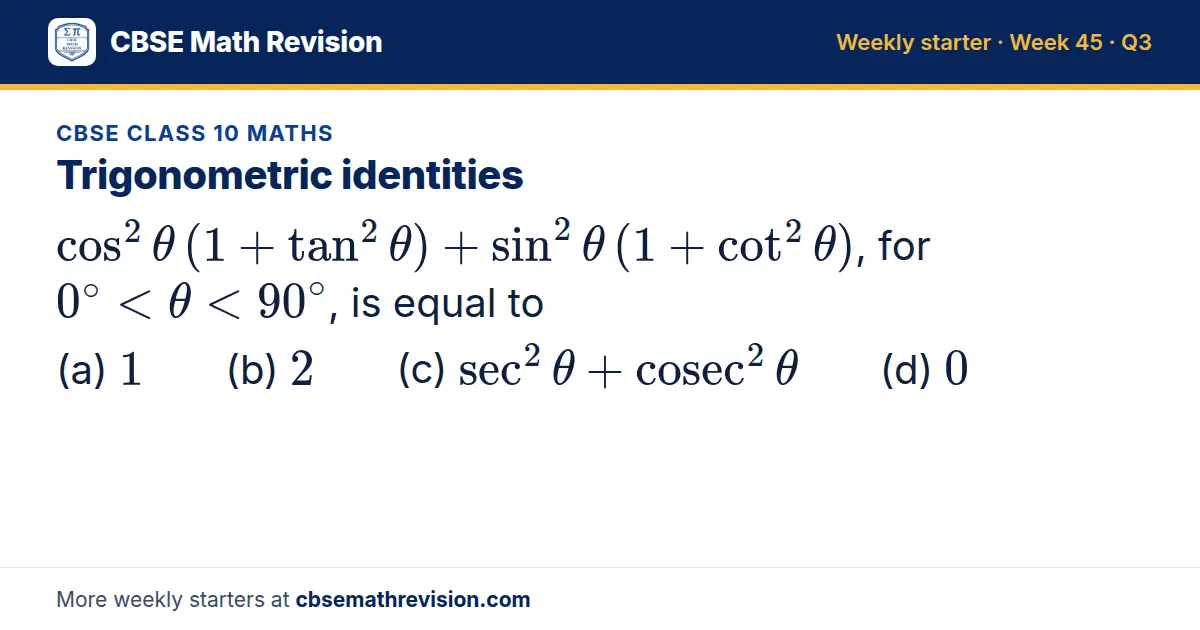
Question 3: Trigonometric identities
cos²θ (1+tan²θ)+sin²θ (1+cot²θ), for 0°<θ<90°, is equal to (a) 1 (b) 2 (c) sec²θ+cosec²θ (d) 0
Week 46
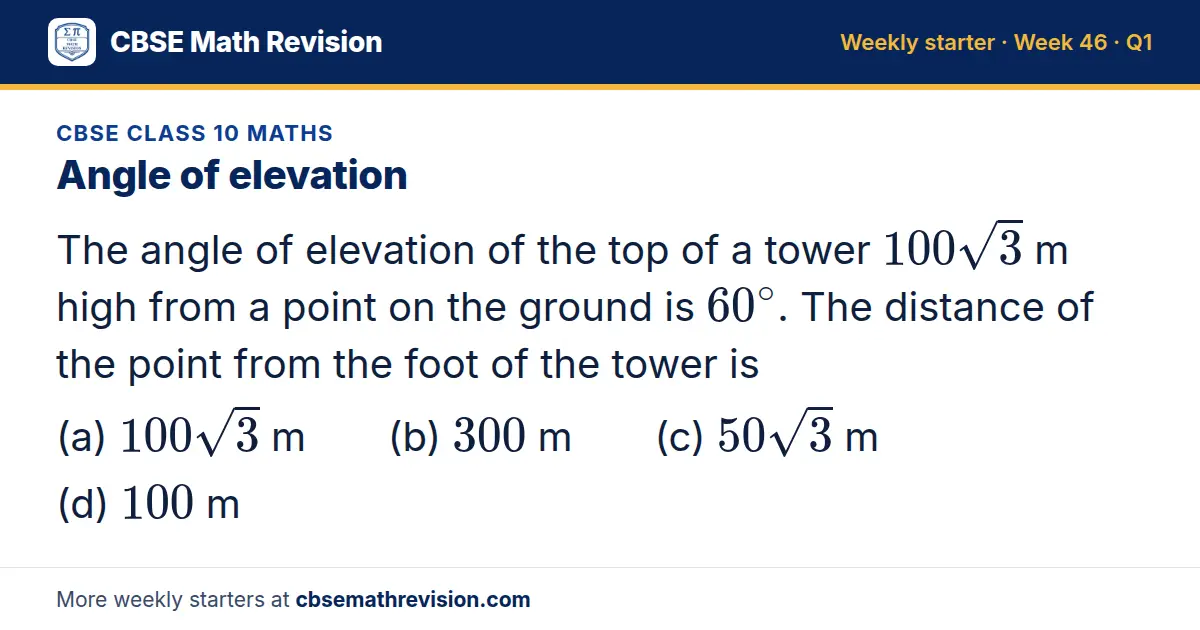
Question 1: Angle of elevation
The angle of elevation of the top of a tower 100√3 m high from a point on the ground is 60°. The distance of the point from the foot of the tower is (a) 100√3 m (b) 300 m (c) 50√3 m (d) 100 m
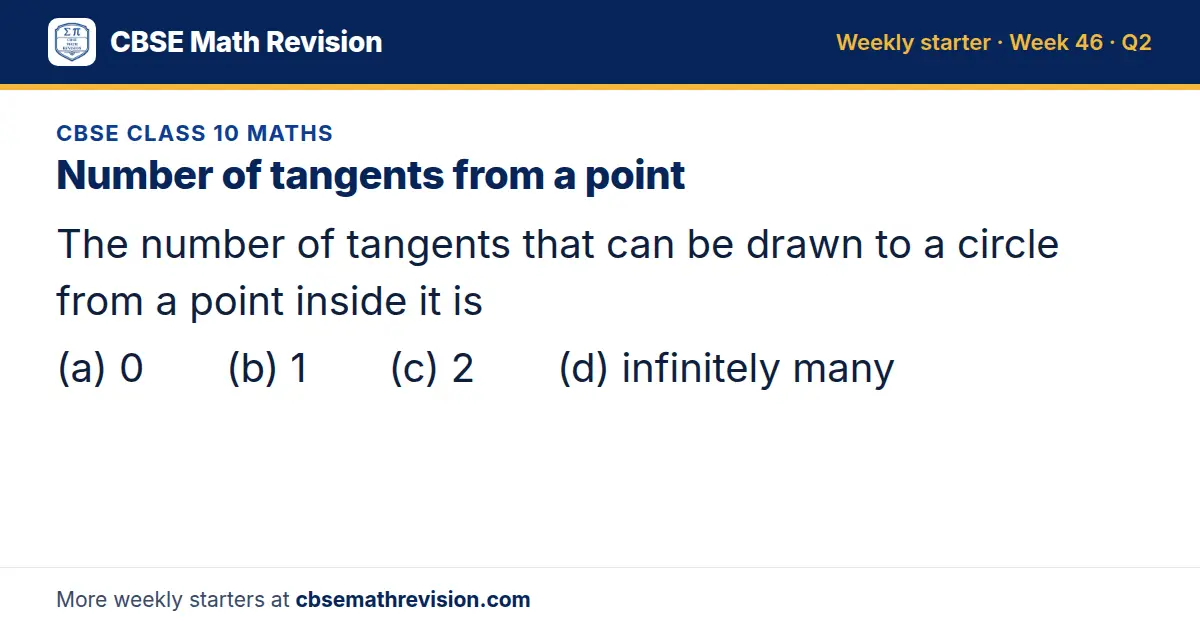
Question 2: Number of tangents from a point
The number of tangents that can be drawn to a circle from a point inside it is (a) 0 (b) 1 (c) 2 (d) infinitely many
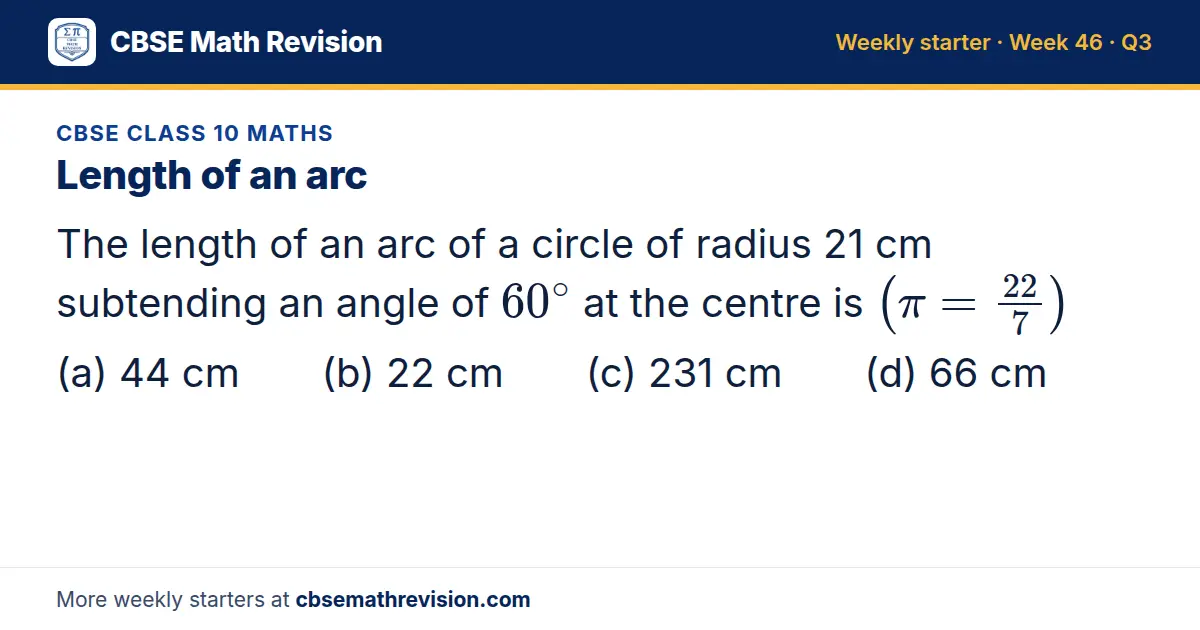
Question 3: Length of an arc
The length of an arc of a circle of radius 21 cm subtending an angle of 60° at the centre is (π=22/7) (a) 44 cm (b) 22 cm (c) 231 cm (d) 66 cm
More starter questions
Other weeks: Weeks 1–18 · Weeks 19–31 · Weeks 33–46. Answers and mark schemes, free for everyone, are on the free weekly starters page.
Keep your streak going
Save your answers and track your progressA free account remembers the questions you have done and brings you back to this page.
Join freeAlready have an account? Sign in