CBSE Class 12 Maths starter questions: weeks 19–31
33 short questions to open a lesson for CBSE Class 12 Mathematics, weeks 19–31 of the teaching year, three or four a week. Each question is shown as an image with its text underneath; answers and mark schemes stay with teachers.
- ← CBSE Class 12 Maths, weeks 1–18
- CBSE Class 12 Maths, weeks 32–46 →
- All CBSE Maths daily and weekly questions
Week 19
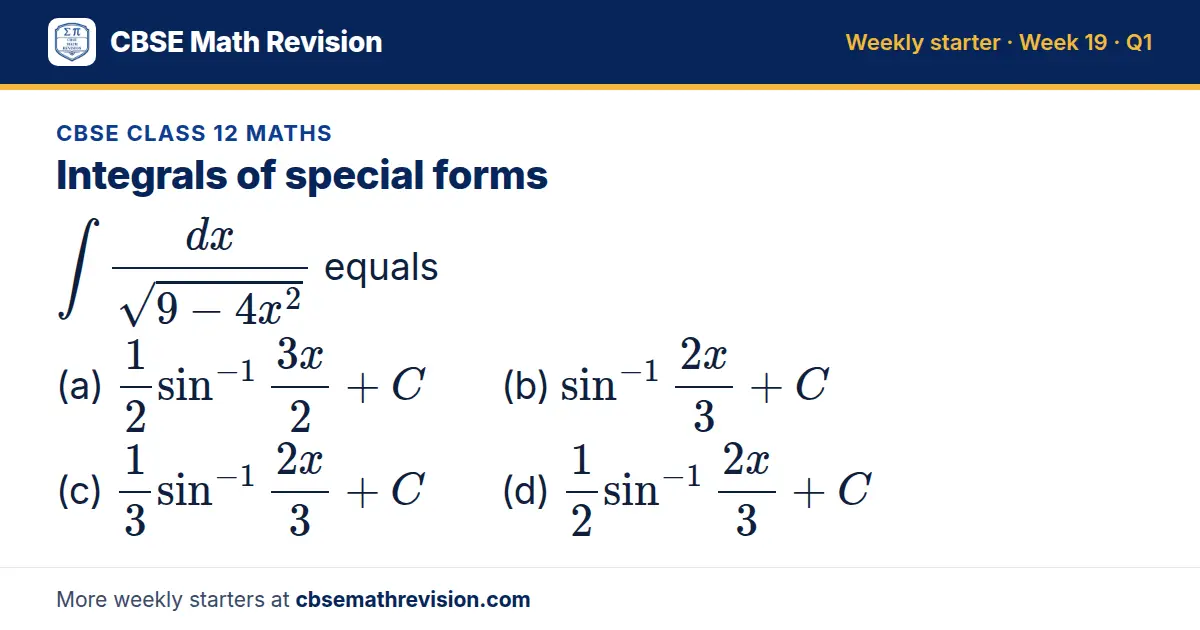
Question 1: Integrals of special forms
/(√(9 - 4x²)) equals (a) 12sin⁻¹3x/2 + C (b) sin⁻¹2x/3 + C (c) 13sin⁻¹2x/3 + C (d) 12sin⁻¹2x/3 + C
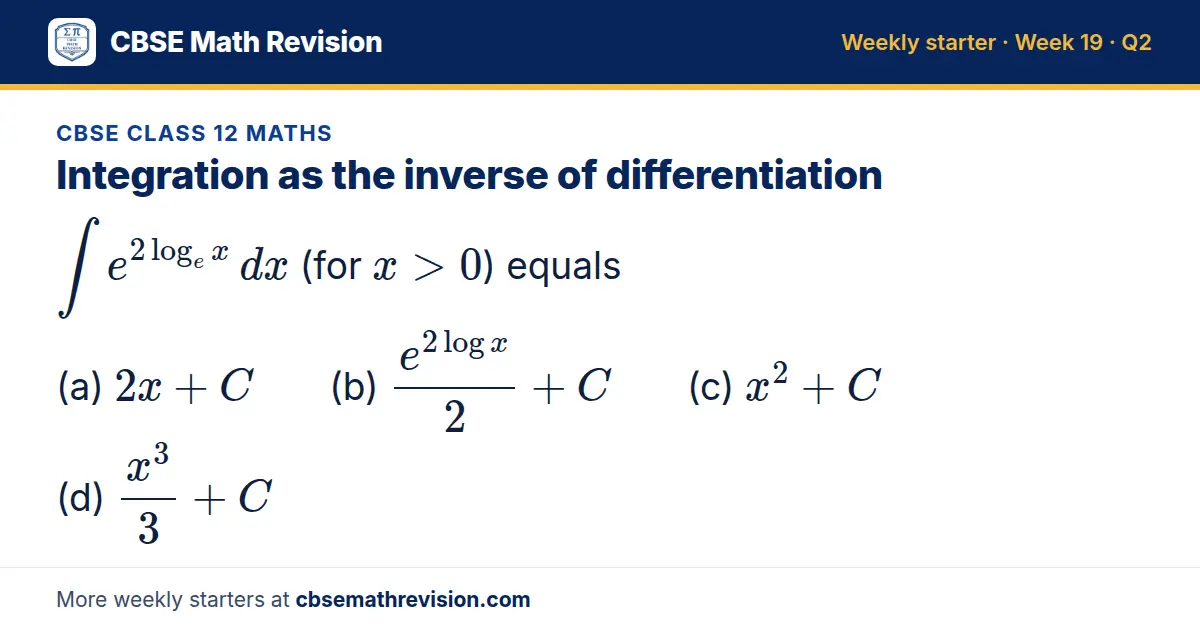
Question 2: Integration as the inverse of differentiation
∫ e^(2log_e x) dx (for x > 0) equals (a) 2x + C (b) (e^(2log x))/2 + C (c) x² + C (d) (x³)/3 + C
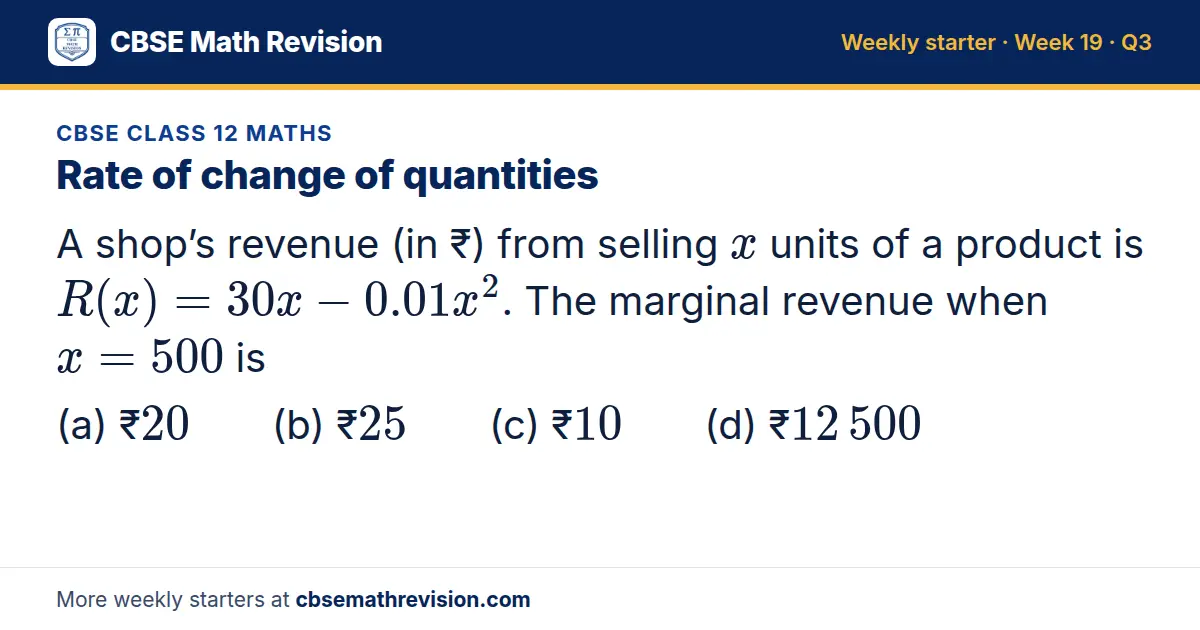
Question 3: Rate of change of quantities
A shop’s revenue (in ₹) from selling x units of a product is R(x) = 30x - 0.01x^2. The marginal revenue when x = 500 is (a) ₹20 (b) ₹25 (c) ₹10 (d) ₹12 500
Week 20
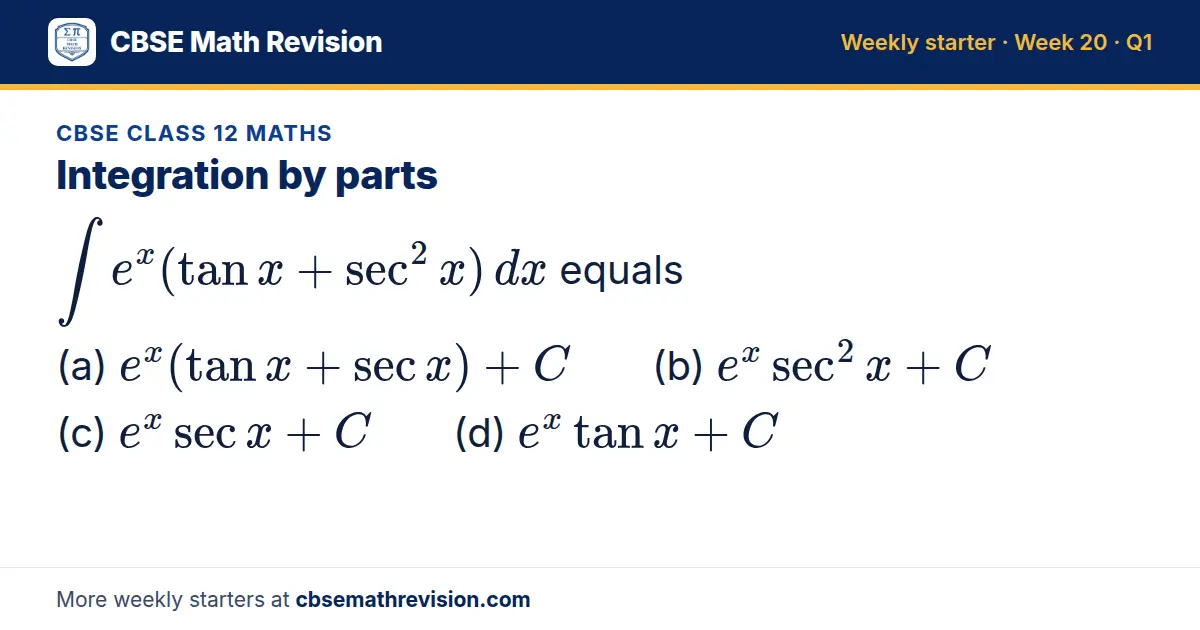
Question 1: Integration by parts
∫ e^x(tan x + sec² x) dx equals (a) e^x(tan x + sec x) + C (b) e^xsec² x + C (c) e^xsec x + C (d) e^xtan x + C
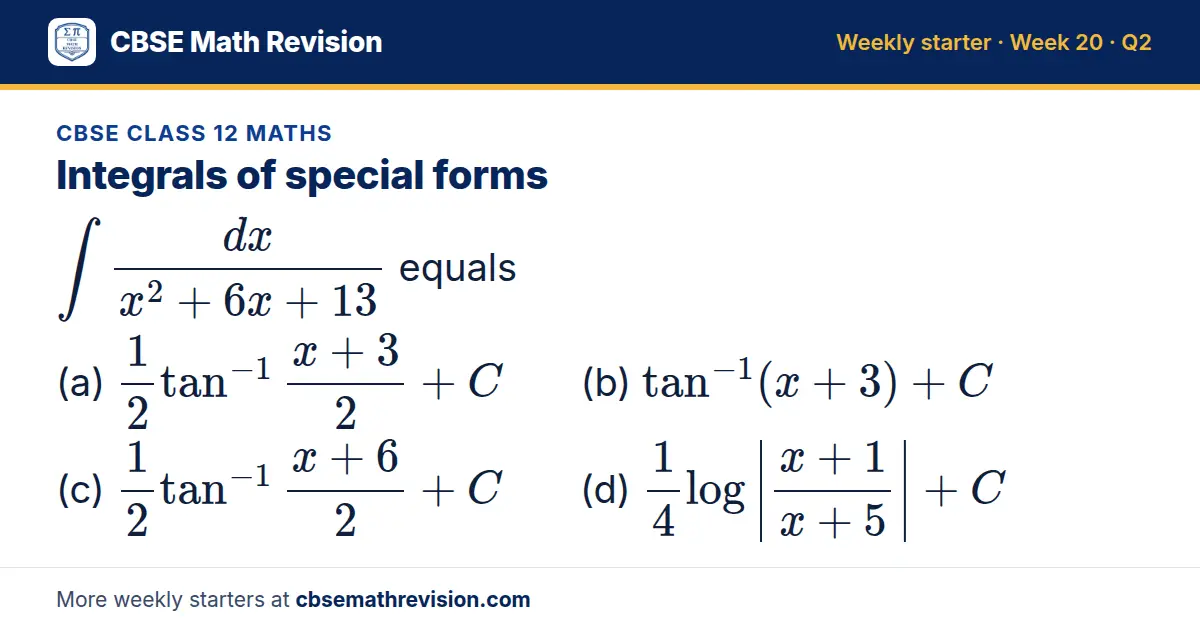
Question 2: Integrals of special forms
/(x² + 6x + 13) equals (a) 12tan⁻¹(x + 3)/2 + C (b) tan⁻¹(x + 3) + C (c) 12tan⁻¹(x + 6)/2 + C (d) 14log|(x + 1)/(x + 5)| + C
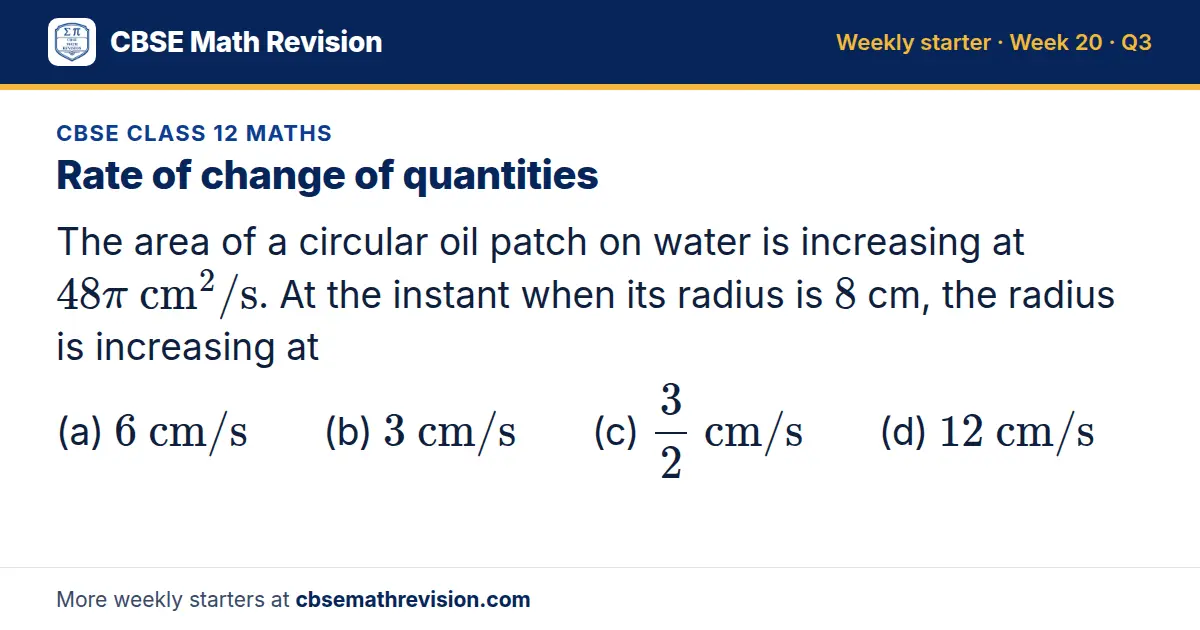
Question 3: Rate of change of quantities
The area of a circular oil patch on water is increasing at 48π cm^2/s. At the instant when its radius is 8 cm, the radius is increasing at (a) 6 cm/s (b) 3 cm/s (c) 3/2 cm/s (d) 12 cm/s
Week 21
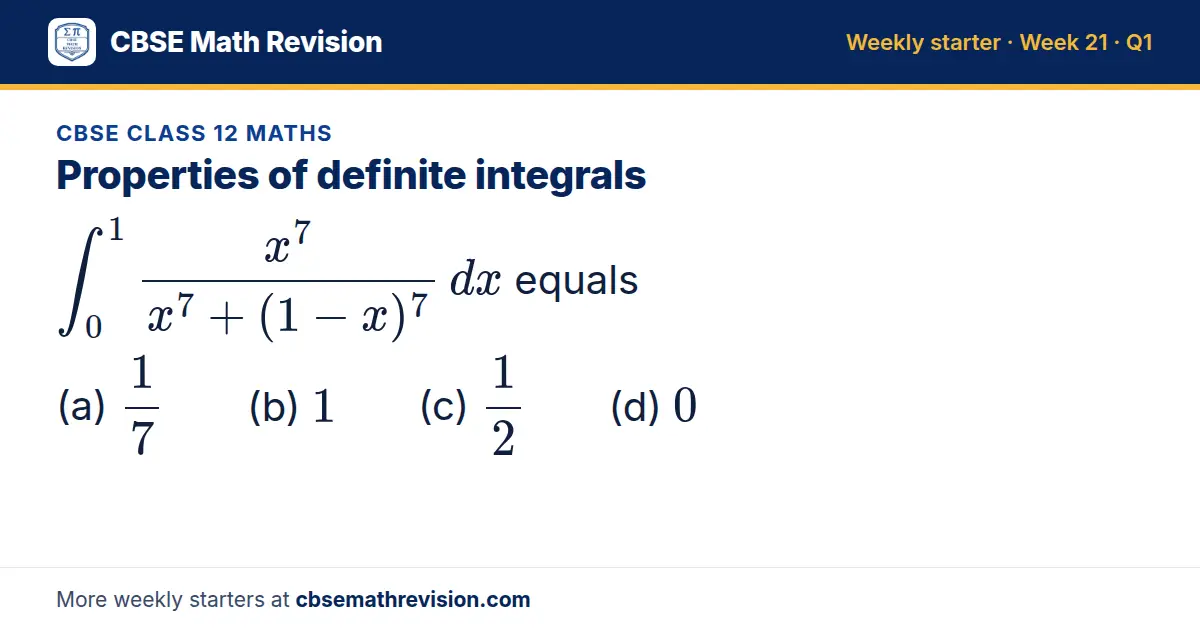
Question 1: Properties of definite integrals
∫_0¹(x⁷)/(x⁷ + (1 - x)⁷) dx equals (a) 17 (b) 1 (c) 12 (d) 0
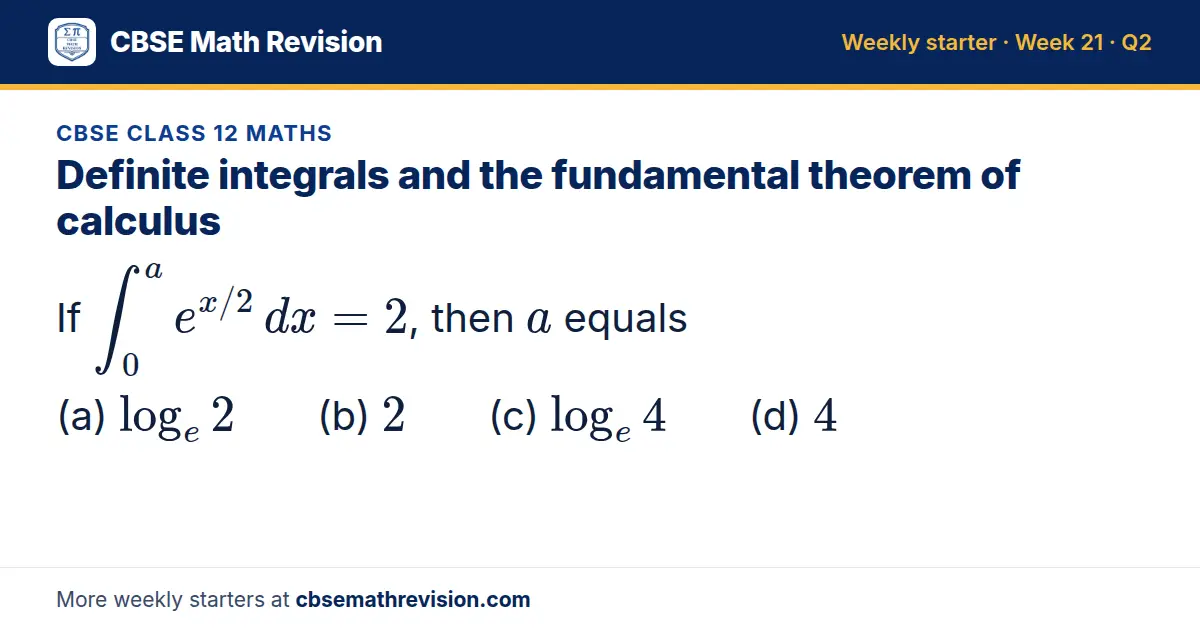
Question 2: Definite integrals and the fundamental theorem of calculus
If ∫_0^a e^(x/2) dx = 2, then a equals (a) log_e 2 (b) 2 (c) log_e 4 (d) 4
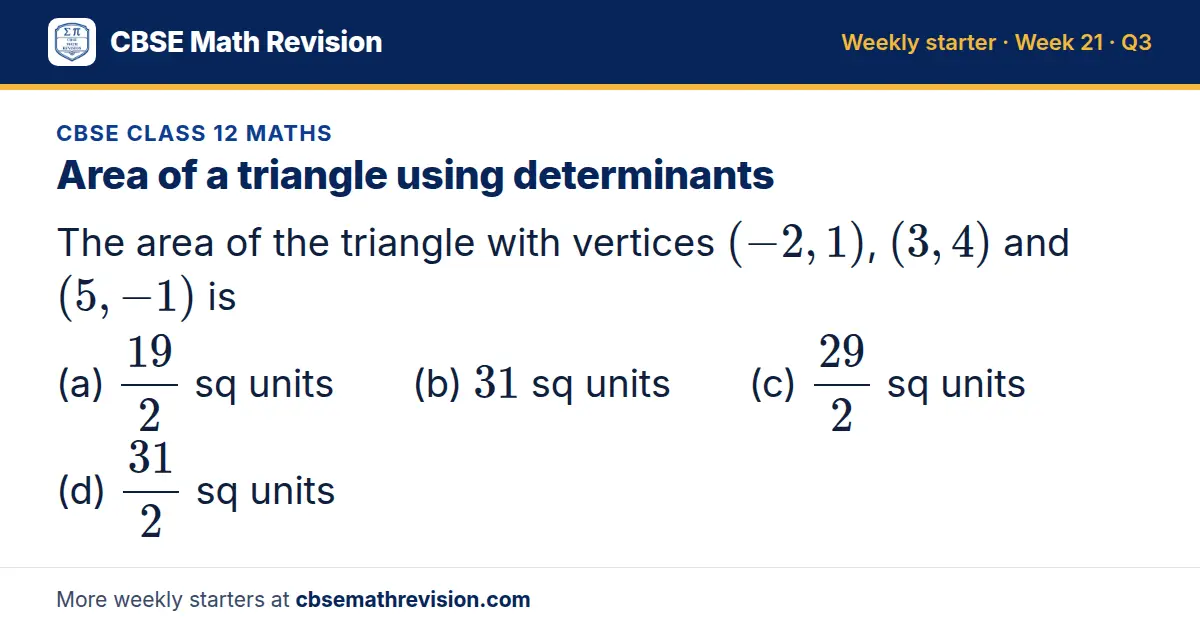
Question 3: Area of a triangle using determinants
The area of the triangle with vertices (-2, 1), (3, 4) and (5, -1) is (a) 19/2 sq units (b) 31 sq units (c) 29/2 sq units (d) 31/2 sq units
Week 22
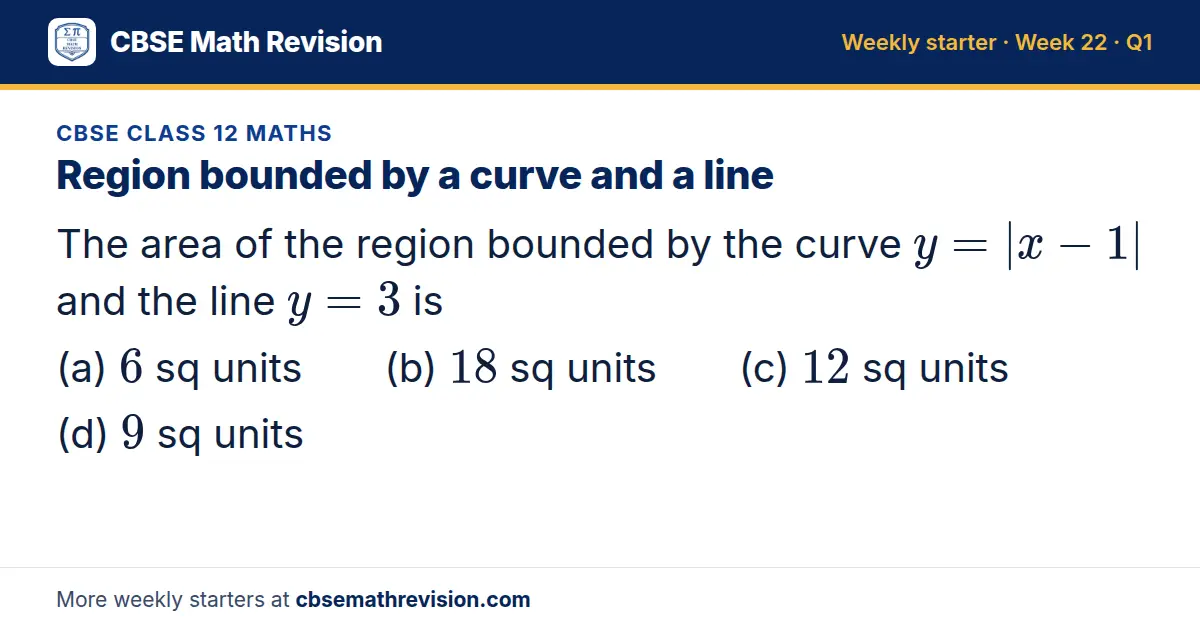
Question 1: Region bounded by a curve and a line
The area of the region bounded by the curve y = |x - 1| and the line y = 3 is (a) 6 sq units (b) 18 sq units (c) 12 sq units (d) 9 sq units
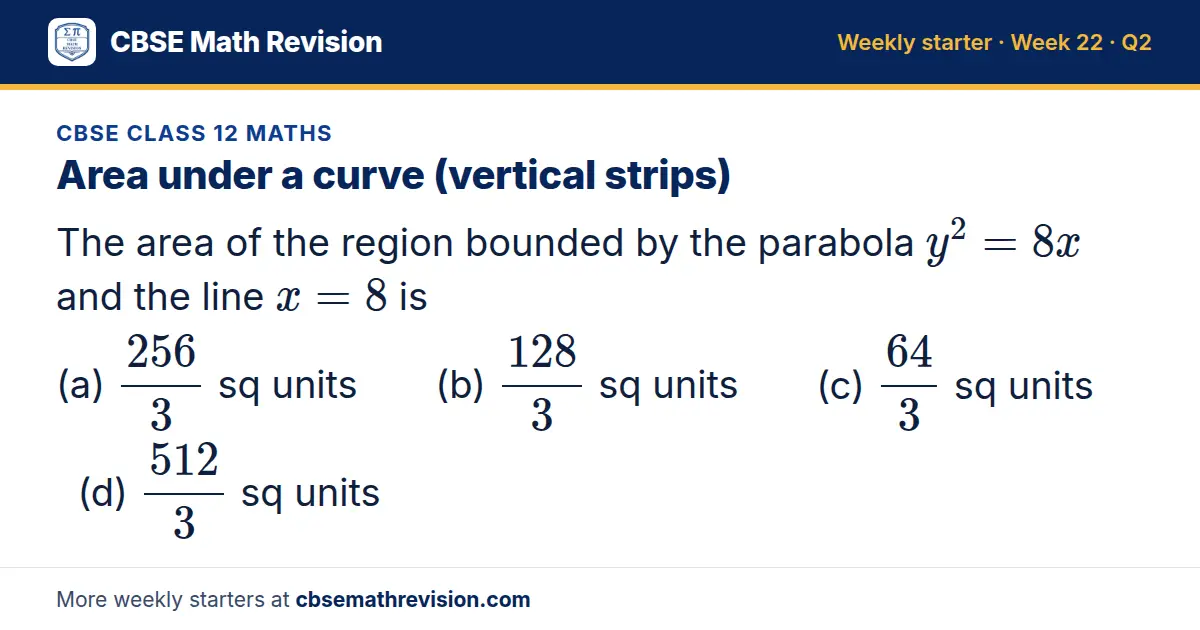
Question 2: Area under a curve (vertical strips)
The area of the region bounded by the parabola y² = 8x and the line x = 8 is (a) 256/3 sq units (b) 128/3 sq units (c) 64/3 sq units (d) 512/3 sq units
![CBSE Class 12 Maths starter question on Exponential and logarithmic functions: d/dx[log_e(sec x + tan x)], where sec x + tan x > 0, equals (a) sec x tan x (b) tan x (c) sec x (d) 1/(sec x + tan x)](/cbse-frontend/img/questions/cbse-maths-class-12-exponential-and-logarithmic-functions-starter-question-cbse12-w22-q3.webp)
Question 3: Exponential and logarithmic functions
d/dx[log_e(sec x + tan x)], where sec x + tan x > 0, equals (a) sec x tan x (b) tan x (c) sec x (d) 1/(sec x + tan x)
Week 23
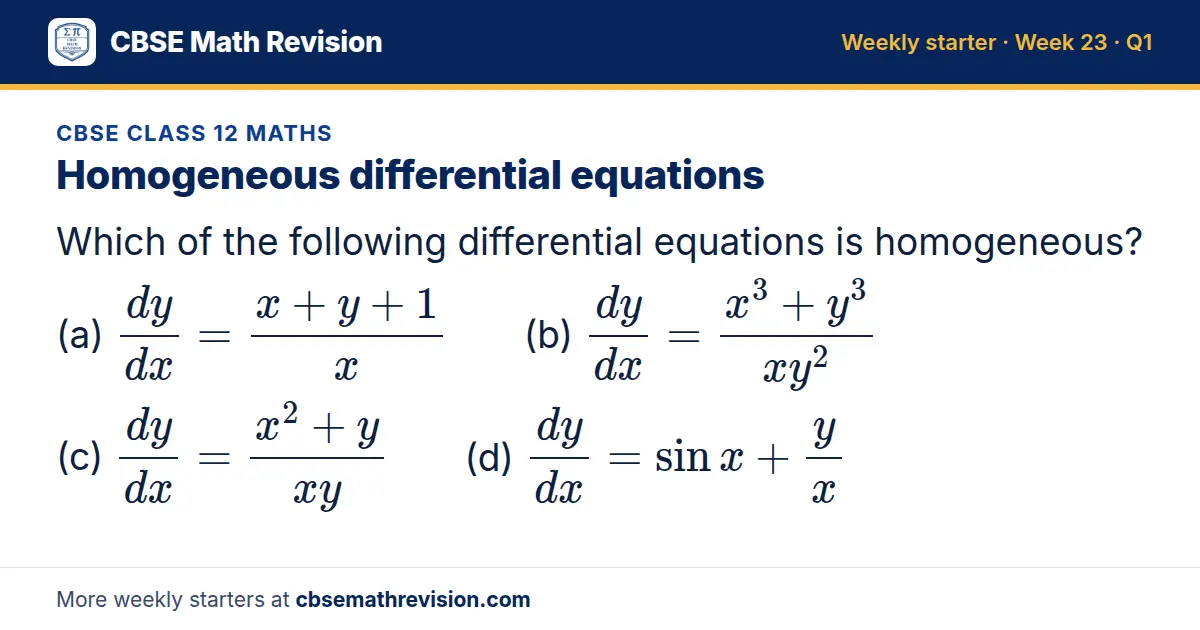
Question 1: Homogeneous differential equations
Which of the following differential equations is homogeneous? (a) dy/dx = (x + y + 1)/x (b) dy/dx = (x³ + y³)/(xy²) (c) dy/dx = (x² + y)/xy (d) dy/dx = sin x + yx
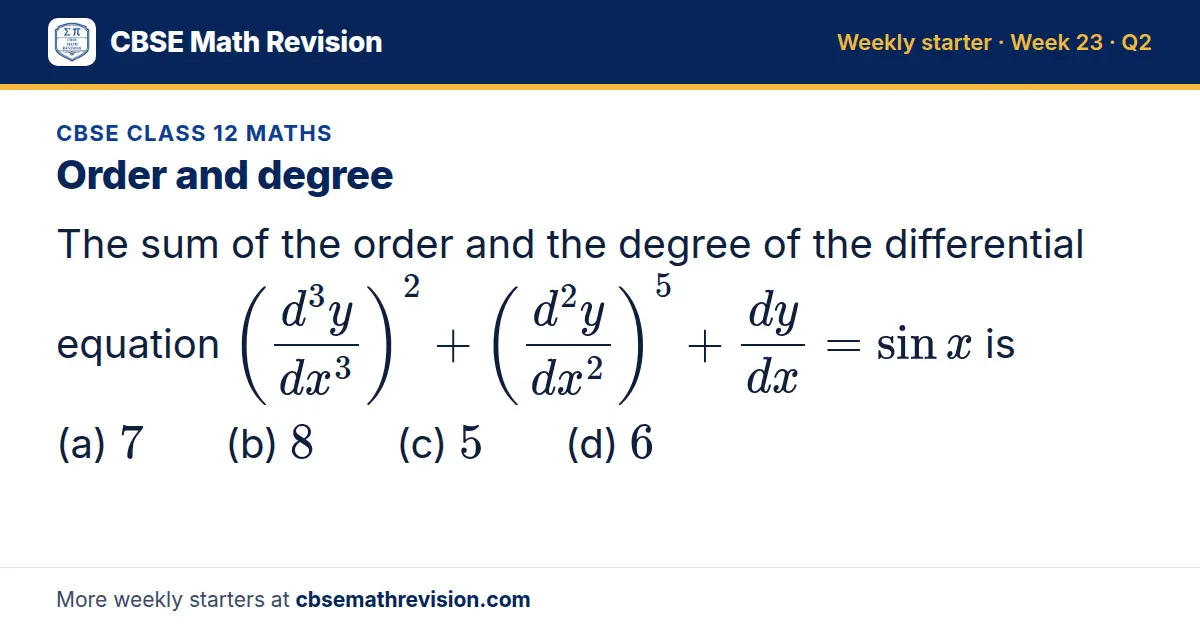
Question 2: Order and degree
The sum of the order and the degree of the differential equation ((d³y)/(dx³))² + ((d²y)/(dx²))⁵ + dy/dx = sin x is (a) 7 (b) 8 (c) 5 (d) 6
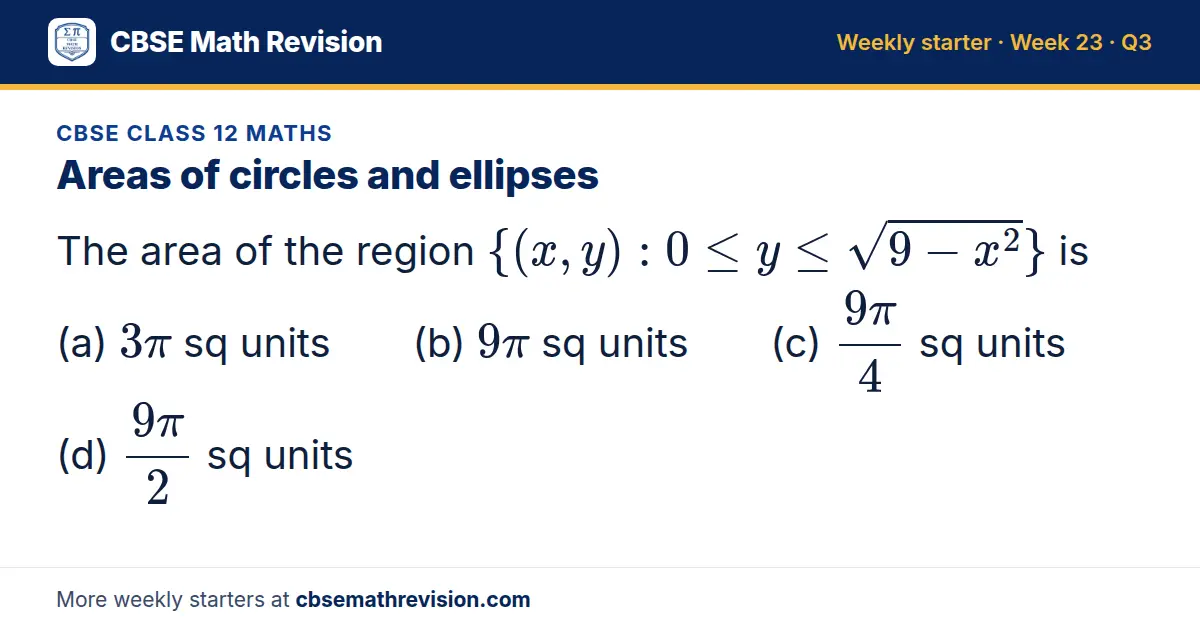
Question 3: Areas of circles and ellipses
The area of the region (x, y): 0 ≤ y ≤ √(9 - x²) is (a) 3π sq units (b) 9π sq units (c) (9π)/4 sq units (d) (9π)/2 sq units
Week 24
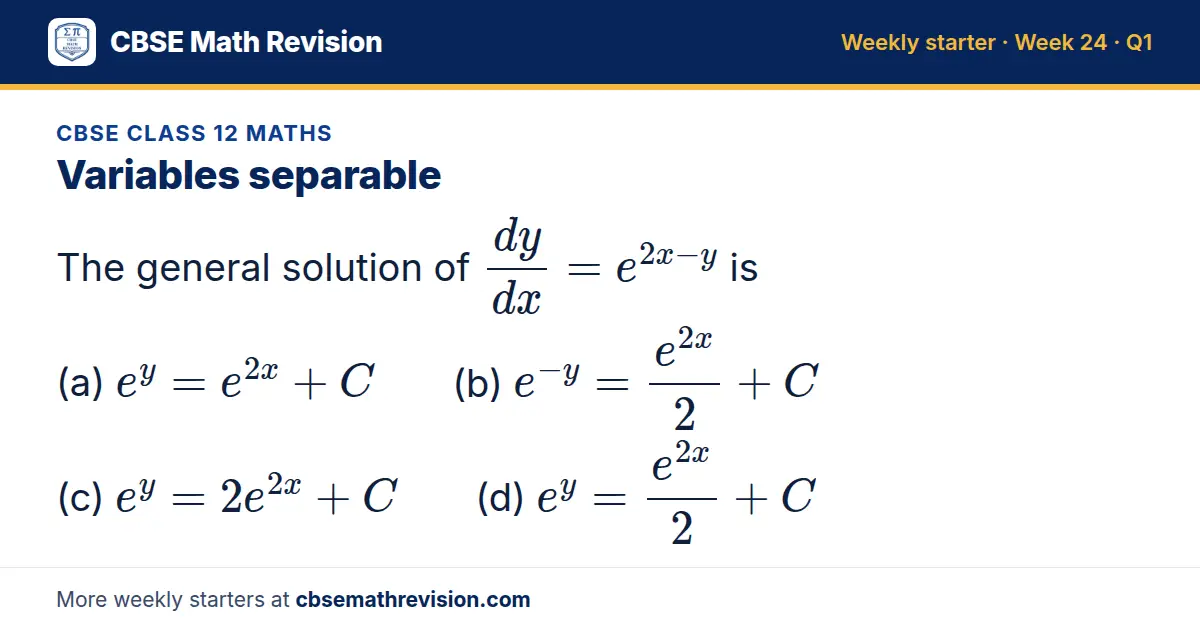
Question 1: Variables separable
The general solution of dy/dx = e^(2x - y) is (a) e^y = e^(2x) + C (b) e^(-y) = (e^(2x))/2 + C (c) e^y = 2e^(2x) + C (d) e^y = (e^(2x))/2 + C
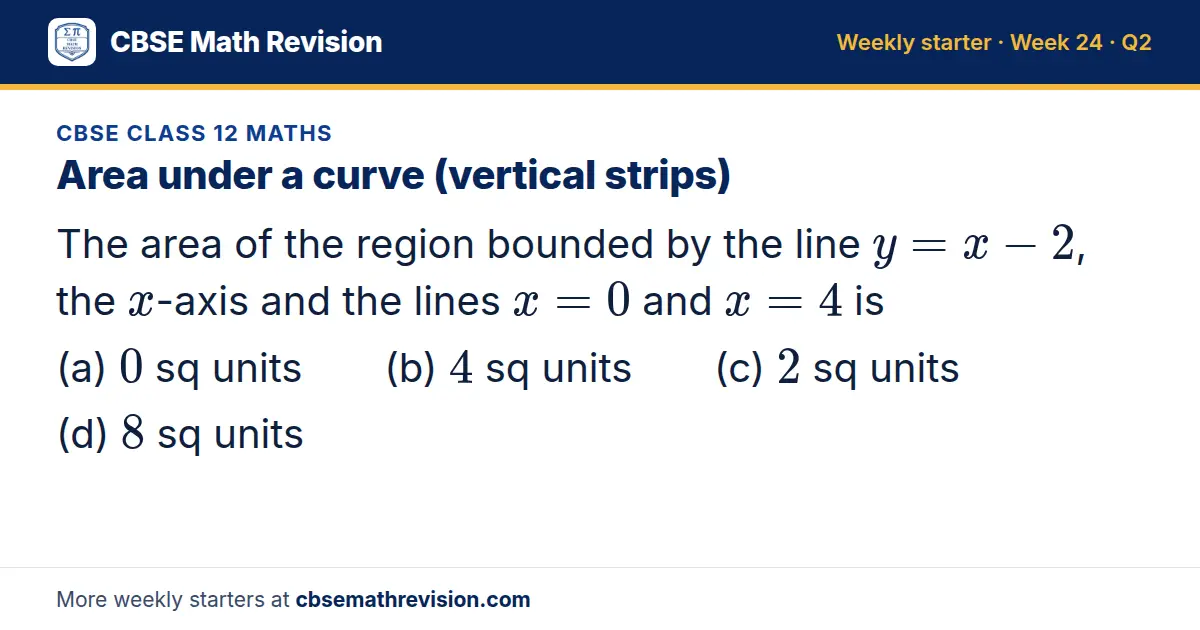
Question 2: Area under a curve (vertical strips)
The area of the region bounded by the line y = x - 2, the x-axis and the lines x = 0 and x = 4 is (a) 0 sq units (b) 4 sq units (c) 2 sq units (d) 8 sq units
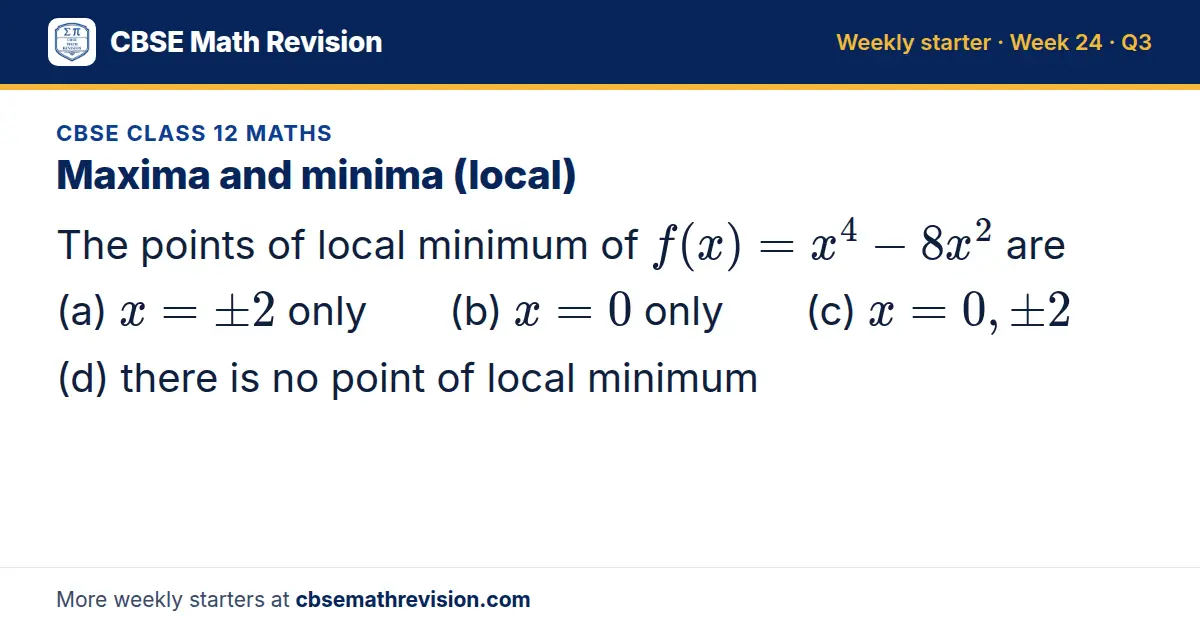
Question 3: Maxima and minima (local)
The points of local minimum of f(x) = x⁴ - 8x² are (a) x = ± 2 only (b) x = 0 only (c) x = 0, ± 2 (d) there is no point of local minimum
Week 27
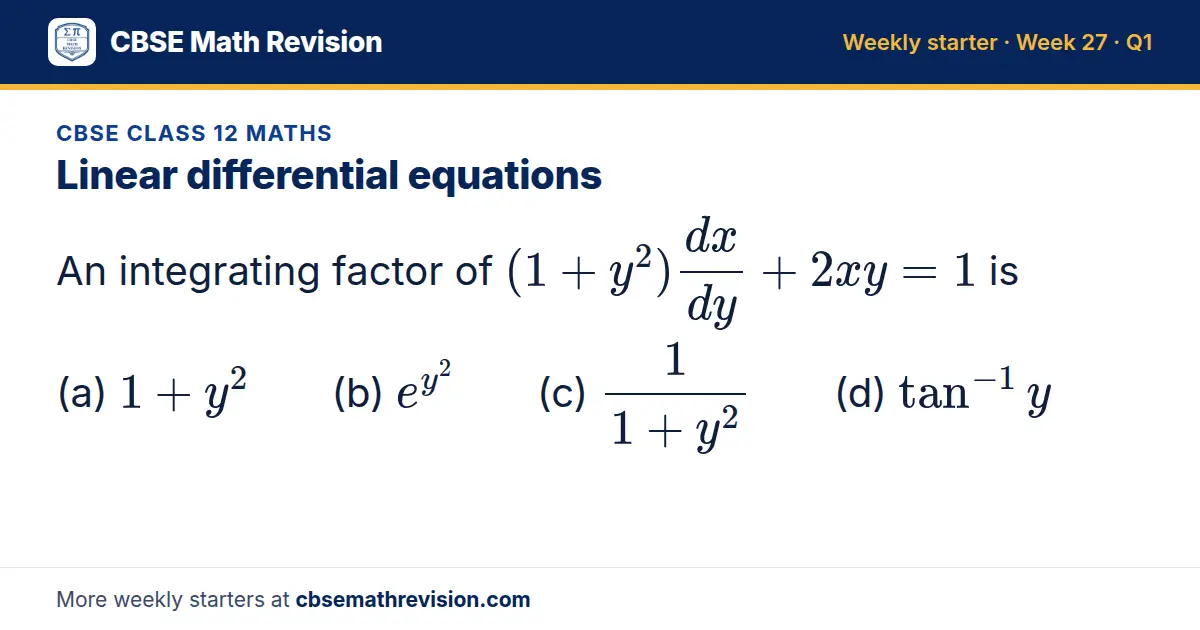
Question 1: Linear differential equations
An integrating factor of (1 + y²)dx/dy + 2xy = 1 is (a) 1 + y² (b) e^(y²) (c) 1/(1 + y²) (d) tan⁻¹ y
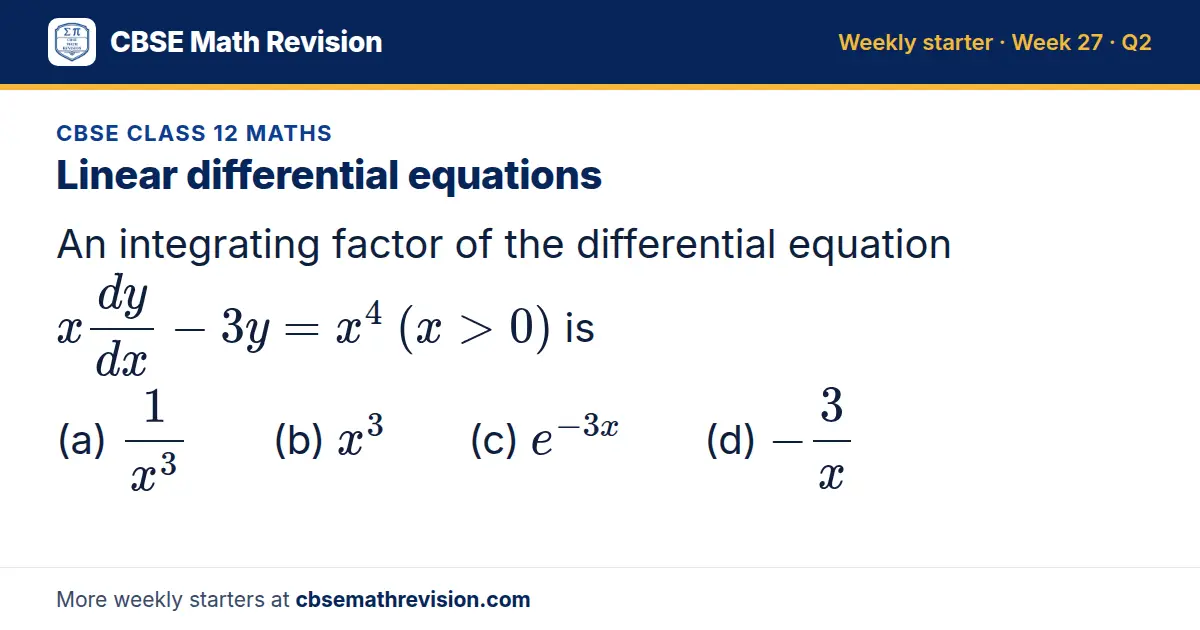
Question 2: Linear differential equations
An integrating factor of the differential equation xdy/dx - 3y = x⁴ (x > 0) is (a) 1/(x³) (b) x³ (c) e^(-3x) (d) -3/x
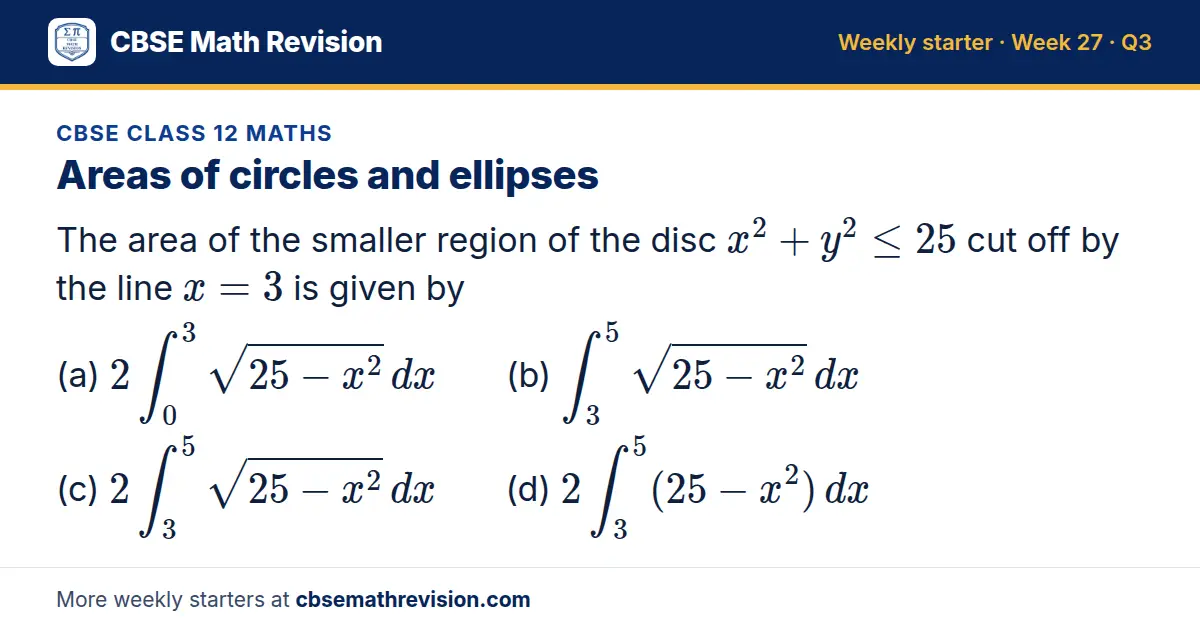
Question 3: Areas of circles and ellipses
The area of the smaller region of the disc x² + y² ≤ 25 cut off by the line x = 3 is given by (a) 2∫_0³ √(25 - x²) dx (b) ∫_3⁵ √(25 - x²) dx (c) 2∫_3⁵ √(25 - x²) dx (d) 2∫_3⁵ (25 - x²) dx
Week 28
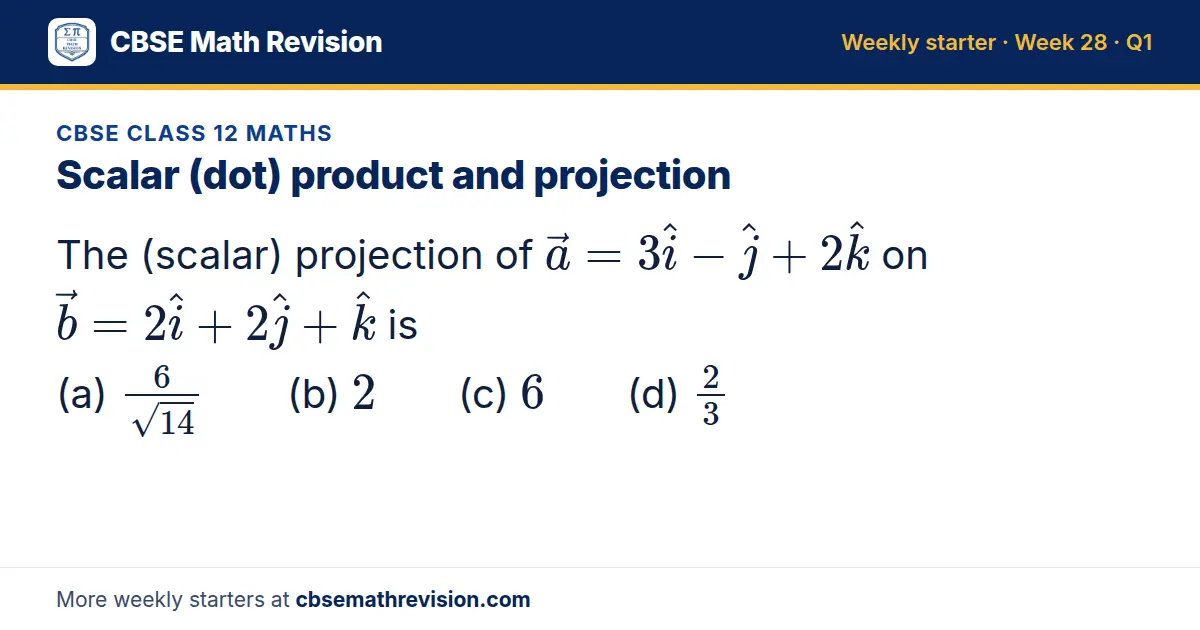
Question 1: Scalar (dot) product and projection
The (scalar) projection of a = 3i - j + 2k on b = 2i + 2j + k is (a) 6/(√14) (b) 2 (c) 6 (d) 23
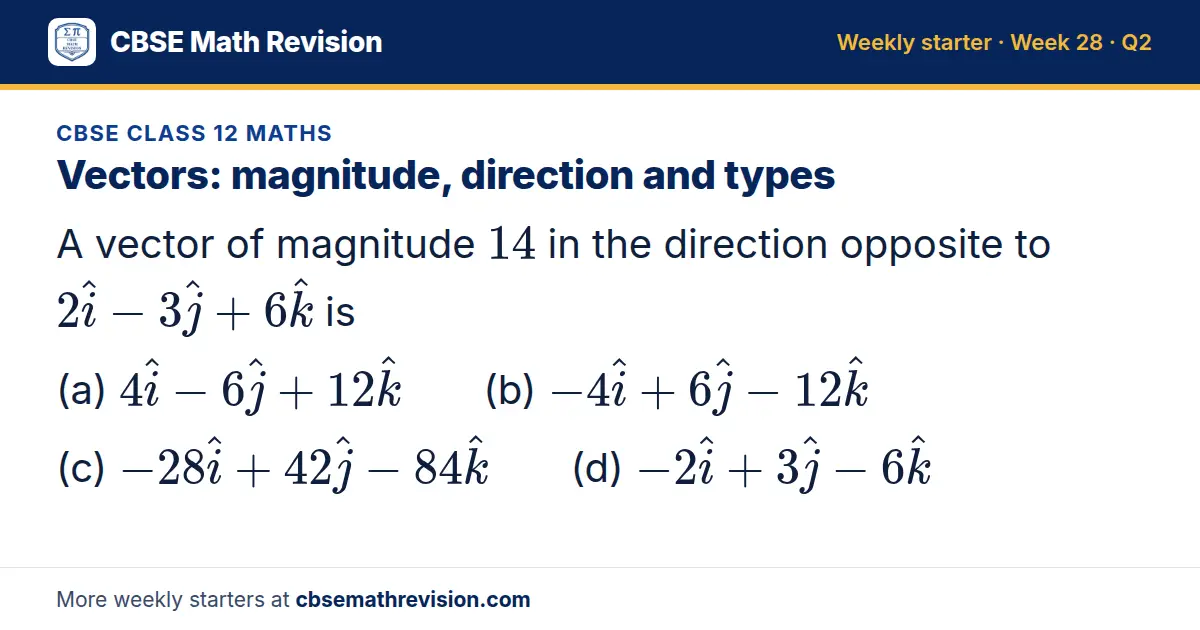
Question 2: Vectors: magnitude, direction and types
A vector of magnitude 14 in the direction opposite to 2i - 3j + 6k is (a) 4i - 6j + 12k (b) -4i + 6j - 12k (c) -28i + 42j - 84k (d) -2i + 3j - 6k
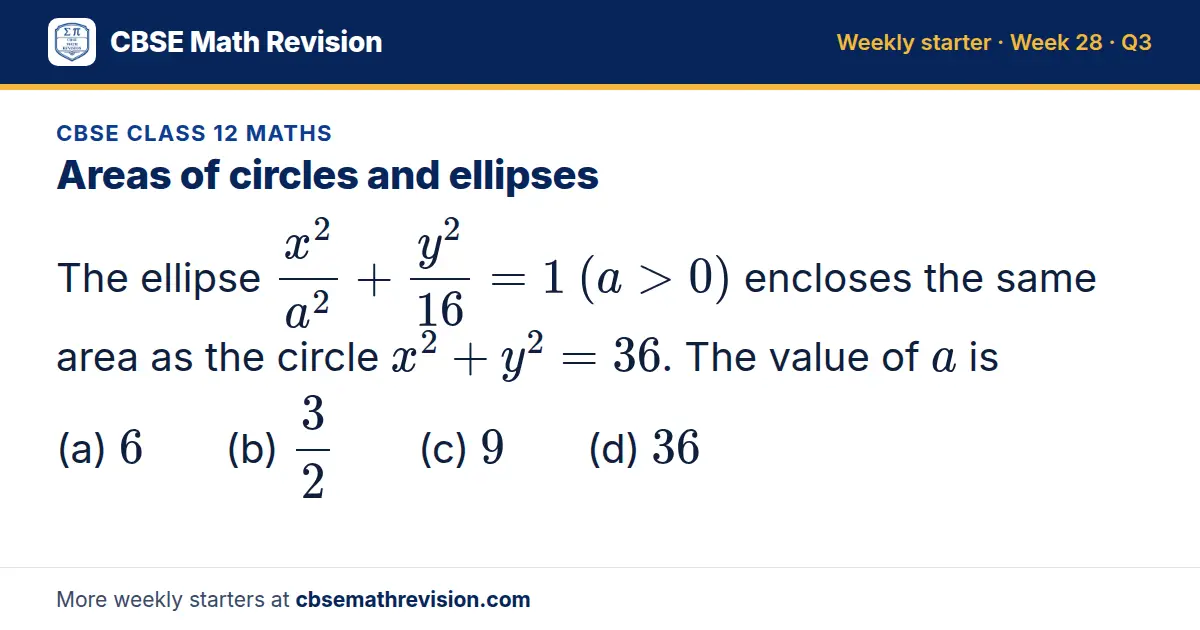
Question 3: Areas of circles and ellipses
The ellipse (x²)/(a²) + (y²)/16 = 1 (a > 0) encloses the same area as the circle x² + y² = 36. The value of a is (a) 6 (b) 3/2 (c) 9 (d) 36
Week 29
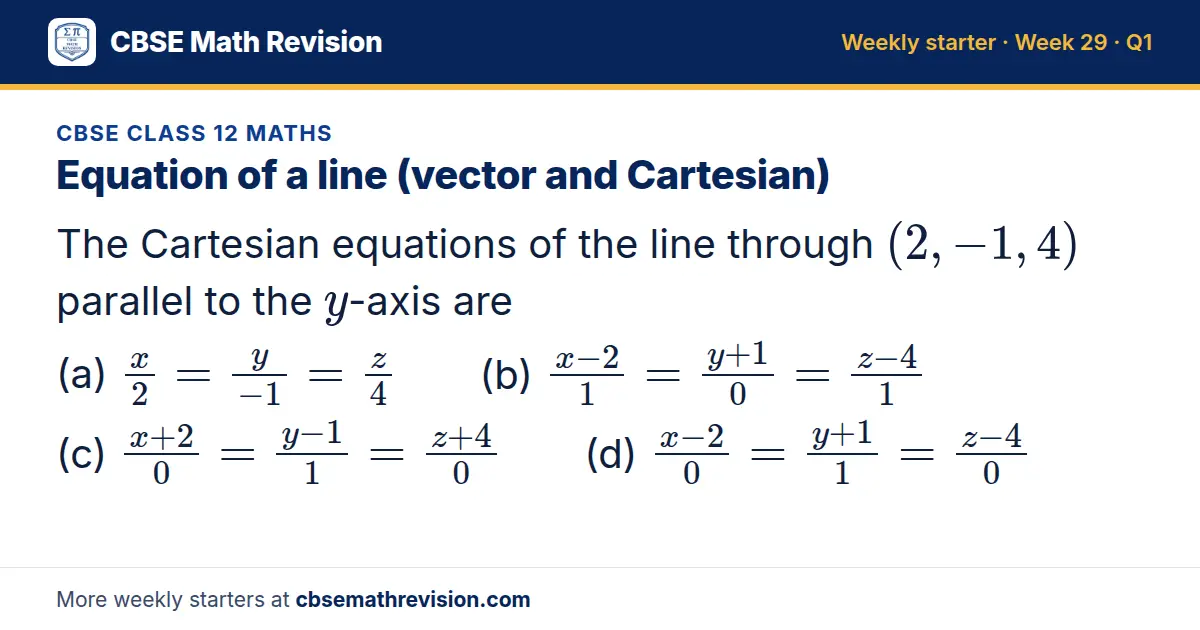
Question 1: Equation of a line (vector and Cartesian)
The Cartesian equations of the line through (2, -1, 4) parallel to the y-axis are (a) x/2 = y/(-1) = z/4 (b) (x - 2)/1 = (y + 1)/0 = (z - 4)/1 (c) (x + 2)/0 = (y - 1)/1 = (z + 4)/0 (d) (x - 2)/0 = (y + 1)/1 = (z - 4)/0
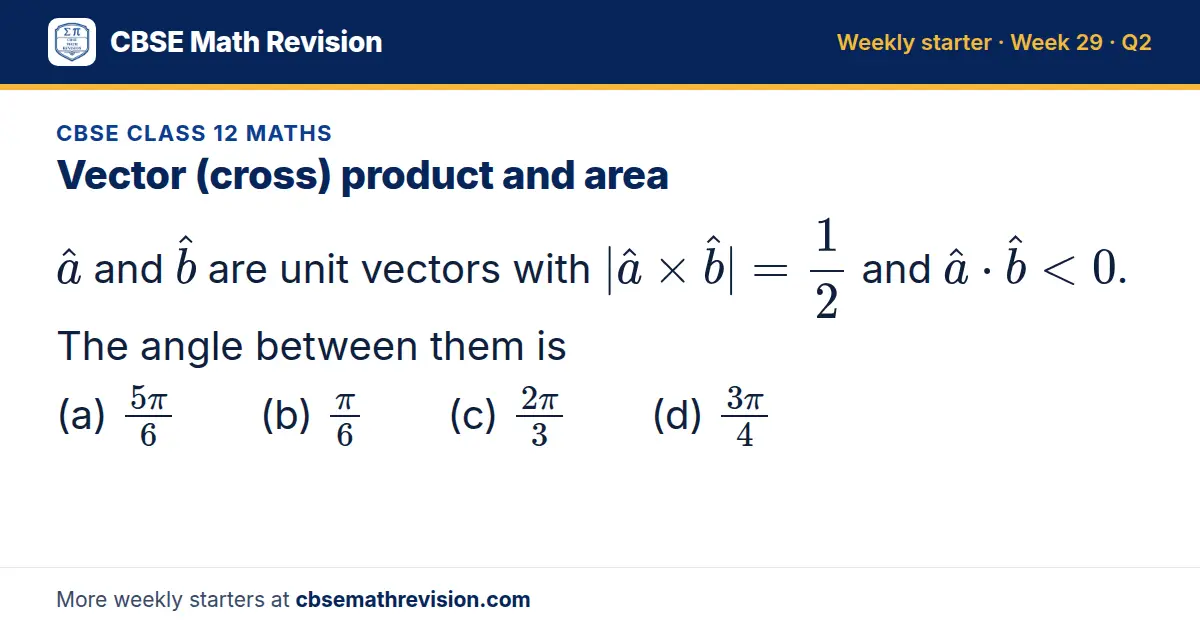
Question 2: Vector (cross) product and area
a and b are unit vectors with |a × b| = 12 and a < 0. The angle between them is (a) (5π)/6 (b) (π)/6 (c) (2π)/3 (d) (3π)/4
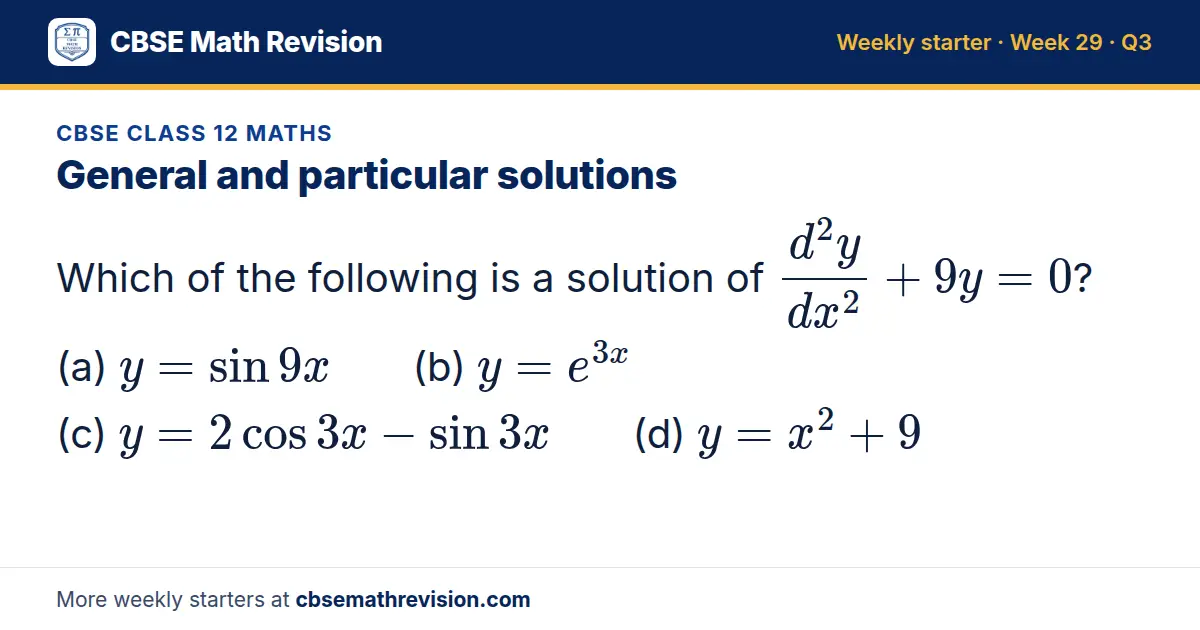
Question 3: General and particular solutions
Which of the following is a solution of (d²y)/(dx²) + 9y = 0? (a) y = sin 9x (b) y = e^(3x) (c) y = 2cos 3x - sin 3x (d) y = x² + 9
Week 30
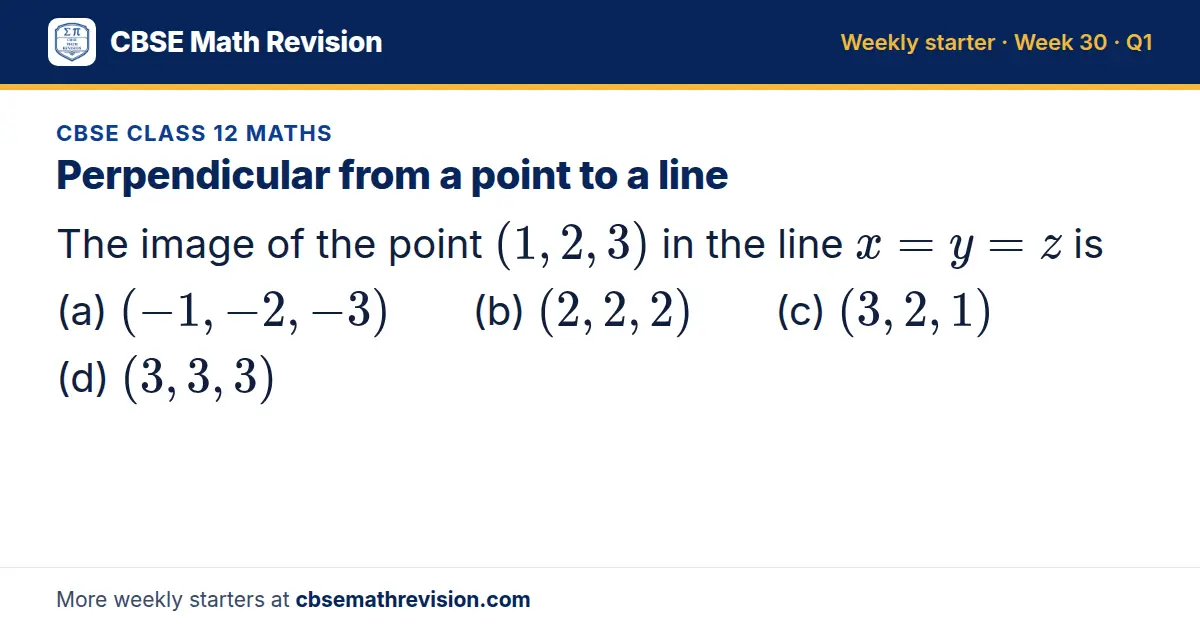
Question 1: Perpendicular from a point to a line
The image of the point (1, 2, 3) in the line x = y = z is (a) (-1, -2, -3) (b) (2, 2, 2) (c) (3, 2, 1) (d) (3, 3, 3)
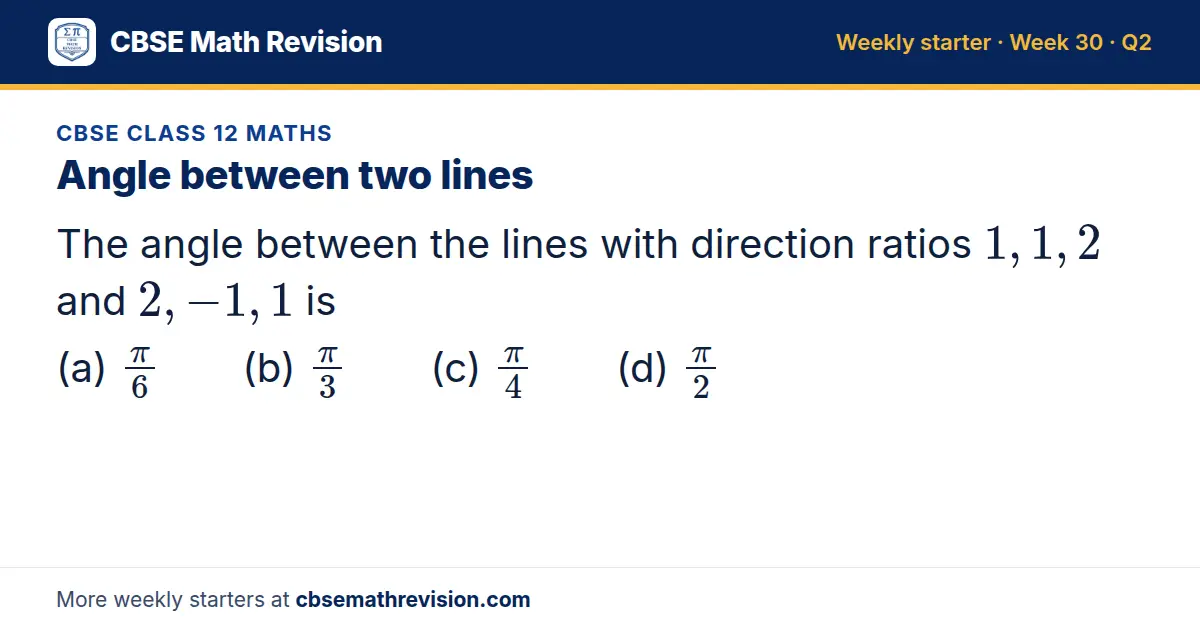
Question 2: Angle between two lines
The angle between the lines with direction ratios 1, 1, 2 and 2, -1, 1 is (a) π6 (b) π3 (c) π4 (d) π2
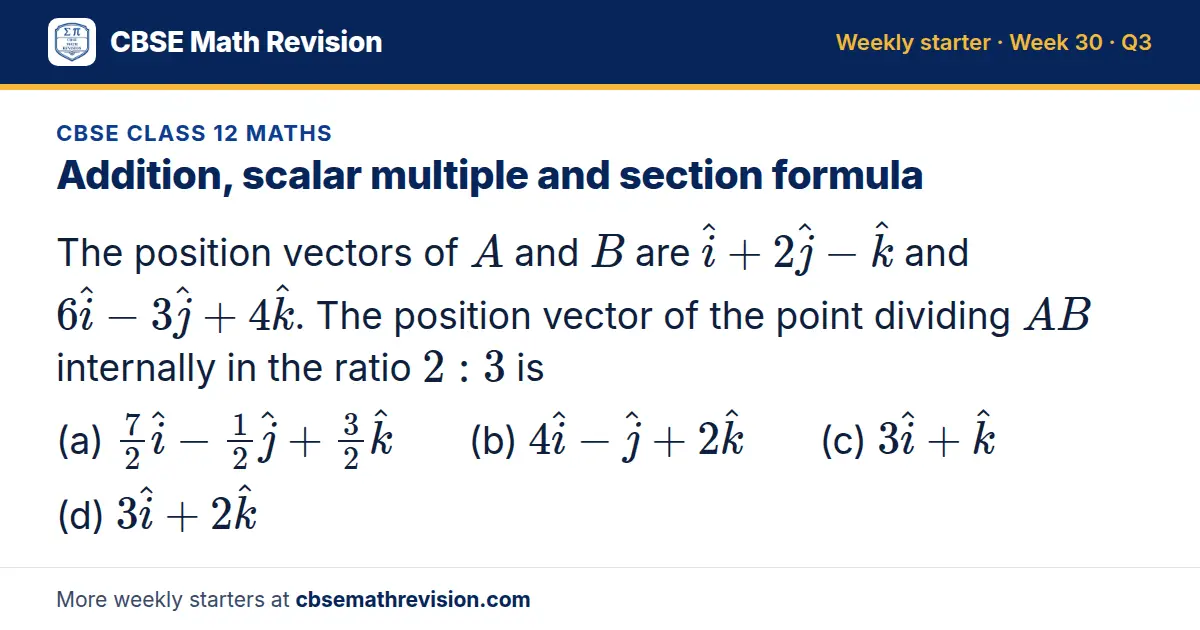
Question 3: Addition, scalar multiple and section formula
The position vectors of A and B are i + 2j - k and 6i - 3j + 4k. The position vector of the point dividing AB internally in the ratio 2: 3 is (a) 72i - 12j + 32k (b) 4i - j + 2k (c) 3i + k (d) 3i + 2k
Week 31
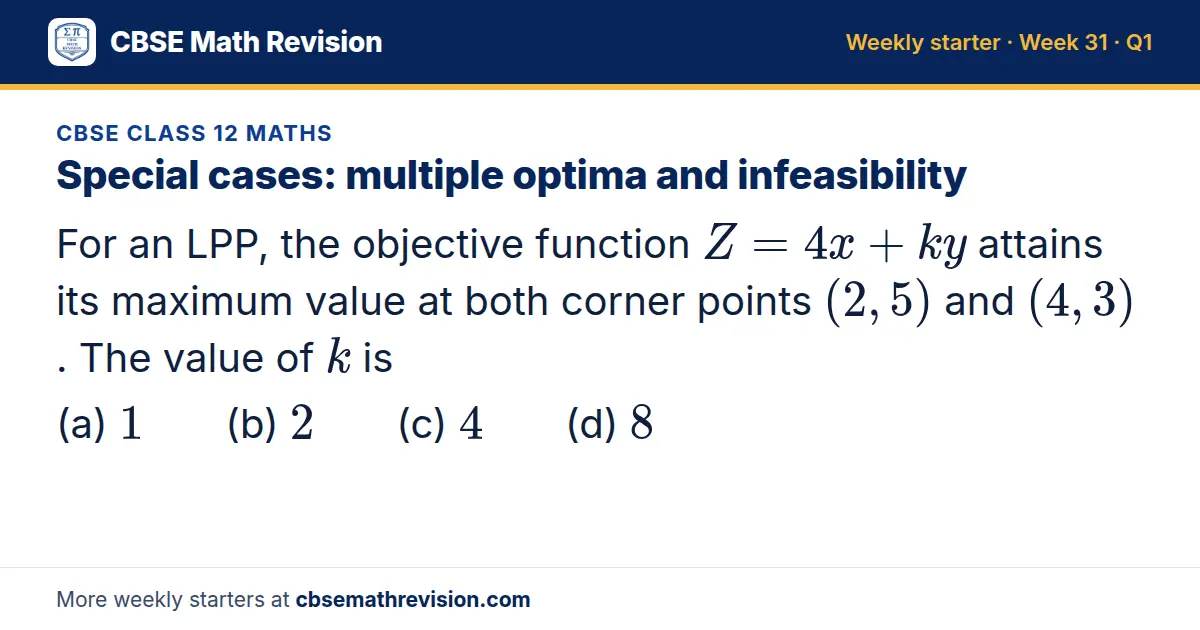
Question 1: Special cases: multiple optima and infeasibility
For an LPP, the objective function Z = 4x + ky attains its maximum value at both corner points (2, 5) and (4, 3). The value of k is (a) 1 (b) 2 (c) 4 (d) 8
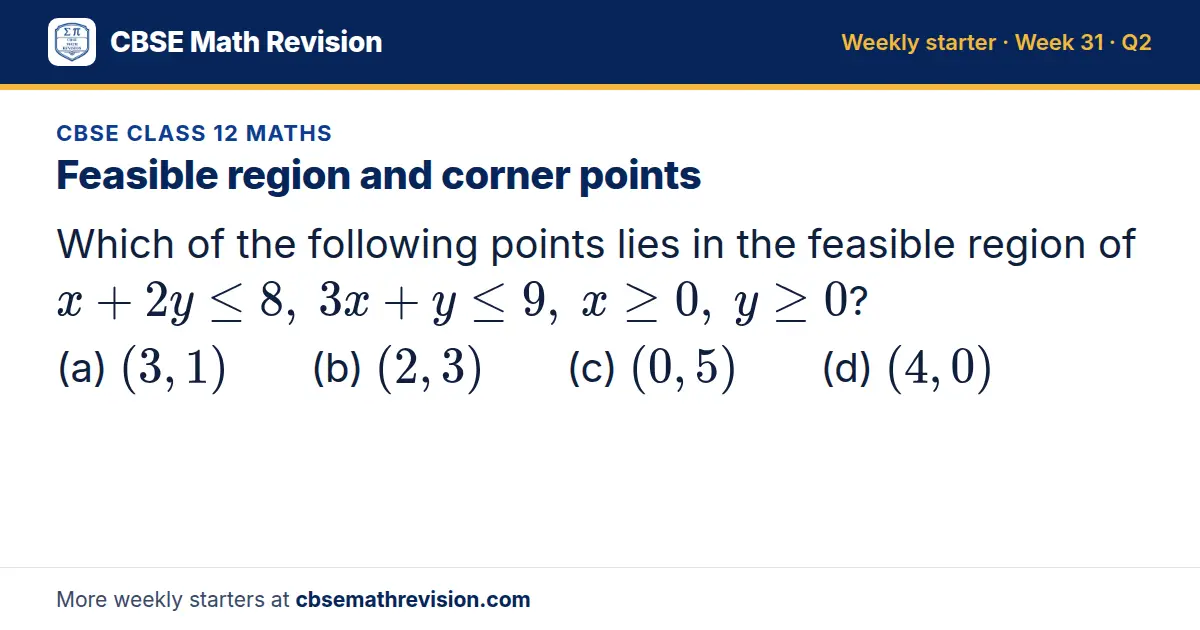
Question 2: Feasible region and corner points
Which of the following points lies in the feasible region of x + 2y ≤ 8, 3x + y ≤ 9, x ≥ 0, y ≥ 0? (a) (3, 1) (b) (2, 3) (c) (0, 5) (d) (4, 0)
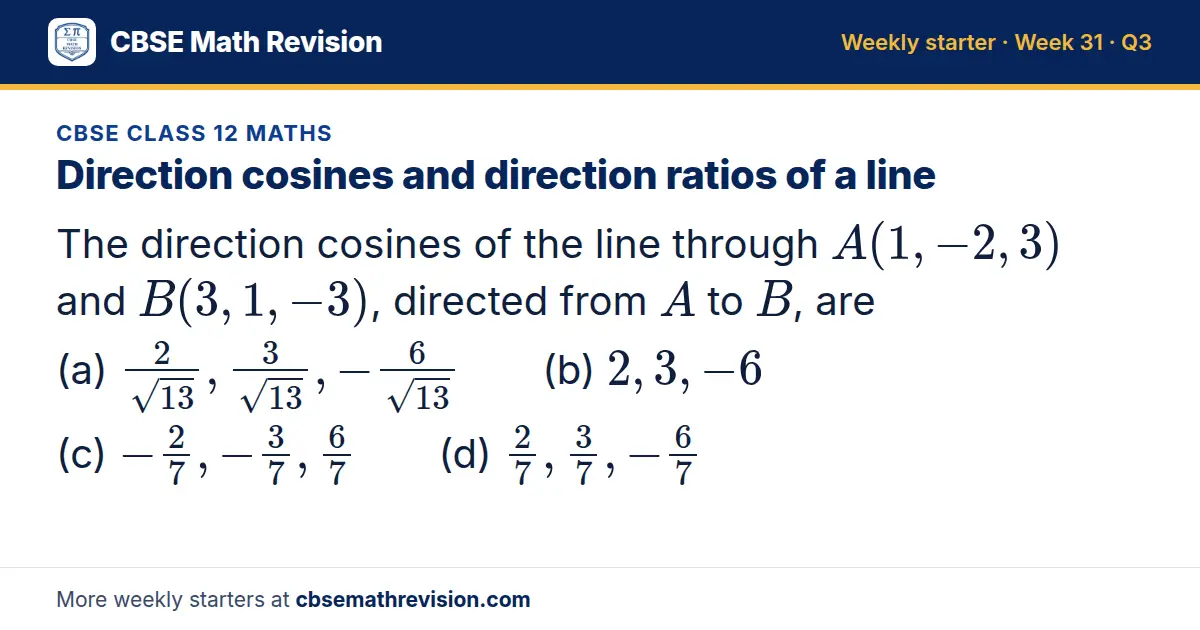
Question 3: Direction cosines and direction ratios of a line
The direction cosines of the line through A(1, -2, 3) and B(3, 1, -3), directed from A to B, are (a) 2/(√13), 3/(√13), -6/(√13) (b) 2, 3, -6 (c) -27, -37, 67 (d) 27, 37, -67
More starter questions
Other weeks: Weeks 1–18 · Weeks 19–31 · Weeks 32–46. Answers and mark schemes are in the teacher tools.