CBSE Class 10 Maths Question of the Day: chapters 12–14
27 CBSE Class 10 Mathematics puzzles from the Question of the Day rotation, chapters 12–14. Each puzzle is three board-style questions on one chapter, shown as an image with the question text written out below it; the answers, hints and step-marked solutions are on the daily puzzle page.
Chapter 12: Surface Areas and Volumes
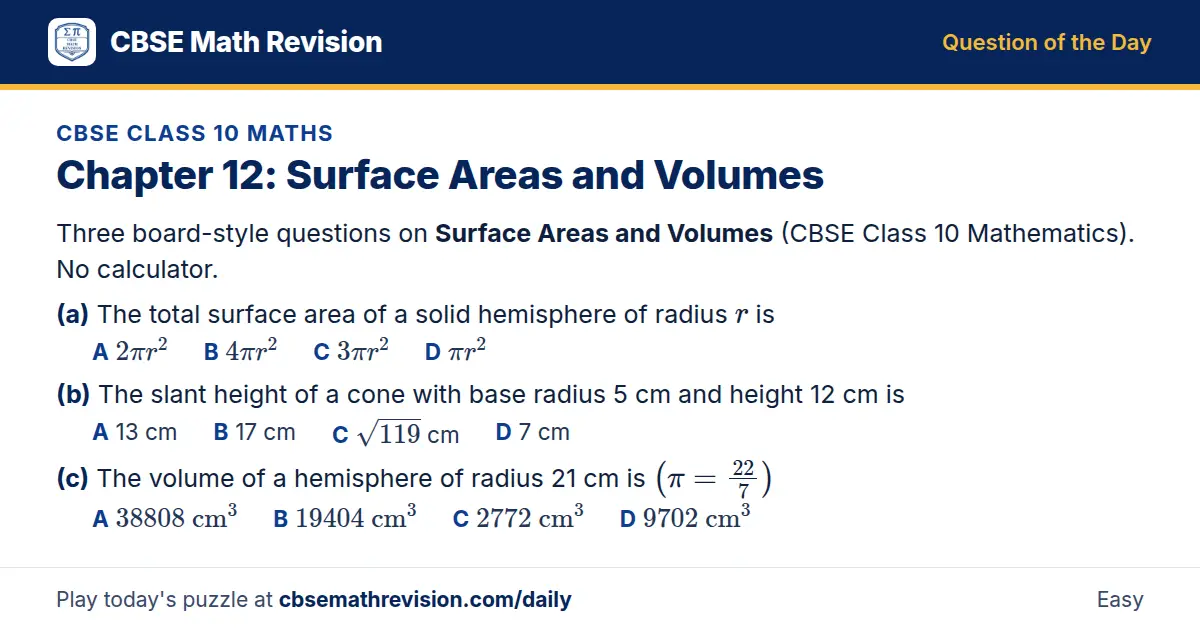
Chapter 12: Surface Areas and Volumes
Three board-style questions on Surface Areas and Volumes (CBSE Class 10 Mathematics). No calculator.
- The total surface area of a solid hemisphere of radius r is Options: A) 2π r²; B) 4π r²; C) 3π r²; D) π r²
- The slant height of a cone with base radius 5 cm and height 12 cm is Options: A) 13 cm; B) 17 cm; C) √119 cm; D) 7 cm
- The volume of a hemisphere of radius 21 cm is (π=22/7) Options: A) 38808 cm³; B) 19404 cm³; C) 2772 cm³; D) 9702 cm³
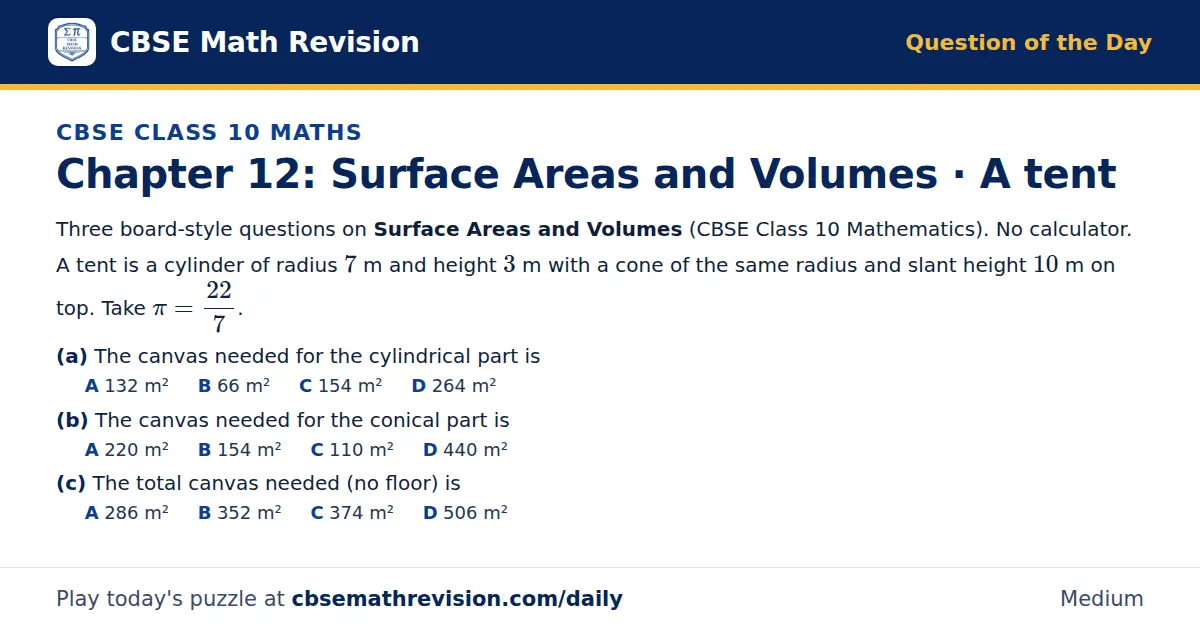
Chapter 12: Surface Areas and Volumes · A tent
Three board-style questions on Surface Areas and Volumes (CBSE Class 10 Mathematics). No calculator. A tent is a cylinder of radius 7 m and height 3 m with a cone of the same radius and slant height 10 m on top. Take π = 22/7.
- The canvas needed for the cylindrical part is Options: A) 132 m²; B) 66 m²; C) 154 m²; D) 264 m²
- The canvas needed for the conical part is Options: A) 220 m²; B) 154 m²; C) 110 m²; D) 440 m²
- The total canvas needed (no floor) is Options: A) 286 m²; B) 352 m²; C) 374 m²; D) 506 m²
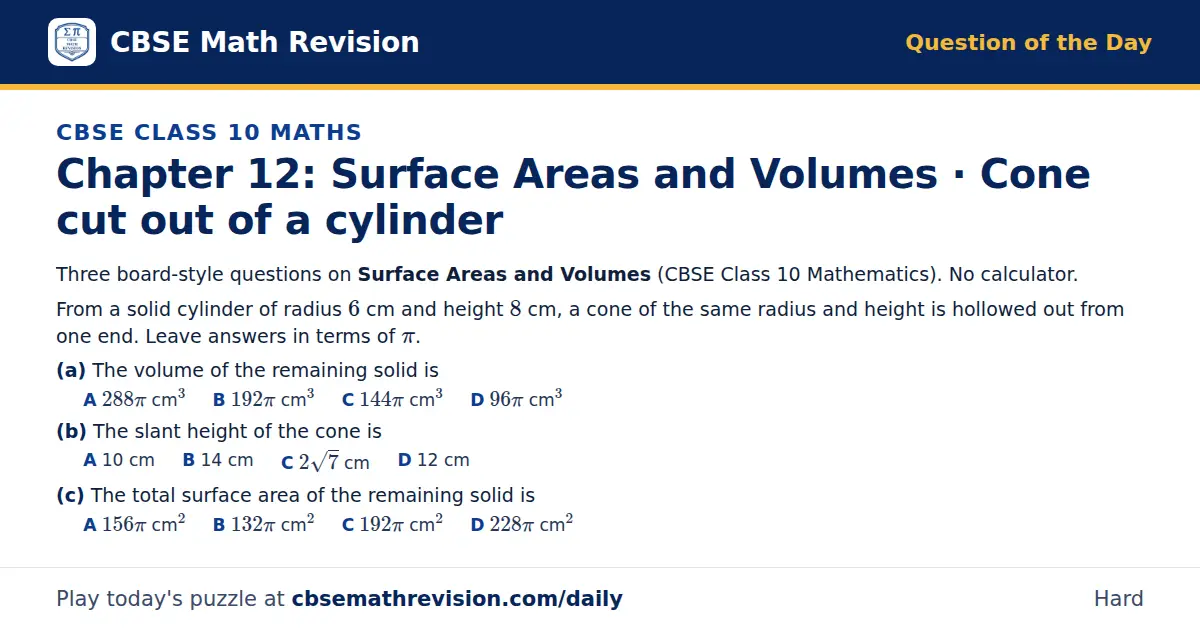
Chapter 12: Surface Areas and Volumes · Cone cut out of a cylinder
Three board-style questions on Surface Areas and Volumes (CBSE Class 10 Mathematics). No calculator. From a solid cylinder of radius 6 cm and height 8 cm, a cone of the same radius and height is hollowed out from one end. Leave answers in terms of π.
- The volume of the remaining solid is Options: A) 288π cm³; B) 192π cm³; C) 144π cm³; D) 96π cm³
- The slant height of the cone is Options: A) 10 cm; B) 14 cm; C) 2√7 cm; D) 12 cm
- The total surface area of the remaining solid is Options: A) 156π cm²; B) 132π cm²; C) 192π cm²; D) 228π cm²
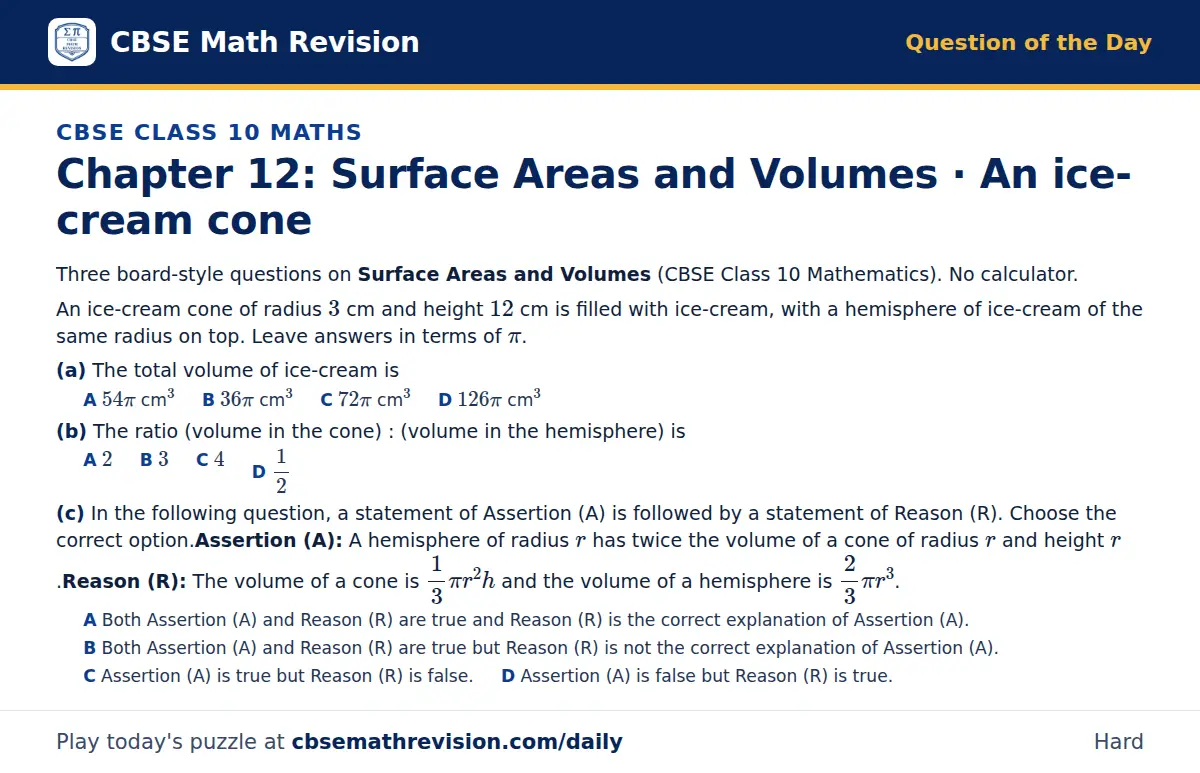
Chapter 12: Surface Areas and Volumes · An ice-cream cone
Three board-style questions on Surface Areas and Volumes (CBSE Class 10 Mathematics). No calculator. An ice-cream cone of radius 3 cm and height 12 cm is filled with ice-cream, with a hemisphere of ice-cream of the same radius on top. Leave answers in terms of π.
- The total volume of ice-cream is Options: A) 54π cm³; B) 36π cm³; C) 72π cm³; D) 126π cm³
- The ratio (volume in the cone): (volume in the hemisphere) is Options: A) 2; B) 3; C) 4; D) 1/2
- In the following question, a statement of Assertion (A) is followed by a statement of Reason (R). Choose the correct option. Assertion (A): A hemisphere of radius r has twice the volume of a cone of radius r and height r. Reason (R): The volume of a cone is 13 π r² h and the volume of a hemisphere is 23 π r^3. Options: A) Both Assertion (A) and Reason (R) are true and Reason (R) is the correct explanation of Assertion (A).; B) Both Assertion (A) and Reason (R) are true but Reason (R) is not the correct explanation of Assertion (A).; C) Assertion (A) is true but Reason (R) is false.; D) Assertion (A) is false but Reason (R) is true.
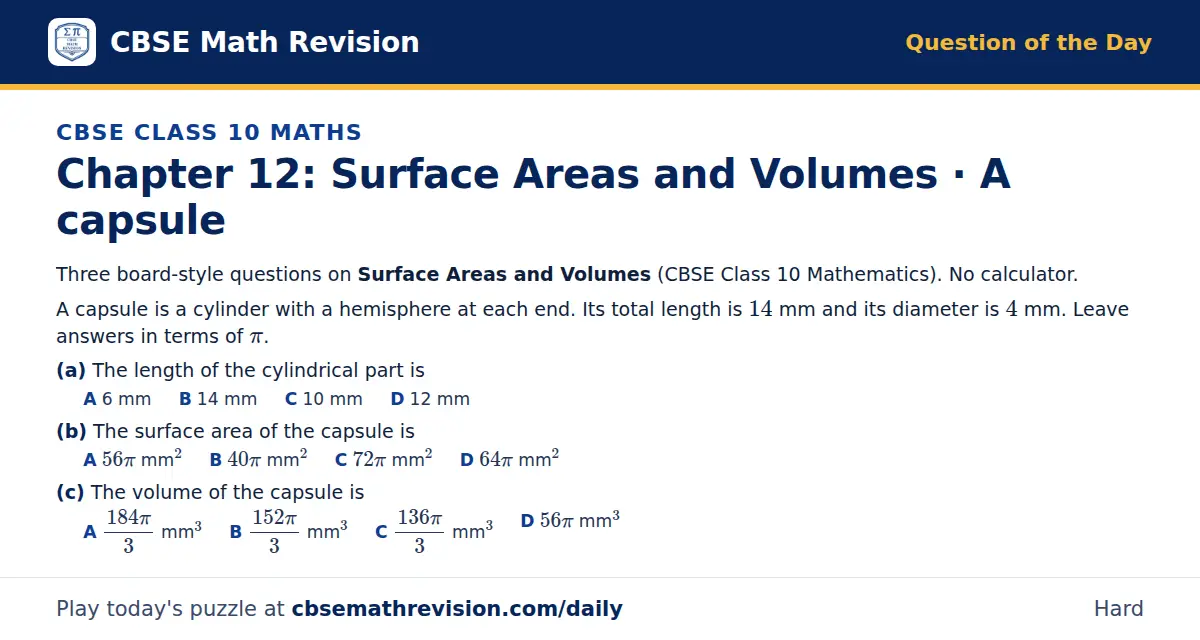
Chapter 12: Surface Areas and Volumes · A capsule
Three board-style questions on Surface Areas and Volumes (CBSE Class 10 Mathematics). No calculator. A capsule is a cylinder with a hemisphere at each end. Its total length is 14 mm and its diameter is 4 mm. Leave answers in terms of π.
- The length of the cylindrical part is Options: A) 6 mm; B) 14 mm; C) 10 mm; D) 12 mm
- The surface area of the capsule is Options: A) 56π mm²; B) 40π mm²; C) 72π mm²; D) 64π mm²
- The volume of the capsule is Options: A) (184π)/3 mm³; B) (152π)/3 mm³; C) (136π)/3 mm³; D) 56π mm³
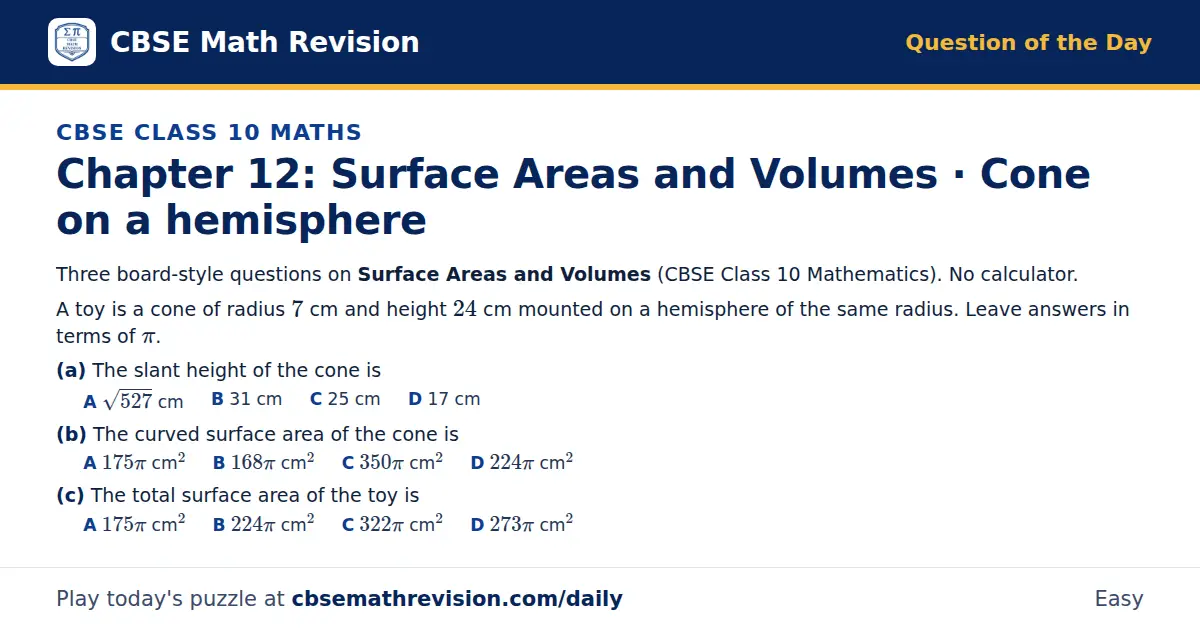
Chapter 12: Surface Areas and Volumes · Cone on a hemisphere
Three board-style questions on Surface Areas and Volumes (CBSE Class 10 Mathematics). No calculator. A toy is a cone of radius 7 cm and height 24 cm mounted on a hemisphere of the same radius. Leave answers in terms of π.
- The slant height of the cone is Options: A) √527 cm; B) 31 cm; C) 25 cm; D) 17 cm
- The curved surface area of the cone is Options: A) 175π cm²; B) 168π cm²; C) 350π cm²; D) 224π cm²
- The total surface area of the toy is Options: A) 175π cm²; B) 224π cm²; C) 322π cm²; D) 273π cm²
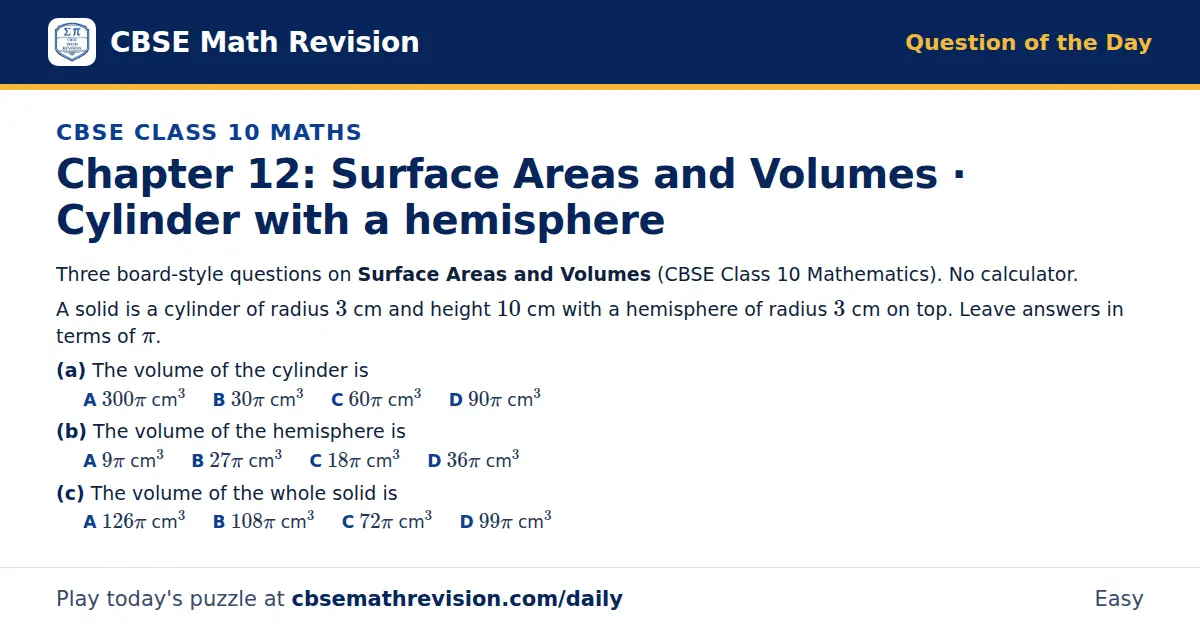
Chapter 12: Surface Areas and Volumes · Cylinder with a hemisphere
Three board-style questions on Surface Areas and Volumes (CBSE Class 10 Mathematics). No calculator. A solid is a cylinder of radius 3 cm and height 10 cm with a hemisphere of radius 3 cm on top. Leave answers in terms of π.
- The volume of the cylinder is Options: A) 300π cm³; B) 30π cm³; C) 60π cm³; D) 90π cm³
- The volume of the hemisphere is Options: A) 9π cm³; B) 27π cm³; C) 18π cm³; D) 36π cm³
- The volume of the whole solid is Options: A) 126π cm³; B) 108π cm³; C) 72π cm³; D) 99π cm³
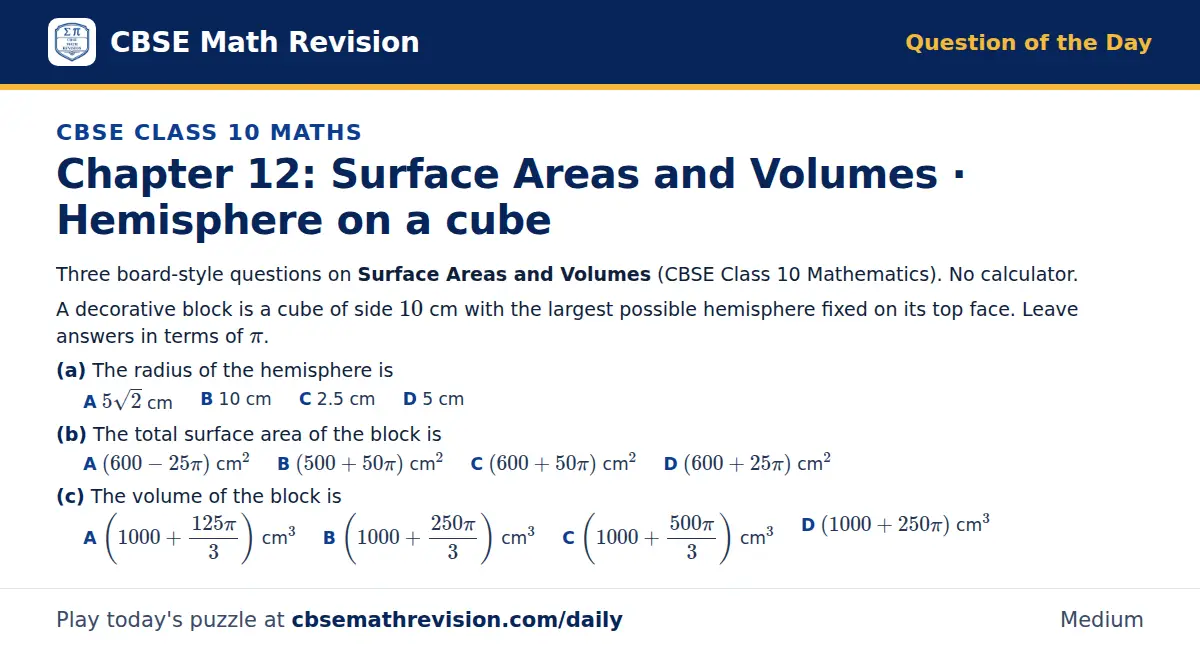
Chapter 12: Surface Areas and Volumes · Hemisphere on a cube
Three board-style questions on Surface Areas and Volumes (CBSE Class 10 Mathematics). No calculator. A decorative block is a cube of side 10 cm with the largest possible hemisphere fixed on its top face. Leave answers in terms of π.
- The radius of the hemisphere is Options: A) 5√2 cm; B) 10 cm; C) 2.5 cm; D) 5 cm
- The total surface area of the block is Options: A) (600 - 25π) cm²; B) (500 + 50π) cm²; C) (600 + 50π) cm²; D) (600 + 25π) cm²
- The volume of the block is Options: A) (1000 + (125π)/3) cm³; B) (1000 + (250π)/3) cm³; C) (1000 + (500π)/3) cm³; D) (1000 + 250π) cm³
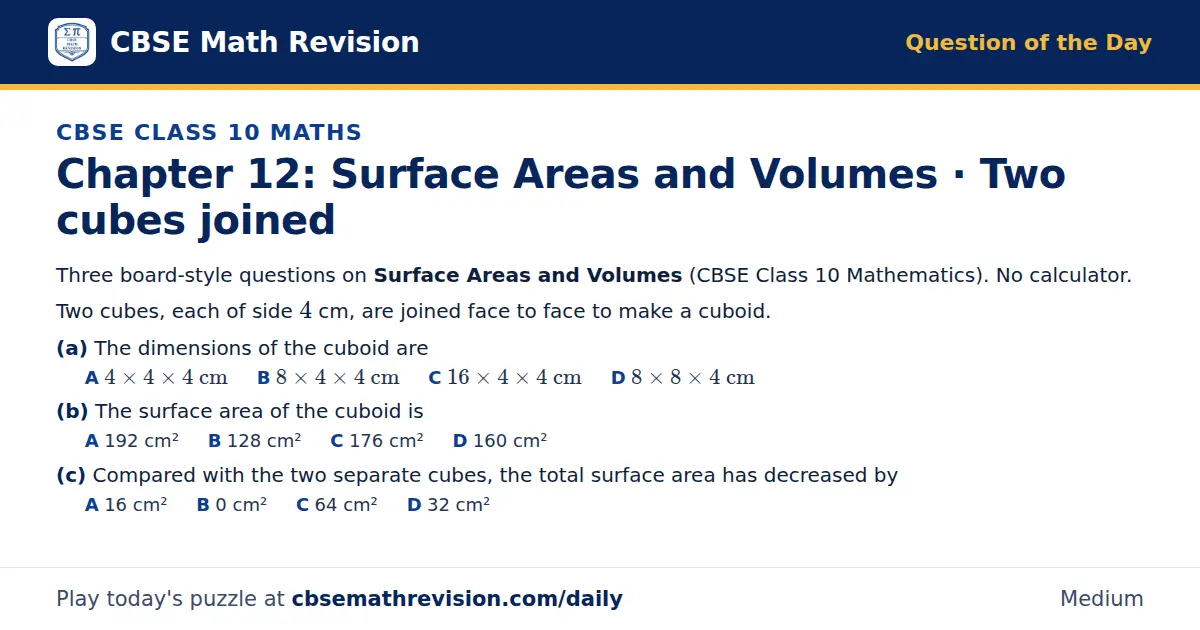
Chapter 12: Surface Areas and Volumes · Two cubes joined
Three board-style questions on Surface Areas and Volumes (CBSE Class 10 Mathematics). No calculator. Two cubes, each of side 4 cm, are joined face to face to make a cuboid.
- The dimensions of the cuboid are Options: A) 4 × 4 × 4 cm; B) 8 × 4 × 4 cm; C) 16 × 4 × 4 cm; D) 8 × 8 × 4 cm
- The surface area of the cuboid is Options: A) 192 cm²; B) 128 cm²; C) 176 cm²; D) 160 cm²
- Compared with the two separate cubes, the total surface area has decreased by Options: A) 16 cm²; B) 0 cm²; C) 64 cm²; D) 32 cm²
Chapter 13: Statistics
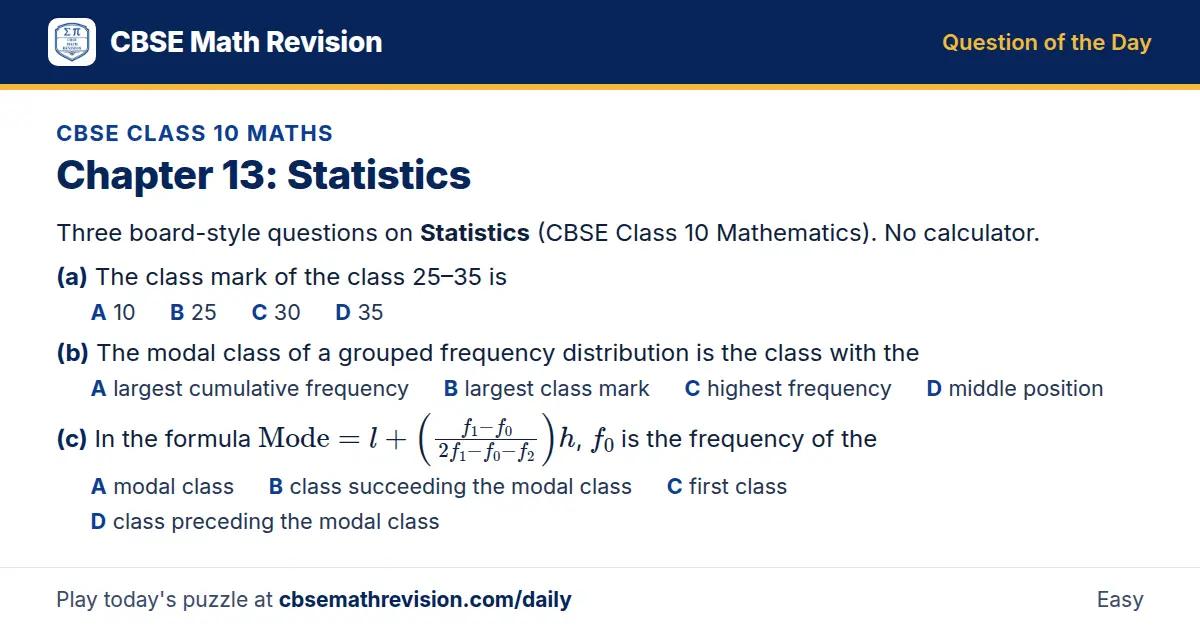
Chapter 13: Statistics
Three board-style questions on Statistics (CBSE Class 10 Mathematics). No calculator.
- The class mark of the class 25–35 is Options: A) 10; B) 25; C) 30; D) 35
- The modal class of a grouped frequency distribution is the class with the Options: A) largest cumulative frequency; B) largest class mark; C) highest frequency; D) middle position
- In the formula Mode=l+((f_1-f_0)/(2f_1-f_0-f_2))h, f_0 is the frequency of the Options: A) modal class; B) class succeeding the modal class; C) first class; D) class preceding the modal class
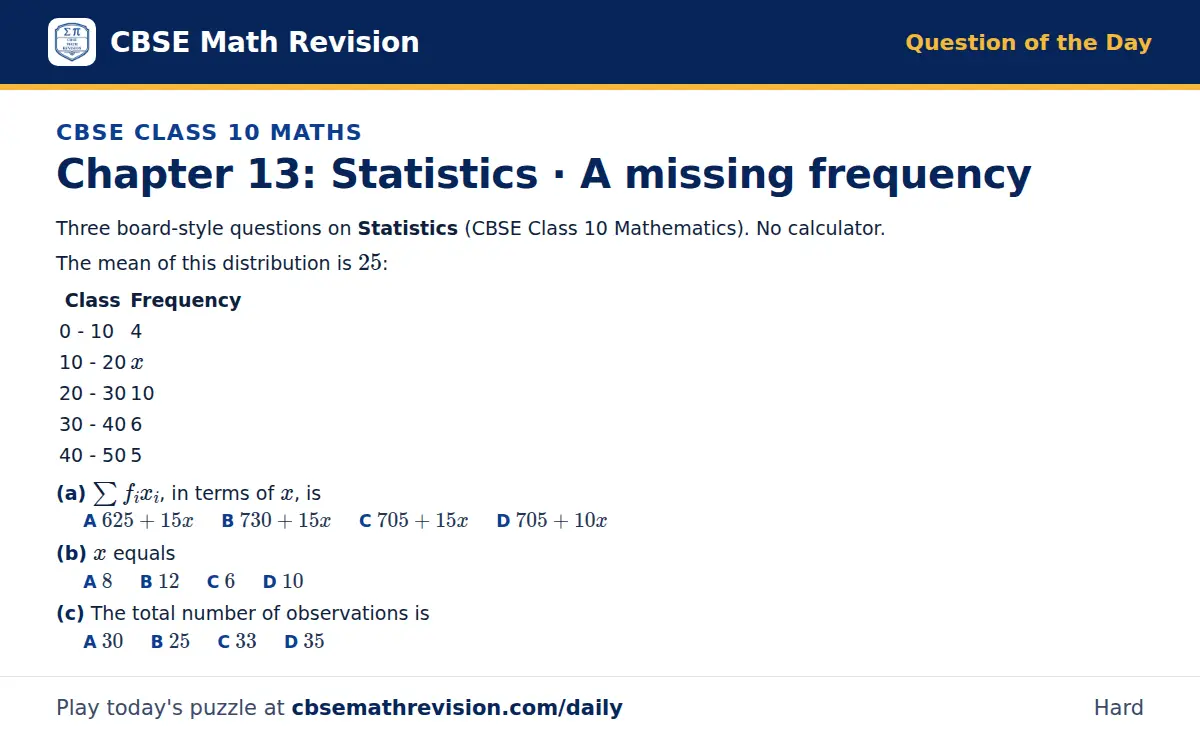
Chapter 13: Statistics · A missing frequency
Three board-style questions on Statistics (CBSE Class 10 Mathematics). No calculator. The mean of this distribution is 25: ClassFrequency0 - 10410 - 20x20 - 301030 - 40640 - 505
- Σ f_i x_i, in terms of x, is Options: A) 625 + 15x; B) 730 + 15x; C) 705 + 15x; D) 705 + 10x
- x equals Options: A) 8; B) 12; C) 6; D) 10
- The total number of observations is Options: A) 30; B) 25; C) 33; D) 35
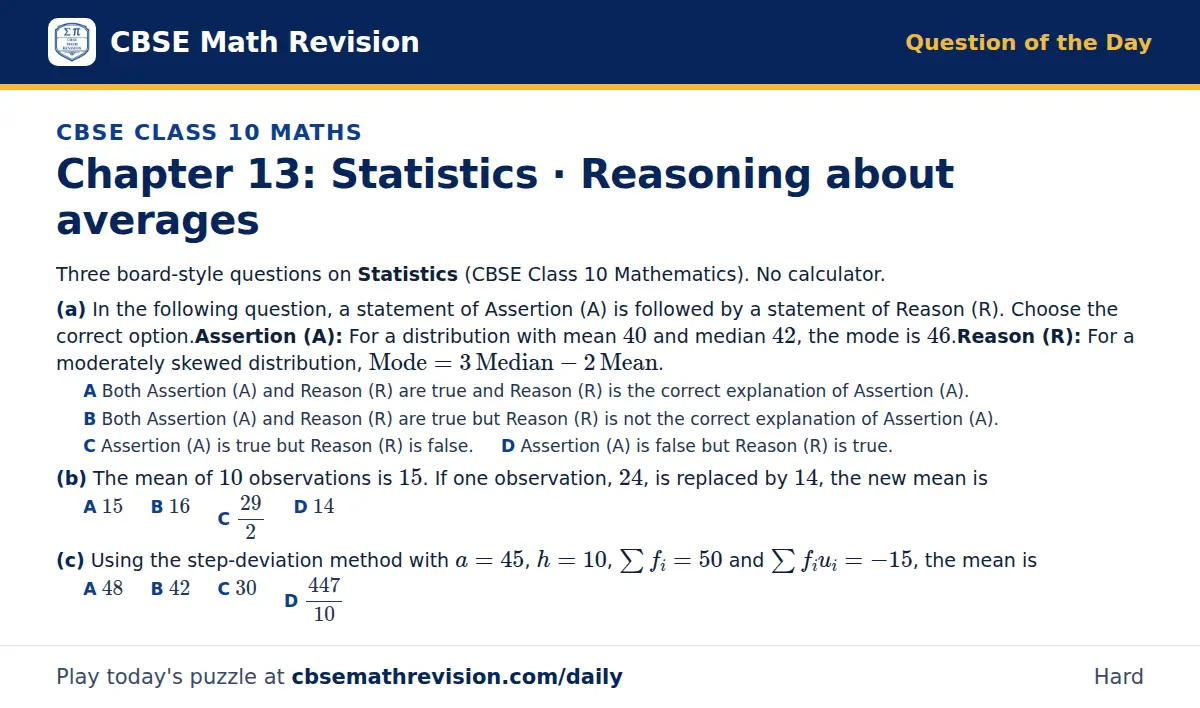
Chapter 13: Statistics · Reasoning about averages
Three board-style questions on Statistics (CBSE Class 10 Mathematics). No calculator.
- In the following question, a statement of Assertion (A) is followed by a statement of Reason (R). Choose the correct option. Assertion (A): For a distribution with mean 40 and median 42, the mode is 46. Reason (R): For a moderately skewed distribution, Mode = 3 Median - 2 Mean. Options: A) Both Assertion (A) and Reason (R) are true and Reason (R) is the correct explanation of Assertion (A).; B) Both Assertion (A) and Reason (R) are true but Reason (R) is not the correct explanation of Assertion (A).; C) Assertion (A) is true but Reason (R) is false.; D) Assertion (A) is false but Reason (R) is true.
- The mean of 10 observations is 15. If one observation, 24, is replaced by 14, the new mean is Options: A) 15; B) 16; C) 29/2; D) 14
- Using the step-deviation method with a = 45, h = 10, Σ f_i = 50 and Σ f_i u_i = -15, the mean is Options: A) 48; B) 42; C) 30; D) 447/10
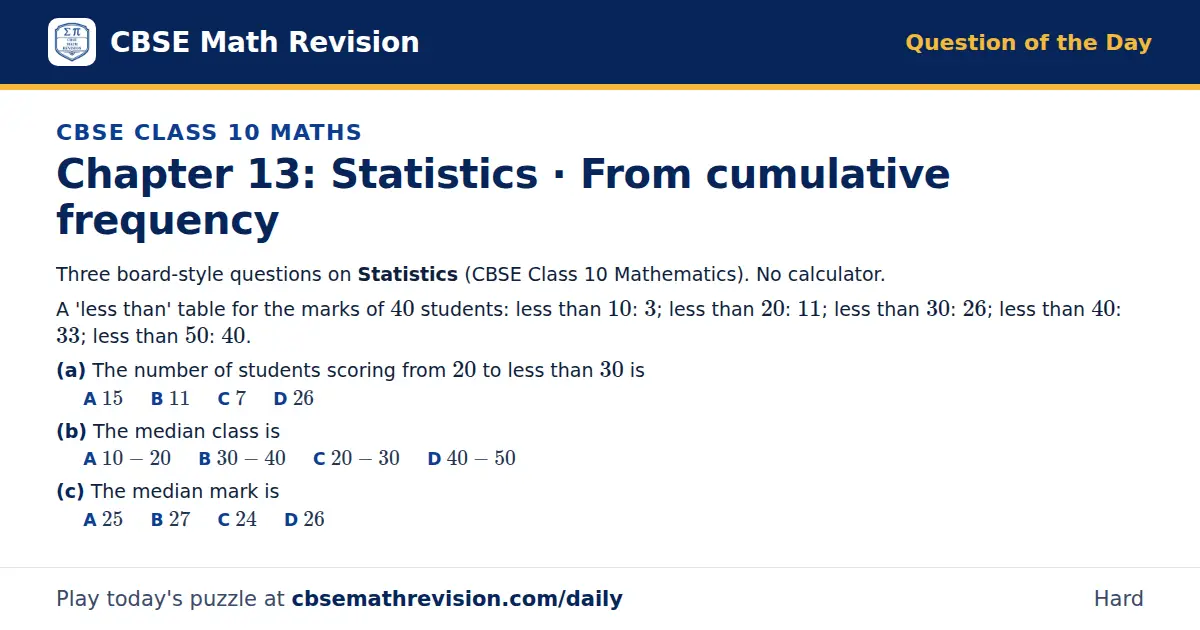
Chapter 13: Statistics · From cumulative frequency
Three board-style questions on Statistics (CBSE Class 10 Mathematics). No calculator. A 'less than' table for the marks of 40 students: less than 10: 3; less than 20: 11; less than 30: 26; less than 40: 33; less than 50: 40.
- The number of students scoring from 20 to less than 30 is Options: A) 15; B) 11; C) 7; D) 26
- The median class is Options: A) 10 - 20; B) 30 - 40; C) 20 - 30; D) 40 - 50
- The median mark is Options: A) 25; B) 27; C) 24; D) 26
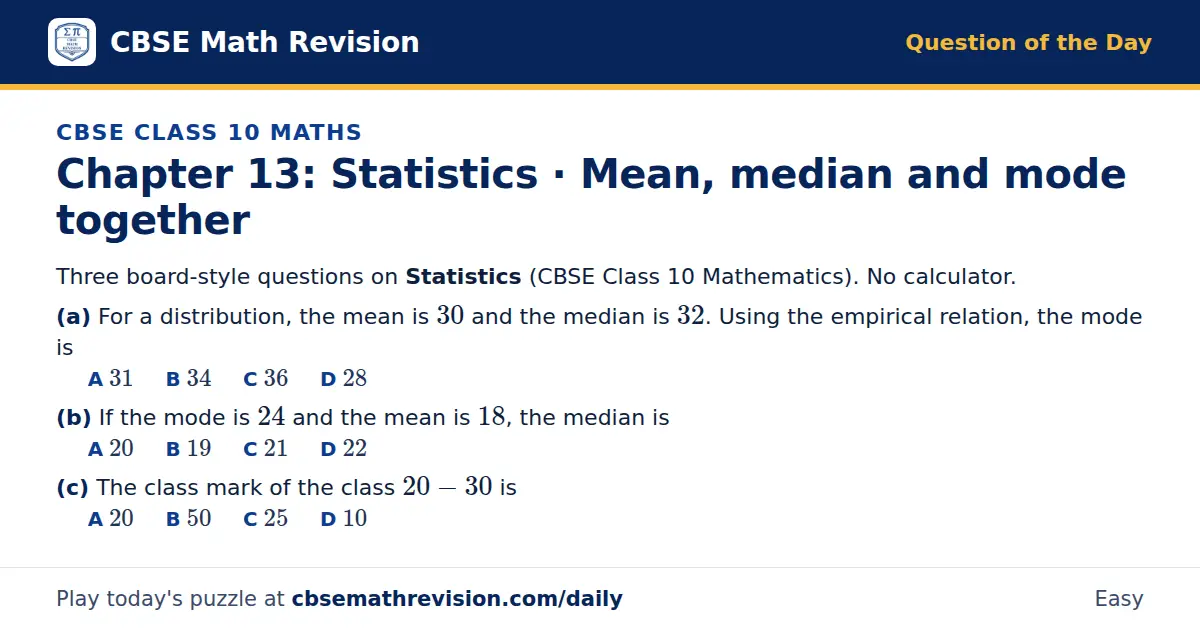
Chapter 13: Statistics · Mean, median and mode together
Three board-style questions on Statistics (CBSE Class 10 Mathematics). No calculator.
- For a distribution, the mean is 30 and the median is 32. Using the empirical relation, the mode is Options: A) 31; B) 34; C) 36; D) 28
- If the mode is 24 and the mean is 18, the median is Options: A) 20; B) 19; C) 21; D) 22
- The class mark of the class 20 - 30 is Options: A) 20; B) 50; C) 25; D) 10
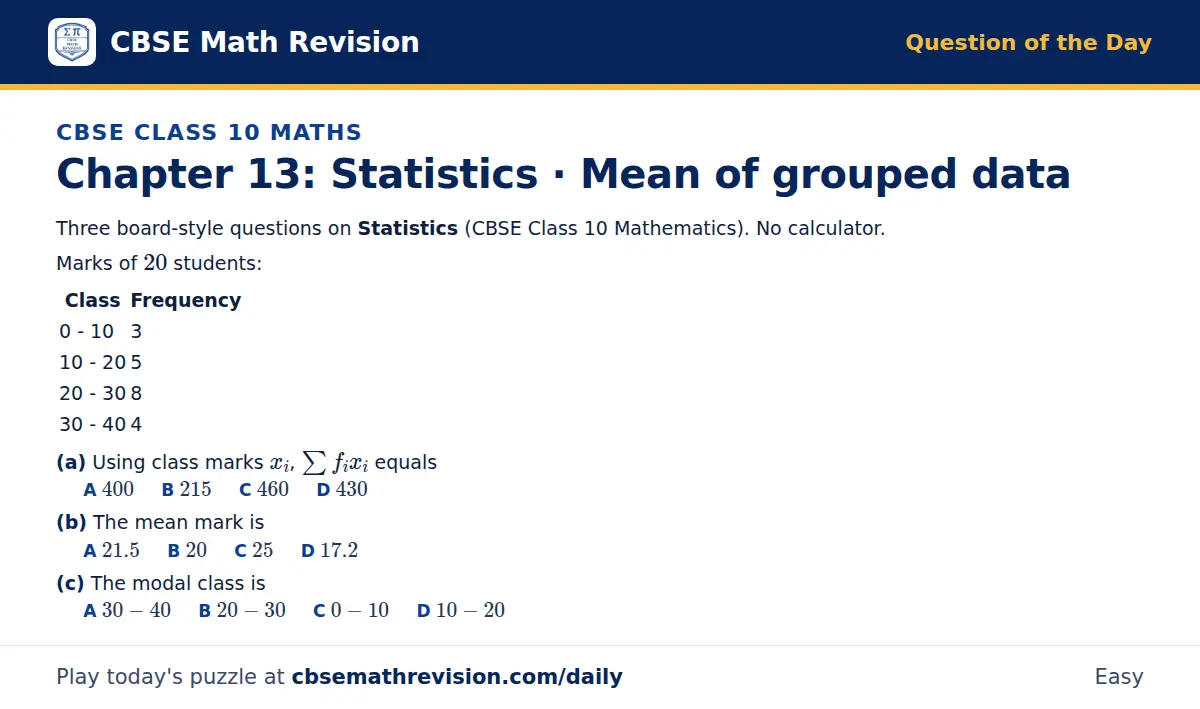
Chapter 13: Statistics · Mean of grouped data
Three board-style questions on Statistics (CBSE Class 10 Mathematics). No calculator. Marks of 20 students: ClassFrequency0 - 10310 - 20520 - 30830 - 404
- Using class marks x_i, Σ f_i x_i equals Options: A) 400; B) 215; C) 460; D) 430
- The mean mark is Options: A) 21.5; B) 20; C) 25; D) 17.2
- The modal class is Options: A) 30 - 40; B) 20 - 30; C) 0 - 10; D) 10 - 20
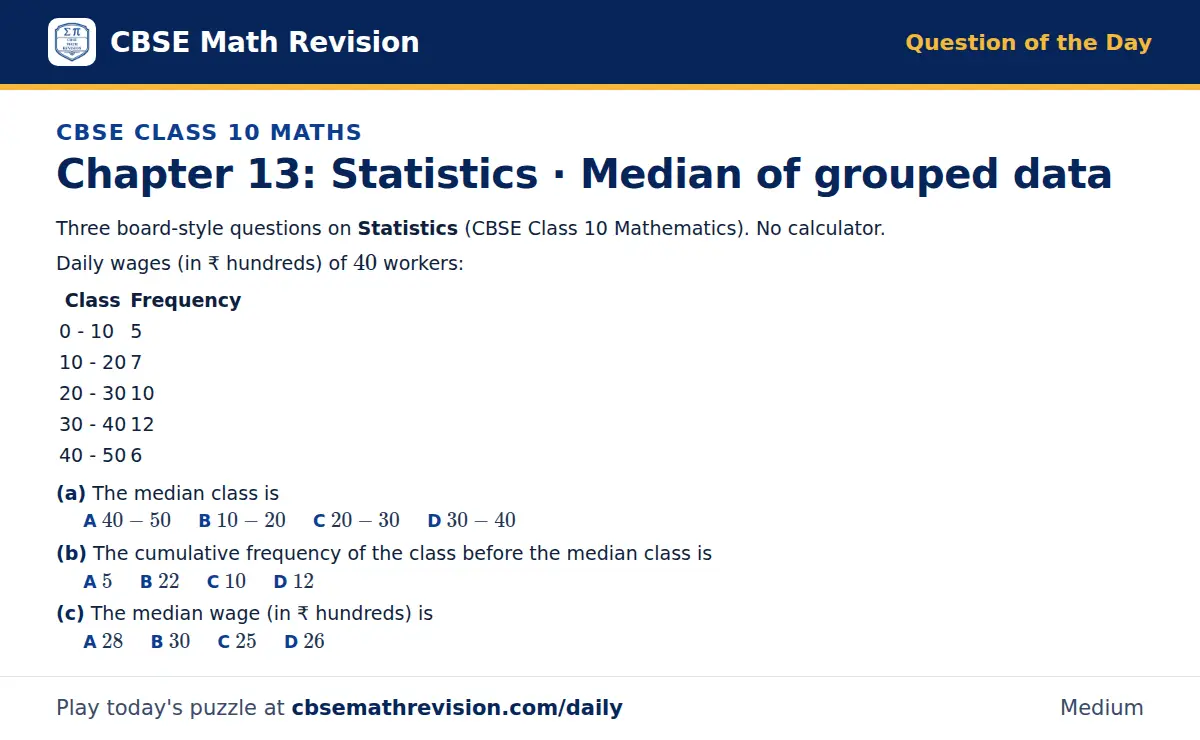
Chapter 13: Statistics · Median of grouped data
Three board-style questions on Statistics (CBSE Class 10 Mathematics). No calculator. Daily wages (in ₹ hundreds) of 40 workers: ClassFrequency0 - 10510 - 20720 - 301030 - 401240 - 506
- The median class is Options: A) 40 - 50; B) 10 - 20; C) 20 - 30; D) 30 - 40
- The cumulative frequency of the class before the median class is Options: A) 5; B) 22; C) 10; D) 12
- The median wage (in ₹ hundreds) is Options: A) 28; B) 30; C) 25; D) 26
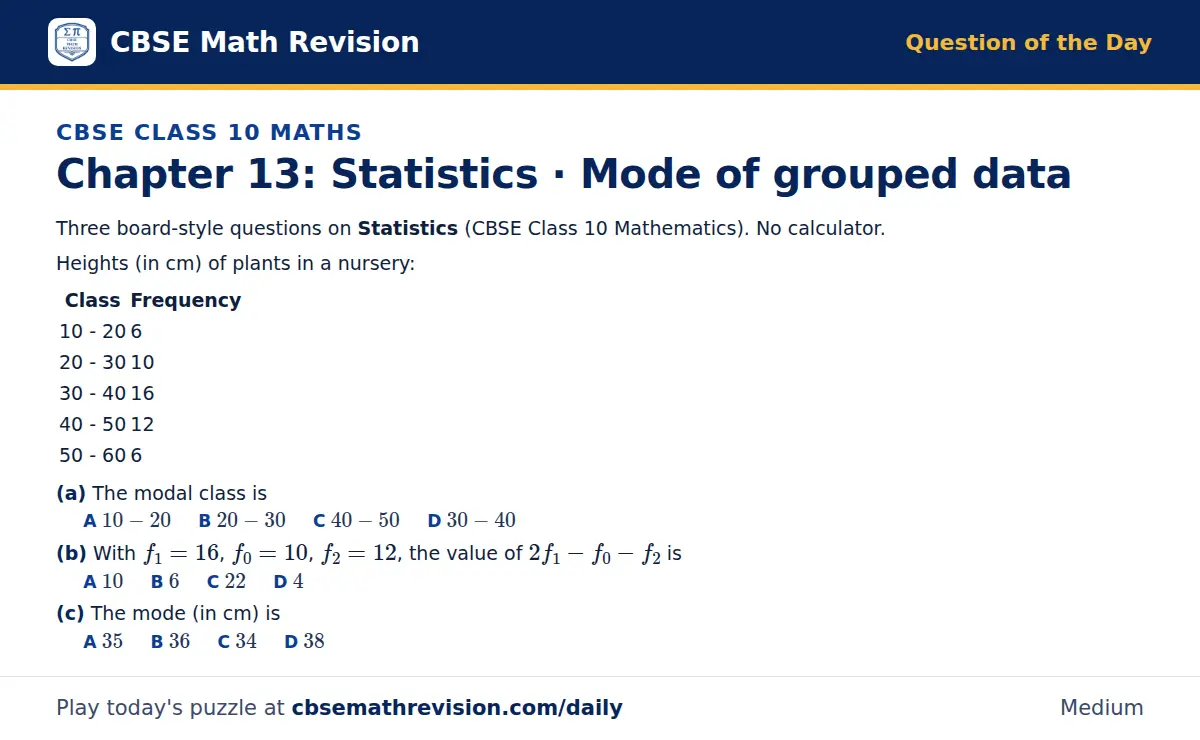
Chapter 13: Statistics · Mode of grouped data
Three board-style questions on Statistics (CBSE Class 10 Mathematics). No calculator. Heights (in cm) of plants in a nursery: ClassFrequency10 - 20620 - 301030 - 401640 - 501250 - 606
- The modal class is Options: A) 10 - 20; B) 20 - 30; C) 40 - 50; D) 30 - 40
- With f_1 = 16, f_0 = 10, f_2 = 12, the value of 2f_1 - f_0 - f_2 is Options: A) 10; B) 6; C) 22; D) 4
- The mode (in cm) is Options: A) 35; B) 36; C) 34; D) 38
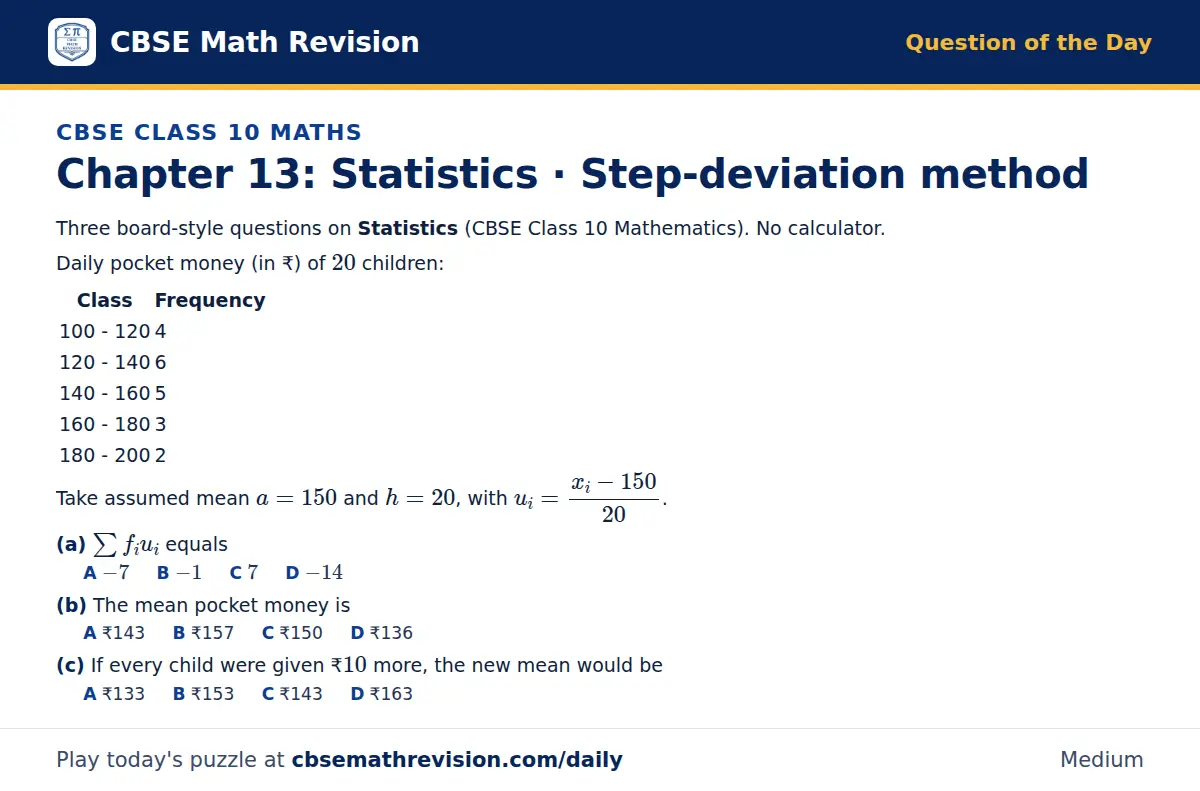
Chapter 13: Statistics · Step-deviation method
Three board-style questions on Statistics (CBSE Class 10 Mathematics). No calculator. Daily pocket money (in ₹) of 20 children: ClassFrequency100 - 1204120 - 1406140 - 1605160 - 1803180 - 2002Take assumed mean a = 150 and h = 20, with u_i = (x_i - 150)/20.
- Σ f_i u_i equals Options: A) -7; B) -1; C) 7; D) -14
- The mean pocket money is Options: A) ₹143; B) ₹157; C) ₹150; D) ₹136
- If every child were given ₹10 more, the new mean would be Options: A) ₹133; B) ₹153; C) ₹143; D) ₹163
Chapter 14: Probability
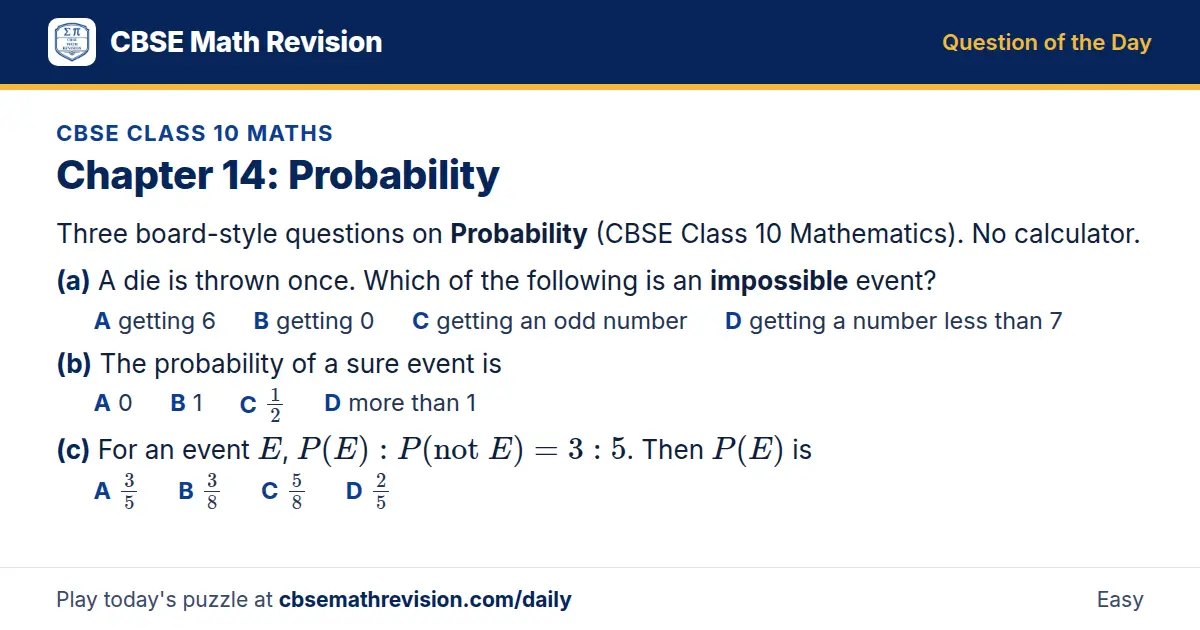
Chapter 14: Probability
Three board-style questions on Probability (CBSE Class 10 Mathematics). No calculator.
- A die is thrown once. Which of the following is an impossible event? Options: A) getting 6; B) getting 0; C) getting an odd number; D) getting a number less than 7
- The probability of a sure event is Options: A) 0; B) 1; C) 12; D) more than 1
- For an event E, P(E): P(not E) = 3: 5. Then P(E) is Options: A) 35; B) 38; C) 58; D) 25
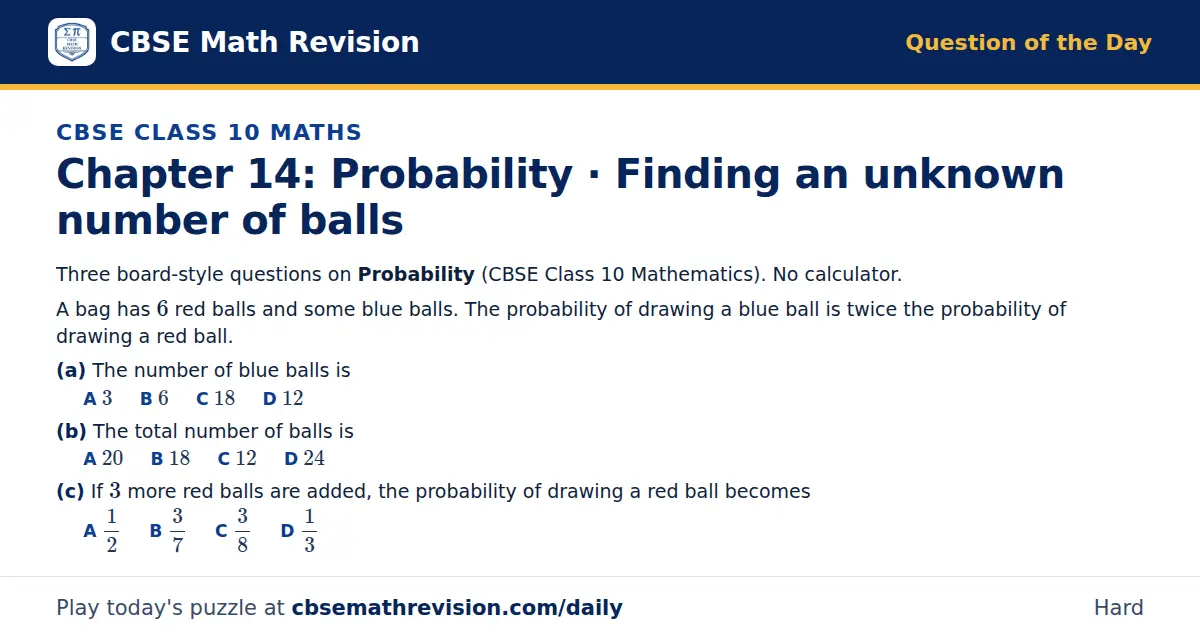
Chapter 14: Probability · Finding an unknown number of balls
Three board-style questions on Probability (CBSE Class 10 Mathematics). No calculator. A bag has 6 red balls and some blue balls. The probability of drawing a blue ball is twice the probability of drawing a red ball.
- The number of blue balls is Options: A) 3; B) 6; C) 18; D) 12
- The total number of balls is Options: A) 20; B) 18; C) 12; D) 24
- If 3 more red balls are added, the probability of drawing a red ball becomes Options: A) 1/2; B) 3/7; C) 3/8; D) 1/3
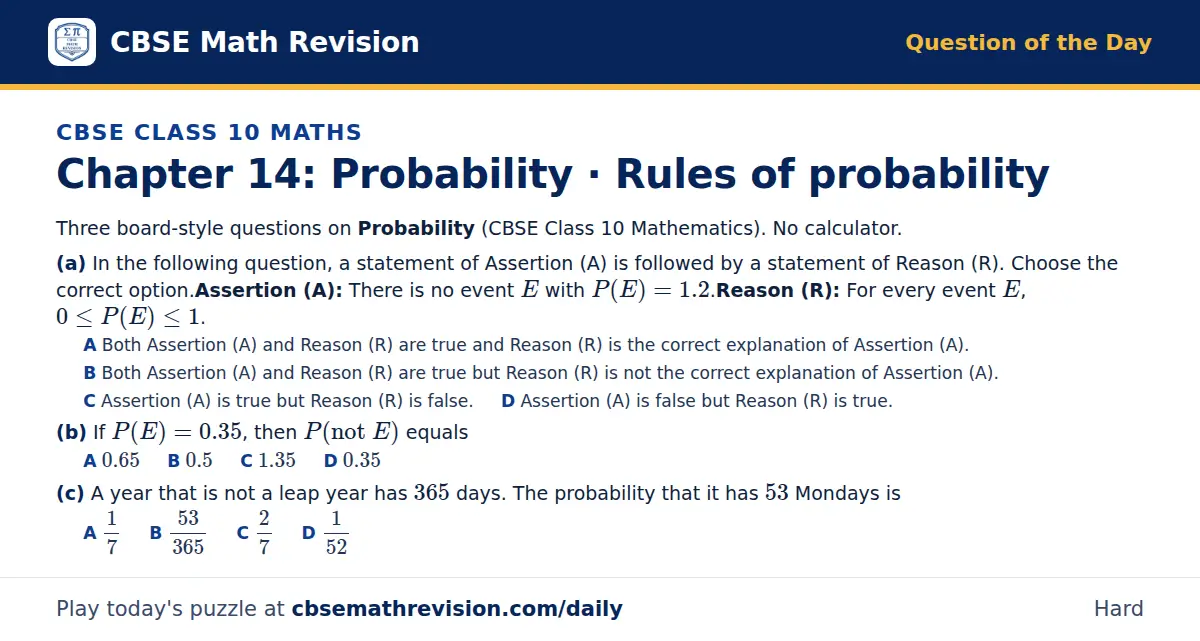
Chapter 14: Probability · Rules of probability
Three board-style questions on Probability (CBSE Class 10 Mathematics). No calculator.
- In the following question, a statement of Assertion (A) is followed by a statement of Reason (R). Choose the correct option. Assertion (A): There is no event E with P(E) = 1.2. Reason (R): For every event E, 0 ≤ P(E) ≤ 1. Options: A) Both Assertion (A) and Reason (R) are true and Reason (R) is the correct explanation of Assertion (A).; B) Both Assertion (A) and Reason (R) are true but Reason (R) is not the correct explanation of Assertion (A).; C) Assertion (A) is true but Reason (R) is false.; D) Assertion (A) is false but Reason (R) is true.
- If P(E) = 0.35, then P(not E) equals Options: A) 0.65; B) 0.5; C) 1.35; D) 0.35
- A year that is not a leap year has 365 days. The probability that it has 53 Mondays is Options: A) 1/7; B) 53/365; C) 2/7; D) 1/52
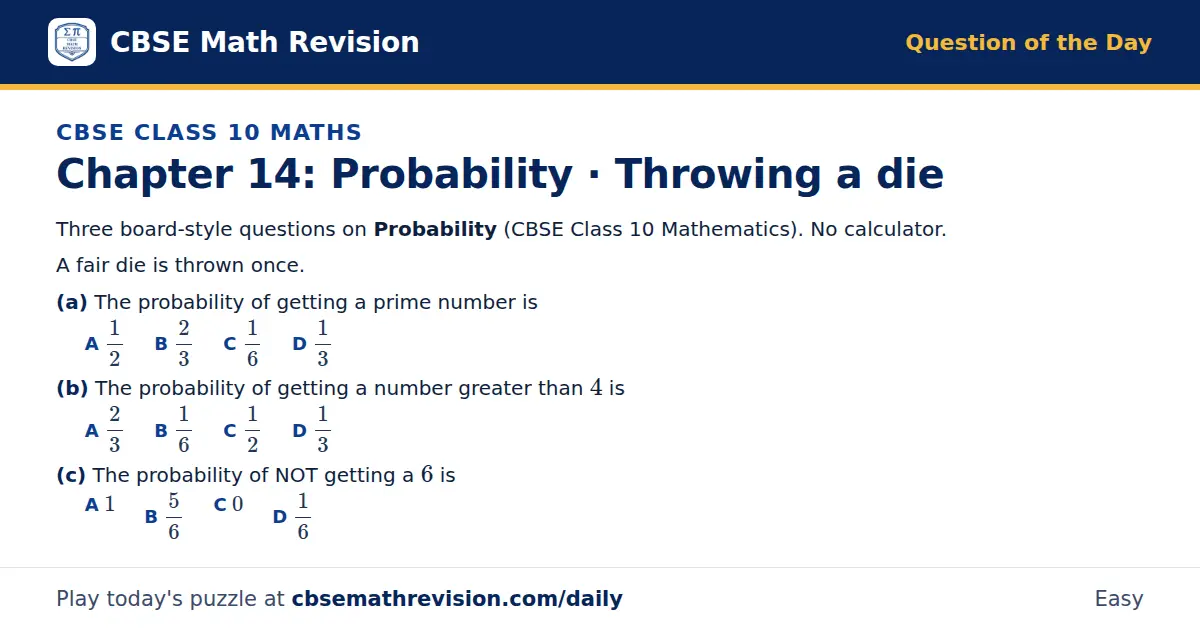
Chapter 14: Probability · Throwing a die
Three board-style questions on Probability (CBSE Class 10 Mathematics). No calculator. A fair die is thrown once.
- The probability of getting a prime number is Options: A) 1/2; B) 2/3; C) 1/6; D) 1/3
- The probability of getting a number greater than 4 is Options: A) 2/3; B) 1/6; C) 1/2; D) 1/3
- The probability of NOT getting a 6 is Options: A) 1; B) 5/6; C) 0; D) 1/6
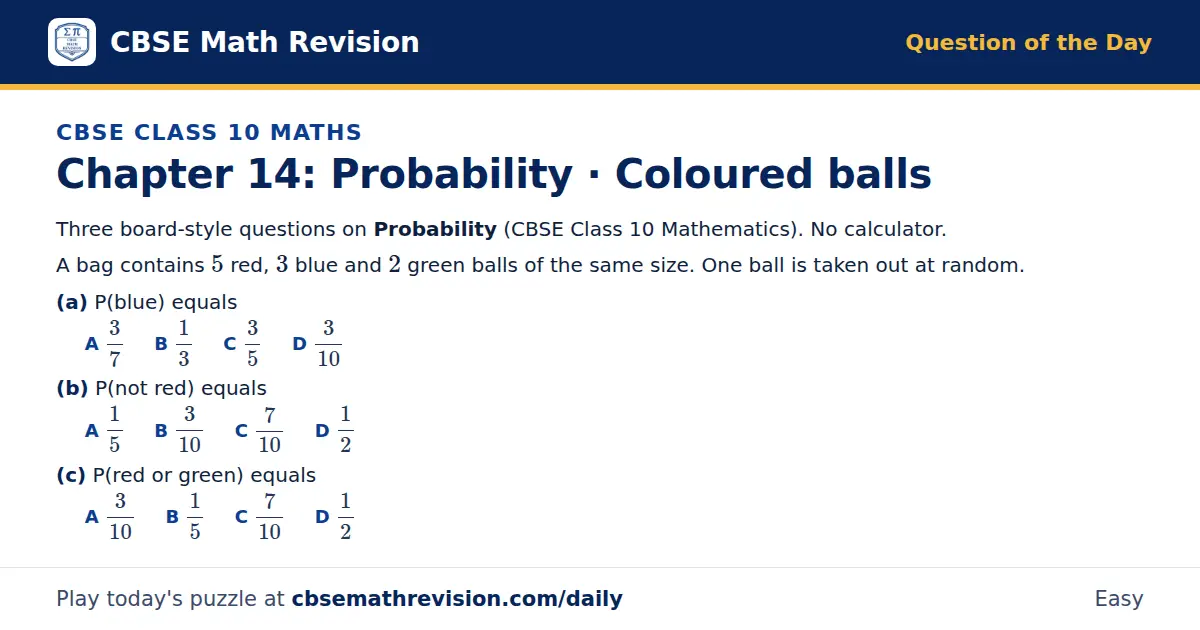
Chapter 14: Probability · Coloured balls
Three board-style questions on Probability (CBSE Class 10 Mathematics). No calculator. A bag contains 5 red, 3 blue and 2 green balls of the same size. One ball is taken out at random.
- P(blue) equals Options: A) 3/7; B) 1/3; C) 3/5; D) 3/10
- P(not red) equals Options: A) 1/5; B) 3/10; C) 7/10; D) 1/2
- P(red or green) equals Options: A) 3/10; B) 1/5; C) 7/10; D) 1/2
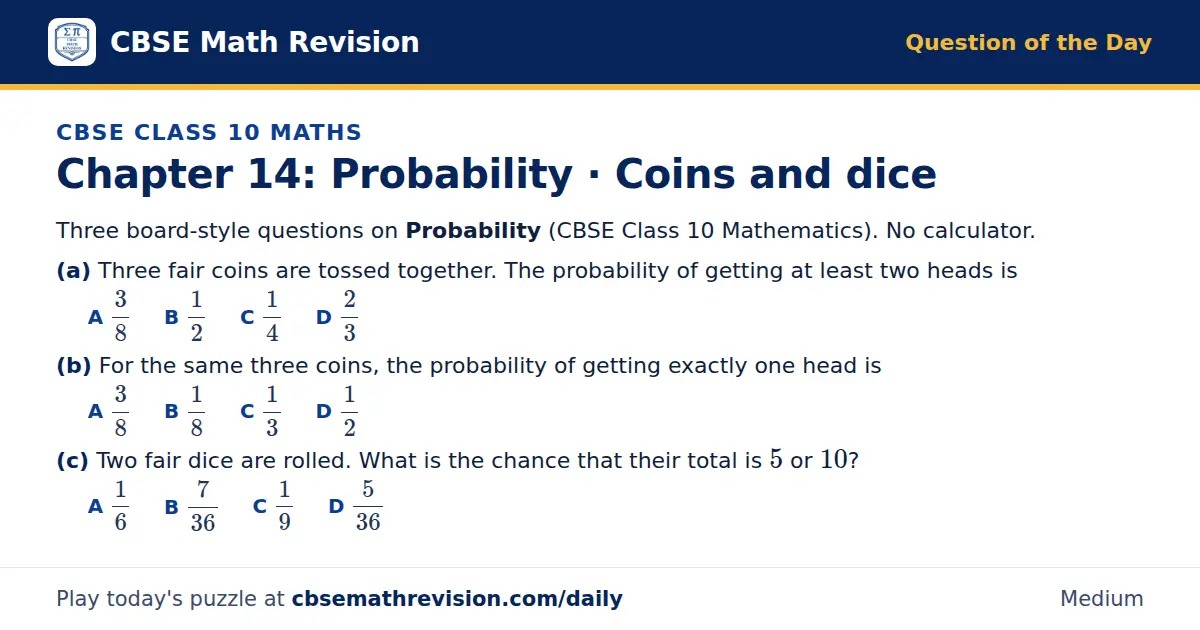
Chapter 14: Probability · Coins and dice
Three board-style questions on Probability (CBSE Class 10 Mathematics). No calculator.
- Three fair coins are tossed together. The probability of getting at least two heads is Options: A) 3/8; B) 1/2; C) 1/4; D) 2/3
- For the same three coins, the probability of getting exactly one head is Options: A) 3/8; B) 1/8; C) 1/3; D) 1/2
- Two fair dice are rolled. What is the chance that their total is 5 or 10? Options: A) 1/6; B) 7/36; C) 1/9; D) 5/36
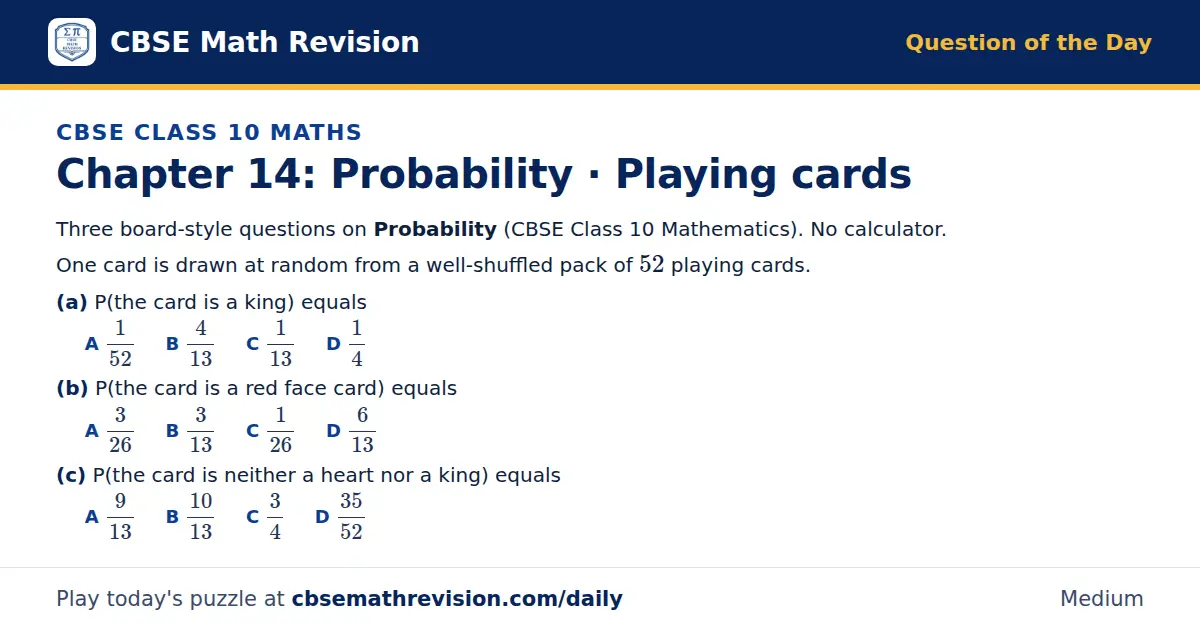
Chapter 14: Probability · Playing cards
Three board-style questions on Probability (CBSE Class 10 Mathematics). No calculator. One card is drawn at random from a well-shuffled pack of 52 playing cards.
- P(the card is a king) equals Options: A) 1/52; B) 4/13; C) 1/13; D) 1/4
- P(the card is a red face card) equals Options: A) 3/26; B) 3/13; C) 1/26; D) 6/13
- P(the card is neither a heart nor a king) equals Options: A) 9/13; B) 10/13; C) 3/4; D) 35/52
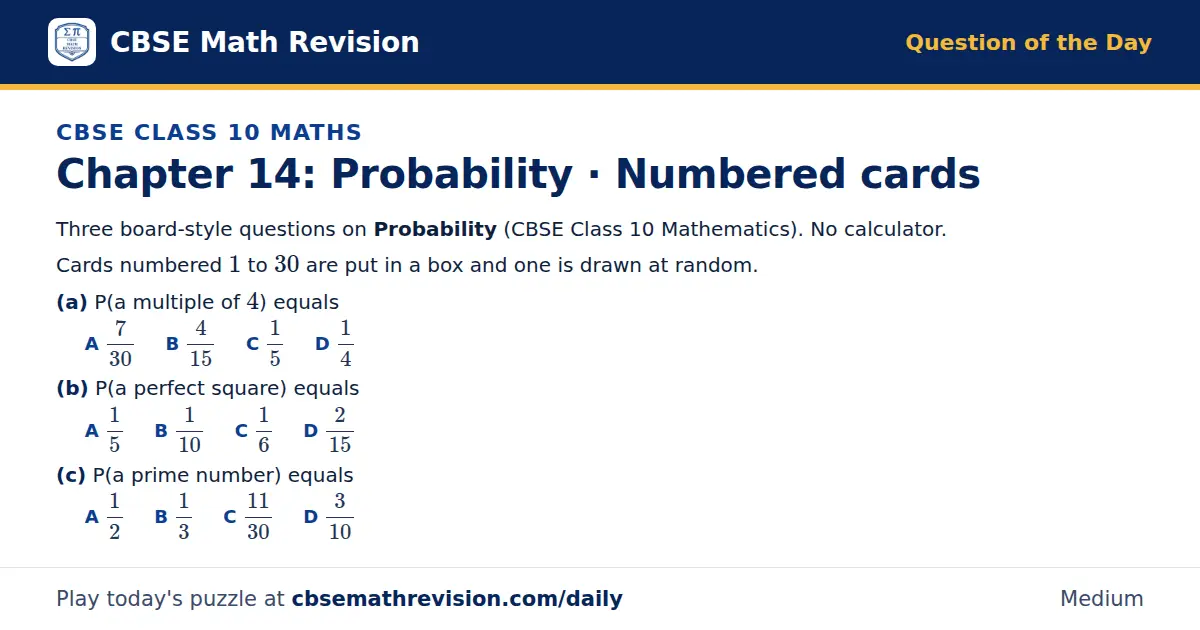
Chapter 14: Probability · Numbered cards
Three board-style questions on Probability (CBSE Class 10 Mathematics). No calculator. Cards numbered 1 to 30 are put in a box and one is drawn at random.
- P(a multiple of 4) equals Options: A) 7/30; B) 4/15; C) 1/5; D) 1/4
- P(a perfect square) equals Options: A) 1/5; B) 1/10; C) 1/6; D) 2/15
- P(a prime number) equals Options: A) 1/2; B) 1/3; C) 11/30; D) 3/10
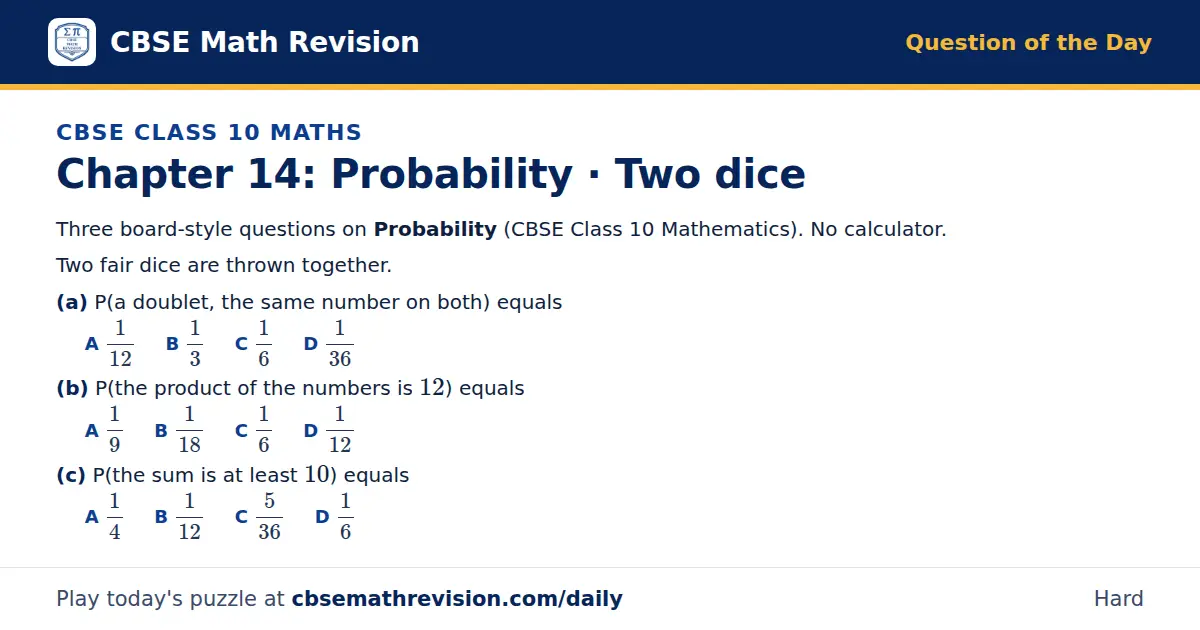
Chapter 14: Probability · Two dice
Three board-style questions on Probability (CBSE Class 10 Mathematics). No calculator. Two fair dice are thrown together.
- P(a doublet, the same number on both) equals Options: A) 1/12; B) 1/3; C) 1/6; D) 1/36
- P(the product of the numbers is 12) equals Options: A) 1/9; B) 1/18; C) 1/6; D) 1/12
- P(the sum is at least 10) equals Options: A) 1/4; B) 1/12; C) 5/36; D) 1/6
More Question of the Day puzzles
Other chapters: Chapters 1–4 · Chapters 5–8 · Chapters 9–11 · Chapters 12–14. See all CBSE Maths daily and weekly questions.