CBSE Class 10 Maths Question of the Day: chapters 1–4
36 CBSE Class 10 Mathematics puzzles from the Question of the Day rotation, chapters 1–4. Each puzzle is three board-style questions on one chapter, shown as an image with the question text written out below it; the answers, hints and step-marked solutions are on the daily puzzle page.
Chapter 1: Real Numbers
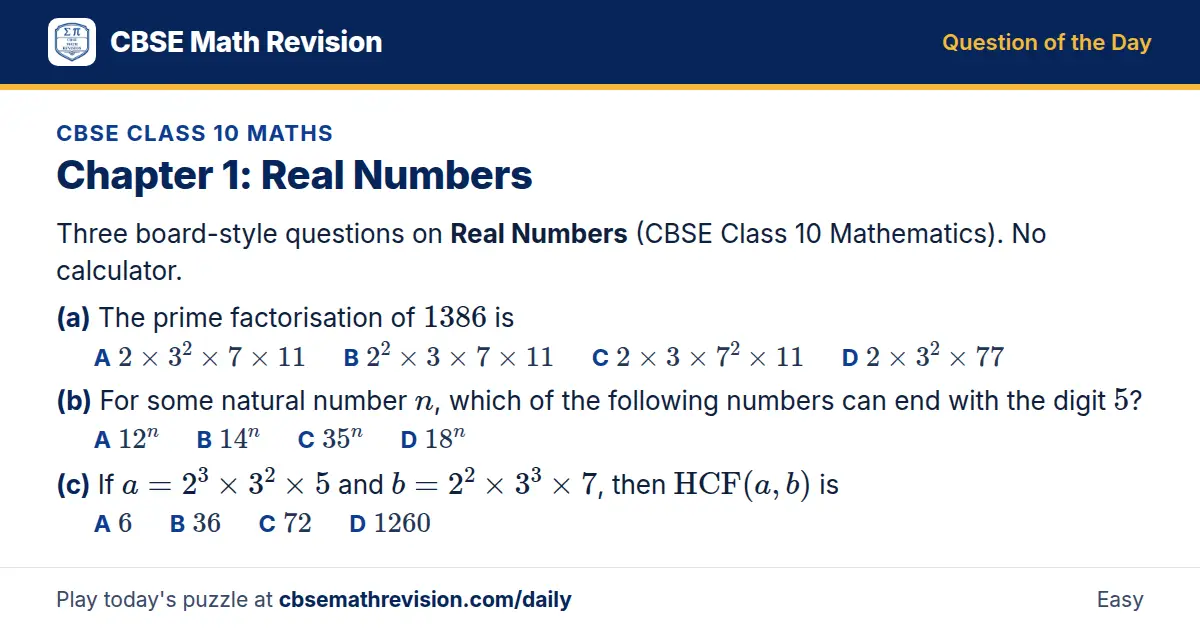
Chapter 1: Real Numbers
Three board-style questions on Real Numbers (CBSE Class 10 Mathematics). No calculator.
- The prime factorisation of 1386 is Options: A) 2 × 3² × 7 × 11; B) 2² × 3 × 7 × 11; C) 2 × 3 × 7² × 11; D) 2 × 3² × 77
- For some natural number n, which of the following numbers can end with the digit 5? Options: A) 12^n; B) 14^n; C) 35^n; D) 18^n
- If a = 2³ × 3² × 5 and b = 2² × 3³ × 7, then HCF(a, b) is Options: A) 6; B) 36; C) 72; D) 1260
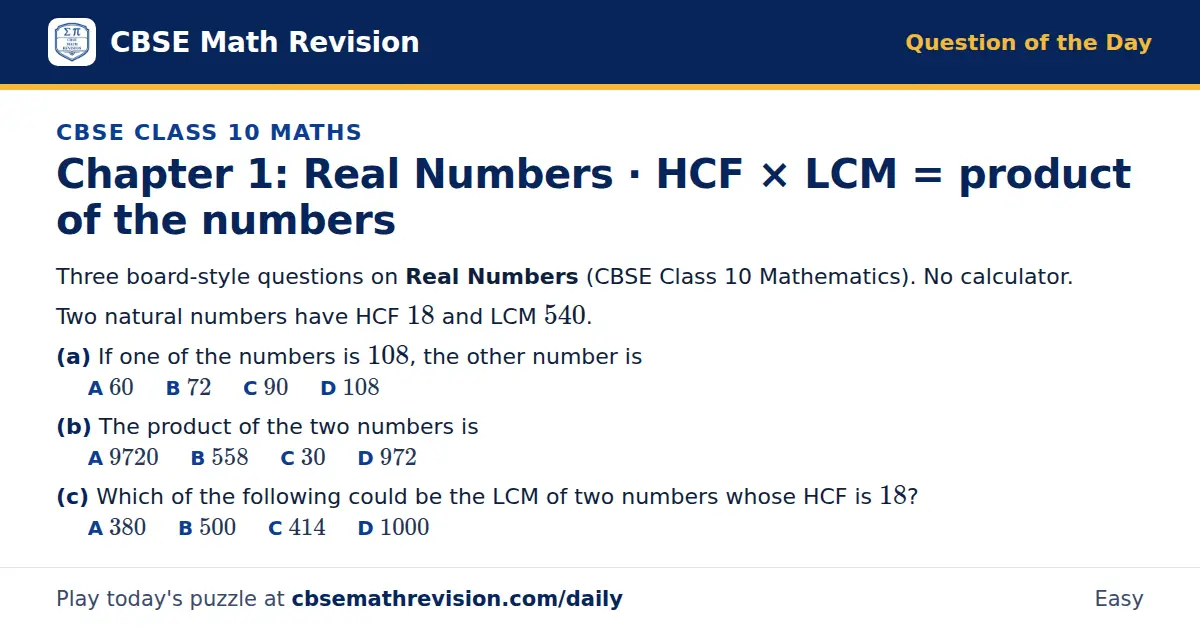
Chapter 1: Real Numbers · HCF × LCM = product of the numbers
Three board-style questions on Real Numbers (CBSE Class 10 Mathematics). No calculator. Two natural numbers have HCF 18 and LCM 540.
- If one of the numbers is 108, the other number is Options: A) 60; B) 72; C) 90; D) 108
- The product of the two numbers is Options: A) 9720; B) 558; C) 30; D) 972
- Which of the following could be the LCM of two numbers whose HCF is 18? Options: A) 380; B) 500; C) 414; D) 1000
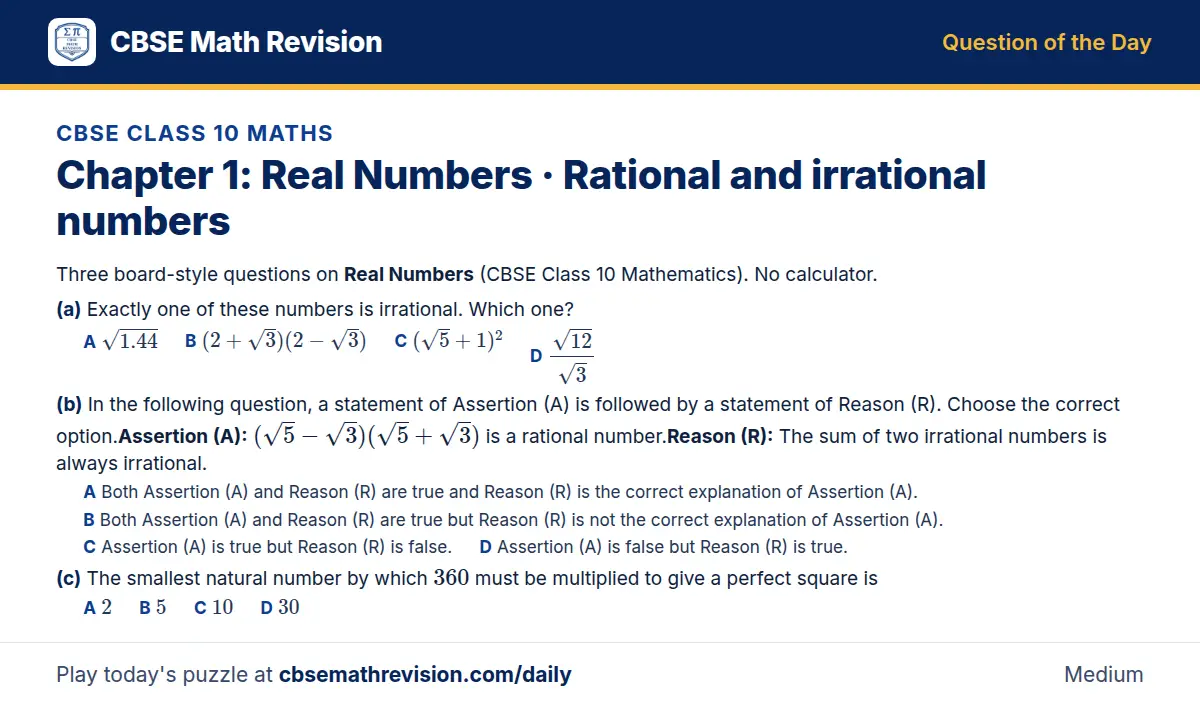
Chapter 1: Real Numbers · Rational and irrational numbers
Three board-style questions on Real Numbers (CBSE Class 10 Mathematics). No calculator.
- Exactly one of these numbers is irrational. Which one? Options: A) √(1.44); B) (2+√3)(2-√3); C) (√5+1)²; D) (√12)/(√3)
- In the following question, a statement of Assertion (A) is followed by a statement of Reason (R). Choose the correct option. Assertion (A): (√5 - √3)(√5 + √3) is a rational number. Reason (R): The sum of two irrational numbers is always irrational. Options: A) Both Assertion (A) and Reason (R) are true and Reason (R) is the correct explanation of Assertion (A).; B) Both Assertion (A) and Reason (R) are true but Reason (R) is not the correct explanation of Assertion (A).; C) Assertion (A) is true but Reason (R) is false.; D) Assertion (A) is false but Reason (R) is true.
- The smallest natural number by which 360 must be multiplied to give a perfect square is Options: A) 2; B) 5; C) 10; D) 30
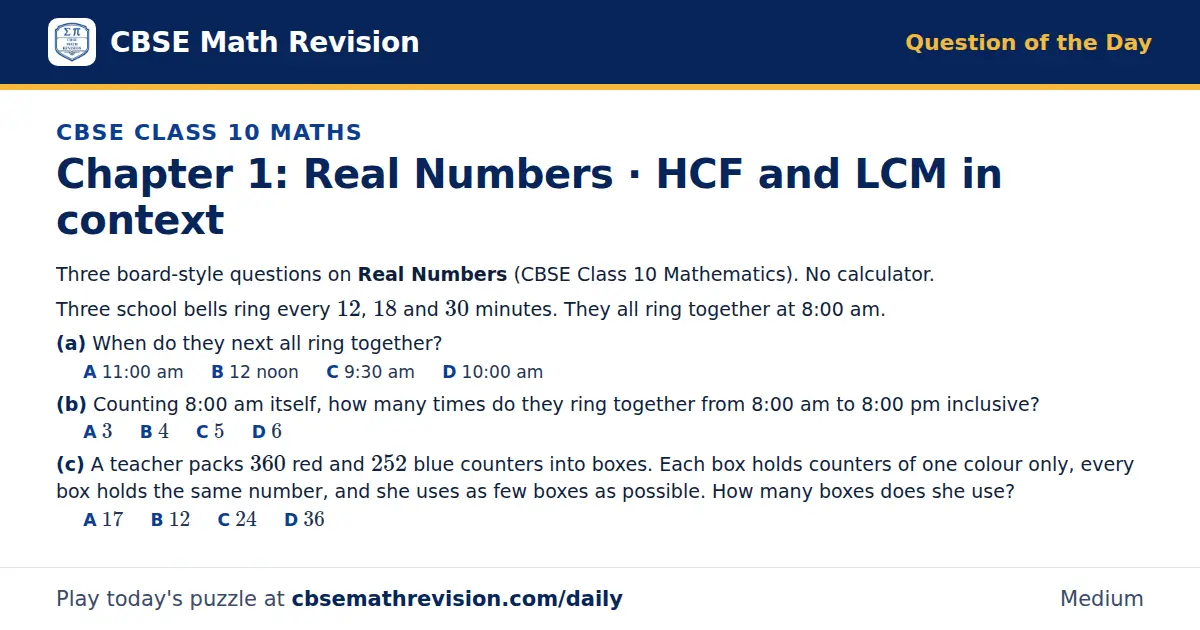
Chapter 1: Real Numbers · HCF and LCM in context
Three board-style questions on Real Numbers (CBSE Class 10 Mathematics). No calculator. Three school bells ring every 12, 18 and 30 minutes. They all ring together at 8:00 am.
- When do they next all ring together? Options: A) 11:00 am; B) 12 noon; C) 9:30 am; D) 10:00 am
- Counting 8:00 am itself, how many times do they ring together from 8:00 am to 8:00 pm inclusive? Options: A) 3; B) 4; C) 5; D) 6
- A teacher packs 360 red and 252 blue counters into boxes. Each box holds counters of one colour only, every box holds the same number, and she uses as few boxes as possible. How many boxes does she use? Options: A) 17; B) 12; C) 24; D) 36
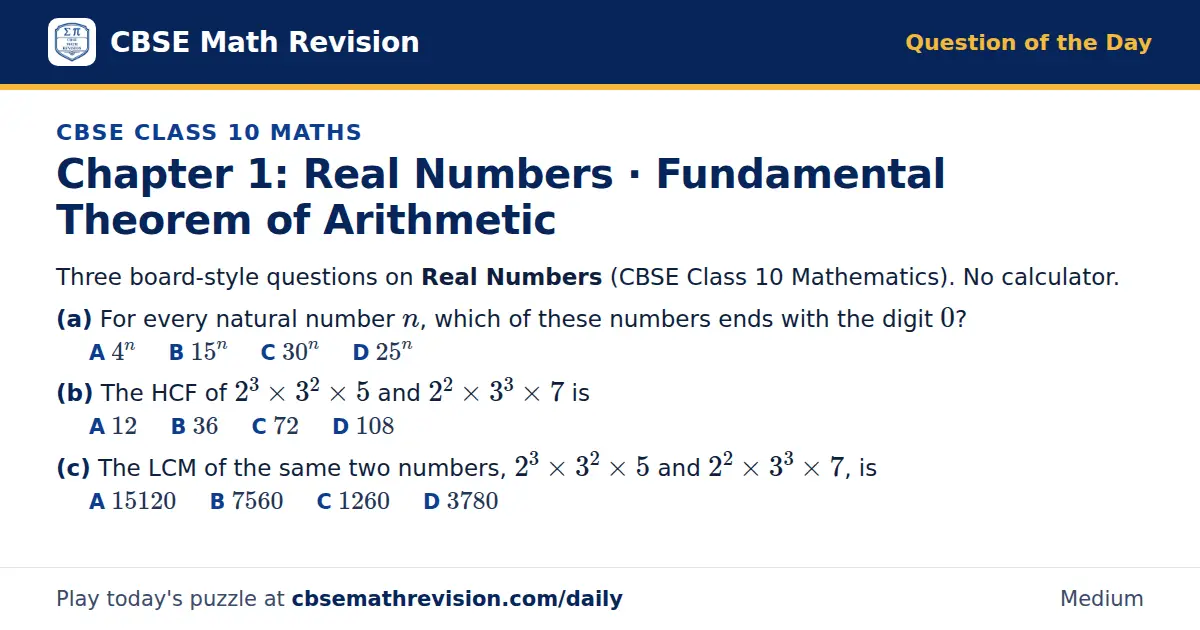
Chapter 1: Real Numbers · Fundamental Theorem of Arithmetic
Three board-style questions on Real Numbers (CBSE Class 10 Mathematics). No calculator.
- For every natural number n, which of these numbers ends with the digit 0? Options: A) 4^n; B) 15^n; C) 30^n; D) 25^n
- The HCF of 2³ × 3² × 5 and 2² × 3³ × 7 is Options: A) 12; B) 36; C) 72; D) 108
- The LCM of the same two numbers, 2³ × 3² × 5 and 2² × 3³ × 7, is Options: A) 15120; B) 7560; C) 1260; D) 3780
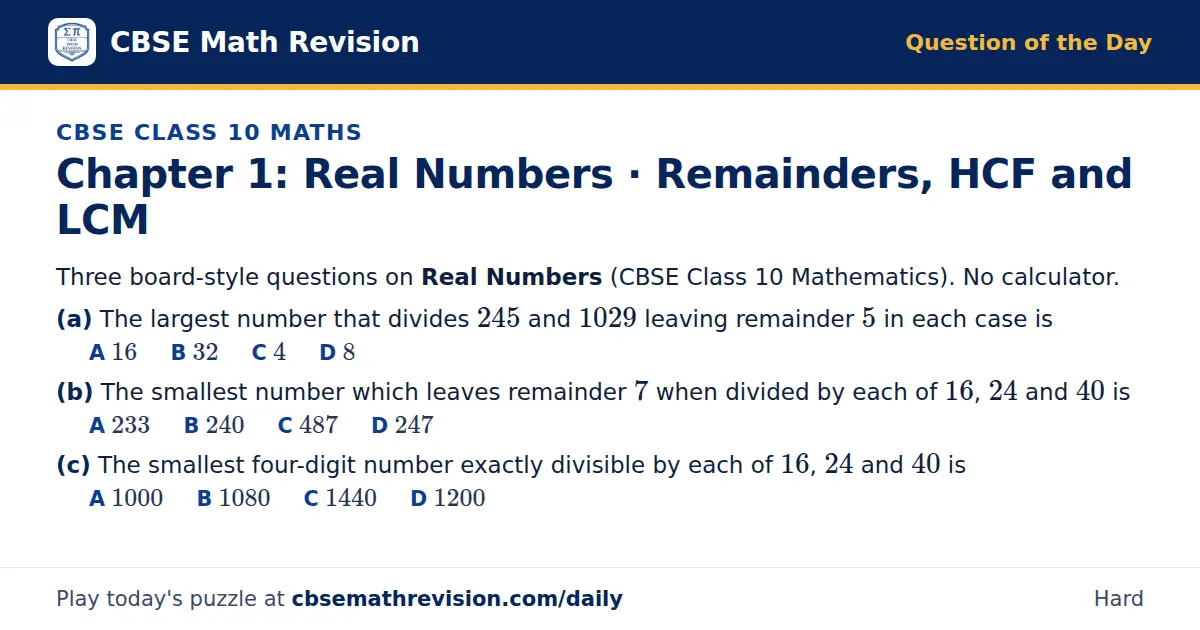
Chapter 1: Real Numbers · Remainders, HCF and LCM
Three board-style questions on Real Numbers (CBSE Class 10 Mathematics). No calculator.
- The largest number that divides 245 and 1029 leaving remainder 5 in each case is Options: A) 16; B) 32; C) 4; D) 8
- The smallest number which leaves remainder 7 when divided by each of 16, 24 and 40 is Options: A) 233; B) 240; C) 487; D) 247
- The smallest four-digit number exactly divisible by each of 16, 24 and 40 is Options: A) 1000; B) 1080; C) 1440; D) 1200
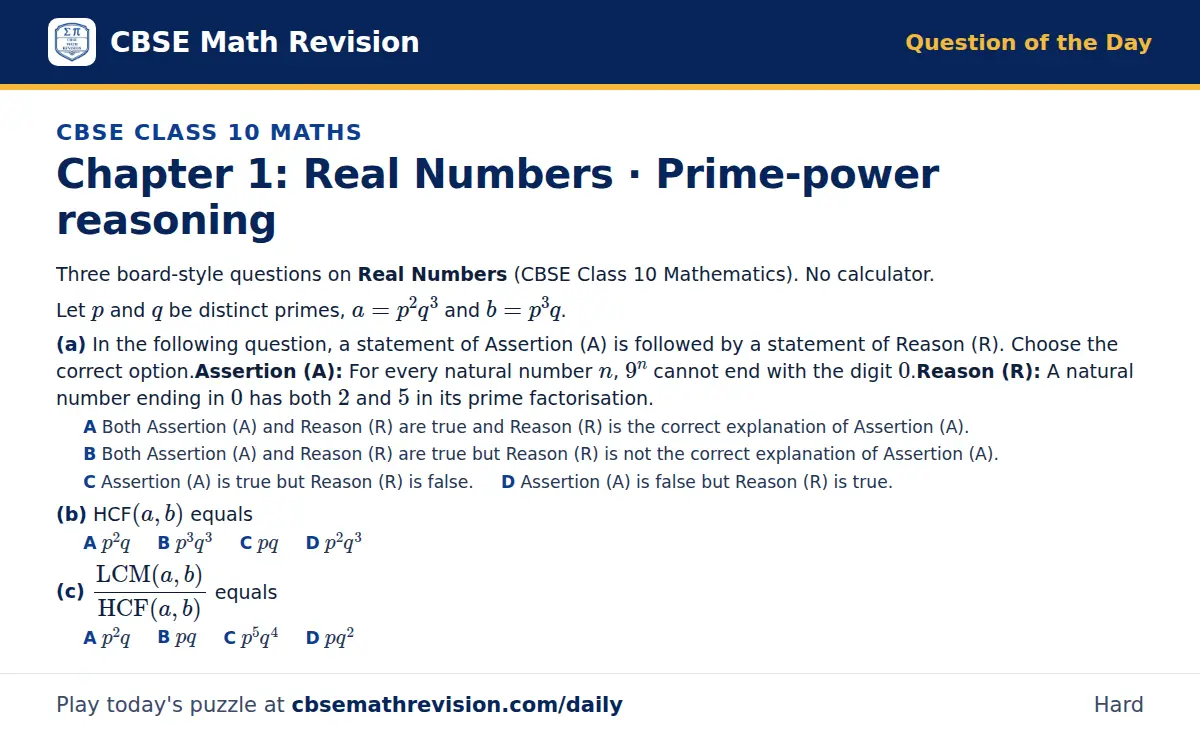
Chapter 1: Real Numbers · Prime-power reasoning
Three board-style questions on Real Numbers (CBSE Class 10 Mathematics). No calculator. Let p and q be distinct primes, a = p²q³ and b = p³q.
- In the following question, a statement of Assertion (A) is followed by a statement of Reason (R). Choose the correct option. Assertion (A): For every natural number n, 9^n cannot end with the digit 0. Reason (R): A natural number ending in 0 has both 2 and 5 in its prime factorisation. Options: A) Both Assertion (A) and Reason (R) are true and Reason (R) is the correct explanation of Assertion (A).; B) Both Assertion (A) and Reason (R) are true but Reason (R) is not the correct explanation of Assertion (A).; C) Assertion (A) is true but Reason (R) is false.; D) Assertion (A) is false but Reason (R) is true.
- HCF(a, b) equals Options: A) p²q; B) p³q³; C) pq; D) p²q³
- (LCM(a, b))/(HCF(a, b)) equals Options: A) p²q; B) pq; C) p⁵q⁴; D) pq²
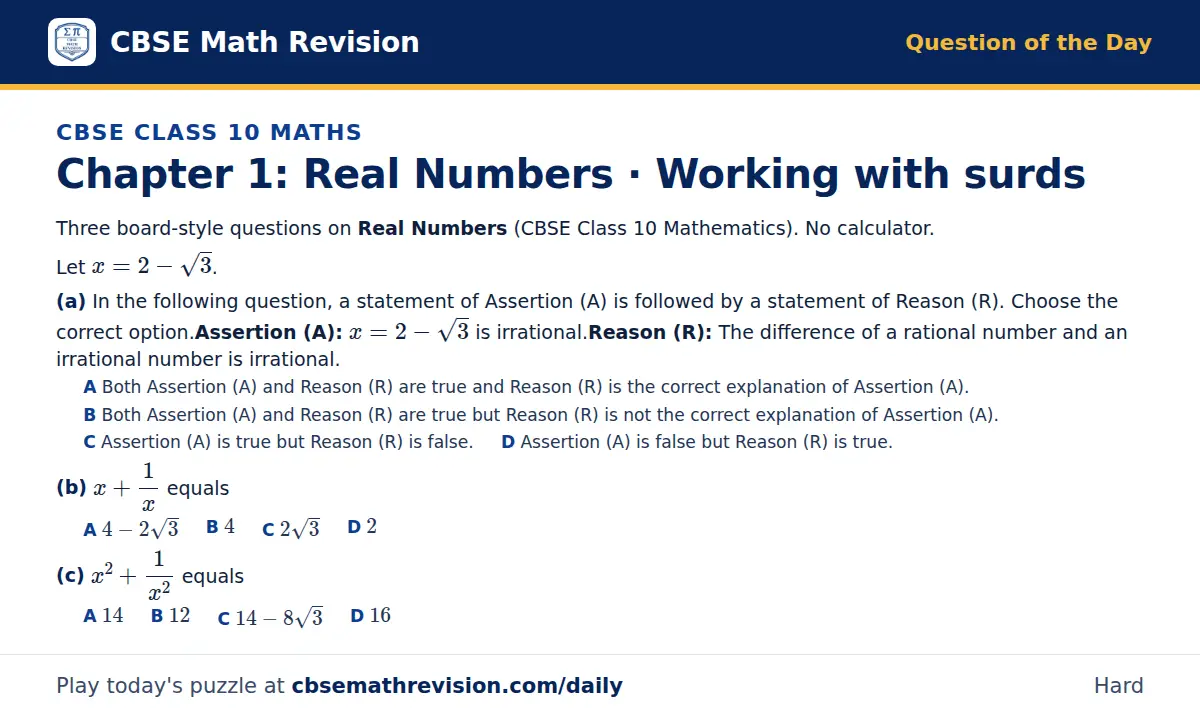
Chapter 1: Real Numbers · Working with surds
Three board-style questions on Real Numbers (CBSE Class 10 Mathematics). No calculator. Let x = 2 - √3.
- In the following question, a statement of Assertion (A) is followed by a statement of Reason (R). Choose the correct option. Assertion (A): x = 2 - √3 is irrational. Reason (R): The difference of a rational number and an irrational number is irrational. Options: A) Both Assertion (A) and Reason (R) are true and Reason (R) is the correct explanation of Assertion (A).; B) Both Assertion (A) and Reason (R) are true but Reason (R) is not the correct explanation of Assertion (A).; C) Assertion (A) is true but Reason (R) is false.; D) Assertion (A) is false but Reason (R) is true.
- x + 1/x equals Options: A) 4 - 2 √3; B) 4; C) 2 √3; D) 2
- x² + 1/(x²) equals Options: A) 14; B) 12; C) 14 - 8 √3; D) 16
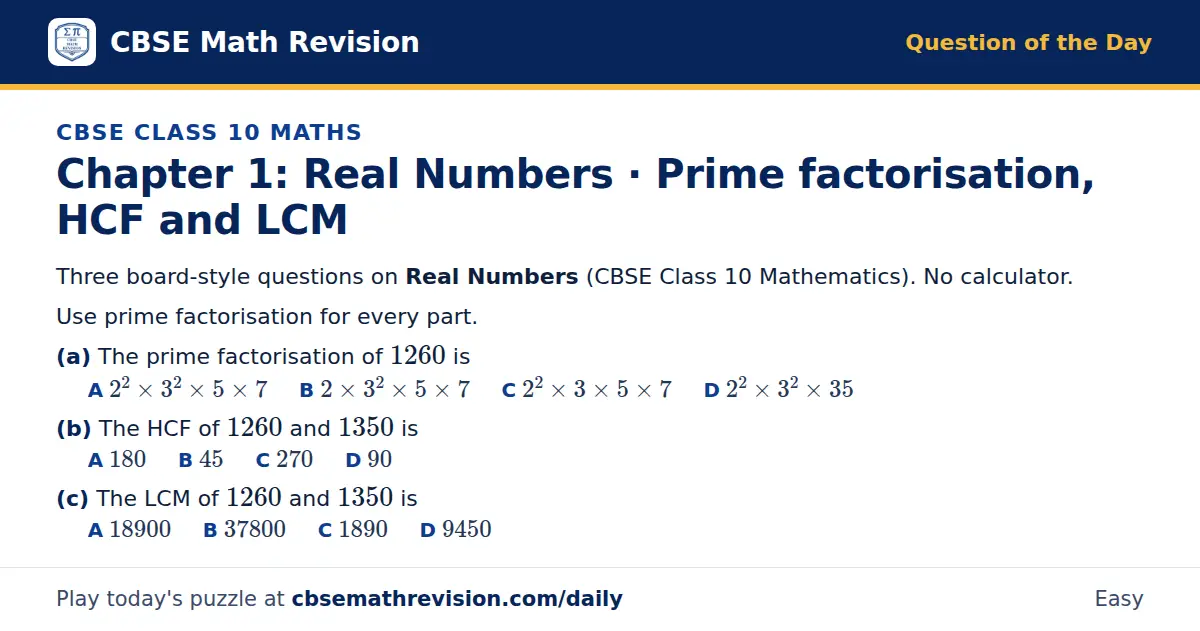
Chapter 1: Real Numbers · Prime factorisation, HCF and LCM
Three board-style questions on Real Numbers (CBSE Class 10 Mathematics). No calculator. Use prime factorisation for every part.
- The prime factorisation of 1260 is Options: A) 2² × 3² × 5 × 7; B) 2 × 3² × 5 × 7; C) 2² × 3 × 5 × 7; D) 2² × 3² × 35
- The HCF of 1260 and 1350 is Options: A) 180; B) 45; C) 270; D) 90
- The LCM of 1260 and 1350 is Options: A) 18900; B) 37800; C) 1890; D) 9450
Chapter 2: Polynomials
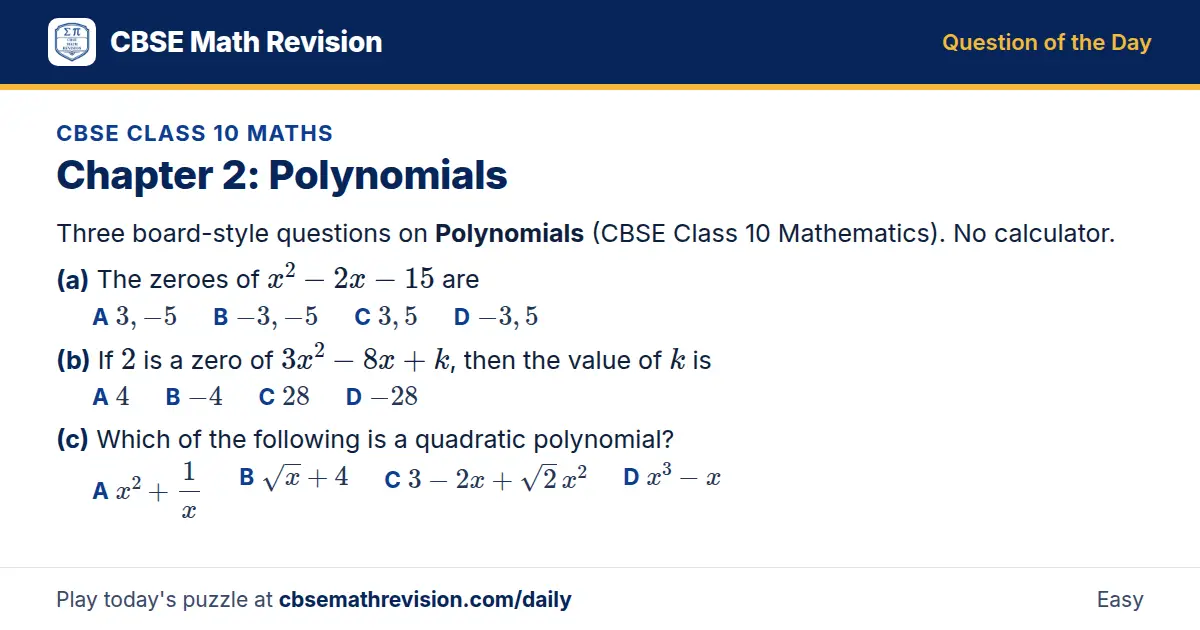
Chapter 2: Polynomials
Three board-style questions on Polynomials (CBSE Class 10 Mathematics). No calculator.
- The zeroes of x² - 2x - 15 are Options: A) 3, -5; B) -3, -5; C) 3, 5; D) -3, 5
- If 2 is a zero of 3x² - 8x + k, then the value of k is Options: A) 4; B) -4; C) 28; D) -28
- Which of the following is a quadratic polynomial? Options: A) x² + 1x; B) √x + 4; C) 3 - 2x + √2 x²; D) x³ - x
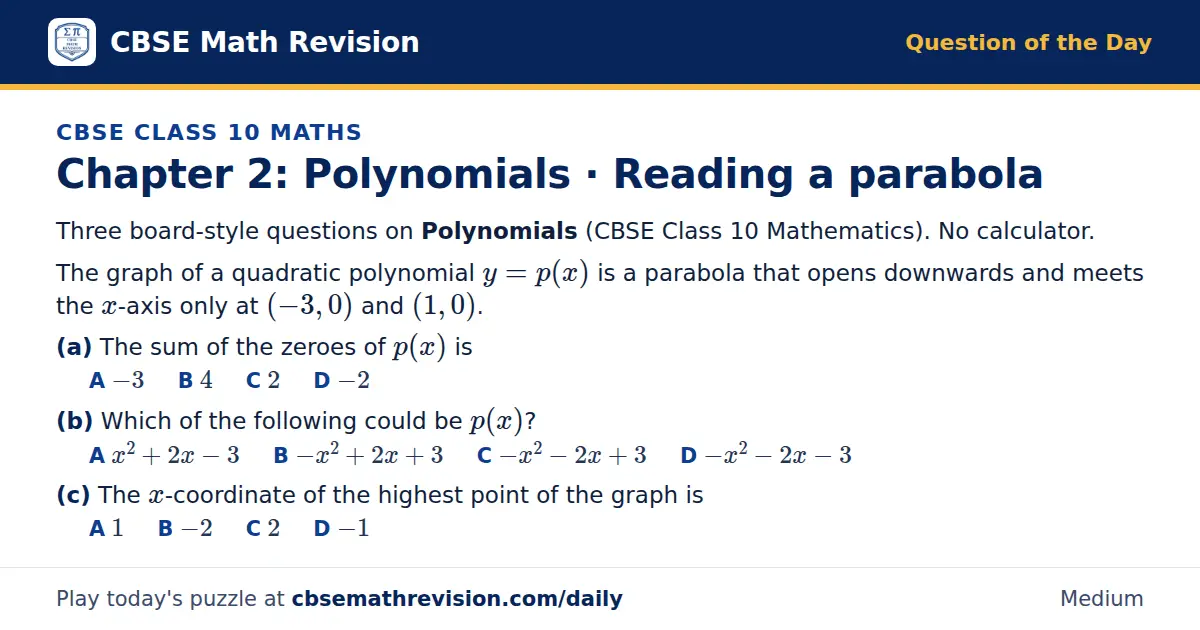
Chapter 2: Polynomials · Reading a parabola
Three board-style questions on Polynomials (CBSE Class 10 Mathematics). No calculator. The graph of a quadratic polynomial y = p(x) is a parabola that opens downwards and meets the x-axis only at (-3, 0) and (1, 0).
- The sum of the zeroes of p(x) is Options: A) -3; B) 4; C) 2; D) -2
- Which of the following could be p(x)? Options: A) x² + 2x - 3; B) -x² + 2x + 3; C) -x² - 2x + 3; D) -x² - 2x - 3
- The x-coordinate of the highest point of the graph is Options: A) 1; B) -2; C) 2; D) -1
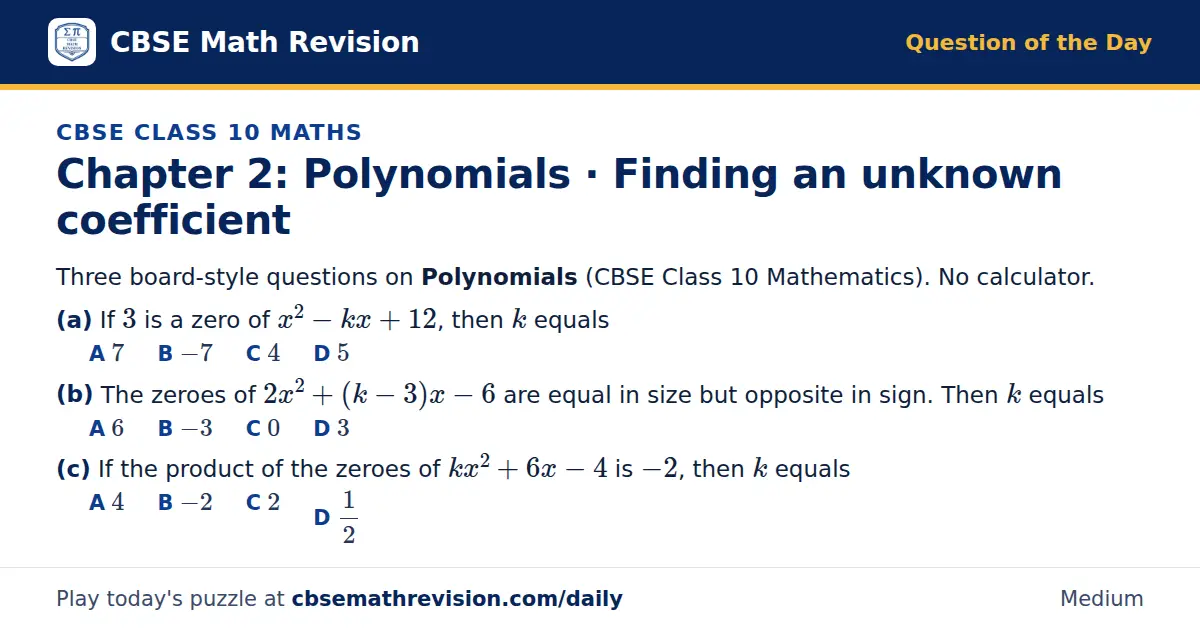
Chapter 2: Polynomials · Finding an unknown coefficient
Three board-style questions on Polynomials (CBSE Class 10 Mathematics). No calculator.
- If 3 is a zero of x² - kx + 12, then k equals Options: A) 7; B) -7; C) 4; D) 5
- The zeroes of 2x² + (k - 3)x - 6 are equal in size but opposite in sign. Then k equals Options: A) 6; B) -3; C) 0; D) 3
- If the product of the zeroes of kx² + 6x - 4 is -2, then k equals Options: A) 4; B) -2; C) 2; D) 1/2
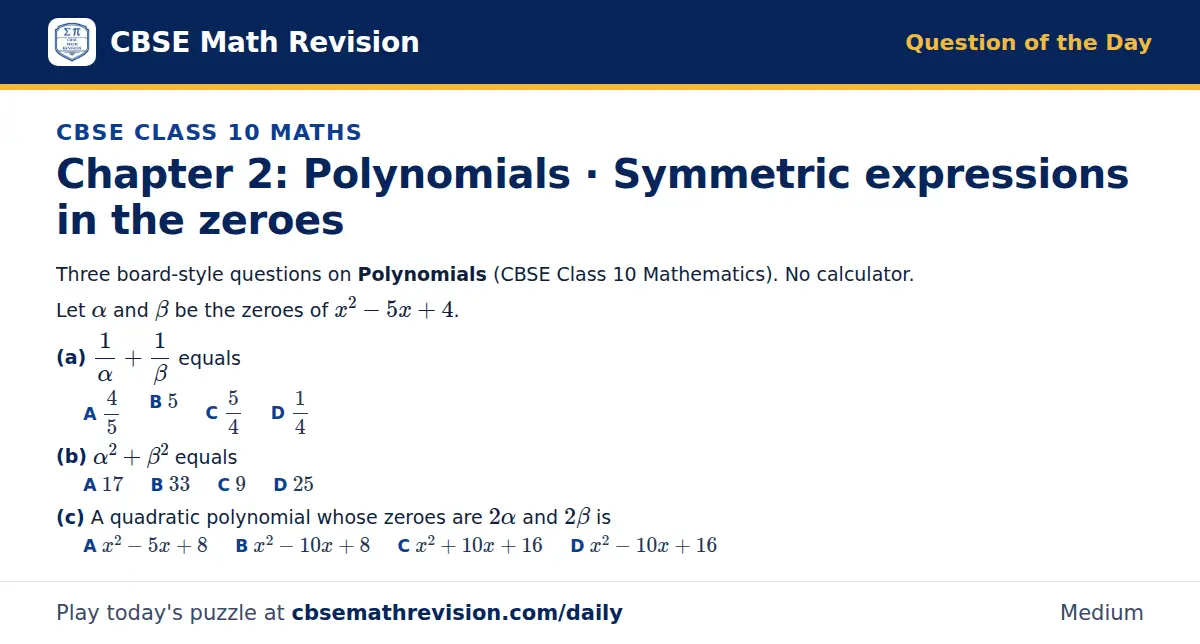
Chapter 2: Polynomials · Symmetric expressions in the zeroes
Three board-style questions on Polynomials (CBSE Class 10 Mathematics). No calculator. Let α and β be the zeroes of x² - 5x + 4.
- 1/(α) + 1/(β) equals Options: A) 4/5; B) 5; C) 5/4; D) 1/4
- α² + β² equals Options: A) 17; B) 33; C) 9; D) 25
- A quadratic polynomial whose zeroes are 2α and 2β is Options: A) x² - 5x + 8; B) x² - 10x + 8; C) x² + 10x + 16; D) x² - 10x + 16
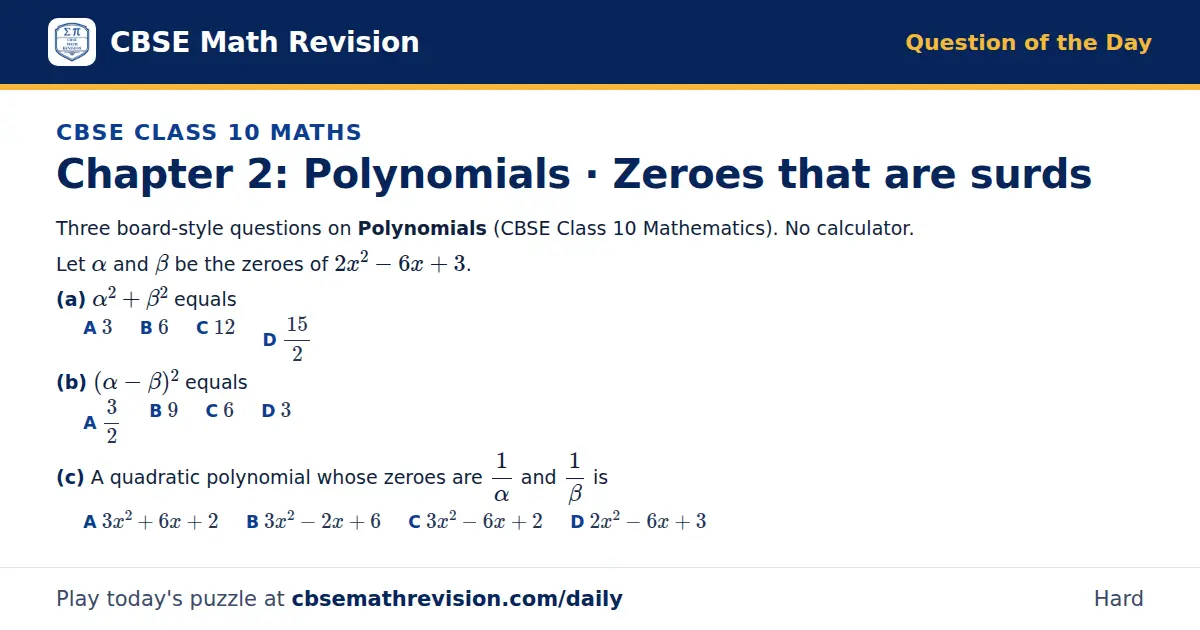
Chapter 2: Polynomials · Zeroes that are surds
Three board-style questions on Polynomials (CBSE Class 10 Mathematics). No calculator. Let α and β be the zeroes of 2x² - 6x + 3.
- α² + β² equals Options: A) 3; B) 6; C) 12; D) 15/2
- (α - β)² equals Options: A) 3/2; B) 9; C) 6; D) 3
- A quadratic polynomial whose zeroes are 1/(α) and 1/(β) is Options: A) 3x² + 6x + 2; B) 3x² - 2x + 6; C) 3x² - 6x + 2; D) 2x² - 6x + 3
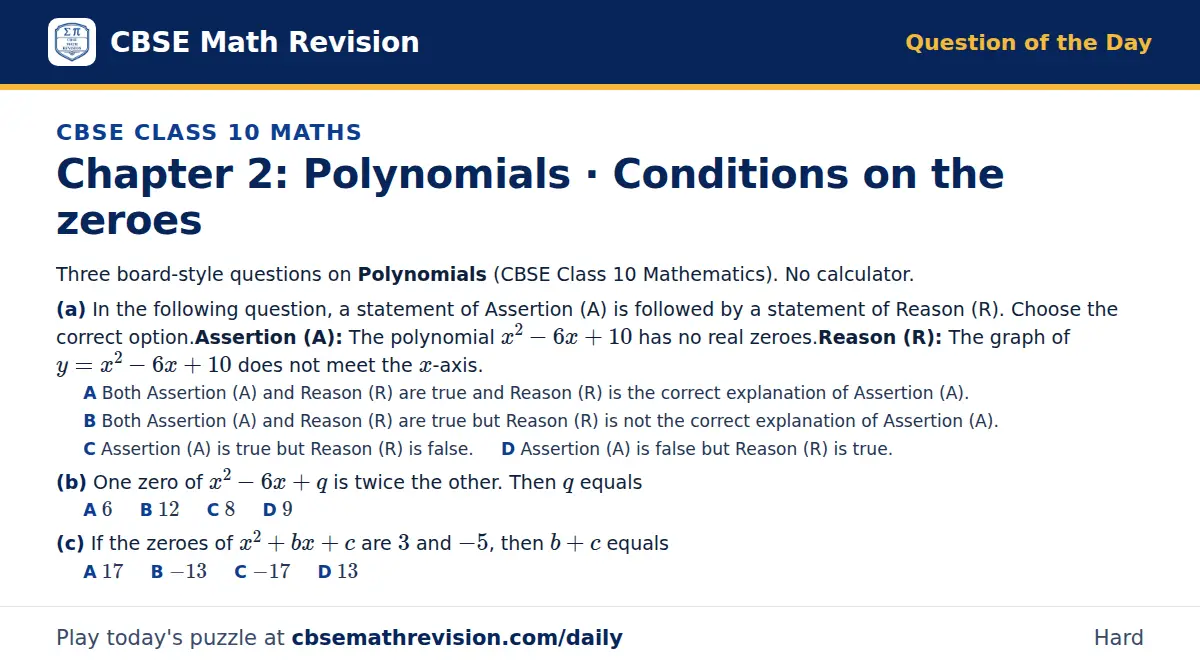
Chapter 2: Polynomials · Conditions on the zeroes
Three board-style questions on Polynomials (CBSE Class 10 Mathematics). No calculator.
- In the following question, a statement of Assertion (A) is followed by a statement of Reason (R). Choose the correct option. Assertion (A): The polynomial x² - 6x + 10 has no real zeroes. Reason (R): The graph of y = x² - 6x + 10 does not meet the x-axis. Options: A) Both Assertion (A) and Reason (R) are true and Reason (R) is the correct explanation of Assertion (A).; B) Both Assertion (A) and Reason (R) are true but Reason (R) is not the correct explanation of Assertion (A).; C) Assertion (A) is true but Reason (R) is false.; D) Assertion (A) is false but Reason (R) is true.
- One zero of x² - 6x + q is twice the other. Then q equals Options: A) 6; B) 12; C) 8; D) 9
- If the zeroes of x² + bx + c are 3 and -5, then b + c equals Options: A) 17; B) -13; C) -17; D) 13
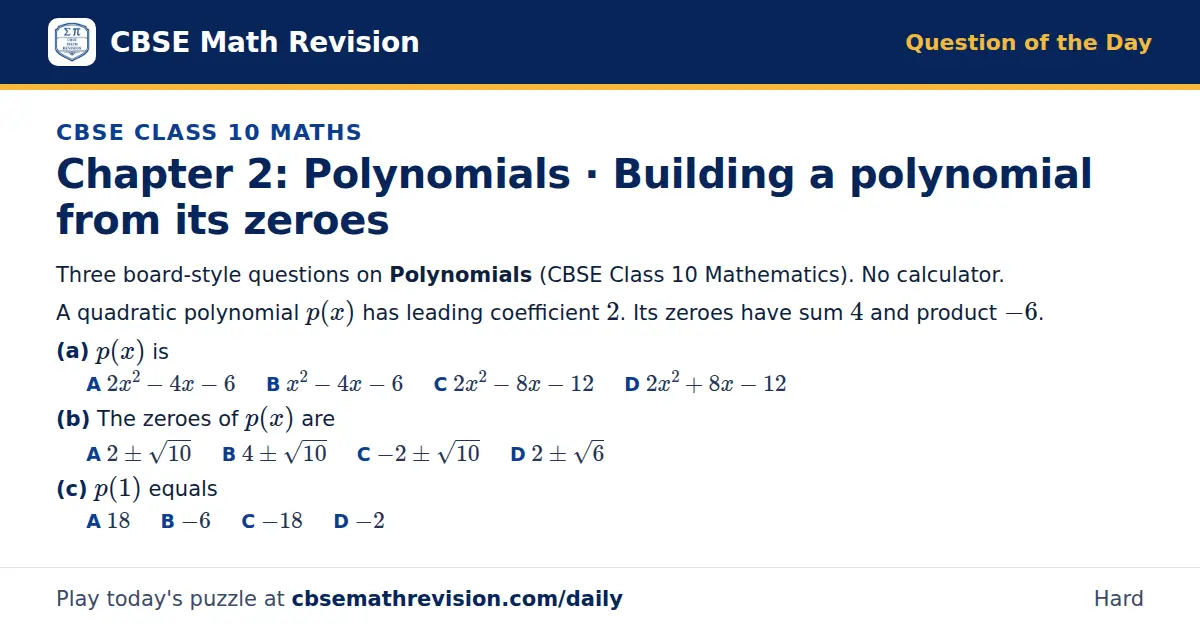
Chapter 2: Polynomials · Building a polynomial from its zeroes
Three board-style questions on Polynomials (CBSE Class 10 Mathematics). No calculator. A quadratic polynomial p(x) has leading coefficient 2. Its zeroes have sum 4 and product -6.
- p(x) is Options: A) 2x² - 4x - 6; B) x² - 4x - 6; C) 2x² - 8x - 12; D) 2x² + 8x - 12
- The zeroes of p(x) are Options: A) 2 ± √10; B) 4 ± √10; C) -2 ± √10; D) 2 ± √6
- p(1) equals Options: A) 18; B) -6; C) -18; D) -2
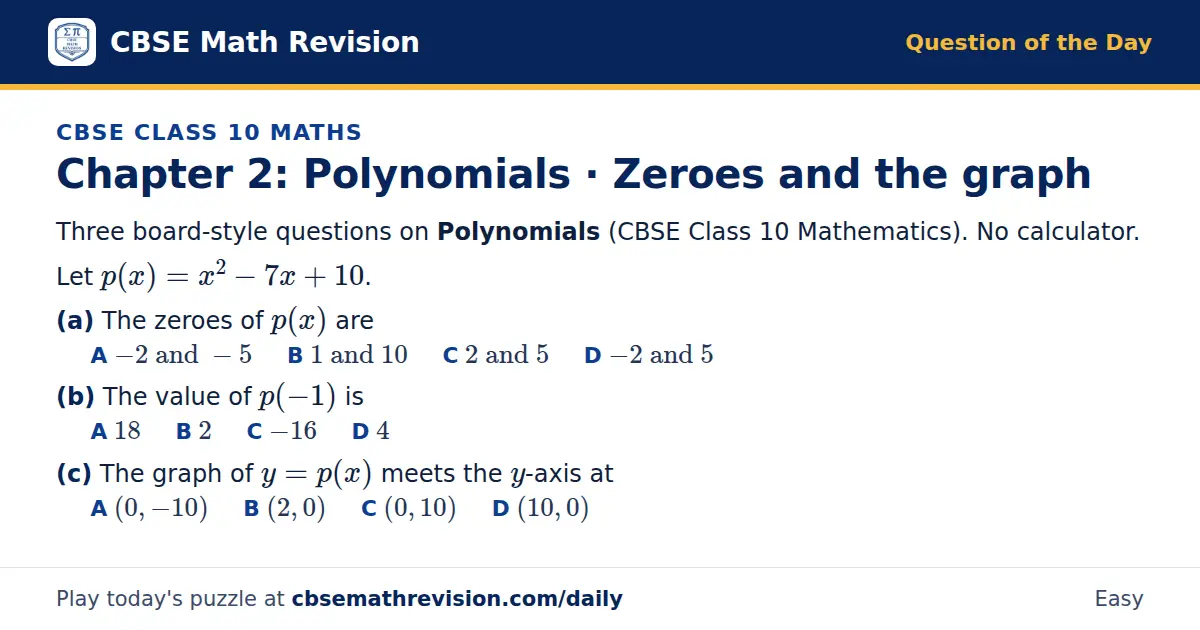
Chapter 2: Polynomials · Zeroes and the graph
Three board-style questions on Polynomials (CBSE Class 10 Mathematics). No calculator. Let p(x) = x² - 7x + 10.
- The zeroes of p(x) are Options: A) -2 and -5; B) 1 and 10; C) 2 and 5; D) -2 and 5
- The value of p(-1) is Options: A) 18; B) 2; C) -16; D) 4
- The graph of y = p(x) meets the y-axis at Options: A) (0, -10); B) (2, 0); C) (0, 10); D) (10, 0)
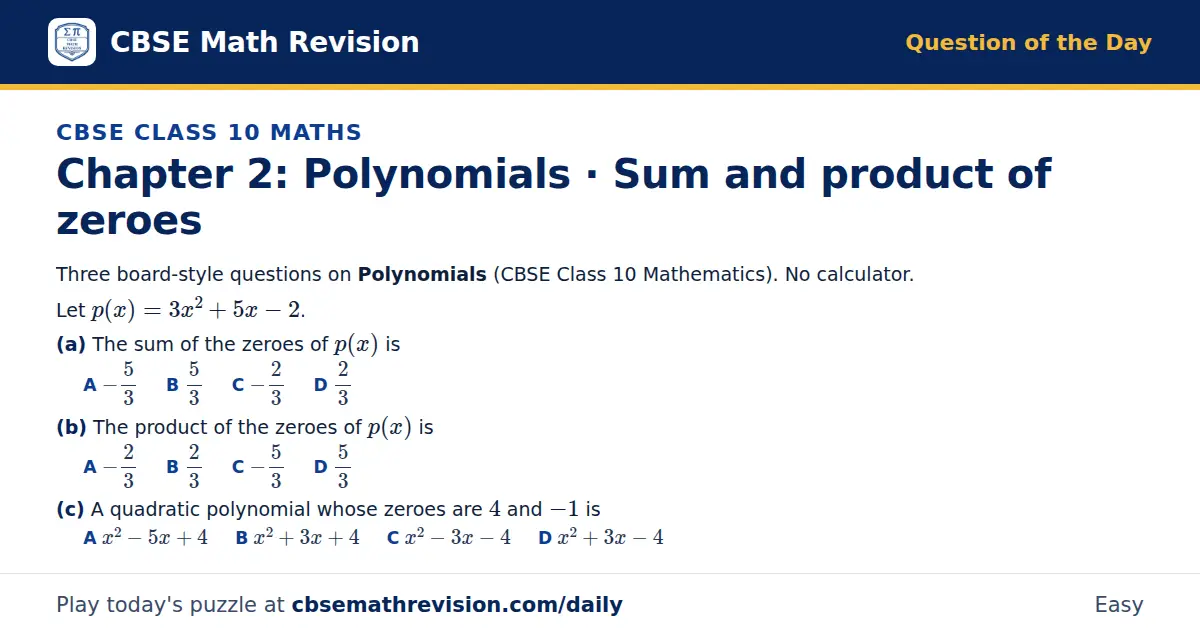
Chapter 2: Polynomials · Sum and product of zeroes
Three board-style questions on Polynomials (CBSE Class 10 Mathematics). No calculator. Let p(x) = 3x² + 5x - 2.
- The sum of the zeroes of p(x) is Options: A) - 5/3; B) 5/3; C) - 2/3; D) 2/3
- The product of the zeroes of p(x) is Options: A) - 2/3; B) 2/3; C) - 5/3; D) 5/3
- A quadratic polynomial whose zeroes are 4 and -1 is Options: A) x² - 5x + 4; B) x² + 3x + 4; C) x² - 3x - 4; D) x² + 3x - 4
Chapter 3: Pair of Linear Equations in Two Variables
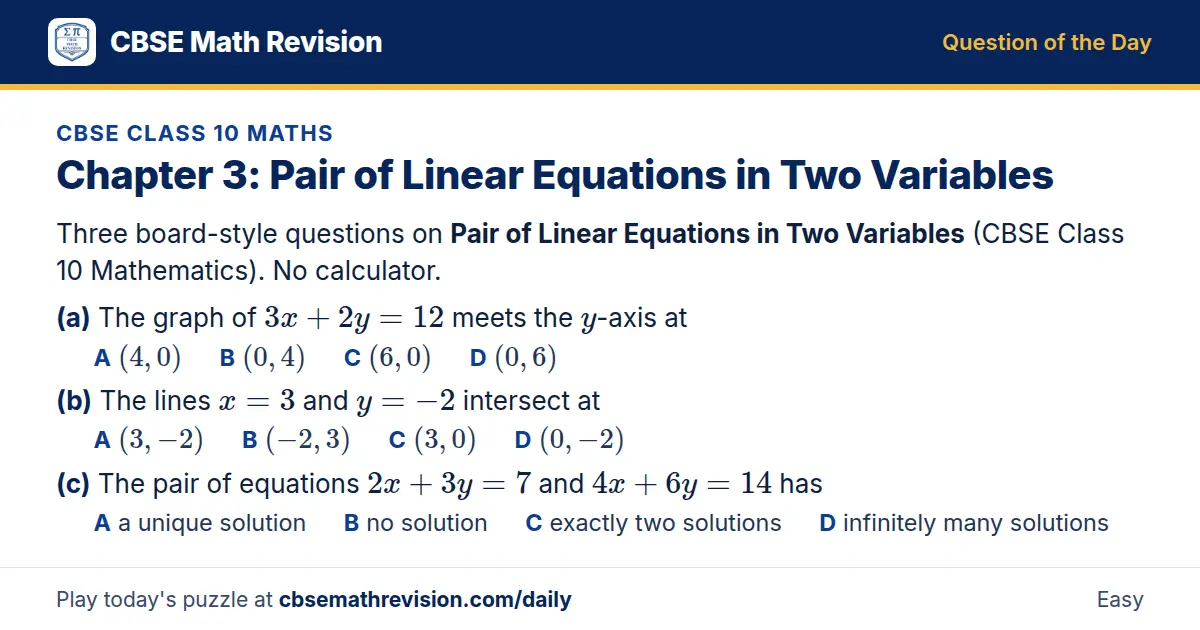
Chapter 3: Pair of Linear Equations in Two Variables
Three board-style questions on Pair of Linear Equations in Two Variables (CBSE Class 10 Mathematics). No calculator.
- The graph of 3x + 2y = 12 meets the y-axis at Options: A) (4, 0); B) (0, 4); C) (6, 0); D) (0, 6)
- The lines x = 3 and y = -2 intersect at Options: A) (3, -2); B) (-2, 3); C) (3, 0); D) (0, -2)
- The pair of equations 2x + 3y = 7 and 4x + 6y = 14 has Options: A) a unique solution; B) no solution; C) exactly two solutions; D) infinitely many solutions
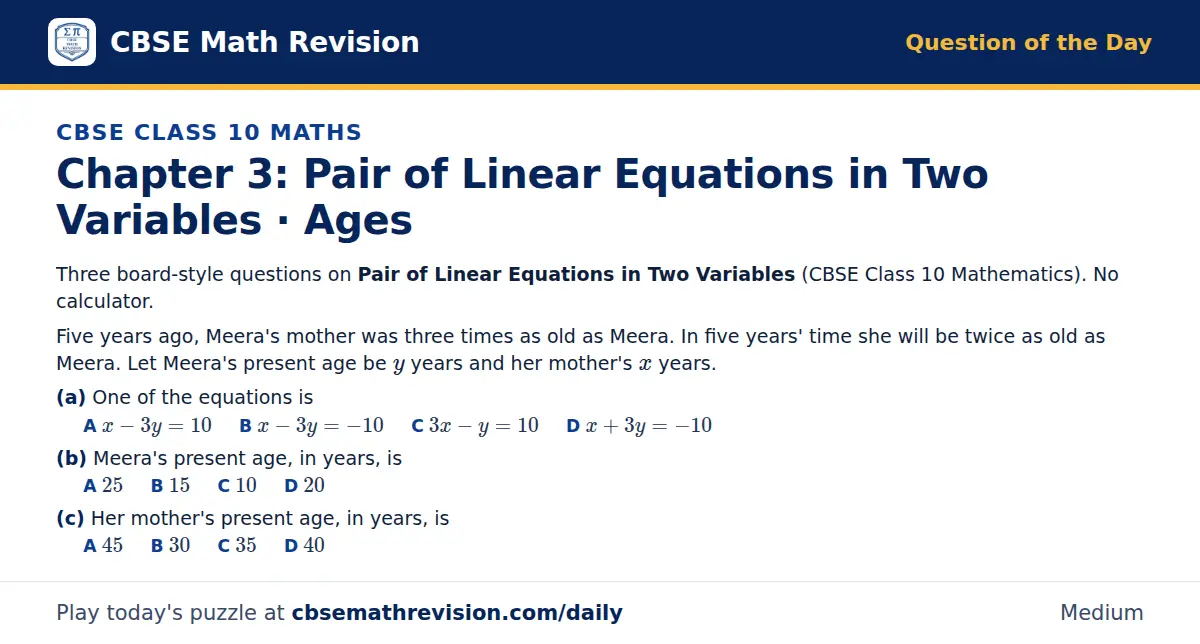
Chapter 3: Pair of Linear Equations in Two Variables · Ages
Three board-style questions on Pair of Linear Equations in Two Variables (CBSE Class 10 Mathematics). No calculator. Five years ago, Meera's mother was three times as old as Meera. In five years' time she will be twice as old as Meera. Let Meera's present age be y years and her mother's x years.
- One of the equations is Options: A) x - 3y = 10; B) x - 3y = -10; C) 3x - y = 10; D) x + 3y = -10
- Meera's present age, in years, is Options: A) 25; B) 15; C) 10; D) 20
- Her mother's present age, in years, is Options: A) 45; B) 30; C) 35; D) 40
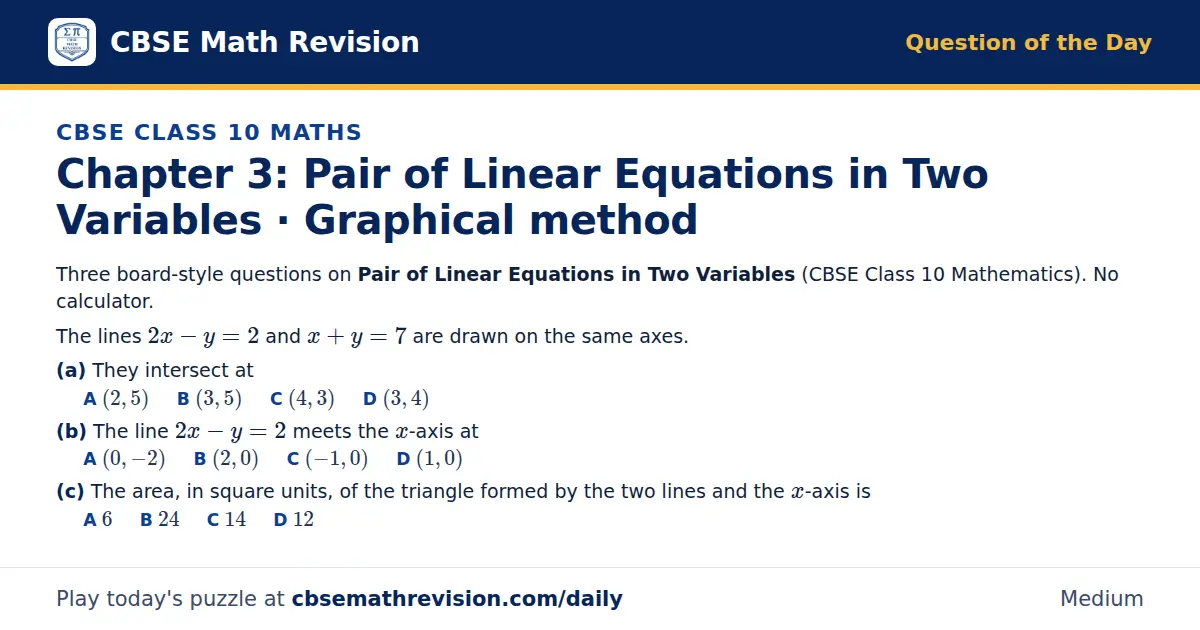
Chapter 3: Pair of Linear Equations in Two Variables · Graphical method
Three board-style questions on Pair of Linear Equations in Two Variables (CBSE Class 10 Mathematics). No calculator. The lines 2x - y = 2 and x + y = 7 are drawn on the same axes.
- They intersect at Options: A) (2, 5); B) (3, 5); C) (4, 3); D) (3, 4)
- The line 2x - y = 2 meets the x-axis at Options: A) (0, -2); B) (2, 0); C) (-1, 0); D) (1, 0)
- The area, in square units, of the triangle formed by the two lines and the x-axis is Options: A) 6; B) 24; C) 14; D) 12
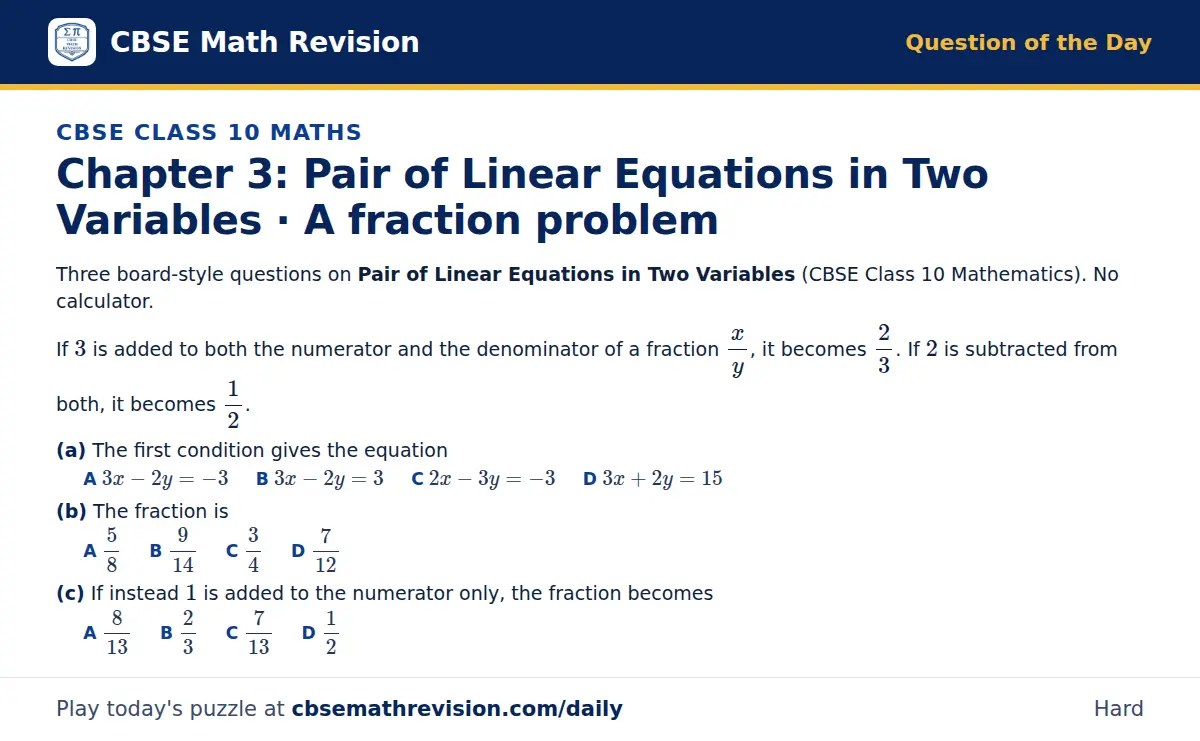
Chapter 3: Pair of Linear Equations in Two Variables · A fraction problem
Three board-style questions on Pair of Linear Equations in Two Variables (CBSE Class 10 Mathematics). No calculator. If 3 is added to both the numerator and the denominator of a fraction x/y, it becomes 23. If 2 is subtracted from both, it becomes 12.
- The first condition gives the equation Options: A) 3x - 2y = -3; B) 3x - 2y = 3; C) 2x - 3y = -3; D) 3x + 2y = 15
- The fraction is Options: A) 5/8; B) 9/14; C) 3/4; D) 7/12
- If instead 1 is added to the numerator only, the fraction becomes Options: A) 8/13; B) 2/3; C) 7/13; D) 1/2
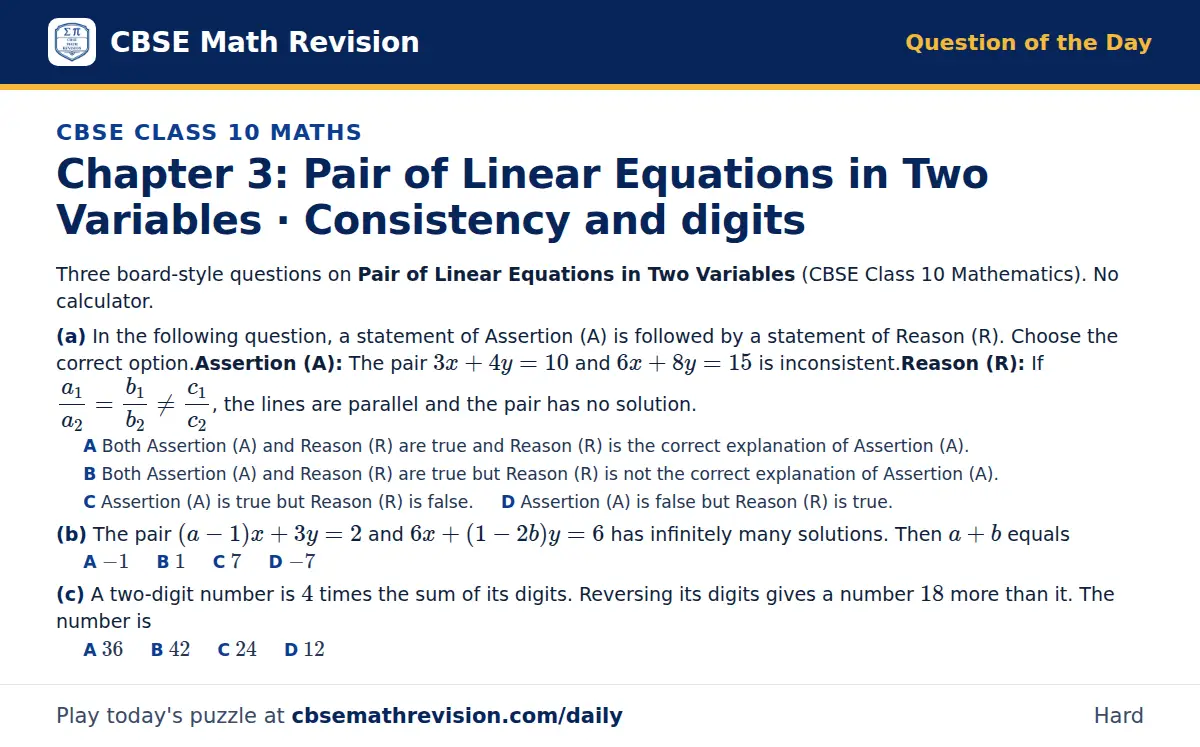
Chapter 3: Pair of Linear Equations in Two Variables · Consistency and digits
Three board-style questions on Pair of Linear Equations in Two Variables (CBSE Class 10 Mathematics). No calculator.
- In the following question, a statement of Assertion (A) is followed by a statement of Reason (R). Choose the correct option. Assertion (A): The pair 3x + 4y = 10 and 6x + 8y = 15 is inconsistent. Reason (R): If a_1/a_2 = b_1/b_2 ≠ c_1/c_2, the lines are parallel and the pair has no solution. Options: A) Both Assertion (A) and Reason (R) are true and Reason (R) is the correct explanation of Assertion (A).; B) Both Assertion (A) and Reason (R) are true but Reason (R) is not the correct explanation of Assertion (A).; C) Assertion (A) is true but Reason (R) is false.; D) Assertion (A) is false but Reason (R) is true.
- The pair (a - 1)x + 3y = 2 and 6x + (1 - 2b)y = 6 has infinitely many solutions. Then a + b equals Options: A) -1; B) 1; C) 7; D) -7
- A two-digit number is 4 times the sum of its digits. Reversing its digits gives a number 18 more than it. The number is Options: A) 36; B) 42; C) 24; D) 12
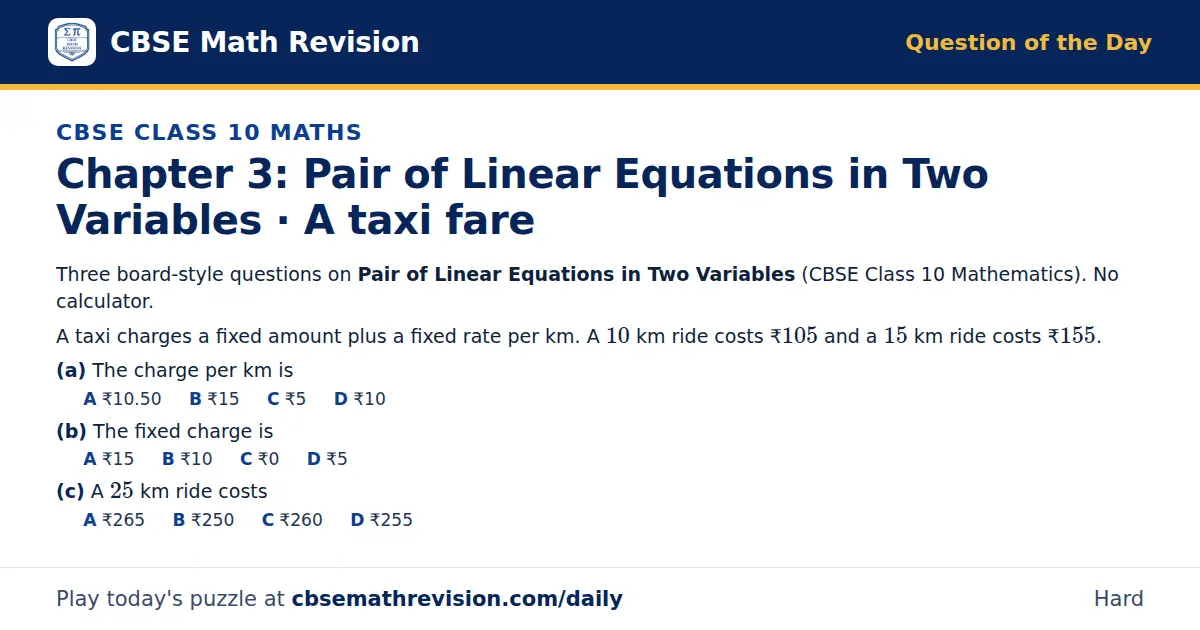
Chapter 3: Pair of Linear Equations in Two Variables · A taxi fare
Three board-style questions on Pair of Linear Equations in Two Variables (CBSE Class 10 Mathematics). No calculator. A taxi charges a fixed amount plus a fixed rate per km. A 10 km ride costs ₹105 and a 15 km ride costs ₹155.
- The charge per km is Options: A) ₹10.50; B) ₹15; C) ₹5; D) ₹10
- The fixed charge is Options: A) ₹15; B) ₹10; C) ₹0; D) ₹5
- A 25 km ride costs Options: A) ₹265; B) ₹250; C) ₹260; D) ₹255
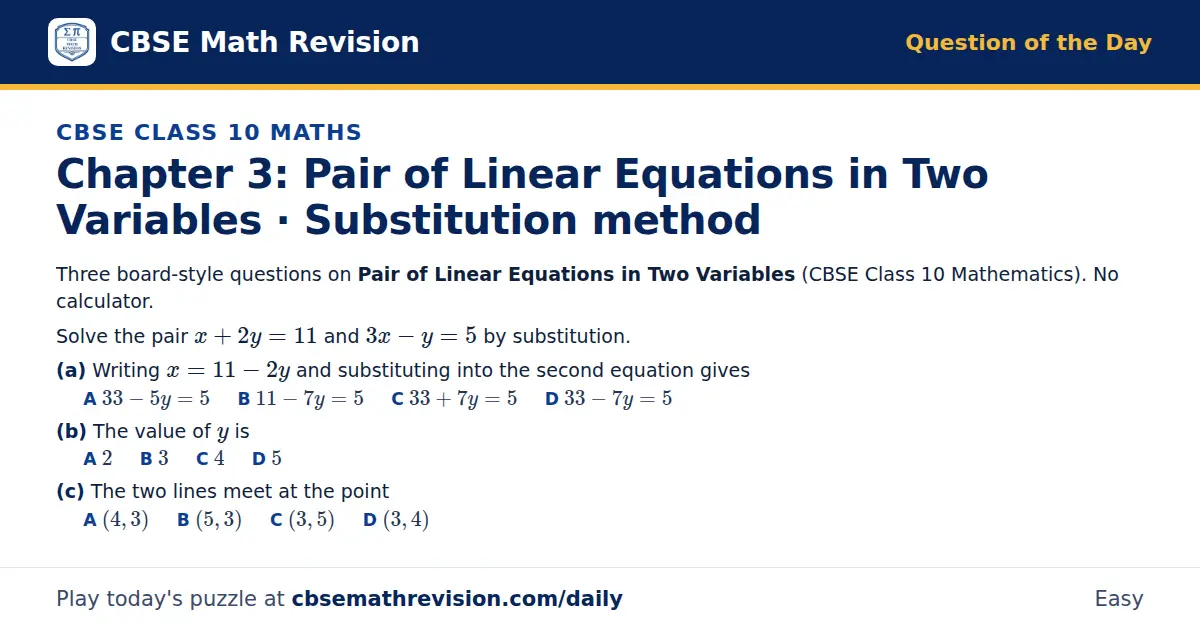
Chapter 3: Pair of Linear Equations in Two Variables · Substitution method
Three board-style questions on Pair of Linear Equations in Two Variables (CBSE Class 10 Mathematics). No calculator. Solve the pair x + 2y = 11 and 3x - y = 5 by substitution.
- Writing x = 11 - 2y and substituting into the second equation gives Options: A) 33 - 5y = 5; B) 11 - 7y = 5; C) 33 + 7y = 5; D) 33 - 7y = 5
- The value of y is Options: A) 2; B) 3; C) 4; D) 5
- The two lines meet at the point Options: A) (4, 3); B) (5, 3); C) (3, 5); D) (3, 4)
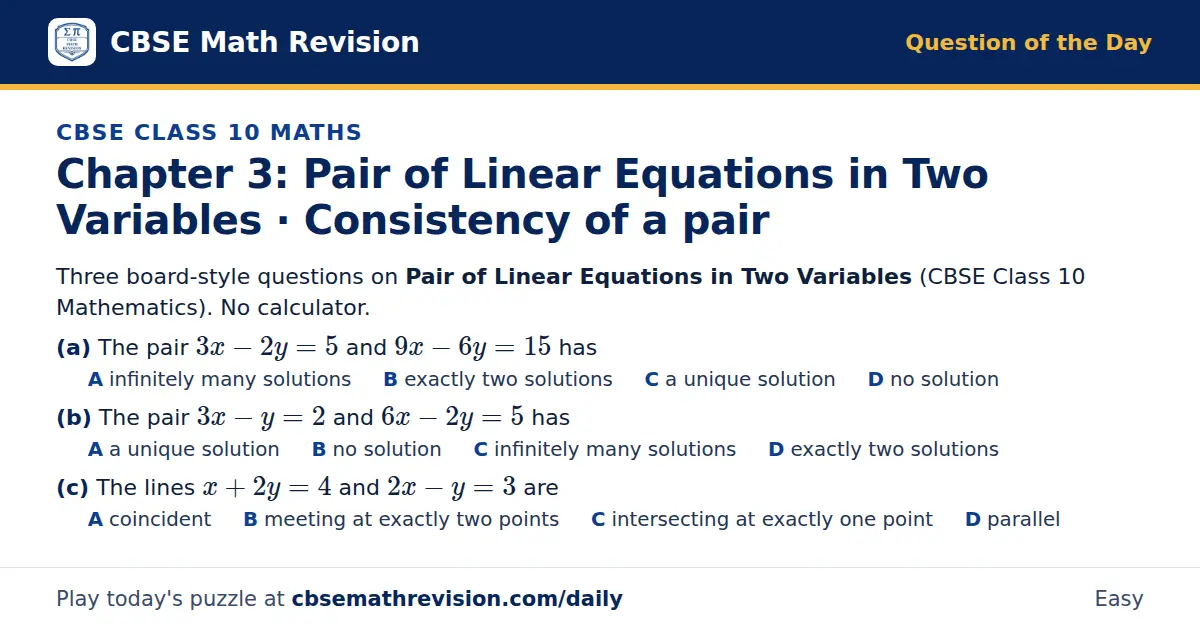
Chapter 3: Pair of Linear Equations in Two Variables · Consistency of a pair
Three board-style questions on Pair of Linear Equations in Two Variables (CBSE Class 10 Mathematics). No calculator.
- The pair 3x - 2y = 5 and 9x - 6y = 15 has Options: A) infinitely many solutions; B) exactly two solutions; C) a unique solution; D) no solution
- The pair 3x - y = 2 and 6x - 2y = 5 has Options: A) a unique solution; B) no solution; C) infinitely many solutions; D) exactly two solutions
- The lines x + 2y = 4 and 2x - y = 3 are Options: A) coincident; B) meeting at exactly two points; C) intersecting at exactly one point; D) parallel
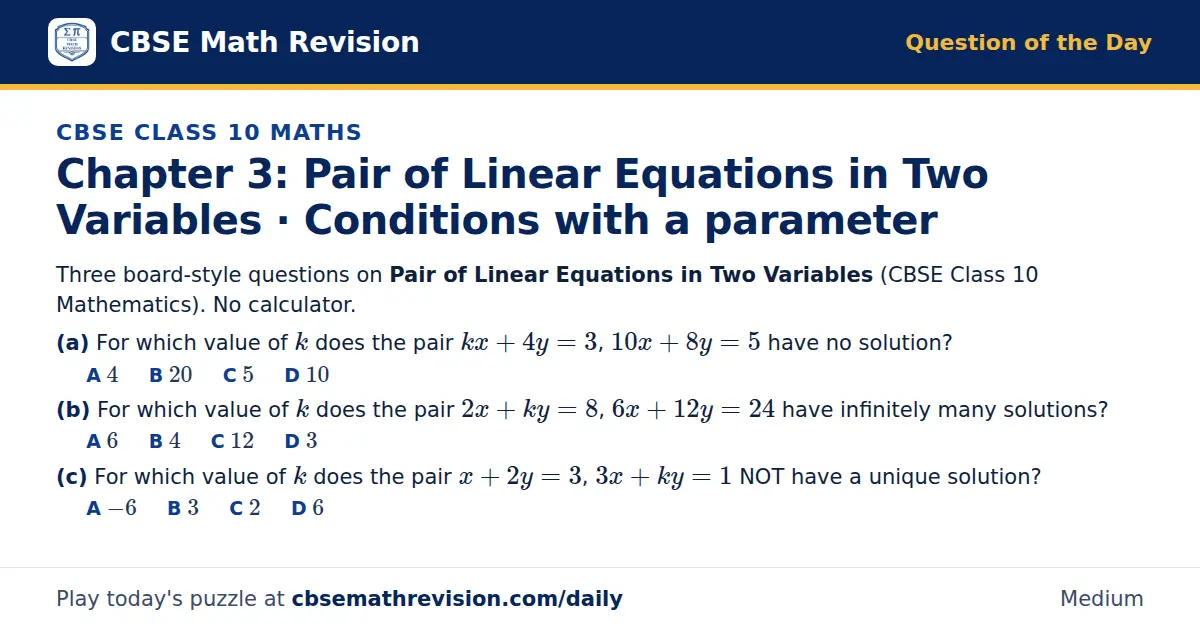
Chapter 3: Pair of Linear Equations in Two Variables · Conditions with a parameter
Three board-style questions on Pair of Linear Equations in Two Variables (CBSE Class 10 Mathematics). No calculator.
- For which value of k does the pair kx + 4y = 3, 10x + 8y = 5 have no solution? Options: A) 4; B) 20; C) 5; D) 10
- For which value of k does the pair 2x + ky = 8, 6x + 12y = 24 have infinitely many solutions? Options: A) 6; B) 4; C) 12; D) 3
- For which value of k does the pair x + 2y = 3, 3x + ky = 1 NOT have a unique solution? Options: A) -6; B) 3; C) 2; D) 6
Chapter 4: Quadratic Equations
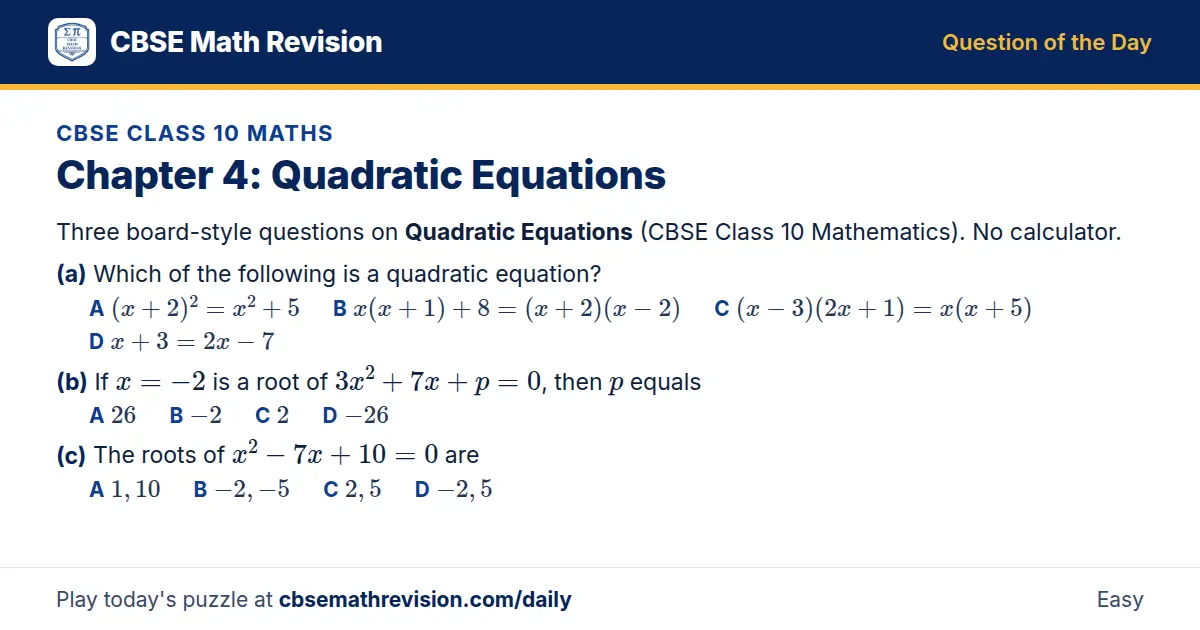
Chapter 4: Quadratic Equations
Three board-style questions on Quadratic Equations (CBSE Class 10 Mathematics). No calculator.
- Which of the following is a quadratic equation? Options: A) (x + 2)² = x² + 5; B) x(x + 1) + 8 = (x + 2)(x - 2); C) (x - 3)(2x + 1) = x(x + 5); D) x + 3 = 2x - 7
- If x = -2 is a root of 3x² + 7x + p = 0, then p equals Options: A) 26; B) -2; C) 2; D) -26
- The roots of x² - 7x + 10 = 0 are Options: A) 1, 10; B) -2, -5; C) 2, 5; D) -2, 5
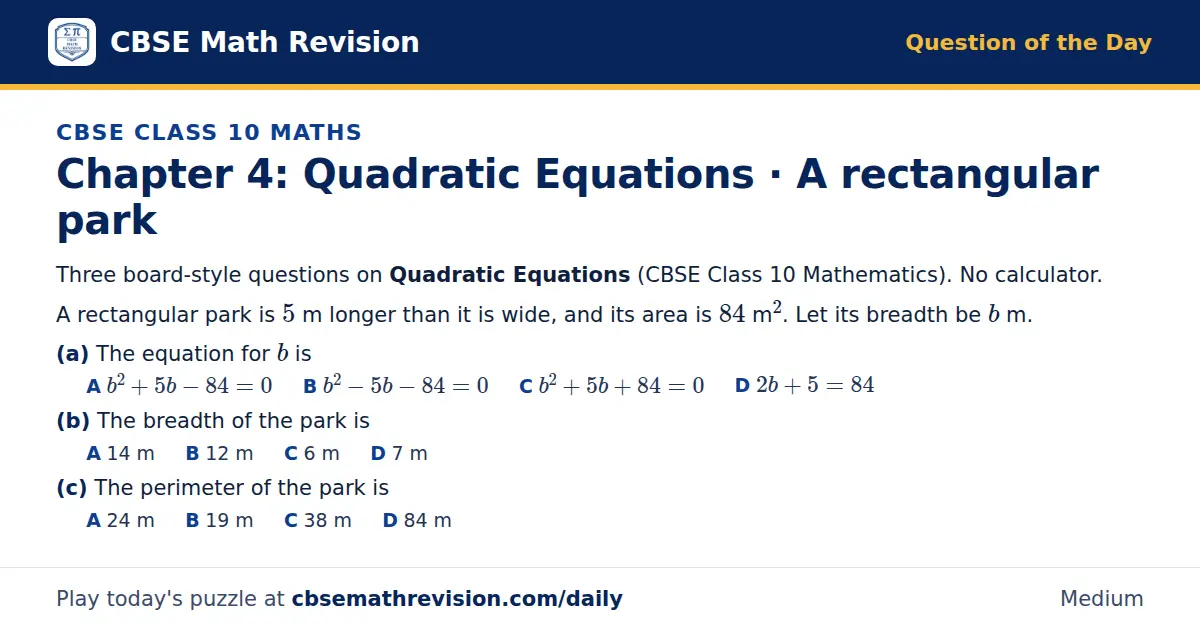
Chapter 4: Quadratic Equations · A rectangular park
Three board-style questions on Quadratic Equations (CBSE Class 10 Mathematics). No calculator. A rectangular park is 5 m longer than it is wide, and its area is 84 m^2. Let its breadth be b m.
- The equation for b is Options: A) b² + 5b - 84 = 0; B) b² - 5b - 84 = 0; C) b² + 5b + 84 = 0; D) 2b + 5 = 84
- The breadth of the park is Options: A) 14 m; B) 12 m; C) 6 m; D) 7 m
- The perimeter of the park is Options: A) 24 m; B) 19 m; C) 38 m; D) 84 m
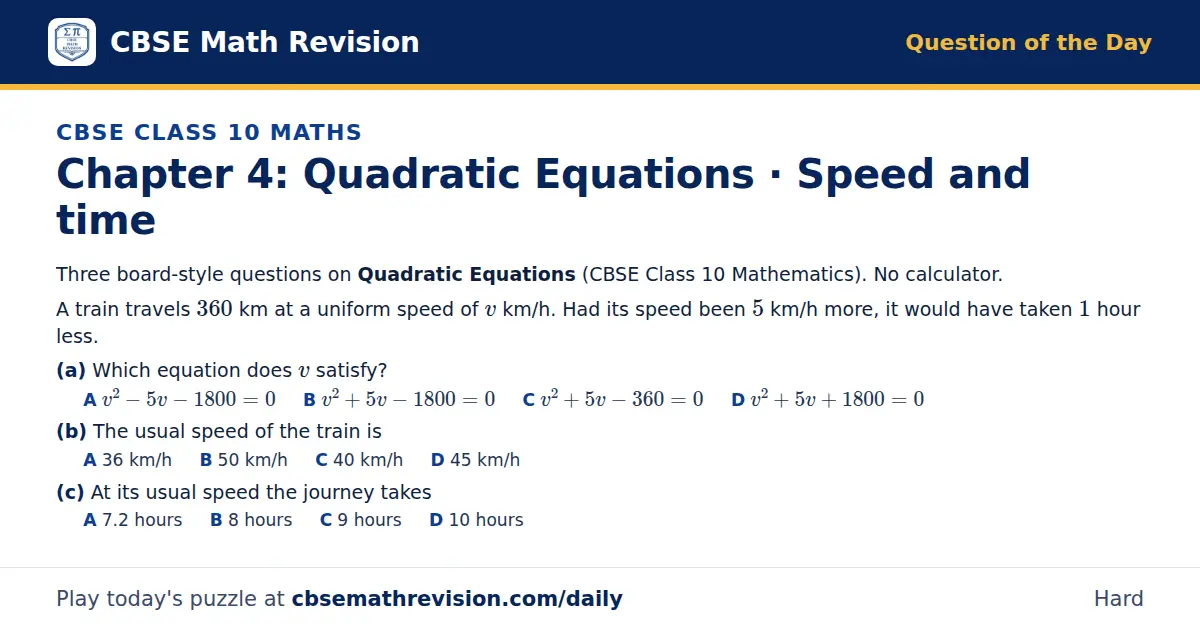
Chapter 4: Quadratic Equations · Speed and time
Three board-style questions on Quadratic Equations (CBSE Class 10 Mathematics). No calculator. A train travels 360 km at a uniform speed of v km/h. Had its speed been 5 km/h more, it would have taken 1 hour less.
- Which equation does v satisfy? Options: A) v² - 5v - 1800 = 0; B) v² + 5v - 1800 = 0; C) v² + 5v - 360 = 0; D) v² + 5v + 1800 = 0
- The usual speed of the train is Options: A) 36 km/h; B) 50 km/h; C) 40 km/h; D) 45 km/h
- At its usual speed the journey takes Options: A) 7.2 hours; B) 8 hours; C) 9 hours; D) 10 hours
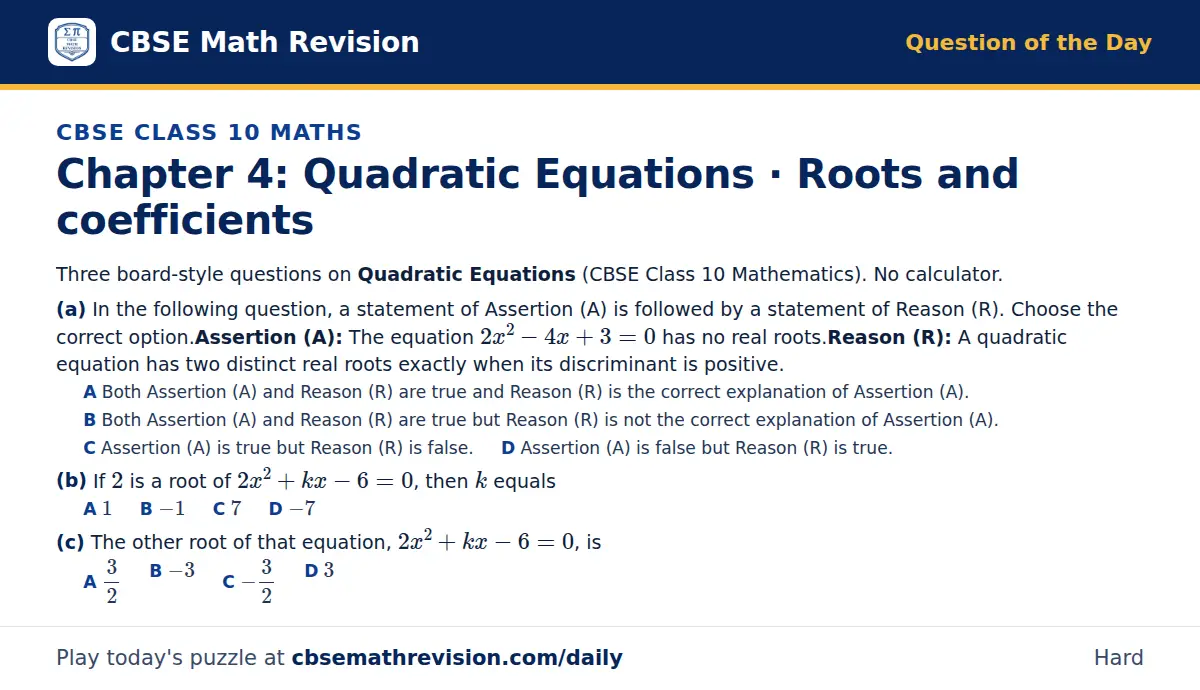
Chapter 4: Quadratic Equations · Roots and coefficients
Three board-style questions on Quadratic Equations (CBSE Class 10 Mathematics). No calculator.
- In the following question, a statement of Assertion (A) is followed by a statement of Reason (R). Choose the correct option. Assertion (A): The equation 2x² - 4x + 3 = 0 has no real roots. Reason (R): A quadratic equation has two distinct real roots exactly when its discriminant is positive. Options: A) Both Assertion (A) and Reason (R) are true and Reason (R) is the correct explanation of Assertion (A).; B) Both Assertion (A) and Reason (R) are true but Reason (R) is not the correct explanation of Assertion (A).; C) Assertion (A) is true but Reason (R) is false.; D) Assertion (A) is false but Reason (R) is true.
- If 2 is a root of 2x² + kx - 6 = 0, then k equals Options: A) 1; B) -1; C) 7; D) -7
- The other root of that equation, 2x² + kx - 6 = 0, is Options: A) 3/2; B) -3; C) - 3/2; D) 3
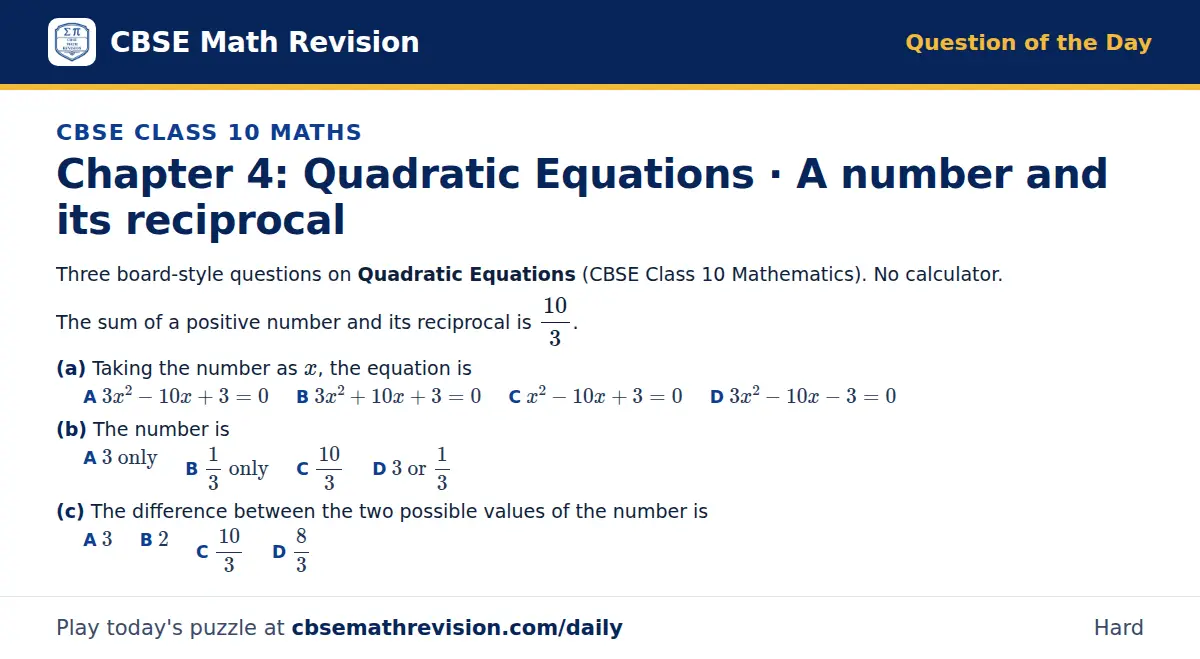
Chapter 4: Quadratic Equations · A number and its reciprocal
Three board-style questions on Quadratic Equations (CBSE Class 10 Mathematics). No calculator. The sum of a positive number and its reciprocal is 10/3.
- Taking the number as x, the equation is Options: A) 3x² - 10x + 3 = 0; B) 3x² + 10x + 3 = 0; C) x² - 10x + 3 = 0; D) 3x² - 10x - 3 = 0
- The number is Options: A) 3 only; B) 13 only; C) 10/3; D) 3 or 13
- The difference between the two possible values of the number is Options: A) 3; B) 2; C) 10/3; D) 8/3
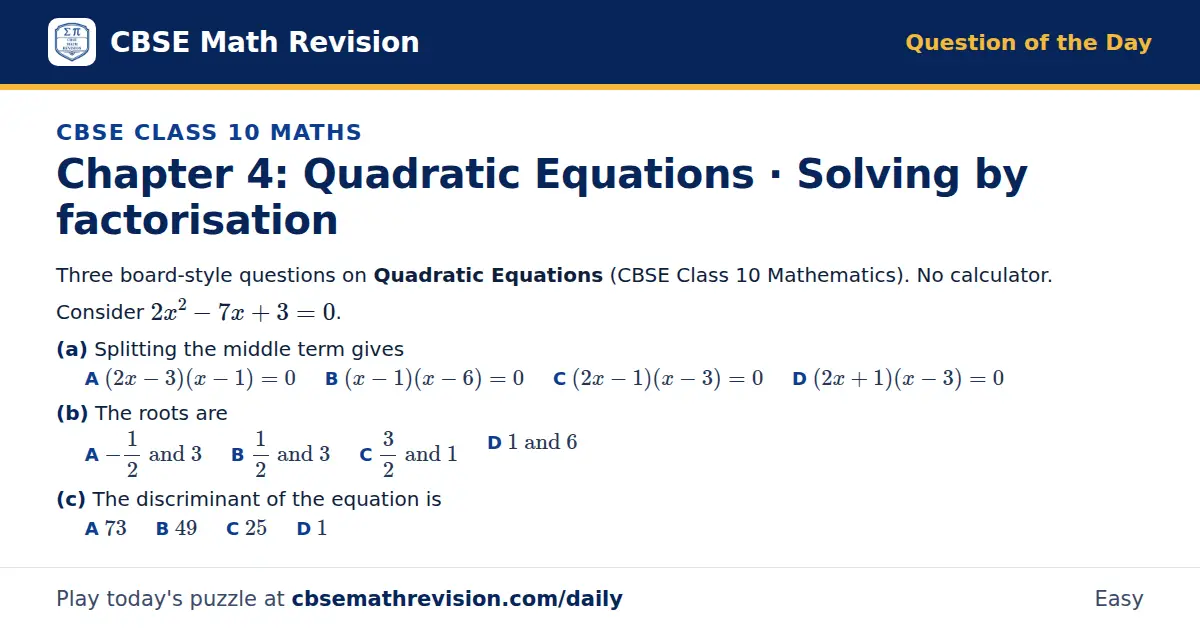
Chapter 4: Quadratic Equations · Solving by factorisation
Three board-style questions on Quadratic Equations (CBSE Class 10 Mathematics). No calculator. Consider 2x² - 7x + 3 = 0.
- Splitting the middle term gives Options: A) (2x - 3)(x - 1) = 0; B) (x - 1)(x - 6) = 0; C) (2x - 1)(x - 3) = 0; D) (2x + 1)(x - 3) = 0
- The roots are Options: A) -12 and 3; B) 12 and 3; C) 32 and 1; D) 1 and 6
- The discriminant of the equation is Options: A) 73; B) 49; C) 25; D) 1
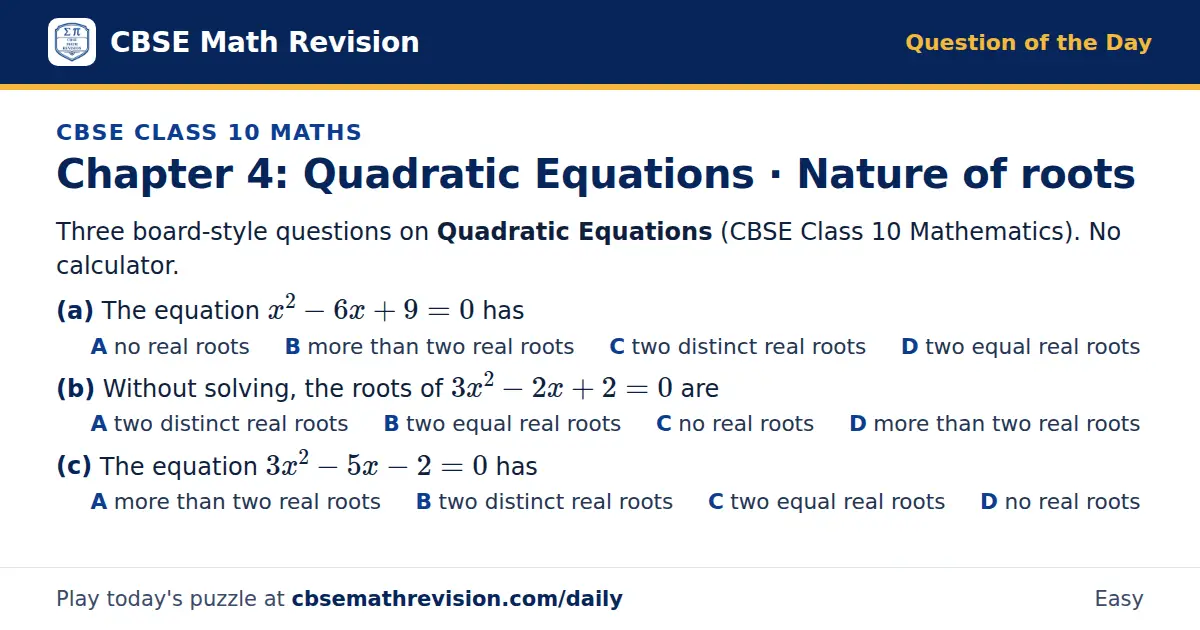
Chapter 4: Quadratic Equations · Nature of roots
Three board-style questions on Quadratic Equations (CBSE Class 10 Mathematics). No calculator.
- The equation x² - 6x + 9 = 0 has Options: A) no real roots; B) more than two real roots; C) two distinct real roots; D) two equal real roots
- Without solving, the roots of 3x² - 2x + 2 = 0 are Options: A) two distinct real roots; B) two equal real roots; C) no real roots; D) more than two real roots
- The equation 3x² - 5x - 2 = 0 has Options: A) more than two real roots; B) two distinct real roots; C) two equal real roots; D) no real roots
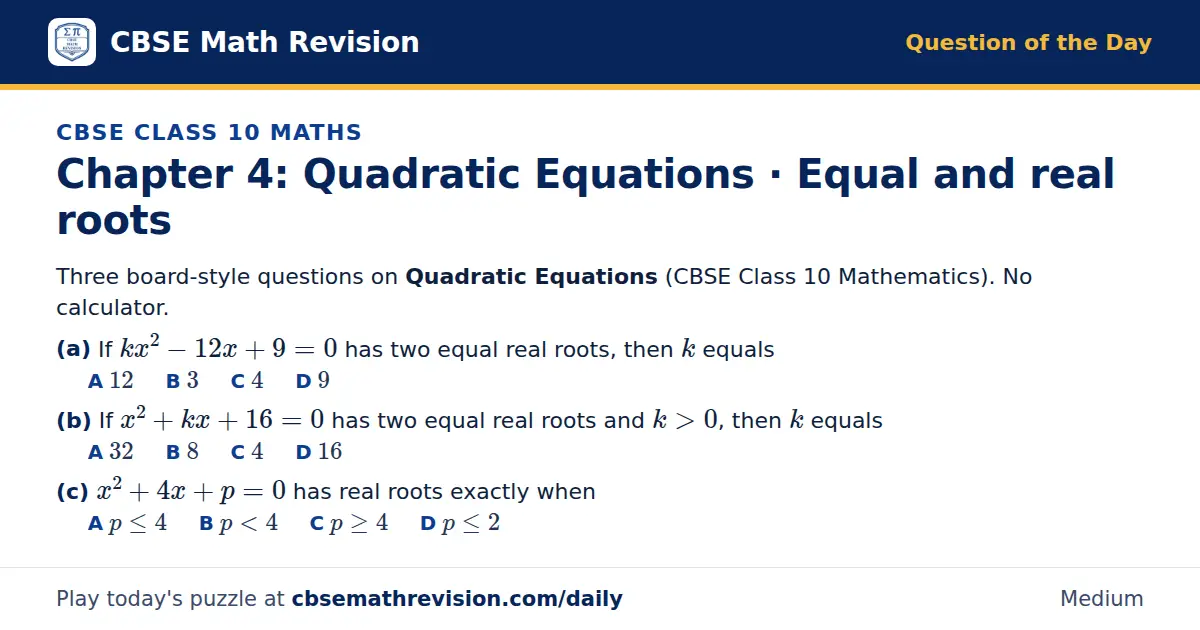
Chapter 4: Quadratic Equations · Equal and real roots
Three board-style questions on Quadratic Equations (CBSE Class 10 Mathematics). No calculator.
- If kx² - 12x + 9 = 0 has two equal real roots, then k equals Options: A) 12; B) 3; C) 4; D) 9
- If x² + kx + 16 = 0 has two equal real roots and k > 0, then k equals Options: A) 32; B) 8; C) 4; D) 16
- x² + 4x + p = 0 has real roots exactly when Options: A) p ≤ 4; B) p < 4; C) p ≥ 4; D) p ≤ 2
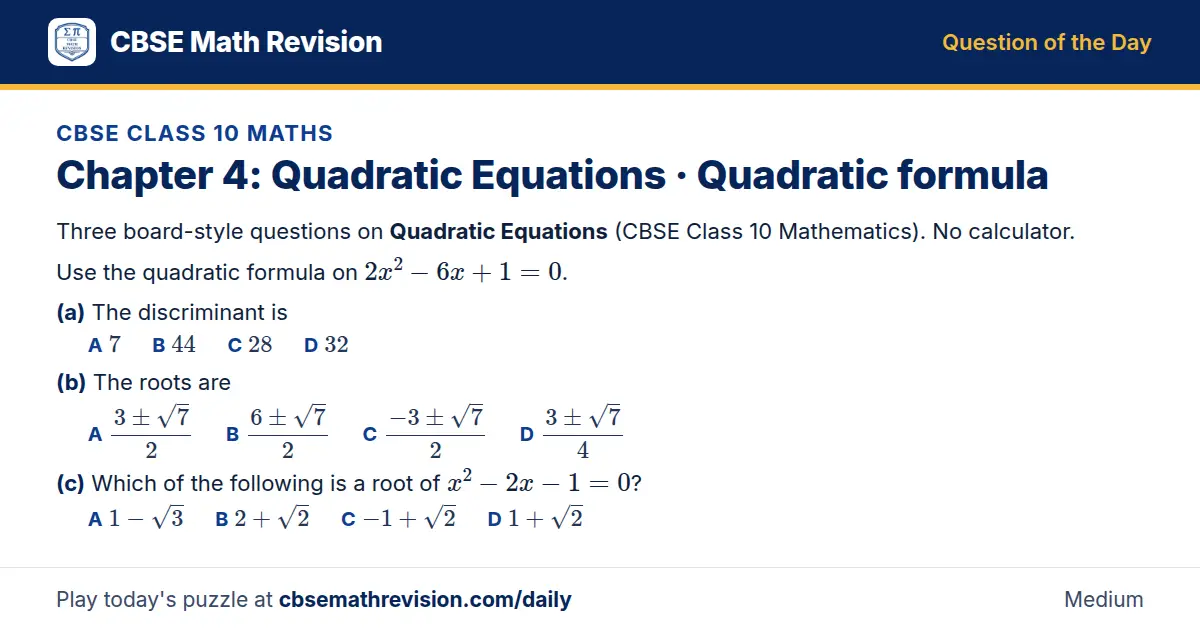
Chapter 4: Quadratic Equations · Quadratic formula
Three board-style questions on Quadratic Equations (CBSE Class 10 Mathematics). No calculator. Use the quadratic formula on 2x² - 6x + 1 = 0.
- The discriminant is Options: A) 7; B) 44; C) 28; D) 32
- The roots are Options: A) (3 ± √7)/2; B) (6 ± √7)/2; C) (-3 ± √7)/2; D) (3 ± √7)/4
- Which of the following is a root of x² - 2x - 1 = 0? Options: A) 1 - √3; B) 2 + √2; C) -1 + √2; D) 1 + √2
More Question of the Day puzzles
Other chapters: Chapters 1–4 · Chapters 5–8 · Chapters 9–11 · Chapters 12–14. See all CBSE Maths daily and weekly questions.