CBSE Class 10 Maths Question of the Day: chapters 5–8
36 CBSE Class 10 Mathematics puzzles from the Question of the Day rotation, chapters 5–8. Each puzzle is three board-style questions on one chapter, shown as an image with the question text written out below it; the answers, hints and step-marked solutions are on the daily puzzle page.
- Play today's CBSE Class 10 Maths puzzle
- ← Chapters 1–4
- Chapters 9–11 →
- All CBSE Class 10 Maths puzzles by chapter
Chapter 5: Arithmetic Progressions
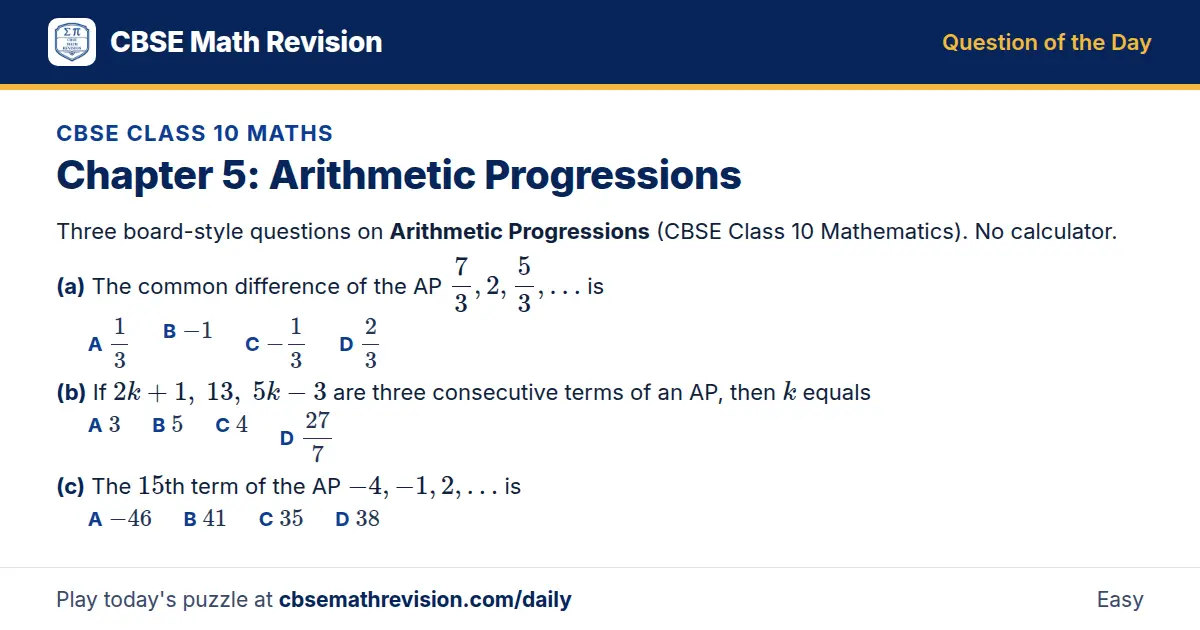
Chapter 5: Arithmetic Progressions
Three board-style questions on Arithmetic Progressions (CBSE Class 10 Mathematics). No calculator.
- The common difference of the AP 73, 2, 53, … is Options: A) 13; B) -1; C) -13; D) 23
- If 2k + 1, 13, 5k - 3 are three consecutive terms of an AP, then k equals Options: A) 3; B) 5; C) 4; D) 27/7
- The 15th term of the AP -4, -1, 2, … is Options: A) -46; B) 41; C) 35; D) 38
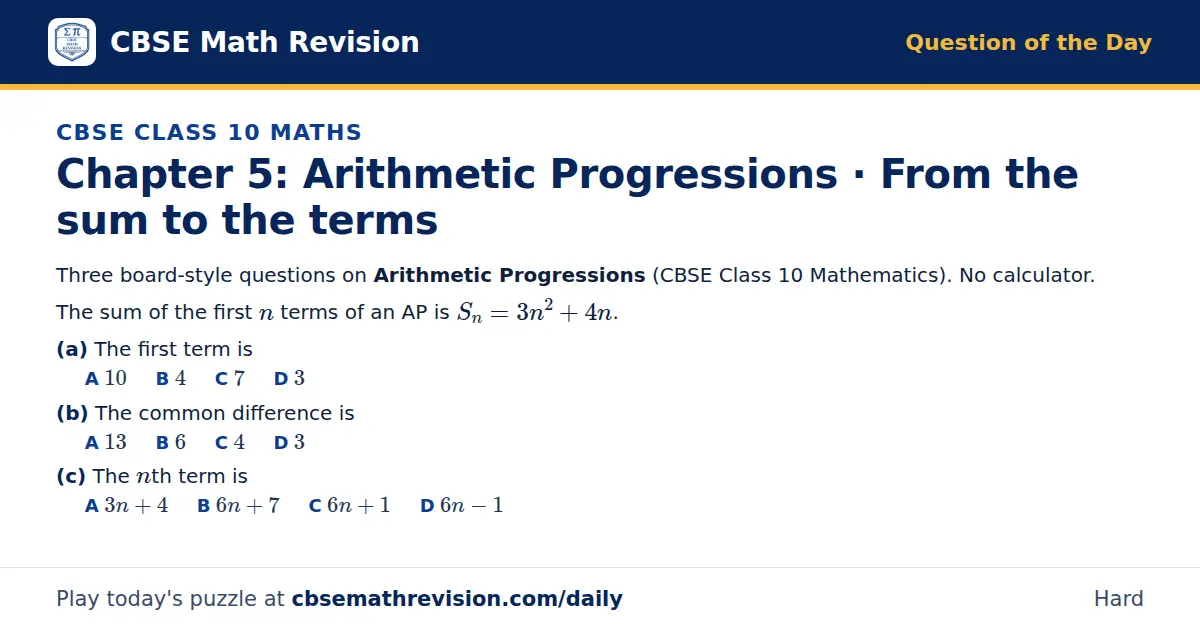
Chapter 5: Arithmetic Progressions · From the sum to the terms
Three board-style questions on Arithmetic Progressions (CBSE Class 10 Mathematics). No calculator. The sum of the first n terms of an AP is S_n = 3n² + 4n.
- The first term is Options: A) 10; B) 4; C) 7; D) 3
- The common difference is Options: A) 13; B) 6; C) 4; D) 3
- The nth term is Options: A) 3n + 4; B) 6n + 7; C) 6n + 1; D) 6n - 1
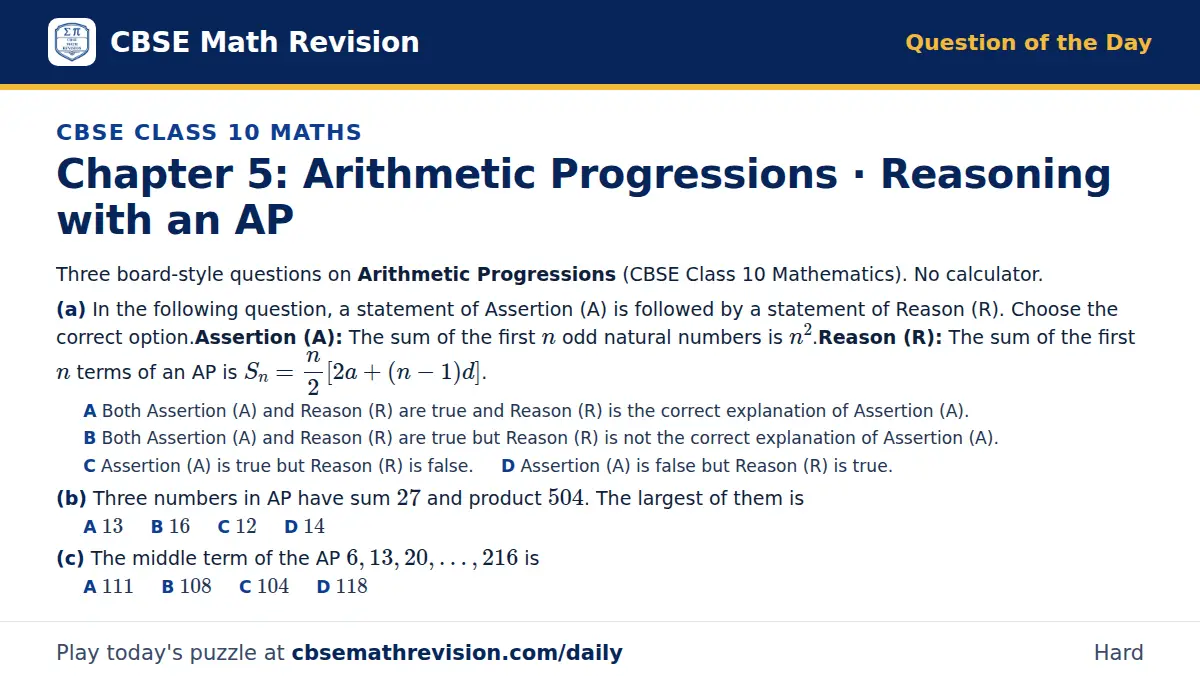
Chapter 5: Arithmetic Progressions · Reasoning with an AP
Three board-style questions on Arithmetic Progressions (CBSE Class 10 Mathematics). No calculator.
- In the following question, a statement of Assertion (A) is followed by a statement of Reason (R). Choose the correct option. Assertion (A): The sum of the first n odd natural numbers is n^2. Reason (R): The sum of the first n terms of an AP is S_n = n/2[2a + (n - 1)d]. Options: A) Both Assertion (A) and Reason (R) are true and Reason (R) is the correct explanation of Assertion (A).; B) Both Assertion (A) and Reason (R) are true but Reason (R) is not the correct explanation of Assertion (A).; C) Assertion (A) is true but Reason (R) is false.; D) Assertion (A) is false but Reason (R) is true.
- Three numbers in AP have sum 27 and product 504. The largest of them is Options: A) 13; B) 16; C) 12; D) 14
- The middle term of the AP 6, 13, 20, …, 216 is Options: A) 111; B) 108; C) 104; D) 118
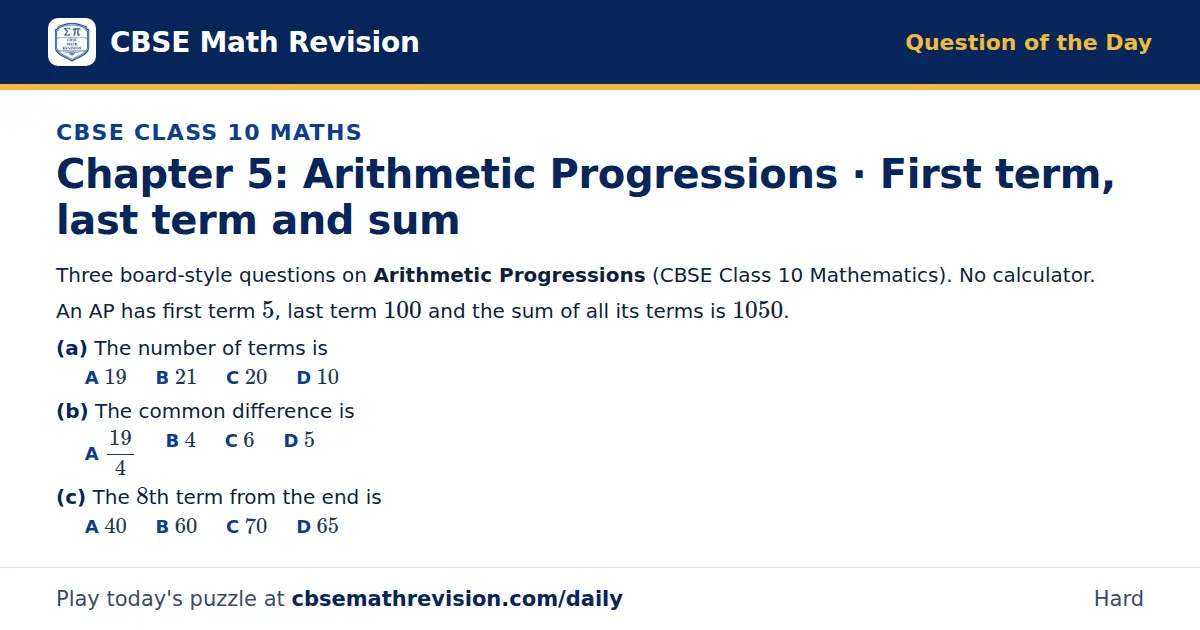
Chapter 5: Arithmetic Progressions · First term, last term and sum
Three board-style questions on Arithmetic Progressions (CBSE Class 10 Mathematics). No calculator. An AP has first term 5, last term 100 and the sum of all its terms is 1050.
- The number of terms is Options: A) 19; B) 21; C) 20; D) 10
- The common difference is Options: A) 19/4; B) 4; C) 6; D) 5
- The 8th term from the end is Options: A) 40; B) 60; C) 70; D) 65
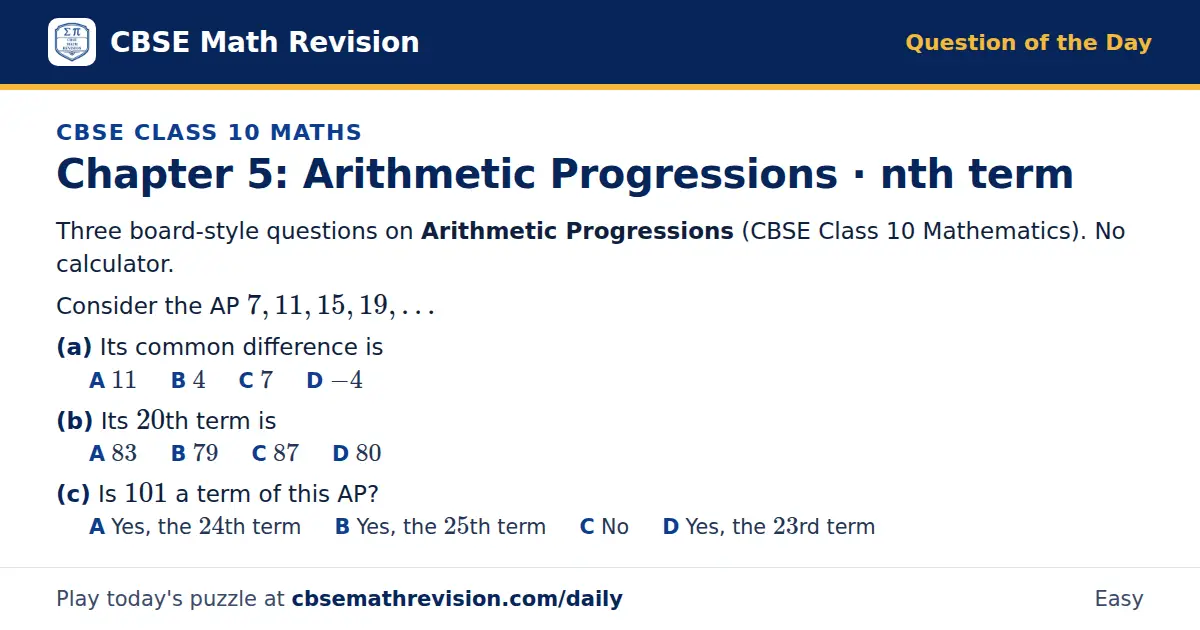
Chapter 5: Arithmetic Progressions · nth term
Three board-style questions on Arithmetic Progressions (CBSE Class 10 Mathematics). No calculator. Consider the AP 7, 11, 15, 19, …
- Its common difference is Options: A) 11; B) 4; C) 7; D) -4
- Its 20th term is Options: A) 83; B) 79; C) 87; D) 80
- Is 101 a term of this AP? Options: A) Yes, the 24th term; B) Yes, the 25th term; C) No; D) Yes, the 23rd term
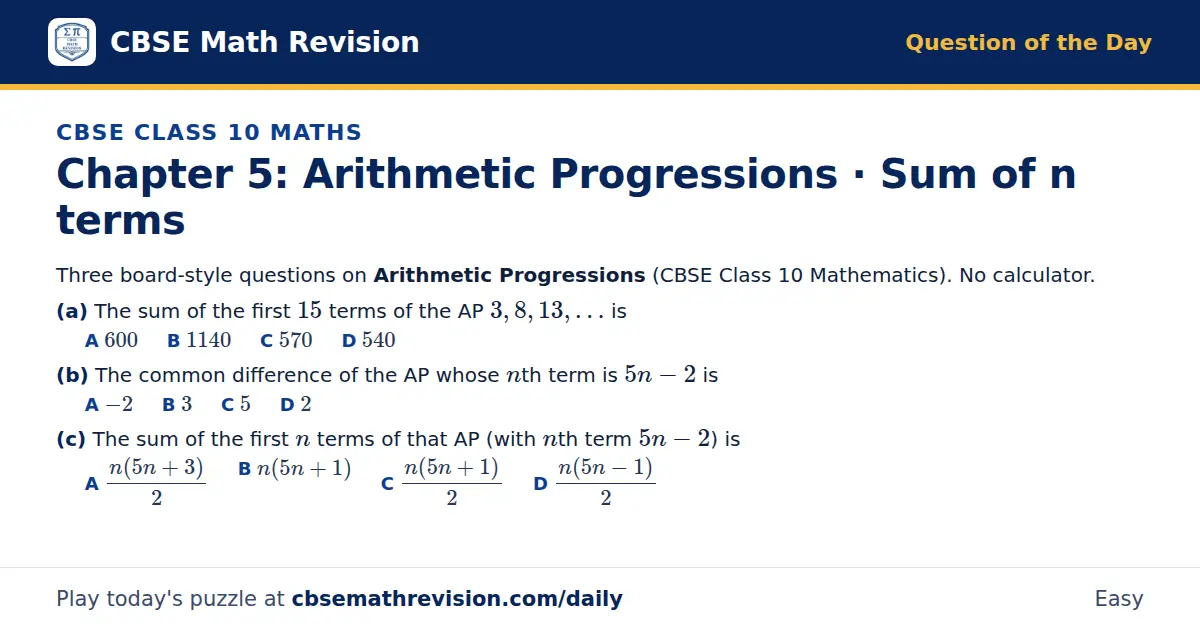
Chapter 5: Arithmetic Progressions · Sum of n terms
Three board-style questions on Arithmetic Progressions (CBSE Class 10 Mathematics). No calculator.
- The sum of the first 15 terms of the AP 3, 8, 13, … is Options: A) 600; B) 1140; C) 570; D) 540
- The common difference of the AP whose nth term is 5n - 2 is Options: A) -2; B) 3; C) 5; D) 2
- The sum of the first n terms of that AP (with nth term 5n - 2) is Options: A) (n(5n + 3))/2; B) n(5n + 1); C) (n(5n + 1))/2; D) (n(5n - 1))/2
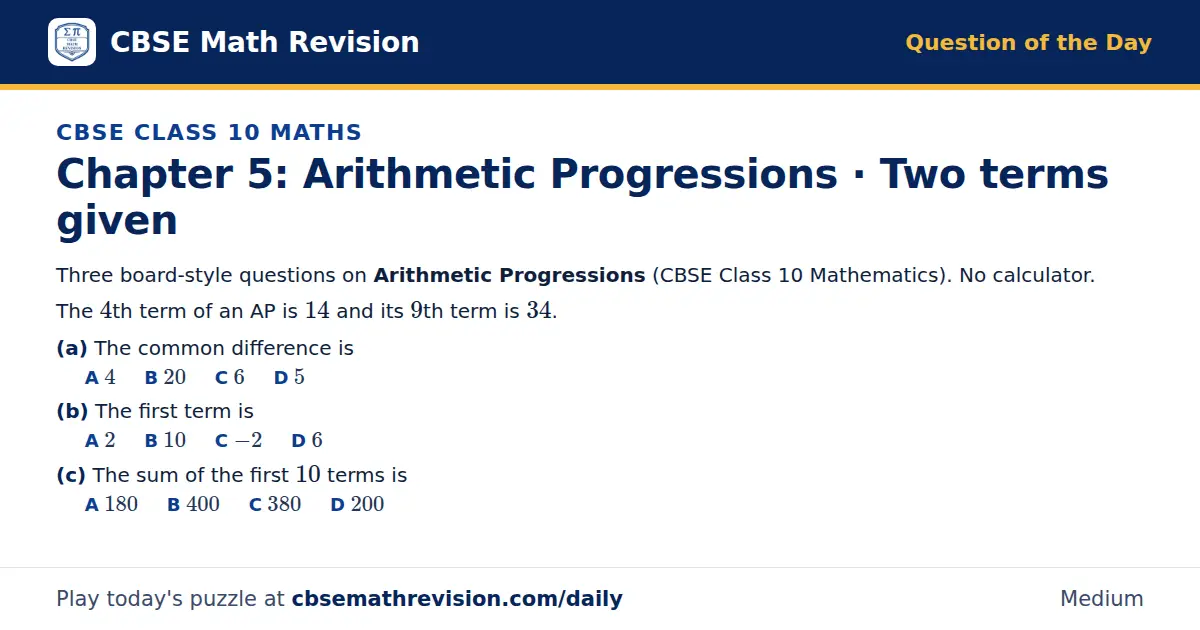
Chapter 5: Arithmetic Progressions · Two terms given
Three board-style questions on Arithmetic Progressions (CBSE Class 10 Mathematics). No calculator. The 4th term of an AP is 14 and its 9th term is 34.
- The common difference is Options: A) 4; B) 20; C) 6; D) 5
- The first term is Options: A) 2; B) 10; C) -2; D) 6
- The sum of the first 10 terms is Options: A) 180; B) 400; C) 380; D) 200
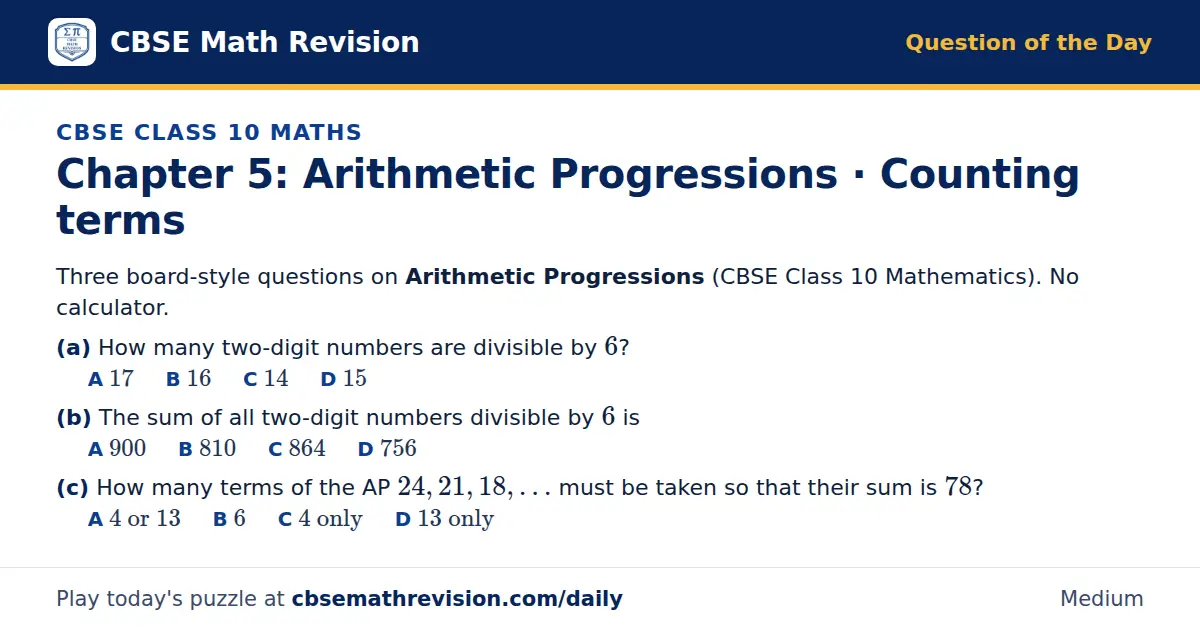
Chapter 5: Arithmetic Progressions · Counting terms
Three board-style questions on Arithmetic Progressions (CBSE Class 10 Mathematics). No calculator.
- How many two-digit numbers are divisible by 6? Options: A) 17; B) 16; C) 14; D) 15
- The sum of all two-digit numbers divisible by 6 is Options: A) 900; B) 810; C) 864; D) 756
- How many terms of the AP 24, 21, 18, … must be taken so that their sum is 78? Options: A) 4 or 13; B) 6; C) 4 only; D) 13 only
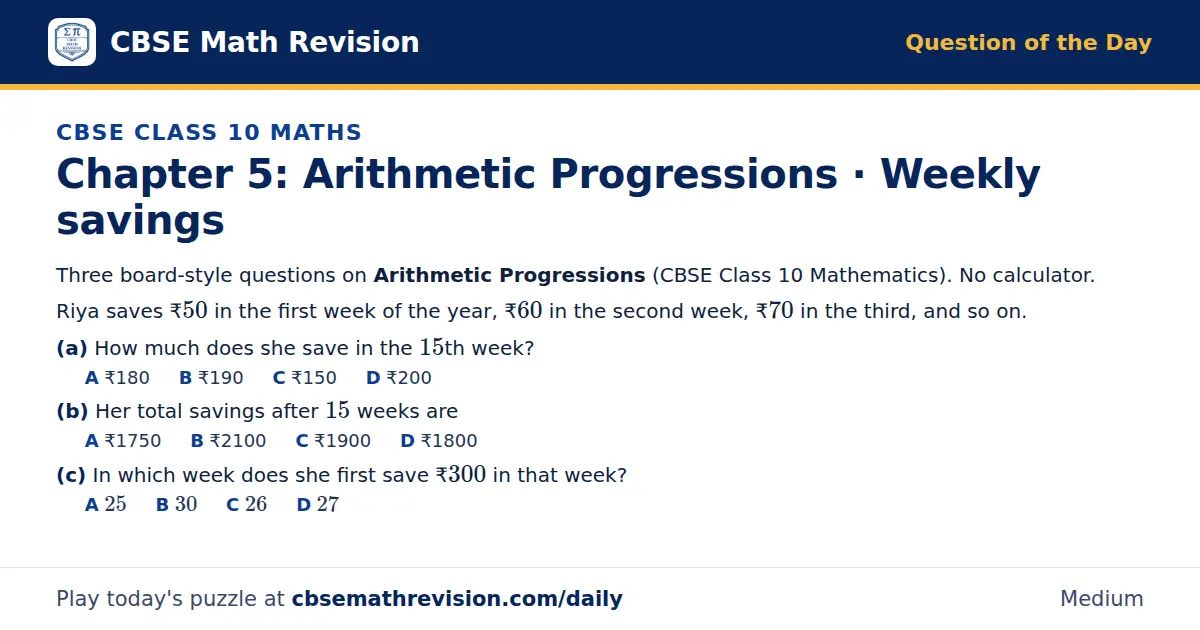
Chapter 5: Arithmetic Progressions · Weekly savings
Three board-style questions on Arithmetic Progressions (CBSE Class 10 Mathematics). No calculator. Riya saves ₹50 in the first week of the year, ₹60 in the second week, ₹70 in the third, and so on.
- How much does she save in the 15th week? Options: A) ₹180; B) ₹190; C) ₹150; D) ₹200
- Her total savings after 15 weeks are Options: A) ₹1750; B) ₹2100; C) ₹1900; D) ₹1800
- In which week does she first save ₹300 in that week? Options: A) 25; B) 30; C) 26; D) 27
Chapter 6: Triangles
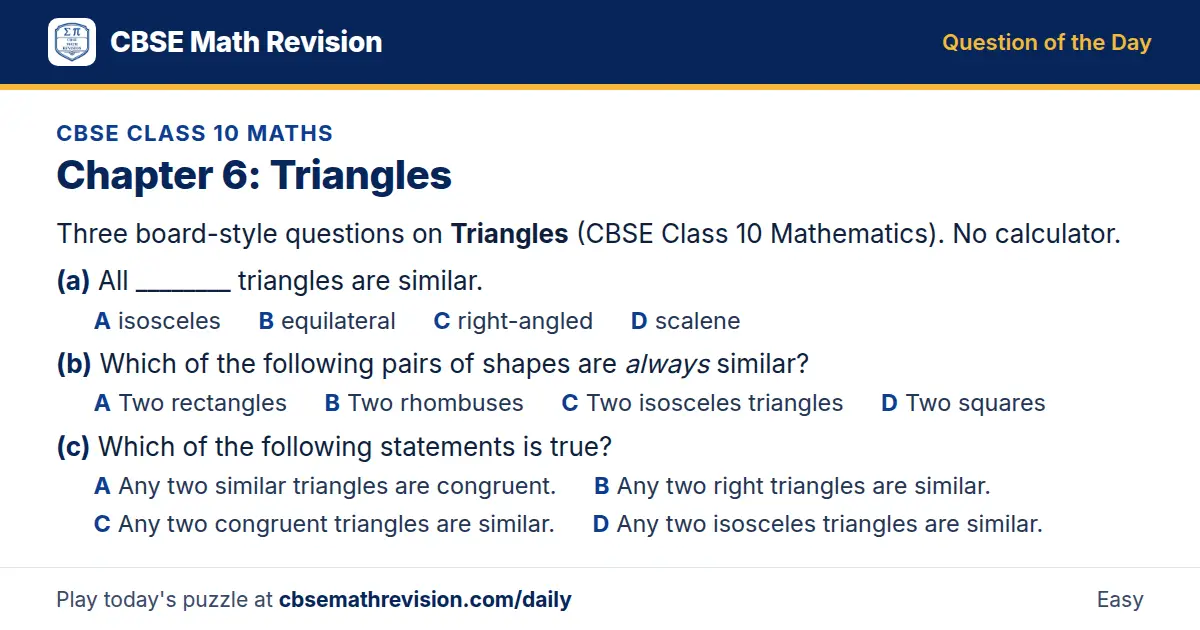
Chapter 6: Triangles
Three board-style questions on Triangles (CBSE Class 10 Mathematics). No calculator.
- All ________ triangles are similar. Options: A) isosceles; B) equilateral; C) right-angled; D) scalene
- Which of the following pairs of shapes are always similar? Options: A) Two rectangles; B) Two rhombuses; C) Two isosceles triangles; D) Two squares
- Which of the following statements is true? Options: A) Any two similar triangles are congruent.; B) Any two right triangles are similar.; C) Any two congruent triangles are similar.; D) Any two isosceles triangles are similar.
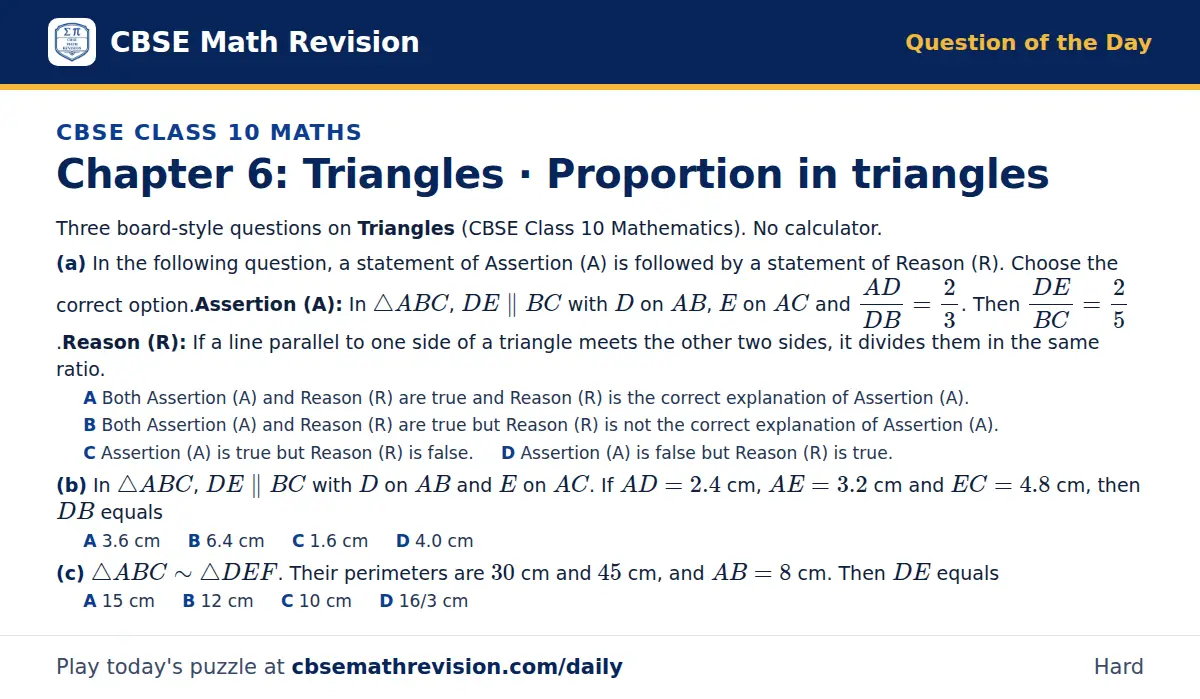
Chapter 6: Triangles · Proportion in triangles
Three board-style questions on Triangles (CBSE Class 10 Mathematics). No calculator.
- In the following question, a statement of Assertion (A) is followed by a statement of Reason (R). Choose the correct option. Assertion (A): In △ ABC, DE ∥ BC with D on AB, E on AC and AD/DB = 23. Then DE/BC = 25. Reason (R): If a line parallel to one side of a triangle meets the other two sides, it divides them in the same ratio. Options: A) Both Assertion (A) and Reason (R) are true and Reason (R) is the correct explanation of Assertion (A).; B) Both Assertion (A) and Reason (R) are true but Reason (R) is not the correct explanation of Assertion (A).; C) Assertion (A) is true but Reason (R) is false.; D) Assertion (A) is false but Reason (R) is true.
- In △ ABC, DE ∥ BC with D on AB and E on AC. If AD = 2.4 cm, AE = 3.2 cm and EC = 4.8 cm, then DB equals Options: A) 3.6 cm; B) 6.4 cm; C) 1.6 cm; D) 4.0 cm
- △ ABC △ DEF. Their perimeters are 30 cm and 45 cm, and AB = 8 cm. Then DE equals Options: A) 15 cm; B) 12 cm; C) 10 cm; D) 16/3 cm
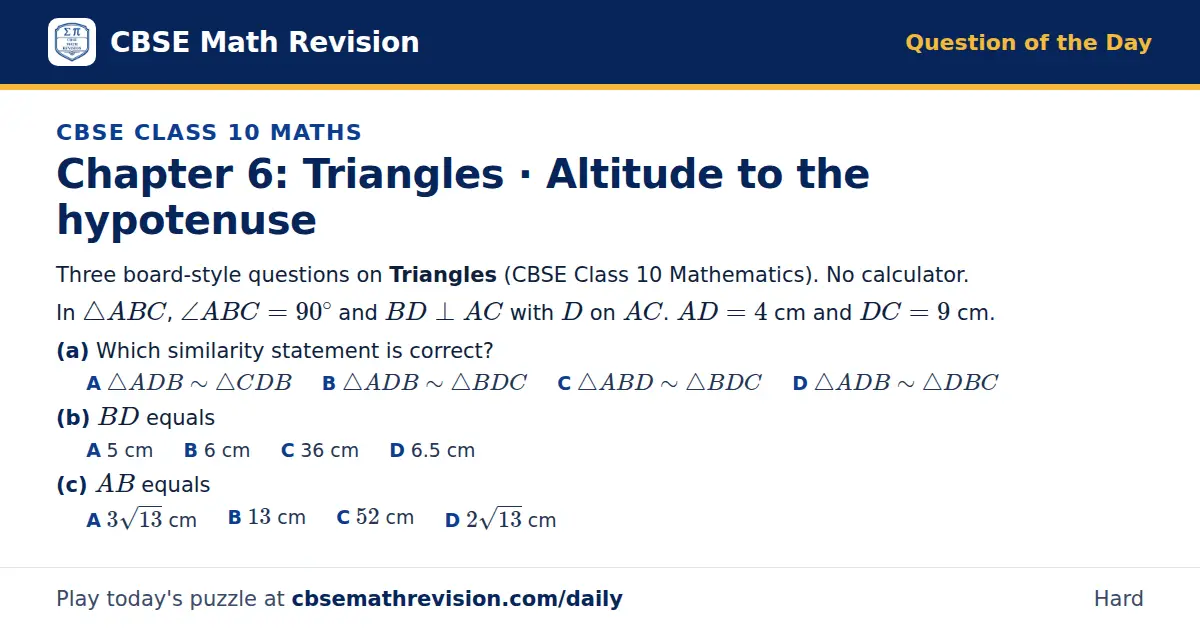
Chapter 6: Triangles · Altitude to the hypotenuse
Three board-style questions on Triangles (CBSE Class 10 Mathematics). No calculator. In △ ABC, ∠ ABC = 90^∘ and BD ⊥ AC with D on AC. AD = 4 cm and DC = 9 cm.
- Which similarity statement is correct? Options: A) △ ADB △ CDB; B) △ ADB △ BDC; C) △ ABD △ BDC; D) △ ADB △ DBC
- BD equals Options: A) 5 cm; B) 6 cm; C) 36 cm; D) 6.5 cm
- AB equals Options: A) 3√13 cm; B) 13 cm; C) 52 cm; D) 2√13 cm
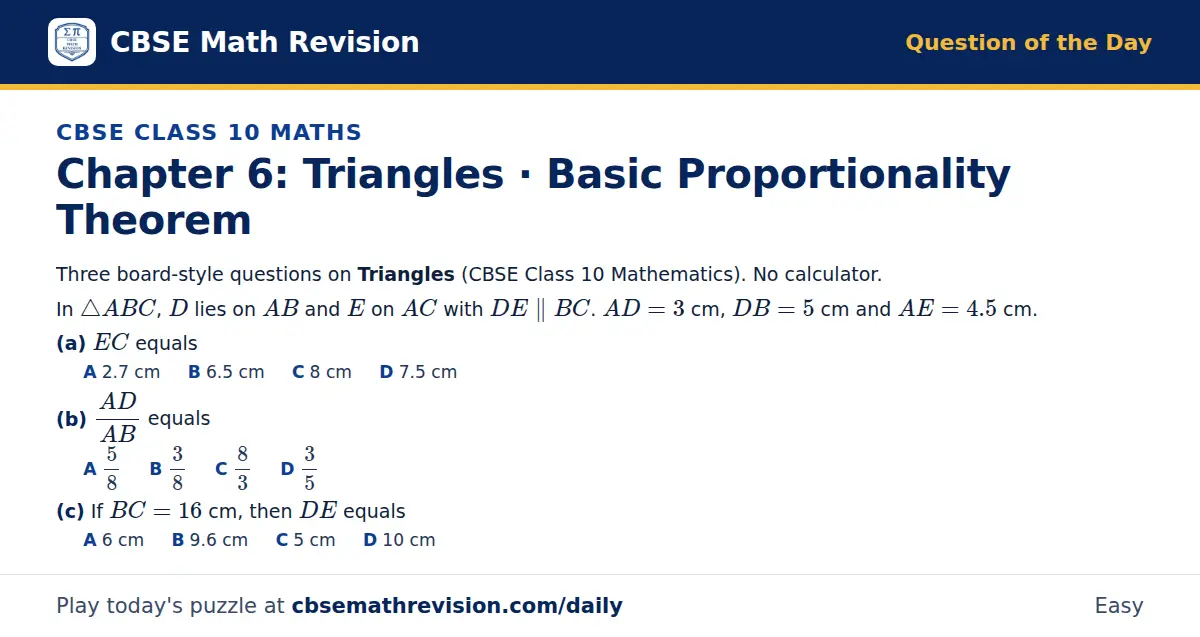
Chapter 6: Triangles · Basic Proportionality Theorem
Three board-style questions on Triangles (CBSE Class 10 Mathematics). No calculator. In △ ABC, D lies on AB and E on AC with DE ∥ BC. AD = 3 cm, DB = 5 cm and AE = 4.5 cm.
- EC equals Options: A) 2.7 cm; B) 6.5 cm; C) 8 cm; D) 7.5 cm
- AD/AB equals Options: A) 5/8; B) 3/8; C) 8/3; D) 3/5
- If BC = 16 cm, then DE equals Options: A) 6 cm; B) 9.6 cm; C) 5 cm; D) 10 cm
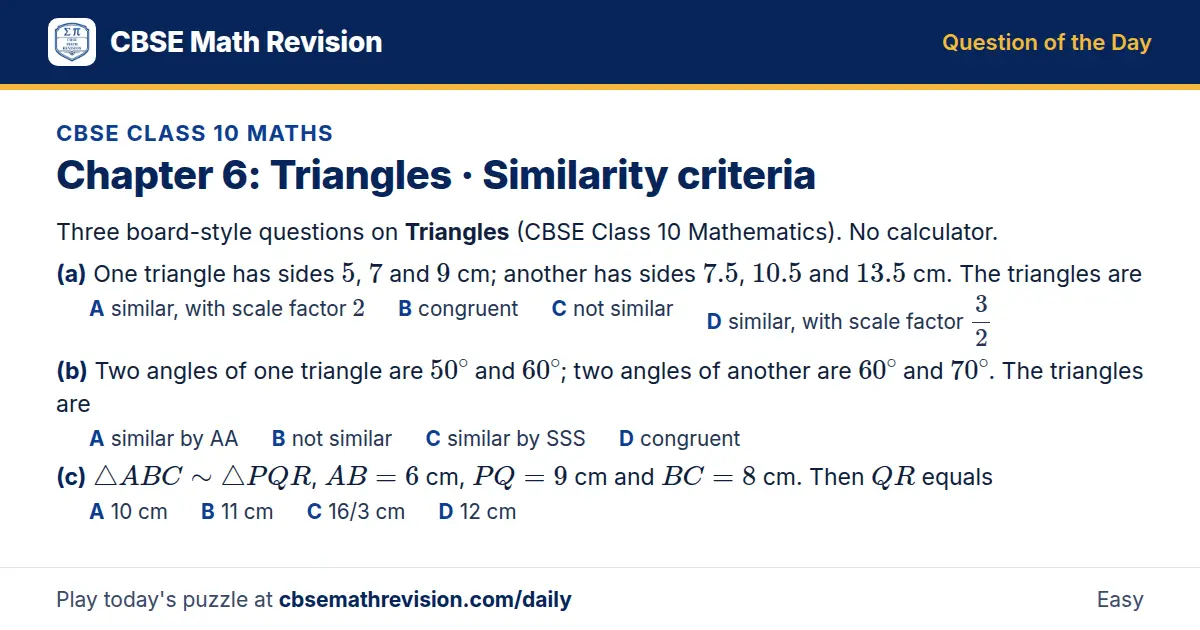
Chapter 6: Triangles · Similarity criteria
Three board-style questions on Triangles (CBSE Class 10 Mathematics). No calculator.
- One triangle has sides 5, 7 and 9 cm; another has sides 7.5, 10.5 and 13.5 cm. The triangles are Options: A) similar, with scale factor 2; B) congruent; C) not similar; D) similar, with scale factor 32
- Two angles of one triangle are 50^∘ and 60^∘; two angles of another are 60^∘ and 70^∘. The triangles are Options: A) similar by AA; B) not similar; C) similar by SSS; D) congruent
- △ ABC △ PQR, AB = 6 cm, PQ = 9 cm and BC = 8 cm. Then QR equals Options: A) 10 cm; B) 11 cm; C) 16/3 cm; D) 12 cm
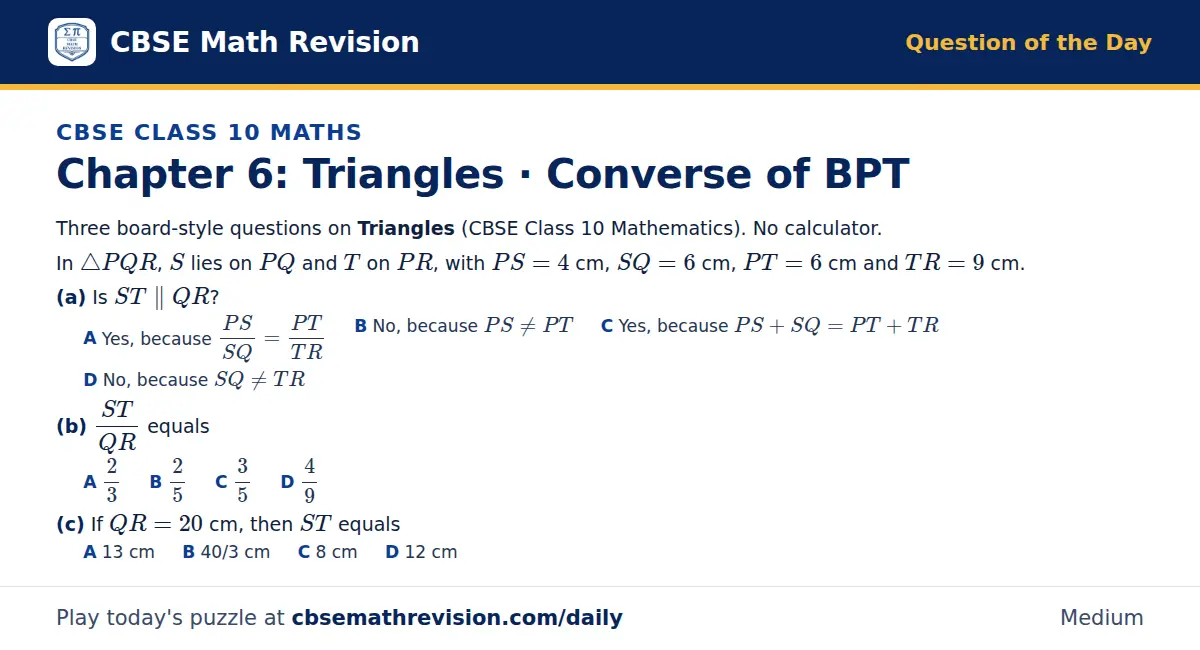
Chapter 6: Triangles · Converse of BPT
Three board-style questions on Triangles (CBSE Class 10 Mathematics). No calculator. In △ PQR, S lies on PQ and T on PR, with PS = 4 cm, SQ = 6 cm, PT = 6 cm and TR = 9 cm.
- Is ST ∥ QR? Options: A) Yes, because PS/SQ = PT/TR; B) No, because PS ≠ PT; C) Yes, because PS + SQ = PT + TR; D) No, because SQ ≠ TR
- ST/QR equals Options: A) 2/3; B) 2/5; C) 3/5; D) 4/9
- If QR = 20 cm, then ST equals Options: A) 13 cm; B) 40/3 cm; C) 8 cm; D) 12 cm
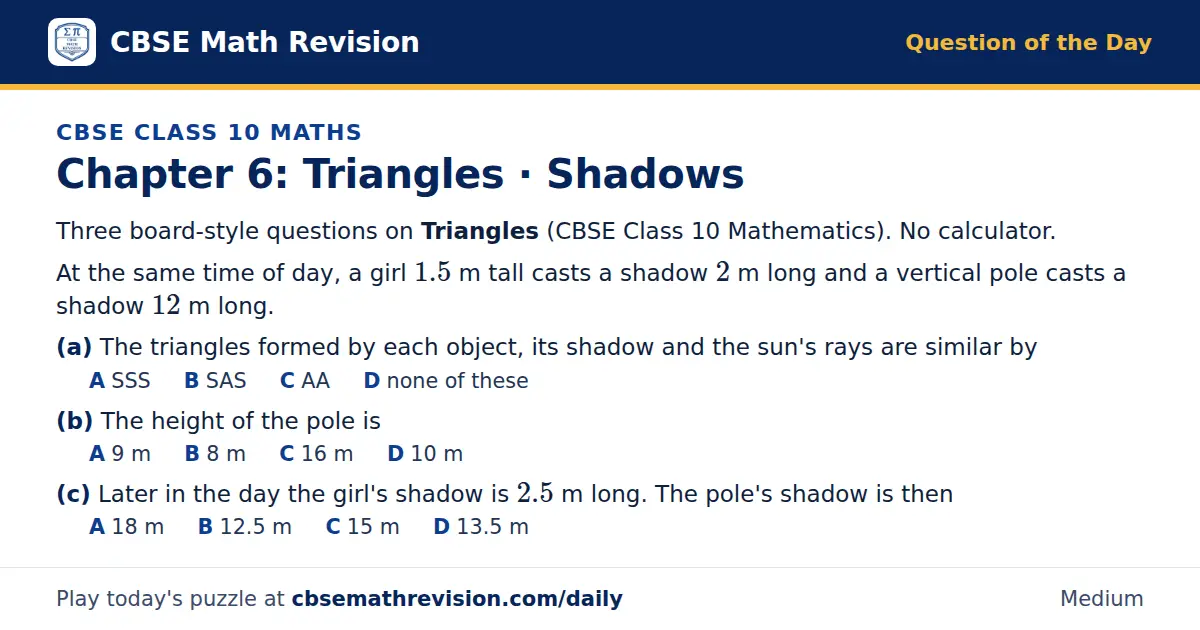
Chapter 6: Triangles · Shadows
Three board-style questions on Triangles (CBSE Class 10 Mathematics). No calculator. At the same time of day, a girl 1.5 m tall casts a shadow 2 m long and a vertical pole casts a shadow 12 m long.
- The triangles formed by each object, its shadow and the sun's rays are similar by Options: A) SSS; B) SAS; C) AA; D) none of these
- The height of the pole is Options: A) 9 m; B) 8 m; C) 16 m; D) 10 m
- Later in the day the girl's shadow is 2.5 m long. The pole's shadow is then Options: A) 18 m; B) 12.5 m; C) 15 m; D) 13.5 m
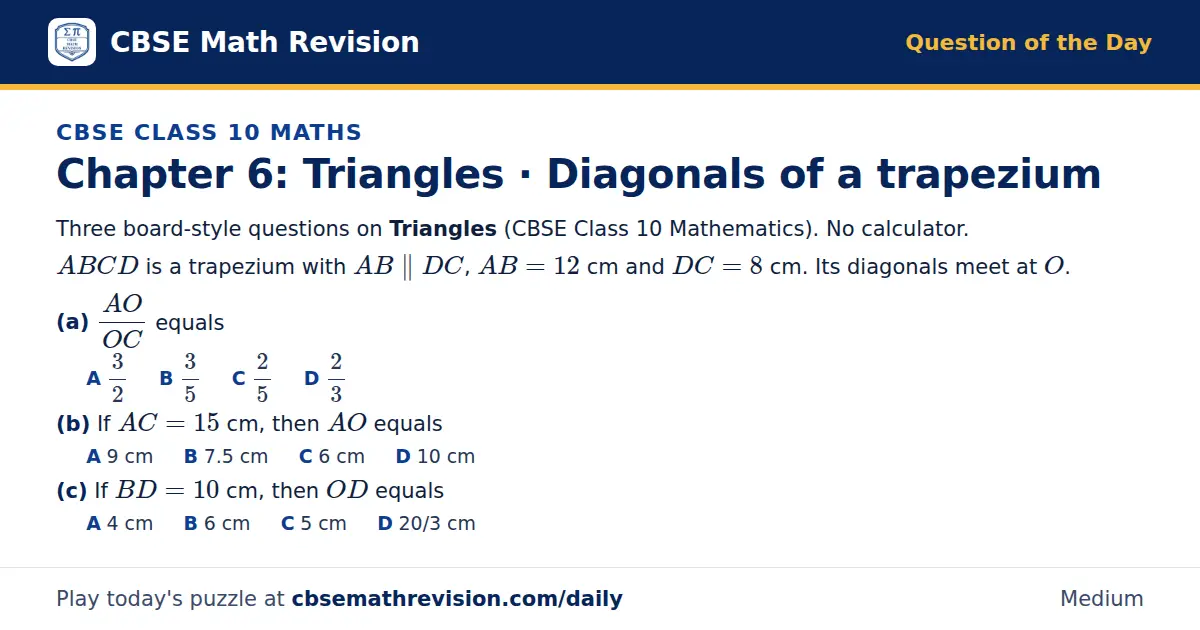
Chapter 6: Triangles · Diagonals of a trapezium
Three board-style questions on Triangles (CBSE Class 10 Mathematics). No calculator. ABCD is a trapezium with AB ∥ DC, AB = 12 cm and DC = 8 cm. Its diagonals meet at O.
- AO/OC equals Options: A) 3/2; B) 3/5; C) 2/5; D) 2/3
- If AC = 15 cm, then AO equals Options: A) 9 cm; B) 7.5 cm; C) 6 cm; D) 10 cm
- If BD = 10 cm, then OD equals Options: A) 4 cm; B) 6 cm; C) 5 cm; D) 20/3 cm
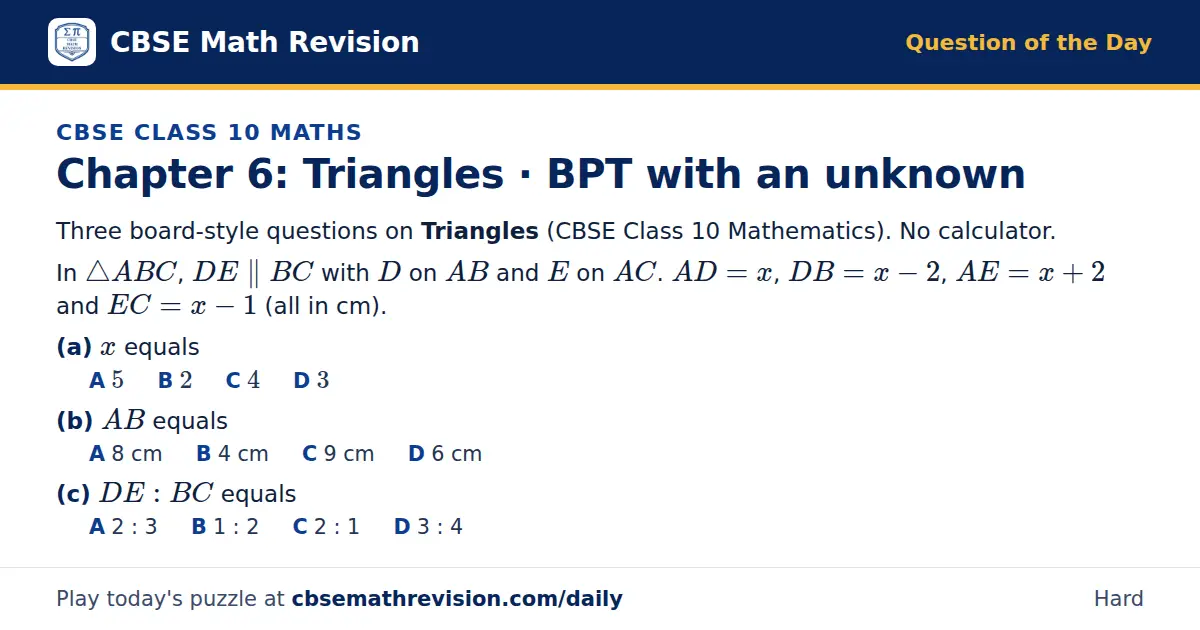
Chapter 6: Triangles · BPT with an unknown
Three board-style questions on Triangles (CBSE Class 10 Mathematics). No calculator. In △ ABC, DE ∥ BC with D on AB and E on AC. AD = x, DB = x - 2, AE = x + 2 and EC = x - 1 (all in cm).
- x equals Options: A) 5; B) 2; C) 4; D) 3
- AB equals Options: A) 8 cm; B) 4 cm; C) 9 cm; D) 6 cm
- DE: BC equals Options: A) 2: 3; B) 1: 2; C) 2: 1; D) 3: 4
Chapter 7: Coordinate Geometry
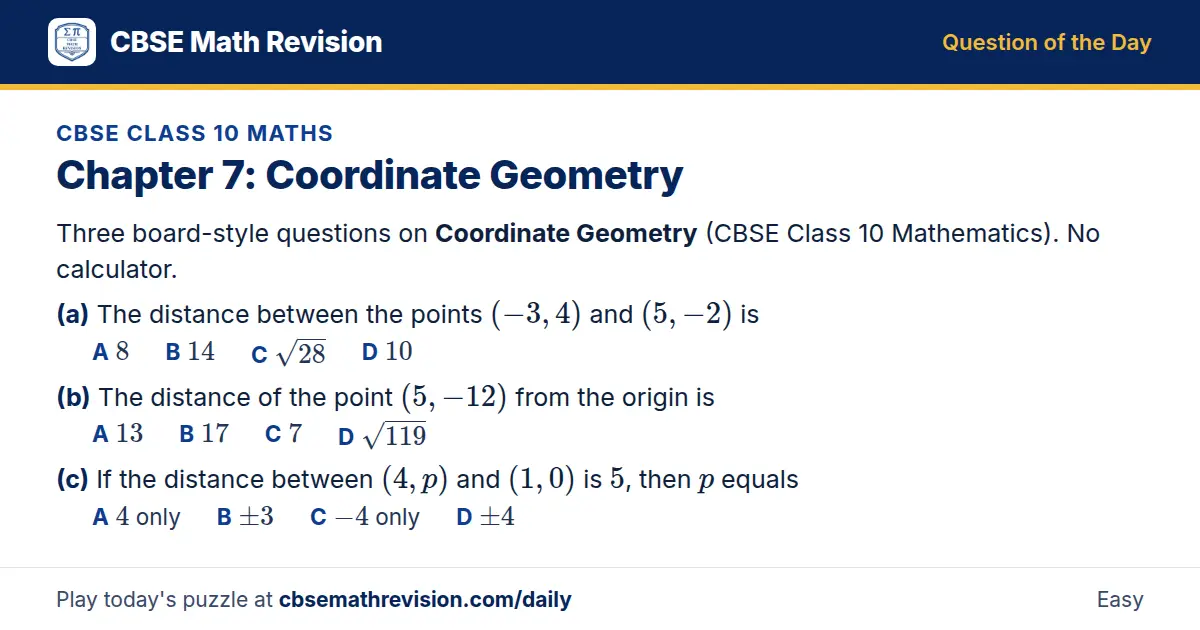
Chapter 7: Coordinate Geometry
Three board-style questions on Coordinate Geometry (CBSE Class 10 Mathematics). No calculator.
- The distance between the points (-3, 4) and (5, -2) is Options: A) 8; B) 14; C) √28; D) 10
- The distance of the point (5, -12) from the origin is Options: A) 13; B) 17; C) 7; D) √119
- If the distance between (4, p) and (1, 0) is 5, then p equals Options: A) 4 only; B) ± 3; C) -4 only; D) ± 4
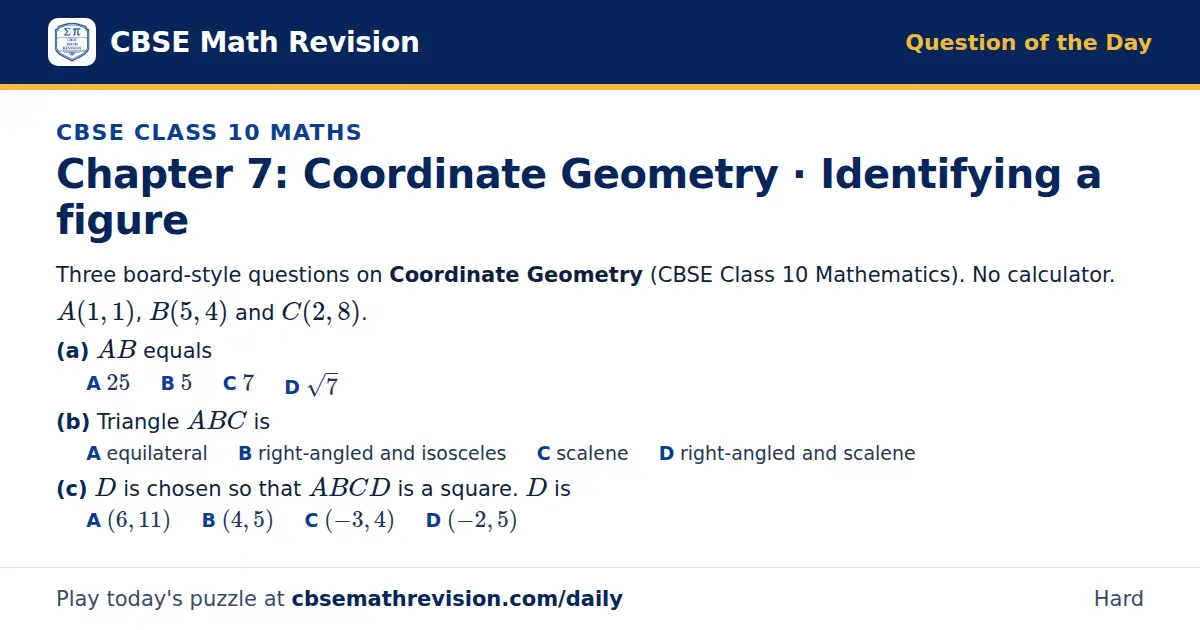
Chapter 7: Coordinate Geometry · Identifying a figure
Three board-style questions on Coordinate Geometry (CBSE Class 10 Mathematics). No calculator. A(1, 1), B(5, 4) and C(2, 8).
- AB equals Options: A) 25; B) 5; C) 7; D) √7
- Triangle ABC is Options: A) equilateral; B) right-angled and isosceles; C) scalene; D) right-angled and scalene
- D is chosen so that ABCD is a square. D is Options: A) (6, 11); B) (4, 5); C) (-3, 4); D) (-2, 5)
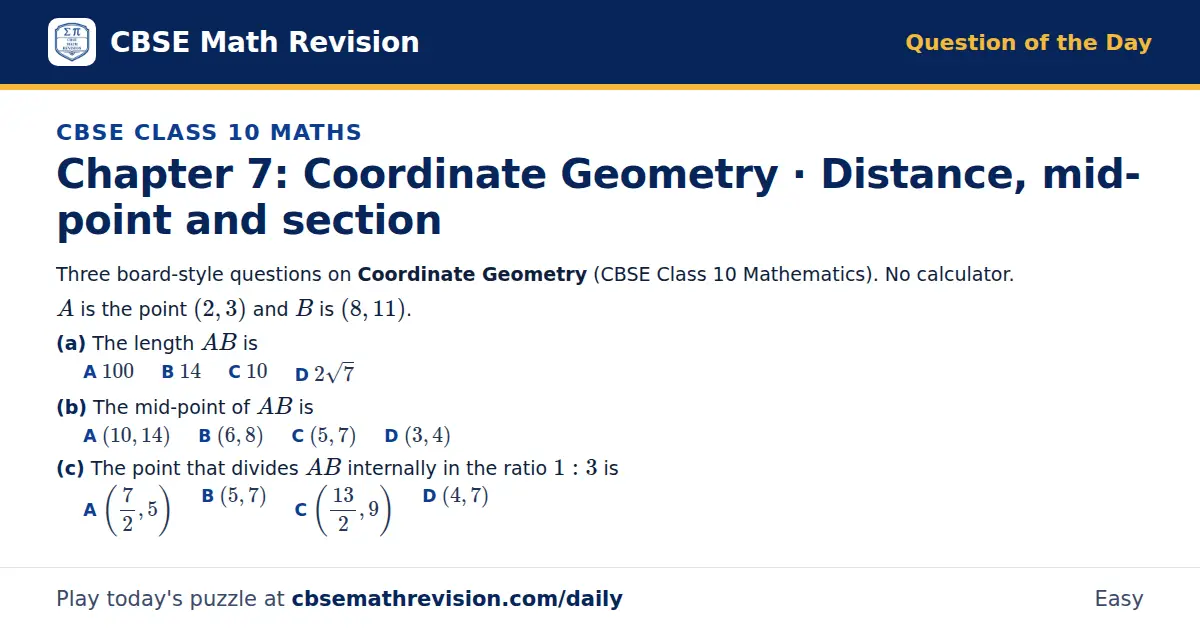
Chapter 7: Coordinate Geometry · Distance, mid-point and section
Three board-style questions on Coordinate Geometry (CBSE Class 10 Mathematics). No calculator. A is the point (2, 3) and B is (8, 11).
- The length AB is Options: A) 100; B) 14; C) 10; D) 2 √7
- The mid-point of AB is Options: A) (10, 14); B) (6, 8); C) (5, 7); D) (3, 4)
- The point that divides AB internally in the ratio 1: 3 is Options: A) (72, 5); B) (5, 7); C) (13/2, 9); D) (4, 7)
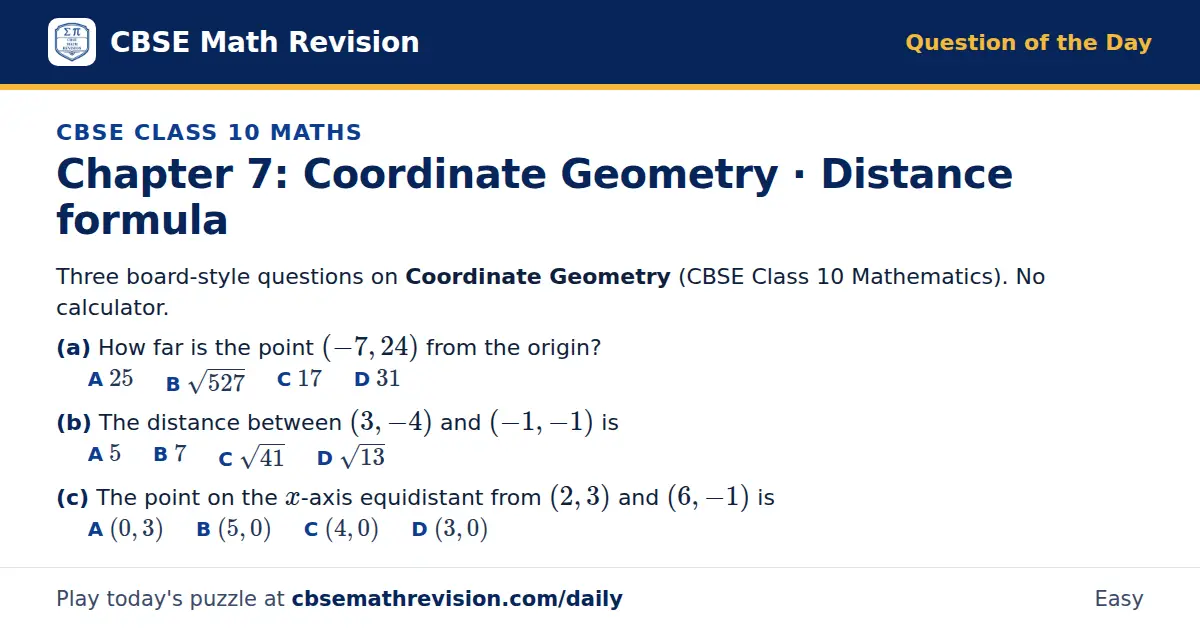
Chapter 7: Coordinate Geometry · Distance formula
Three board-style questions on Coordinate Geometry (CBSE Class 10 Mathematics). No calculator.
- How far is the point (-7, 24) from the origin? Options: A) 25; B) √527; C) 17; D) 31
- The distance between (3, -4) and (-1, -1) is Options: A) 5; B) 7; C) √41; D) √13
- The point on the x-axis equidistant from (2, 3) and (6, -1) is Options: A) (0, 3); B) (5, 0); C) (4, 0); D) (3, 0)
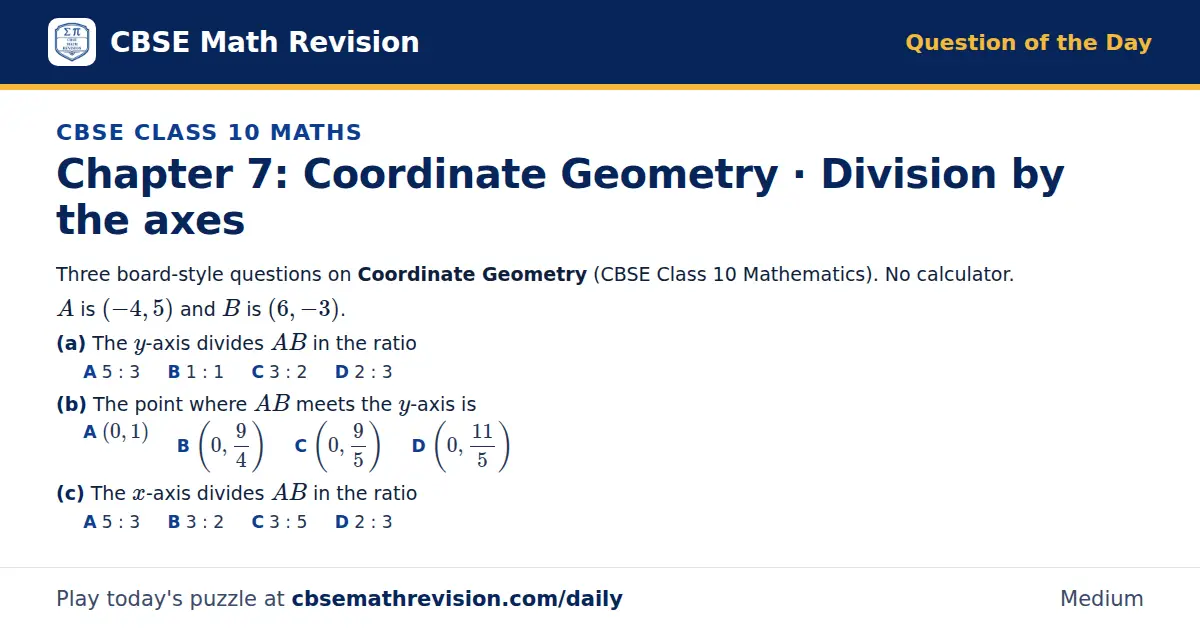
Chapter 7: Coordinate Geometry · Division by the axes
Three board-style questions on Coordinate Geometry (CBSE Class 10 Mathematics). No calculator. A is (-4, 5) and B is (6, -3).
- The y-axis divides AB in the ratio Options: A) 5: 3; B) 1: 1; C) 3: 2; D) 2: 3
- The point where AB meets the y-axis is Options: A) (0, 1); B) (0, 9/4); C) (0, 95); D) (0, 11/5)
- The x-axis divides AB in the ratio Options: A) 5: 3; B) 3: 2; C) 3: 5; D) 2: 3
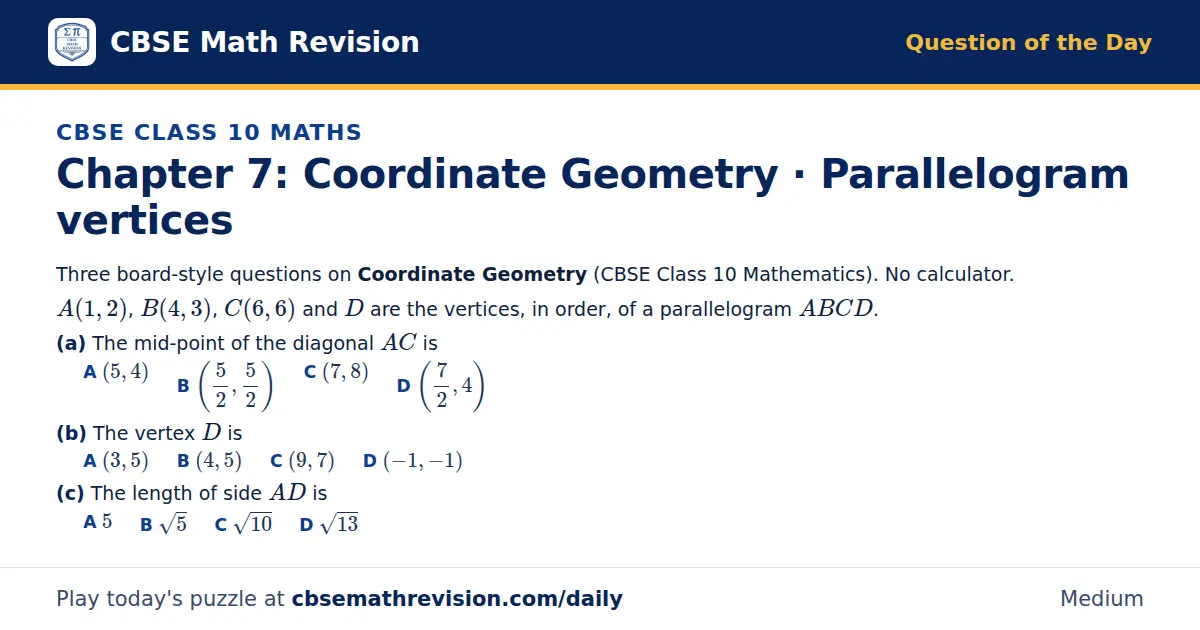
Chapter 7: Coordinate Geometry · Parallelogram vertices
Three board-style questions on Coordinate Geometry (CBSE Class 10 Mathematics). No calculator. A(1, 2), B(4, 3), C(6, 6) and D are the vertices, in order, of a parallelogram ABCD.
- The mid-point of the diagonal AC is Options: A) (5, 4); B) (52, 52); C) (7, 8); D) (72, 4)
- The vertex D is Options: A) (3, 5); B) (4, 5); C) (9, 7); D) (-1, -1)
- The length of side AD is Options: A) 5; B) √5; C) √10; D) √13
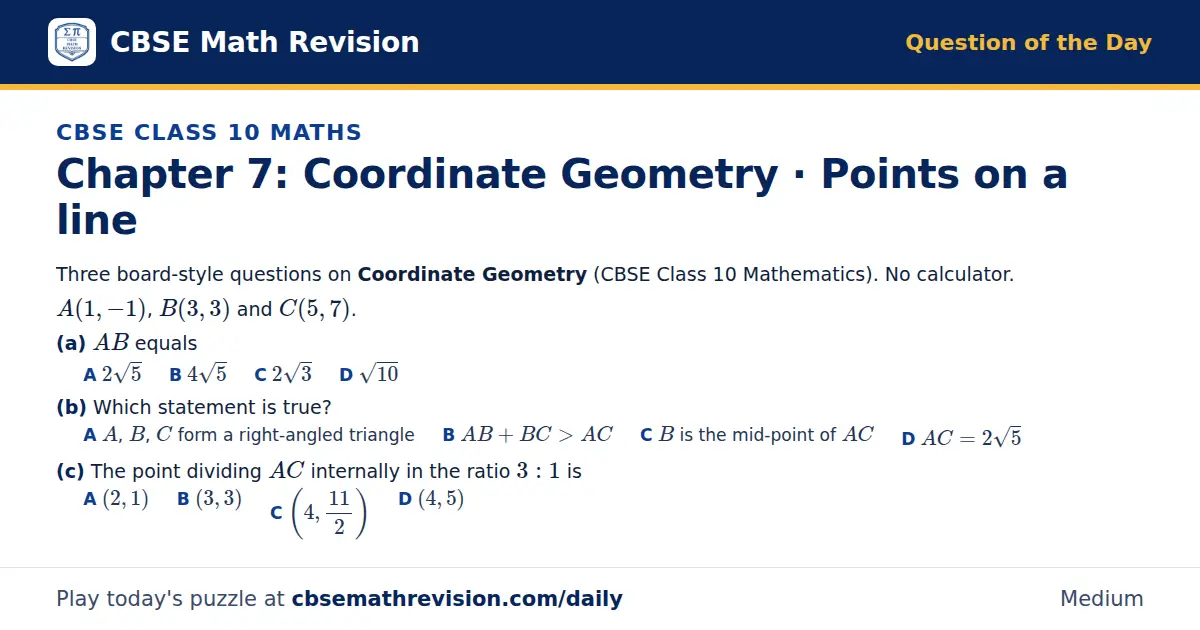
Chapter 7: Coordinate Geometry · Points on a line
Three board-style questions on Coordinate Geometry (CBSE Class 10 Mathematics). No calculator. A(1, -1), B(3, 3) and C(5, 7).
- AB equals Options: A) 2 √5; B) 4 √5; C) 2 √3; D) √10
- Which statement is true? Options: A) A, B, C form a right-angled triangle; B) AB + BC > AC; C) B is the mid-point of AC; D) AC = 2√5
- The point dividing AC internally in the ratio 3: 1 is Options: A) (2, 1); B) (3, 3); C) (4, 11/2); D) (4, 5)
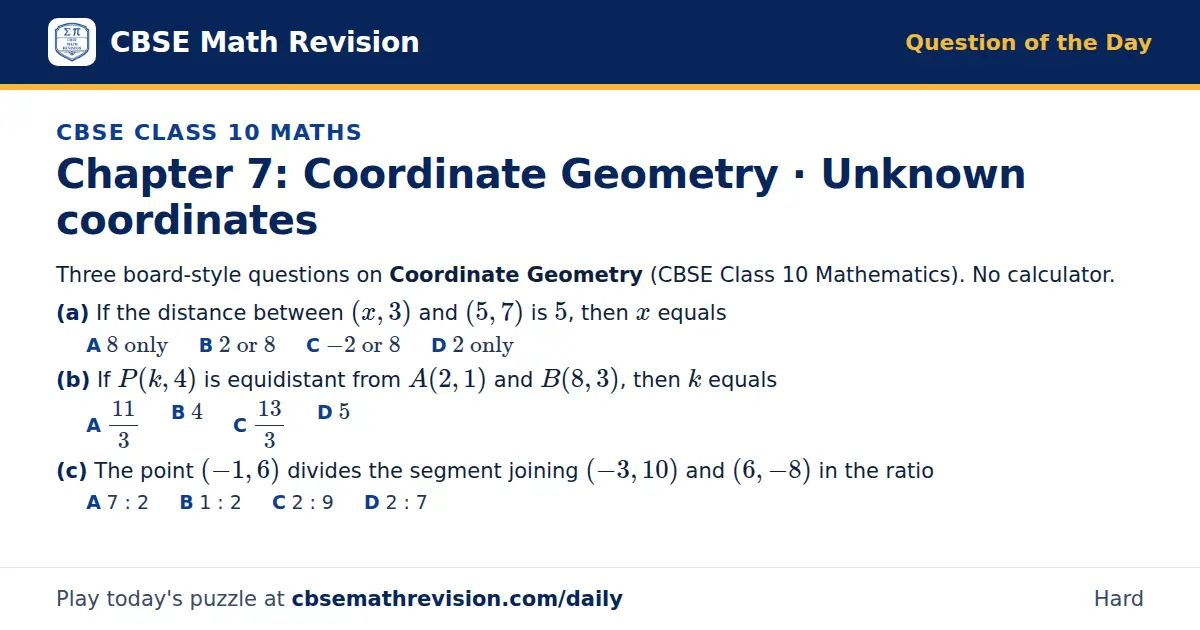
Chapter 7: Coordinate Geometry · Unknown coordinates
Three board-style questions on Coordinate Geometry (CBSE Class 10 Mathematics). No calculator.
- If the distance between (x, 3) and (5, 7) is 5, then x equals Options: A) 8 only; B) 2 or 8; C) -2 or 8; D) 2 only
- If P(k, 4) is equidistant from A(2, 1) and B(8, 3), then k equals Options: A) 11/3; B) 4; C) 13/3; D) 5
- The point (-1, 6) divides the segment joining (-3, 10) and (6, -8) in the ratio Options: A) 7: 2; B) 1: 2; C) 2: 9; D) 2: 7
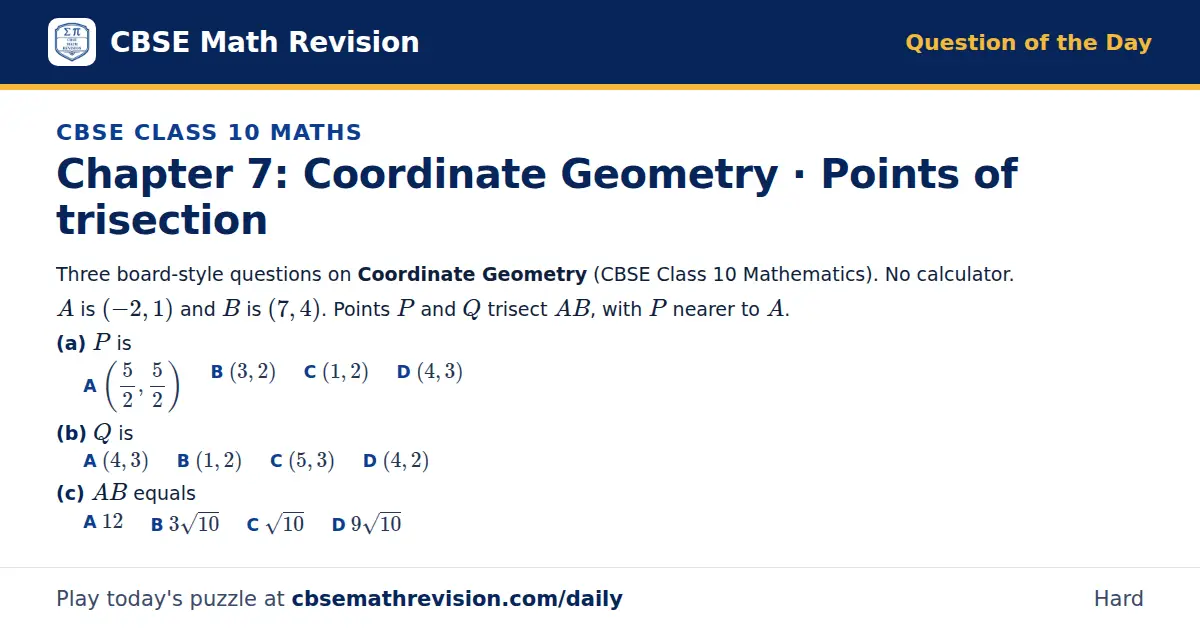
Chapter 7: Coordinate Geometry · Points of trisection
Three board-style questions on Coordinate Geometry (CBSE Class 10 Mathematics). No calculator. A is (-2, 1) and B is (7, 4). Points P and Q trisect AB, with P nearer to A.
- P is Options: A) (52, 52); B) (3, 2); C) (1, 2); D) (4, 3)
- Q is Options: A) (4, 3); B) (1, 2); C) (5, 3); D) (4, 2)
- AB equals Options: A) 12; B) 3 √10; C) √10; D) 9 √10
Chapter 8: Introduction to Trigonometry
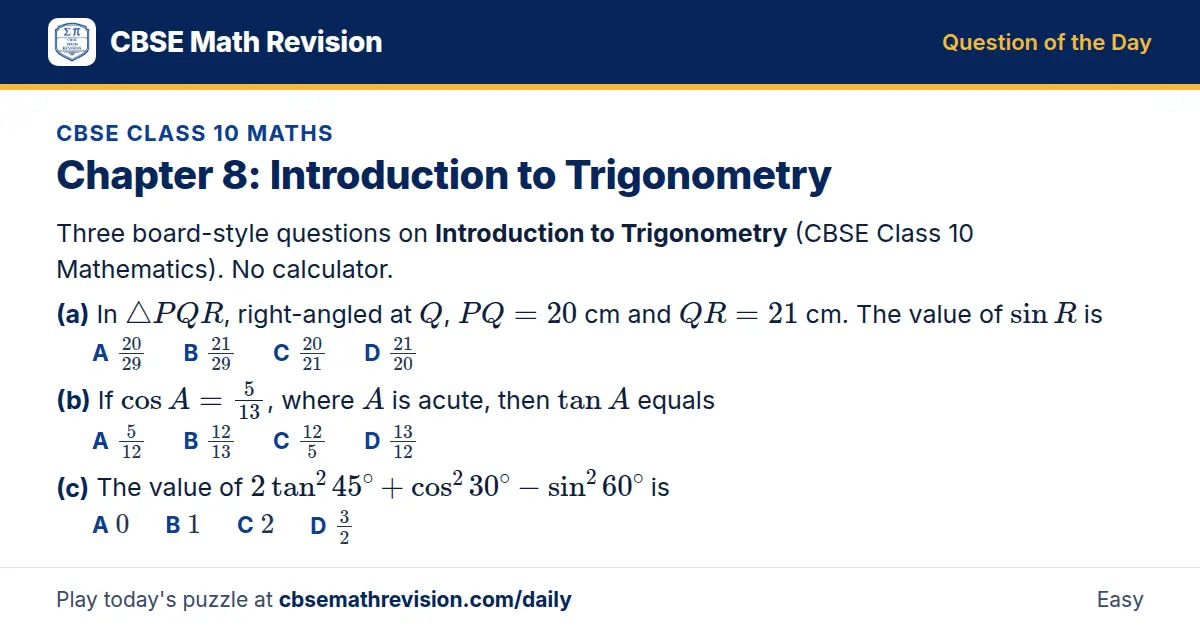
Chapter 8: Introduction to Trigonometry
Three board-style questions on Introduction to Trigonometry (CBSE Class 10 Mathematics). No calculator.
- In △ PQR, right-angled at Q, PQ = 20 cm and QR = 21 cm. The value of sin R is Options: A) 20/29; B) 21/29; C) 20/21; D) 21/20
- If cos A = 5/13, where A is acute, then tan A equals Options: A) 5/12; B) 12/13; C) 12/5; D) 13/12
- The value of 2tan² 45^∘ + cos² 30^∘ - sin² 60^∘ is Options: A) 0; B) 1; C) 2; D) 3/2
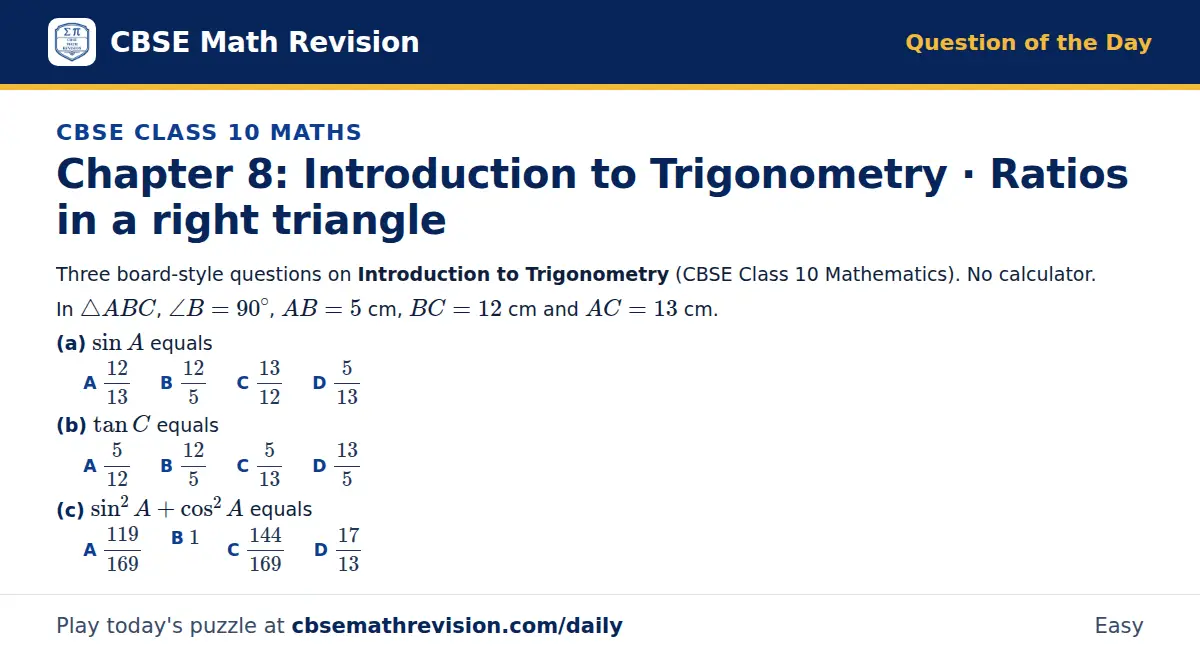
Chapter 8: Introduction to Trigonometry · Ratios in a right triangle
Three board-style questions on Introduction to Trigonometry (CBSE Class 10 Mathematics). No calculator. In △ ABC, ∠ B = 90^∘, AB = 5 cm, BC = 12 cm and AC = 13 cm.
- sin A equals Options: A) 12/13; B) 12/5; C) 13/12; D) 5/13
- tan C equals Options: A) 5/12; B) 12/5; C) 5/13; D) 13/5
- sin² A + cos² A equals Options: A) 119/169; B) 1; C) 144/169; D) 17/13
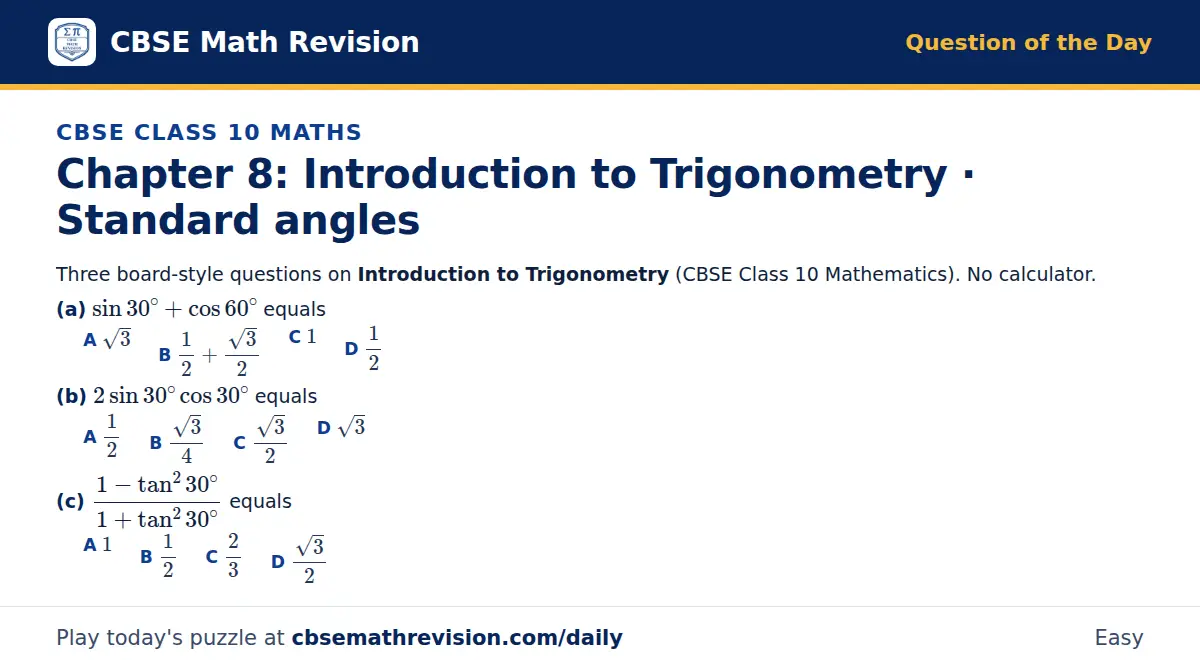
Chapter 8: Introduction to Trigonometry · Standard angles
Three board-style questions on Introduction to Trigonometry (CBSE Class 10 Mathematics). No calculator.
- sin 30^∘ + cos 60^∘ equals Options: A) √3; B) 1/2 + (√3)/2; C) 1; D) 1/2
- 2 sin 30^∘ cos 30^∘ equals Options: A) 1/2; B) (√3)/4; C) (√3)/2; D) √3
- (1 - tan² 30^∘)/(1 + tan² 30^∘) equals Options: A) 1; B) 1/2; C) 2/3; D) (√3)/2
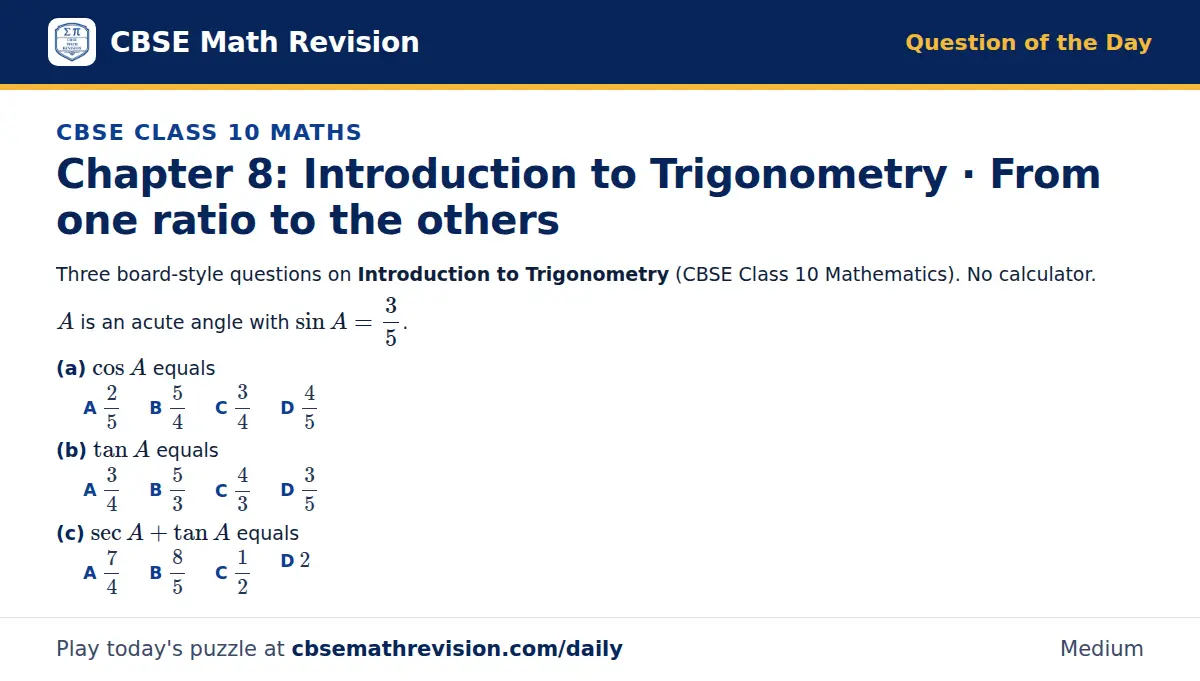
Chapter 8: Introduction to Trigonometry · From one ratio to the others
Three board-style questions on Introduction to Trigonometry (CBSE Class 10 Mathematics). No calculator. A is an acute angle with sin A = 35.
- cos A equals Options: A) 2/5; B) 5/4; C) 3/4; D) 4/5
- tan A equals Options: A) 3/4; B) 5/3; C) 4/3; D) 3/5
- sec A + tan A equals Options: A) 7/4; B) 8/5; C) 1/2; D) 2
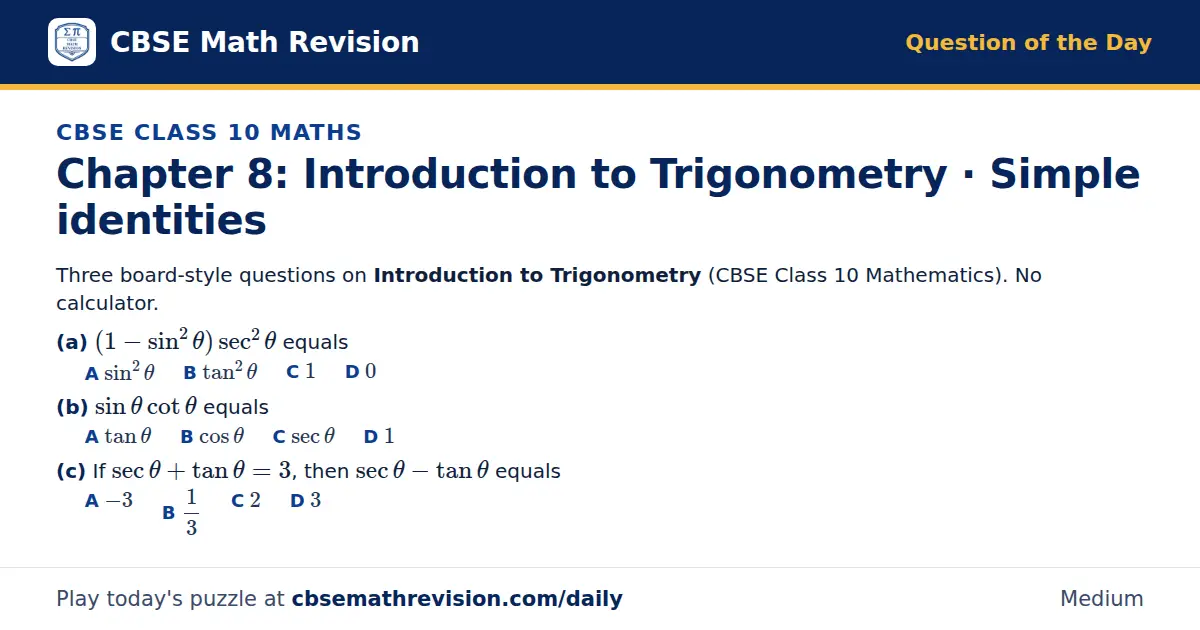
Chapter 8: Introduction to Trigonometry · Simple identities
Three board-style questions on Introduction to Trigonometry (CBSE Class 10 Mathematics). No calculator.
- (1 - sin²θ)sec²θ equals Options: A) sin² θ; B) tan² θ; C) 1; D) 0
- sinθ cotθ equals Options: A) tanθ; B) cosθ; C) secθ; D) 1
- If secθ + tanθ = 3, then secθ - tanθ equals Options: A) -3; B) 1/3; C) 2; D) 3
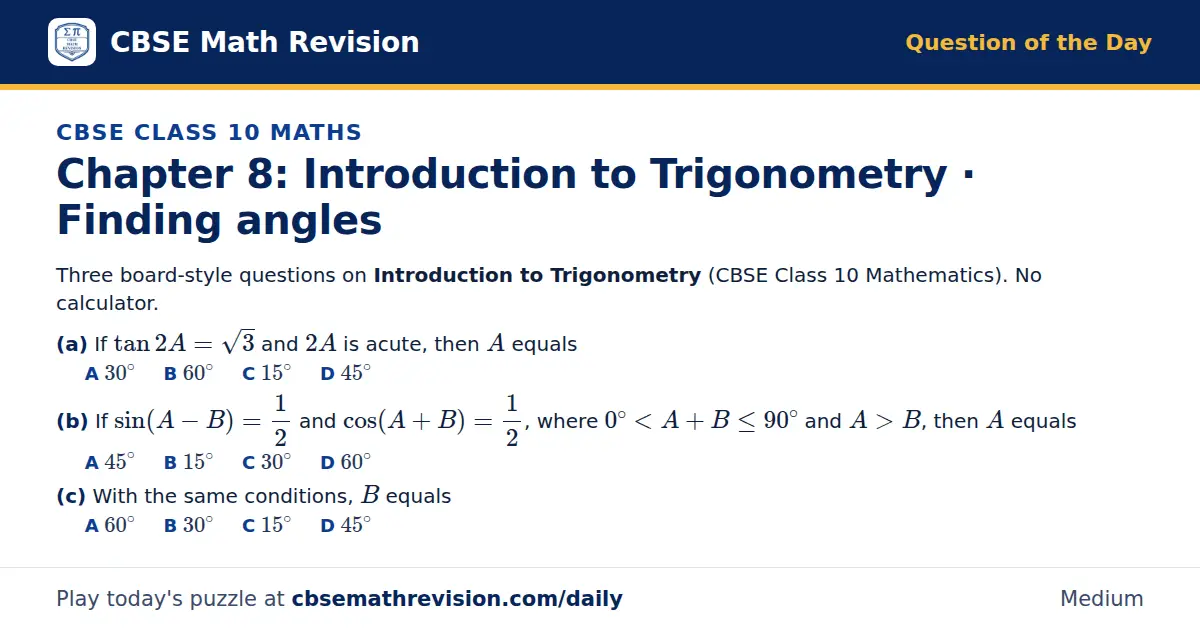
Chapter 8: Introduction to Trigonometry · Finding angles
Three board-style questions on Introduction to Trigonometry (CBSE Class 10 Mathematics). No calculator.
- If tan 2A = √3 and 2A is acute, then A equals Options: A) 30^∘; B) 60^∘; C) 15^∘; D) 45^∘
- If sin(A - B) = 12 and cos(A + B) = 12, where 0^∘ < A + B ≤ 90^∘ and A > B, then A equals Options: A) 45^∘; B) 15^∘; C) 30^∘; D) 60^∘
- With the same conditions, B equals Options: A) 60^∘; B) 30^∘; C) 15^∘; D) 45^∘
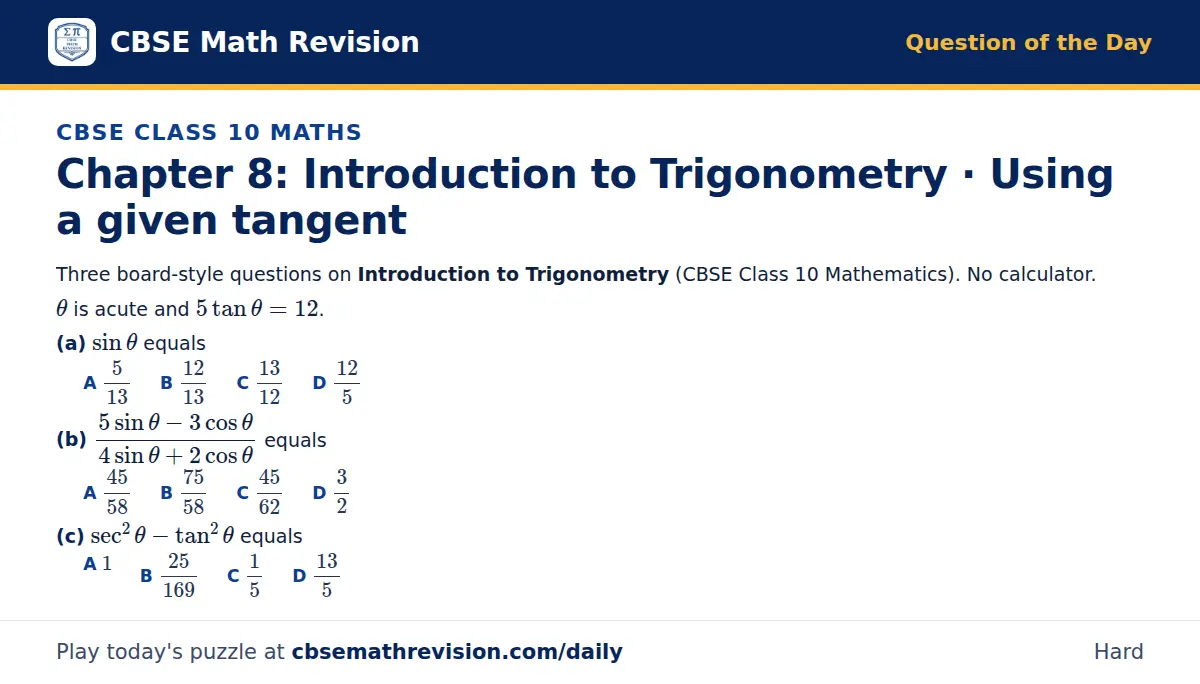
Chapter 8: Introduction to Trigonometry · Using a given tangent
Three board-style questions on Introduction to Trigonometry (CBSE Class 10 Mathematics). No calculator. θ is acute and 5tanθ = 12.
- sinθ equals Options: A) 5/13; B) 12/13; C) 13/12; D) 12/5
- (5sinθ - 3cosθ)/(4sinθ + 2cosθ) equals Options: A) 45/58; B) 75/58; C) 45/62; D) 3/2
- sec²θ - tan²θ equals Options: A) 1; B) 25/169; C) 1/5; D) 13/5
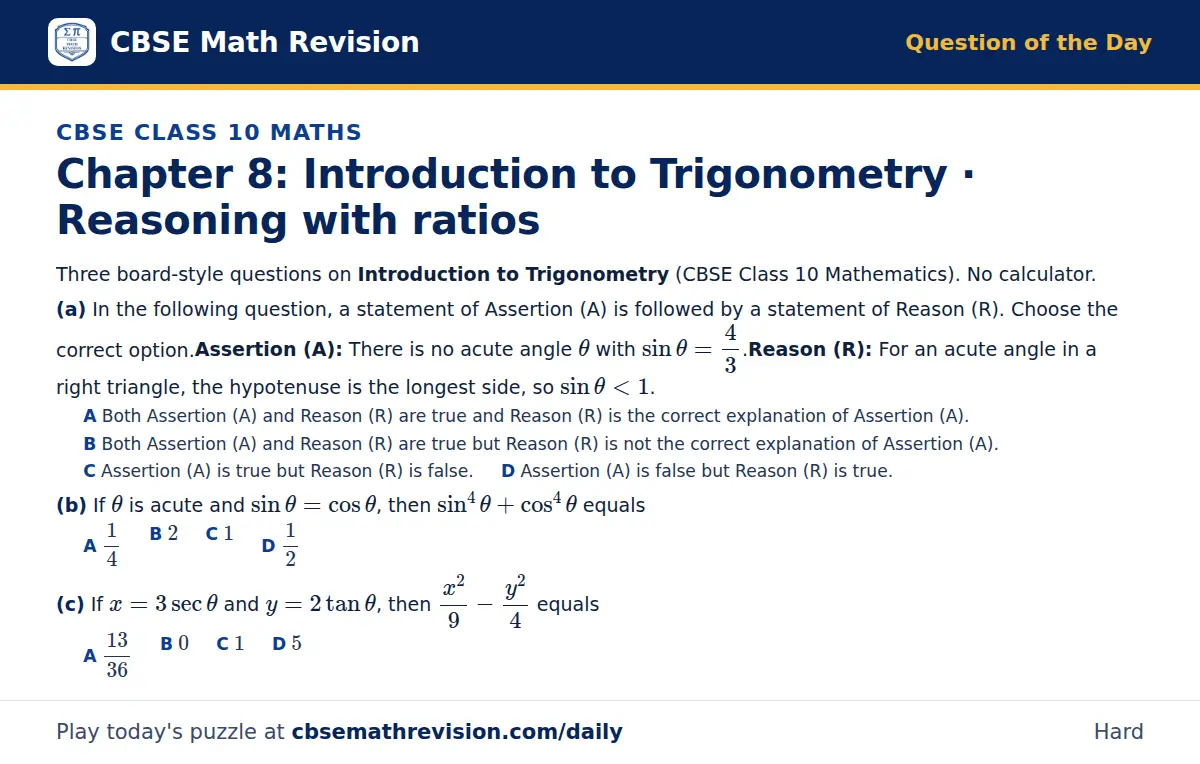
Chapter 8: Introduction to Trigonometry · Reasoning with ratios
Three board-style questions on Introduction to Trigonometry (CBSE Class 10 Mathematics). No calculator.
- In the following question, a statement of Assertion (A) is followed by a statement of Reason (R). Choose the correct option. Assertion (A): There is no acute angle θ with sinθ = 43. Reason (R): For an acute angle in a right triangle, the hypotenuse is the longest side, so sinθ < 1. Options: A) Both Assertion (A) and Reason (R) are true and Reason (R) is the correct explanation of Assertion (A).; B) Both Assertion (A) and Reason (R) are true but Reason (R) is not the correct explanation of Assertion (A).; C) Assertion (A) is true but Reason (R) is false.; D) Assertion (A) is false but Reason (R) is true.
- If θ is acute and sinθ = cosθ, then sin⁴θ + cos⁴θ equals Options: A) 1/4; B) 2; C) 1; D) 1/2
- If x = 3secθ and y = 2tanθ, then (x²)/9 - (y²)/4 equals Options: A) 13/36; B) 0; C) 1; D) 5
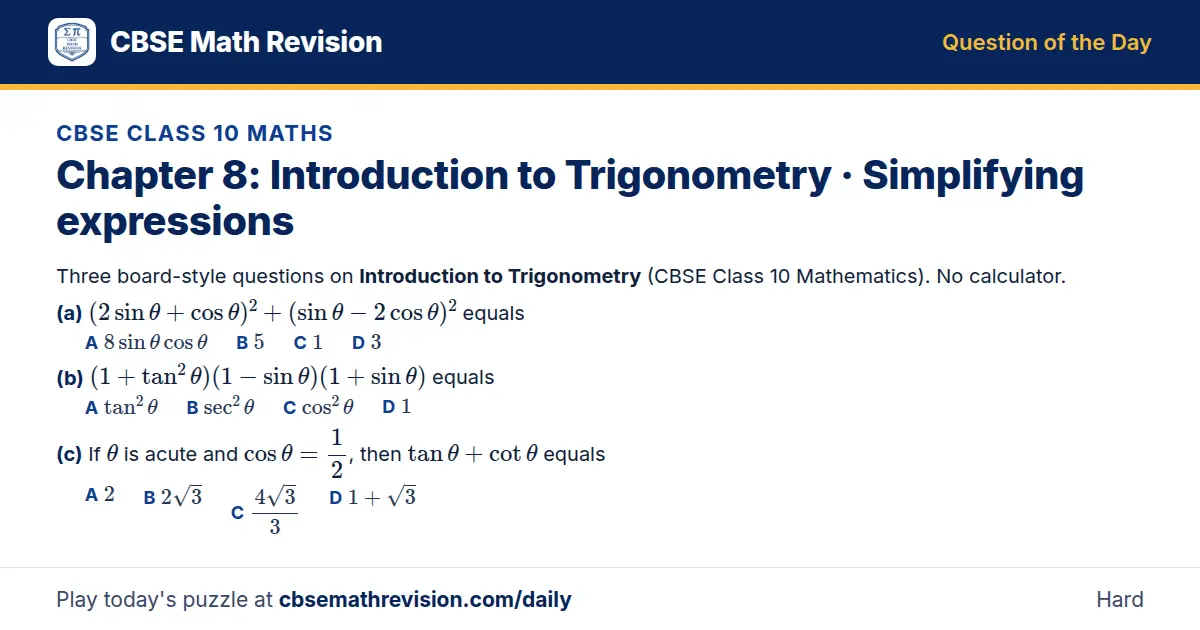
Chapter 8: Introduction to Trigonometry · Simplifying expressions
Three board-style questions on Introduction to Trigonometry (CBSE Class 10 Mathematics). No calculator.
- (2sinθ + cosθ)² + (sinθ - 2cosθ)² equals Options: A) 8 sin θ cos θ; B) 5; C) 1; D) 3
- (1 + tan²θ)(1 - sinθ)(1 + sinθ) equals Options: A) tan² θ; B) sec² θ; C) cos² θ; D) 1
- If θ is acute and cosθ = 12, then tanθ + cotθ equals Options: A) 2; B) 2 √3; C) (4 √3)/3; D) 1 + √3
More Question of the Day puzzles
Other chapters: Chapters 1–4 · Chapters 5–8 · Chapters 9–11 · Chapters 12–14. See all CBSE Maths daily and weekly questions.