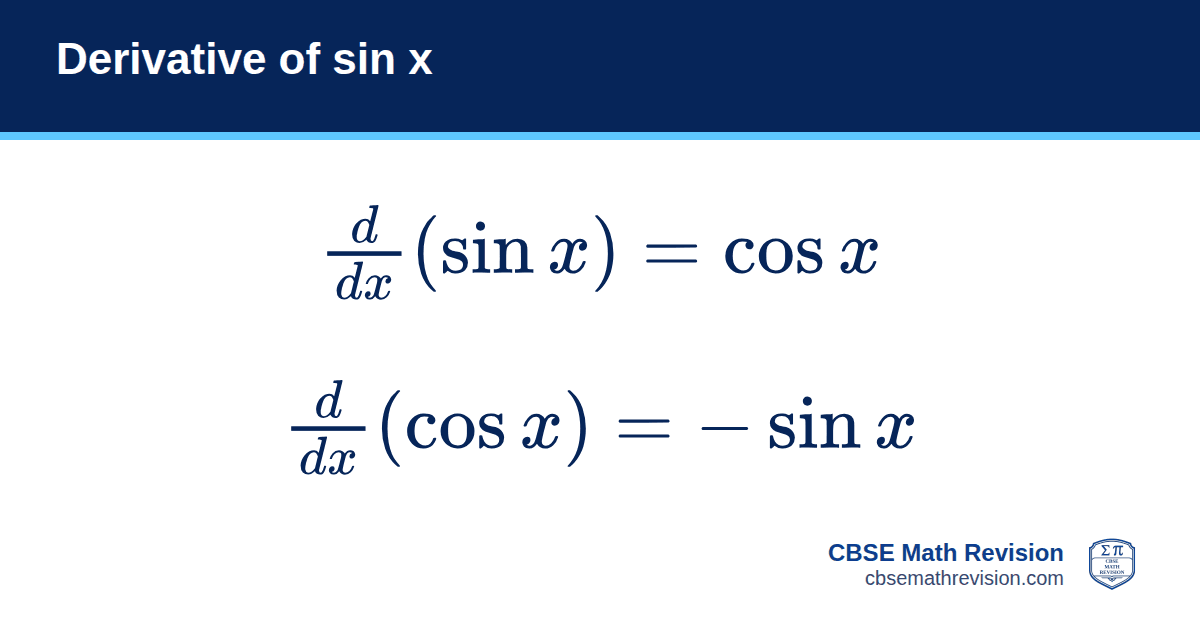
Differentiation of sin x: d/dx (sin x) = cos x
The differentiation of sin x is d/dx (sin x) = cos x and d/dx (cos x) = −sin x (x in radians).
What each letter means
- \(x\) the angle, in radians
- \(\frac{d}{dx}\) differentiate with respect to x
When to use it
To find gradients, rates of change and stationary points of trig functions. With the chain rule, d/dx (sin kx) = k cos kx.
Worked example
Differentiate \(y=5\sin x+x^2\) with respect to \(x\).
- \(\dfrac{d}{dx}(5\sin x)=5\cos x\) and \(\dfrac{d}{dx}(x^2)=2x\)
Answer: \(\dfrac{dy}{dx}=5\cos x+2x\)
Common mistake
Losing the minus sign: the derivative of cos x is −sin x. And the results only hold with x in radians.
On your course
| Course | In the exam |
|---|---|
| Class 11 | Learn it: CBSE gives no formula booklet |
From our own CBSE Maths formula sheets, in our words.
Practise and revise
Questions
What is the differentiation of sin x formula?
The differentiation of sin x is d/dx (sin x) = cos x and d/dx (cos x) = −sin x (x in radians). x: the angle, in radians; d/dx: differentiate with respect to x.
Is the derivative of sin x given in the exam?
Class 11: learn it: CBSE gives no formula booklet. This comes from our own CBSE Maths formula sheets; your teacher has the official booklet.
Why must x be in radians?
The result comes from sin h / h → 1 as h → 0, which is only true when h is measured in radians.
Our own wording, examples and card, checked by CBSE Math Revision. Not produced or endorsed by CBSE or NCERT.