CBSE Math Revisioncbsemathrevision.com
CBSE Class 11 MathematicsAll 14 chapters · one-page formula sheet · 2026–27 rationalised syllabus
CBSE gives no formula booklet: learn every result on this sheet. Organised by NCERT chapter.
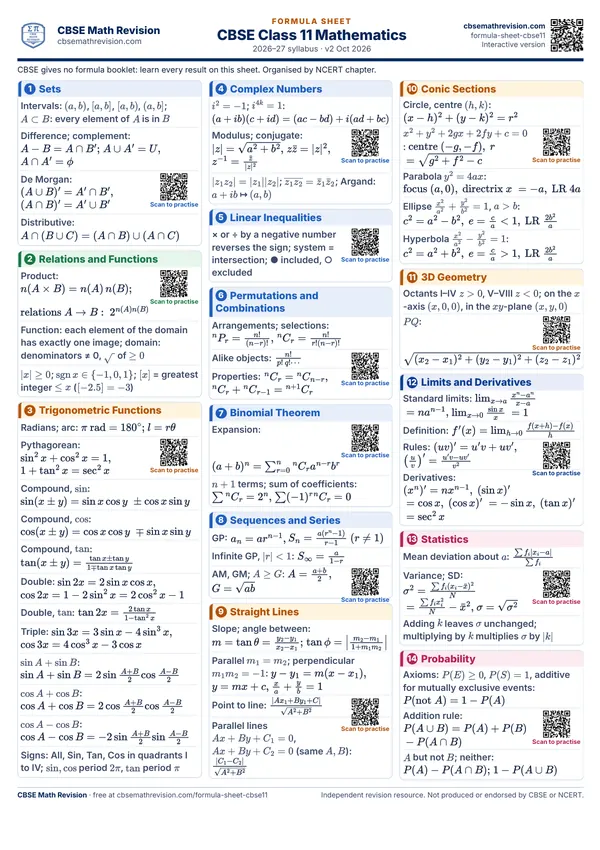
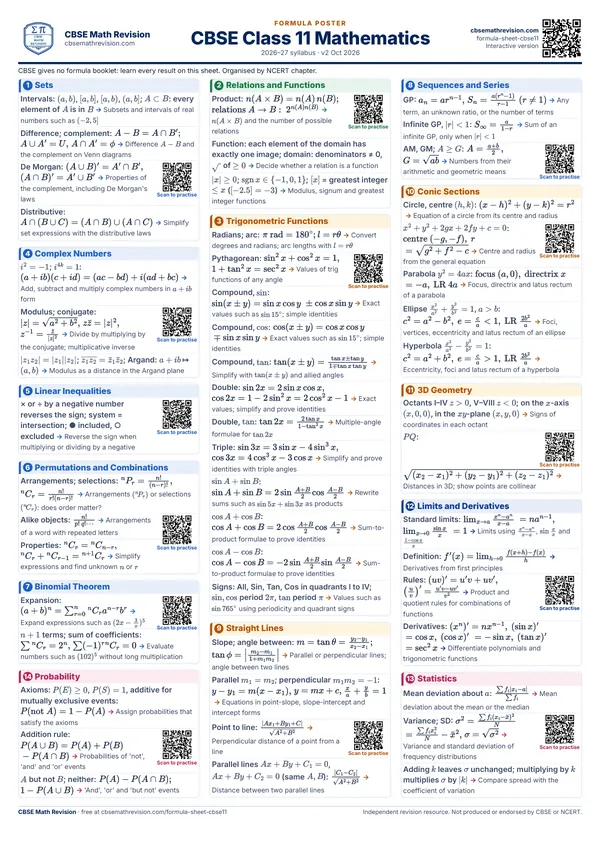
1 Sets
Intervals: \((a,b)\), \([a,b]\), \([a,b)\), \((a,b]\); \(A\subset B\): every element of \(A\) is in \(B\)Use: Subsets and intervals of real numbers such as \((-2, 5]\)
Difference; complement: \(A-B=A\cap B';\) \(A\cup A'=U,\) \(A\cap A'=\phi\)Use: Difference \(A - B\) and the complement on Venn diagrams
De Morgan: \((A\cup B)'=A'\cap B',\) \((A\cap B)'=A'\cup B'\)Use: Properties of the complement, including De Morgan's laws
Distributive: \(A\cap(B\cup C)=(A\cap B)\cup(A\cap C)\)Use: Simplify set expressions with the distributive laws
2 Relations and Functions
Product: \(n(A\times B)=n(A)\,n(B);\) \(\text{relations }A\to B:\ 2^{n(A)n(B)}\)Use: \(n(A \times B)\) and the number of possible relations
Function: each element of the domain has exactly one image; domain: denominators ≠ 0, \(\sqrt{\ }\) of \(\ge0\)Use: Decide whether a relation is a function
\(|x|\ge0\); \(\operatorname{sgn}x\in\{-1,0,1\}\); \([x]\) = greatest integer \(\le x\) (\([-2.5]=-3\))Use: Modulus, signum and greatest integer functions
3 Trigonometric Functions
Radians; arc: \(\pi\text{ rad}=180^\circ;\) \(l=r\theta\)Use: Convert degrees and radians; arc lengths with \(l = r\theta\)
Compound, \(\sin\): \(\sin(x\pm y)=\sin x\cos y\) \({}\pm\cos x\sin y\)Use: Exact values such as \(\sin 15^\circ\); simple identities
Compound, \(\cos\): \(\cos(x\pm y)=\cos x\cos y\) \({}\mp\sin x\sin y\)Use: Exact values such as \(\sin 15^\circ\); simple identities
Compound, \(\tan\): \(\tan(x\pm y)=\frac{\tan x\pm\tan y}{1\mp\tan x\tan y}\)Use: Simplify with \(\tan(x \pm y)\) and allied angles
Double: \(\sin2x=2\sin x\cos x,\) \(\cos2x=1-2\sin^2x=2\cos^2x-1\)Use: Exact values; simplify and prove identities
Double, \(\tan\): \(\tan2x=\frac{2\tan x}{1-\tan^2x}\)Use: Multiple-angle formulae for \(\tan 2x\)
Triple: \(\sin3x=3\sin x-4\sin^3x,\) \(\cos3x=4\cos^3x-3\cos x\)Use: Simplify and prove identities with triple angles
\(\sin A+\sin B\): \(\sin A+\sin B=2\sin\tfrac{A+B}2\cos\tfrac{A-B}2\)Use: Rewrite sums such as \(\sin 5x + \sin 3x\) as products
\(\cos A+\cos B\): \(\cos A+\cos B=2\cos\tfrac{A+B}2\cos\tfrac{A-B}2\)Use: Sum-to-product formulae to prove identities
\(\cos A-\cos B\): \(\cos A-\cos B=-2\sin\tfrac{A+B}2\sin\tfrac{A-B}2\)Use: Sum-to-product formulae to prove identities
Signs: All, Sin, Tan, Cos in quadrants I to IV; \(\sin,\cos\) period \(2\pi\), \(\tan\) period \(\pi\)Use: Values such as \(\sin 765^\circ\) using periodicity and quadrant signs
4 Complex Numbers
\(i^2=-1\); \(i^{4k}=1\): \((a+ib)(c+id)=(ac-bd)+i(ad+bc)\)Use: Add, subtract and multiply complex numbers in \(a + ib\) form
Modulus; conjugate: \(|z|=\sqrt{a^2+b^2},\) \(z\bar z=|z|^2,\) \(z^{-1}=\frac{\bar z}{|z|^2}\)Use: Divide by multiplying by the conjugate; multiplicative inverse
\(|z_1z_2|=|z_1||z_2|\); \(\overline{z_1z_2}=\bar z_1\bar z_2\); Argand: \(a+ib\) ↦ \((a,b)\)Use: Modulus as a distance in the Argand plane
5 Linear Inequalities
× or ÷ by a negative number reverses the sign; system = intersection; ● included, ○ excludedUse: Reverse the sign when multiplying or dividing by a negative
6 Permutations and Combinations
Arrangements; selections: \({}^nP_r=\frac{n!}{(n-r)!},\) \({}^nC_r=\frac{n!}{r!(n-r)!}\)Use: Arrangements \(({}^{n}\!P_{r})\) or selections \(({}^{n}\!C_{r})\): does order matter?
Alike objects: \(\frac{n!}{p!\,q!\cdots}\)Use: Arrangements of a word with repeated letters
Properties: \({}^nC_r={}^nC_{n-r},\) \({}^nC_r+{}^nC_{r-1}={}^{n+1}C_r\)Use: Simplify expressions and find unknown \(n\) or \(r\)
7 Binomial Theorem
Expansion: \((a+b)^n=\sum_{r=0}^n{}^nC_ra^{n-r}b^r\)Use: Expand expressions such as \((2x - \frac{3}{x})^{5}\)
\(n+1\) terms; sum of coefficients: \(\sum{}^nC_r=2^n,\) \(\sum(-1)^r{}^nC_r=0\)Use: Evaluate numbers such as \((102)^{5}\) without long multiplication
8 Sequences and Series
GP: \(a_n=ar^{n-1},\) \(S_n=\frac{a(r^n-1)}{r-1}\ (r\ne1)\)Use: Any term, an unknown ratio, or the number of terms
Infinite GP, \(|r|<1\): \(S_\infty=\frac a{1-r}\)Use: Sum of an infinite GP, only when \(|r| < 1\)
AM, GM; \(A\ge G\): \(A=\frac{a+b}2,\) \(G=\sqrt{ab}\)Use: Numbers from their arithmetic and geometric means
9 Straight Lines
Slope; angle between: \(m=\tan\theta=\frac{y_2-y_1}{x_2-x_1};\) \(\tan\phi=\left|\frac{m_2-m_1}{1+m_1m_2}\right|\)Use: Parallel or perpendicular lines; angle between two lines
Parallel \(m_1=m_2\); perpendicular \(m_1m_2=-1\): \(y-y_1=m(x-x_1),\) \(y=mx+c,\) \(\frac xa+\frac yb=1\)Use: Equations in point-slope, slope-intercept and intercept forms
Point to line: \(\frac{|Ax_1+By_1+C|}{\sqrt{A^2+B^2}}\)Use: Perpendicular distance of a point from a line
Parallel lines \(Ax+By+C_1=0\), \(Ax+By+C_2=0\) (same \(A, B\)): \(\frac{|C_1-C_2|}{\sqrt{A^2+B^2}}\)Use: Distance between two parallel lines
10 Conic Sections
Circle, centre \((h,k)\): \((x-h)^2+(y-k)^2=r^2\)Use: Equation of a circle from its centre and radius
\(x^2+y^2+2gx+2fy+c=0\): \(\text{centre }(-g,-f),\ r\) \({}=\sqrt{g^2+f^2-c}\)Use: Centre and radius from the general equation
Parabola \(y^2=4ax\): \(\text{focus }(a,0),\ \text{directrix }x\) \({}=-a,\ \text{LR }4a\)Use: Focus, directrix and latus rectum of a parabola
Ellipse \(\frac{x^2}{a^2}+\frac{y^2}{b^2}=1\), \(a>b\): \(c^2=a^2-b^2,\ e=\tfrac ca<1,\ \text{LR }\tfrac{2b^2}a\)Use: Foci, vertices, eccentricity and latus rectum of an ellipse
Hyperbola \(\frac{x^2}{a^2}-\frac{y^2}{b^2}=1\): \(c^2=a^2+b^2,\ e=\tfrac ca>1,\ \text{LR }\tfrac{2b^2}a\)Use: Eccentricity, foci and latus rectum of a hyperbola
11 3D Geometry
Octants I–IV \(z>0\), V–VIII \(z<0\); on the \(x\)-axis \((x,0,0)\), in the \(xy\)-plane \((x,y,0)\)Use: Signs of coordinates in each octant
\(PQ\): \(\sqrt{(x_2-x_1)^2+(y_2-y_1)^2+(z_2-z_1)^2}\)Use: Distances in 3D; show points are collinear
12 Limits and Derivatives
Standard limits: \(\lim_{x\to a}\frac{x^n-a^n}{x-a}\) \({}=na^{n-1},\) \(\lim_{x\to0}\frac{\sin x}x\) \({}=1\)Use: Limits using \(\frac{x^{n} - a^{n}}{x - a}\), \(\sin \frac{x}{x}\) and \(\frac{1 - \cos x}{x}\)
Definition: \(f'(x)=\lim_{h\to0}\frac{f(x+h)-f(x)}h\)Use: Derivatives from first principles
Rules: \((uv)'=u'v+uv',\) \(\left(\frac uv\right)'=\frac{u'v-uv'}{v^2}\)Use: Product and quotient rules for combinations of functions
Derivatives: \((x^n)'=nx^{n-1},\ (\sin x)'\) \({}=\cos x,\ (\cos x)'\) \({}=-\sin x,\ (\tan x)'\) \({}=\sec^2x\)Use: Differentiate polynomials and trigonometric functionsExplained: Derivative of sin x · Power rule
13 Statistics
Mean deviation about \(a\): \(\frac{\sum f_i|x_i-a|}{\sum f_i}\)Use: Mean deviation about the mean or the median
Variance; SD: \(\sigma^2=\frac{\sum f_i(x_i-\bar x)^2}N\) \({}=\frac{\sum f_ix_i^2}N-\bar x^2,\) \(\sigma=\sqrt{\sigma^2}\)Use: Variance and standard deviation of frequency distributions
Adding \(k\) leaves \(\sigma\) unchanged; multiplying by \(k\) multiplies \(\sigma\) by \(|k|\)Use: Compare spread with the coefficient of variation
14 Probability
Axioms: \(P(E)\ge0\), \(P(S)=1\), additive for mutually exclusive events: \(P(\text{not }A)=1-P(A)\)Use: Assign probabilities that satisfy the axioms
Addition rule: \(P(A\cup B)=P(A)+P(B)\) \({}-P(A\cap B)\)Use: Probabilities of 'not', 'and' and 'or' events
\(A\) but not \(B\); neither: \(P(A)-P(A\cap B);\) \(1-P(A\cup B)\)Use: 'And', 'or' and 'but not' events