Integration by parts formula: ∫ f g dx = f ∫ g dx − ∫ (f′ ∫ g dx) dx
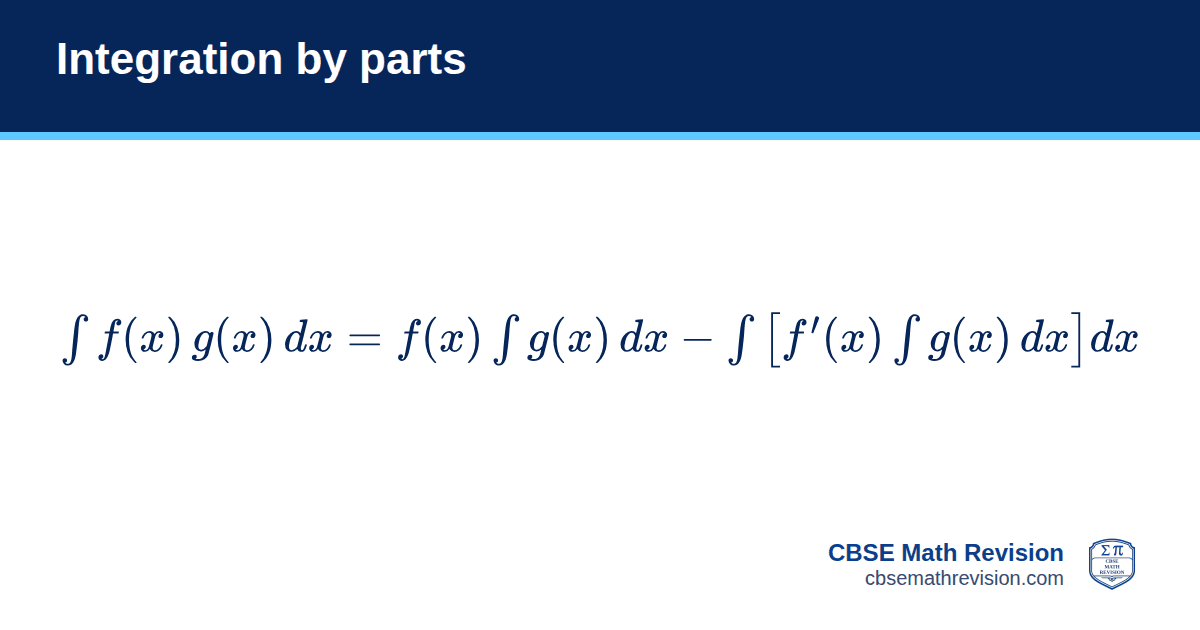
The integration by parts formula is ∫ f(x) g(x) dx = f(x) ∫ g(x) dx − ∫ [f′(x) ∫ g(x) dx] dx.
Example: ∫ x cos x dx = x sin x − ∫ sin x dx = x sin x + cos x + C (f = x by ILATE).
What each letter means
- \(f(x)\) the first function, chosen by ILATE (you differentiate it)
- \(g(x)\) the second function (you integrate it)
Integration by parts in the CBSE syllabus
| Class | Chapter |
|---|---|
| Class 12 Board exam | Chapter 7: Integrals Calculus unit: 35 of the 80 theory marks |
Calculators are not allowed: CBSE's 2026-27 sample question paper for Class 12 Mathematics says: "Use of calculators is not allowed." The paper is 3 hours and 80 marks. So questions give any value you need and expect exact answers; every example on this page works by hand.
In our Class 12 Integrals question bank, 8 of the 67 board-style questions are on this: 1 one-mark, 2 two-mark, 3 three-mark, 1 four-mark and 1 five-mark questions.
In our Class 12 sample papers on the 2026-27 pattern it comes up 5 times: paper 1, Q12 (1 mark), paper 2, Q27 (3 marks), paper 4, Q27 (3 marks), paper 6, Q27 (3 marks), paper 6, Q34 (5 marks).
When to use it
To integrate a product such as x eˣ, x sin x or x ln x, where substitution does not help.
Many books write it with u and v: ∫ uv dx = u ∫ v dx − ∫ (u′ ∫ v dx) dx, where u is the first function. In differential form it is ∫ u dv = uv − ∫ v du.
Worked example
Evaluate \(\displaystyle\int x\cos x\,dx\).
- By ILATE, first function \(f=x\), second \(g=\cos x\)
- \(x\sin x-\displaystyle\int1\cdot\sin x\,dx\)
Answer: \(x\sin x+\cos x+C\)
Common mistake
Choosing u badly. With ln x, let u = ln x (you cannot easily integrate it); with x eˣ, let u = x.
Try one yourself
One quick CBSE Maths question on the integration by parts. No sign-in needed.
Integrating by parts, \(\displaystyle\int xe^{x}\,dx\) is found to be
Get 5 more like this — freeGoogle, Microsoft or email. No card needed.
CBSE board-style questions, marked step by step
Our own questions in the styles of the CBSE paper, with the marks set against each line the way a marking scheme splits them. The splits are our illustration: how step marking works.
Find \(\displaystyle\int x^2\log x\,dx\), \(x \gt 0\).
- ILATE: \(\log x\) (L) comes before \(x^2\) (A), so the first function is \(f=\log x\) and the second \(g=x^2\): \(\displaystyle\int x^2\log x\,dx=\log x\cdot\frac{x^3}{3}-\int\frac1x\cdot\frac{x^3}{3}\,dx\) 1 mark · method: f chosen, formula with values in
- \(=\dfrac{x^3}{3}\log x-\dfrac13\displaystyle\int x^2\,dx\) 1 mark · simplifying the second integral
- \(=\dfrac{x^3}{3}\log x-\dfrac{x^3}{9}+C\) 1 mark · answer, with + C
Answer: \(\dfrac{x^3}{3}\log x-\dfrac{x^3}{9}+C\) 3 marks in all
Where marks slip: Taking \(f=x^2\) instead leaves \(\int\log x\,dx\) to be done first, which is longer. Leaving out \(+\,C\) costs the last mark.
Evaluate \(\displaystyle\int_0^{\pi/2} x\sin x\,dx\).
- \(f=x\), \(g=\sin x\): \(\displaystyle\int x\sin x\,dx=x(-\cos x)-\int 1\cdot(-\cos x)\,dx\) 1 mark · method: formula with f and g
- \(=-x\cos x+\sin x\) 1 mark · integral found
- \(\Big[-x\cos x+\sin x\Big]_0^{\pi/2}=\left(0+1\right)-\left(0+0\right)=1\) 1 mark · limits substituted, answer
Answer: \(1\) 3 marks in all
Where marks slip: Watch the sign: \(\int\sin x\,dx=-\cos x\), a slip we list among this chapter's mark losses. Show both limits on the page, even when one gives \(0\).
For \(x \gt 0\), \(\displaystyle\int e^{x}\left(\dfrac1x - \dfrac{1}{x^2}\right)dx\) equals
- (a) \(\dfrac{e^x}{x^2} + C\)
- (b) \(e^x\log x + C\)
- (c) \(\dfrac{e^x}{x} + C\)
- (d) \(-\dfrac{e^x}{x} + C\)
Answer: (c) \(\dfrac{e^x}{x} + C\)
With \(f(x) = \dfrac1x\), \(f'(x) = -\dfrac{1}{x^2}\): \(\int e^x(f + f')\,dx = e^xf(x) + C = \dfrac{e^x}{x} + C\).
An MCQ carries no part marks, so check the option before you move on.
Where CBSE students lose marks with it
- Missing +C in indefinite integrals. Fix: write + C on every indefinite answer; the A1 is lost without it.
- Sign slips with ∫sin x dx = −cos x and in integration by parts. Fix: choose u by ILATE and write the formula ∫u v dx = u∫v − ∫(u′∫v) before substituting.
- Integration: + C forgotten and substitution signs. Fix: Write + C on every indefinite integral; show the substitution and dt line.
Revise it for your CBSE exam
- Revise Class 12 Chapter 7: Integrals: notes, practice and the Route to 95
- Free 10 Integrals important questions with step-marked answers
- Print Chapter 7 on the Class 12 formula sheet
- Practise Skill Builder: Integration by parts (Class 12, free account)
- Papers Class 12 sample papers on the 2026-27 pattern
- Dates CBSE board exam dates and the 2027 timetable
- Beyond JEE Main and CUET practice: integrals and differential equations
On your CBSE Maths course
| Course | In the exam |
|---|---|
| Class 12 | Learn it: CBSE gives no formula booklet |
From our own CBSE Maths formula sheets, in our words.
Practise and revise
- Practise Class 12 Integrals MCQs
- Revise Class 12 Integrals
- Print Class 12 one-page formula sheet
CBSE Maths FAQ
Is the integration by parts given in the CBSE board exam?
Class 12: learn it: CBSE gives no formula booklet.
What is the ILATE rule?
ILATE is the order for choosing the first function f (the one you differentiate): Inverse trigonometric, Logarithmic, Algebraic, Trigonometric, Exponential. In ∫ x cos x dx, x (algebraic) comes before cos x (trigonometric), so f = x.
Which CBSE class and chapter covers integration by parts?
Class 12, Chapter 7 (Integrals), in the Calculus unit, which carries 35 of the 80 theory marks. CBSE gives marks by unit, not by chapter.
What does ILATE stand for in CBSE Class 12 integration?
Inverse trigonometric, Logarithmic, Algebraic, Trigonometric, Exponential: the order for picking the first function (the one you differentiate), as on our Class 12 formula sheet. In ∫x² log x dx, log x (L) comes before x² (A), so log x is the first function and you integrate x².
Are calculators allowed for integration by parts questions in the CBSE board exam?
No. CBSE's 2026-27 sample question paper for Class 12 Mathematics says: "Use of calculators is not allowed." The paper is 3 hours and 80 marks. Questions give any value you need, such as π = 22/7.
What is ∫eˣ[f(x) + f′(x)] dx?
eˣf(x) + C. It comes from integration by parts, and our Class 12 sample papers 1 and 2 each have a question of this form (sample paper 1, question 12; sample paper 2, question 27).
Our own wording, examples and card, checked by CBSE Math Revision. Not produced or endorsed by CBSE or NCERT.