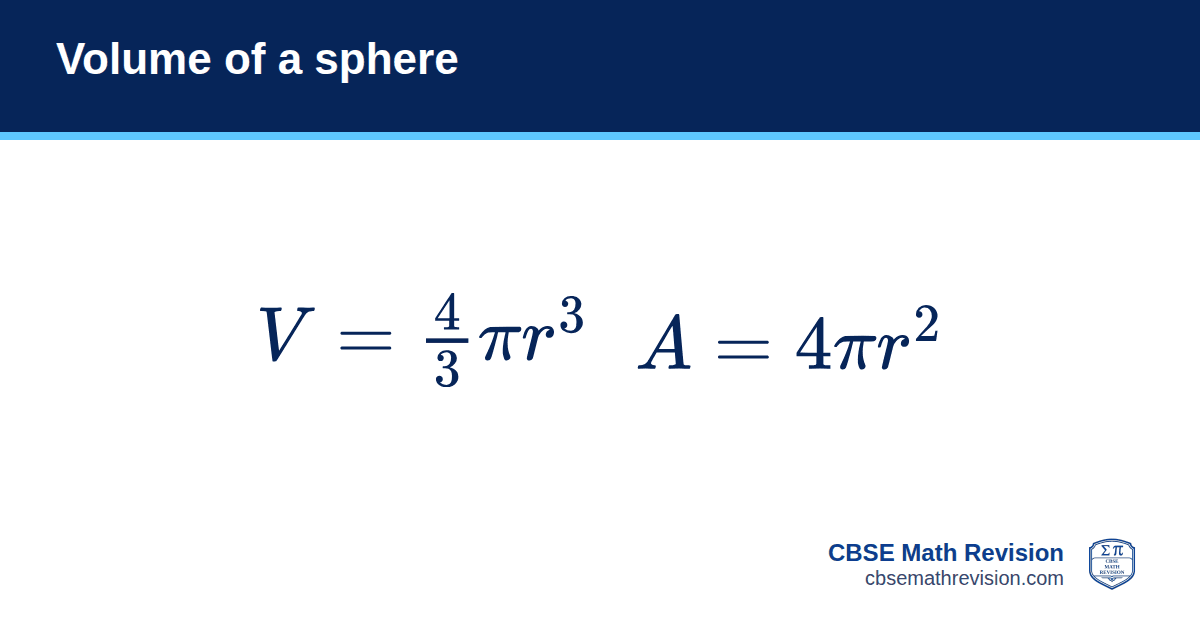
Volume of a sphere formula: V = ⁴⁄₃πr³
The volume of a sphere formula is V = ⁴⁄₃πr³ (surface area A = 4πr²).
Example: r = 21 cm gives V = ⁴⁄₃ × 22/7 × 21³ = 38808 cm³.
What each letter means
- \(V\) the volume
- \(A\) the surface area
- \(r\) the radius
Volume of a sphere in the CBSE syllabus
| Class | Chapter |
|---|---|
| Class 10 Board exam | Chapter 12: Surface Areas and Volumes Mensuration unit: 10 of the 80 theory marks |
| Class 9 School exam | Chapter 13: Surface Area and Volume Mensuration unit: 14 of the 80 theory marks |
Class 10, Basic or Standard: both papers need it. Standard (041) and Basic (241) share one Class 10 curriculum document, the NCERT textbook and the same 20-mark internal assessment (pen-paper tests 10, portfolio 5, lab practical 5). Basic papers put more of the 80 marks on remembering and understanding (60, against 43 in Standard), so Standard has more application questions. Basic or Standard: how to choose.
Calculators are not allowed: CBSE's 2026-27 sample question papers for Class 10 (Mathematics Standard and Mathematics Basic) say: "Use of calculators is not allowed." Each paper is 3 hours and 80 marks. So questions give any value you need and expect exact answers; every example on this page works by hand.
Class 9: a school exam on CBSE's syllabus (80 marks theory + 20 internal assessment), so your school sets the paper; the board-style questions below are good practice for it.
In our Class 10 Surface Areas and Volumes question bank, 12 of the 46 board-style questions are on this: 3 one-mark, 2 two-mark, 4 three-mark, 1 four-mark and 2 five-mark questions.
In our Class 10 sample papers on the 2026-27 pattern it comes up 5 times: paper 3, Q15 (1 mark), paper 3, Q35 (5 marks), paper 4, Q15 (1 mark), paper 4, Q25 (2 marks), paper 5, Q16 (1 mark).
When to use it
For balls, bubbles, planets and hemispheres (half of each formula, plus the flat face πr² for the surface of a solid hemisphere).
Worked example
Find the volume and the surface area of a sphere of radius 21 cm. Use \(\pi=\tfrac{22}{7}\).
- \(V=\tfrac43\times\tfrac{22}{7}\times21^3=38\,808\)
- \(A=4\times\tfrac{22}{7}\times21^2=5544\)
Answer: \(V=38\,808\text{ cm}^3\), \(A=5544\text{ cm}^2\)
Common mistake
Using the diameter as r. Halve the diameter first.
Try one yourself
One quick CBSE Maths question on the volume of a sphere. No sign-in needed.
The volume of a hemisphere of radius \(3\) cm is
Get 5 more like this — freeGoogle, Microsoft or email. No card needed.
CBSE board-style questions, marked step by step
Our own questions in the styles of the CBSE paper, with the marks set against each line the way a marking scheme splits them. The splits are our illustration: how step marking works.
A hemispherical bowl has an internal radius of \(21\) cm. How many litres of water can it hold? (Take \(\pi=\dfrac{22}{7}\).)
- \(V=\dfrac23\pi r^3=\dfrac23\times\dfrac{22}{7}\times21\times21\times21=19404\ \text{cm}^3\) 1 mark · hemisphere volume
- \(1000\ \text{cm}^3=1\) litre, so \(19404\ \text{cm}^3=19.404\) litres 1 mark · units converted, answer
Answer: \(19.404\) litres 2 marks in all
Where marks slip: A hemisphere is half a sphere: \(\tfrac23\pi r^3\), not \(\tfrac43\pi r^3\). Convert to litres only at the end.
A solid metal sphere of radius \(6\) cm is melted and recast into a solid cone of base radius \(6\) cm. Find the height of the cone.
- The volume does not change: \(\dfrac43\pi(6)^3=\dfrac13\pi(6)^2h\) 1 mark · equal volumes
- \(288\pi=12\pi h\) 1 mark · both sides worked out
- \(h=24\) cm 1 mark · answer with units
Answer: \(24\) cm 3 marks in all
Where marks slip: Leave \(\pi\) as \(\pi\): it cancels, so there is nothing to approximate.
The largest sphere is carved out of a solid cube of edge \(14\) cm. The volume of the sphere is (Take \(\pi = \dfrac{22}{7}\).)
- (a) \(\dfrac{2156}{3}\ \text{cm}^3\)
- (b) \(1372\ \text{cm}^3\)
- (c) \(\dfrac{4312}{3}\ \text{cm}^3\)
- (d) \(4312\ \text{cm}^3\)
Answer: (c) \(\dfrac{4312}{3}\ \text{cm}^3\)
\(r = 7\) cm. \(V = \dfrac43 \times \dfrac{22}{7} \times 343 = \dfrac{4312}{3}\ \text{cm}^3\).
An MCQ carries no part marks, so check the option before you move on.
Where CBSE students lose marks with it
- Mixing units (cm with m, cm³ with litres). Fix: convert at the start; 1000 cm³ = 1 litre and 1 m³ = 1000 litres.
- Using the diameter as the radius. Fix: write r = d/2 on the first line.
- Mensuration: units, π and squaring the radius. Fix: Write the formula, square r, use the π given, and finish with the right unit.
Revise it for your CBSE exam
- Revise Class 10 Chapter 12: Surface Areas and Volumes: notes, practice and the Route to 95
- Free 10 Surface Areas and Volumes important questions with step-marked answers
- Print Chapter 12 on the Class 10 formula sheet
- Practise Skill Builder: Volume of basic solids (Class 10, free account)
- Revise Class 9 Chapter 13: Surface Area and Volume: notes, practice and the Route to 95
- Print Chapter 13 on the Class 9 formula sheet
- Practise Skill Builder: Sphere and hemisphere (Class 9, free account)
- Papers Class 10 sample papers on the 2026-27 pattern
- Dates CBSE board exam dates and the 2027 timetable
On your CBSE Maths course
| Course | In the exam |
|---|---|
| Class 10 | Learn it: CBSE gives no formula booklet |
| Class 9 | Learn it: CBSE gives no formula booklet |
From our own CBSE Maths formula sheets, in our words.
Practise and revise
CBSE Maths FAQ
Is the volume of a sphere given in the CBSE board exam?
Class 10: learn it: CBSE gives no formula booklet. Class 9: learn it: CBSE gives no formula booklet.
What is the surface area of a sphere?
Surface area = 4πr². A hemisphere has curved surface 2πr², plus πr² for the flat face if it is solid.
Which CBSE class and chapter covers volume of a sphere?
Class 10, Chapter 12 (Surface Areas and Volumes), in the Mensuration unit, which carries 10 of the 80 theory marks; it is also used in Class 9, Chapter 13 (Surface Area and Volume), in the Mensuration unit, which carries 14 of the 80 theory marks. CBSE gives marks by unit, not by chapter.
What is the volume of a hemisphere?
Half the sphere: ⅔πr³. Its curved surface area is 2πr², and a solid hemisphere's total surface area is 3πr² (the flat circle πr² as well).
Do CBSE Basic and Standard maths both need volume of a sphere?
Yes. Standard (041) and Basic (241) share one Class 10 curriculum document, the NCERT textbook and the same 20-mark internal assessment (pen-paper tests 10, portfolio 5, lab practical 5). Class 10 students in 2026-27 (board exam in 2027) stay on the existing scheme and may opt for Mathematics Basic. CBSE is discontinuing the Basic and Standard levels after them.
Are calculators allowed for volume of a sphere questions in the CBSE board exam?
No. CBSE's 2026-27 sample question papers for Class 10 (Mathematics Standard and Mathematics Basic) say: "Use of calculators is not allowed." Each paper is 3 hours and 80 marks. Questions give any value you need, such as π = 22/7.
How do melting and recasting questions work?
The volume stays the same: write volume of the old solid = total volume of the new solid(s) and solve. The second example above is this type.
Our own wording, examples and card, checked by CBSE Math Revision. Not produced or endorsed by CBSE or NCERT.