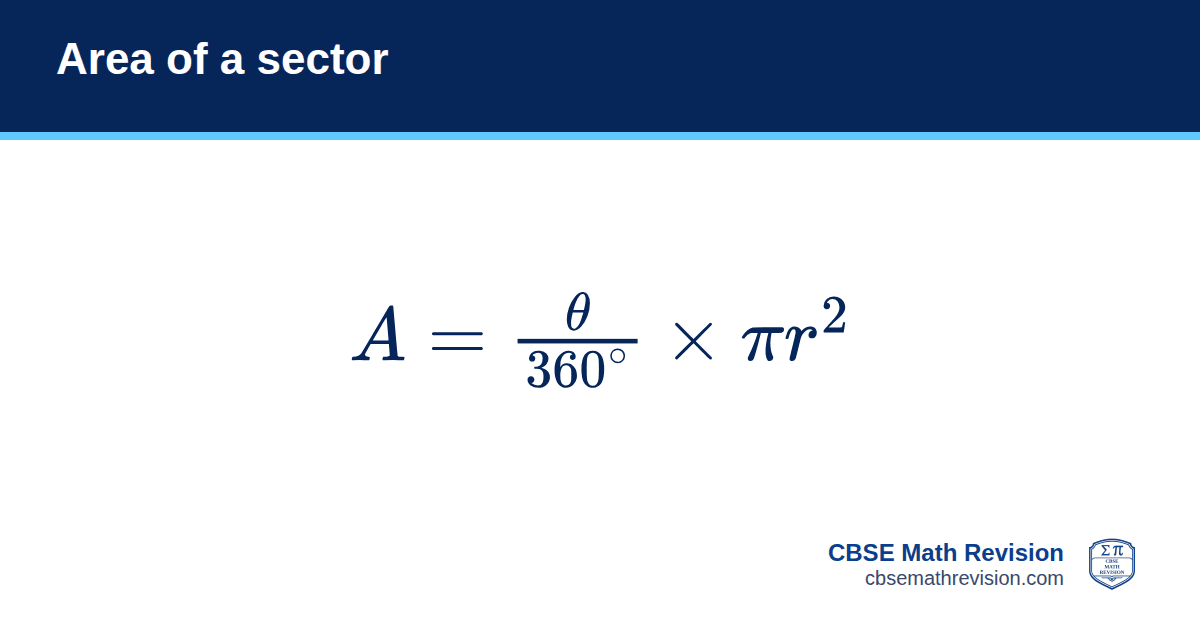
Area of a sector formula: A = θ/360° × πr²
The area of a sector formula is area of a sector = (θ/360°) × πr².
What each letter means
- \(A\) the area of the sector
- \(r\) the radius
- \(\theta\) the angle of the sector, in degrees
When to use it
To find the area of a 'slice' of a circle. Subtract the triangle ½r² sin θ to get the area of a segment.
Worked example
Find the area of a quadrant of a circle of radius 14 cm. Use \(\pi=\tfrac{22}{7}\).
- A quadrant has \(\theta=90^\circ\)
- \(A=\dfrac{90}{360}\times\dfrac{22}{7}\times14^2=\dfrac14\times616\)
Answer: \(154\text{ cm}^2\)
Common mistake
Using 2πr (the circumference) instead of πr² (the area).
On your course
| Course | In the exam |
|---|---|
| Class 10 | Learn it: CBSE gives no formula booklet |
| Class 9 | Learn it: CBSE gives no formula booklet |
From our own CBSE Maths formula sheets, in our words.
Practise and revise
Questions
What is the area of a sector formula?
The area of a sector formula is area of a sector = (θ/360°) × πr². A: the area of the sector; r: the radius; θ: the angle of the sector, in degrees.
Is the area of a sector given in the exam?
Class 10: learn it: CBSE gives no formula booklet. Class 9: learn it: CBSE gives no formula booklet. This comes from our own CBSE Maths formula sheets; your teacher has the official booklet.
What is the difference between a sector and a segment?
A sector is bounded by two radii and an arc, like a slice of pizza. A segment is bounded by a chord and an arc: sector area minus the triangle.
Our own wording, examples and card, checked by CBSE Math Revision. Not produced or endorsed by CBSE or NCERT.