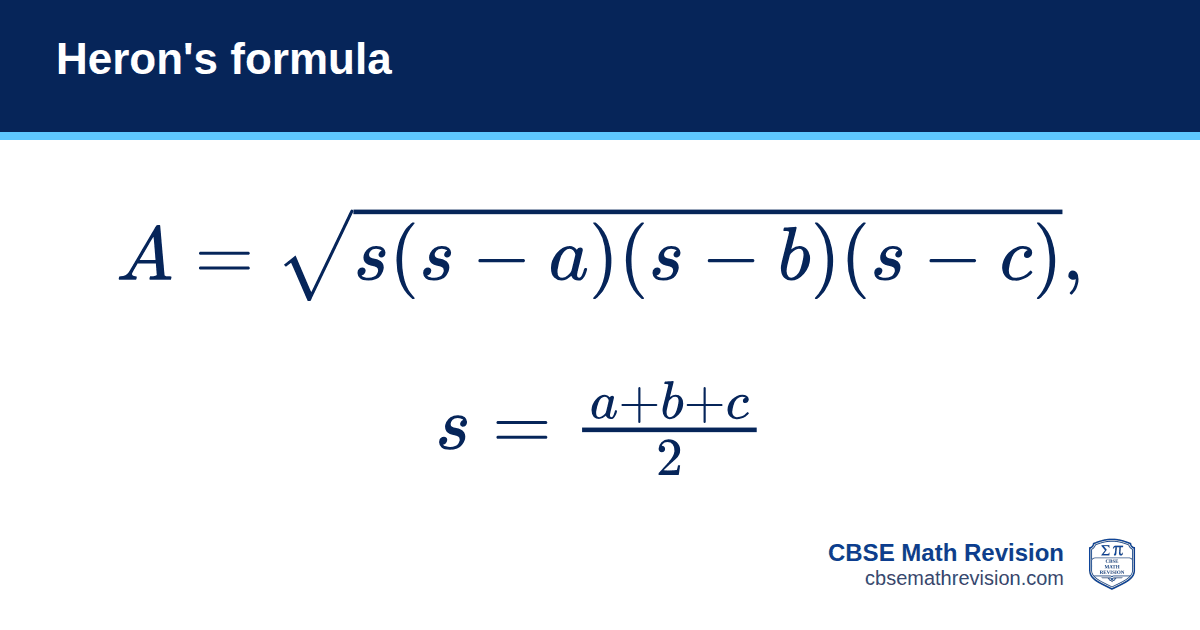
Heron's formula: A = √(s(s − a)(s − b)(s − c))
The Heron's formula is Area = √(s(s − a)(s − b)(s − c)), where s = (a + b + c)/2.
What each letter means
- \(a,\ b,\ c\) the three sides of the triangle
- \(s\) the semi-perimeter: half the perimeter
When to use it
When you know all three sides of a triangle but not its height or any angle.
Worked example
Find the area of a triangle with sides 13 cm, 14 cm and 15 cm.
- \(s=\dfrac{13+14+15}{2}=21\)
- \(A=\sqrt{21\times8\times7\times6}=\sqrt{7056}\)
Answer: \(84\text{ cm}^2\)
Common mistake
Using the whole perimeter for s. s is half the perimeter.
On your course
| Course | In the exam |
|---|---|
| Class 9 | Learn it: CBSE gives no formula booklet |
From our own CBSE Maths formula sheets, in our words.
Practise and revise
- Revise Class 9 Area and Perimeter
- Print Class 9 one-page formula sheet
Questions
What is the Heron's formula?
The Heron's formula is Area = √(s(s − a)(s − b)(s − c)), where s = (a + b + c)/2. a, b, c: the three sides of the triangle; s: the semi-perimeter: half the perimeter.
Is the Heron's formula given in the exam?
Class 9: learn it: CBSE gives no formula booklet. This comes from our own CBSE Maths formula sheets; your teacher has the official booklet.
When should I use Heron's formula?
When all three sides are known. If you know the base and height, ½ × base × height is quicker.
Our own wording, examples and card, checked by CBSE Math Revision. Not produced or endorsed by CBSE or NCERT.