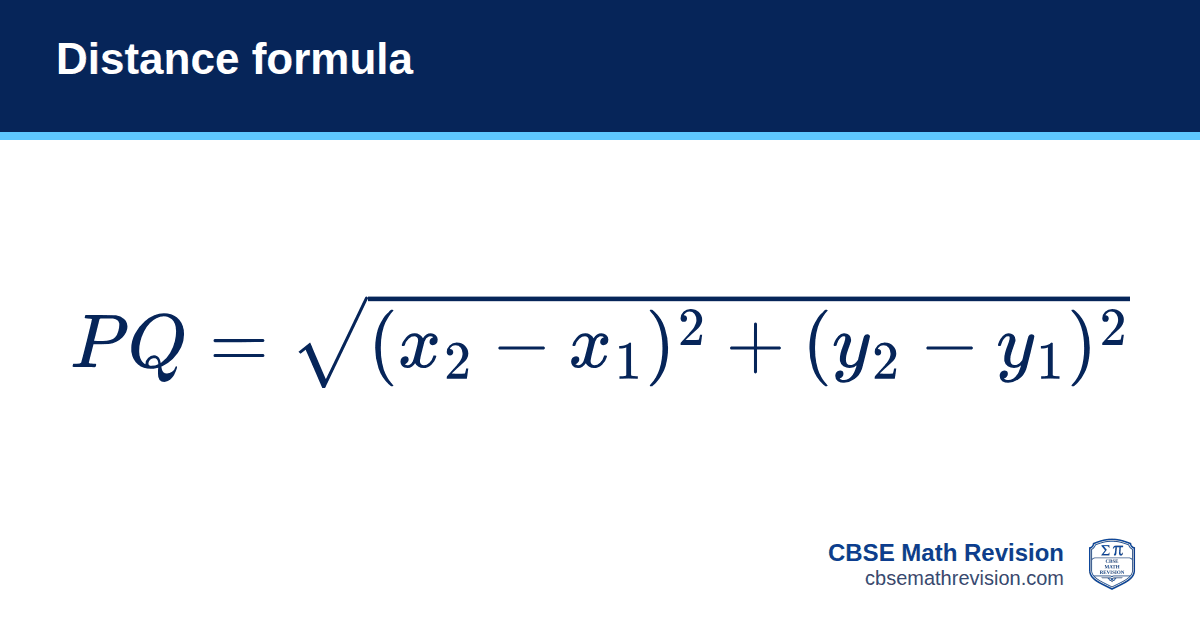
Distance formula: PQ = √((x₂ − x₁)² + (y₂ − y₁)²)
The distance formula is PQ = √((x₂ − x₁)² + (y₂ − y₁)²).
What each letter means
- \(P(x_1,\ y_1),\ Q(x_2,\ y_2)\) the two points
- \(PQ\) the distance between them
When to use it
To find the length of a line segment from the coordinates of its ends. It is Pythagoras on the horizontal and vertical gaps.
Worked example
Find the values of \(x\) for which the distance between \((x,2)\) and \((3,-2)\) is 5 units.
- \((x-3)^2+(2+2)^2=25\), so \((x-3)^2=9\)
- \(x-3=\pm3\)
Answer: \(x=6\) or \(x=0\)
Common mistake
Squaring a negative wrongly: (−6)² = 36, not −36. Put negative differences in brackets.
On your course
| Course | In the exam |
|---|---|
| Class 10 | Learn it: CBSE gives no formula booklet |
| Class 9 | Learn it: CBSE gives no formula booklet |
From our own CBSE Maths formula sheets, in our words.
Practise and revise
- Practise Class 10 Coordinate Geometry MCQs
- Revise Class 10 Coordinate Geometry
- Revise Class 9 Coordinate Geometry
- Print Class 10 one-page formula sheet
Questions
What is the distance formula?
The distance formula is PQ = √((x₂ − x₁)² + (y₂ − y₁)²). P(x₁, y₁), Q(x₂, y₂): the two points; PQ: the distance between them.
Is the distance formula given in the exam?
Class 10: learn it: CBSE gives no formula booklet. Class 9: learn it: CBSE gives no formula booklet. This comes from our own CBSE Maths formula sheets; your teacher has the official booklet.
How is the distance formula related to Pythagoras?
The horizontal and vertical gaps between the points are the two shorter sides of a right-angled triangle, so the distance is its hypotenuse.
Our own wording, examples and card, checked by CBSE Math Revision. Not produced or endorsed by CBSE or NCERT.