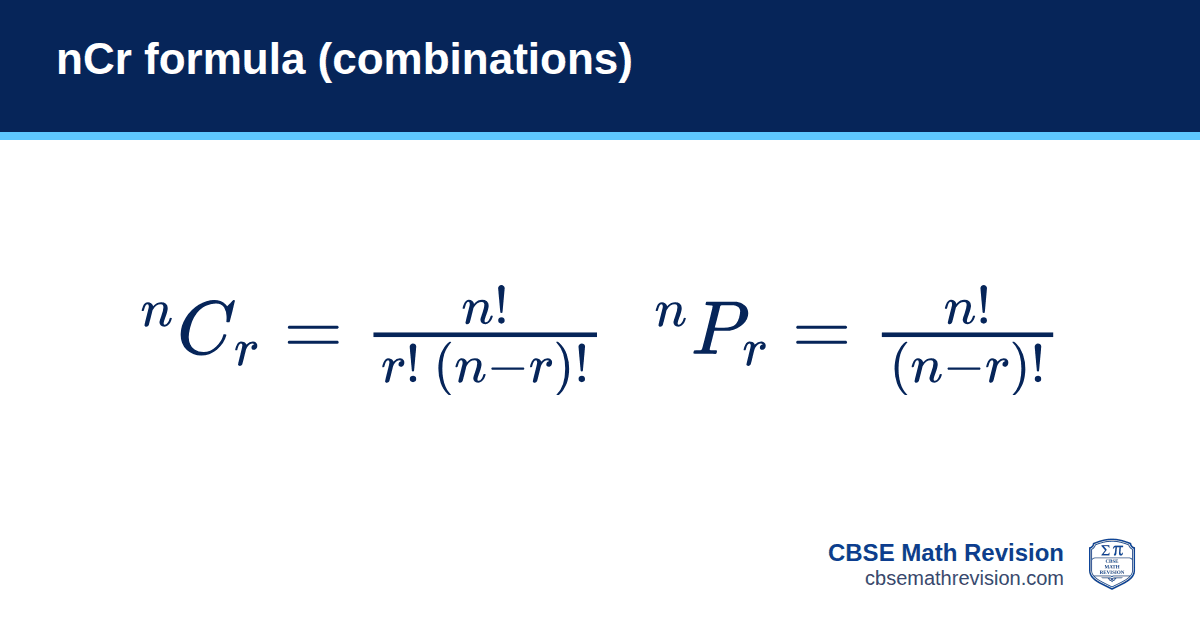
nCr formula: nCr = n! / (r!(n − r)!)
The nCr formula is nCr = n! / (r!(n − r)!) and nPr = n! / (n − r)!.
What each letter means
- \(n\) how many items there are to choose from
- \(r\) how many you choose
- \(n!\) n factorial: n × (n − 1) × … × 2 × 1, with 0! = 1
When to use it
To count selections where the order does not matter (teams, committees, hands of cards), and for the coefficients in a binomial expansion.
Worked example
A committee of 3 boys and 2 girls is chosen from 6 boys and 5 girls. In how many ways can this be done?
- Boys: \({}^6C_3=20\). Girls: \({}^5C_2=10\)
- Both choices are made, so multiply
Answer: \(20\times10=200\) ways
Common mistake
Using nPr when the order does not matter. Choosing Asha then Ben is the same team as Ben then Asha, so use nCr.
On your course
| Course | In the exam |
|---|---|
| Class 11 | Learn it: CBSE gives no formula booklet |
From our own CBSE Maths formula sheets, in our words.
Practise and revise
Questions
What is the nCr formula?
The nCr formula is nCr = n! / (r!(n − r)!) and nPr = n! / (n − r)!. n: how many items there are to choose from; r: how many you choose; n!: n factorial: n × (n − 1) × … × 2 × 1, with 0! = 1.
Is the nCr formula (combinations) given in the exam?
Class 11: learn it: CBSE gives no formula booklet. This comes from our own CBSE Maths formula sheets; your teacher has the official booklet.
What is the difference between nCr and nPr?
nCr counts selections, where order does not matter. nPr = n!/(n − r)! counts arrangements, where it does, so nPr = nCr × r!.
Our own wording, examples and card, checked by CBSE Math Revision. Not produced or endorsed by CBSE or NCERT.