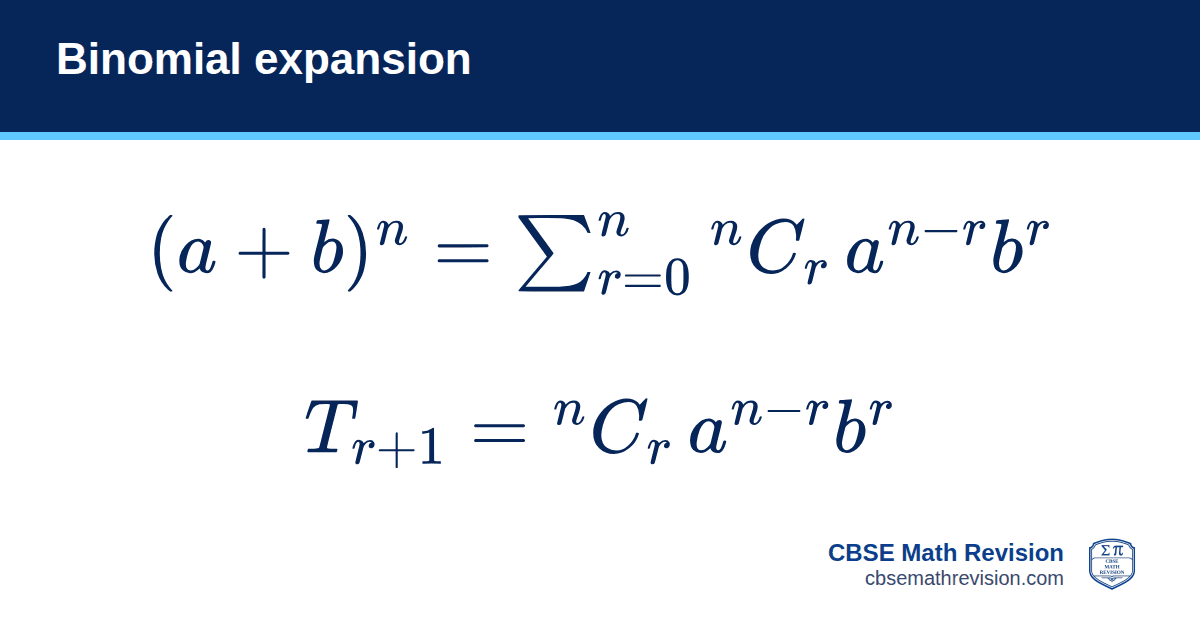
Binomial expansion formula: (a + b)ⁿ = Σ nCr aⁿ⁻ʳ bʳ
The binomial expansion formula is (a + b)ⁿ = Σ nCr aⁿ⁻ʳ bʳ, with general term T(r+1) = nCr aⁿ⁻ʳ bʳ.
What each letter means
- \(n\) the power (a positive whole number)
- \(\binom{n}{r}\) the binomial coefficient nCr
- \(r\) which term: T₁ has r = 0
- \(a,\ b\) the two terms in the bracket, signs included
Binomial expansion in the CBSE syllabus
| Class | Chapter |
|---|---|
| Class 11 School exam | Chapter 7: Binomial Theorem Algebra unit: 25 of the 80 theory marks |
Class 11: a school exam on CBSE's syllabus (80 marks theory + 20 internal assessment), so your school sets the paper; the board-style questions below are good practice for it and for the Class 12 boards.
In our Class 11 Binomial Theorem question bank, 8 of the 32 board-style questions are on this: 3 one-mark, 3 two-mark and 2 three-mark questions.
When to use it
To expand a bracket raised to a power without multiplying it out, or to find one term or coefficient (for example the x³ term) straight away.
Worked example
Find the coefficient of \(x^2\) in the expansion of \((1+3x)^5\).
- The \(x^2\) term has \(r=2\): \(T_3={}^5C_2\,(1)^3(3x)^2\)
- \({}^5C_2=10\) and \((3x)^2=9x^2\)
Answer: \(10\times9=90\)
Common mistake
Forgetting to raise the number with x to the power: in (1 + 3x)⁵ the r = 2 term has (3x)² = 9x², not 3x².
CBSE board-style questions, marked step by step
Our own questions in the styles of the CBSE paper, with the marks set against each line the way a marking scheme splits them. The splits are our illustration.
Expand \((2x-3)^4\) using the binomial theorem.
- \((2x)^4+4(2x)^3(-3)+6(2x)^2(-3)^2+4(2x)(-3)^3+(-3)^4\) 1 mark · coefficients 1, 4, 6, 4, 1 with each term bracketed
- \(=16x^4-96x^3+216x^2-216x+81\) 1 mark · answer
Answer: \(16x^4-96x^3+216x^2-216x+81\) 2 marks in all
Where marks slip: Bracket \((2x)\) and \((-3)\) before raising them to a power: \((2x)^3=8x^3\), not \(2x^3\), and the signs alternate.
Using the binomial theorem, find the value of \((98)^4\).
- \((98)^4=(100-2)^4={}^4C_0\,100^4-{}^4C_1\,100^3(2)+{}^4C_2\,100^2(2)^2-{}^4C_3\,100(2)^3+{}^4C_4(2)^4\) 1 mark · split and expansion written
- \(=100000000-8000000+240000-3200+16\) 1 mark · each term worked out
- \(=92236816\) 1 mark · answer
Answer: \(92236816\) 3 marks in all
Where marks slip: Choose the split that makes the powers easy (\(100-2\), not \(90+8\)). Calculators are not allowed, so the method is the point of the question.
Where CBSE students lose marks with it
- Coefficient inside the bracket not raised to the power: (3x)² written 3x². Fix: bracket every term before raising it.
- Alternating signs missed in (a − b)ⁿ. Fix: the sign is (−1)^(power of b).
Revise it for your CBSE exam
On your CBSE Maths course
| Course | In the exam |
|---|---|
| Class 11 | Learn it: CBSE gives no formula booklet |
From our own CBSE Maths formula sheets, in our words.
Practise and revise
- Revise Class 11 Binomial Theorem
- Print Class 11 one-page formula sheet
CBSE Maths FAQ
Is the binomial expansion given in the CBSE board exam?
Class 11: learn it: CBSE gives no formula booklet.
How do I find one term without expanding everything?
Use the general term T(r+1) = nCr aⁿ⁻ʳ bʳ and choose r so that the power of x is the one you want.
Which CBSE class and chapter covers binomial expansion?
Class 11, Chapter 7 (Binomial Theorem), in the Algebra unit, which carries 25 of the 80 theory marks. CBSE gives marks by unit, not by chapter.
How many terms are there in the expansion of (a + b)ⁿ?
n + 1, and the coefficients add up to 2ⁿ (put a = b = 1). Both are on our Class 11 formula sheet, in the Binomial Theorem section.
Our own wording, examples and card, checked by CBSE Math Revision. Not produced or endorsed by CBSE or NCERT.