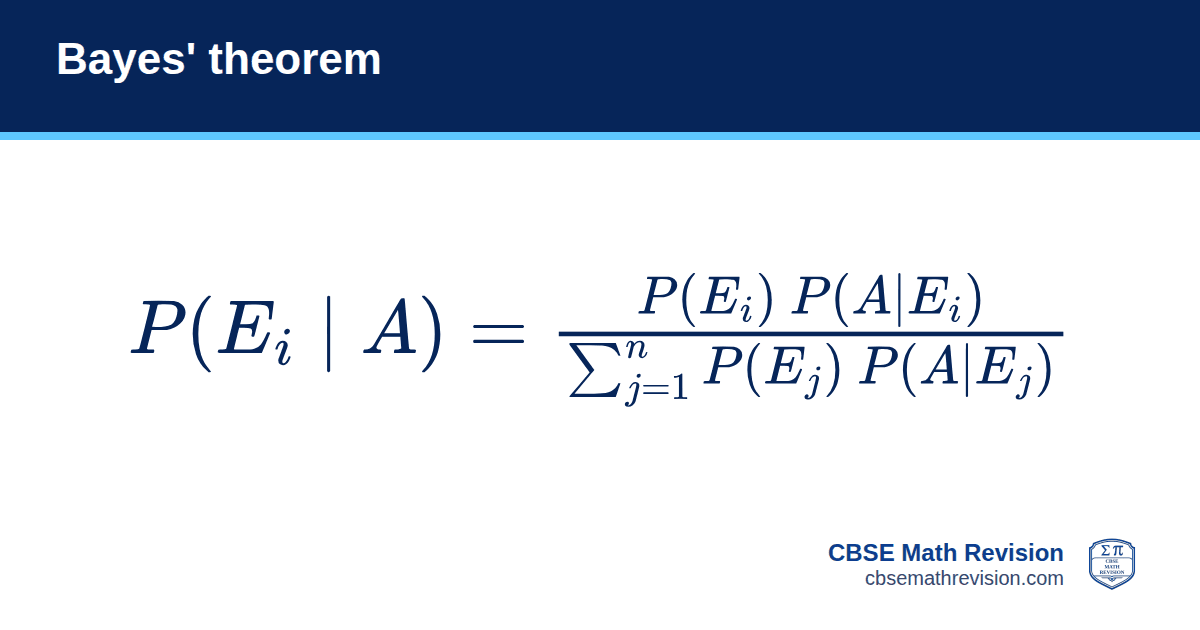
Bayes theorem formula: P(Eᵢ | A) = P(Eᵢ)P(A | Eᵢ) / ΣP(Eⱼ)P(A | Eⱼ)
The Bayes theorem formula is P(Eᵢ | A) = P(Eᵢ) P(A | Eᵢ) / Σ P(Eⱼ) P(A | Eⱼ).
What each letter means
- \(E_1,\dots,E_n\) the possible causes: exactly one of them happens
- \(A\) the event you observed
- \(P(A\mid E_i)\) the probability of A if the cause is Eᵢ
When to use it
To work backwards from an observed result to the probability of each cause: which machine made a faulty part, which bag a ball came from.
Worked example
Machine X makes 60% of a factory's bolts and 2% of its bolts are defective. Machine Y makes the rest and 3% of its bolts are defective. A bolt chosen at random is defective. Find the probability that it was made by X.
- \(P(X)P(D\mid X)=0.6\times0.02=0.012\); \(P(Y)P(D\mid Y)=0.4\times0.03=0.012\)
- \(P(X\mid D)=\dfrac{0.012}{0.012+0.012}\)
Answer: \(P(X\mid D)=\tfrac12\)
Common mistake
Leaving out a cause in the denominator. The bottom line is the total probability of A over every cause.
On your course
| Course | In the exam |
|---|---|
| Class 12 | Learn it: CBSE gives no formula booklet |
From our own CBSE Maths formula sheets, in our words.
Practise and revise
- Practise Class 12 Probability MCQs
- Revise Class 12 Probability
- Print Class 12 one-page formula sheet
Questions
What is the Bayes theorem formula?
The Bayes theorem formula is P(Eᵢ | A) = P(Eᵢ) P(A | Eᵢ) / Σ P(Eⱼ) P(A | Eⱼ). E₁, …, Eₙ: the possible causes: exactly one of them happens; A: the event you observed; P(A| Eᵢ): the probability of A if the cause is Eᵢ.
Is the Bayes' theorem given in the exam?
Class 12: learn it: CBSE gives no formula booklet. This comes from our own CBSE Maths formula sheets; your teacher has the official booklet.
What does 'total probability' mean in Bayes' theorem?
The denominator adds P(Eⱼ) P(A | Eⱼ) over every possible cause Eⱼ: it is the overall probability that A happens.
Our own wording, examples and card, checked by CBSE Math Revision. Not produced or endorsed by CBSE or NCERT.