 CBSE Math Revision
Halloween maths activities for CBSE Class 10
A ready-to-teach Halloween lesson for Class 10: a 5-minute starter, a 35-minute main activity in four short tasks, an extension and full worked answers. It practises APs, spheres, probability and coordinate geometry.
- Level
- MYP / KS3 (ages 11 to 14)
- Time
- 35 minutes, plus a 10-minute extension
- Topics
- Negative numbers and the order of operations; Ratio and proportion; Area and perimeter; Probability
- Equipment
- No calculator needed. Every answer works out exactly.
Suggested timings
| Part | Time | What |
|---|---|---|
| Starter | 5 min | Quick questions on the board |
| Main: task A | 15 min | Pumpkin patch |
| Main: task B | 15 min | Trick or treat |
| Extension | 10 min | Fast finishers or homework |
Starter (5 minutes)
Quick-fire, no calculator. Show one at a time or all four on the board.
- A ghost floats 7 m above the ground, then sinks 12 m into a cellar. What is its height now?
- The code on the witch’s door is 3 + 4 × 5. What is the code?
- Pumpkin soup for 4 bowls uses 600 g of pumpkin. How much pumpkin is needed for 6 bowls?
- A bag holds 3 orange sweets and 5 green sweets. One is picked without looking. What is the probability that it is orange?
Main activity (30 minutes)
Task A: Pumpkin patch (15 min)
A rectangular pumpkin patch is 12 m long and 8 m wide.
- Find the area of the patch.
- A fence goes all the way round the patch. How long is the fence?
- Each pumpkin plant needs 4 m2 of ground. How many plants fit in the patch?
- The farmer sells pumpkins and lanterns in the ratio 5 : 2. She sells 35 items. How many are lanterns?
Task B: Trick or treat (15 min)
Mia visits 20 houses. At each house the probability of getting a treat is 3/4.
- How many treats would Mia expect to get?
- At one house a bowl holds 6 toffees, 4 lollies and 2 chocolate spiders. Mia takes one without looking. Find the probability that she gets a chocolate spider, in its simplest form.
- Find the probability that she does not get a lolly.
Extension (10 minutes)
For fast finishers, or as homework.
- A haunted house has 3 doors and 4 staircases. A ghost picks one door and then one staircase. How many different routes are there? List them in a system to check.
- The mean age of 4 vampires is 250 years. A fifth vampire joins and the mean age becomes 300 years. How old is the new vampire?
For teachers
Teacher notes and full worked answers
- Pitched at MYP and KS3 (ages 11 to 14). Every question works without a calculator; ask for a short method with each answer.
- Task B leads into expected frequency: ask why Mia might not get exactly 15 treats.
Starter
- −5 m (5 m below the ground)
- 7 − 12 = −5
- 23
- Multiply first: 4 × 5 = 20.
- 3 + 20 = 23
- 900 g
- 600 ÷ 4 = 150 g for one bowl.
- 150 × 6 = 900 g
- 3/8
- There are 3 + 5 = 8 sweets and 3 are orange.
Task A: Pumpkin patch
- 96 m2
- 12 × 8 = 96
- 40 m
- 2 × (12 + 8) = 40
- 24 plants
- 96 ÷ 4 = 24
- 10 lanterns
- 5 + 2 = 7 parts, so one part is 35 ÷ 7 = 5.
- Lanterns: 2 × 5 = 10
Task B: Trick or treat
- 15 treats
- 3/4 of 20 = 15
- 1/6
- There are 6 + 4 + 2 = 12 sweets.
- 2/12 = 1/6
- 2/3
- 12 − 4 = 8 sweets are not lollies.
- 8/12 = 2/3
Extension
- 12 routes
- Each of the 3 doors goes with each of the 4 staircases.
- 3 × 4 = 12
- 500 years
- Total of the four: 4 × 250 = 1000.
- Total of the five: 5 × 300 = 1500.
- 1500 − 1000 = 500
The same answers are in the answers PDF. Every answer was checked before publishing.
- Level
- CBSE Class 10 (Class 9 can try most of it)
- Time
- 40 minutes, plus a 10-minute extension
- Topics
- Arithmetic progressions; Surface areas and volumes; Probability; Coordinate geometry: distance and section formulae
- Equipment
- No calculator. Every answer works out exactly; use π = 22/7 where a question says so.
Download student sheet (Class 9–10) (PDF)Answers (PDF)
Suggested timings
| Part | Time | What |
|---|---|---|
| Starter | 5 min | Quick questions on the board |
| Main: task A | 9 min | The lantern parade |
| Main: task B | 10 min | Pumpkins and candles |
| Main: task C | 8 min | The sweet bowl |
| Main: task D | 8 min | Haunted house maze |
| Extension | 10 min | Fast finishers or homework |
Starter (5 minutes)
Quick-fire mental maths.
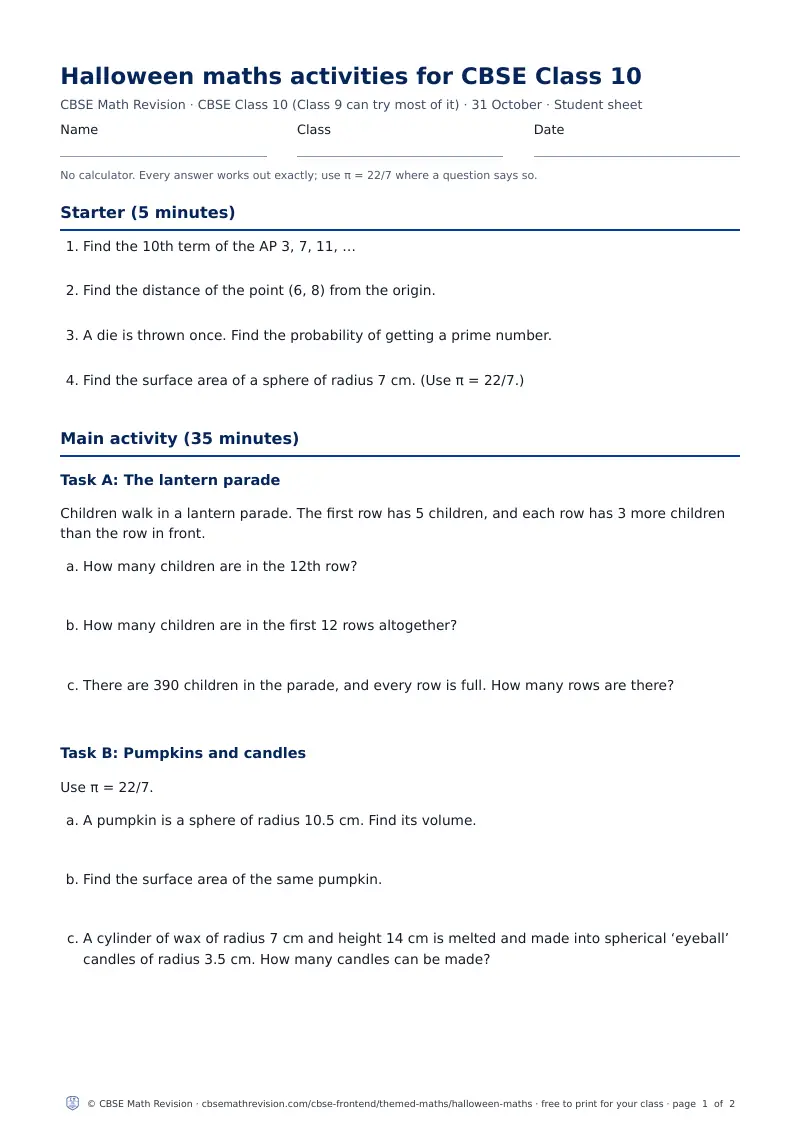
- Find the 10th term of the AP 3, 7, 11, …
- Find the distance of the point (6, 8) from the origin.
- A die is thrown once. Find the probability of getting a prime number.
- Find the surface area of a sphere of radius 7 cm. (Use π = 22/7.)
Main activity (35 minutes)
Task A: The lantern parade (9 min)
Children walk in a lantern parade. The first row has 5 children, and each row has 3 more children than the row in front.
- How many children are in the 12th row?
- How many children are in the first 12 rows altogether?
- There are 390 children in the parade, and every row is full. How many rows are there?
Task B: Pumpkins and candles (10 min)
Use π = 22/7.
- A pumpkin is a sphere of radius 10.5 cm. Find its volume.
- Find the surface area of the same pumpkin.
- A cylinder of wax of radius 7 cm and height 14 cm is melted and made into spherical ‘eyeball’ candles of radius 3.5 cm. How many candles can be made?
Task C: The sweet bowl (8 min)
A bowl has 8 toffees, 5 lollipops and 7 chocolate bars. One sweet is taken at random.
- Find the probability that it is a lollipop.
- Find the probability that it is not a chocolate bar.
- Two toffees are eaten first. Now find the probability of taking a toffee.
- Starting again with the full bowl, how many extra toffees must be added so that the probability of a toffee is 1/2?
Task D: Haunted house maze (8 min)
A ghost glides in a straight line from A(−2, 3) to B(6, −3) on the plan of a haunted house.
- Find the length AB.
- A trapdoor P divides AB in the ratio 1 : 3. Find P.
- The chest is at C(6, 3). Show that triangle ABC has a right angle at C, and find its area.
Extension (10 minutes)
For fast finishers, or as homework.
- Find the point on the y-axis that is the same distance from A(−2, 3) and B(6, −3).
- The radius of a spherical pumpkin increases by 50%. By what percentage does its surface area increase?
For teachers
Teacher notes and full worked answers
- In the lantern parade, students find two roots of the quadratic: insist they reject the negative one with a reason.
- In the candle question, cancel before multiplying: 2156 × 3 ÷ 539 is 4 × 3 = 12 because 539 × 4 = 2156.
- The section formula slip to watch for: putting the 1 with the first point instead of the second.
Starter
- 39
- a = 3, d = 4: a10 = 3 + 9 × 4 = 39
- 10
- √(62 + 82) = √100 = 10
- 1/2
- The primes are 2, 3 and 5: 3 out of 6 outcomes, so 3/6 = 1/2.
- 616 cm2
- 4 × 22/7 × 7 × 7 = 616
Task A: The lantern parade
- 38
- a12 = 5 + 11 × 3 = 38
- 258
- S12 = 12/2 × (5 + 38) = 6 × 43 = 258
- 15 rows
- n/2 × (10 + 3(n − 1)) = 390 gives 3n2 + 7n − 780 = 0.
- Discriminant = 49 + 9360 = 9409 = 972, so n = (−7 + 97)/6 = 15.
- (The negative root does not make sense.)
Task B: Pumpkins and candles
- 4851 cm3
- 4⁄3 × 22/7 × 10.5 × 10.5 × 10.5
- = 4⁄3 × 22/7 × 1157.625 = 4851
- 1386 cm2
- 4 × 22/7 × 10.5 × 10.5 = 4 × 22/7 × 110.25 = 1386
- 12 candles
- Cylinder: 22/7 × 7 × 7 × 14 = 2156 cm3.
- One candle: 4⁄3 × 22/7 × 3.5 × 3.5 × 3.5 = 539/3 cm3.
- 2156 ÷ 539/3 = 2156 × 3/539 = 12
Task C: The sweet bowl
- 1/4
- 5 out of 20: 5/20 = 1/4
- 13/20
- 1 − 7/20 = 13/20
- 1/3
- 6 toffees out of 18 sweets: 6/18 = 1/3
- 4
- (8 + x)/(20 + x) = 1/2 gives 16 + 2x = 20 + x, so x = 4.
Task D: Haunted house maze
- 10 units
- √((6 + 2)2 + (−3 − 3)2) = √(64 + 36) = 10
- P(0, 3/2)
- x = (1 × 6 + 3 × (−2))/4 = 0
- y = (1 × (−3) + 3 × 3)/4 = 6/4 = 3/2
- Right angle at C; area 24 square units
- AC = 8 and BC = 6, and AB = 10.
- 82 + 62 = 100 = 102, so by the converse of Pythagoras the angle at C is 90°.
- Area = ½ × 8 × 6 = 24
Extension
- (0, −8/3)
- Let the point be (0, y). Then 22 + (y − 3)2 = 62 + (y + 3)2.
- 4 + y2 − 6y + 9 = 36 + y2 + 6y + 9, so −12y = 32 and y = −8/3.
- 125%
- The new radius is 1.5r, so the new area is 4π(1.5r)2 = 2.25 × 4πr2.
- The area is multiplied by 2.25: an increase of 125%.
The same answers are in the answers PDF. Every answer was checked before publishing.
- Level
- CBSE Class 11 (no calculator)
- Time
- 35 minutes, plus a 10-minute extension
- Topics
- Sequences and series (GP); Straight lines; Permutations and combinations; Sets
- Equipment
- No calculator. Every answer works out exactly.
Suggested timings
| Part | Time | What |
|---|---|---|
| Starter | 5 min | Quick questions on the board |
| Main: task A | 15 min | Zombie doubling |
| Main: task B | 15 min | The haunted house plan |
| Extension | 10 min | Fast finishers or homework |
Starter (5 minutes)
Quick-fire, no calculator. Show one at a time or all four on the board.
- Find the 10th term of the GP 3, 6, 12, …
- How many arrangements are there of the letters of the word GHOST?
- Find the slope of the line through (2, 3) and (6, 11).
- A = {1, 2, 3, 4} and B = {3, 4, 5}. Find n(A ∪ B).
Main activity (30 minutes)
Task A: Zombie doubling (15 min)
On day 1, 5 new zombies appear. Each day the number of new zombies is double the day before: 5, 10, 20, …
- How many new zombies appear on day 6?
- Find the total number of zombies after 8 days.
- After how many whole days does the total first go above 10 000?
Task B: The haunted house plan (15 min)
On a plan of a haunted house, the front door is at A(1, 2) and the cellar door at B(7, 10).
- Find the distance AB.
- Find the equation of line AB in the form y = mx + c.
- A secret passage is perpendicular to AB and passes through the midpoint of AB. Where does it meet the y-axis?
- A committee of 3 is chosen from 5 ghosts and 4 witches. In how many ways can it include at least one witch?
Extension (10 minutes)
For fast finishers, or as homework.
- The houses on Spooky Street have two-digit numbers that leave remainder 3 when divided by 7. Find the sum of all these numbers.
For teachers
Teacher notes and full worked answers
- For CBSE Class 11. No calculator: every answer works out exactly, as in board exams.
Starter
- 1536
- a = 3, r = 2: a10 = 3 × 29 = 3 × 512 = 1536
- 120
- 5 different letters: 5! = 120
- 2
- (11 − 3)/(6 − 2) = 8/4 = 2
- 5
- A ∪ B = {1, 2, 3, 4, 5}
Task A: Zombie doubling
- 160
- 5 × 25 = 160
- 1275
- S8 = 5(28 − 1)/(2 − 1) = 5 × 255 = 1275
- 11 days
- 5(2n − 1) > 10 000 gives 2n > 2001.
- 210 = 1024 is too small and 211 = 2048 is enough, so n = 11
Task B: The haunted house plan
- 10 units
- √((7 − 1)2 + (10 − 2)2) = √(36 + 64) = √100 = 10
- y = 4x/3 + 2/3
- Slope m = 8/6 = 4/3.
- 2 = (4/3)(1) + c gives c = 2/3
- (0, 9)
- The midpoint of AB is (4, 6) and the perpendicular slope is −3/4.
- y − 6 = −3/4 (x − 4); at x = 0, y = 6 + 3 = 9
- 74
- All committees: 9C3 = 84. With no witch: 5C3 = 10.
- 84 − 10 = 74
Extension
- 676
- They are 10, 17, 24, …, 94: an AP with a = 10, d = 7.
- Number of terms: (94 − 10)/7 + 1 = 13.
- Sum = 13/2 × (10 + 94) = 676
The same answers are in the answers PDF. Every answer was checked before publishing.
- Level
- IB HL and A Level Further Maths (no calculator)
- Time
- 35 minutes, plus a 10-minute extension
- Topics
- Differential equations: logistic growth; Complex numbers: roots on the Argand diagram; Proof by induction; Discrete probability
- Equipment
- No calculator needed: every answer is exact.
Suggested timings
| Part | Time | What |
|---|---|---|
| Starter | 5 min | Quick questions on the board |
| Main: task A | 15 min | Zombie logistic |
| Main: task B | 15 min | Cauldron roots |
| Extension | 10 min | Fast finishers or homework |
Starter (5 minutes)
Quick-fire, no calculator. Show one at a time or all four on the board.
- Write (1 + i)4 in the form a + bi.
- Find the sum of the whole numbers from 1 to 31, one for each day of October.
- Find the exact value of ∫0ln 2 ex dx.
- In how many ways can 5 different masks be hung in a row?
Main activity (30 minutes)
Task A: Zombie logistic (15 min)
A zombie population Z (in thousands) grows so that dZ/dt = Z(1 − Z/10), with Z = 1 when t = 0 (t in days).
- Find the rate of growth when Z = 4.
- For which value of Z is the population growing fastest?
- Show that Z = 10/(1 + 9e−t) satisfies the differential equation and the starting value. What happens to Z as t → ∞?
- Find the exact time at which Z = 5.
Task B: Cauldron roots (15 min)
The witches’ magic number z satisfies z3 = 8i.
- Write 8i in modulus–argument form.
- Find the three cube roots of 8i, giving each in the form a + bi.
- The three roots are the corners of a triangle on the Argand diagram. Find its exact area.
Extension (10 minutes)
For fast finishers, or as homework.
- Prove by induction that 1 + 3 + 5 + … + (2n − 1) = n2 (the sweets in an n by n tray, built up in L shapes). How many odd numbers, starting from 1, add up to 961?
- A haunted die is biased so that P(X = k) = k/21 for k = 1, 2, …, 6. Find E(X).
For teachers
Teacher notes and full worked answers
- For IB HL and A Level Further Maths classes. Every answer is exact and the whole set works without a calculator.
- Task A pairs well with a sketch of dZ/dt against Z: ask where the population curve is steepest before any algebra.
Starter
- −4 (that is, −4 + 0i)
- (1 + i)2 = 2i
- (2i)2 = −4
- 496
- 31 × 32 ÷ 2 = 496
- 1
- [ex] from 0 to ln 2 = 2 − 1 = 1
- 120
- 5! = 120
Task A: Zombie logistic
- 12/5 = 2.4 thousand zombies per day
- 4 × (1 − 4/10) = 4 × 3/5 = 12/5
- Z = 5
- The growth rate is Z − Z2/10.
- Its derivative with respect to Z is 1 − Z/5, which is 0 when Z = 5 (a maximum: the second derivative is −1/5).
- Z → 10 (10 000 zombies)
- At t = 0, Z = 10/10 = 1.
- dZ/dt = 90e−t/(1 + 9e−t)2, and Z(1 − Z/10) = 10/(1 + 9e−t) × 9e−t/(1 + 9e−t) is the same.
- As t → ∞, e−t → 0, so Z → 10.
- t = ln 9 = 2 ln 3 days
- 10/(1 + 9e−t) = 5 gives 9e−t = 1.
- et = 9, so t = ln 9
Task B: Cauldron roots
- 8 cis(π/2)
- |8i| = 8, and 8i lies on the positive imaginary axis, so its argument is π/2.
- √3 + i, −√3 + i and −2i
- The roots are 2 cis(π/6 + 2kπ/3) for k = 0, 1, 2.
- 2 cis(π/6) = √3 + i, 2 cis(5π/6) = −√3 + i, 2 cis(3π/2) = −2i
- 3√3
- The roots are equally spaced on a circle of radius 2, so the triangle is equilateral.
- Area = 3 × ½ × 2 × 2 × sin(2π/3) = 6 × √3/2 = 3√3
Extension
- 31
- Proof: true for n = 1; if the first k add to k2, adding 2k + 1 gives (k + 1)2.
- n2 = 961, so n = 31
- 13/3
- E(X) = Σ k × k/21 = (1 + 4 + 9 + 16 + 25 + 36)/21
- = 91/21 = 13/3
The same answers are in the answers PDF. Every answer was checked before publishing.
- Level
- Beyond school: for adults and maths fans
- Time
- 35 minutes, plus a 10-minute extension
- Topics
- Counting and recurrences; Number theory; Probability puzzles; Geometry
- Equipment
- No calculator needed. Every answer works out exactly.
Suggested timings
| Part | Time | What |
|---|---|---|
| Starter | 5 min | Quick questions on the board |
| Main: task A | 15 min | The haunted staircase |
| Main: task B | 15 min | Masks and pumpkins |
| Extension | 10 min | Fast finishers or homework |
Starter (5 minutes)
Quick-fire, no calculator. Show one at a time or all four on the board.
- Friday the 13th: what is the last digit of 1313?
- A cave holds 20 spiders and bats with 76 legs between them. A spider has 8 legs and a bat 2. How many spiders are there?
- Find the smallest whole number that leaves remainder 1 when divided by 2, 3, 4, 5 and 6, and is a multiple of 7.
- How many three-digit numbers have digits that add up to 13?
Main activity (30 minutes)
Task A: The haunted staircase (15 min)
A ghost climbs a staircase, going up 1 or 2 steps at a time.
- In how many ways can it climb 4 steps?
- Explain why the number of ways for n steps is the number for n − 1 plus the number for n − 2. How many ways are there for 10 steps?
- The ghost now refuses to take two 2-steps in a row. How many ways are there for 10 steps?
Task B: Masks and pumpkins (15 min)
Probability with a twist.
- Four trick-or-treaters put their masks in a pile, and the masks are handed back at random. What is the probability that nobody gets their own mask?
- With more and more trick-or-treaters this probability gets closer and closer to 1/k for a famous constant k. Which constant?
- Two witches each pick a whole number from 1 to 100 at random. What is the probability that their numbers differ by at most 1?
Extension (10 minutes)
For fast finishers, or as homework.
- A pumpkin is a sphere of radius 10 cm. A cylindrical hole of radius 6 cm is drilled straight through its centre. Find the volume that is left, in the form kπ cm3.
For teachers
Teacher notes and full worked answers
- A stretch set for anyone past school maths: adults, maths clubs and keen sixth-formers. Competition style, no calculator, every answer exact.
- Task A is the Fibonacci numbers in disguise; the extension is the famous napkin-ring problem.
Starter
- 3
- The last digit of 13n runs 3, 9, 7, 1, 3, … (period 4).
- 13 = 4 × 3 + 1, so the last digit is 3.
- 6 spiders
- If all 20 were bats there would be 40 legs: 36 too few.
- Each spider adds 6 legs: 36 ÷ 6 = 6 spiders (and 14 bats).
- 301
- It is one more than a multiple of LCM(2, 3, 4, 5, 6) = 60: 61, 121, 181, 241, 301, …
- The first of these that divides by 7 is 301 = 7 × 43.
- 69
- For hundreds digit a, count the pairs of digits adding to 13 − a.
- a = 1 to 9 gives 7, 8, 9, 10, 9, 8, 7, 6 and 5 pairs.
- Total 69
Task A: The haunted staircase
- 5 ways
- 1+1+1+1, 2+1+1, 1+2+1, 1+1+2, 2+2
- 89 ways
- The first move is a 1-step (then n − 1 steps are left) or a 2-step (then n − 2 are left).
- 1, 2, 3, 5, 8, 13, 21, 34, 55, 89: the Fibonacci numbers
- 41 ways
- Let a(n) count the climbs ending in a 1-step (or empty) and b(n) those ending in a 2-step: a(n) = a(n − 1) + b(n − 1) and b(n) = a(n − 2).
- Totals for n = 1 to 10: 1, 2, 3, 4, 6, 9, 13, 19, 28, 41
Task B: Masks and pumpkins
- 3/8
- Count the arrangements of 4 with no one in their own place: 9 of the 24.
- 9/24 = 3/8
- k = e (the probability tends to 1/e)
- By inclusion–exclusion the probability is 1 − 1 + 1/2! − 1/3! + … ± 1/n!.
- This tends to e−1, so k = e.
- 149/5000
- Equal: 100 pairs. Differ by exactly 1: 2 × 99 = 198 pairs.
- 298/10 000 = 149/5000
Extension
- 2048π/3 cm3
- The hole is 2√(100 − 36) = 16 cm long.
- The ring left is the solid of revolution between y = −8 and 8 of π(100 − y2 − 36): π∫(64 − y2) dy = π(1024 − 1024/3)
- = 2048π/3. (Surprise: it depends only on the 16 cm length of the hole.)
The same answers are in the answers PDF. Every answer was checked before publishing.
Practise the topics
Children’s Day (India) maths · National Mathematics Day maths · National Science Day (India) maths · All themed maths
More for lessons: Weekly starters · Skill Builders · Worksheet builder · Olympiad and competition maths · National Mathematics Day puzzles