 CBSE Math Revision
Children’s Day maths puzzle challenge for CBSE Class 9 and 10
A ready-to-run puzzle challenge for Children’s Day on 14 November: a 5-minute warm-up, four 8–9 minute rounds (number, algebra, geometry and chance) for teams, a bonus round and full worked answers. No calculator.
- Level
- CBSE Class 6 to 8 (no calculator)
- Time
- 35 minutes, plus a 10-minute extension
- Topics
- Number: LCM, fractions and primes; Area, angles and volume; Probability
- Equipment
- No calculator. Every answer works out exactly.
Suggested timings
| Part | Time | What |
|---|---|---|
| Starter | 5 min | Quick questions on the board |
| Main: task A | 15 min | Round 1: number |
| Main: task B | 15 min | Round 2: shape and chance |
| Extension | 10 min | Fast finishers or homework |
Starter (5 minutes)
Quick-fire, no calculator. Show one at a time or all four on the board.
- Work out 14 × 11.
- Write 0.75 as a fraction in its simplest form.
- How many minutes are there in 2½ hours?
- What is the smallest prime number greater than 20?
Main activity (30 minutes)
Task A: Round 1: number (15 min)
Questions for the children’s fair.
- Balloons come in packs of 4, cups in packs of 6 and plates in packs of 10. What is the smallest number of each you can buy so that the numbers are equal?
- A class has 36 children and 5/9 of them are girls. How many boys are there?
- Find the sum of the first 10 odd numbers.
Task B: Round 2: shape and chance (15 min)
More questions for the fair.
- The play area is a rectangle 15 m long and 8 m wide. Find its area.
- The angles of a four-sided flower bed are 80°, 95°, 105° and x°. Find x.
- A gift box is a cube with edges of 4 cm. Find its volume.
- A fair die is rolled. What is the probability that it shows a number greater than 4?
Extension (10 minutes)
For fast finishers, or as homework.
- Children stand in a line. Asha is 7th from the front and 12th from the back. How many children are in the line?
For teachers
Teacher notes and full worked answers
- For CBSE Class 6 to 8. No calculator: every answer works out exactly.
Starter
- 154
- 14 × 11 = 140 + 14 = 154
- 3/4
- 0.75 = 75/100 = 3/4
- 150
- 2 × 60 + 30 = 150
- 23
- 21 = 3 × 7 and 22 = 2 × 11, but 23 has no factors except 1 and 23.
Task A: Round 1: number
- 60
- LCM(4, 6, 10) = 60
- 16
- 5/9 of 36 = 20 girls
- 36 − 20 = 16
- 100
- 1 + 3 + 5 + … + 19 = 100 (= 102)
Task B: Round 2: shape and chance
- 120 m2
- 15 × 8 = 120
- 80
- The angles of a quadrilateral add up to 360°.
- 360 − 80 − 95 − 105 = 80
- 64 cm3
- 4 × 4 × 4 = 64
- 1/3
- 5 and 6: 2 of the 6 numbers.
- 2/6 = 1/3
Extension
- 18
- 6 children are in front of Asha and 11 behind her.
- 6 + 1 + 11 = 18
The same answers are in the answers PDF. Every answer was checked before publishing.
- Level
- CBSE Class 9 and 10
- Time
- 40 minutes, plus a 10-minute extension
- Topics
- Real numbers: HCF, LCM and remainders; Pair of linear equations; Quadratic equations; Triangles, angles and quadrilaterals; Probability
- Equipment
- No calculator. Every answer works out exactly.
Download student sheet (Class 9–10) (PDF)Answers (PDF)
Suggested timings
| Part | Time | What |
|---|---|---|
| Starter | 5 min | Quick questions on the board |
| Main: task A | 9 min | Number round |
| Main: task B | 9 min | Algebra round |
| Main: task C | 9 min | Geometry round |
| Main: task D | 8 min | Chance round |
| Extension | 10 min | Fast finishers or homework |
Starter (5 minutes)
Warm-up: answer on mini whiteboards.
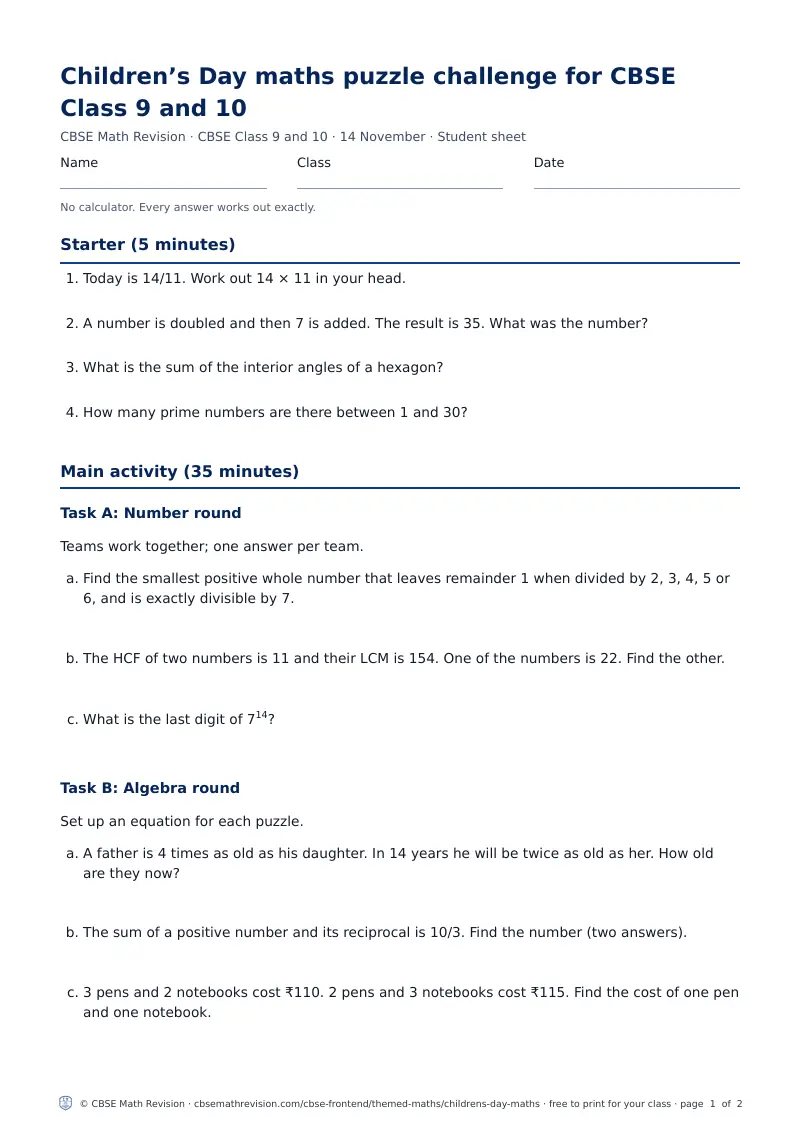
- Today is 14/11. Work out 14 × 11 in your head.
- A number is doubled and then 7 is added. The result is 35. What was the number?
- What is the sum of the interior angles of a hexagon?
- How many prime numbers are there between 1 and 30?
Main activity (35 minutes)
Task A: Number round (9 min)
Teams work together; one answer per team.
- Find the smallest positive whole number that leaves remainder 1 when divided by 2, 3, 4, 5 or 6, and is exactly divisible by 7.
- The HCF of two numbers is 11 and their LCM is 154. One of the numbers is 22. Find the other.
- What is the last digit of 714?
Task B: Algebra round (9 min)
Set up an equation for each puzzle.
- A father is 4 times as old as his daughter. In 14 years he will be twice as old as her. How old are they now?
- The sum of a positive number and its reciprocal is 10/3. Find the number (two answers).
- 3 pens and 2 notebooks cost ₹110. 2 pens and 3 notebooks cost ₹115. Find the cost of one pen and one notebook.
Task C: Geometry round (9 min)
Draw a sketch first.
- A right-angled triangle has shorter sides 9 cm and 12 cm. Find its hypotenuse and its area.
- The angles of a quadrilateral are in the ratio 3 : 4 : 5 : 6. Find the largest angle.
- What is the angle between the hour and minute hands of a clock at 3:30?
Task D: Chance round (8 min)
Write each answer as a fraction in its lowest terms.
- Two dice are thrown. Find the probability that the total is 7.
- A card is picked at random from cards numbered 1 to 50. Find the probability that the number is a multiple of 4 or of 6.
- A coin is tossed three times. Find the probability of at least two heads.
Extension (10 minutes)
Bonus round for the fastest teams.
- How many squares of all sizes are there on an 8 by 8 chessboard?
- The sum of three consecutive odd numbers is 147. Find the numbers.
For teachers
Teacher notes and full worked answers
- Run it as a team quiz: teams of three or four, one answer sheet per team, one mark per correct answer, and 1 extra mark for clear working in the algebra round.
- The rounds are independent, so you can use one round as a starter on another day.
- In the number round, the clock and last-digit questions reward spotting a repeating pattern: ask teams to explain how they found it.
Starter
- 154
- 14 × 11 = 140 + 14 = 154
- 14
- 2x + 7 = 35, so 2x = 28 and x = 14.
- 720°
- (6 − 2) × 180° = 720°
- 10
- 2, 3, 5, 7, 11, 13, 17, 19, 23, 29
Task A: Number round
- 301
- Remainder 1 when divided by 2, 3, 4, 5 and 6 means one more than a multiple of LCM(2, 3, 4, 5, 6) = 60.
- Try 61, 121, 181, 241, 301: the first multiple of 7 is 301 = 7 × 43.
- 77
- HCF × LCM = product of the numbers: 11 × 154 = 1694.
- 1694 ÷ 22 = 77
- 9
- The last digits of 7, 72, 73, 74 are 7, 9, 3, 1, and then the pattern repeats every 4.
- 14 = 4 × 3 + 2, so the last digit is the same as for 72: 9.
Task B: Algebra round
- Daughter 7, father 28
- Let the daughter be x: 4x + 14 = 2(x + 14).
- 4x + 14 = 2x + 28, so 2x = 14 and x = 7. The father is 28.
- 3 or 1/3
- x + 1/x = 10/3 gives 3x2 − 10x + 3 = 0.
- (3x − 1)(x − 3) = 0, so x = 3 or 1/3.
- Pen ₹20, notebook ₹25
- Add the equations: 5p + 5n = 225, so p + n = 45.
- Subtract them: p − n = −5.
- So 2p = 40: p = 20 and n = 25.
Task C: Geometry round
- 15 cm; 54 cm2
- √(81 + 144) = √225 = 15
- Area = ½ × 9 × 12 = 54
- 120°
- 3 + 4 + 5 + 6 = 18 parts = 360°, so 1 part = 20°.
- Largest = 6 × 20° = 120°
- 75°
- The minute hand points at 6: 180° from 12.
- The hour hand is halfway from 3 to 4: 90° + 15° = 105° from 12.
- 180° − 105° = 75°
Task D: Chance round
- 1/6
- (1, 6), (2, 5), (3, 4), (4, 3), (5, 2), (6, 1): 6 of the 36 outcomes.
- 6/36 = 1/6
- 8/25
- Multiples of 4: 12. Multiples of 6: 8. Multiples of both (of 12): 4.
- 12 + 8 − 4 = 16, so 16/50 = 8/25.
- 1/2
- HHH, HHT, HTH, THH: 4 of the 8 outcomes.
- 4/8 = 1/2
Extension
- 204
- There are 82 squares of size 1 by 1, 72 of size 2 by 2, and so on down to 12 of size 8 by 8.
- 64 + 49 + 36 + 25 + 16 + 9 + 4 + 1 = 204
- 47, 49, 51
- (x − 2) + x + (x + 2) = 3x = 147, so x = 49.
The same answers are in the answers PDF. Every answer was checked before publishing.
- Level
- CBSE Class 11 (no calculator)
- Time
- 35 minutes, plus a 10-minute extension
- Topics
- Sequences and series; Permutations and combinations; Binomial theorem; Coordinate geometry, sets and limits
- Equipment
- No calculator. Every answer works out exactly.
Suggested timings
| Part | Time | What |
|---|---|---|
| Starter | 5 min | Quick questions on the board |
| Main: task A | 15 min | Round 1: algebra |
| Main: task B | 15 min | Round 2: coordinates, sets and limits |
| Extension | 10 min | Fast finishers or homework |
Starter (5 minutes)
Quick-fire, no calculator. Show one at a time or all four on the board.
- Find 5P2.
- Find i4 + i2.
- Find the sum of the first 20 natural numbers.
- Find the slope of the line 3x − 4y + 8 = 0.
Main activity (30 minutes)
Task A: Round 1: algebra (15 min)
Children’s Day puzzles for Class 11.
- Find the 8th term of the GP 2, 6, 18, …
- In how many ways can 6 children sit in a row if two friends must sit next to each other?
- Find the coefficient of x3 in the expansion of (1 + 2x)5.
Task B: Round 2: coordinates, sets and limits (15 min)
More puzzles.
- Find the distance between (−1, 2) and (5, 10).
- In a class of 40, 25 like cricket, 20 like football and 10 like both. How many like neither?
- Find the centre and radius of the circle x2 + y2 − 4x + 6y − 12 = 0.
- Find the limit of (x2 − 4)/(x − 2) as x → 2.
Extension (10 minutes)
For fast finishers, or as homework.
- How many diagonals does a 10-sided polygon have?
For teachers
Teacher notes and full worked answers
- For CBSE Class 11. No calculator: every answer works out exactly, as in board exams.
Starter
- 20
- 5 × 4 = 20
- 0
- 1 + (−1) = 0
- 210
- 20 × 21 ÷ 2 = 210
- 3/4
- 4y = 3x + 8, so y = 3x/4 + 2
Task A: Round 1: algebra
- 4374
- 2 × 37 = 2 × 2187 = 4374
- 240
- Treat the two friends as one block: 5! = 120 orders.
- The friends can swap within the block: 120 × 2 = 240
- 80
- 5C3 × 23 = 10 × 8 = 80
Task B: Round 2: coordinates, sets and limits
- 10
- √(62 + 82) = √100 = 10
- 5
- Cricket or football: 25 + 20 − 10 = 35.
- 40 − 35 = 5
- Centre (2, −3), radius 5
- (x − 2)2 + (y + 3)2 = 12 + 4 + 9 = 25
- 4
- (x2 − 4)/(x − 2) = x + 2 for x ≠ 2, which tends to 4.
Extension
- 35
- 10C2 − 10 = 45 − 10 = 35
The same answers are in the answers PDF. Every answer was checked before publishing.
- Level
- CBSE Class 12 (no calculator)
- Time
- 35 minutes, plus a 10-minute extension
- Topics
- Integrals and areas; Differential equations; Probability; Vectors; Determinants
- Equipment
- No calculator. Every answer works out exactly.
Suggested timings
| Part | Time | What |
|---|---|---|
| Starter | 5 min | Quick questions on the board |
| Main: task A | 15 min | Round 1: calculus |
| Main: task B | 15 min | Round 2: chance and vectors |
| Extension | 10 min | Fast finishers or homework |
Starter (5 minutes)
Quick-fire, no calculator. Show one at a time or all four on the board.
- Find ∫01 3x2 dx.
- Find the derivative of xex at x = 0.
- Find (1 + i)(1 − i).
- Find 7C3.
Main activity (30 minutes)
Task A: Round 1: calculus (15 min)
Children’s Day puzzles for Class 12.
- Find the area enclosed between y = x2 and y = 2x.
- A rectangular play area has perimeter 20 m. Find the largest possible area.
- Solve dy/dx = y with y = 3 when x = 0, and find y when x = ln 2.
Task B: Round 2: chance and vectors (15 min)
More puzzles.
- A and B are independent, with P(A) = 1/2 and P(B) = 1/3. Find P(A ∪ B).
- A bag has 4 red and 6 blue balls. Two are drawn without replacement. Find the probability that both are red.
- a = i + 2j + 2k and b = 2i + j − 2k. Find a · b and the angle between them.
- Find the area of the parallelogram with sides a and b.
Extension (10 minutes)
For fast finishers, or as homework.
- Find the determinant of the matrix with rows (2, 1) and (3, 4).
For teachers
Teacher notes and full worked answers
- For CBSE Class 12. No calculator: every answer works out exactly.
Starter
- 1
- [x3] from 0 to 1 = 1
- 1
- (1 + x)ex = 1 at x = 0
- 2
- 1 − i2 = 2
- 35
- 7 × 6 × 5 ÷ 6 = 35
Task A: Round 1: calculus
- 4/3
- They meet at x = 0 and 2.
- ∫02 (2x − x2) dx = 4 − 8/3 = 4/3
- 25 m2
- Sides x and 10 − x: area x(10 − x).
- The derivative 10 − 2x = 0 at x = 5: area 25
- 6
- y = 3ex
- 3eln 2 = 6
Task B: Round 2: chance and vectors
- 2/3
- 1/2 + 1/3 − 1/6 = 2/3
- 2/15
- 4/10 × 3/9 = 12/90 = 2/15
- a · b = 0, so the angle is 90°
- 2 + 2 − 4 = 0
- 9
- a × b = −6i + 6j − 3k
- √(36 + 36 + 9) = 9
Extension
- 5
- 2 × 4 − 1 × 3 = 5
The same answers are in the answers PDF. Every answer was checked before publishing.
- Level
- Beyond school: for adults and maths fans
- Time
- 35 minutes, plus a 10-minute extension
- Topics
- Counting; Number theory; Probability
- Equipment
- No calculator needed. Every answer works out exactly.
Suggested timings
| Part | Time | What |
|---|---|---|
| Starter | 5 min | Quick questions on the board |
| Main: task A | 15 min | Round 1: puzzles for 14 November |
| Main: task B | 15 min | Round 2: chance |
| Extension | 10 min | Fast finishers or homework |
Starter (5 minutes)
Quick-fire, no calculator. Show one at a time or all four on the board.
- Find 1 + 2 + 3 + … + 100.
- What is the last digit of 3100?
- How many positive divisors does 100 have?
- How many two-digit numbers are multiples of 7?
Main activity (30 minutes)
Task A: Round 1: puzzles for 14 November (15 min)
The number 14 everywhere.
- In how many ways can 14 identical sweets be shared between 3 children so that each gets at least one?
- What is the smallest whole number with exactly 14 positive divisors?
- How many zeros are at the end of 14! (14 factorial)?
Task B: Round 2: chance (15 min)
A group of 14 children: 7 boys and 7 girls.
- Two children are picked at random. What is the probability that one is a boy and one is a girl?
- A fair die is rolled 14 times. What is the expected number of sixes?
- A fair die is rolled 3 times. What is the probability of at least one six?
Extension (10 minutes)
For fast finishers, or as homework.
- In how many ways can 14 be written as a sum of different positive whole numbers, ignoring order (14 on its own counts)?
For teachers
Teacher notes and full worked answers
- A stretch set for anyone past school maths: adults, maths clubs and keen sixth-formers. Competition style, no calculator, every answer exact.
Starter
- 5050
- 50 pairs adding to 101: 5050
- 1
- The last digits of 3n run 3, 9, 7, 1 (period 4).
- 100 is a multiple of 4, so the last digit is 1.
- 9
- 100 = 22 × 52: (2 + 1)(2 + 1) = 9
- 13
- 14, 21, …, 98: that is 98/7 − 1 = 13
Task A: Round 1: puzzles for 14 November
- 78
- Choose 2 of the 13 gaps between the sweets: 13C2 = 78
- 192
- 14 divisors means 213 or p6q.
- The smallest is 26 × 3 = 192.
- 2
- Factors of 5 come from 5 and 10: two of them.
Task B: Round 2: chance
- 7/13
- 7 × 7 = 49 mixed pairs out of 14C2 = 91.
- 49/91 = 7/13
- 7/3
- 14 × 1/6 = 7/3
- 91/216
- 1 − (5/6)3 = 1 − 125/216 = 91/216
Extension
- 22
- List by the largest part, or use the generating function (1 + x)(1 + x2)(1 + x3)…; the coefficient of x14 is 22.
The same answers are in the answers PDF. Every answer was checked before publishing.
Practise the topics
National Mathematics Day maths · National Science Day (India) maths · Pi Day maths · All themed maths
More for lessons: Weekly starters · Skill Builders · Worksheet builder · Olympiad and competition maths · National Mathematics Day puzzles