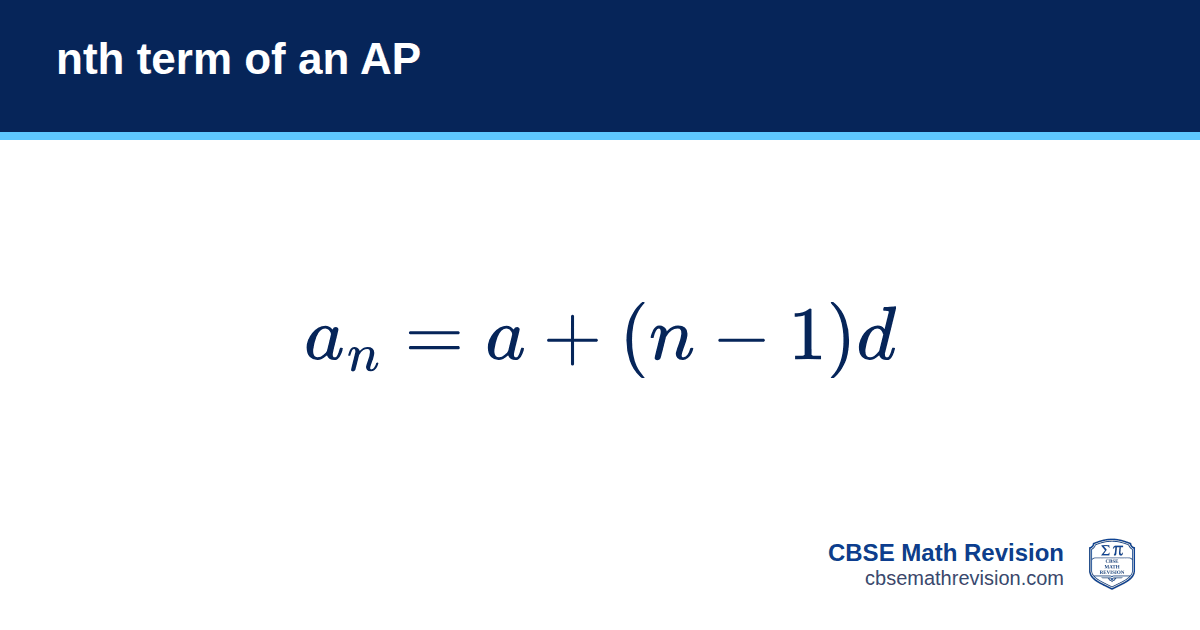
nth term of AP formula: aₙ = a + (n − 1)d
The nth term of AP formula is aₙ = a + (n − 1)d.
What each letter means
- \(a_n\) the nth term of the AP
- \(a\) the first term
- \(d\) the common difference
- \(n\) the number of the term
When to use it
When a sequence goes up or down by the same amount each time, to find any term, or to find which term has a given value.
Worked examples
1. Find the 25th term of the AP \(3, 8, 13, \dots\)
- \(a=3,\ d=5\)
- \(a_{25}=3+24\times5\)
Answer: \(a_{25}=123\)
2. Which term of the AP \(21, 18, 15, \dots\) is \(-81\)?
- \(a=21,\ d=-3\)
- \(21+(n-1)(-3)=-81\), so \(n-1=34\)
Answer: \(n=35\): the 35th term
Common mistake
Using n instead of n − 1. The first term has had no differences added yet.
On your course
| Course | In the exam |
|---|---|
| Class 10 | Learn it: CBSE gives no formula booklet |
From our own CBSE Maths formula sheets, in our words.
Practise and revise
Questions
What is the nth term of AP formula?
The nth term of AP formula is aₙ = a + (n − 1)d. aₙ: the nth term of the AP; a: the first term; d: the common difference; n: the number of the term.
Is the nth term of an AP given in the exam?
Class 10: learn it: CBSE gives no formula booklet. This comes from our own CBSE Maths formula sheets; your teacher has the official booklet.
How do I find the common difference?
Subtract any term from the next one: d = u₂ − u₁. It is negative if the sequence goes down.
Our own wording, examples and card, checked by CBSE Math Revision. Not produced or endorsed by CBSE or NCERT.